February 5 – National Weatherperson’s Day

celebrate-picture-books-picture-book-review-when-the-wind-blows-cover

About the Holiday

When you flip on the weather report in the morning, do you ever wonder who the first weather reporter was? Well, In America that honor may well go to native Bostonian John Jeffries, who was born on this date in 1745 and who in 1774 began measuring the weather and making others aware of its importance. In 1784 he became the first to gather weather information during a hot-air balloon flight over London. If meteorological science is your thing, enjoy this day—and this poem by an anonymous British poet:

Whether the weather be fine
Or whether the weather be not,
Whether the weather be cold
Or whether the weather be hot,
We’ll weather the weather
Whatever the weather,
Whether we like it or not.

When the Wind Blows

Written by Linda Booth Sweeney | Illustrated by Jana Christy


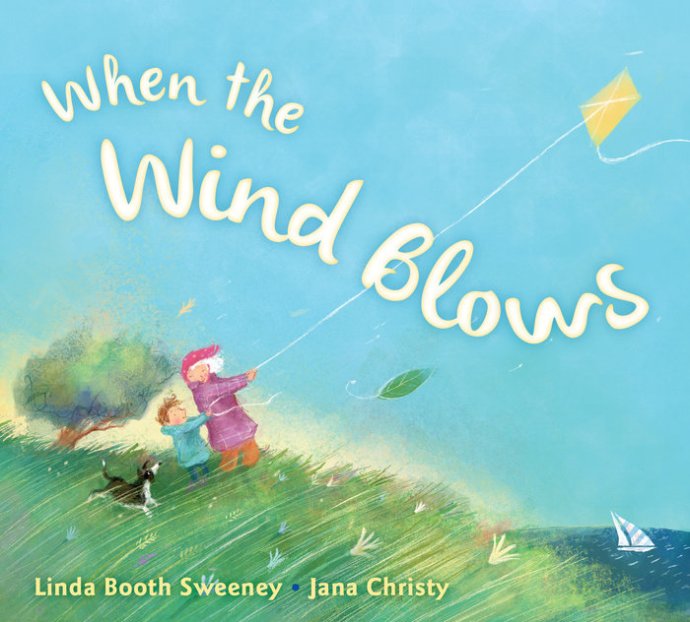
A little boy peeks out of his rattling window as the wind sends chimes ringing and doors creeaaaking. Jumbled into their jackets the boy’s mom, baby sister, and grandmother go out to enjoy the day. They fly a kite while nearby bells clang and walkers stroll hand in hand. In the sweeping wind “Trees dance. / Spiders curl. / Mice shiver. / Leaves swirl.”
celebrate-picture-books-picture-book-review-when-the-wind-blows-chase

Image copyright Jana Christy, text copyright Linda Booth Sweeney. Courtesy of G. P. Putnam Sons

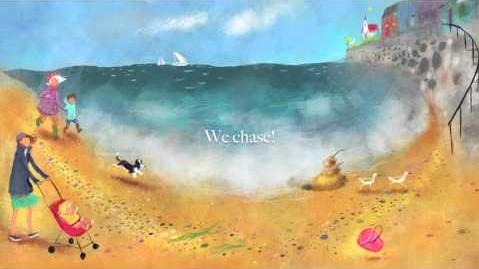
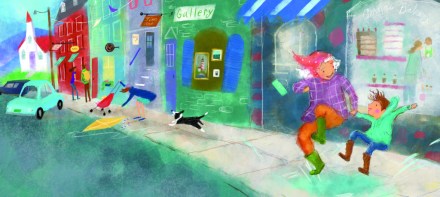
When the wind snatches the kite, the boy and his grandma chase after it amid clouds racing across the sky and seeds scattering to and fro. Running after the kite through waving beach grass, the family sees “Sails puff. / Boats wobble. / Gulls float. / buoys bobble.” Their pursuit takes them into town where they track down their kite lying on a sidewalk. When the wind blows on these narrow seaside village lanes, “Signs shake. / Lights jiggle. / Puddles splosh. / We giggle.”

With the kite safely in hand the foursome ventures to the park for some rolling, swaying, whirling play. But the day is graying—“Skies darken. / Thunder BOOMS. / Rain falls. / We zoom!” Back at home all is cozy as the family dries off and the little boy takes a bath. Tucked into bed the little boy and his mom cuddle while their pets curl up on the blankets. As they sleep, “Skies clear. / Stars gleam. / Earth sleeps. / We dream.”
celebrate-picture-books-picture-book-review-when-the-wind-blows-city

Image copyright Jana Christy, courtesy of G. P. Putnam Sons

Linda Booth Sweeney’s charming tale of a day spent in the midst of a windy day perfectly captures the sights and sounds of such a gusty natural event. Sweeney’s eye for detail and talent for evocative verbs elevate the two-word lines in these short verses, letting readers fully experience the effects of a wild squall. Kids will appreciate the original imagery and love repeating the lyrical lines.

The blustery wind is evident in Jana Christy’s vibrant pastel illustrations, where clouds swirl in scribbles, flowers bow, and buffeted grasses protect small creatures. Everywhere, the wind flutters head scarves and clothing, bends signs, and tears hats and kites from unsuspecting hands. As rain approaches Christy’s skies acquire a gray, gauzy texture, and when the family again reaches home, the colors turn warm and bright, as comforting as a cup of tea or hot chocolate. Readers will be rewarded for lingering over the beautiful pages by seeing details and people carried over from page to page, uniting the story.

Ages 3 – 6

G. P. Putnam’s Sons, Penguin Group, 2015 | ISBN 978-0399160158

Meet Linda Booth Sweeney and find fun activities to extend the fun of When the Wind Blows on her Children’s Books website. You can find detailed information as well as videos, podcasts, and activities about her Systems work on lindaboothsweeney.net.

Learn more about Jana Christy and view galleries of her children’s books and illustration and sculpture work on her website.

Watch this windblown book trailer by animator Xin Xin and Linda Booth Sweeney.

National Weatherperson’s Day Activity
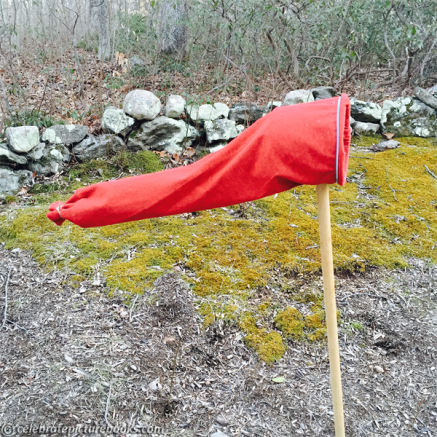
CPB - Windsock

Catch the Wind! Windsock Craft


You can feel the wind in your hair and see it blowing through the trees, but can you actually catch it? You can with this easy-to-make windsock!

Supplies

  • 1 large yogurt container (32 oz) or 1-pound deli salad container
  • 1 long-sleeve T-shirt
  • Strong glue
  • Dowel, 5/8 diameter x 48-inches long or longer
  • String
  • Rubber band
  • sewing seam ripper or cuticle scissors
  • X-acto knife
  • Scissors

Directions

  1. Remove the sleeve from a long-sleeve t-shirt with the seam ripper or cuticle scissors
  2. Cut the shoulder off the sleeve by cutting straight across from the underarm seam
  3. Cut 2 inches from the bottom of the yogurt container OR cut the bottom out of the deli container with the x-acto knife or scissors
  4. With the x-acto knife or scissors, make a hole a little smaller than the diameter of the dowel about 1 inch from the rim of the container
  5. Slide the container into the large opening of the sleeve
  6. Fold about a ¾ -inch edge over the rim of the container and attach all along the rim with strong glue
  7. Put the rubber band around the outside edge of the opening
  8. Tie the bottom of the sleeve’s cuff together with the string
  9. To attach the dowel: Option 1: leaving the t-shirt in place, push the dowel and material through the hole in the container. The t-shirt material will hold the dowel in place (I used this option).  Option 2: cut a small hole in the t-shirt at the location of the hole in the container. Push the dowel through this hole and the hole in the container. Secure with strong glue
  10. Stick your windsock in the ground in an open area where it can catch the wind. As the wind changes direction, you can turn your windsock so the opening faces the wind.

Picture Book Review

January 30 – Chinese New Year

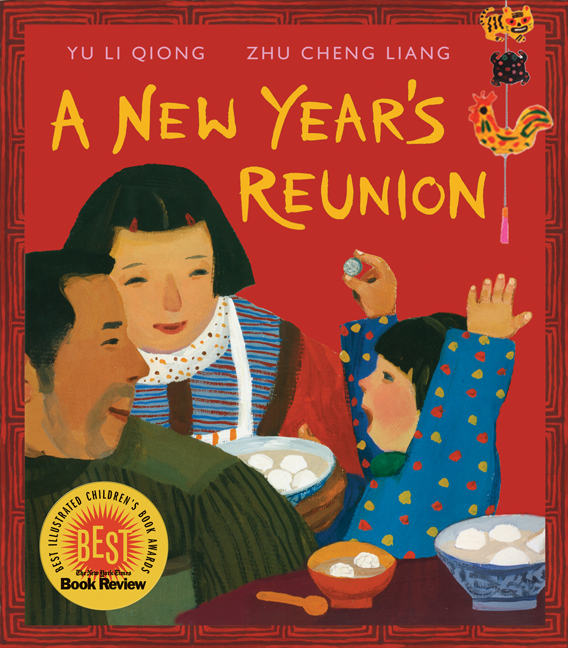
celebrate-picture-books-picture-book-review-a-new-year's-reunion-cover

About the Holiday

Chinese New Year celebrations began on the eve of January 28, ushering in the Year of the Rooster. Also known as the Spring Festival, the New Year is a time for festivities including lion and dragon dances, fireworks, visiting friends and relatives, family meals, and special decorations.The New Year is the busiest travel season of the year as family members return home to spend the holiday with loved ones. The Chinese New Year celebrations  end on the 15th day of the new year with the Lantern Festival.  People born in the Year of the Rooster are said to be honest, energetic, intelligent, flexible, and confident.

A New Year’s Reunion

Written by Yu Li-Qiong | Illustrated by Zhu Cheng-Liang


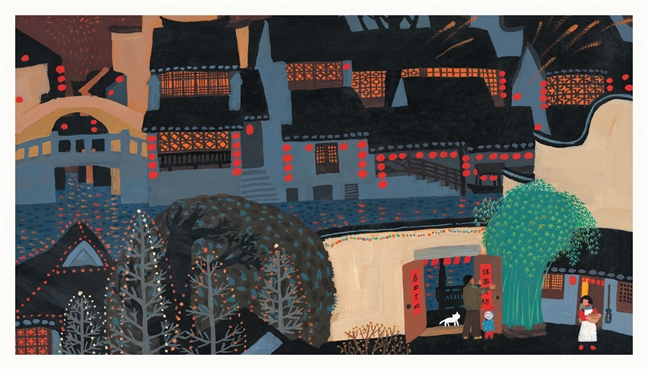
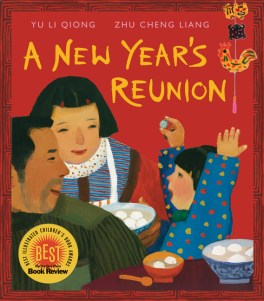
Maomao’s papa works far away as a house builder and can only return home once a year—during Chinese New Year. Today, Maomao and her mother wake up early and get ready because “Papa is coming home.” When Papa arrives, Maomao peers at her father from a distance. He seems unfamiliar, and when he picks her up in his arms she calls for her mama in alarm. But Papa has come with gifts—a hat for Maomao and a coat for Mama.

celebrate-picture-books-picture-book-review-a-new-year's-reunion-papa-decorating-house

Image copyright Yu Li-Qiong, 2011, courtesy of Candlewick Press

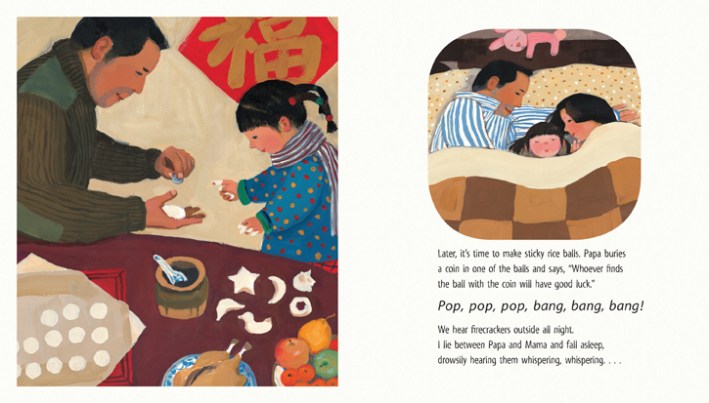
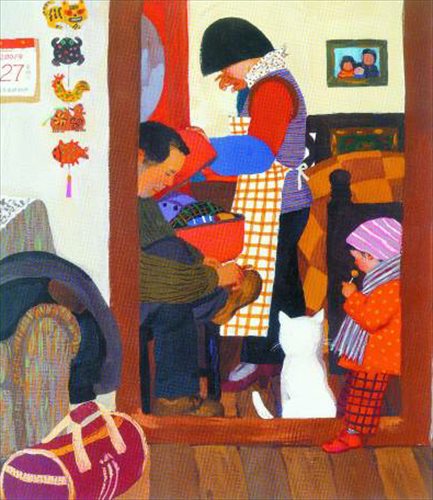
After catching up and eating lunch, Papa takes Maomao with him to the barber shop, where he gets a haircut and a shave. As Maomao watches, the Papa in the mirror is getting more like Papa the way he used to be.” Back home, Papa helps the family decorate their house and later they make sticky rice balls for the next day. “Papa buries a coin in one of the balls and says, ‘Whoever finds the ball with the coin will have good luck.’” As she falls asleep to the whispers of her parents, Maomao hears firecrackers snapping in the night air.

celebrate-picture-books-picture-book-review-a-new-year's-reunion-making-sticky-rice-balls

Image copyright Yu Li-Qiong, 2011, text copyright Zhu Cheng-Liang, 2013. Courtesy of Candlewick Press.

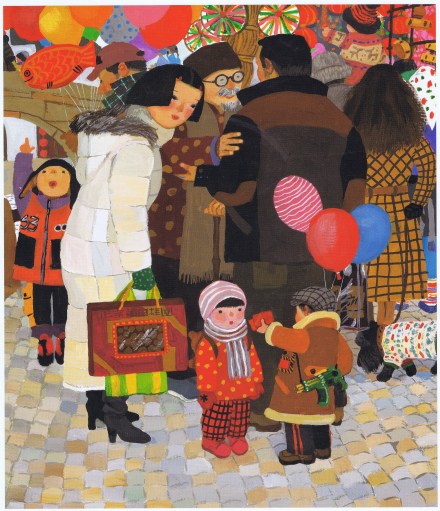
In the morning while eating the sticky rice balls, Maomao bites down on something hard. “‘The fortune coin! It’s the fortune coin!’” she exclaims. Her papa tells her to put it in her pocket so that the good luck will not escape. She places it in her coat pocket and then they all join the crowd in the square going on holiday visits. On the way she meets her friend Dachun, who shows her the red envelope he has gotten. Maomao proudly shows Dachun her lucky coin.

On the second day of New Year’s while Papa is doing chores around the house, he takes his little daughter to the roof. From here she can see Dachun’s house and hear the dragon dance over on Main Street. Maomao stands on tiptoe as tall as she can, but she can’t see the parade. Papa swings her onto his shoulders. “‘Now can you see it?’ he asks. ‘Yes, I can. They’re coming!’” she answers with excitement.

celebrate-picture-books-picture-book-review-a-new-year's-reunion-visiting-in-square

Image copyright Yu Li-Qiong, 2011, courtesy of Candlewick Press

The third day of New Year’s brings snow, and Maomao, Dachun, and the other neighborhood children build a tall snowman and have a snowball fight in the courtyard. When Maomao comes in at the end of the day, she reaches into her coat pocket, but her fortune coin is gone! She runs outside, but the courtyard is covered in snow, and she can’t find it anywhere. Papa tries to give her another coin, but it isn’t the same.

Later, feeling miserable, Maomao climbs into bed and takes off her jacket. Suddenly, she hears a clink as something falls to the floor. “‘It’s the coin! My fortune coin!’” she cries. ‘‘Papa come quick—come and see! I haven’t lost the fortune coin. It’s been with me all the time.’” Maomao falls asleep happy. The next morning, she wakes to see Mama packing Papa’s things. Soon, he will return to work. He crouches down and with a promise to bring Maomao a doll hugs her tight. But Maomao shakes her head. “‘I want to give you something…,’” she says. She puts the coin in Papa’s hand and tells him, “‘Here, take this. Next time you’re back, we can bury it in the sticky rice ball again!’” Papa is silent and gives Maomao another hug before they say goodbye for another year.

celebrate-picture-books-picture-book-review-a-new-year's-reunion-papa-packing

Image copyright Yu Li-Qiong, 2011, courtesy of Candlewick Press

Yu Li-Qiong’s touching story of a little girl’s reunion with the father she rarely sees is a heartfelt reminder that love continues over miles and days or months. Just as the fortune coin was with Maomao all the time, Maomao’s papa is always in her heart and she in his. Little ones, especially, will be captivated by the day-to-day activities of Maomao’s New Year festivities and appreciate the importance of her coin. Li-Qiong’s sweet story, filled with homey details of child and parent interactions, resonates beyond the holiday theme of the story and is a beautiful book for the many children who have parents who travel frequently with their jobs.

The quiet grace and wonder of Zhu Cheng-Liang’s gouache illustrations perfectly convey the loving relationship between father and daughter and the excitement of a family being together after a long absence. Although the Chinese New Year provides a frame for the story, Cheng-Liang’s paintings predominately focus on the day-to-day activities Maomao and her papa share—getting a haircut, fixing the house, cooking, meeting and playing with friends, and special hugs—emphasizing the universal scope of the story. The enchantment of the New Year’s festivities shines in a two-page spread where a fiery red-and-orange dragon puppet cavorts over the village bridge followed by a throng of people as others watch from homes and windows. Adorable Maomao may raise a lump in readers throats as she hugs her papa and gives him her treasured fortune coin.

A brief Author’s Note following the text pays tribute to the millions of migrant workers in China who often do not see their families except once each year.

A New Year’s Reunion would be a welcome book on any child’s bookshelf as a reminder that love overcomes any absence, long or short.

Ages 3 – 7

Candlewick Press, 2011 | ISBN 978-076366748

Chinese New Year Activity

celebrate-picture-books-picture-book-review-chinese-new-year-lantern-festival-coloring-page

Lantern Festival Coloring Page


Chinese New Year festivities end with a brilliant festival of lights. Enjoy this printable Lantern Festival Coloring Page to celebrate the Chinese New Year.

celebrate-picture-books-picture-book-review-a-new-year's-reunion-cover

You can find A New Year’s Reunion at these booksellers

Amazon | Barnes & Noble | Books-a-Million | IndieBound

Picture Book Review


January 27 – It’s Creativity Month

celebrate-picture-books-picture-book-review-stitchin'-and-pullin'-a-gee's-bend-quilt-cover

About the Holiday

January is a time for reflection and new beginnings. What better time to start thinking creatively and finding your inner artist, scientist, inventor, thinker? Go ahead and do the thing you’ve always wanted to do!

Stitchin’ and Pullin’: A Gee’s Bend Quilt

Written by Patricia C. McKissack | Illustrated by Cozbi A. Cabrera

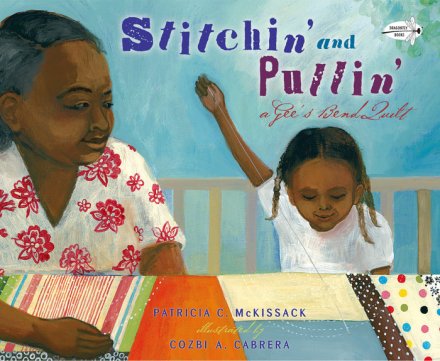
In this story told through poems, a little girl begins telling of her life, starting with a recitation on Gee’s Bend Women: “Gee’s Bend women are / Mothers and Grandmothers / Wives / Sisters and Daughters / Widows.” They are every kind of woman you know, doing every type of work and activity. “Gee’s Bend women are / Talented and Creative / Capable / Makers of artful quilts / Unmatched. / Gee’s Bend women are / Relatives / Neighbors / Friends— / Same as me.”

In Who Would Have Thought, the girl muses on how perceptions change. “For as long as anyone can remember,” she says, the women of Gee’s Bend, Alabama have created quilts that were slept under, sat on, and wrapped around the sick or cold. But now those same quilts are “…hanging on museum walls, / their makers famous….”

When she was just a tot “Baby Girl” reveals in Beneath the Quilting Frame, she played under the quilting frame, listening to her “mama, grandma, and great-gran / as they sewed, talked, sang, and laughed / above my tented playground.” She remembers the “steady fingers  /[that] pieced together colorful scraps of familiar cloth / into something / more lovely / than anything they had been before” as her mother sang her a lullaby.

celebrate-picture-books-picture-book-review-stitchin'-and-pullin'-a-gee's-bend-quilt-puzzling-the-pieces

Image copyright Cozbi A. Cabrera, courtesy of Random House Books for Young Readers

In Something Else, “Baby Girl” is growing too big to play beneath the frame. Her legs becoming longer and her mind full of “recipes for eleven kinds of jelly…how to get rid of mold…and the words to a hundred hymns and gospel songs” while she waits her turn at the frame. Finally, in Where to Start? her time comes. The girl asks her mama how to begin and she answers, “‘Look for the heart. / When you find the heart, / your work will leap to life… / strong, beautiful, and… / independent.’”

In Remembering, the girl thinks about how her mama has told her that “cloth has a memory.” As she chooses the cloth that will become her quilt she sees the life and the history in each. 

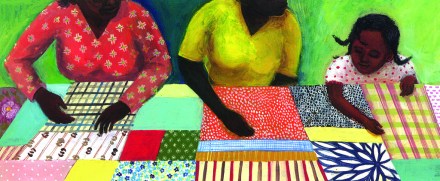
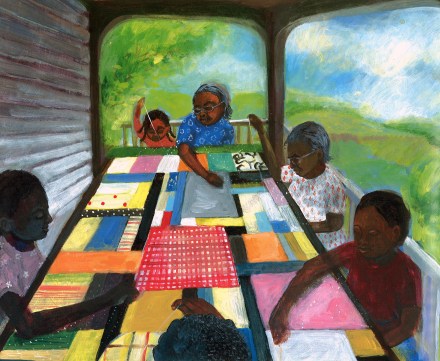
Nothing Wasted sees Grandma pulling apart a red-and-white gingham dress stitch by stitch to become a quilting square that the girl suddenly knows “will be the heart of my quilt.” In Puzzling the Pieces the girl and her grandma stand over the quilting frame fitting the squares together in the perfect way to tell the girl’s story. Her quilt comes together piece by piece to tell the history of Gee’s Bend in The River Island. The brown strips along three sides mirror the muddy waters surrounding her town. The fourth side is a green strip—“a symbol of the fields where my ancestors / worked cotton from can to can’t— / can see in the morning until / can’t see at night.” Lined up next to the green strip are six squares representing the small communities “where families with / the same name / are not kin by blood / but by plantation.”

Being Discovered is portrayed with “a large smoke-gray square”—the color of the Great Depression and the 15 minutes of fame Gee’s Bend garnered when discovered “by sociologists, historians, / educators, and journalists” who came and went, leaving Gee’s Bend “the way it had been / before being discovered.”

celebrate-picture-books-picture-book-review-stitchin'-and-pullin'-a-gee's-bend-quilt-understanding-comes-later

Image copyright Cozbi A. Cabrera, courtesy of Random House Books for Young Readers

In Colors, the girl’s grandma explains the meanings and feelings behind each colored cloth. “Blue cools. / Red is loud and hard to control, / like fire and a gossiping tongue.” Green, orange, yellow, white, pink, and all the others have their own personalities. “Grandma says, / ‘Colors show how you / feel deep down inside.’”

In Pinky, the harrowing facts of the march from Selma to Montgomery, Alabama frame the story of one marcher, Mr. Willie Quill who broke horses for the Alabama State Mounted Patrol and was saved from the Police attacks when one of the horses he’d trained knew his voice. In Dr. King Brings Hope, the little girl adds a “Patch of bright pink / to remember Pinky’s story. / Next to it I sew / a spotless white patch for the hope Dr. Martin Luther King / brought to the Bend” and goes on to tell how her grandma saw Dr. King at Pleasant Grove Baptist Church and what it meant to her.

By and By follows the girl as she adds “golden thank-yous, for James Reeb,” a “bright blue piece of velvet for Viola Liuzzo,” and a “big plaid people circle of white, black, brown, yellow, and red for Reverend Dr. King, all “killed for believing in justice.”

In the 1960s, The Sewing Bee tells, Gee’s Bend quilters were once again discovered. There were buyers for the handmade quilts, but stipulations. The girl asks her grandma if she was part of the Bee, to which she replies, “‘Yes, / more money. Less freedom. I chose to stay free.’”

At last all of the patches are laid out and the time comes to stitch the girl’s quilt. Five women stand at the frame “all stitchin’ and pullin.’” They work “in a slow and steady rhythm” relaxing and enjoying being together until the quilt is finished. In Finished, the last stitch is sewn, and the thread bitten and knotted. The girl has hundreds of ideas for future quilts. “Quilts that are about me, / the place where I live, / and the people / who have been here for generations.”

Further poems unite the history of “Baby Girl,” her family, and neighbors, and an Author’s Note about quilting and the women of Gee’s Bend follow the text.

Patricia McKessack’s free verse poems capture the close relationships and camaraderie of the generations of women who join around the quilting frame to share and pass down their art and their heart. McKessack’s conversational verses, on page after page like the patches of a quilt, reveal the complexity of this handmade art form in the way intimate talks between friends unveil a life. Readers learn not only about the little girl and her own thoughts, but the history and influence of her immediate family, world events, inspirational figures, and deeply held beliefs that make her who she is and ties her to the other Gee’s Bend women.

Cozbi A. Cabrera’s stunning acrylic paintings take readers inside the heart of the Gee’s Bend women, depicting the girl’s home, the table-sized quilting frame where the women collectively work, the plantations, the protests, and the changes that came but did not unravel the convictions, values, and love of the little girl’s family. Readers can almost hear the talking and singing of the Gee’s Bend women as they stitch their quilts, and the comforting, embracing environment is evident on every page. Cabrera’s portraits of the little girl, her mama, and her grandma are particularly moving. For What Changed, Cabrera depicts a yellow school bus appearing on the dirt road from the right hand corner of the page. In the side mirror a dot of a house comes into view, reminding readers that no matter how far these women are from home, Gee’s Bend is always with them.

Children—and adults—will find Stitchin’ and Pullin’: A Gee’s Bend Quilt inspirational and uplifting. This volume of poetry can be read at one sitting and delved into again and again, making it a wonderful choice for home libraries and a must for school, public, and other libraries.

Ages 5 – 12

Dragonfly Books, Random House, 2016 (paperback edition) | ISBN 978-0399549502

View a gallery  of fashion designs, dolls, and other handmade art work by Cozbi A. Cabrera on her website!

Creativity Month Activity

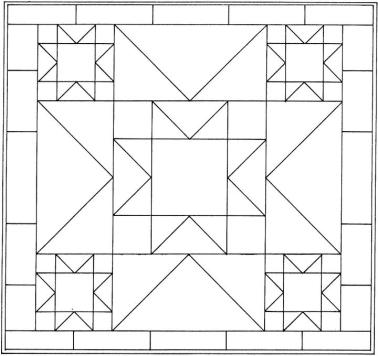
celebrate-picture-books-picture-book-review-stars-quilt-coloring-page

Design a Quilt Coloring Pages

Quilts are so much more than pieces of material sewn together—they’re life stories! Here are two quilt coloring pages for you to design and color. What does each piece mean to you? As you color each section, write a sentence about an event or thought that is important to you.

Quilt Template 1 | Quilt Template 2

Picture Book Review
January 26 – Walk Your Pet Month

celebrate-picture-books-picture-book-review-excellent-ed

About the Holiday

January has been designated as Walk Your Pet Month to remind pet owners of the importance of regular exercise for their pooches – or other animals who may enjoy a stroll. Keeping pets fit is one way to make sure they stay healthy and live a long and happy life!

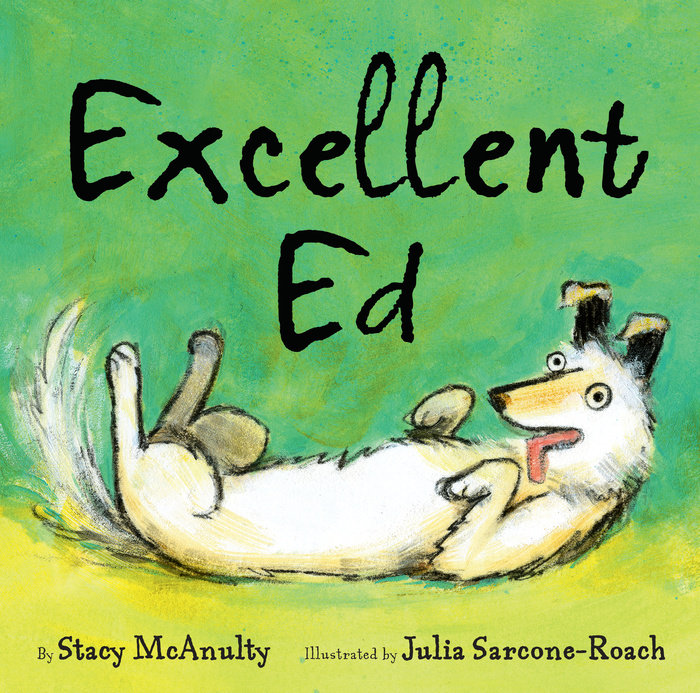
Excellent Ed

Written by Stacy McAnulty | Illustrated by Julia Sarcone-Roach


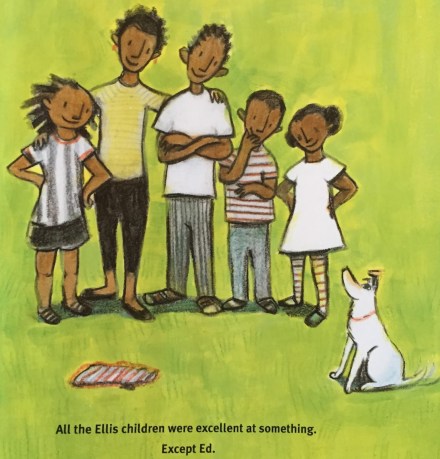
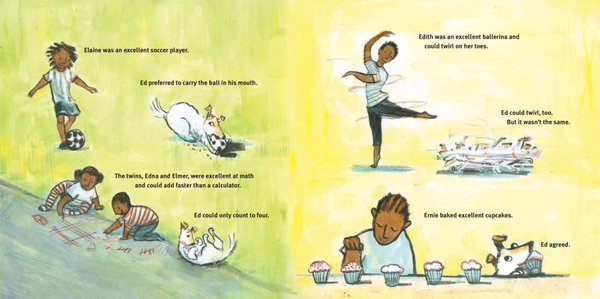
Ed, the Ellis family’s dog, is feeling a little left out. All five of the children are excellent at something, but not Ed. All the Ellis kids can eat at the table, ride in the car, sit on the couch, and use the indoor bathroom, but not Ed. Each kid has his or her own talent—playing soccer, calculating math, dancing, and baking cupcakes—and while Ed can carry a ball in his mouth, count to 4, spin after his tail, and eat cupcakes, it’s just not the same.

One day Ed wonders—if he was excellent at something, could he have the same perks as the kids? He considers his talents and comes up with what he thinks is a good one. He knows he’s great at breaking stuff! Surely this will earn him a place at the dinner table. But even before he gets going, Elaine runs in with the news that she’s broken the record for most soccer goals in a season. Ed sadly realizes that Elaine is better at breaking stuff than he is.

celebrate-picture-books-picture-book-review-excellent-ed-ellis-family

Image copyright Stacy McAnulty, text copyright Julia Sarcone-Roach. Courtesy of Alfred Knopf Books for Young Readers

Again Ed thinks. Suddenly it dawns on him that he’s excellent at losing things—he even lost himself last week! This kind of ability was surely worth a ride in the van. But just as he’s about to jump in, the twins both shout, “I’ve lost a tooth!” Foiled in this attempt, Ed goes back to the drawing board. Hmmm…it was just there, at the tip of his brain…oh, yeah! Ed is fantastic at forgetting stuff! After proving to Dad that he doesn’t remember eating just a minute ago, he’s ready to take his place on the couch. But Ed is thwarted again by Edith, who is thrilled to tell her family that she forgot to be nervous during an audition and is now the lead ballerina.

celebrate-picture-books-picture-book-review-excellent-ed-counting

Image copyright Stacy McAnulty, text copyright Julia Sarcone-Roach. Courtesy of Alfred Knopf Books for Young Readers

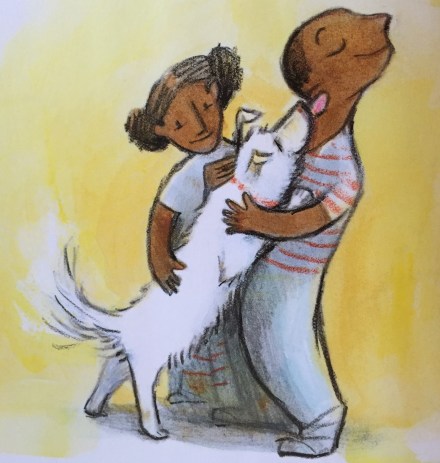
Ed whimpers. Is there nothing he’s most excellent at? Maybe he doesn’t even belong in the Ellis family. Just then Ernie drops his sandwich and Ed gobbles it up, leaving no crumbs on the floor. “‘Wow, Ed! You are excellent at cleaning the floor,’” Earnie says. When Emily and Elmer come home, Ed runs to meet them and covers them in kisses. “‘Ed! You’re excellent at welcoming us home,’” the twins exclaim. Later, with the couch stuffed with Ellises, Ed lays across Edith’s and Elaine’s feet. “‘Ed is excellent at warming feet,’” Elaine and Edith agree.

Ed wags his tail—he is an excellent floor cleaner, welcomer, and feet warmer! Now he knows why he doesn’t sit at the table, stays home instead of riding in the van, and doesn’t join the family on the couch. He realizes that he is an important part of the Ellis family, and that he’s always loved and appreciated. Now, if only he could figure out that indoor bathroom thing….

celebrate-picture-books-picture-book-review-excellent-ed-hugs-and-kisses

Image copyright Stacy McAnulty, courtesy of Alfred Knopf Books for Young Readers

There comes a time in everyone’s life when they doubt their place in the world. Stacy McAnulty explores that feeling through Ed, who worries, works the problem, and discovers that he is without a doubt excellent just the way he is. Giving the Ellis kids a variety of ages and talents makes this a great universal book for readers. McAnulty’s twist which turns “negative” gifts for breaking, losing, and forgetting things into triumphs for the Ellis kids is ingenious, adding humor, depth, and “ah-ha! moments” to the story. The mystery of Ed’s abilities is well-kept until the end, and the solution comes as a happy surprise.

Readers will wish they were part of the Ellis family, with their exuberant smiles, supportive cheers, snuggly, crowded couch, and, of course, adorable Ed. Julia Sarcone-Roach’s vivid illustrations are infectious as Ed perks up his ears, rolls his eyes skyward and with tongue out thinks about his situation. Scenes of his shenanigans will elicit giggles, and Ed’s sweet looks and wagging tale will win readers’ hearts.

Pet owners and animal lovers will want to bring Excellent Ed into their families. A wonderful book for story times or those times when you need a little encouragement, Excellent Ed is inspirational for all kids! 

Ages 4 – 8

Alfred A. Knopf Books for Young Readers, 2016 | ISBN 978-0553510232

Discover more about Stacy McAnulty and her picture books, chapter books, and novels on her website!

View a gallery of picture books, illustration, sketches, and film by Julia Sarcone-Roach on her website!

Walk Your Pet Month Activity

celebrate-picture-books-picture-book-review-dog-maze

A-maze-ing Pets Maze


When dogs are out for a walk, they love to take circuitous routes as they pick up scents that are too enticing not to follow! Can you find your way through this printable A-maze-ing Pets Maze? Here’s the Solution!

Picture Book Review
January 13 – It’s National Soup Month

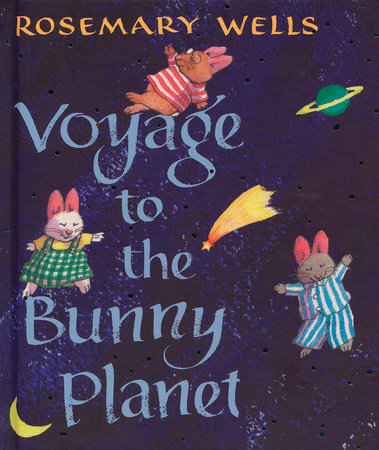
celebrate-picture-books-picture-book-review-voyage-to-the-bunny-planet-cover

About the Holiday

Winter weather is made for soup…or…is soup made for winter weather? Either way, soup offers the warm, comforting, stick-to-your ribs meal that just seems so right as the temperatures dip. Today, grab a can or cook up a batch of your favorite soup and add a hearty loaf of sourdough or artisanal bread and have a feast!

celebrate-picture-books-picture-book-review-first-tomato-cover

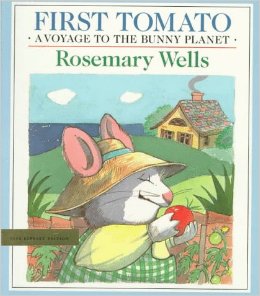
First Tomato: A Voyage to the Bunny Planet

By Rosemary Wells


The day is new—only 7:00 a.m. —and already Claire is having a tough time.  At breakfast she “ate only three spoons of cornflakes” before the bowl was knocked to the floor. While walking to school, Claire’s feet were soaked by snow, and “by eleven in the morning, math had been going on for two hours.” The cafeteria was serving baloney sandwiches—blecchh!—and at recess “Claire was the only girl not able to do a cartwheel.” At the end of school, all Claire wanted to do was go home, but she was left waiting…and waiting…and waiting at the bus stop.

celebrate-picture-books-picture-book-review-voyage-to-the-bunny-planet-tomato-soup-baloney-sandwich

Image copyright Rosemary Wells, courtesy rosemarywells.com

After all the slights and disappointments, “Claire needs a visit to the Bunny Planet.” She closes her eyes and floats away…. “Far beyond the moon and stars, / Twenty light-years south of Mars, / Spins the gentle Bunny Planet / And the Bunny Queen is Janet.”

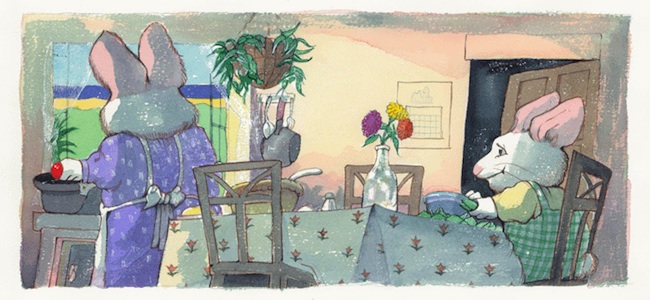
Janet ushers Claire into “the day that should have been.” Wafting on the warm winds Claire hears her mother’s voice: “pick me some runner beans and sugar snap peas. / Find a ripe tomato and bring it to me, please.” So early in the season, Claire finds only one red, ripe tomato on the vine. It “smells of rain and steamy earth and hot June sun” that tempts her to taste it, but she puts in her basket and gives it to her mother.

celebrate-picture-books-picture-book-review-voyage-to-the-bunny-planet-tomato-soup-baloney-shelling-peas

Image copyright Rosemary Wells, courtesy rosemarywells.com

As her mother cooks, Claire sits at the cozy kitchen table shelling the peas. Soon, Claire’s mother brings her a steamy bowl of soup, and as they gaze at each other in understanding, Clair hears her “mother calling when the summer winds blow, / ‘I’ve made you First Tomato soup because I love you so.’”

Finally the bus arrives to take Claire home. During the ride she spies the Bunny Planet “near the evening star” and realizes that it was there all the time.

Today I chose a favorite book from when my own kids were little. One of three Voyage to the Bunny Planet books, Rosemary Wells’ First Tomato never failed to bring a little lump to my throat as I read it to my son and daughter (and even reading it again for this review, I felt the same catch in my heart).

In the difficulties that Claire suffers during the school day, kids will recognize the predicaments they also experience, and as Claire visits the Bunny Planet they’ll understand that solace is always close by. Claire’s sweet face and vintage dress as well as the lush details of the settings make each square illustration a masterpiece of expression and emotion. Wells’ beautiful turns of phrase and lyrical lines soothe the disquiet of real life with the balm of a parent’s or caregiver’s love, making First Tomato a wonderful book to share again and again.

All three Voyage to the Bunny Planet books—including The Island Light and Moss Pillows, two more enchanting and touching quiet-time reads—are available in a single-volume gift edition.

Ages 3 – 7

Viking Books for Young Readers, 2008 | ISBN 978-0670011032

To discover more about Rosemary Wells and her books, plus videos, games, coloring pages, information for parents and educators, and more, visit her website!

National Soup Month Activity

celebrate-picture-books-picture-book-review-souper-maze

Souper Maze!


You can’t eat soup without a spoon! Can you help the spoon get through the maze to the bowl in this printable Souper Maze? Here’s the Solution!

Picture Book Review

January 6 – Cuddle Up Day

celebrate-picture-books-picture-book-review-you-belong-to-me-cover

About the Holiday

As the cooler days of December turn into the colder days of January, Cuddle Up Day reminds us that snuggling up with someone you love warms us and warms our hearts. Children especially love the comfort and security that close hugs bring. Today, get your comfy clothes on, pour a mug of hot chocolate or tea, and cuddle up together with a good book!

You Belong to Me

By Mamoru Suzuki


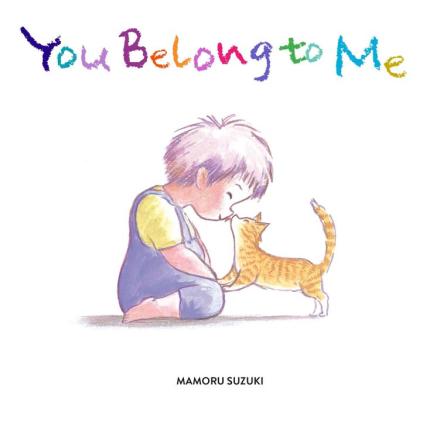
The emotions of parents and other caregivers of children escape from the heart on the very first page of this gentle, spoken lullaby: “I love you so much.” On the second page, listeners discover why: “You are my favorite person in the whole world.” As the pages flow, the reader continues to reassure the child of the constancy of their love. Devotion is shown when the adult spends time with their child, watches out for them, and takes them to activities, play dates, and even, perhaps on flights of fancy.

celebrate-picture-books-picture-book-review-you-belong-to-me-I-love-you-so-much

Image and text copyright Mamoru Suzuki, courtesy of Museyon Press

Through the words on the pages, the reader encourages the child to “come to me whenever you are lonely” or “whenever you can’t sleep” and promises that “I’ll hug you when you are sad.” Comfort comes in many forms—from drying tears to stroking hair—and from the many people who love the child.

celebrate-picture-books-picture-book-review-you-belong-to-me-where-you-want-to-go

celebrate-picture-books-picture-book-review-you-belong-to-me-I-love-you-so-much

In fact, all of the people in the child’s life agree that “we all love you” and that they will be there “whenever,” “wherever,” and “however” the child needs them. But the deepest love of all is found in the heart of the reader who confirms “I love you most of all, because…you belong to me.”

celebrate-picture-books-picture-book-review-you-belong-to-me-we-love-you

celebrate-picture-books-picture-book-review-you-belong-to-me-I-love-you-so-much

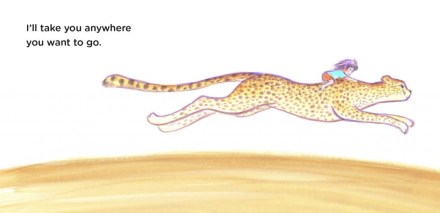
Mamoru Suzuki’s sweet hug of a book gives parents and caregivers the tender words that overflow in their hearts coupled with endearing illustrations of various animals nuzzling, snuggling, protecting, and comforting a small child. The mellow colors and chiffon texture of the images are at once soothing and stirring, wonderfully mirroring the mixture of emotions that make love for a child so profound.

You Belong to Me is a cuddle to keep on your child’s bookshelf for those times when you want to tell them how much you love them.

Ages birth – 5

Museyon, 2016 | ISBN 978-1940842127

Cuddle Up Day Activity

celebrate-picture-books-picture-book-review-snuggle-buddy-craft

Snuggle Buddy Craft


It’s easy to make your own snuggle buddy with a few pieces of fleece, some fiber fill, and a needle and thread or fabric glue. The great thing about creating your own friend is you can personalize your pal anyway you want!

Supplies

  • 1 8-inch by 11-inch piece of fleece in the color or your choice for the body (or scraps if you have some from an earlier project). A larger piece of fleece can be used to make a larger buddy
  • 1 5-inch by 8-inch piece of fleece in the color or your choice for the hair (or scraps if you have some from an earlier project)
  • 1 small piece of fleece or other material for a pocket, clothes, or blanket
  • Small scraps of fleece or other material for the face
  • Fiber Fill
  • Thread and sewing needle OR fabric glue
  • Scissors

Directions

To Make the Body

  1. Fold the large piece of fleece in half lengthwise and sew along the open side and along the bottom. Alternatively, if using a larger size piece of fleece, fold upward and sew or glue the two sides closed.
  2. Turn the form inside out

To Make the Hair

  1. Cut a piece of fleece as wide as your buddy and about 7 – 8 inches long
  2. Fold the fleece lengthwise
  3. Insert both ends of the fleece into the opening at the top of the body
  4. Sew or glue the opening shut, securing the hair
  5. Cut strips about ¼-inch wide from the top of the hair to close to where the hair is sown into the body

To Make a Pocket or Clothes

  1. Cut a piece of fleece in the shape of a pocket, shirt, pants, diaper, or blanket
  2. Sew or glue the pocket or clothes to the buddy

To Make the Face

  1. Cut eyes, a nose, and a mouth in whatever way you would like your buddy to look. (My buddy is sleeping.)
  2. Sew or glue the face to the buddy
  3. Snuggle up!

Picture Book Review
December 26 – Kwanzaa

celebrate-picture-books-picture-book-review-kevin's-kwanzaa-cover

About the Holiday

Today’s holiday is celebrating it’s 50th anniversary this year. Kwanzaa was established in 1966 by Dr. Maulana Karenga, professor and chairman of Black Studies at California State University, Long Beach as a way to unite African-Americans as a community. Derived from the Swahili phrase matunda ya kwanza, which translates as “first fruits,” Kwanzaa incorporates aspects of several African harvest celebrations. The seven-day holiday is observed from December 26 through January 1, and as the little boy in today’s book relates, offers excitement, togetherness, and meaningful reflection.

Kevin’s Kwanzaa

Written by Lisa Bullard | Illustrated by Constanza Basaluzzo


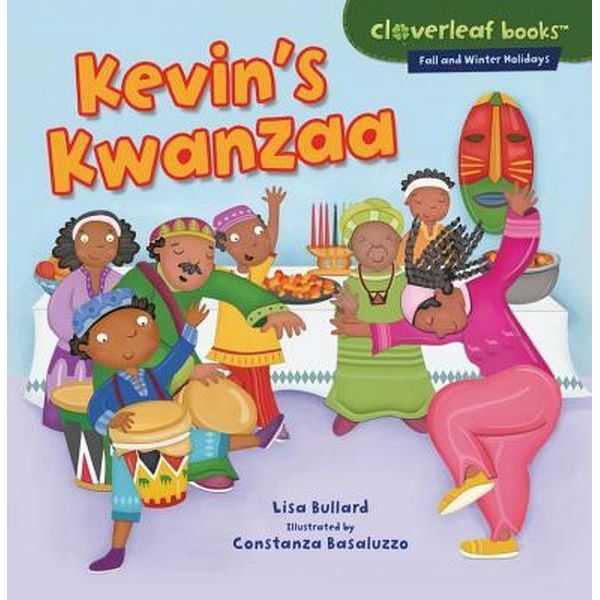
Surrounded by red, green, yellow, and black paper and his craft supplies, Kevin is excited to be making decorations for his family’s Kwanzaa celebration. “Mom says it celebrates our African American culture,” Kevin says. Together, Kevin and his mom set the table. First, his mom lays down a mat. Then Kevin adds the candleholder and the special Kwanzaa candles while his mom adds a bowl of fruit and vegetables. “There’s an ear of corn for each kid,” Kevin explains. “Next comes the unity cup. Didn’t I do a great job decorating it? We put out presents too! Now we’re ready for Kwanzaa,” he adds with pride.

On the first night of Kwanzaa, Kevin’s family gathers at the table as Kevin’s grandfather lights the first candle—the black candle in the center of the candleholder. Each night another candle will be lit. Kevin can’t wait for his turn on the last night. After the candle lighting, “Grandpa explains the Kwanzaa word for the first day. Every day has a special word in Swahili,” Kevin says. The first word is Umoja, which means unity, or “sticking together as a group.”

Grandpa explains that “sticking together is why Kwanzaa began.” The holiday was created by Dr. Maulana Karenga in 1966, who wanted African Americans to “feel proud of their shared African background.”  Each night another family member lights candles, so Kevin watches closely to be ready for his turn. On the third night, Kevin’s mom lights the candles, and the principle word is Ujima or “collective work and responsibility.” The family talks “about helping one another solve problems”—like Kevin’s “messy bedroom problem.” The fifth night belongs to Kevin’s brother, and the family discusses their goals to help the community. Kevin says that he has two goals: to become a teacher and to light the Kwanzaa candles.

The sixth night is Kevin’s favorite. His family attends a big party, and because the day’s word is Kuumba, which means “creativity,” there will be homemade decorations, presents, and drums. Kevin loves to “boom, boom with the drummers” and “stomp, stomp with the dancers” and “eat and eat!” At last, it is the seventh day of Kwanzaa! Kevin is excited to open his presents, but he says he “likes lighting the candles even more!” Grandpa tells Kevin his special word Imani means “faith,” and that he “should believe in our people every day.” Kevin agrees, thinking “that will be like living Kwanzaa all year long!”

Each two-page spread of Kevin’s Kwanzaa also presents facts about the holiday. Readers learn how the holiday began, where it is celebrated, and that it incorporates parts of African harvest festivals. They discover that the one black candle, three red candles, and three green candles are lit in a special order and learn the Nguzo Saba or “Seven Principles” of Kwanzaa. Shared activities, such as drinking from the unity cup, are also discussed.

Lisa Bullard’s story, told by a young boy proud to be celebrating Kwanzaa and lighting the candles for the first time, is an engaging introduction to the holiday. Through the narrator’s enthusiasm as he prepares for and takes part in the family celebrations, Bullard reveals the principles and traditions that make Kwanzaa so meaningful. Kids will also appreciate the sentiments expressed in the gentle bits of humor. Divided into short chapters, Kevin’s Kwanzaa allows young readers to feel more grown up—just as Kevin does as he joins the family in lighting the candles.

Through her vibrant illustrations, Constanza Basaluzzo brings the traditions and ceremonies of Kwanzaa to life for children. As the family gathers each night, the joy and pride they feel is clearly depicted. Images of the decorations, clothing, and homemade items as well as portrayals of the seven principles and the founding of Kwanzaa make the concepts easily understood.

Ages 4 – 7

Millbrook Press, Lerner Books, 2013 | ISBN 978-0761385882

Discover more about Lisa Bullard and her books as well as fun activities on her website!

Kwanzaa Activity

celebrate-picture-books-picture-book-review-kwanzaa-word-search

Kwanzaa Word Search


Kwanzaa is a holiday of fun as well as family and community togetherness. Discover 25 words related to the holiday in this Kwanzaa Word Search puzzle! Here’s the Solution!

Picture Book Review