August 21 – World Honey Bee Day

celebrate-picture-books-picture-book-review-h-is-for-honey-bee-cover

About the Holiday

In 2009 National Honey Bee Day was proclaimed by US Secretary of Agriculture Thomas J. Vilsek. The holiday quickly spread and is now celebrated worldwide. World Honey Bee Day began as National Honey Bee Day in 2009 with a proclamation issued by the Secretary of Agriculture, Thomas J. Vilsek. The day recognizes both the honey bee and the beekeepers who tend the hives and encourages people to learn about and create supportive environments in their own yards to promote healthy bee populations. Of course, it’s also a day to buy and enjoy locally grown honey. To celebrate this holiday, explore a variety of honey flavors, try a few new recipes that incorporate honey, and learn all the buzz about bees, honey, and beekeeping with today’s book!

I’d like to thank Sleeping Bear Press for sharing H is for Honey Bee: A Beekeeping Alphabet with me for review consideration. All opinions are my own.

H is for Honey Bee: A Beekeeping Alphabet

Written by Robbyn Smith van Frankenhuyzen | Illustrated by Eileen Ryan Ewen


If your garden or yard is anything like mine, the bees are humming around late-summer blooms and tracing their circuitous route to nearby or far-flung hives. The mystery and marvel of how honey bees convert powdery pollen into sweet honey never fails to awe and delight. In H is for Honey Bee, readers of all ages discover fascinating facts and stories about Bees from Apis mellifera (“Apis is the clue that we’re talking about a bee. / And mellifera means it’s all about honey”) to Z “for Zen and BUZZZZ.”

celebrate-picture-books-picture-book-review-h-is-for-honey-bee-A-and-B

Image copyright Eileen Ryan Ewen, 2020, text copyright Robbyn Smith van Frankenhuyzen, 2020. Courtesy of Sleeping Bear Press.

In between children learn all about a bee hive, its resident bees (from Drones to Guards to the Queen), how bees communicate, and at E how organized beekeeping dates back to 2400 BC and how important it was to Egyptian culture. “Found on hieroglyphs in the sun temple of Pharaoh Ne-user-re near Cairo, Egypt, an Egyptian peasant is depicted smoking stacked hives while other workers are storing and sealing honey in jars.”

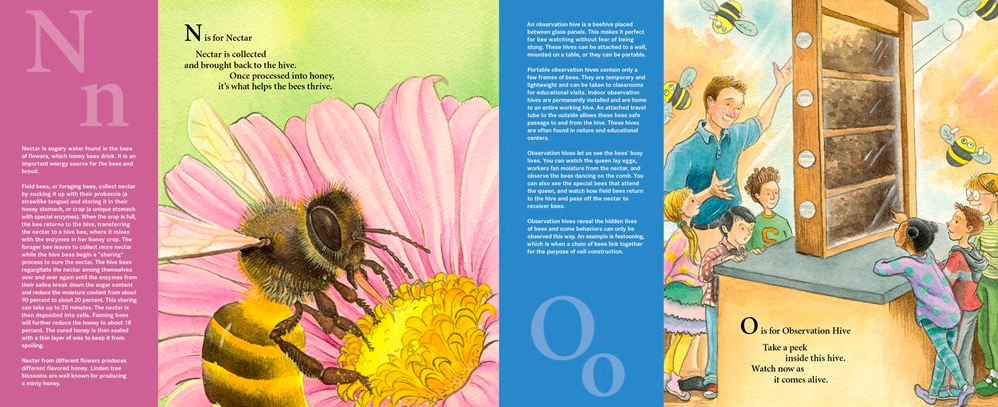
celebrate-picture-books-picture-book-review-h-is-for-honey-bee-N-and-O

Image copyright Eileen Ryan Ewen, 2020, text copyright Robbyn Smith van Frankenhuyzen, 2020. Courtesy of Sleeping Bear Press.

At L kids learn about Lorenzo Langstroth, “the father of humane, practical beekeeping.” After discovering that natural hives had small passages that allowed bees to move freely though them, he invented a hive with removable frames that didn’t upset the other bees or damage the combs. Langstroth’s hive paved the way for other innovations, such as the Observation Hive at O, that gives people a clear view of bees at work. “You can watch the queen lay eggs, workers fan moisture from the nectar, and observe the bees dancing on the comb” and other marvels of a bee’s day.

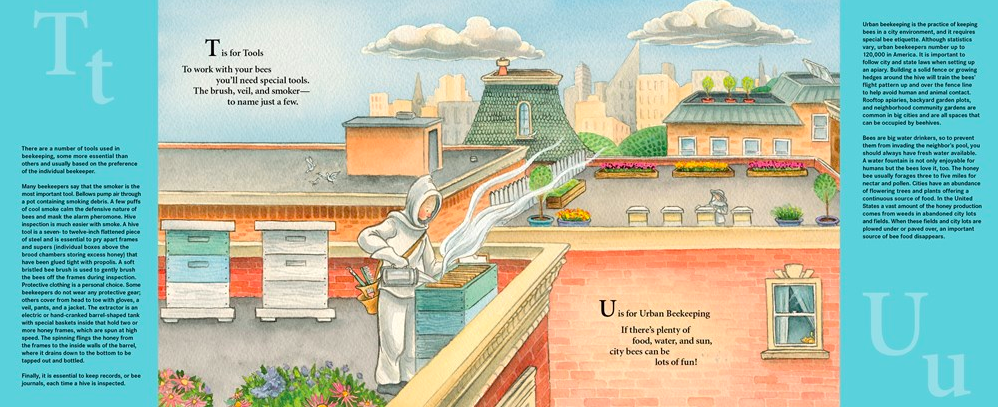
celebrate-picture-books-picture-book-review-h-is-for-honey-bee-T-and-U

Image copyright Eileen Ryan Ewen, 2020, text copyright Robbyn Smith van Frankenhuyzen, 2020. Courtesy of Sleeping Bear Press.

Humans aren’t the only innovative ones, and readers will be fascinated to learn about Propolis at P, which bees make from their own saliva and other natural ingredients to protect their hive. V is for Venom—the bee’s defense that is more fun to learn about than experience. If you’re interested in where Beeswax comes from, just flip to W, and if you want to know how to tell if a hive is happy, Z is where you’ll find it.

Back matter includes resources on how you can create a safe and productive atmosphere for bees in your own yard, tips for becoming a beekeeper, and fun facts about busy bees.

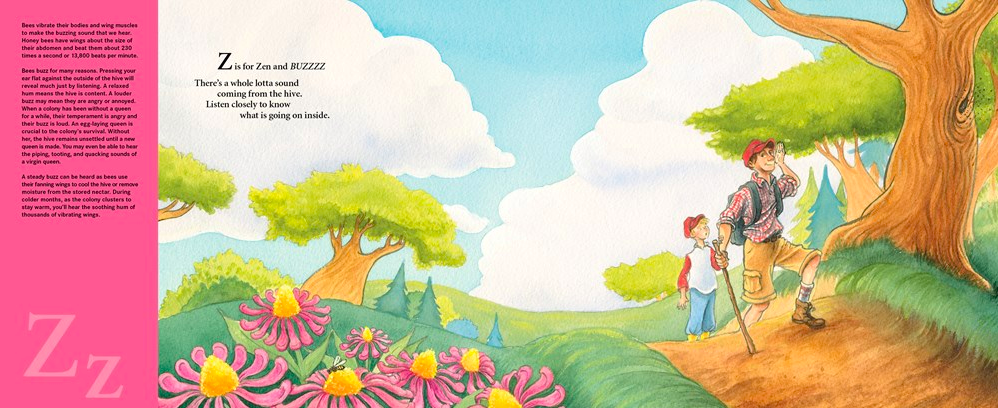
celebrate-picture-books-picture-book-review-h-is-for-honey-bee-Z

Image copyright Eileen Ryan Ewen, 2020, text copyright Robbyn Smith van Frankenhuyzen, 2020. Courtesy of Sleeping Bear Press.

Through charming and informative four-line rhymes and a column of detailed facts for each letter of the alphabet, Robbyn Smith van Frankenhuyzen presents a full and exhilarating look at bees, honey, and the job of beekeeping. She describes the behavior of bees—from how they communicate to how they survive winter temperatures to how the queen rules the hive and more—as well as the dangers bees face, from inside the hive and out, in vivid language that will captivate kids. Discussions on the healthy properties of honey as well as the joys of amateur beekeeping are here as well.

Accompanying the text are Eileen Ryan Ewen’s vibrant illustrations that give readers an up-close view of honey bees developing from egg to adult, gathering nectar, and working in their hive. Kids also meet Lorenzo Langstroth, see beekeepers working at their hives in yards and on rooftops, and travel down the Nile River with ancient beekeepers who moved their hives to continually provide them with the nectar and pollen they needed. Each page invites lingering to see and discuss all the details.

A well-rounded and comprehensive resource for those interested in bees and insects, gardeners of any age, and kids who love nature as well as for elementary and middle-grade science classes, H is for Honey Bee: A Beekeeping Alphabet is highly recommended for home, school, and public libraries.

Ages 7 – 10 and up

Sleeping Bear Press, 2020 | ISBN 978-1534110700

Discover more about Robbyn Smith van Frankenhuyzen and her books on her website.

To learn more about Eileen Ryan Ewen, her books, and her art, visit her website.

World Honey Bee Day Activity

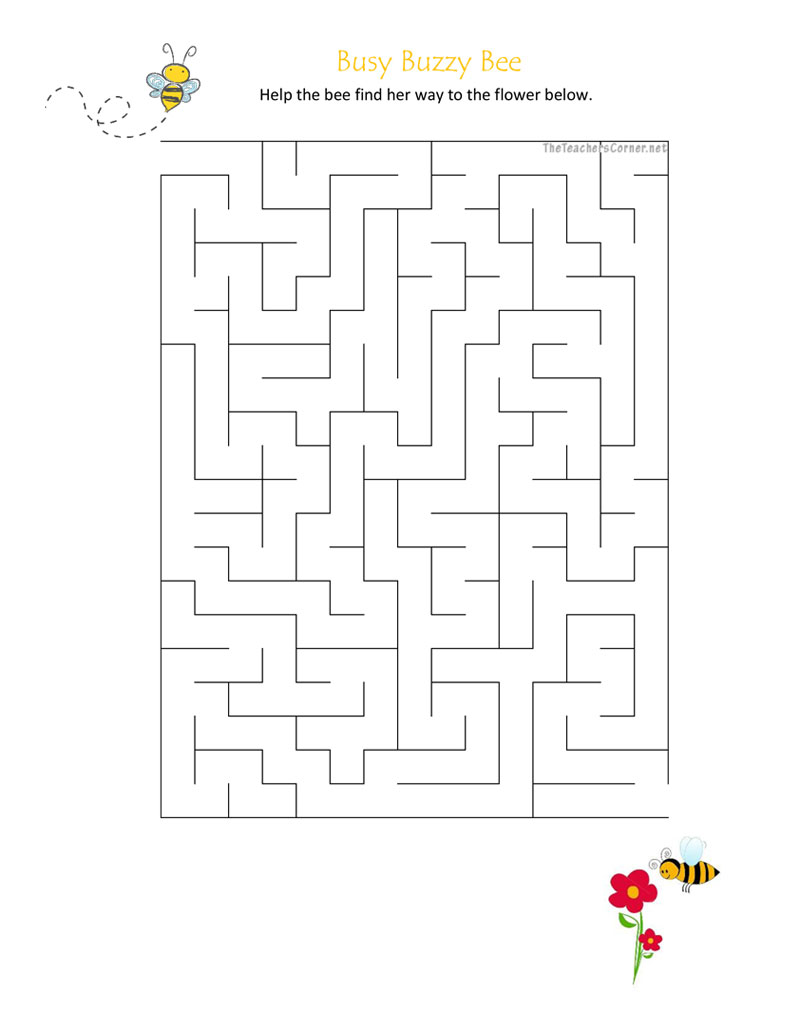
CPB---Busy-Buzzy-Bee-Maze

Busy Buzzy Bee Maze


Can you help the little bee find her way to the flower and her friend in this printable maze?

Busy Buzzy Bee Maze PuzzleBusy Buzzy Bee Maze Solution

celebrate-picture-books-picture-book-review-h-is-for-honey-bee-cover

You can find H is for Honey Bee: A Beekeeping Alphabet at these bookseller

Amazon | Barnes & Noble | Books-a-Million

To support your local independent bookstore, order from

Bookshop | IndieBound

Picture Book Review

August 12 – World Elephant Day

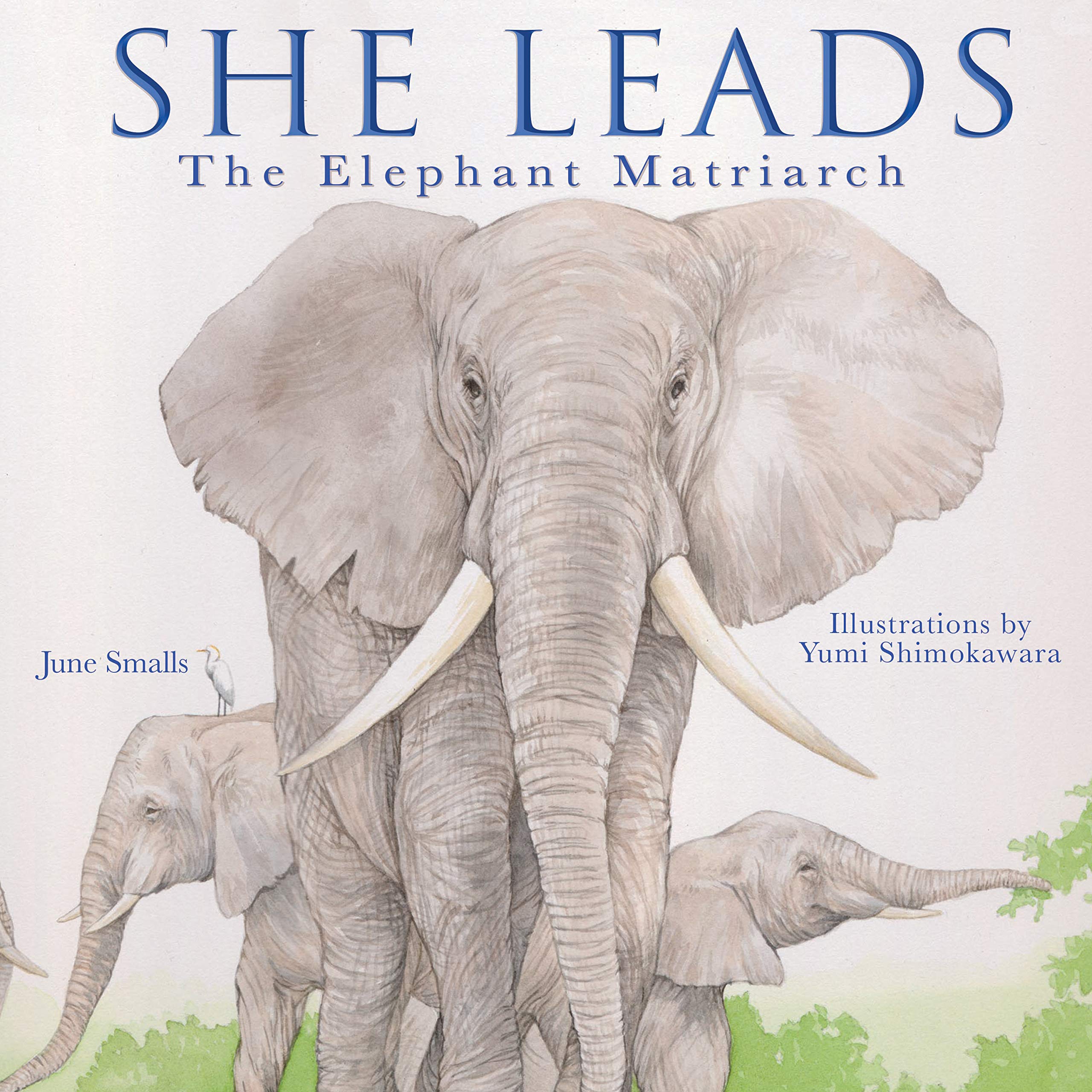
celebrate-picture-books-picture-book-review-she-leads-cover

About the Holiday

This year World Elephant Day celebrates its 10th anniversary. The holiday was launched to raise awareness of the dangers the Asian and African elephant populations face. Poaching, habitat destruction, human-elephant conflict, and mistreatment in captivity all threaten these gentle, intelligent creatures. World Elephant Day encourages people to enjoy seeing elephants in safe, non-exploitive environments and to get involved in their protection and survival. To learn more about elephants, discover how you can be elephant ethical, and commemorate today’s holiday with virtual events led by elephant specialists, artists, zoos, and other organizations, visit the World Elephant Day website.

Thanks to Familius for sending me a copy of She Leads: The Elephant Matriarch for review consideration. All opinions on the book are my own. 

She Leads: The Elephant Matriarch

Written by June Smalls | Illustrated by Yumi Shimokawara


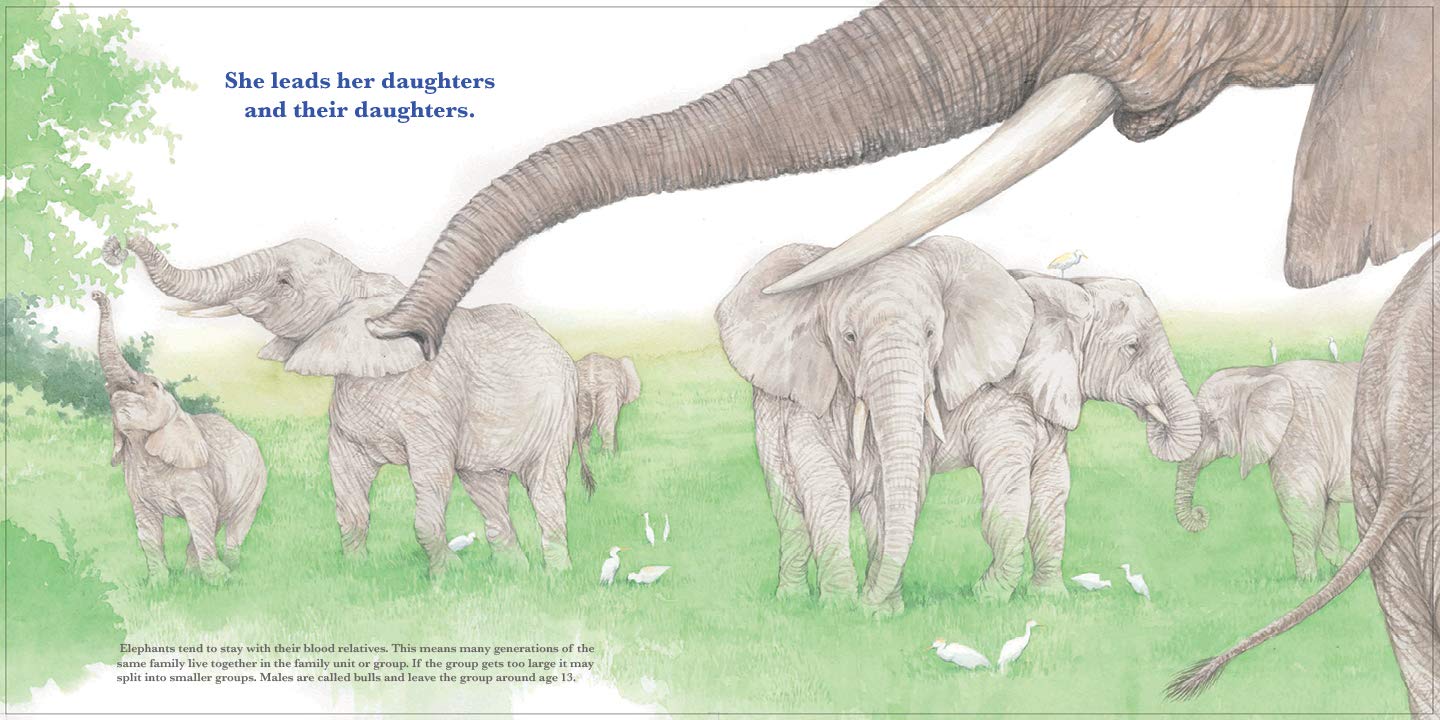
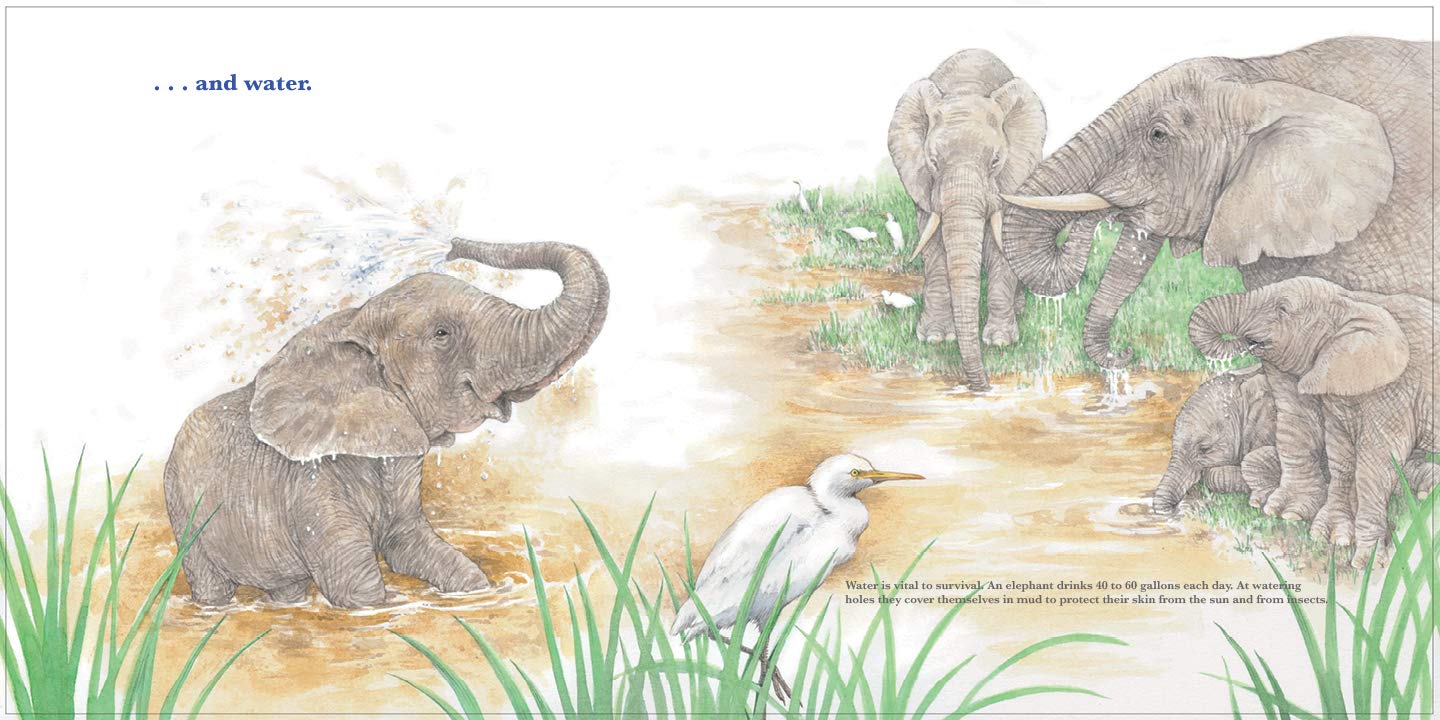
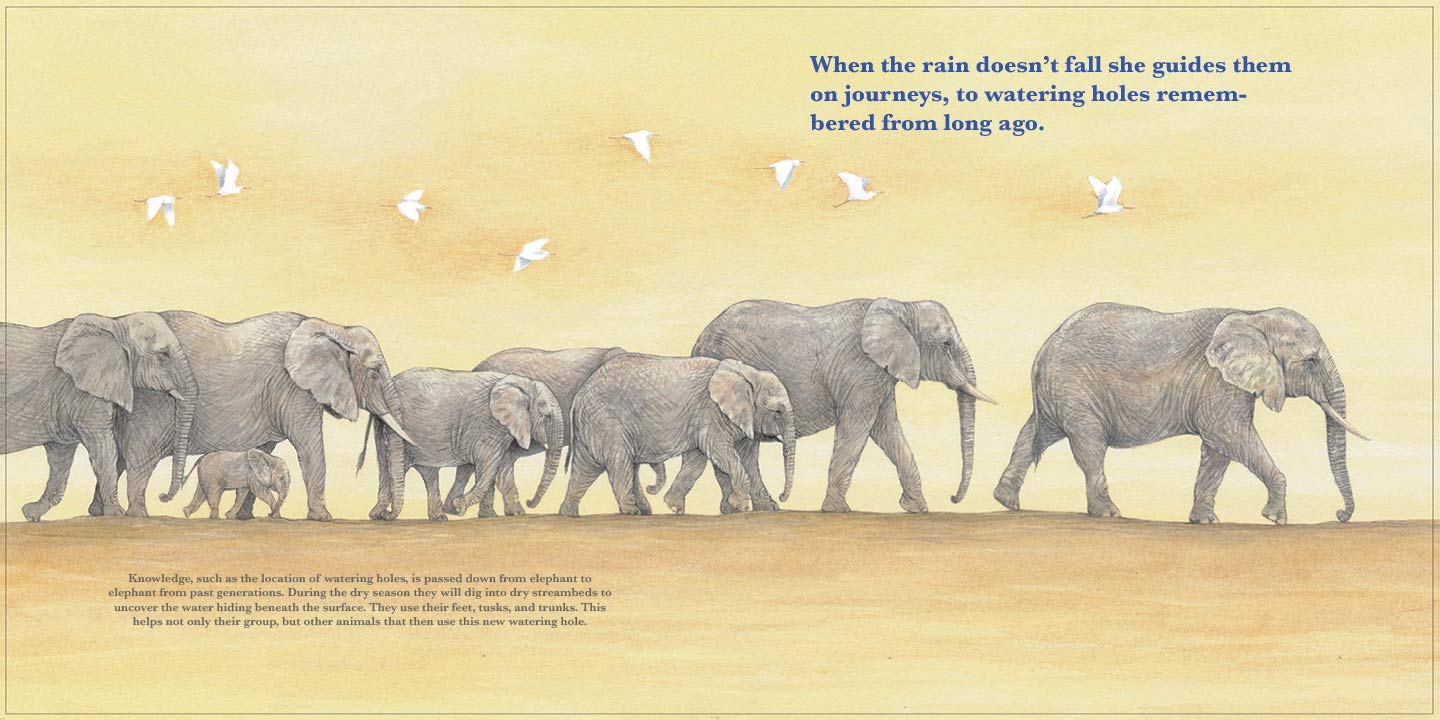
The elephant matriarch is the queen of the family group. “She is usually the oldest, but not always. It is her job to guide and teach her subjects to give them the best opportunities for survival.” Her family group consists of blood relatives—daughters and granddaughters—living together. When groups get too big, some elephants break off and form their own group. The matriarch leads the other elephants to food and water, and when water is scarce “she guides them on journeys to watering holes remembered from long ago.”

celebrate-picture-books-picture-book-review-she-leads-queen

Image copyright Yumi Shimokawara, 2020, text copyright June Smalls, 2020. Courtesy of Familius.

Like a loving grandmother, the matriarch teaches younger elephants how to take care of their little ones. Everyone in the family group helps rear the young. “The clumsy babies are sometimes caught in mud or water and the older elephants will work together to push, pull, or dig to rescue them.”

Sometimes, groups of elephants that once lived together will meet. They remember each other and spend time “foraging for food together. These meetings are like a family reunion.” When danger from another animal lurks, the elephants watch and learn how the matriarch defends them. They also huddle together and surround the smaller elephants for protection. “If nature, or predators, or poachers take her friends, she will comfort and care for the orphans.”

celebrate-picture-books-picture-book-review-she-leads-daughters

Image copyright Yumi Shimokawara, 2020, text copyright June Smalls, 2020. Courtesy of Familius.

Little ones grow and play under the watchful eye of the matriarch and, just like human children, “elephants are not born with all the skills they need.” The matriarch helps teach her children, grandchildren, and great-grandchildren how to use their trunks for heavy work like moving logs and for delicate finessing, such as having the “ability to gently pluck a leaf from a tree.”

celebrate-picture-books-picture-book-review-she-leads-water

Image copyright Yumi Shimokawara, 2020, text copyright June Smalls, 2020. Courtesy of Familius.

The matriarch also thinks about the future when she won’t be able to lead the group anymore. She passes on her knowledge and skills to the elephants in her lineage, “so that when she is gone another matriarch will lead her family.” When the matriarch does die, the elephants mourn their loss in ways similar to humans. “Elephants have been observed burying their dead with grasses and branches,” and they will return to the spot months later to “touch the bones of their lost family member.” A new matriarch emerges to lead the family group. This is “usually the oldest daughter of the matriarch,” and her call “to her daughters and their daughters” can be heard for miles and miles – sometimes up to 110 square miles – as this new queen begins her reign.

celebrate-picture-books-picture-book-review-she-leads-rain

Image copyright Yumi Shimokawara, 2020, text copyright June Smalls, 2020. Courtesy of Familius.

June Smalls’ tribute to the matriarchal society of elephants and, through her lyrical storytelling, to strong women in every family and community is both poignant and powerful. The main story reveals the role of the matriarch in leading and teaching her daughters, granddaughters, and great-granddaughters over a lifetime, which can span seventy years. Smalls’ stirring text illuminates the similarities between elephants and humans in everyday needs, behavior, memory, familial care, and even in death. In addition to the story, each page spread includes fascinating, and often touching, facts about how a family group forages for enormous amounts of food, finds crucial water supplies, protects each other, rears their young, and sustains each other in the passing of the matriarch. Smalls’ book ends with an inspirational entreaty to young girls to awaken to their future role as leaders.

Yumi Shimokawara’s stunning realistic illustrations of an elephant matriarch leading and teaching her family group in the wild will thrill readers. On each page spread, young readers follow their elephant peer as she (or he, as male elephants stay with the family group until about age thirteen) plucks leaves from a sun-drenched tree, splashes in a watering hole, walks in the shade of two adults on a long, hot journey, is protected from predators, and plays games with sticks and other babies in the group. Shimokawara’s delicate color palette and beautifully composed images depict the intelligence and gentle manner of these animals in lively and tender moments that children will want to view again and again.

An exquisite combination of inspiration and education, She Leads: The Elephant Matriarch will captivate children as a spark for further learning about these majestic animals, the environment, and nature conservation as well as encouragement to bravely take their place in the world with grace, love, and strength. The book is a must for all home, classroom, and public library collections.

Ages 3 – 8

Familius, 2020 | ISBN 978-1641702324

Discover more about June Smalls and her books on her website.

You can find more books from Familius that joyfully reflect the habits of happy families, including reading, talking, laughing, eating, working, loving, healing, learning, and playing together as well as the Familius blog The Habit Hub here.

World Elephant Day Activity

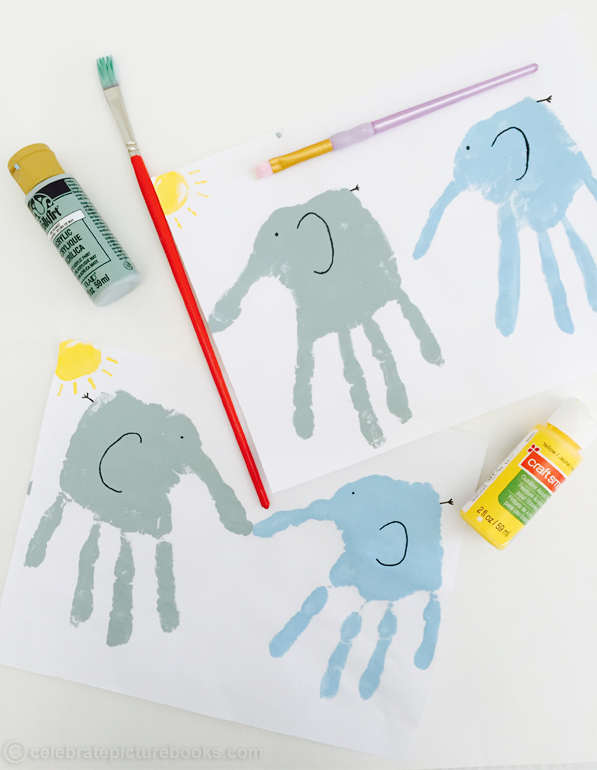
celebrate-picture-books-picture-book-review-hand-print-elephants-craft

Elephant Handprint Craft


This easy craft is fun for families to do together. Using siblings’ hands or the hands of a child and an adult to make the elephants can make a meaningful and comforting picture to hang in a child’s room or gift for mom, dad, or other family members.

Supplies

  • Craft paint in two colors of the children’s choice
  • Yellow craft paint
  • Black fin-tip marker
  • Crayons, markers, or colored pencils to make a background
  • Paper
  • Paint brush

Directions

  1. Paint one child’s hand and press it on the paper. The thumb is the truck and the fingers make the legs.
  2. Paint the second child’s or adult’s hand and press it on the paper near the other “elephant.” 
  3. After the paint has dried, draw on ears and an eye.
  4. Add a sun with the yellow paint or crayon.
  5. Add grass, trees, or other background features if desired.

celebrate-picture-books-picture-book-review-she-leads-cover

You can buy She Leads: The Elephant Matriarch on the Familius website.


This post contains affiliate links. You can read my full disclosure statement here.

Picture Book Review

June 30 – National Oceans Month

celebrate-picture-books-picture-book-review-the-big-beach-cleanup-cover

About the Holiday

During National Oceans Month, we celebrate the wondrous diversity of sea life. A majority of the earth’s surface is covered in water and yet we know only a fraction of what the oceans have to show us. With new technology scientists are diving deeper and deeper and discovering some of the most unique creatures in the world. The holiday also gives us an opportunity to pledge our help to preserving the fragile ecosystems that exist in and near the world’s oceans from climate change, pollution, and habitat destruction. To join in on this month’s holiday, visit a beach or aquarium, learn more about the animals and resources of the sea, and consider donating to or volunteering with an organization dedicated to protecting the world’s oceans. To learn more about the world’s oceans, including information on ocean health, life, science, and trivia; find education resources, podcasts, videos, and more, visit the National Ocean Service website.

The Big Beach Cleanup

Written by Charlotte Offsay | Illustrated by Katie Rewse


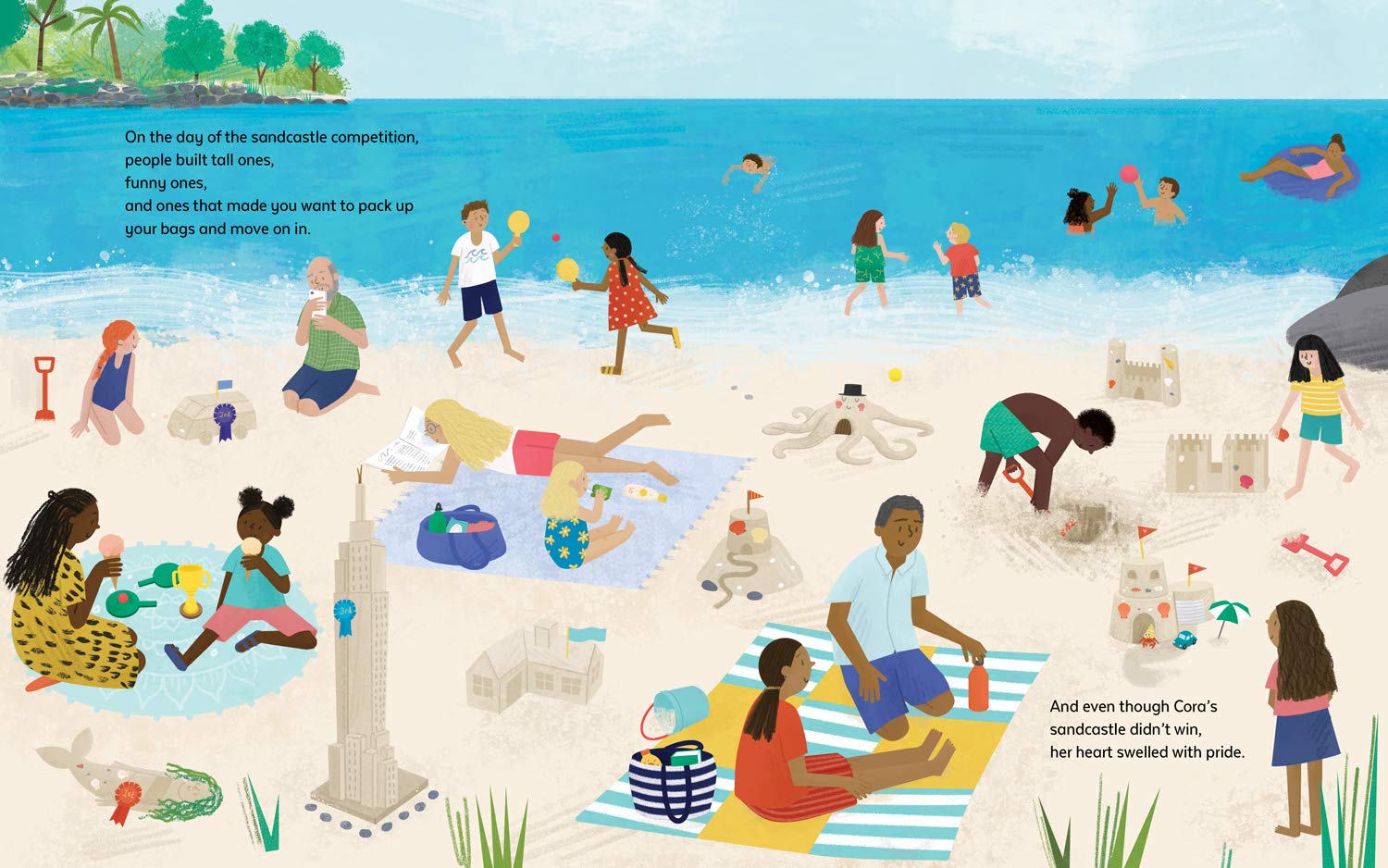
At the end of the summer, the Crystal Beach Sandcastle Competition would be held and Cora planned on being crowned the champion. She had all summer to practice and she had visions of castles she could build – from towering ones to funny ones to “ones that made you want to pack up your bags and move on in.” But when she got to the beach to begin practicing, she discovered a sign that said the sandcastle competition had been postponed because the beach was so filled with trash. In fact, everywhere Cora dug she unearthed more and more trash.

celebrate-picture-books-picture-book-review-the-big-beach-cleanup-fliers

Image copyright Katie Rewse, 2021, text copyright Charlotte Offsay, 2021. Courtesy of Albert Whitman & Company.

Cora asked Mama if she could fix it. “‘I wish I could,'” Mama answered. “‘I don’t have enough hands.'” Cora wondered if their four hands together could do the job. Mama took gloves from her truck and she and Cora began filling bags with trash. Cora wondered where all the trash came from and Mama explained that some of it could come from trash dropped in cities or towns that makes its way to the ocean or the beach through a drain. Before Cora and Mama could pick up much more, it started raining. Four hands just weren’t enough, thought Cora.

The next day Cora asked her grandfather to join them in cleaning up the beach, but when they got there Cora felt discouraged. The sand looked just as bad as it had the day before. After they’d worked a while, Grandpa suggested taking a “sandcastle break.” Nearby, Cora was upset to see a seagull eating a food wrapper. Six hands weren’t nearly enough, either. Then she looked at the posters on the beach bulletin board and had an idea.

celebrate-picture-books-picture-book-review-the-big-beach-cleanup-twelve-hands

Image copyright Katie Rewse, 2021, text copyright Charlotte Offsay, 2021. Courtesy of Albert Whitman & Company.

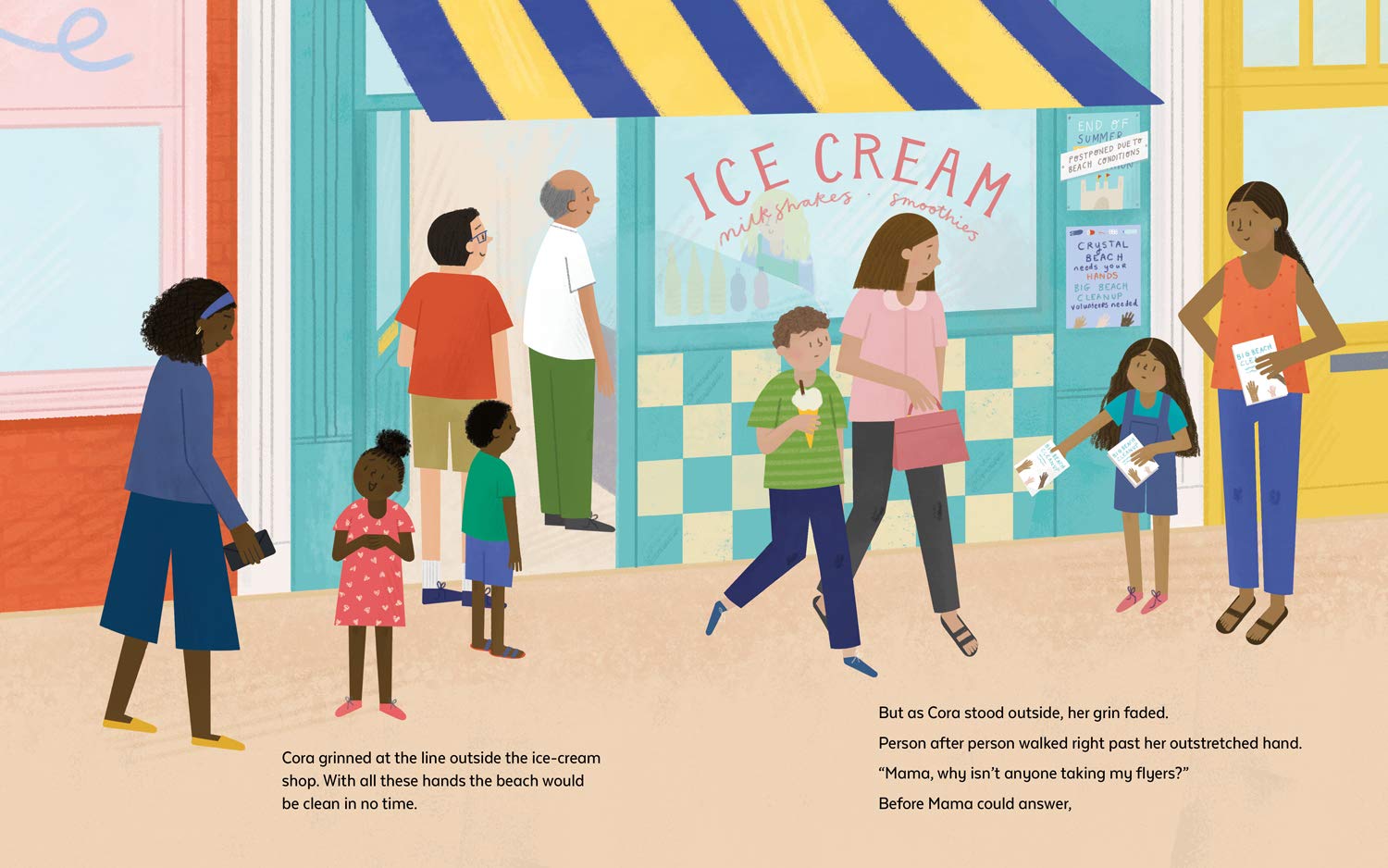
Cora drew her own posters, reading “Chrystal Beach needs your HANDS” and “BIG BEACH CLEANUP.” She and her mother posted the signs around town. Outside the ice-cream shop, Cora tried to hand out her fliers but everyone just walked past without taking one. Everyone seemed to busy to come to get involved. But Mama told Cora that there are many other ways people could help, “‘like not littering, or saying no to things we use only once, like straws, so that less trash ends up in the ocean.'”

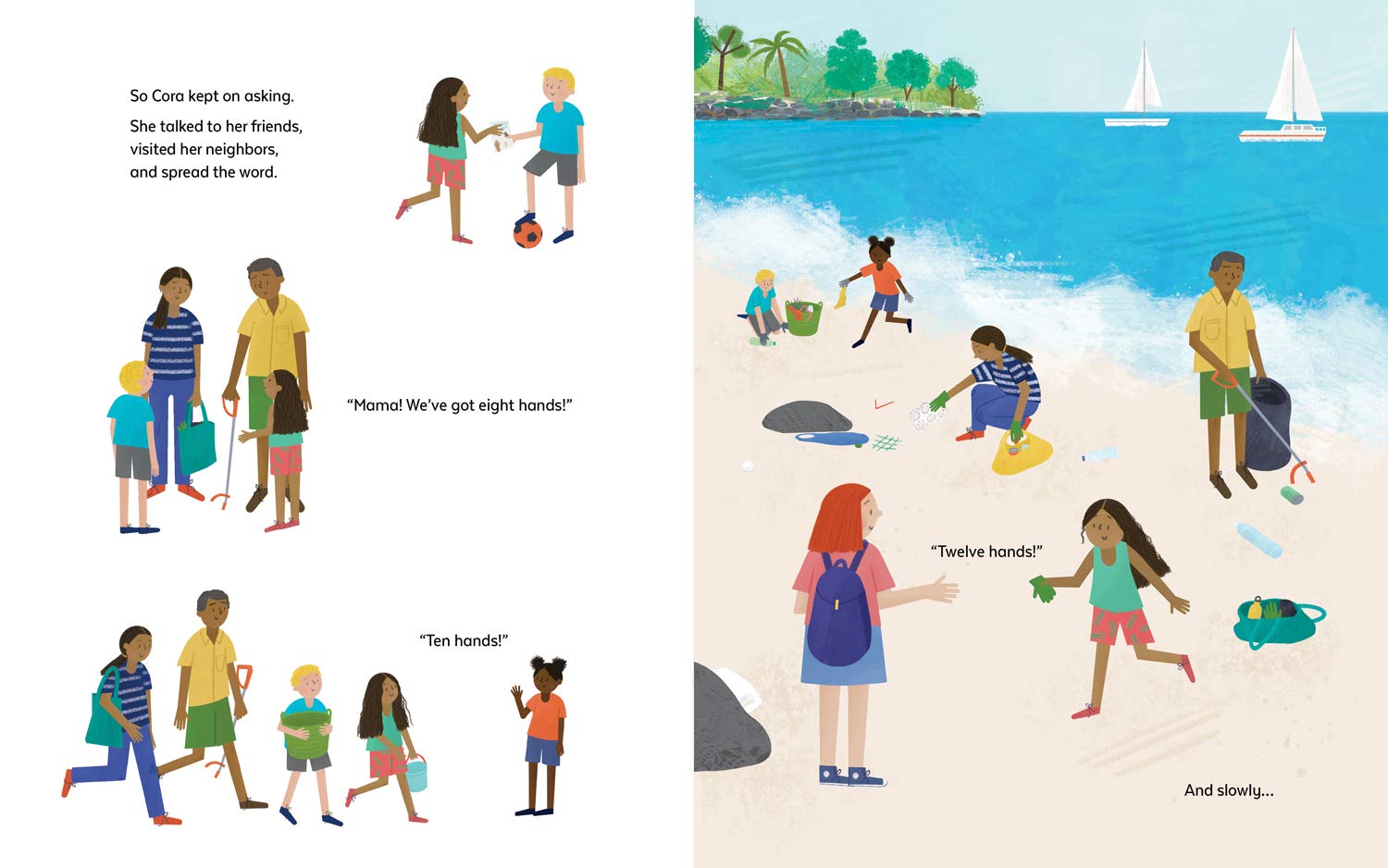
Cora understood, but she kept asking friends, neighbors, and others. Little-by-little, there were eight hands, then ten, and twelve. More people caught on and came out to the beach to pick up litter. Cora got so many hands that the sandcastle contest was reinstated “thanks to local activists.” On the day of the contest, families came out and built all kinds of creative castles. Cora wasn’t crowned champion, but “her heart swelled with pride” at what she had accomplished. And that was just the beginning….

An Author’s Note outlining steps everyone can take to reduce trash and prevent it from littering the oceans and beaches as well as a list of facts about ocean pollution follow the story.

celebrate-picture-books-picture-book-review-the-big-beach-cleanup-contest

Image copyright Katie Rewse, 2021, text copyright Charlotte Offsay, 2021. Courtesy of Albert Whitman & Company.

Through her earnest and activist protagonist, Cora, Charlotte Offsay gives a voice to those children who want to make a difference in their communities. While Offsay touches on how trash makes its way to oceans and beaches, the real appeal of the story is in her realistic, hands-on ideas that can empower kids to find activities for cleaning up their neighborhood or local beach, park, woodland, or other public space. Her straightforward and accessible storytelling reflects the questions children have about today’s issues and their enthusiasm to help solve problems as well as the disappointments that sometimes come with trying to solicit the involvement of others. Offsay’s well-paced narrative show kids that change can be or seem to be slow, but that sticking with any effort pays benefits.

Katie Rewse’s vibrant illustrations will keep children riveted to the pages as they watch Cora dig up more and more trash from an already well-littered beach. Images of Cora making and hanging posters will inspire kids to try similar outreach in their own communities. Page spreads depicting clean-up efforts realistically portray the types of trash found on beaches and other recreation areas. For children who may be unsure if one pair of hands can really make a difference, Rewse’s illustrations of Cora and Mama working together at the beginning of the story show the positive impact of just one or two people, while later in the story, as more and more people join in, they will see the transformative power that a group effort can make. Kids will love being invited to the sandcastle competition to see all the entrants as well as the winning sculptures.

Inspiring, empowering, and offering realistic ideas and expectations for budding environmentalists, The Big Beach Cleanup is sure to spark awareness and action for children at home and at school. The book would make an impactful addition to home, school, and public library collections.

Ages 4 – 8

Albert Whitman & Company, 2021 | ISBN 978-0807508015

Discover more about Charlotte Offsay and her books on her website.

To learn more about Katie Rewse, her books, and her art, visit her website.

National Oceans Month Activity

celebrate-picture-books-picture-book-review-kinetic-sand-craft

Kinetic Sand


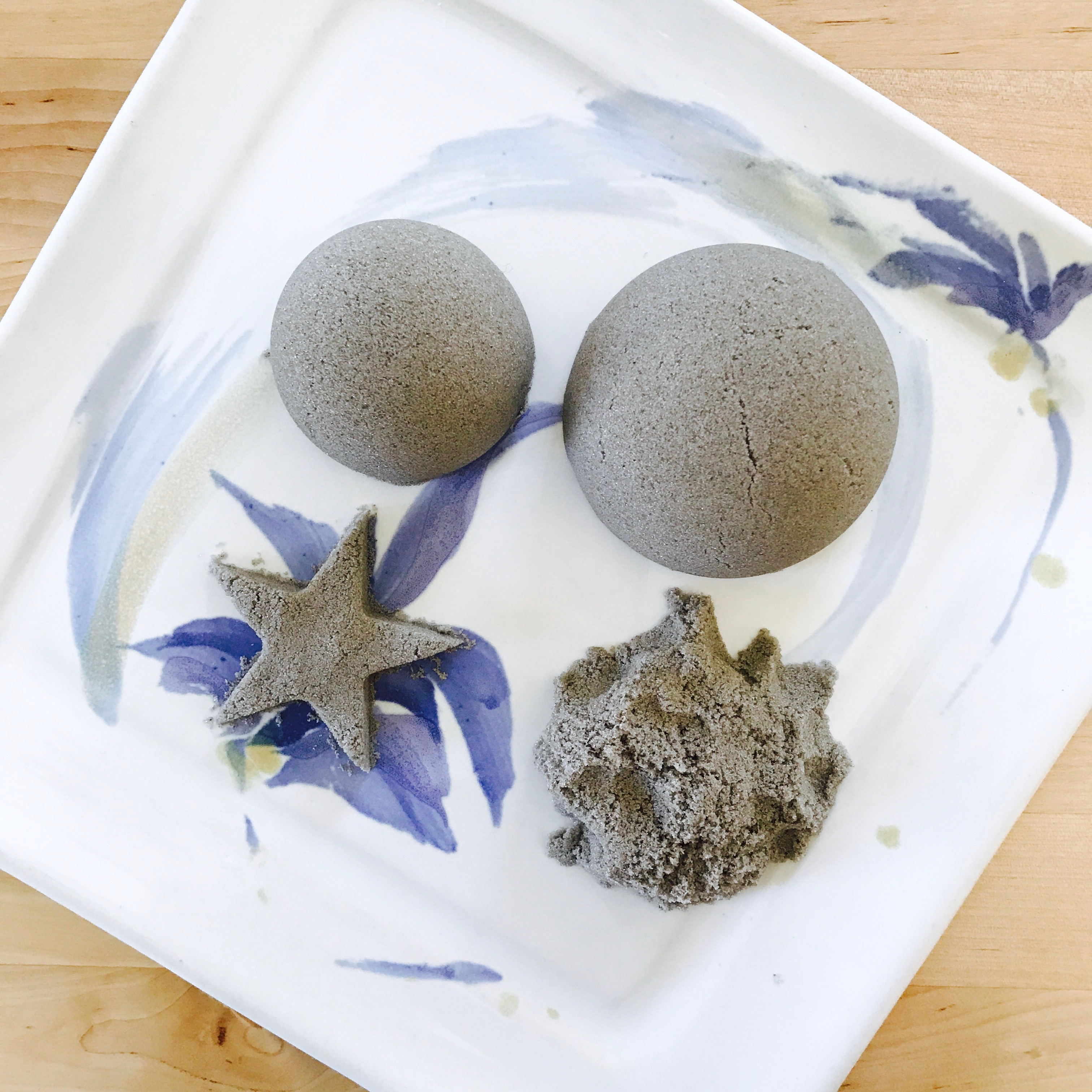
Sand is so much fun to play with at the beach that you just wish you could bring it home. Now you can! With this easy recipe you can create your own kinetic sand to form or let run through your fingers. It makes a great anti-stress reliever too!

Supplies

  • 1 cup sand
  • ½ tablespoon cornstarch
  • 1 teaspoon dish soap
  • Water as needed – about ¾ cup
  • Bin or bowl for mixing dry ingredients
  • Bowl for mixing dish soap and water

Directions

  1. In the bin combine the sand and cornstarch and mix well
  2. In the bowl combine the dish soap and water until the water is bubbly
  3. Slowly add the water mixture to the dry ingredients, mixing and adding water little-by-little until the desired consistency is reached. The grain of the sand will determine how much water is needed.
  4. The sand can be formed with cookie cutters, molds, hands, etc. and is strong enough to stack. Or just let it drip and ooze through your fingers.

celebrate-picture-books-picture-book-review-the-big-beach-cleanup-cover

You can find The Big Beach Cleanup at these booksellers

Amazon | Barnes & Noble | Books-a-Million

To support your local independent bookstore, order from

Bookshop | IndieBound

Picture Book Review

June 29 – International Day of the Tropics

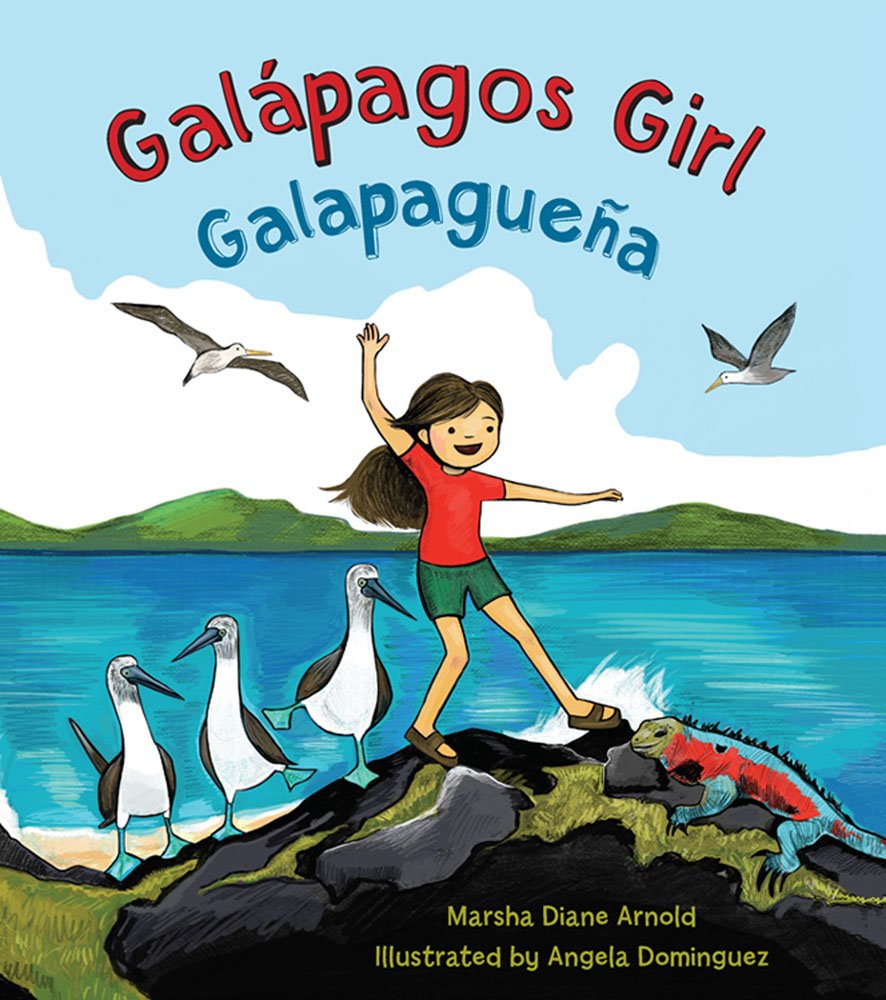
celebrate-picture-books-picture-book-review-galapagos-girl-cover

About the Holiday

The International Day of the Tropics is a United Nations–sponsored holiday that celebrates the extraordinary diversity of the tropics while putting a spotlight on the unique challenges and opportunities the nations of the Tropics face. The Tropics are a region roughly defined as the area between the tropic of Cancer and the tropic of Capricorn and have in common a warm and typically unvaried seasonal temperature fluctuations and the prevalence of rain  determined by a region’s proximity to the equator. While it is projected that by 2050, the Tropics will be home to most of the world’s population and two-thirds of its children, the area faces challenges due to climate change, deforestation, logging, urbanization, and demographic shifts.  Today’s observance provides individuals, organizations, and governments an opportunity to take stock of progress across the tropics, to share stories and expertise, and to acknowledge the diversity and potential of the region. Today’s book tell the true story of one woman who is working to make a difference.

Thanks to Lee & Low Books for sending me a copy of Galápagos Girl/ Galápagueña for review consideration. All opinions about the book are my own. 

Galápagos Girl / Galapagueña

Written by Marsha Diane Arnold | Illustrated by Angela Dominguez | Translated by Adriana Dominguez


On the day when baby Valentina joined Mamá, Papá, and eleven brothers and sisters, even the sea lions, blue-footed boobies, and iguanas seemed to welcome her to the “island formed by fire.” Valentina loved growing up on the Galápagos Island of Floreana. She explored the lava rocks, where Sally Lightfoot crabs scuttled back and forth. She swam with dolphins and manta rays, and even played with penguins.
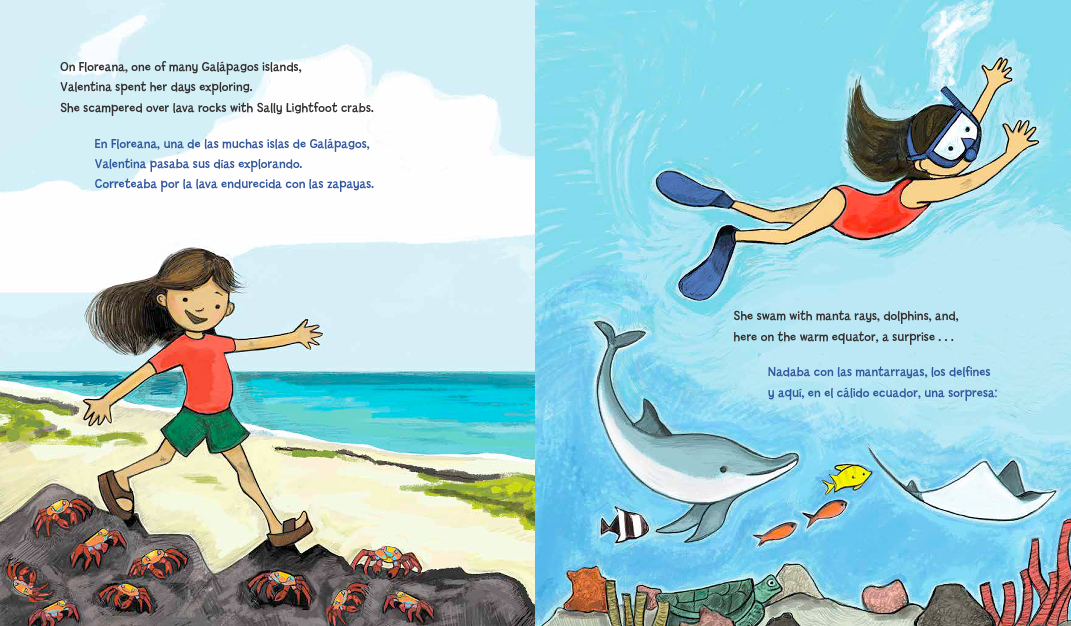
celebrate-picture-books-picture-book-review-Galápagos-Girl-crabscelebrate-picture-books-picture-book-review-Galápagos-Girl-crabs

Image copyright Angela Dominguez, 2018, text copyright Marsha Diane Arnold, 2018. Courtesy of Lee & Low Books.

“Valentina watched pink flamingoes wading near mangroves. Blue butterflies fluttering on the breeze. Red-and-green iguanas sneezing salt like tiny geysers.” The crashing waves, albatross, and finches created a symphony as Valentina stopped to rest on a grassy cliff overlooking the ocean. The lava lizards, blue-footed boobies, and twirling sea lions provided young Valentina with a variety of dance partners.
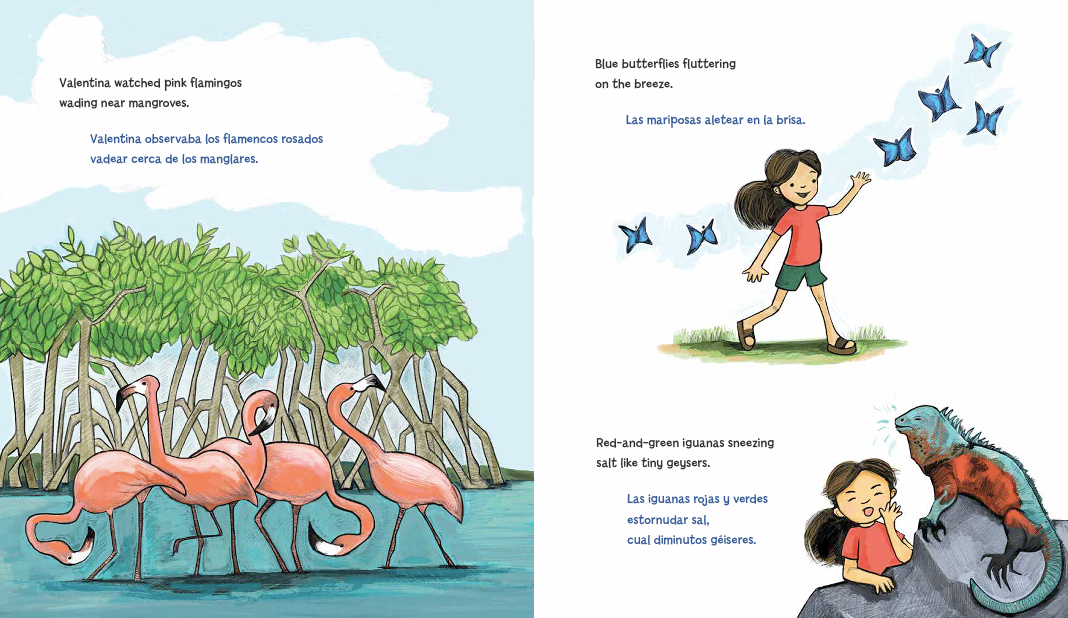
celebrate-picture-books-picture-book-review-Galápagos-Girl-iguana

Image copyright Angela Dominguez, 2018, text copyright Marsha Diane Arnold, 2018. Courtesy of Lee & Low Books.

At home, Valentina’s family shared their home with two giant tortoises—Carlitos and Isabella. One day Papá told Valentina their story as they fed the tortoises plums that had fallen from their backyard trees. Papá had gotten Carlitos and Isabella from a friend when he first moved to Floreana. Although it was nearly impossible to imagine now that the tortoises were grown, at the time they were so small that they fit into Papá’s pockets.
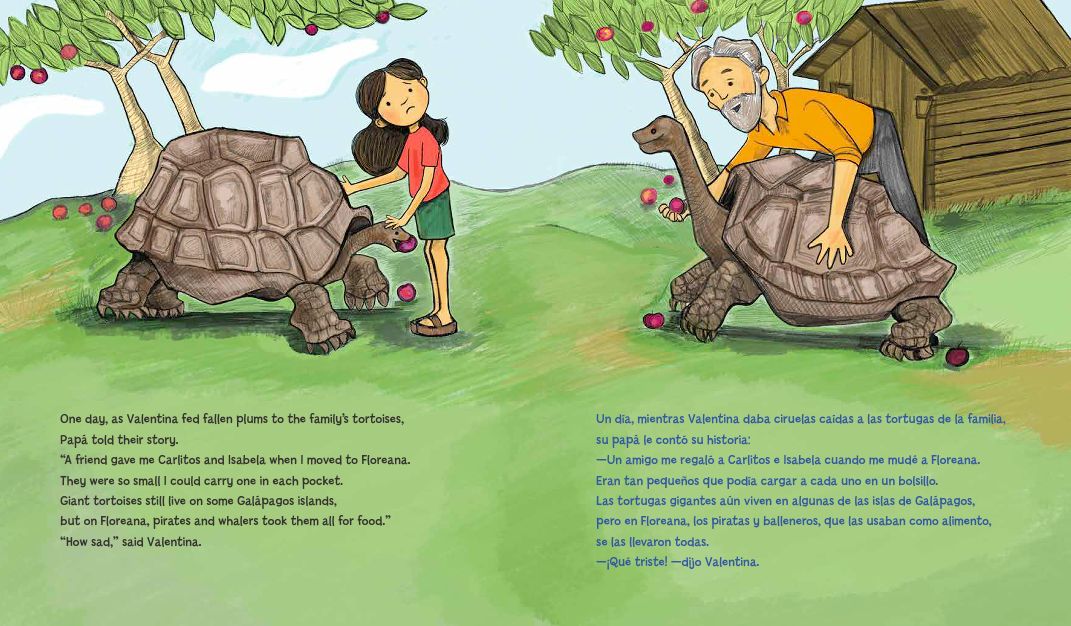
celebrate-picture-books-picture-book-review-Galápagos-Girl-tortoises

Image copyright Angela Dominguez, 2018, text copyright Marsha Diane Arnold, 2018. Courtesy of Lee & Low Books.

There was also a sad note to Papá’s story. He said that while giant tortoises still lived on other Galápagos islands, pirates and whalers had wiped out the population on Floreana. Papá went on to tell Valentina that many Galápagos animals were in danger. They were “threatened by other animals that don’t belong here. Threatened by people who don’t understand how to care for our islands.” Valentina promised that she would always protect them.

When she was older, Valentina left the island to go to school. She didn’t want to leave her beautiful home, but Mamá told her that she was “ready to learn about the world beyond.” And Papá reminded her that “like our islands, you have a heart full of fire.” On school vacations, Valentina always came back to study the wildlife on the Galápagos islands. She had not forgotten her promise to keep them safe.
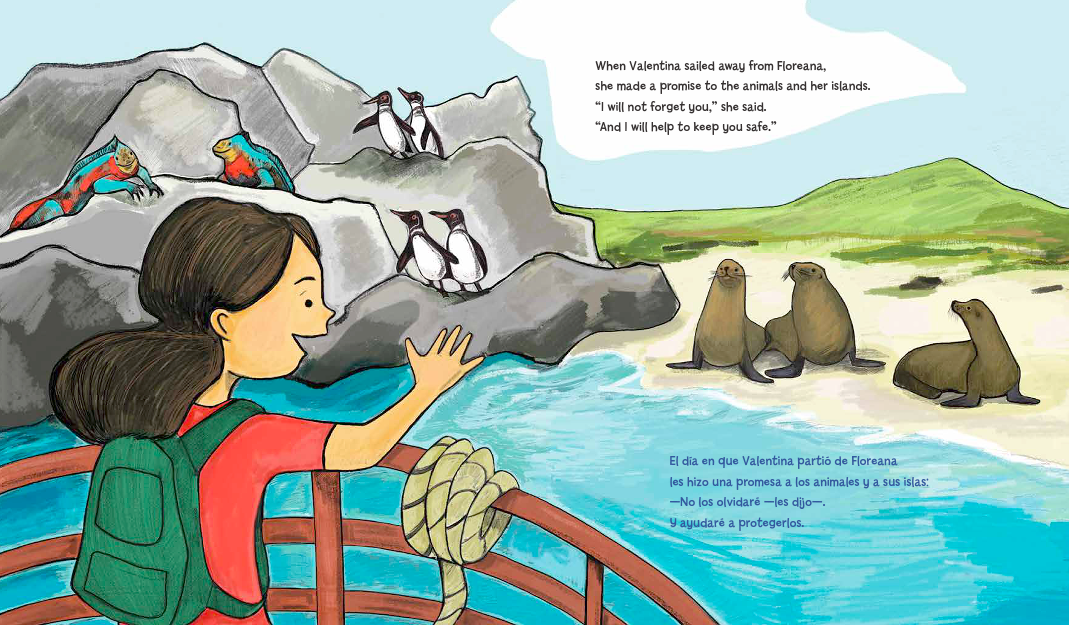
celebrate-picture-books-picture-book-review-Galápagos-Girl-going-to-school

Image copyright Angela Dominguez, 2018, text copyright Marsha Diane Arnold, 2018. Courtesy of Lee & Low Books.

After she graduated with a degree in biology, Valentina returned to the islands as a nature guide to teach visitors about the beauty and uniqueness of the Galápagos. Some visitors were even lucky enough to meet Carlitos and Isabella when the plums dropped from the trees and the two old tortoises returned from exploring Floreana to eat them. Because of Valentina’s commitment to the Galápagos, her visitors also made a promise to always remember and protect them.

Extensive backmatter includes an Author’s Note about Valentina Cruz, the tortoises Carlitos and Isabella, and the history of tortoises on Floreana. There is also information on the Galápagos as well as fun facts about all of the animals in the story. A bibliography of sources invites readers to learn more.

Each two-page spread presents the text in English and translated into Spanish by Adriana Dominguez.
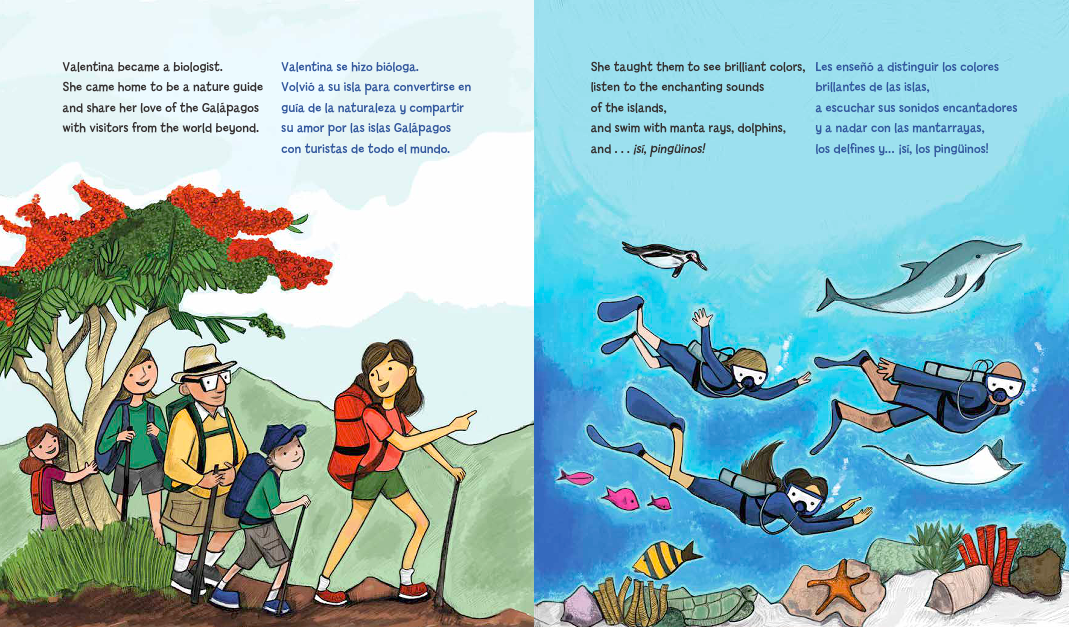
celebrate-picture-books-picture-book-review-Galápagos-Girl-guiding-visitors

Image copyright Angela Dominguez, 2018, text copyright Marsha Diane Arnold, 2018. Courtesy of Lee & Low Books.

Marsha Diane Arnold’s lyrical and buoyant passages sing with the carefree joy Valentina felt as a girl exploring her beloved Galápagos and which brought her back home as a biologist to protect them. After seeing Valentina playing and swimming with the native animals and feeding Carlitos and Isabella, readers will also feel Valentina’s sadness at the dangers they face and want to make a positive difference to the environment and the world around them. Arnold’s dialogue-rich storytelling highlights the personal nature of the subject and will draw children into Valentina’s world.celebrate-picture-books-picture-book-review-Galápagos-Girl-blue-footed-booby
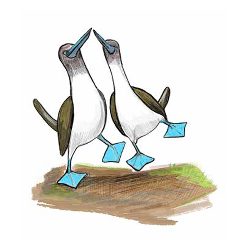
Saturated with glorious color, each of Angela Dominguez’s illustrations is a celebration of the splendor of the Galápagos. Playful sea lions, high-stepping blue-footed boobies, scampering crabs, and even a sneezing iguana will captivate young readers and inspire them to learn more about these creatures and the islands. Images of Valentina camping out to study the animals during school breaks will excite environmentally conscious kids, and pictures of Carlitos and Isabella happily munching on plums will generate smiles and “awwws.”

Galápagos Girl / Galapagueña will excite kids to learn more not only about the Galápagos region but about their own local environment, and the call to action will spark an enthusiasm for protecting the earth’s animals. The book would make an inspiring addition to home bookshelves and an excellent way to begin classroom discussions on environmental issues and science lessons. The engaging Spanish translation will delight Spanish-speaking and bilingual families.

Ages 4 – 8

Lee & Low Books, 2018 | ISBN 978-0892394135

Discover more about Marsha Diane Arnold and her books on her website. You can also download activity sheets and teachers’ guides for most of her books here as well.

To learn more about Angela Dominguez, her books, and her art, visit her website.

Welcome Marsha Diane Arnold
celebrate-picture-books-picture-book-review-marsha-diane-arnold

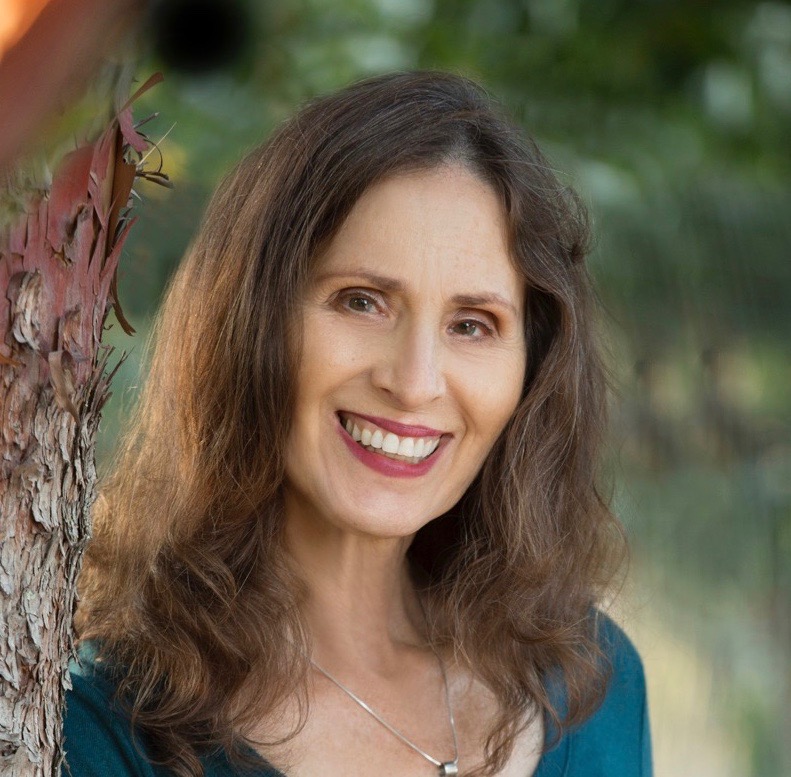
In 2018, I was thrilled to talk with award-winning picture book author Marsha Diane Arnold about the backstory of Galápagos Girl / Galápagueña. Her interview, originally for National Wildlife Day, is just as timely today. Marsha was inspired to write this story after traveling to the Galápagos Islands, where she met Valentina Cruz and had the opportunity to swim with sea lions and dolphins.

Marsha Diane Arnold is an award-winning picture book author whose books have sold over one million copies. Her 21st book, Lights Out, was published in the fall of 2020. Arnold’s other books include Badger’s Perfect Garden, May I Come In? and Mine. Yours. Among Marsha’s honors are the Ridgeway Award for Best First Book, state Children’s Choice awards, IRA Distinguished Book, and Smithsonian Notable Book. Her bilingual book Galápagos Girl was selected as a 2019 Bank Street Best Books of the Year, a Campoy-Ada honor book, and a 2019 Green Prize in Sustainable Literature. The media has referred to her as, “a born storyteller.” Educators have called her a “true literary artist” whose books show “warmth and respect for one’s self.”  She lives with her family in Alva, Florida.

Thank you, Kathryn, for inviting me to celebrate Galápagos Girl / Galápagueña, along with conservation of wild places and animals!

As a child, would you have enjoyed swimming with sea lions? Feeding plums to giant tortoises by hand? Having warblers fly through your house? That was the life of Valentina Cruz. Galápagos Girl is based on her idyllic life on remote Floreana island in the Galápagos Islands, a volcanic archipelago west of Ecuador.
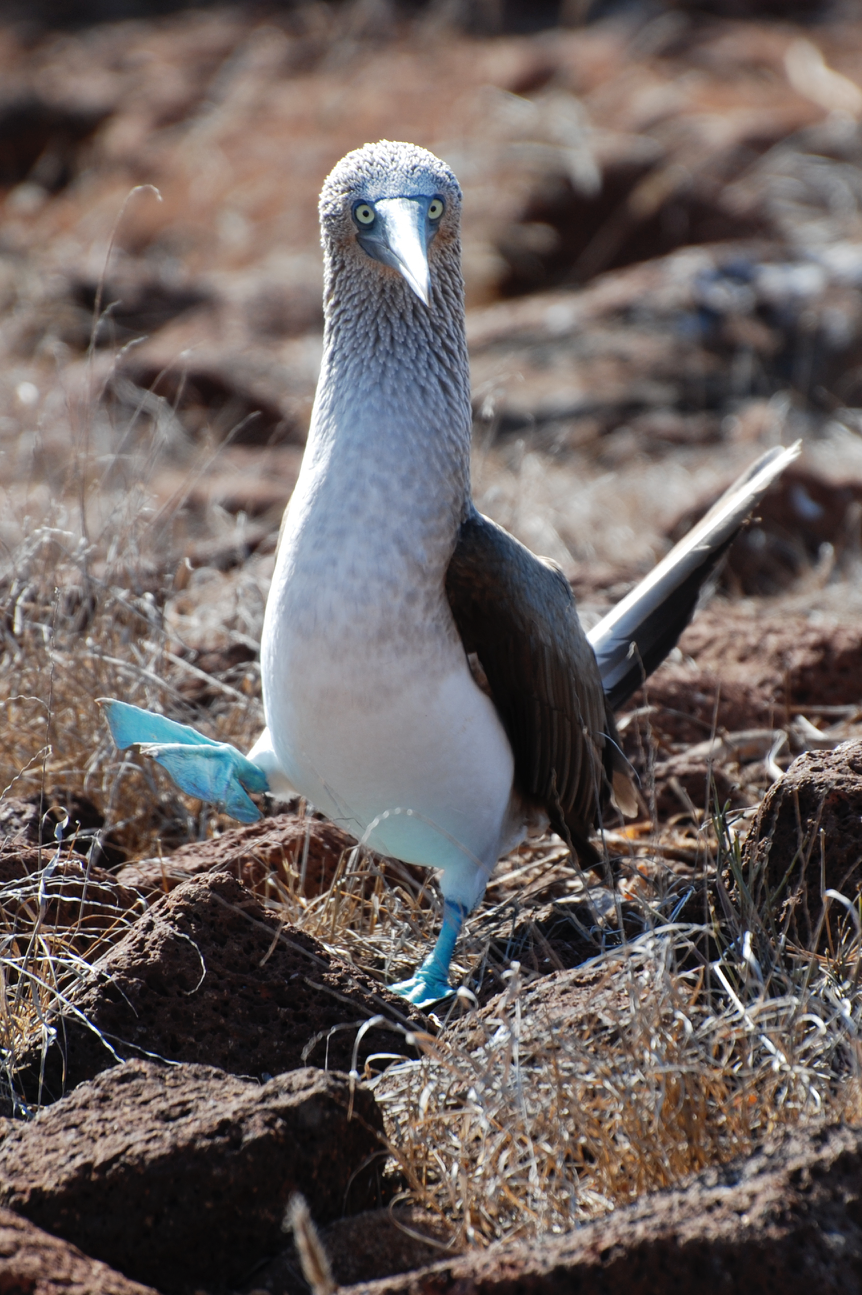
celebrate-picture-books-picture-book-review-galapagos-girl-blue-footed-booby

celebrate-picture-books-picture-book-review-galapagos-girl-marine-iguana

My photos of actual blue-footed booby and Galápagos marine iguana.

Valentina grew up surrounded by nature, but perhaps more accurately, she grew up in nature. I think when a child grows up seeing wild wonders every day, they grow up respecting and protecting nature and wildlife. Valentina and her siblings certainly did. She grew up to be a biologist and naturalist guide. One brother, Eliecer Cruz, was director of the Galápagos National Park and, later, director of the Galápagos branch of the World Wildlife Fund. Another brother, Felipe, worked on many projects with the Charles Darwin Research Station, including studying the challenges that face the Galápagos petrel. Her sister, Marilyn, is director of Galápagos Biosecurity Agency, which helps control and prevent invasive species in the islands.

In some ways, Valentina’s childhood was similar to mine. She was surrounded by a loving family—her parents and eleven brothers and sisters. I only had one brother, but along with my parents, cousins, aunts, and uncles, we gathered on many Sunday afternoons at my grandmother’s house. Valentina and I both delighted in nature, though hers was a more exotic nature—the distant Galápagos Islands, where Charles Darwin discovered those famous finches and came up with his theory of natural selection. Mine was a small farm on the Kansas plains—I didn’t see the ocean until I was an adult. Valentina had Galápagos tortoises as pets and swam with sea lions. (Of course, keeping tortoises as pets is not allowed today.) I played with my neighbor’s pet raccoon (also, not allowed today) and listened to the meadowlark’s song from the roof of my house.

Valentina loves nature, home, and family, but has the soul of an adventurer. I’m much the same. When I grew up I yearned to see as much of the world as possible. When my long-time traveling buddy, Jean Gallagher, asked me to travel with her to the Galápagos, one of my long-time dreams came true.
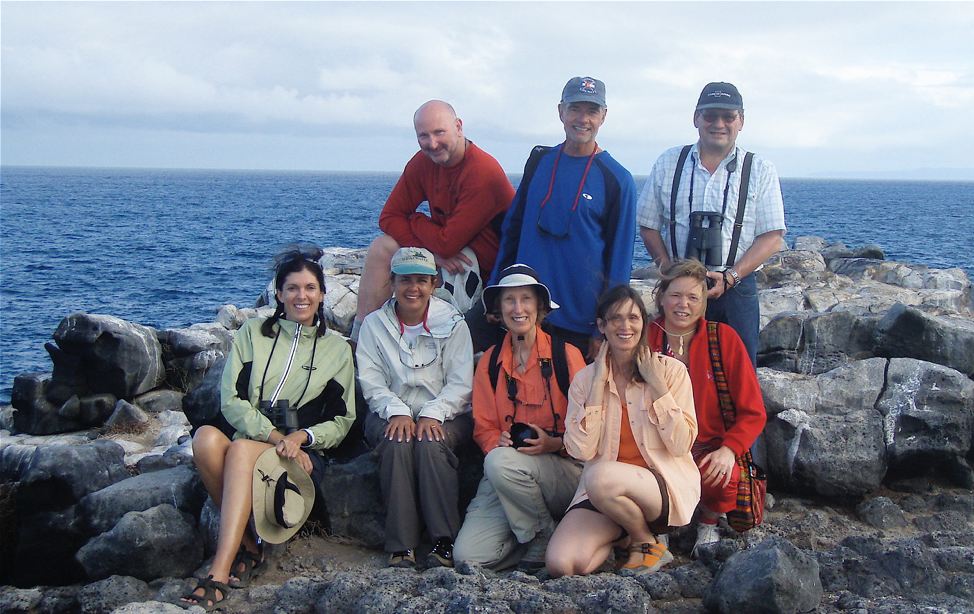
celebrate-picture-books-picture-book-review-galapagos-girl-blue-marsha-and-friends

The Galápagos Gang – fellow travelers to a far-off land. Jean is 3rd to right in front. I am 4th.

It was on that 2007 trip that I met Valentina, one of our naturalist guides. With her, we visited Floreana and saw the home where she grew up. I was enamored. I thought how wonderful a book about the islands and their unique wildlife, woven together with Valentina’s childhood, would be. Yet it wasn’t until April 2009 that I emailed Valentina and told her of my dream to write a picture book based on her life. Over months and years, Valentina generously shared her stories with me.
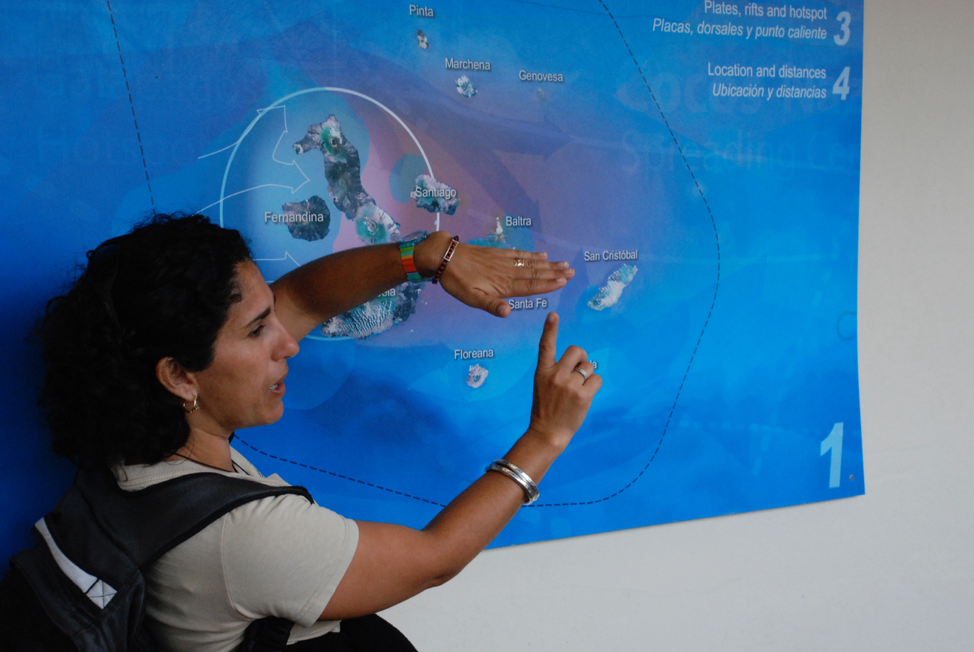
celebrate-picture-books-picture-book-review-galapagos-girl-valentina-showing-lay-of-land

Valentina showing us the lay of the land.

Valentina got her sense of adventure and love of nature from her father, Eliecer Cruz Cevallos, who first arrived in the Galápagos in 1939. He was one of only 100 people living in the Galápagos at that time!

Eliecer returned to Ecuador and married Valentina’s mother, Emma Bedon. She made him promise they would never live in the Galápagos. Who can blame her? They’d have almost no human neighbors! But in 1944, she changed her mind. Emma sailed to Floreana with Eliecer to build a life together. Valentina told me that even living in the wild, her mother taught her children “to keep all the rules of a city so we do not grow up wild.”
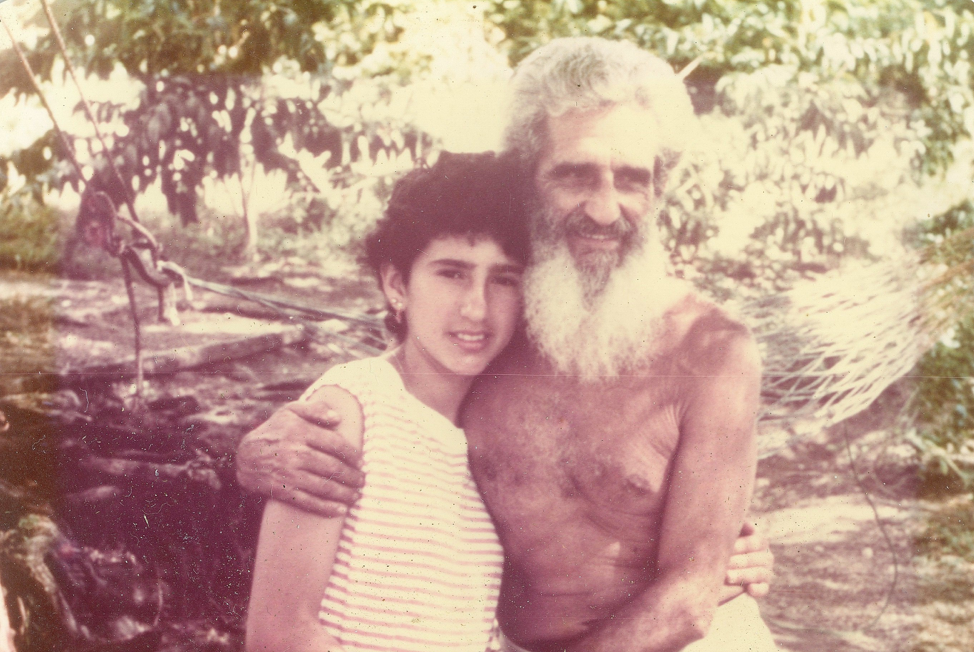
celebrate-picture-books-picture-book-review-galapagos-girl-valentina-and-father

Valentina and her father on Floreana

celebrate-picture-books-picture-book-review-galapagos-girl-valentina-mother-and-sister

Valentina, her mother, and her sister

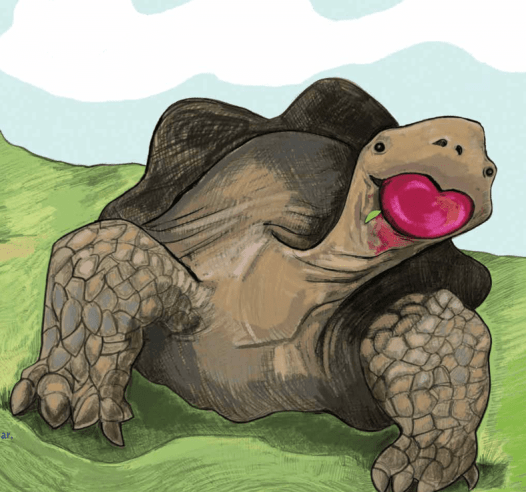
Two Galápagos tortoises were a big part of Valentina’s childhood, so I had to include them in Galápagos Girl. Floreana tortoise had long been extinct (or so it was thought).  So when Eliecer moved to Floreana, his friend gave him young tortoises from other islands. Eventually, the family released the tortoises to roam free. One of the most exciting things that happened to Valentina as a child was seeing the tortoises return to their farm that first year after their release. The main reason was the tasty plums dropping from the trees. Every year after that, when the plums ripened, the family waited for the tortoises to return. They always did!
celebrate-picture-books-picture-book-review-galapagos-girl-isabella-eating-plum

An illustration of one of the family’s tortoises eating a plum treat by Angela Dominguez

The tortoise story changed several times during the writing of my book due to Valentina’s remembering more over time, checking facts with her family, and a discovery near Wolf Volcano on Isabela, another Galápagos Island. What’s in my book isn’t exactly the way things were, but it’s close to the real story. As Valentina wisely shared: “Each of us remember things in different ways. Our memory is like pictures of what impresses us in that specific moment, so everything can be true and everything can be fiction.”
celebrate-picture-books-picture-book-review-galapagos-girl-galapagos-tortoise

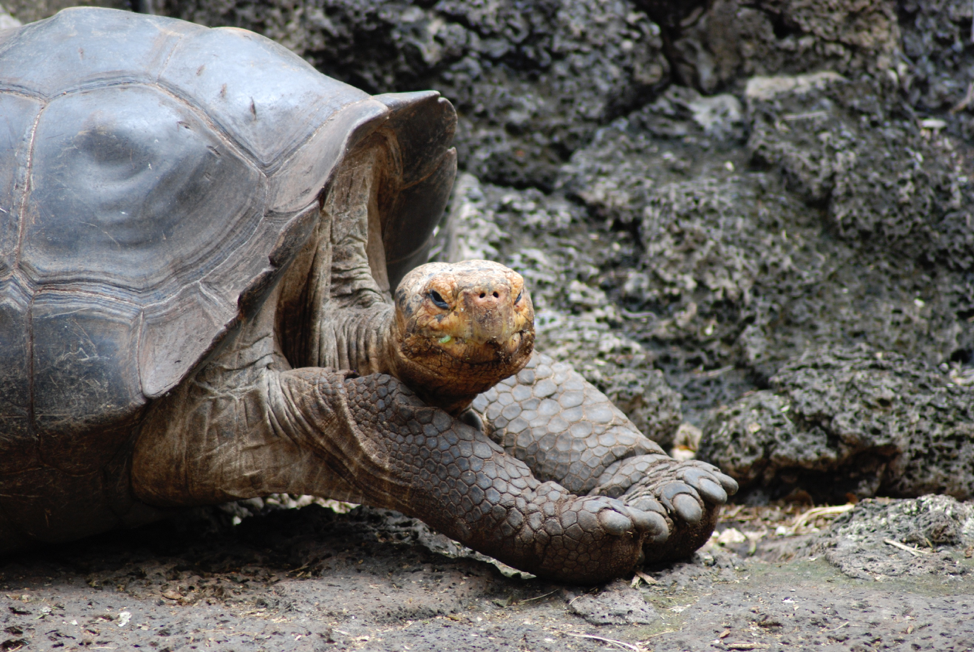
One of eleven species of Galápagos tortoise

Regarding the exciting discovery on Wolf Volcano, scientists recently found tortoises there that carry some of the Floreana tortoise genes! There is a project now to bring these tortoises back to Floreana. Wouldn’t it be wonderful to have partial Floreana tortoises wandering freely, restoring the ecology of Floreana?

You may ask, “How did Floreana tortoises get on Isabela Island?” That’s one more fascinating question about the Galápagos. If I visit your school, you can ask me and I’ll share more.

Thanks so much, Marsha, for sharing the fascinating story behind Galápagos Girl / Galápagueña!

You can connect with Marsha Diane Arnold on

Her Website | Earth’s Voices | Facebook

International Day of the Tropics Activity

celebrate-picture-books-picture-book-review-animals-of-the-galapagos-match-up-puzzle

Animals of the Galápagos Match Up Puzzle


There are so many fascinating animals that live in the Galápagos! Can you match the picture of each animal to its description in this printable Animals of the Galápagos Match Up Puzzle? You can find and download the activity sheet from the Lee & Low Books website:

Animals of the Galápagos Match Up Puzzle

celebrate-picture-books-picture-book-review-galapagos-girl-cover

You can find Galápagos Girl / Galapagueña at these booksellers

Amazon | Barnes & Noble | Books-a-Million

To support your local independent bookstore, order from

Bookshop | IndieBound

Picture Book Review

June 12 – National Get Outdoors Day

celebrate-picture-books-picture-book-review-southwest-sunrise-cover

About the Holiday

Established in 2008, National Get Outdoors Day was instituted to inspire people – and especially young people – to enjoy healthy, active outdoor fun and exploration. Celebrated in conjunction with national parks, people are encouraged to hike, explore, and enjoy the natural wonders near them. You can also head out into your yard to play games or into your neighborhood with bikes, scooters, skates, or just for a walk. There’s so much for kids to see and discover – even concepts that may seem simple are beautiful and complex in the eyes of a child, as you’ll see in today’s book. 

Thank you to Bloomsbury Children’s Books for sharing Southwest Sunrise with me for review consideration. All opinions of the book are my own. 

Southwest Sunrise

Written by Nikki Grimes | Illustrated by Wendell Minor


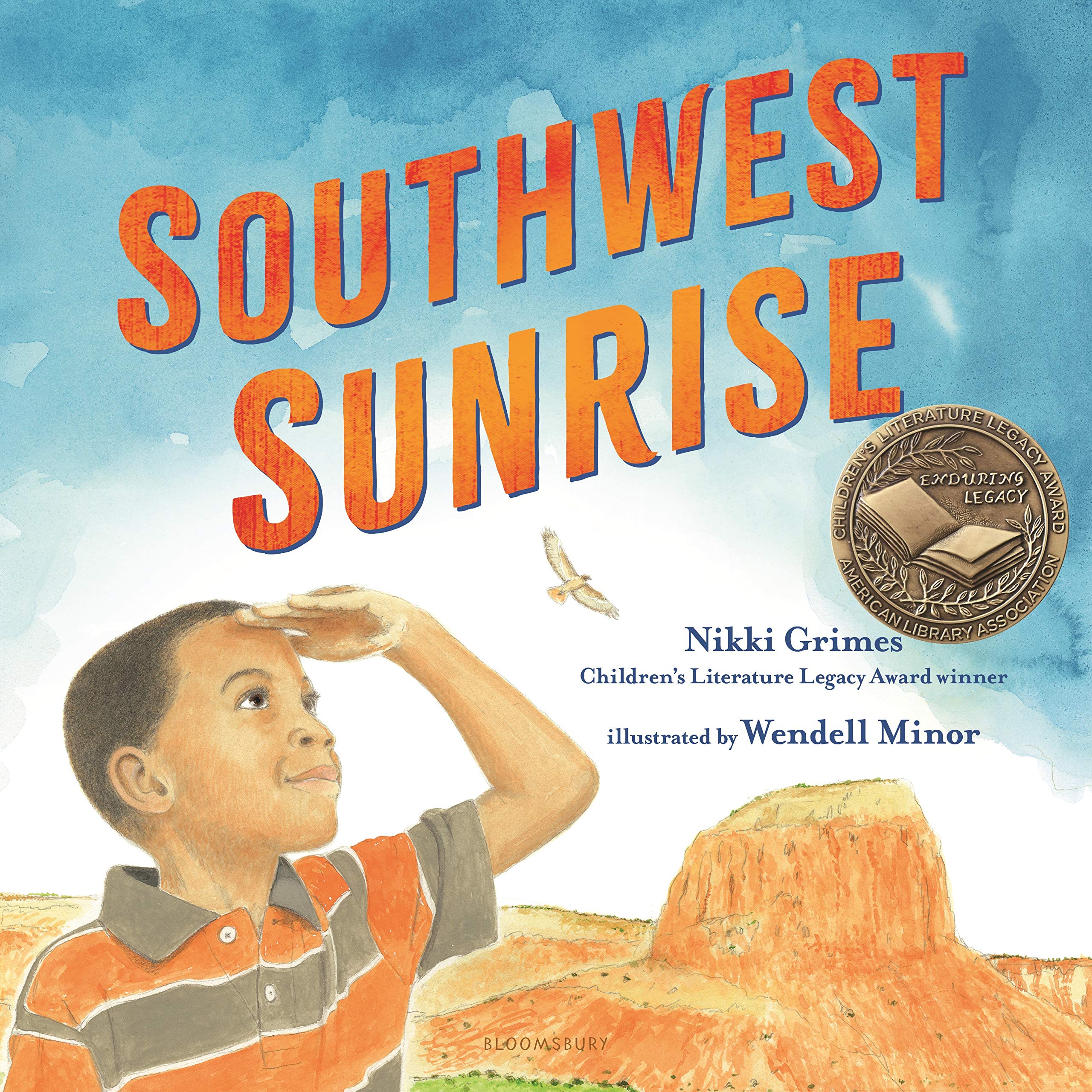
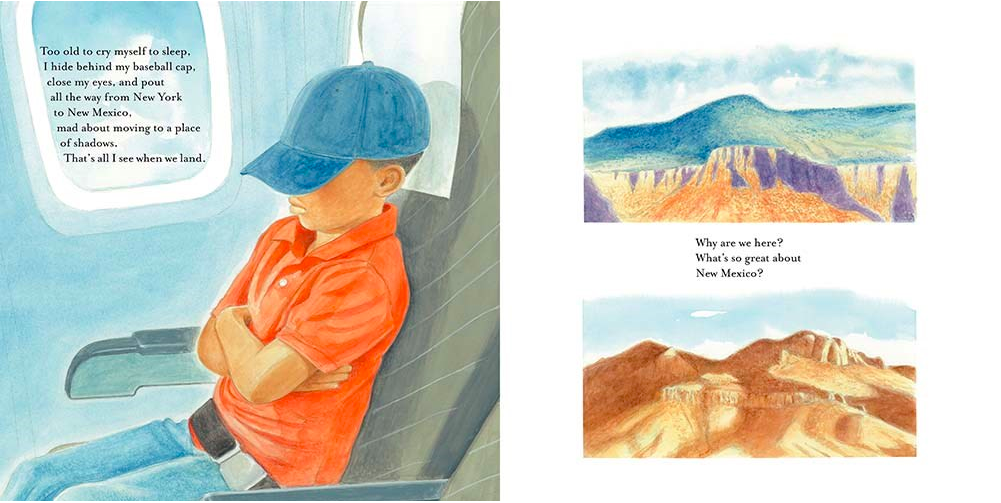
Jayden mopes all the way from New York to New Mexico, upset about moving from his beloved city to “a place of shadows.” Shadows and drabness are all he sees when he gets off the plane. In the morning, though, he wakes up “to a knife of sunlight slicing through” his room. Here, his window doesn’t have bars, and the view is of a “mountain striped in rainbow.” Jayden is surprised; he didn’t know that was there.

celebrate-picture-books-picture-book-review-southwest-sunrise-moving

Image copyright Wendell Minor, 2020, text copyright Nikki Grimes, 2020. Courtesy of Bloomsbury Children’s Books.

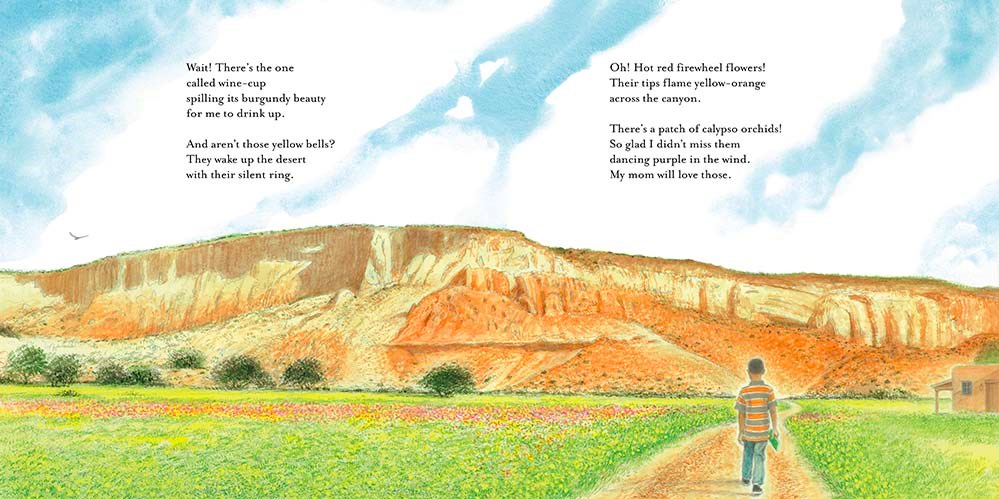
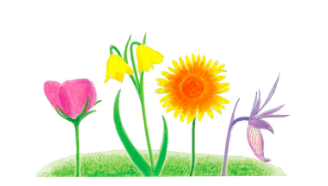
A string of chili peppers brightens the kitchen. Jayden isn’t optimistic that he’ll see any other colors in his new desert surroundings. His mom gives him a field guide to New Mexico at breakfast, and as he pages through it he doesn’t really think he’ll find any of the colorful flowers inside. But then, as he looks around, he spies the burgundy wine-cup and yellow bells that “wake up the desert with their silent ring.” He finds more flowers from the book that add red and purple to the landscape.

celebrate-picture-books-picture-book-review-southwest-sunrise-firewheel-flowers

Image copyright Wendell Minor, 2020, text copyright Nikki Grimes, 2020. Courtesy of Bloomsbury Children’s Books.

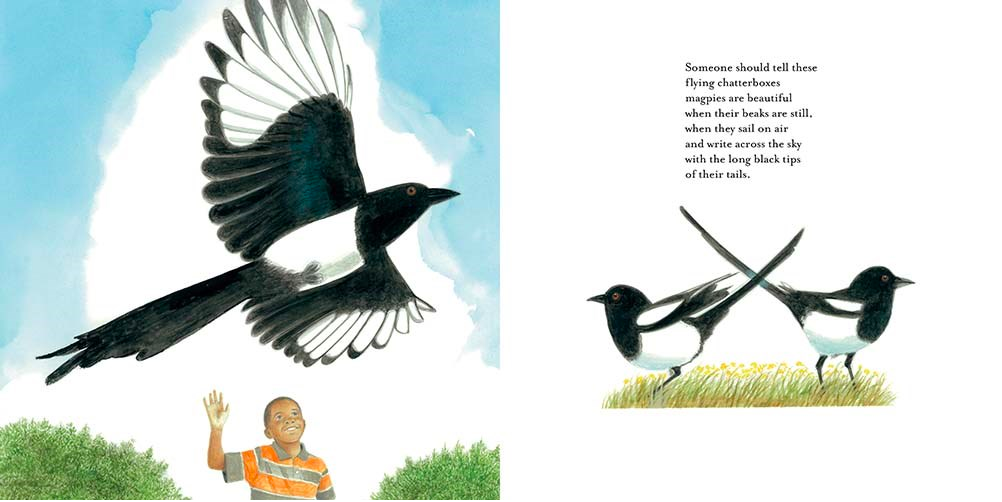
Jayden walks on, farther away from his new house. The unfamiliar silence is broken by “the mad chatter of winged gossips passing secrets” from one piñon tree to another. He watches the long-tailed magpies swoop through the “deep waves of turquoise overhead” and wonders why he never saw so much sky in New York. Still, he misses looking up and seeing the grandeur of the skyscrapers.

celebrate-picture-books-picture-book-review-southwest-sunrise-magpies

Image copyright Wendell Minor, 2020, text copyright Nikki Grimes, 2020. Courtesy of Bloomsbury Children’s Books.

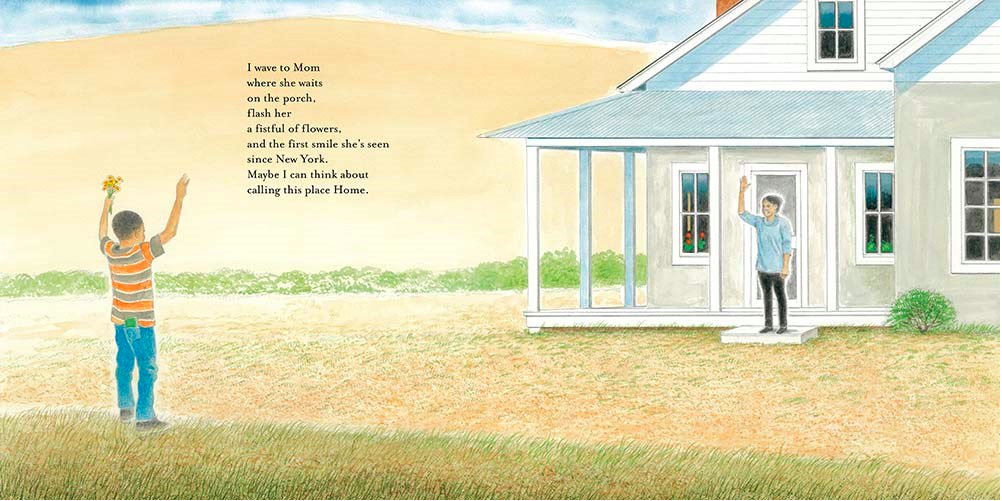
Looking down again, Jayden finds a striped lizard that seems happy to run along his hand, tickle his fingers. Instead of seashells, he finds bones and an abandoned turtle shell. “What stories do they have to tell?” he wonders. He continues his walk and, upon turning the corner, finds himself in the shadow of a different kind of skyscraper—rugged, red, and rocky. On the air, Jayden hears his mom calling. He picks some flowers the colors of sunset to take home to her. He waves as he nears the house and sees her standing on the porch and flashes her “the first smile she’s seen since New York.” He thinks that maybe New Mexico can be Home.

celebrate-picture-books-picture-book-review-southwest-sunrise-mom

Image copyright Wendell Minor, 2020, text copyright Nikki Grimes, 2020. Courtesy of Bloomsbury Children’s Books.

Nikki Grimes’ lyrical story is in plot a tale about moving from one part of the country to another, but in spirit it is a invitation for children and adults alike to open their heart to new experiences, to find the beauty in the unfamiliar and the joy in the unexpected. As Jayden journeys from New York to New Mexico and then around his new environment, Grimes explores honest emotions—the disappointment and anger change can bring, the preconceived ideas about the unknown that can color feelings and actions, and even that moment when a person can reject or accept the new circumstance or opportunity. As a poet, Grimes excels at the perfectly chosen detail and sublime description. Here, her words put readers in the spotlight of New Mexico’s laser sun, let them feel the skittering feet of a lizard, meet a haughty raven, and bask in the rainbow of colors Jayden never expected he’d see. His final smile and resolve to give his new city a chance fulfills the new dawning inherent in the title and is uplifting encouragement for all.

celebrate-picture-books-picture-book-review-southwest-sunrise-flowers

Slouched down in his airplane seat, baseball cap pulled low over his eyes, Wendell Minor’s Jayden is a picture of despondency. But things begin to look brighter when, in the morning, he notices the mountains and colors he missed the night before. Minor’s sun-washed illustrations allow readers to discover the beauty of the New Mexico desert along with Jayden. His new home is light and open, with a timbered ceiling and windows free of the bars he’s used to. Minor’s use of perspective allows children to view sweeping vistas of the desert landscape as well as images of some of the creatures found there. Putting the raven front and center gives kids an idea of the size and attitude of this striking bird. Fiery reds and oranges, vivid yellows, pinks, and purples, and glorious blues punctuate the sandy backdrop as Jayden’s thoughtful expressions depict his growing appreciation for his new home.

An exquisite book for any child, whether they are moving to a new home, exploring new experiences, or keen observers of their surroundings, Southwest Sunrise would be a joyful addition to home, school, and public library collections.

Ages 3 – 6

Bloomsbury Children’s Books, 2020 | ISBN 978-1547600823

Discover more about Nikki Grimes  and her books as well as educator guides and resources on her website.

To learn more about Wendell Minor, his books, and his art, visit his website.

National Get Outdoors Day Activity

Screen Shot 2020-07-11 at 9.36.56 PM

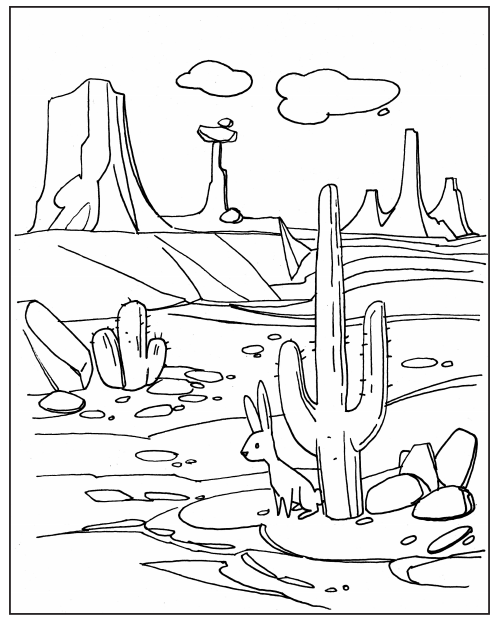
Beautiful Desert Coloring Pages


The desert has plants, animals, and landmarks seen nowhere else. Grab your crayons or pencils and give these two printable scenes some of its unique color.

Curious Rabbit Desert Scene | Western Sun Desert Scene

celebrate-picture-books-picture-book-review-southwest-sunrise-cover

You can find Southwest Sunrise at these booksellers

Amazon | Barnes & Noble | Books-a-Million

To support your local independent bookstore, order from

Bookshop | IndieBound

Picture Book Review

June 8 – World Oceans Day

celebrate-picture-books-picture-book-review-ocean-soup-cover

About the Holiday

Since 1992, The United Nations has sponsored World Oceans Day on this date to raise awareness of the importance of the Earth’s seas. Institutions, science centers, schools, research centers, businesses, governments, and communities around the world take part in special events, webinars, meetings, a photography contest, and other programs. This year’s theme is “The Ocean: Life and Livelihoods” and sheds “light on the wonder of the ocean and how it is our lifesource, supporting humanity and every other organism on earth.” This year’s virtual program begins at 10:00 a.m. and features a line up of thought-leaders, celebrities, community activists, entrepreneurs, and industry experts. The day ends with a concert given by musical artists from around the world. For more information on World Oceans Day, visit the UN World Oceans Day website. For educational resources, click here. To see the schedule of events, click here.

Ocean Soup: A Recipe for You, Me, and a Cleaner Sea

Written by Meeg Pincus | Illustrated by Lucy Semple


“From afar the vast ocean appears pure and clean. / How if sparkles and shimmers—a beautiful scene.” But what will you find if you look at just a small portion of the ocean—even a tiny drop—up close? Under a microscope, “the sea looks more like…soup” with “ingredients” that have been simmering for decades. And what’s in this soup? Many “chefs” have created it with Styrofoam cups and their lids; single-use bottles, bags, and straws; microbead soaps, synthetic materials, and balloons.

celebrate-picture-books-picture-book-review-ocean-soup-microscope

Image copyright Lucy Semple, 2021, text copyright Meeg Pincus, 2021. Courtesy of Sleeping Bear Press.

“The real problem is plastic; it’s in all that stuff. Whether hard or elastic, that plastic is tough!” Dumps around the world are overflowing with plastic, and much of it ends up in the ocean “churning round the five gyres— / the huge saltwater whirlpools / where breakdown transpires.” As the plastic churns under the sun, it turns into “specks” that can’t be removed. This plastic soup is “…gulped by the dolphins, the whales, and the seals, / and it’s slurped by the fish, / and the plankton and eels.”

celebrate-picture-books-picture-book-review-ocean-soup-beach

Image copyright Lucy Semple, 2021, text copyright Meeg Pincus, 2021. Courtesy of Sleeping Bear Press.

This confetti of plastic is found above the water in icebergs and deep on the ocean floor. If it’s in the fish that we eat, “is it in you and me” too? To clean up the oceans, we need new chefs and a new recipe for ending the manufacturing of plastic, practicing new habits with sustainable, reusable materials, and refusing products packaged in plastic. “Ocean soup may have simmered before we were here, / but the call for us all to pitch in rings out clear.”

Extensive backmatter includes an author’s note; a discussion about the invention of plastics and the astounding amount of “‘plastic smog'” that is in the ocean, as well as a description of how gyres break down plastic into tiny particles. Readers also learn what eight types of plastic are the worst polluters and are given ten steps for reducing daily plastic use. 

celebrate-picture-books-picture-book-review-ocean-soup-gyres

Image copyright Lucy Semple, 2021, text copyright Meeg Pincus, 2021. Courtesy of Sleeping Bear Press.

Meeg Pincus’s eye-opening comparison between the ocean and a pot of soup gives young readers crucial information about the plight of our oceans that is easy to understand and visualize. Her entreaty to look closely at what lies beneath the shimmering blue surface of the water grabs readers’ attention, and her short history of how and when plastics came on the scene provides context and perspective. The plastics Pincus mentions show the magnitude of the problem, and kids will be familiar with most if not all of these products. Pincus’s unstinting rhyming verses present the science of how plastic is shredded by the sea, where it ends up, and how it is ingested by ocean creatures in a way that is sure to spur readers to action. Her examples of ways we can reduce our plastic use within the story and in the backmatter empowers readers of all ages to make changes to protect the Earth’s oceans now and for future generations.

Lucy Semple’s bold illustrations show kids exactly how pervasive the kinds of containers, toys, wrappers, and other plastic products that are polluting our oceans really are and how blithely we use them. Through successive panels she demonstrates how plastic bags, bottles, straws, and cups break apart due to sun and water currents, and a double-spread map orients kids to where the five gyres are found. Images of sea creatures gulping down the tiny shards of plastic are effective and will resonate with children, as will the final pages where readers will find reinforcement for new habits of using and promoting recycled and reusable products.

An excellent overview of and introduction to the crisis of plastics in the world’s oceans, Ocean Soup: A Recipe for You, Me, and a Cleaner Sea will spark in readers a desire to embrace more sustainable products, adopt better recycling habits, and take action to reduce plastics use. The book would be an impactful way to begin science, environment, history, and other cross-curricular lessons as well as a jumping off place for more extensive research in classrooms and for homeschoolers. Ocean Soup is highly recommended for home bookshelves and is a must for school and public library collections.

Ages 6 – 9 

Sleeping Bear Press, 2021 | ISBN 978-1534111189

Discover more about Meeg Pincus and her books on her website.

You can connect with Lucy Semple on Instagram and Twitter.

World Oceans Day Activity

celebrate-picture-books-picture-book-review-Turtle-Swimming-coloring-page

Sea Creatures Coloring Pages


Grab your crayons and enjoy these printable coloring pages of favorite sea creatures!

Fish | Octopus | Seahorse | Turtle

celebrate-picture-books-picture-book-review-ocean-soup-cover

You can find Ocean Soup: A Recipe for You, Me, and a Cleaner Sea at these booksellers

Amazon | Barnes & Noble | Books-a-Million

To support your local independent bookstore, order from

Bookshop | IndieBound

Picture Book Review

June 5 – World Environment Day

celebrate-picture-books-picture-book-review-this-little-environmentalist-cover

About the Holiday

Sponsored by the United Nations, World Environment Day encourages worldwide awareness and action for the protection of the environment. Each year a different country hosts the day’s events. This year Pakistan has been chosen as the host country. Today’s holiday also launches the UN Decade on Ecosystem Restoration, which runs from 2021 to 2030 and “aims to prevent, halt, and reverse the degradation of ecosystems on every continent and in every ocean.” This work is crucial to the survival of our planet. The statistics are alarming. Studies have found that every three seconds the world loses enough forest to cover a soccer field and over the last century, half of our wetlands and as much as fifty per cent of our coral reefs have been destroyed. This year’s theme is “Reimagine. Recreate. Restore.” Everyone is needed to make a difference. You can learn more about World Environment Day, the UN Decade on Ecosystem Restoration, and how you can join the #GenerationRestoration movement on the UN World Environment Day website.

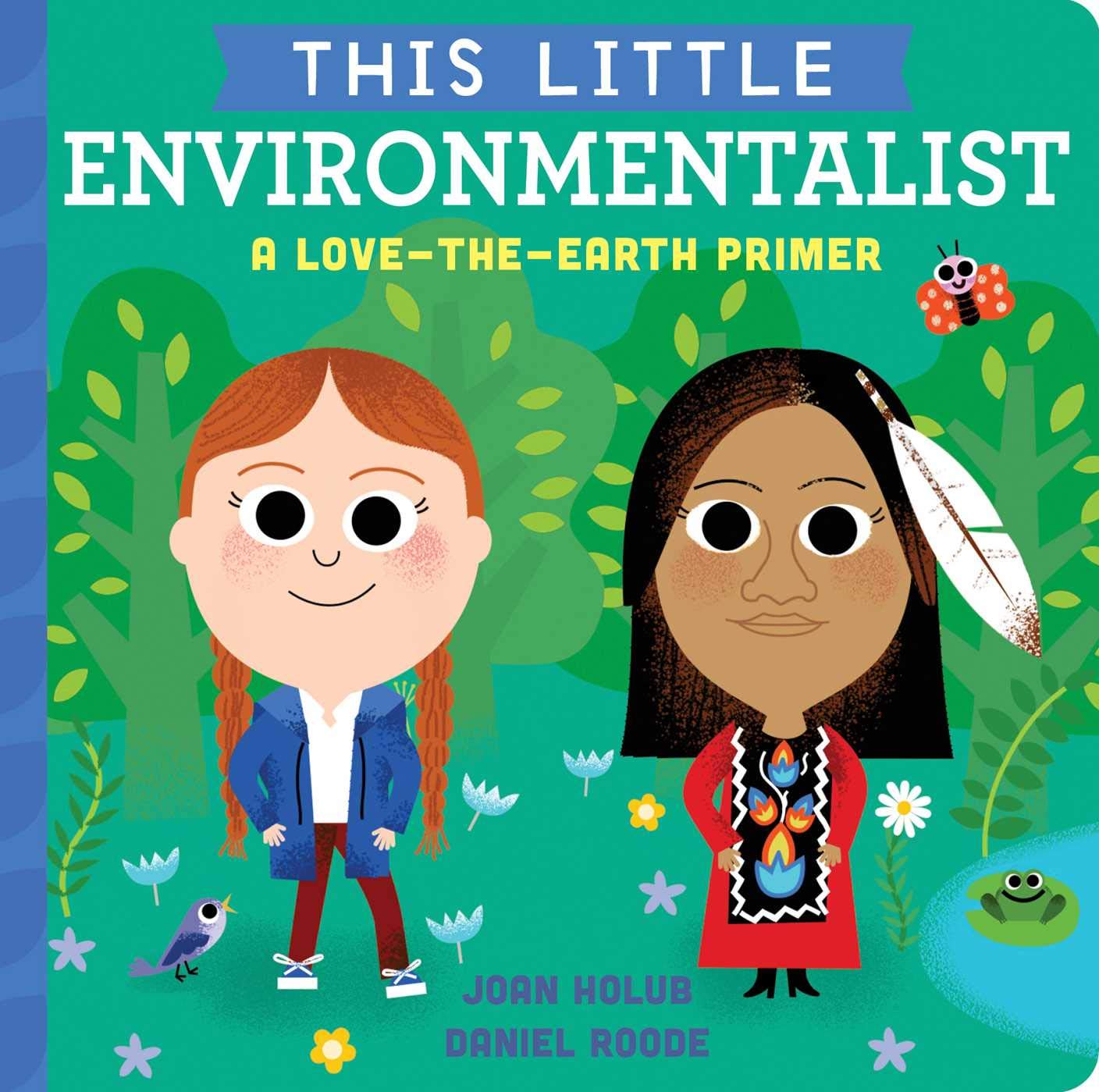
This Little Environmentalist: A Love-the-Earth Primer

Written by Joan Holub | Illustrated by Daniel Roode


Take any little one outside and they’re immediately fascinated with plants, animals, and bugs they see. They want to play in the water at the beach or lake. And who doesn’t like to take a boat ride on a river? When they look up, there are fluffy clouds and birds passing by, and, of course, the tall trees provide shade for outdoor play. Kids instinctively want to protect nature and seem to be born with compassion for animals – their pets and those that live in the wild. 

celebrate-picture-books-picture-book-review-this-little-environmentalist-sylvia-earle

Image copyright Daniel Roode, 2021, text copyright Joan Holub, 2021. Courtesy of Little Simon.

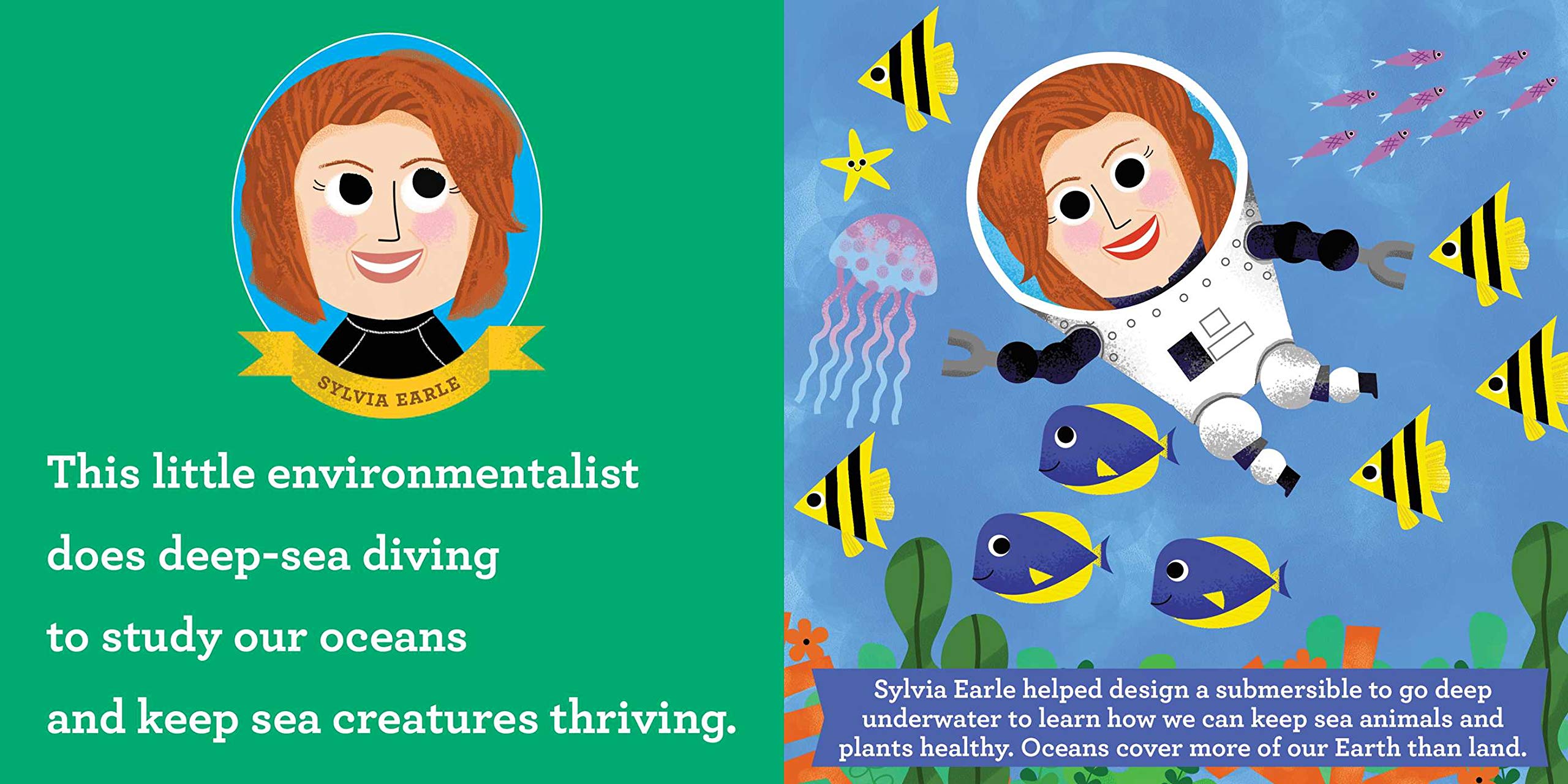
This Little Environmentalist: A Love-the-Earth Primer recognizes young children’s desire to help and learn more about nature with mini-biographies of ten people who have found distinct ways to preserve the environment today and for future generations. Each biography is introduced with a rhyming verse that makes it easy for little readers to understand and remember how each of these activists made an impact. They then learn more specifics about each person’s work to protect open land, inspire new environmental laws, save forests, support clean water, and fight against climate change.
celebrate-picture-books-picture-book-review-this-little-environmentalist-wangari-maathai

Image copyright Daniel Roode, 2021, text copyright Joan Holub, 2021. Courtesy of Little Simon.

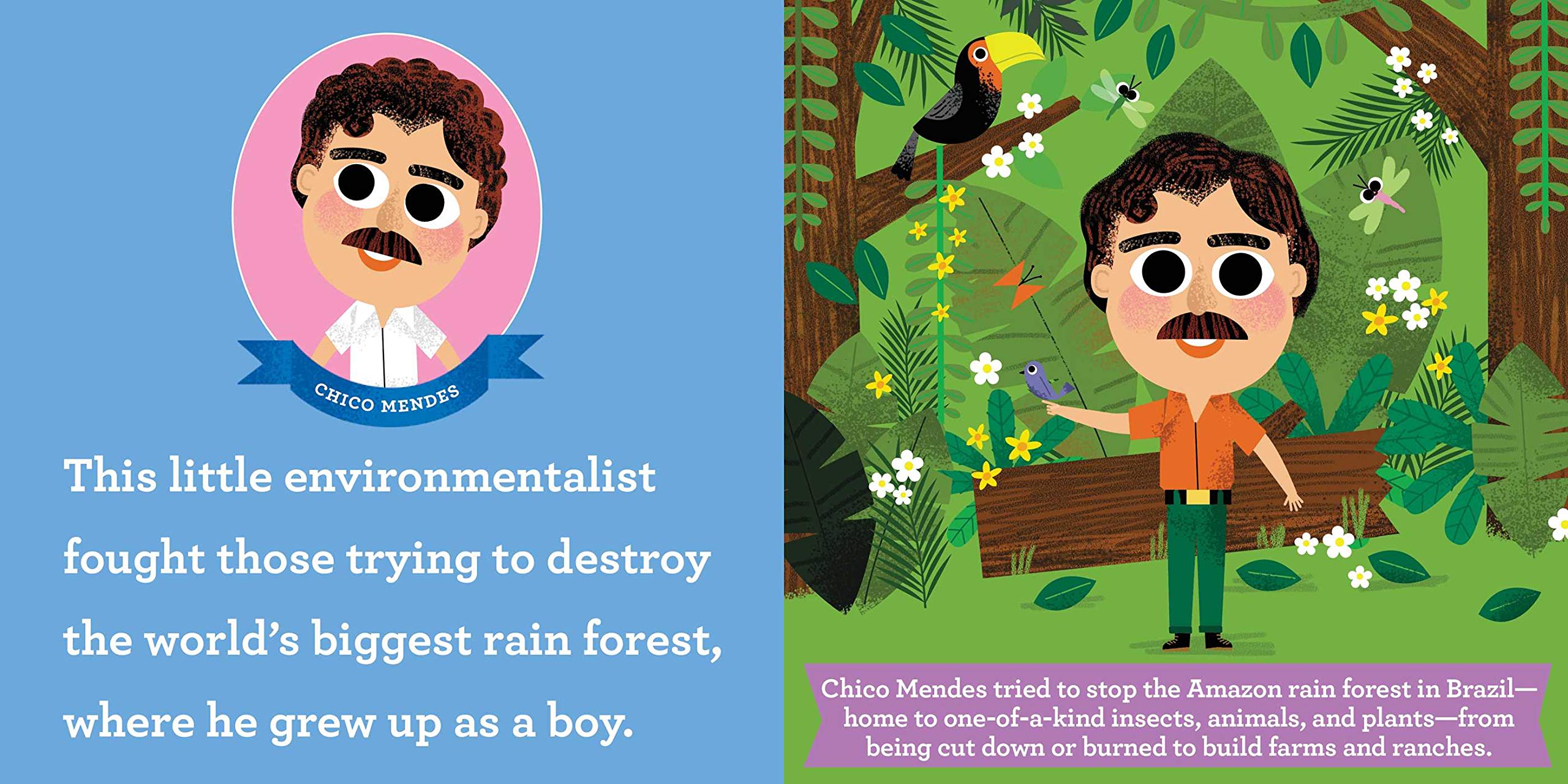
Children learn about Edgar J. Helm, who created the Goodwill company that provided jobs and decreased trash; Wangari Maathai, who “got African women to plant millions of trees in Kenya to provide fruit, shade from the sun, wood for building , and firewood for cooking”; Vandana Shiva, who encourages farmers and communities to create seed banks for the future; Miranda Wang and Jeanny Yao who have devised a way to “break down hard-to-recycle plastic trash”; and six more influential environmentalists.

Following these ten biographies are one– or two-sentence profiles of seventeen other people, including writers, artists, politicians, scientists, and other visionaries who are involved in protecting our earth. The last frame is left blank for the next environmentalist on the scene – could it be you?

celebrate-picture-books-picture-book-review-this-little-environmentalist-chico-mendes

Image copyright Daniel Roode, 2021, text copyright Joan Holub, 2021. Courtesy of Little Simon.

With her straightforward and informative text, Joan Holub will inspire kids to follow in the footsteps of well-known personalities and community leaders and keep an eye out for ways they can make a difference at home, school, or in their neighborhood. Inclusion of environmentalists from around the world give readers knowledge about a wide range of environmental concerns and innovative ideas people have for addressing them.

Daniel Roode’s bright and engaging illustrations help kids visualize the place where each environmentalist lives and the type of work they do. Background details give kids and adults plenty to talk about as they read and as they take walks in the neighborhood, go to the park, visit the grocery story and farmers market, and notice more about their own area.

A smart, inclusive, and timely addition to the This Little series, This Little Environmentalist: A Love-the-Earth Primer is a must for fans of the series as well as for classroom and public library collections.

Ages 3 – 5

Little Simon, 2021 | ISBN 978-1534475588

World Environment Day Activity

celebrate-picture-books-picture-book-review-recycling-maze

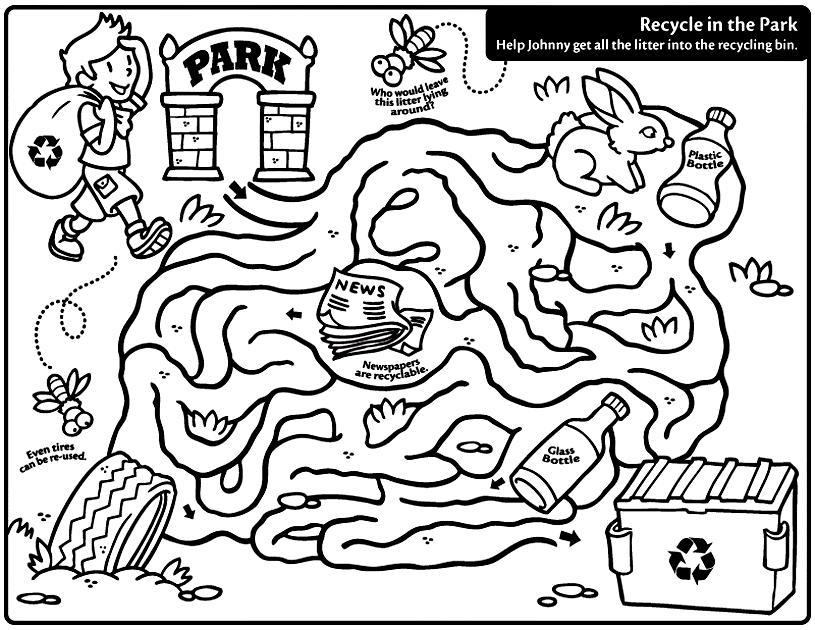
Recycling Maze


This little boy wants to help the environment! Can you help him pick up recyclable items in this printable maze?

Recycling Maze

celebrate-picture-books-picture-book-review-this-little-environmentalist-cover

You can find This Little Environmentalist at these booksellers

Amazon | Barnes & Noble | Books-a-Million

To support your local independent bookstore, order from

Bookshop | IndieBound

Picture Book Review