November 23 – Fibonacci Day

celebrate-picture-books-picture-book-review-blockhead-the-life-of-fibonacci-cover

About the Holiday

Today’s holiday is dedicated to the man—Leonardo of Pisa, today known as Fibonacci—who promoted awareness throughtout Europe of the number sequence that now bears his name. First appearing in Indian mathematics and linked to the golden triangle and the golden ratio, the number pattern states that each consecutive number in the series is the sum of the two preceding numbers: 1, 2, 3, 5, 8, 13, 21, 34…. This sequence is found again and again in nature in such arrangements as leaves on a flower stem, seeds in a sunflower, the tapering of a pinecone, the swirl of a seashell, and manys. These precise compositions allow each leaf to get enough sunlight, make room for the correct number of petals, or squeeze in as many seeds as possible. To celebrate, learn more about this sequence and then observe patterns in nature. A good place to start is with today’s book!

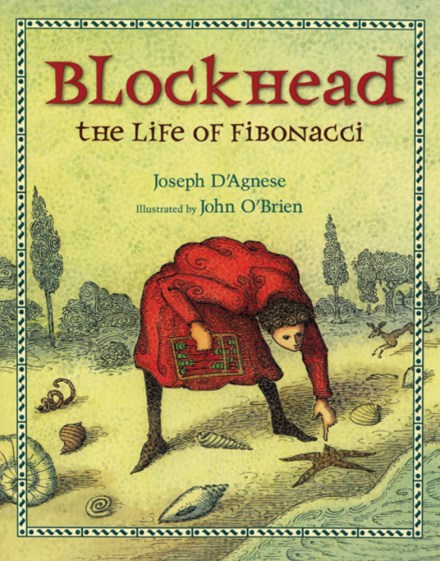
Blockhead: The Life of Fibonacci

Written by Joseph D’Agnese | Illustrated by John O’Brien


Leonardo Fibonacci introduces himself this way: “You can call be blockhead. Everyone else does.” He goes on to reveal that he acquired that nickname because he loved to think about numbers. Once when his teacher gave the class ten minutes to solve a math problem, he knew the answer in two seconds. At home he counted everything he saw. When he was bored his mind pondered the patterns he saw. For instance, on that school day while his classmates worked on the problem, Leonardo spent the time gazing out the window. H e noticed 12 birds sitting in a tree. How many eyes was that? How many legs? “And if each bird sang for two seconds, one bird after the other, how long would it take all of them to sing?” He was counting these answers in his head when his teacher yelled, “‘How dare you daydream in my class!’” He told Leonardo there would “‘be no thinking in this classroom—only working! You’re nothing but an absent-minded, lazy dreamer, you…you BLOCKHEAD!’”

celebrate-picture-books-picture-book-review-blockhead-the-life-of-fibonacci-story-starts

Image copyright John O’Brien, courtesy of Henry Holt and Company

Leonardo ran from the room into the city he loved—Pisa, one of the greatest cities in 1178 Italy. A new tower was being constructed—although the builders were having trouble with their math and the tower stood at an angle. He was so enthralled with the math he saw all around him that he nearly walked into danger. “‘What are you, a blockhead?’” a woman shouted. Leonardo’s father was angry and embarrassed by his son’s reputation in town. He wanted Leonardo to become a merchant, and took him to northern Africa to learn the business.
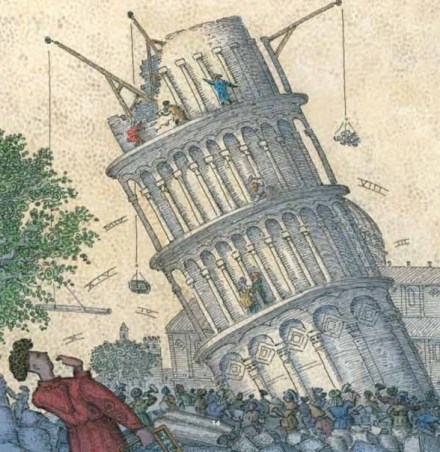
celebrate-picture-books-picture-book-review-blockhead-the-life-of-fibonacci-tower-of-pisa

Image copyright John O’Brien, courtesy of Henry Holt and Company

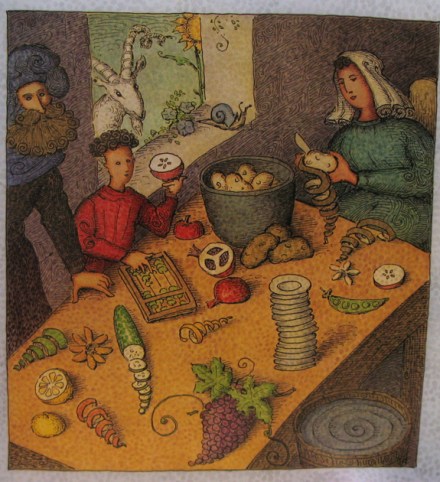
In Africa Leonardo learned a new number system. Instead of Roman numerals, the people used numbers “they had borrowed from the Hindu people of India.” In this system XVIII became the much easier 18. During the day Leonardo handled his father’s business accounts, but at night Alfredo, his father’s advisor and Leonardo’s champion, accompanied him as he learned the new number system. As Leonardo grew older, his father sent him on trips to other countries to conduct business. In each Leonardo learned new mathematics concepts. In Egypt he learned about fractions. In Turkey and Syria he discovered methods of measurement. In Greece he learned geometry, and in Sicily he used division and subtraction.
celebrate-picture-books-picture-book-review-blockhead-the-life-of-fibonacci-kitchen

Image copyright John O’Brien, courtesy of Henry Holt and Company

One day Leonardo “began to write a book about Hindu-Arabic numerals” and included riddles to demonstrate the ideas. One was about a pair of rabbits. Leonardo asked Alfredo to tell him how many baby rabbits would be born within one year if it took a baby one month to grow old enough to have babies of its own and one more month to have a pair of babies. Alfredo tried to solve it but couldn’t. As Leonardo explained the sequence of adult pairs and baby pairs of rabbits to Alfredo, he noticed a pattern. At the end of month two, there would be 1 grown-up pair of rabbits and 1 baby pair; at the end of month three there would be 2 grown-up pairs and 1 baby pair; at the end of month 4 there would be 3 grown-up pairs and 2 baby pairs…. Leonardo saw that by adding “any two consecutive numbers in the pattern,” you’d get the next correct number. This discovery made solving the problem even easier.
celebrate-picture-books-picture-book-review-blockhead-the-life-of-fibonacci-sea-shells

Image copyright John O’Brien, courtesy of Henry Holt and Company

Leonardo’s work with math soon spread across Europe. Frederick II, the ruler of the Holy Roman Empire invited Leonardo to visit. There Frederick’s wise men challenged him with math problems that were no match for Leonardo’s quick brain. Frederick II didn’t call Leonardo a blockhead, instead he said he was “‘one smart cookie.’” When Leonardo went home, however, the people of Pisa grumbled and complained. They thought the old Roman numerals were good enough.

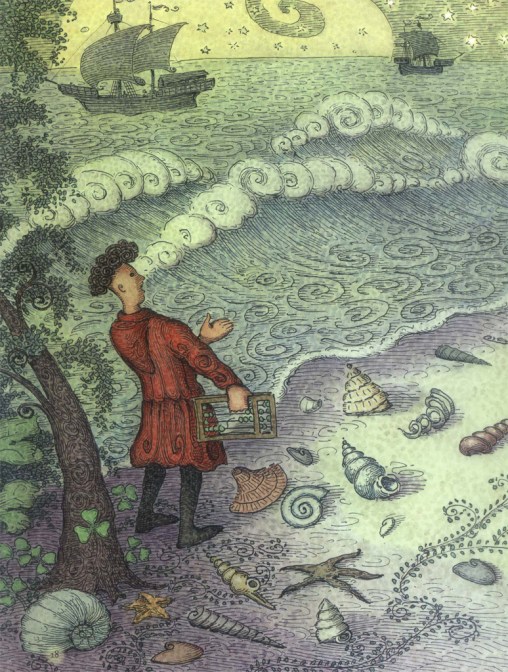
Leonardo set out to prove how valuable Hindu-Arabic numerals were. He began observing nature, and everywhere, from the petals of a flower to the arms of a starfish to the seeds in an apple, Leonardo discovered the same numbers—the sequence he had discovered in the rabbit riddle. He realized that these numbers could be used in different ways—to draw a spiral; the same type of spiral found within pinecones and the center of a sunflower.
celebrate-picture-books-picture-book-review-blockhead-the-life-of-fibonacci-old-man

Image copyright John O’Brien, courtesy of Henry Holt and Company

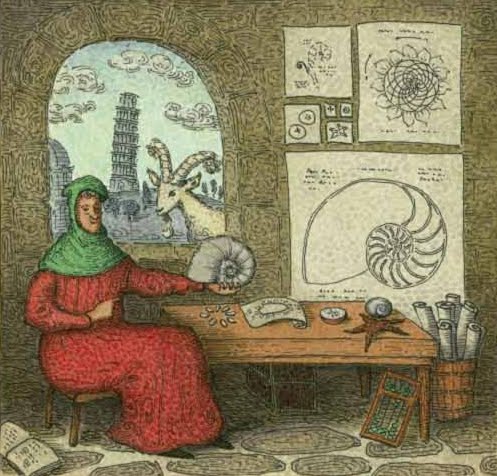
Leonardo finishes his story by relating that even though he is now old, numbers still delight him, as does the secret Mother Nature cleverly uses to organize the world and even the universe. He invites readers to look again through his story and find the places where his Fibonacci sequence appears.

More biographical information about Leonardo of Pisa plus a discussion of where readers can find Fibonacci number patterns in nature and a scavenger hunt through the book follow the text.

Blockhead: The Life of Fibonacci is an engaging, accessible biography that describes this mathematical scholar’s life and theory in a clear and entertaining way, whether their thing is math and science or English, history, and art. Joseph D’Agnese immediately entices kids into the story with the revelation of how Leonardo acquired the nickname that gives the book its title. Using anecdotes such as the birds in the trees and the rabbit riddle, he invites readers to think like Fibonacci, leading to a better understanding and enjoyment of his life story and the mathematical concept. The idea of using your talents and passions wherever you are—as Leonardo does in his work for his father—is a valuable lesson on its own.

John O’Brien’s wonderfully detailed illustrations take children back to early Italy and the Mediterranean with his depictions of Leonardo’s school and town, as well as the under-construction Tower of Pisa and the influential cultures of other countries he visited. Cleverly inserted into each page are examples of the Fibonacci sequence at work—in whorls of wood grain, the spirals of women’s hats, the web of a spider and horns on a passing goat, and so many more. The rabbit riddle is neatly portrayed for a visual representation of the math involved, and the way nature uses the pattern is also organically portrayed. Children will love searching for and counting the various ways Fibonacci’s seuqence is used throughout the illustrations.

Blockhead: The Life of Fibonacci is a fantastic book to share with all children, especially as they begin to learn mathematical problem solving, the value of math, how it is used, and how it occurs naturally in the world. The book makes a marvelous teaching resource and addition to classroom libraries and also a great addition to home bookshelves.

Ages 5 – 9

Henry Holt and Company, 2010 | ISBN 978-0805063059

To discover more books by Joseph D’Agnese for children and adults visit his website!

Find a vast portfolio of cartoon and illustration work by John O’Brien for kids and adults on his website!

Watch the Blockhead: The Life of Fibonacci book trailer!

Fibonacci Day Activity

celebrate-picture-books-picture-book-review-spiral-coloring-page

Spiral Coloring Page


Have fun coloring this printable Spiral Coloring Page that is inspired by Leonardo Fibonacci’s work.

Picture Book Review

November 14 – International Girls Day

celebrate-picture-books-picture-book-review-women-in-science-cover

About the Holiday

Today’s holiday recognizes the spirit of girls and encourages girls and young women to pursue their dreams, talents, and abilities with the slogan “She Can Do Anything.” Around the world young women have a long way to go to overcome the stereotypes, conditions, and pressures in the media and other organizations that keep them from receiving an equal education and from both attempting and succeeding in their desired profession. Today, celebrate the uniqueness of the girls and women in your life, listen to what they really want and want to accomplish, and support them.

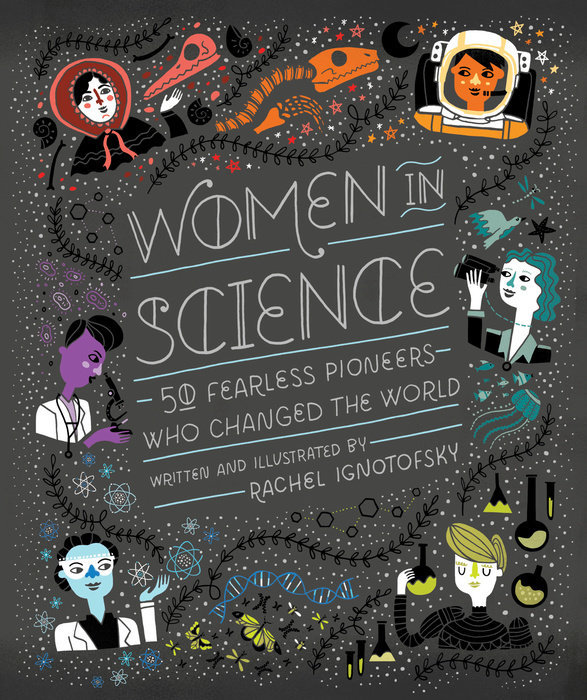
Women in Science: 50 Fearless Pioneers Who Changed the World

By Rachel Ignotofsky


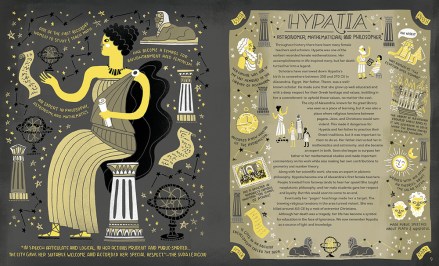
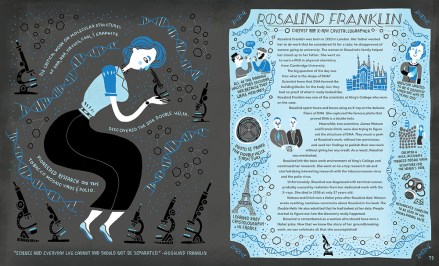
“Nothing says trouble like a woman in pants.” With this revealing attitude from the 1930s, Rachel Ignotofsky introduces her scintillating biographies of 50 intelligent, self-confident, persevering, and inspiring women working in engineering, math, medicine, psychology, geology, physics, astronomy, and more sciences from ancient history through today. The book begins with Hypatia who lived in Greece in the late 300s to early 400s CE and became an expert in astronomy, philosophy,and mathematics, making “contributions to geometry and number theory.” She became one of Alexandria’s first female teachers, “invented a new version of the hydrometer,” and can be found among the intellects in Raphael’s painting “The School of Athens.”

celebrate-picture-books-picture-book-review-women-in-science-hypatia

Image and text copyright Rachel Ignotofsky, courtesy of rachelignotofskydesign.com

Zipping ahead to 1647 readers find Maria Sibylla Merian, considered one of the “greatest scientific illustrators of all time.” Her specialty was entomology. By carefully documenting the lifespan of butterflies, she taught people about the science of metamorphosis, publishing a book on the subject filled with notes and illustrations in 1679. Later she scoured the rainforests of South America, gathering information on never-before-seen insects from that region. Her book, The Metamorphosis of the Insects of Suriname “was published in 1705 and became a hit all over Europe.” Maria was so famous, her picture appeared on German money and stamps.

celebrate-picture-books-picture-book-review-women-in-science-mary-anning

Image and text copyright Rachel Ignotofsky, courtesy of rachelignotofskydesign.com

Other women in the nature sciences include Mary Anning, who as a child discovered the first complete ichthyosaur skeleton and went on to become a paleontologist; Mary Agnes Chase, a botanist and expert on grasses; Marjorie Stoneman Douglas, who as a conservationist helped save the Florida Everglades; and Joan Beauchamp Procter, a zoologist specializing in reptiles who discovered the Peninsula Dragon Lizard in 1923; and more.

celebrate-picture-books-picture-book-review-women-in-science-marie-curie

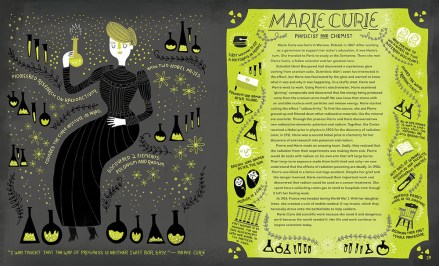
Image and text copyright Rachel Ignotofsky, courtesy of rachelignotofskydesign.com

One of the earliest women astronomers and mathematicians was Wang Zhenyi, born in China in 1768. Creating her own eclipse model, she proved her advanced “theories about how the moon blocks our view of the sun—or the earth blocks the sun’s light from reaching the moon—during an eclipse.” She also measured the stars and explained the rotation of the solar system. At the age of 24 she published the 5-volume Simple Principles of Calculation. Zhenyi died at the age of 29, but in her short life she published many books on math and astronomy as well as books of poetry.

celebrate-picture-books-picture-book-review-women-in-science-patricia-bath

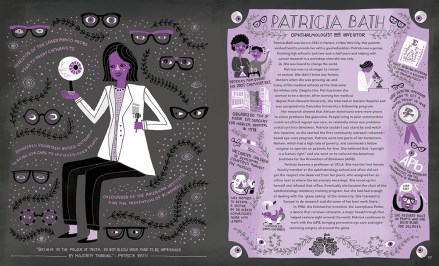
Image and text copyright Rachel Ignotofsky, courtesy of rachelignotofskydesign.com

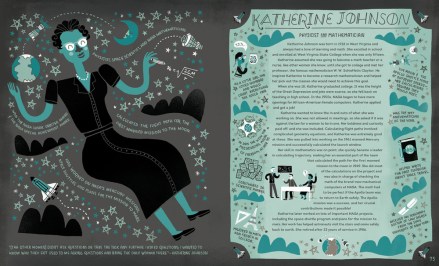
Women in Science includes many other women who have looked to the stars and mathematics for their careers. Some of these are: Ada Lovelace, the first person to write a computer program; Emmy Noether, who helped Albert Einstein develop his theory relativity, created the field of abstract algebra, and “made new connections between energy and time, and angular momentum”; Cecilia Payne-Gaposchkin a quantum physicist in 1900s England who “discovered that the sun is made mostly of hydrogen and helium gas” and in 1956 became Harvard University’s first astronomy professor; Mae Jemison, who in 1992 became the first African-American woman in space and later started her own technology consulting firm as well as founding BioSentient Corporation, and a science camp for kids; plus many others.

celebrate-picture-books-picture-book-review-women-in-science-rosalind-franklin

Image and text copyright Rachel Ignotofsky, courtesy of rachelignotofskydesign.com

The book also features Engineers, such as Hertha Ayrton who improved electric lights by inventing “a new rod that made a clean and quiet bright light” and the Ayrton fan that blew away mustard gas during World War I; and Lillian Gilbreth, who used her theories of “organizational psychology” in inventing the foot pedal for garbage cans, shelving for refrigerators, and even the “work triangle” for kitchens “that determines the distance from the sink to the stove” and saves time. There are Geneticists such as Nettie Stevens who discovered the “X” and “Y” chromosomes, and Barbara McClintock—the pants wearer from the beginning of the post—and the first person “to make a complete genetic map of corn” and discover jumping genes, or “transposons.”

The field of Medicine has benefited from women such as Elizabeth Blackwell, the first woman doctor; Alice Ball, a chemist and the first African-American woman to graduate from the University of Hawaii, who helped cure leprosy with her chemical work; and Gerty Cori who discovered how our bodies covert glucose, helping us better understand diabetes. In 1947 she became the first American woman to win a Nobel Prize.

celebrate-picture-books-picture-book-review-women-in-science-katherine-johnson

Image and text copyright Rachel Ignotofsky, courtesy of rachelignotofskydesign.com

And this list only begins to scratch the surface of all the fascinating stories of women who overcame social, political, and personal obstacles to follow where their intelligence took them. Inspirational, entertaining, and undeniably eye-catching Rachel Ignotofsky’s Women in Science presents expertly written, one-page biographies that hit all the high (and sometimes unfortunate low) points in these scientist’s lives. The striking layout of both the text and illustrations keep readers riveted to the page, The left-hand side contains a representational drawing of the scientist surrounded by the subjects and materials of her work as well as trivia about her and a quotation. On the right-hand page, small illustrated facts frame the woman’s life story.

Interspersed between the biographies are pages offering a timeline of women’s milestones, depicting lab tools, and graphing statistics of women in STEM. The back matter is impressive, with two more pages presenting 15 more scientists, a four-page, illustrated glossary, resources including films, websites, and books, and an index. Rachel Ignotofsky concludes her book by saying, “Let us celebrate these trailblazers so we can inspire the next generation. Together, we can pick up where they left off and continue the search for knowledge. So go out and tackle new problems, find your answers and learn everything you can to make your own discoveries!”

Ages 7 and up

Ten Speed Press, 2016 | ISBN 978-160774976

To discover more books by Rachel Ignotofsky, visit her website!

International Girls Day Activity

celebrate-picture-books-picture-book-review-scientists-word-search

What Kind of Scientist Would You Be? Word Search


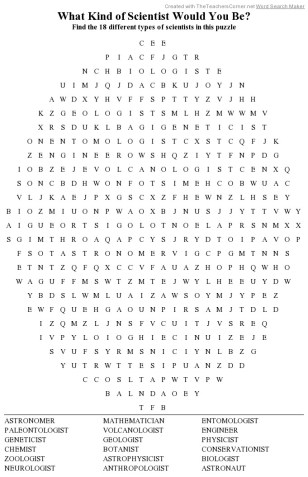
Find the 18 different scientists in this printable What Kind of Scientist Would You Be? Puzzle. Here’s the Solution!  Then pick one and write why you would like to be that type of scientist!

Picture Book Review

November 13 – World Kindness Day

celebrate-picture-books-picture-book-review-extra-yarn-cover

About the Holiday

Perhaps now—more than we’ve seen in a long time—the world needs a day of kindness. Today’s holiday was initiated in 1997 when a number of humanitarian groups made a Declaration of Kindness and dedicated themselves to paying goodness forward and sharing positivity. With so many ways to help our friends, neighbors, even strangers living both near and far away, it’s within each person’s grasp to make the world a better place for all. To learn more about World Kindness Day and ways that you can make a difference, visit Random Acts of Kindness.

Extra Yarn

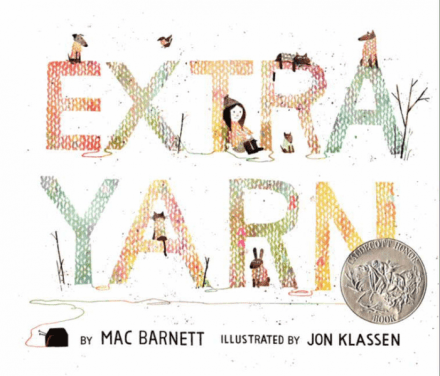
Written by Mac Barnett | Illustrated by Jon Klassen


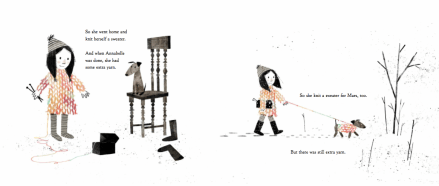
In the dulled world of winter, “Annabelle found a box filled with yarn of every color.” With it she knit herself a sweater, and because she had not run out of yarn, she knit a sweater for her dog, Mars, too. Afterwards, the two went for a walk, and Annabelle carried her box of yarn with her. They happened on Nate and his dog—dreary smudges against the monochrome landscape. “‘You two look ridiculous,’” Nate taunted. “‘You’re just jealous,’ said Annabelle.” Nate denied it, but after Annabelle knit him and his dog their own sweaters, they discovered she was right.

celebrate-picture-books-picture-book-review-extra-yarn-annabelle-knits-sweater

Image copyright Jon Klassen, text copyright Mac Barnett. Courtesy of harpercollinschildrens.com

These four sweaters hardly put a dent in the yarn in the box, so Annabelle took it to school. There, the kids in their dark, winter clothes couldn’t stop staring at and whispering about Annabelle. Their teacher, Mr. Norman, shouted for quiet. “‘Annabelle, that sweater of yours is a terrible distraction. I cannot teach with everyone turning around to look at you!’” Annabelle knew just what to do. The class—and even Mr. Norman—looked brighter with their new sweaters. “And when she was done, Annabelle still had extra yarn.”

celebrate-picture-books-picture-book-review-extra-yarn-mr-crabtree

Image copyright Jon Klassen, text copyright Mac Barnett. Courtesy of harpercollinschildrens.com

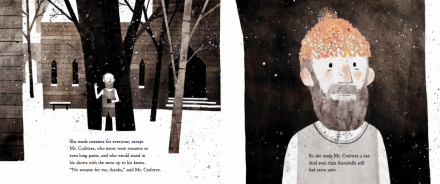
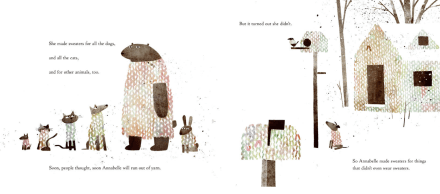
She began knitting sweaters for everyone in town. Mr. Crabtree was the only exception. Since he wore shorts and a t-shirt in even the snowiest weather, Annabelle knit him a cap to keep his bald head warm. When all the people were snug, Annabelle fashioned sweaters for all the animals—from the tiniest birds to the biggest bears. “Soon, people thought, soon Annabelle will run out of yarn. But she didn’t. So Annabelle made sweaters for things that didn’t even wear sweaters.” Suddenly, the town was no longer drab and lifeless.

celebrate-picture-books-picture-book-review-extra-yarn-annabelle-knits-animal=sweaters

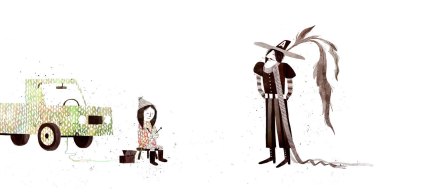
Word spread about Annabelle and her endless box of yarn. People came from all over to meet her and see her sweaters. The news even reached a clotheshorse of an archduke, who sailed his ship into port and demanded to see Annabelle. He offered her one million dollars for her box of yarn, but Annabelle turned him down. He raised his offer to two million, but Annabelle shook her head. “‘Ten million!’ shouted the archduke. ‘Take it or leave it!’” “‘Leave it,’ said Annabelle. ‘I won’t sell the yarn.’”

That night the archduke sent robbers to steal Annabelle’s box of yarn, and when they had it, the archduke sailed away under the dark cover of night. In his shadowy castle, the shady archduke opened the box. It was empty. In a fit of rage, he flung the box out the window into the sea, cursing Annabelle with eternal unhappiness. But the box found its way onto an ice floe, and it rode the current back to Annabelle, who was forever after happy.

celebrate-picture-books-picture-book-review-extra-yarn-archduke

Image copyright Jon Klassen, text copyright Mac Barnett. Courtesy of harpercollinschildrens.com

Mac Barnett’s extraordinary story of a box of yarn and a little girl that keeps giving despite teasing, challenges, and attempts to strip her of her gift is an uplifting reminder that even the simplest of gestures can create profound change. With the lilt of a fairy tale but the anchors of reality, Barnett’s tale offers a universal lesson that children and adults can use their individual talents to improve their own lives and those of others. The title of the book may be Extra Yarn, but the question remains: is it the yarn or Annabelle who is special? The final scene proves that goodness and kindness always win out and will find its way back to the giver.

Jon Klassen’s brown, stolid town seems poised to suck readers in to its close, silent emptiness until Annabelle discovers the box of yarn and knits herself a rainbow to wear. With Mars similarly outfitted, they return to the somber outside. Annabelle, at first the only bright spot in the town and school, quickly transforms her classmates and neighbors into colorful individuals with sweaters as unique as they are. After the homes, buildings, mailboxes, and birdhouses acquire their own cozies, the town looks open and inviting. Once the archduke arrives on the scene, the pages turn dusky and gray, but there is one point of light: in the black, nighttime sea the little box floats on an icy raft that shines in the full moonlight.

celebrate-picture-books-picture-book-review-extra-yarn-townspeople

Image copyright Jon Klassen, courtesy of macbarnett.com

Klassen adds plenty of visual humor here too, as when Mars tangles his yarn leash around a grove of trees, and the archduke demonstrates a penchant for monogramming all of his possessions. Kids will be delighted to see some of their favorite Klassen characters so dandily dressed, and the images of the students and townspeople connected by a leading thread of yarn may help them see that Annabelle not only knit them sweaters but made them a much closer-knit community as well.

Ages 3 – 8

Balzar + Bray, HarperCollins Childrens, 2012 | ISBN 978-0061953385

Want to see what other books Mac Barnett has written? Visit his website and find out!

You can find a gallery of picture books and other artwork by Jon Klassen on tumblr!

World Kindness Day Activity

CPB - Random Acts of Kindness cards

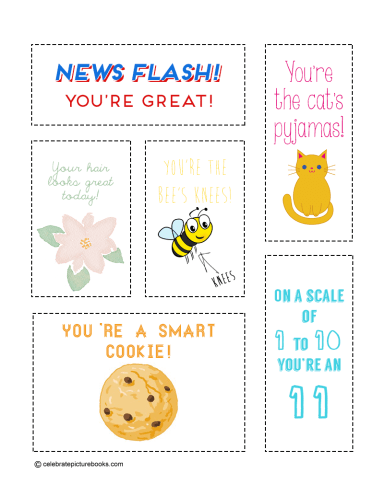
Kindness Cards to Share


It’s fun to surprise someone with an unexpected compliment! It makes the other person and you feel happier! Here are some printable Kindness Cards that you can give to anyone you meet today—or any day. If you’d like to write your own, here is a set of Blank Cards. You can give one to your teacher, librarian, favorite store clerk, your postal worker, your neighbors and friends, the person next to you on the bus or train. Or why not brighten someone’s day by leaving a note where they might find it—in a book at the library or bookstore, in a friend’s lunchbox, in your mailbox, on a store shelf, or anywhere you go!

Picture Book Reviews

November 11 – Veterans Day

celebrate-picture-books-picture-book-review-anna-and-natalie-cover

About the Holiday

Veterans Day is observed each year on this date to honor and thank all members of the military who are currently serving or have served in the United States Armed Forces. The official ceremony begins at 11:00 a.m. with a wreath laying at the Tomb of the Unknowns and then continues inside the Memorial Amphitheater with a parade of colors by veterans’ organizations and comments by dignitaries. While an official government holiday, some schools remain in session, holding special ceremonies of their own and inviting veterans to relate their experiences.

Anna & Natalie

Written by Barbara H. Cole | Illustrated by Ronald Himler


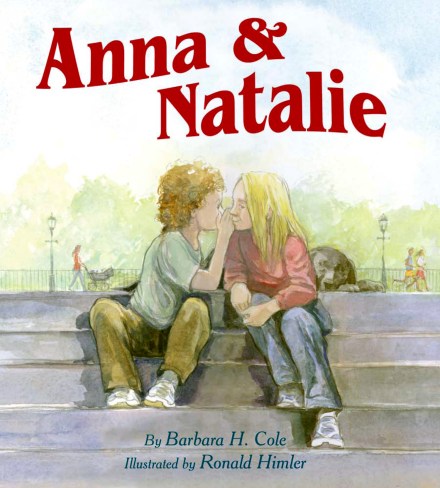
Every year Mrs. Randall’s third-grade class attends the Wreath-laying ceremony at the Tomb of the Unknown Soldier at Arlington National Cemetery. What’s more every year four students are chosen from her class to carry the wreath. This year everyone wonders who those lucky four will be. Students who want to be in the running to be selected, Mrs. Randall, says, must write a letter telling her why they should be chosen. Hearing that Freddie and Tommy drop out immediately, while Nancy says her letter will be the best.

Anna dreams of being chosen too, but experience tells her she will not. She’s never chosen for the basketball or softball team, the cheerleading squad, or the lines of Red Rover. “Sure, someone always chose her for the spelling team, but the others—the fun ones—never.” But this time seems different. All day—even though Mrs. Randall’s eagle eyes catch it—Anna daydreams and makes plans. When the bus drops her and her sister off, they hurry home to start work.

celebrate-picture-books-picture-book-review-anna-and-natalie-school-bus

Image copyright Ronald Himler, text copyright Barbara H. Cole. Courtesy of Star Bright Books

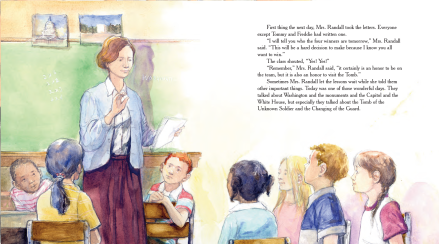
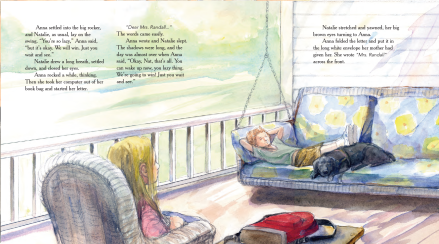
There Anna makes a secret call to her grandpa and then she and Natalie go to the front porch, and while Nat naps on the swing Anna pulls out her computer and begins writing her letter to Mrs. Randall. The next day Mrs. Randall collects the letters with the promise to choose the team by tomorrow and a reminder for those who will not be picked: “‘Remember,’” she says, “‘it certainly is an honor to be on the team, but it is also an honor to visit the Tomb.’” Then “they talked about Washington and the monuments and the Capitol and the White House, but especially they talked about the Tomb of the Unknown Soldier and the Changing of the Guard.”

celebrate-picture-books-picture-book-review-anna-and-natalie-on-the-porch

Image copyright Ronald Himler, text copyright Barbara H. Cole. Courtesy of Star Bright Books

At school the next day, Mrs. Randall says that while she received four excellent letters, one stood out. She begins to read it to the class: “‘I want to be on the team, not for myself, but for many others who have not been honored or remembered….They worked long and hard and saved many lives….And sometimes they were heroes bigger than the strongest men around. Sometimes they carried medicine and food to dangerous places to save the wounded soldiers. My own great-great-grandfather was in this special service and saved lives. I would like to be on the team to say thank you to those forgotten heroes of World War II. Yours truly…’ Mrs. Randall’s voice cracked and choked, and then she read, ‘From Natalie (with help from Anna)’”

The class starts whooping and cheering, but Mrs. Randall interrupts their celebration to read one more line: “P.S.—Would you please let Anna walk with me so I will not be alone and she won’t be either?” The class begins chanting “Yeah, Anna! Yeah, Anna!,” and Anna can’t believe that her dream of being on the team has come true. When Anna gets home from school and tells her family, they proudly make plans to travel with their “two girls” to the ceremony.

celebrate-picture-books-picture-book-review-anna-and-natalie-anna-and-natalie

Image copyright Ronald Himler, text copyright Barbara H. Cole. Courtesy of Star Bright Books

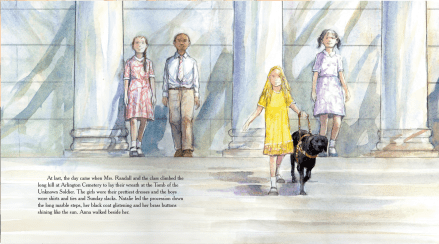
Finally, the day of the Wreath-Laying Ceremony arrives. The students are dressed in their best clothes, and as the four team members prepare to accept the wreath, “Natalie led the procession down the long marble steps, her black coat glistening and her brass buttons shining like the sun. Anna walked beside her.” As the soldier hands the children the wreath fashioned from “dogwood flowers, magnolias, and decorative red birds,” he loudly announces, “The students of Willow Run School and Natalie, a seeing-eye dog, will lay this wreath to honor the men who served in World War II and the dogs who helped them. ATTENTION!”

celebrate-picture-books-picture-book-review-anna-and-natalie-tomb-of-the-unknowns

Image copyright Ronald Himler, text copyright Barbara H. Cole. Courtesy of Star Bright Books

The clear notes of Taps rang across Arlington National Cemetery as Anna and the three other children lay the wreath in front of the Tomb of the Unknown Soldier. Afterward, Anna’s grandfather and parents took pictures of Anna and Natalie to remember “this shining moment of Anna, and of Natalie, who saw the world that Anna could not see.”

An Author’s Note revealing the use of dogs during wartime—from ancient history to today—follows the text.

Barbara H. Cole’s story of Anna and Natalie is compelling in many ways. First, it presents a look at what Veterans Day means to children from their point of view. Second, the story honors not only the brave soldiers who protect our country but also the canine corps which has served our military from our country’s earliest history. Third, in Anna, Cole has created a character who is part of a military family through her great-great-grandfather and also has a personal connection to service dogs through Natalie, her seeing-eye dog. The portrayal of Anna as a child with a disability is honest and inclusive, and while the fact of Anna’s blindness is contained in a surprise ending, this serves to present Anna as just another student in the class—a girl who is an excellent writer, enthusiastic about her dreams to be part of the team, and a good friend.

celebrate-picture-books-picture-book-review-anna-and-natalie-classroom

Image copyright Ronald Himler, text copyright Barbara H. Cole. Courtesy of Star Bright Books

Cole’s straight narration of a school day and a special assignment—complete with asides from students—as well as Anna’s family life creates an environment that will be familiar to readers and carries the story in a natural arc.

Ronald Himler’s realistic illustrations of Anna’s Willow Run School, her home, and Arlington Cemetery beautifully represent this moving story. His pages are full of diverse, real kids, smiling, laughing, getting off the school bus, enjoying a family dinner, and solemnly performing their job at the Tomb of the Unknown Soldier. A hint to Natalie’s true identity is subtly inserted into various scenes, making the final reveal a satisfying moment.

Anna & Natalie is a wonderful choice for all kids observing Veterans Day, Memorial Day, and other patriotic holidays.

Ages 5 – 10

Star Bright Books, 2010 | ISBN 978-1595722119

To learn more about Anna & Natalie and download a Curriculum Guide, visit Star Bright Books!

To view a gallery of artwork and picturebook illustration by Ronald Himler, visit his website!

Veterans Day Activity

celebrate-picture-books-picture-book-review-american-flag-and-wreath

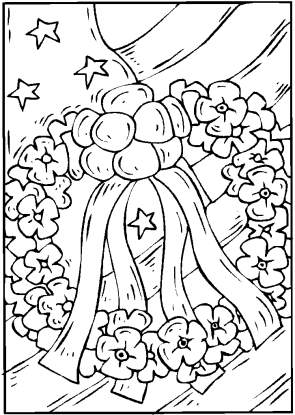
Wreath and American Flag Coloring Page


Remember everything our members of the Armed Forces do to keep our country safe as you color this printable Wreath and American Flag.

Picture Book Review
November 9 – National Aviation History Month

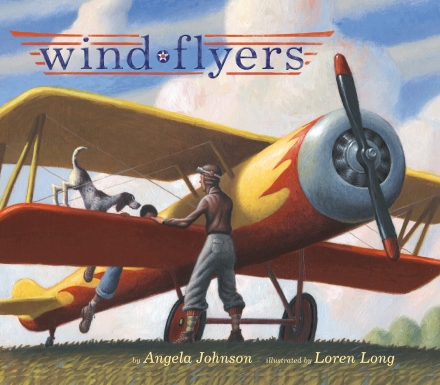
celebrate-picture-books-picture-book-review-wind-fliers-cover

About the Holiday

If you look back in history you see that people have always been fascinated with flight. The first kite was invented in 1000 BCE in China; around 400 BCE Archytas of Tarentum developed a steam-powered pigeon; and most people are familiar with the designs of flying machines that Leonardo de Vinci created in the late 1400s. An important discovery that led inventors in the right direction came in 1680 when an Italian mathematician determined that human muscles were incompatible with flight.

Zip ahead about 100 years and the first hot-air balloon flight was undertaken, which led to more and more complex technology, resulting in Wilbur and Orville Wright’s flight in 1903. From there, it seemed, the sky was the limit. Amelia Earhart became the first woman to complete a trans-Atlantic Ocean solo flight in 1932, and in 1947 Charles Yeager broke the sound barrier. But it’s astounding to think that from that modest 12-second first flight by the Wright Brothers to the first man in space—Soviet cosmonaut Yuri Gagarin—it took only 58 years! Today astronauts from countries around the world live and work in the International Space Station, and spacecraft are traversing deep space.

Wind Flyers

Written by Angela Johnson | Illustrated by Loren Long

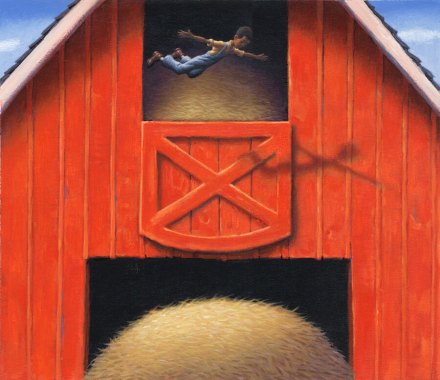
With pride a young African-American boy tells the story of his great-great-uncle who was a Tuskegee Airman in World War II. His uncle was “a smooth wind flyer. A Tuskegee wind flyer…,” the boy says. He knows well his uncle’s history—how like a bird, his uncle believed he was born to fly. “With his arms flapping, he jumped off a chicken coop at the age of five,” and when he was only seven he soared from a lofty barn into a pile of hay. His first real flight came at the age of eleven, when he paid 75 cents to be a passenger with a barnstormer.

celebrate-picture-books-picture-book-review-wind-fliers-jumping-from-hayloft

Image copyright Loren Long, courtesy of Simon & Schuster

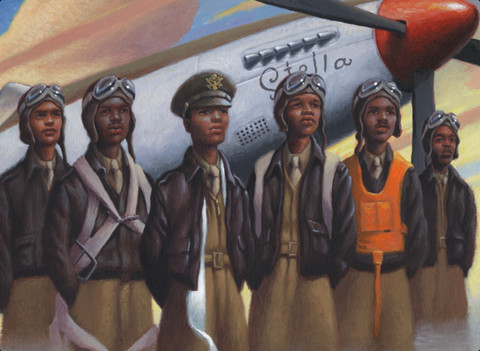
Flying over lakes and fields, his uncle felt as if he were in Heaven, among clouds “like soft blankets, saying, ‘Come on in, get warm. Stay awhile and be a wind flyer too.’” The experience changed him forever. In fact he “cried when they landed because then he knew what it was like to go into the wind, against the wind, beyond the wind.” As a young adult his uncle contributed his dream and his skills to the World War II effort, becoming a Tuskegee Airman, one of the first black pilots in the United States military.

celebrate-picture-books-picture-book-review-wind-fliers-tuskegee-arimen

Image copyright Loren Long, courtesy of Simon & Schuster

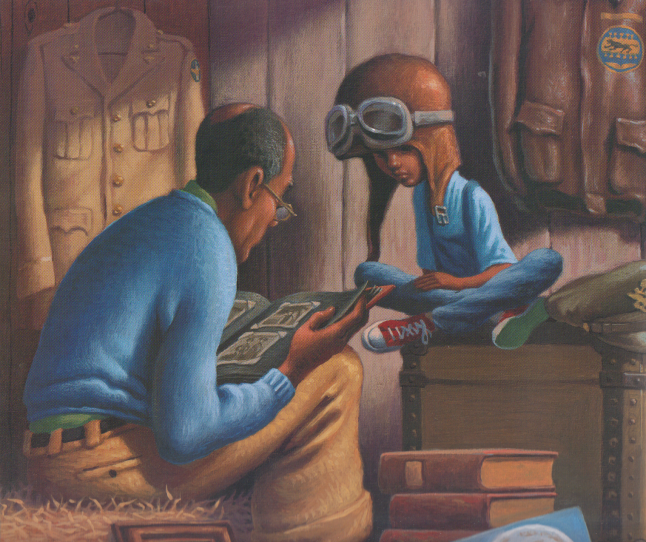
As the pair sit in the uncle’s barn, surrounded by his military uniform, leather jacket, and other memories of his flying career—after the war to continue flying he became a crop duster—the pair look through old photographs, seeing once more those young and brave pilots—the Tuskegee wind flyers. Planes are different now, Uncle says, but the clouds remain the same. The boy and his uncle climb to the highest point of the uncle’s barn to watch the jets—and in those moments they once more become the smooth wind flyers, flying into the wind and beyond.

celebrate-picture-books-picture-book-review-wind-fliers-grandfather-and-grandson

Image copyright Loren Long, courtesy of Simon & Schuster

In her soaring, rhythmic language, Angela Johnson captures the dreams and yearning of a young boy whose greatest desire is to fly among the clouds. Her combination of straight narration with lyrical lines as he joins the Tuskegee Airman in World War II enhances the sense of achievement and pride the young pilots felt. The structure of the story is well chosen, as relating the uncle’s life from childhood through old age through the eyes of his nephew strengthens the themes of strong familial relationships as well as shared dreams across generations.

Loren Long gives Wind Flyers additional power with his strong, vibrant paintings. Two-page spreads provide a sense of the vastness of the skies that so enticed the young would-be pilot. Even the clouds echo the emotion of the page—fluffy, floating, and alive in the flight scenes while linear, flat, and stationary when the plane and the uncle are earthbound. Realistic portrayals of the boy, his uncle, and the other Tuskegee Airmen are reminiscent of the WPA murals of the 1940s while still setting this book firmly in today for a new generation.

Wind Flyers is a wonderful book to share with aviation buffs, budding historians, and dreamers of all types and would make a welcome thoughtful book for quiet story times.

Ages 4 – 9

Simon & Schuster Books for Young People, 2007 | ISBN 978-0689848797

To learn more about Angela Johnson‘s books for all ages, visit her website!

View a gallery of artwork for picture books and other media by Loren Long, visit his website!

National Aviation History Month Activity

CPB - Biplane side

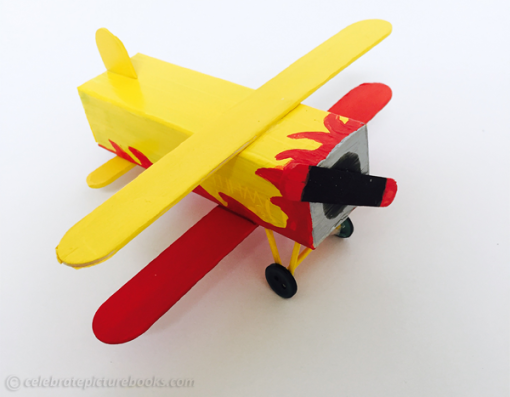
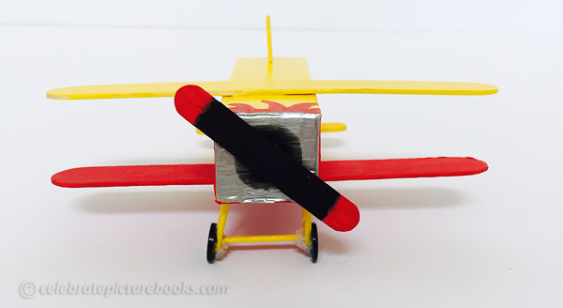
Head in the Clouds Box Biplane

If you love airplanes and flying, you’ll have fun making your own plane from recycled materials! Use your creativity to decorate your plane while you imagine yourself flying through the clouds on a beautiful day. Younger children will have fun sharing this activity with an adult or older sibling too!

Supplies

  • Travel-size toothpaste box
  • 3 6-inch x 1/2-inch craft sticks
  • 2  2 1/2-inch x 7/8-inch mini craft sticks
  • 5 Round toothpicks, with points cut off
  • Paint in whatever colors you like for your design
  • 4 small buttons 
  • 2 mini buttons
  • Paint brushes
  • Strong glue or glue gun

CPB - Biplane front

Directions

  1. Empty toothpaste box
  2. Paint toothpaste box and decorate it
  3. Paint the craft sticks and 5 toothpicks
  4. Paint one small craft stick to be the propeller
  5. Let all objects dry

To assemble the biplane

  1. For the Bottom Wing – Glue one 6-inch-long craft stick to the bottom of the plane about 1 inch from the end of the box that is the front of the plane
  2. For the Top Wing – Glue the other 6-inch-long craft stick to the top of the plane about 1 inch from the front of the plane
  3. For the Tail – Glue one mini craft stick to the bottom of the box about ¾ inches from the end that is the back of the plane
  4. For the Vertical Rudder – Cut the end from one of the painted 6-inch-long craft sticks, glue this to the back of the box, placing it perpendicular against the edge and half-way between each side

CPB - Biplane bottom

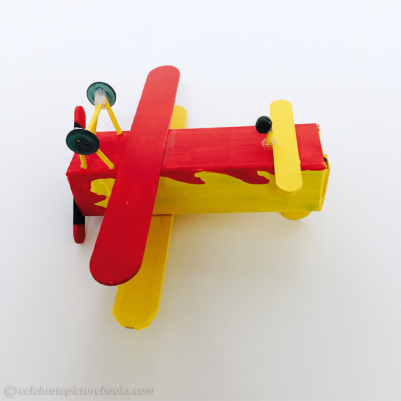
To assemble the front wheels

  1. Cut 4 painted toothpicks to a length of ¾-inches long
  2. Cut one painted toothpick to a length of 1-inch long
  3. Glue 2 of the 3/4-inch toothpicks to the back of 1 button, the ends of the toothpicks on the button should be touching and the other end apart so the toothpicks form a V
  4. Repeat the above step for the other wheel
  5. Let the glue dry
  6. Glue the 1-inch long toothpick between the wheels at the center of each wheel to keep them together and give them stability. Let dry

To make the back wheel

  1. Cut two ¼-inch lengths of painted toothpick and glue them together. Let dry
  2. Glue two mini buttons together to form the back wheel. Let dry
  3. Glue the ¼-inch toothpicks to the mini buttons. Let dry
  4. Glue these to the bottom of the plane in the center of the box directly in front of and touching the tail

Display your biplane!

Picture Book Review

Picture Book Review
November 7 – Job Action Day

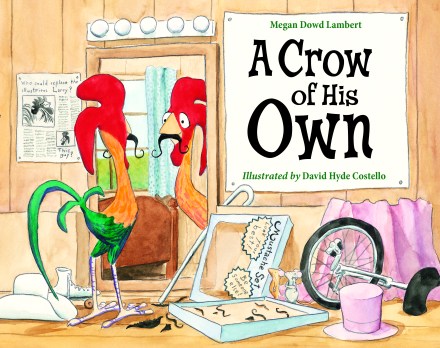
celebrate-picture-books-picture-book-review-a-crow-of-his-own-cover

About the Holiday

Instituted in 2008 and now sponsored by LiveCareer to empower employees and job seekers to assess their careers, make plans, and take action, Job Action Day gives people a chance to reflect on their true goals in life. Are you doing the job you’re passionate about? Are you bringing your passions to the job you are doing? If you are unhappy or dissatisfied with your position, step back and take another look, broaden your horizons. Discover the possibilities and opportunities that lie within your current job and pursue them. You never know where a particular job will lead you if you put all your creativity, knowledge, and—most importantly—unique personality—into it. Job Action Day brings together experts across the web and in participating companies to provide the latest in career advice.

A Crow of His Own

Written by Megan Dowd Lambert | Illustrated by David Hyde Costello


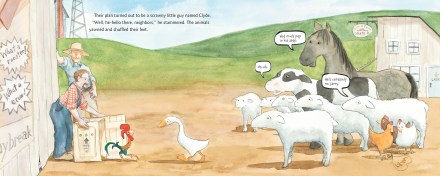
When fame and fortune came calling for Larry, the charismatic rooster of Sunrise Farm, the daily routine turned upside down. “The animals overslept and no one knew what to do.” But while the cow, horse, sheep, chickens, and goose fretted, Farmer Jay and Farmer Kevin had a plan. One day they gathered all the animals and introduced Clyde, the new rooster. Looking at the “scrawny little guy” as he stammered his hello, the cow, horse, and sheep expressed doubt in his abilities, already comparing him to their beloved Larry.

Roberta, the goose, stepped forward, however, and reassured him that “they just miss Larry.” When Clyde asked who Larry was, the animals gasped. “Only the best rooster ever,” claimed the sheep. “Take it straight from my mouth: he was more than that,” said the horse. “He was a genius,” the cow chimed in.” And the chickens? In the dirt they scratched a heart with Larry and XOX in the center.

celebrate-picture-books-picture-book-review-a-crow-of-his-own-clyde-joins-the-farm

Image copyright David Hyde Costello, text copyright Megan Dowd Lambert. Courtesy of Charlesbridge

Clyde was worried—how could he ever live up to Larry? Roberta tried to soothe him. “‘Larry wasn’t a genius…he just made quite a show of it.” Emboldened and with an inkling of what he needed to do, Clyde thanked Roberta and dashed off. “Clyde spent the whole day gathering props, designing his costume, and choreographing a sublime two-step.” As Clyde gave himself one last look in the mirror in his top hat and cloak, he had misgivings. “Could he put on a show of a crow?” He went to bed, but hardly slept at all.

In the morning…well…Clyde overslept. The animals were not happy. “Who ever heard of a rooster sleeping in?” baaad mouthed the sheep. “What a worthless chicken,” complained the horse. And the cow had issues of her own. Once again Roberta came to Clyde’s defense. With a wagon full of new props and material, Clyde rushed away to prepare for the next day. Up bright and early and balanced on a unicycle atop the coop while surrounded by promotional signs, Clyde “opened his beak, and…promptly fell to the ground with an undignified croak.”

celebrate-picture-books-picture-book-review-a-crow-of-his-own-skating-ramp

Image copyright David Hyde Costello, text copyright Megan Dowd Lambert. Courtesy of Charlesbridge

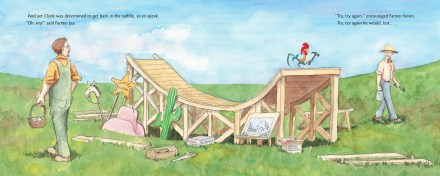
Poor Clyde! Humiliated and hurt he once again had to endure the slights of the farmyard animals, but their comments only spurred him on. Vowing to go bigger and better, Clyde built himself a ramp, ordered roller skates for birds and a parachute, and designed a colorful Western-theme set. “‘Oh, my!’” remarked Farmer Jay as he walked by. “‘Try, try again,’ encouraged Farmer Kevin.” But in the morning Clyde’s spectacular trick left him hanging upside down from the chicken coop, and the animals more “disgruntled and dismayed” than before.

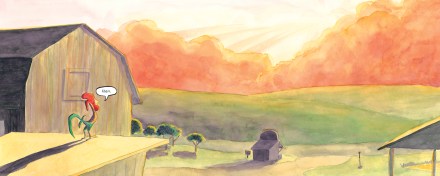
Clyde was distraught. “‘Forget about Larry.’” Roberta said. “‘Just crow your own crow.’” Clyde considered her advice. The next morning as the sky turned pink and orange with the rising sun, Clyde stood tall atop the chicken coop. He quietly cleared his throat and then—“COCK-A-DOODLE-DOO!” The newly awakened animals came running. Even Farmer Jay and Farmer Kevin came to see this new Clyde. The horse summed up their collective feeling: “It’s not so much like crowing, but crooning.” Roberta agreed. “‘Enough to give you goose bumps!’” she exclaimed. As an encore, “Clyde took a deep breath, gave a shake of his comb, and called out another crow of his own.”

celebrate-picture-books-picture-book-review-a-crow-of-his-own-sunrise

Image copyright David Hyde Costello, text copyright Megan Dowd Lambert. Courtesy of Charlesbridge

These days it’s nearly impossible for kids not to compare themselves or be compared to others—even those they’ve never met. All they need to do is jump on the Internet and discover that so-and-so has double, triple, or more friends and/or followers than they do; go to class and get their grade on that assignment they worked so hard on; or simply stand by their locker, go to lunch, or head out to gym and overhear the comments of other students. Avoidance isn’t the answer, but a good base of self-confidence and personal identity is. In A Crow of His Own Megan Dowd Lambert offers readers such a base in her entertaining and meaningful tribute to self-acceptance and love that hits all the right notes.

As soon as scrawny Clyde walks out of his crate to the scorn of his farm mates, kids will root for this underchicken. With a light touch and plenty of wordplay, Dowd deftly presents honest portrayals of the opposition Clyde is up against as well as Clyde’s distressed reactions. Clyde’s three attempts to act like Larry humorously demonstrate the difficulties of trying to be someone you’re not. When Clyde finally musters the courage to “crow his own crow” and is met with praise, readers will see that their own unique talents will find an appreciative audience.

David Hyde Costello knows how to put on a show! His Sunrise Farms is a gentle, bucolic spread still under the thrall of Larry. Humorous details, such as the valentines to Larry the chickens draw in the dirt, the movie house-style posters on the side of the barn, and the surprised and exasperated expressions of the animals, testify to Larry’s enduring legacy. But careful observers will notice that while Larry is a rather bland white rooster with some black tail feathers, Clyde is distinctively colorful from his comb to his feet. Kids will giggle at Clyde’s increasingly complex morning shenanigans even as they sympathize with his plight. When Clyde finally reveals his magnificent crow, readers will cheer.

A Crow of His Own is a winner on so many levels. It offers parents and children a way to discuss and begin building the strong sense of self so important to a happy and successful life. The book also presents a positive visual representation of diversity, and in Roberta and Farmer Jay and Farmer Kevin it shows that finding support helps. And it does all of this in a story that stands on its own as a funny, laugh-inducing romp. Because kids will want to hear this story over and over, A Crow of His Own would be a wonderful addition to libraries and home book collections.

Ages 4 – 9

Charlesbridge, 2015 | ISBN 978-1580894470

To learn more about Megan Dowd Lambert, her picture books, her Whole Book Approach to Reading, and more visit her website!

On David Hyde Costello‘s website you’ll find a gallery of artwork, a portfolio of picture books, videos, and more!

Job Action Day Activity

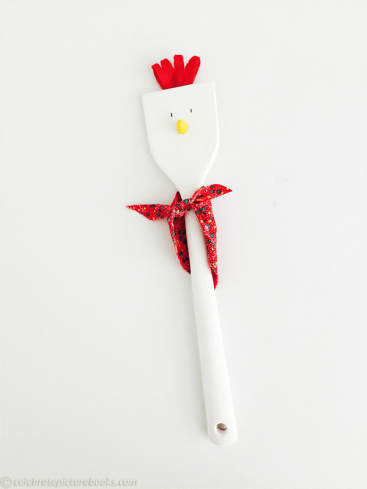
celebrate-picture-books-picture-book-review-chicken-craft

A Chicken to Crow About


A long-handled wooden turner makes a plucky decoration for your room or kitchen—and a great reminder to bring your passions to every job! In a few simple steps, you’ll have a cute companion you’ll want to crow about!

Supplies

  • Printable Comb and Scarf Template
  • Long-handled wooded turner, available in kitchen supply stores
  • Red felt
  • Yellow bakable clay
  • Fabric, 12 inches square
  • A small piece of white felt or fleece (optional)
  • White paint (or any color you would like)
  • Black marker
  • Fabric glue
  • Glue gun
  • Paint brush

celebrate-picture-books-picture-book-review-chicken-craft

Directions

  1. Paint the wooden turner, let dry
  2. Cut the scarf from the piece of fabric
  3. Make a beak from the yellow clay and bake it according to package directions

To make the comb

  1. Cut out the comb from the red felt
  2. Fold the felt in half and glue the end together with the fabric glue
  3. Cut short strips from the folded top of the felt, about ½-inch to ¾ -inch in length
  4. Round the corners of the strips slightly

To make the scarf

  1. Fold the fabric in half
  2. With the long, straight edge of the scarf template along the fold, cut out the scarf
  3. With the fabric glue, glue the two sides of the scarf together so that you have two “right” sides
  4. Let dry

To assemble the chicken

  1. Pinch the bottom of the comb together so that the strips open and the felt pleats a little
  2. With the glue gun attach the comb to the back of the painted turner, keeping the bottom pinched together
  3. Attach the beak to the front of the turner
  4. Draw eyes on the chicken with the black marker
  5. Tie the scarf around the neck of the handle, hold in place with a drop of glue in the back if necessary
  6. To make tail feathers in a turner with a hole in the handle, pinch together a small folded piece of white felt or fleece and push it through the hole in the handle of the turner.
  7. Cut or arrange to look like feathers

Picture Book Review
November 6 – Marooned without a Compass Day

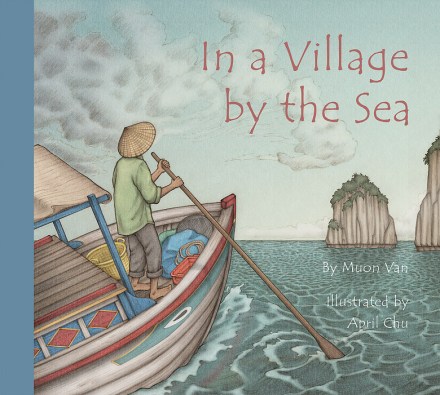
celebrate-picture-books-picture-book-review-in-a-village-by-the-sea-cover

About the Holiday

It may seem appropriate that the origins of this holiday are lost to history, like someone left to languish on a deserted island. But it’s true that—at some time or another—most of us feel marooned without a compass, flailing with decisions about what to do, who to confide in, even who we are. Today is an opportunity to reflect on the direction you are going in life and, if you find you are off course, to steer once more down the right path. It’s comforting to know that someone will be waiting for you when you reach home—wherever that may be.

In a Village by the Sea

Written by Muon Van | Illustrated by April Chu


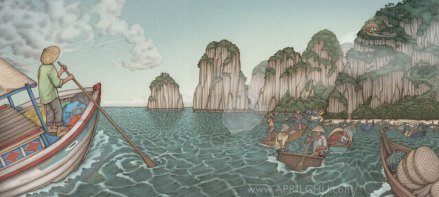
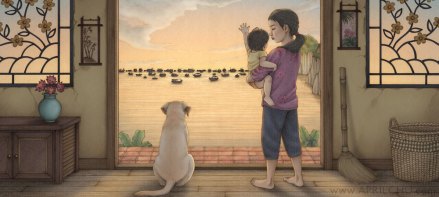
High on a cliff a small house looks out over the sea, where fishermen are poling their craft and setting their nets. “In that house, high above the waves, is a kitchen.” In the kitchen a warm fire blazes under “a pot of steaming noodle soup.” A woman, preparing ingredients for dinner, watches, mixes, and stirs while the pot simmers.

celebrate-picture-books-picture-book-review-in-a-village-by-the-sea-small-house-on-the-cliff

Image copyright April Chu, courtesy of aprilchu.com

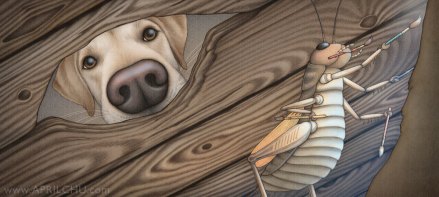
“By that woman is a sleepy child, yawning and turning. By that child, tucked in the shadows, is a dusty hole.” If you peer into that hole, you will see something astounding—a brown cricket is “humming and painting.” The cricket, brushes in four hands is surrounded by paints contained in seashells. It is painting a “sudden storm, roaring and flashing.”

celebrate-picture-books-picture-book-review-in-a-village-by-the-sea-small-house-dog-finds-cricket

Image copyright April Chu, courtesy of aprilchu.com

A white boat rides this roiling sea, rising and dipping with the crashing waves as lightning flashes ahead. Under the cover of the boat’s canvas roof a fisherman eyes the threatening sky and waits for the storm to end. In his hand he opens a precious box. Inside are two pictures: one of a small house high on a hill; the other of a smiling woman holding a little child while their dog looks on. Next to these sits a special cricket.

In the painting there is also a small house, and “in that house is a family waiting for [the fisherman] to come home.”

celebrate-picture-books-picture-book-review-in-a-village-by-the-sea-looking-out-the-door

Image copyright April Chu, courtesy of aprilchu.com

Muon Van’s lyrical tale expands and contracts through the eyes of family members to reveal not only the actions and emotions of one afternoon but those that eternally exist in each character’s heart. In the opening page readers view the small house from afar as the husband and father fisherman casts off on his journey. Children are then invited into the kitchen and finally into a small crevice.
Through the cricket’s tiny painting, readers once again see the wider world with its storms and worries. Narrowing the perspective to the fisherman’s view as he looks at his photo box, however, they understand that comfort and reassurance are always close at hand. As the next page zooms out, children are again invited into the little home to join the woman, baby, and vigilant dog as they gaze out into the bay, watching and waiting for one particular boat.
Van’s quiet and simple story holds much universal feeling as it traverses both homey and unpredictable landscapes. As each page depends on the previous one, a gentle suspense builds, enticing readers to follow wherever the story takes them. The inclusion of the “dusty hole,” where a cricket—a symbol of good luck—paints the rest of the story, is irresistible and lends the tale a mystical quality.

celebrate-picture-books-picture-book-review-in-a-village-by-the-sea-on the shore

Image copyright April Chu, courtesy of aprilchu.com

April Chu’s gorgeous paintings transport readers to a Vietnamese fishing village with their delicate and colorful details. The small home glows with the light of paper lanterns and the fire in the stove. As the perspective of the text changes, so does the perspective of Chu’s paintings. When readers peer into the soup pot, bubbling with delicious vegetables, the family’s Labrador gazes up at them, almost begging to know what smells so good. Another bird’s eye view lets kids watch as the dog discovers the hole under the rug, a beautiful device to increase their enjoyment of and wonderment at the story.
Kids will marvel at the cricket’s artistic talent, as the stormy sea churns with whitecaps and lightning flashes from the tip of the small creator’s paintbrush. But it is Chu’s mastery that makes each page so meaningful.

Ages 3 – 10

Creston Books, 2015 | ISBN 978-1939547156

View a porfolio of picture books and other artwork by April Chu on her website!

Marooned without a Compass Day Activity

celebrate-picture-books-picture-book-review-sail-boat-maze

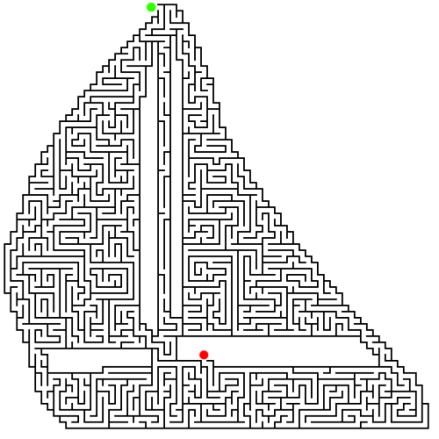
Sailboat Maze


Sometimes getting through a maze is as smooth as sailing on a calm sea—and sometimes the path is a little choppy. Get your pencil ready and chart a path through this printable Sailboat Maze!

Picture Book Review