
About the Holiday
As the cold and snowy weather keeps us inside more and more, what are we to do? Why not create?! Whether you like writing, drawing, cooking, woodworking, gardening, photography, dance, or other pursuits, January is the perfect time to begin a new project. Stock up on supplies, get those ideas going, and create!
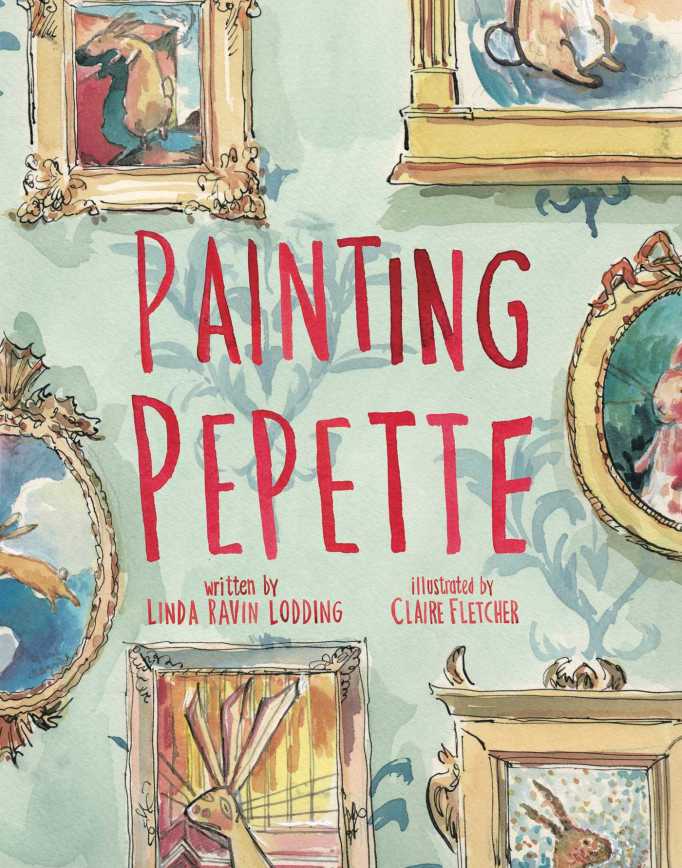
Painting Pepette
Written by Linda Ravin Lodding | Illustrated by Claire Fletcher
If you were to peek in the great room window of the grand yellow house at #9 Rue Laffette in Paris, you would most likely see Josette Bobette and her beloved stuffed rabbit Pepette cuddled together on the comfortable seat. It was their favorite place. Looking past them you would see that on the walls hung portraits of the family—Josette’s mother was there as well as grand-mère and grand-père, the three Bobette sisters, and even their schnoodle Frizette.
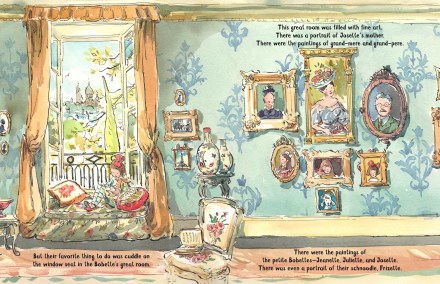
Image copyright Claire Fletcher, text copyright Linda Ravin Lodding. Courtesy of simonandschuster.com
“One day Josette noticed something strange. There was no portrait of Pepette!” Josette at once determined to find an artist to paint a special portrait of her best friend. The pair head out to Montmartre, where all of the best artists set up their easels to paint and sell their work. It didn’t take long for a man in a striped shirt to stop them.
“‘Those ears!’” he cried. “‘Never have I seen such majestic ears. I must paint this rabbit’s portrait!’” Pepette blushed at such an effusive compliment, and Josette exclaimed, “‘Magnifique!’” It appeared that Josette had found just the artist to create Pepette’s portrait. The painter waved his brush with a flourish, “declared his painting a ‘masterpiece,’” and held it up for inspection. Josette gazed at a Pepette with two noses and three ears. Diplomatically, she proclaimed the picture “‘nice’” but not quite Pepette. Her best friend agreed.
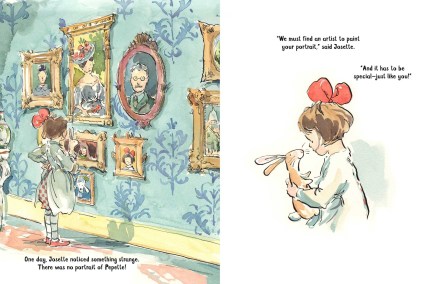
Image copyright Claire Fletcher, text copyright Linda Ravin Lodding. Courtesy of simonandschuster.com
Just then a man with a thin, curved handlebar mustache spied the pair. Admiring Pepette’s whiskers, the artist begged to capture “‘the very essence of her rabbitness!’” He immediately set to work, and in no time a most unusual portrait emerged. Pepette seemed to melt from atop a tall red wall. Josette considered it—and her reaction—carefully. “‘It’s imaginative,’” she said. “‘But you’ve painted Pepette quite, well, droopy.’” Pepette agreed.
As Josette and Pepette enjoyed a Parisian snack on the curb of Montmartre, a rakish young man happened along. He was arrested by Pepette’s nose, which he likened to “‘a faint star twinkling in a misty, velvet night.’” Josette had a good feeling about this artist and followed him across the square to his easel. Pepette posed on a red tufted stool as the artist painted a rabbit soaring through the clouds. He proclaimed the finished portrait “‘one of my best works’” as he displayed it to the crowd. Josette liked the clouds but told the painter that Pepette is afraid of heights and not fond of flying. Pepette agreed.
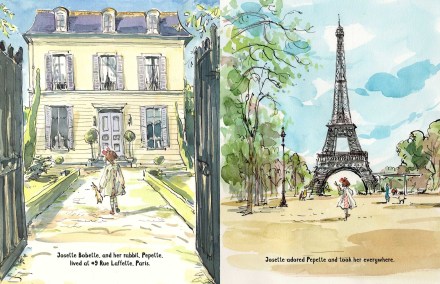
Image copyright Claire Fletcher, text copyright Linda Ravin Lodding. Courtesy of simonandschuster.com
By now Pepette was the most sought-after model in Paris, and another artist rushed up, captivated by her beauty. The balding man in a dapper suit and round spectacles peered at Pepette. “‘What a colorful lady—balloon blue, pansy pink, and radish red!’” Although a little suspicious of his vision, Josette allowed him to paint Pepette. “‘Ta da!’” the man exclaimed, revealing the magic of his brush. Josette studied the canvas with its vibrant dots, dashes, and splashes. While she admired the colors, she reminded the artist that Pepette isn’t pink.
“‘Ah, yes,’” nodded the painter. “‘But through art we can see the world any way we want.’”
With the sun setting low in the sky, Josette politely said thank-you and goodbye to the artists. She and Pepette had enjoyed their day, but it was time to go home. Curled up once more on the window seat, Josette sighed. She had so hoped to have the perfect portrait of Pepette—one that showed her velvety grey listening ears, her heart-shaped nose, and her soft arms that give tight hugs. Suddenly, Josette had an idea! After gathering all of her art supplies, she created the perfect likeness—one as special as Pepette herself!
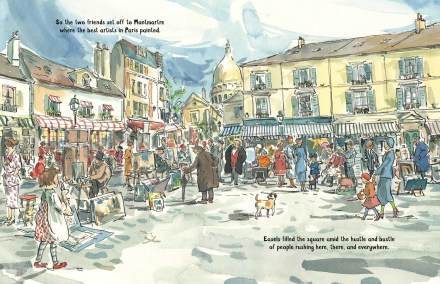
Image copyright Claire Fletcher, text copyright Linda Ravin Lodding. Courtesy of simonandschuster.com
An author’s note on the last page describes the creative atmosphere of 1920s Paris, home to writers, artists, musicians, and fashion designers, that gives a frame to her story. The artists that Josette meets are inspired by Pablo Picasso, Salvador Dalí, Marc Chagall, and Henri Matisse.
In Painting Pepette Linda Ravin Lodding has written a multi-layered story of love, friendship, and unique vision. Through the sweet relationship between Josette and Pepette and with a sprinkling of humorous self-congratulation by the artists, Lodding nudges readers to appreciate that while art can reveal and obscure, reflect or transcend reality, ultimately the success of a piece—complex or simple—lies within the viewer’s heart. Children will also see that their creative endeavors, undertaken with love, are just as meaningful and appreciated as those of professional artists. Lodding’s lyrical language trips off the tongue and is a joy to read—as if readers are following Josette as she skips happily through Paris.
Claire Fletcher’s striking pen-and-ink illustrations pay delicate homage to cityscapes of a bygone Paris. Adorable Josette and her enchanting rabbit are the perfect tour guides through crowded Montmartre and this introduction to art history. Soft tones of yellow, rose, and green illuminate the apartments and cafes of the square, where colorful shoppers and artists mingle. Fletcher’s renderings of Pepette’s various portraits will not only make kids giggle, but entice them to learn more about each artistic style. The final endpapers reveal that the four fine-art portraits now hang in the Muse of Paris, while readers already know that Josette’s perfectly perfect portrait of her well-loved friend has taken its rightful place on the wall in the Bobette’s great room!
Painting Pepette is a beautiful addition to any child’s bookshelf and a lovely way for teachers to initiate a discussion of art history and get kids excited about artists and different art styles.
Ages 4 – 9
little bee books, 2016 | ISBN 978-1499801361
Follow Josette through Paris as she searches for just the right artist to paint a portrait of her best friend Pepette and comes to a surprising discovery in this beautiful Painting Pepette book trailer:
Discover more books by author Linda Ravin Lodding on her website.
Illustrator Clair Fletcher invites you to find more of her artwork by visiting her online gallery.
Creativity Month Activities
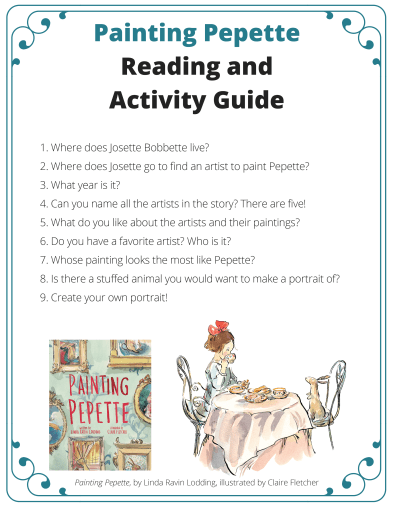
Painting Pepette Reading and Activity Guide
little bee books has created an interactive activity so you can continue to explore Josette’s world and your own artistic talent! Just click here—Painting Pepette Reading and Activity Guide—to start having fun!
Stuck on You Magnets or Picture Hanger
Creativity is meant to be shared! Here’s an easy craft that you can make to give to your friends whether they live close by or far away. These magnets can used by themselves or to hold a picture-hanging wire. Use inside jokes, favorite characters, or shared experiences to make these crafts personal!
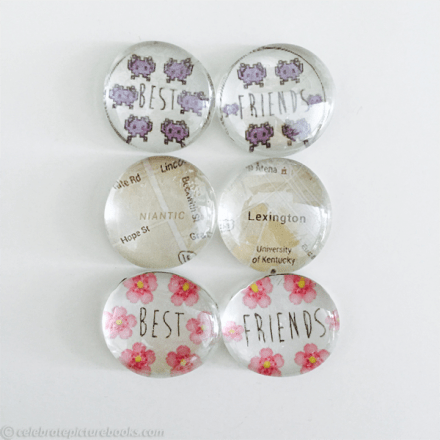
For Magnets
Supplies
- To get you started, here are two printable Best Friends Templates! Template 1 Template 2
- Poster board
- Large, 1 ½-inch clear glass stones (decorative fillers), available in craft stores
- Markers or colored pencils OR find images online to print out
- Medium to large flexible magnets, available in craft stores
- Super glue
- Toothpicks
- Scissors
Directions
- Place the glass stone on the poster board and trace around it
- Draw your design in the circle on the poster board
- Cut out the circle
- With the toothpick, apply glue around the very edge of the design side of the circle
- Attach the circle to the flat side of the stone, let dry
- Trim the cardboard circle if needed
- Attach the magnet to the back of the cardboard with glue
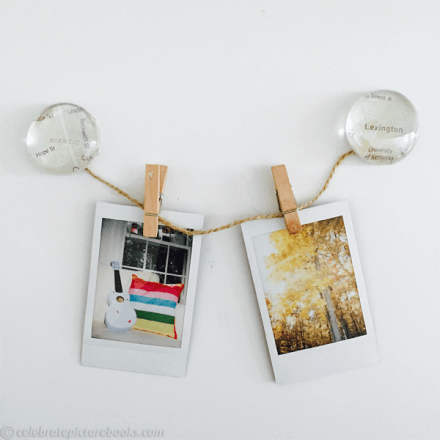
For Map Picture Holder
Supplies
- Use a mapping program to find a map of your town and your friend’s town
- Poster board
- Large, 1 ½-inch clear glass stones (decorative fillers), available in craft stores
- Twine
- Super Glue
- Toothpicks
- Scissors
- Heavy duty mounting squares
Directions
- Find maps of your and your friend’s towns
- Zoom in so the name of your and your friend’s towns are displayed well. You will be using about a 1-inch area around the towns’ names.
- Take a screen shot of the maps
- Print the maps
- Place the glass stone on the map and trace around it
- Place the glass stone on the poster board and trace around it
- Cut out the circles on the map and poster board
- With the toothpick, glue the map to the poster board, let dry
- With the toothpick, apply glue around the very edge of the map side of the circle
- Attach the circle to the flat side of the glass stone, let dry
- Trim the cardboard circle if needed
- Repeat with the other map
- Attach a length of twine to the back of each glass stone
- Attach heavy duty mounting squares to the back of each glass stone
- Attach stones to the wall and hang pictures on the twine
Picture Book Review




 celebratepicturebooks.com