March 14 – National Learn about Butterflies Day

celebrate-picture-books-picture-book-review-butterflies-belong-here-cover

About the Holiday

Spring has sprung – or is right around the corner – so today’s holiday reminds us to watch out for the butterflies in your area. With more than 20,000 species of butterflies around the world, these delicate beauties are one of the most recognized and beloved natural wonders on earth. Butterflies are important to our ecosystem, too, but habitat destruction and climate change are decreasing their numbers by alarming amounts. You can help! By planting milkweed and other plants as well as nectar-producing flowers in your yard or community, you can create an area where butterflies can find shelter, food, and a place to lay their eggs. To learn more about saving monarch butterflies, visit Save Our Monarchs.

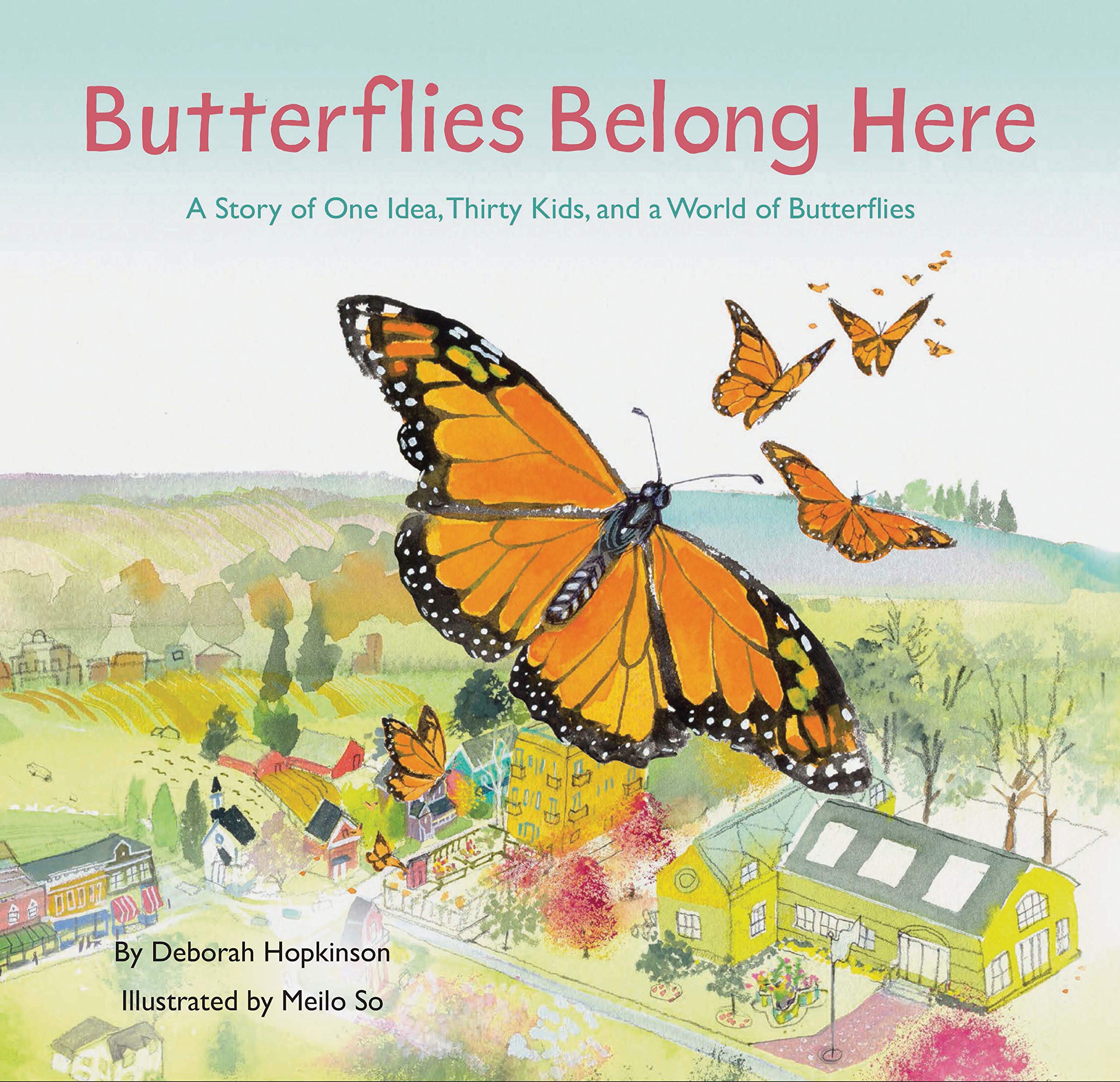
Butterflies Belong Here: A Story of One Idea, Thirty Kids, and a World of Butterflies

Written by Deborah Hopkinson | Illustrated by Meilo So


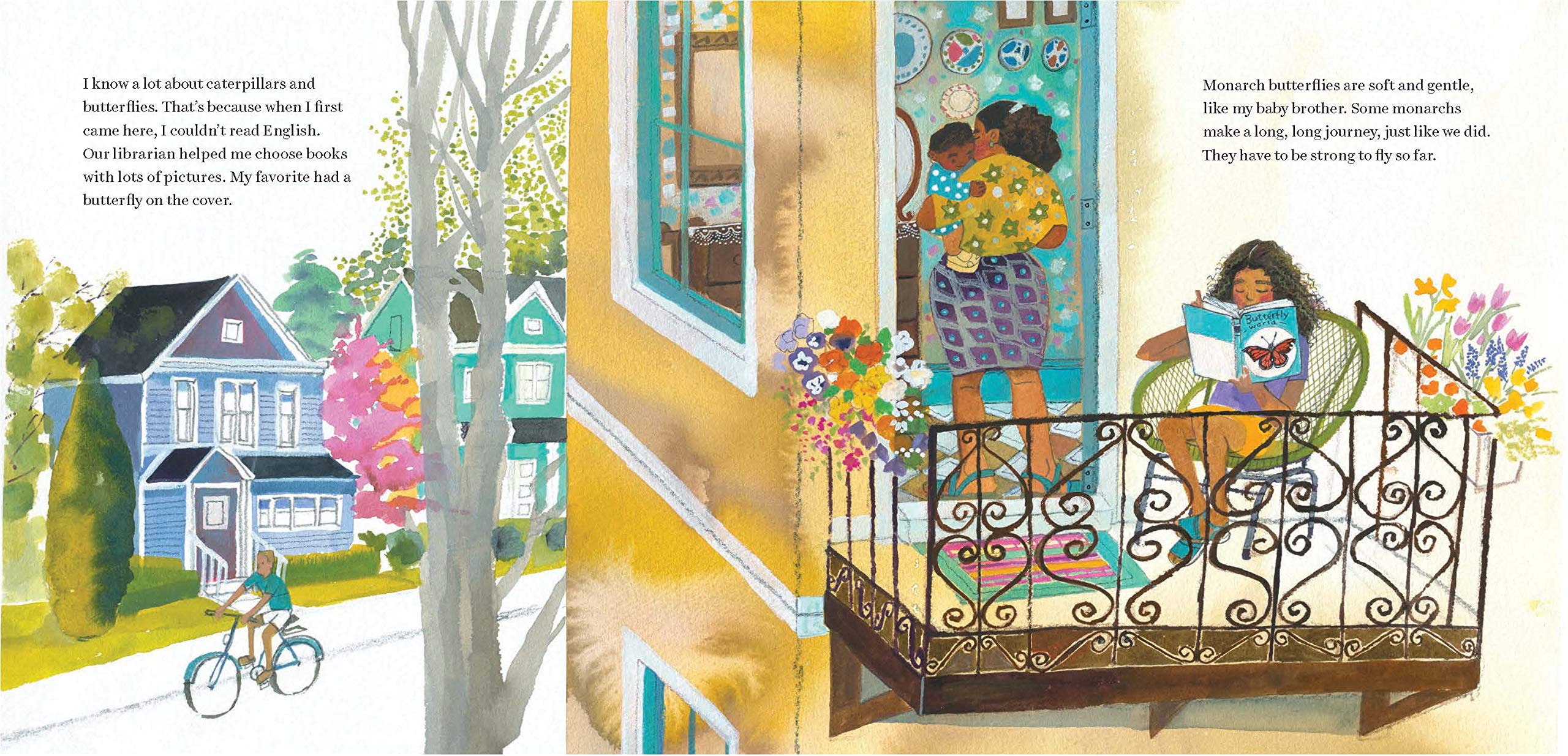
Last spring, the narrator of the story reveals, she was a “little like a caterpillar…quiet and almost invisible.” She had recently moved to the United States and couldn’t read English. The school librarian gave her books with a lot of pictures and her favorite was one about butterflies. Since then she has learned a lot about Monarch butterflies and how they “make a long, long journey” just like her family did. The frame of her story leads into a detailed discussion of the spring monarch migration and the life cycle of caterpillars.

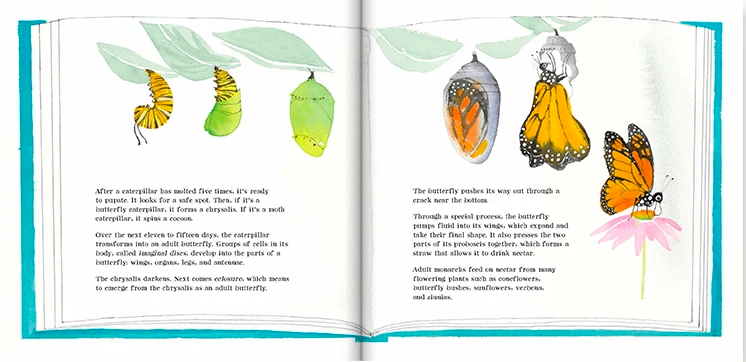
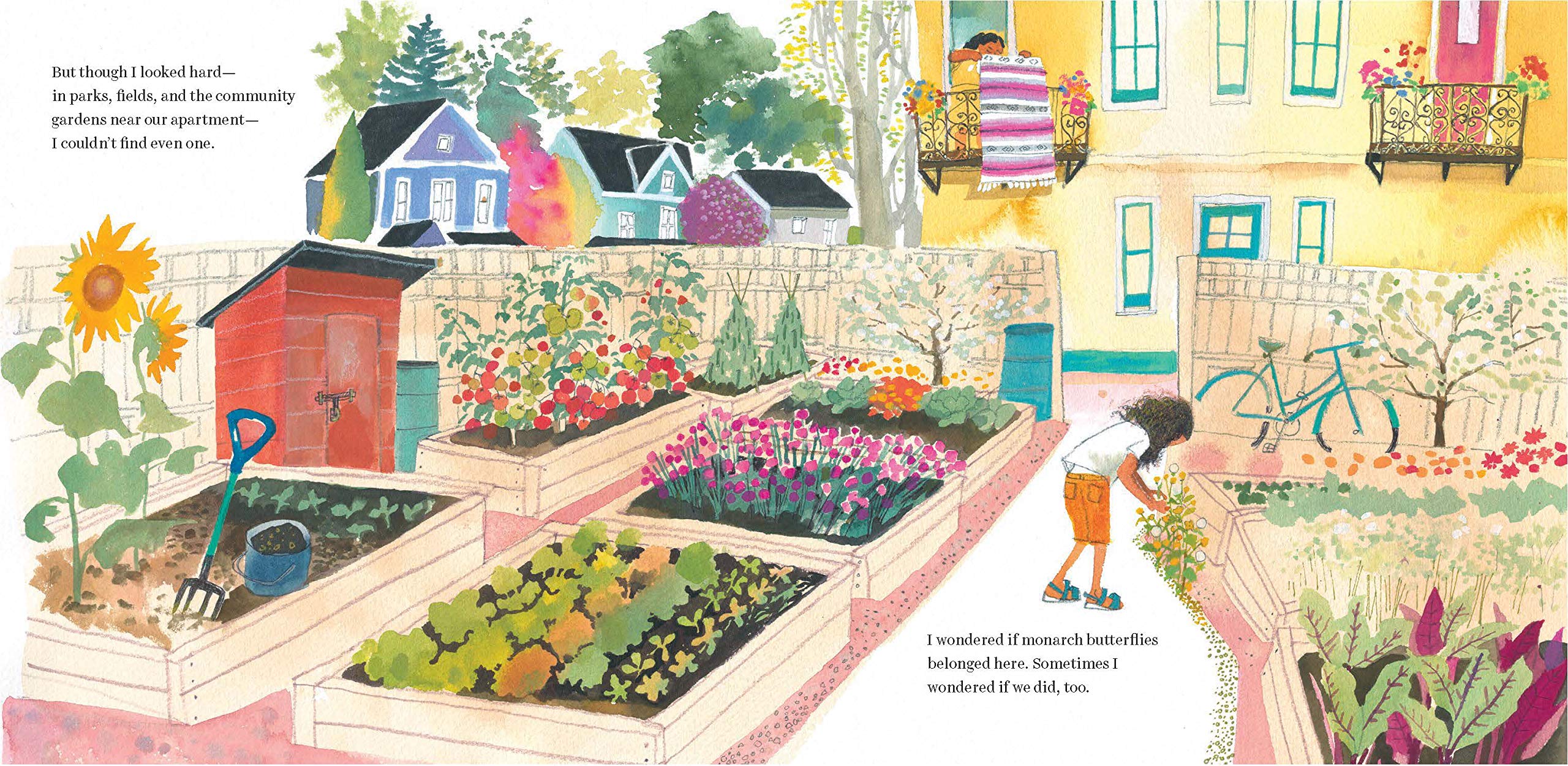
When summer came, the girl thought for sure she would see monarch butterflies. She “wanted to see them flit from flower to flower sipping nectar.” But no matter where she looked—the park, grassy fields, an even the community garden—she couldn’t find any. She began to wonder “if monarch butterflies belonged here.” Sometimes she wondered if her family did either. Turning the page, kids learn how a caterpillar transforms into a butterfly and how, once it emerges from its chrysalis, it “pumps fluid into its wings, which expand and take their final shape” and creates the “straw” it drinks nectar with.
celebrate-picture-books-picture-book-review-butterflies-belong-here-reading

Image copyright Meilo So, 2020, text copyright Deborah Hopkinson, 2020. Courtesy of Chronicle Books.

In the fall when school began, the girl rushed to find her favorite book. Now she could read it, and she discovered that butterflies need milkweed to multiply and thrive. She also learned that milkweed is sparse now, due to habitat destruction due to building, chemical use, and climate change. She also learned some shocking facts, such as “in 20 years, the number of monarchs has fallen by 90 percent.”

One day the librarian calls the girl over and tells her that she has ordered new butterfly books and offers them to her first. The librarian also explains that over the summer she created a monarch way station. The girl knows about these special butterfly gardens. She points out the library window at a place within the school yard that would make a perfect monarch way station. “‘It takes just one person to get things started,’” the librarian says. “‘I’m not that kind of person,’” the girl whispers. But the librarian is encouraging. She reminds the girl about the amazing trip monarchs take and says, “‘It’s surprising what such a tiny creature can do.’” Readers next learn about the generations of butterflies that are born during the summer and how the final generation is different from the rest.
celebrate-picture-books-picture-book-review-butterflies-belong-here-chrysalis

Image copyright Meilo So, 2020, text copyright Deborah Hopkinson, 2020. Courtesy of Chronicle Books.

During the winter, the girl remembers the monarchs who lived “high in the fir forests of Mexico, waiting out the cold to make their long journey north.” She thinks about what the librarian said, and wonders if she could “ever be brave enough to speak up, take charge, and be noticed.” But when she presents a research project on butterflies for her class, the kids loved it. At the end she tells the class how important butterflies are and that they need to help them.

She is surprised by how excited the class is to help and that they want to make a butterfly garden as the class project. The teacher turns to her and asks if she has any ideas on what they could do. The girl is prepared. She turns her poster around and shows them her “plan for a monarch way station, the beginning of a timeline, a list of supplies, and how much it might cost.” And so, they started on their garden. Over the next few weeks, the girl says “‘I could feel myself growing and changing, little by little.’”
celebrate-picture-books-picture-book-review-butterflies-belong-here-community-garden

Image copyright Meilo So, 2020, text copyright Deborah Hopkinson, 2020. Courtesy of Chronicle Books.

The class talked to the principal, made a presentation to parents, and invited gardeners and scientists to speak to the class. They also wrote letters to students in other places who were doing similar projects. Then they held an all-school assembly and asked for volunteers. Kids from all classes—even kindergarten—signed up. They even went to a town council meeting and explained how important milkweed was. They asked that it not be sprayed with poison but instead “be planted in every city park.” The mayor even shook the girl’s hand and told her the city needed citizens like her.

Finally, with a fence and garden plots built, it was planting day. When spring class picture time rolls around again, the girl can be found in the front row, right in the center and holding the class sign. The kids met students from another school who have been helping the butterflies for two years and now serve as monarch trackers, placing tags on their legs and following their migration routes. The class’s monarch way station is thriving, and while they don’t have monarchs yet, the girl is already thinking about how the class can become monarch trackers next year. Just like a caterpillar, the girl thinks again, she has grown and emerged “as something new, unexpected, surprising.”

Backmatter includes an Author’s Note about the story, a guide for making a school or home monarch way station, facts about monarchs, and books and internet resources for learning more about monarchs and how you can help.

celebrate-picture-books-picture-book-review-butterflies-belong-here-migration

Image copyright Meilo So, 2020, text copyright Deborah Hopkinson, 2020. Courtesy of Chronicle Books.

Deborah Hopkinson’s moving and educational story combines a fictional account of growing up with scientific information on butterflies. The structure is exceptionally effective in showing kids and adults that some children find their voice, discover a talent, or overcome hesitation or shyness when they become involved in a cause or activity they believe in. The school librarian and the teacher both model actions and words that can encourage children to express and extend themselves. The girl’s thoughts allow children to see that fears of speaking up or taking charge are not uncommon while also reassuring them that by taking even small actions one step at a time, their confidence will grow. The cyclical structure of the story enhances the idea that change is gradual—in nature and in people. Hopkinson’s text revolving around butterflies and making a butterfly garden way station will excite kids to do the same at their school, at home, or in their community.

Meilo So’s gorgeous and tender illustrations portray vibrant scenes of flower bedecked balconies, blooming community gardens, and a busy, colorful town. So cleverly depicts the library’s stacks of books in similar floral hues, connecting the nurturing of children and butterflies. The faces of all the children and the adults are thoughtful and enthusiastic. Readers can clearly see the protagonist’s physical growth throughout the seasons as well as her developing self-confidence and will want to watch for ways in which she mirrors a butterfly. The children in the classroom and the school are a diverse mix and demonstrate the enthusiasm and determination of kids who want to make a difference.

So is a master at illustrating butterflies, caterpillars, and other insects, and her realistic images will fascinate readers. Children get to see a caterpillar form a chrysalis, transform into a butterfly inside, and emerge. They also see the seeds inside a milkweed pod as well as the plants themselves, throngs of monarchs during migration, and maps of migration routes. 

Exhilarating, poignant, and inspirational on many levels, Butterflies Belong Here is highly recommended for home libraries and a must for school and public libraries.

Ages 5 – 8 and up

Chronicle Books, 2020 | ISBN 978-1452176802

Discover more about Deborah Hopkinson and her books on her website.

To learn more about Meilo So and view portfolios of her art, visit her website and heflinreps.

National Learn about Butterflies Day Activity
celebrate-picture-books-picture-book-review-beautiful-butterflies-maze

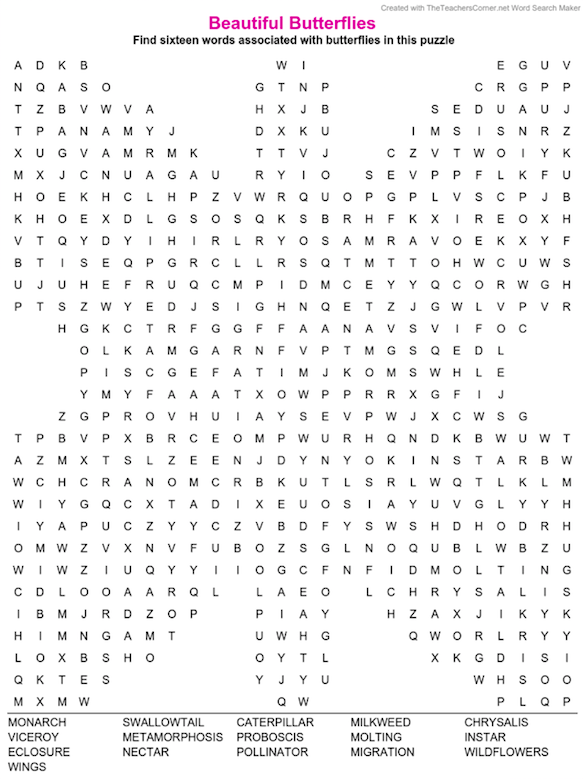
Beautiful Butterflies Maze


Can you find the sixteen words associated with butterflies in this printable puzzle?

Beautiful Butterflies Maze Puzzle | Beautiful Butterflies Maze Solution

celebrate-picture-books-picture-book-review-butterflies-belong-here-cover

You can find Butterflies Belong Here at these booksellers

Amazon | Barnes & Noble | Books-a-Million

To support your local independent bookstore, order from

Bookshop | IndieBound

Picture Book Review
March 13 – It’s Women’s History Month

celebrate-picture-books-picture-book-review-shaking-things-up-cover

About the Holiday

National Woman’s History Month was established by the United States Congress in 1987 to recognize and celebrate the achievements of American women in the past and today. This year’s theme is “Nevertheless She Persisted: Honoring Women Who Fight All Forms of Discrimination against Women” which provides an opportunity to recognize the tireless efforts of women in all walks of life who fight against discrimination to be heard and to achieve their goals. There’s no better time than now to get involved to ensure that all women have equal rights and standing in all areas of their lives.

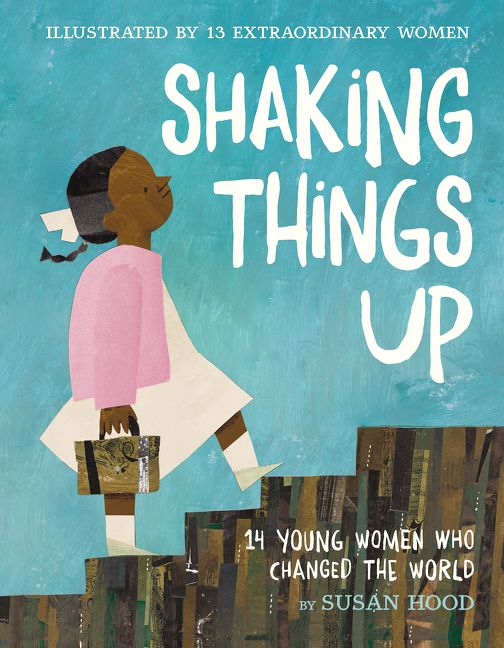
Shaking Things Up: 14 Young Women Who Changed the World

Written by Susan Hood 


Illustrated by Shadra Strickland, Hadley Hooper, Lisa Brown, Emily Winfield Martin, Sara Palacios, Erin K. Robinson, Sophie Blackall, Melissa Sweet, Oge Mora, Isabel Roxas, Julie Morstad, LeUyen Pham, and Selina Alko


This superb collection of biographies in verse highlights not only well-known pioneers but some delightfully fresh names and a few who are influencing the arts, science, and cause of human rights today. Each of the women profiled show the qualities of  bravery, persistence, intelligence, and ability over a vast spectrum of fields. Their success led the way for today’s women and will inspire tomorrow’s.

celebrate-picture-books-picture-book-review-shaking-things-up-Molly-Williams

Image copyright Shadra Strickland, 2018, text copyright Susan Hood, 2018. Courtesy of HarperCollins.

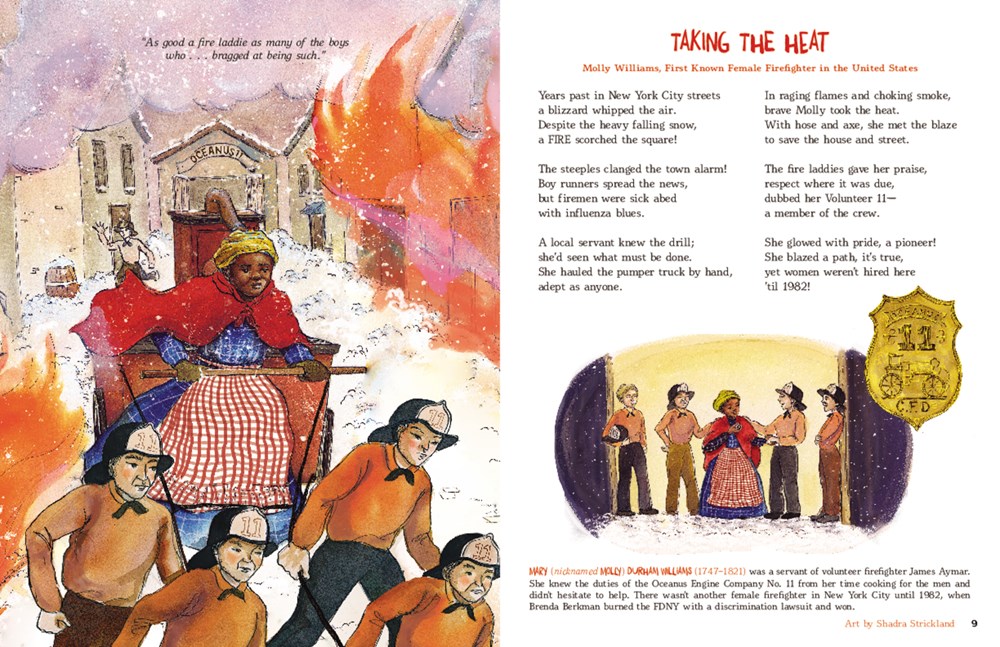
Organized on a timeline from the early 1780s to 2014, Shaking Things Up begins with Taking the Heat and Molly Williams, who was the first known female firefighter in America. When the flu knocked out all the members of the Oceanus Fire Department and a fire raged, Molly, the servant of James Aymar, a volunteer fireman, “… knew the drill; / she’d seen what must be done. / she hauled the pumper truck by hand, / adept as anyone.” For her work she was named Volunteer 11 and made part of the crew. It took about two-hundred years before another woman—Brenda Berkman—was added to the New York Fire Department.

celebrate-picture-books-picture-book-review-shaking-things-up-Mary-Anning

Copyright Hadley Hooper, 2018, courtesy of HarperCollins.

Young paleontologists-in-the-making will be amazed by the story of Mary Anning, who, while searching the British coast for fossils to sell to support her family, uncovered the skeleton of an ichthyosaur in 1812. In Buried Treasure, children learn how she went on to discover “the first two complete plesiosaurs and a pterosaur, laying the foundation for Charles Darwin’s theory of evolution.”

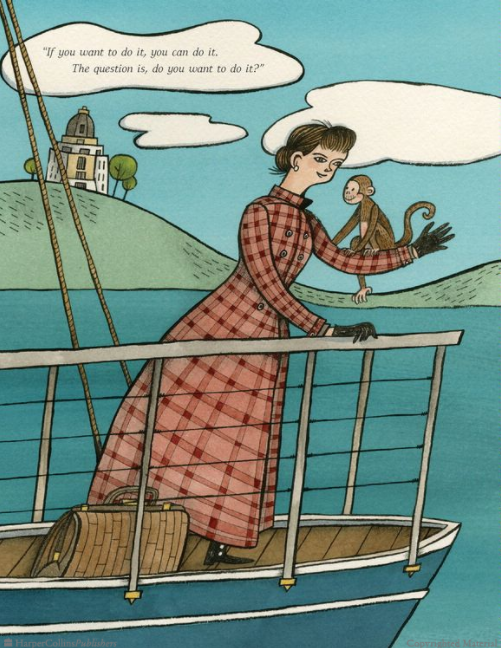
Children who love spies, news reporting, and uncovering the truth will want to know about Nellie Bly, who as an investigative journalist took on disguises to infiltrate institutions and write about “corruption and cruelty.” She was also widely admired for her around-the-world trip that beat Jules Verne’s “80 days” by eight days. As told in Woman of the World: “Bly hopped a ship and told her tale / of all she saw on Earth. / She wrote of camels, temples, jewels / with gutsy wit and mirth.” Nellie was only twenty-five when she undertook her travels in “a record-breaking race. / No soul on Earth had ever sped / the globe at such a pace!”

celebrate-picture-books-picture-book-review-shaking-things-up-Mary-Anning-poem

Image copyright Hadley Hooper, 2018, text copyright Susan Hood, 2018. Courtesy of HarperCollins.

If it weren’t for Annette Kellerman, women may never have made such a splash in swimming. Kellerman was a champion swimmer who began the sport to strengthen her legs after having rickets. Turning the Tide reveals that when she took to the water “without pantaloons—her swimsuit was deemed obscene!” After she was arrested she calmly stated, “who can swim fifty laps / wearing corsets and caps? / Her statement could not be contested,” and she went on to create the modern one-piece swimsuit, changing swimming for women forever.

In The Storyteller, a full alphabet of attributes describes Pura Belpré, a children’s librarian and the New York Public Library’s first Latina librarian. By offering—and often writing—Spanish books and creating programs for the Spanish-speaking community, Belpré revolutionized her library and touched many lives. 

celebrate-picture-books-picture-book-review-shaking-things-up-nellie-bly

Copyright Lisa Brown, 2018, courtesy of HarperCollins.

Children who reach for the stars will be transported by Lift-Off and the inspiration of Mae Jemison, the first female African-American astronaut. When young Mae gazes into the dark night sky, the “glittering stars, swirling galaxies / fill her, thrill her.” It doesn’t matter if she is afraid of the dark and afraid of heights, Mae looks and goes where she wants, where she needs to to learn and understand. And when she’s ready? “Ignition. / All systems are go. / Three / Two / One / Blast off!”

celebrate-picture-books-picture-book-review-shaking-things-up-secret-agents

Image copyright Sophie Blackall, 2018, text copyright Susan Hood, 2018. Courtesy of HarperCollins.

Break It Down reveals the way Angela Zhang attacks the questions she has about the way the world works, questions that lead her to answers and incredible achievements. From creating magic solutions with a Harry Potter potion kit at five years old to discovering answers to questions like why rainbows follow storms at seven years old to using a Stanford University lab at fifteen, Zhang has chipped away “at the ‘black boxes of life,’” including the “biggest black box of all– / a cure for cancer.” For Zhang science is “… both stone and chisel, / and I, your willing apprentice, / yearn to care away life’s mysteries / as a sculptor chisels marble / to find beauty inside.”

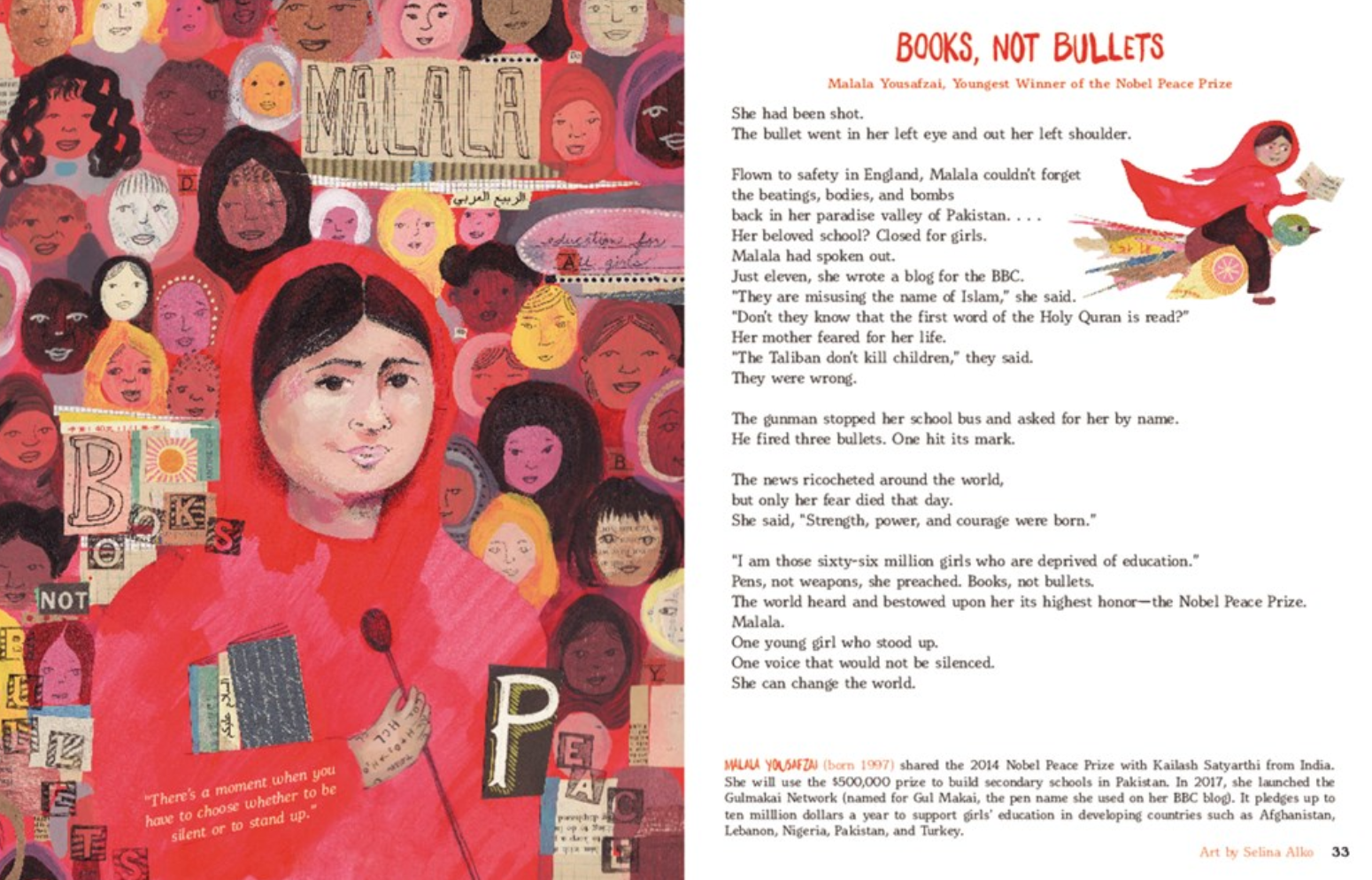
celebrate-picture-books-picture-book-review-shaking-things-up-Malala-Yousefzai

Image copyright Selina Alko, 2018, text copyright Susan Hood, 2018. Courtesy of HarperCollins.

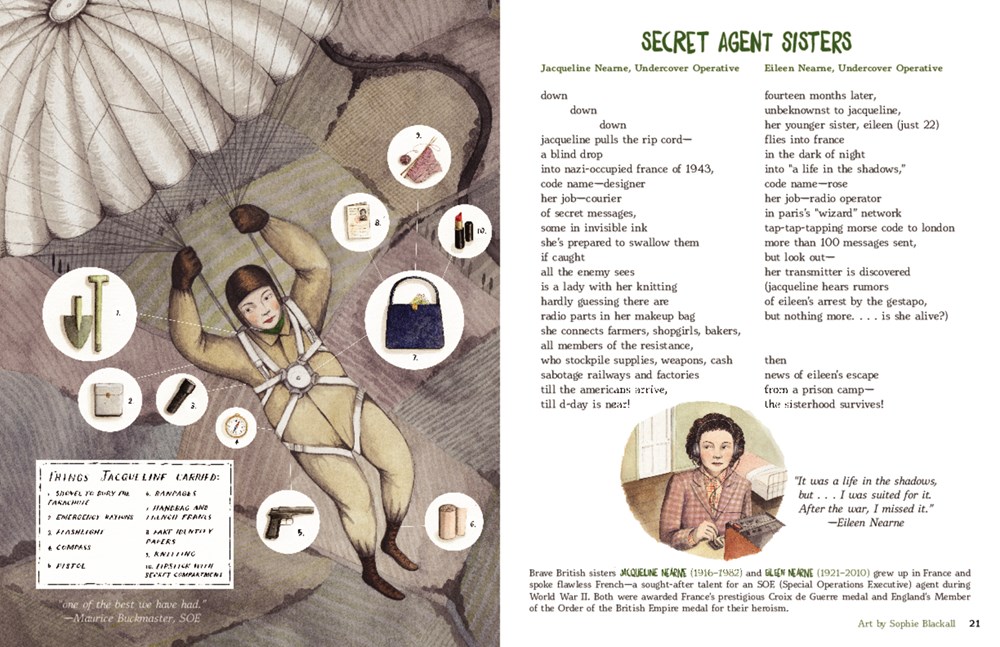
Also included are poems about artist Frida Kahlo, World War II secret agents Jacqueline and Eileen Nearne, anti-hunger activist Frances Moore Lappé, civil rights pioneer Ruby Bridges, architect Maya Lin, and Noble Peace Prize winner Malala Yousafzai.

An illustrated timeline precedes the text, and suggested resources for further study on each woman follows the text.

Susan Hood has created fourteen poems that are as unique as the woman they describe. Some rhyming and some free verse, the poems include facts, quotes, intriguing details and the rhythms, sounds, and dreams of these young women. A paragraph following each poem reveals more about the woman and her work. Readers will be awe-struck by the enticing stories that inform each lyrical biography and will long to learn more about the women and their lives.

The theme of individuality is carried through in the illustrations, which are each created by a different illustrator. Colorful, whimsical, and realistic, the illustrations let children see the faces of the women presented, surrounded by their work and set within their time period. Readers will want to linger over the images and discuss the details included. A quotation from each woman accompanies her illustration.

Shaking Things Up offers an inviting way to introduce children to these amazing women and is an excellent reminder that they too can dream of what could be and make it happen. A must for classroom and school libraries, the book would be an inspirational addition to home bookshelves as well.

Ages 4 – 10

HarperCollins, 2018 | ISBN 978-0062699459

Discover more about Susan Hood and her books on her website.

You can learn more about these illustrators on their websites:

Shadra Strickland | Hadley Hooper | Lisa Brown | Emily Winfield Martin | Sara Palacios | Erin K. Robinson | Sophie Blackall | Melissa Sweet | Oge Mora | Isabel Roxas | Julie Morstad | LeUyen Pham | Selina Alko

Check out the Shaking Things Up book trailer!

Women’s History Month Activity

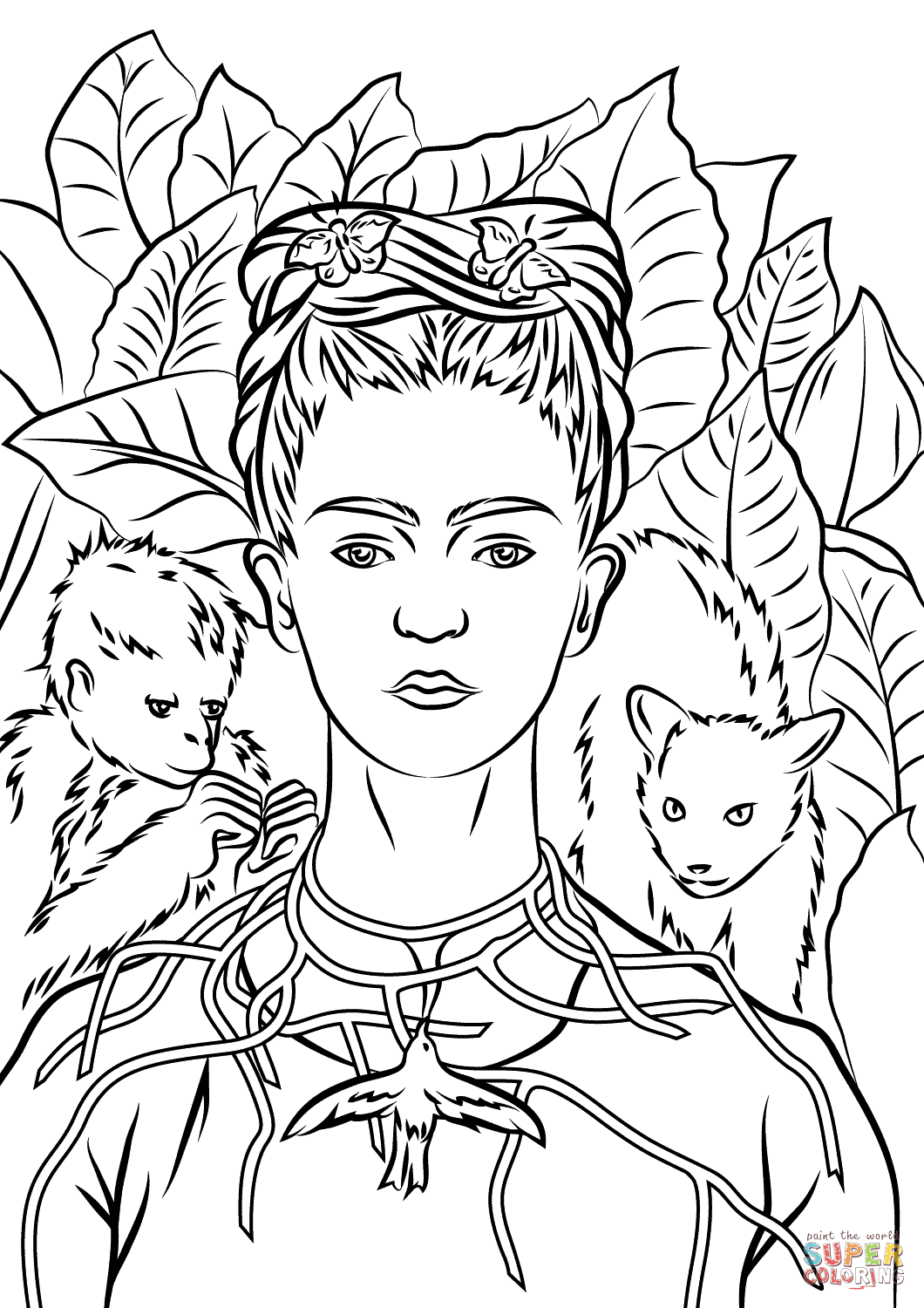
celebrate-picture-books-picture-book-review-freda-kahlo-coloring-page

Amazing Women Coloring Pages


There are so many incredible women to learn about during this month. Today, enjoy these coloring pages of inspiring women.

Mary Anning | Mae Jemison | Freda Kahlo 

celebrate-picture-books-picture-book-review-shaking-things-up-cover

You can find Shaking Things Up: 15 Young Women Who Changed the World at these booksellers

Amazon | Barnes & Noble | Books-a-Million

To support your local independent bookstore, order from

Bookshop | IndieBound

Picture Book Review
March 12 – It’s International Ideas Month

celebrate-picture-books-picture-book-review-the-floating-field-cover

About the Holiday

This month we celebrate something that you can’t see or hold but which is real all the same. What is it? An idea! Ideas are amazing things. Sometimes seemingly conjured up out of thin air; sometimes borne out of necessity as in today’s book; and sometimes the “Eureka!” result of long, hard work, ideas fuel our arts, sciences, education, and home life. So today, write down those ideas you have while driving or commuting to work, while in the shower, when you’re daydreaming, or just as you turn off the light to go to sleep. You never know what they might become!

The Floating Field: How a Group of Thai Boys Built Their Own Soccer Field

Written by Scott Riley | Illustrated by Nguyen Quang and Kim Lien


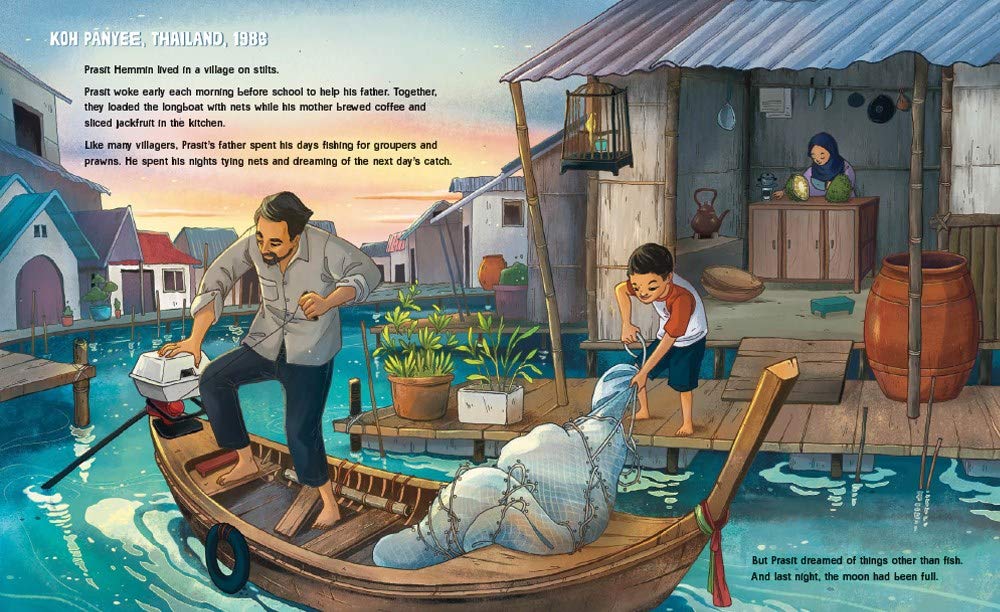
Like all of the villagers living on the small island of Koh Panyee, Prasit Hemmin’s home was built on stilts. His father was a fisherman, and every morning Prasit helped him load his boat before school. Today was an exciting day, and Prasit hurried to meet his friends at Uncle’s coffee shop. They had big decisions to make: “Who will carry the poles? Who’s on which team? Who gets to kick off first?” The full moon had come and later the tide would go out.

celebrate-picture-books-picture-book-review-the-floating-field-koh-panyee

Image copyright Nguyen Quang and Kim Lien, 2021, text copyright Scott Riley, 2021. Courtesy of Millbrook Press.

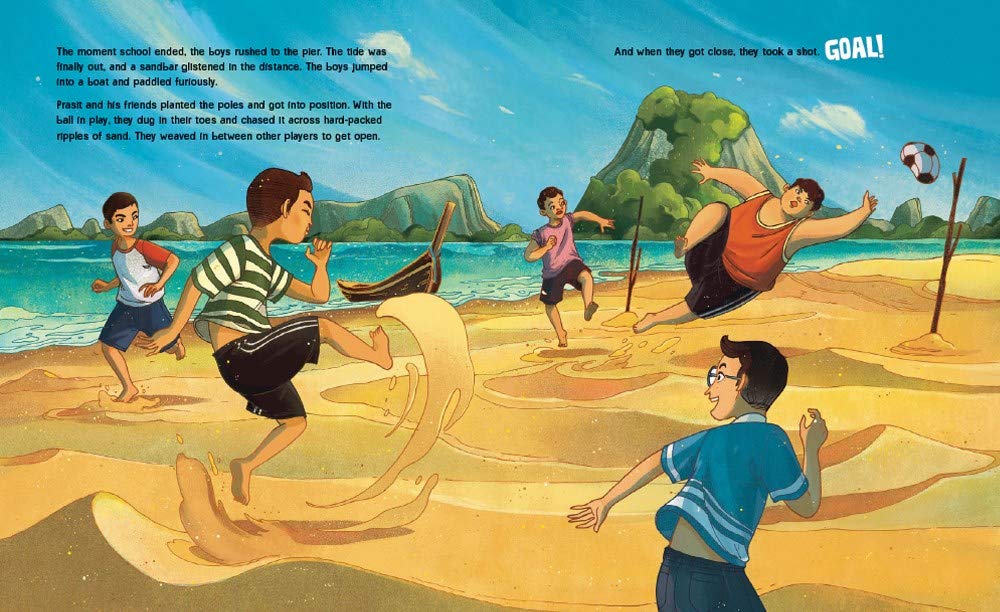
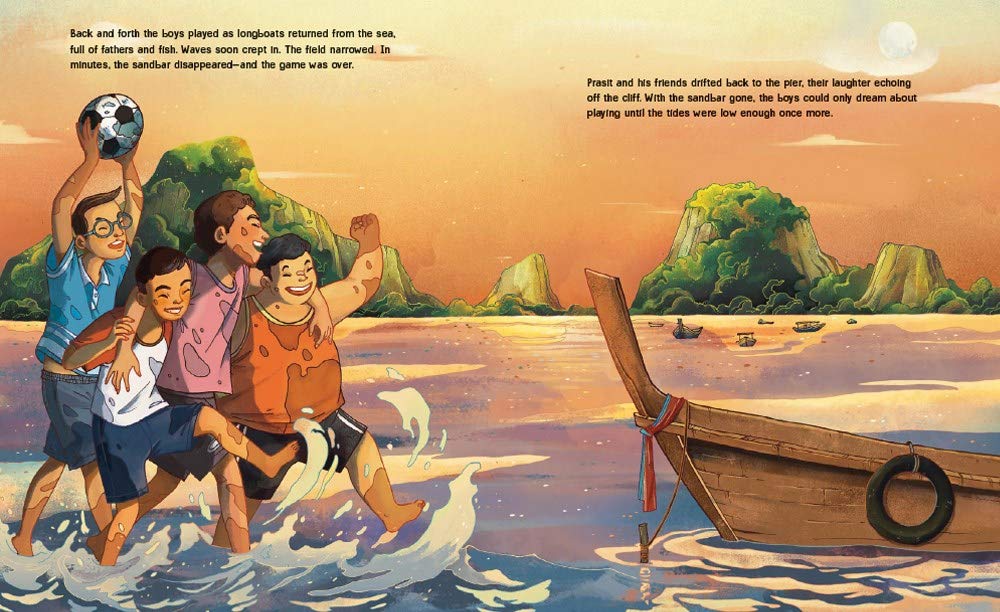
By the time school was over, the sandbar with its glittering sand was ready, beckoning to the boys to come play. They set up their goal and dropped the ball then “they dug in their toes and chased it across the hard-packed ripple of sand. They weaved in between other players to get open. And when they got close, they took a shot. GOAL!” The boys played until the sun went down and the fisherman’s longboats returned home. Then they “could only dream about playing until the tides were low enough once more.”

Fortunately, the World Cup was being held this month, and the boys watched the games on the small TV at Uncle’s coffee shop—“the only one on the island.” The boys decided that they needed a team of their own. But where would they play? Prasit looked around at their floating village and had an idea. They could build their own field. The next day, they collected materials and got to work. With planks and barrels, they built a platform. When it was ready, they tethered it in place, painted the lines, and put up goals.

celebrate-picture-books-picture-book-review-the-floating-field-coffee-shop

Image copyright Nguyen Quang and Kim Lien, 2021, text copyright Scott Riley, 2021. Courtesy of Millbrook Press.

Every day, Prasit and his friends played on their floating field, learning some fancy footwork to avoid rough spots on the boards. The villagers who once thought they were crazy for building the field now stopped to watch. One day the boys heard about a tournament being held on the mainland, and they signed up. On the morning of the tournament, just before they left for the mainland, the villagers surprised them with new uniforms and “the Panyee Football Club was born.”

The boys stood nervously on the field before their first game began, but once the ball was in play, they knew just what to do. “They passed it down the field. They weaved in between other players to get open. And when they got close, the took a shot. GOAL!” The Panyee Football Club won several games, but by the afternoon, the weather had turned and rain pelted the field. While their opponents knew how to play on the soggy field, the Panyee boys didn’t. At halftime they were down 2 – 0. Prasit had an idea.

celebrate-picture-books-picture-book-review-the-floating-field-beach

Image copyright Nguyen Quang and Kim Lien, 2021, text copyright Scott Riley, 2021. Courtesy of Millbrook Press.

Back on the field, the boys ran barefoot, just as they did at home. They were quicker and more agile, and they were able to tie the score. But with only minutes left in the game, the other team scored—and won. “But that day, in their very first tournament, the Panyee Football Club came in third place.” On the boat ride home, the boys celebrated, eager to get back on their floating field “where they could play the game they loved, whenever they wanted.”

Extensive backmatter includes an Author’s Note, complete with photographs, reveals some unusual places soccer is played and more about how this story came to be; a note from Prasit Hemmin about his childhood experiences and the future success of the football club he and his friends started; and a glossary of soccer vocabulary in English and Thai with pronunciation tips. There is also a list of resources for further reading.

celebrate-picture-books-picture-book-review-the-floating-field-sandbar

Image copyright Nguyen Quang and Kim Lien, 2021, text copyright Scott Riley, 2021. Courtesy of Millbrook Press.

Soccer fans and sports lovers of all kinds will find the story of Prasit Hemmin and the soccer field he and his friends designed enthralling. The idea that these boys could only play their favorite game twice a month will be eye-opening for kids used to daily or weekly practice, and their ingenious solution will inspire them to greater problem-solving. Through Scott Riley’s detailed storytelling, readers gain knowledge about life on the small island of Panyee as well as how the boys built their floating field. Riley also showcases the camaraderie between the boys and the pride of the villagers, making this a beautiful story of community.

Through various perspectives, Nguyen Quang and Kim Lien’s gorgeous and vibrant illustrations introduce readers to the island of Panyee with its dense collection of homes and businesses that left no room for a soccer field. The blue ocean water shimmers under the sun and ripples where longboats skim over the surface. Immersive images take kids into the Hemmin home and Uncle’s coffee shop, where Prasit’s mother makes breakfast while Prasit and his father ready the fishing boat for the day. Depictions of the boys playing soccer on the sandbar and later on the floating field they built are exciting and full of action. Soccer players may be fascinated by the proportions of the floating field and its goals and appreciate the precision with which Prasit and his friends scored. The contrast between the island and the mainland soccer field will also give readers an appreciation for the Panyee Football Club’s accomplishment in winning third place in their first tournament.

A stellar addition to any child’s library as well as to classroom and homeschool geography, STEM, and multicultural lessons, The Floating Field: How a Group of Thai Boys Built Their Own Soccer Field is highly recommended for home, school, and public library bookshelves.

Ages 7 – 11

Millbrook Press, 2021 | ISBN 978-1541579156

Discover more about Scott Riley and his book on his website.

To learn more about Nguyen Quang and Kim Lien, their books, and their art, visit their website, Kaa Illustration.

International Ideas Month Activities

celebrate-picture-books-picture-book-review-soccer-maze

Kick It In!


Use some fancy footwork to move the soccer ball down the field and score in this printable puzzle!

Kick It In Maze Puzzle | Kick It In Maze Solution

Visit Koh Panyee

Learn more about this unique village with this video about Koh Panyee!

https://www.youtube.com/watch?v=J5_bKc2O-is

celebrate-picture-books-picture-book-review-the-floating-field-cover

You can find The Floating Field: How a Group of Thai Boys Built Their Own Soccer Field at these booksellers

Amazon | Barnes & Noble | Books-a-Million

To support your local independent bookstore, order from

Bookshop | IndieBound

Picture Book Review
March 11 – Worship of Tools Day

celebrate-picture-books-picture-book-review-whose-tools-cover

About the Holiday

What would we do without tools? Handheld and big machinery devices help us create buildings, artwork, crafts, and furniture; cook delectable meals; tend the garden; and keep our vehicles and homes in tip-top shape. Even animals use sticks, rocks, and their own paws as tools to get food and build homes. To celebrate today’s holiday make sure your tools are all in order and working, or if you’ve had your eye on a new tool, treat yourself!

Whose Tools?

Written by Toni Buzzeo | Illustrated by Jim Datz


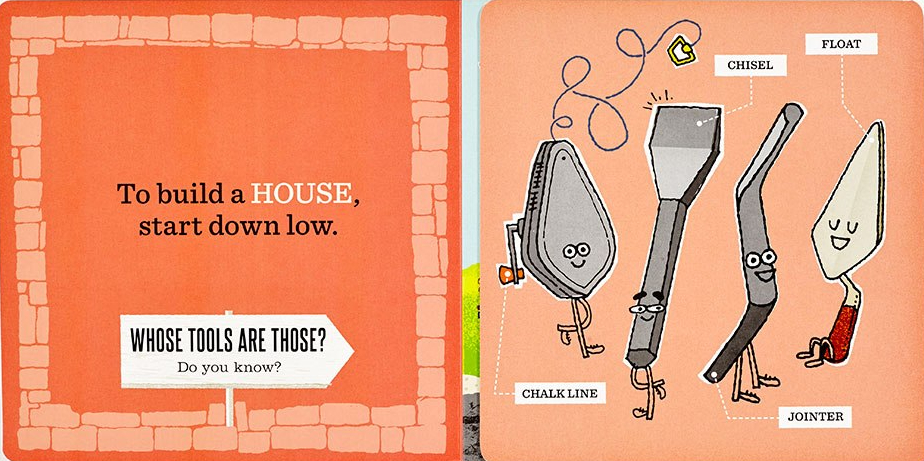
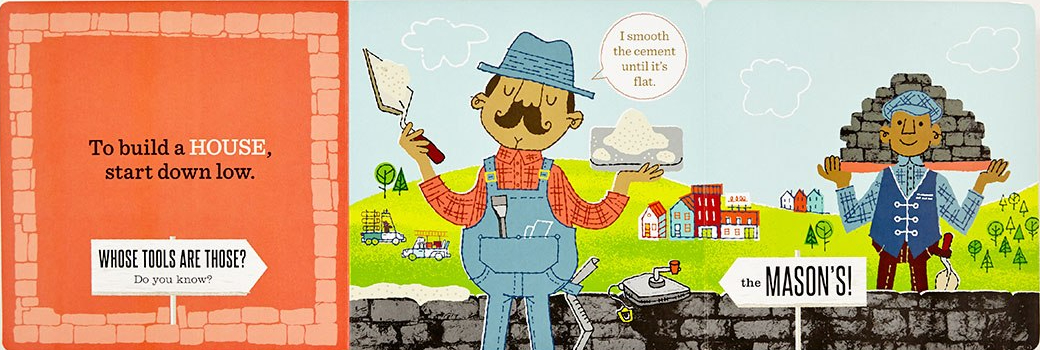
There’s a lot of building going on! Where to start? Well, that depends…. “To build a house, start down low” and use these tools: the chalk line, the chisel, the jointer, and the float. “Whose tools are those? The mason’s!” What does he use them for? He’ll tell you himself: “I smooth the cement until it’s flat.” Where do windows go? Way up high! Here are the hammer, the level, the square, and the saw. Can you guess who uses those tools? They belong to the carpenter! He’s cutting the frame where the windows will go.

celebrate-picture-books-picture-book-review-whose-tools-foundation

Image copyright Jim Datz, 2015, text copyright Toni Buzzeo, 2015. Courtesy of Harry N. Abrams Books for Young Readers.

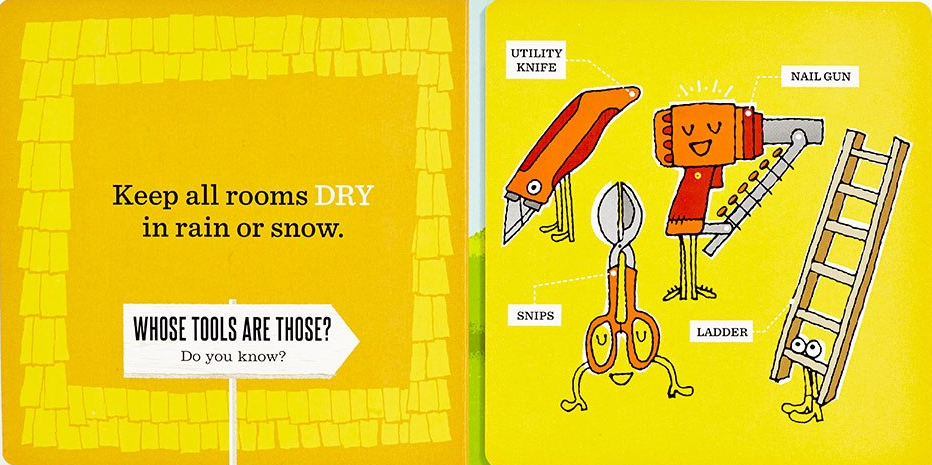
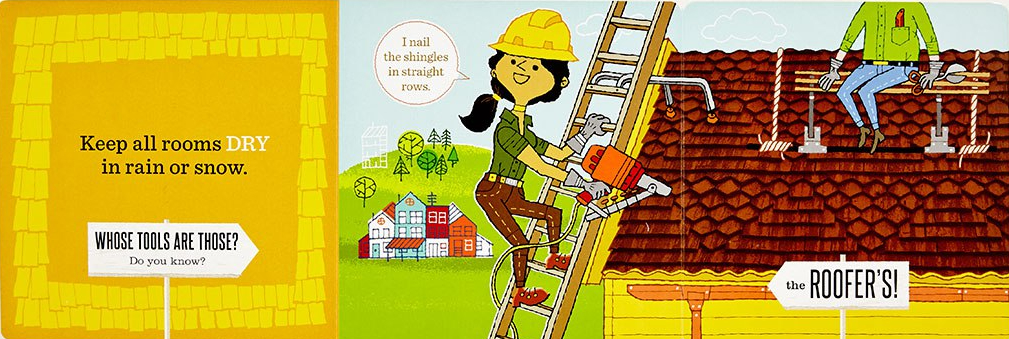
It’s important that a house stays dry in rain and snow. What tools help with that? The utility knife, the snips, the nail gun, and the ladder. “Whose tools are those? Do you know?” They’re the roofer’s! What does she do with them? She climbs to the top of the house and nails “the shingles in straight rows.” A house can’t be dark, so the workers will “add some lights that softly glow.” They’ll use a screwdriver, a drill, a linesman pliers, and a wire stripper. Who are they? They’re the electricians! One electrician is busy stringing “the wire from switches to lights.”

celebrate-picture-books-picture-book-review-whose-tools-mason

Image copyright Jim Datz, 2015, text copyright Toni Buzzeo, 2015. Courtesy of Harry N. Abrams Books for Young Readers.

A house needs water too! What kinds of tools are used for that? An adjustable wrench, a pipe cutter, pipe tape, and a pipe wrench. And who uses these tools? The plumber! He turns “the pipe elbows until they’re tight” so there are no leaks! The house is almost finished, and now “on all four walls bright colors flow.” What tools are used to make such a pretty house? A brush, a roller, a roller tray, and masking tape. And who uses them? The painter! Right now she’s putting another coat of green paint on the wall. “The house is still not finished, though. Who’s come to build?” Surprise! “It’s you!”

celebrate-picture-books-picture-book-review-whose-tools-roof

Image copyright Jim Datz, 2015, text copyright Toni Buzzeo, 2015. Courtesy of Harry N. Abrams Books for Young Readers.

Children are naturally curious about the tools, utensils, and machinery they see adults using. Toni Buzzeo’s delightful board book introduction to twenty-four tools for the youngest readers will capture their interest and imagination with fun prompts and a house-construction project in process. Buzzeo’s enthusiastic language and guess-who format invites multiple readings during which little ones are sure to memorize the names of all the tools and recognize them in the “real world” when they see them.

celebrate-picture-books-picture-book-review-whose-tools-roof-fold-out

Image copyright Jim Datz, 2015, text copyright Toni Buzzeo, 2015. Courtesy of Harry N. Abrams Books for Young Readers.

Through Jim Datz’s cheery illustrations, kids watch as a cozy house comes together from foundation to finished as they learn the shape of each tool and see some being used. Questions are introduced on the left-hand page while the particular tools, drawn with sweet, smiling faces, are named on the right. This page opens to a double spread in which both men and women workers are busily and happily plying their trade. The final image will bring a giggle from kids as they discover that the house being built is actually a house of blocks being carefully constructed by a little girl and boy.

Whose Tools? would make a welcome baby gift and a fun addition to home and preschool libraries for little tool lovers.

Ages 2 – 4

Harry N. Abrams, 2015 | ISBN 978-1419714313

Discover more about Toni Buzzeo and her books on her website.

To view a portfolio of artwork by Jim Datz, visit his website

Worship of Tools Day Activity

Tool-Box-Coloring-Page-[www.getcoloringpages.com]

Terrific Tools! Coloring Pages


Tools are terrific when you need to fix something old or build something new! Have fun coloring these tools and their toolbox!

Saw | Wrench | Toolbox

celebrate-picture-books-picture-book-review-whose-tools-cover

You can find Whose Tools? at these booksellers

Amazon | Barnes & Noble | Books-a-Million

To support your local independent bookstore, order from

Bookshop | IndieBound

Picture Book Review

March 10 – It’s Women’s History Month

celebrate-picture-books-picture-book-review-send-a-girl-cover

About the Holiday

Calling all gals, pals, and woman-identifying people! This month is dedicated to YOU and all the women throughout history who have worked to make things fair. Women throughout history have often been treated as less than men, especially women of color. This concept is called gender inequality, and a whole lot of wonderful ladies across the world have been working to change it. In 1987 the National Women’s History Project petitioned to have the US Congress officially designate March as Women’s History Month. From that point on, organizations and communities have celebrated and recognized the month-long holiday by uplifting the stories of role-model women throughout US history. To celebrate Women’s History Month, read about some of the achievements of women in various fields of study, learn about (and from) stories of activism, and spend some quality time with the women and girls who matter most in your life. To learn more about Women’s History Month, visit: https://womenshistorymonth.gov/ 

Thank to Bloomsbury Children’s Books for sending me a copy of Send a Girl! for review consideration. All opinions on the book are my own.

Reviewed by Dorothy Levine

Send a Girl! The True Story of How Women Joined the FDNY

Written by Jessica M. Rinker | Illustrated by Meg Hunt


As a girl growing up in the 1950’s, Brenda Berkman dealt with a lot of adults telling her what she could and couldn’t do. Brenda loved to play sports and spend time outside. But many of her favorite activities were ones that people considered “boy’s games.” When Brenda tried to join a baseball team, the coach said he wouldn’t send a girl to play a boy’s game. But, did Brenda let this stop her? Nope! Brenda was determined to keep doing the things she liked to do, so she made her own all-girls football team with friends instead. 

As Brenda grew older, people’s views on what boys and girls could do began to expand. Brenda had moved to New York and studied to become a lawyer but realized that she yearned for a career that was more active. In 1977 the New York City Fire Department announced that they would finally allow women to take the exam to become firefighters. This was exciting news! Brenda didn’t think that this would ever be a possibility for her because “In the past, every firefighter in the city had to be a man. In fact, they’d only ever been called firemen!”

celebrate-picture-books-picture-book-review-send-a-girl-football

Image copyright Meg Hunt, 2021, text copyright Jessica Rinker, 2021. Courtesy of Bloomsbury Books for Children.

Brenda knew she wanted to do something that would involve helping people, using her mind to strategize, being active, and getting outdoors. Becoming a firefighter seemed like the perfect fit. Becoming a firefighter proved to be a tough journey for Brenda. Even though the fire department now allowed women to apply, many people did not support this decision. “They said, ‘Don’t send a girl to do a man’s job!’ They didn’t think women were courageous enough, smart enough, or strong enough.” Brenda knew she was going to have to work really hard to prove these people wrong. She passed the written test and began to train for the fitness test.

When Brenda took her physical exam, she found that the men in charge were not looking for the strengths firefighters need to do their jobs. None of the women who took the test passed, and Brenda knew this was no coincidence. It wasn’t that the women weren’t strong enough, but rather the people in charge of the firefighters’ test didn’t want women to pass. Brenda realized that she could use her background in law to fight against this injustice. After four long years of working to prove her case in court, Brenda won, and the test was restructured to better match the skills that people need to have as firefighters. 

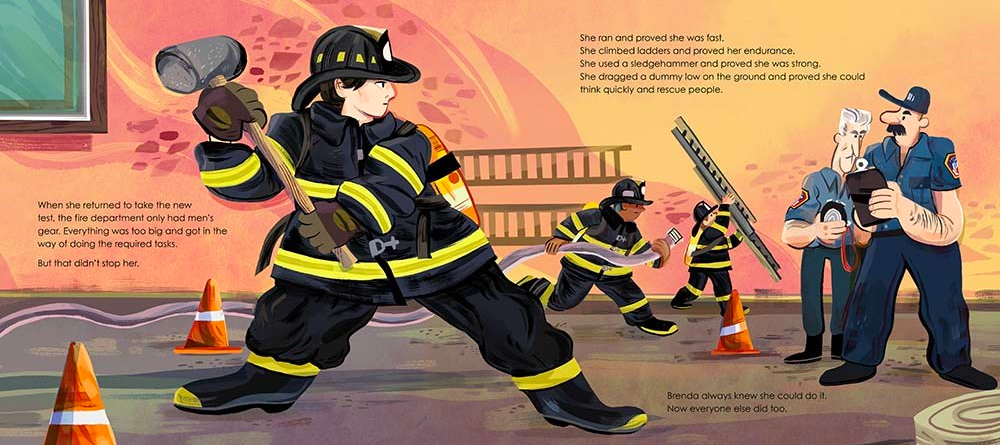
In 1982 Brenda Berkman and forty others became the first female firefighters to join the New York City Fire Department. In Brenda’s new job, “She hauled hoses! Climbed ladders! Broke through walls! Fighting fires was exciting and gritty, loud and dirty, and sometimes dark and dangerous.” But her fight against people’s bias and discrimination was far from over. Many people still didn’t think that women were tough enough for the job, even after they had proved they were. “They said, ‘I want to be saved by fireMEN!’”

celebrate-picture-books-picture-book-review-send-a-girl-test

Image copyright Meg Hunt, 2021, text copyright Jessica Rinker, 2021. Courtesy of Bloomsbury Books for Children.

And, some of the men already on the New York City Fire Department agreed. They were mean and made the job as difficult as possible for Brenda and the other women firefighters. Sometimes they would pull pranks on the women in their departments that were incredibly cruel and dangerous. “Firefighters need to depend on one another. Brenda wasn’t sure she could depend on all her fellow firefighters. Sometimes it was lonely. Often, she felt invisible.” To combat against this, Brenda formed a group called United Women Firefighters, where women could come and talk about these issues and support each other. 

With this new group, strong friends, and time, things got slowly better for Brenda. People began to change their opinions on firefighting only being for men. Brenda continued to excel as a firefighter, and eventually became a captain of her department. She continued to fight fires—and discrimination—throughout her life, and she proved that firefighting is something you can “send a girl” for. Now there are people of all genders across the nation who fight fires every day and save lives. 

An Author’s Note at the end details the importance of learning stories like Brenda’s and provides more information on the history of firefighting and Brenda’s accomplishments. A list of websites where readers can learn more about women firefighters and other influential women is also included.

celebrate-picture-books-picture-book-review-send-a-girl-rescue

Image copyright Meg Hunt, 2021, text copyright Jessica Rinker, 2021. Courtesy of Bloomsbury Books for Children.

In this inspiring story of overcoming norms and gender discrimination, Jessica Rinker eloquently recounts Brenda Berkman’s stirring biography. Readers of all ages will rejoice in the perseverance that Berkman exhibited throughout her career. Rinker’s repetition of Brenda’s firefighting tasks takes on an exciting, triumphant tone and echoes the thrill Brenda felt while fighting fires despite all of the hardship she faced. Rinker’s straightforward writing discusses difficult themes of women’s inequality, bullying, and discrimination in an easily digestible manner for young readers. 

Illustrator Meg Hunt provides a diverse cast of characters to make the story come alive. Her multimedia images match the bustling, busy nature of New York City and provide an immersive view into city living. Readers are transported into the story to fight fires right alongside Brenda with intricate, realistic, and colorfully designed spreads. They watch the protagonist age throughout the story with determination and power. The first image of Brenda valiantly hauling a firehose to a window of billowing smoke in an NYC apartment is mirrored near the end. Readers follow Brenda in a full circle—working tirelessly to become a firefighter, shining at her job, and then extending her joy for firefighting to the next generation of young women on the final spread. 

Book lovers of all types will be inspired by Brenda Berkman’s story and how she shaped the history of fighting fires, both literal and metaphorical. An honest, informative and empowering book. The sentiment and lessons in Send a Girl! are of utmost importance for young girls, and really all young readers to hear.

Ages 4 – 8

Bloomsbury Children’s Books, 2021 | ISBN 978-1547601745

Discover more about Jessica M. Rinker and her books on her website.

To learn more about Meg Hunt, her books, and her art, visit her website.

Women’s History Month Activities

celebrate-picture-books-picture-book-review-womens-history-month-word-search

Women’s History Month Word Search


Find the names of fifteen inspirational women in this printable word search puzzle.

Women’s History Month Word Search Puzzle | Women’s History Month Word Solution

Teacher Thrive mint tin book report craft

Mint-Tin Book Report


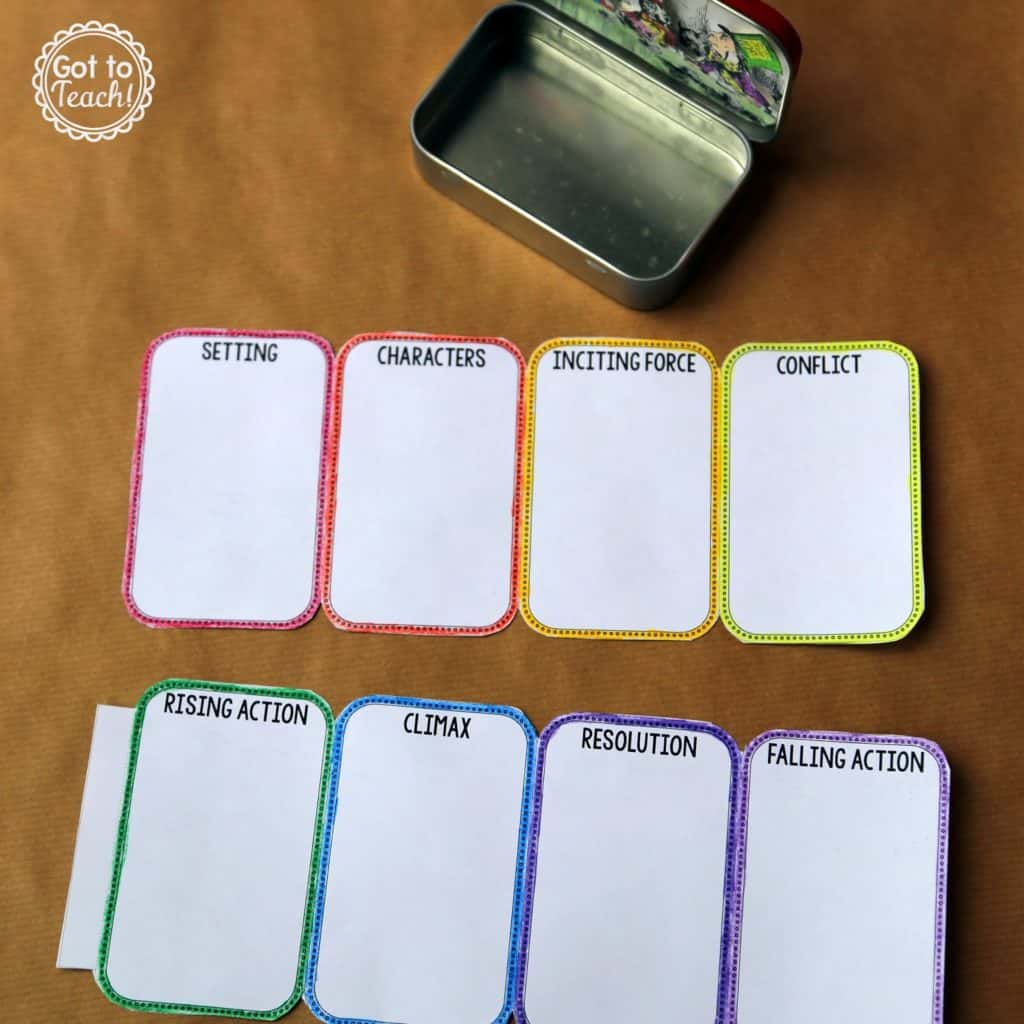
Create a mint-tin book report of Brenda Berkman’s story in Send a Girl! or of another book highlighting an important women’s biography. You can find more about this clever idea from Melissa at Teacher Thrive

Materials

Instructions

Cut out the pages from the printable template and fold along the creases. Glue the “conflict” and “rising action” pieces together using the extra rectangle of paper. Write down the most important facts or highlights from each part of the story and decorate. Fold up the pages accordion style and stick into a mint tin. Use the blank parts to decorate the top and inside of the lid. Then you’ll have a portable, cute book report to carry around wherever you please!

celebrate-picture-books-picture-book-review-send-a-girl-cover

You can find Send a Girl! The True Story of How Women Joined the FDNY at these booksellers

Amazon | Barnes & Noble | Books-a-Million

To support your local independent bookstore, order from

Bookshop | IndieBound

Picture Book Review

March 9 – Unique Names Day

celebrate-picture-books-picture-book-review-my-name-is-wakawakaloch-cover

About the Holiday

Unique Names Day was established in 1997 by Jerry Hill, a hobbyist in onomatology – the study of the etymology, history, and use of proper names – as part of Celebrate Your Name Week. The holiday celebrates uncommon or uncommonly spelled names and encourages those with unique names to always take pride in their name. One way to enjoy the day is to find out more about your name and how or why your parents chose it. You can have fun with names every day this week. Upcoming are Discover What Your Name Means Day, Nametag Day, Middle Name Pride Day, and Descendent’s Day. You can learn more about each daily holiday at Names Universe.

My Name is Wakawakaloch!

Written by Chana Stiefel | Pictures by Mary Sullivan


Wakawakaloch had a problem. Well, it wasn’t really her problem; none of the kids at school could pronounce or even remember her name. After another day in which her name was mangled (Oog called her “‘Walawala,’” Boog shouted “‘Look out, Wammabammaslamma!’” and Goog cheered her on during Club Club with “‘Swing, Lokamokatok!’”), Wakawakaloch was as angry as an erupting volcano.

celebrate-picture-books-picture-book-review-my-name-is-wakawakaloch-easy-club-club

Image copyright Mary Sullivan, 2019, text copyright Chana Stiefel, 2019. Courtesy of HMH Books for Young Readers.

When her parents asked what was wrong, Wakawakaloch said she wanted to change her name to Gloop. Pa thought Gloop was a good name, but reminded his daughter that her name had been “‘in family many, many moons.’” But Wakawakaloch was inconsolable. Not only could no one say her name right, but she never found it on any T-shirts. Ma and Pa thought there was only one thing to do—take her to see Elder Mooch.

Despite his leathery skin and aroma of “rotting mammoth poop,” Elder Mooch was an insightful Neanderthal. He started off with an ill-considered joke that set Wakawakaloch reaching for tissues from the nearby dispenser rock. But she poured out her heart and the fact that she wanted an easy name, one found on T-shirts. She could just imagine all of the heroic and adventurous things she could do with a name and T-shirt like that.

celebrate-picture-books-picture-book-review-my-name-is-wakawakaloch-easy-name

Image copyright Mary Sullivan, 2019, text copyright Chana Stiefel, 2019. Courtesy of HMH Books for Young Readers.

Elder Mooch looked at her and then bestowed his wisdom. He told her she was a “‘forward thinker’” but “‘must be a backward seer too.’” This bit of knowledge cost her two pigeons and left her smoldering. What did he mean by that? Later that night as she tossed and turned in bed, she caught a glimpse of the paintings on her wall. They showed her great-great-great-great-great grandmother Wakawakaloch “performing brave and heroic acts…. Little Wakawakaloch placed her hand on the ancient handprint of her mighty namesake. It was a perfect match.”

celebrate-picture-books-picture-book-review-my-name-is-wakawakaloch-cave-drawing

Image copyright Mary Sullivan, 2019, text copyright Chana Stiefel, 2019. Courtesy of HMH Books for Young Readers.

In the morning, Wakawakaloch was smiling. She no longer wanted to be called Gloop, and she told her parents that she was ready to help others. When the Roll-the-Boulder tournament came round, Wakawakaloch had her personalized T-shirt stand all set. Oog, Boog, and Goog thought her shirts for Chana, Sioban, Xavier, Eoghan were “‘Ooga booga’ (way cool).” Wakawakaloch had even made one for herself. Elder Mooch wanted to buy three, and when little Hoopaloopie came by, Wakawakaloch got to work on another shirt.

celebrate-picture-books-picture-book-review-my-name-is-wakawakaloch-tee-shirts

Image copyright Mary Sullivan, 2019, text copyright Chana Stiefel, 2019. Courtesy of HMH Books for Young Readers.

For all those kids who never find their names on shirts, mugs, necklaces, keychains, or other personalized items and who frequently hear the question, “How do you pronounce that?,” Chana Stiefel’s book is for you! This fresh tale will also resonate with any child who feels different for any reason. Wakawakaloch, with her strong personality, thoughtful introspection, and creative solution, is a character that readers will love and want to emulate. Stiefel deftly navigates this sensitive landscape with a combination of honest feelings and hilarious mispronunciations, prehistorical details, and descriptions. Readers will laugh all the way through but will also be absorbing the lesson that everyone should embrace their own “mighty” personality and be celebrated and recognized for their unique qualities.

In her vibrant illustrations, Mary Sullivan creates a comically anachronistic ancient world, where safety cones made of stone mark the playground, a stone telescope is aimed out the window, mail is delivered (this part may be accurate, I’d have to check), and cupcakes are eaten with forks. Kids will want to linger over each page to point out all of the funny elements that add depth and glee to this story. Wakawakaloch shows the feelings bubbling up inside her with furrowed brows, livid gestures, and ready tears, while the other kids cluelessly continue to distort her name even after being told the right pronunciation multiple times. Wakawakaloch’s visit to Elder Mooch is a funny take on therapy sessions, but his advice leads to a welcome image of contemplation and realization that makes Wakawakaloch appreciate her family history and also want to contribute to its—and society’s—advancement. Wakawakaloch’s T-shirt booth is sure to inspire kids to make their own shirt too.

A delightfully inventive story with many applications and prompts for further discussion as well as activities celebrating individuality, My Name is Wakawakaloch! will be a much-asked-for favorite on home, classroom, and public library shelves.

Ages 4 – 7

HMH Books for Young Readers, 2019 | ISBN 978-1328732095

Discover more about Chana Stiefel and her books on her website.

To learn more about Mary Sullivan, her books, and her art, visit her website.

Check out the My Name is Wakawakaloch! “ooga booga” book trailer!

Unique Names Day Activity

CPB - Name Jars standing

Love Your Name Organizer Jar


Everyone needs a place to store their special stuff! Here’s a way to recycle a plastic jar and make a cool organizer jar with your name on it. This organizer jar also makes a great gift for your friends!

Supplies

  • A large plastic jar, such as a peanut butter jar or mayonnaise jar, cleaned out and with the label removed
  • Acrylic multi-surface paint or markers
  • Chalkboard paint
  • Paint brush
  • Chalk

CPB - Name Jars on sides

Directions

  1. Paint a rectangle on the front of the jar with chalkboard paint
  2. Decorate the rest of the jar with paint, markers, or paper just the way you want! My green jar sports a friendly dinosaur!

celebrate-picture-books-picture-book-review-my-name-is-wakawakaloch-cover

You can find My Name is Wakawakaloch! at these booksellers

Amazon | Barnes & Noble | Books-a-Million

To support your local independent bookstore, order from

Bookshop | IndieBound

Picture Book Review

March 8 – International Women’s Day

celebrate-picture-books-picture-book-review-code-breaker-spy-hunter-cover

About the Holiday

Today’s holiday is celebrated around the world and focuses on the social, economic, cultural, and political accomplishments of women. Spurred on by this mission, the theme for 2021 is “Choose to Challenge.” The sponsors of today’s holiday know that “a challenged world is an alert world and from challenge comes change.” Individually, each of us can choose to call out and challenge gender bias and inequality wherever we see it. Each of us can choose to seek out and celebrate women’s achievements. Collectively, we can all help create an inclusive world. To celebrate today and all year through, commit to helping forge an inclusive world. To learn more about International Women’s Day and how you can get involved in making positive change toward gender equality, visit the International Women’s Day website.

Thanks to Abrams Books for Young Readers and Blue Slip Media for sharing a copy of Code Breaker, Spy Hunter with me for review consideration. All opinions of the book are my own. I’m excited to be teaming with them for a giveaway of the book. See details below.

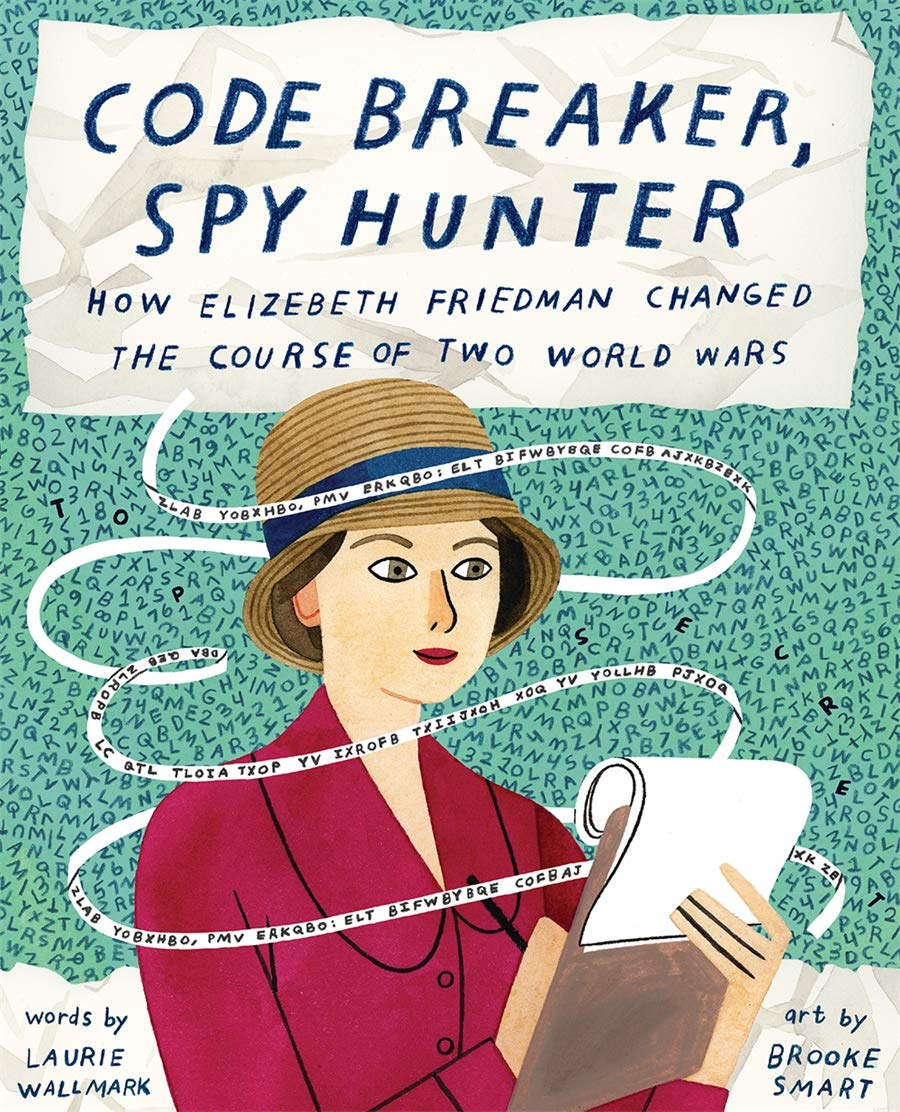
Code Breaker, Spy Hunter: How Elizebeth Friedman Changed the Course of Two World Wars

Written by Laurie Wallmark | Illustrated by Brooke Smart


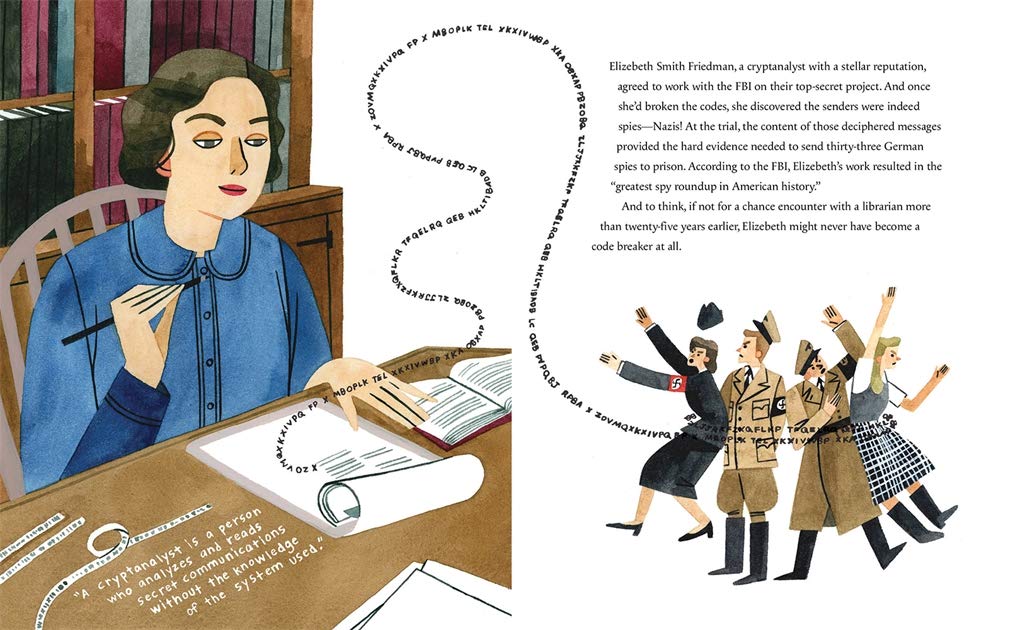
In Code Breaker, Spy Hunter, readers open the cover to an intriguing question: “Could it be? Had enemy spies sneaked into the United States?” World War II was raging, but the United States had not yet joined the effort. And yet the “FBI had intercepted hundreds of coded messages from a secret base in New York.” The problem was no one could read them. Who did the FBI turn to? Elizebeth Smith Friedman, who broke the codes, discovered a cadre of Nazi spies, and provided the evidence “to send thirty-three German spies to prison.” Who was Elizebeth Friedam? Children are about to find out!

celebrate-picture-books-picture-book-review-code-breaker-spy-hunter-cryptanalyst

Image copyright Brooke Smart, 2021, text copyright Laurie Wallmark, 2021. Courtesy of Abrams Books for Young Readers.

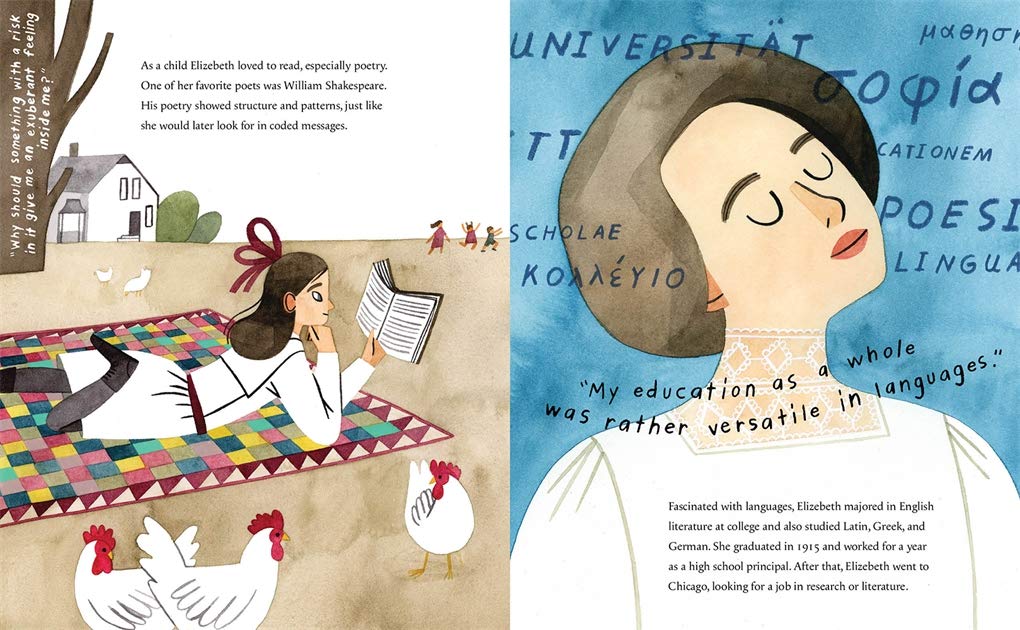
As a child, Elizebeth loved poetry and especially the work of William Shakespeare, with its structure and patterns. In college, she studied English literature, Latin, Greek, and German. While looking for a job in Chicago in 1916, she met the eccentric George Fabyan, who was trying to prove that Francis Bacon was the true writer of Shakespeare’s plays. He hired Elizebeth to “find secret messages Bacon had supposedly hidden in the plays. But the more she explored the plays, the more convinced she became that there were no hidden messages.”

Elizebeth shared her thoughts with a friend, William Friedman, who also loved puzzles and secret codes. Over a year’s time, their discussions resulted in a stronger friendship and finally marriage. In 1917, the US entered World War I and Fabyan asked Elizebeth and William to establish “the country’s first code-breaking unit, the Riverbank Department of Cyphers…. Their methods are now considered the basis for the modern science of cryptology, the study of secret codes.”

celebrate-picture-books-picture-book-review-code-breaker-spy-hunter-childhood

Image copyright Brooke Smart, 2021, text copyright Laurie Wallmark, 2021. Courtesy of Abrams Books for Young Readers.

In 1921, Elizebeth and William moved to Washington D.C., where they worked as code breakers for the Army. At the time, the Army used a large, cumbersome machine to convert messages into code, which precluded soldiers in the field from sending intelligence back. Elizebeth and William invented a complex code that used “only pencil and paper.” After the war, Elizebeth settled down to write books and raise a family, but still the entreaties came to decode messages for court cases sometimes thousands of miles away.

In 1925 with Prohibition the law of the land, smugglers were running rampant. The Coast Guard summoned her, and within three months Elizebeth had cracked “two years of backlogged messages.” Her work and court testimony that helped to convict smugglers made Elizebeth a recognized expert in the new field of cryptology, and when the work became overwhelming for just two people, she created the Coast Guard’s first code-breaking unit.

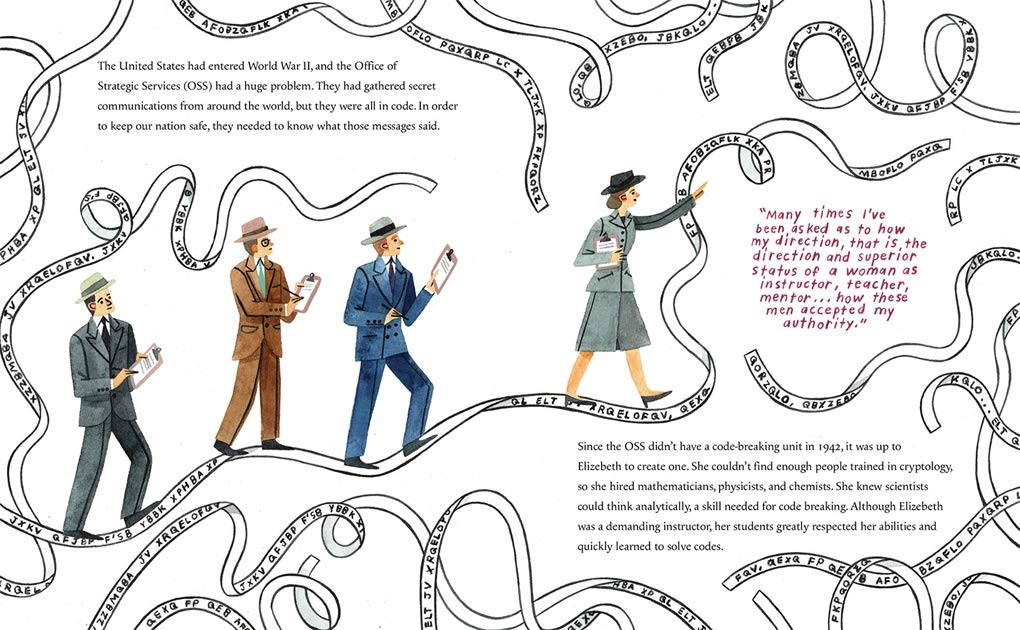
With the entry of the US in World War II, Elizebeth’s expertise was once again needed. Again, she needed to create a code-breaking unit, and in 1942 she hired and taught “mathematicians, physicists, and chemists” the skills of cryptology. Now, Elizebeth’s team was learning important war information about the Nazi’s movements and plans. When the FBI director wanted to nab the spies, Elizebeth recommended waiting “until the military could learn more of the enemy’s secrets.” But he disagreed and raided their hiding place. The spies that escaped quickly changed their codes, making their communications harder to decipher. The FBI director took all the credit for breaking the codes and catching the spies.

celebrate-picture-books-picture-book-review-code-breaker-spy-hunter-world-war-II

Image copyright Brooke Smart, 2021, text copyright Laurie Wallmark, 2021. Courtesy of Abrams Books for Young Readers.

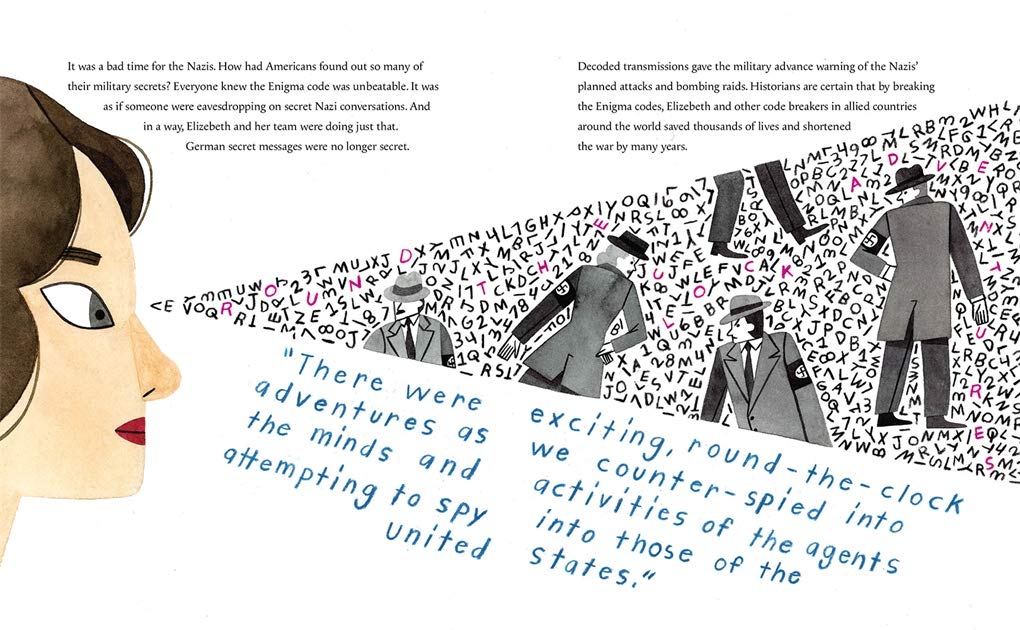
As the war progressed, Elizebeth helped capture an American spy working for the Japanese, and when the Germans developed Enigma, a powerful code-making machine that could “create billions of different cipher alphabets, it was Elizebeth’s team that broke the code for the United States. In Allied countries around the world, other cryptologists were also decrypting Enigma messages. The Nazis were now at a disadvantage, their planned attacks thwarted. Historians believe the work of these code breakers “saved thousands of lives and shortened the war by many years.”

Throughout her life Elizebeth could not speak a word about her work, even to her family. It was classified as Top Secret Ultra by the government and kept locked in the National Archives. At last, in 2015, Elizebeth’s work was declassified. “She is now considered one of the most gifted and influential code breakers of all time.”

celebrate-picture-books-picture-book-review-code-breaker-spy-hunter-counter-spied

Image copyright Brooke Smart, 2021, text copyright Laurie Wallmark, 2021. Courtesy of Abrams Books for Young Readers.

Compelling and wonderfully detailed, Laurie Wallmark’s biography of Elizebeth Friedman immerses children in the world of war-time spies, where cracking codes equaled saved lives and battles won. Wallmark’s storytelling of Elizabeth’s trajectory from Shakespeare scholar to ultra-secret code cracker reads like a thriller and is sprinkled throughout with quotes from Elizebeth that give kids a sense of her personality and the demands of her career. By including several cases Elizebeth was instrumental in solving, Wallmark provides readers with historical context on the broad range of nefarious activity that relied on secret codes to inform their knowledge of today’s uses of encryption as well as international spy networks. Each page is a celebration of Elizebeth’s talent, intelligence, and accomplishments, and her incredible story will enthrall readers.

Brooke Smart’s watercolor and gouache illustrations offer enticing glimpses into the past while following Elizebeth as she meets George Fabyon who shows her around his museum-like house while carrying a small monkey on his shoulder, establishes the United States’ first code-breaking unit, testifies in court, and thwarts the Nazis’ war plans. Interspersed with Smart’s realistic depictions of Elizebeth’s life are images in which lines of coded messages snake across the page, giving readers a look at the kinds of unreadable text Elizebeth and her teams cracked. In addition to presenting a visual representation of the tangled communications that eventually nabbed our enemies, two of these clever illustrations contain messages of their own.

A superlative biography that would enhance any history, social studies, language arts, or STEM curriculum as well as captivate kids who love spy, military, and detective stories, Code Breaker, Spy Hunter: How Elizebeth Friedman Changed the Course of Two World Wars is highly recommended for home bookshelves and is a must for school and library collections.

Ages 7 – 11

Abrams Books for Young Readers, 2021 | ISBN 978-1419739637

Discover more about Laurie Wallmark and her books on her website.

To learn more about Brooke Smart, her books, and her art, visit her website.

International Women’s Day Activity

celebrate-picture-books-picture-book-review-pig-pen-cipher

Send a Secret Message


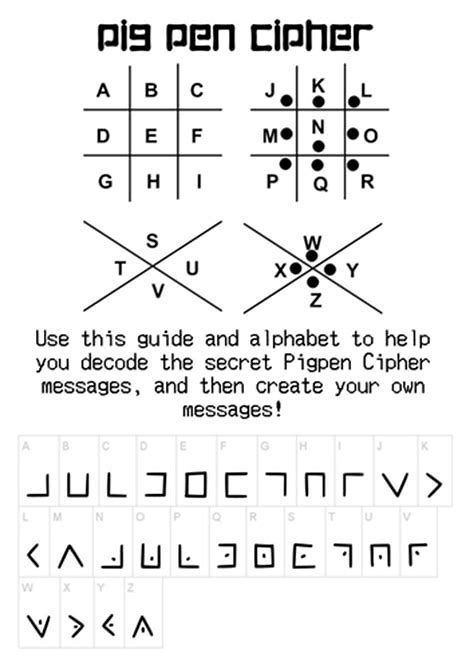
Would you like to be a code breaker – or a spy? Get started with this Pigpen Cipher that makes sending secret messages to friends, siblings, and other family easy and fun. This ancient code is called the Pigpen Cipher because each letter is in its own “pen.” Use it as originally developed then try mixing the letters and pens to create new codes. 

Pigpen Cipher Key

celebrate-picture-books-picture-book-review-code-breaker-spy-hunter-cover

You can find Code Breaker, Spy Hunter at these booksellers

Amazon | Barnes & Noble | Books-a-Million

To support your local independent bookstore, order from 

Bookshop | IndieBound

Picture Book Review