January 18 – National Thesaurus Day

celebrate-picture-books-picture-book-review-the-right-word-cover

About the Holiday

Today we celebrate that most marvelous, stupendous, spectacular, cool, awe-inspiring, remarkableand—one from my early youth—groovy book, the thesaurus! Without its incredible cross-referenced lists of synonyms and antonyms, the world would be much more boring, dull, lackluster, monotonous place. Today, spice up your speech and writing with the perfect word to express all the nuances of life!

The Right Word: Roget and His Thesaurus

Written by Jen Bryant | Illustrated by Melissa Sweet


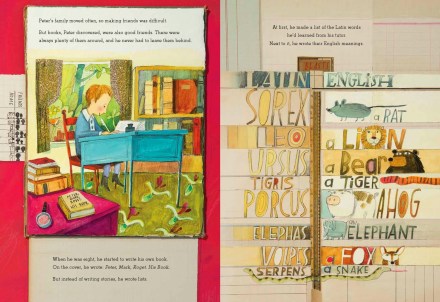
While just a young child, Peter, along with his mother, his uncle, and his baby sister Annette, travel to their new home following the death of his father. It would not be his first move, and in the absence of long-time friends, Peter found companionship in books. When he was eight years old, he began writing his own book titled: Peter, Mark, Roget. His Book. But this was not a book of stories or even one story; it was a book of lists. The first list was divided in two. On one side were the Latin words he knew; on the other were their definitions.
celebrate-picture-books-picture-book-review-the-right-word-roget-peter-starts-his-book

Image copyright Melissa Sweet, 2014, text copyright Jen Bryant, 2014. Courtesy of Eerdmans Books for Young Readers.

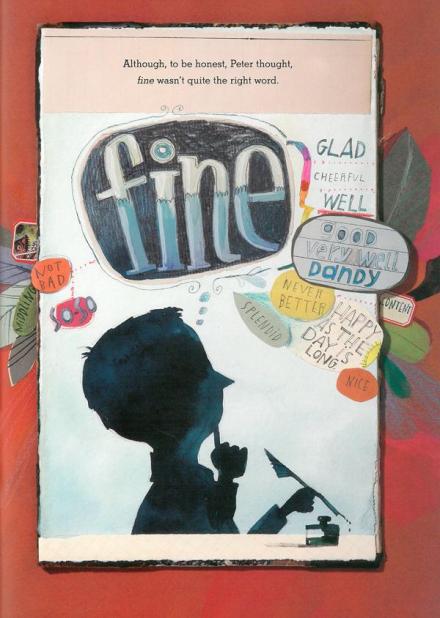
Peter’s mother hovered and worried over her son, and he always told her he was “fine.” “Although, to be honest, Peter thought, fine wasn’t quite the right word.” As the years went by, Peter added lists to his book, prompting his mother to complain about his constant “scribbling.” But Peter looked at his lists differently. “Words, Peter learned, were powerful things. And when he put them in long, neat rows, he felt as if the world itself clicked into order.”

As a teenager Peter was shy, preferring to wander the London gardens alone, “making lists of all the plants and insects,” as in one of his favorite science books by Linnaeus. His “mother didn’t approve, and Peter told her not to worry—but “perhaps worry wasn’t quite the right word. What was the right word? Peter began a new list: Worry, fret, grieve, despair, intrude, badger, annoy, plague, provoke, harass. Enough to drive one mad. How wonderful it felt to find just the right word.”
celebrate-picture-books-picture-book-review-the-right-word-roget-fine

Image copyright Melissa Sweet, 2014, text copyright Jen Bryant, 2014. Courtesy of Eerdmans Books for Young Readers.

An idea crept into Peter’s mind for a book where “all the ideas in the world could be found in one place,” and people could “find the best word, the one that really fit.” When Peter was 14 he entered medical school in Edinburgh, Scotland. Upon graduation at 19, his uncle told him that patients would be wary of a doctor so young. To gain a bit of experience and maturity, Peter became a tutor to two teenage boys.

At last Peter set up his medical practice in Manchester, England, where he took care of the factory workers, who “were poor and often sick.” At night Peter worked on his book of lists, and in 1805 he declared it finished. “It had about one hundred pages, one thousand ideas, and listed more than fifteen thousand words!” Eventually, Peter moved back to London where he joined science societies and attended lectures. “Before long, he was asked to give lectures too,” and once-shy Peter astonished his audiences with his knowledge of math, magnetism, and other scientific subjects. He even invented a portable chess set.
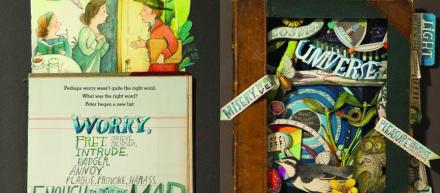
celebrate-picture-books-picture-book-review-the-right-word-mother-worries

Image copyright Melissa Sweet, 2014, text copyright Jen Bryant, 2014. Courtesy of Eerdmans Books for Young Readers.

When Peter was 45 years old, he married Mary Hobson, and they had two children, Kate and John. As he grew older, he visited fewer patients, but he continued to take walks and work on his lists. While some other writers had published their own word lists to help people “to speak and to write more politely,” Kate and John “thought their father’s book was much better. Peter agreed.” For three years he rewrote his book. “He made it larger, more organized, and easier to use. Long ago Peter had discovered the power of words. Now he believed that everyone should have this power—everyone should be able to find the right word whenever they needed it.”
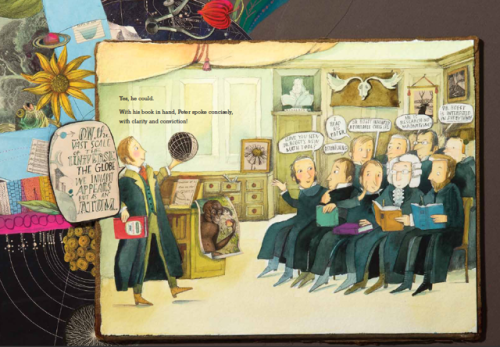
celebrate-picture-books-picture-book-review-the-right-word-roget-lecturing

Image copyright Melissa Sweet, 2014, text copyright Jen Bryant, 2014. Courtesy of Eerdmans Books for Young Readers.

“In 1852, Roget published his Thesaurus, a word that means ‘treasure house’ in Greek.” It was an instant best seller, and Peter became a popular author. But he never stopped making lists.

Following the text, a timeline of principal events in Peter’s life as well as world events allow readers to better understand the historical period in which Peter worked. Extensive Author’s and Illustrator’ Notes also expand on Roget’s biography, and resources for further reading and research are included.

Jen Bryant’s biography of a brilliant boy who grew up to give the world its most fascinating and comprehensive collection of word lists, is a spritely telling of Roget’s life and revelation into his personality, which was perfectly suited to his scientific and written accomplishments. Children will appreciate Roget’s reactions to his mother’s worries as well as the message in his well-rounded pursuit of science and writing. Through Bryant’s captivating and lyrical storytelling, children will be inspired by Roget’s journey from shy child to much-accomplished adult.
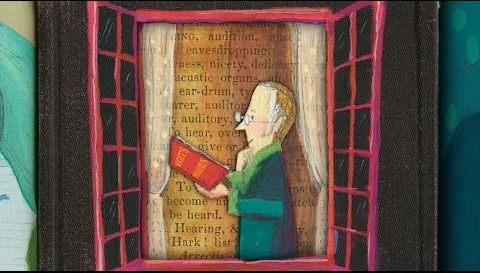
celebrate-picture-books-picture-book-review-the-right-word-roget-at-home

Image copyright Melissa Sweet, 2014, courtesy of Eerdmans Books for Young Readers.

Melissa Sweet beguiles readers with her mixed media, collage, and watercolor illustrations that are as jam-packed with ideas, images, portraits, and typography as Roget’s thesaurus is full of words. In the early pages describing Peter’s childhood, the pages contain simple framed pictures of Roget and his family. As he grows, however, his lists of words are transformed into vibrant artwork that jostles for position from corner to corner of the pages. In the midst of these, delicate watercolors portray Peter as he strolls through a garden, takes his young charges to Paris, treats his patients, lectures, marries, and finally publishes his thesaurus. A special mention must be made of the typography, which at times in the text runs down the center of the page in one- or two-word lines, mirroring Roget’s love of lists, and in the illustrations presents the myriad synonyms in a mixture of colorful block letters, fine print, and calligraphy.

For bibliophiles, wordsmiths, scientists, and history buffs, The Right Word: Roget and His Thesaurus is just the right book for home libraries.

Ages 6 – 18

Eerdmans Books for Young Readers, 2014 | ISBN 978-0802853851

Discover more about Jen Bryant and her books as well as news, contests, and events, visit her website!

Learn more about Melissa Sweet and her books and have fun with the downloadable activities you’ll find on her website!

Watch this The Right Word: Roget and His Thesaurus book trailer!

Thesaurus Day Activity

celebrate-picture-books-picture-book-review-synonyms-word-search

Word Words Word Search Puzzle


When you’re looking for just the right word, where do you go? To the thesaurus of course! Can you find the 25 synonyms for “Word” in this printable Word Words Word Search Puzzle? Here’s the Solution!

celebrate-picture-books-picture-book-review-the-right-word-cover

You can find The Right Word: Roget and His Thesaurus at these booksellers

Amazon | Barnes & Noble | Books-a-Million | IndieBound

Picture Book Review

October 30 – It’s National Book Month

celebrate-picture-books-picture-book-review-everybody's-favorite-book-cover

About the Holiday

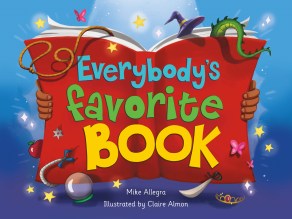
It’s been a terrific month of celebrating the joys of reading at home, in the classroom, and at the library! Every book read to and with a child enriches their life and helps to foster a life-long love of learning. Whether your child likes books that are fiction or nonfiction, stories or poetry, funny or poignant, there are a vast array of new and old books to teach them about the world and get them excited about being part of it. There really is a book for every child—as you’ll see in today’s review!

I received a copy of Everybody’s Favorite Book from Imprint to check out. All opinions are my own. I’m thrilled to be partnering with Macmillan Publishing in a giveaway of the book. See details below.

Everybody’s Favorite Book

Written by Mike Allegra | Illustrated by Claire Almon


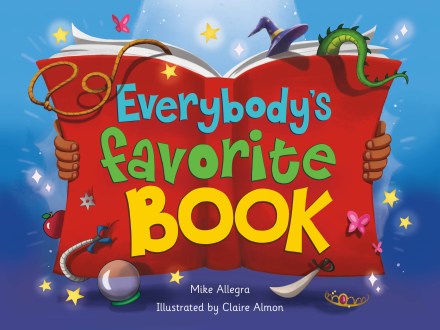
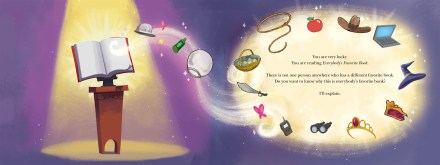
You are quite lucky, the narrator greets you, to be holding the world’s most favorite book. What makes it everybody’s favorite? Well, “lots of great books have cool heroes.” But these are heroes with just one talent—“like spacemen! Or ninjas! Or cowgirls!” In this book, though, the hero multitasks! What is he? “A space ninja cow!” and “his name is Bob.”

celebrate-picture-books-picture-book-review-everybody's-favorite-book-opening

Image copyright Claire Almon, 2018, text copyright Mike Allegra, 2018. Courtesy of Imprint at Macmillan Publishing.

Of course, a hero needs a villain to vanquish, and Bob is lucky because instead of a one-dimensional bad guy, he gets to pit himself against a fierce mash up of a robot, a dragon, and a pirate. What’s this horrible marauder’s name?. Are you ready? It’s Corky! So Bob and Corky fight. It’s thrilling…it’s dangerous…it’s stopped? Ah, the narrator sees now— “everybody doesn’t like violent books” and since this is Everybody’s Favorite Book, the story needs to be a bit more… Well, let’s see if Princess Glittersprinkles can help!

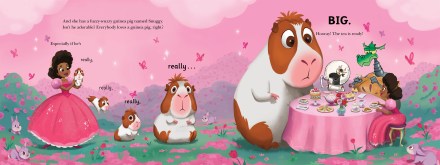
Yes! A tea party would be splendid. Bob and Corky and the princess sit down to a lovely spread with the adorable but really, really, really, really BIG guinea pig, Snuggy. But, wait! We’re forgetting about babies. Baby’s love books too, right? Now might be a good time to offer a bit of ABC fun. “A is for Apple. B is for Bob.” By the way…where is Bob? Is that a suspicious bulge in Snuggy’s cheeks? 

celebrate-picture-books-picture-book-review-everybody's-favorite-book-tea-party

Image copyright Claire Almon, 2018, text copyright Mike Allegra, 2018. Courtesy of Imprint at Macmillan Publishing.

Finding Bob’s going to require spies, especially cool ones. Now, while they’re out spying, let’s give it up for those teachers and librarians who love big, educational words like “Gallimaufry, Codswallop, and Frippery.” Sure, the narrator knows the definitions, but the book will be more fun and educational if you read them for yourself. Oh, dear! Are those words too educational? Then maybe a poop jok…wait a minute! Do you see a suspicious bump in Snuggy’s belly? No, me either.

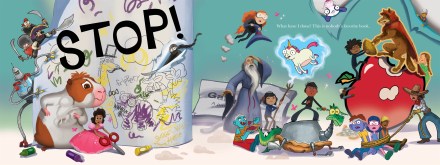
If this really is Everybody’s Favorite Book, it seems that “we are still missing so many things that everybody likes. Things like wizards! And a fairy tale!” And so many other characters and things to do…. Hey! Why is everyone fighting? There’s plenty of room for everybody, but right now “this is nobody’s favorite book.” What’s needed is a hero. “Oh wait! There’s Bob,” launching from Snuggy’s HUGE burp just in time! “Maybe he has an idea.” Bob suggests a “sweet ending.” This is more like it! All the hugs and smiles and cooperation is so sweet. Sweet, Snuggy. Not sweets! Oh dear….

celebrate-picture-books-picture-book-review-everybody's-favorite-book-stop

Image copyright Claire Almon, 2018, text copyright Mike Allegra, 2018. Courtesy of Imprint at Macmillan Publishing.

Mike Allegra will have kids laughing out loud with every page turn in his riotously clever genre mash-up. Allegra’s well-meaning narrator offers up droll juxtapositions of characters and situations while riffing on favorite books and movies, fads and fantasies with some crafts, coloring, and craziness to boot. The fast pace, abrupt interruptions, and zigzagging storyline keep kids guessing and eager to find out what comes next. As the action devolves into a free-for-all, the promise of a book for everybody is fulfilled with inclusive hugs and teamwork.

Claire Almon’s cartoon-inspired illustrations are bold, dynamic, and full of action with plenty of humor thrown in. Ingenious details, comically used tropes, and familiar styles of graphics from kids favorite TV shows and movies give young readers a feeling of shared experiences and culture that underline the theme of friendship. Readers will love following Bob’s journey to escape from Snuggy’s belly, and cutaways and character involvement from page to page keeps everybody reacting to the narrator’s directions until the big finale.

For book lovers of all stripes, Everybody’s Favorite Book will be a much-asked for addition to home, classroom, and library bookshelves. The book makes a terrific gift for all those readers on your list.

Ages 3 – 7 

Imprint, 2018 | ISBN 978-1250132765

Discover more about Mike Allegra, his books, and other projects on his website.

To learn more about Claire Almon, her books, and her art, visit her tumblr.

Meet Mike Allegra

celebrate-picture-books-picture-book-review-mike-allegra-headshot

I’m excited to be chatting with Mike Allegra today about his inspiration for his most original book, what kind of mash-up character he’d be, and his role in a family holiday tradition.

What was the inspiration or spark for Everybody’s Favorite Book?

The idea came to me while wandering around the children’s book section of Barnes & Noble. In the picture book area, I stumbled upon a huuuuge display dedicated to ninjas. Everything you could imagine was ninja-related: ninja pigs, ninja school, ninja camp, ninja grandma, ninja notary public… It was crazy. So I thought, “Hmm…I wonder if I can write a book about a ninja? Then I saw another display dedicated to astronauts and a third display dedicated to cowboys—and thought, “Hmm…I wonder if I can put ninjas and spacemen and cowboys into a single book?” That thought soon evolved into, “I wonder if I can cram a spaceman and ninja and cowboy into a single character?”

And Bob the Space Ninja Cow was born.

Then the creative floodgates opened wide. I giddily zipped around the children’s section looking for characters and genres and themes I could shoehorn into a single picture book. It was a blast!

If you were a mashup hero like Bob or even a mashup villain like Corky, what would you be? What would your name be?

I would want to be a mastodon-sized guinea pig like Snuggy. And I’d want to fly. And solve mysteries.

And they would call me Wondersnug, The Flying Pigamajig.

You’ve done a bit of everything in the writing field—plays, journalism, essay-writing, communications, editing—what do you like about writing for children?

Writing for children is like giving yourself permission to let your creative spirit soar. The possibilities are almost endless. I can write about a Space Ninja Cow! Or a dragon who knits! Or a boy who turns into a Kafka-esque giant bug! My mind can move in the wildest, weirdest directions. It’s wonderful.

You wrote so much as a child that a teacher predicted you’d become a writer. Was your work always funny?

No, but I always tried to make it funny, which is not the same thing.

My sixth-grade teacher, Mrs. Snelback, was the first person outside of my own family to say that I could write “funny.” And Mrs. Snelback was not one of those teachers who spouted compliments. Quite the opposite, really. She was pretty miserly, compliment-wise.

So when she told my parents that I should pursue a career as a writer, it really meant something. Mrs. Snelback didn’t say anything unless she absolutely, positively, 100% believed it. That’s why Mrs. Snelback will always be my favorite teacher. She shoved me onto the writing path and it has been an amazing journey.  

How do you tap into the humor and rhythms that really make kids laugh?

I’d love to say something profound here—like: “I try to see the world through the wondrous eyes of a child”—but the truth is a lot simpler: I like writing silly things and kids like reading silly things. So it works out for both of us!

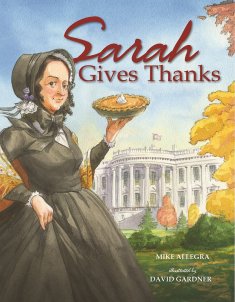
I love hearing about how holidays inspire picture books. Can you talk a little about your first published children’s picture book, Sarah Gives Thanks: How Thanksgiving Became a National Holiday?

Ah, the great Sarah Josepha Hale. She is so awesome. She was a celebrated and prolific writer. She edited the most widely read magazine in America. She founded charities, led patriotic fundraising drives, championed college educations for women, and used her magazine to influence public opinion on a wide spectrum of topics—the most famous of which was a nationalized Thanksgiving, which at that time was rarely celebrated outside of New England.

celebrate-picture-books-picture-book-review-sarah-gives-thanks-cover
And she did all these things in the early- to mid-1800s, when women were widely seen as second-class citizens. And she also did all of these things while raising five children by herself! 

See what I mean? Awesome!

Once I learned about Sarah, I just had to write about her. 

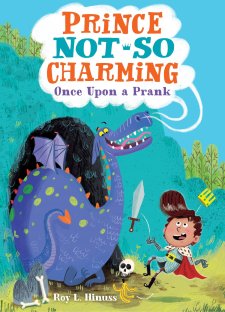
This summer two books in your Prince Not-So-Charming series were released. Can you introduce readers to this prince with other dreams and the very capable princess he encounters?

celebrate-picture-books-picture-book-review-prince-not-so-charming-once-upon-a-prank

Prince Carlos Charles Charming is the young prince of the happy and peaceful land of Faraway Kingdom and the sole heir to the kingdom’s throne. But Carlos would much rather be a jester, so he’s forced to live a double life of sorts, performing dangerous princely duties to satisfy his mom and dad (the queen and king) while also searching out venues to perform his juggling routine and road-test his impressive collection of fart jokes.

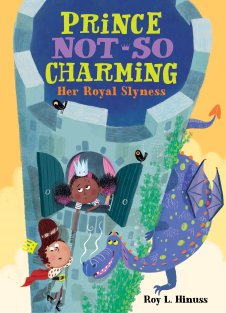
celebrate-picture-books-picture-book-review-prince-not-so-charming-her-royal-slyness

Princess Pinky, from the neighboring kingdom of Ever After Land, is in a similar situation; she would happily give up her crown to be an artist.

So Carlos and Pinky become fast friends who pursue their passions while going on princely and princessly adventures. (Oh, and Carlos has a pet dragon named Smudge who likes to knit. So there’s that, too.)

Any sneak peek into the prince’s future?

Carlos is going to be very busy. In future books he’ll joust, get turned into a frog, lead a search-and-rescue expedition, and attempt to stop a war.

What’s up next for you?

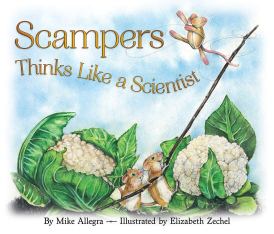
celebrate-picture-books-picture-book-review-scampers-thinks-like-a-scientist-cover

Well, I have another picture book coming out in March titled Scampers Thinks Like a Scientist, which I’m excited about. I just recorded the audiobook for it—which is either a good thing or a bad thing depending on what you think of my voice.

I’m also writing a middle grade murder mystery novel.

What’s your favorite holiday?

I love Christmas, but as I get older, I find myself gravitating toward holidays that contain a lot less hoopla. Thanksgiving is the holiday for me. I get to eat my favorite food on a crisp fall day. (Oh, how I love the fall with its pumpkin-spiced everything!) Also, I was born on November 25th, so I can celebrate my birthday on Thanksgiving, too! Thanksgiving is pretty much perfect.

In other words, Sarah Josepha Hale was a very wise woman.

Do you have an anecdote from a holiday that you’d like to share?

Sure! When I was a kid, every Christmas the entire family would assemble at my grandparents’ house to open presents and eat dinner.

One year—I think I was about seven—I noticed that every time a present was opened, half the room would say, “Ooh,” the other half would say, “Ahh,” and my grandmother would say, “Isn’t that nice!”

No joke; this happened every single time for every single present.

The problem, as I saw it, was that it these responses were too disorganized; everyone was ooh-ing and ahh-ing over everyone else. It was a big ol’ mess of noise. So I stood up and asked if I could conduct my family’s reactions like Leopold Stokowski. They happily agreed.

So whenever a present was opened, I would wave my arms to cue the “Ooh-ers,” the “Ahh-ers,” and Grandma’s “Isn’t that nice!” I never felt more powerful in my life. More importantly, almost everyone in the room was practically peeing their pants laughing. And, from that point forward, an Allegra Christmas tradition was born.

National Book Day Activity

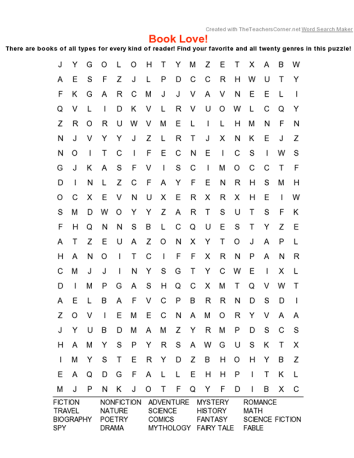
celebrate-picture-books-picture-book-review-book-love-word-search-puzzle

Book Love! Word Search


There are all kinds of books for every reader. Find your favorite along with twenty favorite genres in this printable puzzle.

Book Love! Word Search Puzzle | Book Love! Word Search Solution

celebrate-picture-books-picture-book-review-everybody's-favorite-book-cover

You can find Everybody’s Favorite Book at these booksellers

Amazon | Barnes & Noble | Books-a-Million | IndieBound

Picture Book Review
October 16 – National Dictionary Day

celebrate-picture-books-picture-book-review-w-is-for-webster-cover-image

About the Holiday

Dictionary Day honors Noah Webster, who wrote the first American dictionary. He was born in 1758 to a family that loved learning and knew the importance of a good education. Even as a boy Noah Webster loved words. He went on to become a lawyer, newspaper editor, Connecticut and Massachusetts legislator, and he helped found Amherst College in Massachusetts. He is most well-known, however, for compiling the first American dictionary that is synonymous with his name and still the most popular dictionary in use. His work, first published in 1828, revolutionized the way language and words were presented and remains always current by every year adding new words that come into common use through new products, fads, and slang. Today, celebrate by taking a walk through the dictionary—either in book form or online—to learn a few new words!

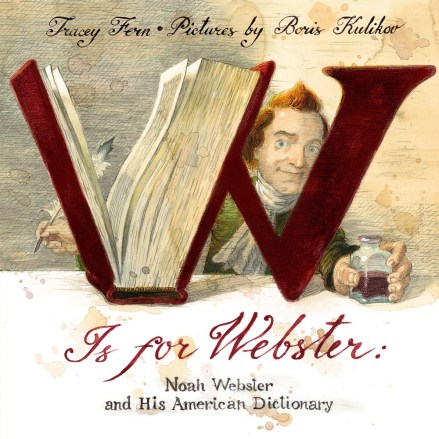
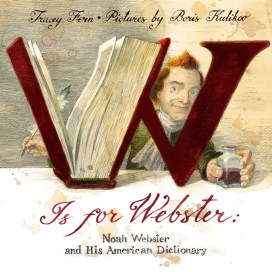
W is for Webster: Noah Webster and His American Dictionary

Witten by Tracey Fern | Illustrated by Boris Kulikov


Noah Webster was always different. Tall and thin with bright red hair, he liked to use big words when he spoke and wanted to do homework instead of goof around in school. Unfortunately for him school was in session for only a few months a year and goofing around seemed to be the major course of study. Of course, Noah didn’t call it “goofing around,” he called it “‘playing roguish tricks.’”

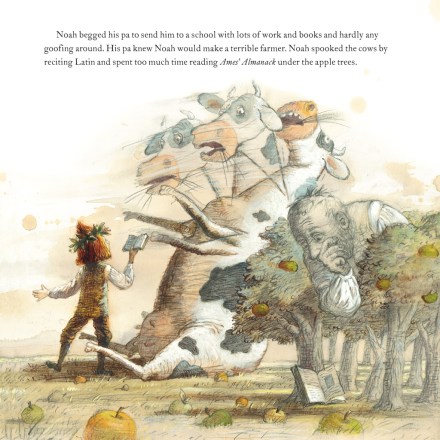
Noah begged to go to a harder school. “His pa knew Noah would make a terrible farmer. Noah spooked the cows by reciting Latin and spent too much time reading Ames’ Almanack under the apple trees.” His pa agreed, and in 1774 at the age of 16 Noah went off to study at nearby Yale College in New Haven, Connecticut. Yale had strict rules. Students had to rise at 5:30 a.m. and study for two hours before class. They were also fined “two shillings for making ‘tumult, noise, hallooing,’ or otherwise goofing around. Noah thought Yale was wonderful.”

celebrate-picture-books-picture-book-review-w-is-for-webster-spooking-horses

Image copyright Boris Kulikov, 2015, text copyright Tracey Fern, 2015 . Courtesy of us.macmillan.com.

Noah hadn’t been at Yale long before the American Revolutionary War broke out. Although Noah signed up to fight, he recognized that he was “‘ill able to bear the fatigues of a soldier,’” which was “Noah’s big way of saying he was a lousy soldier.” He returned to Yale and graduated in 1778, but he left the school with no job and no prospects. Even his pa told him to leave home to find work.

Noah became a teacher, but he found the British textbooks “‘defective and erroneous.’” He believed the students should have American textbooks that better reflected their diverse experiences. With the Revolutionary War at an end and America victorious, Noah wanted to help “hold his new, complicated nation together.” He believed that America needed a language different than the English spoked in Britain. “‘A national language is a national tie,’ Noah insisted to all who would listen, and to many who wouldn’t.”

celebrate-picture-books-picture-book-review-w-is-for-webster-teaching-school

Image copyright Boris Kulikov, 2015. Courtesy of us.macmillan.com.

He began the work himself with a speller. Right from the start Noah’s speller was different than the British books. It included everyday words “like scab, grub, and mop.” He also simplified the spelling by taking out unpronounced letters or spelling words phonetically. He also added pictures to every page and presented lists of rhyming words. He also priced his book so almost anyone could afford it. Noah’s speller became a bestseller.

Still, Noah had bigger ideas. He wanted to write a patriotic dictionary with uniquely American words. He took his idea on the road to make money for the venture, lecturing wherever he could. But Noah’s know-it-all tone of delivery, his “prickly personality,” even his “‘porcupine hair’” put people off. And what’s more, they didn’t like the idea of his dictionary. People thought he was a “lunatic” for wanting to replace British words with American ones.

celebrate-picture-books-picture-book-review-w-is-for-webster-working-on-letter-a

Image copyright Boris Kulikov, 2015, text copyright Tracey Fern, 2015. Courtesy of us.macmillan.com

In 1806 Noah went ahead and published “A Compendious Dictionary of the English Language. It was a flop, but Noah wasn’t discouraged.” The next year he started working on a bigger dictionary. He copied words out of British dictionaries and added American words and he traced the roots of all the words and wrote definitions, sometimes including quotes from famous people to show differences in meaning. He figured the whole dictionary would take 5 years to finish—eight to ten, tops.

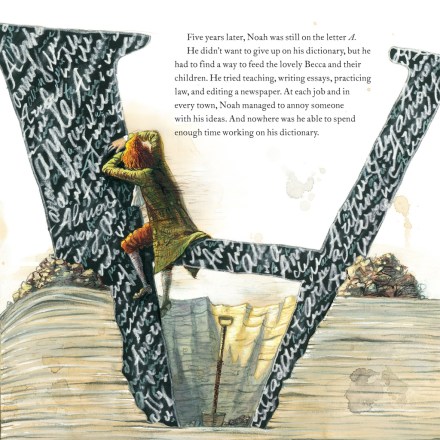
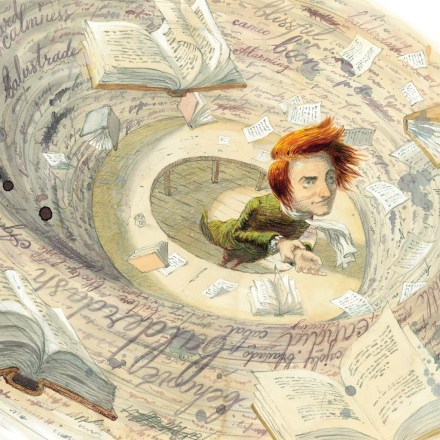
But five years later, Noah was still on the letter A. With no money coming in and a growing family, Noah took a variety of jobs, but he always seemed to rub someone the wrong way, and he lost job after job. He decided to sell his fancy house and bought a farm. Here he was able to gather books, books, and more books around his unusual donut-shaped desk. Standing inside the center of the desk, he spun around and around reading the books and finding words to include in his dictionary.

celebrate-picture-books-picture-book-review-w-is-for-webster-special-desk

Image copyright Boris Kulikov. 2015. Courtesy of us.macmillan.com.

By 1822 Noah had exhausted all the books in his study. He took to traveling to other American libraries, moved his family to New Haven to use the Yale library, and in 1824 even sailed to Europe to explore books found in the National Library in Paris and at the University of Cambridge in England.

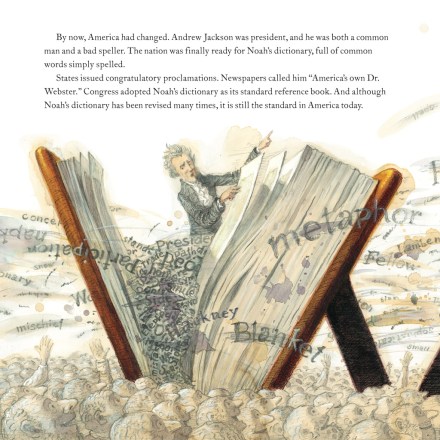
Finally, in 1825 Noah finished his dictionary.  With more than 70,000 words, An American Dictionary of the English Language was the largest English dictionary ever written. “Many people thought it was the best English dictionary ever written.” Why the change of heart? Well, one reason might have been that the President of the United States, Andrew Jackson, “was a common man and a bad speller.” Another might have been that the timing was just right.

celebrate-picture-books-picture-book-review-w-is-for-webster-finished-dictionary

Image copyright Boris Kulikov, 2015, text copyright Tracey Fern, 2015. Courtesy of us.macmillan.com.

However it came to be, Noah was now lauded as a hero by states and newspapers. Congress even adopted the dictionary as its standard reference book. Noah had not only succeeded in writing an American dictionary, he had “created a new American language for a new American nation.” One that is still beloved today.

An Author’s note as well as a list of resources follow the text.

Webster’s dictionary is intrinsically woven into every American child’s life through language and vocabulary development. Tracey Fern’s captivating story reveals the charm and foibles of its author, a man with just the right temperament and perseverance to tackle and complete such an overwhelming task. Fern’s exceptional storytelling skills and deft turns of phrase allow for a comprehensive review of Webster’s life that is full of exhilaration, empathy, and a good dose of the “big” words Webster loved. Fern builds suspense and tension while offering an insightful look at early American history by including details of the staggering research required and the adverse reactions to Webster and his work.

Boris Kulikov’s expressive illustrations perfectly capture the complex personality of Noah Webster, late-1700s-to-early-1800s American society, and the obstacles Webster faced in writing his dictionary. Fittingly, words, books, or ink blots abound on every page, pouring from the air, sprouting from the ground, stacked like the skyscrapers that would come, and surrounding Noah Webster the way they must have swarmed through his brain. Kulikov infuses humor into his paintings, as when Noah tears at his hair wondering how he will support himself after college, shrugs nonplussed at his students’ shenanigans, and buys himself quiet work time by handing out sweets to his kids. Visual metaphors for the hard, backbreaking and mind bending work also enhance this beautiful biography.

Ages 5 – 10 (adult’s will also enjoy this biography)

Farrar Straus Giroux, 2015 | ISBN 978-0374382407

Visit Tracey Fern’s website to learn more about her and her books!

Discover a gallery of artwork by Boris Kulikov on his website!

National Dictionary Day Activity

celebrate-picture-books-picture-book-review-big-words-vocabulary-word-search-puzzle

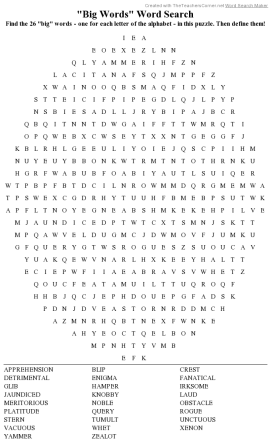
“Big Words” Word Search


Knowing and using a wide range of words allows you to express yourself in exact—and often—fun ways. Find the 26 “big” words—one for each letter of the alphabet—in this printable “Big Words” Word Search puzzle. Here’s the Solution!

celebrate-picture-books-picture-book-review-w-is-for-webster-cover-image

You can find is for Webster at these booksellers

Amazon | Barnes & Noble | Books-a-Million | IndieBound

Picture Book Review
September 24 – National Punctuation Day

celebrate-picture-books-picture-book-review-a-bunch-of-punctuation-cover

About the Holiday

Founded in 2004 by Jeff Rubin, National Punctuation Day promotes the correct usage of all those little marks that make reading clearer and more meaningful. Do you ever wonder just how to use the ; and what’s the real difference between – and —? It can all get a little confusing. But misplaced or misused punctuation can result in some pretty funny mistakes—or some serious misinterpretations. Whether you love punctuation, would like to understand it better, or just use it to make emojis, today’s holiday will make you : – ). To find information on the day, resources for using punctuation correctly, and a fun contest to enter, visit Jeff Rubin’s National Punctuation Day website.

Boyds Mills Press sent me a copy of A Bunch of Punctuation to check out. All opinions are my own. 

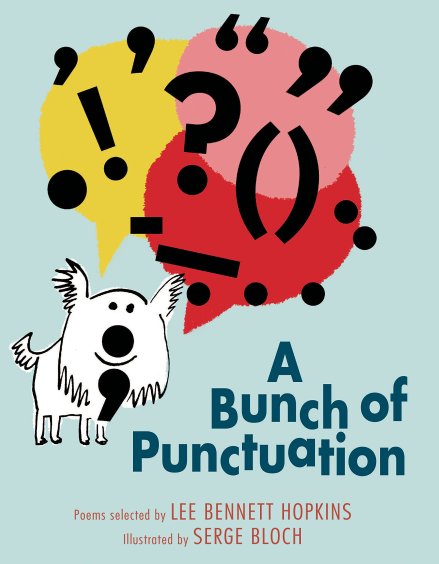
A Bunch of Punctuation

Poems selected by Lee Bennett Hopkins | Illustrated by Serge Bloch


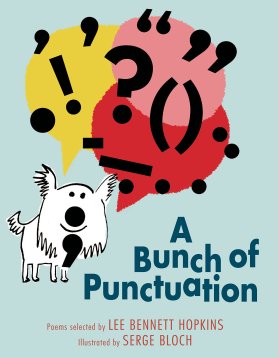
In the world of writing and reading, the letters of the alphabet seem to get all the acclaim as they create cool words and form captivating sentences. But what about those little marks of punctuation that separate clauses, slow readers down, add mystery and excitement, and even tell readers when they should stop? They’d like a little attention too! In this enchanting collection of poetry, they get it as commas, apostrophes, quotation marks, and all the rest are put center stage—as you will see!

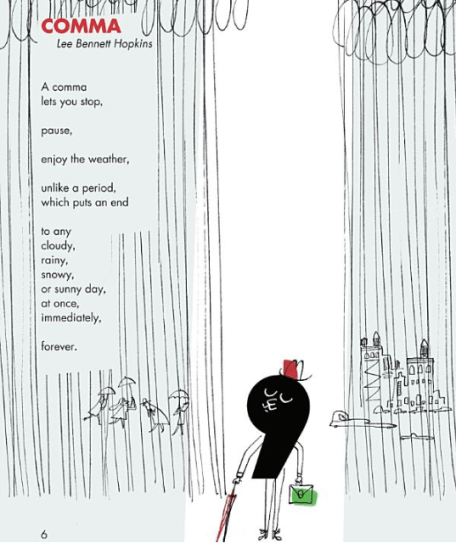
We all know about commas and the quandaries they pose: Is one needed here? Is one needed there? Should I use the Oxford comma? What is an Oxford comma, anyway? Lee Bennett Hopkins offers a lyrical example of a comma’s power in Comma:

“A comma / lets you stop, / pause, / enjoy the weather, / unlike a period, / which puts an end / to any / cloudy, / rainy, / snowy, / or sunny day, / at once, / immediately, / forever.”

celebrate-picture-books-picture-book-review-a-bunch-of-punctuation-comma

Image copyright Serge Bloch, 2018, Comma by Lee Bennett Hopkins, 2018. Courtesy of WordSong.

While a comma is a gentle reminder to take a break, in The Dash Charles Ghigna reveals that the little line is—among other things:

“A subdued dude / in tweet and text, / he signals what / is coming next. / The daring dash— / an interruption— / is cause for pause / a clear disruption.”

In Alice Schertle’s five-stanza Forgotten: A Colon’s Complaint, these two little stacked dots just want some respect:

“The comma, incredibly common / butts right into line after line. / Couldn’t there be a small place for me: / just one little sentence that’s mine?”

celebrate-picture-books-picture-book-review-a-bunch-of-punctuation-apostrophe

Image copyright Serge Bloch, 2018, poems selected by Lee Bennett Hopkins, 2018. From Apostrophe by Amy Ludwig VanDerwater. Courtesy of WordSong.

Julie Larios counts up from 1 to 10 and down from 10 to 1 with the most dynamic of punctuation marks in !!!!!!!!—Superhero Kaboom—!!!!!!!!. Just a peek gives us:

“1 big boom! / 2 kapows!! / 3 in a row of wow, wow, wows!!! / 4 kahblooies!!!! / 5 bops and bams!!!!! / 6 gee whizzes!!!!!! / 7 whops and whams!!!!!!!” And what’s at the end of all this excitement? “1 more kaboom, then it’s off to bed!”

Twelve more rhyming and free-verse poems from Rebecca Kai Dotlich, Amy Ludwig VanDerwater, Allan Wolf, J. Patrick Lewis, Michele Krueger, Jane Yolen, Prince Redcloud, Joan Bransfield Graham, and Betsy Franco will have kids looking at punctuation in new and creative ways. A final poem by Lee Bennett Hopkins invites children (and adults) to write their own poems based on four thought-provoking prompts, such as:

“Can you write poems posing questions / like who, what, where, / when, how, and why?” and “Can you write poems causing / words such as: / Whoopee! / Whee! / Wha-hoo! / to look as if they are / leaping off pages?”

celebrate-picture-books-picture-book-review-a-bunch-of-punctuation-a-punctuation-tale

Image copyright Serge Bloch, 2018, poems selected by Lee Bennett Hopkins, 2018. From A Punctuation Tale by Rebecca Kai Dotlich. Courtesy of WordSong.

Lee Hopkins Bennett gathers a group of the most inventive and popular poets for children in this collection that turns learning about punctuation into a flight of fancy, a comical romp, and an all-around engaging way to learn how these tiny show-stoppers work on a page. Each poem will spark discussions and “Ah-ha” moments about the function of punctuation and will make a grammar lesson one of the most eagerly anticipated classes of the day.

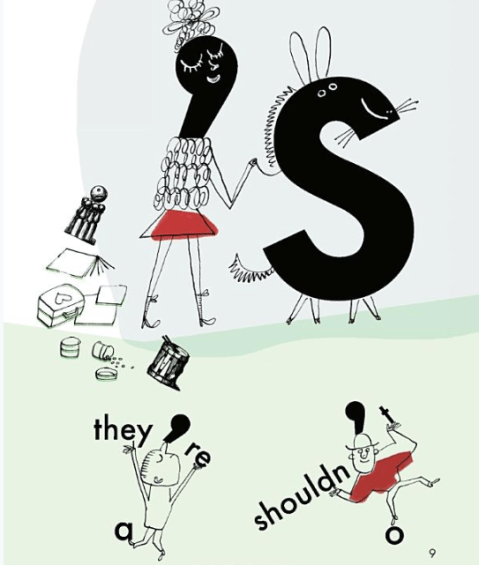
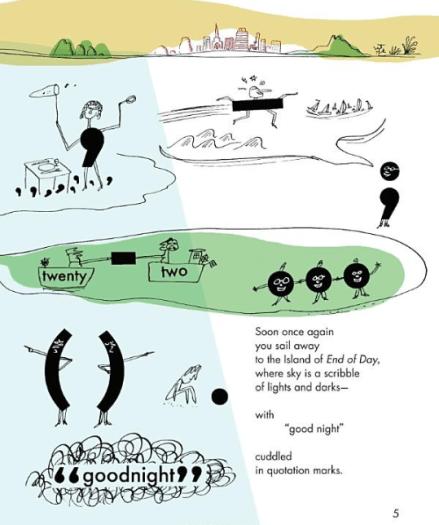
With his signature line drawings and humorous flair, Serge Bloch gives each type of punctuation mark a unique personality and purpose whether it’s creating a contraction, crying a puddle of lonely tears, lassoing words, or linking clauses in a train of thought. Bloch’s bold colors and action-packed pages bring the punctuation to life and will delight readers.

For young and older grammarians and poetry lovers, A Bunch of Punctuation is a bunch of fun to add to home, school, and classroom libraries.

Ages 8 – 12

WordSong, 2018 | ISBN 978-1590789940

To learn more about Lee Bennet Hopkins, his books, and his poetry, visit his website.

To learn more about Serge Bloch, his books, and his art, visit his website.

National Punctuation Day Activity

celebrate-picture-books-picture-book-review-Punctuation-Word-Search

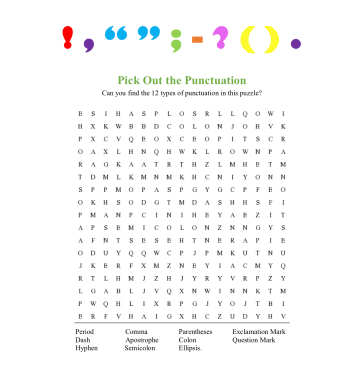
Pick Out the Punctuation! Word Search


Have fun finding the twelve types of punctuation in this printable puzzle!

Pick Out the Punctuation! Word Search Puzzle | Pick Out the Punctuation! Solution

celebrate-picture-books-picture-book-review-a-bunch-of-punctuation-cover

You can find A Bunch of Punctuation at these booksellers

Amazon | Barnes & Noble | Books-a-Million | IndieBound

Picture Book Review
August 30 – Frankenstein Day

celebrate-picture-books-picture-book-review-mary-who-wrote-frankenstein-cover

About the Holiday

Today’s holiday celebrates the birth of Mary Wollstonecraft Shelley, who in 1818 at the age of 18, penned one of the most influential books of all time. Considered the first modern science fiction novel, Frankenstein; or, The Modern Prometheus incorporates elements of horror, psychology, love, abandonment, and acceptance. These themes and Shelley’s enthralling storytelling created a book that is always current. During this 200th anniversary year of the publishing of classic novel, discover (or rediscover) the spellbinding thrill of reading Frankenstein.

Mary Who Wrote Frankenstein

Written by Linda Bailey | Illustrated by Júlia Sardà


Mary was a dreamer. She liked to spend time alone, thinking and imagining “things that never were.” Mary called these daydreams “‘castles in the air.’” Mary loved to write stories too, but her daydreams were even more thrilling. When Mary wanted to read and dream, she went to the graveyard and sat next to her mother’s grave. Mary’s mother had died when Mary was only 11 days old.

While Mary loved her father, she didn’t like the way he punished her. Mary didn’t like his new wife, either. Mary’s father is friends with many famous people, and he invites them to visit. One night “a writer named Samuel Taylor Coleridge recites a strange, eerie poem—The Rhyme of the Ancient Mariner. Mary loves such poems.” Even though she was supposed to be in bed, she hid and listened, shivering “with fear at the spine-tingling tale of a ship full of ghosts.” Forever after, Mary remembered that night and that poem.

celebrate-picture-books-picture-book-review-mary-who-wrote-frankenstein-town

Image copyright Júlia Sardà, 2018, text copyright Linda Bailey, 2018. Courtesy of Tundra Books.

By the time Mary was fourteen, she was unhappy at home and causing trouble. One night, when she was sixteen, she and her stepsister, Claire, ran away with a “brilliant, young poet” named Percy Bysshe Shelley. They traveled through Europe, one day finding themselves outside a “ruined castle. It’s called Castle Frankenstein. Such an interesting name! Does it stick in Mary’s mind?”

Eighteen months later, the three traveled to Switzerland, where they became friends with Lord Byron—the most famous poet in the world. One night as torrential storms crashed around Lord Byron’s house, he read ghost stories from Fantasmagoriana. After reading, Byron challenged his friends, who also included a doctor named John Polidori, to write a ghost story. Eighteen-year-old Mary, Percy Bysshe Shelley, and John Polidori accepted the challenge. But Mary could not think of a good story idea.

celebrate-picture-books-picture-book-review-mary-who-wrote-frankenstein-friends

Image copyright Júlia Sardà, 2018, text copyright Linda Bailey, 2018. Courtesy of Tundra Books.

Soon, Shelley and Polidori gave up on their ghost stories, but their talk of new scientific experiments excited Mary. “Electricity can make the muscles of a dead frog twitch. Could it bring a dead creature to life? The idea is both thrilling and frightening.” The idea captured Mary, but instead of a frog, she imagined “a hideous monster, made of dead body parts, stretched out—and coming to life!” Mary suddenly realized she had the idea for her ghost story.

It took nine months for Mary to finish her story. When it was published, some people thought it had been written by Percy Bysshe Shelley—they didn’t “believe young Mary could have done it! How could a girl like her come up with such a story?” But she was a writer, assembling bits and pieces, ideas, and scientific changes in her imagination until they turned into the book Frankenstein. In the two-hundred years since the novel was first published, the story has become a classic. It has sparked movies, inspired other writers, and become a favorite all around the world.

An extensive Author’s Note about Mary Shelley, her life, and inspiration as well as Linda Bailey’s thoughts on the story behind Frankenstein follows the text. A full-page portrait of Mary Wollstonecraft Shelley and a list of sources rounds out the informative backmatter.

celebrate-picture-books-picture-book-review-mary-who-wrote-frankenstein-graveyard

Image copyright Júlia Sardà, 2018, text copyright Linda Bailey, 2018. Courtesy of Tundra Books.

With atmospheric and riveting details, Linda Bailey captures the life of Mary Wollstonecraft Shelley and the influences on her imagination that resulted in Frankenstein. Bailey’s use of the present tense is inspired as it reflects the continued currency of the novel while encouraging today’s readers to embrace their “castles in the air.” Facts about Mary’s travels, new scientific discoveries, and favorite books sprinkled throughout the story inform readers on how the imagination combines experiences to create art.

One look at Júlia Sardà’s spellbinding cover tells readers that they are in for an extraordinary reading experience. Muted tones of red, green, gold, blue, and plum cloaked in black create a thrilling backdrop to Bailey’s story. Ghostly winged creatures fly over Lord Byron’s home on a stormy night, smoky monsters emerge from Fantasmagoriana, a frog sits up in its coffin, and the spectre of the monster leans over Mary and sleeps at her feet as she writes her novel. At once spine-tingling and cozy, Júlia Sardà’s illustrations will draw children into this superb story of a ghost story.

Mary Who Wrote Frankenstein is sure to spark the imagination of children who love literature, art, and writing. The book would be a thrilling addition to classroom libraries for literature and writing classes as well as an inspiring favorite on home bookshelves.

Ages 5 – 8

Tundra Books, 2018 | ISBN 978-1770495593

Discover more about Linda Bailey and her books on her website.

To learn more about Júlia Sardà, her books, and her art, visit her website.

Frankenstein Day Activity

celebrate-picture-books-picture-book-review-frankenstein-puzzle

Monstrously Good Puzzle


See if you’re a Frankenstein scholar by filling in this printable puzzle full of words and phrases about the novel!

Monstrously Good Puzzle | Monstrously Good Puzzle Word ListMonstrously Good Puzzle Solution

celebrate-picture-books-picture-book-review-mary-who-wrote-frankenstein-cover

You can find Mary Who Wrote Frankenstein at these booksellers

Amazon | Barnes & Noble | Books-a-Million | IndieBound

Picture Book Review


August 3 – It’s National Back to School Month

celebrate-picture-books-picture-book-review-idea-jar-cover

About the Holiday

It may seem like summer vacation just began, but it’s already time to start thinking about the new school year. The stores are stocked with clothes, supplies, and plenty of gear to make the new school year the best ever. But the stuff of going to school is just part of getting ready. Kids are looking forward—eagerly or maybe with a little trepidation—to meeting new friends, having new teachers, and exploring new subjects and ideas. Making the transition to a different grade easier and exciting is what National Back to School Month is all about.

Simon & Schuster sent me a copy of Idea Jar to check out. All opinions are my own. I’m also thrilled to be partnering with Simon & Schuster in a giveaway of a copy of Idea Jar. See details below.

Idea Jar

Written by Adam Lehrhaupt | Illustrated by Deb Pilutti


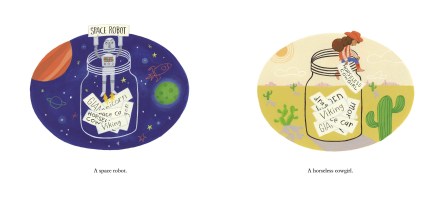
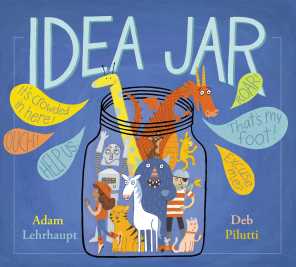
On the teacher’s desk sits an Idea Jar that holds her student’s story ideas. The teacher “says a story can be about anything” the kids want it to be. Like maybe “a space robot” or a “horseless cowgirl” or, yes, even that Viking who is trying to hoist himself over the edge of the jar to freedom. See, “there’s no such thing as a bad story idea,” and there are so many ways to tell your story.

celebrate-picture-books-picture-book-review-idea-jar-space-robot

Image copyright Deb Pilutti, 2018, text copyright Adam Lehrhaupt, 2018. Courtesy of simonandschuster.com.

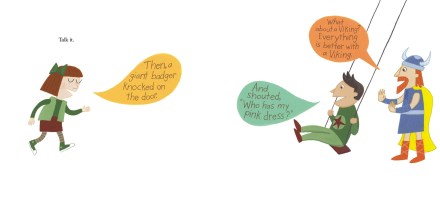
You can even combine your own ideas or make up a story with a friend. And maybe even that Viking in the back of your mind would make a good character too. He certainly thinks so. His motto is “Everything is better with a Viking”—even a giant badger who has lost her pink dress.

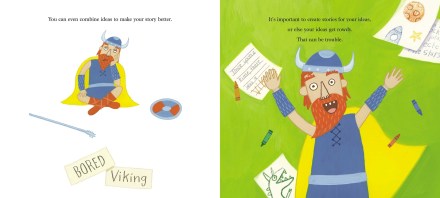
There is one thing about the Idea Jar, though. “It’s important to create stories for your ideas, or else your ideas get rowdy.” Just look at that Viking, who’s poking…at…the…jar! “Oh no! The ideas!”  They’re all loose! Now the robot is shooting his laser eyes and the dragon is swishing its enormous tail and the ideas are running amok!

celebrate-picture-books-picture-book-review-idea-jar-bored-giant-badger

Image copyright Deb Pilutti, 2018, text copyright Adam Lehrhaupt, 2018. Courtesy of simonandschuster.com.

“These ideas need a story. Will you help?” Great! Should we? Should we start with the Viking? What if he gets into a battle with the space robot? Then gets rescued by the dragon? Who’s ridden by the horseless cowgirl! What? You’d like to change some ideas around? Go for it! This is your story, after all! “Wow! You were awesome!” You made all of those story ideas very, very happy. But it’s time that they went back in the jar to meet some other ideas for next time.

celebrate-picture-books-picture-book-review-idea-jar-bored-viking

Image copyright Deb Pilutti, 2018, text copyright Adam Lehrhaupt, 2018. Courtesy of simonandschuster.com.

As the award-winning author of Warning: Do Not Open this Book, Please Open this Book, This is a Good Story, and many others, Adam Lehrhaupt knows a thing or two—or three—about corralling ideas into a story. By appealing directly to students and any story creator, the narrator of the madcap Idea Jar will excite kids to pay attention to the ideas rattling around and flashing through their minds and inspire them to write, draw, or tell their own stories. The persistent Viking, who gives story suggestions throughout the book and nudges the story along, will delight kids and can serve two purposes for teachers or other writing coaches.

With his infectious enthusiasm, the Viking is that great idea that knocks at your consciousness until it is used. His whispered recommendations may also remind writers and artists of that little self-editor who so often can keep great ideas from running free. Learning to manage both of these is what great storytelling is all about. As the Viking sails into the classroom portrayed in the book, kids will jump at the chance to turn on their imaginations and give him—and their own characters—a story full of suspense, humor, and unexpected twists and turns.

celebrate-picture-books-picture-book-review-idea-jar-viking-climbing-out-of-jar

Image copyright Deb Pilutti, courtesy of simonandschuster.com.

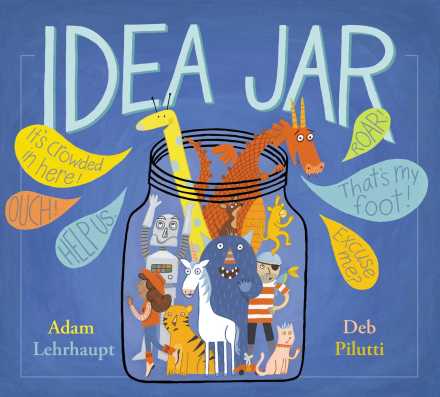
As a space robot rockets from the Idea Jar, a horseless cowgirl lifts herself over the edge, and a big, scaly arm reaches from within to pull out the words “dragon” and “giant,” kids will be instantly invested in these characters without a story…yet. Deb Pilutti’s vibrant and dynamic illustrations show the creative process in action, whether a child’s talent lies in writing, drawing, or even reciting ideas aloud. The crafty Viking makes a frequent appearance—just like any good idea does—to prod the ideas in the jar (including the horseless cowgirl, the space robot, and the dragon as well as a pirate, a unicorn, a giraffe, a monster, and various animals) to unleash their inventive power. As the story comes together, the students and teacher cheer as they see their creation come to life. 

Kids will love answering the call to create a story and interacting with the ideas in Idea Jar. Idea Jar is infused with the natural spontaneity and inventiveness of children’s imaginations, making it a winner for jump-starting writing or art lessons in classrooms and inspiring creativity at home for kids and adults.

Ages 4 – 8 (and up)

Simon & Schuster/Paula Wiseman Books, 2018 | ISBN 978-1481451666

Discover more about Adam Lehrhaupt and his books on his website.

To learn more about Deb Pilutti, her books, and her art, visit her website.

Meet Deb Pilutti

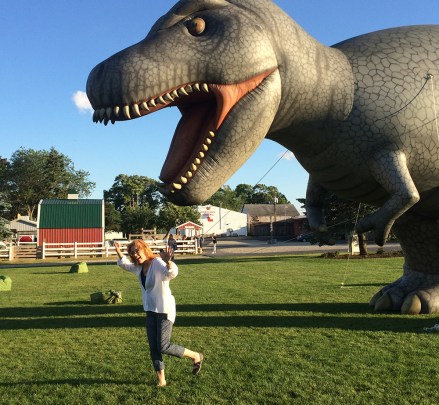
celebrate-picture-books-picture-book-review-deb-pilutti-intreview-chased-by-t-rex

Today I’m excited to talk with author/illustrator Deb Pilutti about her new book Idea Jar with Adam Lehrhaupt, her branding work inspired by vintage signs, and the old Creepy Crawlies Thingmaker, a toy which I was surprised and delighted to discover we both loved as children.

Readers will love the way the characters interact with each other and with the kids writing and drawing stories in Idea Jar. Can you describe your journey from when you first received Adam Lehrhaupt’s manuscript for Idea Jar to the finished book?

I am a fan of Adam’s Warning: Do Not Open this Book! so I was quite excited when Paula Wiseman at Simon & Schuster asked me if I would like to illustrate IDEA JAR. Who wouldn’t want to illustrate a book with a Space Robot, a Viking, a cowgirl and a Dragon as the main characters? Adam left a lot of room for me to play. He did not specify what the other ideas in the jar would be, only the characters he had written into the text. It was fun to develop additional characters and their relationships and mini-side stories, like the developing friendship between the Yeti and the small dog, and the mouse driving a race car.

Kids’ imaginations are always so full of possibilities, and they can make such funny and amazing leaps of character and plot. What are some steps you’d give young writers and illustrators for capturing those snatches of imagination and developing an idea into their own story?

Keep a journal. I have several that I write or doodle in. If there is something I find interesting, like an idea or a character, I go back to it and try to work out a story. I start by asking questions of the character or situation. What would happen if… type of questions.

celebrate-picture-books-picture-book-review-deb-pilutti-interview-hello!-ice-cream-truck

Your branding work for Sea World, Warner Brothers, artists, food trucks, and more are infused with such a fun vintage vibe. Do you have a favorite decade to draw design ideas from, and why?

I absolutely love vintage signage and type from the 50s and 60s. Some of it is so campy while others can be evocative or elegant. The colors used were bold and saturated.

celebrate-picture-books-picture-book-review-deb-pilutti-intreview-studio-toys

Before you began illustrating and writing for children, you designed toys, and in your recent release The Secrets of Ninja School, the main character makes dragon stuffies for all of her classmates. Why do you think playing with traditional toys is so important for children? What was your favorite toy when you were a child?

Mostly because it’s fun. I also think it’s a way to navigate the world, but that isn’t something I thought about as a child. When I was young, I loved making Creepy Crawlers, which was an incredibly dangerous toy at that time. You pored possibly toxic goop into a metal mold and cooked it in a blisteringly hot ThingmakerTM oven, which resulted in many scorched fingers. But totally worth it, because once the plate cooled, you would have an army of colorful and stretchy bugs.

celebrate-picture-books-picture-book-review-deb-pilutti-intreview-srudio-desk

My cousin is a graphic designer and whenever I visited her as a child I loved seeing her special corner of the house. It was so full of color and knick-knacks (inspiration, really, I guess) and works in progress, that I developed a fascination with artists’ studios. Do you mind describing your work space a little? What is your favorite thing in it?

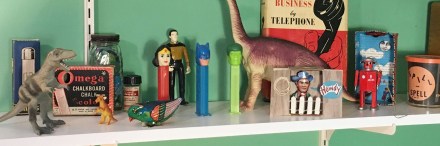
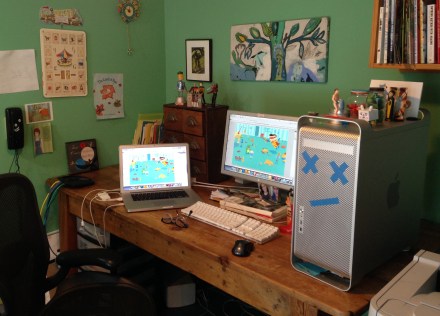
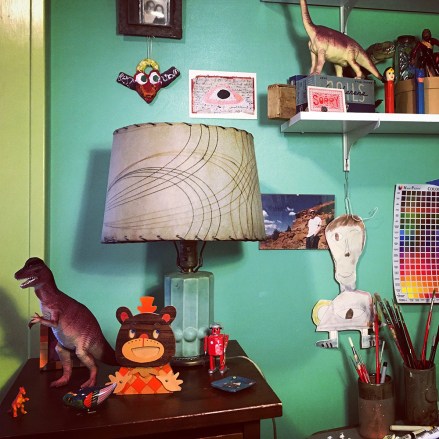
My studio is in a small bedroom. I have a long table with a computer and extra monitor set up on it, and I sometimes sketch here as well. A painting easel is in the corner of the room. It’s a very messy place, with papers everywhere and knick-knacks and toys and bits of shiny things on every surface. I like all of my toys, but my favorite one is a realistic toy model of a T-rex with a moveable jaw.

celebrate-picture-books-picture-book-review-deb-pilutti-intreview-studio-knick-knacks

What’s the best part of being a children’s illustrator and author?

I have always loved books. To be involved with the art of bookmaking is a wondrous thing. My favorite part of the process is making the final illustrations.

Do you have any anecdotes from a reading or event that you’d like to share?

I was visiting a school last April and had a blast creating stories with the students using an Idea Jar. We made some pretty silly stories together. One student came up with a zombie tomato for a character, which was brilliant!

What’s up next for you?

I’m currently working on final illustrations for two books. The first is Old Rock (is not boring). A story about a rock sounds like it could be boring, right? At least Old Rock’s friends think so. Old Rock reveals her own surprising story, slowly and languidly, as rocks do. I’m also illustrating a sequel to Ten Rules of Being a Superhero. It’s called Ten Steps to Flying Like a Superhero. I had so much fun with the characters from the first book that they are back for another adventure. Lava Boy’s superhero toy, Captain Magma, wants to fly more than anything. They devise a plan, which does not go as anticipated.

What is your favorite holiday and why?

Summer Solstice. I live in Michigan, which is quite lovely, but the cold and dark of winter can get a bit old. I miss the light. Our summer nights are very long. On Summer Solstice, I try to stay outside until the last vestiges of daylight disappear at around 9:45.

Has a holiday ever influenced your work?

Yes, I illustrated The Twelve Days of Christmas in Michigan, illustrated by Susan Collins Thoms.

Thanks so much for chatting, Deb! I wish you all the best with Idea Jar and all of your books!

National Back to School Month Activities

celebrate-picture-books-picture-books-review-adam-lehrhaupt-create-your-own-idea-jar

Make Your Own Idea Jar

If you have lots of ideas looking for a place to hang out, discover how to make your own Idea Jar and find some cool starter ideas from Adam Lehrhaupt! Make your own IDEA JAR!

celebrate-picture-books-picture-books-review-deb-pilutti-5-methods-to-generate-stories-logo

Dream up Story Ideas

Do your kids (or maybe you!) want to think up awesome story ideas? Check out Deb Pilutti’s 5 Methods of Generating Story Ideas

celebrate-picture-books-picture-book-review-idea-jar-cover

You can find Idea Jar at these booksellers

Amazon | Barnes & Noble | Books-a-Million | IndieBound

Picture Book Review

February 16 – Do a Grouch a Favor Day

celebrate-picture-books-picture-book-review-be-quiet-cover

About the Holiday

It’s probably safe to say that everyone knows a grouch. And if we’re being honest, it’s probably safe to say that we’ve all been a grouch at one time or another. Some days (weeks?) are just like that. Today’s holiday aims to make life just a little better for those who are having a grouchy day. If you know someone who’s grumpy or complainy try giving them a smile or a little special treat. Even doing something goofy or surprising might make them laugh in spite of the doldrums. Perhaps there’s something going on in their life that they’d like to talk about. Spending a little time listening as a friend, may help brighten their day too. Sometimes, though, no matter how much we try to help, all the grouch really wants is for us to…
BE QUIET!

By Ryan T. Higgins


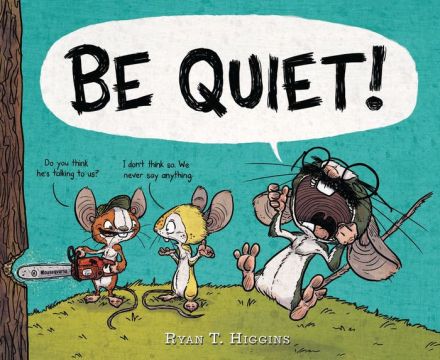
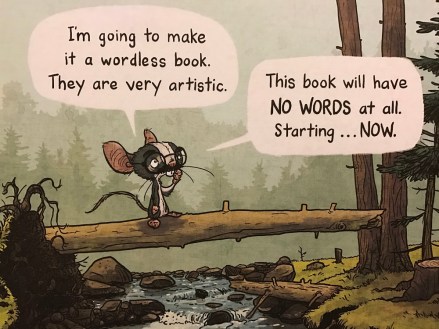
Rupert, a scholarly little mouse is so excited to be writing a book in which he will be the starring character. It’s going to be great—a wordless book that is “very artistic.” But just as he gets started his friend Nibbs, pops over and wonders what Rupert is doing. Rupert tells him, “Shhh. Be QUIET. This book does not have words.” When Nibbs hears this, he wants to help, but there’s supposed to be no talking and he’s talking. In fact, he’s “talking about talking.”

celebrate-picture-books-picture-book-review-be-quiet-wordless-book-beginning

Copyright Ryan T. Higgins, 2017, courtesy of Disney-Hyperion.

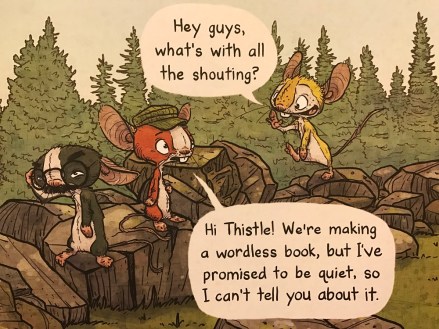
Rupert wants to throw his friend out of the book, but Nibbs begs and pleads to be included. He’ll even be “extra wordless” if he can just stay. Rupert is beside himself. “I said BE QUIET. This book is wordless!” Just then their friend Thistle drops by wondering what all the shouting is about. Nibbs tells him in some detail what’s going on and why he can’t talk about it.

celebrate-picture-books-picture-book-review-be-quiet-thistle

Copyright Ryan T. Higgins, 2017, courtesy of Disney-Hyperion.

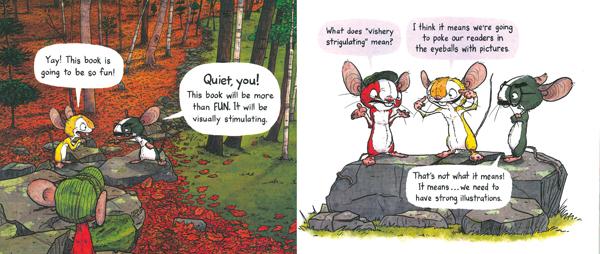
Thistle thinks a wordless book sounds perfect and also wants to be included. Nibbs says sure, but says they won’t tell Rupert because they’re not supposed to be talking. Rupert, though, is keeping count of all these words, and there are too many of them. Thistle rubs his hands in glee: it’s going to be such fun. But Rupert takes him to task. His book is going “to be more than FUN. It will be visually stimulating.” Nibbs isn’t sure what that means, so Thistle explains that it means they’re going to “poke our readers in the eyeballs with pictures.”

After a bit of strong-man silliness, Nibbs and Thistle buckle down to find “strong-but-silent types.” Nibbs suggests a very familiar bear, but Thistle thinks he looks too grumpy. Rupert thinks a cute kitten would be a good addition, but those claws? And those teeth? On second thought perhaps a cucumber would be better. With just a squiggly smile and some googly eyes, the cucumber makes a great vegetarian character. Thistle tries to explain about vegetarians, and Rupert is in a fury over all this nonsense clogging up his “brilliant piece of wordless literature.”

celebrate-picture-books-picture-book-review-be-quiet-visually-stimulating

Copyright Ryan T. Higgins, 2017, courtesy of Disney-Hyperion.

Oh! Well, if “serious” is what Rupert wants, how about a portrait of Vincent van Mouse? Too esoteric? Then maybe the three mice should be converted into three potatoes. Rupert yells that he doesn’t even like potatoes. Action is what’s needed, says Thistle. A silent superhero, like “Captain Quiet the Vocabulary Vigilante. Bam! Pow! Kaboom!” No, no, no! Rupert is hopping mad. “No superheroes and no onomatopoeia either.” Say what? “I’m-a-gonna-pee-a?” asks Nibbs “What’s that mean?” Thistle thinks Rupert “should have gone to the bathroom before the book started.”

Really, Thistle and Nibbs just want to help. What about mimes? Nibbs comes up with a great routine, flapping arms and all. Thistle tries to guess what he is, and Rupert can’t understand how they don’t know what “quiet” means. Oh!, say Nibbs and Thistle. Like that saying about the tree in the forest. Is that what quiet is? With a chain saw and a nearby tree, they try it. But Rupert is screaming so much they can’t hear if it makes a sound or not.

celebrate-picture-books-picture-book-review-be-quiet-cutting-down-tree

Copyright Ryan T. Higgins, 2017, courtesy of Disney-Hyperion.

Poor Rupert! All he wants is for them to “be quiet for just one page!” He can’t hold his frustration in any longer. He goes on a tirade of words. Nibbs quietly interrupts him. “WHAT?!” yells Rupert. “Shhh. Be Quiet. This book does not have words,” Nibbs reminds him just as the book ends. Now that the book is finished, Thistle and Nibbs think it came out pretty good and hope they can do another one.

Ryan T. Higgins’ laugh-out-loud book about best intentions gone awry is a definite day brightener. Kids and adults will recognize the zany truth of control lost to the unexpected or the oblivious. While we may often feel Rupert’s frustration in real-life situations, Higgins reminds us that it’s good to step back and see the humor in it all. Higgins’ action-packed illustrations and rakish mice ramp up the fun. Kids will enjoy seeing a glimpse of their favorite grumpy bear, Bruce, and discovering what the three mice have been up to since they transformed Bruce’s home into a hotel.

Clever wordplay, realistic dialogue, and sweet characters make BE QUIET! a perfect read-aloud book that kids will want to hear again and again. It would be a funny and fun addition to any child’s bookshelf.

Ages 3 – 6

Disney-Hyperion, 2017 | ISBN 978-1484731628

Discover more about Ryan T. Higgins and his books on his website!

Do a Grouch a Favor Day Activity

celebrate-picture-books-picture-book-review-grouchy-wordsearch-puzzle


Smile If You’re Grouchy! Word Search Puzzle


Do you feel grouchy, grumpy, cantankerous? Then maybe a smile would help! Find all twenty words in this printable Smile if You’re Grouchy! puzzle. You’ll be smiling when you do!

Smile if You’re Grouchy! Word Search PuzzleSmile if You’re Grouchy! Word Search Solution

celebrate-picture-books-picture-book-review-be-quiet-cover

You can find BE QUIET! at these booksellers

Amazon | Barnes & Noble | Books-a-Million | IndieBound

Picture Book Review