September 16 – Collect Rocks Day

About the Holiday

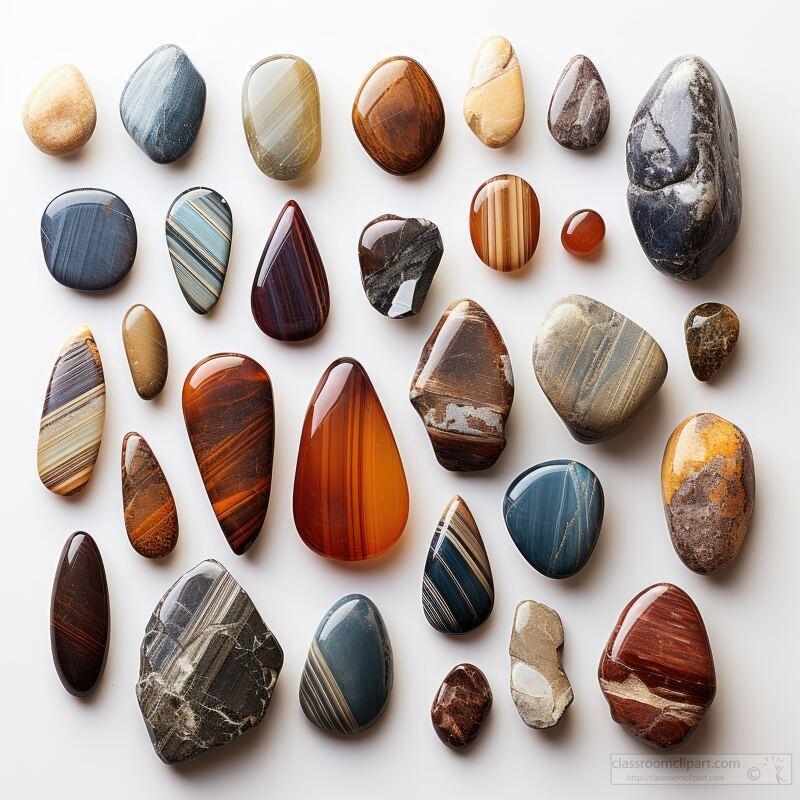
You can find rocks almost everywhere you go—from tiny pebbles to imposing boulders. Most of the time we may not pay much attention to the pebbles under our feet or the rock formations we pass frequently, but today’s holiday encourages people to really take a look at the variety of sizes and colors that make each rock unique. Rock collecting can be a fun and educational hobby as each type of stone has its own fascinating history and science to learn about. Why not get outside, do a bit of rock hunting, and start your collections today?!

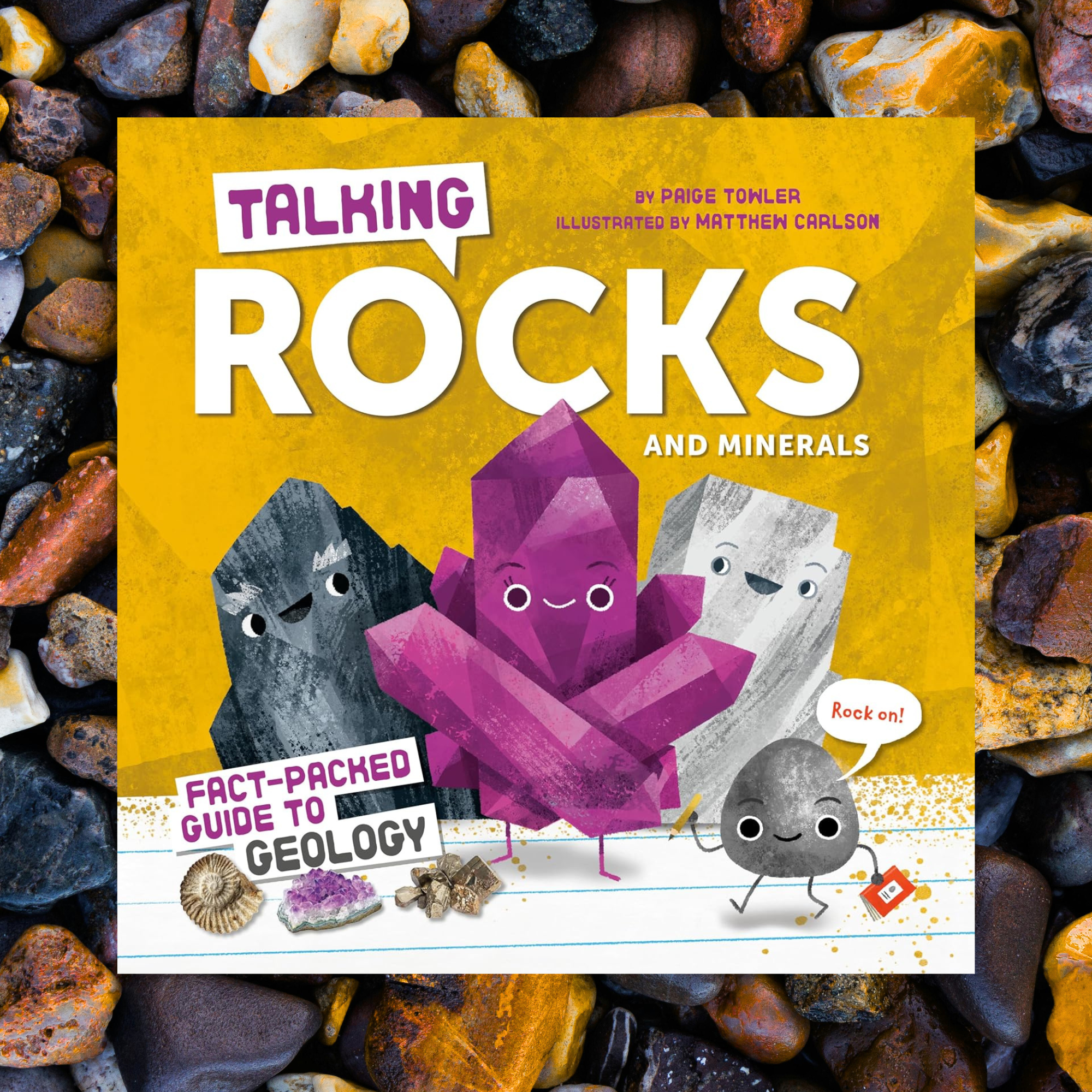
Talking Rocks and Minerals: Fact-Packed Guide to Geology

Written by Paige Towler | Illustrated by Matthew Carlson


In Talking Rocks and Minerals, readers meet ace reporter Pebble, whose resume boasts, “I’m in constant conversation with the gems of geology. The rock stars of rocking the rock world. The minerals making the mentions.” And he’s not kidding! A quick scan of his notebook reveals interviews scheduled with all the big names in rock, and he’s sent an open invitation for kids to come along and hear what they have to say. First up, readers meet an igneous rock, who regales them with memories of long, long, long ago when he started out as magma then cooled to become granite, “one of the strongest stones on earth.”
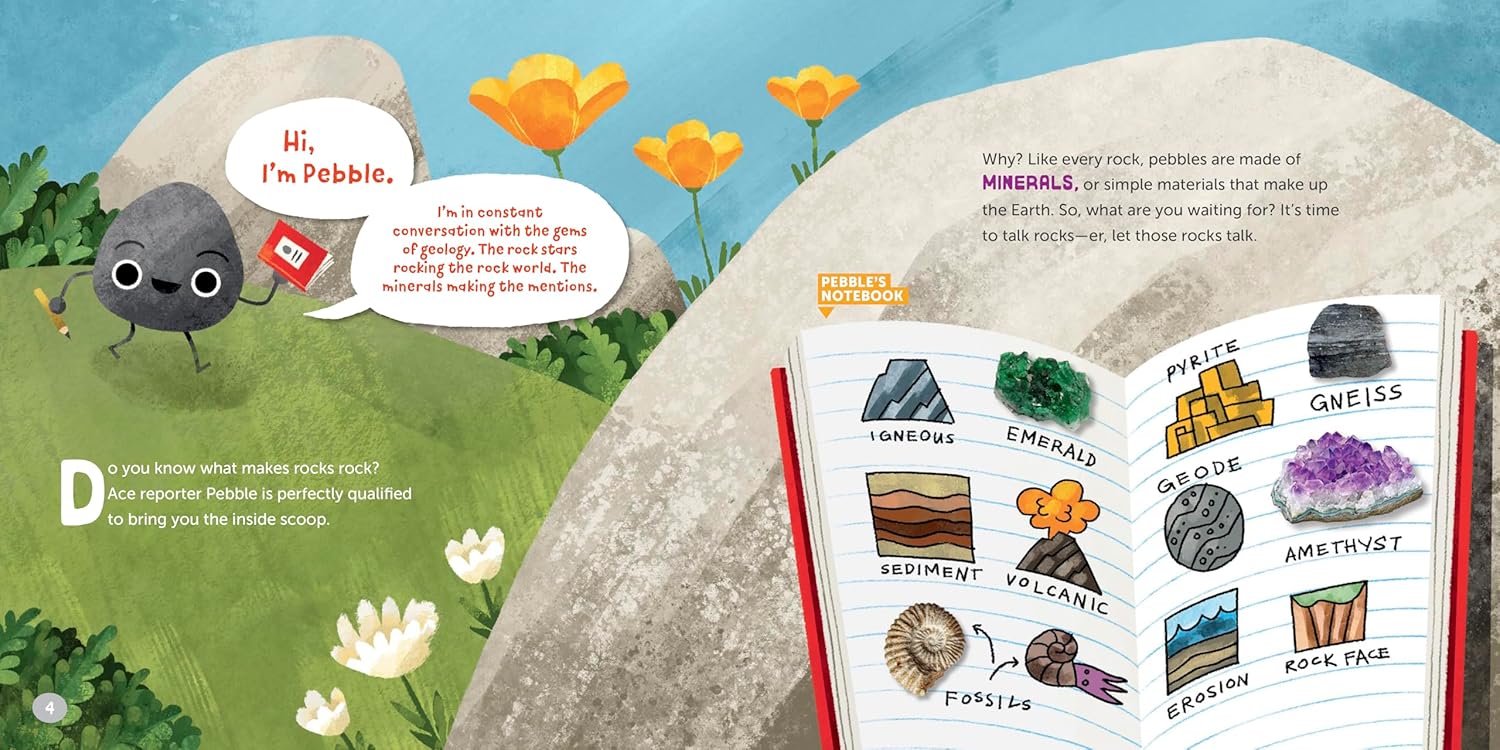
Illustration © 2025 by Matthew Carlson. Text © 2025 by Paige Towler. Courtesy of Grosset & Dunlap.

From there, Pebble moves on to talk to Coal and Limestone and discovers the layered story of what it’s like being a sedimentary rock. A couple of geodes then roll by to give kids a peek of the secrets they hold inside and make their story “crystal clear.” Amethyst gives an exclusive, showing how this royal gem developed, from when “a volcano blew its top” to the gamma rays that turned it purple. Pebble then introduces kids to two types of metamorphic rock—Marble and Gneiss—that start out as one kind of stone but under pressure and heat become another.
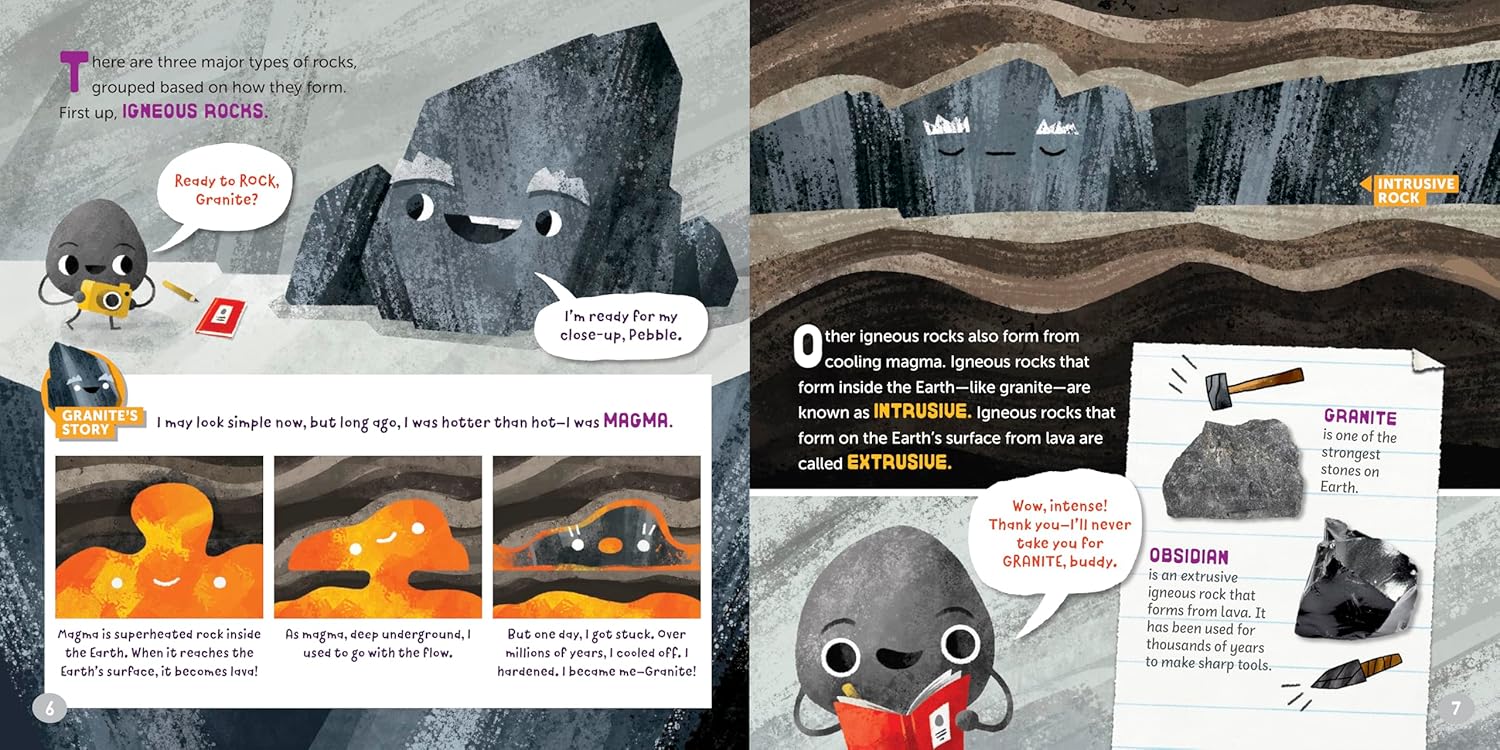
Illustration © 2025 by Matthew Carlson. Text © 2025 by Paige Towler. Courtesy of Grosset & Dunlap.

After learning the steps to the rock cycle, kids go deep underground to meet Diamond and learn how diamonds are formed from carbon and how they appear before they’re polished to a shine. Pebble interviews other gems too, like Emerald, Sapphire, and Ruby, who shine a light on how different minerals create such a variety of colorful and valuable stones.
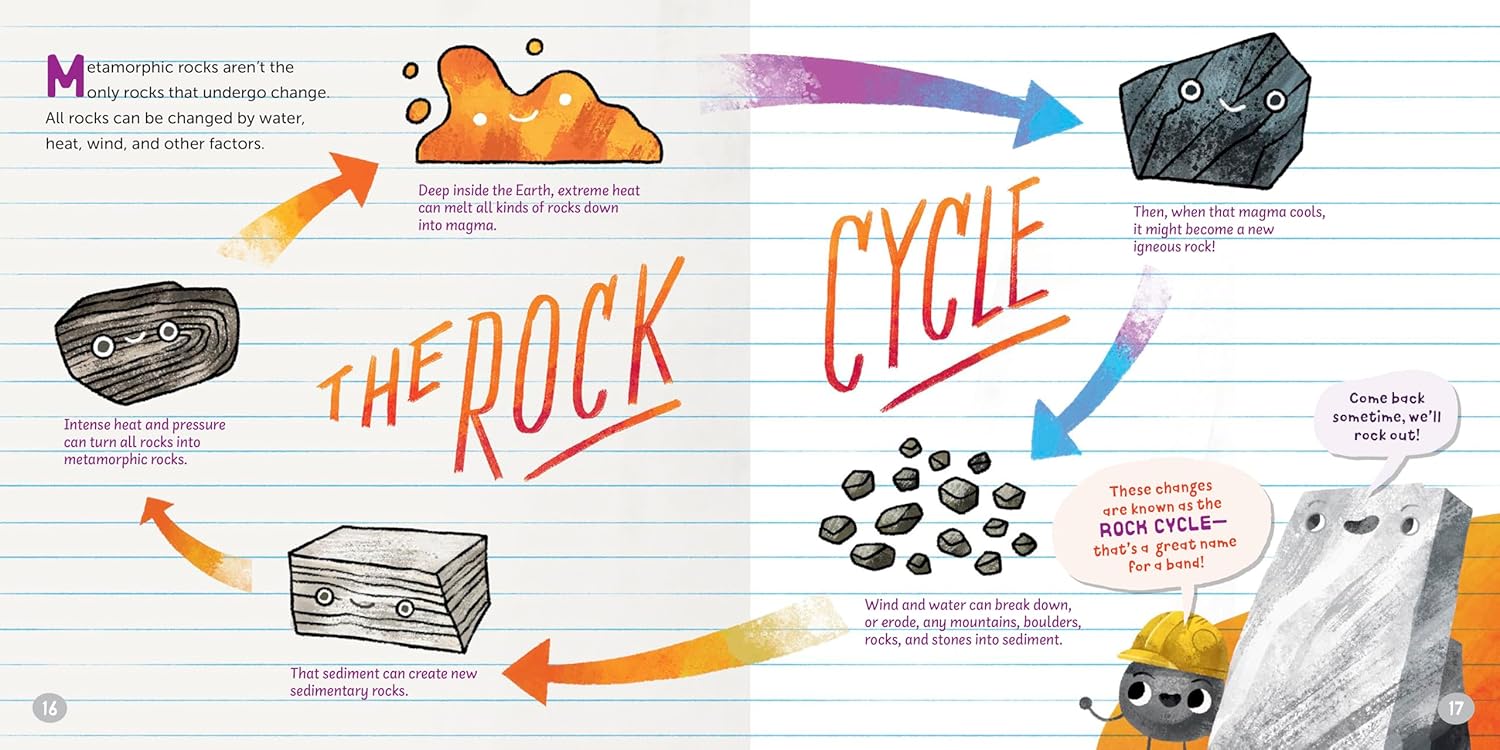
Illustration © 2025 by Matthew Carlson. Text © 2025 by Paige Towler. Courtesy of Grosset & Dunlap.

Emerging from underground, Pebble talks with pyrite, a shiny, golden mineral that often fooled prospectors during California’s gold rush, who has a surprising revelation to share. Continuing his walk, Pebble encounters a dinosaur fossil, who recounts how bones, leaves, and footprints become fossilized, leaving evidence of creatures and plants from eons ago. Speaking of eons ago, a trio of space rocks drop in—assuring Pebble “We come in pieces.”—to contrast asteroids from meteorites and tell how meteorites come to Earth.

Surrounded by all of his new friends, Pebbles signs off, but the learning continues. Back matter includes a glossary, a note from a geologist, a list of ideas on how kids can become rock hounds, and a bibliography of more books to check out.
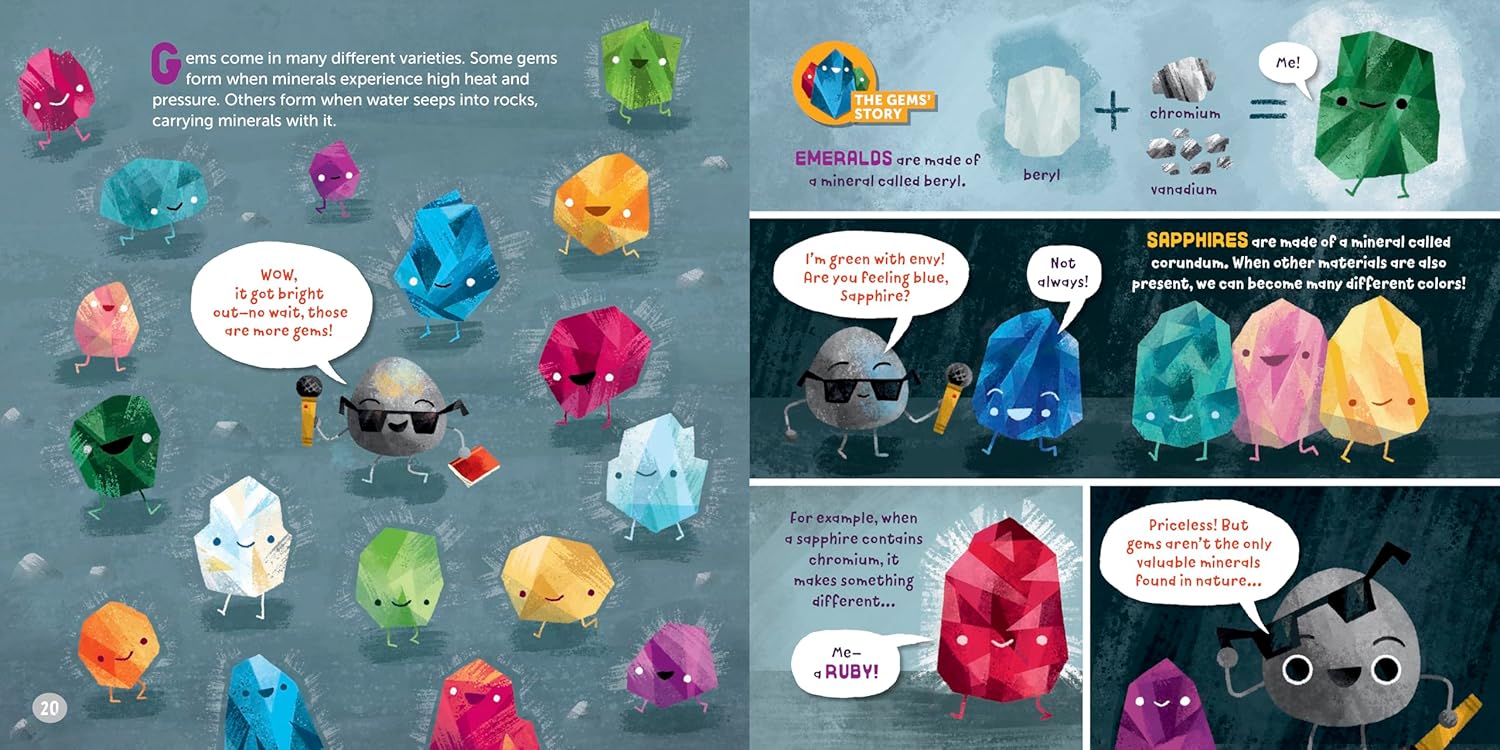
Illustration © 2025 by Matthew Carlson. Text © 2025 by Paige Towler. Courtesy of Grosset & Dunlap.

Gem-packed with puns, jokes, and hard-core facts, Paige Towler’s Talking Rocks and Minerals will excite kids already enthralled with geology and spark enthusiasm in those unfamiliar with the science, variety, and history of rocks we see every day as well as the stones we prize as valuable. Towler’s accessible text will appeal to all learners, making the book an excellent resource for educators. Her conversational delivery draws children in, creating a personal connection between them and the subject that will continue as they grow in their scientific studies.

Matthew Carlson’s eye-catching pages reflect how children learn today, offering adorable interacting characters, separate panels or full-page spreads that illustrate particular facts or scientific processes, and a wealth of detail that allows children to see the layers in sedimentary rock, look inside a geode, follow the rock cycle and the preservation of prehistoric creatures in fossils, and watch an asteroid plummet through Earth’s atmosphere to become a meteorite, among so many other elements.

A brilliant teaming of author and illustrator, Talking Rocks and Minerals: Fact-Packed Guide to Geology is an enriching and enlightening STEM book that is a must for all elementary classrooms, geology-loving children, science educators, and library collections.

Ages 6 – 9

Grosset & Dunlap, 2025 | ISBN 978-0593890950

About the Author

Paige Towler is a children’s book author and poet living in Washington, DC. She loves writing scary stories, tales about animals, and nonfiction facts about the weird and wonderful world around us. Her previous picture books include Mysterious, Marvelous Octopus! (National Geographic Kids), Baby Bat Bedtime (Smithsonian Institution/Sleeping Bear Press), Yoga Animals (National Geographic Kids), and more. Visit her at paigetowler.com.

About the Illustrator

Matthew Carlson is an illustrator, game designer, and graphic designer in Northern California. He studied art and English literature at the University of California, Berkeley. He’s illustrated projects for Robert Mondavi Wines, Facebook, and Twitter, and is currently the director of UX Design for Education, Fonts, and Drawing & Painting at Adobe. Originally from Seattle, Washington, Matthew now lives in Marin, California, with his partner, two kids, two dogs, and a growing collection of rocks.
You can purchase Talking Rocks and Minerals: Fact-Packed Guide to Geology from these booksellers:

Amazon | Barnes & Noble | Bookshop

Picture Book Review

November 7 – It’s Picture Book Month

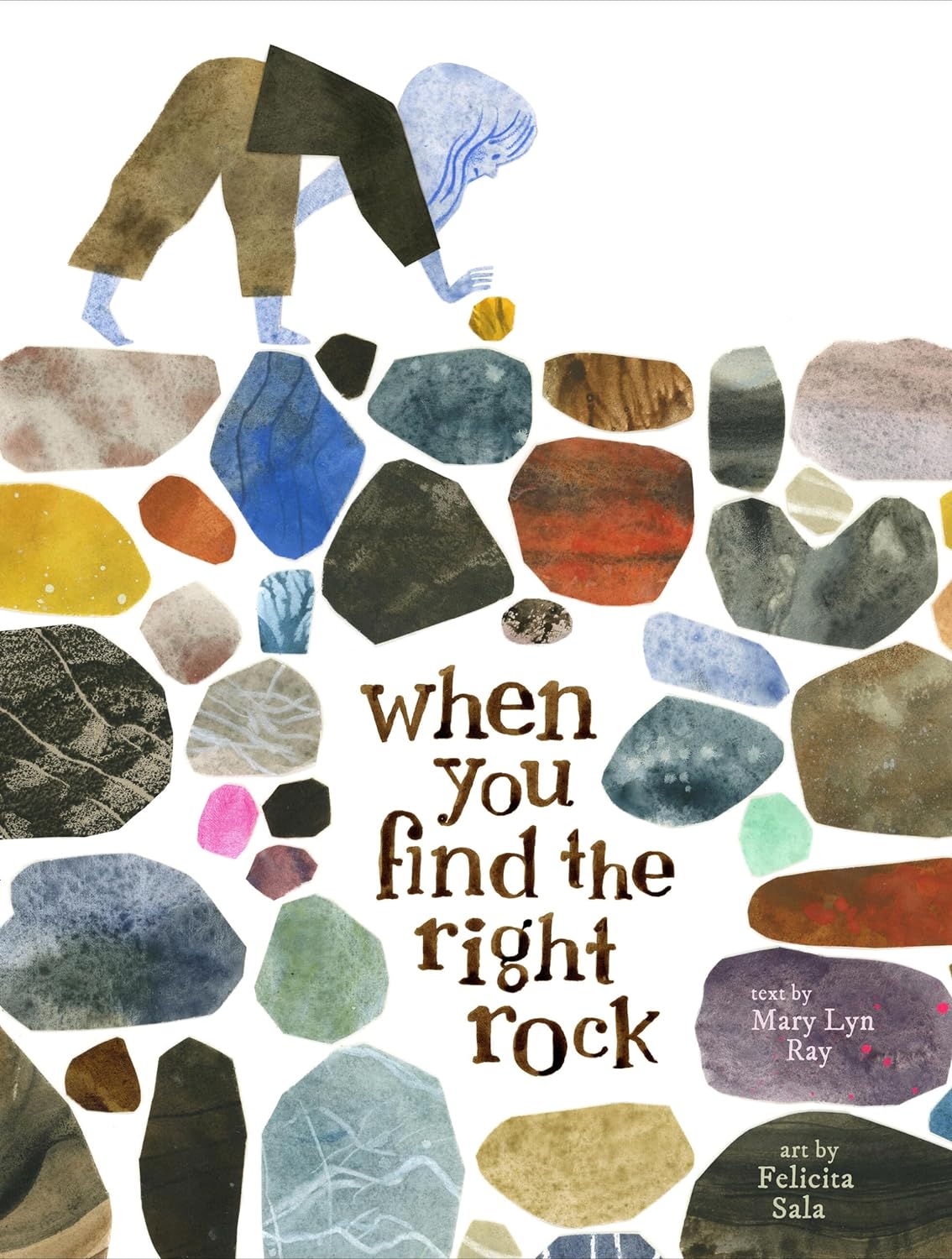
celebrate-picture-books-picture-book-review-when-you-find-a-rock-cover

About the Holiday

November is Picture Book Month, a month to remind us of the importance of picture books as a source of learning, growing and connecting for adults and children alike. While every day is a day to remember and celebrate our love for picture books, we challenge you this November to check out a few new titles, to share a book with a loved one, and keep on reading! To celebrate this month, we highlight a story that draws children and adults together in a meditation on the importance of connection, exploration, play and time for contemplation—all tied together by rocks!

I’m thrilled to welcome back Dorothy Levine, who has recently graduated from college and always lends a fresh, astute, and thoughtful perspective to her reviews. To learn more about Dorothy see our Welcome page.

Review by Dorothy Levine

When You Find the Right Rock 

Written by Mary Lyn Ray | Illustrated by Felicita Sala


Calling all collectors, connectors, climbers, and thinkers. Find a seat to get cozy in as we mosey our way through the narrative of When You Find the Right Rock. Some of us tend to walk with our eyes cued into the scenery around us. Perhaps you are one to scan the ground for treasures as you walk or skim the skyline for birds. In a world of go-go-go, children and adults alike are often discouraged from taking the time to pause and ground themselves in place, to notice the details of the wide world that connect us all.

One of these connectors is rocks, particularly the biggest rock of all, the one that lives “far under grass and trees / and houses and schools,” the rock that Lyn Ray describes as “one big enough for / everyone to stand on.”

celebrate-picture-books-picture-book-review-when-you-find-a-rock-bolders

Image copyright Felicita Sala, 2024, text copyright Mary Lyn Ray, 2024. Courtesy of Chronicle Books.

The story begins as a continuation of the title sentence: “You may try to go around it, / Or to just keep thinking whatever / you were thinking.” Told from the second person “you” view, readers are immediately able to place themselves in this story. Artist Felicita Sala depicts a young child staring out at us, grasping hands with an adult and, facing forward, in a rush toward their destination.

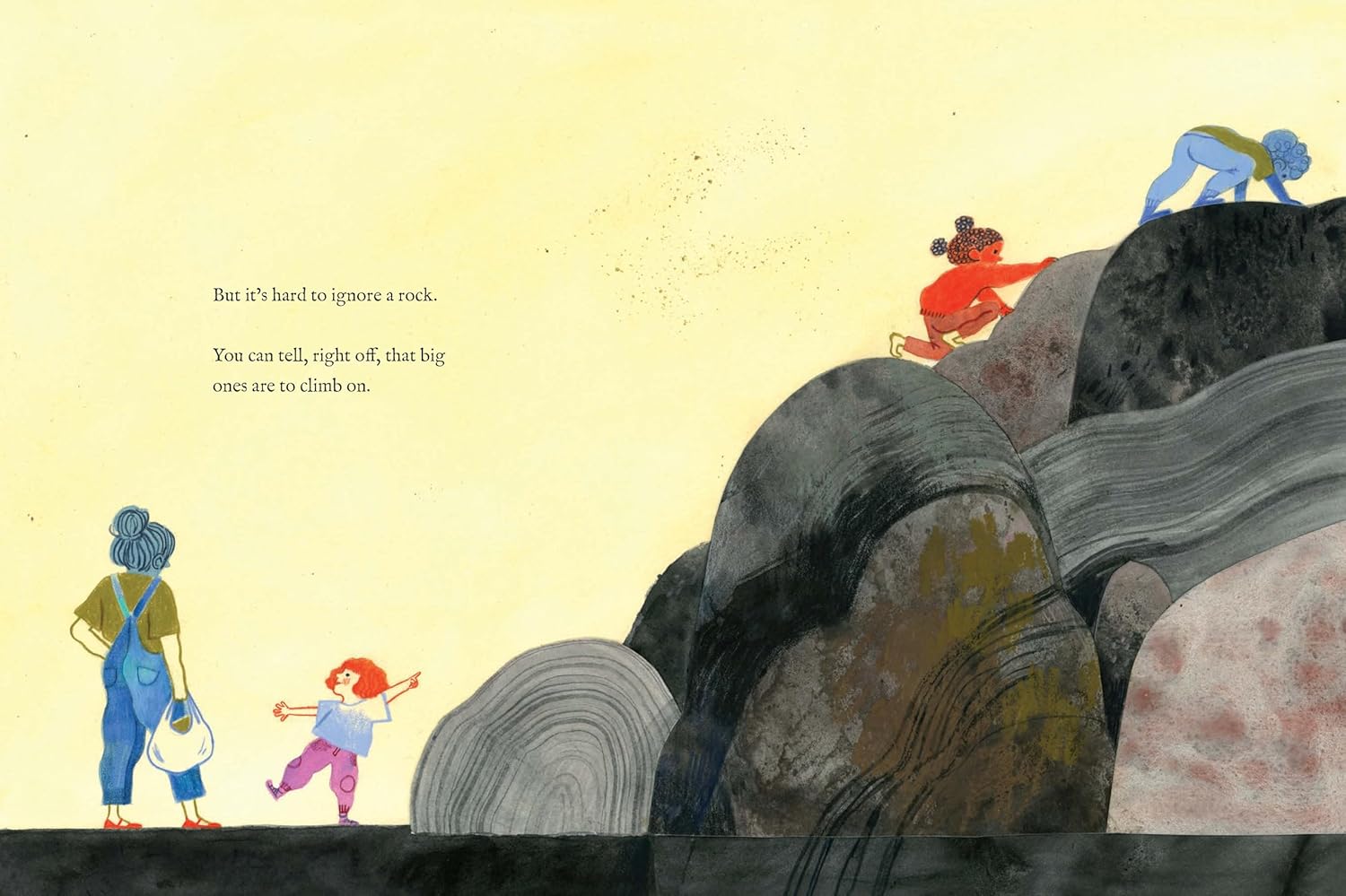
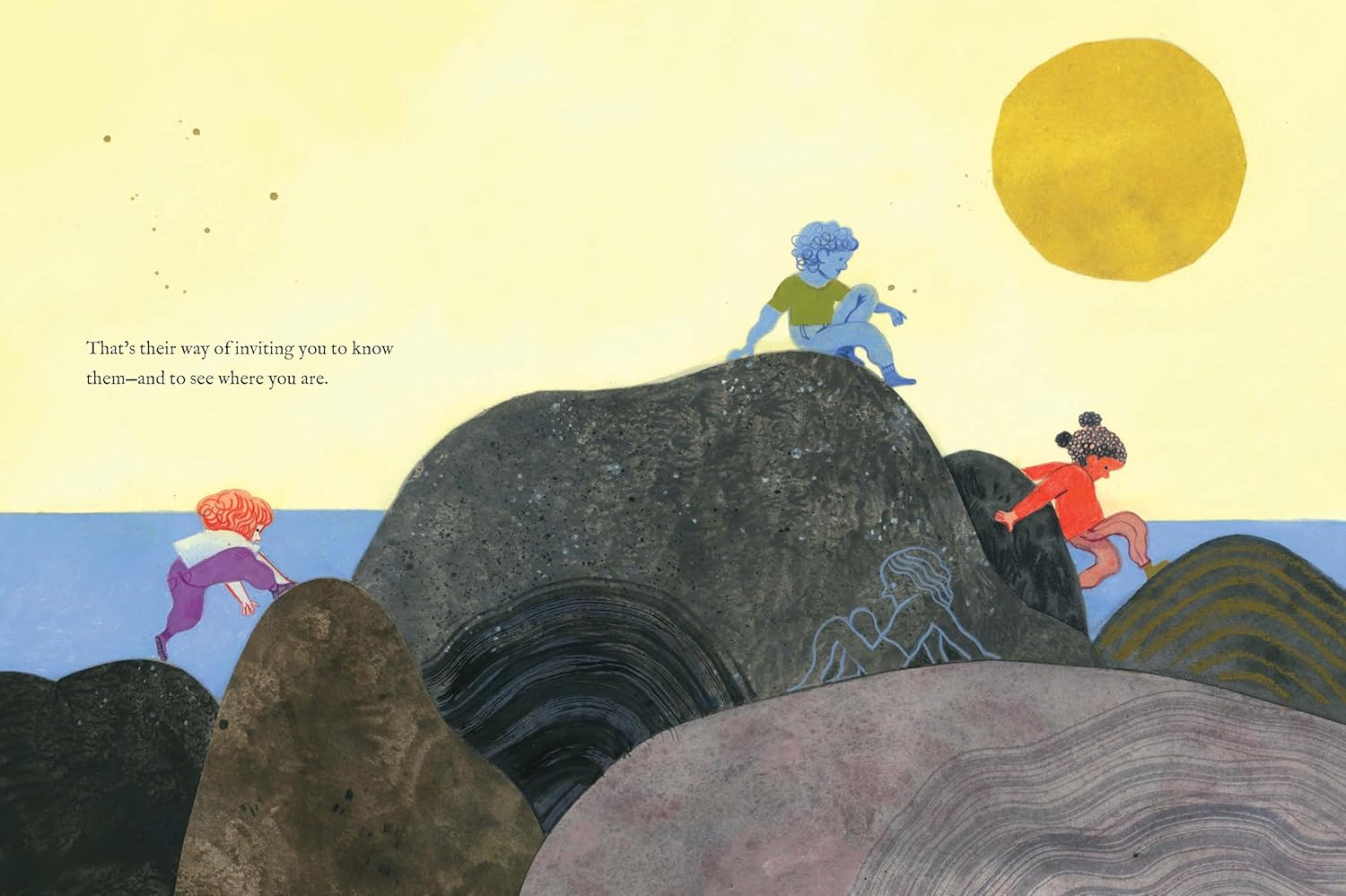
“But it’s hard to ignore a rock. You can tell, right off, that big ones are to climb on. That’s their way of inviting you to know them—and to see where you are.” When the child gestures to a large group of boulders, her adult puts a hand on her hip. Regardless, the child begins to climb and is met by others halfway up the rock. As the children climb, readers are lifted onwards and outwards from the original illustrated narrative, as Lyn Ray takes us through different sizes of rocks and some of the many fun and creative possibilities of what a rock can be and do.

celebrate-picture-books-picture-book-review-when-you-find-a-rock-climbing

Image copyright Felicita Sala, 2024, text copyright Mary Lyn Ray, 2024. Courtesy of Chronicle Books.

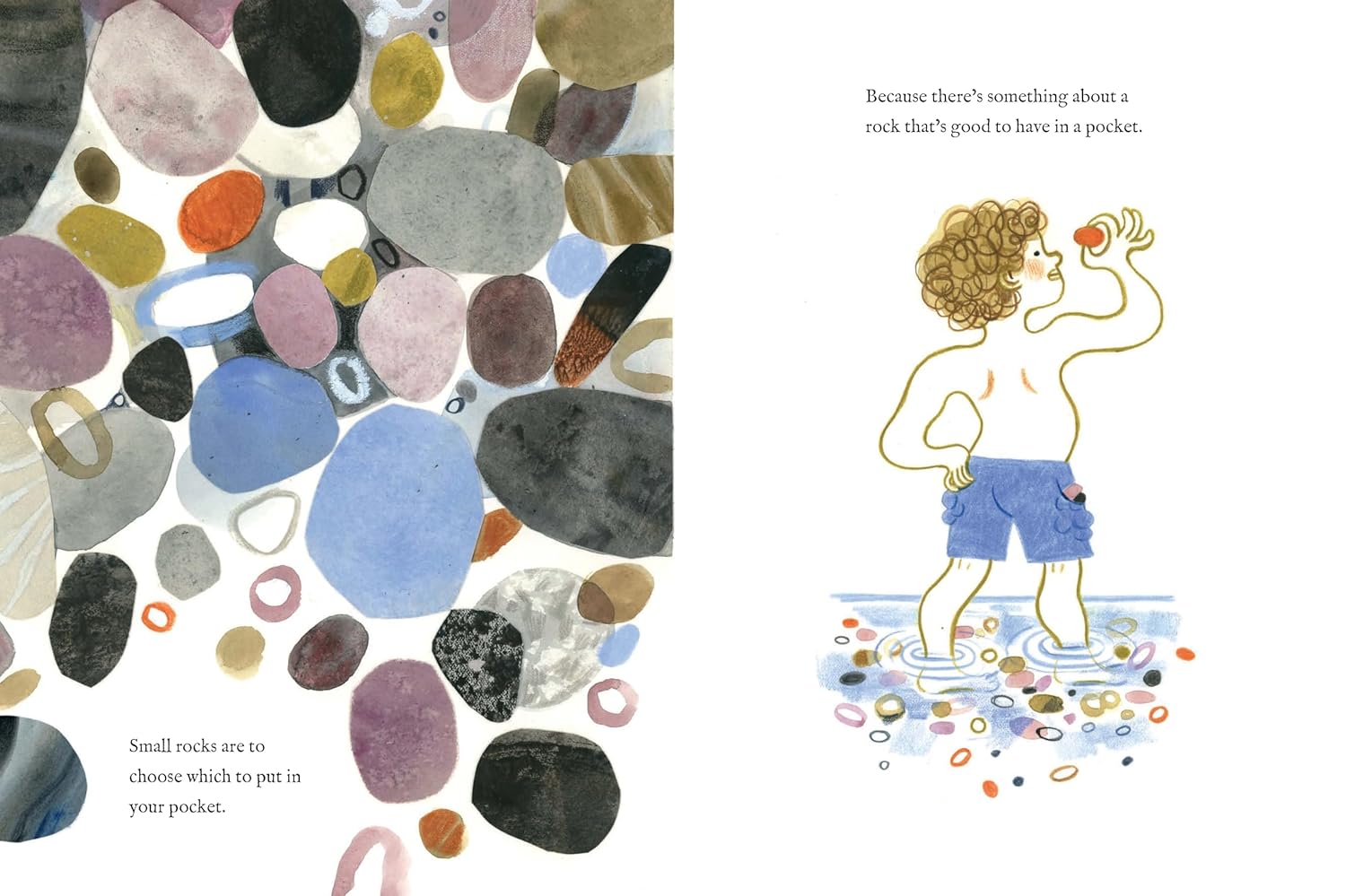
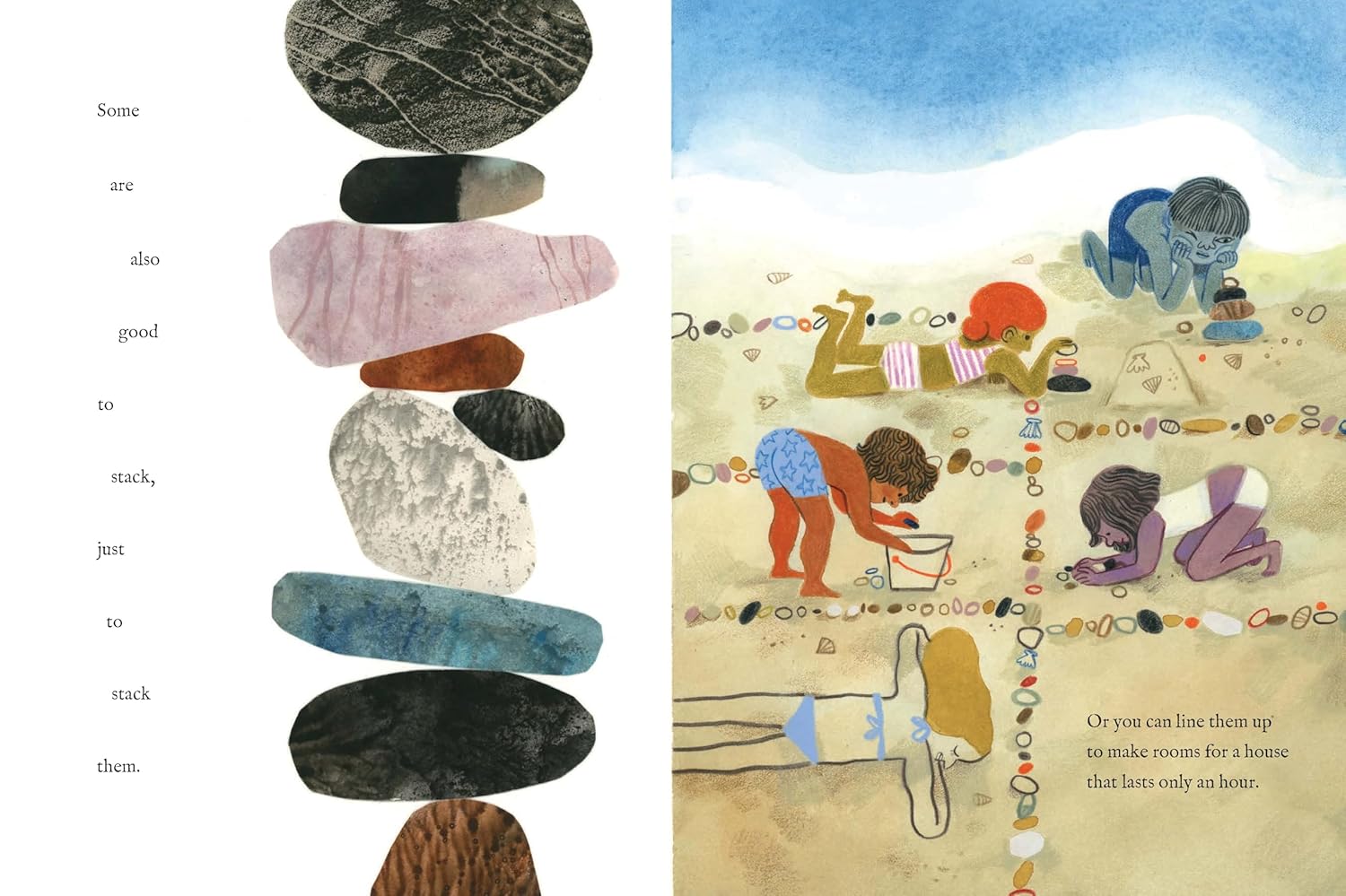
The purposes range from playful (to build a room of a pretend house on the beach) to explorative (“to show you / what heavy feels like”) and even philosophical (medium rocks are for perching on to see how your view of the world can change). Each spread shows a diverse cast of children. All these options hold equal weight. Lyn Ray writes: “Sometimes people might think you’re doing nothing, / same as they might think the rock is doing nothing. / But you and the rock know they’d be wrong.”

celebrate-picture-books-picture-book-review-when-you-find-a-rock-pocket

Image copyright Felicita Sala, 2024, text copyright Mary Lyn Ray, 2024. Courtesy of Chronicle Books.

The story then zooms out to a greater metaphorical sense of finding and grounding oneself in a world of shifting social relations and chaos. Lyn Ray compares finding something special or surprising within yourself (“just when you were maybe feeling sort of ordinary”) to finding a surprising rock in a less exciting bunch of pebbles. Readers are encouraged to reflect and hold on to these moments of inner finding: “You’ll want to keep that discovery in the place inside you where you remember certain things—Same as, maybe, you keep your special rocks somewhere.”

Readers are advised to take the time to “say hi to each rock you meet.” Because maybe if you find a rock that feels right in your hand, “you can feel like you’re holding hands with all the wide world.” On the final spread, we return to the scene of the child with the adult. This time, the child holds a small rock in one hand and rushes to hold the hand of her adult with her other. The two smile at each other, caught in a moment of connection.

celebrate-picture-books-picture-book-review-when-you-find-a-rock-stacked

Image copyright Felicita Sala, 2024, text copyright Mary Lyn Ray, 2024. Courtesy of Chronicle Books.

Illustrator Felicita Sala draws readers into the magic of rocks and relationships with others with detailed watercolor and colored pencil spreads that draw our focus from tiny to large scale as the words follow suit. Brightly colored pages are contrasted with darker-toned images where a rock or the child protagonist are the only ones highlighted. The illustrations masterfully weave in an under-narrative of the child and adult not told in the words, but on an emotional journey of their own, even in the singular one walk depicted.

The simplicity of the cover text, with the title displayed in the middle of a jumble of colorful textured rocks of different shapes and sizes—they even bump out of the cover in a glossed shine!—and the small choice to simplify the language to “text by” and “art by” rather than written and illustrated reflects the intentionality behind the beautiful simplicity of Mary Lyn Ray’s story as a whole; you don’t need to be a fancy geologist to admire rocks; you don’t need a reason beyond joy and admiration to stop and look at the world around you. Just like you don’t need to be a child to enjoy a picture book or a rock-lover to enjoy the story of When You Find the Right Rock.

Ages 3 – 8

Chronicle Books, 2024 | ISBN 978-1797214580

About the Author

Mary Lyn Ray has written many acclaimed books for children, including StarsPumpkinsMudThe Thank You Bookand Go to Sleep, Little Farm. She lives in South Danbury, New Hampshire, on an old farm where there are big rocks and pocket rocks, medium-sized and big, big rocks—all just right for saying hello to. Visit Mary at marylynray.com.

About the Illustrator

Felicita Sala is a self-taught illustrator. She studied philosophy and languages in Australia but then decided she wanted to create pictures. Since moving to Italy, she has worked on a few stop-motion animation projects along with her husband, Gianluca, but her passion lies in making picture books. She gets inspired by nature, children, mid-century illustration, folk art, and architecture. She lives in Rome with Gianluca and their daughter, Nina. Visit Felicita at felicitasala.com.

Picture Book Month Activity

celebrate-picture-books-picture-book-review-rock-collection-activity

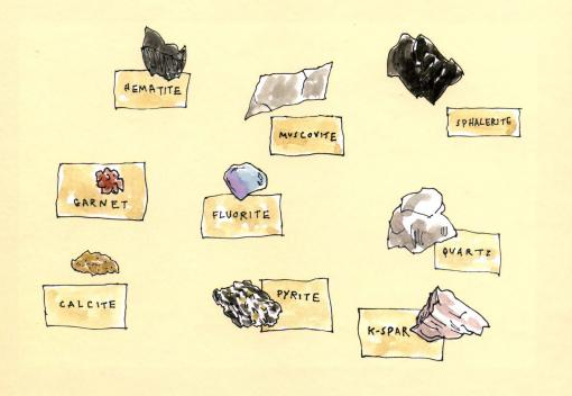
Rock Exploration and Collection Ideas


On her website Early Learning Ideas, Jennifer Hier offers kids and adults a variety of ideas for ways to explore and collect rocks with children. Check out her post: 20 Easy Activities with Rocks that Will Make Learning Fun.

celebrate-picture-books-picture-book-review-when-you-find-a-rock-cover

You can purchase When You Find the Right Rock at these booksellers

Amazon | Barnes & Noble | Bookshop (to support your local independent bookstore)

Picture Book Review
January 7 – Old Rock Day

celebrate-picture-books-picture-book-review-old-rock-is-not-boring-cover

About the Holiday

Do you love rocks—the history they tell, their versatility, intricate patterns, and glorious colors? Today’s holiday celebrates these wonders of nature and encourages geologists—both professionals and amateurs—to indulge their passion. You can learn a bit more about the history of the study of rocks, the first use of the term “geology,” and on to more modern times at NationalToday. To celebrate today’s holiday, take a walk in your backyard or neighborhood, pick up a few rocks, and research a little more about them. Then have fun with today’s craft.

Thank you to G. P. Putnam’s Sons for sharing a copy of Old Rock (is not boring) with me for review consideration. All opinions on the book are my own.

Old Rock (is not boring)

By Deb Pilutti


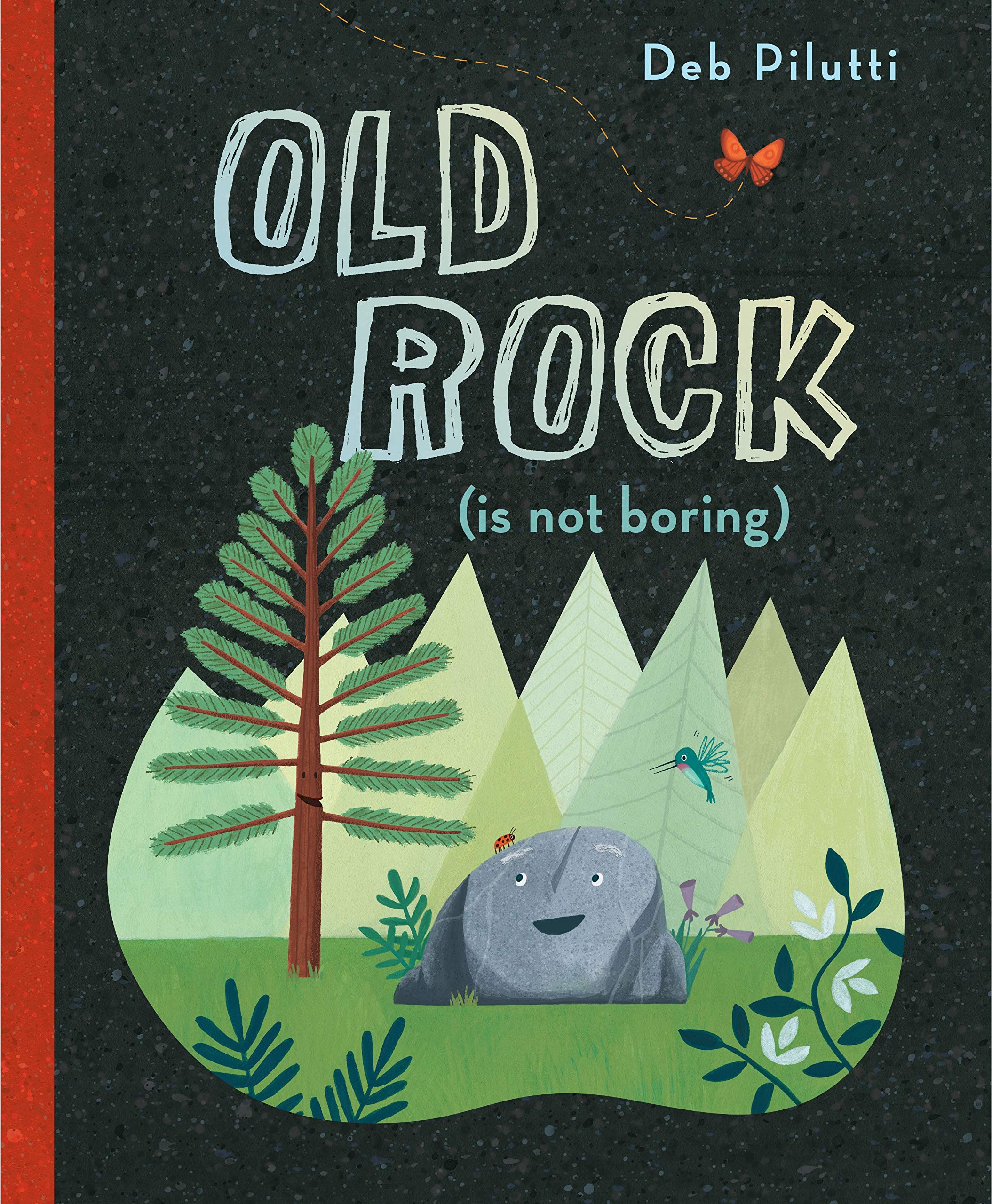
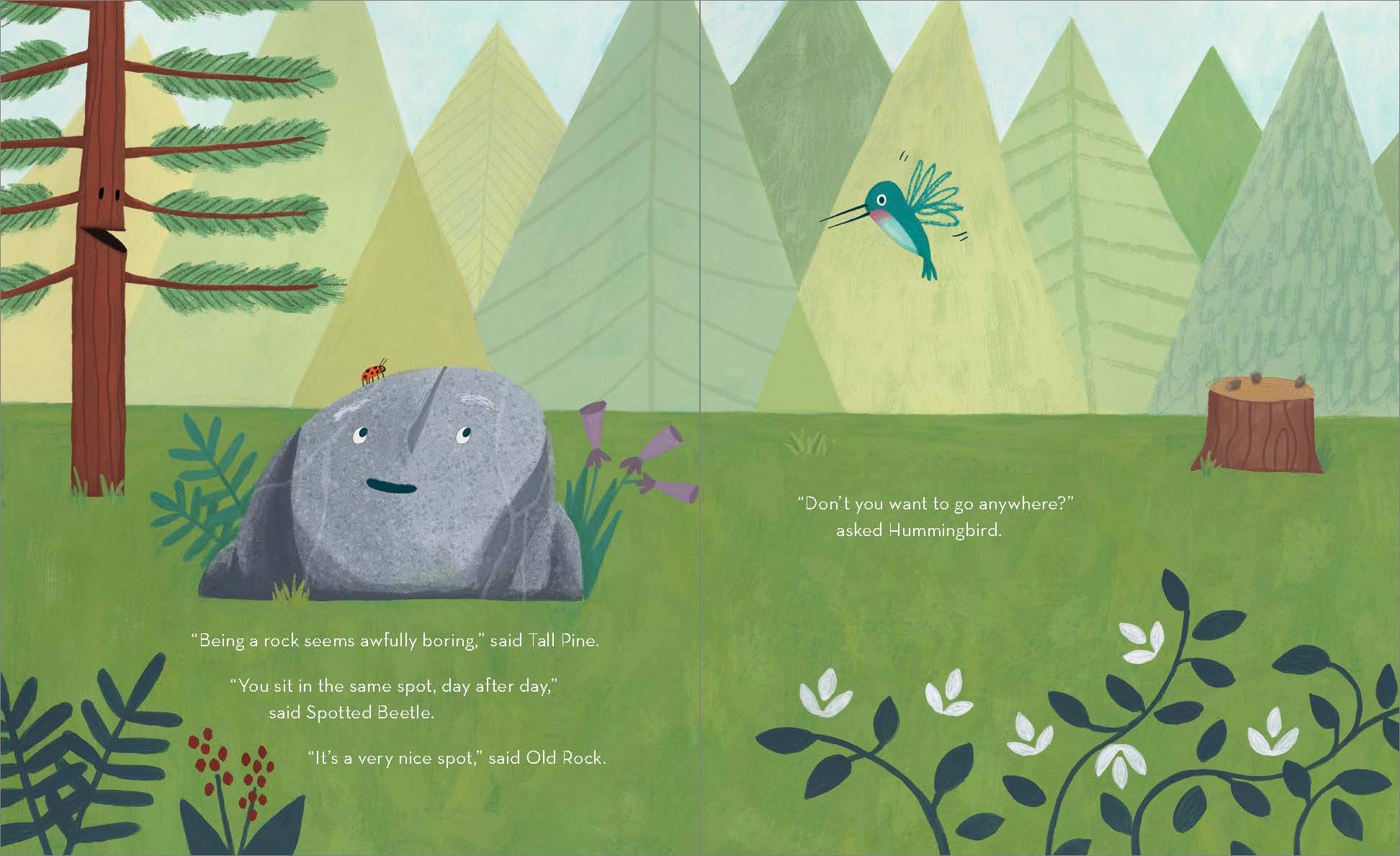
It seemed that Old Rock had been sitting in the same spot forever. Tall Pine and Spotted Beetle thought being a rock must be pretty boring. Hummingbird wondered, “‘Don’t you ever want to go anywhere?’” She knew she would be if she couldn’t fly all over the world and taste exotic nectars. But Old Rock had flown once, and he began to tell his story.

celebrate-picture-books-picture-book-review-old-rock-is-not-boring-hummingbird

Copyright Deb Pilutti, 2020, courtesy of G. P. Putnam’s Sons Books for Young Readers.

It was during the time when he was surrounded by darkness, but then the volcano erupted and Old Rock “‘soared through a fiery sky into the bright light of a new world.’” Tall Pine, Spotted Beetle, and Hummingbird weren’t very impressed. They still thought Old Rock must be bored. Spotted Beetle told him how much he might see if he climbed to Tall Pine’s very highest branch.

celebrate-picture-books-picture-book-review-old-rock-is-not-boring-volcano

Copyright Deb Pilutti, 2020, courtesy of G. P. Putnam’s Sons Books for Young Readers.

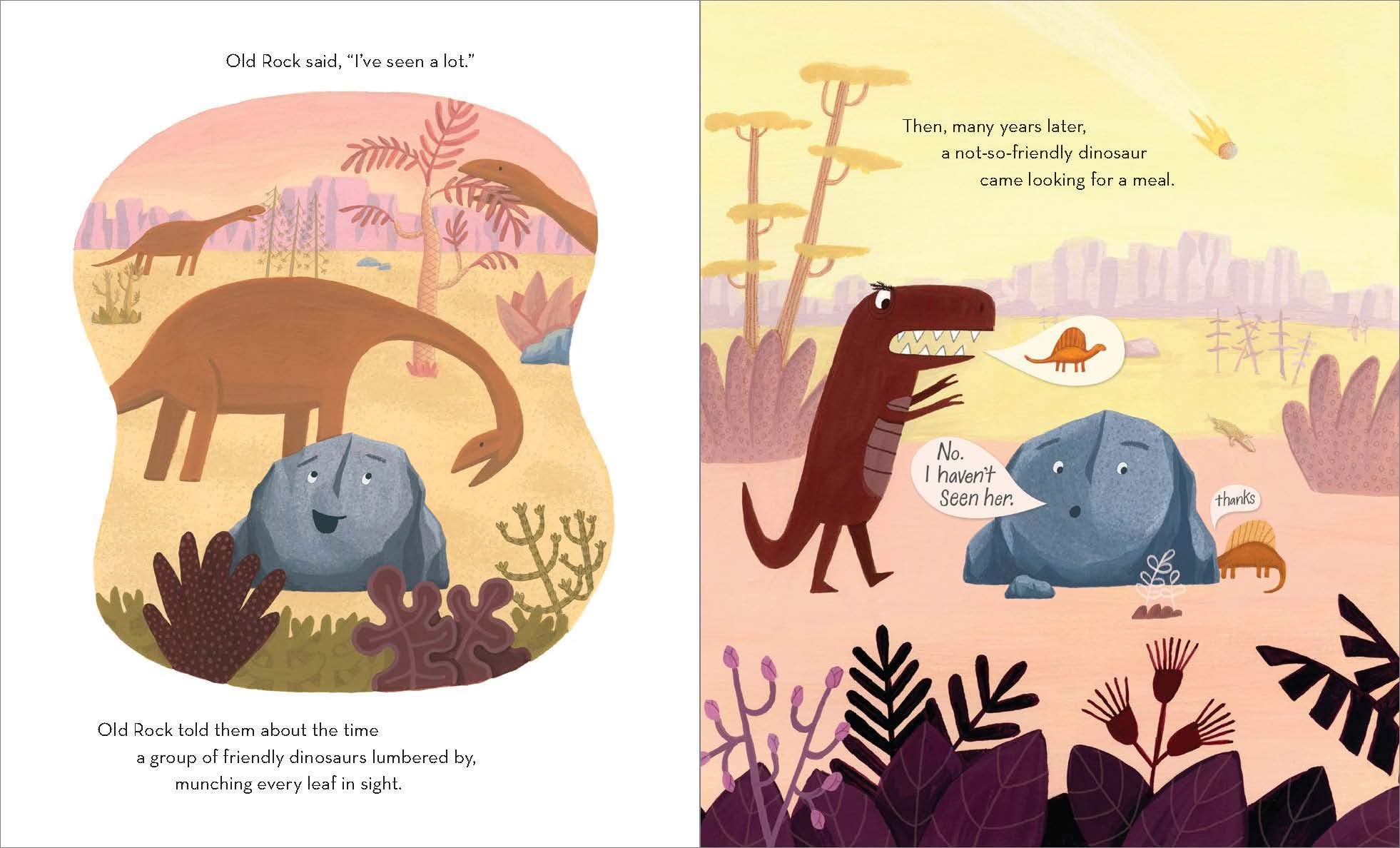
Old Rock countered that he had seen a lot. He’d watched dinosaurs pass by and had even hidden a spinosaurus from a hungry T. rex. He’d traveled in a glacier and been left teetering on a ridge overlooking a vast desert, where he “could see the place where the sky touches the earth.” Spotted Beetle and Hummingbird were intrigued, but Tall Pine dismissed these experiences as “ages ago.” He wanted to know about now. Didn’t Old Rock feel like moving? Tall Pine showed Old Rock how his limbs could dance in the wind.

celebrate-picture-books-picture-book-review-old-rock-is-not-boring-dinosaurs

Copyright Deb Pilutti, 2020, courtesy of G. P. Putnam’s Sons Books for Young Readers.

While Old Rock couldn’t dance, he did recall how he’d turned somersaults off the ridge, landing in a prairie where mastodons grazed near a lake. Tall Pine, Spotted Beetle, and Hummingbird were mesmerized by Old Rock’s story and wanted to know what had happened next. Out of the prairie, sprang a pine forest, Old Rock revealed. And from one of the pine trees a pinecone fell and a seed was released. That seed grew “to be the tall pine who dances in the wind and keeps me company.” Sometimes, he continued, a spotted beetle and a hummingbird meander by. Old Rock was very pleased with his spot, and the others had to agree that it was “very nice” and “not boring at all.”

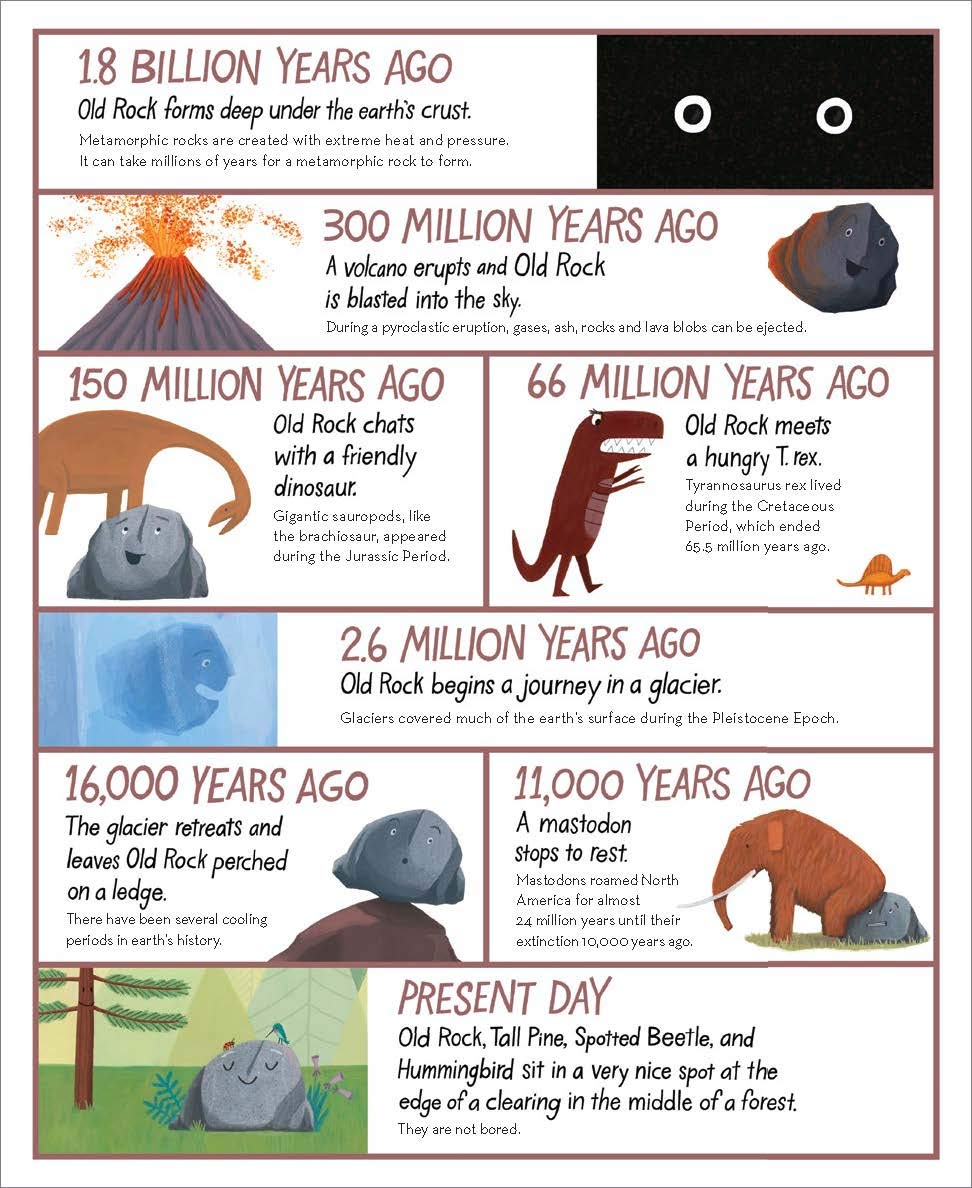
An illustrated timeline of Old Rock’s life from 18 billion years ago to the present day follows the text.

celebrate-picture-books-picture-book-review-old-rock-is-not-boring-time-line

Copyright Deb Pilutti, 2020, courtesy of G. P. Putnam’s Sons Books for Young Readers.

So much clever thought went into Deb Pilutti’s Old Rock as she reveals to kids what a fascinating and active life the rocks and boulders we see every day have had. Tall Pine, Spotted Beetle, and Hummingbird’s skepticism keeps the suspense building as Old Rock rolls out stories of his various travels and talents. Once he has them hooked, they—like young readers—want to hear more, leading to the just-right ending that sweetly encompasses shared history, happiness with one’s place in life, and friendship. The trio’s questions to Old Rock and their related experiences also engage children to think about issues and opinions from a variety of perspectives.

Pilutti’s mixed-media illustrations are nicely textured to bring out Old Rock’s grainy surface while highlighting nature’s vivid colors. Her vignettes from the dinosaur eras, the ice age (where the skeletons of dinosaurs are also swept up and away in the same glacier as Old Rock), and beyond impress upon readers the long time-frame involved, how the earth has changed, and even the fascinating science of the fossil record.

A multi-layered story, perfect for general story times or as a lead in to science lessons and to promote discussion and research in the classroom, Old Rock (is not boring) would be an original and exciting addition to home, classroom, and public library collections.

Ages 4 – 8

G. P. Putnam’s Sons Books for Young Readers, 2020 | ISBN 978-0525518181

To learn more about Deb Pilutti, her books, and her art, visit her website.

Old Rock Day Activity

CPB - Nasty Bugs magnet II (2)

Rock This Craft!


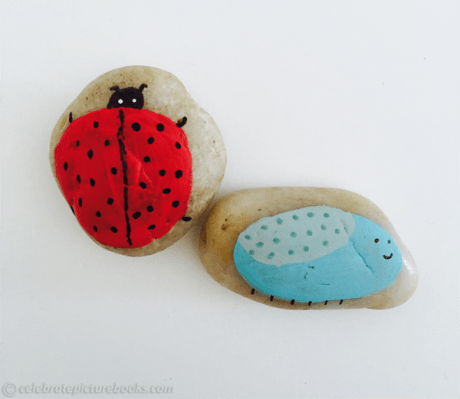
Smooth stones can give you a natural canvas for your creativity! With a little bit of paint, pins or magnets, and some imagination, you can make refrigerator magnets, jewelry, paper weights, and more!

Supplies

  • Smooth stones in various sizes
  • Paint or markers
  • Small magnets, available at craft stores
  • Jewelry pins, available at craft stores
  • Paint brush
  • Strong glue

Directions

To make magnets

  1. Design and paint an image on a light-weight stone
  2. Attach a magnet to the back with strong glue, let dry
  3. Use to hang pictures, notes, or other bits of important stuff on your refrigerator or magnetic board

To make jewelry

  1. Using a smaller, flatter stone, design and paint an image on the stone
  2. Attach a jewelry pin to the back with the strong glue, let dry
  3. Wear your pin proudly

CPB - rock painting craft

To make a paper weight or kindness stone

  1. Using a large stone, design and paint an image on the stone, let dry
  2. Display and use on your desk to keep those papers in place or find a spot around town to leave your rock for someone to find and enjoy

celebrate-picture-books-picture-book-review-old-rock-is-not-boring-cover

You can find Old Rock (is not boring) at these booksellers

Amazon | Barnes & Noble | Books-a-Million

To support your local independent bookstore, order from

BookshopIndieBound

Picture Book Review
 

September 16 – Collect Rocks Day

celebrate-picture-books-picture-book-review-old-rock-is-not-boring-cover

About the Holiday

Today’s holiday allows anyone who just can’t resist picking up a particularly pretty or unusual stone to indulge their whims and fancies. Rock collecting can be a fun and educational hobby as each type of stone has its own fascinating history and science to learn about. Why not go on a hike today and discover the unique shapes, colors, and feel of the rocks below your feet.

I received a copy of Old Rock (is not boring) from G. P. Putnam’s Sons for review consideration. All opinions are my own.

Old Rock (is not boring)

By Deb Pilutti


It seemed that Old Rock had been sitting in the same spot forever. Tall Pine and Spotted Beetle thought being a rock must be pretty boring. Hummingbird wondered, “‘Don’t you ever want to go anywhere?’” She knew she would be if she couldn’t fly all over the world and taste exotic nectars. But Old Rock had flown once, and he began to tell his story.

celebrate-picture-books-picture-book-review-old-rock-is-not-boring-hummingbird

Copyright Deb Pilutti, 2020, courtesy of G. P. Putnam’s Sons Books for Young Readers.

It was during the time when he was surrounded by darkness, but then the volcano erupted and Old Rock “‘soared through a fiery sky into the bright light of a new world.’” Tall Pine, Spotted Beetle, and Hummingbird weren’t very impressed. They still thought Old Rock must be bored. Spotted Beetle told him how much he might see if he climbed to Tall Pine’s very highest branch.

celebrate-picture-books-picture-book-review-old-rock-is-not-boring-volcano

Copyright Deb Pilutti, 2020, courtesy of G. P. Putnam’s Sons Books for Young Readers.

Old Rock countered that he had seen a lot. He’d watched dinosaurs pass by and had even hidden a spinosaurus from a hungry T. rex. He’d traveled in a glacier and been left teetering on a ridge overlooking a vast desert, where he “could see the place where the sky touches the earth.” Spotted Beetle and Hummingbird were intrigued, but Tall Pine dismissed these experiences as “ages ago.” He wanted to know about now. Didn’t Old Rock feel like moving? Tall Pine showed Old Rock how his limbs could dance in the wind.

celebrate-picture-books-picture-book-review-old-rock-is-not-boring-dinosaurs

Copyright Deb Pilutti, 2020, courtesy of G. P. Putnam’s Sons Books for Young Readers.

While Old Rock couldn’t dance, he did recall how he’d turned somersaults off the ridge, landing in a prairie where mastodons grazed near a lake. Tall Pine, Spotted Beetle, and Hummingbird were mesmerized by Old Rock’s story and wanted to know what had happened next. Out of the prairie, sprang a pine forest, Old Rock revealed. And from one of the pine trees a pinecone fell and a seed was released. That seed grew “to be the tall pine who dances in the wind and keeps me company.” Sometimes, he continued, a spotted beetle and a hummingbird meander by. Old Rock was very pleased with his spot, and the others had to agree that it was “very nice” and “not boring at all.”

An illustrated timeline of Old Rock’s life from 18 billion years ago to the present day follows the text.

celebrate-picture-books-picture-book-review-old-rock-is-not-boring-time-line

Copyright Deb Pilutti, 2020, courtesy of G. P. Putnam’s Sons Books for Young Readers.

So much clever thought went into Deb Pilutti’s Old Rock as she reveals to kids what a fascinating and active life the rocks and boulders we see every day have had. Tall Pine, Spotted Beetle, and Hummingbird’s skepticism keeps the suspense building as Old Rock rolls out stories of his various travels and talents. Once he has them hooked, they—like young readers—want to hear more, leading to the just-right ending that sweetly encompasses shared history, happiness with one’s place in life, and friendship. The trio’s questions to Old Rock and their related experiences also engage children to think about issues and opinions from a variety of perspectives.

Pilutti’s mixed-media illustrations are nicely textured to bring out Old Rock’s grainy surface while highlighting nature’s vivid colors. Her vignettes from the dinosaur eras, the ice age (where the skeletons of dinosaurs are also swept up and away in the same glacier as Old Rock), and beyond impress upon readers the long time-frame involved, how the earth has changed, and even the fascinating science of the fossil record.

A multi-layered story, perfect for general story times or as a lead in to science lessons and to promote discussion and research in the classroom, Old Rock (is not boring) would be an original and exciting addition to home, classroom, and public library collections.

Ages 4 – 8

G. P. Putnam’s Sons Books for Young Readers, 2020 | ISBN 978-0525518181

To learn more about Deb Pilutti, her books, and her art, visit her website.

Collect Rocks Day Activity

CPB - rock painting craft

Rock This Craft!


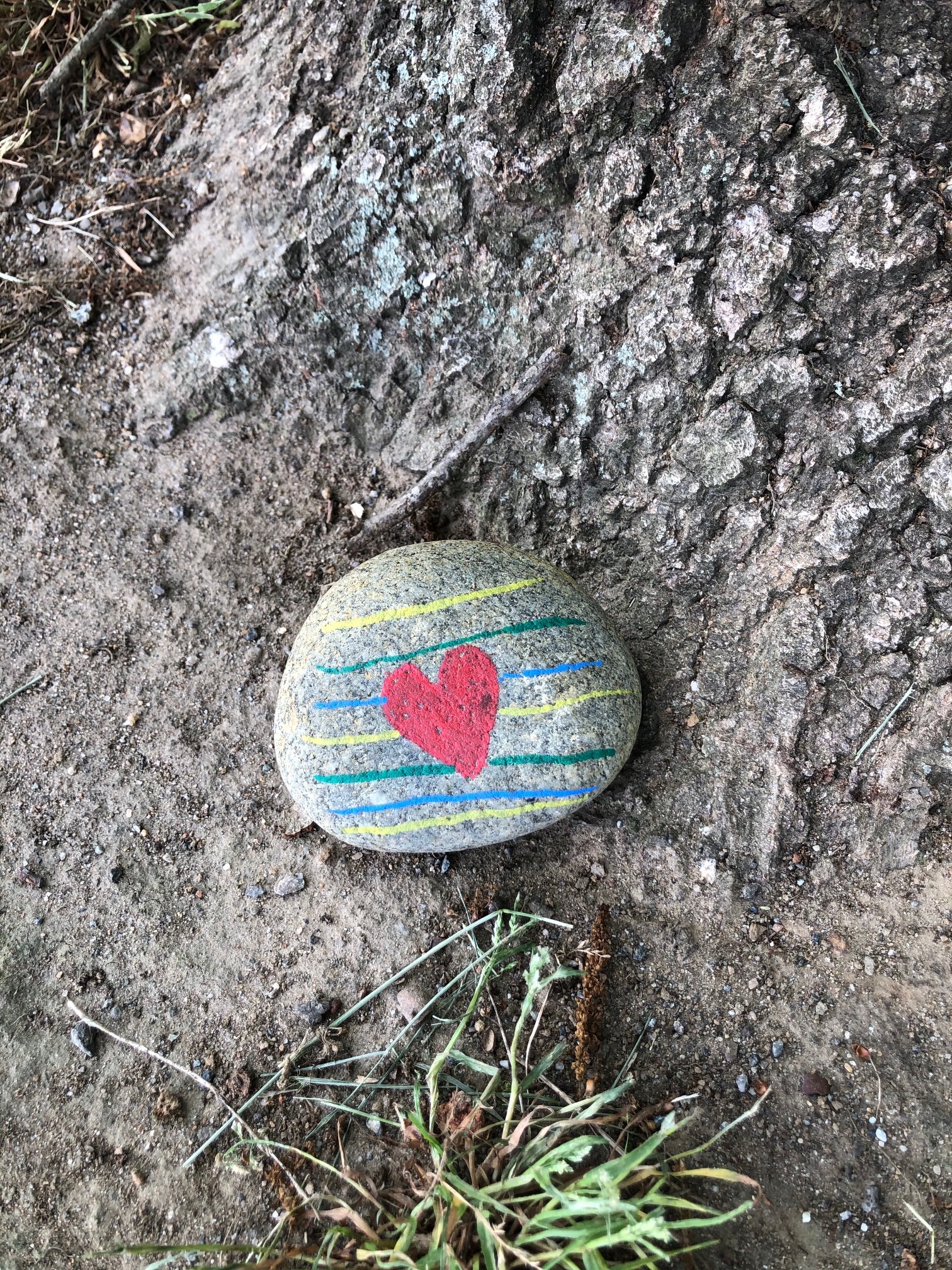
Smooth stones can give talented artists like yourself a natural canvas for your creativity! So collect some rocks and use your imagination to design rocks to leave for people to find on paths or sidewalks, near a store, or anywhere in your neighborhood. You may even want to leave one outside your local library. That’s where I found the rock pictured here!

Supplies

  • Smooth stones in various sizes
  • Paint or markers
  • Small magnets, available at craft stores
  • Jewelry pins, available at craft stores
  • Paint brush
  • Strong glue

Directions

  1. Find stones in your yard or neighborhood or buy them at a craft store or garden center
  2. Wash and dry rocks as needed
  3. Design and paint an image on the stone
  4. Have fun finding spots to leave your works of art!

celebrate-picture-books-picture-book-review-old-rock-is-not-boring-cover

You can find Old Rock (is not boring) at these booksellers

Amazon | Barnes & Noble | Books-a-Million

To support your local independent bookstore, order from

BookshopIndieBound

Picture Book Review
May 18 – International Museum Day

celebrate-picture-books-picture-book-review-rocks-in-his-head-cover

About the Holiday

On today’s date, museums around the world typically hold special exhibits, events, and activities with visitors in their buildings and other venues. This year, however, the COVID-19 pandemic means that the 40th anniversary of International Museum Day will be celebrated online through digital activities. The theme for this year’s remembrance is “Museums for Equality: Diversity and Inclusion.” The International Council of Museums––a global network of more than 44,000 museum professionals at 20,000 museums in 138 countries––”hopes that this special day will ‘become a rallying point to both celebrate the diversity of perspectives that make up the communities and personnel of museums and champion tools for identifying and overcoming bias in what they display and the stories they tell.'” To take part, visit the website of your local museums or a favorite museum elsewhere in the world and see what treasures they have to share.

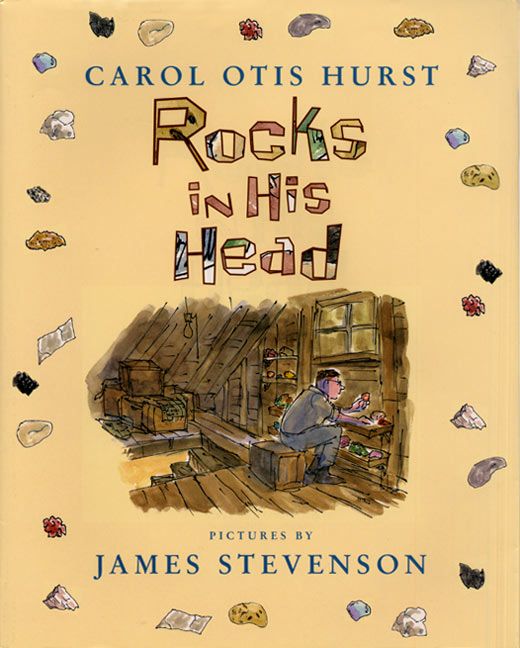
Rocks in His Head

Written by Carol Otis Hurst | Illustrated by James Stevenson


Carol Otis Hurst tells the story of her father, who—even when he was a boy—loved everything to do with rocks. He collected them and in his spare time walked “along stone walls and around old quarries, looking for rocks.” Everyone said “he had rocks in his pockets and rocks in his head,” and he had to agree. When he thought about what he wanted to do when he grew up, he imagined it would have something to do with rocks, and when he was told “‘There’s no money in rocks,’” he was okay with that. In the end, though, he opened a gas station in Springfield, Massachusetts with his father’s help. He called it the Antler Filling Station.

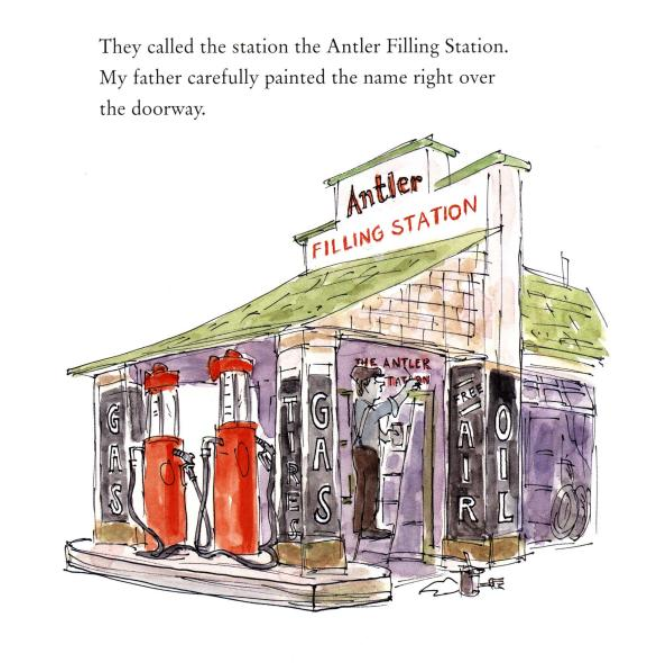
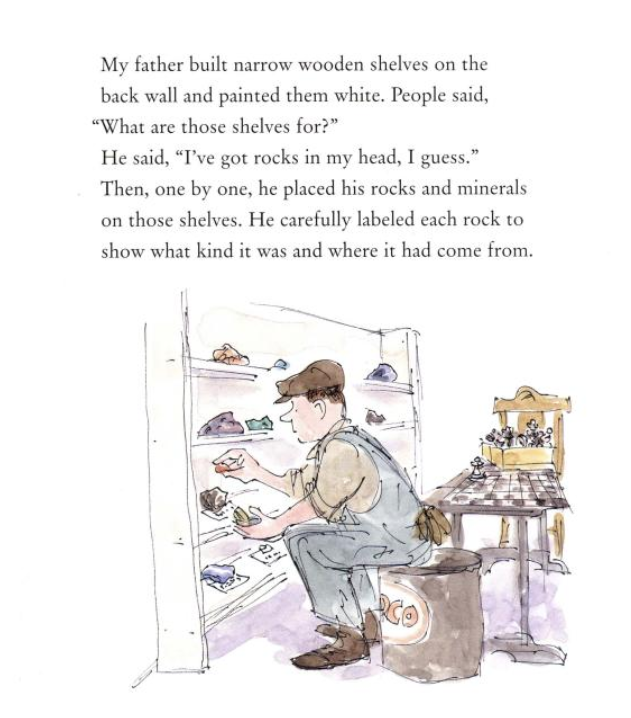
In the back of the filling station, Carol’s father displayed his rock and mineral collection. “He carefully labeled each rock to show what kind it was and where it had come from.” When the Model T automobile came out, more people could afford to buy a car. Carol’s father learned every inch of the Model T by taking it apart and reassembling it many times. He thought that someone who could repair the car and sell spare parts would have a good business, so he began collecting parts for the Model T—so many that “the pile of parts was bigger than the filling station.”

celebrate-picture-books-picture-book-review-rocks-in-his-head-stone-wall

Image copyright James Stevenson, 2001, text copyright Carol Otis Hurst, 2001. Courtesy of Greenwillow Books.

Most people in town said he “had rocks in his head” if he thought he would sell all those parts, but pretty soon drivers were flocking to the Antler Filling Station for gas and fixes to their cars. They also came inside to see the rocks, ask questions, and hear the stories of each rock and gemstone. Then the stock market crashed and people didn’t have the money for gas or to fix their cars. Things slowed down at the Antler, and when things were really slow, Carol, her father, and her friends would pile into their Model T and go searching for more rocks.

But while the collection at the filling station grew, people stopped coming because they were all out looking for jobs. Soon the Antler Filling Station closed and the family had to move to a new house. The house was falling apart, but Carol’s father began repairing it—after building shelves in the attic for his rock collection. When he wasn’t repairing the house, he was studying more about rocks. Along the way, he looked for work, taking any job he could even if they only lasted a day or two.

celebrate-picture-books-picture-book-review-rocks-in-his-head-antler-filling-station

Image copyright James Stevenson, 2001, text copyright Carol Otis Hurst, 2001. Courtesy of Greenwillow Books.

On days when he had no work, Carol’s father went to the Springfield Science Museum, where “they had a whole room full of glass cases containing many rocks. Sometimes he’d spend the whole day in that room.” One day, he met a woman who asked him what he was looking for. He answered “‘I’m looking for rocks that are better than mine.’” Out of the hundreds of rocks in that room, he told her, he’d only found ten, “‘maybe eleven,’” that were better. They smiled at each other.

Then the lady introduced herself as Grace Johnson, the director of the museum. “‘These rocks have come from all over the world,’” she told him, and he said that his had too. She wanted to see his collection, and so they drove out in her big car. Carol’s father showed her up to the attic. After looking around, she told him that while the board of directors wouldn’t allow her to hire him as a mineralogist because he lacked a college degree, she did need a night janitor. When he heard that the job sometimes included cleaning rocks, he took it.

One day, Mrs. Johnson discovered him correcting a label on one of the rocks. She smiled and told him that she had told the board of directors that she needed “‘somebody with rocks in his head and rocks in his pockets.’” Then she asked, “‘Are you it?’ Maybe I am,’” Carol’s father answered. “‘Maybe I am.’” And he was!

celebrate-picture-books-picture-book-review-rocks-in-his-head-antler-filling-station-shelves

Image copyright James Stevenson, 2001, text copyright Carol Otis Hurst, 2001. Courtesy of Greenwillow Books.

Carol Otis Hurst’s lovely and affectionate memoir of her father offers young readers a snapshot of history while introducing them to a man who stayed true to himself and his life-long love of rocks despite obstacles and good-natured jibes by those around him. Hurst’s easy-going, conversational storytelling represents her father well, allowing children to get a feel for his personality and steady outlook on life. His acceptance as a mineralogist (and ultimate position as director of the Springfield Science Museum as told in the author’s bio on the jacket flap) will satisfy readers.

celebrate-picture-books-picture-book-review-rocks-in-his-head-rock-samples

James Stevenson’s familiar watercolor-and-ink illustrations are infused with charm, taking children beside an old stone wall that meanders through the woods, back to old-style filling stations and Model-T cars, and into the heart of a true collector. Images of the author’s father attentively setting up his collection in the filling station and later in the attic will resonate with any young collectors reading the book, and the full-page illustration of Grace Johnson and the author’s father talking and smiling together is happy validation that kindred spirits do cross paths in life.

For children who love collecting, history, museums, and biographies, Rocks in His Head is a delightful choice for home libraries and would make am appealing lead in to science lessons or museum field trips for elementary classrooms.

Ages 4 – 8

Greenwillow Books, 2001 | ISBN 978-0060294038

International Museum Day Activity

CPB - Cookie Jar Museum (2)

Create a Museum Exhibit


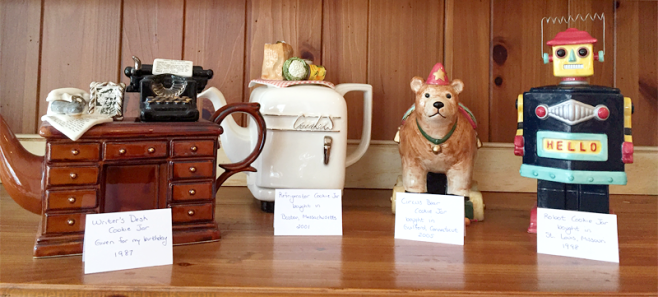
Every item has a story. A fun and educational way for kids to learn family stories and interact with their own history is to create a museum exhibit of objects in your home. Maybe there’s a funny anecdote behind a knick-knack on the shelf. Perhaps the family’s favorite serving dish holds sentimental value. How about your child’s best-loved toys or  drawings or crafts they’ve made? This can be a fun way to spend some time while staying at home and let everyone see common objects in a whole new light.

Supplies

  • A number of household 
  • Paper or index cards
  • Marker, pen, or pencil
  • A table, shelf, or other area for display

Directions

  1. To get started help children gather a number of items from around the house to be the subjects of their exhibit. An exhibit can have a theme, such as Travel Souvenirs, or it can contain random items of your child’s choice, like toys, plants, tools, or artwork.
  2. Using the paper or cards, children can create labels for their exhibit items. Older children can write the labels themselves; younger children may need adult help.
  3. Spend a little time relating the story behind each object: where it came from, how long you’ve had it, and when and how it was used in the past. Include any funny or touching memories attached to the item. Or let your child’s imagination run free, and let them create histories for the objects.
  4. When the labels are finished, arrange the items on a table, shelf, or in a room, and let your child lead family members on a tour. You can even share the exhibit with family and friends on FaceTime, Skype, Zoom, or other app.

Museum Coloring Pages

celebrate-picture-books-picture-book-review-museum-of-modern-art-coloring-page

Museum Coloring Pages


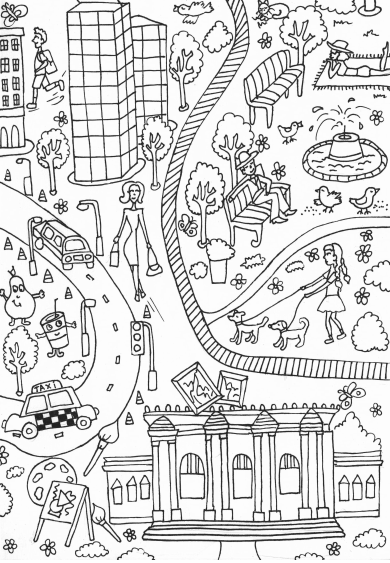
You may not be able to visit a museum in person right now, but you can enjoy three of the most amazing museums in the world with these coloring pages. 

New York’s Metropolitan Museum of Art | London’s British Museum | The Louvre in Paris

celebrate-picture-books-picture-book-review-rocks-in-his-head-cover

You can find Rocks in His Head at these booksellers

Amazon | Barnes & Noble | Books-a-Million

To support your local independent bookstore, order from 

BookshopIndieBound

Picture Book Review
February 4 – It’s Children’s Authors and Illustrators Week

celebrate-picture-books-picture-book-review-old-rock-is-not-boring-cover

About the Holiday

Children’s Authors and Illustrators Week was established with the idea of getting authors, illustrators, and children together to share great books, the joys of creating them and the fun of reading. During the week, authors and illustrators hold special events, including storytelling, exciting presentations, and writing workshops in venues around the country. To find out more about the Children’s Authors Network and discover classroom resources to use throughout the year, visit the Children’s Authors Network website.

I received a copy of Old Rock (is not boring) from G. P. Putnam’s Sons for review consideration. All opinions are my own.

Old Rock (is not boring)

By Deb Pilutti


It seemed that Old Rock had been sitting in the same spot forever. Tall Pine and Spotted Beetle thought being a rock must be pretty boring. Hummingbird wondered, “‘Don’t you ever want to go anywhere?’” She knew she would be if she couldn’t fly all over the world and taste exotic nectars. But Old Rock had flown once, and he began to tell his story.

celebrate-picture-books-picture-book-review-old-rock-is-not-boring-hummingbird

Copyright Deb Pilutti, 2020, courtesy of G. P. Putnam’s Sons Books for Young Readers.

It was during the time when he was surrounded by darkness, but then the volcano erupted and Old Rock “‘soared through a fiery sky into the bright light of a new world.’” Tall Pine, Spotted Beetle, and Hummingbird weren’t very impressed. They still thought Old Rock must be bored. Spotted Beetle told him how much he might see if he climbed to Tall Pine’s very highest branch.

celebrate-picture-books-picture-book-review-old-rock-is-not-boring-volcano

Copyright Deb Pilutti, 2020, courtesy of G. P. Putnam’s Sons Books for Young Readers.

Old Rock countered that he had seen a lot. He’d watched dinosaurs pass by and had even hidden a spinosaurus from a hungry T. rex. He’d traveled in a glacier and been left teetering on a ridge overlooking a vast desert, where he “could see the place where the sky touches the earth.” Spotted Beetle and Hummingbird were intrigued, but Tall Pine dismissed these experiences as “ages ago.” He wanted to know about now. Didn’t Old Rock feel like moving? Tall Pine showed Old Rock how his limbs could dance in the wind.

celebrate-picture-books-picture-book-review-old-rock-is-not-boring-dinosaurs

Copyright Deb Pilutti, 2020, courtesy of G. P. Putnam’s Sons Books for Young Readers.

While Old Rock couldn’t dance, he did recall how he’d turned somersaults off the ridge, landing in a prairie where mastodons grazed near a lake. Tall Pine, Spotted Beetle, and Hummingbird were mesmerized by Old Rock’s story and wanted to know what had happened next. Out of the prairie, sprang a pine forest, Old Rock revealed. And from one of the pine trees a pinecone fell and a seed was released. That seed grew “to be the tall pine who dances in the wind and keeps me company.” Sometimes, he continued, a spotted beetle and a hummingbird meander by. Old Rock was very pleased with his spot, and the others had to agree that it was “very nice” and “not boring at all.”

An illustrated timeline of Old Rock’s life from 18 billion years ago to the present day follows the text.

celebrate-picture-books-picture-book-review-old-rock-is-not-boring-time-line

Copyright Deb Pilutti, 2020, courtesy of G. P. Putnam’s Sons Books for Young Readers.

So much clever thought went into Deb Pilutti’s Old Rock as she reveals to kids what a fascinating and active life the rocks and boulders we see every day have had. Tall Pine, Spotted Beetle, and Hummingbird’s skepticism keeps the suspense building as Old Rock rolls out stories of his various travels and talents. Once he has them hooked, they—like young readers—want to hear more, leading to the just-right ending that sweetly encompasses shared history, happiness with one’s place in life, and friendship. The trio’s questions to Old Rock and their related experiences also engage children to think about issues and opinions from a variety of perspectives.

Pilutti’s mixed-media illustrations are nicely textured to bring out Old Rock’s grainy surface while highlighting nature’s vivid colors. Her vignettes from the dinosaur eras, the ice age (where the skeletons of dinosaurs are also swept up and away in the same glacier as Old Rock), and beyond impress upon readers the long time-frame involved, how the earth has changed, and even the fascinating science of the fossil record.

A multi-layered story, perfect for general story times or as a lead in to science lessons and to promote discussion and research in the classroom, Old Rock (is not boring) would be an original and exciting addition to home, classroom, and public library collections.

Ages 4 – 8

G. P. Putnam’s Sons Books for Young Readers, 2020 | ISBN 978-0525518181

To learn more about Deb Pilutti, her books, and her art, visit her website.

Children’s Authors and Illustrators Week Activity

celebrate-picture-books-picture-book-review-rocks-word-search-puzzle

Rock This Puzzle! Word Search


You can discover a lot about an area by its rocks. Find the twenty rock-related words in this printable puzzle then learn more about them.

Rock This Puzzle! Word Search | Rock This Puzzle! Solution

celebrate-picture-books-picture-book-review-old-rock-is-not-boring-cover

You can find Old Rock (is not boring) at these booksellers

Amazon | Barnes & Noble | Books-a-Million | IndieBound

Picture Book Review
January 7 – Old Rock Day

celebrate-picture-books-picture-book-review-a-rock-is-lively-cover

About the Holiday

Do you love rocks? Are your eyes captured by the colors and patterns on the stones you see while out walking? Today’s holiday celebrates these wonders of nature and encourages geologists—both professionals and amateurs—to indulge their passion and maybe even teach others about the history and formation of rocks. To celebrate, take a walk in your area or even in your own backyard, pick up a few rocks, and research a little more about them.

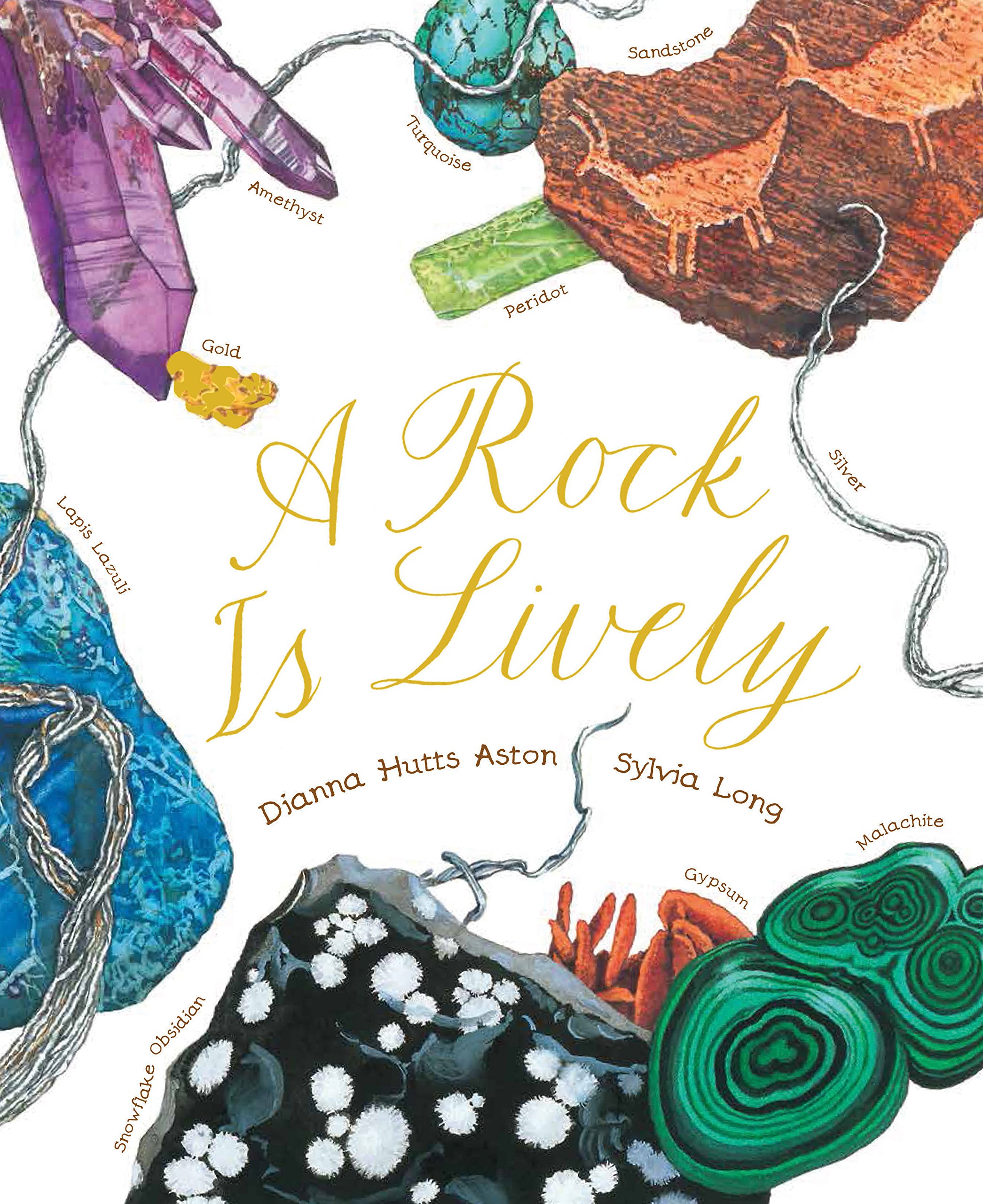
A Rock is Lively

Written by Dianna Hutts Aston | Illustrated by Sylvia Long


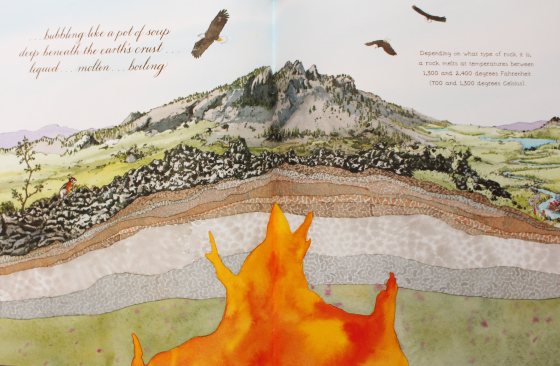
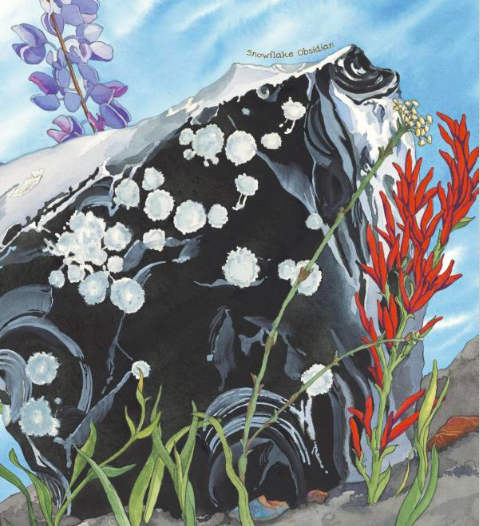
Open the cover of A Rock is Lively and before the text—even before the title—readers are treated to an array of fifty-one gemstones that dazzle the eyes. How enticing to learn about all of these natural works of art! “A rock is lively…” the text begins, arching over a shining piece of snowflake obsidian—an ebony-colored rock dotted with lacy blots. These lively rocks bubble “like a pot of soup deep beneath the earth’s crust…liquid…molten…boiling.” How hot does it need to be to melt a rock? Anywhere “between 1,300 and 2,400 degrees Fahrenheit (700 and 1,300 degrees Celsius).”

celebrate-picture-books-picture-book-review-a-rock-is-lively-lava

Image copyright Sylvia Long, 2012, text copyright Dianna Hutts Aston, 2012. Courtesy of Chronicle Books.

What happens at these temperatures? Well, like your favorite cookie recipe, “a rock is mixed up. All rocks are made of a mix of ingredients called minerals.” Take the recipe for Lapis Lazuli, for instance: “Mix the mineral lazurite with a dash of sodalite and a pinch of both calcite and pyrite. Heat within the earth until a brilliant blue.”

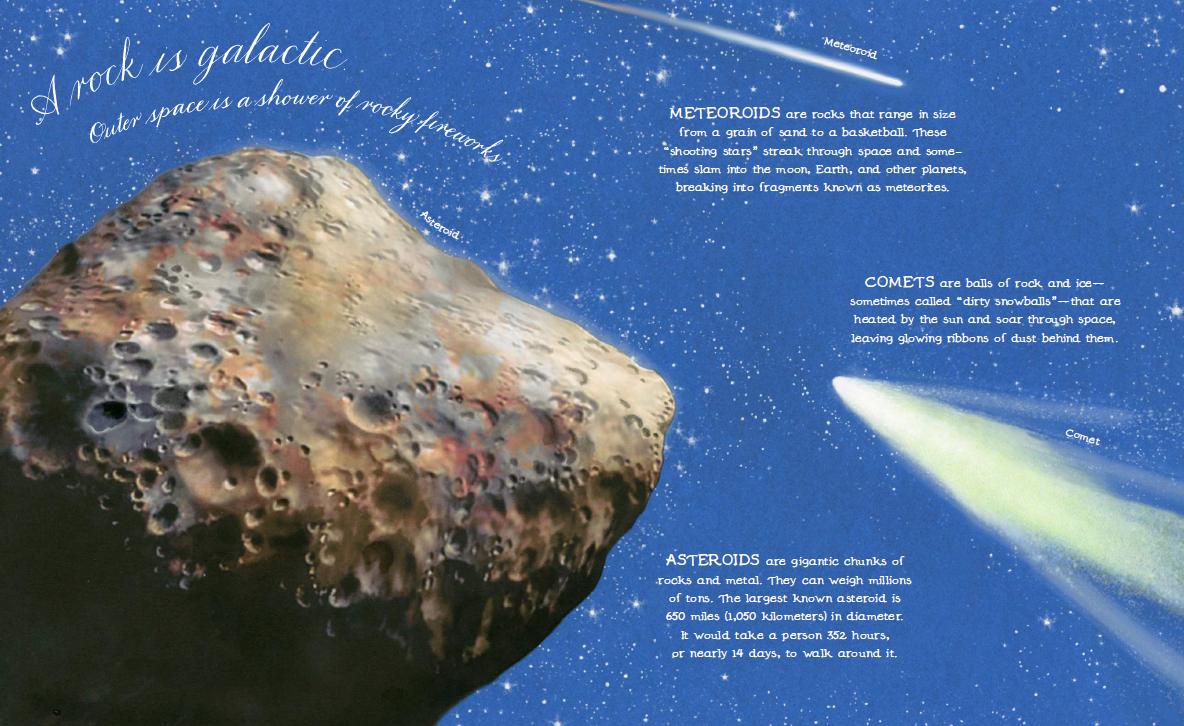
Rocks don’t exist just here on earth. Rocks are also galactic. “Outer space is a shower of rocky fireworks” made of meteoroids, comets, and asteroids. You’ll learn the differences among them here too. You probably already know that rocks are old, but how old? Billions of years old! “The oldest rocks ever found are nearly 4.5 billion years old.” Rocks are “huge…and tiny.” They are as big as a mountain reaching for the sky and as small as the grains underneath your feet.

“A rock is helpful.” Animals use rocks in many amazing ways. Some birds swallow stones to help with digestion, and some sea creatures ingest them to help keep them balanced in the water. Other animals use rocks to crack open shellfish and nuts so they can get to the goodness inside. Some rocks look plain on the outside but hold a beautiful surprise inside. Some rocks are full of colorful rainbows, others look like a starry night sky, while still others look like a white chrysanthemum or a red-and-green watermelon.

celebrate-picture-books-picture-book-review-a-rock-is-lively-galactic

Image copyright Sylvia Long, 2012, text copyright Dianna Hutts Aston, 2012. Courtesy of Chronicle Books.

From humans’ earliest days rocks have been chiseled into arrow heads and spear points, axe blades, and hammers. They’ve become mortars and pestles and are ground up today to “make cement and bricks, paper and pencils, glass, and toothpaste.” But rocks aren’t only useful, they’re creative too. Ancient peoples made paints from minerals and created colorful “pictographs on cave walls, rock shelters, and ledges.” Petroglyphs were made by chipping and pecking away at rock surfaces. As civilizations developed, so did their buildings and artwork made from stone. The pyramids were made from limestone, Stonehenge is formed from “sandstone, dolerite, and others,” the Taj Mahal and Michelangelo’s “David” are marble marvels, and Mt. Rushmore was carved from Granite.

“A rock is recycled.” Formed in three different ways, rocks are categorized as sedimentary, metamorphic, or igneous. “Over thousands of millions of years, [a rock] changes from one form to another. This is called the rock cycle,” and it keeps rocks very lively!

celebrate-picture-books-picture-book-review-a-rock-is-lively-surprising

Image copyright Sylvia Long, 2012, text copyright Dianna Hutts Aston, 2012. Courtesy of Chronicle Books.

Dianna Hutts Aston’s inventively and conversationally accessible discussion of the rocks that make up our earth and universe will enthrall any rock hound or entice the curious. Aston’s lead-in heads make for clear classification of and intriguing introductions to the various types of rocks, how they’re formed, what they look like, and how they’ve been used through history.  Her pages contain short, but very informative paragraphs that teach children about rocks through time and size comparisons they’ll understand, descriptions with familiar references, and evocative verbs and adjectives. Aston’s dynamic look at this subject will excite kids to learn more.

celebrate-picture-books-picture-book-review-a-rock-is-lively-snowflake-obsidian

Image copyright Sylvia Long, 2012, text copyright Dianna Hutts Aston, 2012. Courtesy of Chronicle Books.

Accompanying Aston’s text are Sylvia Long’s stunning illustrations that open readers eyes to the incredible beauty of each type of rock. To begin, young readers see a cut away of the rock layers beneath earth’s crust as well as the rocks that shoot across the sky. Aston shows animals using rocks in a myriad of ways as well as the tools, art, and buildings created by humans throughout history. The showstoppers are her depictions of the interior of different types of geodes, with their electric blues, reds, purples, and oranges and figures that lend the rocks their names. The double-spread pages containing fifty-one rocks with their name that introduce and end the book are a young geologist’s dream come true and will send them scurrying to discover and collect them all.

A fantastic reference, A Rock is Lively makes a terrific addition to home and classroom libraries  or a gift (pair it with a geode or small boxed rock collection) for young nature lovers and scientists.

Ages 7 – 12

Chronicle Books, 2012 (Hardcover; 2015 Paperback) | ISBN 978-1452106458

Discover more about Dianna Hutts Aston and her books on her website.

To learn more about Sylvia Long, her books, and her art, visit her website.

Old Rock Day Activity

CPB - Nasty Bugs magnet II (2)

Rock This Craft!


Smooth stones can give you a natural canvas for your creativity! With a little bit of paint, pins or magnets, and some imagination, you can make refrigerator magnets, jewelry, paper weights, and more!

Supplies

  • Smooth stones in various sizes
  • Paint or markers
  • Small magnets, available at craft stores
  • Jewelry pins, available at craft stores
  • Paint brush
  • Strong glue

Directions

To make magnets

  1. Design and paint an image on the stone
  2. Attach a magnet to the back with strong glue, let dry
  3. Use to hang pictures, notes, or other bits of important stuff on your refrigerator or magnetic board

To make jewelry

  1. Using a smaller, flatter stone, design and paint an image on the stone
  2. Attach a jewelry pin to the back with the strong glue, let dry
  3. Wear your pin proudly

To make a paper weight

  1. Using a large stone, design and paint an image on the stone
  2. Let dry
  3. Display and use on your desk to keep those papers in place

celebrate-picture-books-picture-book-review-a-rock-is-lively-cover

You can find A Rock is Lively at these booksellers

Amazon | Barnes & Noble | Books-a-Million | IndieBound

Picture Book Review