March 10 – It’s Women’s History Month

celebrate-picture-books-picture-book-review-send-a-girl-cover

About the Holiday

Calling all gals, pals, and woman-identifying people! This month is dedicated to YOU and all the women throughout history who have worked to make things fair. Women throughout history have often been treated as less than men, especially women of color. This concept is called gender inequality, and a whole lot of wonderful ladies across the world have been working to change it. In 1987 the National Women’s History Project petitioned to have the US Congress officially designate March as Women’s History Month. From that point on, organizations and communities have celebrated and recognized the month-long holiday by uplifting the stories of role-model women throughout US history. To celebrate Women’s History Month, read about some of the achievements of women in various fields of study, learn about (and from) stories of activism, and spend some quality time with the women and girls who matter most in your life. To learn more about Women’s History Month, visit: https://womenshistorymonth.gov/ 

Thank to Bloomsbury Children’s Books for sending me a copy of Send a Girl! for review consideration. All opinions on the book are my own.

Reviewed by Dorothy Levine

Send a Girl! The True Story of How Women Joined the FDNY

Written by Jessica M. Rinker | Illustrated by Meg Hunt


As a girl growing up in the 1950’s, Brenda Berkman dealt with a lot of adults telling her what she could and couldn’t do. Brenda loved to play sports and spend time outside. But many of her favorite activities were ones that people considered “boy’s games.” When Brenda tried to join a baseball team, the coach said he wouldn’t send a girl to play a boy’s game. But, did Brenda let this stop her? Nope! Brenda was determined to keep doing the things she liked to do, so she made her own all-girls football team with friends instead. 

As Brenda grew older, people’s views on what boys and girls could do began to expand. Brenda had moved to New York and studied to become a lawyer but realized that she yearned for a career that was more active. In 1977 the New York City Fire Department announced that they would finally allow women to take the exam to become firefighters. This was exciting news! Brenda didn’t think that this would ever be a possibility for her because “In the past, every firefighter in the city had to be a man. In fact, they’d only ever been called firemen!”

celebrate-picture-books-picture-book-review-send-a-girl-football

Image copyright Meg Hunt, 2021, text copyright Jessica Rinker, 2021. Courtesy of Bloomsbury Books for Children.

Brenda knew she wanted to do something that would involve helping people, using her mind to strategize, being active, and getting outdoors. Becoming a firefighter seemed like the perfect fit. Becoming a firefighter proved to be a tough journey for Brenda. Even though the fire department now allowed women to apply, many people did not support this decision. “They said, ‘Don’t send a girl to do a man’s job!’ They didn’t think women were courageous enough, smart enough, or strong enough.” Brenda knew she was going to have to work really hard to prove these people wrong. She passed the written test and began to train for the fitness test.

When Brenda took her physical exam, she found that the men in charge were not looking for the strengths firefighters need to do their jobs. None of the women who took the test passed, and Brenda knew this was no coincidence. It wasn’t that the women weren’t strong enough, but rather the people in charge of the firefighters’ test didn’t want women to pass. Brenda realized that she could use her background in law to fight against this injustice. After four long years of working to prove her case in court, Brenda won, and the test was restructured to better match the skills that people need to have as firefighters. 

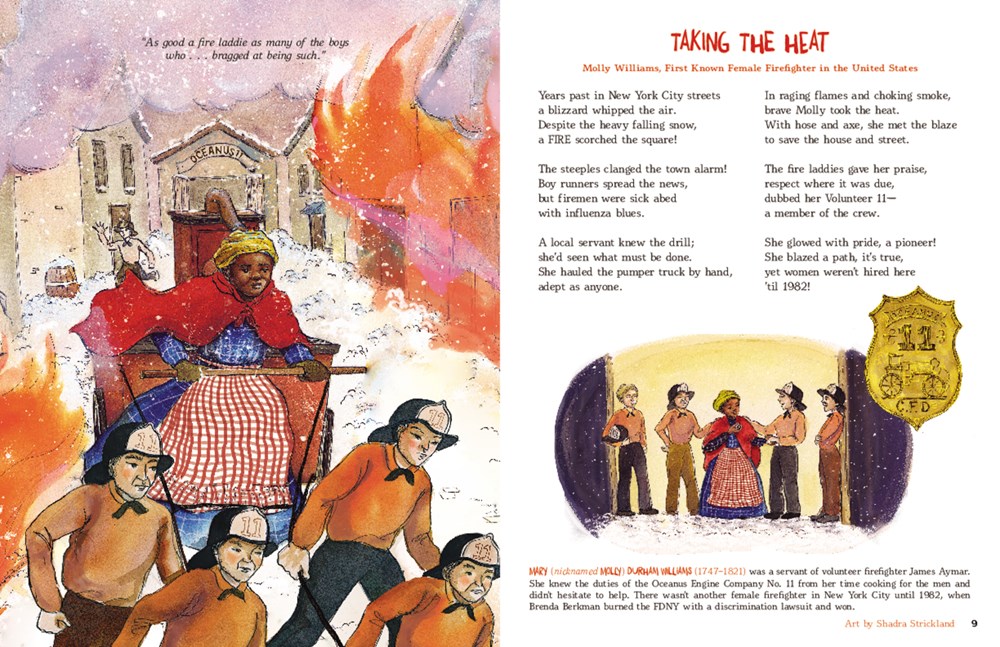
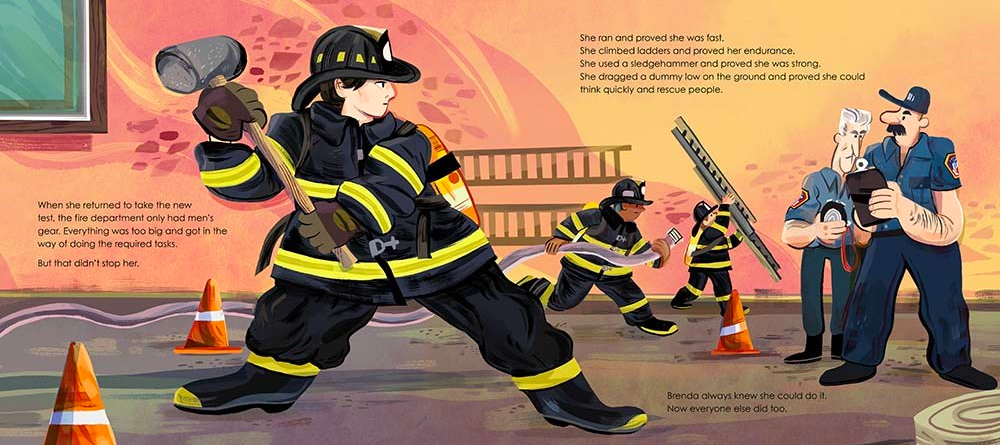
In 1982 Brenda Berkman and forty others became the first female firefighters to join the New York City Fire Department. In Brenda’s new job, “She hauled hoses! Climbed ladders! Broke through walls! Fighting fires was exciting and gritty, loud and dirty, and sometimes dark and dangerous.” But her fight against people’s bias and discrimination was far from over. Many people still didn’t think that women were tough enough for the job, even after they had proved they were. “They said, ‘I want to be saved by fireMEN!’”

celebrate-picture-books-picture-book-review-send-a-girl-test

Image copyright Meg Hunt, 2021, text copyright Jessica Rinker, 2021. Courtesy of Bloomsbury Books for Children.

And, some of the men already on the New York City Fire Department agreed. They were mean and made the job as difficult as possible for Brenda and the other women firefighters. Sometimes they would pull pranks on the women in their departments that were incredibly cruel and dangerous. “Firefighters need to depend on one another. Brenda wasn’t sure she could depend on all her fellow firefighters. Sometimes it was lonely. Often, she felt invisible.” To combat against this, Brenda formed a group called United Women Firefighters, where women could come and talk about these issues and support each other. 

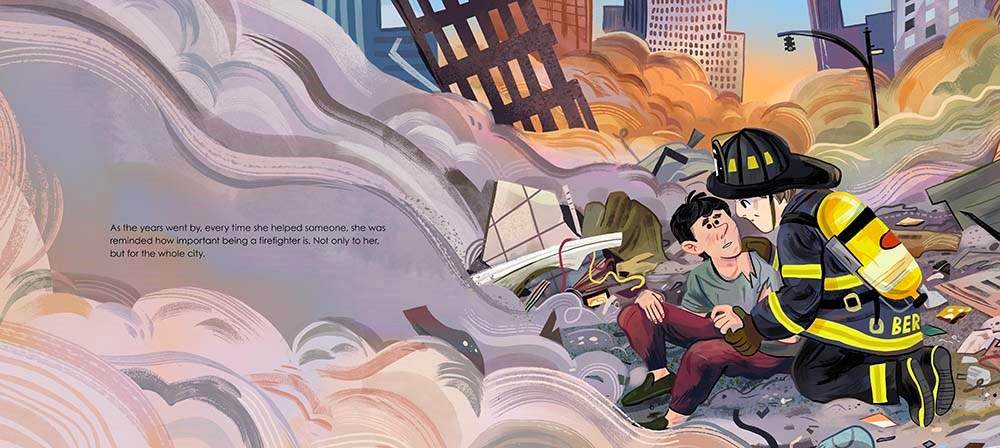
With this new group, strong friends, and time, things got slowly better for Brenda. People began to change their opinions on firefighting only being for men. Brenda continued to excel as a firefighter, and eventually became a captain of her department. She continued to fight fires—and discrimination—throughout her life, and she proved that firefighting is something you can “send a girl” for. Now there are people of all genders across the nation who fight fires every day and save lives. 

An Author’s Note at the end details the importance of learning stories like Brenda’s and provides more information on the history of firefighting and Brenda’s accomplishments. A list of websites where readers can learn more about women firefighters and other influential women is also included.

celebrate-picture-books-picture-book-review-send-a-girl-rescue

Image copyright Meg Hunt, 2021, text copyright Jessica Rinker, 2021. Courtesy of Bloomsbury Books for Children.

In this inspiring story of overcoming norms and gender discrimination, Jessica Rinker eloquently recounts Brenda Berkman’s stirring biography. Readers of all ages will rejoice in the perseverance that Berkman exhibited throughout her career. Rinker’s repetition of Brenda’s firefighting tasks takes on an exciting, triumphant tone and echoes the thrill Brenda felt while fighting fires despite all of the hardship she faced. Rinker’s straightforward writing discusses difficult themes of women’s inequality, bullying, and discrimination in an easily digestible manner for young readers. 

Illustrator Meg Hunt provides a diverse cast of characters to make the story come alive. Her multimedia images match the bustling, busy nature of New York City and provide an immersive view into city living. Readers are transported into the story to fight fires right alongside Brenda with intricate, realistic, and colorfully designed spreads. They watch the protagonist age throughout the story with determination and power. The first image of Brenda valiantly hauling a firehose to a window of billowing smoke in an NYC apartment is mirrored near the end. Readers follow Brenda in a full circle—working tirelessly to become a firefighter, shining at her job, and then extending her joy for firefighting to the next generation of young women on the final spread. 

Book lovers of all types will be inspired by Brenda Berkman’s story and how she shaped the history of fighting fires, both literal and metaphorical. An honest, informative and empowering book. The sentiment and lessons in Send a Girl! are of utmost importance for young girls, and really all young readers to hear.

Ages 4 – 8

Bloomsbury Children’s Books, 2021 | ISBN 978-1547601745

Discover more about Jessica M. Rinker and her books on her website.

To learn more about Meg Hunt, her books, and her art, visit her website.

Women’s History Month Activities

celebrate-picture-books-picture-book-review-womens-history-month-word-search

Women’s History Month Word Search


Find the names of fifteen inspirational women in this printable word search puzzle.

Women’s History Month Word Search Puzzle | Women’s History Month Word Solution

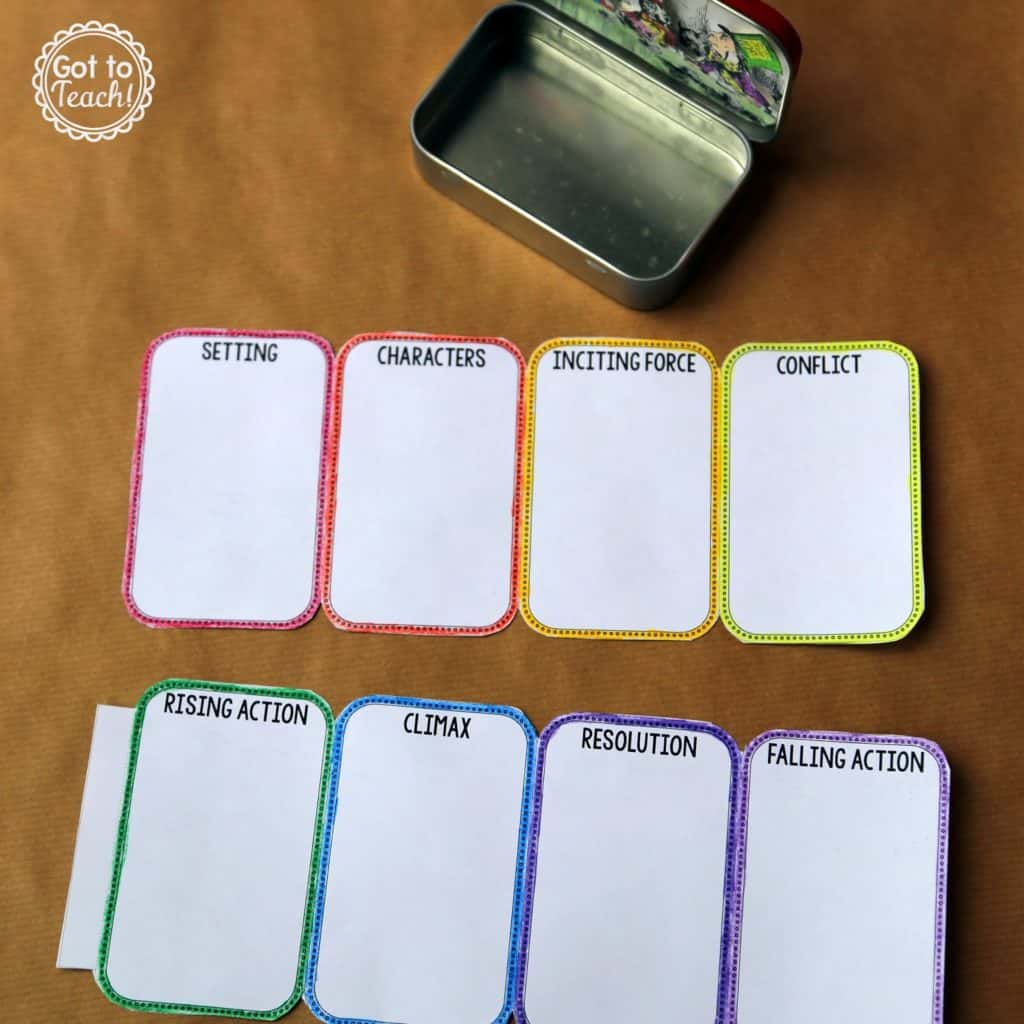
Teacher Thrive mint tin book report craft

Mint-Tin Book Report


Create a mint-tin book report of Brenda Berkman’s story in Send a Girl! or of another book highlighting an important women’s biography. You can find more about this clever idea from Melissa at Teacher Thrive

Materials

Instructions

Cut out the pages from the printable template and fold along the creases. Glue the “conflict” and “rising action” pieces together using the extra rectangle of paper. Write down the most important facts or highlights from each part of the story and decorate. Fold up the pages accordion style and stick into a mint tin. Use the blank parts to decorate the top and inside of the lid. Then you’ll have a portable, cute book report to carry around wherever you please!

celebrate-picture-books-picture-book-review-send-a-girl-cover

You can find Send a Girl! The True Story of How Women Joined the FDNY at these booksellers

Amazon | Barnes & Noble | Books-a-Million

To support your local independent bookstore, order from

Bookshop | IndieBound

Picture Book Review
March 8 – International Women’s Day

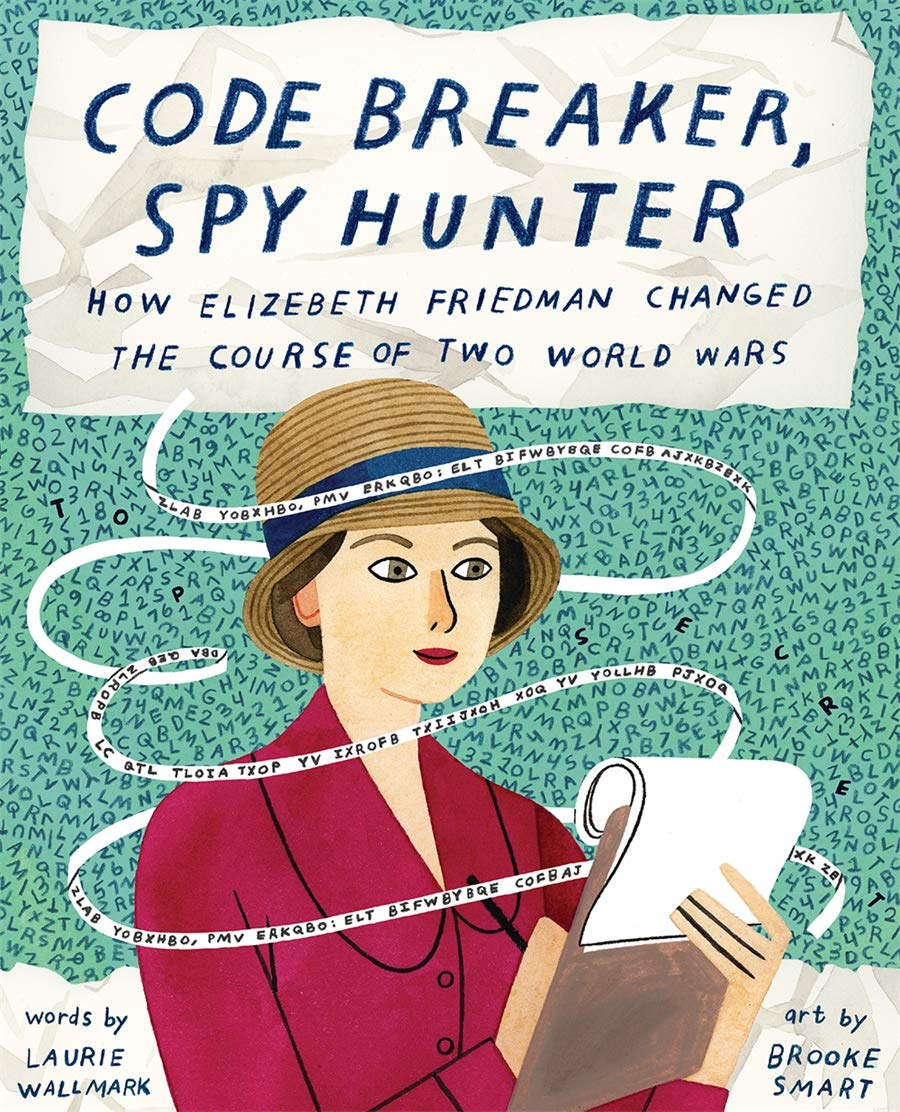
celebrate-picture-books-picture-book-review-code-breaker-spy-hunter-cover

About the Holiday

Today’s holiday is celebrated around the world and focuses on the social, economic, cultural, and political accomplishments of women. Spurred on by this mission, the theme for 2021 is “Choose to Challenge.” The sponsors of today’s holiday know that “a challenged world is an alert world and from challenge comes change.” Individually, each of us can choose to call out and challenge gender bias and inequality wherever we see it. Each of us can choose to seek out and celebrate women’s achievements. Collectively, we can all help create an inclusive world. To celebrate today and all year through, commit to helping forge an inclusive world. To learn more about International Women’s Day and how you can get involved in making positive change toward gender equality, visit the International Women’s Day website.

Thanks to Abrams Books for Young Readers and Blue Slip Media for sharing a copy of Code Breaker, Spy Hunter with me for review consideration. All opinions of the book are my own. I’m excited to be teaming with them for a giveaway of the book. See details below.

Code Breaker, Spy Hunter: How Elizebeth Friedman Changed the Course of Two World Wars

Written by Laurie Wallmark | Illustrated by Brooke Smart


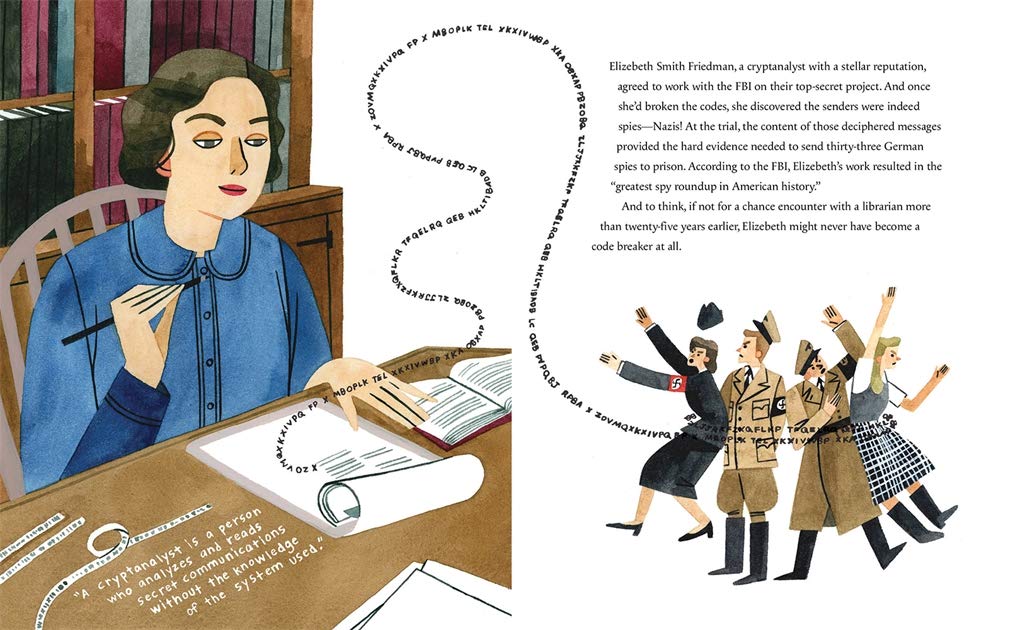
In Code Breaker, Spy Hunter, readers open the cover to an intriguing question: “Could it be? Had enemy spies sneaked into the United States?” World War II was raging, but the United States had not yet joined the effort. And yet the “FBI had intercepted hundreds of coded messages from a secret base in New York.” The problem was no one could read them. Who did the FBI turn to? Elizebeth Smith Friedman, who broke the codes, discovered a cadre of Nazi spies, and provided the evidence “to send thirty-three German spies to prison.” Who was Elizebeth Friedam? Children are about to find out!

celebrate-picture-books-picture-book-review-code-breaker-spy-hunter-cryptanalyst

Image copyright Brooke Smart, 2021, text copyright Laurie Wallmark, 2021. Courtesy of Abrams Books for Young Readers.

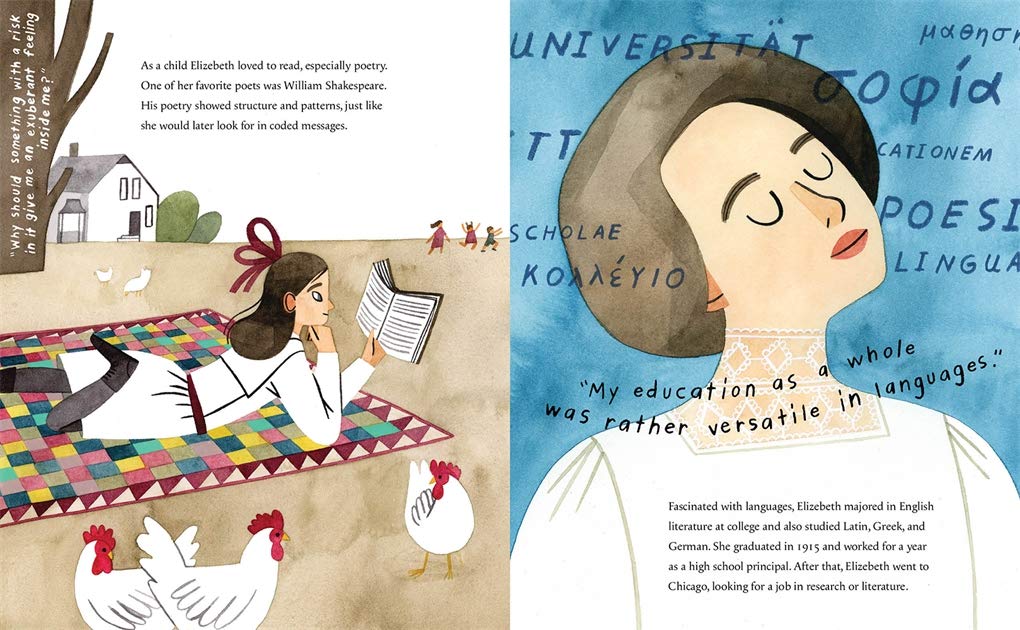
As a child, Elizebeth loved poetry and especially the work of William Shakespeare, with its structure and patterns. In college, she studied English literature, Latin, Greek, and German. While looking for a job in Chicago in 1916, she met the eccentric George Fabyan, who was trying to prove that Francis Bacon was the true writer of Shakespeare’s plays. He hired Elizebeth to “find secret messages Bacon had supposedly hidden in the plays. But the more she explored the plays, the more convinced she became that there were no hidden messages.”

Elizebeth shared her thoughts with a friend, William Friedman, who also loved puzzles and secret codes. Over a year’s time, their discussions resulted in a stronger friendship and finally marriage. In 1917, the US entered World War I and Fabyan asked Elizebeth and William to establish “the country’s first code-breaking unit, the Riverbank Department of Cyphers…. Their methods are now considered the basis for the modern science of cryptology, the study of secret codes.”

celebrate-picture-books-picture-book-review-code-breaker-spy-hunter-childhood

Image copyright Brooke Smart, 2021, text copyright Laurie Wallmark, 2021. Courtesy of Abrams Books for Young Readers.

In 1921, Elizebeth and William moved to Washington D.C., where they worked as code breakers for the Army. At the time, the Army used a large, cumbersome machine to convert messages into code, which precluded soldiers in the field from sending intelligence back. Elizebeth and William invented a complex code that used “only pencil and paper.” After the war, Elizebeth settled down to write books and raise a family, but still the entreaties came to decode messages for court cases sometimes thousands of miles away.

In 1925 with Prohibition the law of the land, smugglers were running rampant. The Coast Guard summoned her, and within three months Elizebeth had cracked “two years of backlogged messages.” Her work and court testimony that helped to convict smugglers made Elizebeth a recognized expert in the new field of cryptology, and when the work became overwhelming for just two people, she created the Coast Guard’s first code-breaking unit.

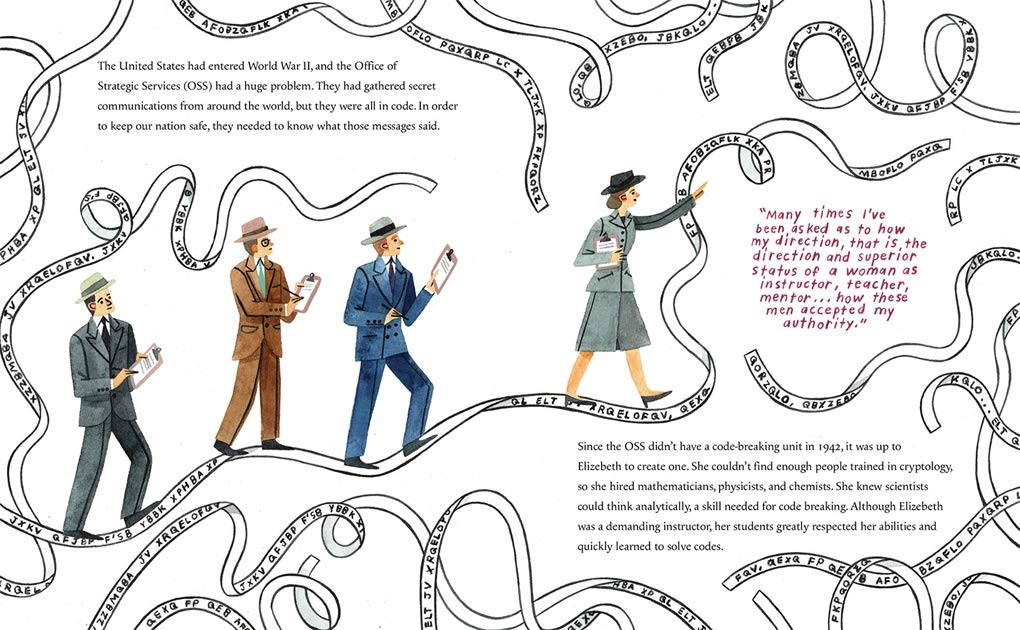
With the entry of the US in World War II, Elizebeth’s expertise was once again needed. Again, she needed to create a code-breaking unit, and in 1942 she hired and taught “mathematicians, physicists, and chemists” the skills of cryptology. Now, Elizebeth’s team was learning important war information about the Nazi’s movements and plans. When the FBI director wanted to nab the spies, Elizebeth recommended waiting “until the military could learn more of the enemy’s secrets.” But he disagreed and raided their hiding place. The spies that escaped quickly changed their codes, making their communications harder to decipher. The FBI director took all the credit for breaking the codes and catching the spies.

celebrate-picture-books-picture-book-review-code-breaker-spy-hunter-world-war-II

Image copyright Brooke Smart, 2021, text copyright Laurie Wallmark, 2021. Courtesy of Abrams Books for Young Readers.

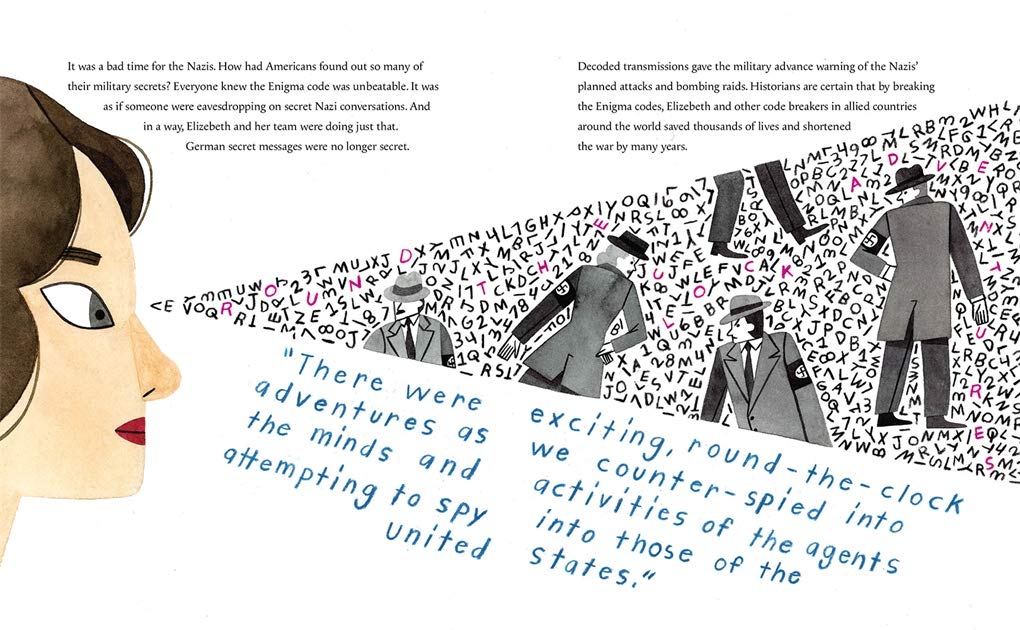
As the war progressed, Elizebeth helped capture an American spy working for the Japanese, and when the Germans developed Enigma, a powerful code-making machine that could “create billions of different cipher alphabets, it was Elizebeth’s team that broke the code for the United States. In Allied countries around the world, other cryptologists were also decrypting Enigma messages. The Nazis were now at a disadvantage, their planned attacks thwarted. Historians believe the work of these code breakers “saved thousands of lives and shortened the war by many years.”

Throughout her life Elizebeth could not speak a word about her work, even to her family. It was classified as Top Secret Ultra by the government and kept locked in the National Archives. At last, in 2015, Elizebeth’s work was declassified. “She is now considered one of the most gifted and influential code breakers of all time.”

celebrate-picture-books-picture-book-review-code-breaker-spy-hunter-counter-spied

Image copyright Brooke Smart, 2021, text copyright Laurie Wallmark, 2021. Courtesy of Abrams Books for Young Readers.

Compelling and wonderfully detailed, Laurie Wallmark’s biography of Elizebeth Friedman immerses children in the world of war-time spies, where cracking codes equaled saved lives and battles won. Wallmark’s storytelling of Elizabeth’s trajectory from Shakespeare scholar to ultra-secret code cracker reads like a thriller and is sprinkled throughout with quotes from Elizebeth that give kids a sense of her personality and the demands of her career. By including several cases Elizebeth was instrumental in solving, Wallmark provides readers with historical context on the broad range of nefarious activity that relied on secret codes to inform their knowledge of today’s uses of encryption as well as international spy networks. Each page is a celebration of Elizebeth’s talent, intelligence, and accomplishments, and her incredible story will enthrall readers.

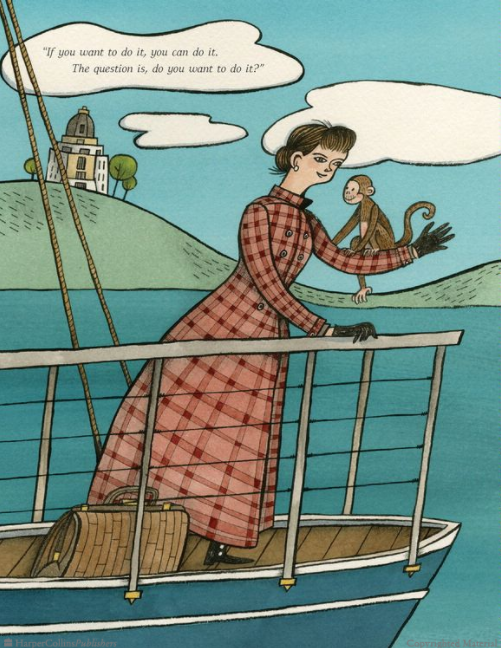
Brooke Smart’s watercolor and gouache illustrations offer enticing glimpses into the past while following Elizebeth as she meets George Fabyon who shows her around his museum-like house while carrying a small monkey on his shoulder, establishes the United States’ first code-breaking unit, testifies in court, and thwarts the Nazis’ war plans. Interspersed with Smart’s realistic depictions of Elizebeth’s life are images in which lines of coded messages snake across the page, giving readers a look at the kinds of unreadable text Elizebeth and her teams cracked. In addition to presenting a visual representation of the tangled communications that eventually nabbed our enemies, two of these clever illustrations contain messages of their own.

A superlative biography that would enhance any history, social studies, language arts, or STEM curriculum as well as captivate kids who love spy, military, and detective stories, Code Breaker, Spy Hunter: How Elizebeth Friedman Changed the Course of Two World Wars is highly recommended for home bookshelves and is a must for school and library collections.

Ages 7 – 11

Abrams Books for Young Readers, 2021 | ISBN 978-1419739637

Discover more about Laurie Wallmark and her books on her website.

To learn more about Brooke Smart, her books, and her art, visit her website.

International Women’s Day Activity

celebrate-picture-books-picture-book-review-pig-pen-cipher

Send a Secret Message


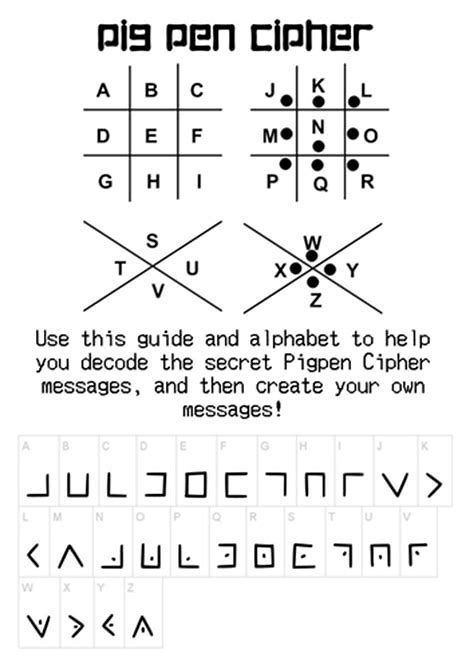
Would you like to be a code breaker – or a spy? Get started with this Pigpen Cipher that makes sending secret messages to friends, siblings, and other family easy and fun. This ancient code is called the Pigpen Cipher because each letter is in its own “pen.” Use it as originally developed then try mixing the letters and pens to create new codes. 

Pigpen Cipher Key

celebrate-picture-books-picture-book-review-code-breaker-spy-hunter-cover

You can find Code Breaker, Spy Hunter at these booksellers

Amazon | Barnes & Noble | Books-a-Million

To support your local independent bookstore, order from 

Bookshop | IndieBound

Picture Book Review
March 3 – World Wildlife Day and Interview with Author Heather Lang

celebrate-picture-books-picture-book-review-the-leaf-detective-cover

About the Holiday

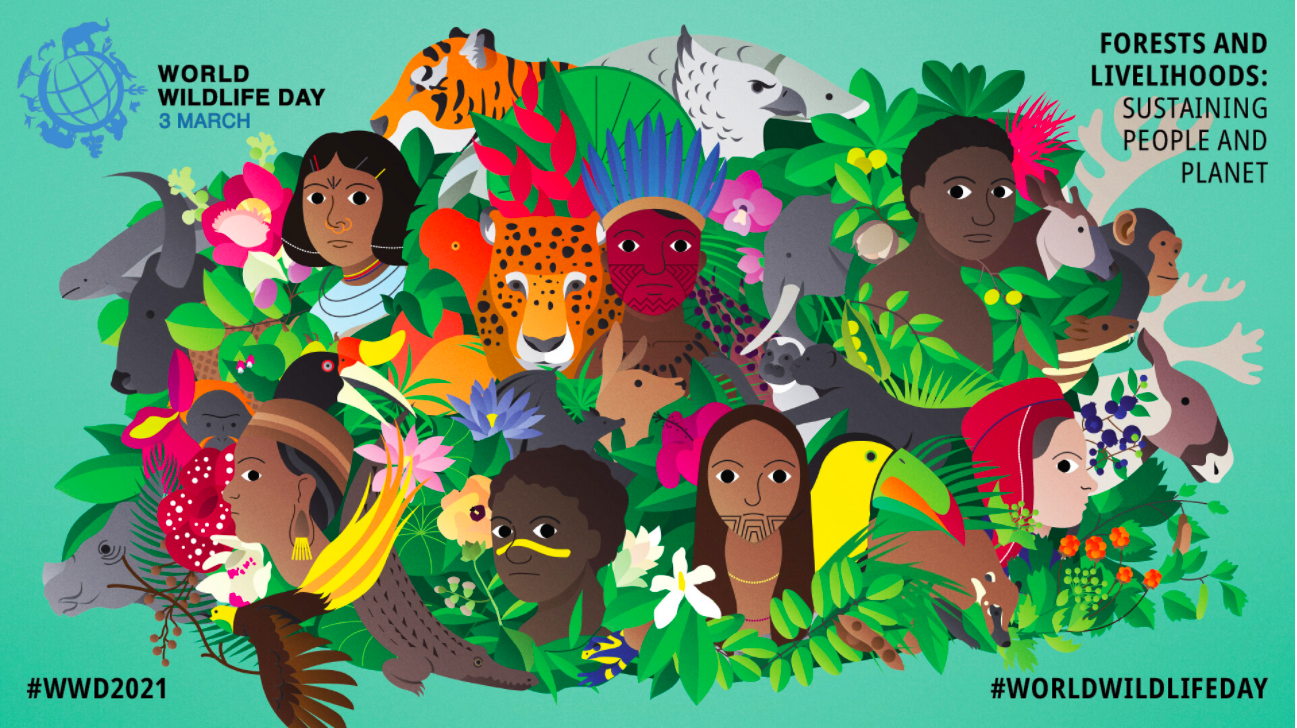
A vast number of plant and animal species are facing endangerment or extinction due to human caused climate change. World Wildlife Day was created in 1973 as an effort to protect the many endangered species of the world. It is an international holiday with a new theme each year to celebrate the biodiversity of our earth while also promoting awareness and advocacy. The theme for this year’s observance is “Forests and Livelihoods: Sustaining People and Planet.” There are many wonderful ways to celebrate this holiday; spend some time in nature, pick up litter around your block, find out about activities going on in your hometown, and read books to educate yourself and others on the livelihood of forests, wildlife and the environment.  To learn more about World Wildlife Day, and the virtual events happening today, visit this webpage: https://www.wildlifeday.org/. If you are searching for books to celebrate, The Leaf Detective is a perfect fit!

Thanks to Boyds Mills for providing a digital copy of The Leaf Detective for review consideration. All opinions on the book are my own.

Reviewed by Dorothy Levine

The Leaf Detective: How Margaret Lowman Uncovered the Secrets in the Rainforest

Written by Heather Lang | Illustrated by Jana Christy


As a child, Meg was quite shy to make friends. She spent lots of time studying and playing with wildlife: “Meg wrapped herself in nature, like a soft blanket.” As she continued to grow, so did her passion for leaves, trees, and nature. Meg attended Sydney University in Australia. In 1979, she became the first person at her graduate school to study the rainforest. Through her studies Meg learned that people had been all the way to outer space to study, but nobody had ever ventured to the tippity top of a canopy tree. Instead, they studied trees from far away through binoculars. Oftentimes scientists would spray trees with chemicals so that the harmed leaves and animals would drop to the forest floor where people could study them up close. Meg sought to change this.

celebrate-picture-books-picture-book-review-the-leaf-detective-harness

Image copyright Jana Christy, 2021, text copyright Heather Lang, 2021. Courtesy of Calkins Creek.

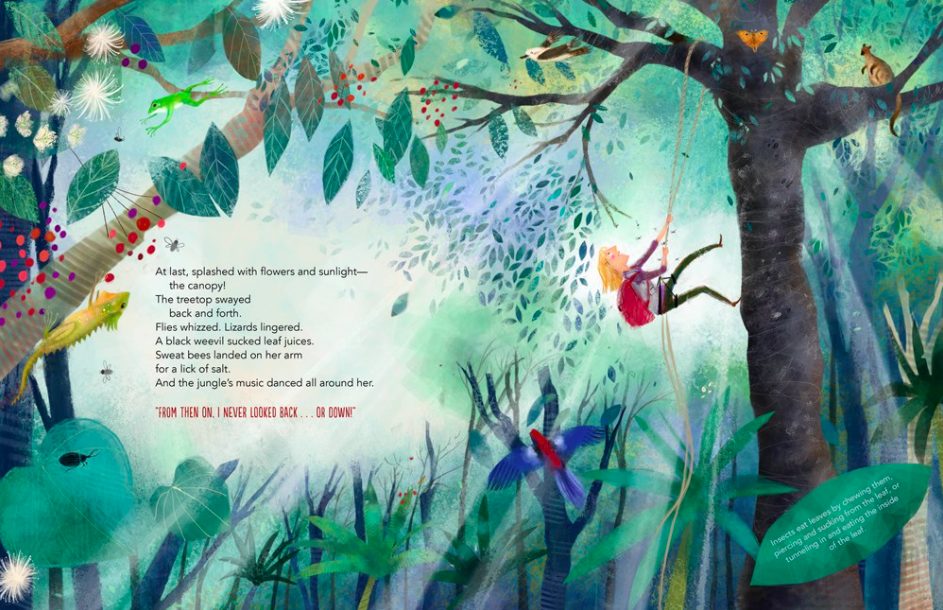
“In the dark, damp forest the trees rose up to distant rustling, squawks and screeches, shadows in the treetops. How could she get up there?” Meg Lowman created her own slingshot and harness and inched up a coachwood tree. When she reached the canopy, she knew she’d found the perfect place to study and explore. Meg is quoted saying, “From then on, I never looked back…or down!”

Meg continued to create new strategies to study the canopy, as a scientist does. And in doing so she made so many discoveries, such as: “We now believe the canopy is home to approximately half the plant and animal species on land.” Many people tried to stop Meg along her journey. They told her she couldn’t take science classes, climb trees, or make inventions because she was a woman. But Meg ignored them. She continued to investigate.

She knew that rainforests were (and are) in danger, and that so many creatures rely on the rainforest ecosystem. People all over the world were cutting down large parts of the rainforests for wood, rubber, paper, and farmland. This worried Meg; she wanted to find a way to protect rainforests before they all disappeared. “She wondered, How can one leaf detective make a difference? How can I save the trees?…Then an idea crawled into Meg’s thoughts—a way to speak for the trees.”

celebrate-picture-books-picture-book-review-the-leaf-detective-bugs

Image copyright Jana Christy, 2021, text copyright Heather Lang, 2021. Courtesy of Calkins Creek.

Meg traveled around the world. She spoke to people across many different countries; taught them how to climb trees, build canopy walkways—she showed people the many gifts rainforests have to offer. Meg educated communities on how they could share their rainforest with outsiders, showcase its beauty to create revenue rather than chopping them down for resources. By using her voice and creative mind, Meg helped implement systems that have saved many trees and creatures across the world.

Meg Lowman continues to study trees, save rainforests, and teach people how to shift their economies to center around ecotourism and sustainable crops rather than resource extraction. She has used her voice to save rainforests across the world, and yet she still says, “If only I could have achieved as much as the tree!… But I have not. I have whittled away at relatively small goals in comparison to the grander accomplishments of a tree.”

Backmatter includes an author’s note detailing Heather Lang’s visit to meet Margaret Lowman in the Amazon rainforest in Perú. The note includes more information on Dr. Lowman’s advocacy work and is followed by an illustrated educational spread on the layers of canopies, and species featured throughout the story are labeled in the final spread, for readers to learn more about specific animals that make their homes in the rainforest.

celebrate-picture-books-picture-book-review-the-leaf-detective-trampoline

Image copyright Jana Christy, 2021, text copyright Heather Lang, 2021. Courtesy of Calkins Creek.

Heather Lang’s lyrical writing matches the carefulness with which Meg studies leaves, trees, and the rainforest canopy. Her compelling storytelling is rich with facts and sensory imagery that immerse readers in the environment and Meg’s determination to understand and, later, save it. Scattered images of leaves drop fun facts and definitions for readers about the rainforest, canopies, transpiration, herbivores, and more. Quotes from Dr. Lowman are thoughtfully placed throughout the story in a manner that neatly flows. The Leaf Detective urges readers to understand that “a tree is not just a tree” but rather “a shelter for animals and people, / a recycler and provider of water, / a creator of food and oxygen, / an inventor of medicine/ a soldier against climate change.”

Jana Christy’s digital drawings contain stunning detail and show an accurate scale of one small person in comparison to the vastness of the rainforest. Her mesmerizing wildlife creatures and immersive watercolor blues and greens transport readers right into the rainforest with “Canopy Meg.” The lush greens of the rainforests contrast strikingly with the spread on deforestation, in which fallen trees lay scattered on the bare, brown ground. Readers will also be interested to see the innovations that have made the trees more accessible to people. One can read the book over and over and notice new details every time. It is a book to treasure, to study, to read and re-read again. 

Come unearth the secrets of the rainforest with Margaret Lowman in this book that’s budding with knowledge, empathy, and magic, and is a tale of how one person can make a difference. The intriguing facts, poignant quotes from Dr. Lowman herself, and beautiful poetic writing will leave readers of this book inspired with wonder and with a hunger for advocacy. The Leaf Detective: How Margaret Lowman Uncovered the Secrets of the Rainforest is an urgent must-read for all ages.

A portion of Heather Lang’s royalties for this book go to TREE Foundation—an organization that funds field trips for children to get into nature, canopy projects, and science book distribution for children with limited access to STEAM, girls especially. 

Ages 6 – 10

Calkins Creek, 2021 | ISBN 978-1684371778

Discover more about Heather Lang and her books on her website.

To learn more about Jana Christy, her books, and her art, visit her website.

Meet Heather Lang

celebrate-picture-books-picture-book-review-Heather-Lang-headshot

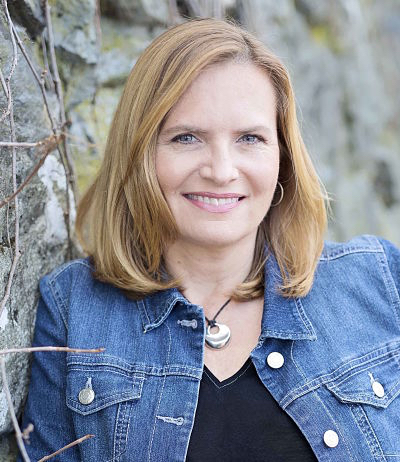
Heather Lang loves to write about real women who overcame extraordinary obstacles and never gave up on their dreams. Her research has taken her to the skies, the treetops of the Amazon, and the depths of the ocean. Her award-winning picture book biographies include, QUEEN OF THE TRACK: Alice Coachman, Olympic High-Jump Champion, THE ORIGINAL COWGIRL: The Wild Adventures of Lucille Mulhall, FEARLESS FLYER: Ruth Law and Her Flying Machine, SWIMMING WITH SHARKS: The Daring Discoveries of Eugenie Clark, and ANYBODY’S GAME: Kathryn Johnston, The First Girl to Play Little League Baseball. When she is not writing, she enjoys going on adventures with her husband and four children. Visit Heather at www.heatherlangbooks.com.

Today I am thrilled to be interviewing author Heather Lang about her new biographical picture book The Leaf Detective: How Margaret Lowman Uncovered the Secrets of the Rainforest. Heather provides some thoughtful notes for shy readers, riveting stories from the rainforest and insight into the importance of exploring and caring for nature.

Can you tell us a little bit about what made you decide to write The Leaf Detective?  

We’ve caused enormous harm to our planet over the last few centuries, and I’m especially concerned about our rainforests. I knew I wanted to write a biography that was also a science book about the rainforest. When I read about Meg’s pioneering work and deep passion for trees, I was hooked! I couldn’t wait to find out how this quiet, nature-loving child, who didn’t know women could be scientists, became a world-class scientist and conservationist.

In the story you talk about how Meg was shy to make playmates with other kids. Were you also a shy kid growing up? Do you have any advice for readers who may relate to this aspect of Meg’s childhood? 

Like Meg, I was very shy as a child and remember wishing I were more outgoing. But as I grew older, I began to recognize the many advantages to being shy! My shy nature led me to sit back and observe. And that led to deeper thinking and understanding, a strong imagination, and creativity. Shy people often think more before they speak. They make their words count, which coincidentally is an important part of writing picture books. This also makes shy people good listeners and thoughtful friends. 

I’m still shy in many ways, and my recommendation to readers who might identify with this is to embrace your shyness! At the same time, don’t let it stop you from doing things you want to do. Meg Lowman told me she used to get so nervous before presenting in graduate school that she’d get physically sick. But with practice, practice, practice, she’s become a captivating presenter and educator. If you watch a few of her FUN FACTS FROM THE FIELD videos on my website, you’ll see what I mean! 

How would you describe your connection to nature? Would you consider yourself a “detective” in any ways? 

I’m constantly in awe of nature and its countless gifts and surprises. Nothing sparks my curiosity more than our natural world, and my curiosity is probably my most important tool as a writer. Being open-minded and asking questions not only generates ideas, but also leads me to think more deeply about a topic and examine it closely from lots of different angles. And of course that generates more detective work and more learning about my topic and myself. Being a detective is one of my favorite parts of writing books.

Do you have a favorite rainforest tree or creature? If so, tell me about it a bit!

When I arrived in the Amazon rainforest, I couldn’t wait to see a sloth! But during my time there I became fascinated with ants. They are everywhere in the rainforest, even in the canopy. I think it’s amazing how such tiny creatures can be so hardworking and organized. Their teamwork is unbelievable. And they are invaluable to the health of our rainforests. Among other things, they’re in charge of waste management on the rainforest floor, and they disperse seeds and aerate the soil!

What was the most rewarding part of writing The Leaf Detective?

This writing project was filled with rewards every step of the way! I learned so much about our rainforests and trees and gained a true understanding of how interconnected we all are—plants, animals, and humans. Getting to really know Meg Lowman and learning from her firsthand was thrilling and strengthened my writing in many important ways. It was also really rewarding to stretch myself as a writer and find a way to effectively write a book that seemed ambitious at first—a biography and conservation book that wove in quotes and science facts. 

Are there any stories from your trip to meet Meg that you did not get the chance to include in your author’s note that you’d like to share?

While I was on my Amazon adventure with Meg, I had many exciting moments. I loved learning from the Indigenous people how to use a blow gun, make clay, and braid palm leaves to make thatched roofs. The local shaman taught me how he uses different plants in the rainforest to treat and prevent injuries and illnesses—from bronchitis to poisonous snake bites. He also helped me confront my fear of snakes by bringing one over for me to touch. I even let it gently coil around my neck! But my favorite moments were exploring with Meg, especially at night and early in the morning when there’s so much activity in the rainforest.

What are you working on next?

I’m having a blast working on a new informational picture book series about extraordinary animals for Candlewick Press with my co-author/illustrator and close friend Jamie Harper. The first book, Supermoms!, features cool nonfiction facts about 18 amazing animal moms in a graphic format with humorous callouts. 

I’m also working on a collective biography for readers in grades 3 – 7. More to come on that soon!

Thanks so much for chatting with me Heather! I had a lovely time hearing about your inspiration, stories, writing process and tips for shy readers. Looking forward to learning and reading more from you in the months and years to come.

World Wildlife Day Activity

Screen Shot 2021-03-02 at 9.24.20 PM

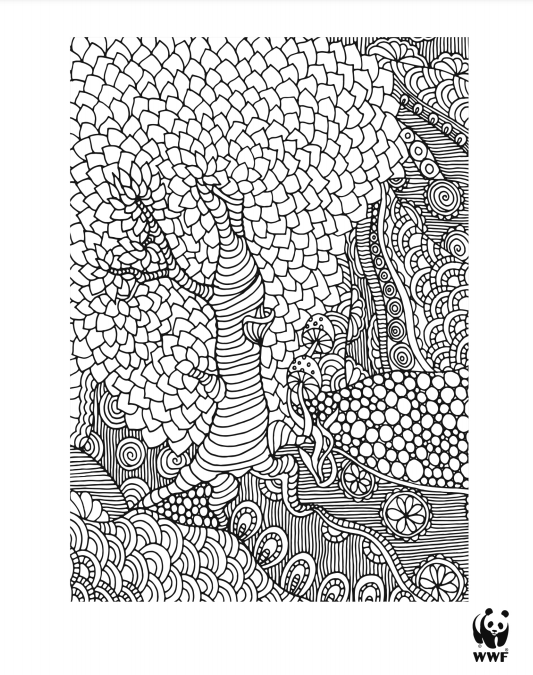
You can create your own rainforest with this coloring page. Use the blank space around the picture to label the layers as shown on the last page of The Leaf Detective!

Rainforest Coloring Page

celebrate-picture-books-picture-book-review-world-wildlife-day-poster-2021

Three different beautiful World Wildlife Day 2021 posters in six languages are available for download here.

You can find The Leaf Detective at these booksellers

Amazon | Barnes & Noble | Books-a-Million

To support your local independent bookstore, order from

Bookshop | IndieBound

Picture Book Review

February 18 – It’s Black History Month

celebrate-picture-month-picture-month-review-the-teachers-march-cover

About the Holiday

Black History Month was instituted by Dr. Carter G. Woodson in 1926 to celebrate the achievements and contributions of African Americans in United States History. The holiday began as a week-long observance taking place during the second week of February to commemorate the birthdays of Frederick Douglass and Abraham Lincoln. In 1976 President Gerald Ford officially established Black History Month. The holiday is now celebrated across the country with special events in schools, churches, and community centers. The theme for 2021 is “Black Family: Representation, Identity and Diversity.” Online events will explore the African diaspora and the spread of Black families across the United States through multiple perspectives. For more information about Black History Month, visit the ASALH website and africanamericanhistorymonth.gov.

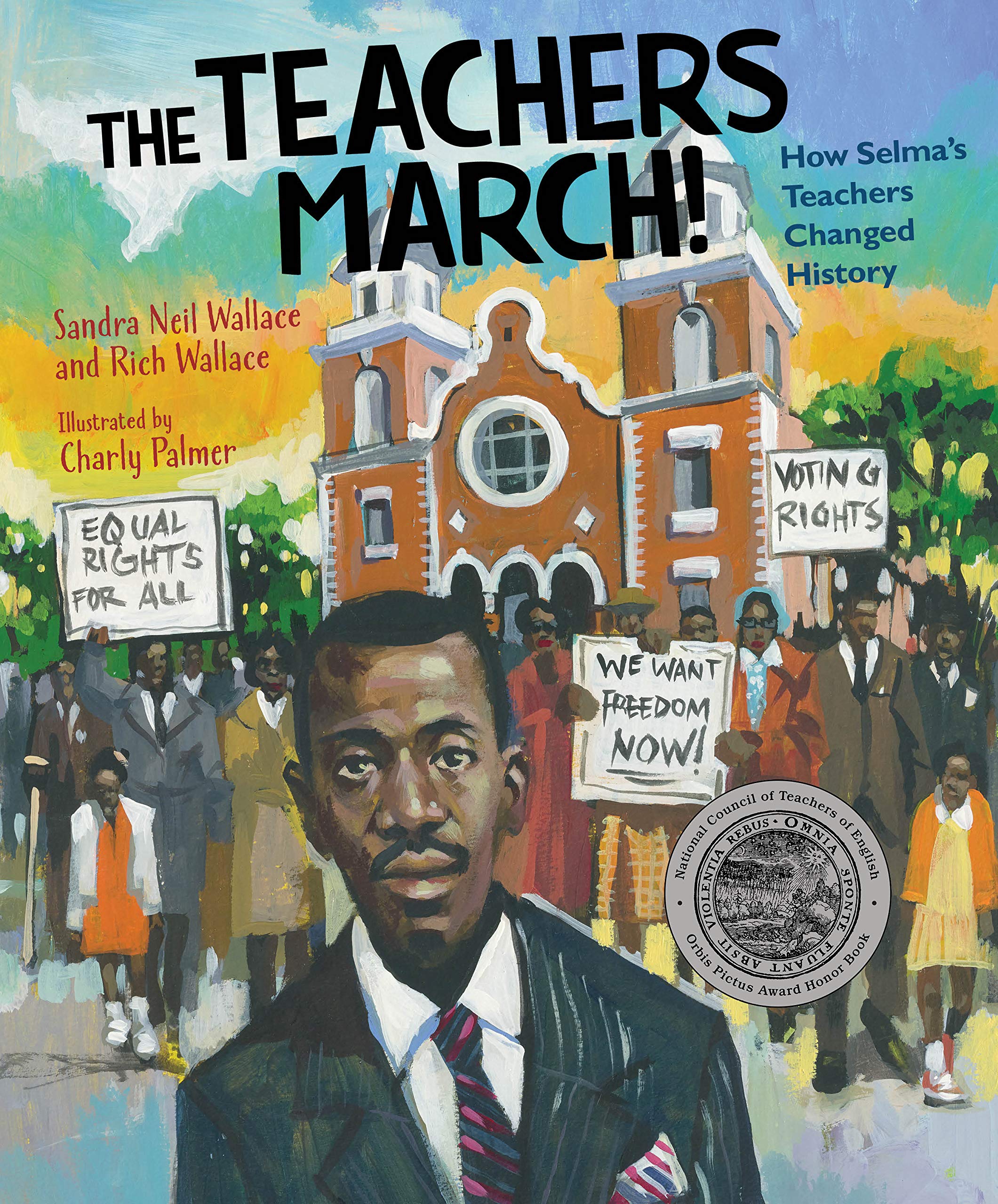
The Teachers March! How Selma’s Teachers Changed History

Written by Sandra Neil Wallace and Rich Wallace | Illustrated by Charly Palmer


Reverend F. D. Reese taught science at R. B. Hudson High School, but his favorite subject was freedom…. To be treated as less than equal, that just wasn’t right.” Reverend Reese led marches to register Black voters. The police called them “troublemakers” and used billy clubs to stop them from voting. If the people did make it inside the courthouse to register, they faced a test they had to pass—a test with impossible questions, such as “How many drops of water are in the Alabama River?” Reverend Reese decided he needed a “‘triumphant idea’” to change things.

It came to him that the teachers—leaders and respected in the community—should march for freedom. But a judge had made it illegal to march and even talk about voting rights. Most people were too afraid to march, so Reverend Reese looked for a “‘glorious opportunity’” to come his way. It came when he watched Dr. Martin Luther King Jr. speak on television and wrote him a letter inviting him to come to Selma to “help convince the teachers to march.”

celebrate-picture-month-picture-month-review-the-teachers-march-toothbrushes

Image copyright Charly Palmer, 2020, text copyright Sandra Neil Wallace and Rich Wallace, 2020. Courtesy of Calkins Creek.

Dr. King agreed and spoke to a crowd of 700 people at Brown Chapel. He told the group that everyone should march and “go to jail by the thousands to defend the right to vote.” Two of the people listening to Dr. King were fifteen-year-old Joyce Parrish and her mother, “Two Sweet.” When Reverend Reese asked for teachers to sign up to march, he said that if both parents in a family were teachers, only one should march so that the other could take care of the children if the first went to jail. For Two Sweet it was a difficult decision. She was a teacher and also a single parent. More than 100 teacher signed up, including “Two Sweet.”

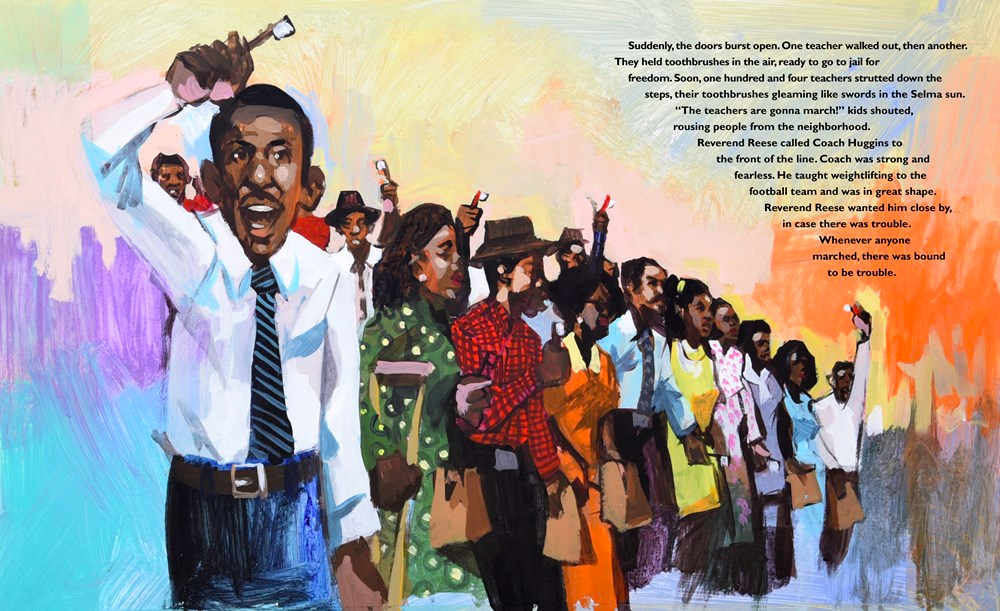
On January 22, the day of the march, Two Sweet packed a toothbrush and a sandwich—things she’d need in jail—and hugged Joyce goodbye. That afternoon as Reverend Reese waited alone outside the school alone, he wondered if the teachers would show up. Then one-by-one the teachers emerged from the building, holding their toothbrushes aloft. Reverend Reese called Coach Huggins to the front of the line and they started walking to the courthouse. People gathered along the street to watch, and Joyce paced nervously, wondering what would happen to her mother.

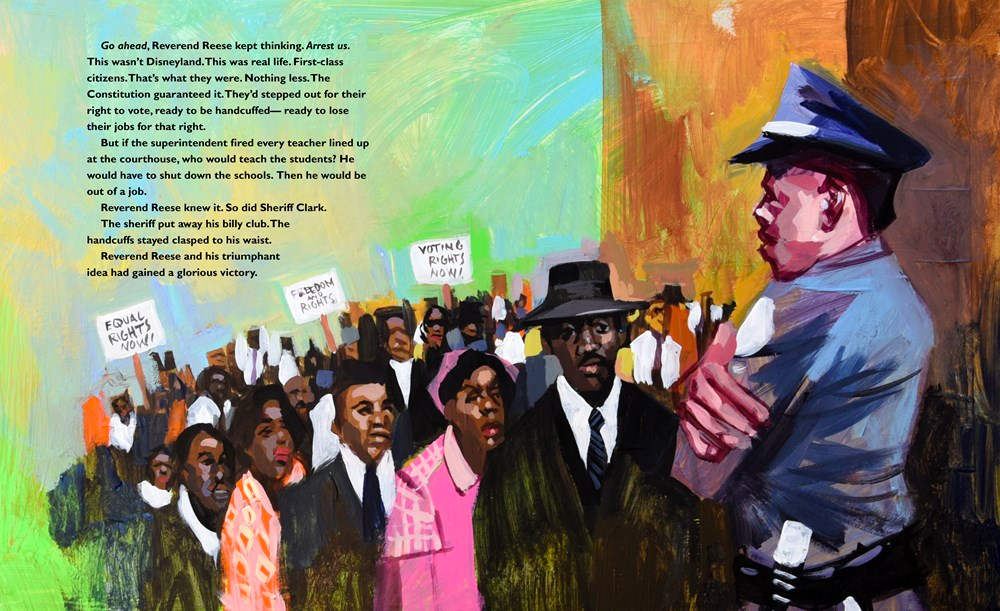
As the teachers crossed into the white section of town, the dirt roads became paved and people swarmed from shops to glare at the marchers, hoping to intimidate them. When they reached the courthouse, the sheriff and his deputies stood atop the steps. Reverend Reese announced that they were there to register to vote, but the sheriff said, “‘You can’t make a plaything out of the corridors of this courthouse.’” He gave the teachers one minute to disperse or face arrest. The teachers stayed put.

celebrate-picture-month-picture-month-review-the-teachers-march-courthouse

Image copyright Charly Palmer, 2020, text copyright Sandra Neil Wallace and Rich Wallace, 2020. Courtesy of Calkins Creek.

When the time was up, the police grabbed their billy clubs. They pushed Coach Huggins and Reverend Reese, causing the teachers to fall backward. When they got up, the police pushed them harder. Then the school superintendent came out of the courthouse. He had the power to fire every teacher. But Reverend Reese and the teachers stood firm for the right the Constitution guaranteed. The superintendent looked out over the crowd. He knew that if he fired them all, there would be no one to teach at the schools and he would lose his job.

The teachers had won the day. They went back to Brown Chapel, where young people were singing freedom songs. The kids were proud of their teachers, and Joyce hugged her mother. That night, Dr. King preached at Brown Chapel. “He praised Reverend Reese and the teachers for making civil rights history” by being the first leaders to risk their jobs by marching. Now other shop keepers and business people were emboldened to march for the right to vote. Kids and young people marched too. These Selma marchers were arrested by the thousands. Across America people took notice. Why, they wondered, were “respectable citizens in suits and dresses, and school kids carrying books” put in jail.

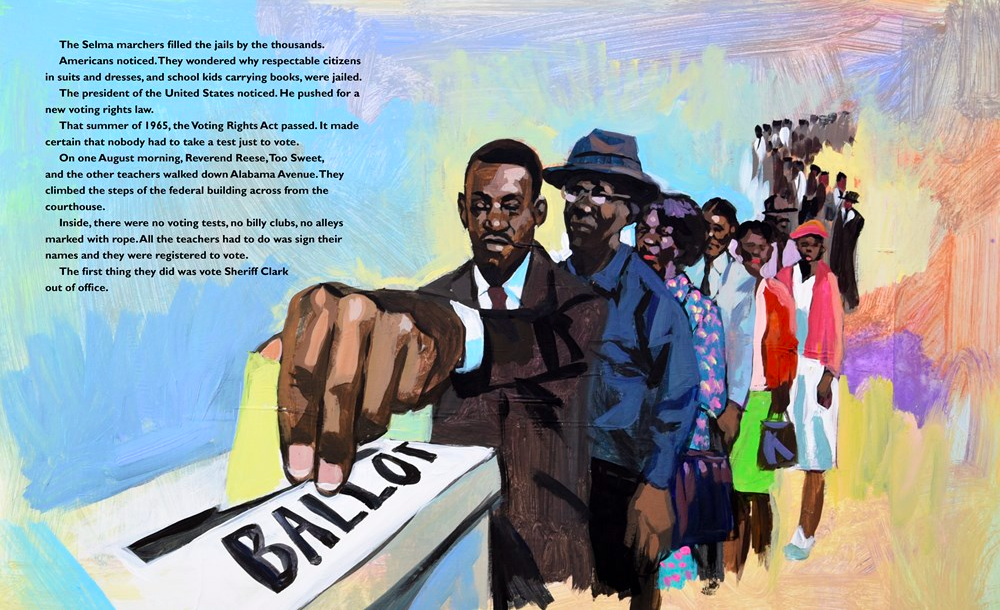
The president of the United States also noticed. In the summer of 1965, Congress passed the Voting Rights Act, ensuring that no test was required to register to vote. In August, Reverend Reese, Two Sweet, and other teachers walked to the federal building and registered to vote. With their first ballot, they voted the sheriff out of office.

Following the text are an extensive Author’s Note about the Teachers’ March and its leaders, with photographs as well as an Illustrator’s Note explains how the illustrations were created. A Timeline follows the 1965 Voting Rights Movement in Selma, Alabama from 1936 to 2018. A photograph of Dr. Martin Luther King Jr., Coretta Scott King, and Reverend Reese leading the 1965 voting rights march from Selma to Montgomery is also included. A selected bibliography of resources used in writing the book, as well as websites where readers can learn more, close out the excellent backmatter.

celebrate-picture-month-picture-month-review-the-teachers-march-ballot

Image copyright Charly Palmer, 2020, text copyright Sandra Neil Wallace and Rich Wallace, 2020. Courtesy of Calkins Creek.

Compelling and comprehensive, Sandra Neil Wallace and Rich Wallace’s story about the teachers march of 1964 is exhilarating reading. Powerful for its personal focus on Reverend Reese, Joyce, and Two Sweet and their fears, doubts, and courage, the story includes vital details that reveal inequalities of the time beyond the issue of voting rights and which will resonate with children aware of continuing inequalities, protests, gerrymandering, and other current issues in the news. Sandra and Rich Wallace build suspense through evocative descriptions to draw children in and immerse them in a reading experience that will have emotional impact.

Charly Palmer’s acrylic on board illustrations capture the motion and emotion of the teachers’ march and the events leading up to that day. All the more moving for their abstract quality, the images portray telling glances (on the first page a student looks out at the reader as Reverend Reese lectures about equal rights at the chalkboard); seminal moments, such as when Dr. Martin Luther King Jr. strides into Brown Chapel and Coach Huggins signs his name, promising to march; and the moments when the sheriff and his deputies confront the teachers with billy clubs raised. The reunion between a worried Joyce and her mother is poignant, and the final illustration of Reverend Reese putting his ballot into the box, reminds all readers of the successes of the past, but also that vigilance and action continues to be needed.

Superb for social studies, American history, homeschooling, and civics lessons, The Teachers March! How Selma’s Teachers Changed History  is highly recommended for home bookshelves and a must for school and public library collections.

Ages 7– 10 and up

Calkins Creek, 2020 | ISBN 978-1629794525

Discover more about Sandra Neil Wallace, and her books on her website. You can also find a downloadable Educator’s Guide for The Teachers March! and other books by Sandra.

You can learn more about Rich Wallace and his books on his website.

To learn more about Charly Palmer and view a portfolio of his art, visit his website.

Watch the trailer for The Teachers March!


Black History Month Activity

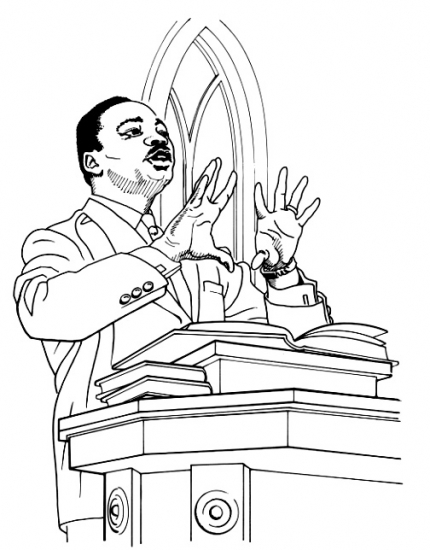
celebrate-picture-books-picture-book-review-Black-History-Month-Coloring-Pages-Martin-Luther-King-Jr

Role Model Coloring Pages


Whether you’re interested in law and politics, science, sports, or the arts, you can find a role model in the people in the printable coloring pages below. 

Dr. Mae Jemison | Jackie Robinson | Maya Angelou  | Louis Armstrong | Garrett Morgan | Rosa Parks

celebrate-picture-month-picture-month-review-the-teachers-march-cover

You can find The Teachers March! at these booksellers

Amazon | Barnes & Noble | Books-a-Million

To support your local independent bookstore, order from

Bookshop | IndieBound

Picture Book Review
February 12 – It’s Black History Month

celebrate-picture-books-picture-book-review-opening-the-road-cover

About the Holiday

Black History Month celebrates the achievements and contributions of African Americans in United States History. Originally a week-long observance initiated by writer and educator Dr. Carter G. Woodson in1926 and occurring during the second week in February to commemorate the birthdays of Frederick Douglass and Abraham Lincoln, Black History Month was officially established in 1976 by then president Gerald Ford. The holiday is now celebrated across the country with special events in schools, churches, and community centers.

The theme for 2021 is “Black Family: Representation, Identity and Diversity.” It explores the African diaspora and the spread of Black families across the United States through multiple perspectives. For more information about Black History Month, visit the ASALH website and africanamericanhistorymonth.gov.

Opening the Road: Victor Hugo Green and His Green Book

Written by Keila V. Dawson | Illustrated by Alleanna Harris


When Black travelers drove the highways of the United States in the 1920s and 30s and tried to stop at restaurants or motels, they “were told: No food… No vacancy… No bathroom… for Black people.” Instead, Black American motorists had to pack their own food, sleep in their car, and bring their own toilet. “Victor Hugo Green was tired of hearing no…. When he and his wife Alma traveled from New York to Virginia to visit family, they risked getting turned away, yelled at, even hurt.”

At the time, Jim Crow laws in the same segregated Black and White Americans throughout society. Because Blacks had nowhere to stay, they often drove through the night. If Black motorists had an accident, there were no ambulances or hospitals that would help them. In northern and western “sunset towns,” Blacks were alerted to leave town before darkness fell by a siren or a White man waving them out.

celebrate-picture-books-picture-book-review-opening-the-road-cafe

Image copyright Alleanna Harris, 2021, text copyright Keila V. Dawson. Courtesy of Beaming Books.

One day Victor discovered a Jewish newspaper that published a guide about places that welcomed Jewish people and sold kosher food. “In the 1930s Jewish Americans couldn’t go everywhere they wanted to either.” Reading this guide, Victor had an idea to write a book of his own for New York. As he walked his route as a mail carrier, he began to ask Black friends and neighbors where they ate, shopped, and played safely. He worked on his book at night after work and finished his ten-page guide, The Negro Motorist Green Book in 1936; he updated it in 1937.

Victor began selling his book at Black churches and social clubs. Readers asked Victor to include more states in his book, so he wrote to other mail carriers all over the country asking for information. Mail carriers responded overwhelmingly. Over the next two years, Victor and Alma worked to expand the Green Book. With the Green Book in hand, “Black travelers knew where to go and who to trust.” As the popularity of the Green Book rose, Victor collected information from readers and agents Victor hired to add to revisions of his book.

celebrate-picture-books-picture-book-review-opening-the-road-road-trip

Image copyright Alleanna Harris, 2021, text copyright Keila V. Dawson. Courtesy of Beaming Books.

In 1940 the United States government named the Green Book an “‘official Negro travel guide.’” Then Esso gas stations of the Standard Oil Company began selling the book. The Green Book became a best seller. The Green Book spurred new businesses as Black women opened their homes as bed and breakfasts for travelers; it also informed readers about Black accomplishments, history, colleges that accepted Black students, and more.

With two million copies sold, the Green Book “made it possible for Black families to enjoy vacations.” Through the 1950s and 1960s as the fight against segregation and the civil rights movement took hold, the Green Book continued to keep Blacks safe. Victor dreamed of the day when, as he said, “‘we as a race will have equal opportunities and privileges in the United States.’” That day came when, in 1964, segregation was ended by law and the Green Book became less necessary. The Green Book ceased publication after the 1966-67 issue, just as Victor had hoped.

An illustrated timeline takes children along a winding highway from 1892, when Victor Hugo Green was born, to 1967 when the Green Book ceased publication, quotations by Victor Green, and a selected bibliography follow the text.

celebrate-picture-books-picture-book-review-opening-the-road-theater

Image copyright Alleanna Harris, 2021, text copyright Keila V. Dawson. Courtesy of Beaming Books.

Keila V. Dawson’s compelling book about Victor Hugo Green’s guide for Black travelers is a powerful tool for teaching children about the history of racial inequality and segregation as well as an expanded understanding of their effects on the lives of Black Americans. While children may be familiar with separate facilities for Blacks and Whites, separate seating on transportation, and school inequality, many will be shocked by travel conditions, the idea that hospitals would not help Blacks, and sunset towns where Blacks were ordered out as the sun went down. While Dawson’s unstinting text will move readers, her storytelling also reveals the resilience of the human spirit and how one man rose above the dangers and prejudice of the time to make traveling and living in America safer for Blacks. The fact that the fight for racial equality continues today makes Dawson’s book an important resource for children to learn not only the exclusion Blacks once legally faced but to make them think about incidents of discrimination that still exist and how they might help bring about a more equitable society.

Alleanna Harris faithfully depicts the times with realistic illustrations that show children how sparsely populated the highway system was, making it even more difficult for Blacks to find welcoming businesses and services. Her image of a Black man driving past a sign that reads “Whites only after dark” as a White man leans against it pointing the way out of town should affect every reader. Children are able to follow Victor Hugo Green and Alma as Victor conceives the idea of the Green Book, and they gather information, and sell the book. They’ll also see the types of businesses mentioned in the Green Book, from gas stations to general stores to movie theaters and private homes where rooms were available for travelers. Interspersed with images of Victor and his work Harris includes illustrations of other familiar ways Blacks were discriminated against.

An important resource for teachers, parents, and other adults engaged in teaching children about American history, the history of civil rights, and the experience of Blacks in America, Opening the Road: Victor Hugo Green and His Green Book is highly recommended for home, school, and public libraries.

Ages 4 – 8

Beaming Books, 2021 | ISBN 978-1506467917

You can find an Opening the Road Educators Guide to download on the Beaming Books website.

Discover more about Keila V. Dawson and her books on her website.

To learn more about Alleanna Harris, her books, and her art, visit her website.

celebrate-picture-books-picture-book-review-opening-the-road-cover

You can find Opening the Road: Victor Hugo Green and His Green Book at these booksellers

Amazon | Barnes & Noble | Books-a-Million

To support your local independent bookstore, order from

Bookshop | IndieBound

Picture Book Review

February 11 – Celebrating International Day of Women and Girls in Science with the Book Trailer Reveal for June Almeida, Virus Detective!

About the Holiday

Gender equality has always been a core issue for the United Nations. As such, on December 22, 2015 the United Nations General Assembly established an International Day to recognize the critical role women and girls play in science and technology. The outbreak of the COVID-19 pandemic has clearly demonstrated the critical role of women researchers in different stages of the fight against COVID-19, from advancing the knowledge on the virus, to developing techniques for testing, and finally to creating the vaccine against the virus.

Against this backdrop, this year’s celebration of the Day will address the themeWomen Scientists at the forefront of the fight against COVID-19” and will gather together experts working in fields related to the pandemic from different parts of the world. For more information, visit the UN website.

That this year’s International Day of Women and Girls in Science celebrates women researchers, and especially those involved in COVID-19, makes it all the more exciting to reveal the trailer for a book highlighting the achievements of the pioneer in the field.

June Almeida, Virus Detective! The Woman Who Discovered the First Human Coronavirus 

Written by Suzanne Slade | Illustrated by Elisa Paganelli


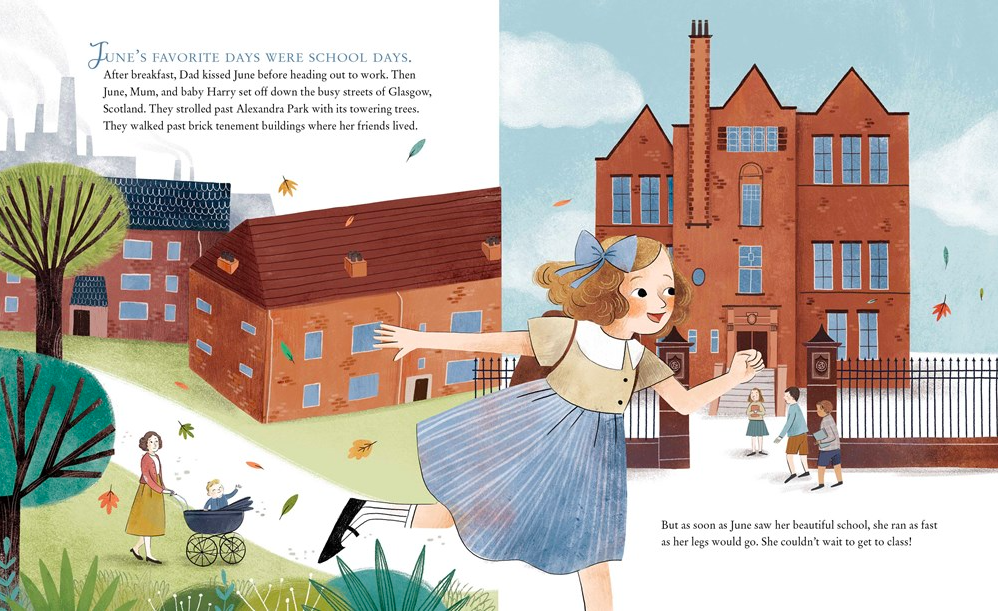
With the rise of the global COVID-19 coronavirus pandemic and its life-changing effects for everyone around the world, scientists, adults, and children began looking for information and answers on how we can defeat the virus so that life can return to normal. In June Almeida, Virus Detective! The Woman Who Discovered the First Human Coronavirus, readers learn the incredible story of the scientist who discovered, photographed, and even named the first human coronavirus.

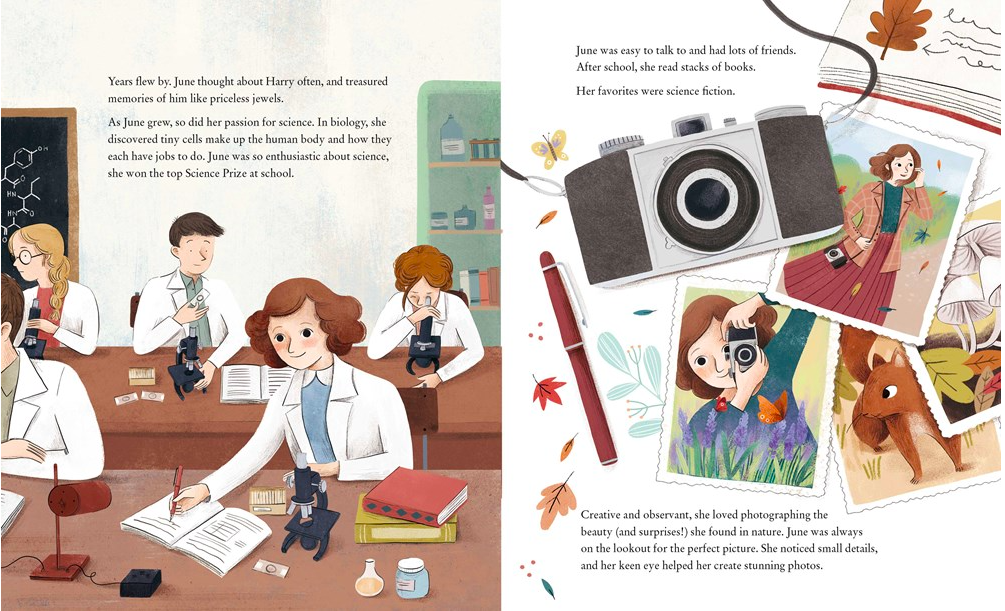
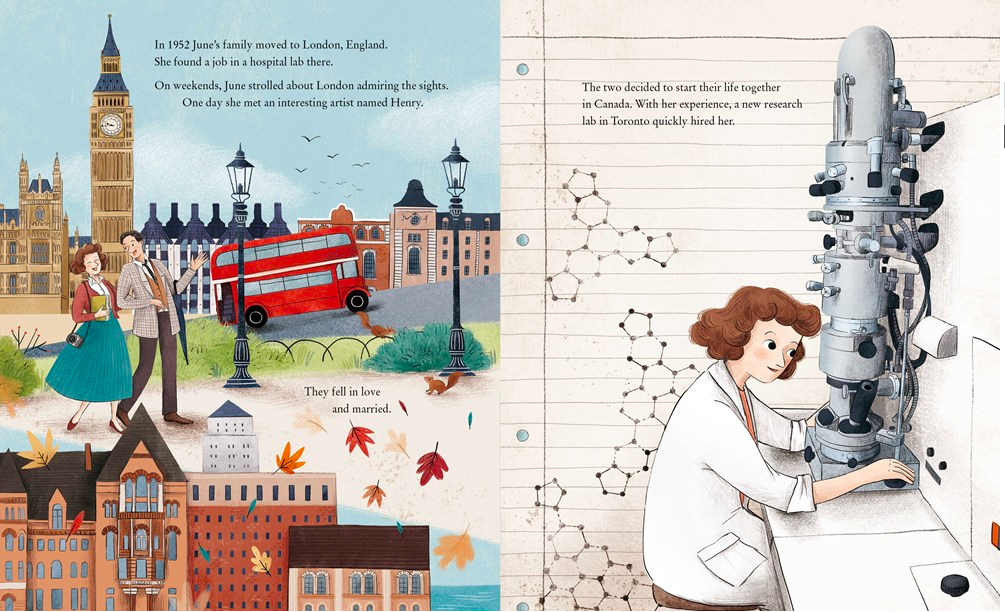
Growing up in Glasgow, Scotland, June Almeida loved learning about science and nature. A good student, she was especially interested in biology and won the top science prize at her school. Creative and observant, June noticed details that others often missed. She dreamed of going to college but economic hardships caused her to leave school at age 16. Still, June was determined to pursue her passion for science. She was hired by a local hospital to work in its lab, using a microscope to magnify and examine cells. Her work helped doctors treat patients. June later worked in labs in London and in Toronto. Her skill in using the electron microscope to examine cells and help identify viruses earned her promotions and respect in the science community. In the late 1960s, when June was 34 years old, she discovered the first human coronavirus. Her groundbreaking work continues to help researchers today in the fight against illnesses caused by viruses, including COVID-19.

While researching and writing June Almeida, Virus Detective!, award-winning science author Suzanne Slade worked closely with June’s daughter, Joyce, to capture the personality and intelligence of this unsung hero in the fight against the coronavirus. Backmatter includes photographs of June working with various microscopes, more about her career, and a timeline.

Ages 6 – 9

Sleeping Bear Press, 2021 | ISBN 978-1534111325

celebrate-picture-books-picture-book-review-suzanne-slade-headshot

Suzanne Slade holds a B.S. degree in science and worked for many years in a STEM career. She is now the award-winning author of more than 100 books, including Out of School and Into Nature: The Anna Comstock Story. She lives in Libertyville, Illinois. Learn more about Suzanne at suzanneslade.com.

celebrate-picture-books-picture-book-review-Elisa-Paganelli-headshot
Elisa Paganelli’s work includes The Highland Falcon Thief, named a Waterstones Book of the Month. She lives in High Wycombe, United Kingdom. Learn more about Elisa at elisapaganelli.com

June Almeida, Virus Detective! is available March 15, 2021

celebrate-picture-books-picture-book-review-june-almeida-virus-detective-cover

You can preorder June Almeida, Virus Detective! at these booksellers

Anderson’s Bookshops | Amazon | Barnes & Noble | Books-a-Million 

To support your local independent bookstore, order from

Bookshop | IndieBound

Picture Book Review
January 20 – Celebrating Inauguration Day 2021

celebrate-picture-books-picture-book-review-joey-cover

About the Holiday

Today we celebrate the inauguration of Joe Biden as the 46th President of the United States. The ceremony begins around 11:30 a.m. with the national anthem and invocation. In a historic moment, Kamala Harris will then be sworn in by Supreme Court Justice Sonia Sotomayor shortly before noon. At noon, Joe Biden will be sworn in by Chief Justice John Roberts on the Capitol’s West Front, as is tradition. The day also includes a visit to Arlington National Cemetery by Biden, Harris and former Presidents Barack Obama, George W. Bush, and Bill Clinton as well as their spouses before traveling from 15th Street to the White House with a military escort. You can introduce your children to our country’s new President and Vice President, who offer hope and a new beginning, through these two excellent biographies. 
Joey: The Story of Joe Biden

Written by Dr. Jill Biden with Kathleen Krull | Illustrated by Amy June Bates


With a gift for storytelling and an ear for the kinds of details that will draw kids in, Jill Biden introduces young readers to her husband and soon-to-be President of the United States, Joe Biden, at the age of eight. Even at this young age, Joe—or Joey as he was then called—demonstrated a fun-loving competitive spirit, maturity, daring, and sense of responsibility that would take him far in life. How competitive? Despite being the smallest boy on any of his teams, “he was always ready for the ball.” How daring? Take your pick: the time he and his friends hopped “from rooftop to rooftop of the garages” in his neighborhood after seeing a Tarzan movie; the time he swung on a rope “over a construction site without a net;” or when he shimmied to the top of the slippery, swaying flag pole at the football field.”

celebrate-picture-books-picture-book-review-joey-football

Image copyright Amy June Bates, 2020, text copyright Jill Biden with Kathleen Krull, 2020. Courtesy of Simon & Schuster.

Where did he learn these qualities? From his mom who always said, “‘Bravery resides in every heart, and yours is fierce and clear.’” And from his dad who encouraged Joey to “‘Get up! Get up!’” whenever he stumbled. To find work, Joey’s family moved, but Joey always had friends in his siblings, especially his younger sister, Valerie.

As he grew older Joey learned about world news and the rudiments of politics at the family dinner table, adding his opinions to those of the adults. At school, though bullies made fun of Joey’s stutter, that sometimes made talking difficult. Instead of taking it, Joey defended himself and others who were being bullied. He also devised ways to practice talking more smoothly. 

celebrate-picture-books-picture-book-review-joey-construction-site

Image copyright Amy June Bates, 2020, text copyright Jill Biden with Kathleen Krull, 2020. Courtesy of Simon & Schuster.

When his dreams of attending the Catholic high school seemed out of reach financially, Joey applied for a work-study program that allowed him to attend in exchange for duties such as painting the fence, pulling weeds, and washing windows. High school was also where he grew a foot taller and became the star of the basketball and football teams. Here he exchanged Joey for Joe. His sense of fairness and equality led him to stand up for his African American football teammate when the owner of the local diner would not serve him, and in a nod to his future profession, he was elected class president “during his junior and senior years.”

celebrate-picture-books-picture-book-review-joey-discussions

Image copyright Amy June Bates, 2020, text copyright Jill Biden with Kathleen Krull, 2020. Courtesy of Simon & Schuster.

As the first in his family to go to college, Joe was “promptly elected president of his freshman class.” He learned about the struggles of blacks in America while working “as the only white lifeguard at a pool in an all-black neighborhood” during “the time of segregation and the struggle for civil rights.” Joe graduated with a law degree, and at the age of twenty-nine he “launched an unlikely quest to become a senator from Delaware”—even though the required age was thirty. “Against all the odds, Joe became one of the youngest people ever elected to the United States Senate.” Reelected five times, “he was powerful and respected.”

celebrate-picture-books-picture-book-review-joey-basketball

Image copyright Amy June Bates, 2020, text copyright Jill Biden with Kathleen Krull, 2020. Courtesy of Simon & Schuster.

Then “after more than three decades of serving his country in the Senate, he was chosen by Barak Obama to run as his vice president. They won, energizing the nation,” and after eight years of serving together, President Obama called Joe, “‘the best vice president America’s ever had.’” In 2019, Joe announced his candidacy for president of the United States, calling the election a “‘battle for the soul of America.’—and Joe Biden was ready to fight it.”

Back matter includes family photographs, an extensive timeline of Joe Biden’s life and government service, inspirational “Bidenisms, sources for the quotations used in the text, and a bibliography.

celebrate-picture-books-picture-book-review-joey-senate

Image copyright Amy June Bates, 2020, text copyright Jill Biden with Kathleen Krull, 2020. Courtesy of Simon & Schuster.

For parents, teachers, and other adults looking to introduce children to the next president of the United States with an in-depth look at his life, his influences, and his vast experience, Dr. Jill Biden’s Joey: The Story of Joe Biden shines with an intimate portrait of his astonishing life. With specific examples that will resonate with children, Biden portrays the qualities and experience that make him the right person to lead our country during these times and demonstrates his long history of concern for all Americans. Conversational and folksy, Biden’s storytelling makes this an uplifting read aloud that will captivate listeners. The book provides an excellent opportunity to spark further research into Joe Biden’ life and government service as well a conversation-starter for adults to discuss the importance of family, character, hard work, perseverance, and community.

celebrate-picture-books-picture-book-review-joey-train

Image copyright Amy June Bates, 2020, text copyright Jill Biden with Kathleen Krull, 2020. Courtesy of Simon & Schuster.

Amy June Bates’ watercolor, gouache, and pencil illustrations are stunning, taking readers from Joey’s neighborhood in Scranton, Pennsylvania—where they can see some of the feats of daring Joey was famous for and how he interacted with friends and siblings—to Delaware, the state that informed his interest in politics and sense of community service. Through Bates’ realistic images, children swing on the rope over the construction site, sit among his siblings as they watch TV, and join in at the dinner table for influential family discussions. Bates also depicts Biden’s struggles with bullies and his stutter. Kids follow him up a ladder to wash windows and to the high school gridiron to watch Joe pull away from the opposing team to score the winning touchdown. As Biden runs for and takes on responsibilities in the Senate, readers are there too. In Biden’s face and stance, Bates clearly portrays his confidence, optimism, intelligence, and pride in a lifetime of serving the American people.

A superb biography of our next president and one that will inspire a new generation of activists and public servants, Joey: The Story of Joe Biden is a must for home, school, and public library collections.

Ages 4 – 8

Simon & Schuster, Paula Wiseman Books, 2020 | ISBN 978-1534480537

You can connect with Dr. Jill Biden on Twitter.

Discover more about Kathleen Krull and her books on her website.

To learn more about Amy June Bates, her books, and her art, visit her website.

You can find Joey: The Story of Joe Biden at these booksellers

Amazon | Barnes & Noble | Books-a-Million

To support your local independent bookstore, order from 

Bookshop | IndieBound

celebrate-picture-books-picture-book-review-kamala-harris-rooted-in-justice-cover

Kamala Harris: Rooted in Justice

Written by Nikki Grimes | Illustrated by Laura Freeman


Eve, a black girl, comes home from school in Oakland, California upset because Calvin, a boy in her class, said that girls can’t be President. Her mother tells her that Calvin is wrong and shows her a newspaper article about Kamala Harris, who “lives right here in Oakland and hopes to be President one day.” Eve’s mom begins to tell her daughter Kamala’s story, which began with “a strong black-and-brown braid coiling from India, where her mother, Shyamala, was born; to Jamaica, where her father, Donald, was born;” to Berkely, California and finally to Oakland.

She goes on to reveal that even as a baby “Kamala was like clay her parents molded for action,” as they took her along on marches for civil rights and to speeches given by Martin Luther King Jr. Kamala listened and learned words like peace, justice, freedom. On a trip to Zambia to visit her grandparents, Kamala learned that “fighting for justice ran in the family.”

celebrate-picture-books-picture-book-review-kamala-harris-rooted-in-justice-lotus

Image copyright Laura Freeman, 2020, text copyright Nikki Grimes, 2020. Courtesy of Atheneum Books for Young Readers.

Then when Kamala was seven her parents divorced, and Kamala, her younger sister Maya, and their mother moved to “‘the flatlands,’ the black working-class area in Berkeley.” From here, Kamala was bussed to Thousand Oaks Elementary in the “wealthy white part of town….,” where, she met “kids who were rich and poor, black and white; kids who celebrated holidays she’d never even heard of,” and learned to “count to ten in many different languages.” Here, Eve interrupts to excitedly tell her mother that their next door neighbor Guadalupe has taught her how to count in Spanish.

Kamala also learned from Mrs. Regina Shelton, a neighbor whom Kamala stayed with after school. Mrs. Shelton introduced her to Frederick Douglass, Sojourner Truth, and Harriet Tubman. She encouraged her pursuits and instilled confidence in her. Just as influential on young Kamala were the family’s weekly visits to the “Rainbow Sign, a cultural center celebrating black art, music, books, and film. James Baldwin spoke there, Maya Angelou read there, and Nina Simone sang there.” Nina’s song “To Be Young, Gifted and Black” particularly resonated with Kamala.

celebrate-picture-books-picture-book-review-kamala-harris-rooted-in-justice-young-kamala

Image copyright Laura Freeman, 2020, text copyright Nikki Grimes, 2020. Courtesy of Atheneum Books for Young Readers.

On Sundays Kamala and Maya visited their father and went to the 23rd Avenue Church of God, where, along with singing in the children’s choir, Kamala learned from the Bible “that God asks us to speak up for those who can’t, to defend the rights of the poor and needy, like some lawyers do.” Maybe, Kamala thought, she would follow in her uncle Sherman’s footsteps and be that kind of lawyer too. Eve wonders if when she makes sandwiches for the homeless she’s helping out too. Her mom tells her yes.

When Kamala’s mother accepted a job in Montréal, Canada, Kamala’s life changed again. One thing that stayed the same, however, was Kamala’s sense of justice. For example when the apartment building manager wouldn’t allow the kids to play soccer on the lawn, she and Maya picketed until he changed his mind. 

Although Kamala adjusted to life in Canada, when it came time to go to college, she returned to the United States to attend Howard University like one of her heroes, Thurgood Marshall. Kamala felt at home at Howard. She won a seat in the student government, competed on the debate team, interned at the Federal Trade Commission, did research at the National Archives, and on weekends joined protests against apartheid in South Africa.

celebrate-picture-books-picture-book-review-kamala-harris-rooted-in-justice-moving

Image copyright Laura Freeman, 2020, text copyright Nikki Grimes, 2020. Courtesy of Atheneum Books for Young Readers.

As a sophomore, Kamala spent her summer as an intern for Senator Alan Cranston “learning from someone whose footsteps echoed in the halls of power every day.” She went on to study law at Hastings College of the Law, leading the Black Law Students Association as president and working to improve the chances that black graduates would be hired by the best companies in the country.

In order to practice law, Kamala had one more hurdle to overcome: the California Bar exam. Kamala failed in her first attempt, but it taught her an important lesson about digging deep and trying harder – a lesson that Eve understands. On her second try, she passed. Since then Kamala’s trajectory has been steadily upward. “First, Deputy District Attorney. Next, the first female District Attorney of San Francisco. Then, the first black woman Attorney General of California” and eventually the “second black woman voted into the US Senate.”

celebrate-picture-books-picture-book-review-kamala-harris-rooted-in-justice-oath

Image copyright Laura Freeman, 2020, text copyright Nikki Grimes, 2020. Courtesy of Atheneum Books for Young Readers.

As Senator, Kamala has fought for workers, women’s rights, and immigrant children. Then in 2019, she announced her candidacy for President of the United States. But running a presidential campaign takes a lot of money. When she and her team realized that they would not be able to sustain a campaign, she decided to give up her quest for the 2020 presidential nomination while still looking “forward to all the good work she could still do as Senator Harris.”

While the biography ends before the election and with the question, “Will she ever get to call the White House home?” the next sentence: “Kamala Harris is still writing her American story” looks forward to a future we will all be following. And what about Eve? She knows the message of Kamala’s life and dreams: “‘If at first you don’t succeed, try, try again.’” That lesson and that Calvin is wrong about a girl’s ability to become the President.

A detailed timeline of Kamala Harris’s life and a list of resources follow the text.

celebrate-picture-books-picture-book-review-kamala-harris-rooted-in-justice-senator

Image copyright Laura Freeman, 2020, text copyright Nikki Grimes, 2020. Courtesy of Atheneum Books for Young Readers.

Nikki Grimes’ compelling biography of Kamala Harris lyrically outlines the importance that ideas of justice, freedom, and inclusion play in both her personal and professional life. Children will be especially captivated by Grimes’ comprehensive and intimate look at Kamala’s childhood and the people, experiences, and places that influenced her education, character, long commitment to equality, and steady focus on achieving her dreams. Specific examples of the large and smaller issues Kamala has fought for throughout her life instill in young readers the knowledge that they too can make a difference. Framed by Eve’s disagreement with Calvin and her interjections about certain aspects of Kamala’s life, the story speaks directly to the reader, creating in them the kind of confidence and reassurance that has served Kamala well. The final lines offer encouragement and inspiration to tomorrow’s leaders.

Laura Freeman’s textured, realistic illustrations introduce Kamala Harris in the context of her family, the causes they put their hearts and voices into, and the communities that nurtured her. As a child, Kamala’s confidence and intelligence are evident as she learns about her family’s activism in Zambia, rides to school on the bus, listens to Mrs. Shelton and Nina Simone, and gets involved in activities at church, in college, and in law school. Images of Kamala as an adult depict her familiar smile, thoughtfulness, poise, and self-confidence. Freeman’s collage-style imagery of the people who have influenced Kamala are particularly powerful reminders of the legacy that parents, grandparents, teachers, mentors, and leaders in society imprint on people from childhood and throughout life.

A beautiful and inspiring biography, Kamala Harris: Rooted in Justice is an exciting introduction to our next Vice President and is sure to encourage discussion, stir dreams of greatness, and motivate girls and children of color to follow in her footsteps. The book is a must for home, school, and public library collections.

Ages 4 – 8

Simon & Schuster, Atheneum Books for Young Readers, 2020 | ISBN 978-1534462670

Discover more about Nikki Grimes, her books, and her poetry on her website.

To learn more about Laura Freeman, her books, and her art, visit her website.

You can find Kamala Harris: Rooted in Justice at these booksellers

Amazon | Barnes & Noble | Books-a-Million

To support our local independent bookstore, order from

Bookshop | IndieBound

 Picture Book Reviewcelebrate-picture-books-picture-book-review-joey-cover