October 2 – It’s National Chili Month

Armadilly Chili picture book review

About the Holiday

What could be more satisfying during a cool autumn month than a spicy bowl of chili?  Whether made with meat or veggies, combined with macaroni, or served in potato skins, the simmered flavors make for a scrumptious meal. Although the origins of chili are lost to history, it’s believed that the dish is a southwestern, specifically Texan, concoction. It began to attract attention in the early 1800s, and by the 1880s”Chili Queens” were selling “bowls o’red” at chili stands throughout San Antonio. In 1893 the San Antonio Chili Stand made an appearance at the Chicago World’s Fair. It’s popularity took off across Texas and throughout the west by the 1920s. When the Great Depression hit, chili became one of the only affordable meals for the hungry population. Today chili is a favorite dish of people all over the world. To celebrate this month’s observation why not whip up a batch of your favorite chili or discover some new recipes!

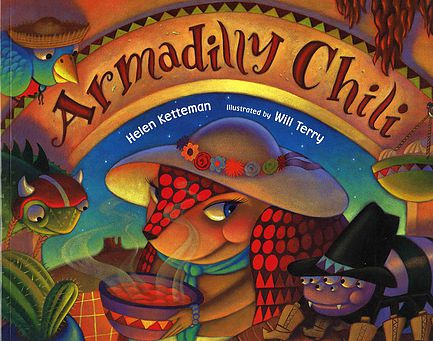
Armadilly Chili

Written by Helen Ketteman | Illustrated by Will Terry

What a hoot! The knee-slappin’, root-a-tootin’ phrasing in Hellen Ketteman’s Armadilly Chili is shor ‘nuf gonna make this a favorite on any child’s bookshelf. While the plot may be familiar, the southwest setting and Miss Billie Armadilly put a fresh, funny twist on it.

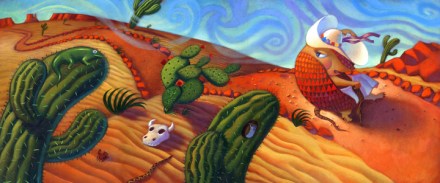
“Miss Billie Armadilly skit-skat-skittered down the lane. A blue-norther’s a-blowin’ and my old, cold bones are rattling for a pot of hot armadilly chili,” she says. She’s gathering ingredients when her friend Tex, a many eyed tarantula, tip taps by. Hey, Tex, she calls, how about tapping your toes this way and helping me gather a boxful of beetles?” But Tex just “wiggles his long jiggly legs and says, ‘Shucks, Miss Billie, I’m going dancing today.’” Miss Billie harrumphs and collects the beetles herself.

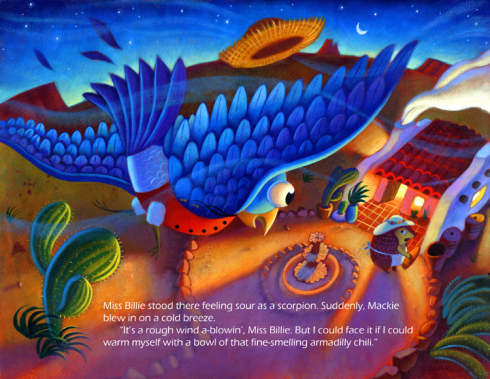
Next Miss Billie is picking peppers, and when Mackie the bluebird flies in she thinks she has an assistant. “‘How ‘bout whistlin’ up a tune and helping me pick a peck o’ peppers for my armadilly chili?’” Once again, though, she’s left on her own since Mackie says he is “‘shakin’ my tail feathers to the movies.’” When Miss Billie “scurries to the prickly pear cactus and begins chippity-chop-chopin,’” her friend Taffy, the horned toad, complains about the noise and then begs off from helping, saying she’s got plans to go skating.
celebrate-picture-books-picture-book-review-armadilly-chili

Image copyright Will Terry, courtesy of Albert Whitman & Company

At home, Miss Billie stirs her chili to a scrumptious bubble. The aroma entices first Tex, then Mackie, and finally Taffy to come a’knockin’ at her door looking for a bowlful, but Billie has something to say about that—specifically, “no workin’ with Billie, no sharin’ the chili!”

Billie’s friends hurry away sorry that she feels that way, and Billie sits down to her feast. But after all that work, the chili tastes as “flat as a Texas prairie.” What’s wrong? She realizes what the missing ingredient is just as the doorbell rings. She opens the door to find her friends standing there with bags in their hands. What’s in those sacks? Apologies! As well as hot apple cider, jalapeno biscuits, and homemade chocolate fudge. Now that the friends are all together, the chili tastes just right, and “they talked and laughed into the cold, blustery night.”
celebrate-picture-books-picture-book-review-armadilly-chili-mackie-visits

Image copyright Will Terry, text copyright Helen Ketteman, courtesy of Albert Whitman & Company

What a hoot! Helen Ketteman’s fast-paced Armadilly Chili is a spicy take on the little red hen story  and what it means to be a good friend. Miss Billie is a sassy, no-nonsense heroine who values her work and talents and makes sure others do too. When anger and frustration bubble over, however, the four friends find a way to apologize and make up. The lesson, humorously conveyed as well as Ketteman’s knee-slappin’, root-a-tootin’ phrasing is shor ‘nuf gonna make this a favorite on any child’s bookshelf. 

Will Terry’s vivid illustrations washed with a palette of deep reds, oranges, greens, and yellows bring the Southwest setting to life. Miss Billie and her friends are enchanting versions of their natural counterparts, and kids will love the environmental and homey details on each page, where even the cacti display personalities. Billie’s facial expressions as each of her friends abandon her to her chores are priceless, and their final camaraderie is highly satisfying.

Ages 4 – 8

Albert Whitman & Company, Illinois, 2008 | ISBN 978-0807504581

Discover more about Helen Kellerman and her books plus fun accompanying activities on her website!

View a portfolio of Will Terry‘s books and artwork on his website!

While I take a few personal days, I am reposting earlier reviews updated with new links and interior art.

National Chili Month Activity
CPB - Chili Pepper Game

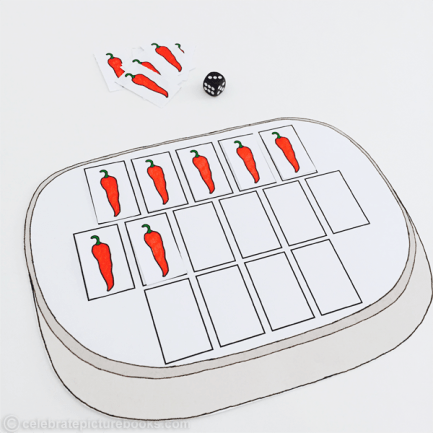
Hot, Hot, Hot! Chili Pepper Chili Game

Chili just isn’t chili without a little heat! But can you take 15 chili peppers in your bowl? If you want to win the Hot, Hot, Hot! Chili Pepper Chili Game you’ll have to!

Object of the Game

The object of the game is to collect 15 chili peppers in your bowl before any other player.

Supplies

Rules

  1. Any number of players can play at one time. Print 1 Chili Bowl game board and 1 set of 15 Chili Pepper cards for each player
  2. Give 1 Chili Bowl Game Board to each player
  3. Place the Chili Pepper Cards in a pile or in a bowl
  4. Roll the die to see who goes first. The person with the highest roll goes first
  5. To begin play, the first player must roll a 1, 2, or 3. They should roll until they get one of these numbers.
  6. Players roll the die and collect or lose chili pepper cards by the number of dots on the die. If you roll a:
  • 1 – Pick up 1 chili pepper card and place it on your chili bowl game board
  • 2 – Pick up 2 chili pepper cards and place them on your chili bowl game board
  • 3 – Pick up 3 chili pepper cards and place them on your chili bowl game board
  • 4 – Get a chili pepper card from the player on your left
  • 5 – Give a chili pepper card to the player on your left
  • 6 – Lose a turn

     7. If a player does not have chili pepper cards to give to another player or if the player on           their left has no cards to give, the player rolls again.

    8. Continue play until one player has filled their Chili Bowl with chili peppers!

Picture Book Review

September 30 – International Translation Day

celebrate-picture-books-picture-book-review-good-night-little-sea-otter-cover

About the Holiday

Established in 1953 by the International Federation of Translators, today’s holiday celebrates the translators in every language who work to break down barriers and bring great literature to all people across the globe. Everyone’s story matters, and it is through access to a wide range of books that readers acquire deeper understanding of the commonalities and unique experiences that make us all citizens of the world. For children in bilingual and multicultural homes the ability to read and hear books in their native tongue as well as their adopted language is especially comforting and promotes greater literacy and language learning. With eight bilingual editions available, today’s book is a great example of the importance of translators’ work!

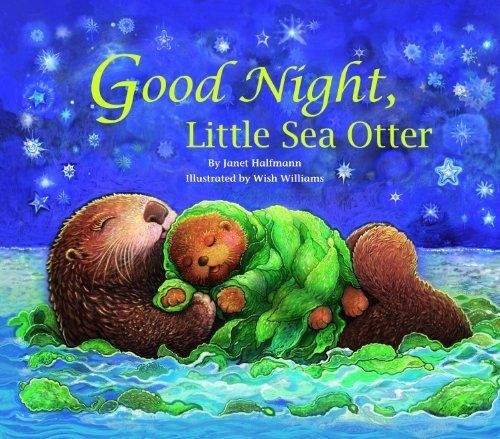
Good Night, Little Sea Otter

Written by Janet Halfmann | Illustrated by Wish Williams


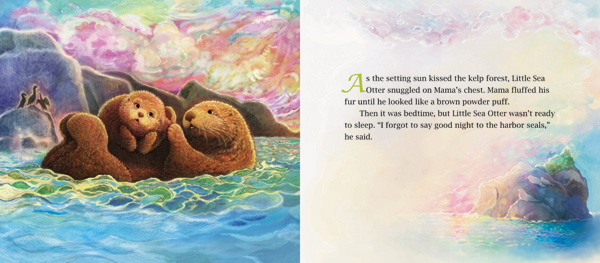
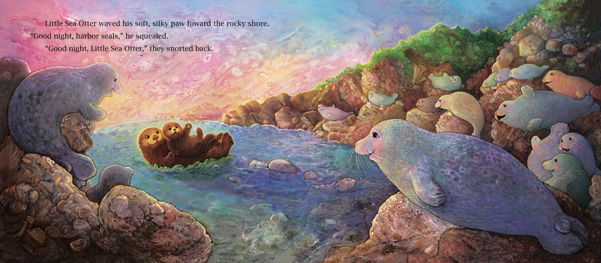
As twilight paints the sky pink, purple, and gold, Little Sea Otter gets ready to sleep in her kelp forest bed. Mama Otter fluffs her baby’s fur and snuggles with her, but Little Otter is still wide awake. “‘I forgot to say goodnight to the harbor seals,’” she tells Mama. The baby waves her “soft, silky paw toward the rocky shore” and says goodnight. The harbor seals all along the craggy cliffs wish the little otter goodnight in return.

celebrate-picture-books-picture-book-review-good-night-little-sea-otter-mama-fluffing-pup's-fur

Image copyright Wish Williams, text copyright Janet Halfmann, courtesy of starbrightbooks.org

Hearing the seals’ goodnight song, the sea lions join in, their loud barks echoing in the air. “‘Good night, father sea lions. Good night, mother sea lions and baby sea lions,’” Little Otter calls. Curious about all the commotion, a seagull swoops down and learns that it’s bedtime for Little Otter. The two say “Good night” to each other, and as the seagull flies away to find his own place to sleep, Mama Otter tries to tuck in her little pup.

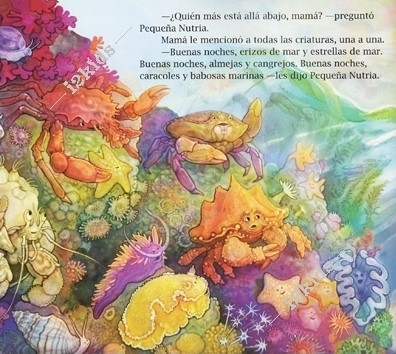
“But before she could say another word, Little Sea Otter dipped her furry face into the chilly water.” There she sees a whole ocean full of fish to greet. She says “Good night” to the yellow fish, the orange fish, and the purple fish. Of course she can’t forget the long fish or the short fish, the striped fish or the spotted fish either. All these fish are happy to wish the tiny pup sweet dreams too. Mama Otter points out other sea creatures getting ready for bed—different types of crabs, snails, sea stars, anemones, clams, and more. Little Otter says “Good night” to each in turn.

celebrate-picture-books-picture-book-review-good-night-little-sea-otter-harbor-seals

Image copyright Wish Williams, text copyright Janet Halfmann, courtesy of starbrightbooks.org

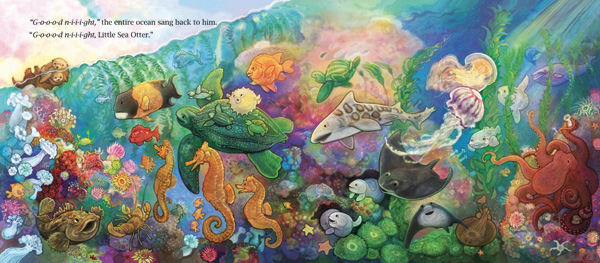
From every part of the ocean sea turtles, lobsters, octopi, rays, jelly fish, sea horses, eels and others bubble a chorus of “Good night” to Little Otter. She listens and responds to each one and then asks Mama if she has forgotten anyone. “‘Yes, you did,’” Mama says, “scooping her up in her paws. ‘You missed ME!’” Little Otter giggles and says “Good night.” Mama Otter hugs her tight and rolls over and over in the kelp, wrapping them both “in ribbons of seaweed” that will keep them secure on the ocean currents as they sleep.

Little Otter gazes up into the night sky and says “Good night” to the moon and the stars. As Little Otter’s eyes finally close and she drifts into sleep, Mama kisses her gently on the head and the sea whispers “‘rock-a-bye.’”

celebrate-picture-books-picture-book-review-good-night-little-sea-otter-all-ocean-creatures

Image copyright Wish Williams, text copyright Janet Halfmann, courtesy of starbrightbooks.org

Janet Halfmann’s gentle bedtime story is a sweet reminder for children of all the people in their life who love them and are thinking of them every day. As Little Sea Otter puts off sleep with just one more “Good night” and then another and another, Halfmann reveals with lyrical language the wide world of the sea and the creatures in it. The readiness of the ocean creatures to respond with their own heartfelt wishes for the little pup suggest that this is a nightly and eagerly anticipated ending to each day by all.

One might imagine that in addition to “Good night” Little Otter’s nightly repertoire includes the request to be told all the names of the fish and sea animals, just as children love to look through pictures of family and friends and learn their names. Mama’s patient support of her pup’s curiosity and connections to her world provide tender moments between mother and child, as do their final bedtime rituals before drifting off to sleep.

celebrate-picture-books-picture-book-review-good-night-little-sea-otter-spanish-translation

Image copyright Wish Williams, text copyright Janet Halfmann, courtesy of starbrightbooks.org

Wish Williams’ beautiful, vivid illustrations are stunning and detailed, offering a magical realism that is perfect for this book’s wide-eyed audience. Little Otter and her sea creature friends are adorable, their smiling faces glowing with their happiness to see each other and finish the day together. While the fish and other sea creatures are colorful, the hues are true to their natural counterparts. The blue-green ocean swirls and foams along the rocky shore at twilight while whitecaps glitter in starlight when the sun goes down.

Little Otter’s repeated phrase of “Good night” gives children plenty of opportunities to read along. Kids and adults who enjoy the beach and marine environments will also be delighted in the scientific facts about sea otters organically sprinkled into the text. The lovely nature of the mother/child relationship, opportunities for child participation, and gorgeous art make Good Night, Little Sea Otter a welcome addition to home bookshelves for quiet story times and bedtime.

Translations

Star Bright Books also publishes Good Night, Little Sea Otter in eight bilingual editions. For information on each click on the links below:

Arabic/English | Burmese/English | Burmese Karen/English | French/English | Hmong/EnglishNavajo/English | Portuguese/English | Spanish/English

Ages 2 – 6

Star Bright Books, 2010 | ISBN 978-1595722546 (English Edition)

Learn more about Janet Halfmann and her other books on her website!

International Translation Day Activity

We Are All Family English/Spanish Word Search

celebrate-picture-books-picture-book-review-we-are-all-family-word-search

Find the names of family members in both English and Spanish in this printable heart- shaped We Are All Family Word Search! Here’s the Solution!


Sleepy Sea Otters Coloring Page

celebrate-picture-books-picture-book-review-sleep-sea-otters-coloring-page

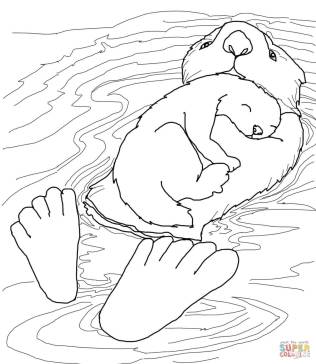
Say “Good night” to these sweet sea otters before going to bed by coloring this printable Sleepy Sea Otters Coloring Page.

Picture Book Review

September 27 – It’s Fall Hat Month

celebrate-picture-books-picture-book-review-mr-brown's-fantastic-hat-cover

About the Holiday

As the weather turns cooler in certain parts of the world, it’s time to pull out those old favorite cozy hats or buy a stylish new one to keep your head and ears warm! Whether you like wearing felt hats, knit hats, furry hats, or even top hats—like the character in today’s book—this is the season for you!

Mr. Brown’s Fantastic Hat

By Ayano Imaí


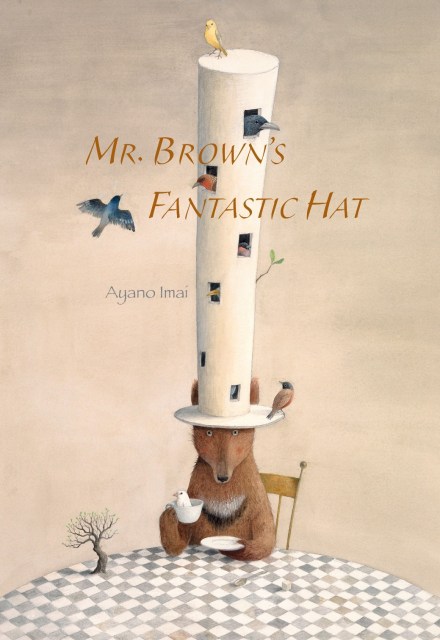
Mr. Brown lived alone and, if you asked him, he’d tell you he liked it that way. He “had no friends and he didn’t want any.” If you were privy to his secret thoughts, however, you’d learn that Mr. Brown was actually very lonely. Mr. Brown liked to take long walks, and when he went out, he always wore his “smart,” distinctive hat. “One day while Mr. Brown was sleeping, a woodpecker flew down and started tapping a hole in his hat, thinking, ‘What a wonderful nest this hat would make!’”

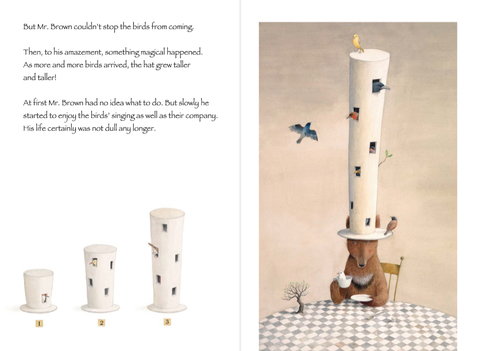
When Mr. Brown woke up he was shocked to discover that a bird had moved into his hat. Someone living this close to him was not what Mr. Brown had in mind at all. Then to Mr. Brown’s dismay the “woodpecker soon told all his friends about the wonderful new home and invited them all to join him.” Soon Mr. Brown’s hat was full of holes—and birds! You might think a regular hat would not have enough room for so many residents—but Mr. Brown’s hat was no ordinary one. As more and more birds moved in, his hat grew taller and taller!

celebrate-picture-books-picture-book-review-mr-brown's-fantastic-hat-birds-live-in-hat

Image copyright Ayano Imaí, 2014, courtesy of minedition

As the days went on Mr. Brown discovered that he was beginning to enjoy the birds’ singing and their company. Now Mr. Brown had renewed purpose in his daily walks: “He loved to show off his hat. Everywhere he went it was full of the music of singing birds.” People on the street took notice and wanted to emulate Mr. Brown. All over town people began wearing tall hats, “but the birds preferred to stay with Mr. Brown no matter how hard people tried to persuade them.”

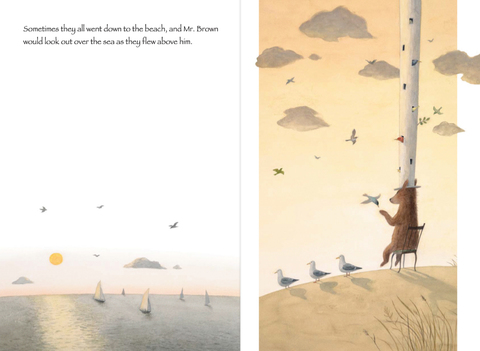
One day as autumn settled in, Mr. Brown noticed that all the birds had flown away. He was sad and didn’t understand where they had gone or why they had left him. He wondered if he would see them again. The idea of a quiet life no longer held the appeal it once did, and Mr. Brown missed his friends. He tried to convince himself that he didn’t care that the birds had left, but he continued to fill the feeders and watch out for them every day.

celebrate-picture-books-picture-book-review-mr-brown's-fantastic-hat-looking-out-to-sea

Image copyright Ayano Imaí, 2014, courtesy of minedition

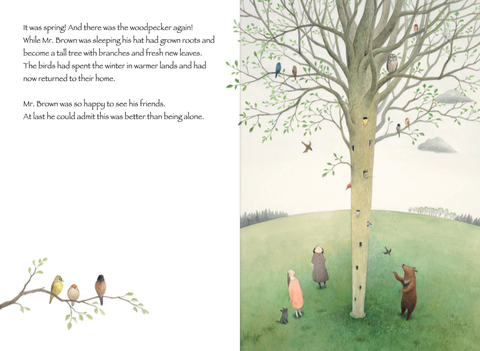
Even though it was time for Mr. Brown to take a long winter’s nap, he tried to stay awake, worried that there would be no one to care for the birds if they returned. But nature took its course, and Mr. Brown fell into a deep sleep. One morning after a particularly vivid dream in which Mr. Brown could hear the birds singing, he woke to a tapping sound. He went to the door and peered out.

Spring had come and with it Mr. Brown’s hat had grown roots and sprouted branches and leaves. The old holes were filled with their previous tenants. The sight filled Mr. Brown with joy, and he finally could admit to himself that sharing his life with friends “was better than being alone.”

celebrate-picture-books-picture-book-review-mr-brown's-fantastic-hat-hat-grows-into-tree

Image copyright Ayano Imaí, 2014, courtesy of minedition

Ayano Imaí’s gloriously beautiful book plumbs the nature of solitude and loneliness as well as the value of friendship with an honesty that is at once heartrending and uplifting. For so many quiet, introspective people—children and adults alike—navigating the world of small talk, casual relationships, and making friends is similar to traveling uncharted territory, where the language and mores are foreign. It can become easier to tell oneself that it doesn’t matter, when in reality it matters a great deal. Many times happiness comes when one finds their niche or, in some surprising way, a niche finds them.

Imaí tells the story of Mr. Brown and his fantastical hat in straightforward narration, but more profound meaning is revealed in her illustrations. Mr. Brown, it is discovered, is a brown bear who has taken on the aspects of humans. He walks upright, carries an umbrella and bag, owns a home, and wears a hat. His fur is even the same color as the townspeople’s clothing. But while he may be among people, he is not of them. His home has a grass floor which sprouts mushrooms and weeds; another weed pokes out from the bristles of his brush; a tree branch juts from a wall; and mushrooms share space with the laundry on the drying line.

Mr. Brown comes from nature and belongs with nature, so it is no surprise that the birds flock to him and prefer him to humans, who in an ironic twist long to be like Mr. Brown. I especially like the ending of Mr. Brown’s Fantastic Hat, in which Mr. Brown stays true to himself. He does not suddenly discover his “wild” side and become someone that he is not. He is able to remain a quiet, introspective bear while also embracing his friends, his love for them, and his place in the world. He finds inner happiness and loved ones to share it with.

Ages 3 – 8 (and up)

minedition, 2014 | ISBN 978-9888240845

Fall Hat Month Activity

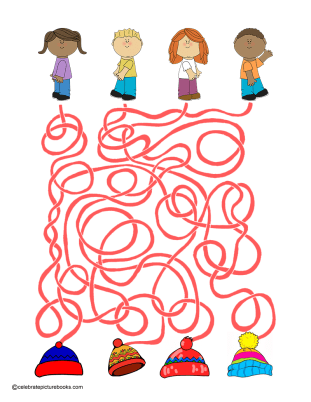
celebrate-picture-books-picture-book-review-favorite-hat-matching-puzzle

Favorite Fall Hat Matching Puzzle


Each child has a favorite hat for cooler weather. Follow the paths in this printable Favorite Fall Hat Matching Puzzle to find out which hat each child chooses!

Picture Book Review
September 22 – Elephant Appreciation Day

celebrate-picture-books-picture-book-review-strictly-no-elephants-cover

About the Holiday

While today’s holiday was established in 1996 by Mission Media and its owner Wayne Hepburn because of Hepburn’s love for elephants, the day has garnered official recognition and deserves wide acknowledgement. These gentile, giant animals need our protection from environmental and human dangers. To celebrate today’s holiday visit a zoo or animal preserve, watch a documentary on elephants, or consider donating to their cause.

Strictly No Elephants

Written by Lisa Mantchev | Illustrated by Taeeun Yoo


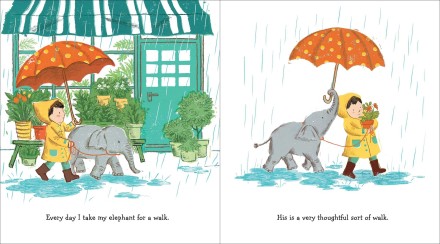
A little boy, his adorable pet elephant by his side, kneels on his bed and gazes out the window at the brownstones across the street. There he sees other kids with their—more conventional—pets: a bird, a cat, a fish, and dogs. “The trouble with having a tiny elephant for a pet is that you never quite fit in,” the boy reveals. Every day the boy takes his elephant for a walk, but even in this common pet-owner activity, the boy and the elephant show their special relationship. The elephant is thoughtful—protecting the boy with an umbrella on rainy days—and the boy is considerate—carrying his elephant over cracks in the sidewalk that frighten it. Why? Because “that’s what friends do: lift each other over the cracks.”

celebrate-picture-books-picture-book-review-strictly-no-elephants-thoughtful-pet

Image copyright Taeeun Yoo, courtesy of simonandschuster.com

On this particular day the boy winds a red scarf around his elephant’s neck and joins the parade of kids on their way to Number 17 where the Pet Club meets. The elephant is reluctant, but the boy is reassuring, even carrying his pet on his back the last few feet. “‘It’ll be fine,’” he says. But when they reach the apartment, there’s a sign on the door that reads “Strictly No Elephants.” There’s even a picture of a crossed out elephant on the sign.

The elephant understands all too well and leads the boy back onto the sidewalk, now ignoring the cracks. “‘That’s what friends do: brave the scary things for you,’” the boy says. The day has suddenly become rainy, and they are caught on the sidewalk without an umbrella. Taking shelter under an awning, the two find a little girl holding her pet skunk. “‘Did you try to go to the Pet Club meeting too?’” she asks. “‘Yes,’” the boy says, “‘But they don’t allow elephants.’”

celebrate-picture-books-picture-book-review-strictly-no-elephants-girl-with-skunk

Image copyright Taeeun Yoo, courtesy of simonandschuster.com

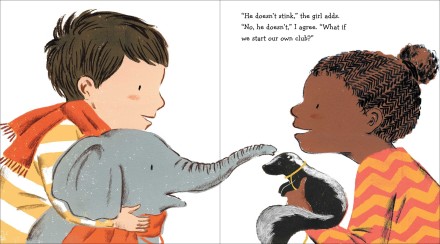
While the sign may not explicitly forbid skunks, the little girl says that the other members didn’t want to play with her and her skunk either. Wisely, the boy tells her “‘They don’t know any better.’” The elephant reaches out its trunk toward the skunk with the girl’s reassurance that he doesn’t stink. The two new friends decide to start their own pet club and head down the sidewalk to find a venue. The boy makes sure that his elephant follows because friends “‘never leave anyone behind.’”

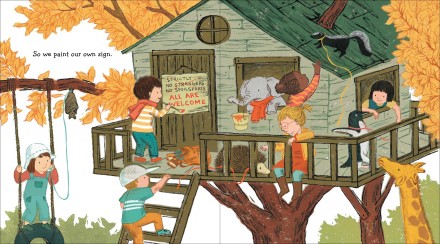
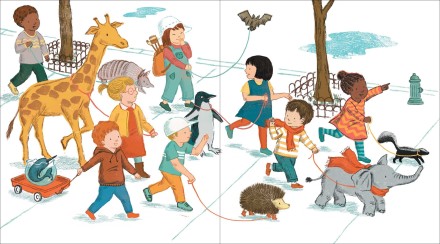
On the way the boy, girl, elephant, and skunk encounter a whole crowd of kids with unusual pets—a tiny giraffe, a mini narwhal, an armadillo, a bat, a hedgehog, and a penguin. They come to a park, complete with tree house, that is perfect for their club. The kids and pets eagerly adopt their new play space—swinging on the tire swing, waddling around the balcony, exploring the roof, playing tag, reading, and more. The boy quickly does the most important thing of all: he paints a new sign for the clubhouse door. “Strictly No Strangers, No Spoilsports ALL ARE WELCOME” it reads. And if you need directions to the club, the boy’s tiny elephant will give them to you “‘because that’s what friends do.’”

celebrate-picture-books-picture-book-review-strictly-no-elephants-new-friends

Image copyright Taeeun Yoo, courtesy of simonandschuster.com

Lisa Mantchev has written a story addressing the types of isolation and rejection that kids (and adults) can face sometimes because of a single perceived difference in an uplifting and productive way. With gentle honesty and thoughtfulness, Mantchev invites kids—on both sides of this “elephant in the room” issue to consider their actions, attitudes, and responses to others. As Mantchev reveals, more inclusiveness leads to more understanding and better relationships. Her lyrical language and sweet reminders of “what friends do” elevate this tribute to camaraderie and companionship and make it a story kids will want to hear again and again.

celebrate-picture-books-picture-book-review-strictly-no-elephants-new-clubhouse

Image copyright Taeeun Yoo, courtesy of simonandschuster.com

Taeeun Yoo’s adorable illustrations of the boy, his tiny pet elephant, and the other animal-and-owner pairs are irresistible. Any reader would want pets as cute and adaptable as these, which may lead to questions about why and how they could be excluded from the club. As the boy and his elephant are turned away from the Pet Club door, the day turns dark and stormy. The two-page spread is rendered in somber shades, except for the little boy with his yellow-striped shirt and red scarf, the elephant sporting a matching red scarf, and the soon-to-be-met African-American girl who wears a red and yellow-striped dress, emphasizing the connections between these two children. The final pages in which the new friends meet and play together are joyful, inviting all readers to “join the club.”

Strictly No Elephants gives readers so much to see, think about, and discuss. The book is a must for school and classroom libraries and would be a very welcome addition to children’s home bookshelves.

Ages 4 – 8

Simon & Schuster, 2015 | ISBN 978-1481416474

Discover Lisa Mantchev’s books for children, young adults, and adults on her website.

See a gallery of books by Taeeun Yoo on her website!

Elephant Appreciation Day Activity

celebrate-picture-books-picture-book-review-spool-elephants-craft

Image copyright Celebrate Picture Books, 2016

Spool Elephant


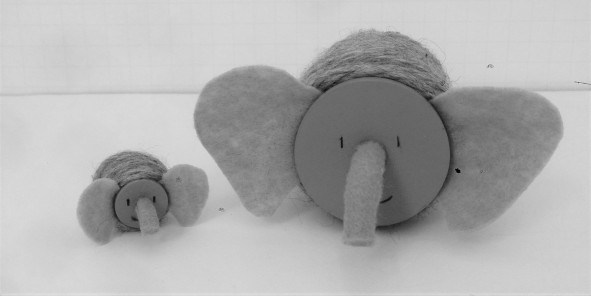
Who wouldn’t like a tiny elephant for a pet?! With this easy craft you can make your own little pal to keep you company.

Supplies

  • Printable Elephant Ears Template
  • 1¾-inch wooden spool with center hole, available at craft stores
  • ¾ -inch wooden spool with center hole, available at craft stores
  • Gray craft paint
  • Chunky gray yarn
  • Gray felt, 1 8 ½ x 11 piece
  • Paint brush
  • Black fine-tip marker
  • Hot glue gun or fabric glue

Directions

To Make the Ears

  1. Print the Elephant Ears Template
  2. Trace and cut out the large and small ears

To Make the Body

  1. Paint the spools with the gray paint, let dry
  2. Glue the tab on the ears to the body of the spool to secure, allowing the ears to stick out on either side of one flat end of the spools
  3. Wind the gray yarn back and forth around the spool, creating several layers of thickness
  4. When the body is as thick as you desire, cut the end and secure with glue

To Make the Trunk

  1. Cut a 2 x 4-inch piece of felt for the large elephant; 1/2 x 2-inch piece for small elephant
  2. Roll tightly and secure with glue
  3. Feed one end of the roll into the hole in the middle of the spool
  4. Cut to desired length

To Make the Tail

  1. Twist a small length of yarn and push it into the hole on the back of the spool
  2. With the marker draw eyes and a mouth on the face

Picture Book Review

August 29 – Get Ready for Kindergarten Month

celebrate-picture-books-picture-book-review-be-quiet-marina-cover

About the Holiday

Children of kindergarten age are looking forward to starting school like “the big kids,” and teachers all over the country are preparing to welcome their new students on the first day. All the desks or tables have the same supplies laid out, the same chairs pushed in, and the same promise of learning. Are all the kids the same? Yes…and no. Yes: They are all about the same age, wonder what the future holds, and want to make friends. No: they all come with different personalities, different histories, and different talents and abilities. And it is these differences that give each child their unique perspective on the world and will determine their unique contribution to it. Today celebrate each child’s distinct skills and gifts.

Be Quiet, Marina!

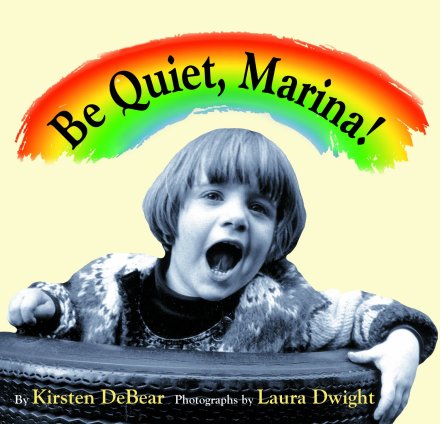
Written by Kirsten DeBear | Illustrated by Laura Dwight


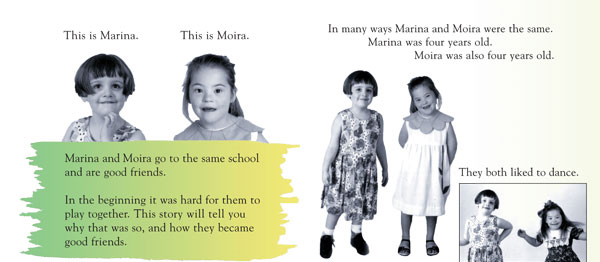
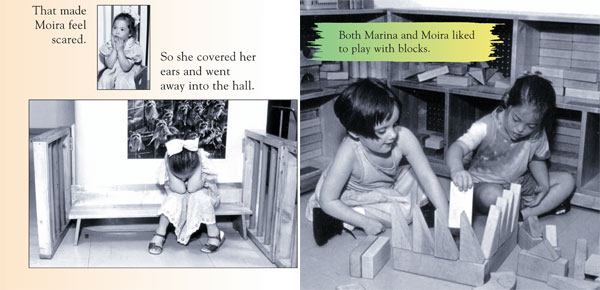
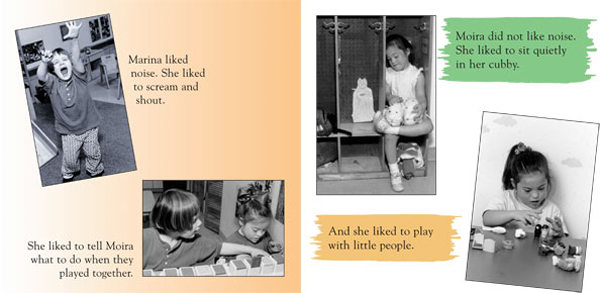
Marina and Moira are four years old and in the same class at school. Marina was born with cerebral palsy; Moira has Down’s Syndrome. They like many of the same things. Both girls like to dance, play ball, dress up, and play with dolls. But when it comes to noises or rushing around, Marina and Moira are different. Marina likes loud noises. She often screams and shouts, and when she and Moira play together, Marina likes to tell Moira what to do.

celebrate-picture-books-picture-book-review-be-quiet-marina-girl's-similarities

Photography by Laura Dwight, courtesy of starbrightbooks.org

Moira, on the other hand, likes to sit quietly, and she can often be found taking a break in her cubby. She also likes to play alone with the little people figures. While both girls like to take walks outside, Moira stays with the teachers and the other students while Marina runs ahead. One of Moira and Marina’s favorite activities is when the teachers swing the kids in a big blanket. Then each student has to wait their turn. Moira can wait patiently, but for Marina waiting is hard; she gets angry and screams or cries. When Moira hears Marina scream, she feels scared. She covers her ears and leaves the room.

While Moira and Marina like to build towers and castles with blocks together, they have different feelings about cleaning up afterward. Marina doesn’t want to help and shows it by yelling. Moira runs from the room with her hands over her ears. “One day on the playground Moira was on the see-saw. Marina wanted to get on too, but she couldn’t…So she started to scream. She screamed so loudly that Moira covered her ears and walked away. Now Marina could get on the see-saw, but it was no fun alone.”

celebrate-picture-books-picture-book-review-be-quiet-marina-playing-with-blocks

Photography by Laura Dwight, courtesy of starbrightbooks.org

Another day Marina started to get upset while the girls were playing with the telephone. This time Moira didn’t run away. Instead she looked at Marina and said, “Please don’t scream!” Marina listened. She became quiet and the two continued to play together. Later in the week when Marina asked Moira to play, Moira told her she would, but only if Marina didn’t scream. Marina said, “Okay, I won’t.”

The two girls came to an understanding. Instead of being afraid of Marina, Moira now knows she is trying to be friends, and Marina realizes that if she wants Moira to play with her, she can’t scream. And they both know that if they need help they can ask their teachers. Now Marina and Moira are best friends, which means they can have fun playing dolls and building with blocks, dancing and dressing up and even going up and down on the see-saw. And when Marina screams, “‘It’s fun!’” Moira makes a little noise herself and shouts “Be Quiet, Marina!”

celebrate-picture-books-picture-book-review-be-quiet-marina-girl's-differences

Photography by Laura Dwight, courtesy of starbrightbooks.org

With simple, straightforward language, Kirsten DeBear reveals the story of how two little girls with what might be considered opposing personalities overcame their differences to become friends. While drawn to each other, these differently abled girls had trouble playing together. Through perseverance and communication, however, they came to understand each other. DeBear brings honesty and humor to this true story that applies to all children who need to accommodate other’s preferences while staying true to themselves when playing or working in a group. The happy resolution shows that there is room for all in our friendships and our hearts.

Laura Dwight’s black and white photos take a storyteller’s approach to chronicling the evolving friendship between Marina and Moira as they participated in schoolroom activities. The smiling girls are shown dancing, dressing in fancy hats, playing with dolls and a ball, building with blocks, and doing other fun things together. The photographs also depict moments of friction between the girls when Maura becomes upset and screams and Moira covers her ears and runs away. At the end of the book Dwight’s lens captures the experiences that led to better understanding between the two girls and their strengthening friendship.

Readers may recognize themselves as a “Maura” who likes loud noise and exploring on her own ahead of the group, or a “Moira” who prefers quiet and staying close to the group. Through the story of these two very smart little girls, all kids may learn to understand and appreciate themselves and alternate viewpoints.

Ages 4 – 7

Star Bright Books, 2014 | ISBN 978-1595726650

Visit Star Bright Books for a vast array of inclusive titles for children that embrace diverse ethnicities and abilities, promote literacy, and are widely available in 24 languages.

View a gallery of photography work by Laura Dwight on her website!

Get Ready for Kindergarten Month Activity

celebrate-picture-books-picture-book-review-threads-of-friendship-photo-holder

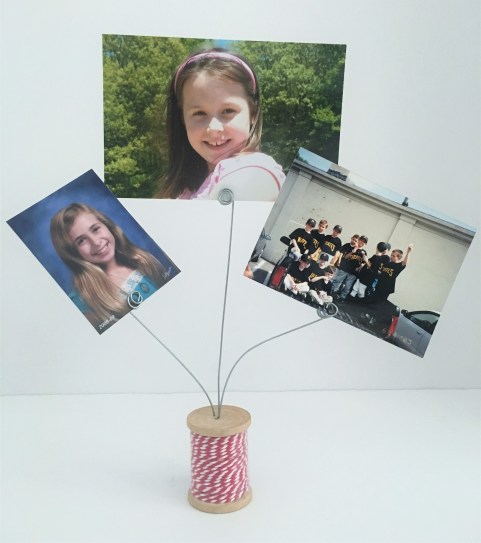
Threads of Friendship Photograph Holder


In the same way that thread holds clothes, blankets, and other material goods together, friendship holds people together. Make this easy Threads of Friendship Photograph Holder to keep pictures of your friends close by!

Supplies

  • Wooden Spool of twine, available at craft stores and some discount retailers
  • Thin-gauge wire, no heavier than 18 gauge
  • Small gauge nail
  • Hammer
  • Needle-nose pliers
  • Pencil
  • Photographs

Directions

To make the photograph holders:

  1. Holding one end of a wire with the needle-nose pliers, wrap it around the pencil four or five times
  2. Remove the wire from the pencil
  3. Squeeze the coils of wire together with the needle-nose pliers
  4. Cut the wires to different lengths so the pictures stand at various heights

To make the stand:

  1. Make two or three holes in the center of the wooden spool of twine with the nail and hammer, holes should be about ½-inch deep to steady wire.
  2. Place the coiled wires in the holes
  3. Put photos in the coils

Note:

Even young children can help hammer the nail, place the wire in the holes, and choose photographs. Adults should coil the wire, cut the wire, and help with hammering.

Picture Book Review

August 25 – Kiss and Make Up Day

celebrate-picture-books-picture-book-review-best-frints-in-the-whole-universe-cover

About the Holiday

Even the best friends and closest relatives get into spats once in a while. The important thing is trying to see the issue from the other person’s point of view and finding a way to patch things up. Today’s holiday is all about saying “I’m sorry” or explaining the situation that started the argument in the first place. On the other side, it’s all about listening and accepting the apology.

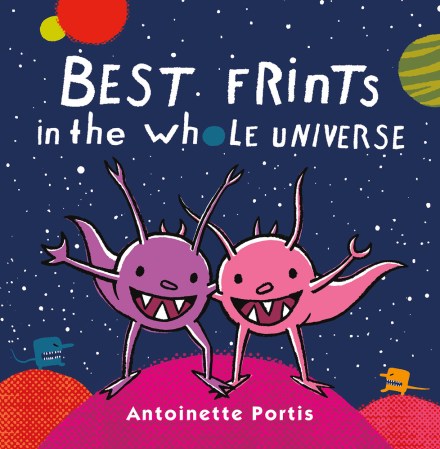
Best Frints in the Whole Universe

By Antoinette Portis


Yelfrid and Omek live on the planet Boborp. They have been best frints since they were little blobbies. Staying frints on Boborp can be hard because “teef are long and tempers are short.” Which makes Boborp a little different than Earth, right? Hmmm… But just like here on Earth having frints is a good thing. And as “Yelfred and Omek know, best frints are the best frints of all.”

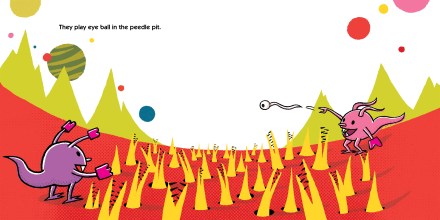
celebrate-picture-books-picture-book-review-best-frints-in-the-whole-universe-peedle-pit

Image copyright Antoinette Portis, courtesy of us.macmillan.com

Yelfred and Omek do everything together, like eating streeeetchy noodles for yunch and playing eye ball in the peedle pit. The peedle pit is full of dangerous spikes and sometimes the eye ball gets stuck in the middle of the pit. “‘Bad frow! You go get it!’” Yelfred says. To which Olmek answers “‘Bad kratch! You go get it!’” This can go on for hours—even until nighttime when Boborp’s two moons rise in the sky.

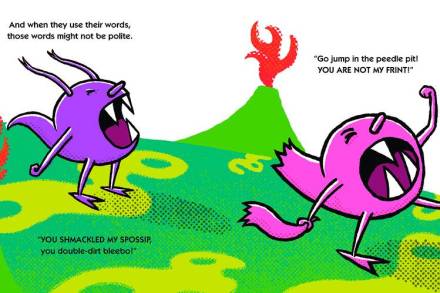
Of course there are blurfdays on Boborp and frints share their blurfday presents. Like if one frint got a spossip they’d let their best frint fly it, right? Hmmm…. But the spossip owner might say “‘No! You’ll schmackle it to bits’” while the other counters, “‘I’m the best driver on Boborp! Let me have a turp!’” But sometimes frints can’t take “No” for an answer, and they borrow the spossip anyway, and sure enough the spossip might get schmackled.

celebrate-picture-books-picture-book-review-best-frints-in-the-whole-universe-bitten-tail

Image copyright Antoinette Portis, courtesy of us.macmillan.com

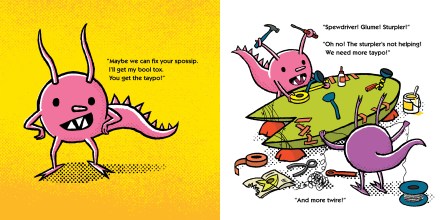
That’s when the teef can come out easier than the words, and things get a bit messy. One frint might even lose their tail, and the words, when they do come out, may not be so polite: “‘YOU SMACKLED BY SPOSSIP, you double-dirt bleebo!’” Frintship can be pretty hard under those circumstances. But real frints find a way to make up. Tails can grow back (even better than before), and spossips can be fixed with a spewdriver, glume, a sturpler, twire, and lots of taypo.

And on planet Boburp, frintships can grow back too—just like on plant Earth!

celebrate-picture-books-picture-book-review-best-frints-in-the-whole-universe-fixing-sossip

Image copyright Antoinette Portis, courtesy of us.macmillan.com

What kid won’t love hearing and saying the words “blobbies,” “yunch,” “peedle pit,” “spossip,” and all the others?! Antoinette Portis’s tribute to the diversities and commonalities of friendship will have kids rolling with laughter. Portis’s made-up vocabulary promotes literacy while introducing the concept of foreign language learning. Portraying arguments and positive resolutions shows kids that while differences occur even between the best friends, mutual cooperation and loyalty wins out.

The boldly colored alien landscape of BoBurp with its oddly familiar toys, celebrations, games, food, and other objects will captures kids’ imaginations, and all the spikey mountains, plants, noodles, and peedle pits give physical form to the theme that sometimes friendship is fraught with danger, but relationships can be smoothed out.

Ages 3 – 7

Roaring Brook Press, 2016 | ISBN 978-1626721364

Follow the little bunny on Antoinette Portis‘s website to discover more of her books!

Kiss and Make Up Day Activity

celebrate-picture-books-picture-book-review-cute-kids-drawing-template

Otherworldly Friends Template


Imagine you and your friends lived on another planet. What would you look like there? What would you be called? Use this printable Otherworldly Friends Template to create this otherworldly world!

Picture Book Review
August 18 – It’s Get Ready for Kindergarten Month

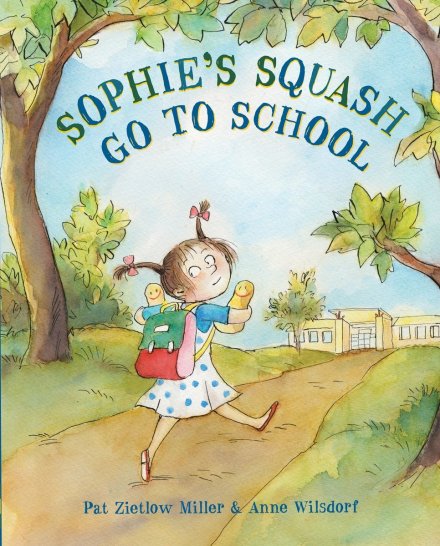
celebrate-picture-books-picture-book-review-sophie's-squash-go-to-school-cover

About the Holiday

Starting kindergarten is a huge step toward future learning and fun! This milestone can take a lot of preparation—from buying backpacks and school clothes to establishing different routines to becoming a new member of the school community. Most school years start during August and this month gives families an opportunity to talk about the changes, go shopping together, and look forward to the new experiences to come!
Sophie’s Squash Go to School

Written by Pat Zietlow Miller | Illustrated by Anne Wilsdorf


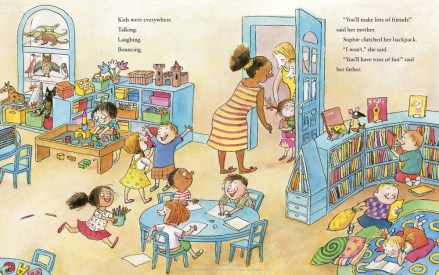
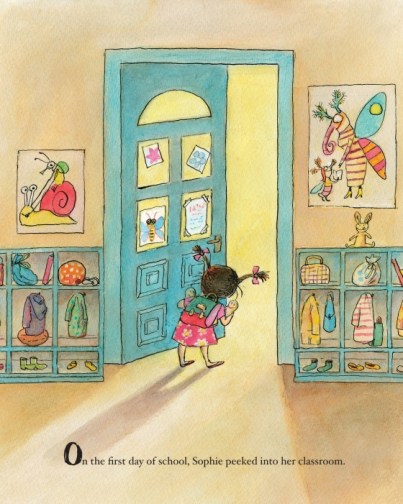
Backed up by her parents and clutching her best friends, two squash named Bonnie and Baxter, Sophie peeks into her classroom on the first day of school. She sees kids running everywhere, talking and laughing. Her parents assure Sophie that she’ll make a lot of friends and have tons of fun, but Sophie is adamant: “‘I won’t,’” she says. And Sophie’s right. “The chairs were uncomfortable. The milk tasted funny. And no one appreciated her two best friends, Bonnie and Baxter.”

celebrate-picture-books-picture-book-review-sophie's-squash-go-to-school-classroom

Image copyright Anne Wilsdorf, courtesy of Schwartz & Wade

The other kids surround her with questions about Bonnie and Baxter. “‘Are they toys? Do they bounce? Can we EAT them?’” Sophie has had enough. “‘No, no, no! I grew them in my garden. They’re my FRIENDS.’” And then there’s Steven Green. He sits near Sophie at circle time, plays near her on the playground, and stands over her breathing down her neck during art time. Ms. Park, the teacher, tells Sophie Steven is just being nice, but Sophie isn’t interested.

Steven does not give up so easily. He returns to show Sophie his best friend—Marvin, a stuffed frog that he got when the toy was just a tadpole. “‘Then you don’t need me,’” Sophie says and decides “that’s that.” But that isn’t that. The next day Steven is back, building a block tower near Sophie, reading her book over her shoulder, and even offering facts about fruit and vegetables during Sophie’s show and tell.

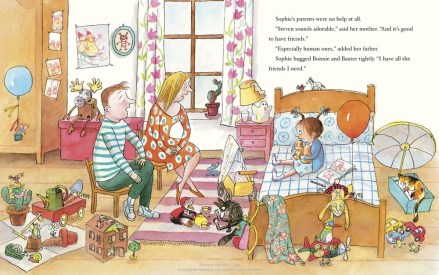
When her parents hear about Steven, they encourage Sophie to make a friend, but Sophie just clings tighter to Bonnie and Baxter. “Still, Sophie knew that Bonnie and Baxter wouldn’t last forever,” so when the other kids dance, spill their milk, or tell jokes, Sophie considers joining in. On the playground Sophie plays hopscotch while the other kids play tag, jump rope, and play other games together. When Steven asks if he can join Sophie, Bonnie, and Baxter, she refuses, leaving Steve and Marvin to sit alone.

celebrate-picture-books-picture-book-review-sophie's-squash-go-to-school-talk-with-mom-and-dad

Image copyright Anne Wilsdorf, courtesy of Schwartz & Wade

When the weekend comes Bonnie and Baxter look “too tired to hop. Or build towers. ‘It’s time,’” says Sophie’s mother. Sophie digs a hole to make “a garden bed and tucked her squash in for their winter nap. ‘Sleep tight,’” she says. “‘See you soon.’ But spring seemed very far away.” On Monday Ms. Park asks the class to tell her what makes a good friend. The kids answer that friends play with you, help you, and think you’re funny. Steven answers “‘They like what you like.’” Ms. Park sends the kids off to draw pictures of their friends.

When Steven wants to see Sophie’s drawing of Bonnie and Baxter, the two get into a scuffle over the paper and it tears in half. “‘You are NOT my friend,’” Sophie says as she walks away. On the way home from school, Sophie tells her mom what happened. “‘Sweet potato,’” her mom says. “‘That adorable boy didn’t mean to tear your picture.’” But Sophie’s not so sure.

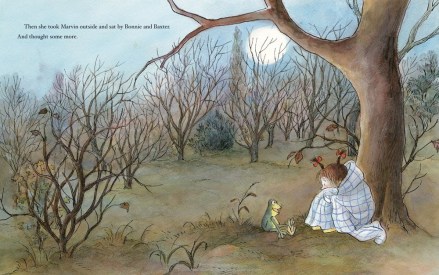
The next morning Sophie finds Marvin and a note in her cubby. She ignores it, and by lunchtime, Marvin is gone. Later that night, though, Sophie and her dad discover Marvin and the note inside her backpack. The note contains a drawing of Bonnie and Baxter as well as a packet of seeds.  “‘Do friends really like the same things you like?’” Sophie asks her dad. When he answers “Sometimes,” Sophie begins to think. She takes Marvin outside and sits near Bonnie and Baxter to think some more.

celebrate-picture-books-picture-book-review-sophie's-squash-go-to-school-nighttime-thinking

Image copyright Anne Wilsdorf, courtesy of Schwartz & Wade

The next day Sophie runs up to Steven to tell him the great idea that Marvin had. They then tell Ms. Park. The next day, Ms. Park hands each child “a cup, some dirt and one small seed.” “‘Can we EAT them?’” a classmate asks. “‘No!’” says Sophie, and Steven adds, “‘You never eat a friend.’” The kids plant the seeds and put the pots on the windowsill. Soon tiny shoots appear in the cups and Sophie and Steven invite the kids to do a new-plant dance.

“‘See?’” Sophie tells Steven. “‘Sometimes growing a friend just takes time.’”

Pat Zietlow Miller’s sequel to her award-winning Sophie’s Squash is a heartfelt story for kids for whom the definition of friendship runs deep. Sophie’s hesitancy to join in the freewheeling play of other kids echoes the feelings of many children entering new classrooms, joining unfamiliar groups, or meeting any new challenge. The excellent pacing of the story as well as Sophie’s honest emotions allow for development of the theme that sometimes friendship takes time. Steven’s persistence sets a positive example for not passing judgement too quickly. Sophie’s transition from squash friends to human is treated sensitively and with cleverness. In the end Sophie learns how to make a friend while still staying true to herself.

celebrate-picture-books-picture-book-review-sophie's-squash-go-to-school-peeking-in-classroom-door

Image copyright Anne Wilsdorf, courtesy of Schwartz & Wade

Anne Wilsdorf’s cartoon-inspired illustrations perfectly depict the world that Sophie reluctantly inhabits. Her classroom is boldly colorful, full of books, toys, separate spaces, and of course all sorts of kids. Sophie’s reactions to the comments and actions of her classmates are clearly registered on her face and will make kids giggle even while they recognize her feelings. Steadfast Steven is, as Sophie’s mom says, adorable, and readers will empathize with his plight in just wanting to make a friend. The nighttime scene beautifully sums up Sophie’s dilemma and provides her and readers a moment to reflect on the story’s ideas.

On so many levels, Sophie’s Squash Go to School makes a wonderful addition to children’s and school bookshelves.

Ages 4 – 9

Schwartz & Wade, Penguin/Random House, 2016 | ISBN 978-0553509441

Discover much more about Pat Zietlow Miller and her books on her website!

Get Ready for Kindergarten Month Activity

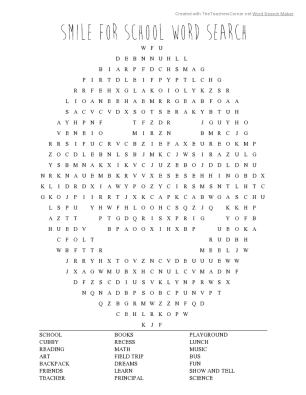
celebrate-picture-books-picture-book-review-smile-for-school-word-search

Smile for School! Word Search


Find 20 words about school in this printable Smile for School! Word Search. Here’s the Solution!

Picture Book Review