June 27 – It’s Effective Communications Month

celebrate-picture-books-picture-book-review-the-bear-who-stared-cover

About the Holiday

Sure, body language can say a lot, but effectively expressing yourself in words and writing helps decrease misunderstandings, misinterpretations, hurt feelings, and conflict. Learning to handle important relationships and work obligations with thoughtful care, consideration, and empathy can take patience and practice. This month people are invited to work on their communications skills to enhance their life with family, friends, co-workers, and others.

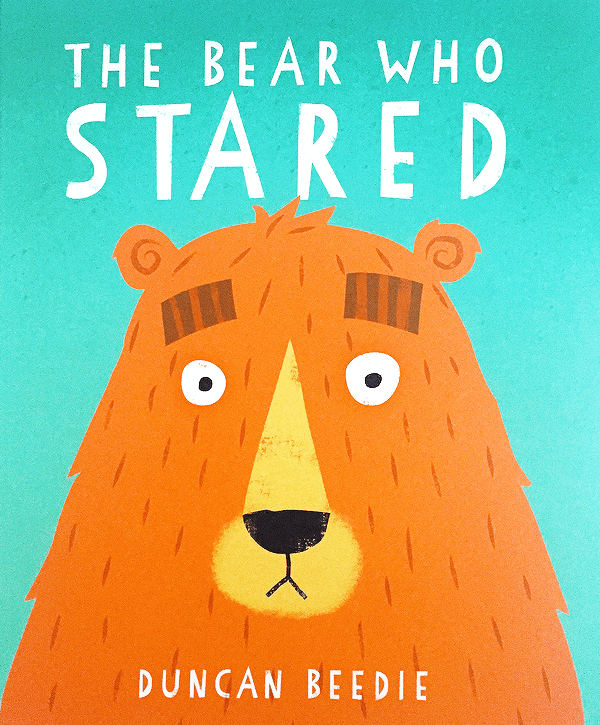
The Bear Who Stared

By Duncan Beedie


Bear loves to stare…and stare…and stare. One morning he emerges from his den to find a family of ladybugs having a picnic breakfast. He can’t help but gaze at them intently. “‘What are you staring at?’” the daddy ladybug demands before he and his family pack up to find a more private leaf. Bear continues on his way. In a bit he climbs a tree and stares at a bird feeding her chicks. “‘Can I help you?’” the mother bird asks, but Bear remains silent. The chicks don’t like Bear interfering with their meal, so the mother bird angrily tells him to “‘sshhhooooo!’”
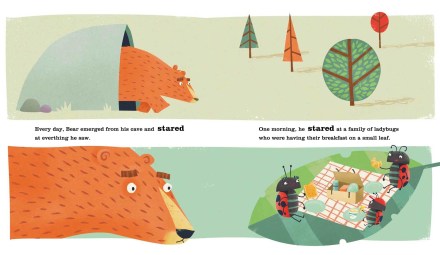
celebrate-picture-books-picture-book-review-the-bear-who-stared-interior-art-ladybugs

Copyright Duncan Beedie, courtesy of simonandschuster.com

At the bottom of the tree Bear spies a badger hole and sticks his head inside. The badger, particularly irritated at Bear’s badgering stare while he is shaving, bites poor bear on the nose. Sore and dejected, Bear wanders through the forest to a large pond. He sits down on a log to ponder his situation. He doesn’t mean to be annoying, he’s “just curious but too shy to say anything.”
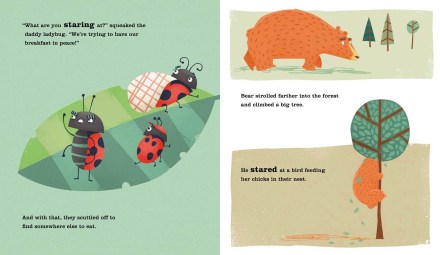
celebrate-picture-books-picture-book-review-the-bear-who-stared-ladybugs-yelling

Copyright Duncan Beedie, courtesy of simonandschuster.com

A little frog floating on a lily pad in the middle of the pond pipes up, “‘I’ve seen that look before.’” Bear stares at the frog and the frog stares back. “‘Not much fun being stared at, is it?’” he says. Bear confesses that he just doesn’t know what to say to anyone. Just then Bear catches a glimpse of another bear staring back at him from the mossy water of the pond. This bear looks exactly like Bear, except that he is green and wavy. Suddenly, the green bear smiles. “‘You see?’” says the frog. “‘Sometimes a smile is all you need.’” The frog dives off his lily pad into the pond, and the green bear disappears too.
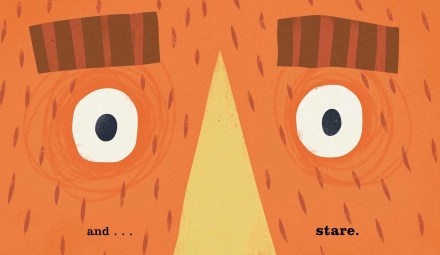
celebrate-picture-books-picture-book-review-the-bear-who-stared-interior-art-staring

Copyright Duncan Beedie, courtesy of simonandschuster.com

The next day Bear leaves his den and discovers the ladybug family breakfasting again. As soon as they spot Bear, they begin to gather their things. “‘Hello!’” Bear says with a big smile on his face. The ladybugs are surprised and happy. “‘Oh, hello!’” replies the dad, smiling back. With renewed confidence Bear wanders into the forest. He smiles at the birds and smiles at the badger, and they smile at him in return. Bear makes a lot of new friends that day. And there’s even that friend down at the pond who likes to stare as much as he does!
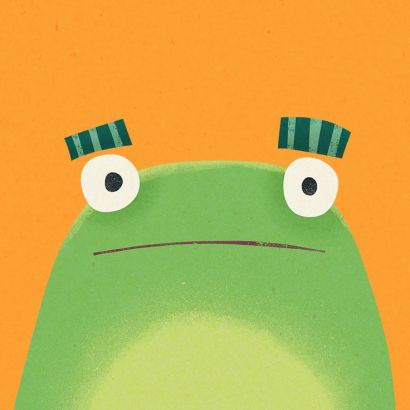
celebrate-picture-books-picture-book-review-the-bear-who-stared-frog

Copyright Duncan Beedie, courtesy of simonandschuster.com

Duncan Beedie highlights the awkward feeling many kids—and even adults—often feel in social situations. Nothing pops immediately to mind to say and yet there’s a desire for connection. As Bear discovers, staring is not the answer—so what is? In The Bear Who Stared, Beedie offers a simple, but universal solution through an engaging and humorous story. Bear, sporting a bemused expression that aptly depicts his predicament, is such an endearing character that readers will wish they could give him a hug as he suffers slights from the woodland creatures.

The full-bleed, oversized pages put readers at eye level with bear and his subjects, and the very up-close look into Bear’s staring eyes will make kids laugh. The green, rust, and blue palette on matte paper is bold, but muted, giving the pages an organic, environmental feel that is perfect to carry the story.

The Bear Who Stared is a funny story time read with a heart that kids will ask for again and again.

Ages 4 – 8

little bee books, 2016 | ISBN 978-1499802856

Check out more of Duncan Beedie’s illustration and animation work on his website!

Take a good looong look at this The Bear Who Stared book trailer!

Effective Communications Month Activity
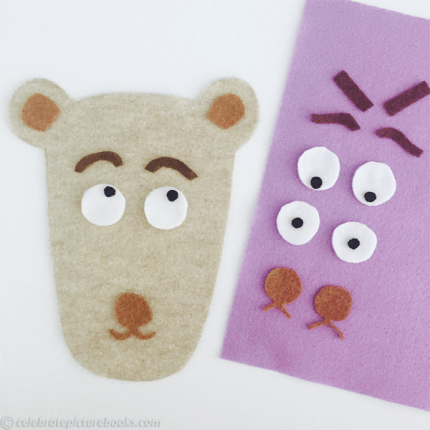
celebrate-picture-books-picture-book-review-bear-craft

Expressive Bear Craft


Sometimes it’s hard to know what to say or how to express your emotions and thoughts. With this easy-to-make felt (or paper) set, you can give the bear different emotions and talk about them, make up stories to go with each facial expression, or play a fun game. Below, you’ll find a couple of ideas!

Supplies

Directions

  1. Print templates
  2. Cut bear head from light felt or fleece
  3. Cut eyes from white felt or fleece
  4. Cut nose and inner ears from dark brown felt or fleece
  5. Cut pupils from black felt or fleece
  6. Glue pupils onto white eyes

Alternately: Color and play with the paper set

To Play a Game

Roll the die to collect parts of the bear’s face. The first player to create a full face is the winner.

  • Die dots correspond to:
  • 1—one eyebrow
  • 2—second eyebrow
  • 3—one eye
  • 4—second eye
  • 5—nose
  • 6—inner ears

For a Fun Story Time

Give the bear different faces and make up stories of why he looks that way!

Picture Book Review

June 20 – World Refugee Day

celebrate-picture-books-picture-book-review-the-journey-cover

About the Holiday

On World Refugee Day, first celebrated in 2001, we commemorate the strength, courage, and perseverance of millions of refugees. The annual commemoration is marked by a variety of events in more than 100 countries, involving government officials, humanitarian aid workers, celebrities, civilians and the forcibly displaced themselves.

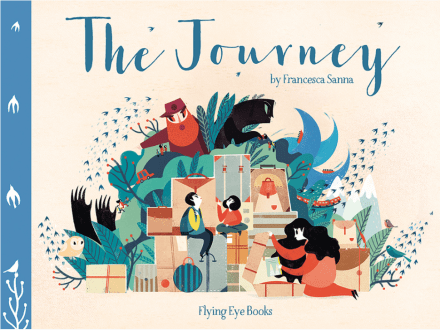
The Journey

By Francesca Sanna 


A child begins the story with a place—the family’s home in a city by the sea. The family used to visit the beach often, but not anymore, “because last year our lives changed forever,” the child reveals. “The war began,” the narrator says, turning their once-peaceful life into “chaos.” Not only was their city torn apart, the family was also, as “one day the war took [their] father.”

celebrate-picture-books-picture-book-review-the-journey-friend

Copyright Francesca Sanna, 2016. Courtesy of Flying Eye Books.

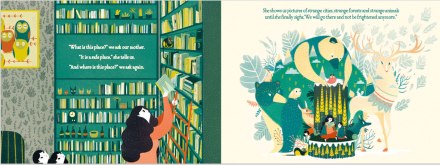
The child’s mother is afraid of the darkness that has descended on them. One of her friends told her that many people are leaving, escaping to another country with high mountains. The two children ask their mother where and what this place is. She answers that “‘it is a safe place’” an then shows them pictures that contain unfamiliar trees and animals. She sighs and tells her son and daughter, “‘We will go there and not be frightened anymore.’”

celebrate-picture-books-picture-book-review-the-journey-library

Copyright Francesca Sanna, 2016. Courtesy of Flying Eye Books.

Even though the children don’t want to leave, they pack up all their belongings and say goodbye to their friends. They leave at night so they won’t be caught. They travel for many days, taking various modes of transportation. With each change the family must leave more and more of their things behind.

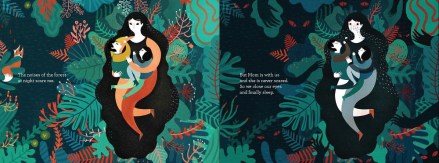
When they reach the border, they are met by an enormous wall that they must climb over. But before they can, a guard stops them and tells them they cannot cross, that they must go back. The family has nowhere else to go, however, and they are very tired. They find a spot in the woods to sleep, but the strange noises keep the children awake. Their mother tells them not to be afraid, and in her arms they finally fall asleep as she cries silent tears.

celebrate-picture-books-picture-book-review-the-journey-leaving-things-behind

Copyright Francesca Sanna, 2016. Courtesy of Flying Eye Books.

Suddenly, they hear shouting and see that the guards are looking for them. They run and run until they meet a man who takes them over the border. They come to the shores of a huge body of water that stretches far into the distance. The family must cross this water to be safe. They board a ferry loaded with other families and sail for days. On the way, they tell stories of the creatures who lurk in the waters below, “ready to gobble [them] up if the boat capsizes.” Other times they tell stories about magic fairies who live in the land they are going to—ones who have “magic spells to end the war.”

celebrate-picture-books-picture-book-review-the-journey-mother-protecting-at-night

Copyright Francesca Sanna, 2016. Courtesy of Flying Eye Books.

In the dawn light, the children and their mother finally see land. They are close to the place where they will be safe, the mother says, but it requires many more days of train travel across many more borders. On the journey the child watches birds migrating just as they are and hopes that one day, like the birds, they will find a new home where they “can be safe and begin our story again.”

Francesca Sanna’s moving compilation of true immigrant stories into a powerful narrative that speaks for so many provides a compelling and sensitive way to discuss the world’s refugee crisis with children. Sanna’s straightforward storytelling allows children to understand the cause and effect relationship of the war on those it displaces. Her focus on the length and difficulty of the family’s journey gives young children—for whom even short times and distances can seem long—a starting point for deeper comprehension. Sanna tempers frightening aspects of the story with her calm delivery and peppering of courage on the part of the mother and children along the way.

celebrate-picture-books-picture-book-review-the-journey-packing

Copyright Francesca Sanna, 2016. Courtesy of Flying Eye Books.

Sanna’s stunning and emotionally resonant artwork deftly presents the experiences of loss and love the story contains. Her use of the amorphous, seeping black images demonstrate the movement of the war and the ravages it imposes. Collage-like aspects to the illustrations gives readers much to talk about at varying age-appropriate levels. As the family’s journey begins, their suitcases and trunks filled with belongings are piled high, but as it continues, their luggage dwindles until only the most precious valuables remain—the two children and their mother. Sanna’s color pallet of oranges, reds, yellows, and greens are eye-catching and convey the urgency of the family’s plight. The final image of the mother, son, and daughter carried on the wind by a majestic bird offers the opportunity to talk about hope with young readers.

Ages 3 – 8

Flying Eye Books, 2016 | ISBN 978-1909263994

Learn more about Francesca Sanna and her work on her website!

World Refugee Day Activity

celebrate-picture-books-picture-book-review-welcome-sign

Learn to Say “Welcome” in Different Languages


With this printable Welcome sign, you can learn how to greet others in their native language!

Picture Book Review

June 12 – It’s Adopt a Cat Month

celebrate-picture-books-picture-book-review-lily's-cat-mask-cover

About the Holiday

Cats make wonderful pets! They can be cuddly or completely independent, but their playful personalities make for lots of laughs and love. If you own a cat, spend some extra time with your pet and ensure that all of your feline friend’s health needs are being met and are up-to-date. If you think you might like to adopt a cat into your family, visit your local animal shelter for cats and kittens who are looking for a forever home.

Lily’s Cat Mask

By Julie Fortenberry


Lily was starting school so her dad took her shopping. “Lily wasn’t sure she wanted to get new things for school, but her father said it would be fun.” After buying some clothes and meeting a woman they knew who gushed at how much Lily had grown, Lily was tired and wanted to go home. “But then she saw the cat mask.” It was the only one on the shelf, and Lily’s dad surprised her by buying it for her.

celebrate-picture-books-picture-book-review-lily's-cat-mask-shopping-with-dad

Copyright Julie Fortenberry, 2017, courtesy of Viking Books for Young Readers.

Lily put it on immediately and wore it on the way home. She wore it to tea parties with her toys, to family parties “when she wanted to be invisible. And when she wanted to be noticed.” When she wore it to her doctor’s appointment, the doctor spoke in meows. One day she lost her mask. Her dad made her a rabbit costume, and while that was fun for a while, Lily was happy to finally find her cat mask.

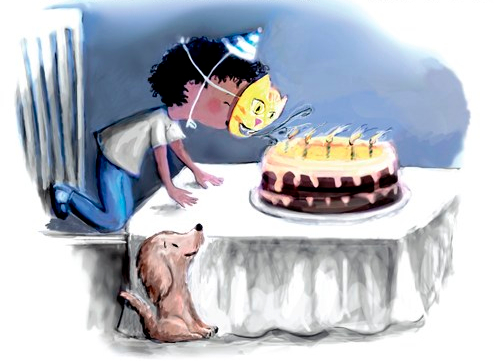
Lily wore her cat mask for many occasions. She wore it when she didn’t want to talk—like when she met her new teacher. “She liked to hide her face when she felt mean and couldn’t get nice.” She even blew out her birthday candles and made a wish wearing the mask. When school started, Lily was only allowed to wear her mask on the playground, but once in a while she put it on, hoping no one would notice. Then it was sometimes put in the teacher’s desk drawer.

celebrate-picture-books-picture-book-review-lily's-cat-mask-making-a-wish

Copyright Julie Fortenberry, 2017, courtesy of Viking Books for Young Readers.

One day, the teacher made a very exciting announcement. The class was going to have a costume party, and everyone could wear a mask or dress up however they wanted. On the day of the party, there were characters, animals, and bugs of all kinds. But then Lily looked across the room and saw the best costume of all—another cat! During recess the new friends played on the swings and meowed happily together.

celebrate-picture-books-picture-book-review-lily's-cat-mask-lily-at-school

Copyright Julie Fortenberry, 2017, courtesy of Viking Books for Young Readers.

Julie Fortenberry’s story of a quiet, hesitant child who discovers a unique way of interacting with the world around her offers openhearted acceptance and understanding for children who are observant and thoughtful integrators. The reaction of Lily’s father, teacher, doctor, and family members to her cat mask is uplifting and provides excellent modeling. The straightforward storytelling highlights Lily’s sweet personality as well as the empathetic responses her costume elicits.

Fotenberry’s illustrations of adorable Lily and her experiences at home, at school, at the doctor’s office, and at the mall are full of joy. The colors are fresh and vibrant, but also calm and peaceful, mirroring Lily’s feelings when wearing her cat mask. The images demonstrate and validate Lily’s preference to watch and participate in events from her own distance.

Lily’s Cat Mask provides the opportunity for much discussion with children, especially about meeting people, Lily’s birthday wish, where Lily sits and plays at parties and at school, and when Lily makes a friend. The book is highly recommended for classroom and school libraries and would make a welcome addition to home bookshelves as well.

Ages 4 – 7

Viking Books for Young Readers, 2017 | ISBN 978-0425287996

Discover more about Julie Fortenberry and view a gallery of her books and artwork on her website!

Adopt a Cat Month Activity

celebrate-picture-books-picture-book-review-The-Cat's-Meow-Word-Search

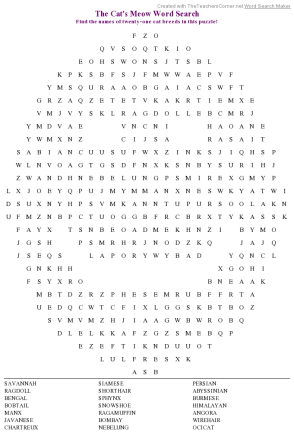
The Cat’s Meow Word Search


There are so many beautiful types of cats! Can you find the names of twenty-one breeds in this printable The Cat’s Meow Word Search puzzle? Here’s the Solution!

Picture Book Review

May 17 – World Baking Day

celebrate-picture-books-picture-book-review-the-case-of-the-stinky-stench-cover

About the Holiday

This may be the most delicious day of the year! Established to share the enjoyment—and scrumptious results—of homemade breads, cookies, cakes, pies…. (Yum! I’m getting hungry just typing this sentence!) …World Baking Day encourages people to try their hand at mixing up a new or favorite recipe. As this is a worldwide holiday, you may consider baking something from another country or from your heritage. With so many cookbooks and online recipe sites available, it’s easy to find—and make—the perfect treat!

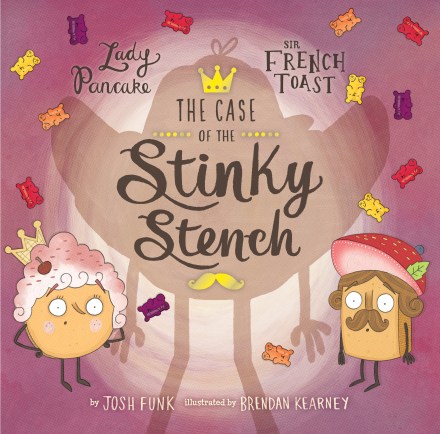
The Case of the Stinky Stench

Written by Josh Funk | Illustrated by Brendan Kearney


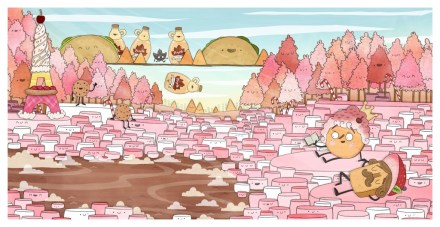
The fridge is full and the denizens happy. Even former rivals Lady Pancake and Sir French Toast are enjoying a sweet vacation together at the Marshmallow Coast. But wait! Who is that strange, half-moon shape rushing “past Trifle Tower” and “across Taco Bridge”? It’s none other than Sir French Toast’s nephew, Inspector Croissant, with a disturbing message. “‘Uncle,’ Croissant said, ‘the fridge is in trouble! / A horrible stench turned a whole shelf to rubble! / I’m the last hope, or the fridge will be lost! / Help me, or else we’ll be cooked, served, and sauced.’”

celebrate-picture-books-picture-book-review-the-case-of-the-stinky-stench-marshmallow-coast

Image copyright Brendan Kearney, text copyright Josh Funk. Courtesy of Sterling Books.

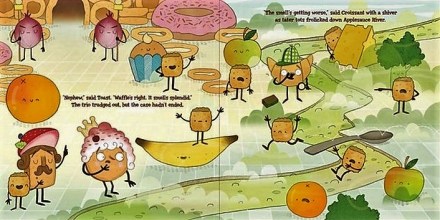
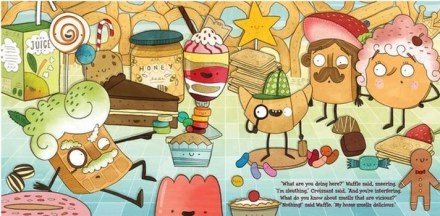
Just as he says this, the facts begin to stink for themselves, and French Toast pledges his help. It’s a do-or-die case for Croissant it seems, as he’s “solved zero cases since getting this job.” Lady Pancake decides the perp is Baron von Waffle and suggests the three pay him a visit. They quietly enter Onion Ring Cave, and Croissant confronts von Waffle. “‘What do you know about smells that are vicious?’ / ‘Nothing!’ said Waffle. ‘My home smells delicious.’” And he’s right; there’s nothing nose-worthy here. Lady Pancake, Sir French Toast and Inspector Croissant leave the cave only to find that the odor has worsened. They follow some tater tots playing nearby to a red curry dish, where an okra divulges an intriguing clue about “a stinky red fish / who lurks at the bottom of Corn Chowder Lake,’” but in his rush to investigate, Croissant trips “by Miss Steak” and goes flying.

celebrate-picture-books-picture-book-review-the-case-of-the-stinky-stench-von-waffle

Image copyright Brendan Kearney, text copyright Josh Funk. Courtesy of Sterling Books.

Back on his feet, the intrepid detective and his side-kicks find a sardine-can boat and row across Corn Chowder Lake until they find the “red herring.” They’re convinced that they’ve “unraveled this stinky affair,” but rowing closer, they catch a tantalizing scent instead of a treacherous one. Lady Pancake is ready to give up, but not Inspector Croissant. He sticks his nose in the air and concludes that the smell hails from Casserole Cliff.

When they get to the cliff, they discover a shriveled up mess. The veggies are soft and the fruit a bit rotten, but Inspector Croissant sees the cause of the trouble—“a moldy old fruitcake from eight months ago!” The three are mulling how to get rid of this putrid pest when the fruitcake shares his story, which is all too familiar. The cake confesses that he came to the fridge as a fresh, yummy treat but was left there uneaten to mold and to reek.

celebrate-picture-books-picture-book-review-the-case-of-the-stinky-stench-tater-tots

Image copyright Brendan Kearney, text copyright Josh Funk. Courtesy of Sterling Books.

The inspector understands a few things about food, and as he leads the sad culprit away from the cliff, he explains, “Everyone knows fruitcakes never go stale.” With careful trimming they clean up the cake. Soon the fruitcake is back to his delectable self and has attracted the attention of softhearted Miss Brie while the other foods welcome him back with good cheer and a party to boot.

With the case solved, kids are invited to join the swingingest party in town. As “Spuddy Holly and the Croquettes,” fill the fridge with music, the residents jiggle, wiggle, and dance with abandon across a two-page spread. A fold-down page presents a map that lets readers follow the action from Taco Bridge to Onion Ring Cave to Casserole Cliff and all the stops in between.

celebrate-picture-books-picture-book-review-the-case-of-the-stinky-stench-onion-cave

Image copyright Brendan Kearney, text copyright Josh Funk. Courtesy of Sterling Books.

Just reading the first line of The Case of the Stinky Stench with its familiar, exuberant rhythm, I caught a smile creeping across my face as I anticipated the story to come. This sequel to Lady Pancake and Sir French Toast is a cool, fresh take on the mystery genre for little detectives in the—dare I say?—baking. The most delicious part of The Lady Pancake and Sir French Toast series is Funk’s freewheeling imagination that comes to fruition in the expanse of that well-stocked refrigerator’s shelves. Clever rhymes, laugh-inducing puns, a whole stew—I mean slew—of fantastic words, and even a red herring await readers. Of course, old nemesis Baron von Waffle makes an appearance, and the introduction of the forgotten fruitcake shows kids that everyone deserves a second chance.

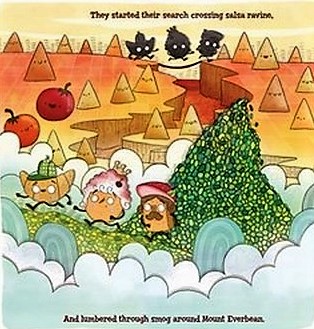
Brendan Kearney recreates the magic of this chef’s-delight of a refrigerator in full, vivid color and with the most adorable foods ever. Pink and white marshmallows, half-moon tacos, muffins, candy, cookies, and gummy bears all wear cute smiles, as they help Inspector Croissant. Even when the odor becomes overwhelming, the bottles, jars, fruit, and veggies sport endearing frowns. Rambunctious tater tots, hot chili peppers, and a steak-and-fries combo, join the fun. Kids will find ingenious details and visual jokes on every page, and will wish their refrigerators were half as exciting as the home of Lady Pancake and French Toast.

Ages 5 – 8

Sterling Children’s Books, 2017 | ISBN 978-1454919605

Discover the world of Josh Funk, his books, and activities for kids on his website!

View a gallery of illustration work and books by Brendan Kearney on his website!

It’s no mystery that you’ll enjoy The Case of the Stinky Stench book trailer!

World Baking Day Activity

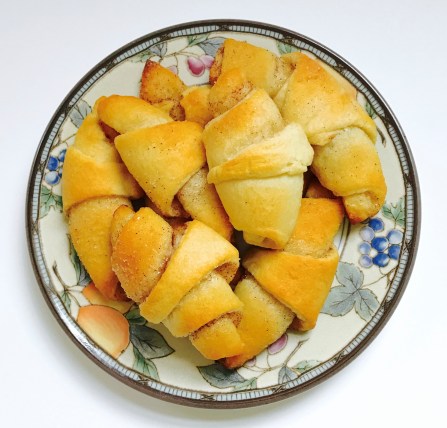
celebrate-picture-books-picture-book-review-cinnamon-croissants

Bite-size Cinnamon Croissants


These mini cinnamon croissants are the perfect accompaniment to cup of tea and a great story! And they’re so easy that kids will love making them as much as they enjoy eating them!

Supplies

  • Tube of refrigerated crescent rolls
  • Sugar
  • Cinnamon
  • Butter
  • Small mixing bowl
  • Rolling pin
  • Knife

Directions

  1. Preheat the oven to 375 degrees, or to the temperature on the package of crescent rolls
  2. Open the tube of crescent rolls and lay them on a cutting board. Do Not separate the rolls
  3. With the rolling pin, roll the dough until it makes one sheet
  4. Measure ¼ cup sugar into the mixing bowl
  5. Add 1 teaspoon cinnamon (or desired amount) to the sugar and stir together until well mixed
  6. Spread a layer of butter over the surface of the dough
  7. Sprinkle the cinnamon sugar across the dough. Use more or less depending on how much cinnamon flavor you like
  8. Cut the dough into triangles about two to three inches wide at the base
  9. Roll the triangles up, starting at the base. Looser rolls make flakier croissants
  10. Place the croissants on a baking sheet and curve them into a crescent shape
  11. Bake the croissants at 375 degrees for about 8 minutes, or until golden on top
  12. Let cool
  13. Enjoy!

Picture Book Review
May 15 – Straw Hat Day

celebrate-picture-books-picture-book-review-miss-fannie's-hat-cover

About the Holiday

Straw hats are found in nearly every culture in the world and have been used since ancient times. Made from local materials, some are unique to and even iconic of the country in which they’re made. Woven loosely, straw hats can protect a person from the hot sun while also keeping their head cool. In rainy climates, tightly woven hats are good for staying dry. Of course, straw hats are a staple of women’s fashion and can be found in nearly every color and decorated with ribbon, flowers, feathers, beads, and more.

Miss Fannie’s Hat

Written by Jan Karon | Illustrated by Toni Goffe


“Miss Fannie has lots of hats. And each one is her favorite.” Miss Fannie is ninety-nine years old and has a closet full of hats that she has worn on special occasions throughout her life. When she tries on her “red felt with the big feather, she looks in the mirror and says ‘I just love this hat!’” It’s the same with her green velour hat that’s decorated with a fancy pin. She’s not the only one who loves her hats. When she wears them to church, people always tell her, “‘Miss Fannie, I sure do love that hat!’” But Miss Fannie has a favorite among her many hats: the pink straw with silk roses. Everyone else loves this hat too.

celebrate-picture-books-picture-book-review-miss-fannie's-hat-closet (2)

Image copyright Toni Goffe, text copyright Jan Karon. Courtesy of Puffin Books.

Miss Fannie is a tiny woman who now lives with her daughter, Wanda. Wanda takes good care of her mother. She makes her big breakfasts, and even though Miss Fannie always says its “way too much,” she always clears her plate. Every Saturday, Wanda helps her mother wash her hair in the bathroom sink. Miss Fannie is so small that she has to stand on a stool to reach. Afterward, Wanda rolls her mother’s hair in curlers, and on Sunday morning she “combs out her mama’s hair, which is all nice and soft and gray, like the feathers of a dove.”

Then Miss Fannie puts on make-up, dresses in her best clothes, and chooses a hat. Choosing can be difficult because “Miss Fannie has three black hats, two red hats, one green hat, two white hats, two navy hats, three beige hats, one brown hat, and the famous pink straw with roses. Because she never wears the same one twice in a row, some people think she has a whole closet full of hats. Which, of course, she does.”

One Sunday, Miss Fannie’s preacher comes to her with an earnest request. He asks her to donate one of her hats to the auction that will raise money to fix up the church for Easter. Miss Fannie wants to help, but how can she choose among her beautiful hats? When they get home, Miss Wanda helps her mother lay out all of her hats on the bed and dresser. Alone in her room, Miss Fannie looks over all her hats. As she holds each in her hand she remembers her past. “The green velour with the fancy pin was very, very old, and still very beautiful.” She had worn it during the great flood of 1916 when she “crossed the swollen river on a ferry to visit her mother and father. As she stood at the rail…a house had floated by, almost close enough to touch.”

celebrate-picture-books-picture-book-review-miss-fannie's-hat-breakfast

Image copyright Toni Goffe, text copyright Jan Karon. Courtesy of Puffin Books.

Next, she considers the red, wide-brimmed felt. The feather on this hat came from a hawk Miss Fannie had caught trying to nab one of her chickens. Then she picks up the brown velvet hat that “always reminded her of Flower, her grandmother’s cow.” She had begun milking Flower when she was seven years old and had learned to churn butter that was better than any found in a store. “Finally, Miss Fannie came to her most favorite hat of all: the pick straw with silk roses.” She had worn it every Easter for thirty-five years and it never failed to make her feel brand new. It was a tradition everyone else enjoyed too, “just as they looked for the tulips and daffodils to bloom in the spring.”

She puts the pink straw hat on, looks in the mirror, and sighs. “In her heart she did not want to giver her hat away. Not at all.” But as she places it back in its box and ties the ribbon, she discovers “she was very, very excited” about all the things it might be able to do. The old pipe organ needed fixing, there was a crack in the church bell, and the roof really needed to be replaced.

At the auction, when the preacher holds up Miss Fannie’s pink straw hat with the silk roses, “the bidding took off lickety-split.” With the bang of the gavel, the hat goes to a woman in the front row. The check she gives the preacher is “enough to really get things fixed,” Miss Fannie knows. She also knows “that she would not miss her favorite hat one bit.”

celebrate-picture-books-picture-book-review-miss-fannie's-hat-outside

Image copyright Toni Goffe, text copyright Jan Karon. Courtesy of Puffin Books.

On Easter morning Miss Fannie rises and fixes her hair. She looks at her hats—none of which seemed right. As she meets Wanda at the front door in her best dress, her best jewelry, her best gloves, and a white corsage, “Miss Wanda couldn’t believe her eyes. Her mama was going out the door without wearing any hat at all!” When they arrive at the freshly painted church, Miss Fannie and Miss Wanda are surprised and delighted to see pink roses planted everywhere around the building. “‘Oh, Mama!’ said Miss Wanda. ‘It looks just like your pink hat!’”

With tears in her eyes, Miss Fannie learns that they were able to fix the organ and the bell as well as planting all the roses. As the congregation looks on “they didn’t see an old woman at all. What they saw was a young girl with hair as soft as the feathers of a dove.” And now when people pass the church, they don’t see gardens of roses. Instead, they see Miss Fannie’s hat. “And it will always be her favorite.”

Jan Karon’s story of selfless love was a favorite in our house when my daughter was young. Not only is the well-paced narrative full of evocative sensory details, bits of history, and realistic dialogue, it centers around a unique plot involving the types of soul-searching decisions that are hard to make. No matter how many times we read the book, Miss Fannie’s choice to auction her favorite hat to benefit her church seemed to come as a surprise that both inspired and heartened. While the tale is primarily Miss Fannie’s, it is Wanda’s story of benevolence too as Karon affectionately describes the ways in which Wanda lovingly attends to her mother’s physical and emotional needs. Throughout Miss Fannie’s Hat, Karon demonstrates that a life well-lived is one abounding in joyous giving.

Toni Goffe takes readers into Miss Wanda’s home—and Miss Fannie’s memory—with his bright, delicate illustrations that fully satisfy little one’s love of realistic detail. My daughter enjoyed the textured feel to the images, where steam rises from a cup of tea and from the bathroom sink, Miss Wanda brushes out her mother’s soft hair, and the hats—made of velvet, velour, and straw and sporting feathers, flowers, nets, and ribbon—beg to be touched. In fact, with the first page and its tantalizing peek into Miss Fannie’s closet, readers will find themselves riveted to her hats and life story. Vignettes from Miss Fannie’s younger years as well as scenes of her now demonstrate her enduring courage and strength of character.

For kids who like to count, sort, and compare, a one-page illustration and a glorious two-page spread allow them to match the list of hats in the text with the contents of Miss Fannie’s closet. They are also invited to choose their favorite from among Miss Fannie’s hats.

Miss Fannie’s Hats is a wonderful story to share with young readers for its ideas of giving, multigenerational relationships, and friendship.

Ages 3 – 6

Puffin Books, 2001 | ISBN 978-0140568127

Discover more about Jan Karon and her books for children and adults on her website!

View a gallery of artwork by Toni Goffe on his website!

Straw Hat Day Activity

celebrate-picture-books-picture-book-review-hat-matching-game

Hat Matching Game


These hats come in pairs—or maybe even triplets—but somehow they’ve been mixed up! Can you find all the matching sets? Just put on your thinking caps and play this printable game!

Supplies

Directions

  1. Print two or more sets of cards
  2. Cut the hat cards apart
  3. Mix them up and lay them face down on the floor or table
  4. Choosing one card at a time, turn them over to try and find a match
  5. If the cards do not match, replace them face down and try again
  6. Continue play until all the hats have been matched

Picture Book Review
May 9 – National Moving Month

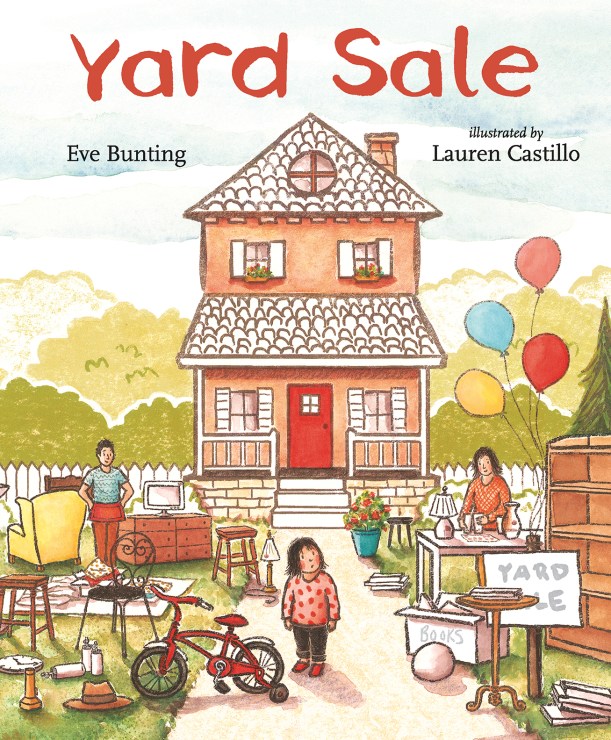
celebrate-picture-books-picture-book-review-yard-sale-book-cover

About the Holiday

With better weather, kids getting out of school, and more jobs opening up, May begins the busiest season in the moving business. Moving can be both hard and exhilarating—and there’s so much to do! But help is only a phone call away. There are professionals to help you all along the way from selling and finding a house to packing up belongings and transporting them. Somewhere along the way, a yard sale is always in the mix to pass along those items that are no longer needed and to make a little money in the process!

Yard Sale

Written by Eve Bunting | Illustrated by Lauren Castillo


From the first words—“Almost everything we own is spread out in our front yard”—readers realize that this is no ordinary yard sale. A little girl sits on the front porch of her tidy house gazing out sadly at the family’s furniture, toys, books, and knick-knacks that are all for sale. The family is moving to a small apartment: “‘Small but nice,’ my mom told me.” The apartment has a secret bed that opens down from the wall “right in the living room.”

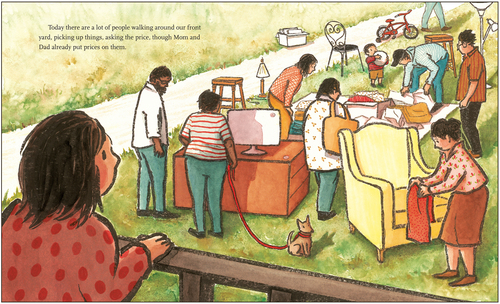
When the yard sale opens people stop by to look, “picking up things, asking the price, though Mom and Dad already put prices on them.” Even though the items are priced low, people haggle over how much they want to pay. A woman complains that ten dollars is too much for the little girl’s bed because the headboard has crayon marks on it. Watching, Callie now wishes she hadn’t made the marks to show how often she had read Goodnight Moon. Her mother settles for five dollars for the bed.

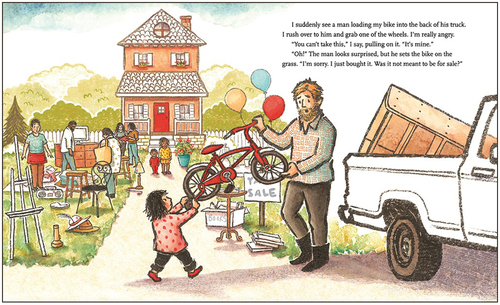
celebrate-picture-books-picture-book-review-yard-sale-bike-sold

Image copyright Lauren Castillo,  text copyright Eve Bunting. Courtesy of laurencastillo.com

Suddenly, Callie sees a man loading her bike into a truck and runs to grab it. The man is confused, sorry for taking it, but tells her he has just bought it. Callie’s dad runs over and explains again that the apartment has no place for the bike or sidewalks nearby to ride it on. Callie looks at her dad who seems to have tears in his eyes. “But probably not,” she decides. “My dad doesn’t cry.” She relinquishes the bike, but asks the man, “‘Will you give it back to me when we get our house back?’”

Callie’s best friend, Sara, is waiting for her. The two friends hug and talk about why Callie has to move. “‘I wish you didn’t have to go,’” Sara mutters. “‘Why do you, anyway?’” Callie shrugs. “‘I don’t know. It’s something to do with money.’” They don’t understand what has happened, and Sara offers, “‘I could ask my parents if you could stay with us.’” But Callie’s heart tells her where she belongs. “‘My parents would be lonely,’” she says. “‘…I’d miss my mom and dad.’”

celebrate-picture-books-picture-book-review-yard-sale-callie-watching

Image copyright Lauren Castillo, text copyright Eve Bunting. Courtesy of laurencastillo.com

The sale continues and people drive away with tables, chairs, and clothing. For a moment, Callie feels important when a man asks her if their large potted geranium is for sale and she directs him to her dad. By the end of the day almost everything is gone. Callie’s mom “looks droopy” and her dad is comforting her. Callie sits dejectedly watching the final things being carried away and thinking that she will give Sara her red heart necklace and invite her to visit their new apartment.

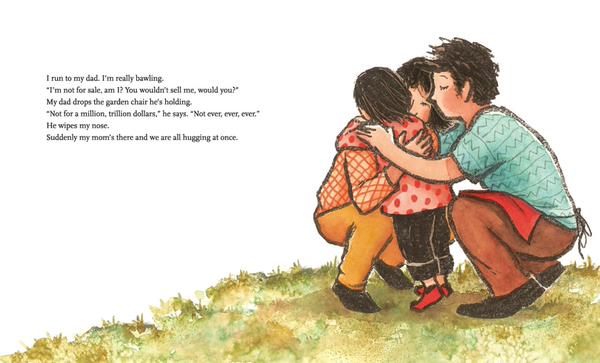
At that moment a woman comes up to Callie and says, “‘Aren’t you just the cutest thing? Are you for sale?’” Callie has a visceral reaction: “A shiver runs through me, from my toes to my head.” She runs to her parents, crying. “‘I’m not for sale, am I? You wouldn’t sell me, would you?’” Her parents drop what they are doing to hug and reassure Callie that they would “‘not ever ever, ever’” sell her. “‘Not for a million, trillion dollars.’”

celebrate-picture-books-picture-book-review-yard-sale-hugging

Image copyright Lauren Castillo, text copyright Eve Bunting. Courtesy of Candlewick Press

With everything gone, Callie and her parents go back inside their “almost empty house.” It’s okay, Callie thinks. None of the stuff is important, and it wouldn’t fit in their new place anyway. “But we will fit in our new place. And we are taking us.”

For so many children frequent relocations or sudden moves from a home they know is a reality. Eve Bunting’s Yard Sale treats this subject with sensitivity and honest emotion through the eyes of a little girl for whom the change is confusing but ultimately reassuring. Bunting does not stint on either the setting of the yard sale itself, where people quibble over a couple of dollars, or the toll the day takes on the family. Her dialogue always rings true, and her straightforward delivery allows for understanding and for the moments of humor to shine through.

celebrate-picture-books-picture-book-review-yard-sale-balloons

Image copyright Lauren Castillo, text copyright Eve Bunting. Courtesy of laurencastillo.com

Lauren Castillo’s ink-and-watercolor paintings anchor this emotional story in a homey, loving environment even as they realistically portray the atmosphere of the yard sale. The full range of feelings are apparent in the characters’ faces from sadness and doubt to kindness and acceptance. Children will respond to Callie with her earnest attempts to understand and feel the comfort and encouragement Callie receives as her parents bend down to talk to her, hold her hand, and give her hugs.

Yard Sale is a poignant story that offers assurance and insight both for children who are facing a move and the friends and classmates who will miss them. The book’s theme is applicable to other daunting circumstances and would be a welcome addition to classroom and local libraries as well as for individuals encountering change.

Ages 4 – 9

Candlewick Press, 2017 (paperback); ISBN 978-0763693053 | 2015 (hardcover); ISBN 978-0763665425

To view more books and artwork by Lauren Castillo, visit her website!

National Moving Month Activity

celebrate-picture-books-picture-book-review-garage-sale-maze

Garage Sale Maze


A garage sale is a bit like a treasure hunt. Can you find your way through this printable Garage Sale Maze from the roadside sign to the items for sale? Here’s the Solution!

May 5 – It’s Get Caught Reading Month

celebrate-picture-books-picture-book-review-old-lion-and-little-rabbit-cover

About the Holiday

Initiated in 1999 and sponsored by the Association of American Publishers, Get Caught Reading Month inspires people of all ages to discover or rediscover the joys of reading. No matter what types of books you like best—from fiction to nonfiction, mystery to humor, picture books to novels—there are stories on bookstore and library shelves that will enhance your life! This month take the opportunity to read a new book or an old favorite and get caught up in the magic!
The Old Lion and the Little Rabbit

By Keiko Kaichi


Once King of the Plains, Old Lion had given up his place in the herd to his sons and now lived a quiet life alone. One day while napping, he felt a tickle in his mane and smelled a tantalizing aroma nearby. Old Lion discovered a tiny baby rabbit sleeping peacefully in the soft fur of his mane. “‘Hey,’ Old Lion thought, ‘this little one won’t fill my belly. But if I let him eat enough, he’ll grow up to be big and delicious!’” So Old Lion gathered as much grass as he could and fed the baby rabbit well, all the while feeling hunger growing in his stomach.
celebrate-picture-books-picture-book-review-old-lion-and-little-rabbit-herd

Copyright Keiko Kaichi, 2017, courtesy of minedition.

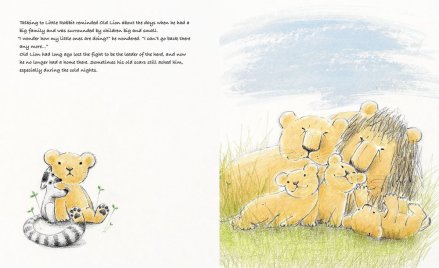
To pass the time between feedings, Old Lion told Little Rabbit about his younger days on the savanna. “Little Rabbit crinkled up his nose with joy when he listened to Old Lion’s stories.” When other animals saw Old Lion and Little Rabbit together, they couldn’t believe it. As Old Lion talked to Little Rabbit, he remembered his big family and the joy of having children around him. He wondered how they were doing. But he knew that he couldn’t go back once he had “lost the fight to be the leader of the herd. Sometimes his old scars still ached him, especially during the cold nights.”

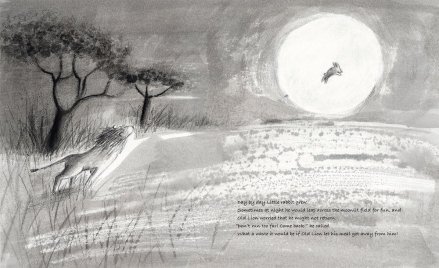
Now that Little Rabbit was growing bigger, he sometimes hopped far into the field, exploring just for fun. Then Old Lion worried that he might not come back, fearful that all his time and hard work would be wasted. He would call after Little Rabbit, reminding him to come back, and Little Rabbit always did.

celebrate-picture-books-picture-book-review-old-lion-and-little-rabbit-hopping-in-moonlight

Copyright Keiko Kaichi, 2017, courtesy of minedition.

They spent their days watching the other animals, Little Rabbit perched on top of the lion’s head in order to see better. As time went by, Old Lion began to wish he could be satisfied with a diet of plants and wondered about the unfamiliar feeling in his heart. “Could it be that he was starting to care about this little creature who trusted him so blindly? Such a thing made no sense. Still, he had to admit that something warm stirred in him when he saw Little Rabbit each morning.”

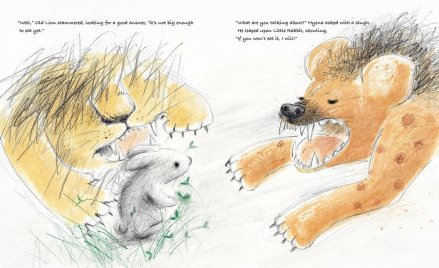
One day as Little Rabbit played among the weeds while Old Lion rested, Hyena came calling. When he saw the little bunny, he immediately asked to share in the delicious meal as he often did. Old Lion was taken off guard and stammered that Little Rabbit was not nearly big enough to make a meal of. Hyena protested and pounced. Old Lion found his former quick reflexes and “with one gulp he snatched up Little Rabbit into his jaws.”

celebrate-picture-books-picture-book-review-old-lion-and-little-rabbit-hyenna

Copyright Keiko Kaichi, 2017, courtesy of minedition.

With a bit of regret but admiration for his old friend, Hyena turned and skulked away. When they were alone, Old Lion opened his mouth wide and let Little Rabbit climb out. He saw that his tiny friend had suffered a cut on his paw and bandaged it carefully. Then he placed Little Rabbit on his head and began to walk in the direction of the wind. “He could no longer deny that he loved Little Rabbit.”

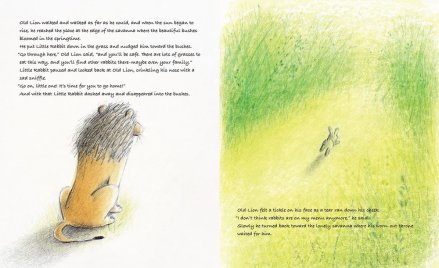
Old Lion walked and walked to the edge of the savanna, where bushes and tall grasses blossomed. He set Little Rabbit down gently and nudged him forward. “You’ll be safe” there, Old Lion told him. “You’ll find other rabbits there—maybe even your family.” Little Rabbit gazed at Old Lion sadly, but the lion reassured him that it was time to go home. Old Lion watched Little Rabbit bound away and “felt a tickle on his face as a tear ran down his cheek.” Then he turned and walked back to where his throne waited.

celebrate-picture-books-picture-book-review-old-lion-and-little-rabbit-letting-rabbit-go

Copyright Keiko Kaichi, 2017, courtesy of minedition.

Keiko Kaichi’s books masterfully tug at readers’ heartstrings with poignant stories populated with adorable characters that immediately inspire love and empathy. In Old Lion and Little Rabbit, the lion’s history is revealed naturally and at a pace that makes his transformation believable and all the more emotional. Just as do children within a family, Little Rabbit alters Old Lion’s life simply through trust and dependence. Children will respond to the growing love between Old Lion and Little Rabbit. They will also find the solution to the mystery established at the beginning both surprising and satisfying. Adult readers cannot be faulted for feeling a small lump in their throat when Old Lion unselfishly protects Little Rabbit from Hyena and then takes him to safety.

Kaichi’s acrylic and pencil drawings are both evocative of the golden savanna and filled with tender sentiments. Old Lion may once have been a fierce predator, but he is now a contemplative and caring elder statesman while Little Rabbit is a wee nubbin of cuteness. As he sits next to the much bigger lion, his tiny paw touching Old Lion’s arm, or collects a bouquet of weeds under Old Lion’s watchful gaze, Little Rabbit swells readers hearts.

Superb in every way, Old Lion and Little Rabbit would make a wonderful choice for home bookshelves as well as for public and school libraries.

Ages 3 – 7

minedition, 2017 | ISBN 978-9888341245

Get Caught Reading Month Activity

celebrate-picture-books-picture-book-review-catch-a-book-maze

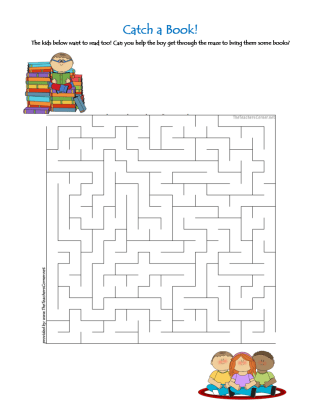
Catch a Book! Maze


One boy has a whole stack of books to share with his friends! Can you help him through this printable Catch a Book! Maze? Here’s the Solution!

Picture Book Review