January 15 – It’s International Creativity Month


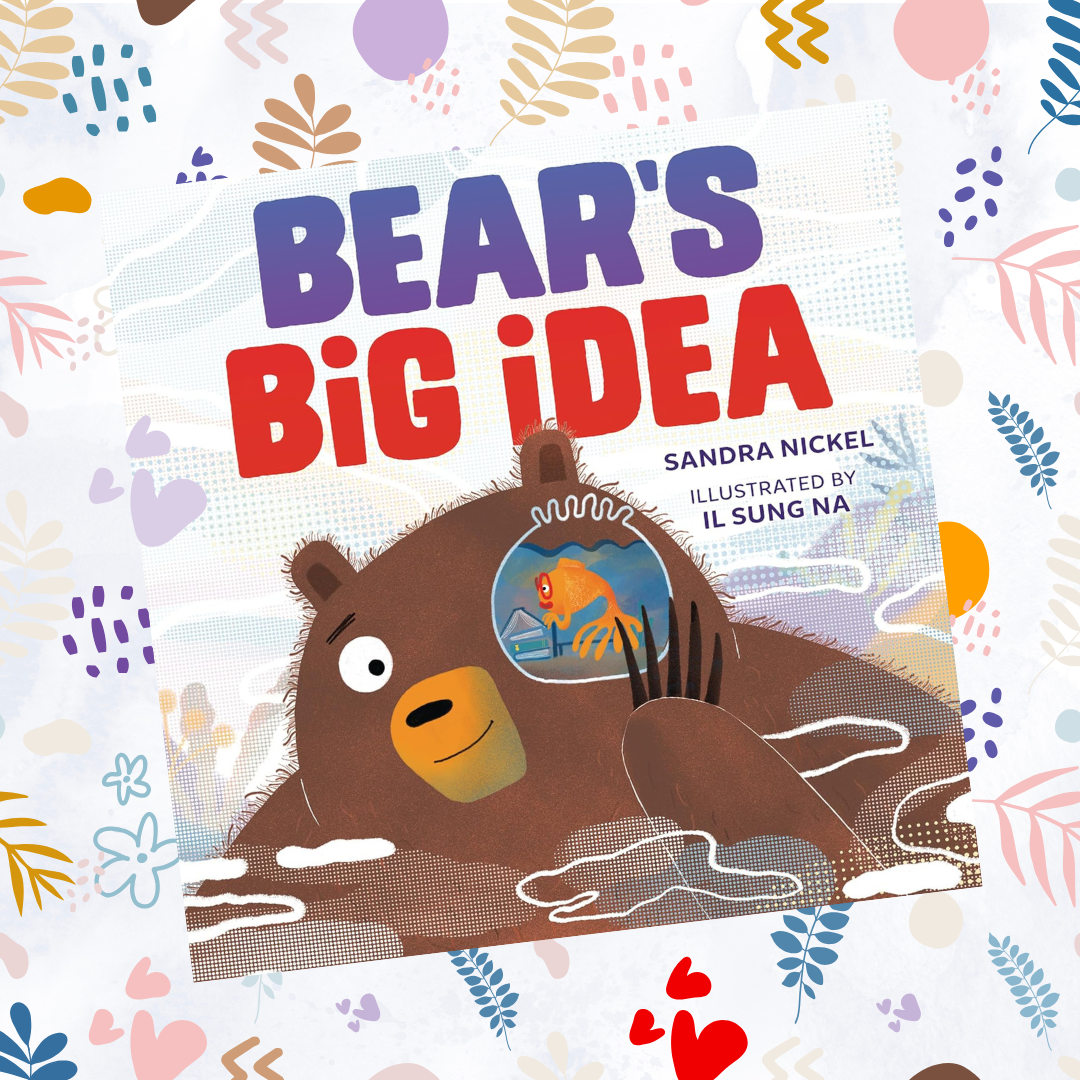
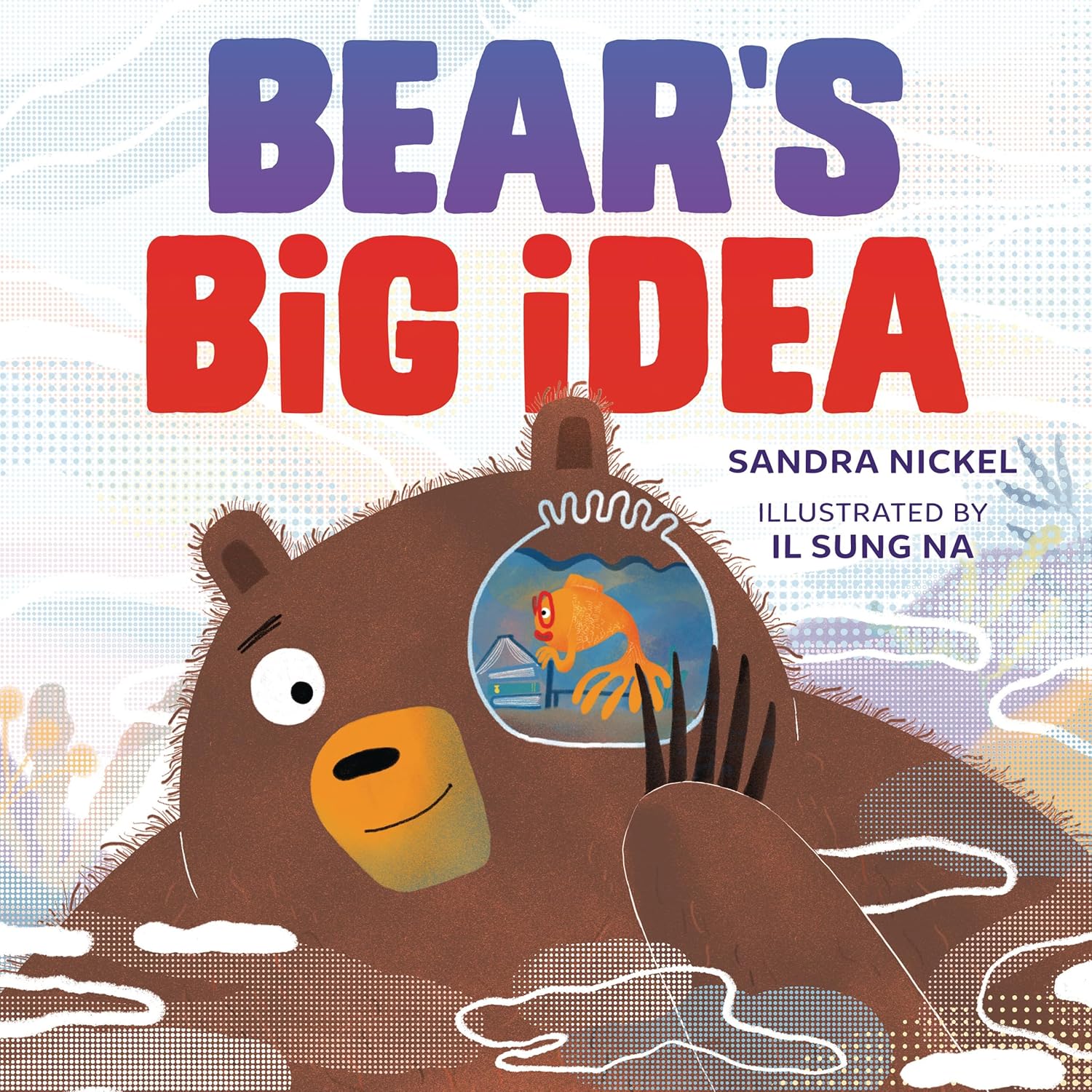
celebrate-picture-books-picture-book-review-bear's-big-idea-cover

About the Holiday

Are you an artist, a writer, a decorator, a chef? How about a floral arranger, a woodworker, a fashion designer, or a gardener? Inside almost every heart lies a desire to create. Whether you use your ingenuity in your job or as an escape from the routine, this month celebrates all that is innovative. Sometimes this comes not in something you can see or touch but in a new thought or novel way of solving a problem—as seen in today’s book!

Thanks to Carolrhoda Books and Barb Fisch at Blue Slip Media for sharing a copy of Bear’s Big Idea with me! All opinions on the book are my own.

Bear’s Big Idea

Written by Sandra Nickel | Illustrated by Il Sung Na


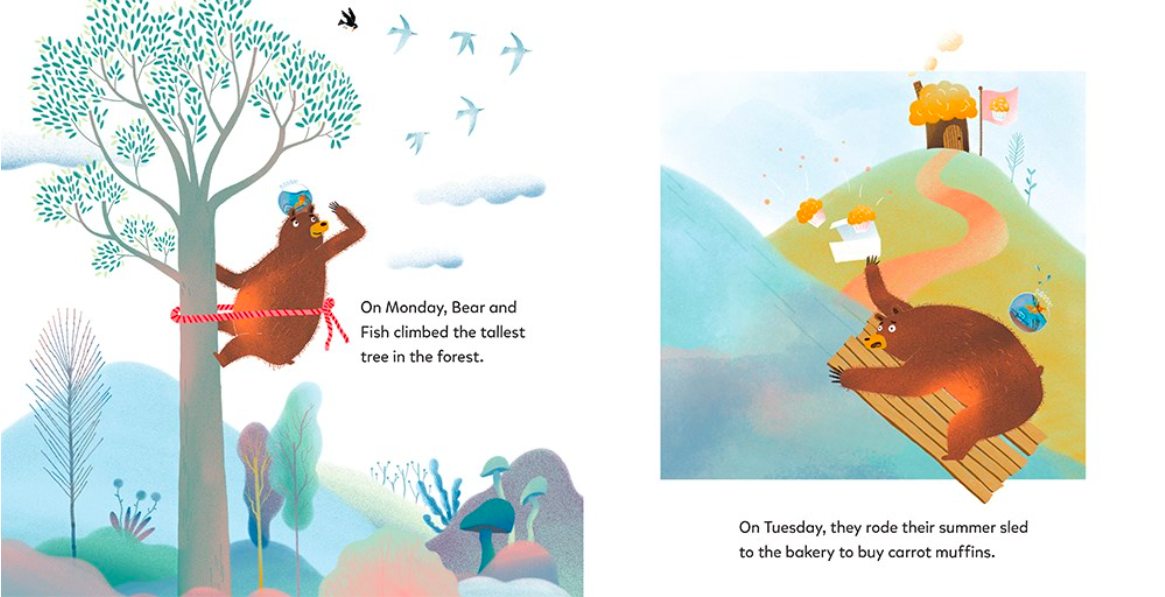
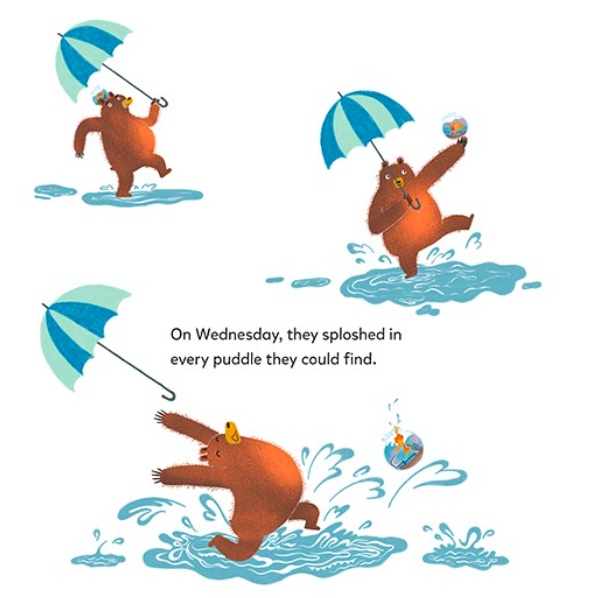
Fish and Bear were best friends. They did everything together, and usually—well, always—Fish was the one with the ideas. “Every morning, Fish would wake up, put on her glasses, and just like that, she would know the perfect thing to do.” Every day of the week, Fish found something—a rope, a sled, an umbrella, and a blanket—and dreamed up an innovative way to have fun with it.
celebrate-picture-books-picture-book-review-bear's-big-idea-Monday

Image copyright Il Sung Na, 2024, text copyright Sandra Nickel, 2024. Courtesy of Carolrhoda Books.

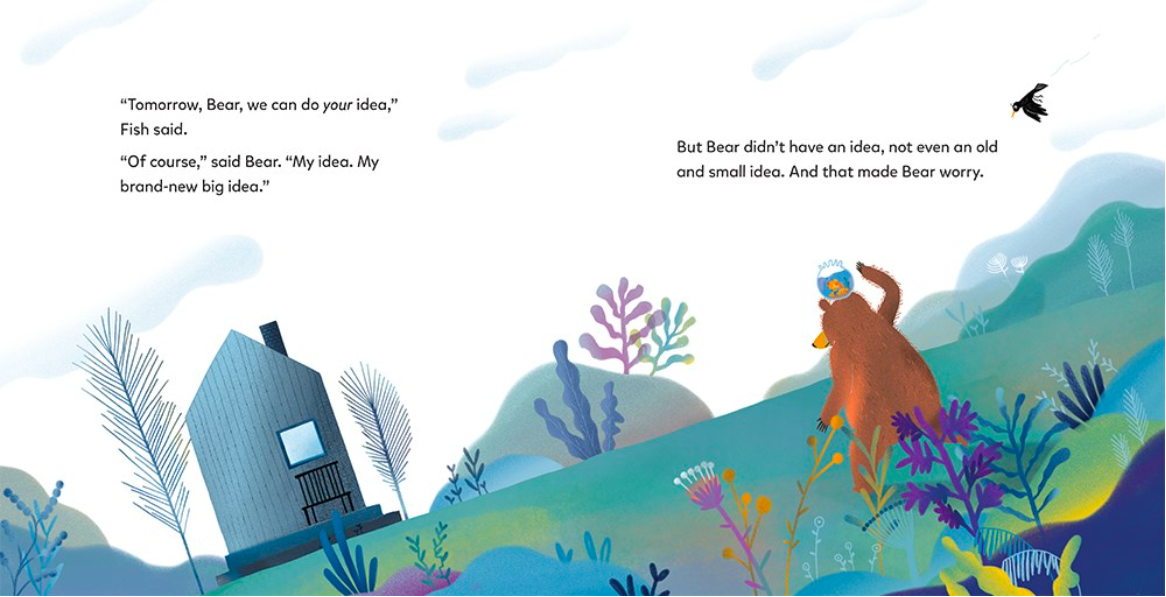
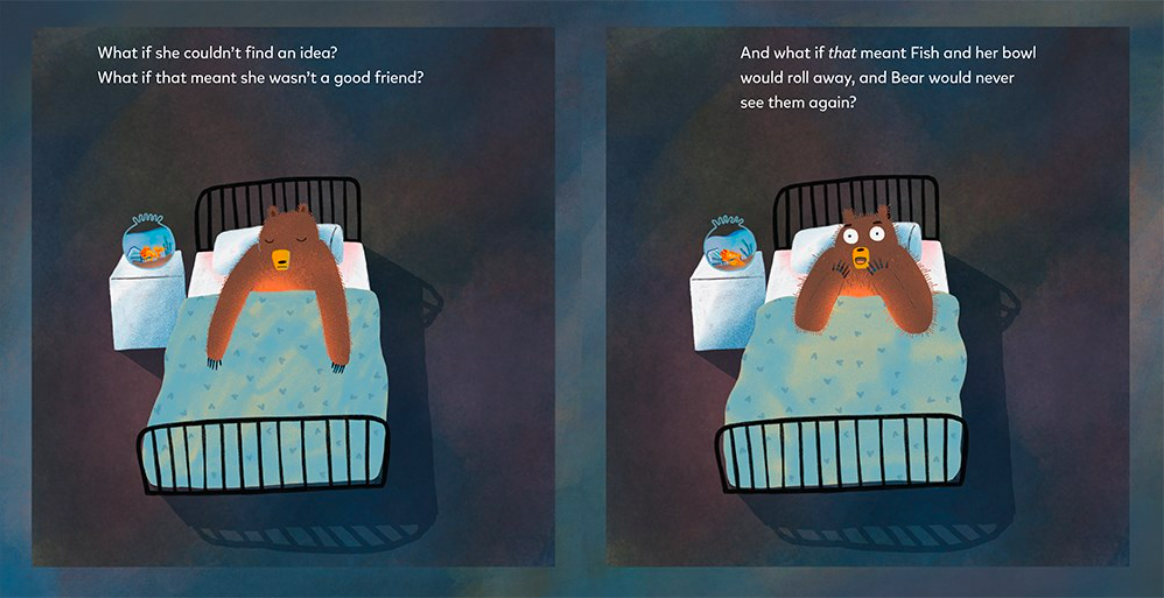
But Fish didn’t want Bear to feel left out, so on Thursday she said that the next day they could do Bear’s idea, “‘Of course, said Bear. ‘My brand-new big idea.'” But Bear was worried. She “didn’t have an idea, not even an old and small idea.” Bear tried to sleep that night, but she was afraid that not having an idea meant she wasn’t a good friend. Would Fish take her bowl and leave? Anxiety muddled Bear’s brain, and all she could think of were now-old ideas.
celebrate-picture-books-picture-book-review-bear's-big-idea-Wednesday

Image copyright Il Sung Na, 2024, text copyright Sandra Nickel, 2024. Courtesy of Carolrhoda Books.

The next morning it was the same. Bear looked everywhere for a brand-new big idea but found nothing. She kept checking in with Fish, asking if she was still there. “‘Always and forever,’ said Fish” with added reassurance. At last, Bear confessed that she couldn’t see an idea anywhere. “‘Don’t worry,’ Fish said. ‘Just because you can’t see something, doesn’t mean it’s not there.'”
celebrate-picture-books-picture-book-review-bear's-big-idea-no-idea

Image copyright Il Sung Na, 2024, text copyright Sandra Nickel, 2024. Courtesy of Carolrhoda Books.

So Bear thought some more, she listened, and she felt the wind whipping up. Suddenly, the air was filled with all of the old things from the past week. As Bear watched the things flying by, she saw it! Her brand-new big idea! She quickly gathered the items together and grabbed Fish’s bowl then rode the sled down to the beach, where she turned those individual items into an ingenious brand-new big idea that even impressed Fish! As pleased as Bear was with her idea, though, she was even happier to discover that good friends were “always and forever there.”
celebrate-picture-books-picture-book-review-bear's-big-idea-sleepless-night

Image copyright Il Sung Na, 2024, text copyright Sandra Nickel, 2024. Courtesy of Carolrhoda Books.

The second book in Sandra Nickel’s Bear and Fish series is a charming story that gently addresses children’s common fears about performance and pressure as well as the nature of friendship itself. Throughout the story, Nickel presents Bear’s conundrum realistically as she first alludes to having a big idea and then worries through the night and part of the next day that she will let down and maybe even lose her bestie because she has no idea at all.

Nickel—through Fish’s encouraging comments and confidence in Bear’s abilities—is always right there, though, with reassurance that children will find comforting in their own life. Nickel’s excellent pacing as well as her metaphorical dark and fog that stymies Bear until her approaching idea clears it away adds depth to the story and shows kids that things such as ideas, learning, self-confidence, and growth come to each person in their own time.

Children will be happy to see Il Sung Na’s fast friends back again in a new adventure. Il Sung’s soft-hued illustrations place Bear and Fish in a whimsically surreal mashup of vegetation from Bear’s forest and Fish’s underwater worlds. Bespectacled, ever-faithful Fish regales Bear with reassuring philosophy from her bowl, but also enjoys a madcap experience of her own thanks to Bear’s big idea. Through Il Sung’s clear depictions of Bear’s emotions, children can empathize with and cheer on Bear while gaining their own sense of self-confidence.

An uplifting, reassuring, and confidence boosting story, Bear’s Big Idea is sure to prompt requests for multiple readings and can spark discussions about feelings of fear, external and internal pressure, true friendship, and using one’s imagination. Bear’s Big Idea would make a valuable addition to home, library, and classroom collections.

Ages 4 – 8

Carolrhoda Books, 2024 | ISBN 979-8765610176

About the Author

Sandra Nickel is a writer of nonfiction picture books for children. Her work includes The Stuff Between Stars, Nacho’s Nachos, and Breaking Through the Clouds. She is the winner of a Christopher Award and holds an MFA in Writing for Children and Young Adults from Vermont College of Fine Arts. When at home in Switzerland, Sandra loves ambling and rambling and eating carrot muffins just as much as Bear and Fish do.

About the Illustrator

Il Sung Na was born in Seoul, South Korea. In 2001, he moved to London to pursue a BFA in Illustration and Animation at Kingston University, where he discovered a passion for children’s books. He completed his MFA Illustration Practice at MICA (Maryland Institute College of Art) in 2015. Il Sung has illustrated several books including Wild Peace, My Tree, and ZZZZ: A Book of Sleep. Currently based in Kansas City, Il Sung teaches illustration courses at KCAI (Kansas City Art Institute) and works on new books.

International Creativity Month Activity
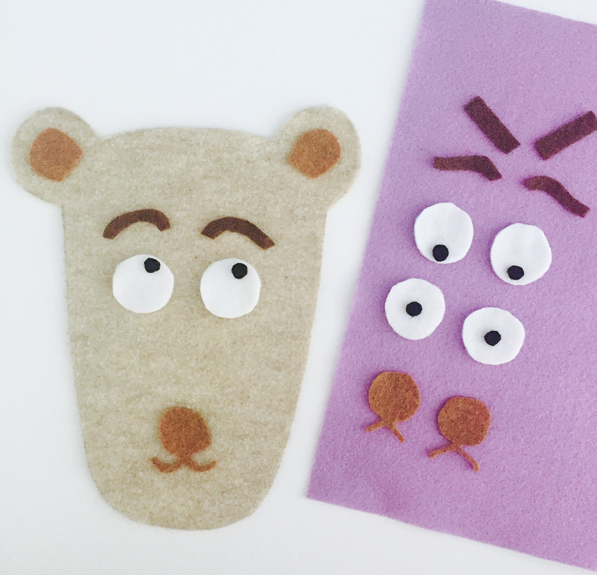
celebrate-picture-books-picture-book-review-bear-craft

Expressive Bear


You can talk about different emotions and feelings or make up your own stories with this Expressive Bear Craft! Use the templates and/or make your own expressive eyes, eyebrows, and nose and mouths. You can also play a game in which the first person to collect all the parts of the bear’s face is the winner.

Supplies

  • Printable Bear Head Template
  • Printable Eyes and Noses Template
  • Printable Eyebrows  and Ears Template
  • Light brown felt or fleece (or color of your choice), 8 ½ x 11 inch piece
  • Dark brown felt or fleece(or color of your choice), 8 ½ x 11 inch piece
  • White felt or fleece, 8 ½ x 11 inch piece
  • Black felt or fleece, for pupils
  • Scissors
  • Glue
  • 1 playing die (optional)

Directions

  1. Print templates
  2. Cut bear head from light felt or fleece
  3. Cut eyes from white felt or fleece
  4. Cut nose and inner ears from dark brown felt or fleece
  5. Cut pupils from black felt or fleece
  6. Glue pupils onto white eyes

Alternatively: Color and play with the paper set

For a Fun Story Time

Give the bear different faces and make up stories of why he looks that way!

To Play a Game

Supplies

  • 1 plastic playing die. Or print this playing die template and draw one of the six facial features on each side.
  • Pencil, pen, or markers (if using printed die template)
  • Cut out, fold, and tape the die together

Directions

  1. Roll the die and follow the instructions below to collect parts of the bear’s face.
  2. The first player to create a full face is the winner.
  • Die dots correspond to:
  • 1—one eyebrow
  • 2—second eyebrow
  • 3—one eye
  • 4—second eye
  • 5—nose
  • 6—inner ears

celebrate-picture-books-picture-book-review-bear's-big-idea-cover

You can purchase Bear’s Big Idea from these booksellers

Amazon | Barnes & Noble | Bookshop (to support your local independent bookstore)

Picture Book Review

November 13 – World Kindness Day

celebrate-picture-books-picture-book-review-touch-the-sky-cover

About the Holiday

World Kindness Day began with a conference in 1997 in which organizations from across the globe met in Japan for the purpose of uplifting and recognizing kindness on a global scale. From this meeting they created a “Declaration of Kindness” and, later, a nonprofit called the World Kindness Movement was formed to support and honor community-scale kindness initiatives. Kindness on any scale, on any day, is important to celebrate. To recognize today’s holiday, we follow a story that shows how just a touch of kindness from another person and a will to persist can help one child reach for the stars and, just maybe, end up touching the clouds. 

Thank you to Carolrhoda Books, an imprint of Lerner Publishing Group, for sharing a copy of Touch the Sky with me for review consideration. All opinions on the book are my own.

Review by Dorothy Levine

Touch the Sky

Written by Stephanie V.W. Lucianovic | Illustrated by Chris Park

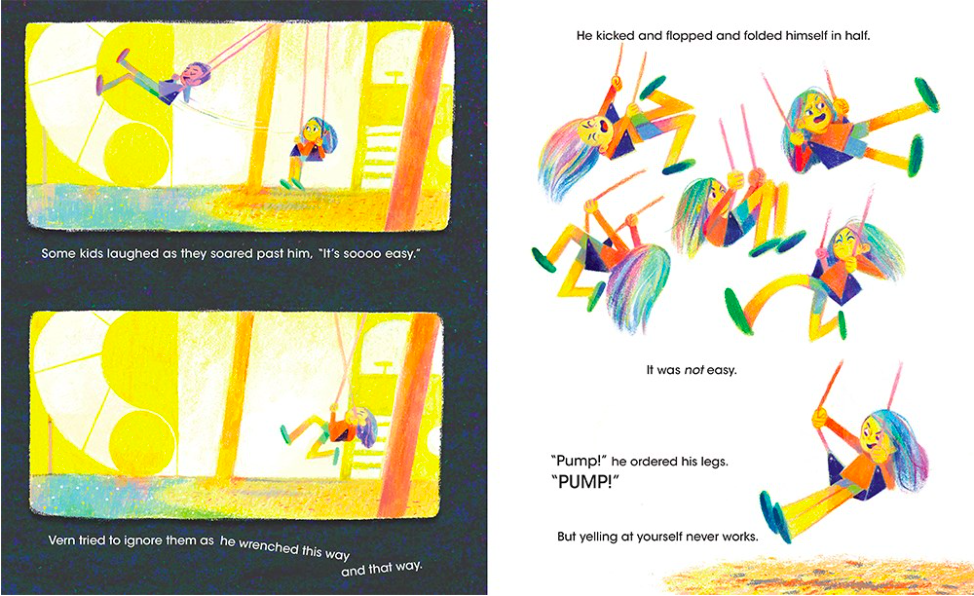
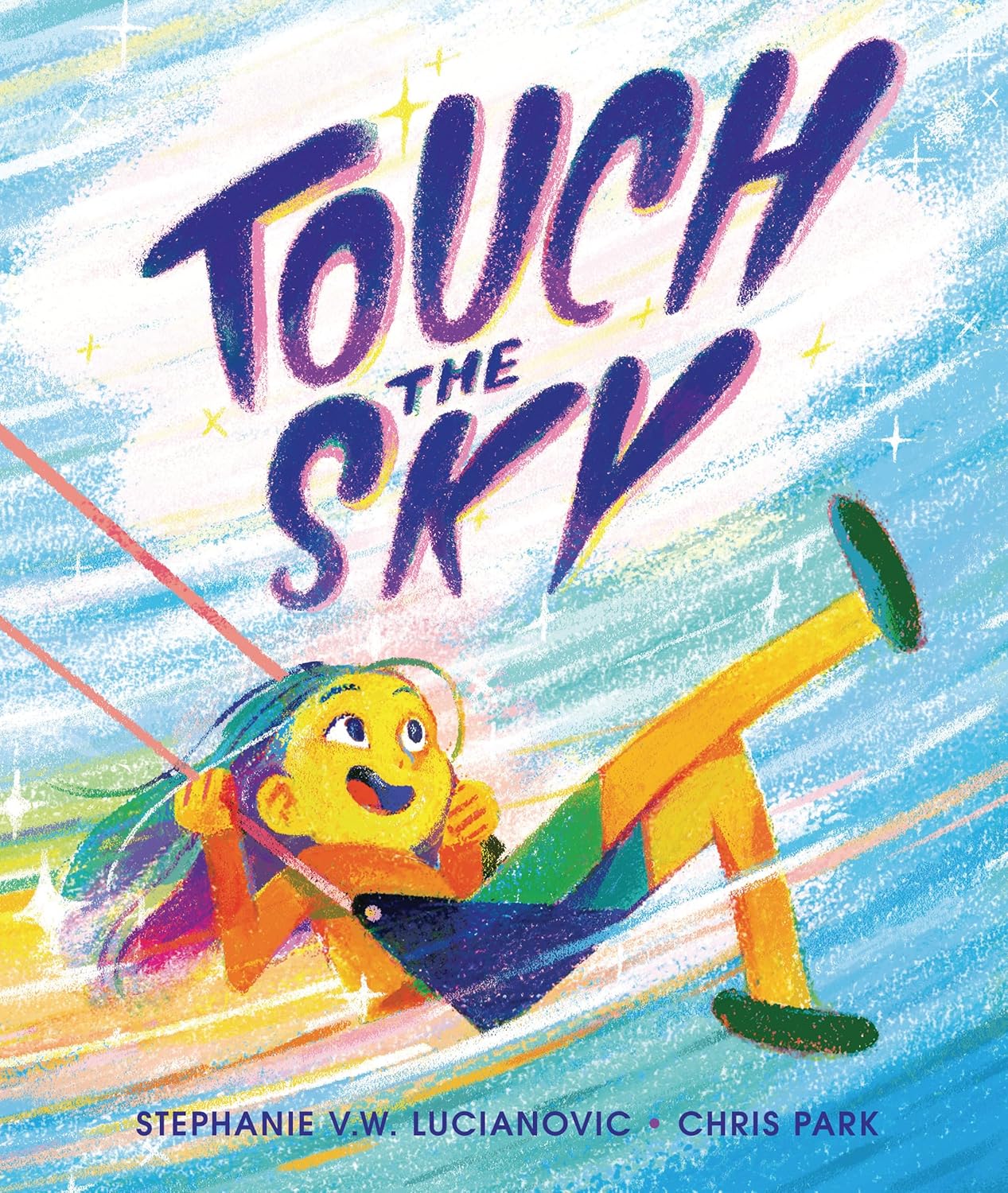
When Vern visits the playground, he yearns to be able to swing like the other children do, “to be one of the kids who swooped until their toes touched the sky.” The only problem is Vern does not (yet) know how to pump. And as much as he tries, yanking his body this way and that, ordering his legs with a scream, nothing seems to work. While Vern tries, other children on nearby swings laugh and swoop by him. 

celebrate-picture-books-picture-book-review-touch-the-sky-Vern-attempts-pumping

Image copyright Chris Park, 2024, text copyright Staphanie V.W. Lucianovic. Courtesy of Carolrhoda Books.

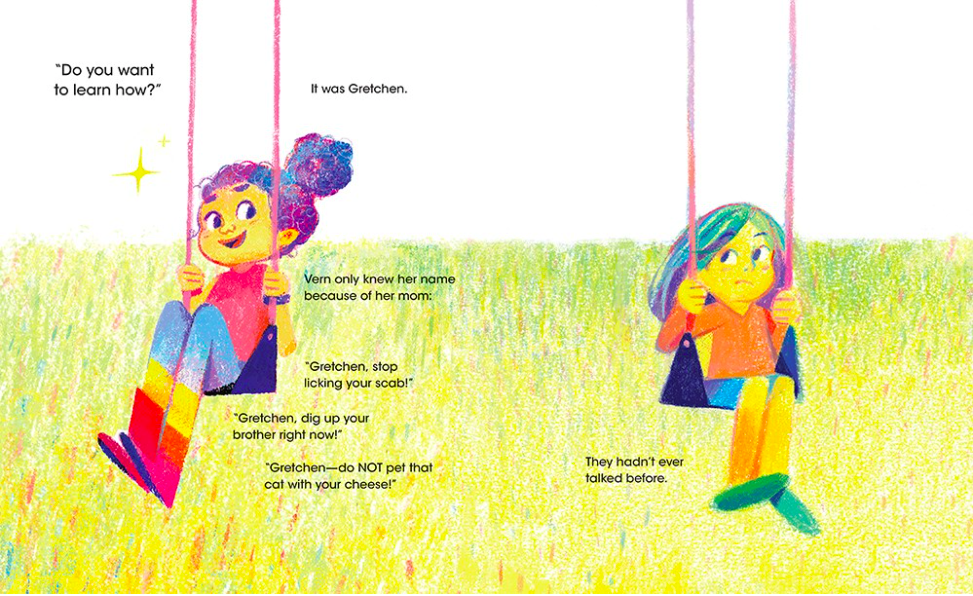
Vern is just about ready to give up, when Gretchen comes along. Even though Gretchen and Vern have never played together, Gretchen confidently snags the swing next to Vern and asks, “Do you want to learn how?”

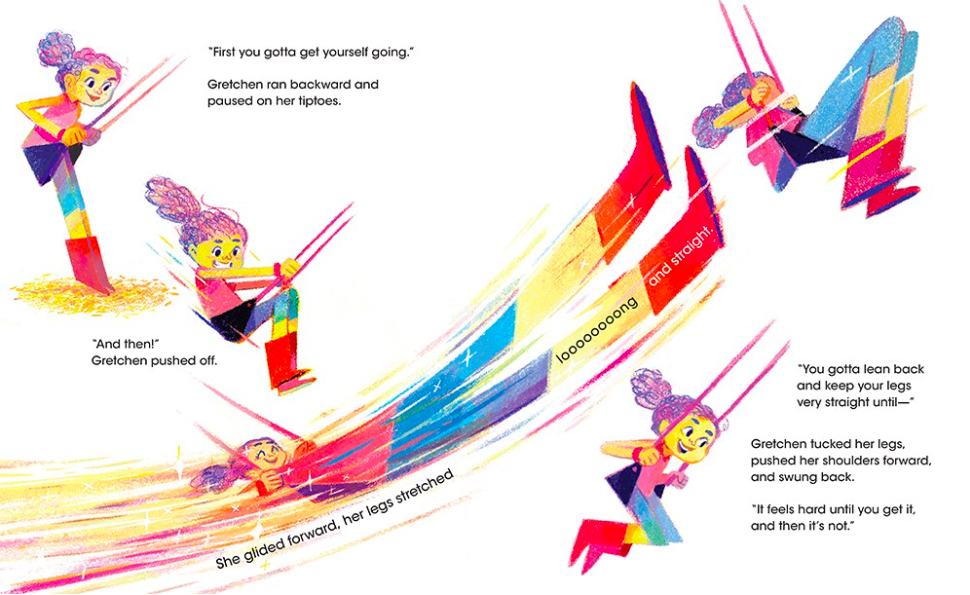
Through many attempts of running, pushing, swooping and trying again, Gretchen coaches and encourages Vern. When her verbal instructions land Vern in the wood chips a few too many times, she switches strategies, standing next to his swing and doing the motions with her own body upright.

celebrate-picture-books-picture-book-review-touch-the-sky-Gretchen-meets-Vern

Image copyright Chris Park, 2024, text copyright Staphanie V.W. Lucianovic. Courtesy of Carolrhoda Books.

Just as Vern starts to make progress, Gretchen must leave. Vern is left with a tough choice: to keep trying on his own or give up. When he decides to continue, the motions Gretchen taught tiptoe down the page along with Vern “Run / Hop / Lean / Stretch / Sweep / Pull / Tuck / Swing” until finally, wonderfully “He [takes] flight with the birds.”

The story then ends with this reminder of the cyclical nature of kindness: After a moment of basking in the meditative motion of pumping, Vern notices another kid in Gretchen’s swing watching him enviously. He repeats what Gretchen said when he felt stuck: “‘It feels hard until you get it, and then it’s not…Do you want to learn how?’”

celebrate-picture-books-picture-book-review-touch-the-sky-Gretchen-teaching

Image copyright Chris Park, 2024, text copyright Staphanie V.W. Lucianovic. Courtesy of Carolrhoda Books.

Touch the Sky brings to light a hurdle (learning to swing) that is common for many young folks but not often discussed in day-to-day life or in a picture book. While some new skills come with lessons (swimming, learning to ride a bike, reading) learning to swing is a challenge that children are often left to master on their own. Lucianovic creatively and accurately captures the process of learning to pump; her verbal instructions are catchy, succinct, and clear to follow. The composition of the words on the page mirrors the learning to pump process—sometimes twisting around like chains of a swing and other times flying colorfully across whole spreads. The story is centered in realistic dialogue, with age-appropriate humorous moments for readers (like when Gretchen’s mother admonishes her for petting a cat with cheese). The story is both literal and lyrical. Sweeping imagery of swinging for the first time adds a thrilling aspect to the tale.

Park’s illustrations add to the magical feeling of first coasting through a new skill. The illustrations are largely in crayon which gives the images a textured, child-like feel, adding a sense of wonder to the scenes. The pages of instructions include zoomed-in panels for readers to watch each step separately. These panels begin jumbled but then sort out into organized squares as Gretchen’s steps to pumping become clearer to Vern. Park’s use of rainbows and tiny stars when Vern’s situation metaphorically and literally begins to look up immerses readers in the journey he takes to “touch the sky.” 

A heartfelt tale of perseverance and kindness that can be appreciated by all who have struggled and received support from unlikely places, Touch the Sky invites readers to keep trying and to offer helping hands to others when they can. The book would be an excellent addition to home, public, and school libraries.

Ages 5 – 9

Carolrhoda Books, 2024 | ISBN 978-1728460451

About the Author

Stephanie V.W. Lucianovic writes books in the San Francisco Bay Area surrounded by a few kids, a few cats, and one husband. Her work includes The End of Something Wonderful, Hello Starand The League of Picky Eaters. Visit her at stephanielucianovic.com.

About the Illustrator

Chris Park has been a professional illustrator for over twelve years. Some of his previous clients include TBS, Team Coco, Rolling Stone, American Greetings Co., Cloudco Entertainment, Pro Publica, Sleeping Bear Press, Usborne Publishing and Lightspeed Magazine. He co-authored and illustrated his the picture books Little Sock and Little Sock Makes a Friend with his wife Kia. Chris lives in Minnesota with his wife and two sons. Visit him at chrispark.com.

World Kindness Day and World Kindness Week Activities

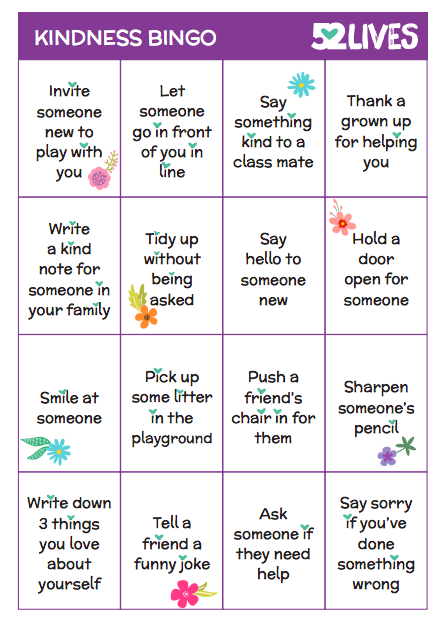
celebrate-picture-books-picture-book-review-school-of-kindness-bingo-card

Courtesy of the School of Kindness.

Kindness Bingo

Invite your child or class to spend World Kindness Day, World Kindness Week, or any day playing Kindness Bingo from the School of Kindness at 52 Lives with this game that includes 30 bingo cards, each containing 16 acts of kindness. Visit the School of Kindness website to learn more about their teaching resources.

Also available for free download is the World Kindness Day Pack, which also includes activities that connect to Anti-bullying week, which this year coincides nicely with kindness week.

celebrate-picture-books-picture-book-review-touch-the-sky-cover

You can purchase Touch the Sky from these booksellers

Amazon | Barnes & Noble | Bookshop (to support your local independent bookstore)

Picture Book Review
September 6 – It’s Friendship Month

celebrate-picture-books-picture-book-review-big-bear-and-little-fish-cover

About the Holiday

Friendship Month was established by the Oddfellows (shortened from The Grand United Order of Oddfellows Friendly Society (GUOOFS)), an international fraternity that dates back to 1730s England with the hope of encouraging people to make friends. Now dedicated to philanthropy and charity, the Oddfellows still promote Friendship Month each September to urge people to spend more time with their friends, get in touch with those they haven’t seen or talked to in a while, and, especially, to reach out to others who are alone or need a friend. As school gets underway, there are plenty of opportunities for kids to meet new people and form friendships – some of which may last a lifetime.

I’d like to thank Carolrhoda Books and Blue Slip Media for sharing a copy of Big Bear and Little Fish with me for review consideration. All opinions on the book are my own.

Big Bear and Little Fish

Written by Sandra Nickel | Illustrated by Il Sung Na


At the fair, Bear approached the basketball game booth, where the grand prize was a huge teddy bear. It was almost as big as Bear, herself. But Bear took away the consolation prize: a goldfish. “It was small. It was very small. It was so small it lived in a bowl.” Bear peered into the bowl, but when Fish woke up and said “‘Hello, Bear. Is this my new home?'”, Bear only nodded, afraid her big voice would scare little Fish.

celebrate-picture-books-picture-book-review-big-bear-and-little-fish-teddy-bear

Image copyright Il Sung Na, 2022, text copyright Sandra Nickel, 2022. Courtesy of Carolrhoda Books.

When lunchtime came, Bear made herself a sandwich with syrup that was as gold as she was. Bear didn’t know what to feed Fish, who was orange and probably liked “carrot muffins … or tangerines and pumpkins.” After lunch, Bear always measured herself. Today, she was over nine feet big! Bear didn’t know how she could measure Fish, so she left home for her regular afternoon walk, wishing – and not for the first time – that Fish was a teddy bear.”

While walking, Bear contemplated how inconvenient Fish might find the outdoors. Things could fall into her bowl and get caught in her tail. If she had a teddy bear Bear thought again, she wouldn’t have to worry about such things as tails. Bear began to regret ever bring Fish home from the fair. When Bear got home again, Fish greeted her with a “‘Hello” and a comment on how much she liked their porch.

celebrate-picture-books-picture-book-review-big-bear-and-little-fish-bowl

Image copyright Il Sung Na, 2022, text copyright Sandra Nickel, 2022. Courtesy of Carolrhoda Books.

In response, Bear gave Fish the bad news that she couldn’t stay. When Fish asked why, Bear laid out her reasons: Fish was orange and ate orange foods; Fish had a tail that made it impossible for her to go on walks with Bear; and finally that Fish was too small. Fish was undaunted. She pointed out that Bear was orange too, and when Bear inspected her belly, she agreed that it “was an orangey sort of gold” kind of “like a carrot muffin.” Fish then added that Bear had a tail, and when Bear looked over her shoulder, she saw a tiny tuft. As to the assertion that she is “small,” Fish was surprised. 

celebrate-picture-books-picture-book-review-big-bear-and-little-fish-hello

Image copyright Il Sung Na, 2022, text copyright Sandra Nickel, 2022. Courtesy of Carolrhoda Books.

“Am I?” she asked then welcomed being measured. She stretched herself out, and Bear measured her: three inches long. Fish was happy with this result; she wasn’t so small after all. “‘I am not one inch. I am not two inches. I am three inches,'” she said proudly. Still, Bear couldn’t get over the idea that Fish was so tiny she had to live in a bowl. 

But Fish was philosophical. “‘Don’t you live in a bowl too?'” she asked. Bear had never thought of it that way before, and as she looked around at the big, blue sky, she suddenly felt small too. Fish reassured her and offered another perspective on physical size compared to how big one could feel inside. Bear considered this and then decided she’d like to take another walk – this time accompanied by Fish. And so they set off in search of a very big carrot muffin.

celebrate-picture-books-picture-book-review-big-bear-and-little-fish-sandwich

Image copyright Il Sung Na, 2022, text copyright Sandra Nickel, 2022. Courtesy of Carolrhoda Books.

In her seemingly odd “fellows” friendship story, Sandra Nickel presents a multi-layered look at what it means to be a true friend. She cleverly offers readers a variety of lenses for them to engage in perspective, from the character’s viewpoints to their own. Bear, alone at home and on her walks, focuses only on herself. At the fair, she wants to win a teddy bear that is a twin to herself but for which she would not need to be responsible in any real sense.

Fish, however, immediately wants to interact with Bear. She talks to him and asks questions. At first, it may seem that Bear will simply ignore Fish, but the idea of her has begun to make Bear think and even worry (here, Nickel creates a complex mix of emotions that invites discussion). Equally thought-provoking are Fish’s counter arguments when Bear tells her she can’t stay. While promoting how similar they are, Fish prompts Bear to reevaluate her view of herself and the world she lives in. Once Bear realizes that she, too, can be considered small and that the full measure of a person (or Fish or Bear) is found inside oneself, she embraces Fish – responsibilities, friendship, muffins, and all.

Il Sung Na plays with perspective and color to subtly guide readers through the stages of this endearing friendship. As Bear walks home from the fair, dejectedly carrying Fish in her bowl, the hilly landscape is washed in shades of blue and the twiggy, leafy, mushroomy vegetation replicates an ocean bottom. This evocative effect continues throughout the book, prompting kids to find other similarities between Bear and Fish and their environments. Readers will also enjoy pointing out examples and comparisons of big and small.

An endearing and thought-provoking story that boosts self-confidence while promoting friendship, empathy, and new perspectives, Big Bear and Little Fish will become a quick favorite on home bookshelves, a go-to book for classrooms, and a must for school and public library collections.

Ages 4 – 8

Carolrhoda Books, 2022 | ISBN 978-1728417172

Discover more about Sandra Nickel and her books on her website.

To learn more about Il Sung Na, her books, and her art on her website.

Dive in to this book trailer for Big Bear and Little Fish!

Friendship Month Activity

celebrate-picture-books-picture-book-review-beanstalk-craft-with-top


Measuring Stick Craft


Bear and Fish loved getting measured. If you’re looking for a unique way to measure how big you are, here’s a craft for you! This nature-inspired measuring stick can keep track of your big and small growth spurts whenever you sprout up. You can even add leaves to record thoughts, favorite things, and other ideas as you age! 

Supplies

  • 50-inch wooden stake, available at craft stores
  • Dark and light green foam sheets or 45 – 50 small wooden leaves, available at craft stores
  • Green paint, light and dark
  • Black marker
  • Paint brush
  • Strong glue
  • Flower pot
  • Oasis or clay
  • Ruler
  • Pencil

celebrate-picture-books-picture-book-review-beanstalk-craft-closeup

Directions

  1. Paint the wooden stake with the green paint, let dry
  2. With the ruler mark the stake in 1-inch increments along the edge of the stake

How to Make the Leaves

  1. If using wooden leaves, paint half light green and half dark green
  2. If using foam, cut 1 3/4-inch-long tear-drop shaped leaves (half from light green foam, half from dark green foam), 45 – 50 or as needed
  3. Cut two larger leaves, one from each color to decorate the top of the stake
  4. Draw a line down the center of each leaf

For Measuring Growth: Write the inch 1 through 45 or higher on each leaf with the black marker, alternating colors

For Recording Ideas: You can write favorite ideas, hobbies, or hopes on the leaves too and measure your growth that way!

How to Attach the Leaves

  1. Glue the leaves to the stake, attaching the odd-numbered inch leaves to the left side of the stake and the even-numbered leaves to the right side of the stake.
  2. Attach half of the leaf to the stake, letting the tip stick out from the side
  3. Glue the two larger leaves to the top of the stake

How to Store Your Yardstick

  1. Put the oasis or clay in the flower pot
  2. Stick the stake into the flower pot to keep it handy

celebrate-picture-books-picture-book-review-big-bear-and-little-fish-cover

To get a copy of Big Bear and Little Fish personalized by Sandra Nickel

Visit Watermark Books to request a signed and personalized copy. When ordering, simply note your desired dedication in the Comments section. Sandra will sign on September 24, 2022, so be sure to order in plenty of time.

You can also find Big Bear and Little Fish at these booksellers

Amazon | Barnes & Noble | Books-a-Million

To support your local independent bookstore, order from

Bookshop | IndieBound

Picture Book Review

February 19 – It’s Nest Box Week

celebrate-picture-books-picture-book-review-rissy-no-kissies-cover

About the Holiday

Nestle in for Nest Box Week! Nest Box Week was founded in 1997 by the British Trust for Ornithology to raise awareness about the widespread loss of habitats for birds. During the week people are encouraged to put up nest box homes to support bird conservation and breeding. The holiday begins on Valentine’s Day, marking the beginning of bird breeding season. To celebrate Nest Box Week, listen closely for backyard birdcalls, look out for local neighborhood birds, read books about birds, or even install your own nest box at home!

Thank you to Carolrhoda Books for sharing a copy of Rissy No Kissies for review consideration. All opinions on the book are my own.

Review by Dorothy Levine

Rissy No Kissies   

Written by Katey Howes | Illustrated by Jess Engle


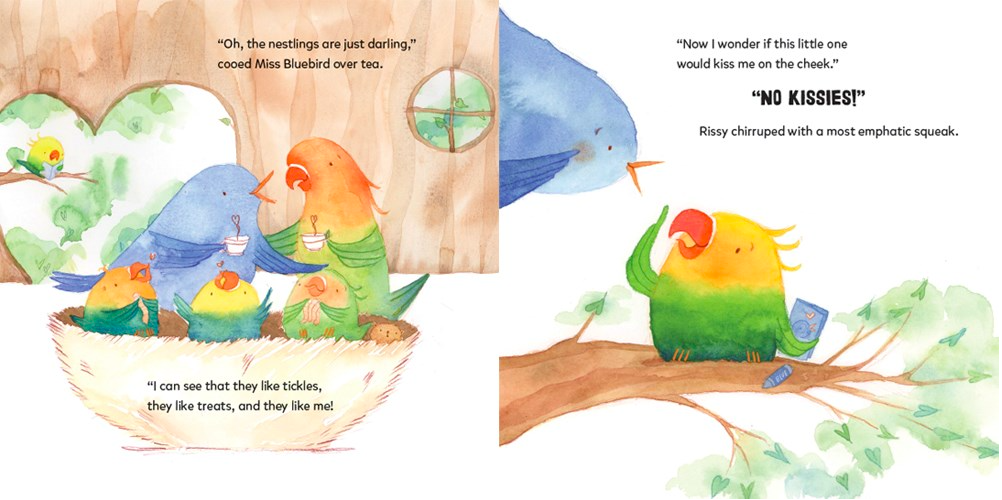
Everybody loves a kiss goodnight, right? Well no, not quite! Rissy the lovebird does not love kisses, even though lovebirds are known for loving to kiss each other. The book begins when Miss Bluebird came over for a visit and tea; she leaned in to give Rissy a smooch on the cheek and, “‘NO KISSIES!’ Rissy chirruped with a most emphatic squeak.”

celebrate-picture-books-picture-book-review-rissy-no-kissies-bluebird

Image copyright Jess Engle, 2021, text copyright Katey Howes, 2021. Courtesy of Carolrhoda Books.

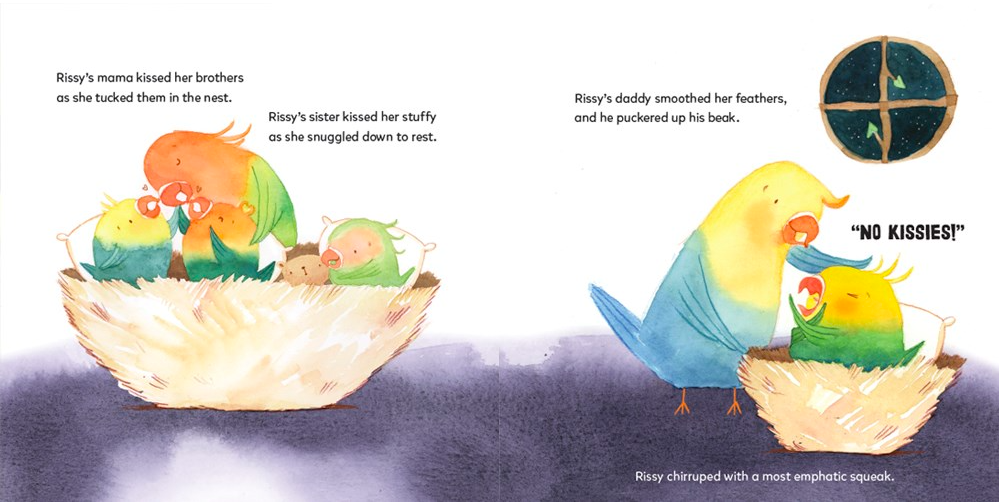
At first everyone laughed, but later as Rissy continues refusing “kissies,” family members are perplexed. They worry Rissy might be confused or coming down with a bug. Grandma Lovebird says, “We know lovebirds all love kisses. I think Rissy’s being rude.” Meanwhile at school, Rissy meets some friendly chick friends, and the three sit and smile and sing together. When Rissy’s friends cuddle in and try to show their love with a kiss, Rissy erupts “NO KISSIES!” once again. Rissy’s friends feel hurt and dejected.

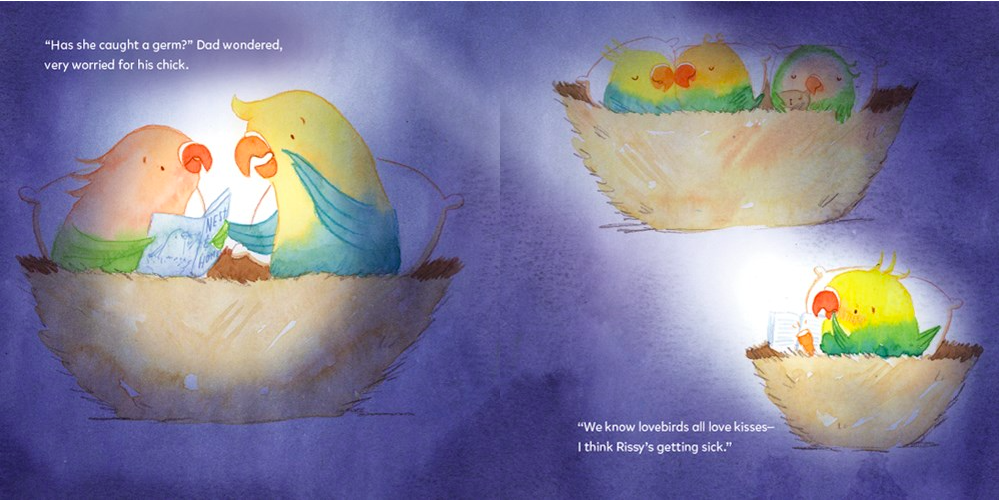
celebrate-picture-books-picture-book-review-rissy-no-kissies-bedtime

Image copyright Jess Engle, 2021, text copyright Katey Howes, 2021. Courtesy of Carolrhoda Books.

Rissy is worried too. She wonders if she’s being mean by refusing kisses. Perhaps if she doesn’t like kisses, she isn’t even a lovebird after all. Rissy tells her mother, “Kissies make my tummy icky. I feel worried, weird, and wrong. If I can’t show love with kissies, then I’ll never quite belong.” But, does Rissy’s not liking kisses really mean she can’t ever show her affection for others? Why of course not! That would be silly. Rissy’s mother comforts her, tells Rissy she’s a lovebird “through and through.” She explains, “Your body and your heart are yours, and you choose how to share. You get to pick the ways you want to show us that you care.”

With this reassurance, Rissy is able to speak up for herself and show others the way she feels comfortable sharing her love. She braces her wings in a heart shape and pulls out a homemade card. While she isn’t one for kisses, she loves to make cookies, sing with friends, give feather fives, and hold wings. She realizes it’s okay – we all like different things!

celebrate-picture-books-picture-book-review-rissy-no-kissies-dad

Image copyright Jess Engle, 2021, text copyright Katey Howes, 2021. Courtesy of Carolrhoda Books.

Author Katey Howes draws on her experience with neuro-diverse children and adults to provide a story that normalizes issues of sensory processing, bodily autonomy, and consent. Rissy is a loveable narrator who will make readers and caregivers alike giggle and smile as the story provides a gentle way to jumpstart conversations about limits and differences.

Jess Engle’s beautiful water-colored lovebirds show clear emotional responses, allowing for kids to easily connect to the feelings in the story beyond just the words. Through subtleties in the pictures, she captures Rissy’s confusion surrounding forms of affection and how lovebirds can show their love. Additionally, the illustrations add depth to the storyline. For example, on the first page Rissy is shown coloring a card with the image of a lovebird and a heart while Miss Bluebird visits with her mother. When Miss Bluebird later admonishes Rissy for refusing a kiss, Rissy’s card appears crumpled and hidden behind her back. The card motif returns at the end, when Rissy declares that making cards is one of the ways she enjoys sharing her love. Together, Howes and Engle have created an accessible story that can help everyone feel loved in a better and comfier way—what could possibly be sweeter?!

Rissy No Kissies provides a platform to empower children to discuss what makes them feel good and how they like to show their love best. With Jess Engle’s gorgeous painted pages and Katey Howes’ singing AB rhyme scheme, Rissy’s story is a joy for all. The book is filled with love, wisdom, kind dialogue, and little hearts brimming from the pages. Following the story there is one note for kids, and another for caregivers; both offer guidance on how to respect one’s personal boundaries and others. Rissy No Kissies teaches that it’s never too early to teach listening and caring practices and the power of consent.

Rissy No Kissies is highly recommended for home libraries and a must for school and public library picture book or family issues collections.

Ages 4 – 9

Carolrhoda Books, 2021 | ISBN 978-1541597983

Discover more about Katey Howes and her books on her website.

To learn more about Jess Engle, her books, and her art, visit her website.

Nest Box Week Activitiescelebrate-picture-books-picture-book-review-consent-heart-coloring-page

Consent Heart Coloring Page & Activities


Love can be shown in so many ways! Share what’s in your heart with this printable coloring page! Parents, teachers, and other caregivers can engage with their kids on the issue of consent with more activities and coloring pages found at SafeSecureKids.org.

Consent Heart Coloring Page

Baby Love Birds

You’ll fall in love with the baby love birds in this video!

celebrate-picture-books-picture-book-review-rissy-no-kissies-cover

You can find Rissy No Kissies at these booksellers

Amazon | Barnes & Noble | Books-a-Million

To support your local independent bookstore, order from

Bookshop | IndieBound

Picture Book Review

June 21 – World Music Day

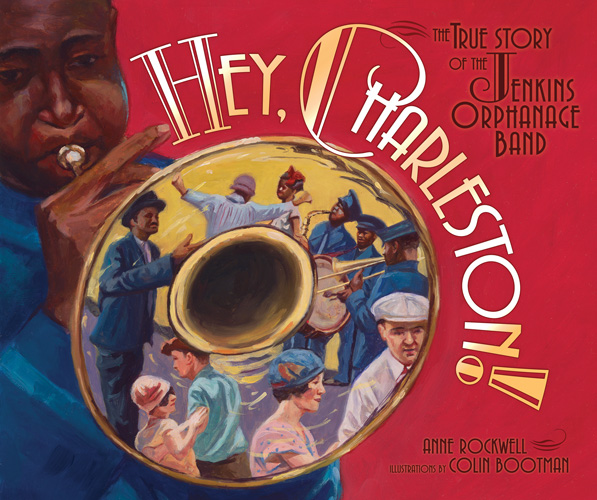
celebrate-picture-books-picture-book-review-hey-charleston

About the Holiday

Celebrated every year on the summer solstice, World Music Day, also known as the Fête de la Musique, brings together professional and amateur musicians to ply their trade and entertain audiences for a day full of sound. The day was first conceived in 1982 by French Minister of Culture Jack Lang, who elicited the help of Maurice Fleuret, the Director of Music and Dance. When Fleuret discovered that half of the nation’s children played a musical instrument, he devised a way to bring people out into the streets for a music festival. Since then, the event has become an international phenomenon, celebrated in more than 700 cities in 120 countries worldwide. To participate consider organizing or attending a  free concert or enjoying music in your favorite way.

Hey, Charleston! The True Story of the Jenkins Orphanage Band

Written by Anne Rockwell | Illustrated by Colin Bootman


“Have you ever known someone who was always trying to turn bad into good, always seeing hope where others saw despair?” This question, which begins the biography of Reverend Daniel Joseph Jenkins and the orphans he loved is as relevant today as it was in the early 1900s, when this story takes place. Reverend Jenkins was the pastor of a small church in Charleston, South Carolina. One night while collecting scrap wood at a railroad yard, he discovered a group of boys huddled and sobbing inside a freight car. Reverend Jenkins took them to his church, fed them, and gave them a warm place to sleep. He knew what it was like to be an orphan because he had been one too.

Soon more orphans showed up at the church door, and Reverend Jenkins accepted them all. Room grew tight so he convinced the city officials to give him an abandoned warehouse for his orphanage. There was just one drawback: the warehouse was next to a prison, where less-than-desirable sounds emanated from the walls. Reverend Jenkins figured out a way to drown out the noise, however. He gathered the orphans and led them in song outside the orphanage door. The kids were good singers, and that gave the reverend an idea.

He had grown up during the Civil War and remembered the marching bands that led the soldiers into battle. He remembered the instruments these musicians carried and asked for any that were now unused to be donated to the children. Instruments poured in! They were polished and tuned and the children learned to play under the direction of the best teachers in Charleston. With the money Reverend Jenkins thought they could make entertaining people, he planned to buy a farm for the orphans.

Soon the Jenkins Orphanage Band was playing on street corners and in other venues. Many of the kids were descended from the Geechee or Gullah people who lived on islands off the coast of South Carolina, and they played the old band music with their own special rhythm, called “rag.” “A couple of Geechee boys would lead the band by doing a dance—twisting and twirling and tapping their toes, knocking their knees, and flapping their arms.” People loved the music, but most South Carolinians were poor and couldn’t donate much to the orphans. Reverend Jenkins decided to take his band to New York City. The band took the city by storm! People loved when the kids played their raggedy music and soon were imitating the Geechee boys’ dance. “Hey, Charleston,” they’d shout, “Give us some rag!” They called the dance “the Charleston,” and soon everyone was doing it.

celebrate-picture-books-picture-book-review-hey-charleston-interior-art

The orphans made so much money they were able to buy a new house, and the music instruction became so renowned that families began paying to have their children taught along with the orphans. The band continued to travel around the United States, and they were even invited to perform in the inaugural parade for President Theodore Roosevelt. Finally, they were able to buy the farm Reverend Jenkins had dreamed of.

In 1914 the Jenkins Orphanage Band was even invited to play for Britain’s King George V at the Anglo-American Exposition in London. While they were there, however, Britain entered World War I. The British government ensured that the band had safe passage back home, but many other Americans were stranded in England. Reverend Jenkins offered to lend these citizens the money needed for them to return home as well.

The ship sailed silently through the dangerous Atlantic Ocean until it reached an American port. Once safe the passengers shouted, “‘Hey, Charleston! Give us some rag!’” Happy to be home, the band tuned up their instruments and played loudly and enthusiastically for the shipboard audience. As the passengers disembarked in New York Harbor, crowds greeted them with a hearty welcome. Back home “as they lay down to sleep that night, those band players knew they had done what Reverend Jenkins always taught them. They had turned bad into good.”

Anne Rockwell succinctly and clearly relays the story of the Jenkins Orphanage Band while also retaining all the heart and soul of this fascinating group of children and their dedicated caregiver. The true-life tale is mesmerizing, not only for the historical details of the growth of ragtime music and the Charleston dance but for the accomplishments of the orphans once given love, acceptance, and education. Rockwell’s conversational tone contributes to the story’s smooth, flowing pace, which will keep listeners or readers rapt from beginning to end.

Colin Bootman’s bold two-page spreads illuminate the sights and sounds of the early 1900s for readers. Emphasizing the personal connections between Reverend Jenkins and the orphans as well as the band and their audiences, Bootman’s vibrant paintings are full of people watching, dancing, marching, and celebrating these boys’ awesome gifts.

Ages 6 – 10

Carolrhoda Books, 2013 | ISBN 978-0761355656

World Music Day Activity

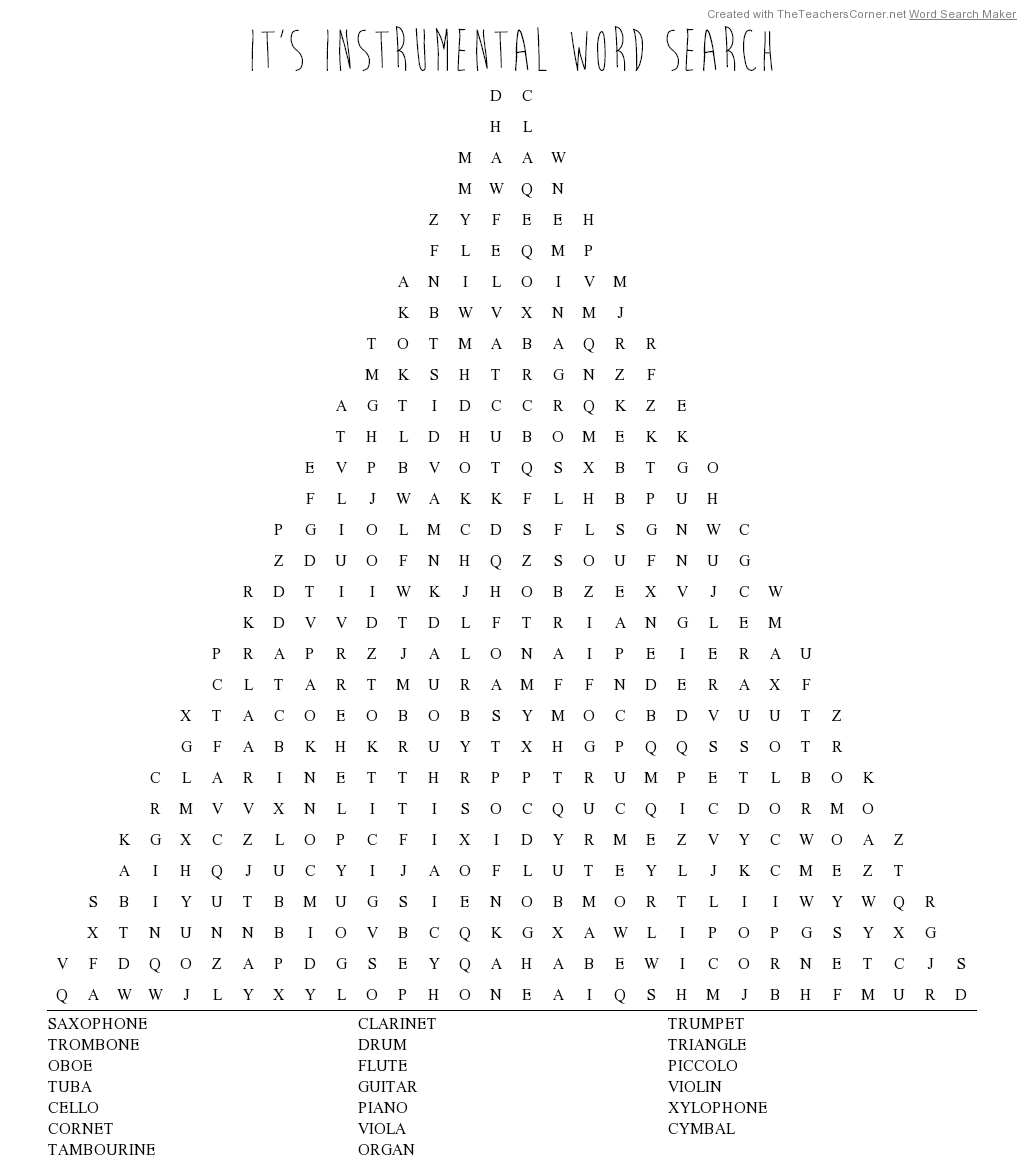
celebrate-picture-books-picture-book-review-musical-instruments-word-search


It’s Instrumental Word Search


Triangles may not get a lot of play in an orchestra, but there’s plenty of play in this printable It’s Instrumental Word Search that contains the names of 20 instruments!