November 17 – Get Ready for Hanukkah

About the Holiday

For children, preparations for Hanukkah are full of magic and wonder, and finding books that mirror their excitement can make the holiday even more special. Today’s book sparkles with an imaginative spin on the eight nights of Hanukkah and its the traditions of light, remembrance, and giving. 

Thank you to Orchard Books for sharing a digital copy of this book with me for review!

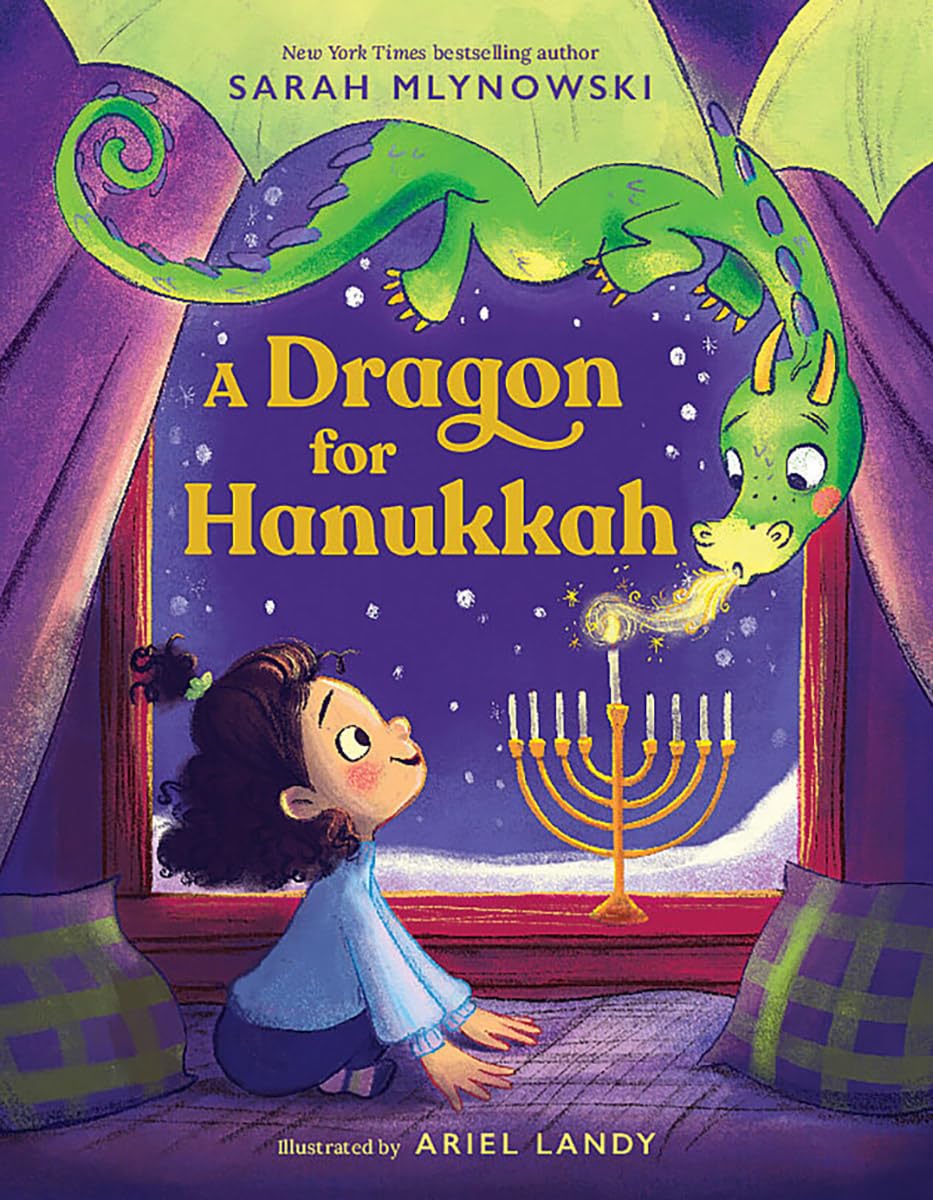
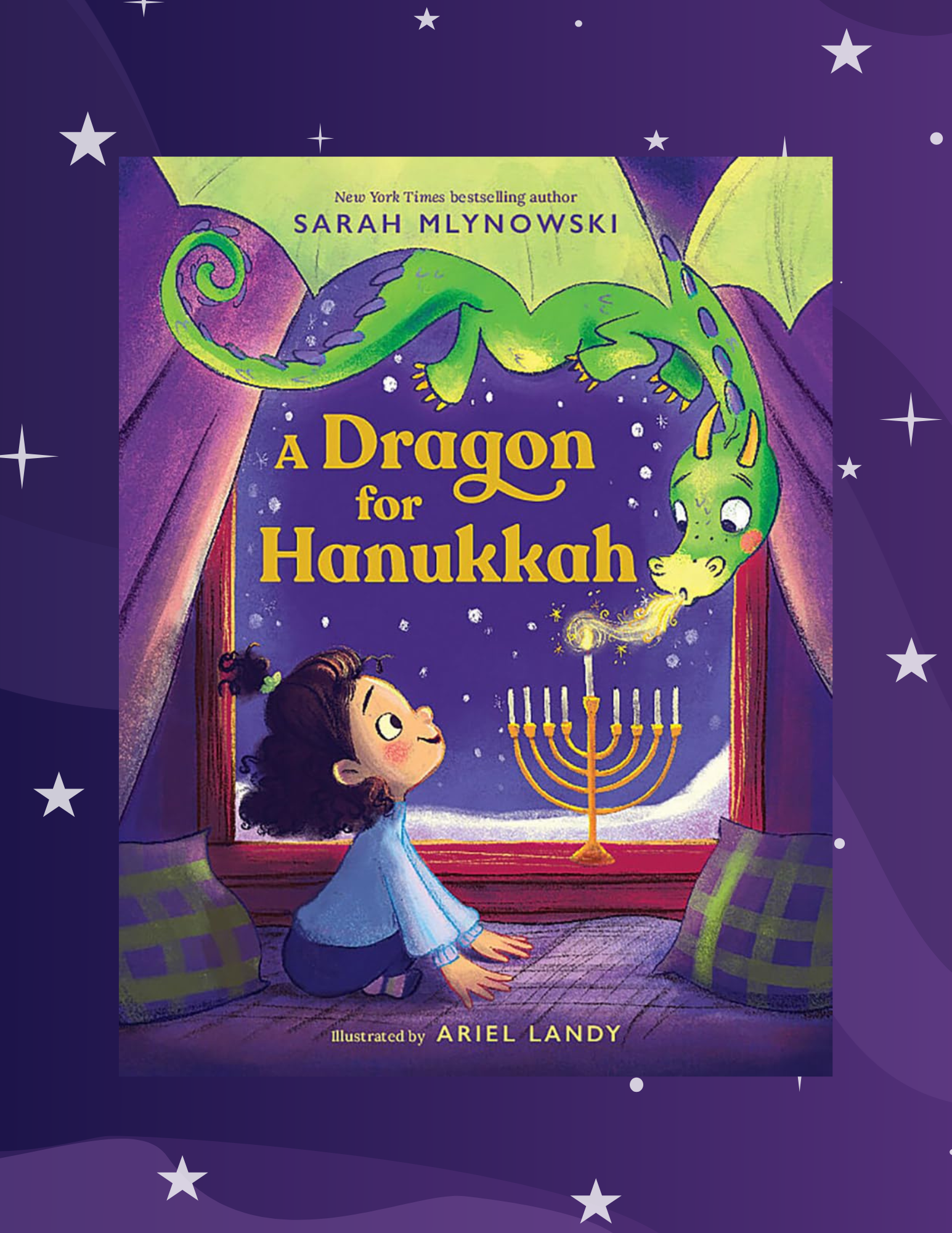
A Dragon for Hanukkah

Written by Sarah Mlynowski | Illustrated by Ariel Landy


A girl, excited to be celebrating Hanukkah with her family, invites readers along as she receives gifts on nights one through seven. On the first night of Hanukkah, her parents give her a baby dragon, whom she calls Nerry and allows to sleep on her bed. On the second night, her Bubbie gives her a rainbow that sweeps her from her room and down the stairs, through the kitchen and out the door, where Nerry catches her before she slides away.
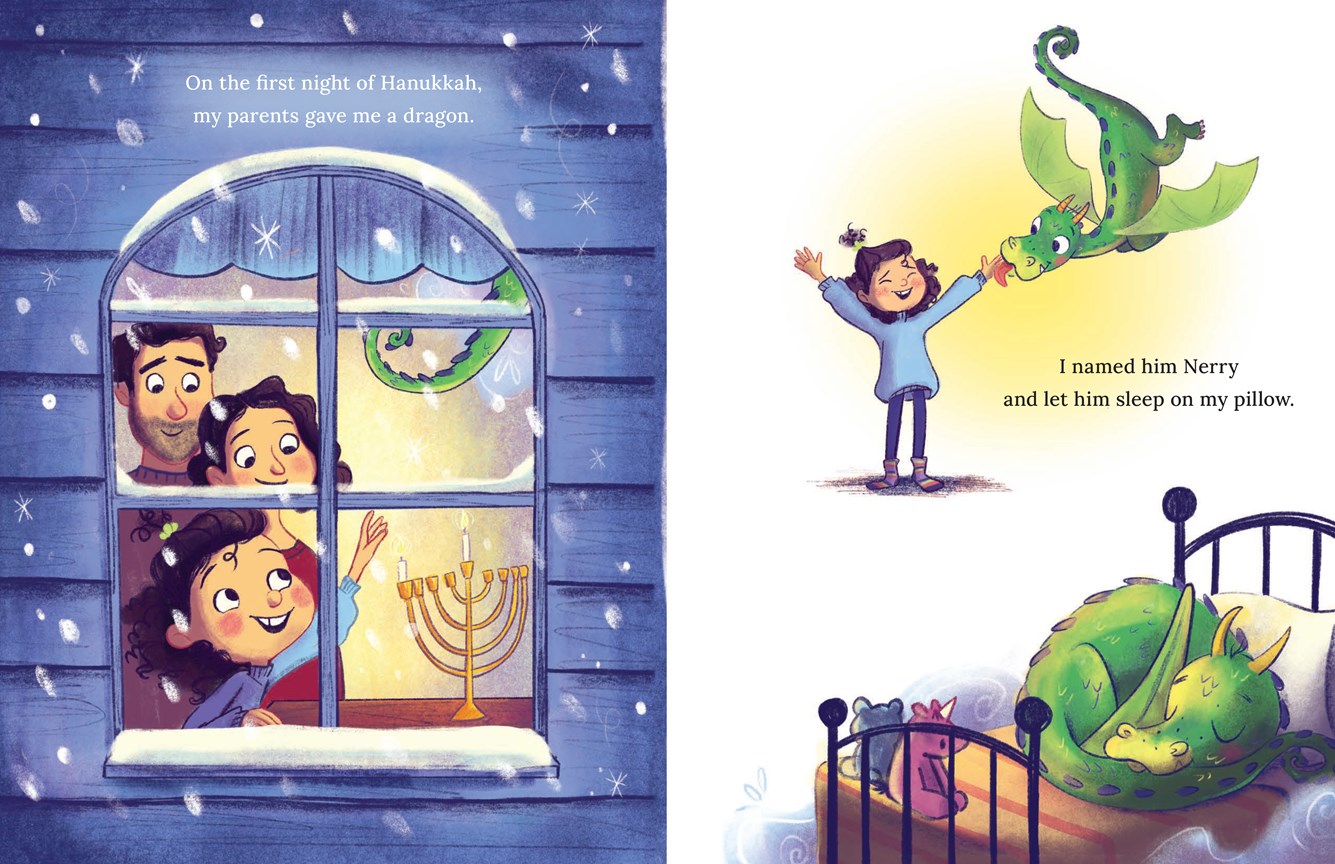
Illustration © 2024 Ariel Landy. Text © 2024 Sarah Mlynowski. Courtesy of Orchard Books.

She receives a treasure chest full of gold and gems, a merry-go-round from her best friend, and a time machine from her cousin that transports them “back two thousand years” to meet the Maccabees. On the sixth night, her Zaidie gives her rocket boots, and on the seventh night, her younger brother presents her with her very own unicorn. Actually it was three energetic unicorns, including a baby that liked to eat socks.

But it’s the eighth night that the girl has been looking forward to the most. On that night, it’s her turn to give gifts, and she’s cooking up a tasty treat. All finished in the kitchen, she heeds her mother’s call to clean up her room. She places her new stuffed dragon on her bed for nap time, returns a rainbow of crayons to their box, spins her dreidel one more time before placing it next to a bowlful of gelt, slides “The Story of Hanukkah” back onto the bookshelf, stuffs her starry socks in the drawer, and hangs up the unicorn pictures from her brother. Then “because it’s a time for giving,” she fills a Tzedakah donation box with toys and books.
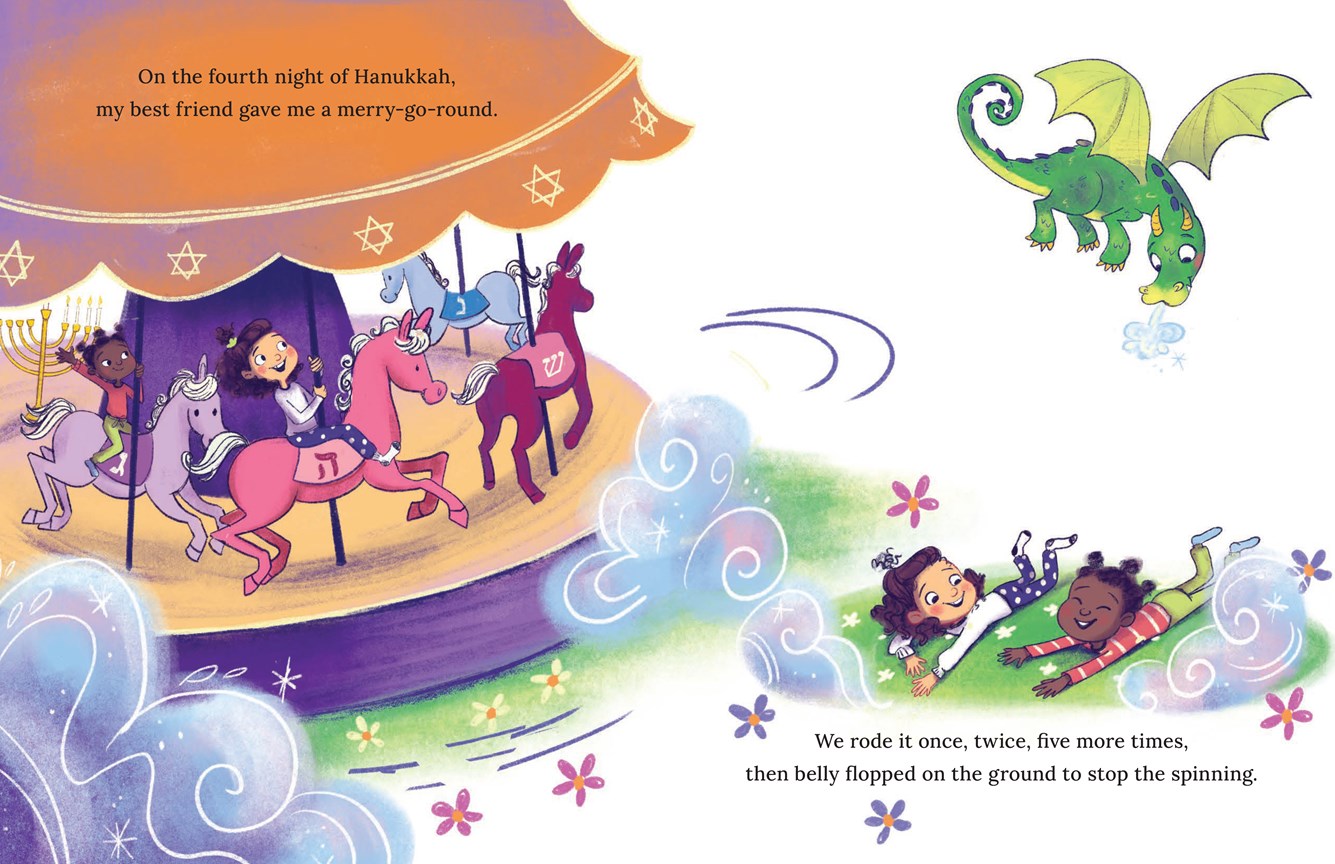
Illustration © 2024 Ariel Landy. Text © 2024 Sarah Mlynowski. Courtesy of Orchard Books.

Soon it’s time for dinner and her family and friends gather around the table to “sing songs, play dreidel, and eat latkes, the tasty treat [she] made.” And, she says’ it is doing these things “which makes this last night, the eighth night, the most magical night of Hanukkah.”

Following the story, the girl and Nerry engage in a dialogue about the history of Hanukkah, how to play dreidel, giving gifts, traditional Hanukkah foods, and even where the dragon’s name comes from.
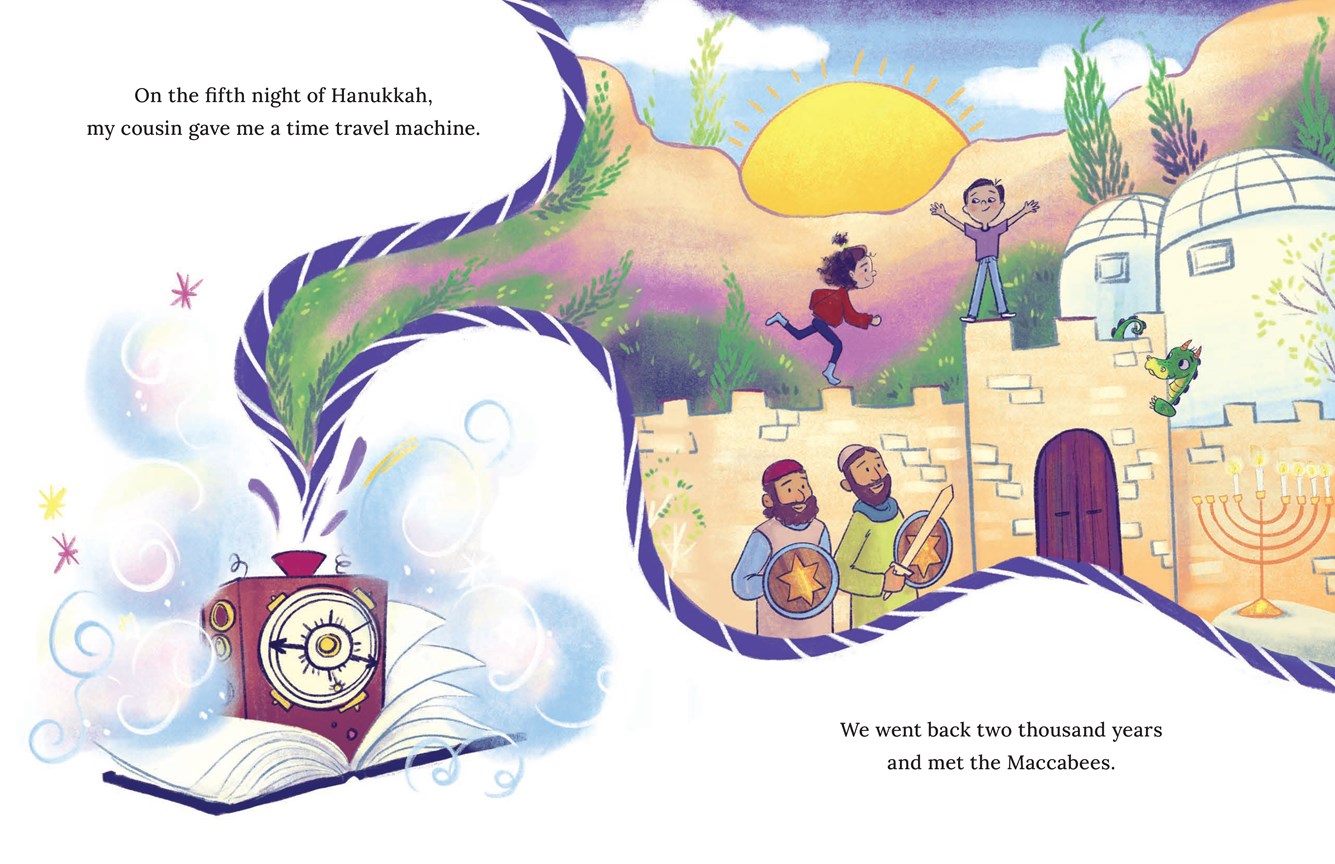
Illustration © 2024 Ariel Landy. Text © 2024 Sarah Mlynowski. Courtesy of Orchard Books.

Sarah Mlynowski blends imagination and tradition in her clever and enchanting story that immerses children in the joy, meaning, and excitement of Hanukkah. While readers logically know that a living dragon, full merry-go-round, or unicorn can’t really be a gift, Mlynowski’s twist when the girl begins cleaning her room comes as a delightful surprise. Her inclusion of a tzedakah box extends the idea of giving past the holiday in a way that resonates with children.

Ariel Landy’s exuberant illustrations sweep kids into the story and keep them riveted to see each new gift, from sweet Nerry to those rambunctious unicorns as well as the real gifts that so charm the little girl. Landy’s vibrant colors, warm tones, and wealth of details will keep children lingering over the pages as they celebrate Hanukkah with the young girl who is excitedly taking part in and contributing to the holiday. On subsequent readings, kids may enjoy pointing out clues to the true nature of some of the imaginative gifts.

A Dragon for Hanukkah is sure to be a favorite for those who celebrate Hanukkah, have family or friends who do, or who want to learn more about the holiday. This book would make a much-loved gift and addition to home and library collections.

Ages 4 – 8

Orchard Books, 2024 | ISBN 978-1338897524

About the Author

Sarah Mlynowski is the New York Times and USA Today bestselling author and coauthor of over fifty books for teens, tweens, kids, and adults, including the Whatever After series, the Best Wishes series, and the Upside-Down Magic series, which was adapted into a Disney Channel movie. Originally from Montreal, Sarah now lives in Los Angeles with her family. Visit her online at sarahm.com.

About the Illustrator

Ariel Landy has been illustrating her whole life, starting with crayon portraits of her cats, dogs, and hamsters. She is the illustrator of the Good Dog series and picture books such as Gitty and Kvetch. Originally from Boston, she currently lives in the south of France with her family. Her favorite Hanukkah song is “I Have a Little Dreidel”. Visit her at ariellandy.com.

Get Ready for Hanukkah Activities
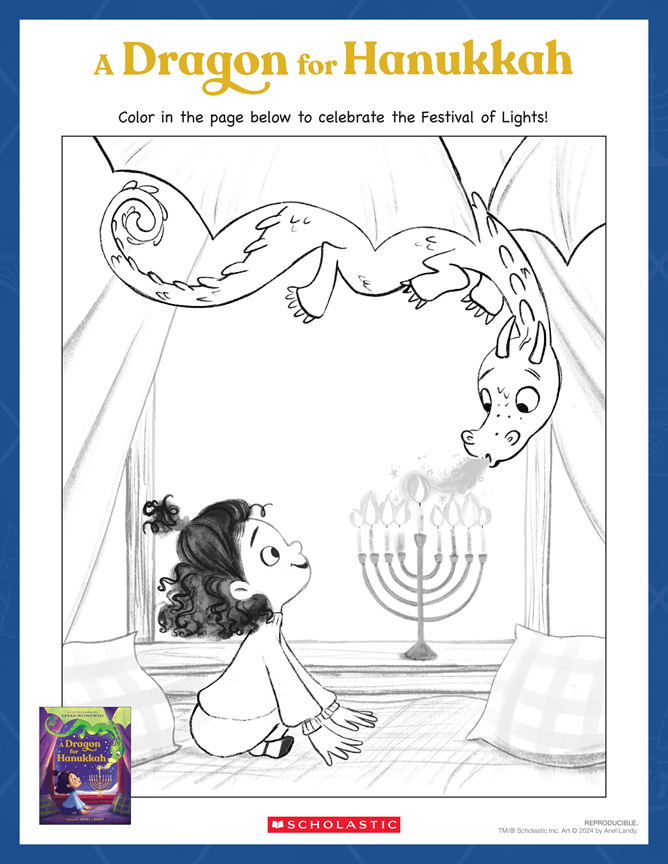
Illustration © 2024 Ariel Landy. Text © 2024 Sarah Mlynowski. Courtesy of Orchard Books.

A Dragon for Hanukkah Coloring Page and Puzzle


Children can enjoy these fun activities from Orchard Books/Scholastic while they look forward to celebrating Hanukkah!

A Dragon for Hanukkah Coloring Page | A Dragon for Hanukkah Word Search
You can purchase A Dragon for Hanukkah from these booksellers

Amazon | Barnes & Noble | Bookshop

Picture Book Review

March 12 – Get Ready for Passover

About the Holiday

Passover, or Pesach in Hebrew, is one of the most sacred Jewish holidays and celebrates the Jews’ liberation from slavery in Egypt and their freedom as a nation under Moses. The holiday begins on the fourteenth day of the Hebrew month Nisan and continues for seven days in Israel or eight days outside of Israell. The holiday begins with a seder meal, for which family and friends gather to remember their history, have symbolic dishes, and celebrate the joy of freedom. Games for children, a reading of the Exodus story, and other meaningful traditions also mark the holiday.

Thank you to Random House Books for Children and Barbara Fisch at Blue Slip Media for gifting me a copy of Next Year in the White House for review.

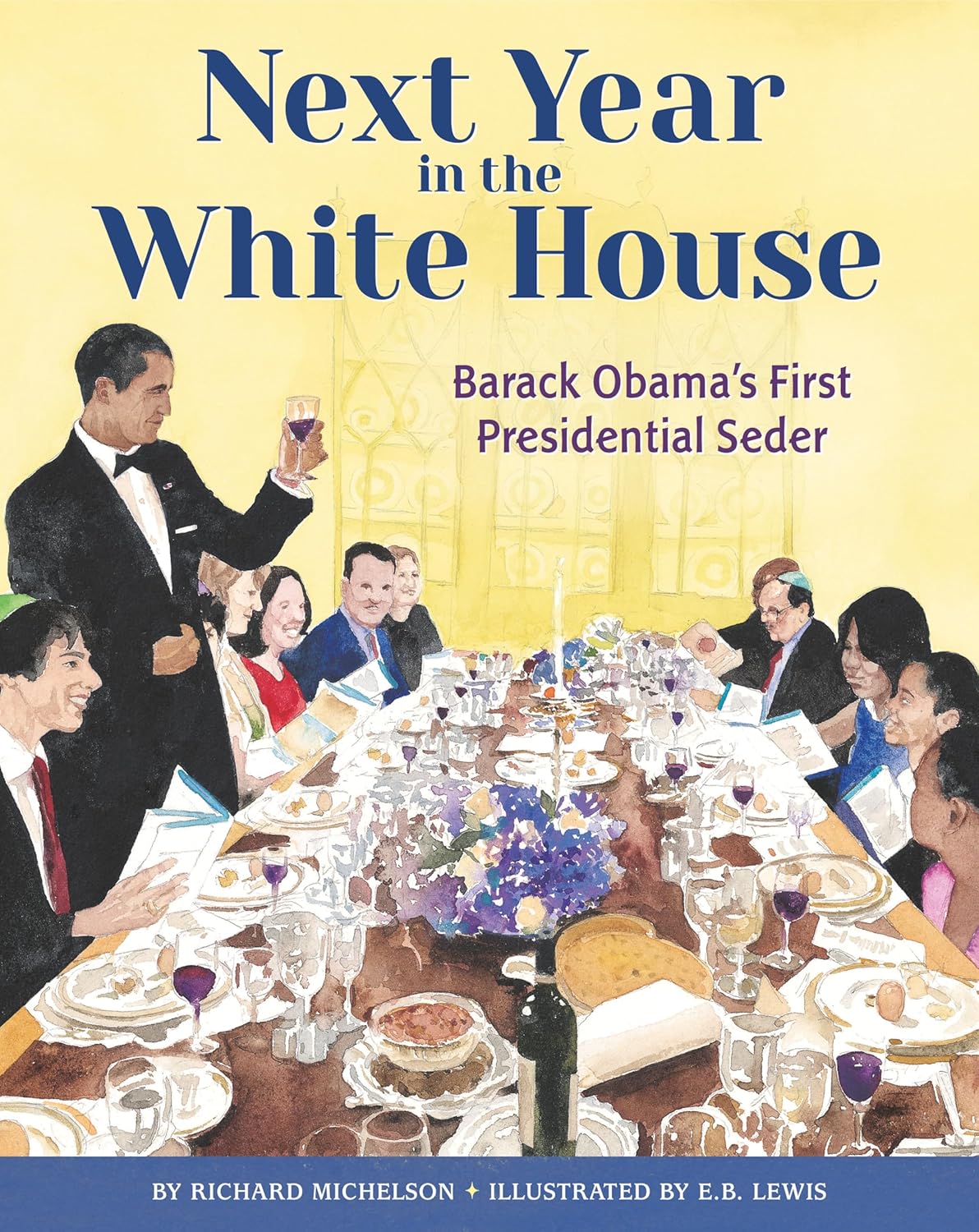
Next Year in the White House: Barack Obama’s First Presidential Seder

By Richard Michelson | Illustrated by E.B. Lewis


Review by Dorothy Levine


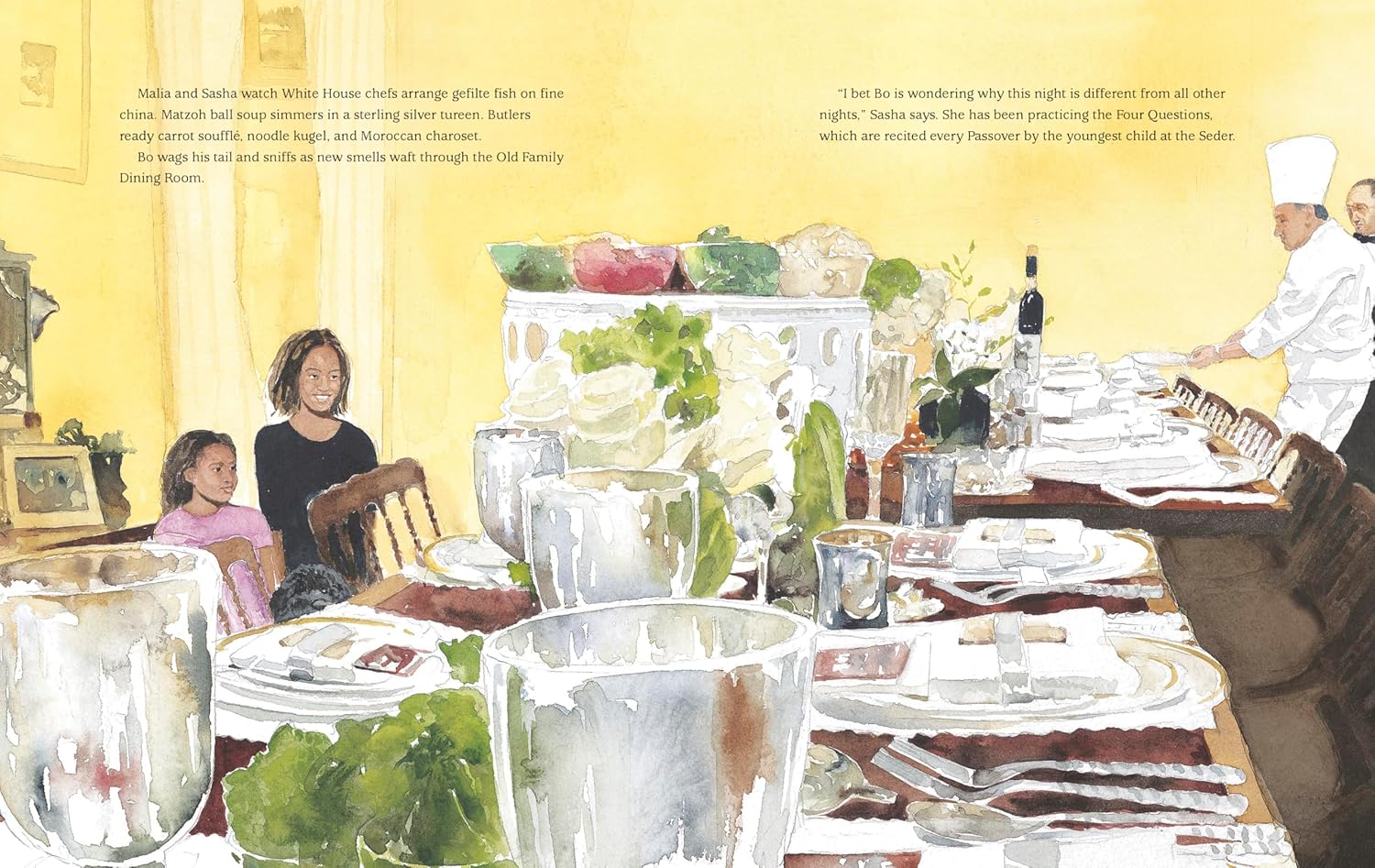
“Malia and Sasha watch White House chefs arrange gefilte fish on fine china. Matzoh ball soup simmers in a sterling silver tureen…Bo wags his tail and sniffs as new smells waft through the Old Family Dining Room.”

Michelson’s story begins right in the action, with everyone preparing for the White House Seder. Barack Obama’s daughter Sasha says, “I bet Bo is wondering why this night is different from all other nights.” She is jokingly referencing the four questions recited by the youngest child in a Passover seder. And why is this night different, you may be wondering? Read on to find out! 

Illustration © 2025 by E.B. Lewis, text © 2025 by Richard Michelson. Courtesy of Random House Children’s Books.

When Eric, Arun, and Herbie set out on the campaign trail with Senator Obama as he ran for president in 2008, they did not expect to find themselves seated in the White House celebrating Passover for the next eight years. These young men joined the campaign trail in hopes that “they could help [Obama] make America a place where all people—regardless of their race, gender or religion—would have an equal opportunity to succeed.” But, “helping others doesn’t mean you don’t get homesick, or hungry, or tired.”

Holidays are especially a time when homesickness can hit for folks far from home. And this was the case for Eric, Arun, and Herbie. When Passover came around, they decided to have their own Passover ceremony, or Seder, in the basement of the hotel where they were staying. The trio managed to snag some matzoh, macaroons and Manishewitz wine along with Haggadahs (booklets of the prayers, songs and story of Passover) to tell the story of Passover—the exodus of enslaved Jews in Egypt who escaped through a parting sea to freedom, one of many miracles that ensured their eventual getaway. “Tonight, they would celebrate the sweet taste of freedom and pledge not to rest until all people are free.”

Illustration © 2025 by E.B. Lewis, text © 2025 by Richard Michelson. Courtesy of Random House Children’s Books.

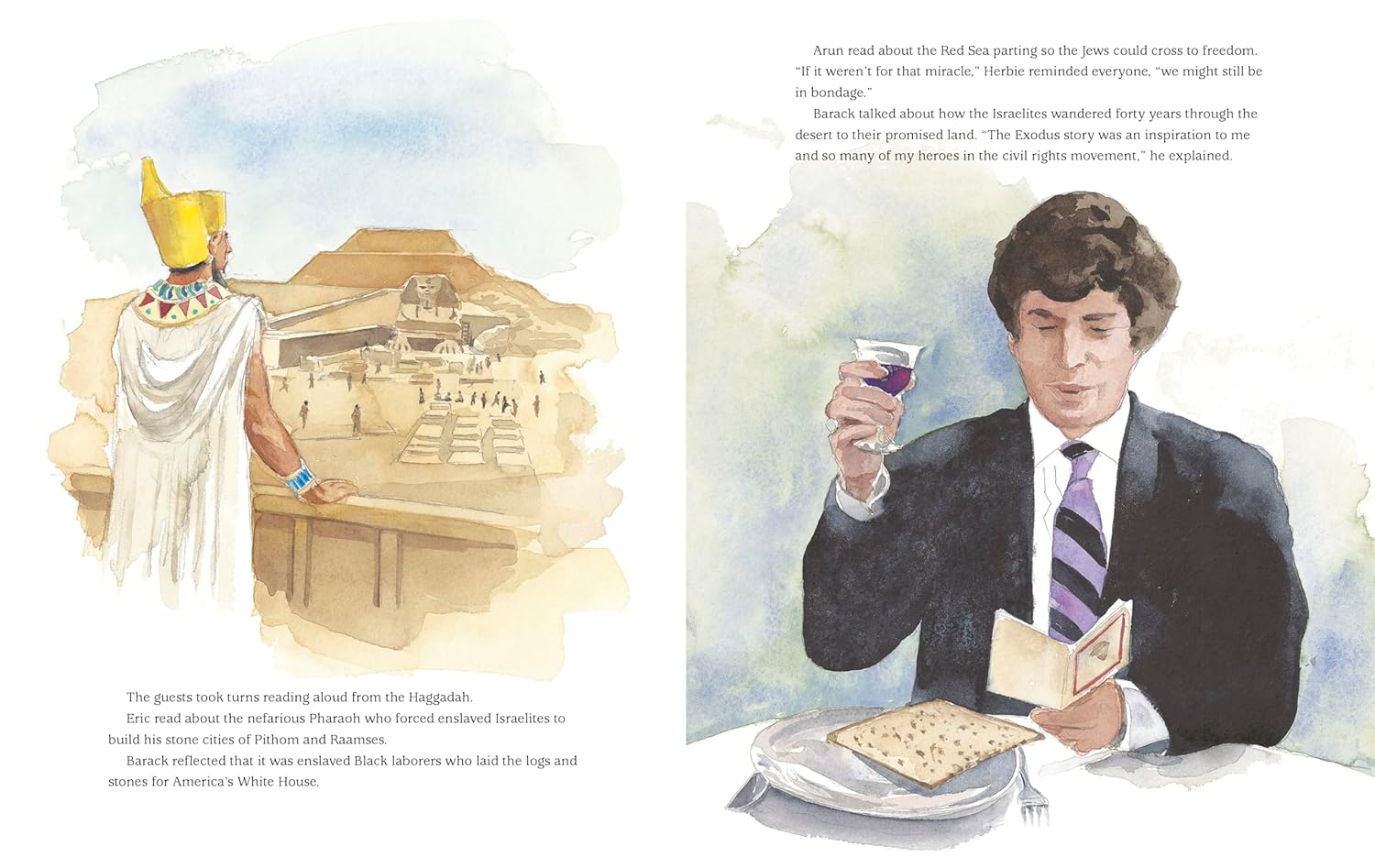
When the three young men rose for the tradition of letting the prophet, Elijah, in through the door they were surprised to find Barack Obama on the other side, requesting to join the gathering. Obama brought to the table connections between the Passover freedom tale and the civil rights movement—how activists throughout time have drawn from the Passover pilgrimage in their protests and speeches. He told of how enslaved Black laborers were the ones who carried the first building blocks for the White House, like how the ancient Pharaoh had made the enslaved Israelites build his stone cities. When Eric called out a traditional Passover expression “Next year in Jerusalem,” a phrase that has come to signify hope for a better tomorrow, Barack replied, “Next year in the White House!”

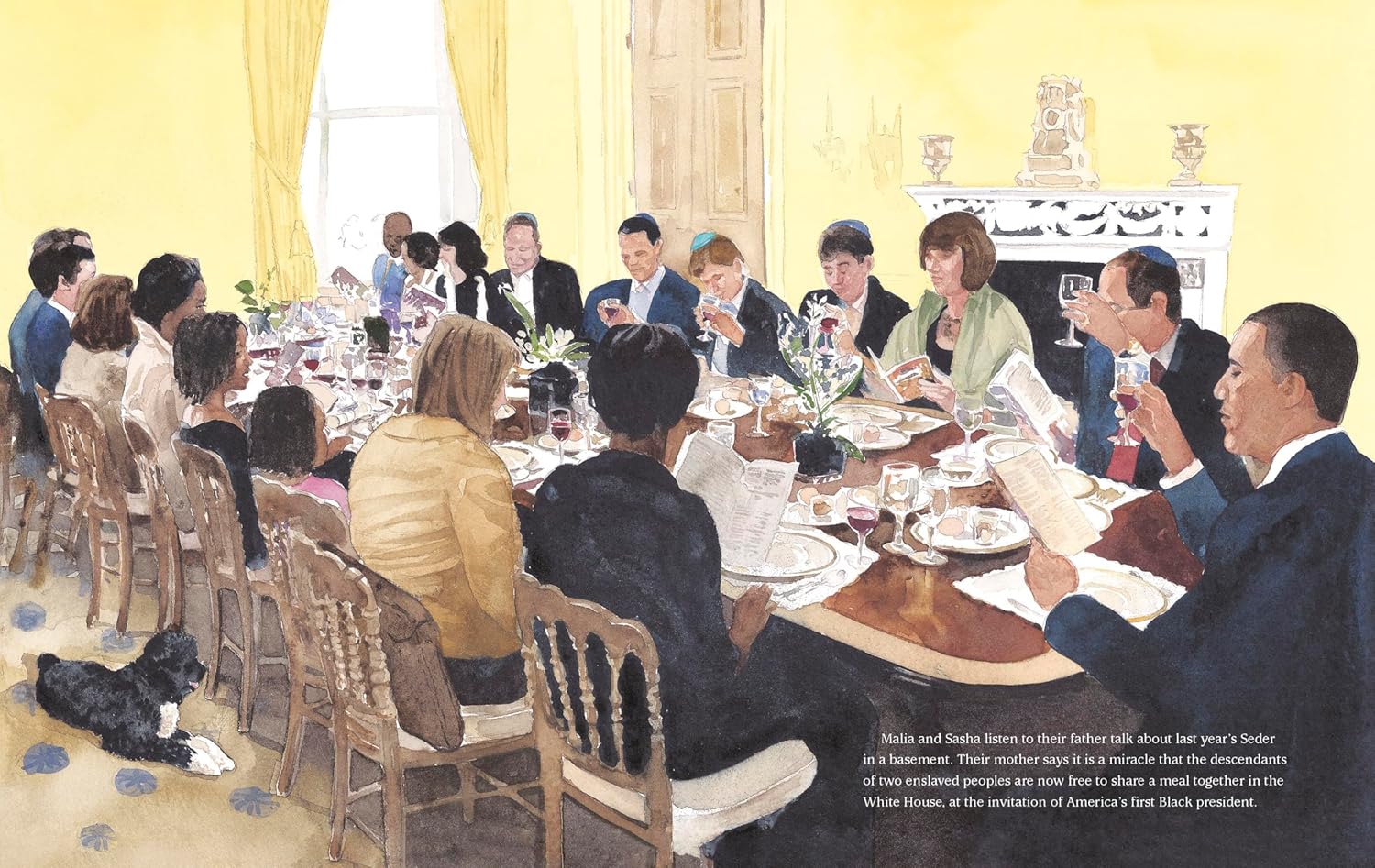
In the following pages, we return to the prologue scene of the book—a description of the first White House Seder, performed in 2009, hundreds of years after both the first White House Christmas and Easter ceremonies. We read of two previously enslaved peoples joining together in resistance and solidarity, to celebrate in the historic White House, where neither group would have been invited years ago. We learn about the traditional Passover foods and games for children—such as piping hot matzoh ball soup and the race to find the afikomen, a hidden piece of matzoh wrapped in a special cloth. And we’re invited in as dozens of people gather to celebrate and cherish the holiday’s call of freedom. When the prize for finding the hidden afikomen is a dog toy for Bo, Sasha remarks, “Now Bo definitely knows why this night is different from all other nights.”

Illustration © 2025 by E.B. Lewis, text © 2025 by Richard Michelson. Courtesy of Random House Children’s Books.

Richard Michelson’s writing is thought provoking, lively and packed with themes of hope and resilience interspersed with knowledge of the Passover traditions. The story contains many references to Passover phrases and themes, such as the call for the homesick, tired, and hungry to come eat and the four questions, which are both part of Passover prayers and motifs shared in Michelson’s story.

Michelson adds a prologue scene to draw readers in, as well as extensive back matter including: a note from Herbie Ziskend, Eric Lesser, and Arum Chaudhary; an annotated page of the Haggadah used at the first White House Seder; more information about the attendees and connections between Black History and Passover; a detailed explanation of Passover traditions; and a special Passover dessert recipe from Arun. His writing instills a sense of social justice, with undertones of the importance of intersectional empowerment and unity.

E.B. Lewis’s signature watercolor spreads bring the book to life with distinctly recognizable characters displaying detailed facial expressions and richly colored backgrounds. Readers will feel immersed in the comradery of the dinner table scenes and the crowds at protests and campaign speeches. The illustrative masterpiece depicting the parting of the sea in the background when Eric, Arun, and Herbie retell the Passover story will inspire awe and mystery. Close-ups of each of the characters also intersperse text and larger detailed scenes. When Arun, Herbie, and Eric are introduced, they each receive their own small illustrative snapshot, as these three unlikely characters become center stage for a Passover miracle story.

Next Year in the White House brings a unique and important historical moment to light and a new story to the table to re-read time and time again, as is tradition with the Passover tale. 

Ages 4 – 8+

Crown Books for Young Readers, 2025 | ISBN 978-0593711583

About the Author

Richard Michelson is a poet, children’s book author, and art dealer whose children’s books have been listed among the 10 Best Books of the Year by The New York Times, Publishers Weekly, and The New Yorker; and among the 12 Best Books of the Decade by Amazon.com. He has been a finalist for the Massachusetts Book Award, the Harlem Book Fest Wheatley Award, and the National Jewish Book Award, as well as receiving two Skipping Stones Multicultural Book Awards, a National Parenting Publication Gold Medal and an International Reading Association Teacher’s Choice Award. In 2009 Michelson received both a Sydney Taylor Gold and Silver Medal from the Association of Jewish Librarians, the only author so honored in AJL’s 50 year history. Michelson received his 2nd Silver Medal in 2017 and his 2nd Gold Medal in 2018. Additionally, Michelson won the 2017 National Jewish Book Award. Michelson is the owner of R. Michelson Galleries, the host of Northampton Poetry Radio, and the current Poet Laureate of Northampton. Massachusetts. You can learn more by visiting him at richardmichelson.com and on Facebook.

About the Illustrator

E.B. Lewis has illustrated over seventy books for children, including the New York Times Best Illustrated Book Award, Kirkus Best Illustrated Book Award, and the Golden Kite Honor Award winner Jabari Asim’s Preaching to the Chickens as well as the Caldecott Honor Award Winner, Jacqueline Woodson’s Coming on Home SoonHe is also a five-time Coretta Scott King winner.
Presently, Lewis teaches at the Pennsylvania Academy of Fine Arts. He is also a member of The Society of Illustrators in New York City, and an artist member of Salamagundi Art Club of New York. Learn more about E.B. Lewis and his work at eblewis.com.

Get Ready for Passover Activity

8 Days of Activity Plans from 18 Doors


Celebrate Passover with your family and these Activity Plan Ideas from 18 Doors! For each of the 8 Days you’ll find a song or video, a craft, and a recipe to help you have a fun Passover!

You can purchase Next Year at the White House from these booksellers

Amazon | Barnes & Noble | Bookshop (to support your local independent bookstore)

Picture Book Review
February 25 – Get Ready for Passover

About the Holiday

Passover is the Jewish spring festival that celebrates the Jews’ liberation from slavery in Egypt. The holiday begins on the fourteenth day of the Hebrew month Nisan, which is the first ecclesiastical month and occurs in March or April. Passover is observed for seven days in Israel and for eight days for Jewish people living outside of Israel. The holiday begins with a seder meal, at which family and friends gather to remember their history, eat symbolic dishes, and celebrate the joy of freedom. This year Passover is celebrated from April 12 – 20.

Thank you to Kar-Ben Publishing for sharing a digital copy of Zayde Babysits before Passover with me.

Zayde Babysits before Passover

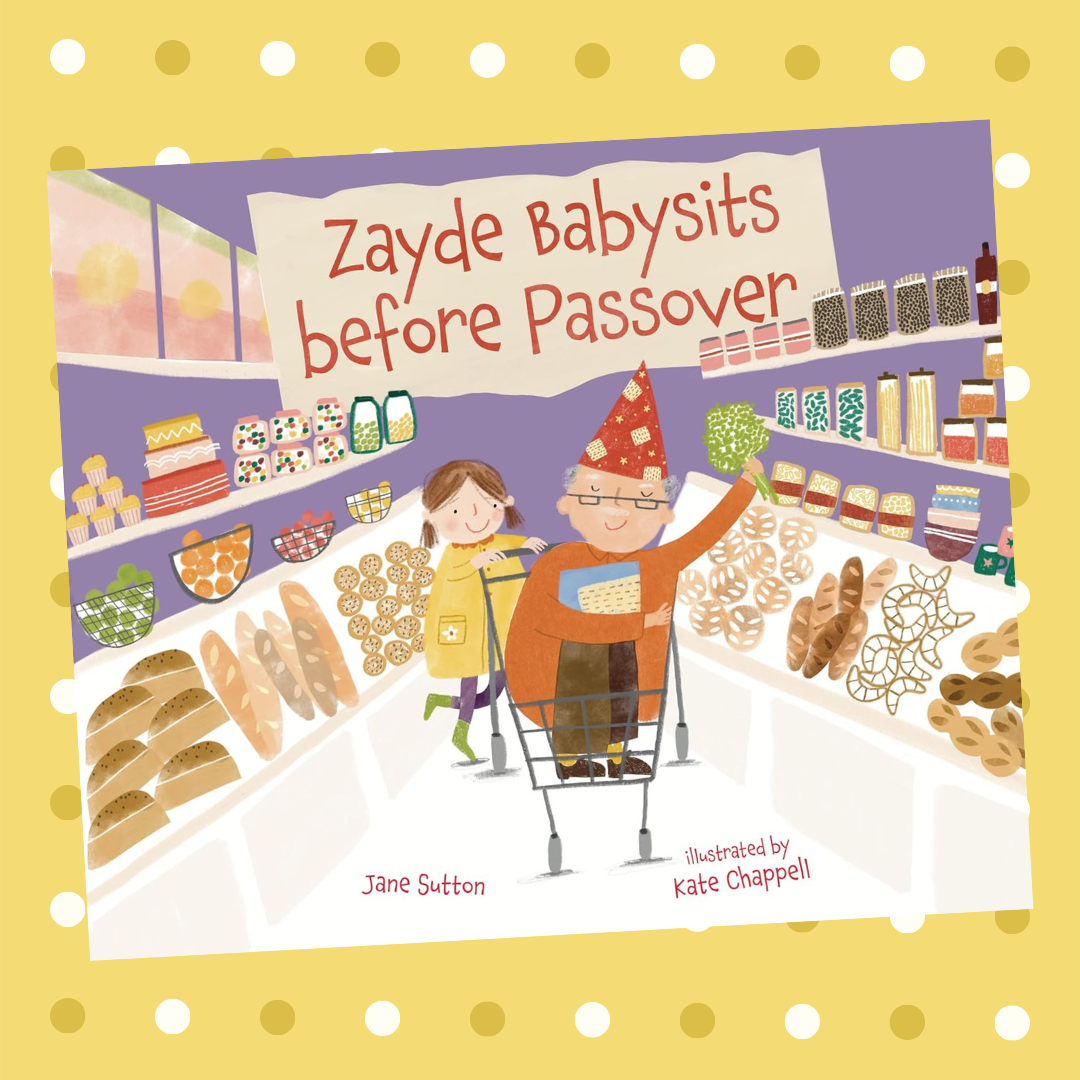
Written by Jane Sutton | Illustrated by Kate Chappell


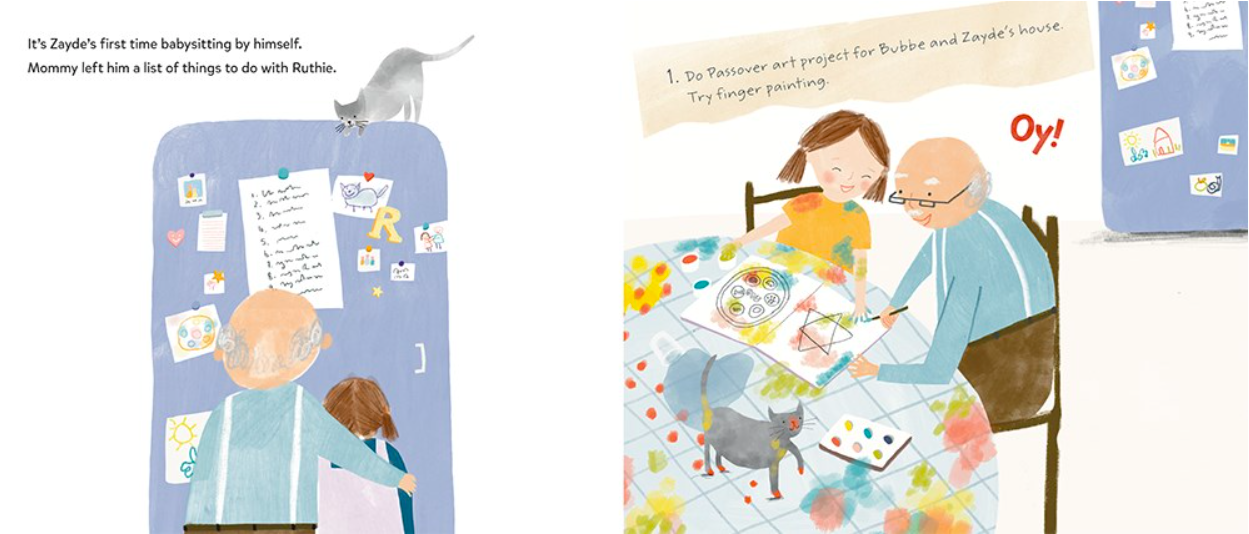
While Ruthie’s mommy and daddy go to Bubbe’s house to prepare for Passover, Zayde is staying with Ruthie at her house. It’s the first time Zayde has ever babysat Ruthie, but he doesn’t have to devise fun activities, or think up places to take her because there’s a long list of tasks to be accomplished stuck to the refrigerator.

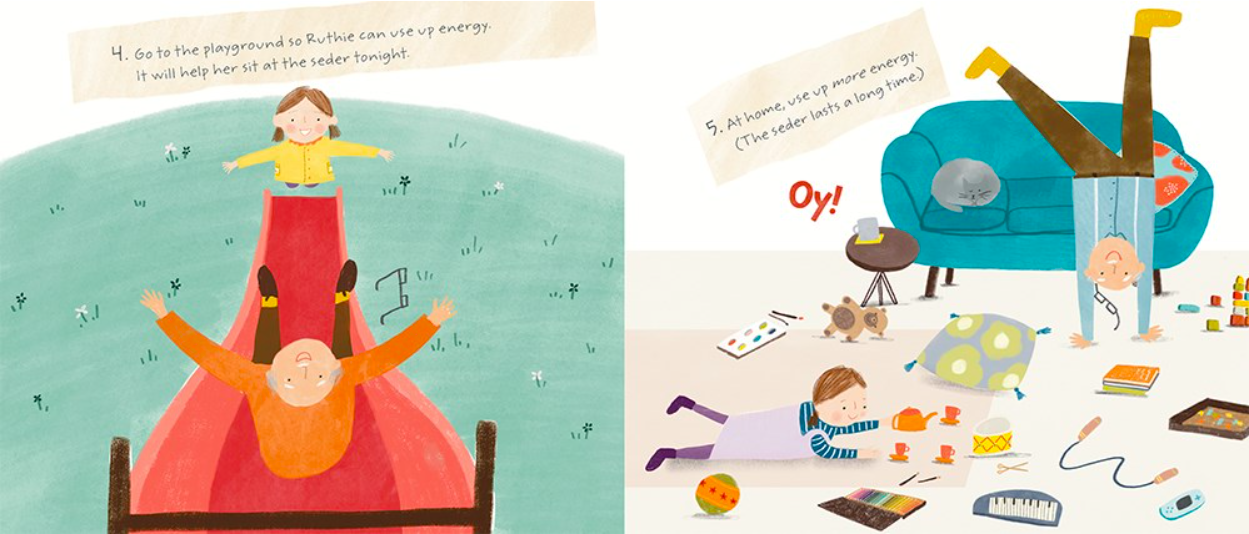
First on the list is to make a few Passover decorations for Zayde and Bubbe’s house. Ruthie’s mommy has suggested finger painting. “Oy!” exclaims Zayde, as the paint escapes the paper onto the tablecloth and Ruthie’s shirt, and even the cat, who joins the fun with some paw painting. The next chores on the list take Ruthie and Zayde into town—to the grocery store for parsley and to the playground “so Ruthie can use up energy” and sit still at the seder later that night. But who’s riding in the cart and who’s slipping down the slide?

Illustration © 2025 Kate Chappell, text © 2025 Jane Sutton. Courtesy of Kar-Ben Publishing.

Back home, Zayde’s been instructed to use up more of Ruthie’s energy, but here, too, who’s doing what is topsy-turvy. Even sweeping up any missed breadcrumbs in the kitchen finds Ruthie pulling Zayde out from under the cupboard. And when Mommy said they should eat a big lunch because dinner will be late, did she really mean that mountain of food? 

Following nap time and bath time, Ruthie and Zayde leave to meet up with the rest of the family. With Zayde leading the seder, it comes off without a hitch. “Ruthie asks the Four Questions. She sings ‘Dayenu’ and hums along with the other songs.” Bubbe’s matzah ball soup is yummy, and Ruthie even “finds the afikomen. Yay!” After everyone leaves, Ruthie tells Zayde she had fun that day and asks if he’ll babysit again. Of course Zayde’s answer is “‘I can’t wait!'”

Illustration © 2025 Kate Chappell, text © 2025 Jane Sutton. Courtesy of Kar-Ben Publishing.

Jane Sutton’s endearing, family Passover story is riotous fun as first-time babysitter Zayde goes all in while fulfilling his pre-Passover seder chores. Kids will enjoy chiming in with Zayde’s exclamations of “Oy!” as things go amiss and will love learning Passover traditions as they spend time with Ruthie and Zayde around town and at home. The burgeoning relationship between Zayde and Ruthie warms the heart.

Kate Chappell’s charming illustrations, juxtaposed with Sutton’s straightforward storytelling, bring to life Zayde and Ruthie’s playful antics and will have kids giggling from page to page. Images of the family’s Passover celebration are uplifting and tender.

A madcap and joyful story for families to share at Passover and whenever grandparents and grandkids get together, Zayde Babysits before Passover would make a wonderful gift and addition to home bookshelves as well as a delightful choice for school and public libraries.

Ages 4 – 9

Kar-Ben Publishing, 2025 | ISBN 979-8765619889

A Chat with Jane Sutton

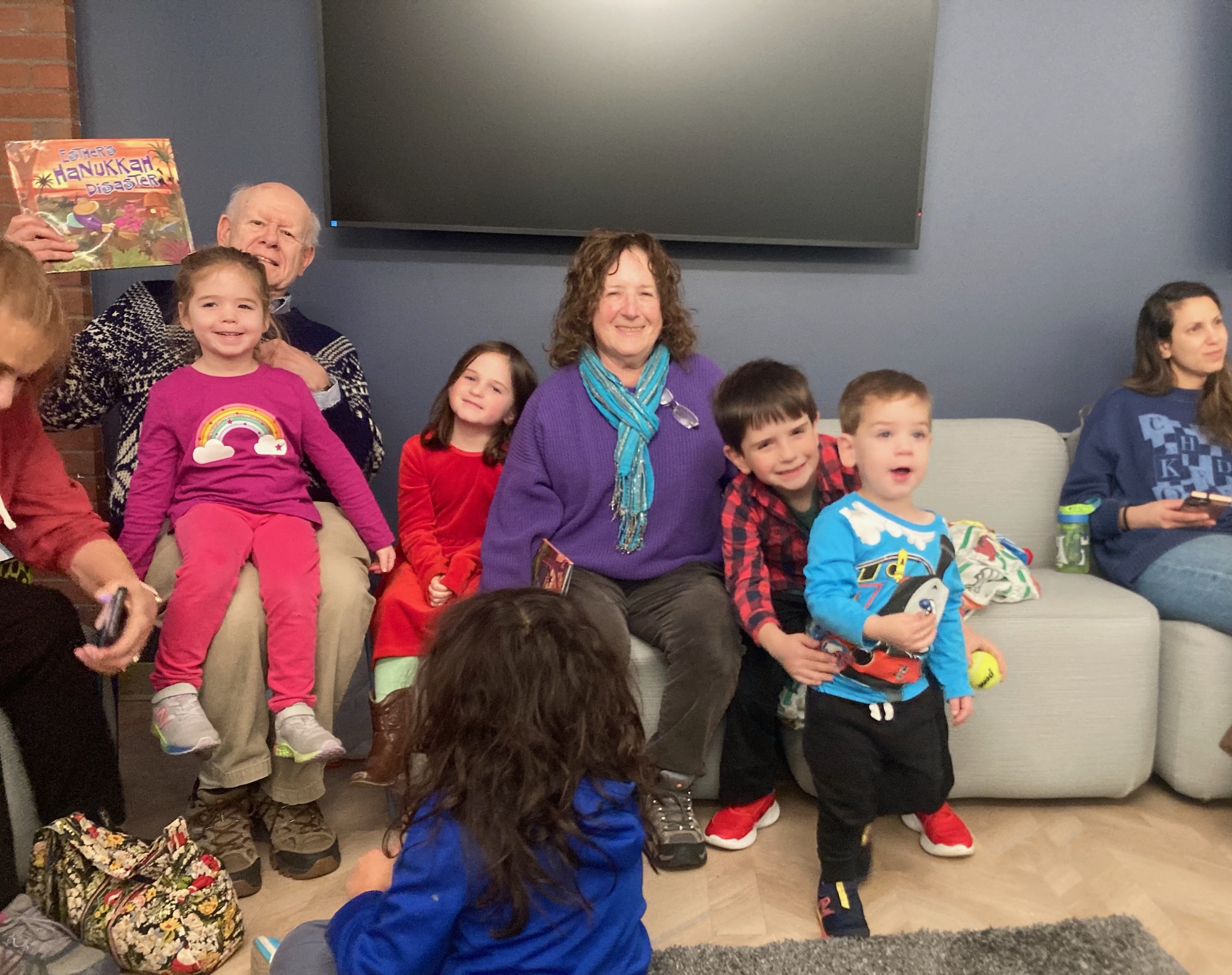
Jane Sutton is an award-winning author of picture books, including Gracie Brings Back Bubbe’s Smile, Paulie’s Passover Predicament, and Esther’s Hanukkah Disaster as well as novels for children. She grew up on Long Island and attended Brandeis University. Jane lives with her husband in the Boston area, as do their grown children and families. She is grateful to get lots of chances to babysit her grandchildren and hopes she makes fewer mistakes than Ruthie’s Zayde. You can visit Jane at jane-sutton.com.

I’m so excited to be chatting with you again about a new book, Jane! The last time we did an interview, it was for What’s Up with this Chicken? and you were a new grandmother to Caleb. So much has happened in the years since! You and your husband are grandparents to four grandchildren now who all live close to you. Has becoming a grandmother influenced the way you write or the subjects you write about?

Come to think of it, my last 2 books have been about a grandparent and a grandchild. And my next book was inspired by a grandchild. I guess it’s natural that I would write about my favorite subject, my grandchildren!

Kate Chappell’s illustrations are so whimsical and really highlight the humor in the story. Kate lives in London. Did you have much interaction with her during the publishing process? Do you have a favorite spread? Which one and what do you like best about it?

I agree. Her whimsical illustrations do just what you said! We didn’t interact directly. My suggestions for art went through the publisher. My favorite spread is also the cover, with Zayde sitting in the shopping cart as Ruthie pushes. It’s so silly and funny, and I love the details Kate includes. It’s my grandchildren’s favorite too!

The images on your blog from your family vacations and other fun times you have together are so infused with love and joy and really make me smile. They made me wonder—does it appear that any of your grandkids have inherited your sense of humor? If so can you share a story?

They’re all funny and witty in their individual ways. One joke that the oldest three grandchildren and I share started on a week-long family vacation. Each morning, we’d greet each other with big smiles while saying, “Not you again!”

How did you get started writing for children? When did you know that this is what you wanted to pursue?

In college I had an assignment in a sociology class to do something we’d always wanted to do and keep a journal about our experience as we did it. I chose to write a series of children’s stories and found that I enjoyed the writing immensely.

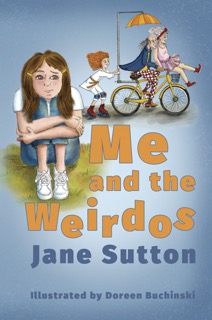
Not only do you write picture books, but you’ve written three middle-grade novels and a young-adult novel. You’ve recently revised and published a new edition of your popular middle grade novel, Me and the Weirdos, after it was turned into a musical by two high school seniors in Utah. I understand you attended the premiere of the play. Tell me more about this book and the experience of seeing it transformed into a musical.

In Me and the Weirdos, Cindy Krinkle feels like the only normal person in her family. She kind of has a point. Some examples: Her father rides a bike with an umbrella on it as he sings opera loudly and off-key. Her mother gargles with orange juice, and her sister has a pet sea urchin. Cindy’s plans to “un-weird” the rest of her family all backfire in amusing ways, and she eventually comes to appreciate them the way they are. Attending the musical was amazing. The lovely students who created it were so talented. They wrote the script and lyrics, composed the music, and directed the play with a middle school cast. The show was both entertaining and true to the book’s humor and message that it’s OK to be different.

It’s clear that you love sharing your love of writing and your books with kids through programs at schools and libraries. Can you give us a peek at what one of your presentations is like? Do you have an anecdote from any program that you’d like to share?

I share my writing process, including more or fewer details depending on the age group. I emphasize the importance of revision, something I strongly believe in and which makes teachers nod and smile. And lest writing seem like too much work, I make sure I express my joy in writing.

I believe young readers have another book to look forward to in 2026! Would you like to give them a little glimpse of what’s to come?

It will be my first board book, one I hope that will make people of all ages smile.

Thanks so much, Jane for this wonderful chat! It’s been terrific catching up! I wish you all the best with Zayde Babysits before Passover and can’t wait to see your board book. I’m sure it will bring a smile!

You can purchase Zayde Babysits before Passover at these booksellers

Amazon | Barnes & Noble | Bookshop (to support your local independent bookstore)

Picture Book Review


September 27 – It’s Read a New Book Month

celebrate-picture-books-picture-book-review-gracie-brings-back-bubbe's-smile-cover

About the Holiday

Even though we’re saying goodbye to Read a New Book Month, families don’t have to stop seeking out new books at their local bookstore or library. In fact, fall and the lead-in to the holidays is one of the busiest times of the year for publishers as they release wonderful books that share traditions and take readers through the winter in thoughtful, funny, and always surprising ways. Maybe that’s why December is also tagged as Read a New Book Month! Really, there’s never a time when you don’t want to celebrate new books—like today’s!

Thanks go to Albert Whitman & Company for sharing a digital copy of Gracie Brings Back Bubbe’s Smile with me for review consideration. All opinions on the book are my own.

Gracie Brings Back Bubbe’s Smile

Written by Jane Sutton | Illustrated by Debby Rahmalia


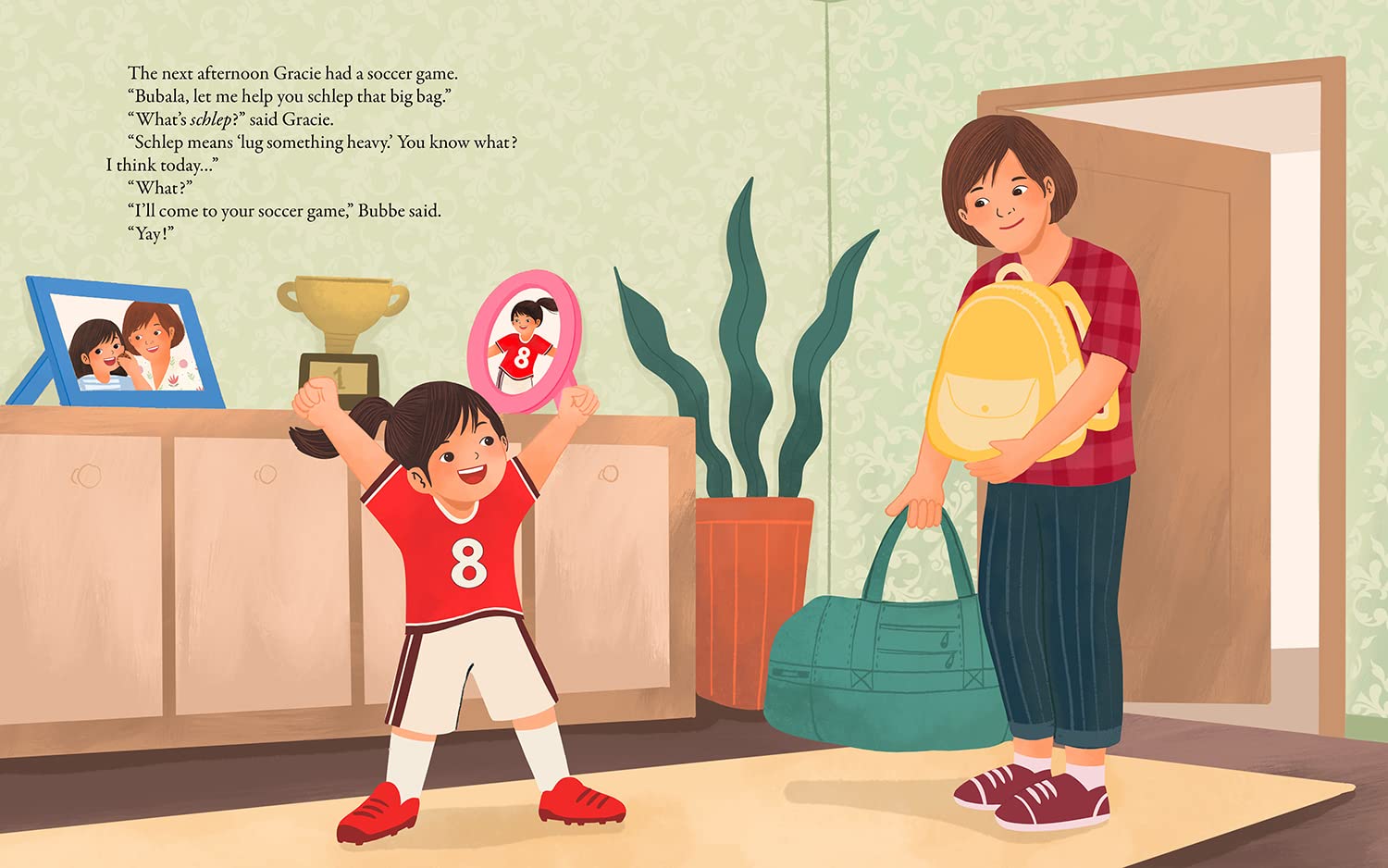
Gracie always loves when Bubbe comes to visit, but this time Bubbe was too sad to do the things she and Gracie usually did together because her husband had died. She didn’t feel like doing yoga or making jokes. “She hardly even smiled.” Gracie missed all the things she used to do with Zayde too—talks about science and sharing inside jokes.

Gracie tried different things to make Bubbe happy again. She asked if she’d like to sing while Gracie played the guitar, if she’d like to come to her soccer game, or help her draw a picture. But each time, Bubbe just said “‘No thank you, Bubala.'” This answer got Gracie thinking. “She knew bubbe meant ‘grandma’ in Yiddish. And zayde meant ‘grandpa.'” But she didn’t know what bubala meant. When Gracie asked Bubbe, she explained that “‘it means “little grandmother. …But you call someone you love “bubala.”‘”

celebrate-picture-books-picture-book-review-gracie-brings-back-bubbe's-smile-running

Image copyright Debby Rahmalia, 2022, text copyright Jane Sutton, 2022. Courtesy of Albert Whitman & Company.

Then Bubbe sighed and told Gracie how much she and Zayde “‘loved using Yiddish words together.'” Gracie wanted to learn Yiddish words too, and asked Bubbe to teach her. They went into the kitchen, and while Bubbe cut up an apple, she taught Gracie the word nosh. “‘It means “eat a snack.”‘” As Gracie noshed on her apple, she thought she saw Bubbe smile just a little.

That night Bubbe taught Gracie how to say “good night” in Yiddish, and the next day when Gracie came home from school she wanted to walk around the neighborhood like they used to, but Bubbe said she didn’t feel like it. Gracie persisted, pulling on her hand and telling her how beautiful it was outside. Bubbe had to admit that it was sheyn. Gracie was excited to understand this Yiddish word for “beautiful” because Zayde often called her sheyna meidala or “pretty girl.” Bubbe conceded and put on her sneakers.

celebrate-picture-books-picture-book-review-gracie-brings-back-bubbe's-smile-soccer

Image copyright Debby Rahmalia, 2022, text copyright Jane Sutton, 2022. Courtesy of Albert Whitman & Company.

Once outside, Bubbe even started jogging a little and taught Gracie another Yiddish word when Gracie asked her to slow down. As the week went on, Gracie and Bubbe began talking about their memories of Zayde. Bubbe even decided to go to Gracie’s next soccer game. At the game Bubbe smiled and even cheered when Gracie scored a goal, and back home they laughed together when Bubbe told Gracie her socks were “‘… so farshtunken, my nose might explode!'”

“‘Bubbe! You’re laughing!'” Gracie cried. And Bubbe had to agree and told Gracie it was for a very special reason. “‘Because you give me naches. That means ‘joy.'”

Back matter includes a short Author’s Note about the Yiddish language as well as a glossary of Yiddish words that includes and expands on the words found in the story, their meaning in English, and a pronunciation for each of them.

celebrate-picture-books-picture-book-review-gracie-brings-back-bubbe's-smile-laughing

Image copyright Debby Rahmalia, 2022, text copyright Jane Sutton, 2022. Courtesy of Albert Whitman & Company.

Jane Sutton’s poignant story will touch readers’ hearts on many levels, from a child and grandmother overcoming grief to the passing on of family heritage to the way children bring a healing kind of joy through their exuberance, empathy, and love. Sutton’s storytelling hits all the right notes as she depicts Bubbe’s transition from mourning to joy over superbly paced scenes and seamlessly introduces Yiddish words through Gracie and Bubbe’s authentic conversations while also demonstrating the family’s strong bond of love and trust. Dialogue rich, the story makes a perfect read aloud that will excite kids about learning the Yiddish words along with Gracie and prompt families to talk about their own history.

In her vibrant illustrations, Debby Rahmalia lets young readers see through Gracie’s viewpoint how Bubbe’s sadness affects her and how much she wants to help her grandmother find happiness again. As Gracie does yoga while Bubbe stands by and shares a silent dinner with her usually talkative grandmother, Gracie’s expressions register concern and disappointment. In Gracie’s attempts to enlist Bubbe in doing their usual activities, Rahmalia portrays not only Gracie’s strong connection with Bubbe, but also a realistic look at how loss can affect emotions and physical energy. When Gracie hits on learning Yiddish as a way to interact with Bubbe, Rahmalia effectively shows how Bubbe’s smile, enthusiasm, and laughter return as she and Gracie share the language and memories of Zayde.

Touching, reassuring, and joyful, Gracie Brings Back Bubbe’s Smile comforts and restores while celebrating family love and generational ties. The book would be a meaningful addition to home bookshelves for all families and one school and public librarians will want in their picture book or family issues collection.

Ages 4 – 7

Albert Whitman & Company, 2022 | ISBN 978-0807510230

You can discover more about Jane Sutton and her books on her website and connect with her on Instagram.

You can view a portfolio of work by Debby Rahmalia here and connect with her on Instagram and Twitter.

Read a New Book Month Activity

celebrate-picture-books-picture-book-review-gracie-brings-back-bubbe's-smile-matching-puzzle

Gracie Brings Back Bubbe’s Smile Matching Puzzle


Gracie loved learning Yiddish words from Bubbe! With this puzzle you can learn the Yiddish words from the book too. Just print the puzzle and match each word with its definition to get started using these words yourself!

Gracie Brings Back Bubbe’s Smile Matching Puzzle

celebrate-picture-books-picture-book-review-gracie-brings-back-bubbe's-smile-cover

You can find Gracie Brings Back Bubbe’s Smile at these booksellers

Amazon | Barnes & Noble | Books-a-Million

To support your local independent bookstore, order from

Bookshop | IndieBound

Picture Book Review

September 9 – National Day of Encouragement

celebrate-picture-books-picture-book-review-alte-zachen-cover

About the Holiday

Everyone can get discouraged, frustrated, and lonely at times, that’s why today’s holiday was conceived as a day to encourage, cheer, and inspire those who are missing out on the joy life can bring. The idea was first celebrated in Arkansas, when Governor Mike Beebe proclaimed September 12, 2007 to be a “State Day of Encouragement.” The holiday later spread across the country when President George W. Bush established September 12 as a National Day of Encouragement. It doesn’t always take a lot to make a difference for someone who’s struggling. Giving a kind word, taking time to listen, sharing a special treat, or just being there for a colleague, friend, or family member are all ways to help them feel happier and more encouraged to complete a goal, deal with a problem, or just have a good day.

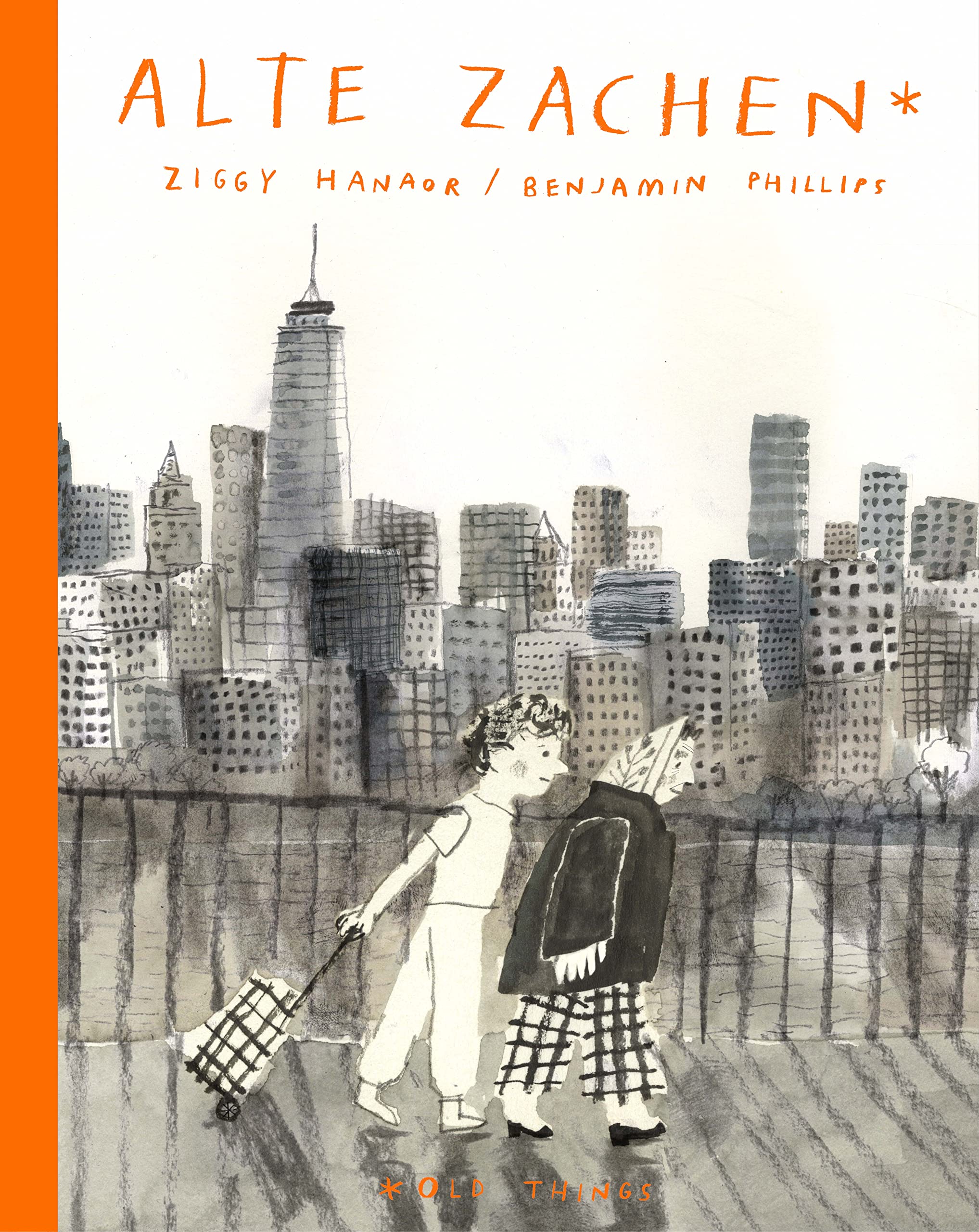
Alte Zachen / Old Things

Written by Ziggy Hanaor | Illustrated by Benjamin Phillips


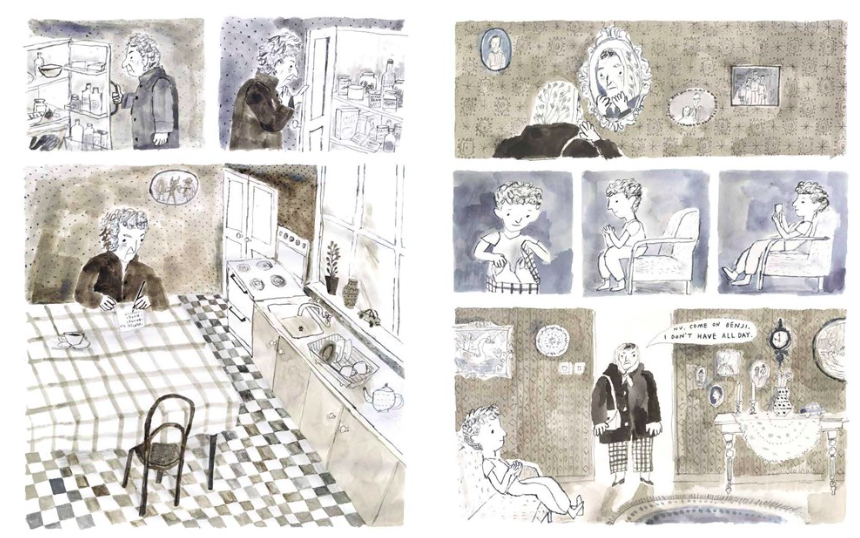
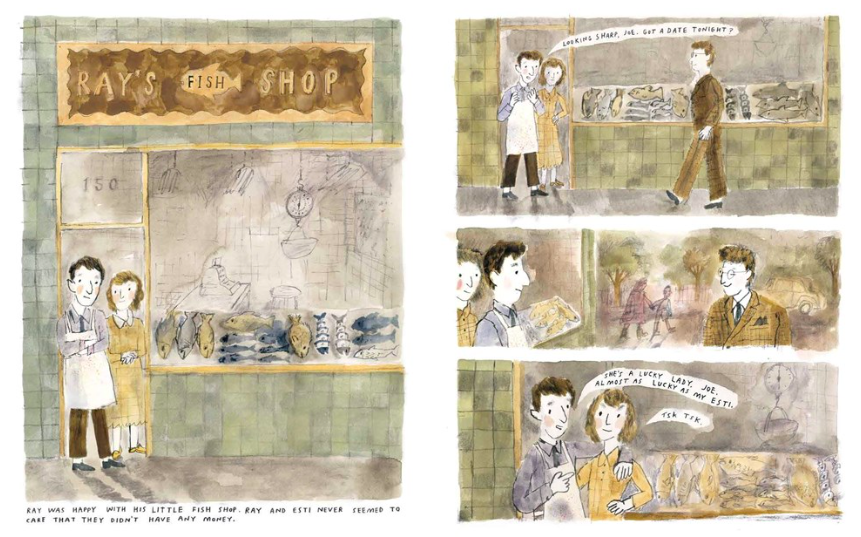
It’s grocery shopping day and Benji’s bubbe, scowling, peers into the refrigerator then sits down to make her list. She looks uncertainly at herself in the wall mirror as she puts on her headscarf. Benji, meanwhile, gets the cart and bags ready and then sits down to wait. He looks at his phone and then waits some more. When Bubbe Rosa finally appears, she says “Now come on, Benji. I don’t have all day.” He stands up and tells her he’s ready, but is met with an inexplicable “You young people are so lazy, everything comes for free. Tsk Tsk.” He pushes back a bit, showing her that he has brought a cart and bags. Bubbe can’t understand why he’s bringing bags when they give them out at the store, and he tells her that they are better for the environment. As they walk down the sidewalk, Bubbe considers this.

celebrate-picture-books-picture-book-review-alte-zachen-grocery-list

Image copyright Benjamin Phillips, 2022, text copyright Ziggy Hanaor, 2022. Courtesy of Cicada Books.

She cheers up at the thought of what she will make for dinner tonight: “…gefilte fish and brisket and kugel.” They will get challah from Carmelli’s and babka from Gershon’s. Bubbe remembers how as a young man, Gershon “was always so forward. He’s a very rude man,” she says. She can’t seem to separate young Gershon from Benji when he mentions that they’ve missed their turn off and tells him that young people these days are also rude and “don’t know anything.”

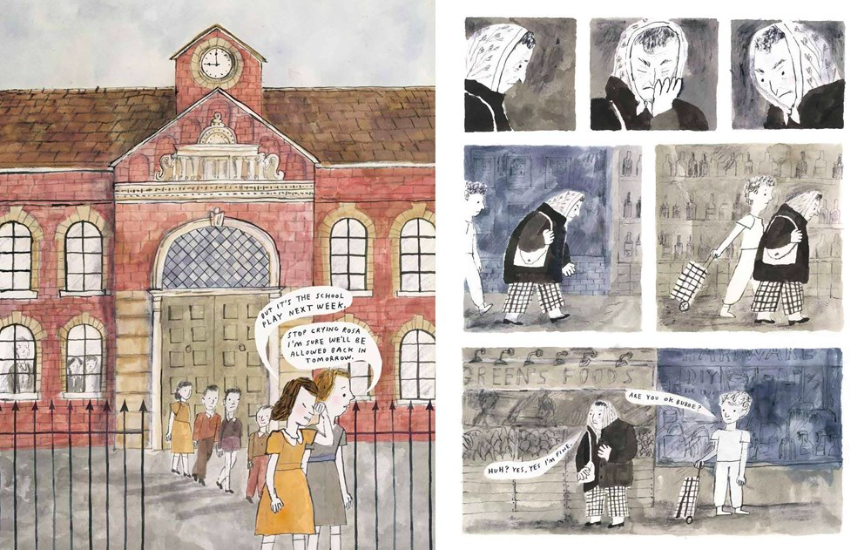
She tells Benji how what kids learn in high school now, they learned in first grade. But then she reveals the day that all Jewish kids were banished from school. She had cried because she was going to be in the school play the next week. Her friend thought they’d be allowed back in, but they weren’t. Bubbe becomes sad at the memory and wipes away a tear. Then her scowl returns, and she trudges angrily on.

celebrate-picture-books-picture-book-review-alte-zachen-banned

Image copyright Benjamin Phillips, 2022, text copyright Ziggy Hanaor, 2022. Courtesy of Cicada Books.

When they get to the place where Rosa believes Ray’s Market is, they discover another store in its place. Bubbe can’t believe it, and begins to tell Benji the story of how Ray came over from Germany on the same boat as Benji’s Zayda Joe. Ray wasn’t as ambitious as Joe, and she wonders what happened to him. Today, when they approach the check-out counter, Bubbe is scandalized to find a tattooed young woman in a crop top behind the cash register, and gives her a piece of her mind.

Outside the store, Benji erupts, telling Bubbe that “girls don’t need boys to validate them” and that they can wear what they want. What Bubbe doesn’t tell Benji, but what readers see in a full-page illustration, is that she was the girl that Gershon chatted up many years ago and that once as she and Joe passed by Gershon’s bakery, their eyes met through the window.

celebrate-picture-books-picture-book-review-alte-zachen-ray's-shop

Image copyright Benjamin Phillips, 2022, text copyright Ziggy Hanaor, 2022. Courtesy of Cicada Books.

The rest of the shopping trip brings much of the same, and when she spots someone smoking outside a tattoo parlor, she yells at him about all of his tattoos. A turn of the page, however, reveals the roots of her rage in another full-page image filled with arms tattooed with numbers from concentration camps.

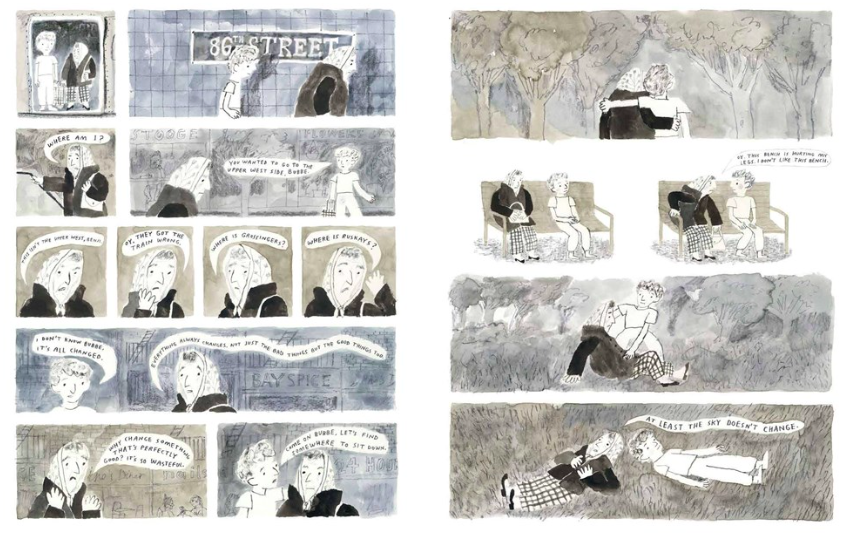
On the subway, Bubbe tells Benji more about her life: her trip from Berlin to Switzerland with her mother and sister—but not her father—and how she used to love to dance the polka. When she and Benji get off the train, Bubbe is disoriented. Benji leads her outside to the park to sit down. There, they lie on the grass, and while Bubbe dozes, Benji watches the people around them. When she awakens, Bubbe Rosa admits that she sometimes forgets, but then it all comes back to her. Readers see dated snapshots from her life—as a baby, with her sister, alone, standing next to Gershon, with Joe’s arm wrapped around her shoulders, with her two children as youngsters and then older, as empty nesters with Joe, and finally older and alone.

celebrate-picture-books-picture-book-review-alte-zachen-park

Image copyright Benjamin Phillips, 2022, text copyright Ziggy Hanaor, 2022. Courtesy of Cicada Books.

It’s time to go home, and Benji calls an Uber he’s used before. In the car, the driver talks about coming from Ghana to New York to work until he can buy a house in Hamburg. While he means Hamburg, Pennsylvania, Rosa thinks only of Hamburg, Germany. Watching people out the window, she seems even more lonely than ever and asks Benji to request they go to Gershon’s bakery.

Benji can’t believe it will still be there, but they go. Rosa alights from the car and heads for the door. She opens it despite the closed blinds in the window and Benji’s entreaties to stop. Inside she does find Gershon, his shelves filled with baked goods and a with scowl on his face. He is surprised to see her and questions when she got so old. They banter with old jokes and then smile at each other.

celebrate-picture-books-picture-book-review-alte-zachen-gershon

Image copyright Benjamin Phillips, 2022, text copyright Ziggy Hanaor, 2022. Courtesy of Cicada Books.

They reminisce about dancing together when they were young, and a turn of the page brings this memory to life with a colorful spread of people dancing, which also spans generations and includes other characters and time periods from the story. Back to present day, Benji sits on the grocery cart now watching Rosa and Gershon dance together under the bakery shop’s lights. “‘You’re just the same as always, Gershon,’ Rosa says.” And Gershon answers, “‘Some things never change, Rosa.’” And here, at least, that seems true as the babkas cost only $2.50. These scenes leave readers with hope that Rosa and Gershon will find the happiness that has eluded them for so many years. Feeling more like herself, Rosa suggests they walk home. She thanks Benji for all of his help that day and calls him a “good boy.” Benji replies that she is a “good bubbe,” too.

Back matter includes a glossary of Yiddish terms sprinkled throughout the story.

celebrate-picture-books-picture-book-review-alte-zachen-walking-home

Image copyright Benjamin Phillips, 2022, text copyright Ziggy Hanaor, 2022. Courtesy of Cicada Books.

Powerful and emotional, Ziggy Hanaor’s Alte Zachen tells the story of one woman who grew up during the 1930s and lived through the holocaust, moving from Berlin to Switzerland to Palestine and finally to New York,  through her memories and their day-to-day repercussions. Hanaor’s gripping debut graphic novel tackles the complex histories and personal loss that affect the way people look at and interact with others in their communities as well as with their own families.

Bubbe Rosa’s displaced anger, distrust, confusion, triggers, and perhaps even envy for contemporary mores that allow more freedom are just some of the emotions that Hanaor explores. The impact of growing old and trying to adjust to a changing world is poignantly depicted through Rosa’s flashbacks and her angry outbursts. Benji is a compassionate ambassador for today’s generation and his counter arguments to Bubbe Rosa’s actions, are courageous—stated forcefully and clearly, but with respect. His tender love for his grandmother is evident in his patience and the way he treats her when she grows weary. Several elements of Rosa’s life are left ambiguous—for example the fate of her father and her prior relationship with Gershon—allowing readers to ponder and discuss the character’s full backstory and its effects.

Benjamin Phillips immediately draws readers into Bubbe Rosa’s consciousness with his nuanced and immersive imagery. Bubba Rosa’s face, its features deftly sketched and angled, reveals her querulous and dour demeanor, only softening when she imagines the dinner she will make and later meets up with Gershon again. Glimpses of Rosa’s profound sadness add depth to this complex character.  Masterfully moving between the present and the past, Phillips allows readers to see that for Rosa, her past—one that is both comforting and tortuous—is ever-present, even though its vestiges have mostly disappeared from her neighborhood.

Phillips depicts the present day in soft washes of blue, brown, and gray while Bubbe Rosa’s memories are as vivid as her recollections. By often portraying Rosa in the same flowered dress and Gershon with a mustache, Phillips orients readers to their history, a substory that threads its way throughout the narrative, enriching readers’ knowledge of these two connected characters.

Compelling and evocative, Alte Zachen is an eloquent intergenerational story that will resonate with and enlighten readers of all ages. The book is a perfect choice for families to share while discussing how particular events from the past, in general, as well as within the family affect the present day. It would also make a poignant selection for mixed-age book discussion groups and library programs. Alte Zachen is an absolute must for home, middle school, high school, university, and public libraries.

Ages 12 and up

Cicada Books, 2022 | ISBN 978-1800660229

You can connect with Benjamin Phillips on Instagram.

celebrate-picture-books-picture-book-review-alte-zachen-cover

You can find Alte Zachen at these booksellers

Amazon | Barnes & Noble | Books-a-Million

To support your local independent bookstore, order from

Bookshop | IndieBound

Picture Book Review

January 27 – International Holocaust Remembrance Day

celebrate-picture-books-picture-book-review-anne-frank-the-girl-heard-around-the-world-cover

About the Holiday

International Holocaust Remembrance Day was officially declared in November 2005 by the United Nations General Assembly. Every year on January 27th, “UNESCO pays tribute to the memory of the victims of the Holocaust and reaffirms its unwavering commitment to counter antisemitism, racism, and other forms of intolerance that may lead to group-targeted violence.” The date marks the day that the Nazi Concentration and Extermination Camp of Auschwitz-Birkenau was liberated by Soviet troops in 1945. This year commemorates the 77th anniversary of the liberation. This year UNESCO is presenting a series of mostly online events, including a commemoration ceremony, a panel discussion on the legacy of Jewish artists who died during the Holocaust and the United Nations, and a photography exhibition titled Generations: Portraits of Holocaust Survivors by the Royal Photographic Society of Great Britain, showcasing over 50 contemporary photos of Holocaust survivors and their families. To learn more about how to watch the events, visit the UNESCO International Holocaust Remembrance Day website. You can also find many excellent resources and personal stories on the United States Holocaust Museum website.

Anne Frank: The Girl Heard Around the World

Written by Linda Elovitz Marshall | Illustrated by Aura Lewis


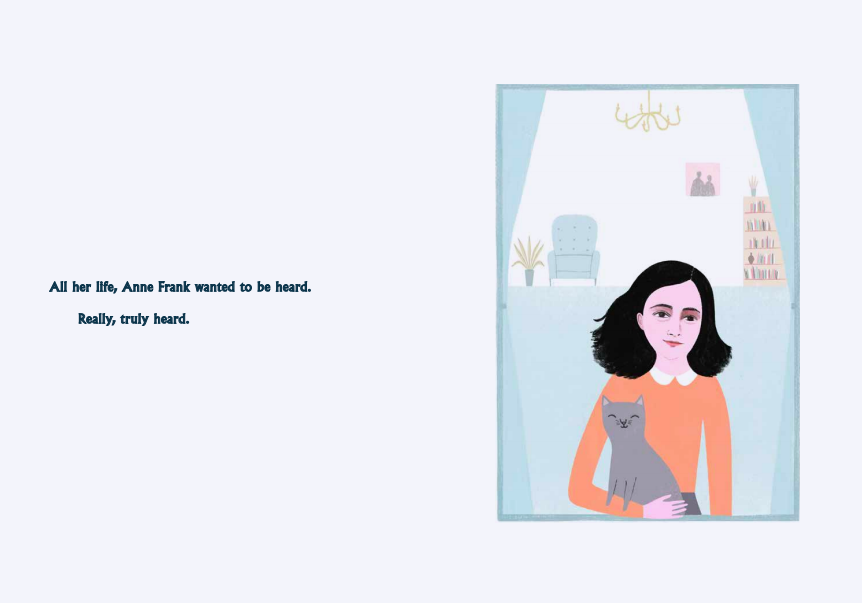
“All her life, Anne Frank wanted to be heard. Really, truly heard.” But sometimes no matter how loudly or entertainingly she talked, no one listened or seemed to understand. Anne’s family, “like many other Jewish families, had lived in Germany for centuries,” but when Adolf Hitler began to govern the country, Jewish families were in danger. When Anne was four years old, her family, hoping to find safety, moved to Amsterdam in the Netherlands. Here, Anne lived happily, “making mischief with her friends, telling jokes, and having fun. “In school, she talked and talked.”

celebrate-picture-books-picture-book-review-anne-frank-the-girl-heard-around-the-world-portrait

Image copyright Aura Lewis, 2020, text copyright Linda Elovitz Marshall, 2020. Courtesy of Orchard Books.

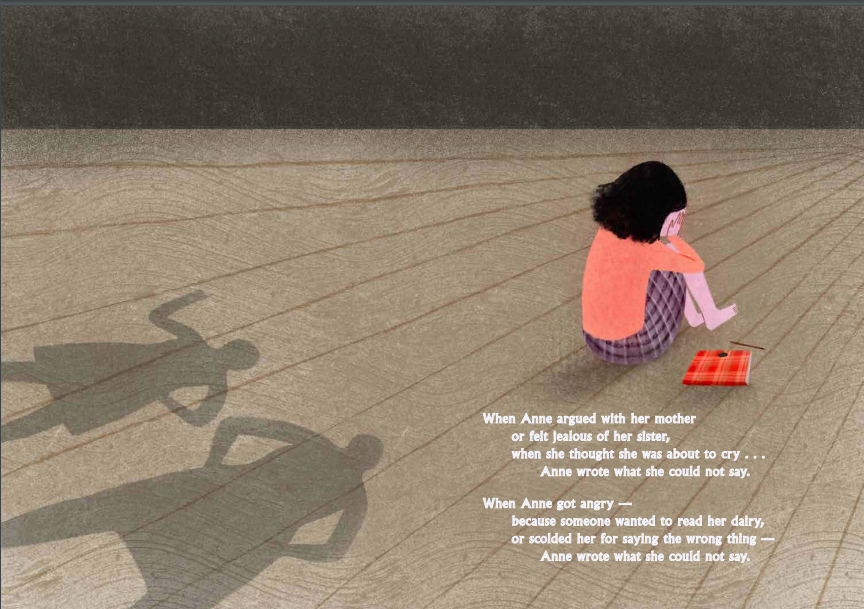
But in 1940, Hitler and his Nazi’s took over the Netherlands too, and life for Jewish people living there was no longer safe. Anyone who talked against the Nazis could be arrested, but Anne needed to express her opinions. On her 13th birthday Anne received a red plaid diary; she named it “Kitty.” In Kitty, Anne could share all of her thoughts and feelings about what was happening in her country. She wrote about the rules that restricted Jews from normal life, that made all Jews wear a yellow star that distinguished them from others. But Anne also wrote about school and other subjects. “Anne realized that by writing, she could speak her mind in a new way. She could really, truly be heard.”

celebrate-picture-books-picture-book-review-anne-frank-the-girl-heard-around-the-world-childhood

Image copyright Aura Lewis, 2020, text copyright Linda Elovitz Marshall, 2020. Courtesy of Orchard Books.

Then on a morning in 1942, Anne’s mother woke her, telling her that they needed to leave quickly and hide. Anne “packed her most treasured things.” Her diary was the first thing she packed. She and her family as well as four other people hid in a secret room in the warehouse where Anne’s father worked. Non-Jewish friends who also worked in the warehouse brought them food and supplies. While Anne tried to make the best of her life in hiding, she was lonely and always careful to whisper and tiptoe so the other workers in the factory did not discover them.

celebrate-picture-books-picture-book-review-anne-frank-the-girl-heard-around-the-world-writing

Image copyright Aura Lewis, 2020, text copyright Linda Elovitz Marshall, 2020. Courtesy of Orchard Books.

Now, Anne’s diary was even more important to her. In Kitty she wrote about her fears and feelings, her days and the things she missed. “She wrote about wishing people could live together, in peace,” and Kitty “was always there to listen, always there to understand.” Anne also wrote stories about a teddy bear, a fairy, and a caring grandmother. Once, water seeped in and soaked her diary. Anne rushed to hang the pages to dry. Anne wrote and wrote for two years. She hoped to publish a book about her experience.

celebrate-picture-books-picture-book-review-anne-frank-the-girl-heard-around-the-world-crying

Image copyright Aura Lewis, 2020, text copyright Linda Elovitz Marshall, 2020. Courtesy of Orchard Books.

“But on August 4, 1944, Nazi police discovered the secret hiding place.” Anne, her family, and all of the people living in the warehouse room were taken away. “One of their non-Jewish friends found Anne’s diary and writings and kept them safe,” hoping to return them to her. But just weeks before the war ended in 1945, Anne died. Anne’s father was the only one to survive. After the war ended, Anne’s father fulfilled her dream and published Anne Frank: The Diary of a Young Girl. Anne’s book has been read by people around the world and continues to speak for her in the hearts of readers everywhere.

Back matter includes more about Anne, her family, the Nazis and how Anne’s diary was saved; a timeline of Anne’s family, the rise of Hitler, and the war years; an Author’s Note; and lists of sources, suggested further reading, and websites.

celebrate-picture-books-picture-book-review-anne-frank-the-girl-heard-around-the-world-world-reads

Image copyright Aura Lewis, 2020, text copyright Linda Elovitz Marshall, 2020. Courtesy of Orchard Books.

Linda Elovitz Marshall’s moving telling of Anne Frank’s life and dreams, focusing on her beloved diary will resonate with children, who, like Anne, want to be heard. In her evocative storytelling, Marshall creates a rich portrait of Anne as a vivacious child who was also smart and thoughtful. Mirroring the devastating disruptions in Anne’s and her family’s life, Marshall intersperses pages of straightforward text which describes the rise of Hitler and the Nazis and emphasizes ways in which they restricted and silenced the Jewish population, reinforcing her book’s theme. The examples Marshall gives—riding bikes, going to the movies, having to wear an identification star—will impress upon children the changes in Anne’s life.

When Anne and her family move to the Secret Annex, Marshall superbly reveals the conditions of their confinement through Anne’s writing and how her diary was her lifeline and her confidant. The family’s eventual discovery is written factually but with sensitivity, fitting for picture book readers. The final spread honors the influence Anne Frank has had on the world with her diary—her voice that could not be silenced.

In Aura Lewis’s emotionally resonant illustrations, readers first meet Anne Frank in a snapshot that shows her as kind, thoughtful, and seemingly wise beyond her years. Vibrant scenes of Anne with her family in Germany and later with family and friends in Amsterdam give way to somber, gray-toned images that reflect Hitler’s takeover and the dangers Anne, her family, and all Jewish people faced. Lewis clearly sketches Anne’s childhood enthusiasms and hope and, especially, her pleasure at receiving her diary. Also, readily recognizable are Anne’s feelings of fear, frustration, and sadness. Lewis portrays Anne in signature orange and plaid, reflecting the deep interconnection between Anne and her diary. This visual metaphor is then carried onto the final spread, where a variety of people of all ages read Anne Frank: The Diary of a Young Girl.

An excellent book to introduce young children to Anne Frank, a most influential and inspiring young girl, Anne Frank: The Girl Heard Around the World would be a meaningful addition to home bookshelves and is a must for school and public library collections.

Ages 6 – 8

Orchard Books, 2020 | ISBN 978-1338312294

Discover more about Linda Elovitz Marshall and her books, visit her website.

To learn more about Aura Lewis, her books, and her art, visit her website.

National Dear Diary Day Activity

celebrate-picture-books-picture-book-review-anne-frank-word-search

Anne Frank and Her Diary Word Search


Find the twenty words associated with Anne Frank, her life, and her diary in this printable puzzle

Anne Frank and Her Diary Word Search Puzzle | Anne Frank and Her Diary Word Search Solution

celebrate-picture-books-picture-book-review-anne-frank-the-girl-heard-around-the-world-cover

You can find Anne Frank: The Girl Heard Around the World at these booksellers

Amazon | Barnes & Noble | Books-a-Million

To support your local independent bookstore, order from

Bookshop | IndieBound

Picture Book Review
November 30 – Get Ready for Hanukkah

celebrate-picture-books-picture-book-review-the-ninth-night-of-hanukkah-cover

About the Holiday

Hanukkah, the Festival of Lights, is the Jewish wintertime celebration that commemorates the victory of the small Maccabean army over the much more powerful Greek/Syrian forces and the rededication of the Holy Temple during the second century BCE. Hanukkah is celebrated for eight days in remembrance of the miracle of the oil lamp, which at the time only held enough oil for one day yet burned for eight days. This year Hanukkah takes place from December 10 through 18.

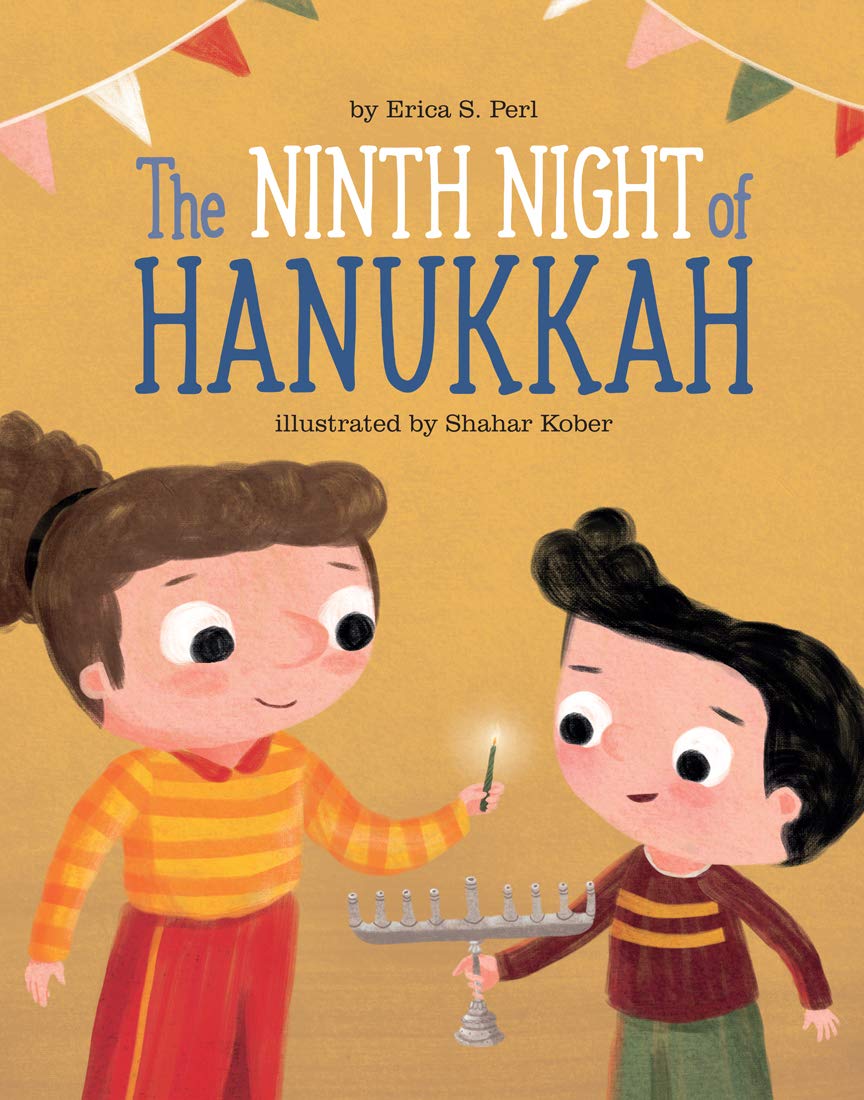
The Ninth Night of Hanukkah

Written by Erica S. Perl | Illustrated by Shahar Kober


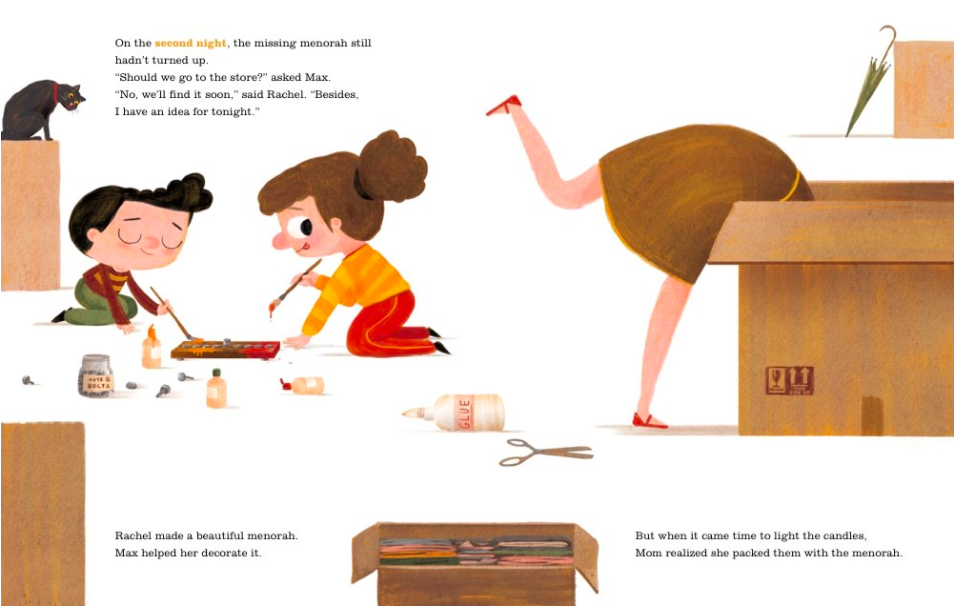
A family has just moved into their new apartment. It’s the first night of Hanukkah, but they can’t find their Hanukkah things amidst all the boxes. So, without the menorah or delicious latkes, Mom, Dad, Rachel, and Max sit on the floor eating pizza. “It was nice…but it didn’t feel quite like Hanukkah.” On the second night, they still hadn’t found the menorah, but Rachel and Max made one from a piece of wood, their jar of nuts and bolts, and some craft paint. It was all ready to light, when Mom discovered that they didn’t have the candles either.

celebrate-picture-books-picture-book-review-the-ninth-night-of-hanukkah-missing-menorah

Image copyright Shahar Kober, 2020, text copyright Erica S. Perl, 2020. Courtesy of Sterling Children’s Books.

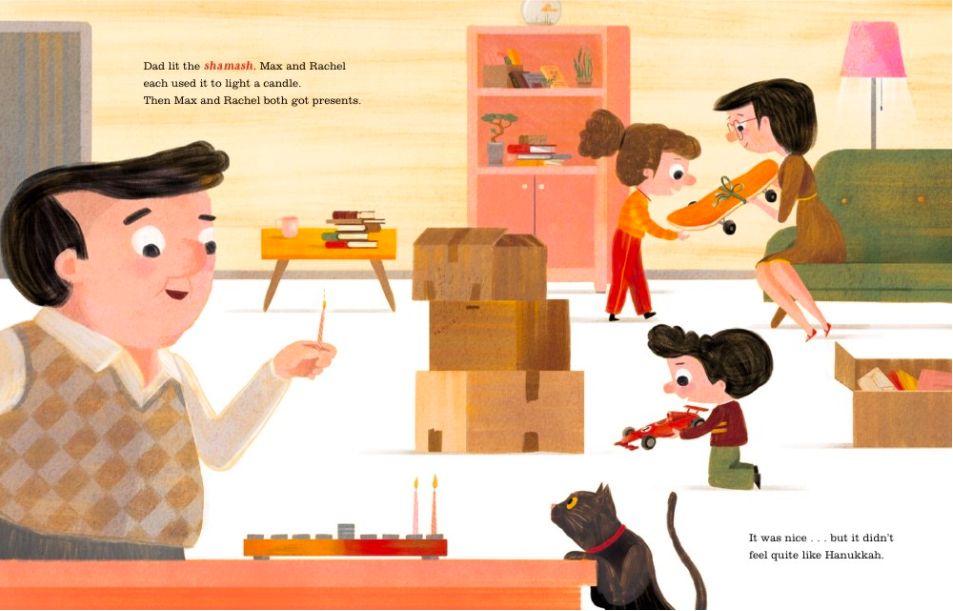
With the stores closed, Rachel and Max went next door to apartment 2C. They introduced themselves to Mrs. Mendez and explained their situation. She offered the only candles she had—a box of birthday candles. “Dad lit the shamash. Max and Rachel each used it to light a candle.” Then they opened presents. While it was nice, it still “didn’t feel quite like Hanukkah.
On the third night, the “lucky latke pan” was nowhere to be found, but Max appeared with a steaming plate of French fries from Joe, the super, who lived downstairs.

By the fourth night of Hanukkah, Mom and Dad were beginning to think the box with their Hanukkah things had gotten lost. Max wanted to play dreidel, so while Mom called the moving company, Max and Rachel met the Watson twins, who didn’t have a dreidel, but they did have a toy that spun and spun. On the fifth night, Rachel and Max had made their own dreidel, “which meant they needed gelt.” On the fourth floor, Max and Rachel met Mr. Patel, who handed Max the only chocolate he had—a bag of chocolate chips. All of these substitutions were “nice…but it didn’t feel quite like Hanukkah.”

celebrate-picture-books-picture-book-review-the-ninth-night-of-hanukkah-shamash

Image copyright Shahar Kober, 2020, text copyright Erica S. Perl, 2020. Courtesy of Sterling Children’s Books.

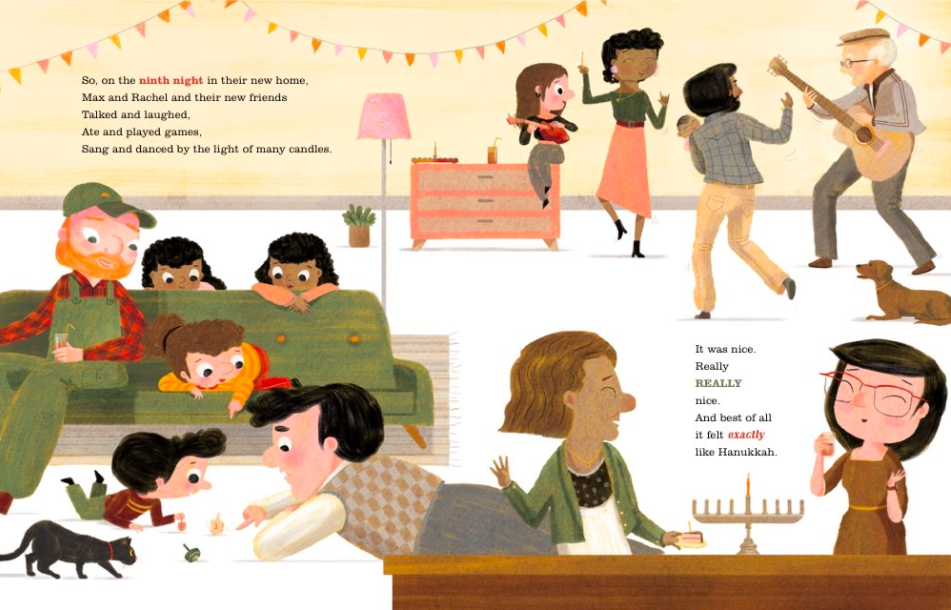
Each night of Hanukkah Max and Rachel missed a different part of their Hanukkah celebration, and each night a new neighbor did the best they could to supply it. On the morning after the eighth night of Hanukkah, a delivery person showed up at the door with Mom’s guitar. She suggested a sing-along, but Rachel reminded her that Hanukkah was over. Max, however, had another idea and pointed to the ninth candle on the menorah. This gave Rachel an idea too, and she and Max whispered and planned. Then they waited. Soon “there was a knock on the door. And another. And another.”

When all the neighbors had gathered, Max and Rachel explained their Shamash Night celebration. Like the Shamash candle “helps light all the other candles,” they said, their new neighbors had helped them celebrate Hanukkah. “‘So we wanted to say thanks—to the Shamash and to you,’” Rachel said. Just then the delivery person appeared with the long-lost box. On the ninth night in their new home, Mom and Dad, Rachel and Max ate, played, sang, and danced with all of their new friends, “and best of all, it felt exactly like Hanukkah.”

An Author’s Note following the story tells about the history and tradition of the shamash candle and the idea that sparked the writing of The Ninth Night of Hanukkah. Erica S. Perl also provides a guide on how families can hold their own “Shamash Night.”

celebrate-picture-books-picture-book-review-the-ninth-night-of-hanukkah-party

Image copyright Shahar Kober, 2020, text copyright Erica S. Perl, 2020. Courtesy of Sterling Children’s Books.

Community, resilience, and children’s creativity infuse every page of Erica S. Perl’s story that’s a wonderful Hanukkah read as well as a story families will want to share all year around. The apartment-house setting and the family’s just-moved-in situation combine to create a charming microcosm of making friends, getting to know new neighbors, and discovering the generosity of strangers. Rachel and Max, creative, close-knit, and accommodating, will captivate kids as they go along on their scavenger hunts for the makings of a homey Hanukkah celebration.

Perl’s substitutions—from birthday candles to French fries to a ukulele will appeal to readers. The repeated phrase “It was nice, but it didn’t feel quite like Hanukkah” applies to many make-do conditions and will resonate with children. It also provides suspense and a nice counterpoint for when the night does finally fulfill the Hanukkah feeling. Max and Rachel’s “Shamash Night” offers a message of gratitude not only for things but for friendship.

Shahar Kober’s warm-toned illustrations mirror the heartfelt story and the kindness of the diverse group of neighbors as they provide workable solutions to Max and Rachel’s requests. Images of Rachel and Max creating a homemade menorah, dreidel, and wrapping paper may inspire kids to design their own Hanukkah or other holiday decorations and traditional items. Kober’s cartoon-style characters are expressive, demonstrating their disappointment in missing their well-loved Hanukkah things but more so their cheerful acceptance of what the neighbors can provide. Kids will enjoy watching the antics of the family’s cat, who likes to be in the middle of the action, but also is happy to make do with a moving box as a new napping spot.

A heartwarming and joyful Hanukkah story with messages of kindness, generosity, acceptance and a loving sibling relationship, The Ninth Night of Hanukkah is highly recommended for all home, school, and public library collections.

Ages 3 – 8 and up

Sterling Children’s Books, 2020 | ISBN 978-1454940883

Discover more about Erica S. Perl and her books on her website.

To learn more about Shahar Kober, his books, and his art, visit his website.

Get Ready for Hanukkah Activity

celebrate-picture-books-picture-book-review-hanukkah-craft

Star of David Decoration


Kids can add a bit of sparkle to their Hanukkah celebrations with this Star of David craft.

Supplies

  • 6 mini craft sticks
  • 2 round lids from clear plastic deli containers
  • Silver glitter
  • Blue craft paint
  • Clear-drying glue
  • Thin ribbon or string, 8 – 10 inches long

Directions

To Make the Star of David

  1. Paint the craft sticks with the blue paint, let dry
  2. Glue three of the craft sticks together to form a triangle; repeat with the other three sticks
  3. Glue the two triangles together to create a Star of David
  4. Glue a short length of ribbon to the top back of the Star of David

To Make the Case

  1. Apply a thin layer of clear-drying glue to the top, indented side of one of the lids
  2. Sprinkle the lid with the glitter, let dry
  3. When the glue is dry, center the Star of David in the lid with the ribbon trailing over the rim of the lid. The Star of David will be free hanging inside the case from the ribbon.
  4. Glue the rim of the indented side of the second lid to the rim of the first lid
  5. When dry, tie the ribbon into a loop for hanging

celebrate-picture-books-picture-book-review-the-ninth-night-of-hanukkah-cover

You can find The Ninth Night of Hanukkah at these booksellers

Amazon | Barnes & Noble | Books-a-Million

To support your local independent bookstore, order from

Bookshop | IndieBound