February 8 – Kite Flying Day

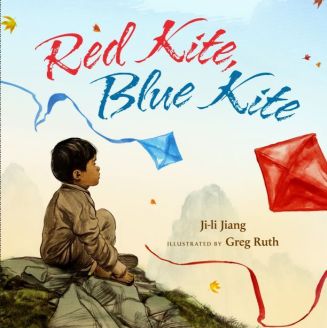
celebrate-picture-books-picture-book-review-red-kite-blue-kite-cover

About the Holiday

If you live in a cold climate and cabin fever has set in or if you live in a warm climate and want to get out and enjoy the day, why not take the opportunity of today’s holiday and go fly a kite? Whether you’re steering a simple diamond or a fancy dragon, watching a kite dip and soar through the sky is an exhilarating experience!

Red Kite, Blue Kite

Written by Ji-li Jiang | Illustrated by Greg Ruth


“I love to fly kites,” young Tai Shan relates, but not he’s while standing on the ground. Instead, because his city is so crowded, his Baba and he climb to the peak of their triangular roof where they are “above but still under, neither here nor there. We are free, like the kites.” While they fly their kites—red for Tai Shan and blue for Baba—Baba tells stories, and Tai Shan feels as if he is soaring through the clouds, “looking down at the dotted houses” and wanting to stay up there forever.

celebrate-picture-books-picture-book-review-red-kite-blue-kite-Tai-Shan-and-Baba-fly-kites

copyright Greg Ruth, courtesy of Disney-Hyperion

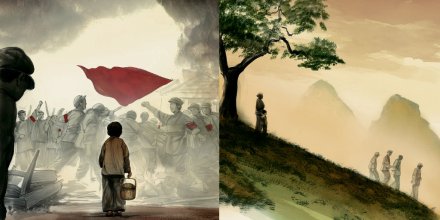
But one day dark times descend. Tai Shan’s school and many others are shuttered. Baba is taken away by men in red arm bands and sent to work in a labor camp. Tai Shan is sent to live with Granny Wang, a farmer who lives in a village next to the labor camp. A thick forest separates Tai Shan and Baba. During the day Granny Wang teaches Tai Shan how to make straw grasshoppers and spin cotton and lets him ride her buffalo. At night Tai Shan dreams of flying kites from the rooftop with his father.

On Sundays Baba walks for hours to visit Tai Shan. He spends time telling stories and playing with his son and his friends. Then they climb the hill and fly kites, Tai Shan’s red one following Baba’s blue. “The kites hop and giggle as they rise and dive, soaring and lunging together.” At the end of the day, Baba returns to the labor camp for another week. In the autumn Baba tells Tai Shan that he won’t be able to visit for a long time. But he has a clever plan—a way that he and Tai Shan can see each other.

Baba gives his son a new red kite and tells him to fly it from the hill each morning. He will see it from his camp. In the evening Baba will fly his blue kite so that Tai Shan can see it. Tai Shan likes the idea of this “secret signal.” The next morning Tai Shan runs to the hill and launches his kite, knowing that “Baba is smiling as he watches the red kite dancing.” In the evening he returns to the hill, and after a long wait “Baba’s blue kite sways into the white clouds.”
celebrate-picture-books-picture-book-review-red-kite-blue-kite-Baba-taken

copyright Greg Ruth, courtesy of Disney-Hyperion

Every day Tai Shan sends his father a silent message—“‘How are you, Baba? I miss you.’” and “Baba’s blue kite swirls and circles, replying, ‘I miss you, too, little Tai Shan.’” Autumn is coming to a close, but still Baba does not visit. One day no blue kite appears in the sky. The next day and the next no kite appears either. Tai Shan asks Granny Wang to take him to the camp to see Baba. If there is no kite on the fourth day they will go, Granny Wang promises.

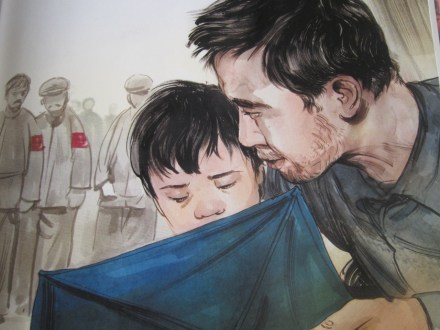
That night Tai Shan dreams about the thick forest and hears Baba whisper, “‘Tai Shan, I saw your red kite fly so high.’” But these words are not in a dream, Baba is there. But Baba is not home to stay. Hurriedly, he gives Tai Shan his blue kite, telling him that he will not be able to fly it for a while. He asks Tai Shan to fly both kites and know that he is looking up and thinking about his son. Suddenly, men with red armbands rush in and take Baba away. Tai Shan tries to run after him, but Granny Wang holds him back.

Tai Shan cries and does not understand. Granny Wang explains that Baba is being sent to another labor camp far away because the authorities don’t agree with his ideas. During the three days when he didn’t fly his blue kite, Granny Wang says, Baba had been imprisoned. He had escaped and run all the way to see Tai Shan before he was taken away. Now Tai Shan flies the two kites every day and thinks of being together with Baba.
celebrate-picture-books-picture-book-review-red-kite-blue-kite-Baba-gives-kite

copyright Greg Ruth, courtesy of Disney-Hyperion

One summer afternoon, Tai Shan dozes while he allows his red kite to dip and soar in the clouds. When he opens his eyes, he sees dozens of red and blue kites in the sky. Tai Shan jumps up. He sees Baba smiling at him and “holding the string of a huge blue kite dancing in the sky.” Tai Shan’s friends are also smiling and flying their new kites. Tai Shan runs to Baba, and Baba runs toward Tai Shan. The sky “is filled with kites—red and blue. They hop and giggle and cheer as they rise and dive, soaring and lunging together. They are free, flying everywhere.”

An Author’s Note about the Chinese Cultural Revolution follows the text.

Inspired by the story of a family friend whose father was sent to a labor camp during the Chinese Cultural Revolution between 1966 and 1976, Ji-li Jiang wrote Red Kite, Blue Kite “for the many fathers and sons who suffered during that turmoil.” Jiang’s story is a universal and relevant reminder of the precious freedoms of thought and speech that need constant and vigilant protection. Through her sensitive storytelling and lyrical language, Jiang offers a story of understanding, hope, and infinite love that will fill readers’ hearts.

Greg Ruth’s stunning paintings show all the emotion of Jiang’s story through exquisite, realistic portraits of Tai Shan, Baba, and Granny Wang. The distinctive landscapes of China are rendered in colorful foregrounds set on gauzy backgrounds of rising hills. Smoky images of the followers of the Cultural Revolution mirrors the darkness and destruction of the time in a way that is understandable for the young audience. The final two-page spread of Tai Shan and Baba’s reunion amid dozens of red and blue kites is inspiring and full of the strength of the human spirit.

Red Kite, Blue Kite is a must for school and public libraries and makes an excellent addition to home libraries as well.

Ages 5 – 9

Disney-Hyperion, 2013 | ISBN 978-1423127536

For a downloadable Educator’s Guide click here.

Learn more about Ji-li Jiang and her books on her website!

Find galleries of books and illustration for children and adults plus lots more on Greg Ruth’s website!

Kite Flying Day Activity
celebrate-picture-books-picture-book-review-kite-maze

Soaring Kite Maze


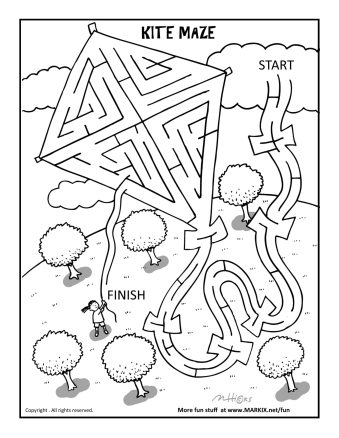
The dips and rises your pencil takes through this maze is a little like the way a kite flies through the sky! Print your Soaring Kite Maze and enjoy!

Picture Book Review

February 1 – National Freedom Day

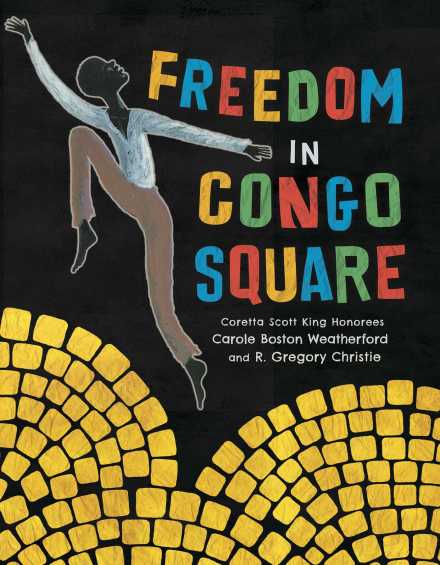
celebrate-picture-books-picture-book-review-freedom-in-congo-square-cover

About the Holiday

National Freedom Day commemorates the February 1, 1865 signing by President Abraham Lincoln of a joint United States House of Representatives and Senate resolution that outlawed slavery and later became the 13th Amendment to the Constitution. Major Richard Robert Wright Sr., a former slave, called on local and national leaders to meet in Philadelphia and formalize a national day of remembrance. In 1947, a year after Wright’s death, the U.S. Congress passed a bill marking February 1 as National Freedom Day. The proclamation was signed into law on June 30, 1948 by President Harry S Truman. The holiday led to Black History Day, which was later expanded to Black History Month.

Freedom in Congo Square

Written by Carole Boston Weatherford | Illustrated by R. Gregory Christie


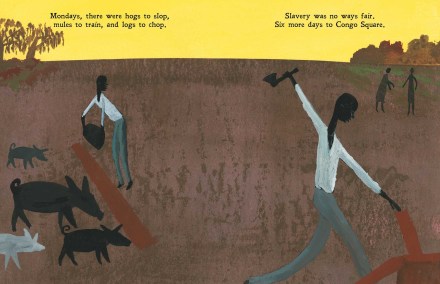
From sunup to sundown slaves brought to the state of Louisiana from their homelands in Africa and the West Indies toiled on plantations six days a week. The seventh day, Sunday, was set aside as a day of rest and worship, and in the afternoon people of African descent gathered in Congo Square in the heart of New Orleans to dance, play instruments, and talk. On Monday morning the long week began anew, but the rhythms of Congo Square sustained the men, women, and children through “hogs to slop, / mules to train, and logs to chop. / Slavery was no ways fair. / Six more days to Congo Square.

celebrate-picture-books-picture-book-review-freedom-in-congo-square-monday

Image copyright R. Gregory Christie, text Carole Boston Weatherford. Courtesy simonandschuster.com

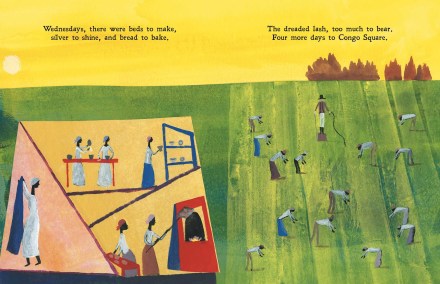
On Tuesdays, with “cows to feed, / fields to plow, and rows to seed,” five more days stretched out in endless labor. “Wednesdays, there were beds to make, / silver to shine, and bread to bake. / The dreaded lash, too much to bear. / Four more days to Congo Square.” Thursdays came with wash tubs and drying lines, scrub brushes, and brooms. “Spirituals rose from the despair. / Three more days to Congo Square.”

celebrate-picture-books-picture-book-review-freedom-in-congo-square-wednesday

Image copyright R. Gregory Christie, text Carole Boston Weatherford. Courtesy simonandschuster.com

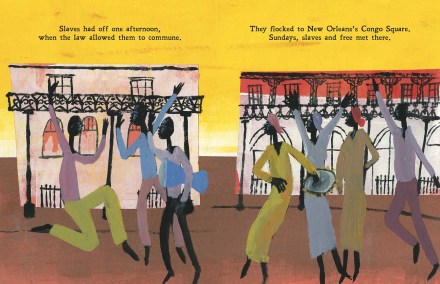
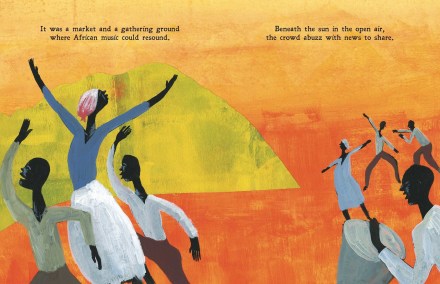
Fridays were spent in back-breaking work and though some brave souls dared to run, most were counting “Two more days to Congo Square.” Saturdays brought no more relief, but the days had whittled down to hours and “Freedom was slaves’ ardent prayer. / One more day to Congo Square.” At last came Sunday afternoon, and slaves and free rushed to Congo Square—“…a market and a gathering ground / where African music could resound.”

They met their kinsmen by nation, tribe, or language and revived their own stories and music played on drums, fiddles, shells, flutes, gourds, and bells that led to chants and dancing. “This piece of earth was a world apart. / Congo Square was freedom’s heart.”

celebrate-picture-books-picture-book-review-freedom-in-congo-square-sunday

Image copyright R. Gregory Christie, text Carole Boston Weatherford. Courtesy simonandschuster.com

Through powerful rhythmic couplets, as spare and austere as the work they describe yet ending in a focal point of hope, Carole Boston Weatherford recreates the steady thrum that resonated in the hearts of slave and free men and women as they anticipated each afternoon in Congo Square.  As the days remaining until Congo Square are counted off, Weatherford’s predominantly one-syllable words form a staccato beat, the pounding of hard, physical work. When Sunday comes and people find joy in their shared music and dance, Weatherford’s phrasing within the same structured couplets rises, employing multi-syllable words that give the verses a pulsing flow that echoes the freedom they find in Congo Square.

celebrate-picture-books-picture-book-review-freedom-in-congo-square-music-resounded

Image copyright R. Gregory Christie, text Carole Boston Weatherford. Courtesy simonandschuster.com

Gregory Christie’s vivid folk-art illustrations are a perfect complement to Weatherford’s verses. The elongated figures stand tall and proud amidst the fields and workrooms of the plantation. In some scenes the slaves’ angled bodies, leaning over to pick cotton, wash floors, or lift baskets may be bent, but they are not broken, and while two men work on building a wall, they seem to kneel prayerfully as they add another brick. In a moving two-page spread set at night, brown wood-grain houses superimposed with rows of sleeping slaves float on a blue-toned ground below a red sky, reminiscent of ships laden with Africans sailing the Middle Passage of the Atlantic slave trade. As the men and women congregate in Congo Square, Christie’s lithe figures raise their arms and kick their legs in dance. The fiery backgrounds swirl with color as the celebrants jump, stretch, play instruments and move with exultation.

A detailed Forward by historian and Congo Square scholar, Freddi Williams Evans and an Author’s Note following the text reveal more information on the history of Congo Square and its significance to Jazz music.

Freedom in Congo Square is both a heartrending and jubilant book that would make a wonderful and meaningful addition to any child’s home library.

Ages 4 – 8

little bee books, 2016 | ISBN 978-1499801033

Learn more about Carole Boston Weatherford and her books and discover book-related resources on her website!

If you’re lucky enough to live in Decatur, Illinois, you can visit R. Gregory Christie’s unique art studio, art school, and bookstore Gas-Art Gifts Autographed Children’s Bookstore. If you don’t live near Decatur, you can check out all the books, art, and items for sale on the website!

National Freedom Day Activity

celebrate-picture-books-picture-book-review-chalk-garden-st

Freedom Stone


Freedom is a precious right—one that can be represented in different ways by each person. For today’s activity use a brick, paving stone, large stone, or molded plaster of Paris and decorate it with a picture or design that means freedom to you. Then put it in a special place—in a garden, near your front or back door, in your room, or in another spot—where it will remind you of freedom’s gifts.

Supplies

  • Brick, paving stone, large stone, plaster of Paris
  • Paint
  • Plastic gems, bead, or other small objects
  • Strong glue or other adhesive
  • Paint brush

Directions

  1. Create a design that shows what freedom means to you or an object that represents freedom to you
  2. Paint your stone with the design, let dry
  3. Add gems, beads, or other objects
  4. Display your Freedom Stone

Picture Book Review

January 16 – Martin Luther King Jr. Day

celebrate-picture-books-picture-book-review-i-am-martin-luther-king-jr-cover.png

About the Holiday

Martin Luther King Jr. Day celebrates the life and legacy of the man who dedicated his life and work to teaching—as Coretta Scott King stated—“the values of courage, truth, justice, compassion, dignity, humility and service” and led a non-violent Civil Rights movement to enact racial equality and justice throughout state and federal law. President Ronald Reagan signed the holiday into law in 1983, setting it on the third Monday of January to coincide with Martin Luther King, Jr.’s birthday on January 15. The holiday was officially observed in all 50 states in 2000. Today, learn more about the life and work of Martin Luther King and how you can help promote justice and equality for all. Consider volunteering in your community where help is needed.

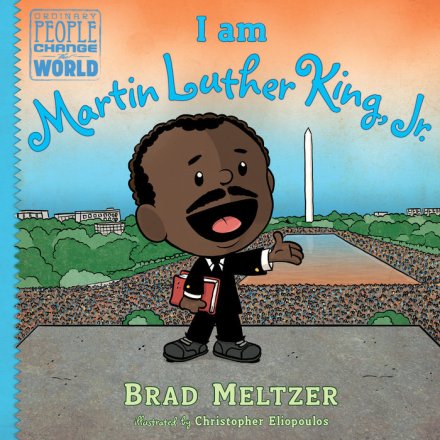
I am Martin Luther King, Jr.

Written by Brad Meltzer | Illustrated by Christopher Eliopoulos


Standing inside a church, Martin Luther King, Jr. introduces himself with two anecdotes from his childhood that demonstrate his world outlook. “When I was little,” he says, “I used to get into a lot of accidents.” He was hit in the head by a baseball bat, knocked down by cars and once even “tumbled over our banister, then bounced through an open door into the basement.” While these incidents could have made him cautious, Martin instead was determined to keep “getting back up.” His second influence were the books in which he could find “big words.” Even as a child Martin recognized that “there is power in words.”

celebrate-picture-books-picture-book-review-i-am-martin-luther-king-jr-as-a-child

Image copyright Christopher Eliopoulos, text copyright Brad Meltzer. Courtesty of Dial Books for Young Readers

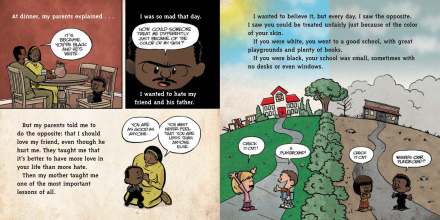
Before he went to school, Martin relates, his best friend was a white boy whose father owned a nearby store. They did everything together until school started. Then Martin went to a school with only black students while his friend went to a white-students-only school. Soon, Martin’s friend told him his father didn’t want them to play together anymore. Martin was confused. When his parents told him the reason was that they had different colored skin, Martin felt angry. He wanted to hate his friend and his father, but Martin’s parents taught him to love his friend, and his mother told him, “you must never feel that you are less than anyone else.”

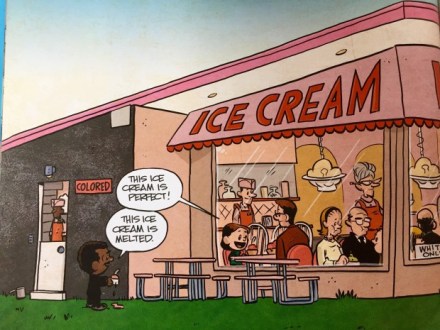
It was a difficult lesson when all around him he saw inequality. White schools had better equipment, there were different elevators, bathrooms, water fountains, and other facilities for black people and white people, on buses black riders had to give up their seats to white riders. Everywhere black people and white people were segregated.

celebrate-picture-books-picture-book-review-i-am-martin-luther-king-jr-ice-cream

Image copyright Christopher Eliopoulos, text copyright Brad Meltzer. Courtesty of Dial Books for Young Readers

When Martin was only 15 he was admitted to college. At 19 he entered the seminary where he learned about civil disobedience and nonviolent resistance—ways to use “love and peaceful methods to change unfair things in society.” These were lessons Martin wanted to share with others. His chance to put his thoughts into action came when Rosa Parks was arrested for refusing to relinquish her seat to a white man. Martin advocated a peaceful protest—a boycott of public buses. He reasoned that without the money from black riders, the bus companies would change their policies.

As the boycott began working, Martin gave a speech in Montgomery, Alabama, motivating people to continue their peaceful protest. Martin was put in jail and his house was bombed, but the boycott continued for more than a year. Eventually, the bus companies changed their rules. Other peaceful protests began to take place in restaurants and other public places.

One protest took place in Birmingham, Alabama.  Martin was again put in prison, where he wrote one of his most famous speeches. Children also took part in the Birmingham protest. The Children’s Crusade attracted more than 1,000 kids. On the first day 900 of them were arrested, but that only inspired the children more. On the second day 2,500 children showed up. They stood firm while they were sprayed with water hoses and attacked by police dogs. People—both black and white—watching the news reports were aghast. Three months later the rules began to change.

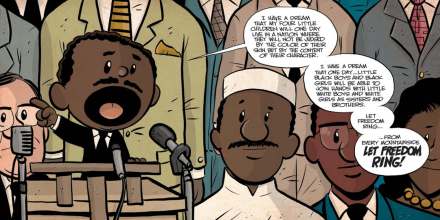
celebrate-picture-books-picture-book-review-i-am-martin-luther-king-jr-i-have-a-dream-speech

Image copyright Christopher Eliopoulos, text copyright Brad Meltzer. Courtesty of Dial Books for Young Readers

“By the summer of 1963, an estimated one million Americans held their own protests in cities across the country.” Then A. Philip Randolph suggested a single huge march to convince “Congress and the president to pass laws so that no one in America can treat people differently based on skin color.” On August 28, 1963 the March on Washington for Jobs and Freedom took place. Martin gave what may now be considered his most famous speech in which he talked about his dreams for the country, for the people, and for their children.

Although Congress began passing new laws, the ability and right to vote in elections still eluded black people. To change the voting rules another march was organized to walk 54 miles from Selma to Montgomery Alabama. The 600 walkers were met by police who stopped them. Two days later 2,500 activists tried again but could not get through. On the third try 8,000 marchers showed up. This time, with the world watching on television, the activists made it to Montgomery, protected by troops sent by President Johnson.

celebrate-picture-books-picture-book-review-i-am-martin-luther-king-jr-montgomery-march

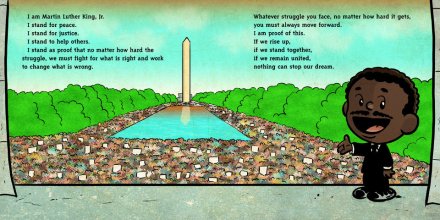
Martin continued to speak out, relating his philosophy and dreams for the nation. “To reach our goals, we must walk the path of peace,” he said. “We must lock arms with our brothers and sisters. We must march together. When we do…Our voices will be heard, and freedom will ring.” The lessons Martin Luther King taught still resonate today. He stands “as proof that no matter how hard the struggle, we must fight for what is right and work to change what is wrong.…if we stand together, if we remain united, nothing can stop our dream.”

celebrate-picture-books-picture-book-review-i-am-martin-luther-king-jr

Brad Meltzer’s Ordinary People Change the World: I am… series of biographies are well-known for showing young readers that they can achieve their dreams and make a difference no matter what those hopes may be. In his biography of Martin Luther King, Jr., Meltzer depicts several incidents from King’s childhood and early adulthood that influenced his future work. These help readers understand not only the types of prejudice King and other African Americans experienced, but also the people who inspired his philosophy of peace.

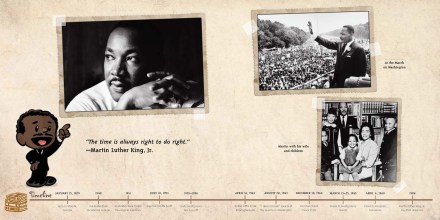
Meltzer’s inclusion of King’s imprisonments and the violence that met the peaceful protesters deepens the understanding of the dangers King and other protesters faced, and provides an opportunity to open a discussion between adults and children about those times and what they now see in the news. Meltzer’s description of the Children’s Crusade will inspire readers, making them proud of children in the past and stirring them to actions of their own. Sections from King’s Letter from Birmingham Jail and his most famous speeches are presented in speech bubbles. The text is followed by photographs of Martin Luther King, Jr. with his family and at the March on Washington as well as a timeline of his life. Sources and resources for further reading are also included.

celebrate-picture-books-picture-book-review-i-am-martin-luther-king-jr-timeline

In keeping with the style of all of Meltzer’s and Christopher Eliopoulos’s Ordinary People Change the World: I am… biographies, the illustrations are vibrant and cartoon-inspired. Martin Luther King, Jr. is depicted with the size of a child but the features of an adult, reinforcing the idea contained in the text of the dual nature of the future adult residing in the child and the ideals of the child remaining in the adult that appeals to ambitious young readers. Speech bubbles highlight text that carry emotional dialogue. Settings, including churches, Birmingham jail, Washington DC, the Edmund Pettus Bridge in Alabama, and the Martin Luther King, Jr. monument give children a look at the cities and places described in the text.

For young readers, I am Martin Luther King, Jr. offers a comprehensive biography of the man who was a national and world leader in the fight for equal rights for all people and makes an excellent starting place for classroom lessons and personal discussions.

Ages 5 – 8

Dial Books for Young Readers, 2016 | ISBN 978-0525428527

Discover more about Brad Meltzer and his books for adults and children as well as other goodies on his website!

Learn more about Christopher Eliopoulos, his books, and his comics on his website!

Martin Luther King Jr. Day Activity

celebrate-picture-books-picture-book-review-martin-luther-king-jr-coloring-page

Martin Luther King, Jr. Portrait


Color this printable Martin Luther King, Jr. Portrait and then hang it in your room or locker to inspire you!

Picture Book Review
December 14 – It’s Human Rights Month

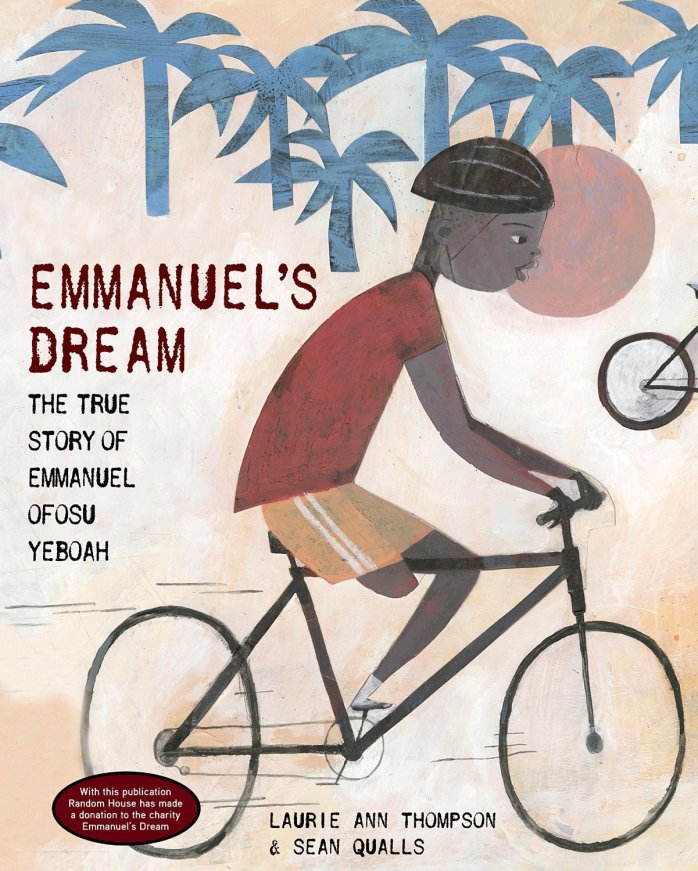
celebrate-picture-books-picture-book-review-emmanuel's-dream

About the Holiday

December is Human Rights Month, an observance established by the United Nations in order to raise awareness of, promote, and protect the equality of the world’s citizens. It takes vigilence, compassion, dedication, and determination, but achieving the goal of equal human rights is a responsibility we all share.

Emmanuel’s Dream: The True Story of Emmanuel Ofosu Yeboah

Written by Laurie Ann Thompson | Illustrated by Sean Qualls


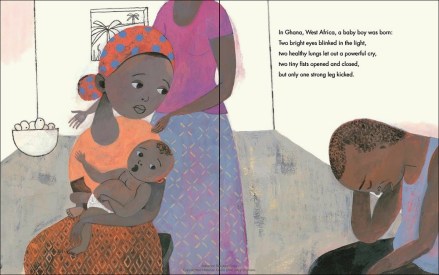
A baby is born in Ghana, West Africa with bright eyes, healthy lungs, and tiny, clasping fingers—but with only one strong leg. Most people think the baby will grow up to be a burden or worse—a curse. His father leaves the family, but his mother keeps the faith. Her name is Comfort and she names her child Emmanuel, which means “God is with us.”

celebrate-picture-books-picture-book-review-emmanuel's-dream-baby

Image copyright Sean Qualls, text copyright Laurie Ann Thompson. Courtesy of Schwartz & Wade

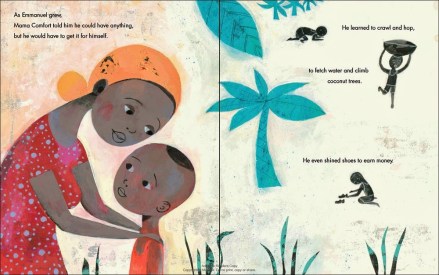
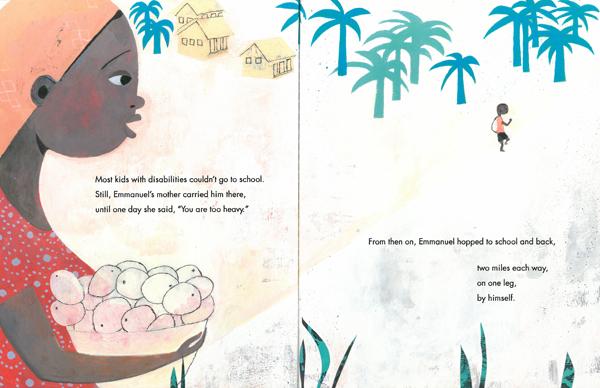
As Emmanuel grows, his mother encourages his independence. He learns how to crawl and hop to complete his daily work all with one leg. Most kids with disabilities don’t go to school, but Comfort carries her son back and forth until he becomes too heavy. From then on Emmanuel hops the two miles each way all by himself. At first the other kids won’t play with him, but Emmanuel is clever. He buys a soccer ball with the money he earns shining shoes and when he offers to share it, the kids include him. On crutches he is a fierce competitor and earns his classmates’ respect. Riding bikes is another favorite activity. Can Emmanuel pump those pedals with only one leg? He practices and falls, practices and falls some more until he masters the technique.

celebrate-picture-books-picture-book-review-emmanuel's-dream-growing-up

Image copyright Sean Qualls, text copyright Laurie Ann Thompson. Courtesy of Schwartz & Wade

When Emmanuel is 13 years old, his mother becomes ill. As the only family member capable of working, Emmanuel takes a train to a city 150 miles away to find a job. He doesn’t see his family again for two years. Because of his disability it is hard for him to find work. Finally, a food stand owner hires him and gives him a place to live. Over time Comfort grows sicker. When Emmanuel goes to be with her, she tells him to never beg and never give up. He takes these words to heart.

Emmanuel has an idea to show the world that “disabled does not mean unable”—all he needs is a bike. When the Challenged Athletes Foundation learns of his plan to bike around Ghana, they give him a bike, a helmet, and clothing. He trains and receives a blessing from the king of his region. Then accompanied by people who will document his trip, he takes off. “He pedaled through rain forests, over rolling hills, and across wide, muddy rivers….He pedaled as trucks roared past on the narrow highways and wild animals stalked his thoughts….He rode up, down, across, and around his country, proudly wearing the colors of its flag on a shirt printed with the words “The Pozo” or “the disabled person.”

celebrate-picture-books-picture-book-review-emmanuel's-dream-going-to-school

Image copyright Sean Qualls, text copyright Laurie Ann Thompson. Courtesy of Schwartz & Wade

Emmanuel talks to others with physical challenges and to those without. He meets farmers, landowners, government officials, and reporters. He wants everyone to learn of his message. People begin to pay attention—they ride and run alongside him; people with disabilities come out of their houses to see him (some leaving home for the first time ever). Emmanuel is becoming a national hero! Emmanuel completes his journey—nearly 400 miles—in only 10 days. In that short amount of time he proves that anyone can do great things and that one person is enough to change the world.

An Author’s Note expanding on Emmanuel Ofosu Yeboah’s life since his bike ride follows the text.

Laurie Ann Thompson tells this story of courage and achievement in straightforward language that highlights the difficulties and prejudices Emmanuel overcame to live the full life his mother envisioned for him. The details Thompson reveals—both within the school setting and in the world beyond—will inspire anyone who reads this special and moving true story.

Sean Qualls renders the story of Emmanuel Ofosu Yeboah in the vibrant colors and patterns of his native West Africa, giving energy and spirit to the fire that burned inside the young boy who rose above his disability and the expectations of his community. His relationship with his strong, supportive mother is drawn with obvious love and compassion. The use of a folk-art style combined with scenes of African markets, landscapes, and traditional tableaus, effectively sets the story for children. One particularly touching illustration shows a tiny Emmanuel hopping off to school as his mother, shown larger in the foreground, watches.

Ages 4 – 9

Schwartz & Wade, Random House, 2015 | ISBN 978-0449817445

Discover more about Laurie Ann Thompson and her books on her website!

To view a gallery of picture book illustration by Sean Qualls, visit his website!

Human Rights Month Activity

celebrate-picture-books-picture-book-review-change-your-world-coloring-page

Change Your World Coloring Page


You can make a difference in your school, your town, and the world around you. Here’s a printable Change Your World message that you can color and hang in your room or locker to remember how much power you have.

Picture Book Review
December 4 – It’s Universal Human Rights Month

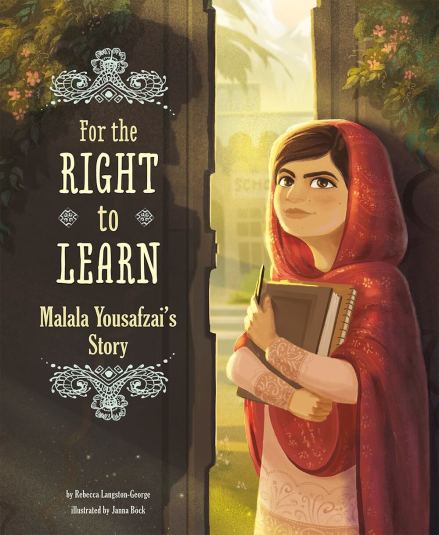
celebrate-picture-books-picture-book-review-for-the-right-to-learn-malala-yousafzai's-story-cover

About the Holiday

In the aftermath of World War II the Four Freedoms that had guided the Allies—Freedom of Speech, Freedom of Religion, Freedom from Want, and Freedom from Fear—did not go far enough in defining the areas that need to be covered. In December 1948 the United Nations General Assembly put forth 30 articles to further delineate the freedoms and rights of the world’s citizens, including the freedom of education, thought, health, opinion, and expression as well as the right to take part in government, have a free choice of employment, and more. To honor today’s observance, speak out when you see inequality and work to bring freedom in all it’s forms to everyone.

For the Right to Learn: Malala Yousafzai’s Story

Written by Rebecca Langston-George | Illustrated by Janna Bock


Malala Yousafzai lived in the Swat Valley of Pakistan, where her father, Ziauddin, ran a school in the town of Mingora. Malala loved school and even when she was tiny visited classes with her father often. Not all Pakistani children could go to school—some families couldn’t afford it and some believed girls should stay home to clean, cook, and keep house. But Malala’s father believed his daughter had the same right to an education as his sons. Malala thrived at school. She learned multiple languages and won many academic awards.

“But Taliban leaders who controlled the area were against letting girls go to school. They declared that females should be separated from males. They wanted to outlaw education for girls.” The Taliban leaders even tried to intimidate Malala’s father. “One ordered Ziauddin to close his school because girls and boys used the same entrance.” Ziauddin refused.

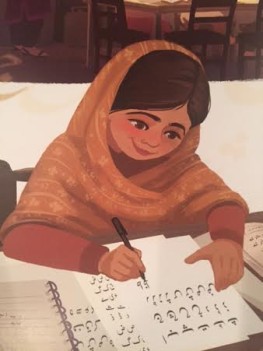
celebrate-picture-books-picture-book-review-for-the-right-to-learn-malala-yousafzai's-story-writing

Image copyright Janna Bock, courtesy of Capstone Press

While her father was worried, Malala’s determination grew stronger. She studied harder at school, and during the school holidays instead of covering her hands with henna flowers and vines as most Pakistani women did, Malala painted science formulas on hers. The Taliban continued to exert a tight grip on the Swat Valley, and instituted new rules: men could not shave, women had to cover their faces, movies were banned. And the radio “crackled with the sound of the Taliban preaching: No education for girls! Girls who attend school bring shame to their families!”

The Taliban frightened many, and empty seats in school classrooms began to be more frequent. Ziauddan and Malala appeared on TV to express the importance of education. In response the Taliban threatened Ziauddan and his school. Despite the threats Malala and her father continued to speak and write, “demanding equal education for girls.” The Taliban began patrolling the streets, perpetrating violence and destruction on anyone who didn’t obey their rules.

In December 2008, the Taliban announced that all girls’ schools would close by January 15. “Even before the deadline, bombs started to rain down on nearby schools as warnings.” The British Broadcasting Corporation wanted to reveal to the world what was happening. They wanted a girl to write a blog about her experience and “how it felt to be denied an education. Malala volunteered.

celebrate-picture-books-picture-book-review-for-the-right-to-learn-malala-yousafzai's-story-sneaking-to-school

Image copyright Janna Bock, courtesy of Capstone Press

She took the pen name Gul Makai and related her blog by phone to a reporter who typed and published her words for two months. The first post appeared on January 3, 2009. On January 14 Malala wrote: “‘They can stop us from going to school, but they can’t stop us learning!’” Because activists were growing angry, the Taliban let girls ages 10 and younger go to school. Malala and her friends were 11. They began dressing to look younger and hid school books in their clothes. If they had been caught lying about their ages, they and their teachers could have been beaten or executed.

In May 2009 the Pakistani army began battling the Taliban and ordered everyone to evacuate. Malala and her family had to pack their belongings and leave. Malala wanted to take her books along, but there wasn’t room. She could only hope that they—and her home—would survive the fighting. Three months later, the people of Mingora were allowed to come home, but the town was not the same as they had left it. Shops and buildings were destroyed, burned frames of cars were strewn across the roads. The school’s walls were riddle with bullet holes. But the Taliban was gone. Ziauddin reopened his school for boys and girls.

While Malala returned to school, her life was not the same. Because of her blog, speeches, and interviews, she was internationally famous. Everyone wanted to hear what she had to say—everyone but the Taliban. “Talban leaders began to threaten her on the Internet. Saying she was working for the West, they announced Malala was on their hit list. The police warned the Yousafzai family to leave, but Malala refused to hide. She refused to be silenced.”

Because of the danger, Malala’s mother wanted her to ride the bus to school instead of walk. On October 9, 2012 as Malala and her classmates rode the bus home after school, the bus was stopped and a man boarded, demanding to know which girl was Malala. While no one spoke, the girls couldn’t stop their eyes from flashing quickly toward Malala. That was all the man needed. He “pointed a gun at Malala. Three shots shattered the silence.”

The bus driver rushed Malala and two of her friends to the hospital. Word spread quickly about the shooting through the town and around the world. Malala lay unconscious for days as the Taliban threatened her again should she live. As determinedly as Malala fought for equal education, she fought for survival. Finally, she was flown to a hospital in England for more surgery and to keep her safe. Gifts and wished poured in from all over the world. Malala stayed in the hospital for three months and underwent many procedures to correct the damage done by the Taliban’s bullets.

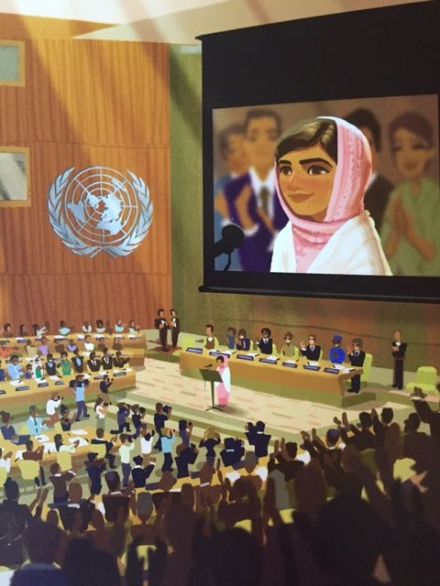
When she had recovered, Malala returned to her family and to her place on the world stage where she continues to speak out for the rights of all. On July 12, 2013 in a speech at the United Nations, Malala “declared, ‘One child, one teacher, one book, and one pen can change the world.’” On December 10, 2014 Malala became the youngest recipient of the Nobel Peace Prize for her “strength, power, and courage” to “lift her voice for children everywhere.”

celebrate-picture-books-picture-book-review-for-the-right-to-learn-malala-yousafzai's-story-speaking-to-the-UN

Image copyright Janna Bock, courtesy of Capstone Press

Malala. Those three syllables have become synonymous with bravery, freedom, and education. Rebecca Langston-George tells Malala’s remarkable story with the same unstinting vision that fuels Malala’s mission. Told sensitively, but candidly, this compelling biography reveals the harrowing evolution of the Taliban’s reach that, far from intimidating young Malala, only served to make her more determined. Langston-George’s excellent command over her well-chosen details and gripping pacing enhances the power of this important true story. Readers should come away inspired—not only by Malala’s life, but the fact that they too can make a difference.

Janna Bock depicts the changing landscape of Malala’s hometown both physically and philosophically with illustrations that help readers clearly envision and understand Malala’s life and environment. The faces of the townspeople and the Yousefzai family register distress and fear, but also determination, courage, and optimism as schools close, Mingora comes under fire, and the citizens become refugees. Malala’s shooting, and recovery are portrayed with thoughtful consideration of the readers, and the ending takes children inside the United Nations to witness Malala’s ultimate triumph.

An Author’s Note detailing more about Malala’s story then and now as well as a glossary and index follow the text.

For the Right to Learn: Malala Yousafzai’s Story is an important biography of current events and people shaping the world and our children’s future and is a must read for all.

Ages 8 – 12

Capstone Press, 2016 | ISBN 978-1623704261

Discover more fascinating books by Rebecca Langston-George on her website!

View a gallery of art by Janna Bock on Tumblr!

Universal Human Rights Month Activity

celebrate-picture-books-picture-book-review-friends-of-the-world-coloring-page

Friends of the World Coloring Page


Love and understanding for others makes the world a smaller—and better—place. Have fun coloring this Friends of the World Coloring Page!

Picture Book Review
October 24 – United Nations Day

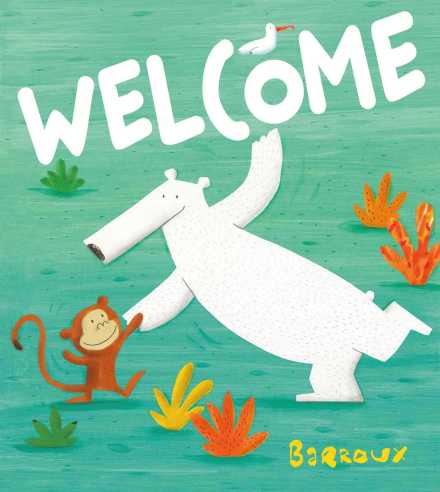
celebrate-picture-books-picture-book-review-welcome-barroux-cover

About the Holiday

Founded in the aftermath of World War II to promote cooperation among all nations and prevent another devastating conflict, the United Nations is an intergovernmental organization whose purpose has grown to include encouraging social and economic development, protecting human rights, and providing aid in times of natural disasters, famine, and war. Today’s holiday commemorates the establishment of the UN and advocates the remembrance and implementation of its principles for this and future generations.

Welcome

By Barroux


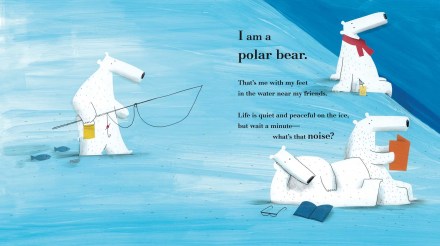
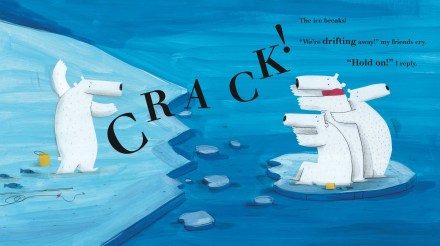
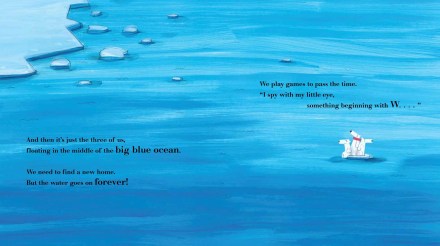
A polar bear sits on the edge of an ice floe enjoying some relaxing time with his friends when he hears an ominous noise. “CRACK! The ice breaks! ‘We’re drifting away!’” his friends cry. In no time at all the three polar bears are adrift in the middle of the sea in need of a new home. They float and float, but “the water goes on forever!” To pass the time the friends play games: “‘I spy with my little eye, something beginning with W…’”

celebrate-picture-books-picture-book-review-welcome-barroux-polar-bears-relaxing

Copyright Barroux, courtesy of little bee books and simonandschuster.com

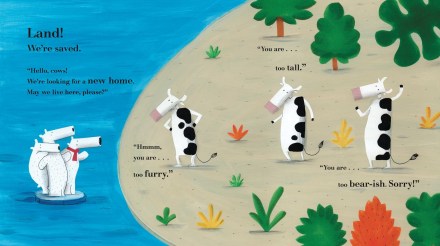
Perhaps days go by. The bears ride out a storm with dark skies and huge waves that threaten to sink them. It’s scary and the trio wants “to find a new home right now!” At last their ice floe—smaller now—approaches a sandy shore. “Land! We’re saved,” cheer the polar bears. They ask the cows on the beach if they can live there, but the cows take exception. The bears are “too furry…too tall…and too bear-ish.” And with a “Sorry!” the cows turn the weary travelers away.

celebrate-picture-books-picture-book-review-welcome-barroux-ice-breaks-away

Copyright Barroux, courtesy of little bee books and simonandschuster.com

Once again on their own, the bears have no choice but to let the current steer them. With standing room for only one their icy raft, they near another beach where a single panda relaxes on pillows in the midst of expansive land. “Yes! This could be our new home,” the polar bears shout. The panda ponders the situation for only a moment before stating, “‘…you are too many. Look around, there’s just not enough room! You can’t live here.’”

celebrate-picture-books-picture-book-review-welcome-barroux-polar-bears-meet-cows

Copyright Barroux, courtesy of little bee books and simonandschuster.com

As the polar bears continue on their journey, their “little ice boat has almost melted” and they are running out of time. They bob next to a tall sea wall. “‘Help us!’” they plead. Behind the wall two giraffes lounge on the beach, too lazy to investigate the noise they hear. The ice floe has melted to a thin disk, with room for only one. The bears are hanging on and about to give up hope when they find an empty island. They jump to shore just in the nick of time and begin enjoying their new home.

celebrate-picture-books-picture-book-review-welcome-barroux-polar-bears-adrift

Copyright Barroux, courtesy of little bee books and simonandschuster.com

It’s not long before a dinghy floats into view with three monkeys on board. “‘Excuse me, we’re looking for a new home. Can you help us please?’” The polar bears stop their game of badminton and step forward. “‘Hmmm,’” they think. “‘You are…

Welcome!’”

With vibrant blue, full-bleed pages as wide open as the sea itself and three endearing long-nosed polar bears, Barroux has crafted a poignant tale with depth and far-reaching applications for readers of all ages. Inspired by the Syrian refugee crisis, Welcome stands on its own as an uplifting story of friendship and inclusiveness, but also offers an excellent means for beginning a discussion on the world events that children see and have questions about. Employing a bear’s first person point of view and incorporating a child-centric perspective on travel—from the humor of the I Spy game to the perseverance of the bears—Barroux sets just the right tone for his audience.

With sparse text and repetition of the bears’ simple request, the subject matter is handled with sensitivity, not fright, which allows children to understand that the theme of the story is relevant on many levels. Whether the “traveler” comes from near or far, is a classmate, teammate or neighbor, or is even the reader or someone else feeling adrift in a certain situation, children will see that all deserve welcome.

Ages 4 – 8

little bee books, 2916 | ISBN 978-1499804447

United Nations Day Activity

celebrate-picture-books-picture-book-review-UN-day-puzzle

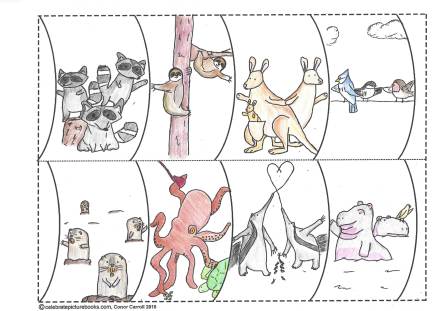
Give Me Your Hand! Puzzle


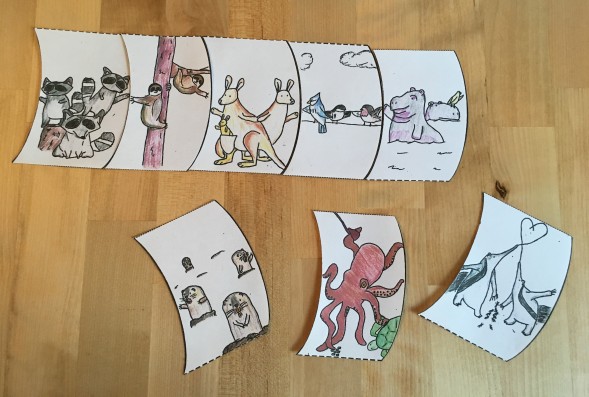
In this printable Give Me Your Hand! Puzzle, everyone is welcomed with a handshake. Offering friendship to all, the interchangeable pieces can be mixed and matched as the animals become buddies with one another.

Supplies

celebrate-picture-books-picture-book-review-UN-day-puzzle

Copyright Conor Carroll, courtesy of celebratepicturebooks.com

Directions

  1. Print the puzzle: to make the puzzle sturdier: Print on heavy stock paper or glue the page to poster board
  2. Color the pictures with colored pencils or crayons
  3. Cut the pieces apart
  4. Switch the pieces around to make many alternate pictures
celebrate-picture-books-picture-book-review-UN-day-puzzle

Copyright Conor Carroll, courtesy of celebratepicturebooks.com

Picture Book Review
Picture Book Review

August 16 – National Airborne Day

celebrate-picture-books-picture-book-review-brave-like-me-cover

About the Holiday

National Airborne Day was established in 1997 as a time to remember and thank the airborne members of the Armed Forces for their service and sacrifices. August 16 was chosen for this observance because it marks the first official United States Army parachute jump that took place in Georgia in 1940 by 48 volunteer members of the Parachute Test Platoon. The successful jump led the way for hundreds of thousands of paratroopers to follow in their footsteps. The day is commemorated by a ceremony at Fort Bragg in North Carolina, home to the 82nd Airborne Division. Other services are held around the country.
Brave Like Me

By Barbara Kerley


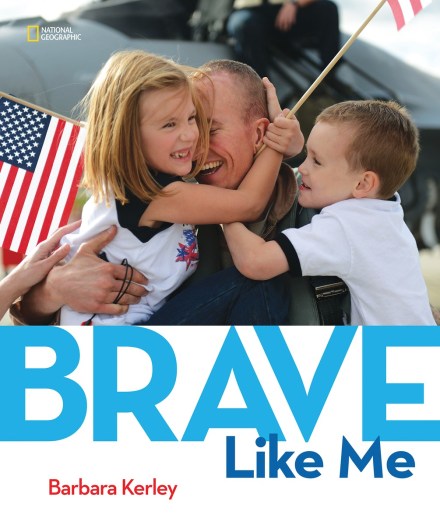
“When someone is serving their country, far from home, they have to be brave. Their families have to be brave. Even their kids have to be brave. Like me.” These lines from a child who has a parent serving their country opens this tribute to military families and the relatives, friends, and neighbors who support them. The child narrator reveals that parents about to be deployed spend a lot of time with their kids “until the day we have to say goodbye.” On that day the family shares kisses and hugs “big enough to last the whole time” parents are away.

Once parents are gone, the house seems empty and children wonder who will take care of them. They look at maps to discover where their parents are and what their day is like. The narrator describes children’s honest emotions, such as sadness and anger at the events parents miss or fear for their safety. But the kids understand that their parents are trained to stay safe.

The children are able to communicate with their parents on the phone and on the computer, where they share the details of their days. They also write letters and draw pictures that they send through the mail. Just as parents have responsibilities, the children know they have jobs to do too. They go to school, do their homework, and help around the house. The family bands together to cook meals, clean, read bedtime stories and tuck younger children into bed.

Friends and neighbors show they care by taking the kids on outings to the park, the movies, the pool, and to special events. Even though parents are far away from home, the child says, they think about their family all the time and want them to be happy playing with friends and pets and even when they are alone. The kids stay busy and enjoy their time with friends and family waiting for the day when they come home. On that day, the narrator says, “I’ll have lots of things to talk about and a million hugs and kisses to share.”

Through full-color photographic spreads and pages alternating between mothers and fathers serving in the military, Barbara Kerley presents an honest and uplifting account of what life is like for children of military families. The photographs of children playing with their parents and kissing and hugging them goodbye as well as pictures of both adults and kids doing their jobs while apart demonstrate the shared love and commitment military families have to their country and their relationships. Brave Like Me is a stirring nonfiction title for school and local libraries to help children understand the sacrifices some families make for their country. It would also be a comforting book for children facing a separation from a service member parent, other relative, or friend or for anyone who wants to better understand the life of service members.

A world map showing the location of each photograph in the book, a variety of children’s definitions of the meaning of “brave” and a discussion on the various branches of foreign service follow the text. There are also pages on how to deal with separation as well as advice and resources for caregivers.

Ages 4 – 8

National Geographic Children’s Books, 2016 | ISBN 978-1426323607

To learn more about Barbara Kerley and her wide range of books, visit her website!

National Airborne Day Activity

celebrate-picture-books-picture-book-review-military-plane-coloring-page

Military Plane Coloring Page


The Airforce uses many different types of planes in their missions. Here’s a printable Military Plane Coloring Page for you to enjoy!