About the Holiday
The month of December is a gift-giver’s delight and looking at the long winter ahead there’s no better gift for everyone on your list than a book (or two or…). With so many new books hitting bookstore shelves, there really is a perfect book to fit everyone’s taste. Young children, especially, benefit from reading a wide range of picture books from laugh-out-loud or touching stories to nonfiction that introduces them to influential people, science, history, and—in a case like today’s book—to all three! Today’s reviewed book also has the distinction of being timely and inspirational. If you’re still looking for gifts to give, it’s not too late to head to your local bookstore or their online shop to find books that will make kids’ eyes light up.
Thank you to Knopf Books for Young Readers for sending me a copy of The Polio Pioneer for review consideration. All opinions about the book are my own. I’m happy to be teaming with Knopf in a giveaway of the book. See details below.
The Polio Pioneer: Jonas Salk and the Polio Vaccine
Written by Linda Elovitz Marshall | Illustrated by Lisa Anchin
Even at the tender age of four, “Jonas Salk was a kid who saw things differently.” As he watched the soldiers marching in the victory parade in New York City following World War I, instead of cheering, he was saddened by all of the injured and wounded men he saw. In his free time, instead of playing ball or games with his friends, he read book after book, and yet he was the one the other kids came to when they needed a fair and knowledgeable referee. Jonas’s family had moved to America, fleeing religious persecution of Jews in Russia and Lithuania. Money was short, yet Jonas’s parents “taught their children the importance of education, of kindness, and of doing good works. Jonas prayed that he might, someday, help make the world a better place.”

Image copyright Lisa Anchin, 2020, text copyright Linda Elovitz Marshall, 2020. Courtesy of Knopf Books for Young Readers.
In college Jonas became enthralled with the study of chemistry and its use in making medicines. He went on “to medical school to become a doctor and researcher.” After graduation, he joined Dr. Thomas Francis in developing a flu vaccine. They had an idea for a new kind of vaccine that could help a “person’s body ‘practice’ fighting the flu” with the hope that the person’s body would “learn to fight the flu virus… and WIN.” After much research and work, they succeeded.
But there was a disease worse than the flu that was paralyzing or killing thousands every year—“including many babies and small children.” Even future President Franklin Delano Roosevelt was affected and required a wheelchair to get around. Not fully knowing how the polio virus spread, public swimming pools and beaches were closed. “Parents kept children away from movie theaters, sleepovers, and crowds.”

Image copyright Lisa Anchin, 2020, text copyright Linda Elovitz Marshall, 2020. Courtesy of Knopf Books for Young Readers.
Dr. Salk believed a polio vaccine could prevent the disease. He and his team of scientists worked tirelessly to develop one. When a viable vaccine was made, they tested it on children in Pittsburg, Pennsylvania. Dr. Salk gave “many of the shots himself.” The vaccine did seem to help defend the body from polio, but could it prevent it? To learn the answer to that question, a larger trial was needed. “Throughout America, almost two million children—POLIO PIONEERS!—participated.” Then on April 12, 1955 the world learned that Dr. Salk’s vaccine could indeed conquer polio.
“Within a few years, cases of polio plummeted,” and soon it was nearly eradicated from America and most areas of the world. But polio was not the only disease that Dr. Salk wanted to eliminate. He continued to work and test and dream. Then in California, Jonas Salk established the Salk Institute for Biological Studies, where “researchers question and discover, seeking cures for cancer, HIV/AIDS, diabetes, multiple sclerosis, and many other diseases.” All of this good stemmed from a little boy “who saw things differently.” Perhaps you know a child like that too.
An Author’s Note from Linda Elovitz Marshall follows the text and describes her own experiences as a young child growing up with the fear of polio as well as what inspired her biography of Jonas Salk. Images of letters children sent to Dr. Salk thanking him for his life-changing vaccine are also included.
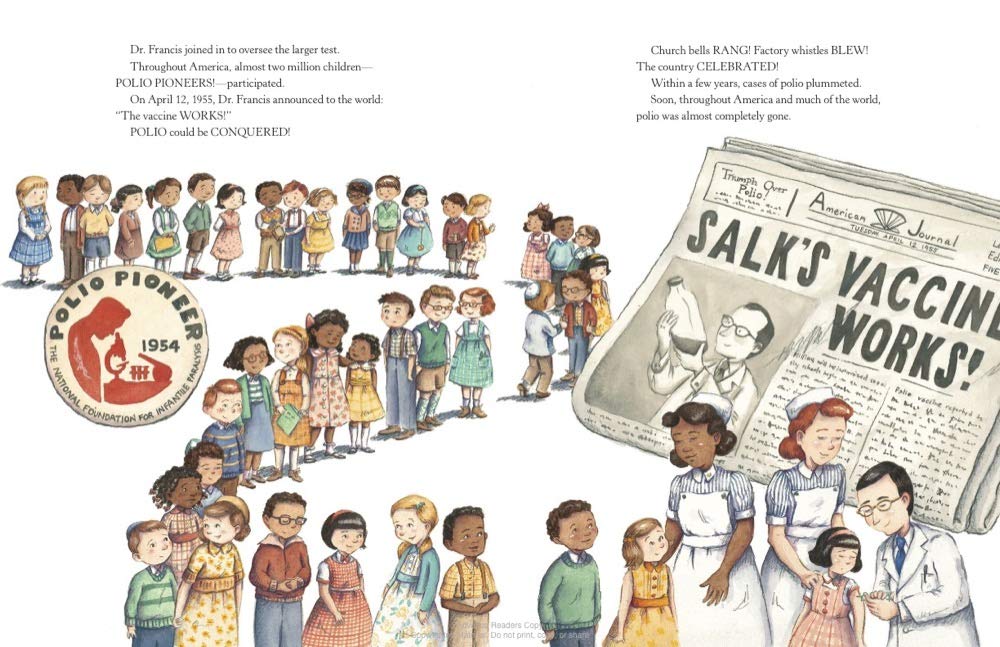
Image copyright Lisa Anchin, 2020, text copyright Linda Elovitz Marshall, 2020. Courtesy of Knopf Books for Young Readers.
Linda Elovitz Marshall’s compelling biography of Jonas Salk, begun many years before the COVID-19 pandemic, reminds young readers—many of whom may also be dreamers like Dr. Salk—that their impressions, feelings, and unique view of the world can make valuable, even indispensable, contributions to the world. Marshall’s introduction of Jonas Salk as a serious, curious, intelligent, and caring child—even very young child—will impress readers with his life-long commitment to helping others and inspire their own good works. Her straightforward storytelling reveals to children a time with fears and hopes similar to their own recent experiences—an eye-opening history that offers context and hope and demonstrates the value of science not only for today but as a glimpse into the past and a light for the future. Through excellent pacing and well-chosen details, Marshall gives readers a sense of the urgency researchers, parents, and the public felt as polio raged and intensifies the suspense as Dr. Salk and his team race to find a vaccine for this dreaded disease.
The parallels of today’s COVID-19 pandemic to the ravages of polio make The Polio Pioneer a unique teaching tool for parents, teachers, librarians and other caregivers for discussing viruses, how epidemics and pandemics occur, the role of doctors and researchers around the world in developing vaccines to combat them, and the importance of getting vaccinated.
Children curious about their peers from the past as well as how science and new ideas in history have transformed today’s medicine will find much to marvel at in Lisa Anchin’s realistic illustrations. Readers, familiar with modern scientific technology and laboratories, may be astonished at illustrations of a lab in the 1950s, where simple bottles, plastic tubing, and stacks of test tubes were the latest tools of the trade. They’ll enjoy comparing these earlier illustrations to a later spread showing scientists currently at work at the Salk Institute. Readers will empathize with images of children restricted to their homes, and a later illustration of a diverse group of children lined up to receive an experimental vaccine as part of the country-wide trial will impress them with the knowledge that kids just like them were instrumental in conquering polio for themselves and future generations.
The Polio Pioneer: Dr. Jonas Salk and the Polio Vaccine is a superb and timely book for teachers and parents to introduce children to one of the world’s great scientific thinkers and lifesaving doctors. The story also gives adults a way to discuss the COVID-19 pandemic and how vaccines are developed and work that will resonate with kids. A superb addition to STEM curriculum that will inspire future researchers and doctors, the book is a highly recommended for home libraries and a must for school and public libraries.
Ages 4 – 9
Knopf Books for Young Readers, 2020 | ISBN 978-0525646518
Discover more about Linda Elovitz Marshall and her books on her website.
To learn more about Lisa Anchin, her books, and her art, visit her website.
Meet Linda Elovitz Marshall
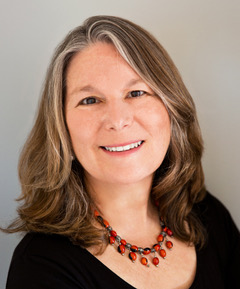
Linda Elovitz Marshall grew up near Boston, graduated from Barnard College, and raised four children and a flock of sheep on a farm in the Hudson River Valley. The author of several picture books, Linda still lives on the farm with her husband, Bob. To learn more, visit LindaMarshall.com.
I’m thrilled to be talking with Linda Elovitz Marshall today about this year’s cornucopia of books, her personal connection with The Polio Pioneer and how the book came to be, and her love of research.
2020 has been an amazing year for you with five books published—Saving the Countryside: Beatrix Potter and Peter Rabbit, Shalom Bayit, Have You Ever Zeen a Ziz?, Anne Frank: The Girl Heard Round the World, and The Polio Pioneer! Can you talk a little about each of your books? Did you conceive of them around the same time or have some been percolating longer than others?
Thank you very much for interviewing me, Kathy. What a year this has been! Hopefully, we’ll have a vaccine widely available soon and can return to being with people we love and doing things we love to do.
Still, in this midst of it all, having all these books come out has definitely kept me busy and kept my spirits up. I’m very thankful for that. I’m thankful, too, to be part of the wonderful community of children’s writers.
About the books…
The idea for THE POLIO PIONEER: DR JONAS SALK AND THE POLIO VACCINE came because Jonas Salk, who lead the team that discovered the polio vaccine, was a hero to me and many in my generation. That, coupled with the realization that people would soon forget about the once-dreaded disease polio – inspired me to write the book.
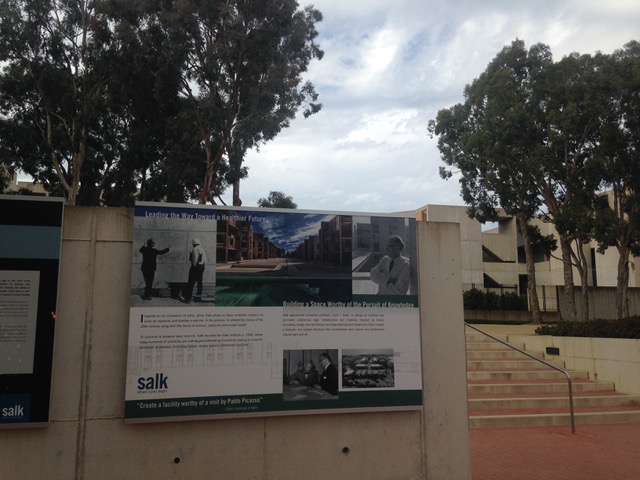
The Salk Institute for Biological Studies, La Jolla, California
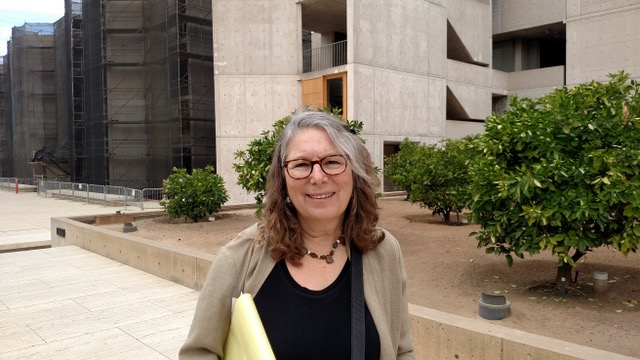
My research began back in 2016 when I’d told a friend of mine—a scientist who had just moved east from California—that we were planning a trip to La Jolla. I asked him what to do there. When he mentioned the Salk Institute, I told him that Salk was one of my heroes. That conversation led to my getting a tour of the Institute. The people at the Salk Institute were so very helpful… and helped me get my research off to a wonderful beginning.
 SHALOM BAYIT: A PEACEFUL HOME (KarBen/Lerner 2020) was inspired by a project I did decades ago about how people live. I’ve come to believe that each home, whether small or grand, has the potential to be sacred space in its own way. A few years ago, a project that my synagogue did called the Jewish Home Project gave me the impetus to write the story. The book may have a specifically Hebrew title—the words mean “Peace in the Home”—but the concept in universal. We all need a sacred space, a place to feel safe, warm, and well-fed.
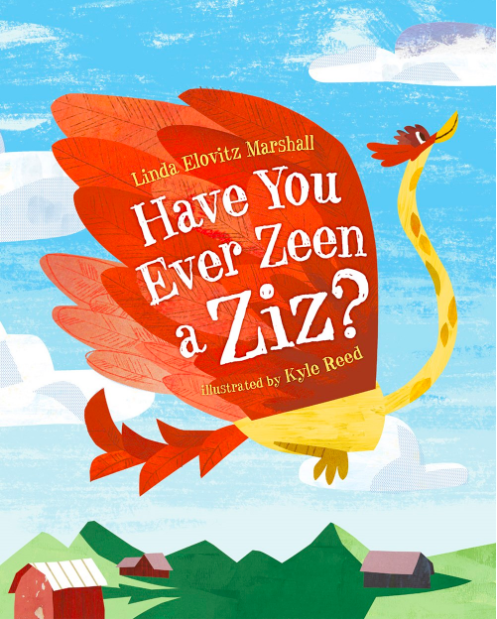
HAVE YOU EVER ZEEN A ZIZ? – This story about a mythological Jewish bird just seemed to fly into my mind. I really don’t remember how it began. I heard the word ZIZ and chuckled…and made up a poem that later became this book. In a way, it really was magical!

ANNE FRANK: THE GIRL HEARD AROUND THE WORLD was suggested to me by my friend and editor (who was formerly) at Scholastic, Orli Zuravicky. She asked if I’d take on the challenge of writing about Anne Frank and how she became a writer. I was honored, but also frightened. Could I do it? Dare I try? That was back in 2017. I re-read Anne’s diary…and cried. I thought and thought about Anne and when, at last, I could feel Anne, I began writing.

SAVING THE COUNTRYSIDE: THE STORY OF BEATRIX POTTER AND PETER RABBIT was inspired by a trip I took to England in 2018 with 11 other children’s writers and illustrators. As preparation, we each chose a writer or illustrator that we would become an “expert” on. As we visited the different writers’ homes, we shared our expertise. I chose Lewis Carroll but, in the end, it was Beatrix Potter whom I found so fascinating that I had to write about her. Beatrix was restrained by the many constraints of her day, and yet she broke loose and did what she wanted to do! She became a writer, an artist, a scientist, a sheep farmer, land conservationist, a helper to many in the countryside. She was AMAZING! I couldn’t stop myself from writing about her!
Three of your new books are biographies. What drew you to these particular people? What do you like best about writing biographies?
I love, love, love research. Also, I like to learn about a person so that I can feel what makes them tick. I want to identify—in some way—with that person about whom I’m writing.
Shortly after leaving my (not-completed) Ph.D. in Cultural Anthropology program, I began to interview people, tape-record the interviews, and write their as-told-to autobiographies. Following the interviews, I would personally transcribe each recording. It took hours! However, playing the tapes over and over would help me feel their voice and get a better sense of the interviewee. And when, at last, I had a good sense of them, I’d begin to write.
As for my choice of subjects… Anne came via a friend. Jonas Salk was a hero to me. Beatrix plopped herself in my lap.
What kind of research did you do for each of your biographies? What is one surprising thing you learned about each of your subjects while writing the books?
I’m a leave-no-stone-unturned researcher. I immerse myself in all things related to that person: books (non-fiction and fiction), movies, articles, everything. I try to get to know the time period, the sensibilities, issues, the problems of the time…I try to learn as much as I can so that I can feel that person and, for a while, carry that person inside me.
I learned that Beatrix Potter was a bit of a rebel but that she (somehow) did her rebelling quite graciously. If she had a pet that died, she boiled the animal, removed its skin, reassemble its bones, and studied its anatomy. She was a brilliant scientist and an amazing entrepreneur, too!
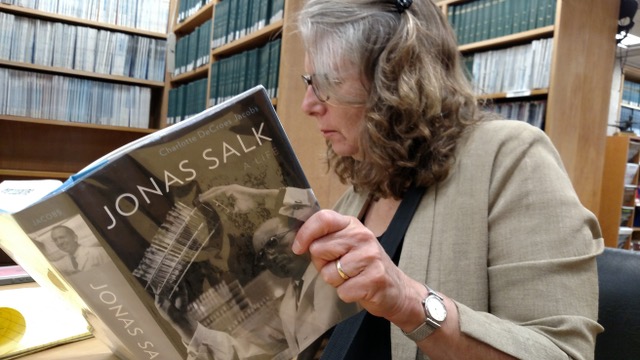
Linda Elovitz Marshall researching Jonas Salk at the Salk Institute.
I learned that, as a child, Jonas Salk thought about becoming a rabbi. Later, he decided to go into government. It was in college that he discovered chemistry…and fell in love with it! And when he and his wife were first married, he cut his own wood for the woodstove/fireplace that heated their cabin.
I also learned that Anne Frank was a lively, boisterous kid with a twinkle in her eye who loved making jokes and liked making a bit of mischief, too.
I’d like for you to talk a little more in depth about today’s reviewed book. Can you take readers on its journey from idea to publication? Why do you think it’s important for children to know about Jonas Salk?
Thank you for asking. As I mentioned earlier, Dr. Salk was a hero to me and to many of my generation. There was even a stamp issued in his honor! It was part of the Distinguished Americans series of postage stamps. When I decided to write picture book biographies in addition to my other writing, Dr. Salk—my hero—was one of the first people I chose to write about. He was someone who saw a problem, wanted to fix it, and did. He was such a hero to me and my husband that when our first son (who grew up to become a doctor) was born, my husband (also a doctor) and I named him Jonah.
When I started researching this book, years before COVID-19 came on the scene, Americans had all-but-forgotten how deadly and devastating a communicable disease could be. Sure, there was fear with recent outbreaks of diseases like Ebola, Zika, and H1N1. But with good fortune and quick action, those diseases were (temporarily, at least) brought under control and, consequently, swept off the radar. It seemed the United States had become a fairly safe place regarding communicable diseases. Then came COVID-19.
The first vaccine that Dr. Salk worked on was the flu vaccine. Worldwide, the Spanish flu had killed millions of people. More people were killed from flu than died during all of World War I. The flu vaccine that Dr. Salk and his mentor, Dr. Francis, developed is the basis of the vaccine we still use. It has saved millions of lives!
Then Dr. Salk saw another problem: polio. He wanted to solve that problem… and he did! But he didn’t stop there. After that, he opened the Salk Institute—a place to identify, study, and solve problems. As we are seeing first-hand with COVID-19, the first step is to recognize a problem. The second is to have the desire to solve them. The third is to get to work. I hope this book inspires people to do all three!
Your experiences with polio outbreaks when you were a child and today’s restrictions in response to the pandemic have direct correlations. What do you remember about those times? What would you tell children today?
I was quite young, but I remember not being allowed to go to lakes or swimming pools or even to the movies. There were many restrictions, much as there are now. Polio, however, was thought to be a disease that struck mostly young children and babies. I don’t remember not being allowed to see or hug my grandparents. On the other hand, we lived quite far from them and didn’t see them often.
What would I tell children today? Wear a mask. Wear a mask. Wear a mask. A mask helps keeps the wearer safe. It helps keep people around the wearer safe. It’s a little thing and it doesn’t hurt.
I would also like to start a public service announcement campaign about masks. Inspired by the words of former U.S. President John Fitzgerald Kennedy, “Ask not what your country can do for you; ask what you can do for your country,” this public announcement campaign would be:
MASK:
What YOU can do for your country!
Anyone want to come up with a graphic? Anyone want to help get the word out?
If we all wear masks and all work together—for our country—we can help stop this pandemic. We can each do our part. MASK: what YOU can do for your country.
And when the vaccine is ready for us to take, we need to be ready to take it…for ourselves, for our communities, for our country.
The announcement of a successful vaccine for COVID-19 has generated excitement and hope. Your descriptions of the research Jonas Salk and his team did on a flu vaccine and on the polio vaccine can inform children’s understanding of the world’s current search to develop a vaccine for COVID-19. How can adults use your biography of Jonas Salk to discuss this topic with their kids or students?
At last, we are seeing rays of sunshine, glimmers of hope. It looks like there will soon be a COVID-19 vaccine readily available. Maybe soon, COVID-19, like polio (and diphtheria, measles, pertussis, etc.), will be a preventable disease. But for that to happen, people need to take the vaccine.
This book is a wonderful teaching tool—especially with its soothing 1950’s retro look—for teaching about how a vaccine solved a problem in a previous epidemic. I’m hoping that teachers, parents, librarians, and caregivers will see the parallel and use it during COVID-19 (and, ugh, in the event that there’s yet another pandemic down the road…).
Adults can read The Polio Pioneer: Dr. Jonas Salk and the Polio Vaccine with their kids or students and talk about it. Read and talk about children around the country who took the shots. Those children, those “polio pioneers,” were heroes! By taking the vaccine, they helped save themselves—and many other people—from a devastating, communicable disease. Dr. Salk was so positive that his vaccine was safe and effective that he gave the shots to his own children!
Speaking of his children, I contacted them while I was researching this book. They’re grown up with children and grandchildren of their own. They were wonderfully helpful! If any of Dr. Salk’s children are reading this, thank you, again!
 .
.
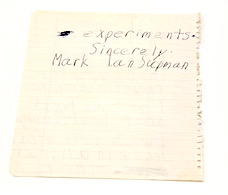
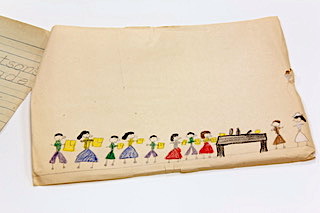

Thank you letters to Dr. Salk from children who received the polio vaccine.
While you were raising your children, you lived on a farm. I’d love to hear a little more about your farm. Did the experience influence any of your books?
I raised my children on a small sheep farm in New York State’s Hudson River Valley. We had sheep, chickens, rabbits, and an occasional goat. We had dogs in the house and cats in the barn. My book, The Passover Lamb, was inspired by something that took place on our farm. The middle grade novel I’m working on is set on the farm. I also have several stories I’m working on, none of which are yet sold, that are also set on – or inspired by – the farm.
In doing a little research for this interview, I saw that you wrote a book about your father, Jerry Ellis (Gerald Elovitz), who founded Building #19—described as “New England’s laziest, messiest department store.” One joke that your dad incorporated into the store caught my eye. It was a sign at the door that read: “Wipe your feet before leaving this store.” Several of your books are based in humor. Did you inherit your sense of humor from your dad? How would you describe the humor in your books for kids?
I wish I could attribute my sense of humor to my father—he was a genius at humor and at making lemonade out of lemons. When he was completely bankrupt with three small children, a new house, and a new mortgage, he started a business that eventually became quite successful. Before that, he’d tried another business venture (selling TV’s and appliances) that failed miserably and depleted his (and the family’s) resources. When he started the new business—selling overstocked, imperfect goods, and damaged items from insurance losses—he wrote his own ads, saying he couldn’t afford to pay anyone else to write them. He even filmed his own TV commercials—using puppets because actors were too expensive! His humor helped make “America’s laziest and messiest department stores” a great success. The business eventually grew to 12 stores…and lasted almost 50 years!
Like my father, I try to add gentle humor to some of my writing. Have You Ever Zeen a Ziz? and The Mitzvah Magician are good examples of that type of humor. Sometimes, I’m serious, too. Mostly, though, I like to play with words. I also need to keep myself amused. That’s important! When I read what I wrote the day (or week or month) before and laugh out loud (assuming it was supposed to be funny), I know it’s good.
Are you working on any new projects now? Would you like to give readers a hint for what’s to come?
I’ve just put (what I hope are) the finishing touches on a picture book biography that will come out in 2022. I have another picture book bio coming out in 2023. I’ve also got another picture book coming out in 2022 or 2023. Covid-19 has changed some of the dates and the illustrators haven’t yet been selected, so I won’t say more about them yet.
I’m also working on several projects, including a middle grade novel. I’ve just completed a wonderful poetry course (taken online, of course) through Highlights. Now I have several poems brewing. I have a long list of projects as well as a list of things that are just twinkles-of-ideas, ranging from board books to adult novels. There’s no way I’ll ever finish even half of what I’m interested in doing. And the list grows longer every day!
Thanks, Linda, for this wonderful talk! Your enthusiasm for your subjects is inspiring! I wish you all the best with The Polio Pioneer and all of your books!
You can connect with Linda Elovitz Marshall on
Her website | Facebook | Twitter
The Polio Pioneer: Dr. Jonas Salk and the Polio Vaccine has been named to these “Best Books” lists!
The National Science Teaching Association Best STEM books for 2021
The Jewish Journal Best Non-Holiday books 2020
And Kirkus calls it “An exciting, informative introduction to medical research, the work of Jonas Salk, and the man himself.”
The Polio Pioneer: Dr. Jonas Salk and the Polio Vaccine Giveaway
I’m happy to be teaming up with Knopf Books for Young Readers in a giveaway of
- One (1) copy of The Polio Pioneer: Dr. Jonas Salk and the Polio Vaccine, written by Linda Elovitz Marshall | illustrated by Lisa Anchin
To enter:
- Follow Celebrate Picture Books
- Retweet a giveaway tweet
- Reply with your hero or person you admire for an extra entry. Each reply earns one extra entry.
This giveaway is open from December 9 to December 15 and ends at 8:00 p.m. EST.
A winner will be chosen on December 16.
Giveaway open to U.S. addresses only. | Prizing provided by Knopf Books for Young Readers
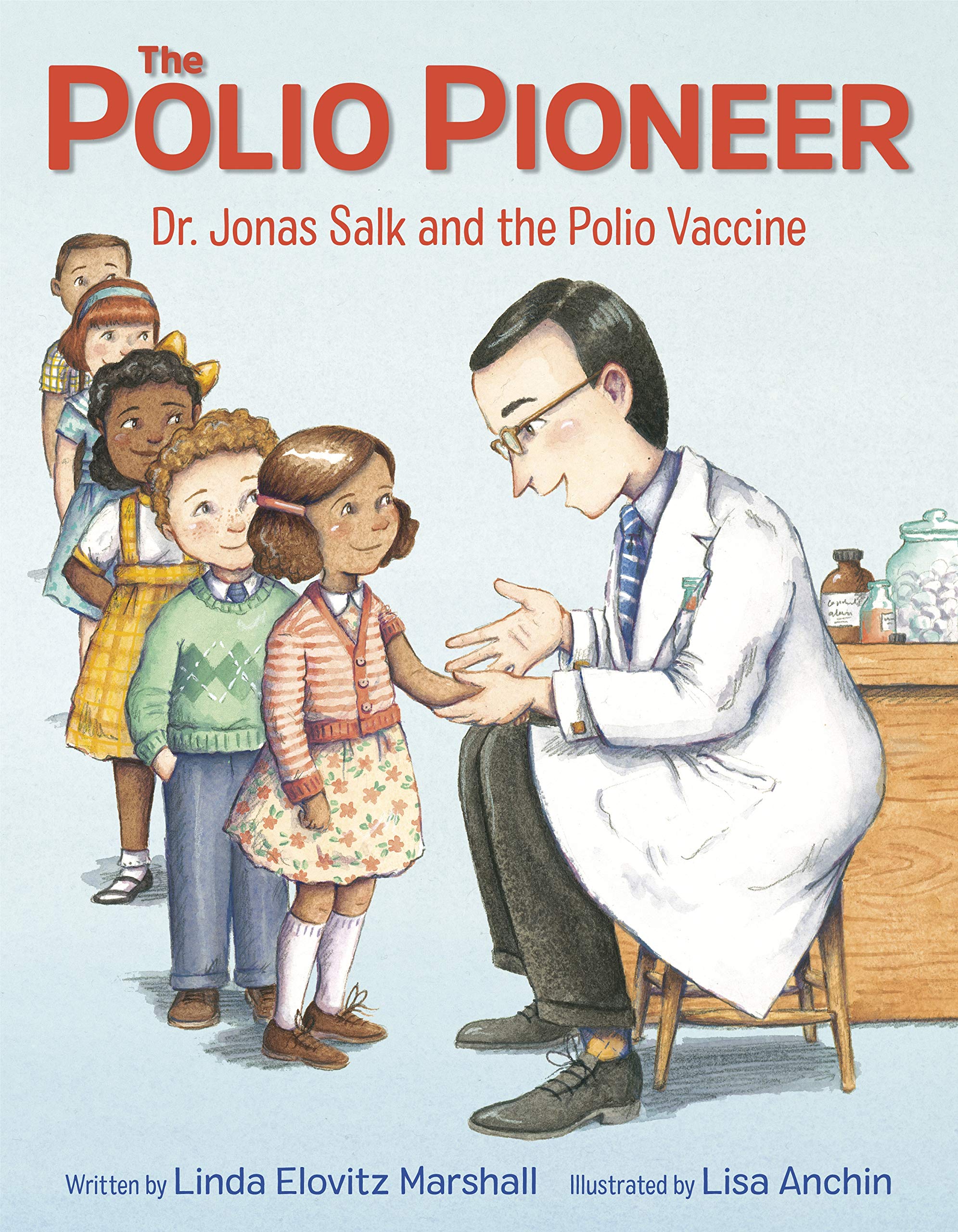
You can find The Polio Pioneer: Dr. Jonas Salk and the Polio Vaccine at these booksellers
Amazon | Barnes & Noble | Books-a-Million
To support your local independent bookstore, order from
Picture Book Review





 celebratepicturebooks.com