June 23 – Let It Go Day

celebrate-picture-books-picture-book-review-it's-tough-to-lose-your-balloon

About the Holiday

No, this isn’t a day dedicated to re- re- re- re- re-watching that movie. It’s a day to take a step back and take stock of the feelings you’re keeping inside or the little irksome quirks that drive you crazy. Are they really worth all the stress? Today’s a day to find inner peace, make amends, or turn disadvantage into advantage.

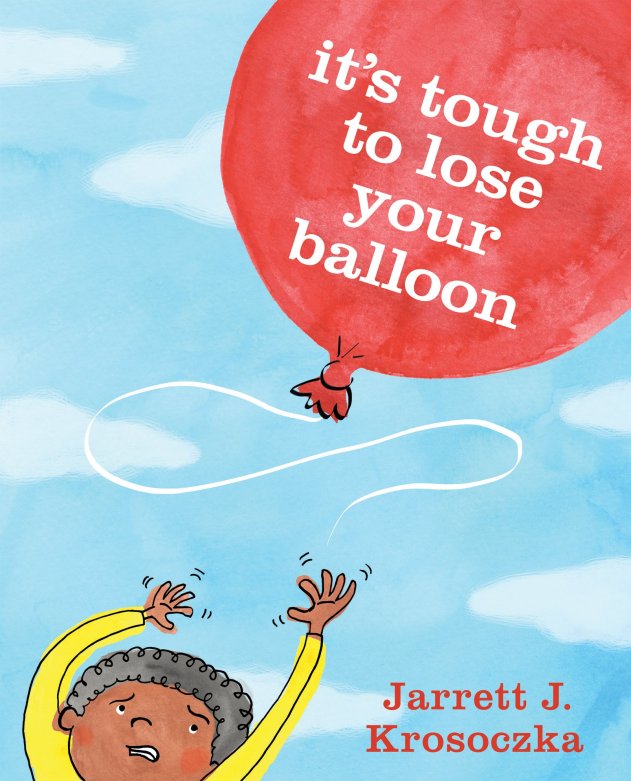
It’s Tough to Lose Your Balloon

By Jarrett J. Krosoczka


Most people wake up each morning with great ideas for a having good day, but sometimes things don’t work out the way they’re planned. For kids, small mistakes, accidental mishaps, and unexpected disappointments can loom large. Frustrations and perceived unfairness can elicit tears or anger, and it’s sometimes hard to know how to comfort an unhappy or upset child.

In It’s Tough to Lose Your Balloon Jarrett Krosoczka acknowledges that sometimes bad or sad things happen, but he reveals to kids how looking at the event from a different perspective or through someone else’s eyes can bring consolation and even happiness. As the title states, it’s hard for kids to watch a balloon suddenly slip through their fingers and float away, but imagining all the other people who will see it and smile can help. Having a picnic on the beach when the unthinkable happens? “It’s sad to drop your sandwich in the sand…but it’ll make some seagulls very happy.” And you know it will make you laugh to watch those crazy guys swooping, diving, and squawking over that now-crunchy snack.

The idea of sharing hurts with others to create a new scenario or a different kind of enjoyment while forming closer bonds is another positive way to turn disappointments into teachable moments that benefit all. As most kids know “it’s never fun when you break a toy…” but with a upbeat attitude they can have “fun fixing it with Grandpa.”

Wet shoes? Melting Ice-cream cone? Scraped knee or new baby sitter? In Jarrett Krosoczka’s hands these letdowns can lead to new freedom, innovation, distinction, and joyful experiences. It’s Tough to Lose Your Balloon can help anyone see “disaster” in a whole new light!

Krosoczka’s illustrations ingeniously depict the way an unexpected mishap or disappointing moment can make someone feel—alone, exposed, and vulnerable. Left-hand pages present the problem while the right-hand page shows the crestfallen child in full color on a black-and-white sketched background. The positive transformation becomes a two-spread, full-color of happy pride and fun abandon. Life can be full of little bumps in the road, keeping a copy of It’s Tough to Lose Your Balloon on the shelf can help smooth the way.

Ages 3 – 7

Knopf Books for Young Readers, 2015 | ISBN 978-0385754798

Visit Jarrett J. Krosoczka’s Website to see more of his books and discover fun activities!

Let It Go Day Activity
celebrate-picture-books-picture-book-review-worry-buddy-craft

Worry Buddy


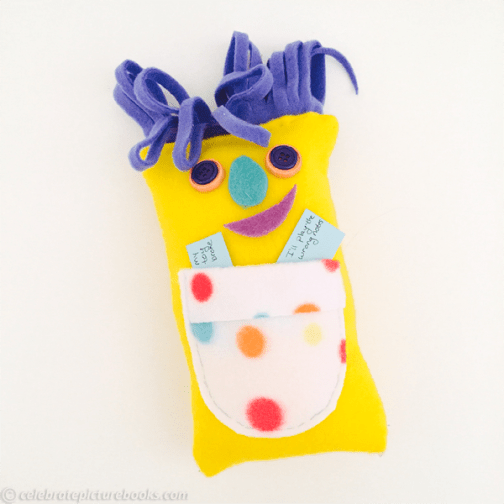
Sometimes worries don’t seem as bad when they are shared with someone else or to at least set aside for awhile. With this craft you can make a friend to help lesson worries, disappointments, fears, and anxieties. And it’s pretty good at hugs too. Older children may like to create this as a sewing project, while younger kids can make it easily with fabric glue. Make your Worry Buddy as unique as you are!

Supplies

  • Fleece or felt in different colors
  • Buttons, two larger in the same color and two smaller in a different color
  • Fiber fill
  • Fabric glue or thread
  • Paper
  • Pen or pencil

Directions

To Make the Body

  1. Cut a 16-inch piece of fleece
  2. Fold the fleece in half
  3. Glue the sides together (older children may enjoy sewing the sides together with simple straight stitches)
  4. Leave the top open
  5. Turn the body inside out
  6. Fill the body with fiber fill

To Make the Hair

  1. Cut a 5-inch piece of fleece or felt
  2. Fold the fleece or felt in half
  3. Glue or sew the folded fleece into the opening in the body
  4. Cut the fleece or felt in ¼-inch strips across the top

To Make the Face

  1. Glue one set of larger and smaller buttons together, repeat with the other set
  2. Glue or sew the buttons to the top part of the body
  3. Cut a nose and mouth out of fleece or felt
  4. Glue or sew the nose and mouth to the face

To make the pocket

  1. Cut a 5-inch piece of felt in the shape of a square-bottom or rounded bottom pocket
  2. Fold down an inch of the top
  3. Glue or sew the pocket to the middle of the body

To share problems with the Worry Buddy, write worries or fears on a slip of paper and put them in the Worry Buddy’s pocket. Your Buddy will keep those problems so you don’t have to.

May 29 – Learn about Composting Day

celebrate-picture-books-picture-book-review-compost-stew

About the Holiday

Composting is a wonderful way to use organic waste to help the environment. Whether you keep a small composting container in your kitchen, set aside a pile in the corner of your yard, or invest in a compost tumbler, letting non-meat or dairy kitchen scraps, outdoor vegetation cuttings, and even hair or dryer lint decompose into nourishing soil additives will make your garden grow bigger and better!

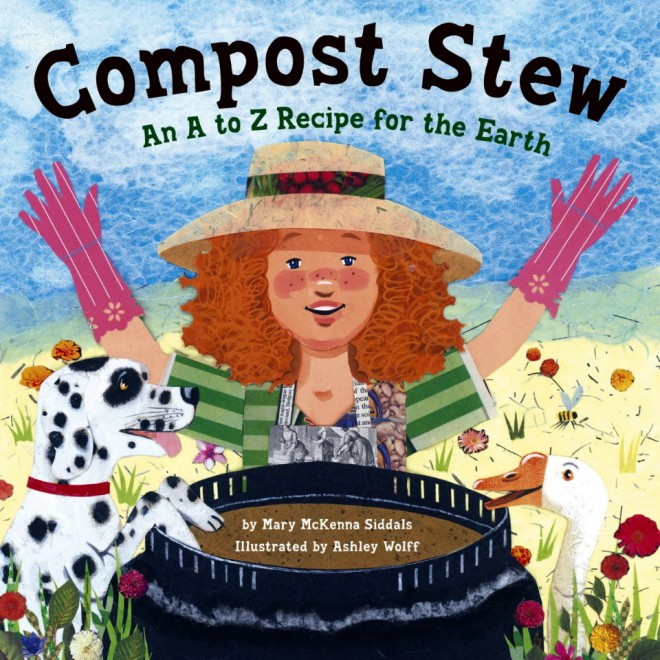
Compost Stew: An A to Z Recipe for the Earth

Written by Mary McKenna Siddals | Illustrated by Ashley Wolff


“Environmental chefs, / here’s a recipe for you / to fix from scratch / to mix a batch / of Compost Stew.” This clever alphabet book reveals the ABCs of gathering the perfect ingredients for a compost pile, which creates a nutritious meal for gardens, flower beds, and the environment:

“Apple cores / Bananas, bruised / Coffee grounds with filters, used / Dirt clods, crumbled / Eggshells, crushed / Fruit pulp left behind, all mushed / Grass clippings / Hair snippings / and an Insect or two / Just add to the pot / and let it all rot / into Compost Stew.”

The catchy rhymes and easy-to-follow directions will make kids excited about saving left-overs, raking up fallen leaves, and shredding paper to add to the pile. Readers may also be surprised by some of the other items that will decompose to make rich soil, such as seaweed, laundry lint, and teabags. Three simple steps for cooking up compost stew follow the alphabet, and create a refrain that kids will love to repeat.

Mary McKenna Siddals brings the science of composting and recycling to kids in a fun, interactive way. Children may even like to think of their own ingredients for each letter of the alphabet. The author’s note at the end of the book reveals substitute ingredients as well as items that are not appropriate or safe for composting.

Ashley Wolff’s brilliant, textured collage artwork depicts four multicultural kids (along with their helpful Dalmatian and goose) gathering the ingredients for their compost bag wherever they are—in the yard, in the kitchen, at the hair salon, at the beach, and more.

Kids interested in gardening and environmental issues will love to have Compost Stew on their bookshelf.

Ages 3 – 8

Dragonfly Books, Random House, 2014 | ISBN 978-0385755382

Learn about Composting Day Activity

celebrate-picture-books-picture-book-review-composting-word-search

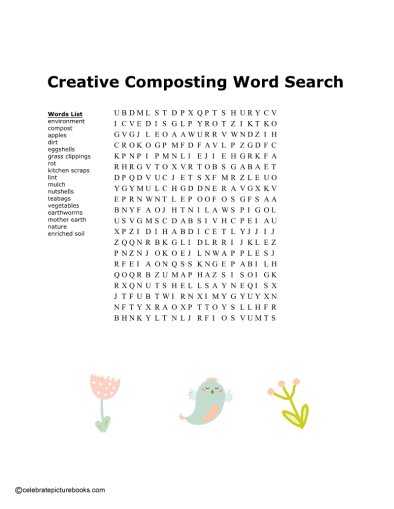
Creative Composting Word Search


Composting takes individual ingredients and combines them to create nourishing soil. Can you find the words that relate to this environmental science in this printable Creative Composting Word Search? Here’s the Solution.

Picture Book Review

May 11 – National Night Shift Workers Day

celebrate-picture-books-picture-book-review-frankie-works-the-night-shift

About the Holiday

Today’s holiday honors all the people—medical personnel, firefighters, police officers, bakers, maintenance workers, and others who work the 3rd or night shift. These night owls work to keep us safe and protected, prepare treats for our morning repast, and maintain our living and work spaces for the next day. Take some time to thank a night shift worker and ask them about their perspective on the world.

Frankie Works the Night Shift

By Lisa Westberg Peters | Illustrated by Jennifer Taylor


In a quiet town after most people have gone to bed, Frankie the cat begins his work. He keeps busy emptying a wastebasket and cleaning two counters. From his doorway he calls other night workers to three meetings.

When the geraniums need watering, he sees that they are fed. It’s also his job to inspect the tool shelves, and tonight he discovers a stray intruder among the hammers. He chases it as it makes for the ladders—up and down, up and down—between the nail bins, ad up the stairs, causing a mess where there had just been order.

Frankie’s bosses wouldn’t approve, but he can’t worry about that now. He has his important job to attend to. But tonight is a wild night, and Frankie has awakened the management. “Be quiet, Frankie,” they shout. From their comfortable beds they ask, “What’s going on? Some of us have to work in the morning!”

And then the day workers see it—“Agh! A mouse!” They give him a task: “Go get it, Frankie!” and try to help by pointing out its whereabouts here and there. But Frankie is good at his job and pursues it through the cat door and into the backyard. It’s a night’s work well done! Frankie yawns and stretches. As he looks back at his domain, he’s glad he doesn’t work the day shift—there’s so much to clean up!

Frankie goes to bed in his red paint bucket in the hardware store window and dreams of relaxing at the beach on his well-deserved vacation.

Kids will love Lisa Westberg Peters’ frisky Frankie who is only doing his job but ends up creating chaos. Sometimes when you’re all in and concentrating on the work at hand, it’s like that, as kids and adults involved in play or projects well know. Peters’ clever story builds from Frankie’s playful antics in the hardware store to his necessary role of family protector and mouse dispatcher. The story contains an element of counting (Frankie empties one trash can, cleans two counters, calls three meetings…) which serves to enhance the humor.

Jennifer Taylor’s stunning mixed media illustrations make excellent use of digital photography. You almost want to reach out and pet Frankie or catch the objects flying in his wake. And when the little mouse peeks out from the broom or scampers across the floor, kids will say “aww!” or “eek!” depending on their courage. The first page of the streetscape at night is arresting for its uniquely designed old buildings. When I opened to this page, my graphics-loving daughter exclaimed, “Oh! What’s this book?!” and settled in to read it with me. Definitely a great beginning to an enjoyable read!

Ages 4 – 8

Greenwillow Books, Harper Collins Publishers, 2010 | ISBN 978-0060090951

Gardening for Wildlife Activity

celebrate-picture-books-picture-book-review-cattails

Creative Cattails


Cattails are so cool, just like their namesake felines. They’re sleek and sophisticated and inside holds mystery that bursts out when you least expect it! Here’s a simple craft for making cattails that will enhance any bouquet or décor.

Supplies

  • 6-inch by 5/8-inch craft stick
  • 3/16–inch by 12-inch dowel
  • Chunky brown yarn,  
  • Green origami paper, 8-inch square
  • Green craft paint
  • Paint brush
  • Glue gun

Directions

To make the cattail:

  1. Paint the dowel green, let dry
  2. Glue 1 inch of the dowel to one end of the craft stick with the glue gun
  3. Starting at the bottom of the craft stick, glue an end of the brown yarn to the end of the craft stick meets the dowel
  4. Wind the yarn upward around the dowel and craft stick to the top. You will leave the 1/2 –inch curved part of the craft stick open.  Then reverse.
  5. Wind the yarn downward, going past the end of the craft stick about ½ inch to make the end of the cattail
  6. Wind the yarn upward once more to the top
  7. When you reach the top, put glue on either side of the curved top of the craft stick and pull a little of existing yarn into the glued area, pinching it closed.
  8. Cut the end of the yarn from the skein and tuck the end into the glued top.

To add the leaf:

  1. Cut a thin triangle from one side of the origami paper, starting with a 1-inch base and angling to the top of the paper
  2. Glue the base to the dowel about 1 ½ inches from the bottom
  3. Wind the paper upward around the dowel, leaving 5 inches unwound
  4. Glue the paper to the dowel, letting the 5-inch section stick up

If you’d like to make another craft using chunky brown yarn, see my April 7 post on The Flying Beaver Brothers and the Crazy Critter Race by Maxwell Eaton III to create a cute spool beaver.

March 24 – National Button Day

Pete the Cat and His Four Groovy Buttons by Eric Litwin and James Dean Picture Book ReviewAbout the Holiday

You have to admit it—those little round things that hold our clothes and bags shut are indispensable. Sometimes tiny works of art in their own right, buttons are fascinating. Antique buttons made of glass, metal, or even bone and decorated with intricate paintings, engraved designs, or gemstones offer a glimpse into history, both American and International. Today’s buttons, fashioned into engaging shapes or brightly colored, have stories of their own and enhance whatever garment or item they adorn.

Button collecting was recognized as an organized hobby by the National Button Society in 1938, and National Button Week – which I’m celebrating today – was founded in 1989. The goal is to promote awareness of the fun of button collecting and to recognize the study and display of antique and collectible buttons. Button collecting is a fun hobby that is exciting for all ages.

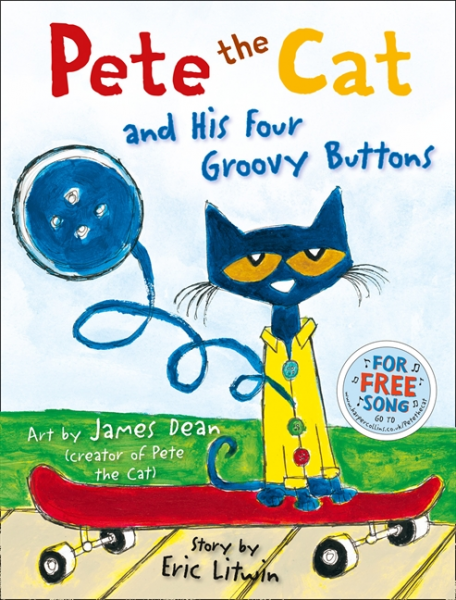
Pete the Cat and His Four Groovy Buttons

Written by Eric Litwin | Created and Illustrated by James Dean


It’s 8:00 in the morning and Pete the Cat is ready to start the day wearing his favorite shirt – the one with 4 groovy buttons. Those buttons are big, they are round, they are colorful, and they inspire him to sing a song: “My buttons, my buttons, my four groovy buttons. My buttons, my buttons, my four groovy buttons.”

Soon, however, one of the buttons pops off! That leaves Pete with how many buttons? 3! Right! Does Pete cry? “Goodness No! Buttons come and buttons go.” Fortunately for readers buttons continue to GO…inviting kids to do the math and sing the infectious song with each “Pop!”

As Pete sits atop his surfboard atop his VW Beetle looking very beachy, his last button goes sprooiiing and rolls away. What does Pete see then? Why, the only button that won’t desert him—his belly button!

Eric Litwin’s short, fast-paced text contains plenty of exciting opportunities for read-along, shout-along fun on every page. The subtraction problems offered as Pete loses buttons provide early learners with confidence-building moments, and Pete’s easy-going attitude is just right for these hyper-busy times.

James Dean’s illustrations are as big, bold, colorful, and groovy as Pete’s buttons. Vibrant primary colors rivet readers to the page, and—Watch out! That popping button is swirling right at you! But through it all Pete the Cat remains his nonchalant self.

Ages 4 – 8

HarperCollins, 2012 | ISBN 978-0062110589

National Button Week Activity

CPB - Button Coat

Pin the Button on the Coat Game


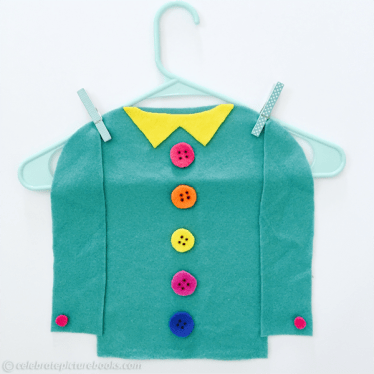
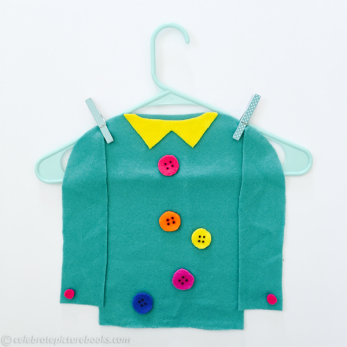
Pin the Button on the Coat is a fun game you can make yourself and play anytime! It’s great for a button-themed party or on any day that you’re holed up and just poppin’ to do something! The game is played like “Pin the Tail on the Donkey,” and the object is to get the buttons as close to the center of the coat as possible. Have fun!

Supplies

CPB - Button Coat II

Directions

  1. Cut out the coat, sleeves, and collar following the printable patterns
  2. With the fabric glue, attach the sleeves to the edge of the coat, and the collar to the top of the coat.
  3. Let dry
  4. Cut circles to represent buttons from the other colors of fleece or felt, as many as you need
  5. With the marker make dots to represent holes in the “buttons”
  6. When the glue on the coat is dry, attach it to the clothes hanger with the clothespins

If you like buttons and button crafts, pop on over to February 29—Haiku Writing Day for Guyku—a fun book of poetry—and directions to make a bookmark with colorful buttons!


February 24 – National Tortilla Chip Day

celebrate-picture-books-picture-book-review-round-is-a-tortilla-a-book-of-shapes-cover-2

About the Holiday

If the tortilla-making machine had produced perfect rounds every time back in the 1950s, the world may never have known the crunchy deliciousness of tortilla chips. Back in the day, Rebecca Webb Carranza and her husband owned the El Zarape Tortilla Factory in Los Angeles, California and were one of the first to automate tortilla production.

Instead of wasting the odd-shaped ones, Carranza cut them into triangles, fried them, and sold them in bags.They were a hit! People all over began enjoying them dipped in salsa and guacamole and smothering them in cheese. In 1994 Carranza was honored with the Golden Tortilla Award for her contributions to the Mexican food industry, and in 2003 Texas named the tortilla chip the official state snack!

Round is a Tortilla: A Book of Shapes

Written by Roseanne Thong | Illustrated by John Parra


“Round are sombreros. / Round is the moon. / Round are the trumpets that blare out a tune. Round are tortillas and tacos too. / Round is a pot of abuela’s stew. / I can name more round things can you?” With wonderful, lyrical verses, Roseanne Thong introduces children to the shapes—circles, squares, triangles, rectangles, ovals, stars, and more—that make up their multicultural world.

celebrate-picture-books-picture-book-review-round-is-a-tortilla-squares

Image copyright John Parra, 2013, text copyright Roseanne Thong, 2013. Courtesy of Chronicle Books.

Here are round chiming campanas and nests full of swallows, square ventanas for peering through and clocks for telling time. Rectangles are cold paletas to eat on a hot summer day and the ice-cream carts that deliver them, and triangles make tasty quesadillas and gliding sailboats. Each verse ends with an invitation for kids to find more shapes around them—an invitation that’s hard to resist!

celebrate-picture-books-picture-book-review-round-is-a-tortilla-triangles

Image copyright John Parra, 2013, text copyright Roseanne Thong, 2013. Courtesy of Chronicle Books.

Rebecca Thong’s bright, fun-to-read verses shine with evocative words that elevate this concept book to a celebration of the sights, sounds, and sensations that make up readers’ lives. Spanish words sprinkled throughout the story enhance the theme of the book and are defined following the text. 

celebrate-picture-books-picture-book-review-round-is-a-tortilla-star

Image copyright John Parra, 2013, text copyright Roseanne Thong, 2013. Courtesy of Chronicle Books.

John Parra’s beautiful folk-art illustrations, which are sure to put a smile on kids’ faces, immerse readers in the daily life of a Latino town. People dance, cook, play games, walk in the park, attend a festival, and more—all while surrounded by colorful shapes. Kids will love lingering over the pages to find all of the intricate details and may well want to learn more about what they see.

Round is a Tortilla is not only a book of shapes, it makes shapes exciting! The book is a wonderful stepping stone to discussions about the places, celebrations, symbols, and decorations found on the pages for students or individuals and would be a welcome addition to any classroom or child’s bookshelf

Ages 3 – 6

Chronicle Books, San Francisco, 2013 | ISBN 978-1452106168 (Hardcover) | ISBN 978-1452145686 (Paperback)

Learn more about Roseanne Thong and her books for children and adults on her website!

View a gallery of books and artwork by John Parra on his website!

National Tortilla Chip Day Activity

CPB - Tortilla chips (2)

Homemade Baked Tortilla Cinnamon Chips

Ingredients

  • 2 10-inch flour tortillas
  • ¾ Teaspoon Cinnamon
  • 2 ½ Tablespoons Sugar
  • Butter

Directions

  1. Preheat oven to 350 degrees
  2. Combine the cinnamon and the sugar in a bowl
  3. Butter the tortillas
  4. Sprinkle the tortillas with the cinnamon sugar mixture
  5. Cut the tortillas into 8 pieces
  6. Place pieces on a baking sheet
  7. Bake in 350-degree oven for 12 – 15 minutes
  8. Chips will become crispier as they cool.

Makes 16 chips

celebrate-picture-books-picture-book-review-round-is-a-tortilla-a-book-of-shapes-cover-2

You can find Round is a Tortilla: A Book of Shapes at these booksellers

Amazon | Barnes & Noble | Books-a-Million | IndieBound


February 4 – Homemade Soup Day


celebrate-picture-books-picture-book-review-soup-day-cover

About the Holiday

On a cold February day (or even a warm one if you live in a southern climate!), there’s nothing more satisfying than a steaming-hot bowl of your favorite soup! While there are many tasty canned soups, in honor of today you may want to try creating your own concoction. Why not check out recipes from your heritage, geographic location, or even your favorite book? Bon appétit!

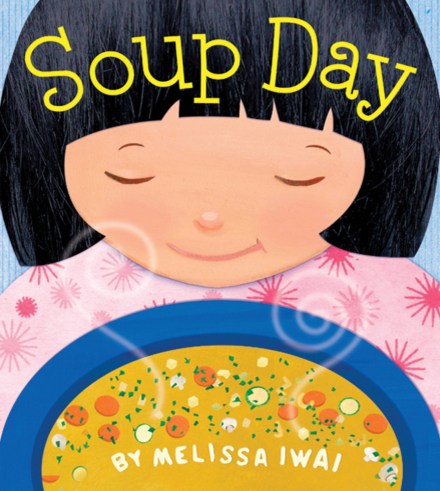
Soup Day

By Melissa Iwai


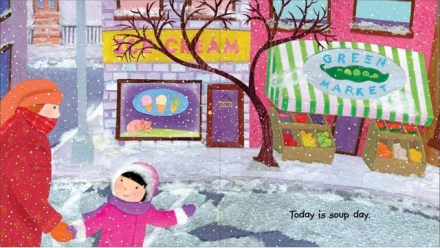
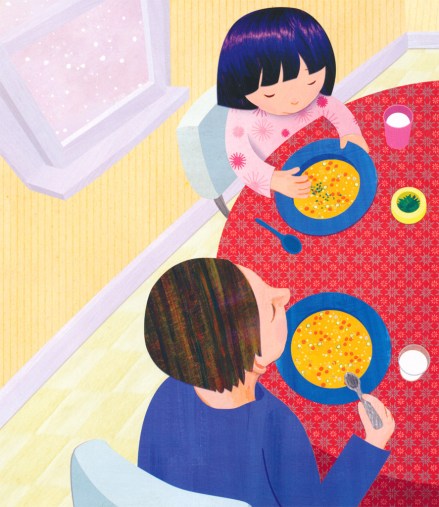
This is the perfect book for a cold winter day that celebrates the warmth and deliciousness of soup! In author-illustrator Melissa Iwai’s delightful book, the white flakes are falling and the sidewalks are piled high with snow as a little girl and her mother make their way to the market to buy ingredients for their homemade soup. At the store they fill their basket with celery, potatoes, mushrooms, carrots, onions, and more.

celebrate-picture-books-picture-book-review-soup-day-today-2

Copyright Melissa Iwai, courtesy of us.macmillan.com

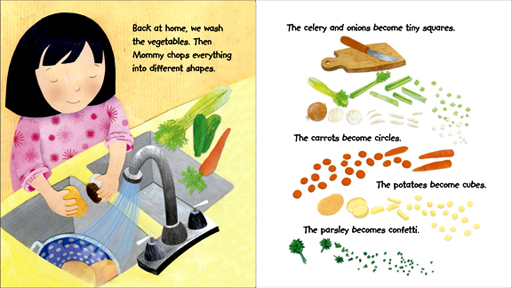
Back at home the little girl and her mom chop the vegetables, put the ingredients in a pot, and simmer the soup until its steamy. While they wait they play games and read together. Later the girl and her mother add spices and alphabet pasta to the bubbling soup. When Daddy comes home they enjoy the delicious meal.

celebrate-picture-books-picture-book-review-soup-day-cutting-veggies

Copyright Melissa Iwai, courtesy of us.macmillan.com

Smoothly integrated into the story are lessons in counting and shapes, which makes the book one that would be fun to replicate with older children—in fact there is a recipe for soup on the last page!

celebrate-picture-books-picture-book-review-soup-day-eating-soup

Copyright Melissa Iwai, courtesy of us.macmillan.com

Iwai’s bold, vivid images are tantalizing. As you turn through the pages you can almost taste the fresh vegetables and wish you could grab some of that produce for yourself. The sweet expressions of the girl and her mother show how much they enjoy spending time together making this special meal.

Ages 2 – 6

Henry Holt, Christy Ottaviano Books, New York, 2010 | ISBN 978-0805090048

Homemade Soup Day Activity

Make Silly Soup


You can create Silly Soup from anything but the kitchen sink in the kitchen sink! Just gather a bunch of fun “ingredients” and stir them together to make soup fit for a…monster? Ogre? Fairy? Your favorite stuffed animal? Who would you like to feed?

Note for Parents: This can be a fun way to teach your child about different foods and kitchen tools. Let your child see and smell different spices as they add them to their soup. Explain the different shapes of pasta. You can even teach about color by combining food colorings to see what happens. Add a science-based experiment by letting your child watch what happens to butter, sugar, or salt when they are placed in warm water.

When all the ingredients are added, use a variety of kitchen tools to stir it up! Show your child a big serving spoon, slotted spoon, whisk, spatula, ladle, teaspoons, and whatever other tool they may like to use.

*Remember, Silly Soup is just for making, not for eating!

Supplies

  • Big pot or bowl
  • Food coloring
  • Sprinkles
  • Glitter
  • Spices
  • Small pasta pieces
  • Butter
  • Sugar
  • Anything of your choice

Directions

  1. Add water to pot or bowl
  2. Add ingredients
  3. Stir
  4. Make up a story about who will eat your soup!