August 29 – Get Ready for Kindergarten Month

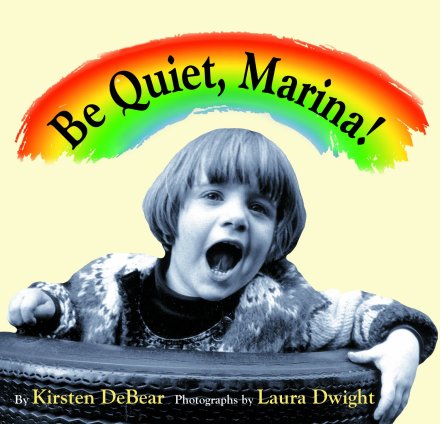
celebrate-picture-books-picture-book-review-be-quiet-marina-cover

About the Holiday

Children of kindergarten age are looking forward to starting school like “the big kids,” and teachers all over the country are preparing to welcome their new students on the first day. All the desks or tables have the same supplies laid out, the same chairs pushed in, and the same promise of learning. Are all the kids the same? Yes…and no. Yes: They are all about the same age, wonder what the future holds, and want to make friends. No: they all come with different personalities, different histories, and different talents and abilities. And it is these differences that give each child their unique perspective on the world and will determine their unique contribution to it. Today celebrate each child’s distinct skills and gifts.

Be Quiet, Marina!

Written by Kirsten DeBear | Illustrated by Laura Dwight


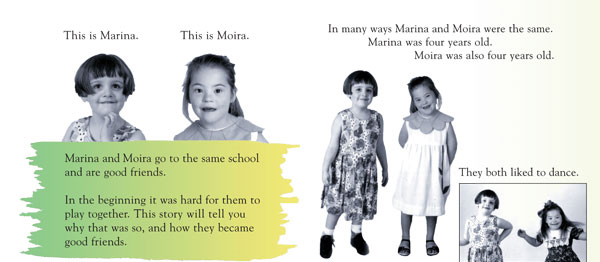
Marina and Moira are four years old and in the same class at school. Marina was born with cerebral palsy; Moira has Down’s Syndrome. They like many of the same things. Both girls like to dance, play ball, dress up, and play with dolls. But when it comes to noises or rushing around, Marina and Moira are different. Marina likes loud noises. She often screams and shouts, and when she and Moira play together, Marina likes to tell Moira what to do.

celebrate-picture-books-picture-book-review-be-quiet-marina-girl's-similarities

Photography by Laura Dwight, courtesy of starbrightbooks.org

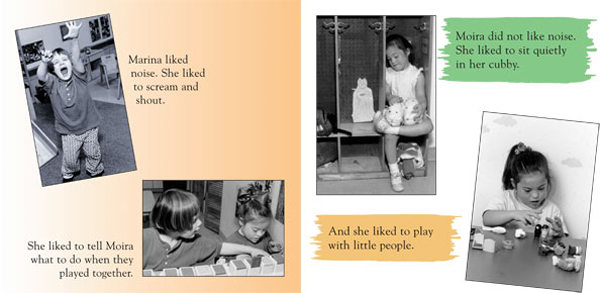
Moira, on the other hand, likes to sit quietly, and she can often be found taking a break in her cubby. She also likes to play alone with the little people figures. While both girls like to take walks outside, Moira stays with the teachers and the other students while Marina runs ahead. One of Moira and Marina’s favorite activities is when the teachers swing the kids in a big blanket. Then each student has to wait their turn. Moira can wait patiently, but for Marina waiting is hard; she gets angry and screams or cries. When Moira hears Marina scream, she feels scared. She covers her ears and leaves the room.

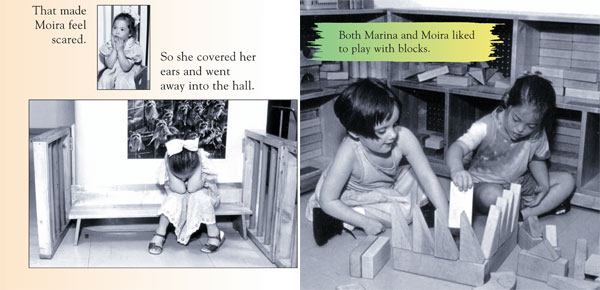
While Moira and Marina like to build towers and castles with blocks together, they have different feelings about cleaning up afterward. Marina doesn’t want to help and shows it by yelling. Moira runs from the room with her hands over her ears. “One day on the playground Moira was on the see-saw. Marina wanted to get on too, but she couldn’t…So she started to scream. She screamed so loudly that Moira covered her ears and walked away. Now Marina could get on the see-saw, but it was no fun alone.”

celebrate-picture-books-picture-book-review-be-quiet-marina-playing-with-blocks

Photography by Laura Dwight, courtesy of starbrightbooks.org

Another day Marina started to get upset while the girls were playing with the telephone. This time Moira didn’t run away. Instead she looked at Marina and said, “Please don’t scream!” Marina listened. She became quiet and the two continued to play together. Later in the week when Marina asked Moira to play, Moira told her she would, but only if Marina didn’t scream. Marina said, “Okay, I won’t.”

The two girls came to an understanding. Instead of being afraid of Marina, Moira now knows she is trying to be friends, and Marina realizes that if she wants Moira to play with her, she can’t scream. And they both know that if they need help they can ask their teachers. Now Marina and Moira are best friends, which means they can have fun playing dolls and building with blocks, dancing and dressing up and even going up and down on the see-saw. And when Marina screams, “‘It’s fun!’” Moira makes a little noise herself and shouts “Be Quiet, Marina!”

celebrate-picture-books-picture-book-review-be-quiet-marina-girl's-differences

Photography by Laura Dwight, courtesy of starbrightbooks.org

With simple, straightforward language, Kirsten DeBear reveals the story of how two little girls with what might be considered opposing personalities overcame their differences to become friends. While drawn to each other, these differently abled girls had trouble playing together. Through perseverance and communication, however, they came to understand each other. DeBear brings honesty and humor to this true story that applies to all children who need to accommodate other’s preferences while staying true to themselves when playing or working in a group. The happy resolution shows that there is room for all in our friendships and our hearts.

Laura Dwight’s black and white photos take a storyteller’s approach to chronicling the evolving friendship between Marina and Moira as they participated in schoolroom activities. The smiling girls are shown dancing, dressing in fancy hats, playing with dolls and a ball, building with blocks, and doing other fun things together. The photographs also depict moments of friction between the girls when Maura becomes upset and screams and Moira covers her ears and runs away. At the end of the book Dwight’s lens captures the experiences that led to better understanding between the two girls and their strengthening friendship.

Readers may recognize themselves as a “Maura” who likes loud noise and exploring on her own ahead of the group, or a “Moira” who prefers quiet and staying close to the group. Through the story of these two very smart little girls, all kids may learn to understand and appreciate themselves and alternate viewpoints.

Ages 4 – 7

Star Bright Books, 2014 | ISBN 978-1595726650

Visit Star Bright Books for a vast array of inclusive titles for children that embrace diverse ethnicities and abilities, promote literacy, and are widely available in 24 languages.

View a gallery of photography work by Laura Dwight on her website!

Get Ready for Kindergarten Month Activity

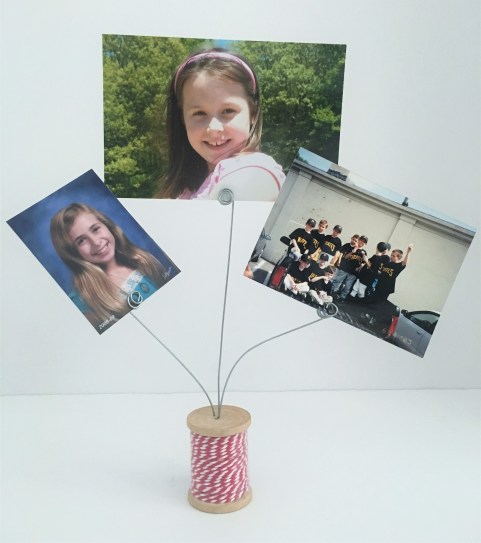
celebrate-picture-books-picture-book-review-threads-of-friendship-photo-holder

Threads of Friendship Photograph Holder


In the same way that thread holds clothes, blankets, and other material goods together, friendship holds people together. Make this easy Threads of Friendship Photograph Holder to keep pictures of your friends close by!

Supplies

  • Wooden Spool of twine, available at craft stores and some discount retailers
  • Thin-gauge wire, no heavier than 18 gauge
  • Small gauge nail
  • Hammer
  • Needle-nose pliers
  • Pencil
  • Photographs

Directions

To make the photograph holders:

  1. Holding one end of a wire with the needle-nose pliers, wrap it around the pencil four or five times
  2. Remove the wire from the pencil
  3. Squeeze the coils of wire together with the needle-nose pliers
  4. Cut the wires to different lengths so the pictures stand at various heights

To make the stand:

  1. Make two or three holes in the center of the wooden spool of twine with the nail and hammer, holes should be about ½-inch deep to steady wire.
  2. Place the coiled wires in the holes
  3. Put photos in the coils

Note:

Even young children can help hammer the nail, place the wire in the holes, and choose photographs. Adults should coil the wire, cut the wire, and help with hammering.

Picture Book Review

August 24 – It’s Get Ready for Kindergarten Month

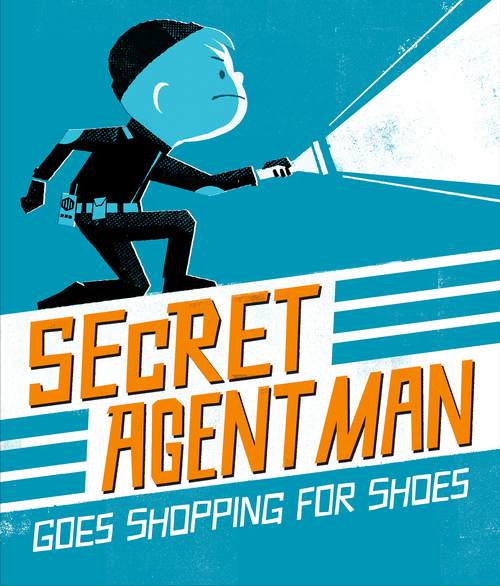
celebrate-picture-books-picture-book-review-secret-agent-man-goes-shopping-for-shoes-cover

About the Holiday

One of the rights of passage for children going to school for the first time (or starting the next grade) is shopping for new clothes and supplies. These include pencils, paper, folders, three-ring binders, lunchboxes, and the backpacks to store it all in as well as a few new shirts, a couple pairs of pants, and maybe a jacket to take kids into the cooler weather. And of course a trip to the shoe store is paramount for those fast-growing feet! If only shopping could be as exciting as it is for the little boy in today’s book. With a little imagination it can be!

Secret Agent Man Goes Shopping for Shoes

Written by Tim Wynne-Jones | Illustrated by Brian Won


S.A.M. has an important missions to complete. He is “digging for the Lost City of Raisins…tracking down the treacherous green spitting bug…balancing on high places…and stealing home”—all while K is hanging out the laundry. K looks at S.A.M sitting on the ground with his box of raisins and says, “‘You need new shoes.’” And it’s true. S.A.M.’s red shoes are tattered and scuffed, and his toes are even poking out of the sole.

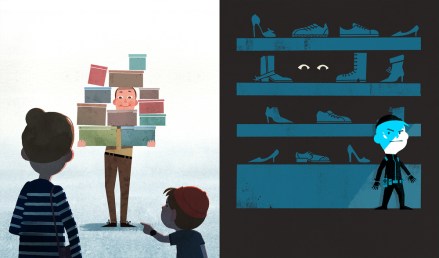
celebrate-picture-books-picture-book-review-secret-agent-man-goes-shopping-for-shoes-shoe-store-man

Image copyright Brian Won, courtesy of brianwon.com

On the way downtown, S.A.M tells K that he can’t decide between rocket shoes and vanishing shoes as he reads a document titled Plans for World Domination. At the store they are met by a clerk carrying a tall stack of boxes. He assures the pair that he’ll help them in a minute, but with his eagle eyes S.A.M. thinks the “Shoe Store Man looks shifty and orders his agents to “‘frisk him.’” The Shoe Store Man turns out to be okay, and S.A.M. tries on lots of shoes. He finally settles on a pair with tiger stripes, and K gets the same for herself.

Time for lunch? “‘ROAR,’” answers S.A.M. All the shoe buying and secret agent prowling has made S.A.M. hungry. “He orders the double buffalo burger with a side of snakes and an electron float. “‘We are matching tigers,’” he says to K. K pokes her fork into a snake fry. “‘ROAR,’” she says.

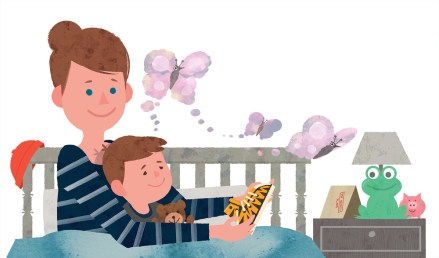
celebrate-picture-books-picture-book-review-secret-agent-man-goes-shopping-for-shoes-taking-a-nap

Image copyright Brian Won, courtesy of brianwon.com

The bus ride home is fraught with danger as S.A.M. foils an attempt by a spy in a stroller to steal the Plans for World Domination. “‘Phew! That was close,’” K says. The stairs to the front door seem unusually steep and tiring, and S.A.M is feeling “whoozy.” There’s only one explanation, he decides: his electron float must have been spiked. S.A.M drifts off into a short nap where he dreams of “beautiful poisonous butterflies and dangerous inflatable frogs.”

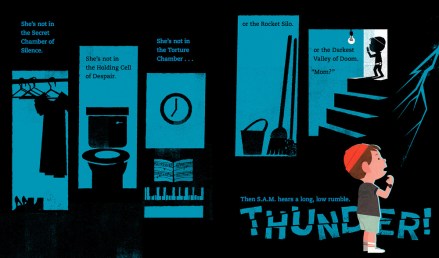
Later he has a secret meeting with Agent Coyote, Agent Ted, and Agent Pig. Their mission is to decode the Plans for World Domination by three o’clock. S.A.M. then goes looking for K. He can’t find her anywhere—not in the Chamber of Silence (the closet), not in the Holding Cell of Dispair (the bathroom), not in the Torture Chamber (the piano room), and not in the Rocket Silo (the utility closet). She’s not even in the Darkest Valley of Doom (the basement). Just then S.A.M. hears thunder.

celebrate-picture-books-picture-book-review-secret-agent-man-goes-shopping-for-shoes-in-the-basement

Image copyright Brian Won, courtesy of brianwon.com

S.A.M. grabs his new orange and black striped shoes, ties up the laces and races to the rescue with the speed of a tiger. K is outside “bringing in the clouds.” Some are being torn away by the wind, and S.A.M. makes a flying leap to save them. As the storm rages outside, S.A.M. and K relax inside with “steaming mugs of lava topped with dollops of candied gardenia and pearls” while discussing S.A.M.’s latest mission. It’s lucky, he says that his “Team of Expert Spies warned him about the storm.”

K recognizes the group “‘T.O.E.S.,’” she says. S.A.M. concurs. “‘We’re ready for anything.’” And indeed they are—in fact S.A.M. has even learned to ties his own tiger shoes. “‘ROAR!’”

celebrate-picture-books-picture-book-review-secret-agent-man-goes-shopping-for-shoes-tiger-sneakers

Image copyright Brian Won, courtesy of brianwon.com

Tim Wynne-Jones channels every kid’s dream of being a spy in this funny send up of an ordinary day of shopping and doing laundry. Using clever acronyms and a full dose of imagination, Wynne-Jones turns raisins into gemstones, French fries into snakes, fluffy laundry into clouds, and a boy into a secret agent man with tiger shoes and abilities. K is a supportive sidekick, encouraging S.A.M’s ingenuity and quick thinking and playing along with his day-brightening shenanigans. S.A.M.’s names for the various rooms in the house will make kids laugh, and they will also love his sweet little boy alter-ego.

Brian Won deftly and humorously shifts between S.A.M.’s secret missions and his reality, depicting S.A.M.’s imaginary world in blue, black, and white and his real world in vivid color. Crafty juxtapositions include an image of the Shoe Store Man, his arms loaded with boxes and his face peeping between them on the left-hand page while on the right-hand page, S.A.M. in his spy gear shuffles along a wall of shoe-display shelves where two illuminated eyes search the darkness. Another occurs when S.A.M and K are having lunch. The top two-thirds of the two-page spread is cloaked in darkness, snakey French fries, an exploding drink, and cool costumes while the lower third shows their regular clothes and new matching tiger sneakers. The tiger unleashed by the new shoes is a vibrant flash in this book that moves as smoothly between life and fancy as a wild cat on the chase.

Ages 4 – 8

Candlewick Press, 2016 | ISBN 978-0763671198

Check out Tim Wynne-Jones’ website for a vast array of books and other fun stuff!

A gallery of work by Brian Won is awaiting you on his website!

Get Ready for Kindergarten Month Activity

celebrate-picture-books-picture-book-review-shoe-lace-craft

Coolee-o-lee Shoe Laces


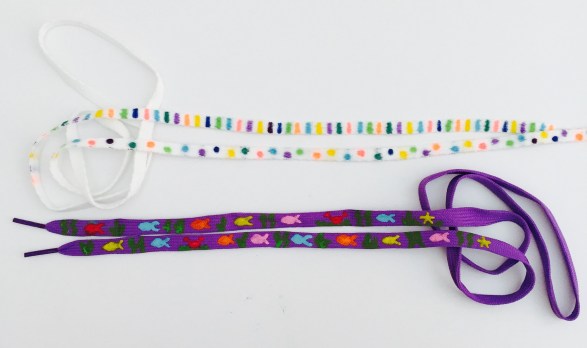
It’s fun and easy to design your own shoe laces for your favorite sneakers or boots or even for tying up hair styles, decorating your room, or you name it!

Supplies

  • White or colorful shoe laces, wide
  • Fabric paint or markers

Directions

  1. Draw or paint special designs or figures on the shoe laces
  2. Let dry
  3. Wear with pride!

Picture Book Review

August 12 – International Youth Day

celebrate-picture-books-picture-book-review-nadia-the-girl-who-couldn't-sit-still-cover

Image copyright Christine Davenier, courtesy of Houghton Mifflin Harcourt Publishing Co.

About the Holiday

In so many ways children and young adults are not only our future but they lead the world forward now. In recognition of this, the United Nations established International Youth Day to work toward ensuring that all children have access to resources to make positive and progressive choices. The theme for this year’s International Youth Day revolves around sustainable consumption, an important topic for the world our young people are inheriting.

It’s fitting that today’s holiday comes during the Olympic Games, a showcase of the best determination, hope, and spirit of today’s youth and tomorrow’s promise. A “perfect” reminder of that is the subject of today’s book!

Nadia: The Girl Who Couldn’t Sit Still

Written by Karlin Gray | Illustrated by Christine Davenier


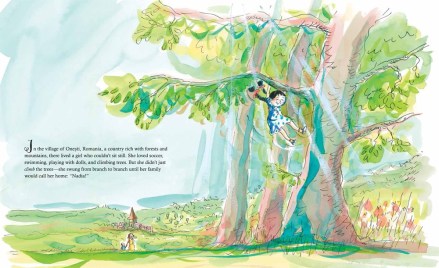
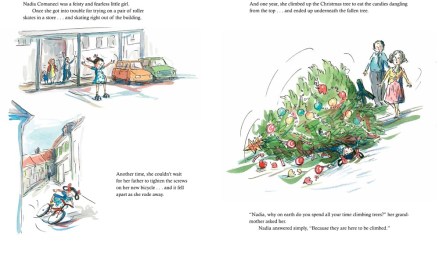
“In the village of Oneşti, Romania, a country rich with forests and mountains” Nadia Comaneci could often be seen swinging from tree branch to tree branch. She was a little girl who loved to play. She was “feisty and fearless,” attempting new things on a whim and always with a sense of adventure. Once she tried on a pair of roller skates and skated right out of the store! Another time she was so impatient to ride her new bike that she pedaled off before her father could even tighten the screws. The bike “fell apart as she rode away.” And one year her love of climbing trees extended to the family Christmas tree, which toppled over on her, pinning her to the ground.

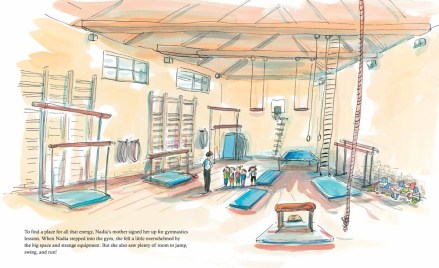
To channel all that energy, Nadia’s mother enrolled her in gymnastics lessons. Nadia’s eyes lit up when she saw the room full of ropes, ladders, bars, mats, and trampolines to discover, but she didn’t leave her new skills at the gym. Nadia and a friend cartwheeled around the school playground, capturing the attention of Bela and Marta Karolyi, who owned a gymnastics school. They invited the girls to join.

celebrate-picture-books-picture-book-review-nadia-the-girl-who-couldn't-sit-still-swinging-in-trees

Image copyright Christine Davenier, courtesy of karlingray.com

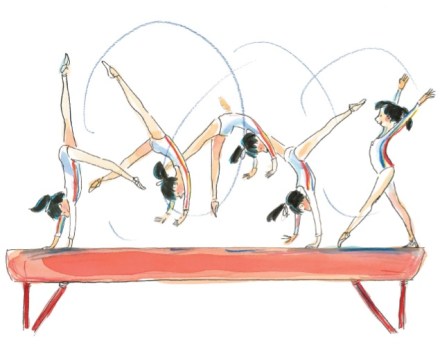
Nadia was only 6 when she began studying with Bela and Marta. Immediately, she discovered that she liked gymnastics better than her school subjects. She progressed quickly from performing “a straight cartwheel on a line painted on the floor” to doing it on a low balance beam and finally on the high balance beam. She began learning harder and harder moves, “flying from bar to bar, from floor to vault, and high above the beam.”

At 9 years old, Nadia competed in her first National Junior Championship. Despite her skill and hard work, she fell from the high beam during a leap not once but three times. Nadia finished the competition in 13th place. Her disappointment only strengthened her resolve. She went back to the gym and continued to practice many hours every day. Her determination paid off, “and at the next National Junior Championship games, she won first place.”

The ultimate recognition of her skill came when she was chosen to be part of the 1976 Romanian Olympic team. The games were held in Montreal, Canada, and all eyes were on the returning gold medalists from Russia, Olga Korbut and Lyudmila Turischeva. But excitement soon filled the venue as Nadia performed on the beam, the floor, and the vault where she scored 9.9, 9.75, and 9.7 on a scale of 1 (the lowest score) to 10 (a perfect score). The next event was the uneven parallel bars on which Olga Korbut had just scored a 9.9. “Nadia mounted the bars. Now fourteen years old, she was a long way from the forests in Romania. But she swung around as easily as she had jumped from branch to branch as a little girl. The audience gasped as she twirled and whipped and flipped.”

celebrate-picture-books-picture-book-review-nadia-the-girl-who-couldn't-sit-still-gym

Image copyright Christine Davenier, courtesy of karlingray.com

Nadia dismounted and landed perfectly on the mat below as the audience “exploded with applause.” Nadia returned to her team to wait for her score. And wait…and wait. Finally, the score appeared on the board—1.00. The worst score. How could that be? “‘What is Nadia’s score?’” Bela asked the judges. “One of the officials held up ten fingers as a voice announced over the loudspeaker: ‘Ladies and gentlemen, for the very first time in Olympic history, Nadia Comaneci has received the score of a perfect ten!’”

Because no one had ever achieved a 10 before, the scoreboards were programmed only for a high of 9.9. Nadia couldn’t bask in her accomplishment for long, however. She moved on to her next event—and her next perfect 10! “When the competition ended, she had earned seven perfect 10s.” At the medal ceremony both Olga and Lyudmila congratulated their competitor as the new Olympic champion. In all Nadia won five medals and became the youngest ever Olympic gold medalist in gymnastics.

celebrate-picture-books-picture-book-review-nadia-the-girl-who-couldn't-sit-still-balance-beam

Image copyright Christine Davenier, courtesy of karlingray.com

Nadia became a darling of the press. They surrounded her, asking “how it felt to have the world’s attention, if she had been confident she would win, and when she would retire.” She answered each reporter with enthusiasm and confidence, and promising that she was a long way from retiring. When she returned home, it seemed that all of Romania had come out to welcome her and her teammates—even the country’s president.

Now Nadia was famous all over the world. She returned to practicing and inventing new routines, preparing for other competitions and the 1980 Olympic Games. She had come far from swinging branch to branch in the trees of Oneşti, but she would always be that little girl who couldn’t sit still.

Karlin Gray’s compelling biography captures all the spunk and spirit of Nadia Comaneci that made the world fall in love with her at the 1976 Olympic Games. Adults of a certain age well remember watching her in astonishment as she seemed to effortlessly swirl, twirl, and flip through her routines, flashing her sweet smile as she waved to fans. In the first pages Gray reveals anecdotes of Nadia’s adventurous nature that will captivate readers even as they giggle at her predicaments.

celebrate-picture-books-picture-book-review-nadia-the-girl-who-couldn't-sit-still-mishaps

Image copyright Christine Davenier, courtesy of karlingray.com

The straightforward narration of Nadia’s trajectory from playground cartwheeler to Olympic champion enhances both the gritty determination of her studies with her coaches as well as the suspense of her competitions. All children—no matter what their talent—will draw inspiration from Nadia’s story, which includes disappointments as well as unbounded accomplishments. Gray’s lyrical language flows as smoothly as Nadia flew through the air and will land in readers’ hearts as a perfect 10.

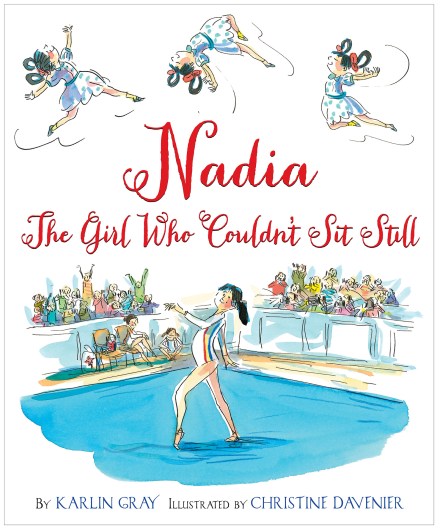
From the cover, which sports Nadia in her iconic floor exercise pose, to the last page, Christine Davenier depicts the world of gymnastics with beauty and the kind of realistic details that create a classic. The two-page spread of the gym where 6-year-old Nadia learns to love gymnastics portrays the enormity of the space and the equipment for a small girl—as well as the enormity of her achievement.

Kids will love the almost “play-by-play” illustrations of how Nadia learned to perform her feats, from starting with a line on the floor to perfecting the high beam and more. Nadia is shown leaping, somersaulting, doing handstands, and even wavering and falling as she practices and competes. The thrill of the Olympic Games, from the opening ceremonies, to the rapt and cheering audiences to the awards ceremony are drawn with stirring action, color, and attention to the specifics of that very special 1976 summer in Montreal.

An Afterword expands on Nadia Comaneci’s courageous life choices and career post-gymnastics and includes a timeline, notes, a selected bibliography, and websites for further study.

Nadia: The Girl Who Couldn’t Sit Still will fascinate kids and would be a very welcome addition to school classroom—as well as home—libraries.

Ages 5 – 10

Houghton Mifflin Harcourt, 2016 | ISBN 978-0544319608

Visit Karlin Gray‘s website to learn more about her and to download fun activities!

View a gallery of artwork by Christine Davenier on her website!

Discover more about Nadia: The Girl Who Couldn’t Sit Still on the Houghton Mifflin Harcourt website!

International Youth Day Activity

celebrate-picture-books-picture-book-review-rhythmic-gymnastics-ribbon-craft

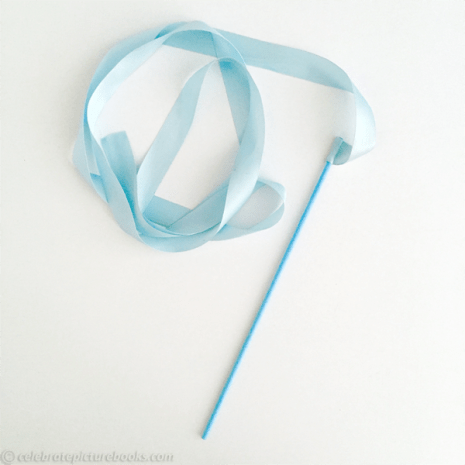
Rhythmic Gymnastics Ribbon


You can recreate the grace of rhythmic gymnastics with this easy craft! The swirling beauty of the ribbon makes any movement fun!

Supplies

  • 12-inch dowel
  • 6-foot length of ribbon
  • Paint the same color as the ribbon
  • Hot glue gun or strong glue
  • Paint brush

Directions

  1. Paint the dowel and let dry
  2. Glue the edge of the ribbon to one end of the dowel. Wrap the ribbon about ½ inch around the dowel and secure with glue. Let glue dry.

Picture Book Review

August 10 – World Lion Day

celebrate-picture-books-picture-book-review-lion-lessons-jon-agee

About the Holiday

The organization Big Cat Rescue established today’s holiday to bring awareness to the declining lion population. Habitat depletion, climate change, poaching, and other dangers have taken their toll on these majestic animals, and they are now on the endangered list. Global organizations aim to reverse the trend through education, protection, and governmental policy.

Lion Lessons

By Jon Agee


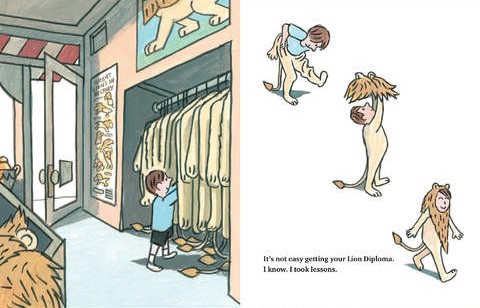
Passing signs for yoga lessons, violin lessons, Spanish classes, knitting classes, karate classes tutoring, a little boy turns into a shop advertising Lion Lessons in 7 Easy Steps. A closet to the right of a poster depicting “Great Lions in History” contains the appropriate garb—lion costumes. The boy steps into the body and attaches the mane. “It’s not easy getting your Lion Diploma,” the boy tells readers. “I know. I took lessons.”

His instructor, a lion himself, reveals that there are seven steps to becoming a lion. But first comes stretching. Converted yoga poses—“the Upward Lion, the Downward Lion, the Upside-Down Lion, the Rolling Lion, and the Flying Lion”—prepare them for the class to come. And, oh yes, they must shake their manes.

celebrate-picture-books-picture-book-review-lion-lessons-jon-agee-wearing-lion-costume

Image copyright Jon Agee, courtesy of Dial Books for Young Readers

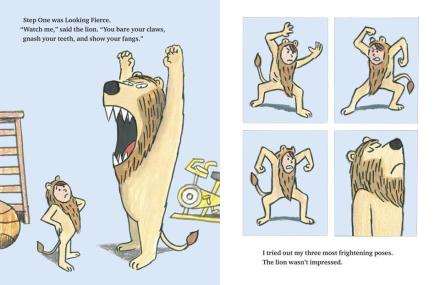
Step One to becoming a lion is “Looking Fierce.” The instructor demonstrates how to do it, complete with bared claws, gnashing teeth, and glinting fangs. The boy attempts these poses, but his instructor isn’t impressed. Step Two is “Roaring.” The boy steps up to the microphone and gives it his loudest growl. The sound barely registers on the noise meter.

Step Three is “Choosing What to Eat.” The instructor folds out the menu, with its wide choice of meats: “free-range muskrat, wombats, organic iguana, grass-fed gnu, all-you-can-eat antelope, sloth, prairie-raised anteater, and wild warthog.” Where’s the spaghetti? the boy wonders, only to learn that lions don’t eat spaghetti. Next up is Step Four: “Prowling Around.” Practice takes place in the forest where the boy learns to hide in the bushes and behind trees without letting his tail show.

Step Five is “Sprinting” and requires meeting the instructor at a faraway tree in five minutes; it took the boy one hour. After Sprinting comes “Pouncing.” The lion maneuvers the boy behind a woman talking on her phone and says, “‘It’s simple. You get a running start and then you jump on that lady.’” The boy protests that he will scare her to death. “‘Uh,’” says the lion, “‘that’s the idea.’” So the boy gets a running start and leaps—right into the lady’s arms. “‘What a cute little kitty-cat!’” she says.

celebrate-picture-books-picture-book-review-lion-lessons-jon-agee-looking-fierce

Image copyright Jon Agee, courtesy of Dial Books for Young Readers

Step seven is “Looking Out for Your Friends.” The boy peers through the telescope and sees a kitten: friend. The dog chasing the kitten: not a friend. The boy lets out a “ferocious roar.” He bares his claws, gnashes his teeth, paws the ground, shakes his mane and sprints across the field. When he’s within striking distance, he pounces…and saves the kitten! “‘Bravo!!’” congratulates the lion.

And that is how the little boy earned his diploma and became a hero to all the neighborhood cats in the bargain!

What kid wouldn’t like to be a lion—if even for a day? To be king of the classroom, or king of the playground, or even king of the house would be awesome. Jon Agee taps into that childhood (and adulthood?) mind set with his story of the little boy who channels his inner big cat to save a little cat from the neighborhood bully dog. Agee’s droll allusions to other popular classes enhances the humor for both kid and adult readers. Instead of yoga pants or a karate gi, the boy dons a lion uniform and proceeds on to perform lion-inspired exercises. While seemingly simple give-and-take, the dialogue between the two characters contains more dry wit that will have kids agreeing with their picture book counterpart and giggling at his predicament.

The over-sized pages and full-bleed colorful spreads allow for king-sized laughs. This is one lion instructor who takes his job seriously no matter how unsavory the menu or pouncing practice may seem to humans. Jon Agee never fails to entertain, and Lion Lessons continues the fun.

Ages 4 – 8

Dial Books for Young Readers, 2016 | ISBN 978-0803739086

To learn more about Jon Agee and his books and view a gallery of his illustrations, visit his website!

World Lion Day Activity

celebrate-picture-books-picture-book-review-wooden-spoon-lion-craft

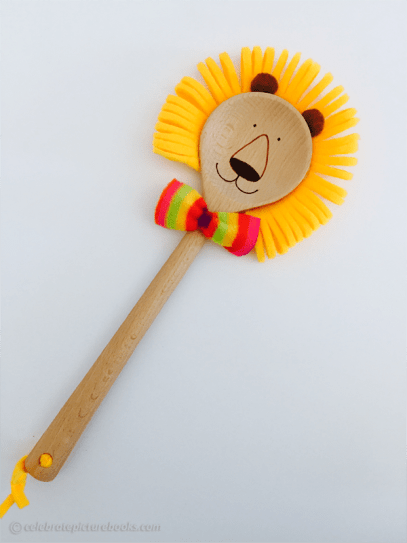
Wooden Spoon Lion Puppet


Unleash your inner lion! With this craft you can make a ROARingly cute lion puppet!

Supplies

  • Wooden mixing spoon
  • Yellow Fleece
  • Brown felt
  • Colorful Fleece or felt
  • Fabric glue
  • Light brown marker
  • Dark brown marker
  • Hot glue gun or super glue

Directions

  1. To make the lion’s face
  2. Draw a nose, mouth, and eyes on the front/bowl of the spoon

To make the mane

  1. Measure the rim of the spoon from one side of the handle to the other
  2. Cut a strip of yellow fleece as long as rim measurement and 4 inches wide
  3. Fold the piece of fleece in half long-ways
  4. Glue the open edges of the fleece together
  5. Along the folded side cut a fringe, leaving the loops intact

To make the ears

  1. Cut round ears from the brown felt

To assemble the lion

  1. Glue the ears to the back of the spoon
  2. Glue the mane to the back of the spoon

To make the bow

  1. Cut a 3-inch x 1 ½-inch piece of colorful fleece or felt
  2. Cut a long thin strip of fleece or felt
  3. Pinch the bow in the middle and tie with the longer piece of cloth. Trim as necessary
  4. Glue the bow to the handle

To make the tail

  1. Cut three thin 4-inch-long strips of yellow fleece
  2. With fabric glue, glue the tops of the strips together
  3. Braid the strips
  4. At the bottom, glue the strips together, leaving the ends free
  5. Fold the top of the tail and push it into the hole in the handle of the spoon

August 9 – Book Lovers Day

celebrate-picture-books-picture-book-review-roger-is-reading-a-book-cover

About the Holiday

For readers today’s holiday might be the best day of the year! With so many fantastic books to discover, one day doesn’t seem like enough! To make the most of it get up early and go to bed late, call in sick (Shhh…don’t tell them I told you to), order take out for lunch and dinner or read in a favorite restaurant, hire a baby sitter, go to the library or local bookstore….Just find a way to have quiet time to yourself—like Roger in today’s book!

Roger Is Reading a Book

By Koen Van Biesen | Translated by Laura Watkinson


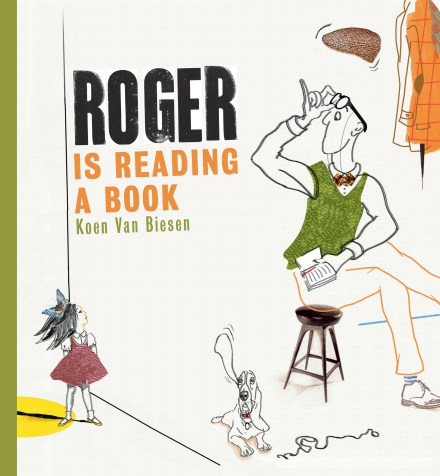
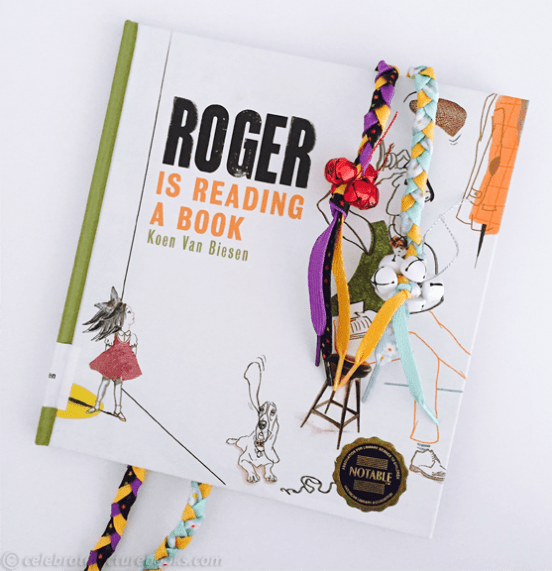
Roger is a minimalist. His room consists of a black padded stool, a hook holding an orange coat, scarf, and umbrella, an extendable lamp jutting from the wall, and a basset hound pining for its leash crumpled on the floor. And—oh yes—there is Roger. Roger is sitting on the stool, reading. The little volume is engrossing, and Roger, in his tweed cap, plaid bowtie, green sweater vest, white shirt, orange outlined pants, and blue striped socks tucked into white shoes, is pondering a page.

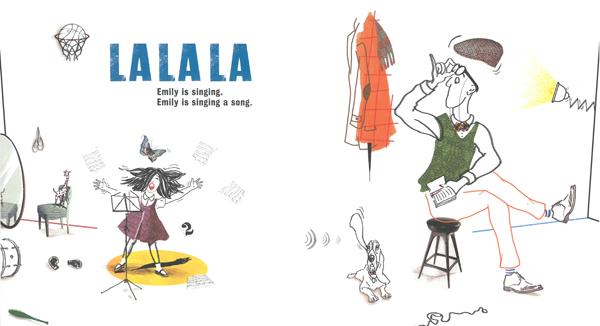
Suddenly from the other side of the wall/left-hand page comes a resounding BOING BOING. It’s Emily bouncing a basketball! Roger flips his lid and the dog’s ear springs to attention. Emily, herself, and her room are a sight to behold. Emily’s thick unruly hair sports an enormous butterfly, she wears a number 2 on her pink dress, and her room is cluttered with the trappings of her hobbies. Roger rises, sets his book on the stool, and knocks on the wall while his dog offers his leash with hope. Emily stops her bouncing to listen.

celebrate-picture-books-picture-book-review-roger-is-reading-emily-singing

Image copyright Koen Van Biesen

Ah! Silence reigns once more and Roger goes back to his book. But what’s this?! Emily is singing. The song is “LALALA” loud! Once again Roger knocks—“KNOCKITY KNOCK.” His dog wags his tail at the door. Okay, order has been restored and Roger, a little distracted, goes back to reading. What on Earth??!! “BOOM BOOM BOOM” Emily is playing the drum. The noise shakes Roger to his core. A shoe flies off, the lamp leaps upward, the book bounds away, Roger whips his head around. “KNOCK KNOCK KNOCKITY KNOCK” Ugh! Thinks Emily. Not this too!

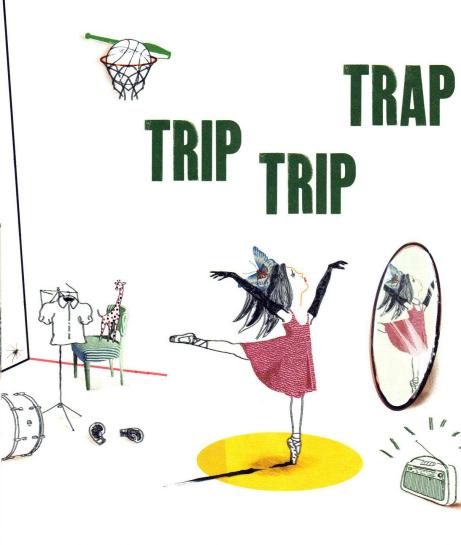
“POK POK POK” Emily juggles colorful clubs while poor Roger rubs his eyes, his book languishing in his hand. Even the basset hound has a paw over his snout. “TRIP TRIP TRAP” Emily is now practicing ballet. Despondent Roger has turned his back on the whole thing—as has his dog and his lamp. The book lies abandoned in the corner. “BAF BAF BAF” Emily is boxing! Something must be done! Roger paces. “Is Roger reading? No, Roger is not reading now.”

celebrate-picture-books-picture-book-review-roger-is-reading-emily-dancing

Image copyright Koen Van Biesen

“Book down. Coat on. Scarf on. Light off. Roger has made up his mind.” “KNOCK KNOCK KNOCK.” Roger knocks on Emily’s door. With a package. Emily tears it open. “OH…A book.” Roger returns to his room and his coat and scarf to the hook. He turns on the lamp and sits down on the stool. “Shhhh! Quiet. Emily is reading. Emily is reading a book.” It’s about juggling and basketball and other things. She holds her stuffed giraffe for company. “Shhhh! Quiet. Roger is reading. Roger is reading a book.” His failthful dog lies nearby for company.

Late into the night they read, their rooms illuminated only by a single lamp. “WOOF WOOF WOOF WOOF WOOF WOOF WOOF WOOF WOOF WOOF WOOF WOOF WOOF ….” Both Roger and Emily jump, startled out of their reverie. There’s only one thing to do. Roger and Emily take the dog for a walk.

With just a glance at the cover of Koen Van Biesen’s Roger Is Reading a Book, readers know they are in for a treat. The distinctive artwork defies simple explanation. Part outline, part optical illusion, the illustrations combine the immediacy of an art installation with the humor of a New Yorker cartoon. You feel for Roger, who just wants to sit quietly and read his book. But perhaps also for Emily, alone, who is trying to fill the empty hours. And of course for Roger’s basset hound, who has a very real need to go out.

The trio’s circumstances come together on a rainy afternoon to create escalating hilarity and finally the perfect solution. The minimal text, displayed in various sizes and colors of type, enhances the droll nature of Roger and Emily’s contest of wills and allows for the illustrations to depict Roger’s growing discontent and Emily’s dedication to her activities. Roger’s basset hound and lamp are funny foils empathizing with Roger’s pain.

The unique art and fun animated read-aloud opportunities presented in this picture book make Roger Is Reading a Book a must for kids’ (or adults’) libraries.

Ages 4 – 8 (and up)

Eerdmans Books for Young Readers, 2015 | ISBN 978-0802854421

Book Lovers Day Activity

celebrate-picture-books-picture-book-review-bell-bookmark-craft

Read aLOUD Bookmark


Make some noise for your favorite book with this bell-tastic bookmark! It’s easy to make, and everywhere you go you’ll give your book a ringing endorsement!

Supplies

  • 3 novelty shoe laces or three strands of thin ribbon in different designs
  • 6 small jingle bells

Directions

  1. Cut the shoelaces or ribbon to the length you want for your books
  2. Knot the three shoelaces or strands of ribbon together at one end
  3. Braid the three shoelaces or strands of ribbon together
  4. Knot the strands together at the top, leaving about two inches of unbraided shoelace or ribbon hanging
  5. Thread the bells on a piece of string or cord
  6. At the knot tie the bells around the shoelaces or ribbon

Picture Book Review

July 31 – Uncommon Instrument Awareness Day

celebrate-picture-books-picture-book-review-ada's-violin-cover

About the Holiday

Today is the day to be musically experimental. Intriguing, inventive instruments that make a wide variety of sounds exist in every corner of the world. From Russia comes the contrabass balalaika, a triangular stringed instrument. The cimbalom, a concert hammered dulcimer, originated in Hungary. And only the Welsh could give us an instrument with no vowels: the crwth. Glass, water, and lightning are also used to make beautiful sounds, and the Holophonor—a musical instrument and hologram projector all in one—is perfect for Elvis sightings wherever he is! So, play a different instrument or research one, and read the inspiring story in today’s book!

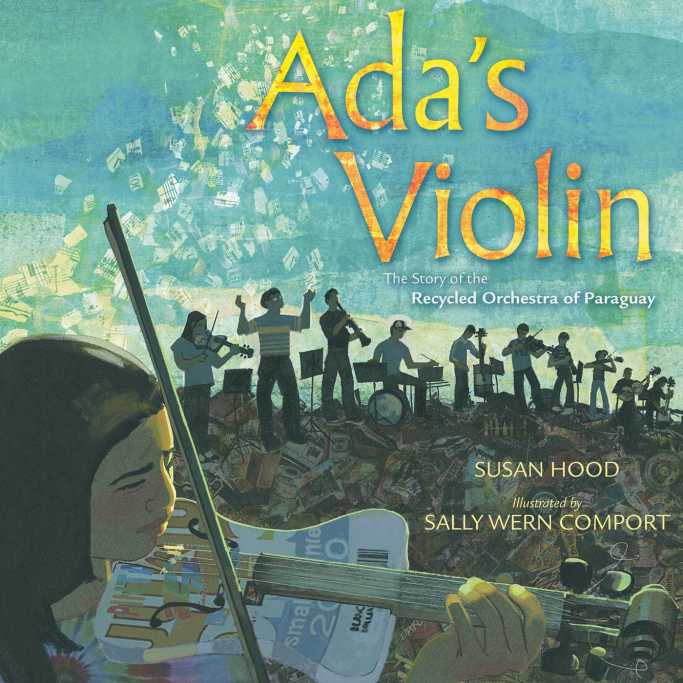
Ada’s Violin: The Story of the Recycled Orchestra of Paraguay

Written by Susan Hood | Illustrated by Sally Wern Comport


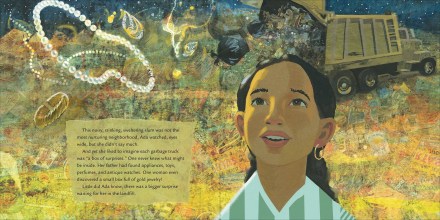
Ada Ríos is growing up in Cateura, a town built of trash as the main garbage dump for the capital city of Paraguay. Every morning the refuse trucks rumble into town to deposit their loads—1,500 tons of trash every day. The citizens of Cateura—gancheros or recyclers—go to work sifting through the mounds and tearing into bags looking for anything valuable enough to recycle or sell. Cardboard is worth 5 cents a pound, plastic 10 cents a pound.

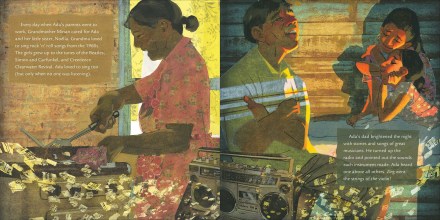
Ada knows the landfill can hold surprises—“Her father, a ganchero, had found appliances, toys, perfumes, and antique watches.”—but she can never imagine what it holds for her. When Ada and her sister were little, their grandmother watched them while their parents worked. They loved to listen to music, to sing, and to learn stories of musicians and the sounds of different instruments. Ada fell in love with the violin.

celebrate-picture-books-picture-book-review-ada's-violin-making-singing

Image copyright Sally Wern Comport, courtesy of simonandschuster.com

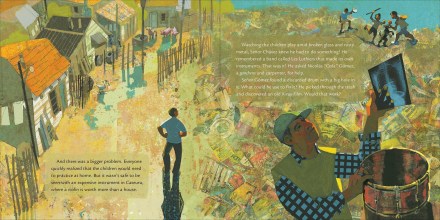
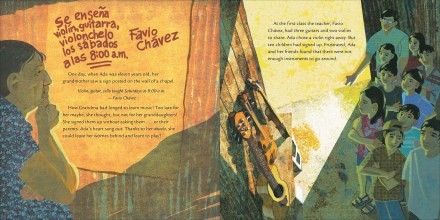
As the girls grow older and go to school, they venture farther into town, but there is little to fill their time. Many kids join gangs or get into fights. When Ada is 11 her grandmother signs her and her sister up for music lessons being offered by a new man in town named Favio Chávez. “Ada’s heart sang out” when she hears the news. On the first day ten children show up to play the five instruments available. But a bigger problem looms: the three guitars and two violins cannot be taken home for practicing as they are magnets for thieves. In Cateura a violin is worth more than a house.

But Favio Chávez has an idea. With help from Nicolás Gómez, a ganchero and carpenter, they pull bits and pieces from the landfill. An old broken drum and an X-ray film become a workable drum, water pipes become flutes, packing crates become guitars and violins, and oil drums become cellos. “Ada chose a violin made from an old paint can, an aluminum baking tray, a fork, and pieces of wooden crates. Worthless to thieves, it was invaluable to her. It was a violin of her very own.”

celebrate-picture-books-picture-book-review-ada's-violin-making-instruments

Image copyright Sally Wern Comport, courtesy of simonandschuster.com

The children practice tirelessly outside in 100-degree heat until the initial “screeches, twangs, and tweets hit all the right notes. Their class became ‘a small island’ where Chávez taught them to respect themselves and one another.” They become known as The Recycled Orchestra. Music now fills the air, adding a soundtrack of beauty to the grueling work. The orchestra is soon invited to play concerts in Cateura and the capital city of Asunción. When word spreads of their talent, they receive offers to play from other cities and even other countries.

When Ada is 16 The Recycled Orchestra is invited to tour with a world-famous rock band. As Ada takes the stage in front of 35,000 people in Bogotá, Colombia, she is afraid, but the audience cheers for them and sings along as they play. On that night the children discover a new life. “Buried in the trash was music. And buried in themselves was something to be proud of.”

celebrate-picture-books-picture-book-review-ada's-violin-lessons

Image copyright Sally Wern Comport, courtesy of simonandschuster.com

An extensive author’s note plus a photograph of The Recycled Orchestra, websites, and videos follow the text, as well as a list of sources.

Ada’s Violin is also available in a Spanish edition—El violín de Ada: La Historia de la Orquesta de Instrumentos Reciclados del Paraguay.

Susan Hood has brought to light an incredible story of perseverance, hope, and the ability of music and other arts to provide opportunities and self-confidence that change lives. Told with unstinting honesty and sensitivity, Hood’s biography of Ada Ríos, Favio Chávez, and The Recycled Orchestra will inspire all who read it. The well-paced text offers revealing details on every page and flows with a lyrical quality that enhances the effect of the story and its impact. From the first sentence to the last, both children and adults will be riveted to The Recycled Orchestra.

celebrate-picture-books-picture-book-review-ada's-violin-hope

Image copyright Sally Wern Comport, courtesy of simonandschuster.com

Sally Wern Comport’s paintings beautifully capture the human spirit that shines through and drives people to astonishing achievements even in the most adverse conditions. With intricately created collages of rich hues, Comport depicts the town of Cateura and the mountains of trash the citizens work and play on. Warm lighting illuminates faces full of dreams and love, and readers will linger over depictions of the instruments workshop and cheer along with the concert audience as the children receive recognition. The full-bleed, two-page spreads echo the expanded world music gave to the children in the orchestra and the adults who heard them as music score confetti flutters throughout.

Both school classrooms and home libraries will benefit from the stirring message of Ada’s Violin.

Ages 4 and up

Simon & Schuster Books for Young Readers, 2016 | ISBN 978-1481430951 (English edition); 978-1481466578 (Spanish edition)

Discover more about Susan Hood and her books, plus fun activities for kids and information for teachers and parents on her website!

View a gallery of Sally Wern Comport’s artwork on her website!

Uncommon Instrument Awareness Day Activity

celebrate-picture-books-picture-book-review-homemade-musical-instrument


Make Your Own Musical Instrument


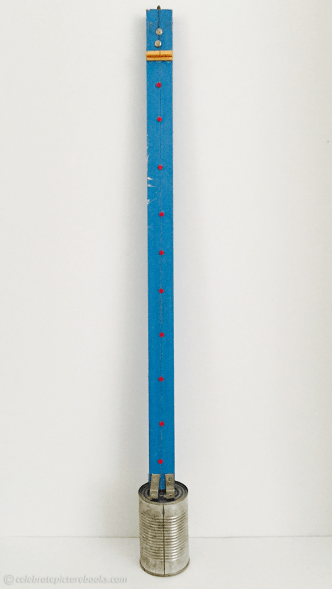
Inspiration for sound can come from almost any object! Look around your house or classroom and discover the music in boxes, cans, blocks of wood, plastic egg cartons or deli containers, and more. Add string or wire for plucking, sticks for drumming, or beans for shaking. With a little glue, tape, or hardware and some creativity, you’ll be making your own rhythms in no time!

Supplies for the instrument shown in the picture above

  • Tin can
  • Two small L brackets
  • Piece of wooden molding, 2 1/2 feet by 1 1/2 inches by 3/4 inches
  • Five small strips of wood to raise the wire off the neck of the instrument. I used long wooden fireplace matches cut into 1 1/2″ sections 
  • Thin wire
  • Small circular hook screw or regular screw
  • Two tacks
  • A nail, screw, or piece of wood that will fit horizontally in the mouth of the can
  • a small nail to make a hole in the can
  • Hammer
  • Strong Glue
  • Paint
  • Foam decorative dots

Directions

  1. Paint the wood and let dry
  2. Paint the small strips of wood and let dry
  3. Decorate the can with paint, sticker, duct tape, or paper
  4. With the hammer and small nail, make a hole in the center of the bottom of the can
  5. Wrap one end of the wire around the nail and glue so it is firmly in place
  6. Feed the other end of the wire through the hole in the bottom of the can
  7. Screw or glue two L brackets to one end of the wood molding so that the bottom of the L is flush with the bottom of the wood molding and there is space between the brackets. This makes the neck of the instrument
  8. Screw the circular or regular screw into the top, center of the wooden molding
  9. When the wooden strips are dry, glue three side by side 3 inches from the top of the molding. Glue two more matches, one on top of the other on the center strip.
  10. When the L brackets are dry, glue them (and the neck of the instrument) to the can, making sure the brackets are on either side of the hole in the can. Make sure the wire is out of the hole. 
  11. When the brackets are firmly attached to the can, pull the wire to the top of the neck. Settle it in the center of the small pieces of wood, so that the wire is not touching the neck.
  12. Wrap the wire around the screw at the top of the molding until it is firmly in place and the wire is taut. 
  13. Secure the wire to the neck with the tacks
  14. Mark the “frets” with the foam dots

Picture Book Review


July 27 – Dog Days of Summer Q & A with Ged Adamson

celebrate-picture-books-picture-book-review-ged-adamson-photo

About the Author

Ged Adamson is a writer and illustrator living in London with his partner Helen and their son Rex. His most recent book Douglas, You Need Glasses! was published by Random House and released this past May. Two previous books—Elsie Clarke and the Vampire Hairdresser (2013) and Meet the McKaws (2015)—were published by Sky Pony Press. Ged has two books hitting shelves in the summer and fall of 2017—Shark Dog from HarperCollins and I Want to Grow from Boyds Mills Press. Ged’s cartoons have appeared in magazines, such as Punch and Prospect, as well as in books and on film. He has worked as a storyboard artist and a caricaturist and also works as a composer for TV and film.

About the Holiday

Here we are in the Dog Days of Summer—that time from July 3 to late August—when the air is still, the sun is bright, and the beach beckons. Although the phrase “dog days” conjures up images of Fido panting and lethargic, the term actually refers to the dog star Sirius—the brightest star and, in Greek mythology, the hunter Orion’s dog. To the ancient Greeks and Romans, the “dog days” occurred when Sirius rose and set with the sun, lending its warmth to the day.

Q & A with Ged Adamson

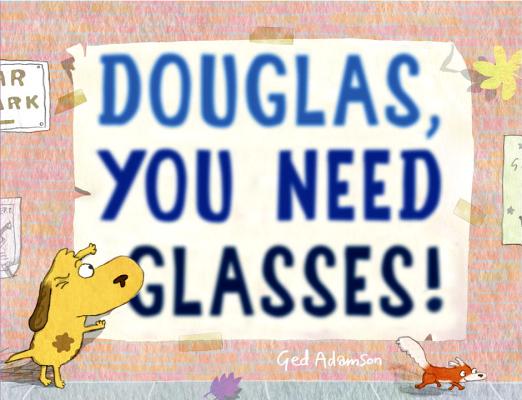
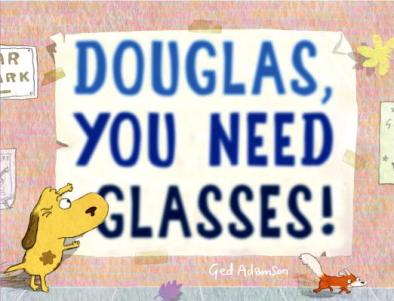
Today, Celebrate Picture Books is featuring another rising star—Ged Adamson. Ged took some time to talk about his work, his inspirations, and that stellar, spectacles-wearing canine Douglas of:
celebrate-picture-books-picture-book-review-douglas-you-need-glasses-cover

What books did you enjoy most as a child?


I wasn’t a great reader of chapter books as a child and I don’t remember us having picture books in the house but we did Roald Dahl stories at school. James and the Giant Peach and Charlie and the Chocolate Factory were favourites.

My mum and dad were avid readers. My dad had some great books. As well as novels, he had a lot of factual books about artists and history. One that I loved was about The Illustrated London News and it was full of beautiful Victorian etchings of everyday life in London. There were always books of cartoons by people like Giles and Frank Dickens. And we had loads of Charles Schultz Peanuts paperbacks.

celebrate-picture-books-picture-book-review-ged-adamson-interview-a-kestrel-for-a-knave-cover

My grandad was Scottish and we used to get a Scottish newspaper every weekend called The Sunday Post. There was a comic section for kids. The two main strips in it were The Broons and Oor Wullie. The characters inhabited a kind of 1950s world which I loved. We would get The Broons and Oor Wullie annuals every Christmas.

The first proper books I read of my own accord were collections of short horror stories that I borrowed from my older brothers. Reading them, I would be scared to death but I couldn’t stop. We did some great books in school that I really enjoyed like Animal Farm by George Orwell, A Kestral For A Knave by Barry Hines and Lord of the Flies by William Golding. And in the school library they had some decent novels for older kids and they had Tintin and Asterix the Gaul in French.

What influenced you to write Douglas, You Need Glasses!?


It was a little drawing I did of a dog in glasses smoking a pipe. Like most doodles, it was done without really thinking. But I was trying to come up with ideas for stories at the time so I wondered if I could do something with this character.
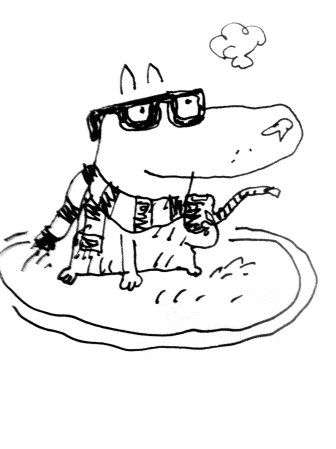
celebrate-picture-books-picture-book-review-ged-adamson-douglas-doodle

Image copyright Ged Adamson

I wear glasses myself so I thought I could use some of my own experiences with short sightedness to develop Douglas’s story. It went through many stages though. In one early idea, Douglas’s newly perfect vision causes him to be too honest about people’s appearances. Another had him befriending a group of insects.

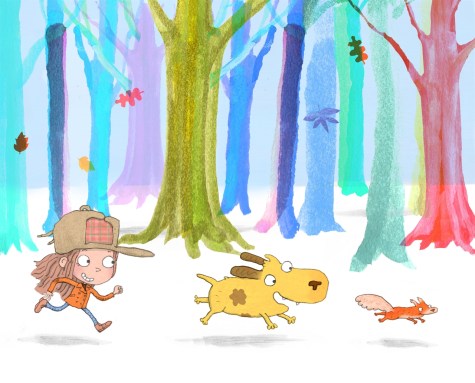
I’d just started to take my illustration style in a different direction, and I wanted to do something that would be visually strong. So from the way Nancy is dressed, the coloured see-through trees, the skate park, the eye chart, through to the big glasses at the end. I was trying to create images that the reader would remember. And most importantly I wanted the story to be funny!
celebrate-picture-books-picture-book-review-ged-adamson-interview-douglas-you-need-glasses

Image copyright Ged Adamson, coiurtesy of gedadamson.com

Can you describe your process when writing and illustrating a picture book?


It will start with an idea. Sometimes, as with Douglas, that will come from a doodle. The next stage is sketches and thinking a lot about the shape of the story. Who are the characters? How will the art look? What is the story saying—what’s its message? I’ll talk to people whose opinions I respect and see what they think—my Agent Isy being one.

The next step is putting together three or four spreads so you get a feel for the tone of the story and how it will look. All the time I’m throwing in bits of text but this changes constantly. I never have a manuscript separate from the images for this reason. To me, the words and pictures can’t exist apart from each other. That’s why I’m always uneasy supplying a manuscript with submissions!

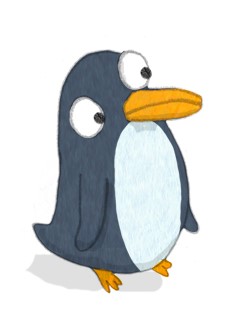
All through this process of me working on a story—and then if I’m lucky, with the publisher—I’ll be chopping things out and adding stuff to solve problems. In my next book, Shark Dog, I’d put a cute little penguin in the final spread. I really liked that penguin! But he had to go because the scene changed from an Arctic sea to a tropical one. And that is a pretty minor change in the grand scheme of things. You have to be prepared for the editor asking to make major overhauls to your book before it goes to the printers.
celebrate-picture-books-picture-book-review-ged-adamson-penguin-doodle

Image copyright Ged Adamson

Can you describe your work space a little?


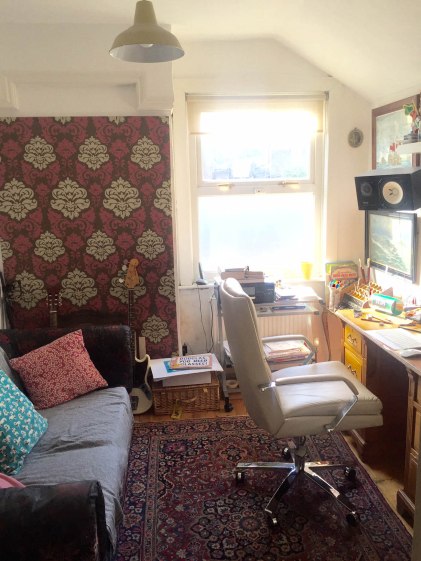
It’s a small room, but it’s mine! I think, no matter how tiny it is, how you arrange the space where you work is important. I like to feel it’s my world and part of my personality. The centre of it is occupied by an old desk with an iMac on it. I replaced my chair recently and I love the new one. It’s like something from an ‘80s quiz show and super comfy. I sometimes record music in there so there are instruments as well as art stuff. There are things I’ve picked up from junk shops and our local market. There’s an old sofa against one wall which is so great when I want to have a break.
celebrate-picture-books-picture-book-review-ged-adamson-interview-ged's-writing-space

Most furniture in our house is second hand. I have bits of paper stuck to the wall with lists of things I need to get done and new book ideas. I’ve got a few pictures up too. There’s one which is just a scene of a rough sea, nothing else—it’s an old framed print. There’s something weirdly relaxing about it. I like that I can look out the window and see the backs of the tall Georgian houses on the other side of the railway tracks. It’s a very London view. I’d like to have a bigger space to work in but I do love my little room.

What is the favorite object on your desk and why?


I want to say something like “Ah, that would be the skull of my great grandfather. He spent his life studying the speech patterns of elk”. But I think it has to be my computer. Though it keeps dropping out of connection which is driving me mad. What the hell, Apple? 

What is the best part about writing picture books?


I remember working on the art for my second picture book Meet The McKaws. I could see the snow coming down outside the window of my little room. I suddenly thought, “I’m really happy doing this”! I hadn’t had that same feeling doing anything else.

Actually, the best part of writing picture books is what I’m experiencing right now with Douglas. People are getting in touch and saying they love the book and the characters. The response from readers is what you look forward to and when you get so much positive feedback for something you spent a long time working on, it’s such a great thing.

But there are other aspects that I love too. Working with talented editors and art directors is a lot of fun and you learn valuable stuff from them too.

It’s also thrilling to see your book on the shelves in a book shop!

What are you working on next?


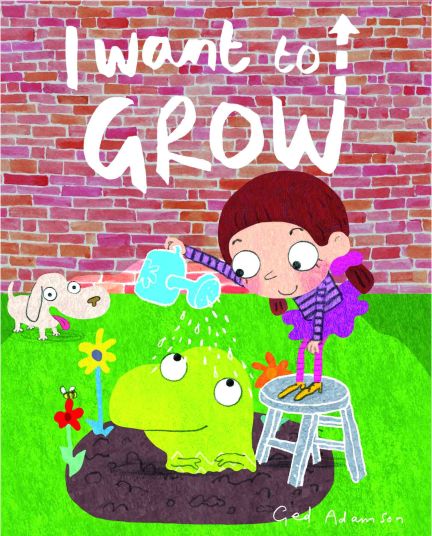
I’m just finishing work on two books that will be out next year. The first is Shark Dog. It’s about a strange but very friendly animal that stows away on an explorer’s boat. HarperCollins is doing that one. The second is called I Want To Grow, and it’s about a little dinosaur called Herb who gets frustrated that his human friend Muriel is getting taller and he’s not. This one’s with Boyds Mill Press.
celebrate-picture-books-picture-book-review-ged-adamson-i-want-to-grow-cover

image copyright Ged Adamson

I’m also working on two new ideas. One of those is about a rainbow and it’s almost ready for submission, so I’m excited to see what publishers think.

I can’t properly call this a holiday themed blog without asking you a couple of questions about special dates, so here goes:

What is your favorite holiday?


Because I’ve always done stuff that doesn’t involve a nine to five working week, I feel slightly guilty that I don’t appreciate holidays. Even weekends. On Twitter and Instagram there’ll be loads of people going, “IT’S THE WEEKEND! HURRAY!!” and I’ll be like, “oh yes, yay!”

I do like Christmas though. My son is still quite little so it’s lovely to experience that kid version of Christmas again through him. I’m not the least bit religious, but I really like when people come to our road and sing carols. The TV’s good and there’s lots of drinking and eating. I mean, what’s not to like about that? 

Do you have an anecdote from any holiday you’d like to share?


I remember a school Summer trip where we all stayed for a week in an old country house in the middle of woodland. Rumours began circulating that the place was haunted. Everybody started to get nervous. This wasn’t helped by a drunken teacher one night on his way to bed telling everyone “Don’t worry, the ghosts won’t harm you”. We were now all terrified and a kind of hysteria took over. We started counting the minutes until we could be reunited with our families. Somebody said they saw a ‘misty figure’ as they made their way back from the disco hut. Panic ensued. Even on the coach home there was a sense of looming disaster. Back at school in September, it wasn’t talked about much. I think everyone was embarrassed that we’d allowed ourselves to get into such a state.

Has a holiday ever influenced your work?


In Shark Dog, the explorers and their new pet set off to the seaside in their Morris Minor. For me that is a very English holiday scene but obviously you don’t see many of those cars any more. My mum and dad didn’t drive so our holidays would involve hours on a coach to somewhere like Wales or Devon. In the new story I’m working on, there is a spread with a multitude of people getting off those kind of coaches. It definitely took me back to being a kid!

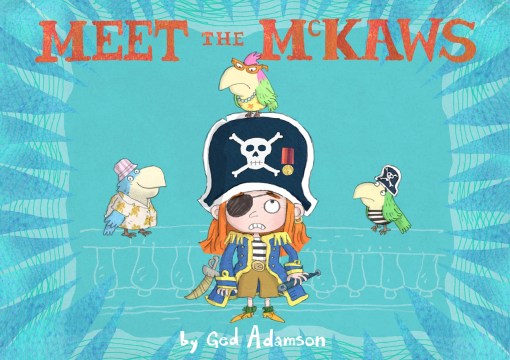
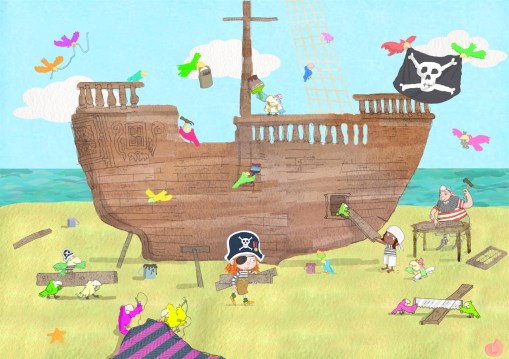
In Meet The McKaws, the story centres on a pirate’s parrot’s family members visiting for a few days. This is an aspect of holiday periods that is fraught with danger!
celebrate-picture-books-picture-book-review-ged-adamson-interview-meet-the-mckaws-cover

celebrate-picture-books-picture-book-review-ged-adamson-interview-meet-the-mckaws-rebuilding-the-ship

Image copyright and courtesy of Ged Adamson

I’d like to thank Ged for his insightful and engaging answers to my questions that prove that the Dog Days of Summer are definitely the best (especially when that dog is Douglas)! 
 

celebrate-picture-books-picture-book-review-douglas-you-need-glasses-cover

Ged is giving away a copy of Douglas, You Need Glasses! plus other goodies! Just click to enter the Rafflecopter Giveaway


You Can Connect with Ged Adamson on

Twitter | Instagram | Ged’s Website

You Can Find Ged Adamson’s Books at

Book Depository | Amazon UK | Amazon US | Barnes and Noble | IndieBound

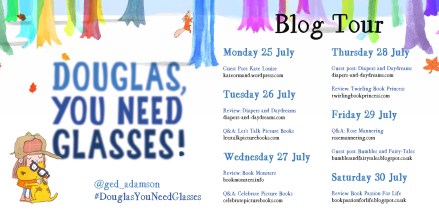
Ged Adamson’s blog tour continues! Don’t miss it!
celebrate-picture-books-picture-book-review-ged-adamson-blog-tour-banner

Review of Douglas, You Need Glasses!

By Ged Adamson


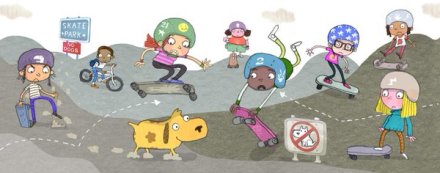
Something may be amiss with Douglas. When Nancy and her playful pooch went out to chase squirrels recently, Douglas ran after a falling leaf while the squirrel escaped up a tree. It’s not the first time something like this has happened. You see, Douglas is a bit nearsighted. Sometimes he mistakes the stair post for Nancy, and his difficulty gets in the way of things (well, mostly Douglas gets in the way of things). He misses important signs—like the one that would have prevented him from tracking wet cement all over the skate park, where there are NO DOGS allowed—and he’s always causing something of a ruckus. Sometimes he even enters the wrong house! But when a game of fetch buzzzzzed toward disaster, Nancy decided something had to be done.
celebrate-picture-books-picture-book-review-douglas-you-need-glasses-skate-park-art

Image copyright Ged Adamson, courtesy gedadamson.com

She took Douglas to the eye doctor where he tried to read a most dog-friendly eye chart. His test revealed that he needed glasses. He found the shelves of Dog Glasses, which offered many options, and had fun trying some on. Each one made him feel different. In one pair he was a rock star; in another a scholar; and in yet another a hippy. He wore them all until he discovered the perfect pair!

On the way home he saw the world in a way he never had before. “‘Wow! Everything looks amazing!’” Douglas said. And it was!

celebrate-picture-books-picture-book-review-douglas-you-need-glasses-interior-art

Image copyright Ged Adamson, courtesy gedadamson.com

Ged Adamson’s funny look at a nearsighted dog will make kids laugh from the first page to the last. Earnest Douglas, going about his doggy days under a bit of a skewed perspective, is so endearing that readers cannot help but love him even as they giggle at his exploits. Adamson’s vibrant multi-hued trees, colorfully clothed kids, and vivid backgrounds with stylish sketched-in details gives the book a fresh, jaunty appeal for a lively, fun story time. Kids facing the prospect of wearing glasses will find lots to give them reassurance and confidence in this book.

Douglas, You Need Glasses is a great addition to any child’s bookshelf!

Ages 3 – 8

Schwartz & Wade, Random House Kids, 2016 | ISBN 978-0553522433

Dog Days of Summer Activity
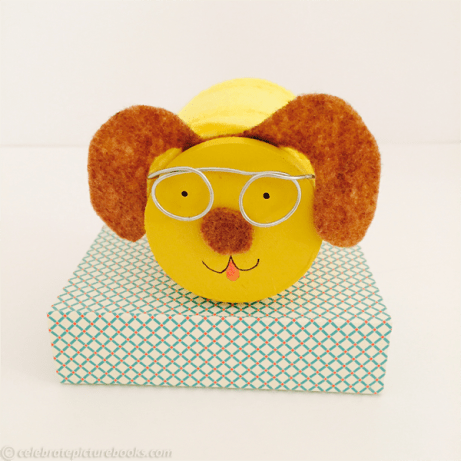
 

celebrate-picture-books-picture-book-review-spool-puppy-craft

Make a Stellar Spool Puppy


No matter where you go and whether you have a real dog or not, you can take this little guy along with you. And just as you would pick out your favorite from an animal shelter, you can make this puppy look any way you’d like!

Supplies

  • Printable ears and nose template
  • 2-inch round wooden spool, available at craft stores
  • 1 skein of yarn in the color you choose. Yardage needed will depend on the thickness of the yarn.
  • Felt
  • Craft paint
  • Paint brush
  • Fabric or strong glue
  • Thin gauge wire
  • Dowel or pencil to wrap wire around to make glasses

celebrate-picture-books-picture-book-review-spool-puppy-craft

Directions

  1. Paint the dowel the color you want your dog to be, let dry
  2. Trace the ears on the felt and cut out (or draw your own ears)
  3. Trace the nose on the felt and cut out
  4. When the spool is dry glue the ears to the body of the spool, allowing the ears to stick up from the top of the spool
  5. Wind the yarn around the spool back and forth until the dog’s body is the size you’d like
  6. Glue the yarn in place with fabric or strong glue

To make the face

  1. Glue the nose over the hole on one end of the spool
  2. Draw the mouth and tongue under the nose with a marker
  3. You will draw the eyes on after the glasses are in place

To make the glasses

  1. Wind the wire around a ½-inch dowel, thick pencil, or rounded handle to make two circles.
  2. Leave about two inches on either side of the circles for the ear pieces of the glasses.
  3. Adjust the size of the circles to fit the spool as glasses.
  4. Put the glasses on the face of the spool, tucking the ear pieces into the yarn on each side
  5. Draw eyes in the center of the glasses

To make the tail

  1. Cut a small square of felt and stuff the edges into the hole on the other end of the spool
  2. You can make the tail as long as you like

Picture Book Review