January 14 – Organize Your Home Day

celebrate-picture-books-picture-book-review-if-i-built-a-house-cover

About the Holiday

Sometimes it seems that clutter multiplies while you’re not looking. The beginning of the year offers an opportunity to clean out those closets, pantries, and basements that can be breeding grounds for mess. Getting the house back in shape can be fun if you get the whole family involved. Kids will appreciate being asked for their suggestions on organizing their rooms and may have some pretty creative ideas—just like the boy in today’s book! 

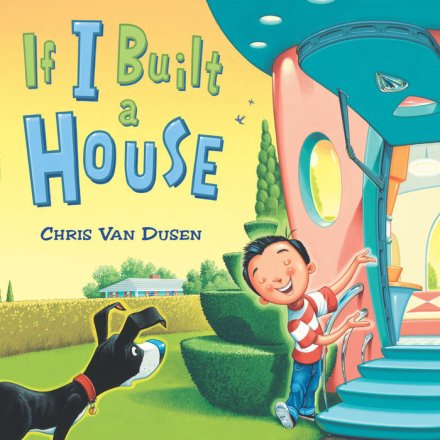
If I Built a House

By Chris Van Dusen


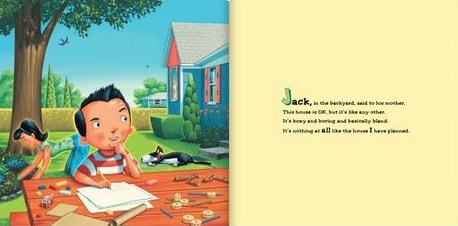
While Jack’s mother digs in the garden and their dog snoozes in the sun, Jack is reconsidering his house. It’s just like the others in the neighborhood, he says—“boxy and boring and basically bland. / It’s nothing at all like the house I have planned.” Sure, his house will have function and flow, but the rooms inside are where his real genius will show. Then with the flair of an HGTV host, Jack invites his mom in to see what he means.
celebrate-picture-books-picture-book-review-if-i-built-a-house-dreaming

Copyright Chris Van Dusen, 2012, courtesy of Dial Books for Young Readers.

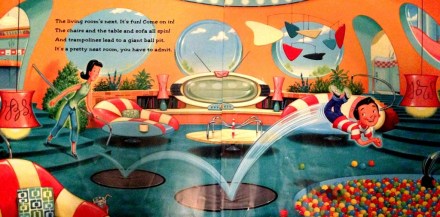
First up is the kitchen that has a mind—and arms—of its own. In this “Kitchen-O-Mat,” Jack tells his mom, “You don’t have to cook and you don’t have to clean. / It’s done by a space-age robotic machine. / It makes all the meals, and the food is deeelish. / Then it washes and puts away every last dish.” The living room is every kid’s dream of an indoor playground, with furniture that spins, a ball pit, and two trampolines.
celebrate-picture-books-picture-book-review-if-i-built-a-house-playground-room

Copyright Chris Van Dusen, 2012, courtesy of Dial Books for Young Readers.

The bathroom is built assembly-line style with no shower or tub—just an ingenious “Scrub-a-Dub-Dub. / Just step on the belt and it washes you clean— / Even the places that you’ve never seen!” Jack’s bedroom’s a penthouse of glass in the round, with a 200-feet long twisty slide that deposits you into the Art Room through a round door in the wall. The wall is great for drawing on too, but “…don’t worry, it’s cool. / Hung way up high, on a big giant spool, / Is a huge roll of paper that hangs to the floor. / Just draw till you’re done, / Then pull down some more.”

celebrate-picture-books-picture-book-review-if-i-built-a-house-kitchen-larger

Copyright Chris Van Dusen, 2012, courtesy of Dial Books for Young Readers.

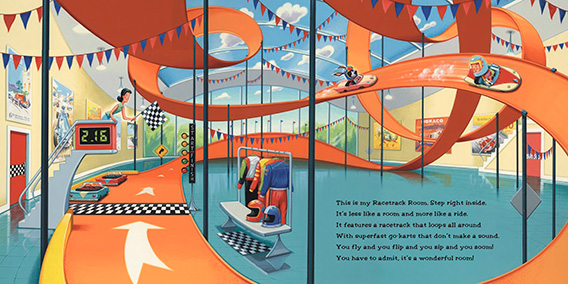
If you’ve ever wanted to explore outer space, Jack’s Flying Room is the place for you. With just a flip of the switch on the wall, you’re floating here and there, totally free. In Jack’s house you’d go from flying to racing in the Racetrack Room, which “features a racetrack that loops all around / with superfast go-karts that don’t make a sound.”

Are you more of a swimmer? Well, Jack’s thought of that too with a Fish Tank Room where you can snorkel and dive with turtles, stingrays, an octopus, and all sizes of fish. Tired of houses that just sit in one place? Then you’ll love the room that Jack’s left for last. “Literally speaking, this room is a BLAST! / “So welcome. Sit down, I’ll seal up the hatches. / This Plexiglass Playroom completely detaches!” Powered by jets, you can soar all around the neighborhood. For Jack, “this room is as good as it gets!”
celebrate-picture-books-picture-book-review-if-i-built-a-house-racetrack-room

Copyright Chris Van Dusen, 2012, courtesy of Dial Books for Young Readers.

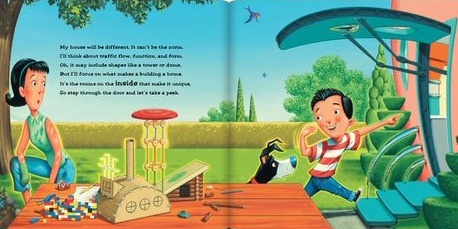
With all of these features and incredible rooms, Jack tells his mom, “My house will be nifty. My house will be neat. / My house will stand out as the best on the street.” Wistfully dreaming of his modern design, Jack says, “If I built a house, that’s just what I’d do.”

Chris Van Dusen knows how to tap into the mind of a child with all of its fantastic imaginings and anything-is-possible daring. Young readers will love seeing what Jack dreams up in his kid-perfect house that combines the best of features of their favorite playgrounds and attractions. Dusen’s sprightly verses pair uncommon words amid complex sentences, and the jaunty rhythm is a joy to read aloud.
celebrate-picture-books-picture-book-review-if-i-built-a-house-front-door

Copyright Chris Van Dusen, 2012, courtesy of Dial Books for Young Readers.

Dusen’s retro illustrations are bold and vibrant with plenty of cool and ingenious details in each room to fascinate kids. The snaking arms that busily cook in the kitchen, merry-go-round coffee table, replaceable wallpaper, and loop-de-loop racetrack offer the kinds of playful pandemonium that kids crave. If only all smart houses looked this cool.

Funny and imaginative, If I Built a House would be a lighthearted choice to inspire creativity at home or in the classroom.

Ages 3 – 7

Dial Books, 2012 | ISBN 978-0803737518

To learn more about Chris Van Dusen, his books, and his illustration work, visit his website.

Organize Your Home Day Activity
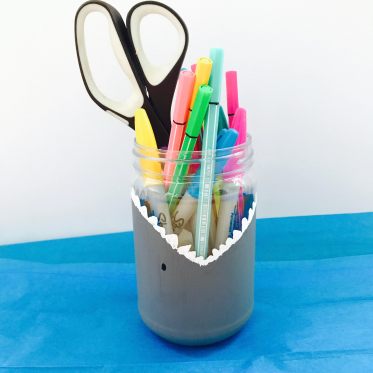
celebrate-picture-books-picture-book-review-shark-jar-craft

Shark Organizer Jar


Does your room need a little organizing? This fun Shark Organizer Jar will take a bite out the messiness and make your room look awesome too!

Supplies

  • Wide-mouth plastic jar, like a peanut-butter jar
  • Gray craft paint
  • White craft paint
  • Black craft paint
  • Paint brush

Directions

  1. Find a point in the middle of the jar on opposite sides of the jar
  2. Mid-way between these points on the other sides of the jar, find a point about 1 1/2 inches above the first points
  3. From the first point draw an angled line up to the higher point and down again to the lower point to make the shark’s upper jaw
  4. Repeat Direction Number 3 to make the shark’s lower jaw
  5. With the gray paint fill in the jar below these lines to make the shark’s head
  6. Along the jawline, paint jagged teeth with the white paint
  7. Add black dots for eyes on either side of the shark’s head
  8. Let dry

Picture Book Review

November 26 – It’s Historic Bridge Awareness Month

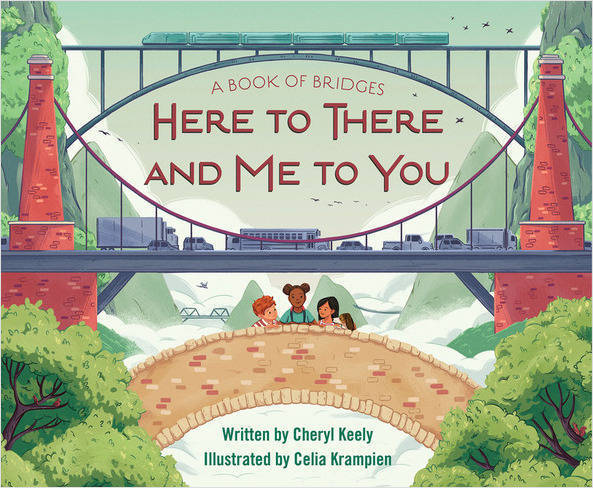
celebrate-picture-books-picture-book-review-a-book-of-bridges-here-to-there-and-me-to-you-cover

About the Holiday

This month we celebrate the bridges across the world who have stood the test of time as they connect roads, highways, and even walking paths over expanses of water or other gaps to convey travelers from one side to the other. Many old bridges are in danger of destruction through neglect or rebuilding. The founders of this month’s holiday ask that these structures be preserved for their beauty and history. There is another kind of bridge that also needs careful tending—as seen in today’s book! 

A Book of Bridges: Here to There and Me to You

Written by Cheryl Keely | Illustrated by Celia Krampien


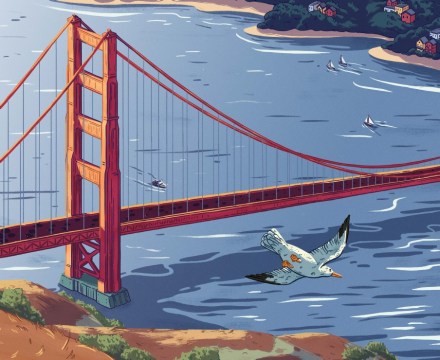
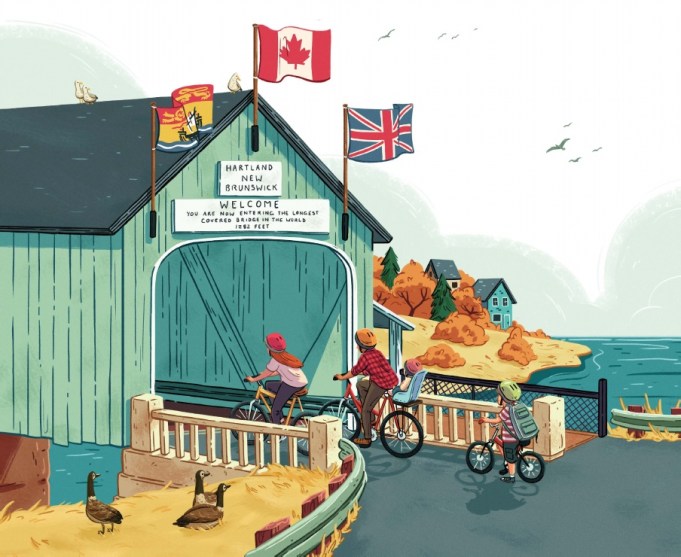
“Bridges do more than connect one place to another. They bring the whole world together.” There are so many types of bridges—each just right for their place or function. Some of the most charming bridges are wooden-covered, like Canada’s Hartland-to-Somerville span in New Brunswick, which is the longest covered bridge in the world at 1282 feet (as long as 32 school buses end to end). Some are colorful like the Golden Gate Bridge in San Francisco, California, which is distinctively orange, a beautiful beacon against the blue sky and sea.

celebrate-picture-books-picture-book-review-here-to-there-and-me-to-you-bridges-connect

Image copyright Celia Krampien, 2017, courtesy of sleepingbearpress.com

In London the bridge isn’t really falling down even though that makes for a fun game! The London Bridge, which crosses the River Thames, was the first stone multi-arch bridge built in Britain.” Over the years the bridge has been renovated many times, and it’s now made of concrete and steel. Drawbridges might be the coolest kind of bridge! It’s fun to watch them split in the middle and rise up, up, up before coming back down after a ship passes. These bridges “date to medieval times when knights in armor—and dragons?!—fought for their castles.”

celebrate-picture-books-picture-book-review-here-to-there-and-me-to-you-golden-gate-bridge

Image copyright Celia Krampien, 2017, courtesy of sleepingbearpress.com

Sometimes bridges don’t have to be fancy to work. Some “bridges can be as simple as a few stones placed across a shallow stream” that give crossers a place to step all along the way. This is known as a clapper bridge. People aren’t the only ones who use bridges either. Places that are home to roaming wildlife—like Banff National Park in Canada—build bridges so animals “such as bears, wolves, moose, and lynx” can cross roads and highways safely.

Trains can also “use bridges to clickity-clack along, carrying people to people. Family together again.” But what if you want to travel from country to country? There are even bridges for that, and they make “a big world seem smaller.” While these types of bridges are strong and sturdy, there are other spans made only of rope and boards that are “rickety, ratchety, swinging and swaying their way to beautiful hid away places.”

celebrate-picture-books-picture-book-review-here-to-there-and-me-to-you-covered-bridge

Image copyright Celia Krampien, 2017, courtesy of sleepingbearpress.com

People can become bridges too! Just try bending backward to touch the ground. Or if you don’t like feeling upside down, there is a simple way that “isn’t so grand. It connects me to you and you to me…through the simple holding of hands.”

Cheryl Keely’s enchanting tour of some of the world’s most beautiful and unusual bridges is sure to engage readers who love architecture, travel, and transportation—or who just have the wanderlust. Keely’s story, punctuated with facts and trivia about different types of bridges, is a lyrical frame for her theme of interconnectedness and friendship, making this a book that resonates on many levels and is a treat to dip into again and again.

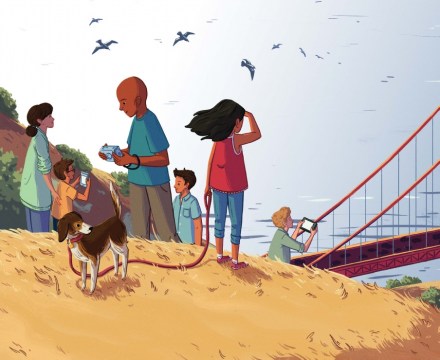
celebrate-picture-books-picture-book-review-here-to-there-and-me-to-you-edge-of-golden-gate-bridge

Image copyright Celia Krampien, 2017, courtesy of sleepingbearpress.com

Celia Krampien’s charming artwork takes readers to the towns and cities, the shores and cliffs that host the world’s bridges. Her realistic depictions show the grandeur of the majestic spans millions of people use every day as well as the rustic simplicity of rope and clapper bridges. Kids will love picking out details of the scenery surrounding each structure as well as recognizing familiar settings they have learned about or, perhaps, traveled to.

A Book of Bridges: Here to There and Me to You is a fresh, uplifting story that will appeal to fiction as well as nonfiction lovers. In addition to being a great addition to any story time, the book has many cross-curricular applications for classrooms and libraries, and would be a welcome find on any bookshelf.

Ages 5 – 8

Sleeping Bear Press, 2017 | ISBN 978-1585369966

To learn more about Cheryl Keely and her work as well as to find a fun bridge game, visit her website!

Find a portfolio of illustration by Celia Krampien on her website!

Historic Bridge Awareness Month Activity

celebrate-picture-books-picture-book-review-spaghetti-box-bridge-craft

Build a Remarkable Recycled Bridge


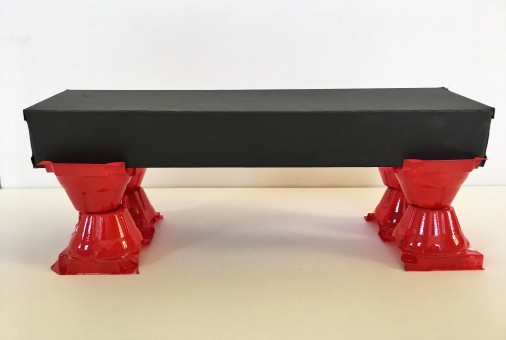
You don’t need fancy blocks and construction materials to build a bridge! Little ones will be fascinated to put together a bridge made out of items you already have at home or that may even be slated for the recycle bin. Spaghetti boxes make great roadways, and cut-up egg cartons can be used as supports.

Want to build a whole town? Cereal boxes and pasta boxes make skyscrapers, apartment buildings, fire stations, and more. Need a farm silo? Grab a peanut butter jar or aluminum can. You can use them as is or—if your kids are sticklers for a little more detail—add a little paint! So look around, use your imagination, and get creative!

Picture Book Review

November 4 – It’s Historic Bridge Awareness Month

celebrate-picture-books-picture-book-review-this-bridge-will-not-be-gray-cover

About the Holiday

Bridges can do so much more than just take vehicles and people over waterways or highways. Many are beautiful structures that enhance the skyline or environment in which they’re found. Covered bridges, stone bridges, and soaring steel and cable bridges all inspire awe in their own way. Unfortunately, many older bridges are slated for destruction or replacement. To honor this month’s holiday, visit a historic bridge in your area or research famous bridges of the past and present.

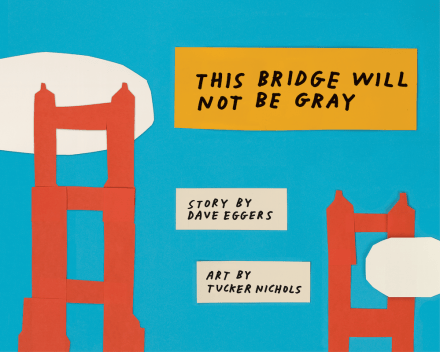
This Bridge Will Not Be Gray

Written by Dave Eggers | Illustrated by Tucker Nichols


“In the beginning there was a bridge.” Well, to back up a bit there was a bay that led to the Pacific Ocean. The opening between the two shores that enclosed the bay was called the Golden Gate. “On one side of the Golden Gate was the Presidio, a military base at the top of the city of San Francisco. On the other side there were only hills, green and yellow, rising high above the sea.” Beyond these hills towns dotted the coastline.

People traveled between these shores by boat or by driving way out of their way. Many times people had thought about building a bridge across the bay, but they were afraid it would ruin the beauty of the land. At last it was decided that a bridge should be built. The year was 1928 and Joseph Strauss, an expert on bridges, was hired to design it. What he came up with looked more like the skeleton of a roller coaster, and while it would be strong, it would also be ugly.

celebrate-picture-books-picture-book-review-this-bridge-will-not-be-gray-people

Image copyright Tucker Nichols, courtesy of mcsweeneys.net

People agreed that for such a beautiful spot, a beautiful bridge was needed. Joseph Strauss then asked for help in developing a plan for the bridge. Leon Moisseiff, known for designing the Manhattan Bridge in New York, came on board. Leon’s idea was for “a suspension bridge, one with swooping lines and tall towers.” The drawings were light and airy and…beautiful. People liked it very much.

“But still the bridge appeared a bit stern in style. So Joseph and Leon asked another person, named Irving Morrow, to help out.” Irving and his wife Gertrude had a different idea about what the bridge could be. With vertical fluting, “art deco flourishes,” pedestrian walkways, and curved lamps lighting the way, “the bridge could be both a bridge and something like art.”

Steelworkers in Maryland, Pennsylvania, and New Jersey built the pieces of the bridge. They were shipped to California by train and by boat. Finally, it was time to construct the bridge. Men had to dive deep into the icy waters of the Pacific Ocean and climb high into the sky while constructing it. It was estimated that it would take 4 years and thousands of workers to finish it.

celebrate-picture-books-picture-book-review-this-bridge-will-not-be-gray-irving-morrow

Image copyright Tucker Nichols, courtesy of mcsweeneys.net

First the tall towers were constructed. The day they were finished was one of “jubilation” and awe as“sometimes the things humans make baffle even the humans who make them. One aspect of the bridge that had not been decided was the color, and many people had opinions on that. “The Navy thought it should be yellow and black so that ships and planes could easily see it.”

“The Army wanted it to look like a candy cane for the same reason the Navy wanted it to look like a tiger with jaundice: so that it would be easily seen by planes and ships.” Most people, though, thought the bridge should be painted black, white, or gray like most other monuments, towers, and buildings. Right now, the bridge was orange—coated with a special anti-rust paint. As Irving Morrow watched the bridge go up, he thought this orange was a beautiful color.

He suggested that the bridge be allowed to stay this color. Others thought he was “nuts.” Never had there been an orange bridge before, “and for a good portion of the human race, because something has not already been, that is a good reason to fear it coming to be.” But the people of San Francisco began to see things Irving’s way. Still, gray seemed to be the safe choice.

celebrate-picture-books-picture-book-review-this-bridge-will-not-be-gray-people-talking

Image copyright Tucker Nichols, courtesy of mcsweeneys.net

Irving, who was usually a shy and quiet sort, began to get vocal about his color preference as the completion date of the bridge came closer. Other’s began to echo his thoughts and arguments. “This bridge will not be gray!” they said. At last “the powers that be” agreed with Irving. The bridge remained orange: International Orange, in fact.

But because the wind, rain, and sun are harsh on the orange bridge, it needs to be repainted every year. Every day some part of it is being painted by dedicated workers. Is that crazy? Maybe, “But people love to paint it, and people love to look at it. The Golden Gate Bridge, which is orange, is the best-known and best-loved bridge in the world” because it is “bold and courageous and unusual and even strange.”

celebrate-picture-books-picture-book-review-this-bridge-will-not-be-gray-golden-gate-bridge

Image copyright Tucker Nichols, courtesy of mcsweeneys.net

San Francisco resident Dave Eggers has written a loving tribute not only about the very distinctive Golden Gate Bridge but to the equally distinctive, quirky, and even courageous Irving Morrow, other architects, and people of the Bay area who saw and championed art where others may only have seen function. Passages of straightforward narration are joined by rivets of whimsically inserted dialogue, soaring description, and moving insight to construct a lyrical story of vision and inspiration that both kids and adults will find fascinating.  

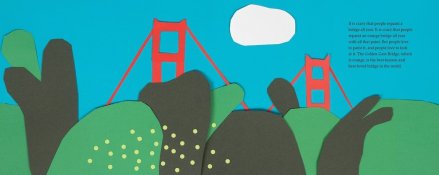
Tucker Nichols’ paper cut illustrations are as playful and full of imagination as a kindergarten classroom. Using simple shapes and a gorgeous palette Nichols crafts portraits, collages, and landscapes that are movingly effective in depicting the San Francisco Bay area, the rising Golden Gate Bridge, and the personalities involved in this fun history of a beloved monument.

This Bridge Will Not Be Gray is a must for school and public libraries, a wonderfully inspiring addition to children’s bookshelves, and a colorful coffee table book for any home.

Ages 4 – 10 and up

McSweeney’s, 2015 | ISBN 978-1940450476

Click here to learn more about Tucker Nichols and his work.

Historic Bridge Awareness Month Activity

celebrate-picture-books-picture-book-review-golden-gate-bridge-coloring-page

Golden Gate Bridge Coloring Page


Get out your markers, colored pencils, or crayons and color this printable Golden Gate Bridge Coloring Page!

Picture Book Review

August 29 – It’s American Artist Appreciation Month

celebrate-picture-books-picture-book-review-maya-lin-artist-architect-of-light-and-lines-cover

About the Holiday

This month we celebrate the artists who interpret the unique history, culture, and people of America in ways that bring new meaning and insight to those who interact with it. To celebrate, visit your local art museum or take a trip to another city to view pieces you’ve never seen before. The dynamics of seeing art up close provides new perspectives and appreciation.

Maya Lin: Artist-Architect of Light and Lines

Written by Jeanne Walker Harvey | Illustrated by Dow Phumiruk


As a child, Maya Lin loved playing and interacting with nature near her home. She and her brother liked to run over what Maya had named “the Lizard’s Back”—a hill behind her house—and into the woods. Sometimes Maya went into the woods alone and “sat as still as a statue, hoping to tame rabbits, raccoons, chipmunks, and squirrels.” She liked to play chess with her brother and build towns from scraps of paper, boxes, books, and other things she found around the house.

celebrate-picture-books-picture-book-review-maya-lin-artist-architect-of-light-and-lines-in-forest

Image copyright Dow Phumiruk, 2017, text copyright Jeanne Walker Harvey, 2017. Courtesy of us.macmillan.com.

Maya’s “parents had fled China at a time when people were told what to be and how to think.” They did not want the same for their children and always encouraged Maya to be and think what she wanted. Maya grew up surrounded by art. Her father worked with clay, and her mother was a poet. Maya also liked to make things with her hands. The beautiful library where she went to college inspired Maya to become an architect.

To learn about different buildings, Maya traveled all over the world. When she was only a senior in college, “Maya entered a contest to design a memorial to honor soldiers who died during the Vietnam War.” The contest stated two rules: the memorial had to fit in with a park-like setting, and it had to include the 58,000 names of the soldiers who had died in the war. These rules resonated with Maya. She “believed that a name brings back all the memories of a person, more than a photo of a moment in time.”

celebrate-picture-books-picture-book-review-maya-lin-artist-architect-of-light-and-lines-as-young-girl

Image copyright Dow Phumiruk, 2017, text copyright Jeanne Walker Harvey, 2017. Courtesy of us.macmillan.com.

Maya visited the site where the memorial would be built. As she looked at the gently rolling hill, she envisioned a simple cut in the earth that would support a polished wall covered in names. Not only would the wall reflect those who died, but also those who came to visit and the surrounding nature. At school, Maya worked with mashed potatoes and then with clay to help her create the perfect monument. When she had finished her drawings and plans, she wrote an essay to accompany them. She wrote that her monument would be “a place to be experienced by walking down, then up past names that seemed to go on forever.”

celebrate-picture-books-picture-book-review-maya-lin-artist-architect-of-light-and-lines-with-parents

Image copyright Dow Phumiruk, 2017, text copyright Jeanne Walker Harvey, 2017. Courtesy of us.macmillan.com.

More than 1,400 artists and architects—many of them famous—entered the contest. The designs were hung in an airplane hangar anonymously for judging. Finally, the day came for the announcement of the winner. When the judges called out Maya Lin’s name and she came forward, they were surprised to find that she was so young. Maya was excited to have won, but then some people began to object to her design. Some said her “design looked like a bat, a boomerang, a black gash of shame.”

celebrate-picture-books-picture-book-review-maya-lin-artist-architect-of-light-and-lines-library

Image copyright Dow Phumiruk, 2017, text copyright Jeanne Walker Harvey, 2017. Courtesy of us.macmillan.com.

Maya was hurt by these comments, but she defended her design and, finally, it was approved. Maya worked with the architects and engineers who excavated the land and built the wall. As each granite panel was polished, engraved with the soldiers’ names, and set in place, Maya looked on. The memorial opened on Veterans Day in 1982. Thousands of people came to see it and to find the names of loved ones they had lost. As Maya approached the wall, “she searched for the name of the father of a friend. When she touched the name, she cried, just as she knew others would.” Every day since then visitors come to the wall to remember.

Maya Lin has gone on to design many more works of art and architecture that can be seen inside and outside. Each piece has a name and a particular vision. Maya wants people to interact with her art—to touch it; read, walk, or sit near it; or think about it. After each piece is finished, Maya thinks about her next work and how she can inspire the people who will see it.

celebrate-picture-books-picture-book-review-maya-lin-artist-architect-of-light-and-lines-Vietnam-War-Memorial

Image copyright Dow Phumiruk, 2017, text copyright Jeanne Walker Harvey, 2017. Courtesy of us.macmillan.com.

An Author’s Note about Maya Lin and the Vietnam War Memorial follows the text.

Jeanne Walker Harvey has written an inspiring biography of Maya Lin that reveals not only her creativity but the importance of creative freedom for children. Lin’s confidence that led her to enter the contest and then defend her winning design will encourage readers to pursue their dreams. Harvey’s lyrical storytelling reflects Maya Lin’s quiet, introspective nature, the influences that nurtured her creative spirit, and her dedication to inviting others to be part of her art.

Dow Phumiruk’s graceful, soft-hued illustrations allow children to follow Maya Lin as she grows from a girl discovering nature, constructing cardboard cities, and learning the arts from her parents to a young woman who draws inspiration from the world’s buildings and relies on her own sensitivity to guide her. Back-to-back pages of the landscape of Vietnam and the site of the memorial connect the two places for children’s better understanding. Phumiruk’s depictions of the Vietnam War Memorial also give children an excellent view of this moving monument. Her images of Lin’s other architectural work will entice young readers to learn more about her and to explore where each of these pieces can be found.

Ages 4 – 8

Henry Holt & Company Books for Young Readers, 2017 | ISBN 978-1250112491

Discover more about Jeanne Walker Harvey and her books on her website!

Learn more about Dow Phumiruk, her art, and her books on her website!

American Artist Appreciation Month Activity

 celebrate-picture-books-picture-book-review-picture-frame

Fantastic Frame


Every great work of art deserves the perfect frame to display it. With a frame ready to decorate from a craft store and a few materials, you can create a Fantastic Frame for any of your drawings or photos!

Ideas for Decorating

  • Stickers
  • Decorative buttons
  • Small objects
  • Shells
  • Markers, crayons, or paint
  • Stencils
  • Washi Tape

Picture Book Review

March 25 – Earth Hour Day

picture-book-review-green-city-allan-drummond

About the Holiday

Earth Hour was organized by the World Wide Fund for Nature as a way to engage people in the discussion on climate change. First enacted in Australia in 2007, the observance has grown to include cities, businesses, corporations, and individuals world wide. For one hour – from 8:30 to 9:30 p.m. local time – participants will turn off all unnecessary lights in a show of solidarity and commitment to protecting our earth. Among the places going dark this year are the Empire State Building, the Space Needle, the Golden Gate Bridge, the Colosseum in Rome, the Pyramids of Egypt, the Sydney Opera House, and the Eiffel Tower.

Green City: How One Community Survived a Tornado and Rebuilt for a Sustainable Future

By Allan Drummond


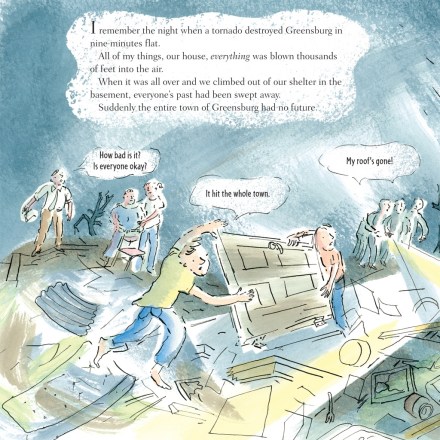
On May 4, 2007 a devastating tornado hit Greensburg, Kansas, destroying the town in 9 minutes. When the residents of the town climbed from their shelters, they emerged into a world completely changed. There were no more homes, no school, no hospital, no grocery store or other shops. No banks, theater, churches, or water tower. Even the trees had been shredded. Only three buildings remained.

celebrate-picture-books-picture-book-review-green-city-after-tornado

Image and text copyright Allan Drummond, courtesy of us.macmillan.com.

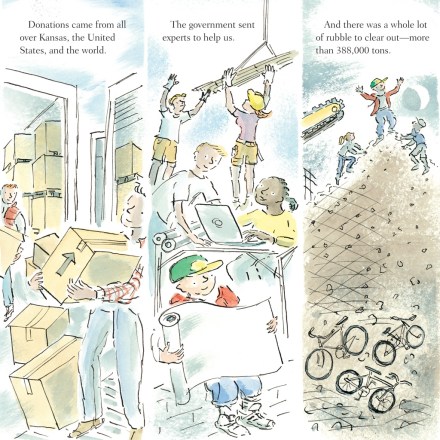
The citizens were urged to move away. Rebuilding would be impossible, some said, and what was the point anyway when the wind could destroy it all again? But others saw opportunity to construct a different kind of town. With the help of volunteers and donations from around the world, Greensburg began the Herculean task of designing and building a new town.

celebrate-picture-books-picture-book-review-green-city-rebuilding-starts

Image and text copyright Allan Drummond, courtesy of us.macmillan.com.

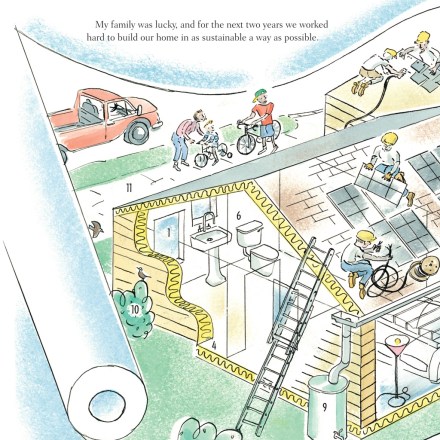
After clearing away 388,000 tons of debris and moving into a community of trailer homes, the people began to envision a unique, green town. Individuals designed sustainable houses of different shapes and materials that would work with the environment. Businesses, too, incorporated sustainability into their offices, retail centers, and hotels as did the hospital and the water tower. A wind farm large enough to provide energy for the entire town was built on the edge of this innovative city.

celebrate-picture-books-picture-book-review-green-city-one-house

Image and text copyright Allan Drummond, courtesy of us.macmillan.com.

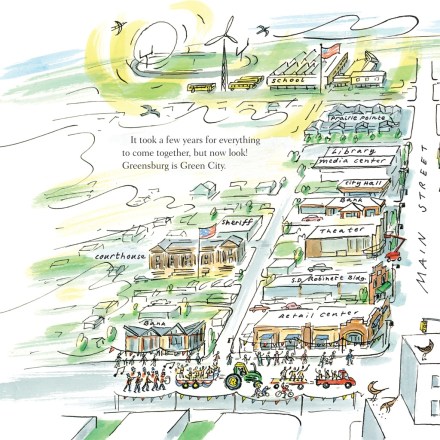
A new school was central to the town’s survival, and for three years the teachers held class in small trailers. Along with their regular studies, the kids became experts in environmental science. After several years Greenburg became a thriving city—a testament to conservation and sustainability that remains an example for global communities now and in the future.

celebrate-picture-books-picture-book-review-green-city-Greensburg-now

Image and text copyright Allan Drummond, courtesy of us.macmillan.com.

Allan Drummond tells this fascinating story of a community that would not give up in an honest and sensitive way that highlights the courage and pride of a town amid devastating loss. Told from a child’s point of view, the story has extra impact for readers who are growing up amid an era of environmental awareness and activism. The sustainable construction of homes and other buildings is effectively explained and clearly depicted in Drummond’s colorful illustrations.

The images also demonstrate the process of negotiation and cooperation among townspeople that went into designing and building a new Greensburg. The final two-page spread of the town’s layout will interest kids as well as adults who have followed this story in the news.

Ages 5 – 9

Farrar, Straus and Giroux, 2016 | ISBN 978-0374379995

Discover more about Allan Drummond, his illustration work and his books on his website!

Earth Hour Activity

celebrate-picture-books-picture-book-review-flashlight-clip-art

Flashlight On, Flashlight Off Game


It’s fun to play games in the dark! During Earth Hour flip off your lamps and overhead lights and play this game that challenges your memory while you think about our planet! This game can be played with two or more players.

Supplies

  • Flashlight 
  • 6 – 12 small objects (the number of objects can be adjusted depending on the ages of the players)
  • A table or floor area large enough to lay out the objects

Directions

With the Flashlight On:

  1. Lay out the objects on a table or on the floor
  2. Give all the players time to look at the objects and try to memorize them
  3. Choose one player to remove one of the objects

With the Flashlight Off

  1. Turn off the flashlight
  2. While the room is dark, the designated player removes one object from the rest
  3. Turn the flashlight back on

With the Flashlight Back On

  1. The other players try to figure out which object is missing

Variations

  • In addition to removing one object, the other objects can be moved around to different positions
  • Remove more than one object at a time
  • Add an object instead of removing one

Picture Book Review


February 24 – National Engineering Week

celebrate-picture-books-picture-book-review-tinyville-town-gets-to-work-cover

About the Holiday

National Engineering Week was established to promote a better understanding of and appreciation for engineering and technical careers to ensure a diverse and well-educated workforce for the future. Several programs throughout the week highlight communication between engineers and the public, the work of young professional and student engineers, and a future-city contest for middle school students. Our future depends on our having talented engineers to solve problems and create new solutions.

Tinyville Town Gets to Work!

By Brian Biggs


It seems there’s trouble in Tinyville Town! Every day the baker creates delicious treats, the trash collectors pick up trash, the bus driver takes riders to their various jobs, and everyone else goes to work and school or runs errands. But today the bus is late, and when Mayor Murphy tries to find out why, he also discovers that the trash collectors can’t haul the trash away and the bakery can’t open it’s doors. Why? Because there’s an enormous traffic jam on the Tinyville Town bridge.

celebrate-picture-books-picture-book-review-tinyville-town-gets-to-work-town

Image and text copyright Brian Biggs, courtesy of Harry N. Abrams

“‘We need a new bridge!’” the townspeople shout. “Mayor Murphy knows just what to do. He meets with Tinyville Town’s engineer and city planner.” The engineer tells the mayor that “‘the old bridge was built when Tinyville Town was much smaller.” Now they need “‘a bridge that is wider so that more cars, trucks, and buses can get across.’” The city planner agrees and adds that the bridge should be stronger.He also assures the mayor that they can also make it beautiful by adding large steel arches.

celebrate-picture-books-picture-book-review-tinyville-town-gets-to-work-mayor-alerts-the-media

Image and text copyright Brian Biggs, courtesy of Harry N. Abrams

Mayor Murphy announces the plan to the news media and invites the citizens to “get to work!” First the excavation crew digs deep holes near the banks of the river so a strong foundation can be laid for the piers. Then a crane operator lifts heavy stones so the stonemasons can put them into place on the piers. Next it’s time for the ironworkers to join in. They build the structure and the big steel arches that “look beautiful and make the bridge much stronger than the old one.” Finally, the road crew paves the road and paints lines to mark the lanes for the cars, trucks, and buses that will drive over it.

When the bridge is finished everyone in Tinyville Town comes out to watch Mayor Murphy cut the ribbon and open the bridge. “‘Hurray!’” they all cheer as they cross over their shiny new bridge.

celebrate-picture-books-picture-book-review-tinyville-town-gets-to-work-finished-bridge

Image and text copyright Brian Biggs, courtesy of Harry N. Abrams

Little would-be engineers and builders as well as any town or city citizens will be captivated by Brian Biggs’ introduction to the inner workings of a town in need of a new bridge. With infrastructure and road work going on in most towns and cities throughout the year, Biggs’ accessible story is a perfect way to explain to youngest readers the whys and hows of the construction work they see as they travel from place to place. The diversity of workers provides welcome inclusiveness and role models for children. The upbeat philosophy of this little town is even reflected in the book’s title, in which the phrase “Gets to Work” can be read two ways.

Biggs’ friendly town on the banks of a river is homey and cute and immediately inviting to his young audience. With bright colors, crisp details, and smiling people, Tinyville Town is a place kids will want to visit again and again. Tinyville Town Gets to Work is one of three in this new series that also includes Tinyville Town: I’m a Veterinarian and Tinyville Town: I’m a Firefighter.

Ages 2 – 5

Harry N. Abrams, 2016 | ISBN 978-1419721335

You’ll find a world of books, drawings, comics, and more on Brian Biggs’ website!

Visit Tinyville Town with this Tinyville Town Gets to Work book trailer!

National Engineering Week Activity

celebrate-picture-books-picture-book-review-spaghetti-box-bridge-craft

Build a Remarkable Recycled Bridge


You don’t need fancy blocks and construction materials to build a bridge! Little ones will be fascinated to put together a bridge made out of items you already have at home or that may even be slated for the recycle bin. Spaghetti boxes make great roadways, and cut-up egg cartons can be used as supports. Want to build a whole town? Cereal boxes and pasta boxes make skyscrapers, apartment buildings, fire stations, and more. Need a farm silo? Grab a peanut butter jar or aluminum can. You can use them as is or—if your kids are sticklers for a little more detail—add a little paint! So look around, use your imagination, and get creative!

Picture Book Review

October 15 -Bridge Day

celebrate-picture-books-picture-book-review-this-bridge-will-not-be-gray-cover

About the Holiday

Today’s holiday hosts the largest formalized jumping event in the world and celebrates BASE jumpers, those intrepid souls who test their mettle against the highest points, including buildings, antennas, cliffs, and bridges. Recognized since 1980 Bridge Day is a world-wide event, and while it may not officially be about the bridges, it brings attention to these beautiful architectural marvels while extreme sports aficionados and their fans gather on spans across the globe to have fun.

This Bridge Will Not Be Gray

Written by Dave Eggers | Illustrated by Tucker Nichols


“In the beginning there was a bridge.” Well, to back up a bit there was a bay that led to the Pacific Ocean. The opening between the two shores that enclosed the bay was called the Golden Gate. “On one side of the Golden Gate was the Presidio, a military base at the top of the city of San Francisco. On the other side there were only hills, green and yellow, rising high above the sea.” Beyond these hills towns dotted the coastline.

People traveled between these shores by boat or by driving way out of their way. Many times people had thought about building a bridge across the bay, but they were afraid it would ruin the beauty of the land. At last it was decided that a bridge should be built. The year was 1928 and Joseph Strauss, an expert on bridges, was hired to design it. What he came up with looked more like the skeleton of a roller coaster, and while it would be strong, it would also be ugly.

celebrate-picture-books-picture-book-review-this-bridge-will-not-be-gray-people

Image copyright Tucker Nichols, courtesy of mcsweeneys.net

People agreed that for such a beautiful spot, a beautiful bridge was needed. Joseph Strauss then asked for help in developing a plan for the bridge. Leon Moisseiff, known for designing the Manhattan Bridge in New York, came on board. Leon’s idea was for “a suspension bridge, one with swooping lines and tall towers.” The drawings were light and airy and…beautiful. People liked it very much.

“But still the bridge appeared a bit stern in style. So Joseph and Leon asked another person, named Irving Morrow, to help out.” Irving and his wife Gertrude had a different idea about what the bridge could be. With vertical fluting, “art deco flourishes,” pedestrian walkways, and curved lamps lighting the way, “the bridge could be both a bridge and something like art.”

Steelworkers in Maryland, Pennsylvania, and New Jersey built the pieces of the bridge. They were shipped to California by train and by boat. Finally, it was time to construct the bridge. Men had to dive deep into the icy waters of the Pacific Ocean and climb high into the sky while constructing it. It was estimated that it would take 4 years and thousands of workers to finish it.

celebrate-picture-books-picture-book-review-this-bridge-will-not-be-gray-irving-morrow

Image copyright Tucker Nichols, courtesy of mcsweeneys.net

First the tall towers were constructed. The day they were finished was one of “jubilation” and awe as“sometimes the things humans make baffle even the humans who make them. One aspect of the bridge that had not been decided was the color, and many people had opinions on that. “The Navy thought it should be yellow and black so that ships and planes could easily see it.”

“The Army wanted it to look like a candy cane for the same reason the Navy wanted it to look like a tiger with jaundice: so that it would be easily seen by planes and ships.” Most people, though, thought the bridge should be painted black, white, or gray like most other monuments, towers, and buildings. Right now, the bridge was orange—coated with a special anti-rust paint. As Irving Morrow watched the bridge go up, he thought this orange was a beautiful color.

He suggested that the bridge be allowed to stay this color. Others thought he was “nuts.” Never had there been an orange bridge before, “and for a good portion of the human race, because something has not already been, that is a good reason to fear it coming to be.” But the people of San Francisco began to see things Irving’s way. Still, gray seemed to be the safe choice.

celebrate-picture-books-picture-book-review-this-bridge-will-not-be-gray-people-talking

Image copyright Tucker Nichols, courtesy of mcsweeneys.net

Irving, who was usually a shy and quiet sort, began to get vocal about his color preference as the completion date of the bridge came closer. Other’s began to echo his thoughts and arguments. “This bridge will not be gray!” they said. At last “the powers that be” agreed with Irving. The bridge remained orange: International Orange, in fact.

But because the wind, rain, and sun are harsh on the orange bridge, it needs to be repainted every year. Every day some part of it is being painted by dedicated workers. Is that crazy? Maybe, “But people love to paint it, and people love to look at it. The Golden Gate Bridge, which is orange, is the best-known and best-loved bridge in the world” because it is “bold and courageous and unusual and even strange.”

celebrate-picture-books-picture-book-review-this-bridge-will-not-be-gray-golden-gate-bridge

Image copyright Tucker Nichols, courtesy of mcsweeneys.net

San Francisco resident Dave Eggers has written a loving tribute not only about the very distinctive Golden Gate Bridge but to the equally distinctive, quirky, and even courageous Irving Morrow, other architects, and people of the Bay area who saw and championed art where others may only have seen function. Passages of straightforward narration are joined by rivets of whimsically inserted dialogue, soaring description, and moving insight to construct a lyrical story of vision and inspiration that both kids and adults will find fascinating.  

Tucker Nichols’ paper cut illustrations are as playful and full of imagination as a kindergarten classroom. Using simple shapes and a gorgeous palette Nichols crafts portraits, collages, and landscapes that are movingly effective in depicting the San Francisco Bay area, the rising Golden Gate Bridge, and the personalities involved in this fun history of a beloved monument.

This Bridge Will Not Be Gray is a must for school and public libraries, a wonderfully inspiring addition to children’s bookshelves, and a colorful coffee table book for any home.

Ages 4 – 10 and up

McSweeney’s, 2015 | ISBN 978-1940450476

Click here to learn more about Tucker Nichols and his work.

Bridge Day Activity

celebrate-picture-books-picture-book-review-golden-gate-bridge-coloring-page

Golden Gate Bridge Coloring Page


Get out your markers, colored pencils, or crayons and color this printable Golden Gate Bridge Coloring Page!

Picture Book Review