February 16 – Innovation Day

CPB - Girls Think of Everything Innovation Day

About the Holiday

Today we celebrate all those people who look at a problem and design a solution, or who just ask, “What if…?” and search for answers. So put on your thinking cap, look around you, and do something new, novel, and completely unexpected. Who knows…you may be the next great inventor!

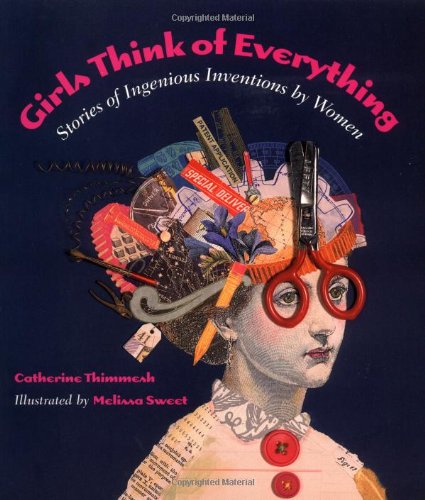
Girls Think of Everything: Stories of Ingenious Inventions by Women

Written by Catherine Thimmesh | Illustrated by Melissa Sweet


Throughout history women have invented new and clever ways of doing things—necessity is the Mother of invention, after all. In her fascinating picture book, Catherine Thimmesh highlights ten women and two girls whose creativity has changed the world.

Here, you’ll learn the intriguing stories behind each invention, the struggles for recognition, and the ultimate victory of innovation. Did you know that the original recipe for chocolate chip cookies was just a time-saver? Or that people once thought windshield wipers weren’t necessary? You’ll also discover how liquid paper, flat-bottomed paper bags, and the Glo-sheet came to be. Women in science have contributed Kevlar, Scotchgard, the COBOL computer language, and the space shields that protect the International Space Station, satellites, and more.

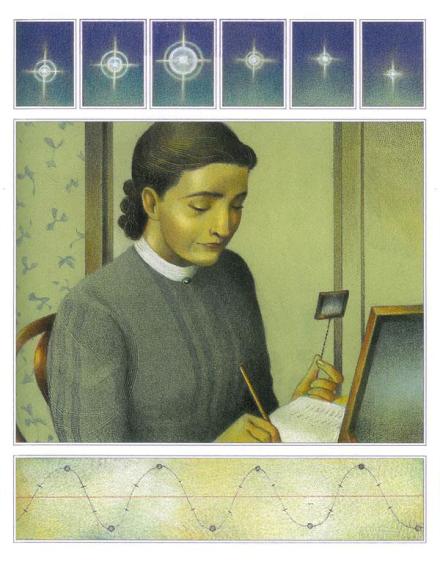
Catherine Thimmesh is an excellent storyteller, drawing you into the actions and minds of these women innovators and the situations or environments that fostered their talents. Melissa Sweet accompanies each profile with portraits of the inventor and colorful collage illustrations that build on the text and tell stories of their own.

Ages 7 – 12

Houghton Mifflin Company, Boston, 2000 | ISBN 978-0618195633

Innovation Day Activity

CPB - Invention Word Scramble

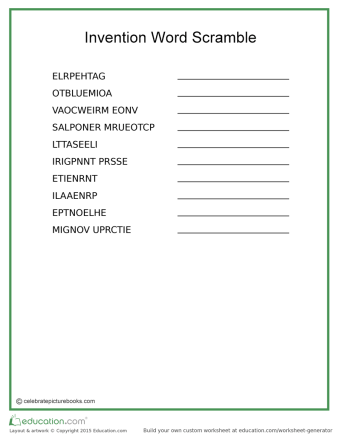
Invention Word Scramble


Every invention started out as a jumble of ideas in someone’s head. In this Invention Word Scramble you can unscramble the letters of some of the world’s greatest creations. Solutionincluded. Odog cklu!


February 15 – Susan B. Anthony Day

celebrate=picture-books-picture-book-review-heart-on-fire-cover

About the Holiday

On February 15, 1820 in Adams, Massachusetts a girl was born who would grow up to set the world afire with her belief in women’s rights. Her name was Susan Brownell Anthony. An early feminist, her father believed it was as important for his five daughters to receive an education as for his two sons. After graduating from school, Susan Anthony became a teacher—at the age of 14—making $2.50 a week compared to the $10.00-per-week salary of the male teachers. Anthony later became active in the abolition and temperance movements. She recognized that the inability to vote limited women’s influence in these causes and began promoting women’s rights. She worked tirelessly to change the voting laws until her death on March 13, 1906 without seeing her greatest wish fulfilled. It was not until 1920, with the ratification of the 19th Amendment, that women were allowed to vote.

Susan B. Anthony has been honored for her dedication with commemorative stamps, and her portrait appears on the dollar coin. We also remember her work on behalf of all women on her birthday with memorial services at her gravesite in Rochester, NY and in Washington DC. Susan B. Anthony Day is a legal holiday in Florida, West Virginia, Wisconsin, New York and California.

Heart on Fire: Susan B. Anthony Votes for President

Written by Ann Malaspina | Illustrated by Steve James


It’s November 1, 1872 and only four days until the presidential election. Everywhere people are being urged to register to vote. Knowing how important voting is, Susan B. Anthony races to the registration office with her sister and a friend in tow. The men in the office stare at her in confusion.

They know that women can’t vote—only men! What is Susan B. Anthony trying to do? But Anthony argues that the new 14thAmendment, which says “all persons born in the United States have the same rights as citizens,” gives women the right to vote. Some inspectors think she is right, some disagree. Finally they allow Anthony to sign the registration card.

celebrate=picture-books-picture-book-review-heart-on-fire-susan-goes-to-vote

Image copyright Steve James, courtesy of Albert Whitman & Company

On November 5, Voting Day, Anthony and 15 other women cast their ballots. Thirteen days later, however, a deputy federal marshal shows up at Anthony’s door with a warrant for her arrest. The charges? Voting illegally! The other women and the men who had allowed them to register and vote are also arrested.

In January word comes that unless Anthony pays a $1,000 fine, she will have to spend the time until her trial in prison. Anthony is adamant about not paying, but her lawyer sends the money. People in the country are split over whether she is right or not, but Anthony knows she’s right. Without being able to vote, women will have no voice in government.

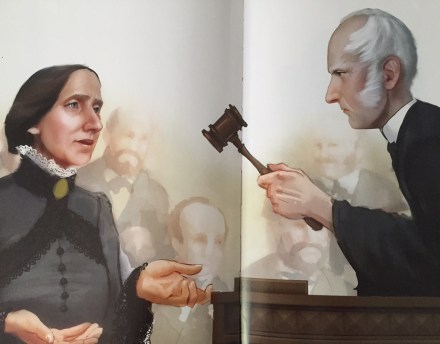
She gives speeches, trying to rally people to her cause, and when her trial begins on June 17, 1873 the courtroom is packed. After Anthony’s lawyer and the prosecutor speak, the judge decides that Anthony has broken the law. He proclaims her guilty. When the judge asks if she has anything to say, Anthony answers, “You have trampled under foot every vital principle of our government. My natural rights, civil rights, political rights….” The judge stops her and does not allow her to continue speaking. He fines her $100, plus court costs. Susan B. Anthony refuses to pay, and she never did.

celebrate=picture-books-picture-book-review-heart-on-fire-susan-pleads-case

Image copyright Steve James, courtesy of Albert Whitman & Company

Through action, dialogue, and the metaphorical theme of fire, Ann Malaspina has written an exciting biography of Susan B. Anthony. Readers will understand and, more importantly, feel the opinions and determination that fueled Anthony’s crusade for women’s rights. The final pages follow the history of the women’s suffrage movement until the ratification of the 19th Amendment in 1920 and provide photographs from the time. The text of the 14th and 19th Amendments is also included.

Opening the pages of Heart on Fire is like walking into a city of the 1800s. The lush colors and intricate details of Steve James’ illustrations immediately immerse readers in the time and place of Susan B. Anthony’s world, depicting the reality of her struggles. This is a perfect book to share with children, especially in this election year when they can see how far women have come—from being denied the vote to running for president.

Ages 5 – 9

Albert Whitman & Company, Chicago, 2012 | ISBN 978-0807531884

Learn more about Ann Malaspina and her books on her website!

View a gallery of illustration by Steve James on his website!

Susan B. Anthony Day Activity

CPB - Vote For Me round (2)

Vote For Me! Campaign Poster and Frame


If you were running for President, what would be important to you? Here’s a Vote For Me! Poster and Picture Frame to get your campaign started!

Supplies

Directions

  1. Print Vote For Me! Poster and Picture Frame templates
  2. Take a selfie or use your school picture
  3. Cut out the Picture Frame and the circle or rectangle in the middle
  4. Tape or glue your picture in the circle or rectangle
  5. If you are using a clear magnetic frame, slip the template inside and hang on your refrigerator or any metal object.
  6. If you are using a magnetic sheet, peel the paper off the adhesive side. Stick the Vote For Me! Picture Frame template with your picture attached to the adhesive. Cut around the edges. Hang!
  7. On the Vote For Me! Poster, list the things you would do if you were President. Talk to your family and see if you might be able to do some of them now! Hang your poster in your room or in the house where others can see it.

February 14 – Frederick Douglass Day

CPB - Words Set Me Free

About the Holiday

Although the exact date is not known, history records Frederick Douglass’ birthday as around Valentine’s Day in 1818, so February 14 was chosen to honor this most unique and influential man. Born into slavery, Frederick Bailey (he later changed his last name to Douglass) learned how to read and write when still a child. As a young man he used his intellect and courage to secure his freedom. He became a compelling speaker, writer, leader of the abolition movement, and statesman. His writings, especially his autobiography Narrative of the Life of Frederick Douglass, an American Slave, are among the most powerful accounts of the slave experience and are still widely read today.

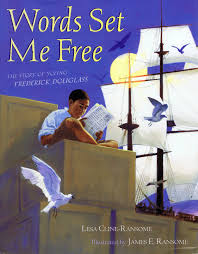
Words Set Me Free

Written by Lesa Cline-Ransome | Illustrated by James E. Ransome


Born into slavery and separated from his mother in infancy, Frederick Bailey is raised by his Grandmama while his mother works on a separate plantation. When she is able Harriet Bailey walks the 12 miles between plantations to spend a few short hours with her son, watching him sleep, before making the long journey back. While Frederick is still a very young child, his mother falls ill and dies. Douglass recalls never seeing his mother’s face in daylight.

At the age of six, Frederick is moved from his Grandmama’s cabin to the plantation house. At eight, he is sent to the master’s brother in Baltimore, Maryland. Here, the master’s wife, Sophia Auld, treats Frederick more like a paid servant then as a slave. When Frederick says he wants to learn how to read and write, she immediately begins teaching him the alphabet. Frederick is always mindful, however, that he may be punished for these lessons, and he has only memorized the letters and a few words before his master puts an end to his education. Angrily, the master explains to his wife, “If you teach him how to read…it would forever unfit him to be a slave.”

These words are perhaps Frederick’s greatest lesson. He never forgets them, and they fuel his resolve to pursue an education. He makes clever use of the few resources he has and slowly learns to read and write. From the newspapers he discovers that the North offers freedom, and Frederick decides to escape. It’s many long years, however, before he can fulfill his dreams. At last, he sees an opportunity to leave the South behind, and using his talent for writing makes his escape a reality.

Lesa Cline-Ransome has written a compelling biography of Frederick Douglass for children in Words Set Me Free. In straightforward language and through first-person point of view, Cline-Ransome reveals the brutal truth of Douglass’s life as a slave and his fight against injustice. As the title suggests, the book focuses on Frederick’s desire to become educated and the obstacles he overcame to succeed. This universally important message continues the work Douglass engaged in long ago.

James Ransome’s stirring paintings highlight pivotal scenes of Frederick’s story. Readers witness the tender moments with his mother, the cruel contrast of slavery and his blossoming intellect, and Frederick’s growing resolve to educate himself and escape.

Ages 5 and up                                                                                                            

Simon & Schuster, New York, 2012 | ISBN 978-1416959038

Frederick Douglass Day Activity

CPB - Words Set Me Free word search

Words Set Me Free word search


Words were so important to Frederick Douglass that he risked everything to learn how to read and write. In this printable Words Set Me Free Word Search Puzzle you will find words about the man we honor today. Solution

February 12 – Abraham Lincoln’s Birthday

CPB - I am Abraham Lincoln

About the Holiday

Today we celebrate Abraham Lincoln’s birthday! Abe Lincoln was born in a one-room log cabin in Kentucky and later worked as a riverboat worker, a shopkeeper, and a postmaster in Illinois before becoming the 16th President of the United States. With compassion, bravery, and strength, Lincoln shepherded the country through the Civil War and signed the 13th Amendment to the Constitution outlawing slavery in the United States. Lincoln’s birthday is commemorated with wreath-laying ceremonies at his birthplace and at the Lincoln Memorial in Washington D.C.

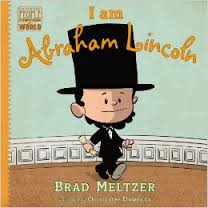
I am Abraham Lincoln

Written by Brad Meltzer / Illustrated by Christopher Eliopoulos


In his I am… series of biographies, Brad Meltzer writes about famous people as they grow from childhood into the influential adults they became. In I am Abraham Lincoln, Meltzer illuminates various experiences of Lincoln’s life that formed his beliefs of equality and inclusiveness. At a time when most children liked to hunt, fish, and tend the farm, young Abe spent his time reading, and he was one of the few people in town who could write. Even at the age of 10, his compassion showed when he stopped a group of his peers from treating a turtle roughly. Later, as a young man and newcomer to Illinois, he faced a group of bullies and dispersed them without throwing a punch.

It was when he witnessed the indignities of a slave boat, however, that his most deeply held beliefs took hold. As President, Lincoln acted on those beliefs, helping the country through the Civil War, gave speeches, and signing laws that ensured all people would be treated equally.

By relating stories from Abraham Lincoln’s childhood, Meltzer not only teaches children about his life, but demonstrates that his young readers can also make a difference by speaking up and helping others whenever they see injustice.

Christopher Eliopoulos’s cartoon-like illustrations are particularly effective in showing the earnestness of Abraham Lincoln’s personality from early childhood on. Speech bubbles display dialogue, modeling the simple words that can so often create great change. Part of the book’s charm is that even as a child Lincoln sports his iconic beard and top hat, making him instantly recognizable as the hero children are familiar with and emphasizing the “man in the child” theme.

Ages 4 – 8

Dial Books for Young Readers, Penguin Group, New York, 2014 | ISBN 978-0803740839

Abraham Lincoln’s Birthday Activities

CPB - Abe Lincoln's Top Hat chalkboard (2)

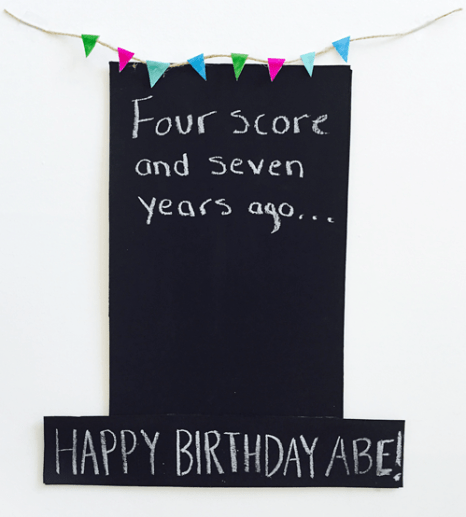
Abe Lincoln’s Top Hat Chalkboard

Abraham Lincoln was known for the black top hat he wore – and for his inspiring words In this activity you can learn how to make a top hat chalkboard to use for your own drawings or inspiring words!

Supplies

  • Cereal Box (I used a large sized cereal box), cardboard or poster board
  • Chalkboard Paint (black)
  • Paint brush
  • Hot Glue Gun or extra-strength glue
  • Removable mounting squares
  • Chalk

Directions

  1. If you are using cardboard or poster board: cut a rectangle at least 8 inches wide by 12 inches long for the hat and 12 inches long by 2 inches wide for the brim (but your top hat can be any size you’d like!)
  2. If you are using a Cereal Box: open the seams of the Cereal Box
  3. Cut the panels of the cereal box apart
  4. Take one face panel and one side panel
  5. With the chalkboard paint, paint both panels
  6. Let the panels dry
  7. Attach the side panel to the bottom of the face panel to create the shape of Lincoln’s top hat
  8. Hang Abe Lincoln’s Top Hat Chalkboard 

Donate to a Food Bank

Today can be a day to remember the hardships that many people still endure. Many still live with hunger every day. Today, gather a bag of non-perishable foods and donate them to your local food bank. This activity can also be done by a group—a classroom, scout troop, youth group, or group of friends. Even a little bit helps a lot!


February 6 – Lace Day

celebrate-picture-books-picture-book-review-fionas-lace-cover

About the Holiday

Lace, that delicate material that trims clothing, covers tables, ties up hair, and makes anything seem more dainty and lovely, has been used since the 1500s. When you look at the intricate patterns and fine threads of lace, it’s hard to believe that people once made it all by hand. Lace makers were paid well for their art by the fashion industry, which used it to attract distinguished customers. While lace is mostly made by machines now, the handcraft is making a comeback. Today’s reviewed picture book is about a girl whose lace work was invaluable.

Fiona’s Lace

By Patricia Polacco


In Fiona’s Lace author-illustrator Patricia Polacco weaves a tale of family love and America’s early immigrant heritage that is as intricate and lovely as the material we celebrate today. The story begins in Ireland, where Fiona and her sister Ailish live with their muther and da. They live happily in Glen Kerry, where their father works in the textile mill and their mother teaches Fiona her art of lace making.

celebrate-picture-books-picture-book-review-fiona's-lace-ma-teaches-lacemaking

Copyright Patricia Polacco, courtesy of simonandschuster.com

In the evenings the girls are entertained by family stories, especially their favorite about how, when their parents first met, their mother left a trail of lace from the factory to her house for her young suitor to follow.

When the textile mill closes, Fiona’s family signs a contract indenturing themselves to a family in Chicago. The voyage to America is long and arduous, but when they arrive in Chicago they marvel at the grand houses and elegant clothes, imagining that this awaits them too in their new home. The reality, however, is much different. Their 2-room apartment is ramshackle, and only by working two jobs can their parents make enough money to live on.

celebrate-picture-books-picture-book-review-fiona's-lace-fiona-gets-job

Copyright Patricia Polacco, courtesy of simonandschuster.com

Fiona wants to help and soon finds that dressmakers will pay handsomely for the lace she makes. The family’s money tin begins to fill up and they are prospering. One night while Muther and Da are away working, a fire rages through Chicago. Fiona and Ailish escape with only the money tin and Fiona’s lace. They run far from home, but worry—how will their parents find them?

Remembering their favorite story, Fiona cuts her lace into strips and ties bits of it along their route to their hiding place. The girls cower in fear until they hear the familiar voices of their parents. Happily reunited, the family lets go of what they have lost, but Ailish cries over the now sooty, torn lace. Ma reassures her and brings comfort, revealing that far from being ruined, this scorched lace is the most valuable and cherished of all because it saved the family.

celebrate-picture-books-picture-book-review-fiona's-lace-trail-of-lace-story

Copyright Patricia Polacco, courtesy of simonandschuster.com

Patricia Polacco’s heartwarming and harrowing story of an Irish immigrant family is a beautiful reminder of the unique talents and strong bonds that built America. Readers will be enthralled by Polacco’s realistic dialogue and detailed storytelling in this compelling and suspenseful tale and will cheer as Ailish cleverly uses her ma and pa’s trick and her own skills to save her family.

Polacco’s gorgeous illustrations bring the time period alive for young readers, portraying the intricate art of lacemaking and the clothing styles that made use of this delicate trimming. Her depictions of tenement living are realistic, yet reveal the love and close family ties within through a warm color palette and the inclusion of cozy comforts brought from Ireland.

Fiona’s Lace is a wonderful book for classroom and home story times.

Ages: 4 – 8

Simon & Schuster, New York 2014 | ISBN 978-1442487246

Discover more about Patricia Polacco and her many, many books on her website!

Lace Day Activity

Hide-and-Seek Game

While Fiona and her sister used a lace trail to lead their parents to their hiding place, you can have fun making a hide-and-seek game for your friends. This game can be played inside or outside

Supplies

  • 1 or 2 yards of lace, cut into sections about 6-inches each. You can use lace to celebrate Lace Day or use string, ribbon, or other kinds of material
  • Choose something to hide – this can be a toy, a secret letter, a snack, or anything

Directions

  1. Hide the item you choose in a secret place
  2. Determine the starting place for your hide-and-seek game
  3. Along the route from the starting point to the hidden item, tie the sections of lace onto things like lamps, furniture, stair banisters, door knobs, etc. if  you’re playing inside. If you are playing outside, tie it onto trees, bushes, bird feeders, swing sets, etc.
  4. For very young children the trail of lace can be straightforward; for older children the trail can be longer and more difficult

February 2 – Sled Dog Day

celebrate-picture-books-picture-book-review-akiak-a-take-from-the-iditarod-cover

About the Holiday

On this day we honor the sled dogs who have bravely risked their lives to help human beings survive and flourish in some of the harshest landscapes from our earliest history. One of these memorable times occurred in 1925 when a diphtheria epidemic swept through Nome, Alaska. The only anti-toxin that could help was in Anchorage—more than 900 miles away! The weather was horrific and the only way for the serum to reach the ailing population in time was by dog sled. Through incredible bravery, strength, and perseverance, a relay of dog-sled teams completed the run and delivered the serum.

Today’s Iditarod honors this heroic effort. While this picture book review revolves around the Iditarod, if you would like to read about the serum run and a brave sled dog that made the success of the project possible, I highly recommend another picture book by Robert Blake: Togo.

Akiak: A Tale from the Iditarod

Written and Illustrated by  Robert J. Blake

The annual Iditarod is the setting for this dramatic outdoor adventure that pits mushers and their sled dogs against the harshest climate and each other. Akiak is a veteran of this grueling race from Anchorage to Nome, Alaska. She has led a team of dogs to a fifth, third, and second place, but that winning spot has been so elusive. This year Akiak is 10 years old and it will be her last chance to bring home a first-place finish for the 16-dog team and Mick, her musher.

celebrate-picture-books-picture-book-review-akiak-a-take-from-the-iditarod-sled-team

Image copyright Robert J. Blake, courtesy of Puffin Books

Akiak possesses the drive and heart to lead the sled up and over dangerously steep hills, through icy water and deep snow, and through howling storms. On Day 3 Akiak, Mick, and the other dogs pass Willy Ketcham, their main rival, and the race is looking good. But on the fourth day of the race, ice jams Akiak’s paw and she can’t continue. Mick leaves her at a checkpoint to be flown home while another of the dog team takes her place.

celebrate-picture-books-picture-book-review-akiak-a-take-from-the-iditarod-akiak-goes-outside

Image copyright Robert J. Blake, courtesy of Puffin Books

But Akiak won’t give up easily. Taking advantage of difficult weather, she is able to escape from the handlers putting her on the plane and speeds away, following her knowledge of the trail and the scent of the team to find Mick.

Akiak waits out a blizzard, outsmarts trail volunteers who try to catch her, and endures hunger and thirst to narrow the distance between her and Mick. With the help along the trail, Akiak comes closer to her old team. Finally on day 10, just when the team and Mick need her most, Akiak catches up with them! The Iditarod rules say Akiak can’t be put back on the team, but that doesn’t mean she still can’t help.

celebrate-picture-books-picture-book-review-akiak-a-take-from-the-iditarod-akiak-gets-food-along-the-way

Image copyright Robert J. Blake, courtesy of Puffin Books

Akiak knows something Mick doesn’t. While the team is floundering among crisscrossing trail marks, Akiak nudges them onto the right track. Akiak jumps in the sled with Mick, and they glide into Nome ahead of Ketcham – triumphant!

Author-illustrator Robert Blake has created a fast-paced adventure full of as many twists and turns as the Iditarod trail itself. Children of all ages will cheer Akiak along on his journey. Blake’s oil painting illustrations bring to life the whipping snow, howling winds, and deep drifts of this forbidding landscape. The movement and determination of Akiak and the other sled dogs are rendered beautifully as they strive to win. Alaska’s vast beauty becomes a character itself in the icy blue and white tones of Blake’s work.

Ages 4 – 8

Puffin Books, New York, 2004 | ISBN 978-0142401859

Discover more about Robert Blake and his many books, plus sketchbooks and a video on his website!

Sled Dog Day Activity

CPB - Iditarod game map

Race the Iditarod Trail! Board Game


Play Race the Iditarod Trail—a game as wild as the run itself! The game board, playing cards, and instructions can all be found here (save images to print a full page):

Even Years Route

Odd Years Route

February 1 – National Freedom Day

celebrate-picture-books-picture-book-review-henry's-freedom-box-cover

About the Holiday

National Freedom Day was created by a former slave named Major Richard Robert Wright Sr. and was established as a national holiday on June 30, 1948 by President Harry S Truman. The observance commemorates the day in 1865 when Abraham Lincoln signed a resolution that would become the thirteenth amendment to the U.S. Constitution. The amendment was ratified almost one year later by each state and outlawed slavery.

Today, people often celebrate National Freedom Day by laying a wreath at the Liberty Bell, which is located in Philadelphia, Pennsylvania.

Henry’s Freedom Box: A True Story from the Underground Railroad

 Written by Ellen Levine | Illustrated by Kadir Nelson


Henry Brown was born a slave. He didn’t know his birthday and he never knew security. “Like autumn leaves are torn from the trees,” his mother tells him, “slave children can be torn from their families.” When Henry’s master calls him to his sickbed, Henry hopes to be freed, but instead, his mother’s fear comes true. Henry is taken away and grows up far from his family, learning to be careful not to make mistakes that will bring severe punishment.

celebrate-picture-books-picture-book-review-henry's-freedom-box-henry

Image copyright Kadir Nelson, text copyright Ellen Levine. Courtesy of Scholastic Press

One day Henry, now a young man, falls in love with Nancy, a slave on another plantation. Henry and Nancy marry and are allowed to live together despite being owned by separate masters. Henry and Nancy have three children and are living happily.

But one day Nancy tells Henry that her master’s plantation is in financial trouble. She is afraid her master will sell their children to make money. The idea strikes fear into Henry’s heart. The next day Henry learns that indeed Nancy and his children have been sold. He knows he can show no emotion, but “his heart twisted in his chest.”

celebrate-picture-books-picture-book-review-henry's-freedom-box-henry-plays-music-for-his-family

Image copyright Kadir Nelson, courtesy of Scholastic Press

Henry runs to the town square and sees his children and Nancy being driven away. Henry is devastated. Time passes and Henry thinks about freedom. Lifting a crate used for shipping tobacco gives him an ingenious idea. He will mail himself to the North, where he can be free.

Henry’s friends agree to help him, and although they’re afraid he will be discovered, they seal him into a wooden box, address it to people in Philadelphia, and send him off. The crate is handled roughly throughout the journey north, and Henry must endure pain for many hours. Henry finally arrives safely in Philadelphia on March 30, 1849. Known from then on as Henry “Box” Brown, he became one of the most famous runaway slaves in America.

celebrate-picture-books-picture-book-review-henry's-freedom-box-henry-comes out of box

Image copyright Kadir Nelson, text copyright Ellen Levine. Courtesy of Scholastic Press

Based on an actual story of The Underground Railway, Henry’s Freedom Box is written and illustrated to stunning effect. Ellen Levine’s lyrical and metaphorical language combines with the excellent pacing of the pages to enhance the emotional impact of this powerful and original true story. Children will be inspired by this man who suffered devastating loss, but persevered and through cunning, bravery, and the help of friends, obtained freedom.

Kadir Nelson took inspiration for his illustrations from an antique lithograph of Henry Brown, created by Samuel Rowse in 1850. Through a combination of watercolor and oils crosshatched with pencil lines, Nelson’s richly hued paintings capture the poignancy of Henry’s struggles and ultimate freedom. His characters’ facial expressions are particularly moving.

Henry’s Freedom Box: A True Story from the Underground Railroad is a riveting story of slavery and one man’s fight for freedom that would make an excellent addition to children’s libraries.

To view a gallery of books and other illustration work by Kadir Nelson, visit his website!

Ages 4 – 8

Scholastic Press, 2007 | ISBN 978-043977733

National Freedom Day Activity

CPB - Freedom Stamp template (2)

Create Your Own Freedom Stamp


If you were going to create a postage stamp representing freedom, what would it look like? Think about what freedom means to you, then grab some colored pencils and design your own stamp!

Supplies

Directions

  1. Print the Freedom Stamp template
  2. Draw your own design about what freedom means to you
  3. Cut out the stamp and display it in your room or in a common area of your home

OR:

  1. Inside the stamp template write a letter to:
  • Someone in the Military: Thank them for their service to the United States to help keep our country free. You can learn how to send letters to members of the military here.
  • Your Teacher: Thank your teacher for all of her or his hard work. Only through education can we really be free.
  • Someone else who inspires you: Tell this person why they inspire you and thank them for their work.
  1. Give your Freedom Stamp letter to the person it is written to

Picture Book Review