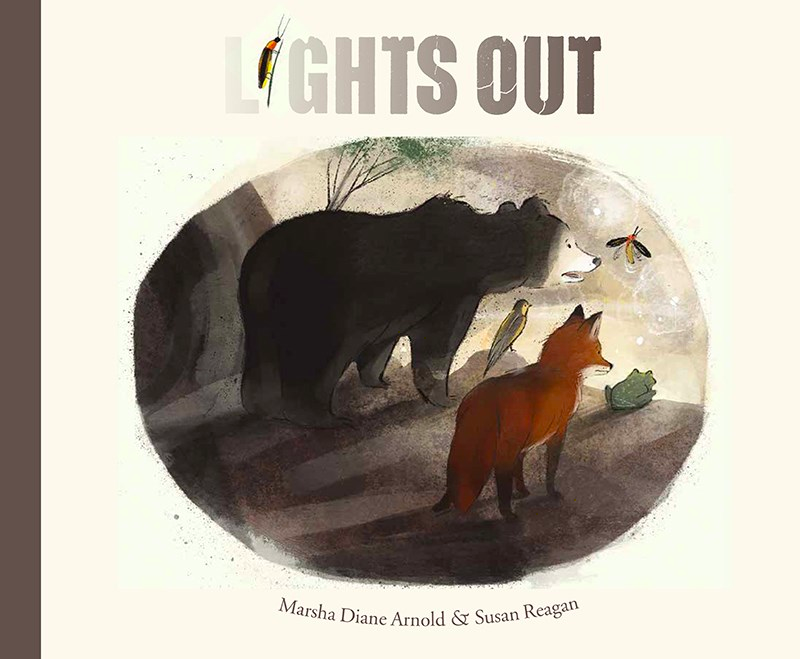
March 27 – Earth Hour

celebrate-picture-books-picture-book-review-Lights-Out-cover

About the Holiday

Earth Hour was organized by the World Wide Fund for Nature as a way to engage people in the discussion on climate change. First enacted in Australia in 2007, the observance has grown to include cities, businesses, corporations, and individuals world wide. For one hour – from 8:30 to 9:30 p.m. local time – participants will turn off all unnecessary lights in a show of solidarity and commitment to protecting our earth. Among the places going dark this year are the Empire State Building, the Space Needle, the Golden Gate Bridge, the Colosseum in Rome, the Pyramids of Egypt, the Sydney Opera House, and the Eiffel Tower. One action you can take is as easy as turning off a light – as today’s book shows. To read more about the holiday, find virtual events taking place around the world, and learn how you can participate, visit earthhour.org.

Lights Out

Written by Marsha Diane Arnold | Illustrated by Susan Reagan


A little fox peeks out of her den. It’s night, but her surroundings are lit up as if it were noon. A Beetle hovers nearby taking in all the “House lights / Car lights / Truck lights / Street lights… / Blinking lights / Flashing lights / Blazing lights / Flickering lights.” There are lights in every color and on every structure. Fox and Beetle wonder where Darkness is—the dark of Night that invites coyotes to sing, owls to hunt, foxes to hunt, and beetles to become “more than beetles.” Perhaps, they think, Night is lost.
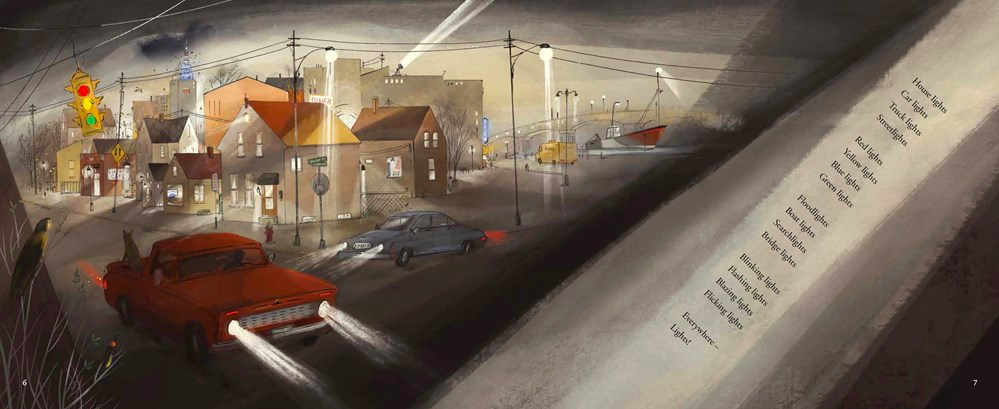
celebrate-picture-books-picture-book-review-Lights-Out-city

Image copyright Susan Reagan, 2020, text copyright Marsha Diane Arnold, 2020. Courtesy of Creative Editions.

Fox and Beetle set out to find Night. They pass a wetlands, where Frog waits in vain for darkness to lend his voice to the nighttime chorus. “Across the wide, wide world, / they search… / for the Dark of Night. / But everywhere – Lights!” Up on the mountain, Bear is waiting for the signal to hibernate, but the brightness keeps him awake. Frog and Bear join in the search for Night.
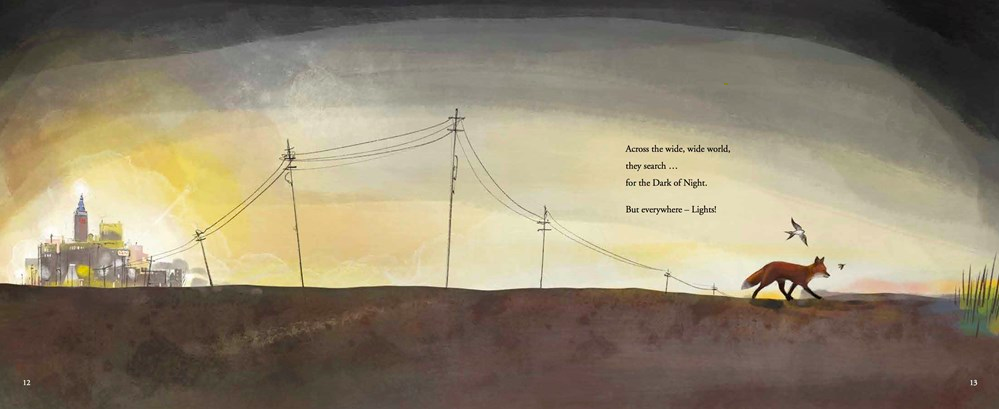
celebrate-picture-books-picture-book-review-Lights-Out-wandering

Image copyright Susan Reagan, 2020, text copyright Marsha Diane Arnold, 2020. Courtesy of Creative Editions.

Fox and Beetle travel through forests and fields, over deserts and dunes, and across wide prairies, but don’t find Night. When they come to the seashore, they witness baby turtles hatching. Instead of scuttling toward the ocean, they’re running toward the lights of the boardwalk shops. Frog stops the little turtles then Bear, Fox, and Frog wade out into the waves and shows them the way.
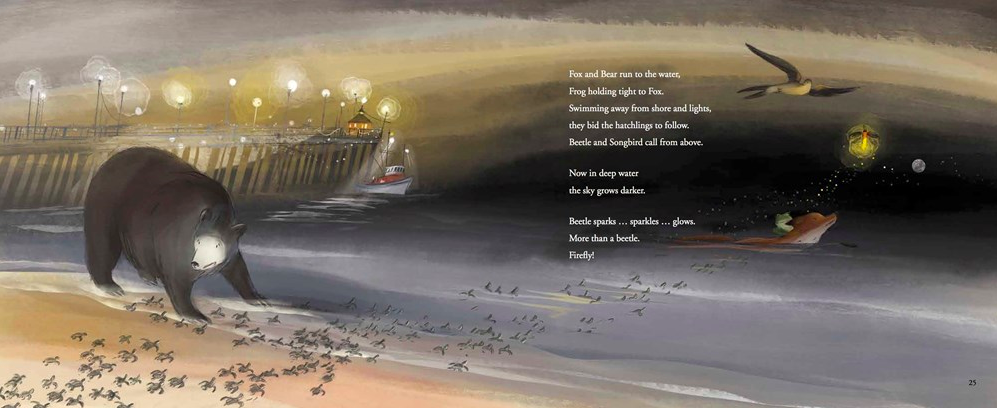
celebrate-picture-books-picture-book-review-Lights-Out-turtles

Image copyright Susan Reagan, 2020, text copyright Marsha Diane Arnold, 2020. Courtesy of Creative Editions.

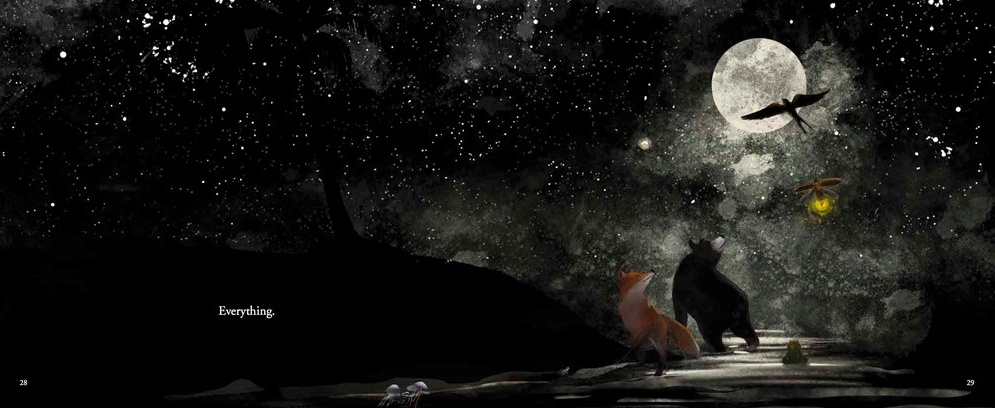
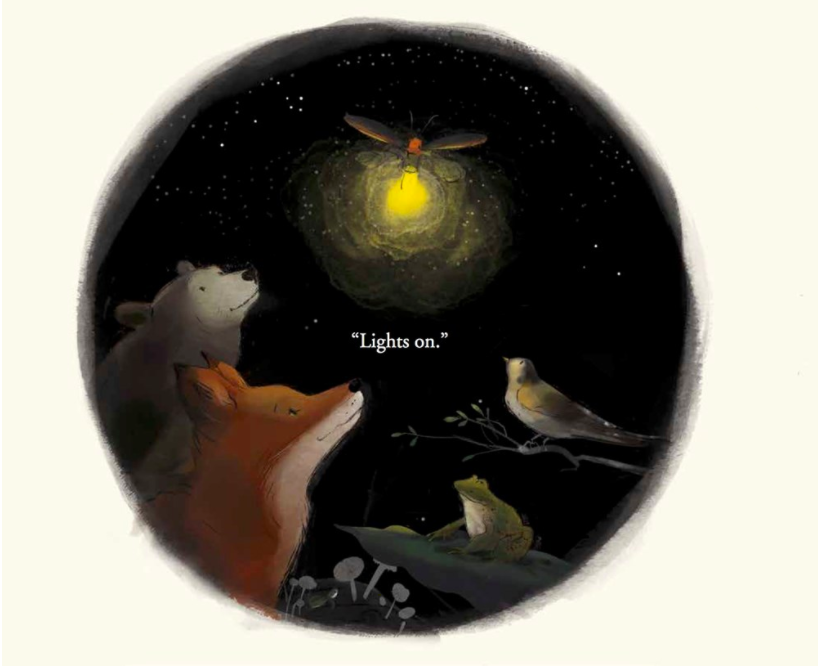
The three friends swim “away from shore and lights” while Beetle and Songbird fly above. Out here, where the sky is dark, Beetle at last sparks and glows. At last the friends reach a far-away island that’s cloaked in darkness. Here “they can see…Everything…. / Mushrooms glowing / Fireflies / Moonlit garden / Shining eyes / Nighttime weavers / Webs of stars / Constellations / Venus, Mars….” Here, they find Night.

An Author’s Note discussing light pollution and its effect on animals and humans and including a resource where readers can learn more about light pollution and what we can do to help precedes the story.
celebrate-picture-books-picture-book-review-Lights-Out-moon

Image copyright Susan Reagan, 2020, text copyright Marsha Diane Arnold, 2020. Courtesy of Creative Editions.

Marsha Diane Arnold’s affecting story about how light pollution changes animal behavior and confuses the natural order of life is a poignant appeal to today’s young environmentally conscious kids, sparking an awareness of the extent of the problem while inviting them to consider ways to restore the darkness of night so important to the health of our planet. Through non-rhyming, yet lyrical language, Arnold takes readers on a journey to find Night. As the friends search place after place, children come to understand that light pollution is a worldwide issue.

Arnold’s capitalization of Night and Darkness makes them characters in the story as well, imbued with living traits and purpose that are just as crucial to wildlife as food and shelter. In one powerful combination of text and illustration, a list of light sources streams from corner to corner in a beam of white light. The number of examples builds to create a glaring realization of all the types of lights that keep the world turned on twenty-four hours a day. After reading Lights Out, children and adults will find themselves paying attention to the lights around them and even in and near their own home.
celebrate-picture-books-picture-book-review-Lights-Out-lights-on

Image copyright Susan Reagan, 2020, text copyright Marsha Diane Arnold, 2020. Courtesy of Creative Editions.

Susan Reagan’s stunning illustrations of cities, waterways, and even out-of-the-way places bathed in a permanent twilight by street lamps, headlights, lighted windows, neon signs, and more are compelling reminders of just how pervasive light pollution is. As the animals wander from place to place looking for Night, their weary and distressed expressions reflect the loss of their natural nocturnal activities. When Beetle and Fox and their friends reach the distant island, Reagan’s gorgeous spreads of a star-and-moonlit sky and vegetation, in which nocturnal animals hunt, luminescent flowers glow, and spider webs glint will have readers taking a nighttime jaunt to discover what they can see in their surroundings.

A unique and important book that raises awareness not only about light pollution but about natural cycles of sleep and wakefulness, Lights Out would be an excellent addition to lessons in science and the environment and is highly recommended for home, school, and public library collections.

Ages 6 – 8

Creative Editions, 2020 | ISBN 978-1568463407

Discover more about Marsha Diane Arnold and her books on her website.

To learn more about Susan Reagan, her books, and her art, visit her website.

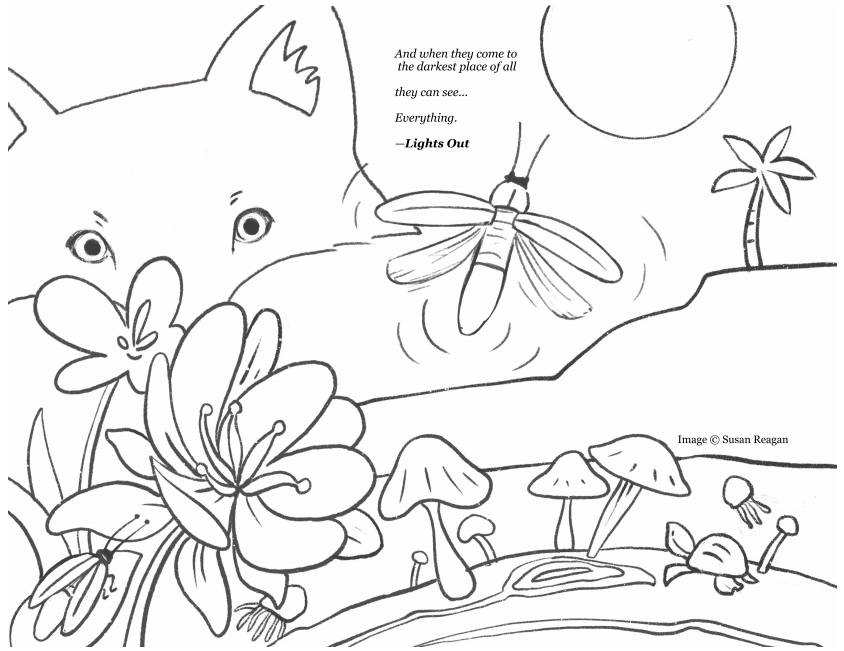
Earth Hour Activity
celebrate-picture-books-picture-book-review-Lights-Out-activity

Image copyright Susan Reagan, 2020, text copyright Marsha Diane Arnold, 2020. Courtesy of Creative Editions.

Lights Out Activity Kit


This extensive Activity Kit gives teachers, homeschoolers, and parents many ways to engage with Lights Out in the disciplines of science, language arts, art, and social action. Through the various activities, children will learn about light pollution and its effects as well as about the ways in which darkness benefits wildlife. You can download the kit from Marsha Diane Arnold’s website:

Lights Out Activity Kit

celebrate-picture-books-picture-book-review-Lights-Out-cover

You can find Lights Out at these booksellers

Amazon | Barnes & Noble | Books-a-Million

To support your local independent bookstore, order from

Bookshop | IndieBound

Picture Book Review
March 26 – It’s National Reading Month

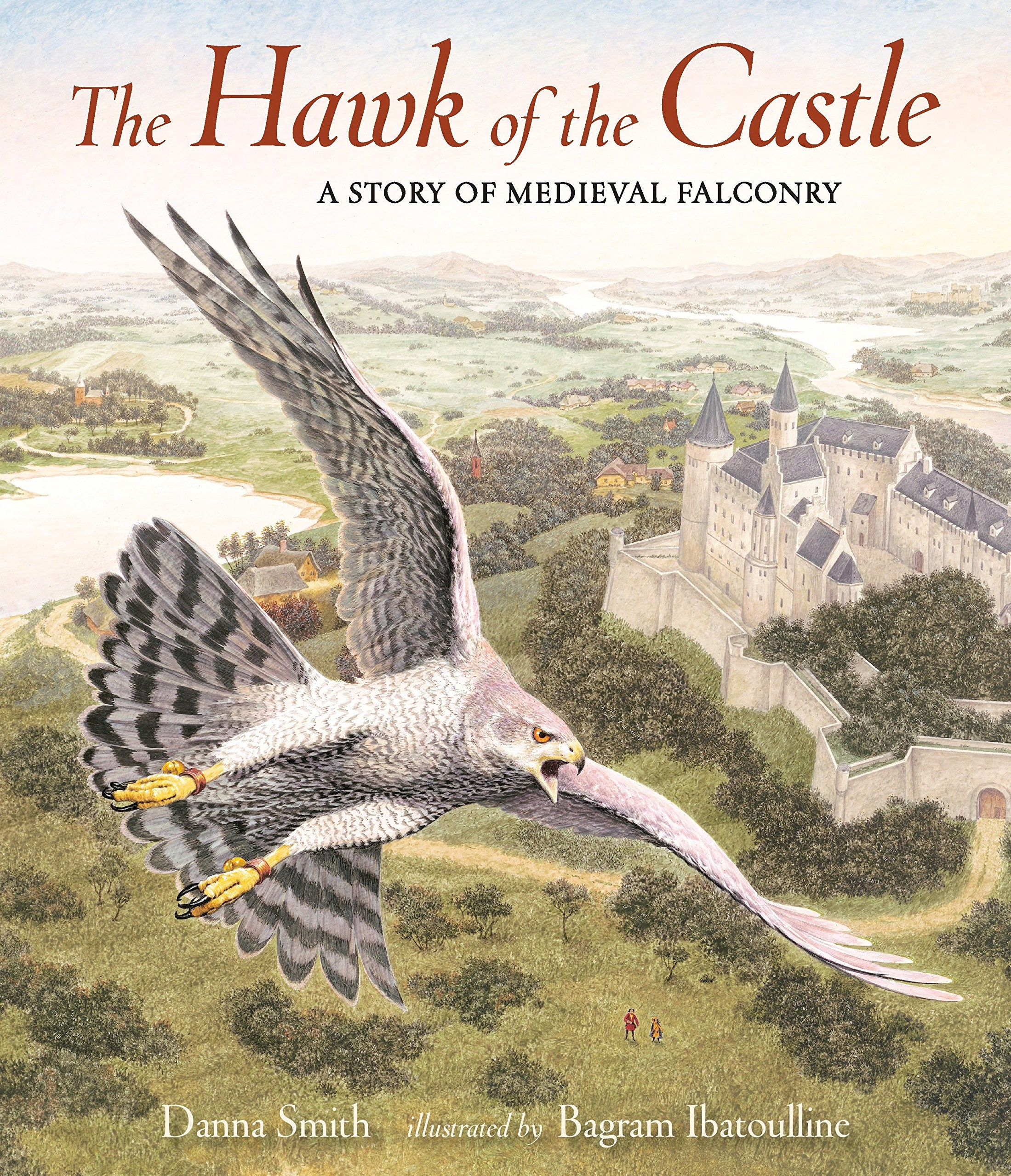
celebrate-picture-books-picture-book-review-the-hawk-of-the-castle-cover

About the Holiday

No matter whether you live in a city, a small town, or a farm, in a house or an apartment, you can travel anywhere through books. The magic of reading lies in its ability to transport readers through history, to far-away places and long-ago times, or perhaps to the future, where all it takes is one’s imagination to make it so. National Reading Month invites readers of all ages to experience the world in new and unfamiliar ways through amazing books like today’s that transports you to medieval times.

The Hawk of the Castle: A Story of Medieval Falconry

Written by Danna Smith | Illustrated by Bagram Ibatoulline


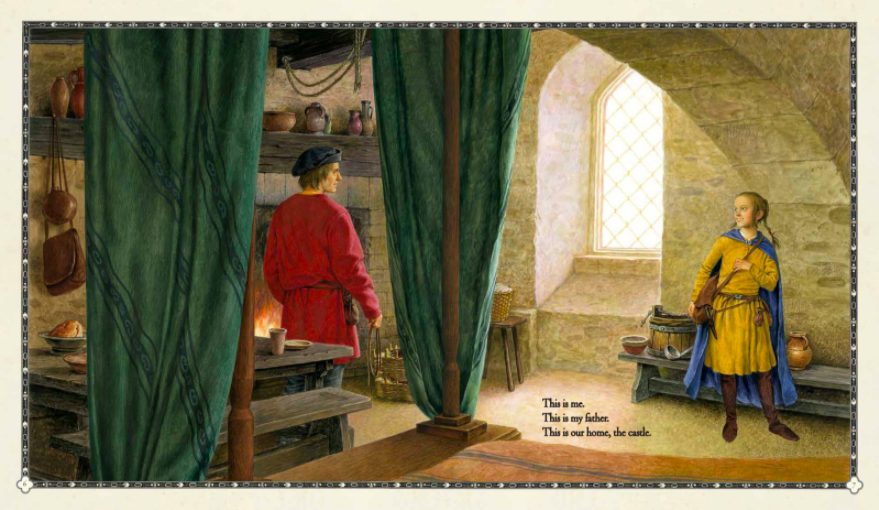
A young girl introduces herself and her father from their fire-warmed room in the castle. Outside the window, a majestic bird waits. The girl says, “This is our hawk: a sight to behold, / a master of flight, graceful and bold. / My father trains this bird of prey / who lives with us at the castle.” An inset on the page reveals facts about the birds of prey used in medieval times for hunting: hawks and falcons.

celebrate-picture-books-picture-book-review-the-hawk-of-the-castle-room

Image copyright Bagram Ibatoulline, 2017, text copyright Danna Smith, 2017. Courtesy of Candlewick.

Down in the courtyard the girl and her father prepare the hawk to fly as it sits on its favorite perch, which, as the inset explains, resembles a tree branch a hawk would normally search out in the wild. Falcons, on the other hand, prefer perches with flat surfaces like the cliffs they gather on. The girl’s father puts on a thick leather glove that protects him from the hawk’s “razor-sharp claws” as they take the bird outside the castle walls. Next, the girl gets out the hood the hawk “wears on his head, / with fancy top feathers of purple and red. / It hides his eyes so he’s not afraid / of soldiers who roam ’round the castle.” Readers learn more about this hood and its purpose in the illustrated inset.

celebrate-picture-books-picture-book-review-the-hawk-of-the-castle-hawk

Image copyright Bagram Ibatoulline, 2017, text copyright Danna Smith, 2017. Courtesy of Candlewick.

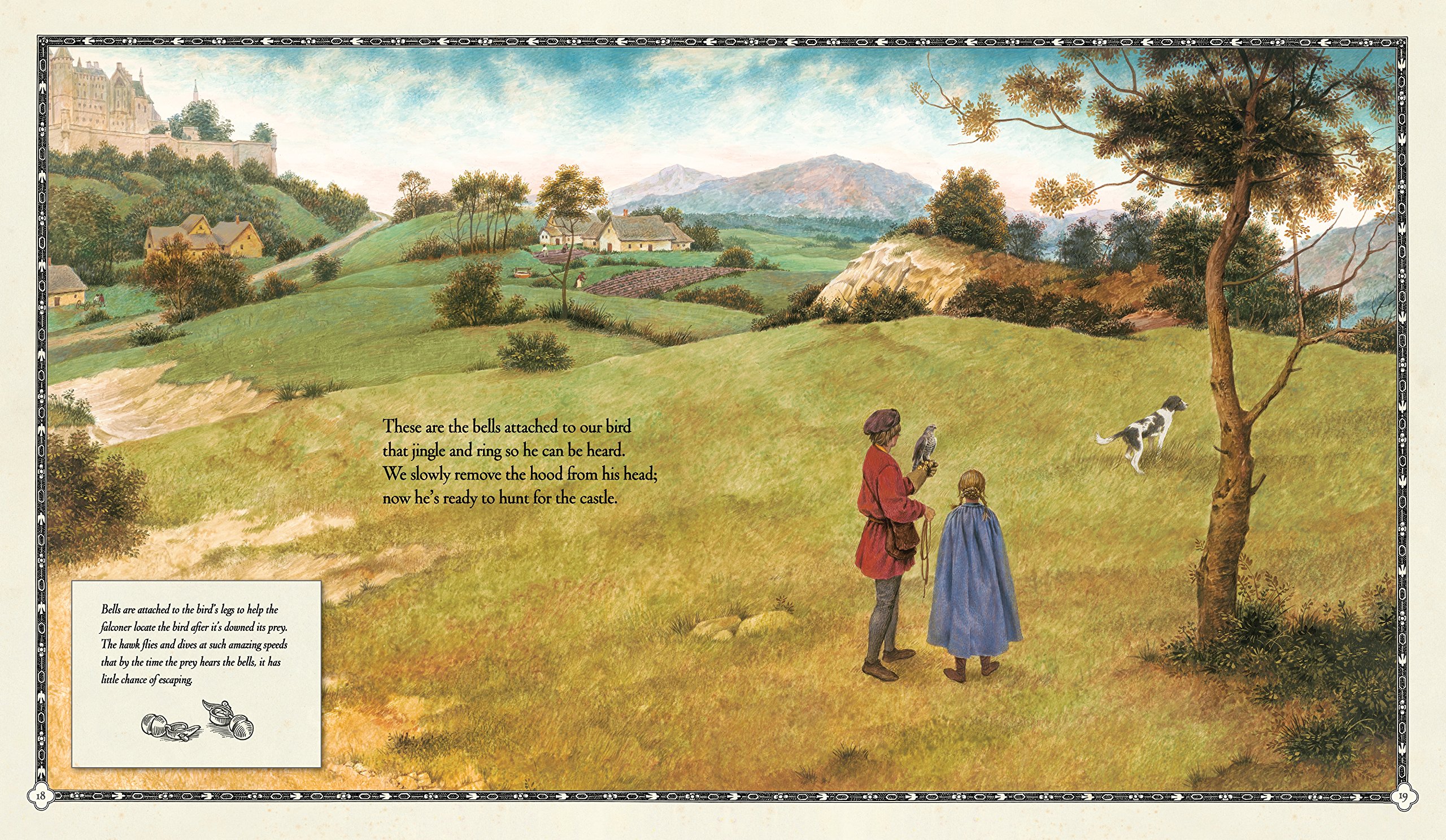
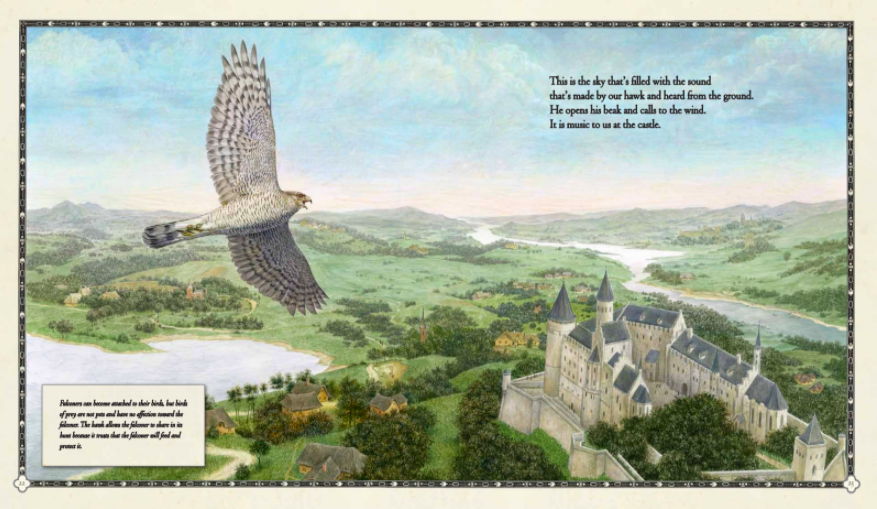
Out in a nearby field, the girl, her father, and the hunting hound they have also trained are ready to begin the day. But before the hawk’s flight begins, children learn an astonishing fact about the bells hawks wear on their legs. Then the girl’s father raises his arm, signaling to the hawk that it’s time to take flight. The hawk takes to the sky with a cry that echoes over the castle.

As the hound flushes grouse from under a bush, the hawk, “…folds his wings and dives headfirst / in pursuit of his prey for the castle.” In midair the hawk grasps the grouse with its talons and brings it to the ground. More information about how a hawk captures its prey is found in the inset. The girl and her father follow the sounds of the bells to where the hawk and its catch hide in the tall grass. Readers discover more about the bells and what a falconer does if the raptor does not catch its prey.

celebrate-picture-books-picture-book-review-the-hawk-of-the-castle-bells

Image copyright Bagram Ibatoulline, 2017, text copyright Danna Smith, 2017. Courtesy of Candlewick.

As a reward, the girl feeds the hawk a treat. The inset explains what kinds of treats falconers often provide for their birds. And when they get back to the castle, a large shallow bowl of water is put out for the hawk to bathe in. When the sun goes down, the sleepy hawk settles on its perch in its own room, called a mews, designed to keep the bird safe. “Built with windows for natural light and ventilation, a mews is large enough for a hawk to move freely inside without damaging its wings.”

Backmatter includes an extensive Authors Note about Danna Smith’s personal experience with falconry, the history of falconry, fascinating information about social standing and different types of raptors, and modern falconry. A list of books and websites is also provided for further reading and research. An index makes finding specific facts and topics easy for young readers.

celebrate-picture-books-picture-book-review-the-hawk-of-the-castle-soaring

Image copyright Bagram Ibatoulline, 2017, text copyright Danna Smith, 2017. Courtesy of Candlewick.

Readers will be mesmerized by Danna Smith’s rich tale of a girl and her father and their important role in a medieval castle. The girl’s pride in her father and awe for the hawk they have trained and care for stands out on every page, creating a story steeped in history and emotional bonding. A wealth of knowledge about falconry and hunting flows fluidly through Smith’s enchanting poetry, and the graceful language of her insets, some of them illustrated, allow for smooth transitions while reading the story aloud.

Bagram Ibatoulline’s breathtakingly realistic acrylic gouache paintings of the castle and countryside will wow kids and draw them into the story to discover the processes, equipment, and purposes of falconry. No detail has been overlooked in these sumptuous pages that make readers feel they only need to reach out to feel the rough stone walls, the elegant fabrics, or the soft feathers of the stunning hawk. The castle environment is fully realized as soldiers in armor stand guard, a horse and rider exit through a stone arch, and plants even wait to be watered on a high ledge.

The centerpiece, of course, are the images of the girl and her father preparing the hawk for hunting and the hawk itself. Through various perspectives, Ibatoulline gives children an idea of the scale of the castle and the rolling countryside outside its walls. In their colorful clothing, father and daughter stand out as they kneel with the bird on its perch, summon it with an outstretched arm, add hood and bells, and release it into the sky. The facial expressions on the father and the girl depict love and trust, not only for each other but also for their hawk.

Enthralling for family reading or as an exciting addition to school or homeschool lessons on many levels, The Hawk of the Castle is a must for home, school, and public libraries.

Ages 4 – 8 and up

Candlewick, 2017 | ISBN 978-0763679927

Discover more about Danna Smith and her books on her website.

To view a portfolio of work by Bagram Ibatoulline, visit his website.

About Danna Smith

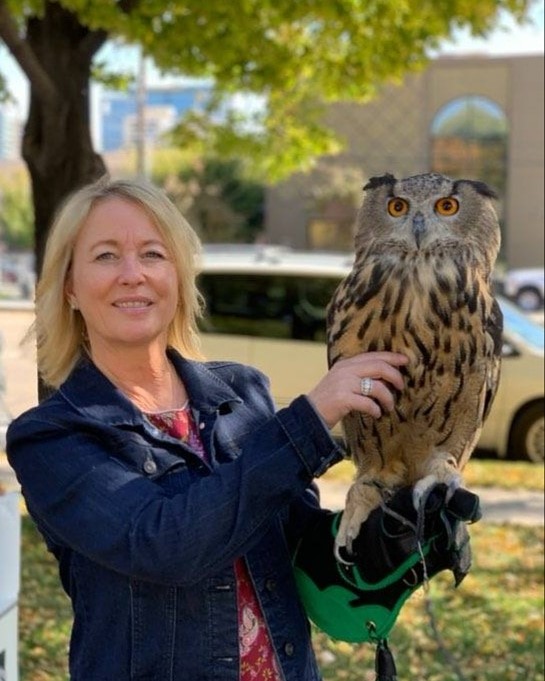
celebrate-picture-books-picture-book-review-danna-smith-with-owlDanna Smith is a poet and an award-winning author of seventeen books for children, including Arctic White, Swallow the Leader, Mother Goose’s Pajama Party, and several Little Golden Books. Her nonfiction picture book, The Hawk of the Castle: A story of Medieval Falconry, received two starred reviews and is a Junior Library Guild Selection.

Born and raised in Salt Lake City, Utah, Danna was exposed to all sorts of creatures through her father, who trained, bred, and rehabilitated animals. It wasn’t uncommon to find bobcats, alligators, monkeys, hawks, or even vultures at her home. A love of animals and nature has spilled over into her love of writing.

Danna is currently living in northern California, where she is hard at work on her next book. For more information about her books, upcoming releases, and teaching activities, visit her book website and her poetry blog. You can also connect with Danna on Facebook | Instagram | Twitter

Learn about why Danna Smith wrote her beautiful story and how it came to be on The Story Behind the Story on Lynne Marie’s blog

Look for these forthcoming books from Danna Smith
One Blue Gnu (Amicus / Spring 2022)
Wake Up, Freight Train (Little Simon / Spring 2022)
Rooftop Garden (Barefoot Books / Summer 2022)
The Thank You Book (Little Simon / Summer 2022)

National Reading Month Activity

The Hawk of the Castle activity sheet questions

The Hawk of the Castle Activity Sheet


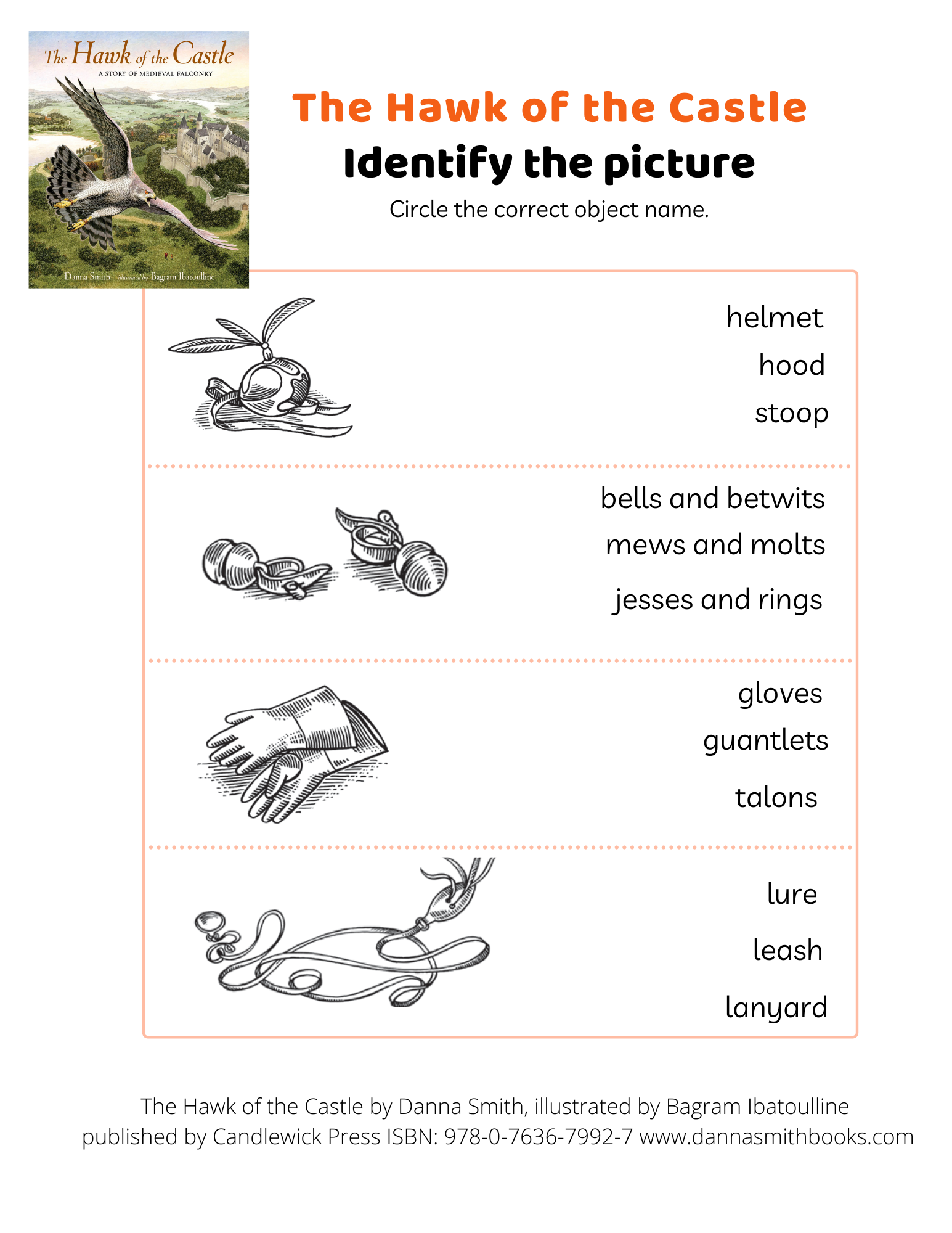
Can you identify this equipment used in falconry? Learn the answers and more about each item in the Answer Sheet

The Hawk of the Castle Activity Sheet | The Hawk of the Castle Activity Sheet Answers

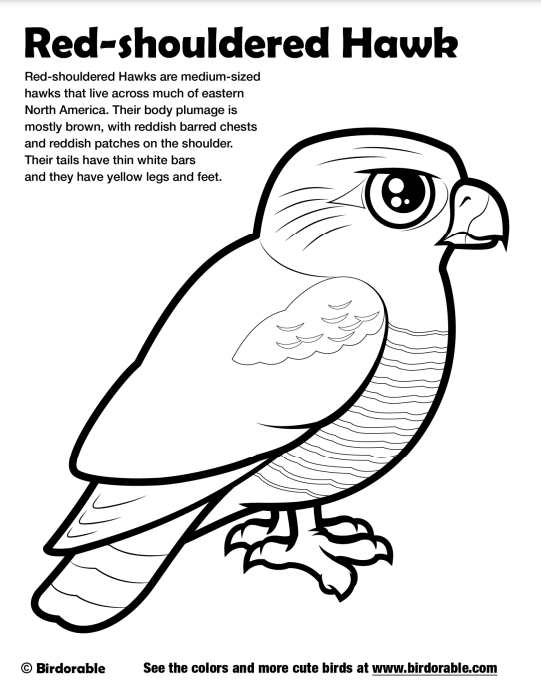
celebrate-picture-books-picture-book-review-red-shouldered-hawk-coloring-page

Hawk Coloring Pages


Enjoy these printable coloring pages while you learn about three kinds of hawks.

Broad-winged Hawk | Red-shouldered Hawk | Ridgeway’s Hawk

celebrate-picture-books-picture-book-review-the-hawk-of-the-castle-cover

You can find The Hawk of the Castle: A Story of Medieval Falconry at these booksellers

Amazon | Barnes & Noble | Books-a-Million

To support your local independent bookstore, order from

Bookshop | IndieBound

Picture Book Review
 

March 24 – It’s Women’s History Month

celebrate-picture-books-picture-book-review-june-almeida-virus-detective-cover

About the Holiday

From its beginning as a single-day observance in 1911 in Sonoma, California, the celebration of women’s achievements and contributions throughout history grew to a week-long event in 1980 and finally to encompass the entire month of March in 1987. During this month we remember the trail-blazing women of yesteryear who used their creativity, intelligence, and perseverance to promote rights for women while contributing their own innovations to science, art, social reform, medicine, and other disciplines as well as today’s pioneers who carry on their legacy and make our world a better place. Today, we feature a book about a woman who revolutionized virology and medical research, connecting the past and the present. To learn more about the holiday, visit the National Women’s History Museum website and check out their resource toolkit.

June Almeida, Virus Detective! The Woman Who Discovered the First Human Coronavirus

Written by Suzanne Slade | Illustrated by Elisa Paganelli

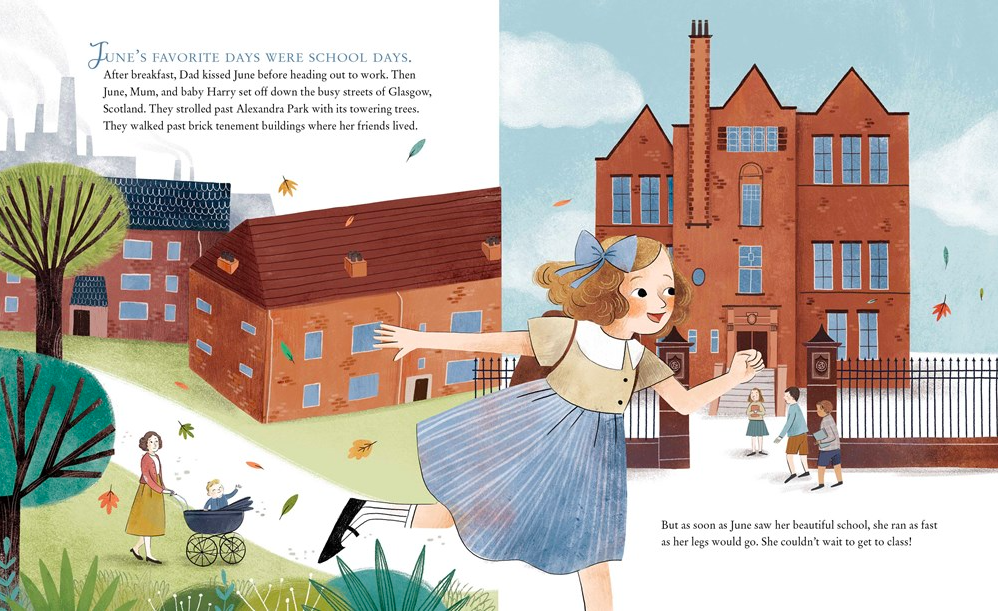
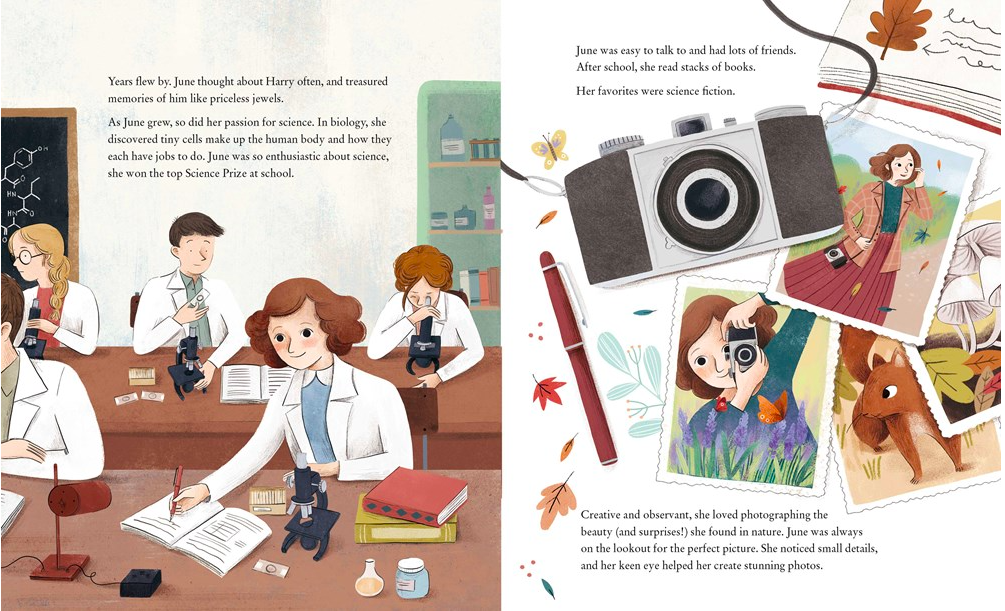
Growing up in Glasgow, Scotland, June Almeida loved school. After class she couldn’t wait to share what she’d learned—especially science subjects—with her mother, father, and little brother, Henry. When June was ten, however, her life changed when Henry became sick and passed away. Throughout elementary school and into high school, June loved studying science, especially biology in which she learned about the cells in the body and their functions. “June was so enthusiastic about science, she won the top science prize at school.”

celebrate-picture-books-picture-book-review-june-almeida-virus-detective-childhood

Image copyright Elisa Paganelli, 2021, text copyright Suzanne Slade, 2021. Courtesy of Sleeping Bear Press.

But science wasn’t the only thing June loved. She had lots of friends, was an avid reader, and became an excellent photographer. Whenever she was out with her camera, “she noticed small details, and her keen eye helped her create stunning photos.” June dreamed of attending college, but the jobs her father and mother held did not pay enough, and when June was sixteen, she dropped out of school to get a job to help pay the bills. June wanted to make a difference, “so she applied to work at the nearby hospital” and was hired as a lab worker. Here she learned how to examine cells with a microscope. “Her findings helped doctors treat patients.”

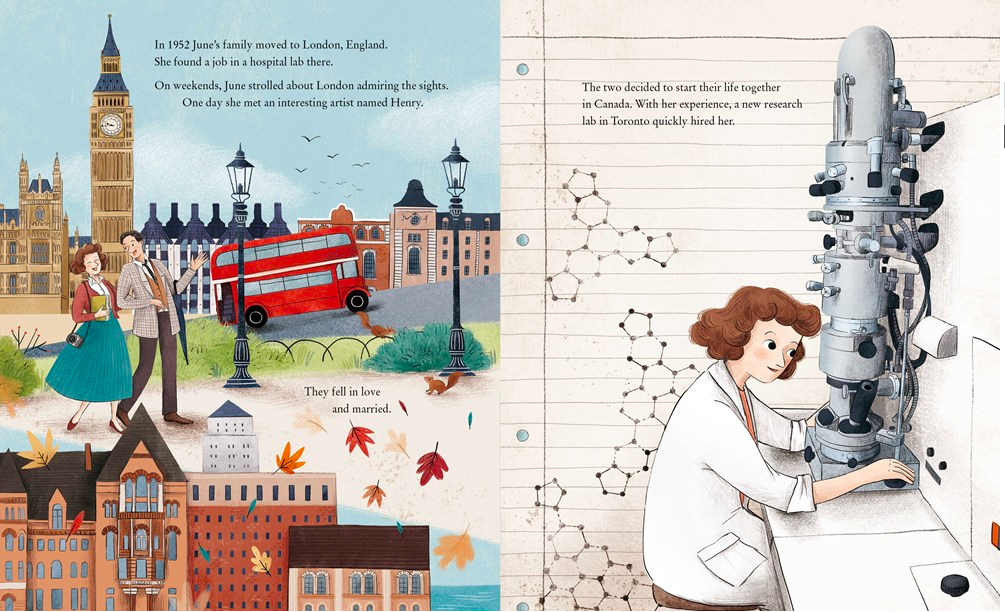
When June was twenty-two, she and her family moved to London. She got a job in a hospital lab and also met and married an artist named Henry. June and Henry moved to Canada, where she quickly found a job at a “new research lab in Toronto.” In this lab, June worked with an electron microscope that could magnify things 25,000 times and produced detailed pictures of the samples being studied. These photos “were helpful. But it was hard to tell which tiny blobs were viruses and which were cells.” June thought she could improve on the photos.

celebrate-picture-books-picture-book-review-june-almeida-virus-detective-photographer

Image copyright Elisa Paganelli, 2021, text copyright Suzanne Slade, 2021. Courtesy of Sleeping Bear Press.

June knew that in the body antibodies would surround viruses as they worked to fight it. June wondered if by introducing antibodies to her samples, scientists would be able to determine the virus from the cells. June’s idea worked. The scientists were astonished. Because of June’s innovation, they now had clear pictures that would help them study and combat viruses.

After June took time away from work to have a baby in 1960, she returned to her research and often lectured about her work. She was recruited to work at a hospital lab in London, so she and her family moved once again. At the time, a researcher named David Tyrrell had been trying to identify a virus that had affected a young boy. Could it be a new virus? He was hoping that June could help.

celebrate-picture-books-picture-book-review-june-almeida-virus-detective-hospital

Image copyright Elisa Paganelli, 2021, text copyright Suzanne Slade, 2021. Courtesy of Sleeping Bear Press.

When June received the sample, she knew that “since it was an unknown virus, there were no antibodies to help find it.” But she was an expert at using another method that might work. Carefully, June implemented the intricate steps. Then she put the sample under the microscope and scanned the picture. “June was stunned.” Each virus blob was encircled by tiny dots “like a crown. ” She had seen this twice before when looking at viruses from sick animals. She had written a paper on it, but it had been rejected by other researchers because they thought her pictures were just blurry and not those of a new virus.

June presented her findings to doctors who agreed with her discovery. They decided to name the new virus coronavirus, after the Latin word for crown, corona. June and David then published a paper telling other doctors and researchers about the new virus. Following this discovery, June continued to study viruses, such as hepatitis B and HIV. Her pictures of these viruses helped researchers develop medications that could “block them from making people sick.” Even after she retired, June never lost her love of learning, teaching herself to play the flute, about antiques, and how to use a digital camera to continue creating incredible photos.

Backmatter includes more about June Almeida and her life’s work, an illustrated timeline of her life, and a selected bibliography.

celebrate-picture-books-picture-book-review-june-almeida-virus-detective-London

Image copyright Elisa Paganelli, 2021, text copyright Suzanne Slade, 2021. Courtesy of Sleeping Bear Press.

Suzanne Slade’s compelling biography of June Almeida gives context for and insight into the research and discovery of the coronavirus and informs present-day events and breakthroughs. Slade’s fluid storytelling clearly reveals Almeida’s intelligence and passion for science as well as her determination to use her skills to the betterment of society. Kids will be astounded that June was able to begin her career at the age of sixteen, and that her beloved hobby of photography became a career that changed medical research. Slade’s sprinkling of personal details about Almeida’s life creates a well-rounded understanding of this influential woman.

Through Elisa Paganelli’s realistic and detailed illustrations, children have the opportunity to see a researcher at work in world-class laboratories. Readers will be especially impressed by images of the electron microscope and how Almeida improved the photographs these powerful machines produced. Children familiar with the shape of the coronavirus will be interested in seeing the faithfully reproduced photographs and how the virus got its name. Kids will also enjoy seeing illustrations of Almeida’s family life, including her daughter Joyce, who is herself a doctor.

An inspirational and fascinating biography of a woman with a very innovative mind, June Almeida, Virus Detective! will thrill children interested in science, medicine, and the arts. The book would be an impactful addition to STEM and STEAM lessons. It is highly recommended for home libraries and is a must for school and public library collections.

Ages 6 – 9 

Sleeping Bear Press, 2021 | ISBN 978-1534111325

Discover more about Suzanne Slade and her books on her website.

To learn more about Elisa Paganelli, her books, and her art, visit her website.

Women’s History Month Activity

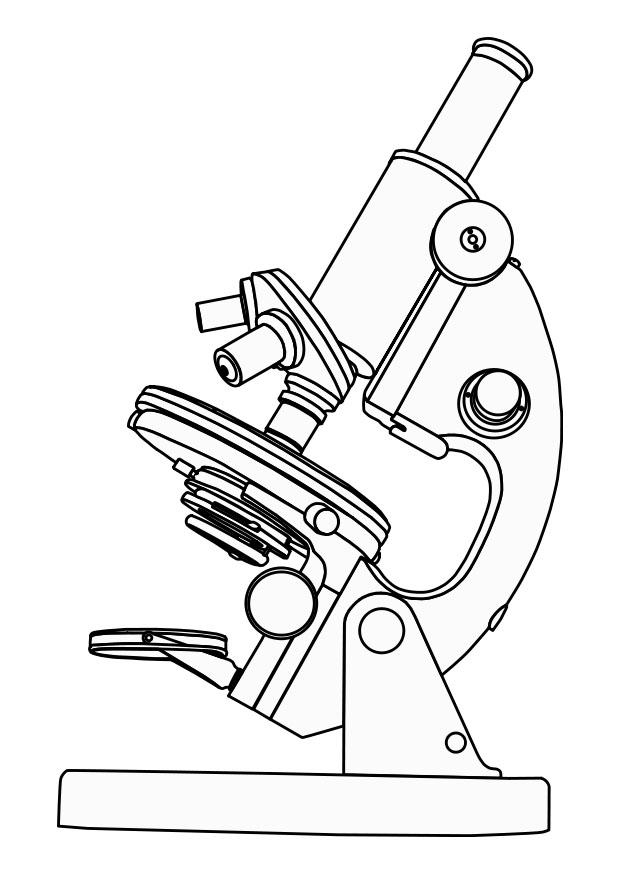
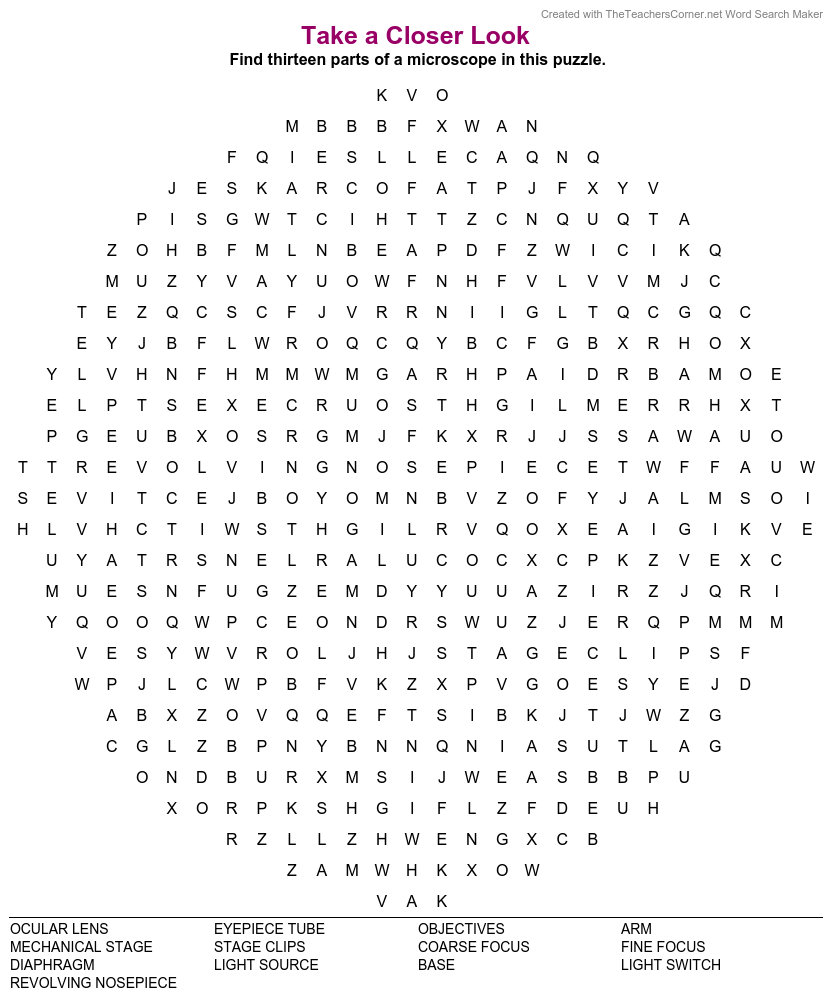
celebrate-picture-books-picture-book-review-microscope-coloring-page          celebrate-picture-books-picture-book-review-microscope-wordsearch-puzzle

Take a Closer Look Coloring Page and Word Search 

You can examine the parts of a microscope with this printable word search puzzle and coloring page.

Take a Closer Look Word Search Puzzle | Take a Closer Look Word Search Solution | Coloring Page

celebrate-picture-books-picture-book-review-june-almeida-virus-detective-cover

You can find June Almeida, Virus Detective! at these booksellers

Amazon | Barnes & Noble | Books-a-Million

To support your local independent bookstore, order from

Bookshop | IndieBound

Picture Book Review

March 23 – Celebrating the Book Birthday of I Miss Your Sunny Smile and Interview with Deb Adamson

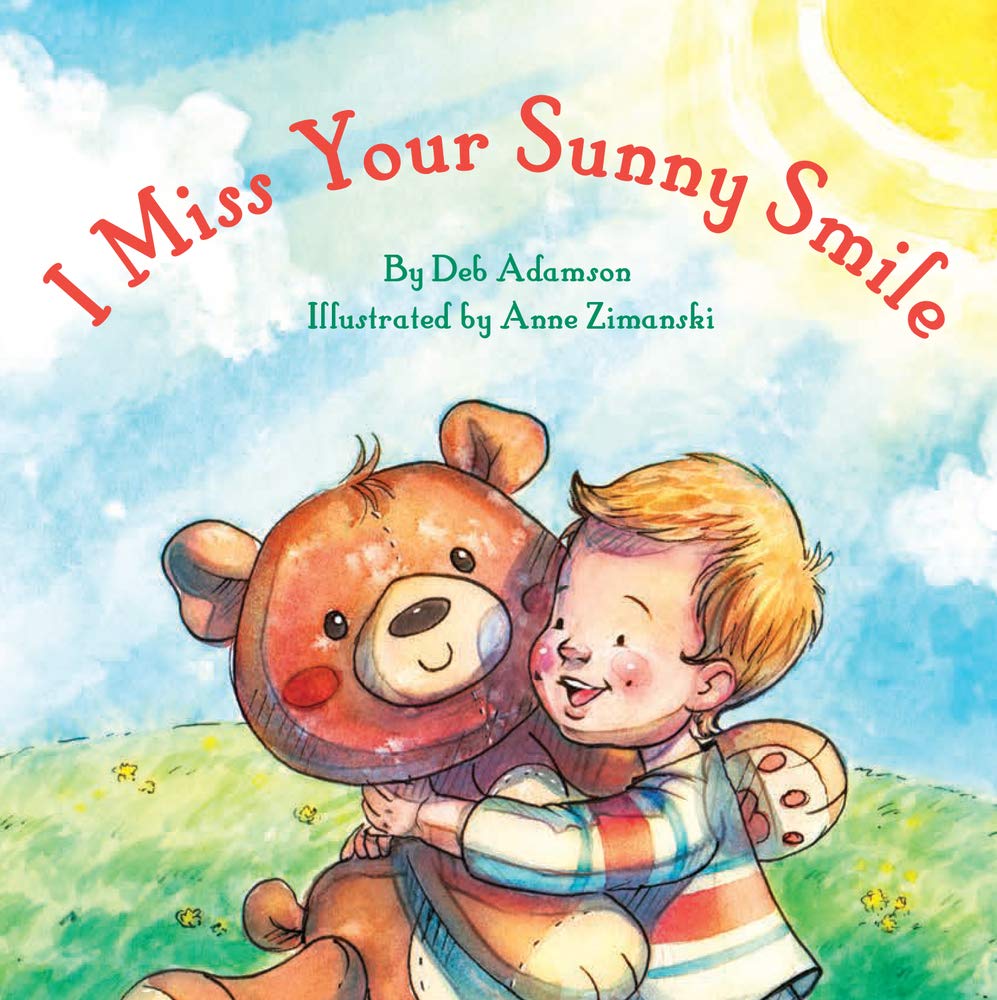
celebrate-picture-books-picture-book-review-I-miss-your-sunny-smile-cover

About the Holiday

It’s National Reading Month, the perfect time to celebrate a book birthday! Today I’m excited to be featuring a sweet board book for the littlest readers that parents and caregivers will love sharing to make every day better. 

Thanks to Blue Manatee Press for sharing a digital copy of I Miss Your Sunny Smile for review consideration. All opinions on the book are my own. I’m happy to be partnering with Deb Adamson in a giveaway of the book. See details below.

I Miss Your Sunny Smile

Written by Deb Adamson | Illustrated by Anne Zimanski


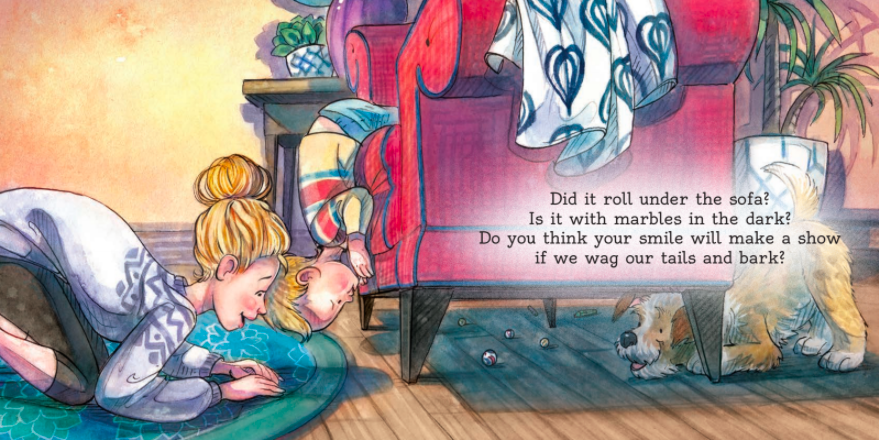
On a rainy day a mom sits with her son watching out the window. The little boy is sad, and Mom is trying to cheer him up. She suggests going in search of his smile. They head to the living room and Mom makes a game of it—and even their dog joins in. “Did it roll under the sofa? / Is it with marbles in the dark? / Do you think your smile will make a show / if we wag our tails and bark?”

celebrate-picture-books-picture-book-review-I-miss-your-sunny-smile-chair

Image copyright Anne Zimanski, 2021, text copyright Deb Adamson, 2021. Courtesy of Blue Manatee Press.

They look in the cookie jar and play dress up, but still the little boy wears a frown. Maybe dancing or playing peek-a-boo will help him find his smile. Even while he’s playing, though, something else is on his mind. He and his mom continue the search. At the boy’s bedroom door, they spy two fuzzy ears peeking out of the blanket. “Wait!” says Mom. “Is that your smile napping? / All cozy in your bed?”

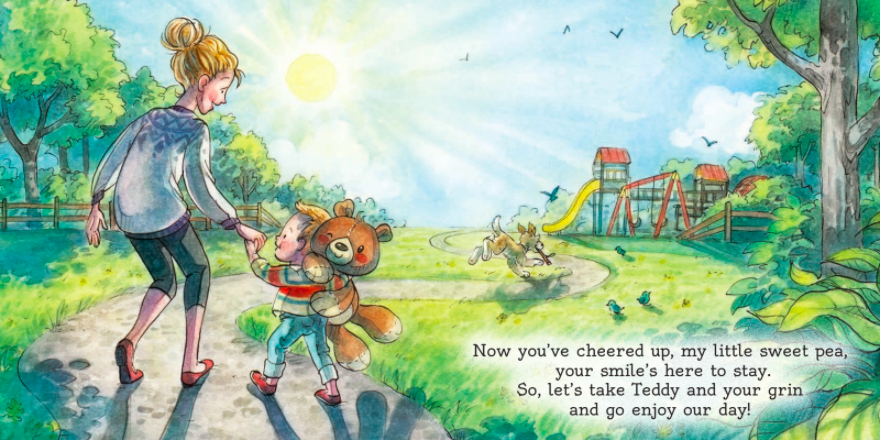
They tiptoe in and lift the covers. There is Teddy—and the boy’s smile. The little boy hugs his teddy bear and grins from ear to ear. Outside the rain has stopped and the sun has come out. The boy, Teddy, and Mom take a walk to the park, ready to enjoy their day.

celebrate-picture-books-picture-book-review-I-miss-your-sunny-smile-park

Image copyright Anne Zimanski, 2021, text copyright Deb Adamson, 2021. Courtesy of Blue Manatee Press.

All little ones have moments when things aren’t going right or they feel afraid or worried. Deb Adamson’s sweet story lets parents and caregivers show their little ones that feeling sad can be temporary and that adults are there to help them by talking about what’s bothering them or trying to find out in other ways. When children aren’t old enough or don’t know how to express their feelings yet, playing with them, having a snack, or just spending time together can lead to happiness. Kids will be charmed by Adamson’s tender rhyming storytelling that reveals a loving mother and son bond and will be reassured when the boy finds his teddy bear—and his smile.

Anne Zimanski’s lovely illustrations show a mother fully engaged with helping her son feel happy again. Children will love her detailed images of home that create a cozy atmosphere as well as the enthusiastic dog that joins in on the search, snack time, and playtime. The characters’ facial expressions clearly show the mother’s love and patience and the little boy’s sadness, discontent, and worry. When the teddy bear is found, the boy’s smile is infectious. This scene is made even more endearing as Teddy’s floppy arms wrap around the boy as he hugs his favorite friend.

An enchanting story for families to share during those times when a little encouragement and understanding are needed as well as for quiet story times full of love and reassurance.

Ages Baby – 4

Blue Manatee Press, 2021 | ISBN 978-1936669875

Discover more about Deb Adamson and her books on her website.

To learn more about Anne Zimanski, her books, and her art, visit her website.

Meet Deb Adamson

celebrate-picture-books-picture-book-review-Deb-Adamson-headshot

Deb Adamson’s children’s books can be silly, sweet and sometimes even a little bit quirky. Her goal is to always bring on a sunny smile! She lives in Connecticut with her husband, son, and orange cat extraordinaire, Lumpy.

You can connect with Deb Adamson on her website | Facebook | Twitter 

Hi Deb! It’s wonderful to be talking with you about your latest book! You’ve had such a varied career in all types of communications jobs—from being a broadcast news journalist and syndicated columnist to working as a public relations spokesperson for a major aquarium to becoming a published picture book author. Do you feel like your previous jobs have led you to writing for children? What do you like most about this genre?

I do feel that my previous careers have influenced my children’s books. As a writer, I feel like everything we do colors our work. And the varied career I’ve had definitely shows up in my  books. Writing can be such a magical pursuit. We draw from all aspects of experience. The subconscious is tapped and what we didn’t even know was a focus or deep impression makes an appearance on the page. I love the saying, “What a boring world it would be if we were all the same.” That goes for writing. I guess for me, once a journalist, always a journalist because  a few of my story ideas came from news stories that sparked an interest. And animals, whether marine or not, seem to more often than not, make a cameo in most of my books. I have to add though, that even through all those careers, I was reading children’s books and writing and querying children’s manuscripts. My first book was published while I was working at the Aquarium. Even before I had my son, there was something about writing for children that called to me. So, this has actually been my preferred career choice for many years now. I consider myself really lucky to finally call this my current vocation!

Have you always loved to write? Who were you influenced by while growing up?

I’ve always loved to read and to write. I was most influenced by my mother. She was a voracious reader. She wrote herself and believed in the power of story. Even though I was barely six years old, I still have vivid memories of the newest branch of our city library opening a half mile from my house. I recall frequently skipping along the sidewalk with her to that library and carrying home stacks of books. Such happy memories.

What inspired you to write I Miss Your Sunny Smile? Can you tell readers a little about your process in writing it?

I am big believer at cultivating emotional intelligence. (I have a shelf lined with self-improvement books!) As adults we come to learn that bad days come and go. So, we focus on what is good in our lives and hopefully are able to put most things in perspective. Little ones have yet to acquire those skills, therefore it is up to us to model a healthy approach. This little book is my attempt at helping parents guide young children ages one through four, through a bad day. The mom in the book is attempting to lighten the situation with distraction and humor, which is a great tool for redirecting feelings in young children. It is my hope that parents will remember the message of distraction and recall it whenever they need it. Even though it has been over 16 years, I certainly remember needing a book like this when my own son was a toddler!

Anne Zaminski’s warm illustrations show such a sweet relationship between the mother and her child. What were your first thoughts when you saw them? Do you have a favorite spread?

I cannot gush enough about Anne Zimanski’s art for this book! The illustrations are somewhat retro. The color is vivid. The emotion she captured is spot-on. We picture book authors are lucky to be paired with such talent. Anne really brought the characters to life, just as I had imagined. I could not be more pleased. If I had to pick a favorite spread it’s the one where the mom, child, and dog are looking under the sofa barking and wagging tails searching for a smile! I imagine that one generating giggles.

Your Twitter followers have been introduced to your cat whom you affectionately call Fatty Lumpkin, or Lumpy for short. Can you tell us a little about him?

Lumpy, like most author cats, is my constant companion.He is usually somewhere in the room, contentedly snoozing, just glad to have me nearby.  And yes! He has been my muse. I was not always a cat person. I grew up with dogs and just never knew a cat until as a young adult. I moved away and decided to adopt one. Then I learned about cats’ many charms. I actually wrote a manuscript inspired by that fact, that many people label themselves one or the other—cat or dog person, but usually not both. That’s often because they just don’t take the time to familiarize themselves with the great differences in cat and dog behavior. The manuscript is  super silly! My agent and I are hoping that one finds a home.

What’s the best part about being a children’s writer?

The best part of being a children’s book writer is losing myself in story and then ultimately sharing what I cultivated with children and families. I think most writers enjoy finding some universal truth that will ultimately reach out and touch the reader. And when that reader is a child it takes on that much more meaning and pleasure. But of course, not all children’s book writing has to have such depth. Like I said, books for kids should also just be written to encourage the pure pleasure of reading. I really enjoy knowing that my books generate laughs!

What’s up next for you?

I have three children’s books coming out in 2021 and one in 2022. I cannot even believe that, myself! I Miss Your Sunny Smile board book in March, Bing Bang Pling, Now We Swing, a picture book this summer, and A Christmas Eve Wish For Santa, a picture book in the fall. Needless to say, I will be especially busy with marketing. And then in 2022, Scott Joplin’s Maple Leaf Rag, a nonfiction picture book is next.

Thanks, Deb! It’s been great chatting with you! I wish you all the best with I Miss Your Sunny Smile and all of your upcoming books!

I Miss Your Sunny Smile Giveaway

I’m happy to be partnering with Deb Adamson in a giveaway of:

  • One (1) copy of I Miss Your Sunny Smile written by Deb Adamson | Illustrated by Anne Zimanski

Here’s how to enter:

This giveaway is open from March 23 through March 30 and ends at 8:00 p.m. EST.

A winner will be chosen on March 31

Giveaway open to U.S. addresses only. | Prizing provided by Deb Adamson.

If you would like a signed copy of I Miss Your Sunny Smile, you can order from Bank Square Books.

I Miss Your Sunny Smile Activity

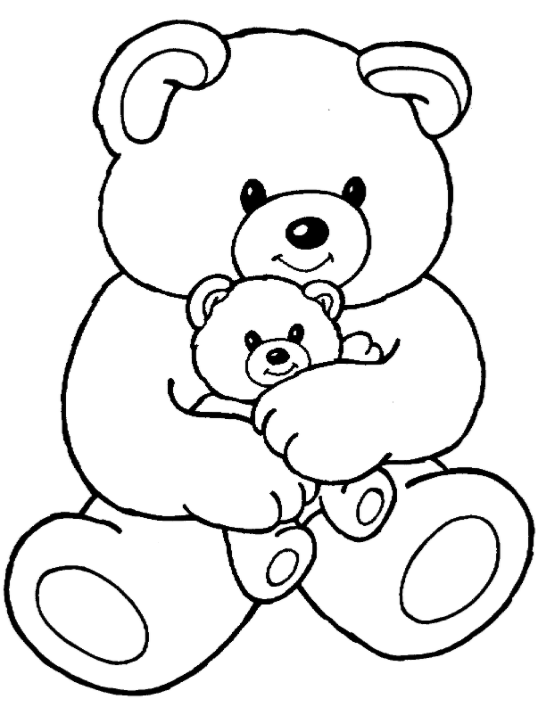
celebrate-picture-book-picture-book-teddy-bear-coloring-page

Teddy Bear Coloring Page


Enjoy some teddy bear love with this printable coloring page!

Teddy Bear Coloring Page

celebrate-picture-books-picture-book-review-I-miss-your-sunny-smile-cover

You can also find I Miss Your Sunny Smile at these booksellers

Amazon | Barnes & Noble | Books-a-Million

To support your local independent bookstore, order from

Bookshop | IndieBound

Picture Book Review
March 22 – National Goof Off Day Book Tour Stop for Cow Says Meow

celebrate-picture-books-picture-book-review-cow-says-meow-cover

About the Holiday

Have things gotten a little too serious? Do you just feel like letting go and being silly? Then today’s the day to do it! Established in 1976 by Monica Moeller Dufour of Davidson, Michigan, encourages people to relax and let go of all the stresses.Having fun once in awhile can put you in a better frame of mind and give you new perspectives. So tell your best (or worst) jokes, watch a comedy, or read some funny books. Now that you have permission to goof off and a whole twenty-four hours to do it in, plan some wacky fun. There are no rules—so enjoy!

Thanks to Kirsti Call and HMH Books for Young Readers for sharing a digital copy of Cow Says Meow with me for review consideration. All opinions on the book are my own. I’m thrilled to be partnering with HMH Books in a giveaway of the book. See details below.

Cow Says Meow

Written by Kirsti Call | Illustrated by Brandon James Scott


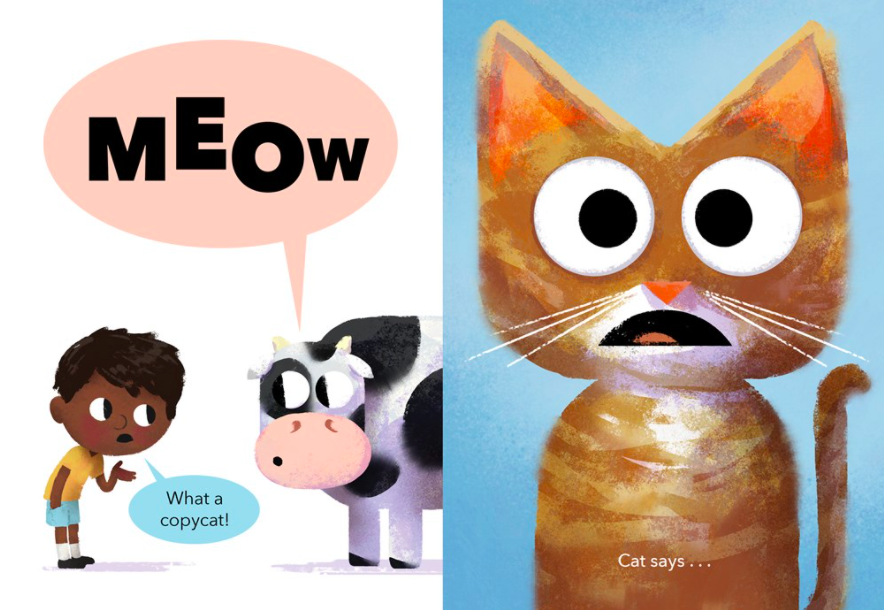
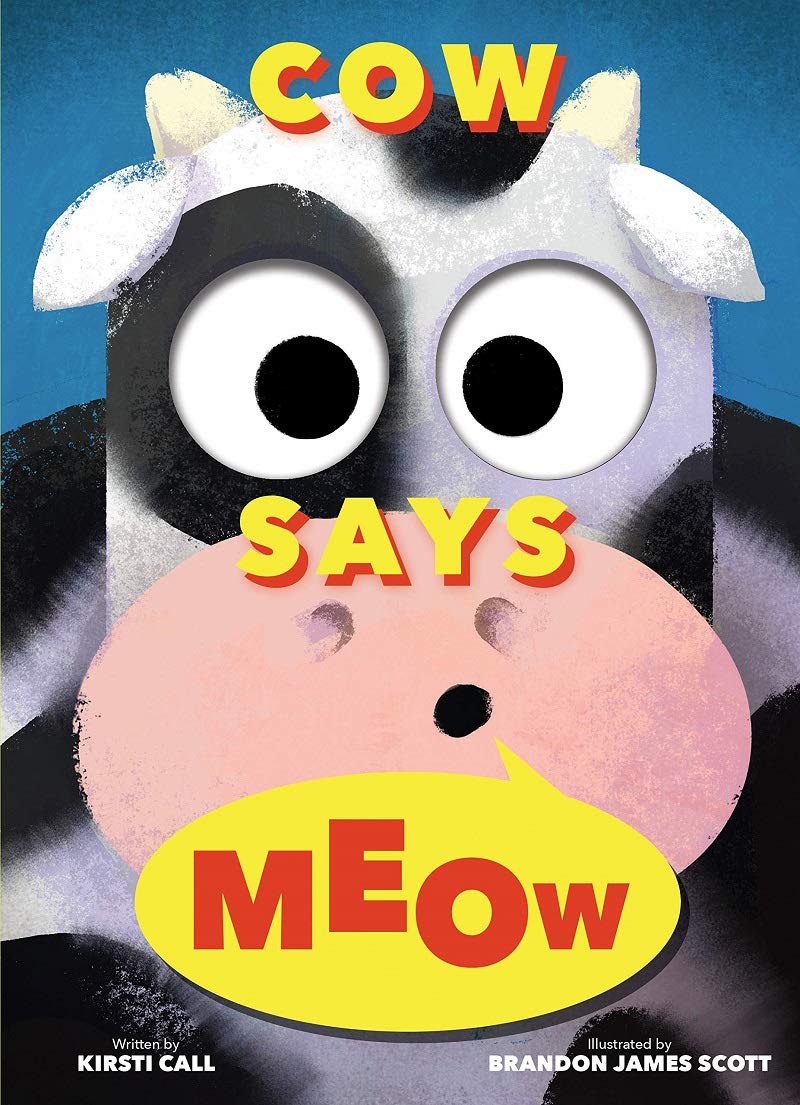
We all know what each animal sounds like, right? But what if the animals themselves forgot or got confused? Well, it might sound a lot like Kirsti Call’s giggle fest, Cow Says Meow. To start off the fun, a little boy peeks up from the bottom of the first page at a cow that already looks a little perplexed as the narrator announces, “Cow says…” Hey! I know this one! readers will think, but when they turn the page, the cow lets out a vigorous “MEOW.”

The boy has something to say about that—as well as a clever sense of humor. He tells the cow “What a copycat!” With this pun, a cat—looking as if someone has just stepped on its tail—pops up. What does this cat say? Well, here’s a hint: the boy thinks “the cat sounds hoarse!” By now kids will be laughing and begging to turn the page to hear what the horse has to say for itself.

celebrate-picture-books-picture-book-review-cow-says-meow-cat

Image copyright Brandon James Scott, 2021, text copyright Kirsti Call, 2021. Courtesy of HMH Books for Young Readers.

Each page introduces kids to another befuddled animal and a funny pun to go with their mixed-up language. At last the boy meets a pig who greets him with a friendly “HI!” But “pigs don’t say ‘hello’!” the boy marvels. And here’s a new kid to set the record straight. But what does she say? Let’s just say the boy thinks “this story was an udder disaster.” Maybe it’s time to start over… after all, the cow’s back asking, “Can I say MEOW again?”

The hilarity of Kirsti Call and Brandon James Scott’s book doesn’t begin and end with just the story. Round cutouts on the front and back covers allow kids to look at the world through the eyes of the cow and the cat and have fun saying whatever animal (or other) sounds they want.

celebrate-picture-books-picture-book-review-cow-says-meow-horse

Image copyright Brandon James Scott, 2021, text copyright Kirsti Call, 2021. Courtesy of HMH Books for Young Readers.

Kirsti Call’s funny, feel-good book is pure escapism into that kid realm of in-the-moment goofiness and laughter that’s so refreshing. Cow Says Meow offers multitudes of rereading opportunities as children will want to match their own mixed-up sounds to each animal and young wordsmiths may want to try out their brainpower by coming up with new puns and jokes.

Brandon James Scott’s big-eyed, bemused animals, shown in comical close-up portraits as they prepare to speak on one page and then full bodied on the next as they do, are the perfect foils for Call’s story. Their vibrant, textured images and slightly crossed eyes enhance both the mystery and the humor of this cleverly conceived book. All dialogue is delivered in speech bubbles, which will thrill new and emergent readers who want to join in. The cut-out eyes in the covers are genius, creating a whole package of storytelling and playtime in one.

If you’re looking for a book that will elicit laughs every time you share it, one that makes a terrific take along, and would be a much-loved gift, Cow Says Meow is it. The book is a must for goofy, just plain fun story times at home, in the classroom, and for public libraries.

Ages 4 – 7

HMH Books for Young Readers, 2021 | ISBN 978-0358423348

Discover more about Kirsti Call and her books on her website.

To learn more about Brandon James Scott, his books, and his art, visit his website.

Sing along with Kirsti Call and this Cow Says Meow song!

National Goof Off Day Activity

celebrate-picture-books-picture-book-review-silly-balloons

Silly Balloons


You can have lots of silly fun with balloons! Try some of these ideas—they’re sure to make you laugh!

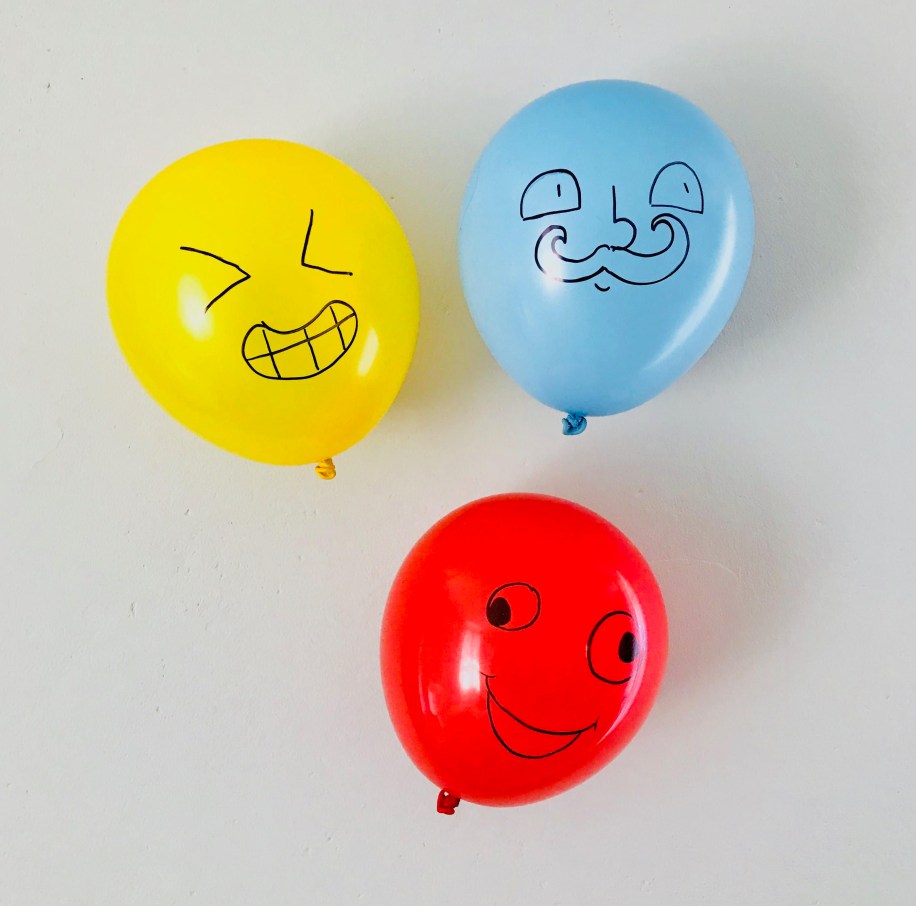
Goofy Faces

Blow up a balloon and draw a funny face on it. Rub the balloon on your shirt or a blanket and stick it to the wall, your shirt, or even your mom or dad!

Crazy Hair

Rub a blown-up balloon on your shirt or a blanket (fleece works well) then hold it near your hair and watch it go a little crazy!

Bend Water

This bit of balloon magic will amaze you! Rub a blown-up balloon on a blanket (fleece works well). Turn on a faucet to a thin stream of water. Hold the balloon near the stream of water and watch it bend toward the balloon. 

Volleyballoon

This is a fun game for two or more people played like volleyball—but with balloons! All you need is a balloon and a line on the floor. Players form teams and bat the balloon back and forth over the line, keeping it in the air.as long as possible. A team wins a point when the opposing team can’t return the balloon.

celebrate-picture-books-picture-book-review-cow-says-meow-cover

You can find Cow Says Meow at these booksellers 

Amazon | Barnes & Noble | Books-a-Million

To support your local independent bookstore, order from

Bookshop | IndieBound

Picture Book Review

March 20 – It’s the Spring Equinox

celebrate-picture-books-picture-book-review-when-spring-comes-cover

About the Holiday

Today, we celebrate the first day of spring! What makes the equinox so special? On this date, day and night are equally long around the globe. With longer days and warmer weather, thoughts turn to nature and renewal. For many this means gardening for ourselves and for the returning bees and butterflies. Today’s book takes a look at one of nature’s most inspiring creatures – the monarch butterfly. 

When Spring Comes

Written by Kevin Henkes | Illustrated by Laura Dronzek


This beautiful tribute to spring is as surprising as new buds pushing through the earth or tiny hatching eggs. Using repeated phrasing, lyrically expressed facts, and poetic rhythms, When Spring Comes echoes the anticipation that sunnier days bring after a long winter. The book opens with a simple, evocative sentence: “Before Spring comes the trees look like black sticks against the sky.” Children will immediately agree—they see trees in this way out their windows and draw them like this in art class.

celebrate-picture-books-picture-book-review-when-spring-comes-robins

Image copyright Laura Dronzek, 2019, text copyright Kevin Henkes, 2019. Courtesy of Greenwillow Books.

The following sentence is equally as true: “But if you wait Spring will bring leaves and blossoms.” The book’s contrasting lines that explore conditions “before Spring comes” and “If you wait” gradually reveal more and more of springtime’s wonder, like the melting snows that usher in rainy days: “Spring comes with sun and it comes with rain and more rain and more rain. Do you like mud? Do you like puddles? I hope you like umbrellas.”

celebrate-picture-books-picture-book-review-when-spring-comes-spring

Image copyright Laura Dronzek, 2019, text copyright Kevin Henkes, 2019. Courtesy of Greenwillow Books.

As Spring wakes more fully, it takes on a personality of its own: “Spring will call out the pussy willows and new kittens too. Spring can come quickly or slowly. It changes its mind a lot. But when Spring is finally here to stay, you will know it…There will be buds and bees and boots and bubbles.”  And there is much more to discover about this season of rebirth as well as the future within these pages.

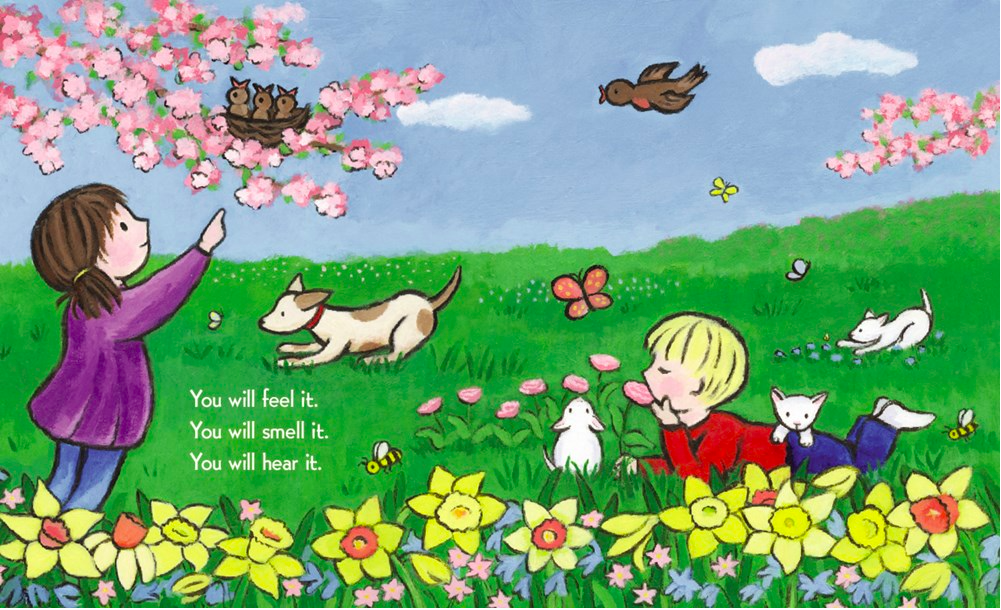
When Spring visits it brings many wonderful smells, sounds, activities, and creatures, all of which are gorgeously depicted in Laura Dronzek’s radiant illustrations. The early gardens, blooming cherry trees, frolicking kittens, and profusions of flowers are as bright and welcome as the springtime sun. As the sweet-faced boy and girl in the book play, they are surrounded by birds, bunnies, dogs and kittens, and even ponder a little worm poking its head from the garden. Brilliant blues, pinks, greens meld with lush browns to create a joyful celebration of the newness of the season.

When Spring Comes is not only a book about a particular season or even for a particular age. The book is a wonderfully gentile and uplifting way to introduce or discuss the idea of waiting for good things to happen. Everyone, even the smallest child, has “winter days” when life doesn’t look so bright. But if you wait, spring comes with new life and surprises. 

Ages 4 – 8

Greenwillow Books, HarperCollins, 2016 | ISBN 978-0062331397 (Hardcover, 2016) | ISBN 978-0062741677 (Paperback, 2019) | ISBN 978-0062741660 (Board Book, 2018)

Discover more about Kevin Henkes and his books on his website.

Spring Equinox Activity

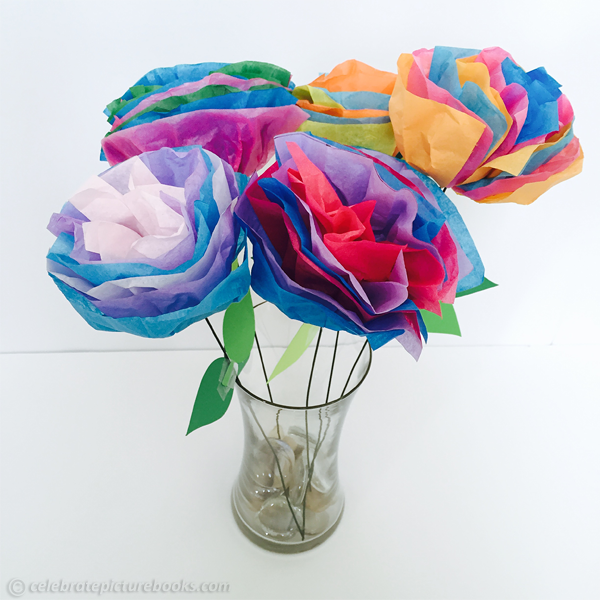
CPB - Paper Flowers

Paper Flowers


These paper flowers will brighten any room and come in a rainbow of colors. Make a bouquet for yourself or share them with a special friend.

Supplies

  • Tissue paper in many colors
  • Green paper
  • Green wire for stems
  • Scissors
  • Tape or glue
  • Pliers

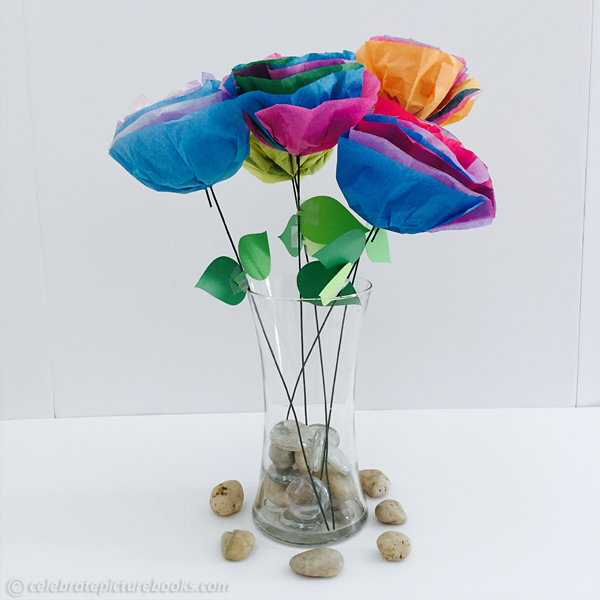
CPB - Paper Flowers II

Directions

To make the stem

  1. Bend a 1 ½ -inch loop in the top of the wire
  2. Squeeze the wire together so it will fit tightly over the tissue paper

To make a flower

  1. Cut 6 or more 7-inch squares from tissue paper, mixing colors (you can make various sizes of flowers by making the squares larger or smaller and adding more squares)
  2. Gather all the squares together and fold them together accordion-style in 1-inch folds
  3. Slide the folded tissue paper under the wire loop, and tighten the wire
  4. Gently fan the tissue paper out on each side
  5. Beginning on one side, gently pull each sheet of tissue paper up toward the center
  6. Repeat step 5 on the other side

To make leaves

  1. Cut leaves from green paper, leaving a stem to wrap around the wire flower stem
  2. Fold the leaf stem around the wire and tape or glue

celebrate-picture-books-picture-book-review-when-spring-comes-cover

You can find When Spring Comes at these booksellers

Amazon | Barnes & Noble | Books-a-Million

To support your local independent bookstore, order from

Bookshop | IndieBound

Picture Book Review
 

March 19 – National Let’s Laugh Day

celebrate-picture-books-picture-book-review-sam's-first-word-cover

About the Holiday

There’s nothing better than a good laugh! Today people are encouraged to share jokes and funny stories and to find the humorous side of events. Laughing every day can make you feel better, and it’s good for your health. So, pick out a funny show to watch and, of course, lots of funny books! There are so many out there to discover—like today’s upcoming holiday offering!

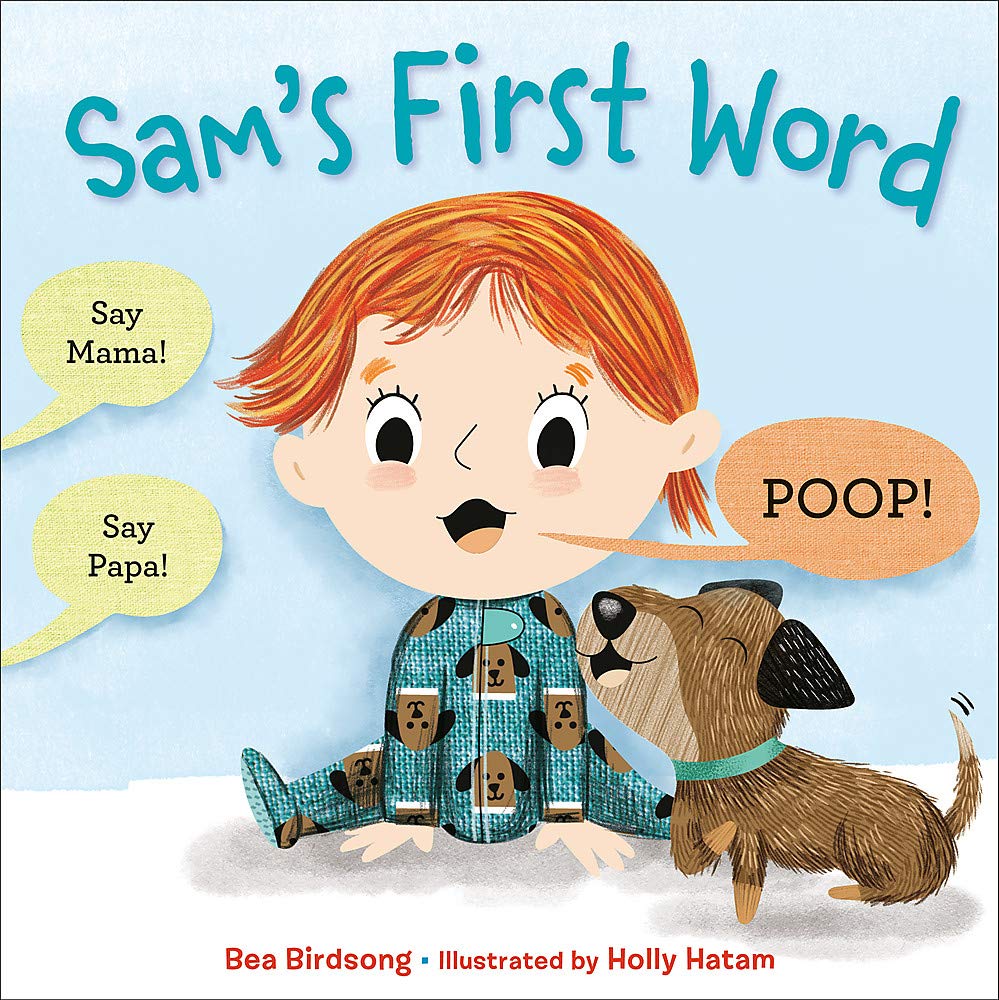
Sam’s First Word

Written by Bea Birdsong | Illustrated by Holly Hatam


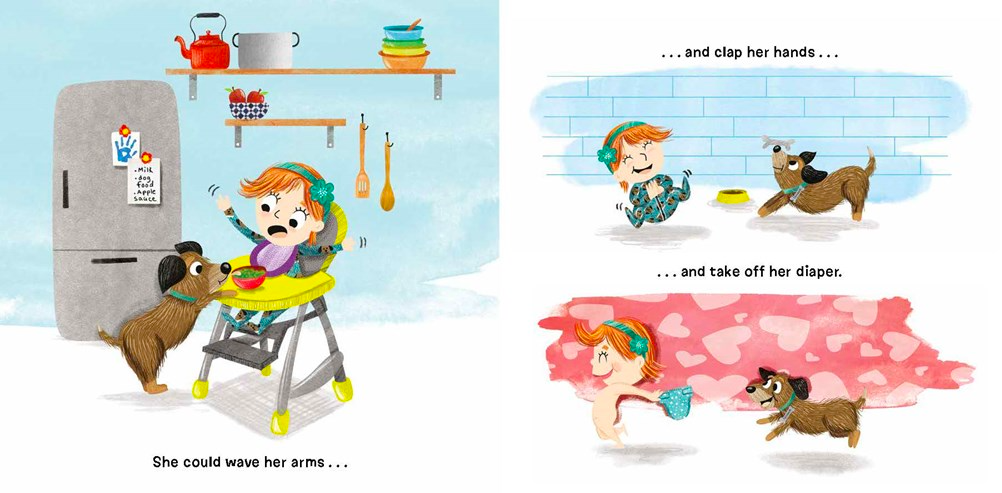
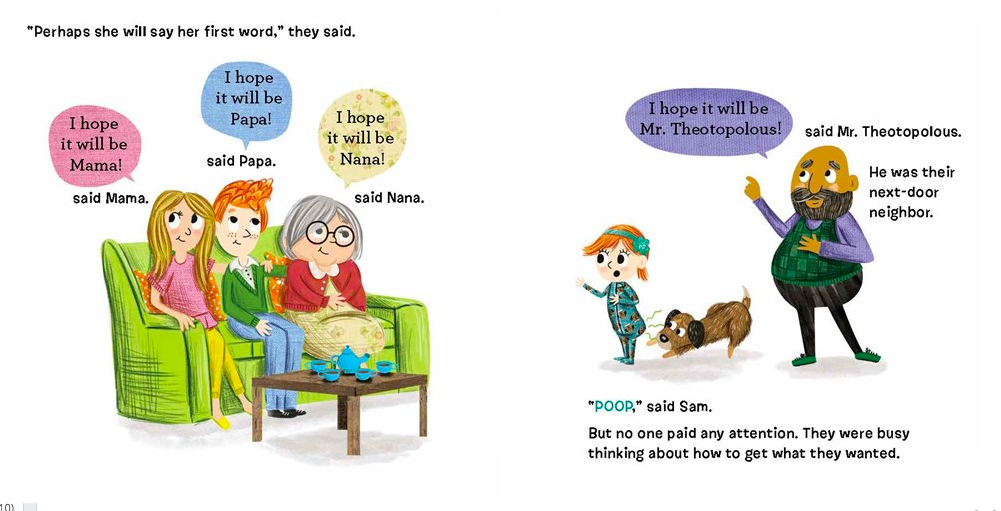
As a “newish” baby, Sam could do a lot. “She could wave her arms… and clap her hands… and take off her diaper.” Whenever Sam did something new, the adults in her life got excited. They cheered her on and then “wondered what she’d do next.” The thing they were waiting for the most was to hear her first word. And Mama, Papa, Nana, and even their next-door neighbor Mr. Theotopolous all hoped Sam’s first word would be their name.

celebrate-picture-books-picture-book-review-sam's-first-word-clapping

Image copyright Holly Hatam, 2021, text copyright Bea Birdsong, 2021. Courtesy of Little Brown Books for Young Readers.

While they were dreaming up ways to influence Sam’s big (announcement), Sam said, “‘POOP.’” But daydreaming as they were, “no one paid any attention.” Mama sang a song for Sam. The lyrics were “Mama Mama Mama Mama” sung sixty-three times. Papa told Sam a story that consisted of “203 words. All of them were Papa.” While all this was going on, Sam was waving her arms and clapping and saying “‘POOP.’” Nana and Mr. Theotopolous also had creative ways to inspire Sam, but Sam was more interested in getting someone to pay attention to her.

She had tried doing almost everything she knew without success. There was only one thing left. Off came the diaper and in her loudest little voice she said, “‘POOP!’” Everyone (well, almost) stopped and gazed at Sam and smiled. “She laughed. She cheered.” And don’t you wonder what she said next?
celebrate-picture-books-picture-book-review-sam's-first-word-hoping

Image copyright Holly Hatam, 2021, text copyright Bea Birdsong, 2021. Courtesy of Little Brown Books for Young Readers.

Bea Birdsong wraps up all the anticipation of a baby’s first word in a playful and funny story that will have kids and adults giggling all the way to the pitch-perfect ending. Adults’ sometimes obliviousness gets a gentle ribbing as Mama, Papa, Nana, and even the neighbor do all they can to hear Sam say their name first. Birdsong sets up the pacing just right to enhance the humor and to allow kids to do some predicting if they like. Speech bubbles invite dramatic reading and singing that kids will want to join in on too. The book may elicit sweet reminiscences for families too.
Fresh, fun, and endearing, Holly Hatam’s bright illustrations will charm kids and adults. While the adults may be momentarily focused on being the apple of Sam’s eye, the love and pride they show in Sam’s accomplishments shine through on each page. Appropriately, little Sam steals the show as she makes her declaration, waving leaves for her mom, clapping at her dad, and pointing pointedly for her nana. A two-page spread hilariously shows that necessity makes an invaluable teacher, and Hatam’s adorably determined Sam reminds readers that when it comes to kids, surprises are always right around the corner.

Witty and original, Sam’s First Word is a story kids and adults will love sharing again and again. The book would make a perfect gift for parents, grandparents, and other caregivers and an often-asked-for addition to all young children’s book collections.

Ages 4 – 8

Little Brown Books for Young Readers, 2021 | ISBN 978-0316452441

Discover more about Bea Birdsong and her books on her website.

To learn more about Holly Hatam, her books, and her art, visit her website.

National Let’s Laugh Day Activity

celebrate-picture-books-picture-book-review-funny-matching-game

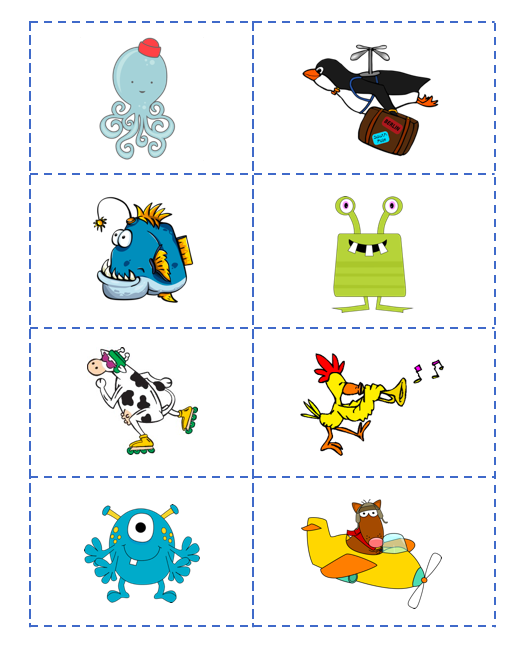
Funny Matching Card Game


Give your memory and your chuckles a workout with this printable game!

Supplies

Directions

  1. Print two copies of each game card
  2. Cut cards apart
  3. Shuffle cards and place them face down on a table
  4. Turn over one card and try to find its match by turning over one other card. If the cards match, pick them up and set them aside
  5. If the cards don’t match, turn them face down again and try again
  6. Keep trying until all cards are matched

celebrate-picture-books-picture-book-review-sam's-first-word-cover

You can find Sam’s First Word at these booksellers

Amazon | Barnes & Noble | Books-a-Million

To support your local independent bookstore, order from

Bookshop | IndieBound

Picture Book Review