With all that’s going on this year, it’s hard to always stay positive. But trying to stay relaxed during times like these can be beneficial in many ways. Being upbeat can improve your health, lower chances of depression, make you more motivated, and lead to better relationships with family and friends. Yoga and relaxation exercises can help. For kids, reading funny books together can lighten the mood and lead to some much-needed laughter. Today’s book is a perfect place to start!
Thanks to little bee books for sending me a copy of Mootilda’s Bad Mood for review consideration. All opinions are my own.
Mootilda’s Bad Mood
Written by Corey Rosen Schwartz and Kirsti Call | Illustrated by Claudia Ranucci
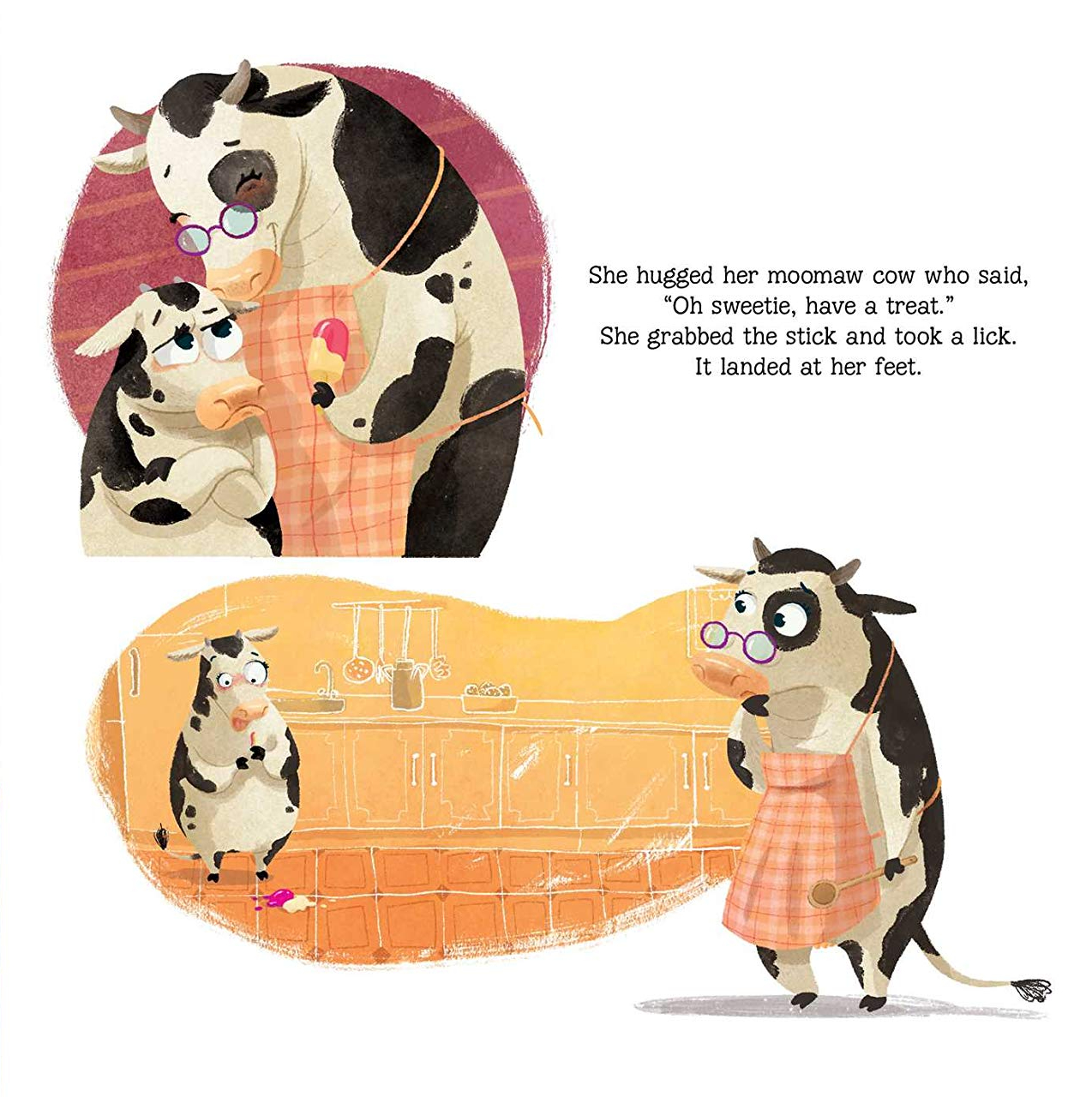
Mootilda woke up from her nap with hay in her hair, her pillow tossed to the side, and her favorite lovey lying on the floor. To make her feel better, her moomaw gave her an ice pop, but when “she grabbed the stick and took a lick, it landed at her feet.” Mootilda scowled. “‘I’m in a bad MOOD!’” she shouted. Her moomaw tried to put things right. “‘That’s terri-bull,’” she said. “She smoothed her cowlick, smooched her cheek, and said, ‘Go jump some rope.’”
Image copyright Claudia Ranucci, 2020, text copyright Corey Rosen Schwartz and Kirstie Call, 2020. Courtesy of little bee books.
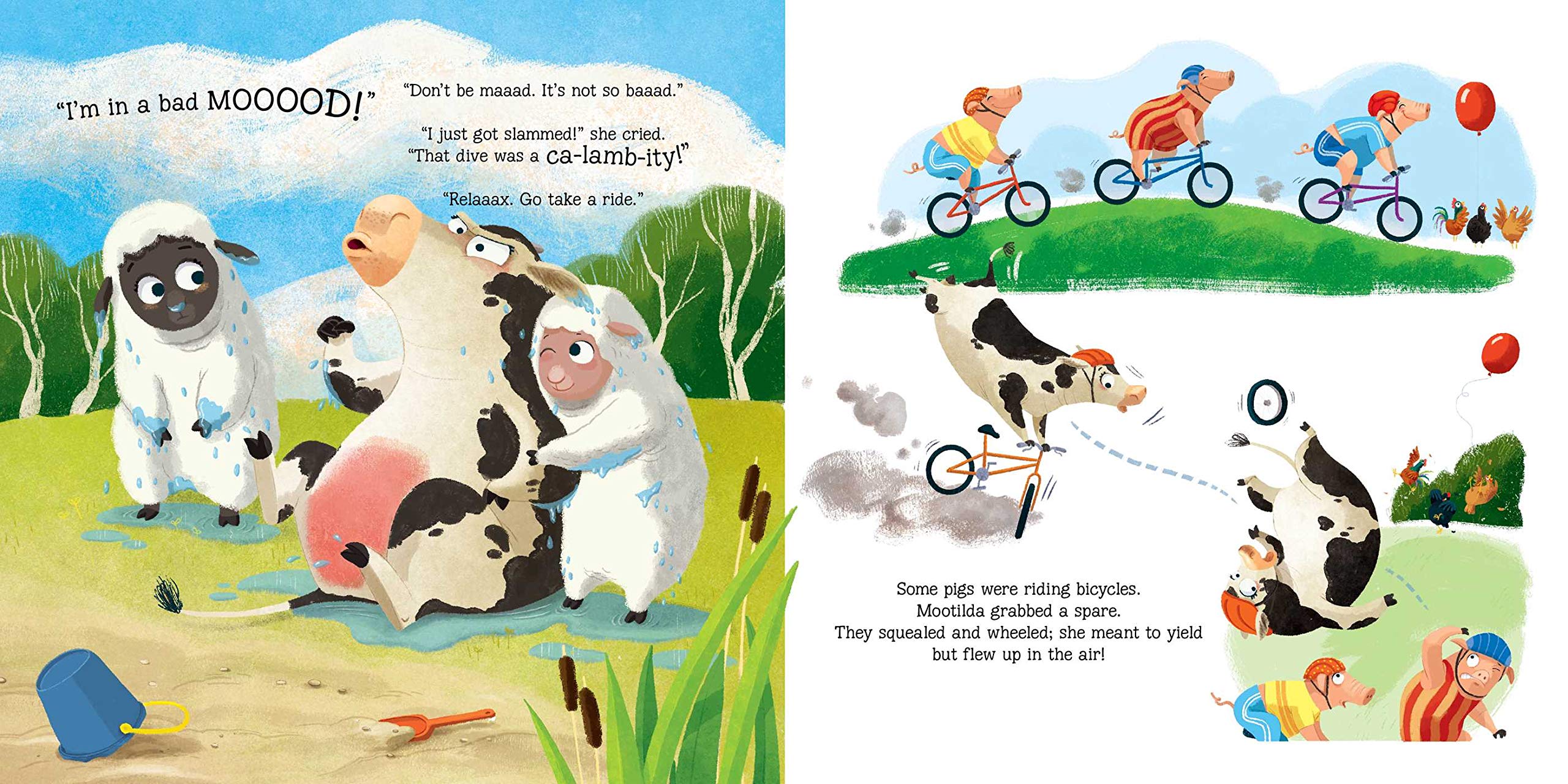
Mootilda found some friends and started off just fine, but a trip-up sent them all in a heap. “‘I’m in a bad MOOOD!’” Mootilda bellowed. Next, to soothe her exasperation, she tried swimming in the pond with the sheep. But while the lambs easily went “kerplop,” Mootilda did a painful “bovine belly flop.” The sheep agreed that Mootilda’s dive had been a “‘ca-lamb-ity,’” but suggested she take a bike ride. But her ride was not relaxing, and her game of H-O-R-S-E went astray. Mootilda stomped and yelled and thought she had been cursed.
Image copyright Claudia Ranucci, 2020, text copyright Corey Rosen Schwartz and Kirstie Call, 2020. Courtesy of little bee books.
But then the chickens who’d been playing in the bushes nearby told Mootilda their story of woe: a basketball had crashed their block building, their balloon had flown away, and their art projects had all been ruined. Mootilda thought it was quite a “cow-incidence” that they were “in a bad mood too.” That was just the word for what they were feeling, and the chickens scratched and clucked and crowed along with Mootilda. “‘We’re in a bad MOOOOOOOOOOOOOOD!’” But then, like her moomaw, Mootilda offered each chicken an ice cream dessert. She was just about to take her first lick of hers when… a crow flying by “knocked hers in the dirt.” Mootilda stared at her dropped cone… “and then she laughed. / her laughs rang on and on. / then suddenly, to her surprise, / her gloomy mood was…gone!”
Image copyright Claudia Ranucci, 2020, text copyright Corey Rosen Schwartz and Kirstie Call, 2020. Courtesy of little bee books.
No child will be able to stay unhappy long once they hear Corey Rosen Schwartz and Kirsti Call’s hilarious moood-boosting story. Rosen Schwartz and Call really milk the farmyard puns for maximum fun while providing a rollicking read aloud with giggle-inducing rhymes and rhythm. Mootilda’s move to cheer up the chickens mirrors her moomaw’s comfort and will remind readers of their own parents’ or caregivers’ reassurances. Mootilda’s reaction to losing her ice cream cone is pitch perfect and the final funny scene brings the story full circle. Kids will love chiming in on the repeated “I’m in a bad mooood” phrases, and as Mootilda proclaims that she’s “over the moooooooon,” you can be sure they’ll ask to hear the story one moooooore time.
Image copyright Claudia Ranucci, 2020, text copyright Corey Rosen Schwartz and Kirstie Call, 2020. Courtesy of little bee books.
Claudia Ranucci’s Mootilda is having the worst day ever, but the deep pout on her pink snout is more endearing than angry. As Mootilda tries activity after activity to have some fun and improve her mood, only to see disaster strike again and again, alert readers will be drawn to the background of each spread, where the chickens are experiencing their own fiascoes, caused by Mootilda’s mishaps. Flapping wings, flying art supplies, a buried sandcastle, a wayward balloon, and an explosion of blocks will keep kids laughing. Bold typography invites kids to read along on the puns, and Ranucci’s vibrant color palette will always brighten readers’ day.
To make any bad day better and any good day exceptional, Mootilda’s Bad Mood would be a fast favorite on home, school, and public library bookshelves.
To learn more about Kirstie Call and her books and to sing along with Mootilda’s Song, visit her website.
You can learn more about Claudia Ranucci and view a portfolio of her work on her website.
Positive Attitude Month Activity
Mooood Brightening Cow Mug
It’s hard to be in a bad mood with a cup of hot cocoa served in this cute cow mug that you’ve made yourself!
Supplies
White ceramic mug, available at craft stores
Black permanent marker or paint for ceramics
Pink permanent marker or paint for ceramics
Brown permanent marker or paint for ceramics
Directions
With the pink marker or paint, draw an oval shape for the nose near the bottom of the mug. Let dry.
With the brown marker or paint, draw two angled nostrils inside the pink oval and color them in. Let dry.
Color in the nose with the pink marker or paint.
With the black marker, color the top tip of the handle where it meets the mug to make the tail.
With the black marker or paint, draw two wavy lines on either side of the face starting at the top, angling toward the middle and returning to the bottom of the mug. Leave white space between the lines.
Draw circles for eyes within the black lines. Add black pupils at the bottom of the eyes.
Color inside the black lines and around the eyes to make the face markings.
With the black marker or paint, make two or three splotches on the back of the mug.
Let the mug dry and follow the directions for the markers or paint to set the color.
Pour yourself a mug of milk and enjoy!
You can find Mootilda’s Bad Day at these booksellers
We love our cars! Sometimes it seems we spend more time with them than with our own family – and maybe some of us do! What do you call such a reliable partner? A friend, of course! Our friends have names, so why shouldn’t our cars? That’s the idea behind today’s whimsical holiday. To celebrate, give your car the perfect moniker. All names are open, well…
Thanks to Blue Slip Media and Aladdin for sending me a copy of All Except Axle for review consideration. All opinions about the book are my own. I’m revved up to be offering a giveaway of the book as well! See details below.
All Except Axle
Written by Sue Lowell Gallion | Illustrated by Lisa Manuzak Wiley
At the car assembly plant, all the new cars were happily getting buffed before they rolled off the conveyor belt and raced into their slot on the lot. That is… “all except one. Axle.” From the parking lot, the cars drove up the ramps and onto the big transport trucks for the next part of their adventure. But one car lagged behind, watching from a distance – Axle.
Image copyright Lisa Manuzak Wiley, 2020, text copyright Sue Lowell Gallion, 2020. Courtesy of Aladdin.
The transport trucks vroomed onto the highway, but…. They were one short. “Earlene, and her passengers…were waiting for Axle.” Axle idled nearby. “‘I think I’m out of alignment,'” he told Earlene. “‘I think you’re stalling,'” Earlene said. The other cars were encouraging, but Earlene got Axle moving with a loud HONNKK!
Finally zooming down the highway, the other cars loved feeling the wind and “[leaning] into the twists and turns.” But Axle felt carsick. When the reached the dealership, the other cars eagerly explored the lot and showroom. All except Axle, who “hurried back up Earlene’s ramp and pleaded with her to go back to the plant.
Image copyright Lisa Manuzak Wiley, 2020, text copyright Sue Lowell Gallion, 2020. Courtesy of Aladdin.
With a Vroom they were off – but not to the plant. Soon, Earlene veered into a truck stop, where, she said, Axle could practice. Axle made right turns, left turns, and U-turns around the cement columns and followed Earlene around and around the lot. Then they left the truck stop and headed out to the flatlands, the foothills, where “the slope grew steeper and steeper,” and even into the mountains. From high on the top of a mountain, Axle stopped to enjoy the view.
Image copyright Lisa Manuzak Wiley, 2020, text copyright Sue Lowell Gallion, 2020. Courtesy of Aladdin.
Earlene was zipping back down the curvy mountain road with Axle far behind. Then Axle smelled something burning and watches as Earlene “rockets up a runaway truck ramp.” When Earlene finally stopped, they saw the flat tire. Earlene needed a tow truck and Axle was her only hope. He turned around and climbed the mountain road again. It was a strain on his engine, but when he reached the top, Axle kept on going all the way back to the truck stop.
There he found a tow truck and led it straight back to Earlene. “‘Nice job, kid,’ the tow truck said” then offered Axle a ride back into town. But Axle replied, “‘No thanks, I can drive!'” and he zoomed ahead to lead Earlene and the tow truck back to the city.
Image copyright Lisa Manuzak Wiley, 2020, text copyright Sue Lowell Gallion, 2020. Courtesy of Aladdin.
Car, truck, and vehicle fans will love Sue Lowell Gallion’s story that boosts little ones’ self-confidence with reassurance and a sweet hero who just needs a little more practice to discover the courage under his hood. With plenty of puns to tickle readers, Gallion’s story reflects the feelings of kids hesitant to make changes or leave their comfort zone. Axle’s reactions mirror many behaviors anxious or hesitant children display, allowing adults and kids an opportunity to talk about emotions. Her well-paced story also lets readers to ride along with Axle as he tries out and improves his skills. When Earlene needs help, Axle may feel a moment of nervousness, but with his new-found belief in himself, he takes to those once-scary roads and saves the day.
Lisa Manuzak Wiley’s bold and vibrant illustrations will appeal to kids – and especially vehicle-lovers – with detailed images of cars on a factory line, loaded into transport trucks, and heading out on the open road. Her vehicles are both realistic and whimsical, and their expressive headlight eyes clearly reflect Axle’s trepidation and the other cars’ excitement for their adventure. Children will enjoy pointing out and counting the different cars from page to page.
For children who need a little encouragement on the road of life, All Except Axle is an engaging and reassuring story that’s sure to capture their imagination.
You can find an All about Axle Storytime Kit with a puzzle, puppets, a coloring page, discussion questions, and a coping strategies worksheet on Sue’s website here.
To learn more about Lisa Manuzak Wiley, her books, and her art, visit her website.
Name Your Car Day Activity
Racing for Friendship Game
Here’s a racing game that kids will love! With poster board, paper, and chalk or other art supplies, kids can place their track in a city, the country, the desert, or even in outer space! Once the scene is ready, get out your own toy cars or trucks to play with or use the printable truck game pieces included below. Use a traditional playing die or the included printable 8-sided playing die. The first player to the finish line wins—or shake it up a bit and make the last person to the line the winner.
The track can be laid out on the floor and taped in place or created on poster board or paper with the supplies below:
Supplies
Poster board or tri-fold display board. I used a 12-inch by 4-foot section of a tri-fold board in my example. This allows you to fold up the board for easier storing.
Cut 30 4- or 5-inch by 1½-inch strips from the white paper
Have kids lay out a track on the board using the white paper strips (each strip is one space) leaving room in between the rows for scenery
Glue or tape the strips in place
Draw scenery around the track OR cut trees, buildings, landmarks, or other scenery from paper and color. Glue or tape to board.
Print and assemble 8-sided playing die with tape (optional)
Give each player a toy truck or car. Alternately, print and cut out included Truck Game Pieces. (To make them sturdier, print on heavy paper or glue them to cardboard)
Choose a player to go first
Players take turns rolling the die and moving the appropriate number of spaces
The first (or last) player to the finish line is the winner
International Music Day was established in 1975 by Lord Yehudi Menuhin, an American-born violinist and conductor – widely considered to be one of the great violinists of the 20th century – to promote the art of music across all segments of society and to apply the UNESCO ideals of peace and friendship among all people, with an exchange of experiences and mutual appreciation of all cultures and their aesthetic values. To celebrate today’s holiday, listen to your favorite music and take some time to discover a new style – it might just become a favorite too!
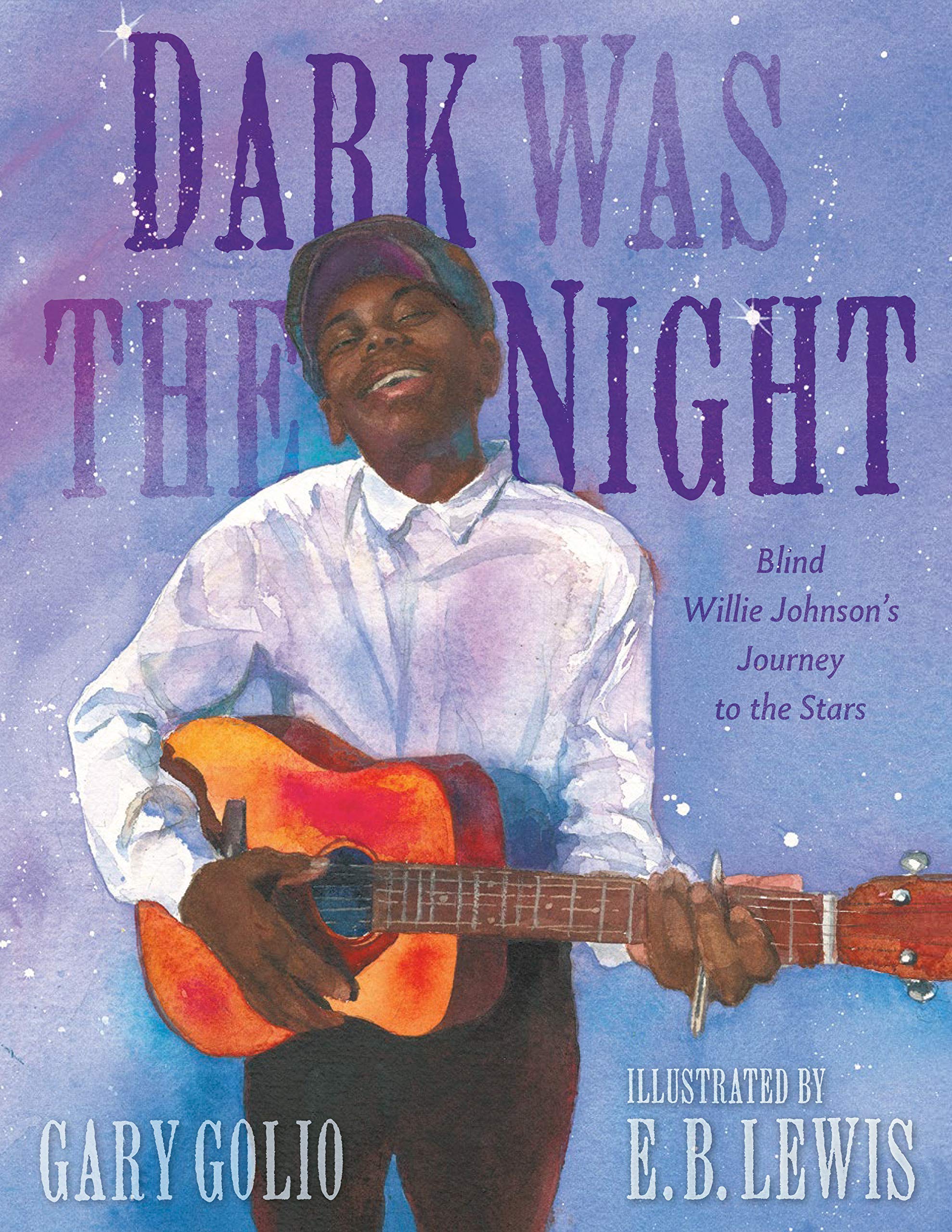
Dark Was the Night: Blind Willie Johnson’s Journey to the Stars
Written by Gary Golio | Illustrated by E.B. Lewis
As readers open the cover to Dark Was the Night, they discover a date: 1977. In this year Voyager I was shot into space carrying “a precious Golden Record, a message to the Universe from Planet Earth.” The record contained pictures of the people and things that make up our life, sounds we hear every day, music from Navajo chants and West African drumming to Beethoven and Chuck Berry. There was also one “ghostly song, about loneliness and the night….a tune of light and hope” from a blind man named Willie Johnson.
Image copyright E.B. Lewis, 2020, text copyright Gary Golio, 2020. Courtesy of Nancy Paulsen Books.
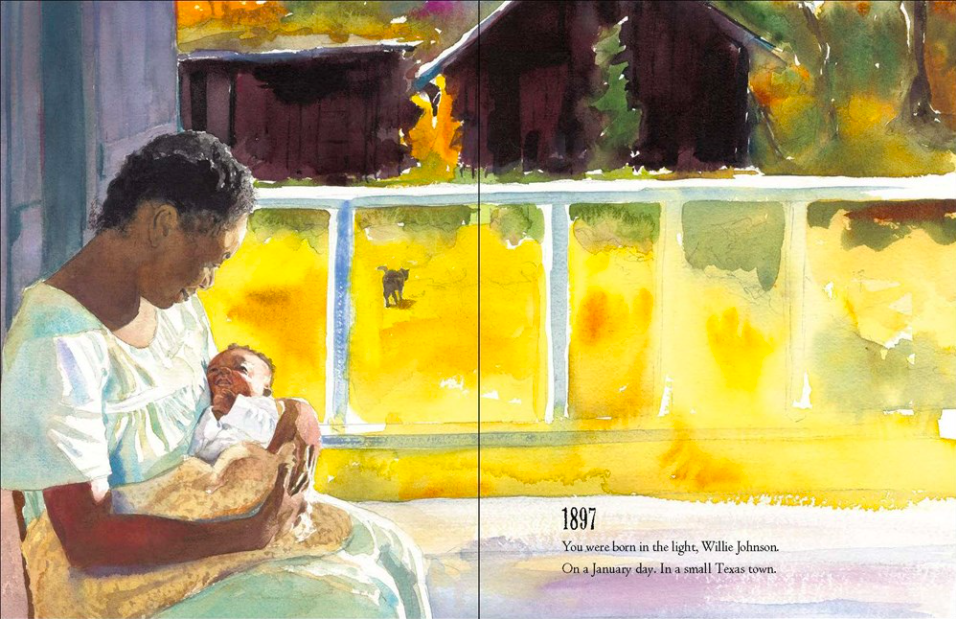
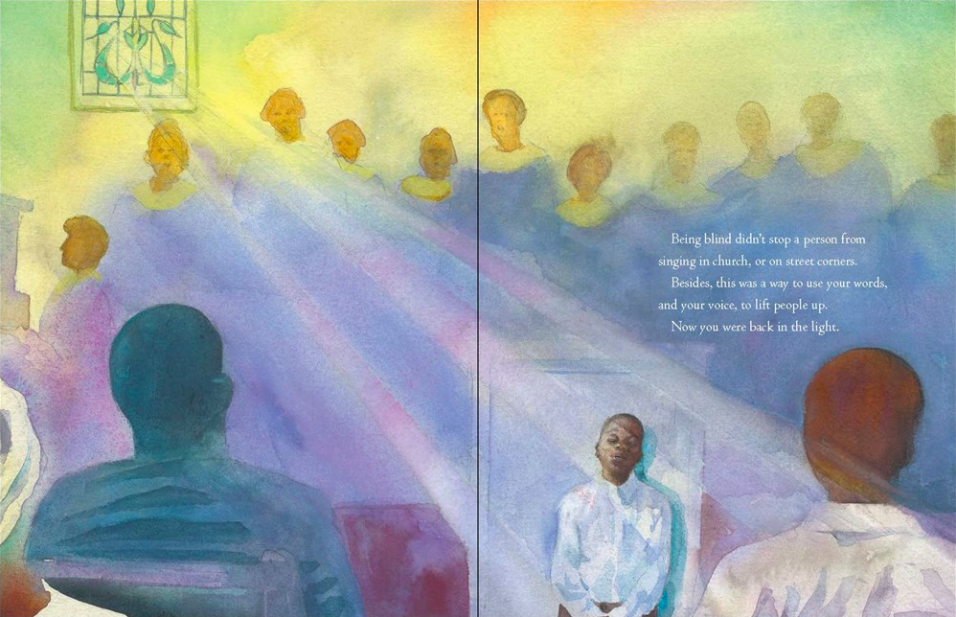
Who was Willie Johnson? In 1897, he was a newborn baby in a small Texas town wrapped in his mother’s love. narrator picks up the thread of Willie’s story when he’s become a small boy who “loved to sing” and play the cigar box guitar his father made him. But that joy was interrupted when “your mama died, and some light went out of your life.” Then at seven or eight, Willie became blind, “and that’s when things got darker still.” But Willie rose above these hurdles. His blindness didn’t keep him “from singing in church, or on street corners.” Using his voice to uplift people brought him “back in the light.”
Image copyright E.B. Lewis, 2020, text copyright Gary Golio, 2020. Courtesy of Nancy Paulsen Books.
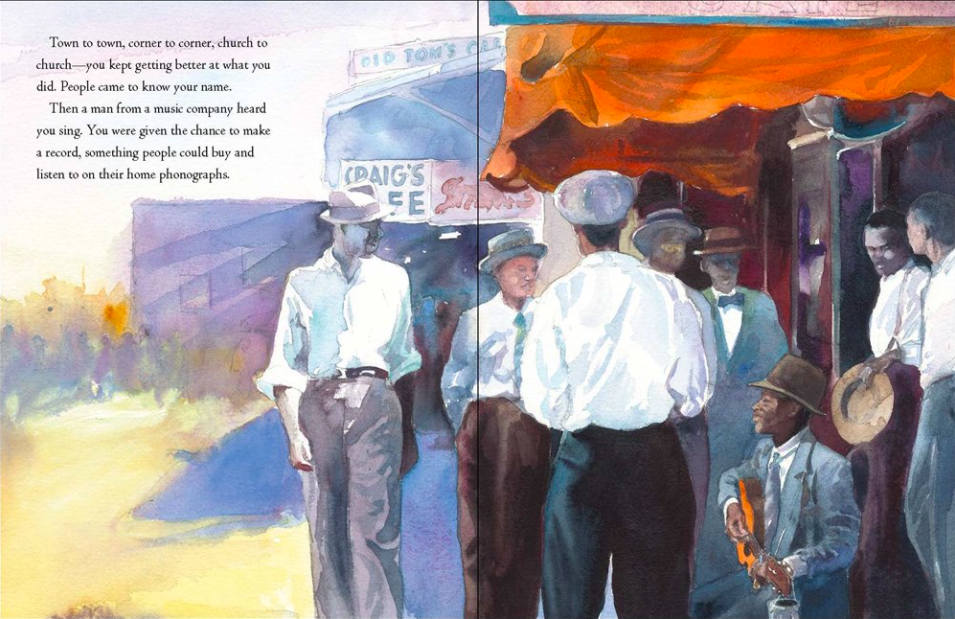
He sang blues and learned how to play a slide by running the edge of a pocketknife along the steel strings of his guitar. “This made a sound like someone laughing or crying, as if the guitar had a voice of its own.” He traveled from town to town in Texas, wherever farmers came to socialize and shop, setting up on street corners and collecting the coins people tossed into his tin cup. Little by little, people grew to know his name. “Then a man from a music company heard you sing. You were given the chance to make a record….”
Image copyright E.B. Lewis, 2020, text copyright Gary Golio, 2020. Courtesy of Nancy Paulsen Books.
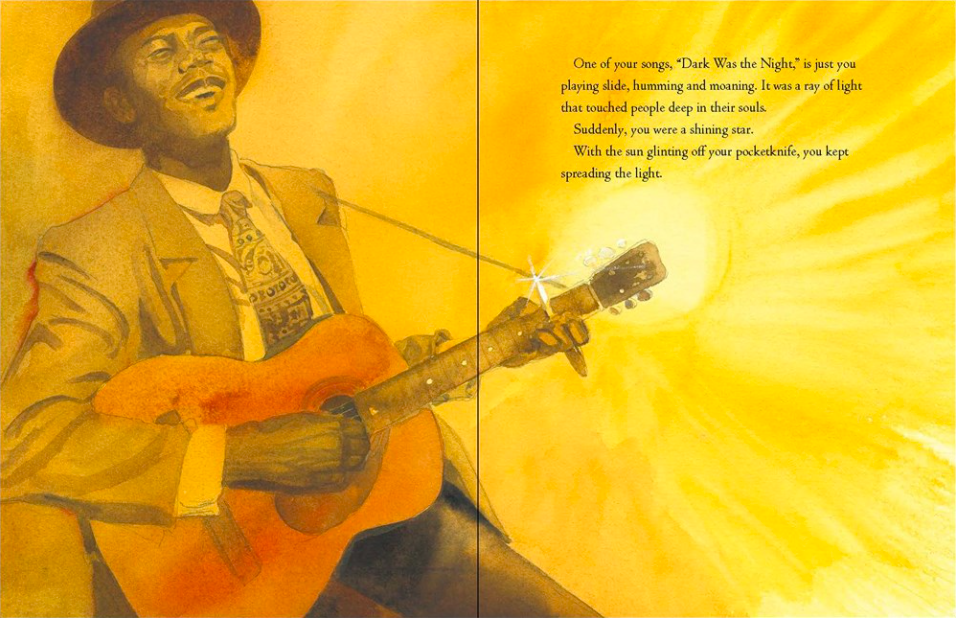
On that record listeners heard “the sound of one human being reaching out to all the others, telling them not to be afraid of the dark.” That first record was a hit, lauded for its unique sound. One song in particular, “Dark Was the Night,” “touched people deep in their souls” and made Willie “a shining star.” The light Willie brought to people has never dimmed; in fact it continues to shine through the darkness on Earth and through Space.
Back matter includes a discussion on what is known about Blind Willie Johnson and what still remains a mystery as well more information about Voyager I and why Johnson’s song Dark Was the Night was chosen for inclusion on the Golden Record. A link to NASA’s Jet Propulsion Laboratory website, where readers can access Voyager I—The Golden Record is also included.
Image copyright E.B. Lewis, 2020, text copyright Gary Golio, 2020. Courtesy of Nancy Paulsen Books.
Gary Golio’s ethereal tale of the life of Blind Willie Johnson and his song, which has touched and continues to move so many people, is a stirring tribute to a unique artist and the power of music to change lives. Golio’s use of the second person creates a poignant personal bond between the story and reader, which allows children to put themselves in Willie’s shoes and believe that they, too, can inspire others with their talent and life. Golio’s lyrical storytelling flows with the cadence of the blues, and his evocative vocabulary brings Willie Johnson’s voice and times fully to life for young readers.
E.B. Lewis transports readers to early 1900s Texas in his stunning watercolor paintings rendered in soft washes of grays, blues, and greens punctuated with yellows that reflect the hope and light that spurred Willie on and flowed from his music. As his mother holds him in her arms as a baby, the landscape outside the window blazes with gold that reflects on Willie’s and his mother’s face. As children learn about Willie’s blindness, the page turns dark, except for a swatch of light across Willie’s eyes, representational, perhaps, of his inner sight that sustained him.
Among the realistic depictions of his farm home, the outskirts of a Texas town seen from a train, and a bustling city, where Johnson plays on a street corner to an appreciative audience, his tin cup hanging from a tuner on his guitar, are transcendent images of Willie performing, his face always lifted to the light. As people gather around a radio listening to Blind Willie Johnson, light once again streams into the shop, and as Golio describes how “Dark Was the Night” becomes a hit, Willie is bathed in a golden glow, his face euphoric with the joy of singing.
At once sensitive, rousing, and inspirational, Dark Was the Night is a beautiful book about one man’s talent and dream that will resonate with all readers. The book is highly recommended for home libraries and is a must for school and public library collections.
Ages 5 – 8
Nancy Paulsen Books, 2020 | ISBN 978-1524738884
Discover more about Gary Golio and his books on his website.
To learn more about E.B. Lewis, his books, and his art, visit his website.
Listen to Blind Willie Johnson’s “Dark Was the Night.”
Meet Gary Golio
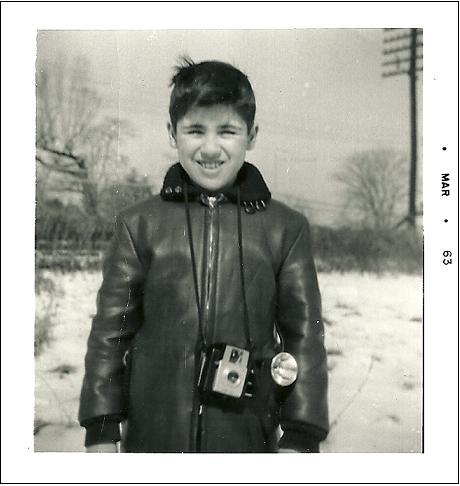
Gary Golio is the author of the New York Times bestseller JIMI: Sounds Like a Rainbow – A Story of the Young Jimi Hendrix, winner of a Coretta Scott King Illustrator Award; Bird & Diz and Strange Fruit – Billie Holiday and the Power of a Protest Song, both ALA Notables; and other books about legendary artists. A writer and musician, Golio has been featured on NPR’s “Weekend Edition”, CBS-TV’s “Sunday Morning News,”and on radio stations nationwide. He lives in the Hudson Valley with his wife, children’s book author Susanna Reich.
Today, I’m thrilled to talk with the multi-talented Gary Golio about Dark Was the Night, his love for writing and art, his father’s influence in his life, and the power of music.
Welcome, Gary! To start off, can you tell readers about your journey with this Dark Was the Night from idea to publication?
A few years back I was listening to some early blues songs, and came upon Willie Johnson’s “Dark Was the Night.” The song stunned me—and gave me the chills. I knew of Willie’s connection with the Voyager I space probe, but had no idea that blues aficionados and amateur music sleuths were devotedly digging for details of his life through the decades. So much mystery surrounded this man—revered by Jimmy Paige, Eric Clapton, and Lucinda Williams—but what intrigued me the most was that, after dying in poverty and being forgotten, Willie and his work enjoyed a revival of interest during the 1960s Folk Movement. Then, in 1978, “Dark Was the Night” ended up on Voyager‘s Golden Record, hurtling through space. And what that said to me is, you never know how a life, and its effect on others, will play out. It’s a hopeful message that inspired me to write the book.
Your father was an artist and you have worked as a fine-artist since you were a teenager. Can you talk about what inspired you to begin writing picture books? Did you always like to write?
My father is an ongoing inspiration in my life. He was a talented amateur artist who provided me with a real-life example of the Art Spirit by how he thought and created. Most importantly, he was a skilled improviser, and didn’t allow himself to be limited by what he didn’t have, something that’s always meant a lot to me. As for writing picture books, I mostly read comics as a boy, and I think it was that combination of pictures and text that really struck a chord. For me, the picture book is a modern descendant of cave painting, Egyptian wall art (images + hieoroglyphs), and Etruscan/Pompeian murals: using words and pictures to tell a story.
In your Author’s Note you talk about the dearth of knowledge about Willie Johnson’s life. Can you share one thing you learned about Willie that didn’t make it into the book?
Willie has a unique voice that somehow manages to balance the rough and the tender. There’s raw power there, but also delicacy, which is very rare. So Willie was in New Orleans at one point—during a recording session there in 1928—and the story goes that he began singing “If I Had My Way I’d Tear this Building Down” in front of the Customs House. A crowd had gathered, listening to him, and a police officer reportedly became so worried—thinking Willie was instigating a riot—that he considered arresting the man. That’s the power of music—to rouse, protest, and stir up human souls—and it’s easy to see why it threatens authority and institutions.
Dark Was the Night is your eighth biography of a musician or entertainer for children. Could you discuss what drew you to write about these musicians?
While there are no actual musicians in my family-of-origin, my parents, grandmother, and maternal aunt all had strong musical interests. Each exposed me to very specific genres and musical tastes—from Frank Sinatra and Bing Crosby to Count Basie, Louis Armstrong, Ella Fitzgerald, Nat King Cole (whom I adore), Willie Nelson, and Elvis Presley. Many of these people were Black, and many were strongly influenced by blues and jazz, and I have vivid memories of watching them on TV with my beloved grandmother, even at five and six years old. That openness to all kinds of music really shaped me, and growing up I looked for clues, in the lives of artists, that would help me find my own path and direction. So my books often focus on the early years of an artist’s/musician’s life, highlighting the roots of their artistry—what inspired and shaped them—to provide young readers with roadmaps, of sorts, to a life in the arts.
In addition to being an artist and writer, you also admit to being “a pretty good musician” – something you share with kids on school visits that sound awesome. Which instruments do you play and how do you incorporate music into your book events?
I play acoustic and electric guitar, mandolin, banjo, and very simple piano, but love above all to improvise. Since my first book on Jimi Hendrix came out, I’ve used the guitar (both electric and acoustic) to demonstrate a wide range of effects and possibilities (Hendrix and Santana), but also to accompany singalongs I did for my Bob Dylan/Woody Guthrie book. At one school visit, the entire fifth grade and I sang “This Land is Your Land” in Spanish, which was both meaningful and fun.
Each of your books has such distinctive illustrations from incredible illustrators. Can you talk a little about E.B. Lewis’s gorgeous illustrations in Dark Was the Night and how he captured your story and Willie’s personality?
E.B. is truly a master of illustration, and specifically of the watercolor medium. His real superpower, however, lies in his ability to convey humanfeeling, to mysteriously imbue a person or setting with mood and life. That’s remarkable—reminiscent of watching my father draw an American Indian on horseback, straight out of his head—and it’s what lends E.B.’s work both its power and subtlety. Not surprisingly, he has a real love for human beings, a quality fed by his passion for traveling and teaching all over the world. Though we only met at a bookstore panel five years ago, Earl and I have become close friends, and spend a lot of time on the phone collaborating about the joining of text and image. He’s a pleasure to work with, and his art for Dark Was the Night is truly sublime. This book also gave him the chance to bring his use of color (in his own words) to another level, something that will be obvious to anyone who knows his artwork and sees the new images.
From your bio on your website, you sound as if you were a pretty inventive kid – creating all sorts of cool electronic devices. And I love your story about being “shocked” to find books with Van Gogh’s paintings in them as a child and how formative that was. Could you discuss the importance of nonfiction, and biographies in particular, to children?
My father could fix most anything, and it was that spirit of improvisation and inventiveness that led me to create little electronic gadgets a la James Bond and The Man from Uncle. For a time, I wanted to be an inventor or electrical engineer, but Art won out. As for van Gogh, watching Lust for Life with my dad had a HUGE impact on me, and seeing a book in the middle school library with all those paintings reproduced made it clear to me—even at 10 years old—that there was gold in reading about the lives of artists.
While I love fantasy, myth, and good stories, the thing about nonfiction is that you’re reading about real people—with all their talents and troubles—and so it’s easier to believe that if someone else muddled through to achieve something, you can also. That’s why I don’t shy away from talking about a person’s “faults” and failures (particularly in my books about John Coltrane and Billie Holiday), because I want kids to see that great people and artists are just as human as everyone else.
What’s up next for you?
Author-wise, I’ve a book coming out next year on the revered jazz saxophonist Sonny Rollins (based on many phone conversations we’ve shared), to be illustrated by the great James Ransome. I’ve also sold, just this year, two new picture book texts: one on Roy DeCarava—a gifted artist who photographed the people of Harlem in all their humanity—and another on Walt Whitman, focused on his remarkable and moving nursing experience during the Civil War. After that, who knows where Destiny will lead me?
International Music Day Activity
I Love Music! Word Search Puzzle
International Music Day celebrates all types of music and instruments. Can you find the eighteen different instruments in this printable word search puzzle?







 celebratepicturebooks.com