In 2009 National Honey Bee Day was proclaimed by US Secretary of Agriculture Thomas J. Vilsek. The holiday quickly spread and is now celebrated worldwide. World Honey Bee Day began as National Honey Bee Day in 2009 with a proclamation issued by the Secretary of Agriculture, Thomas J. Vilsek. The day recognizes both the honey bee and the beekeepers who tend the hives and encourages people to learn about and create supportive environments in their own yards to promote healthy bee populations. Of course, it’s also a day to buy and enjoy locally grown honey. To celebrate this holiday, explore a variety of honey flavors, try a few new recipes that incorporate honey, and learn all the buzz about bees, honey, and beekeeping with today’s book!
I’d like to thank Sleeping Bear Press for sharing H is for Honey Bee: A Beekeeping Alphabet with me for review consideration. All opinions are my own.
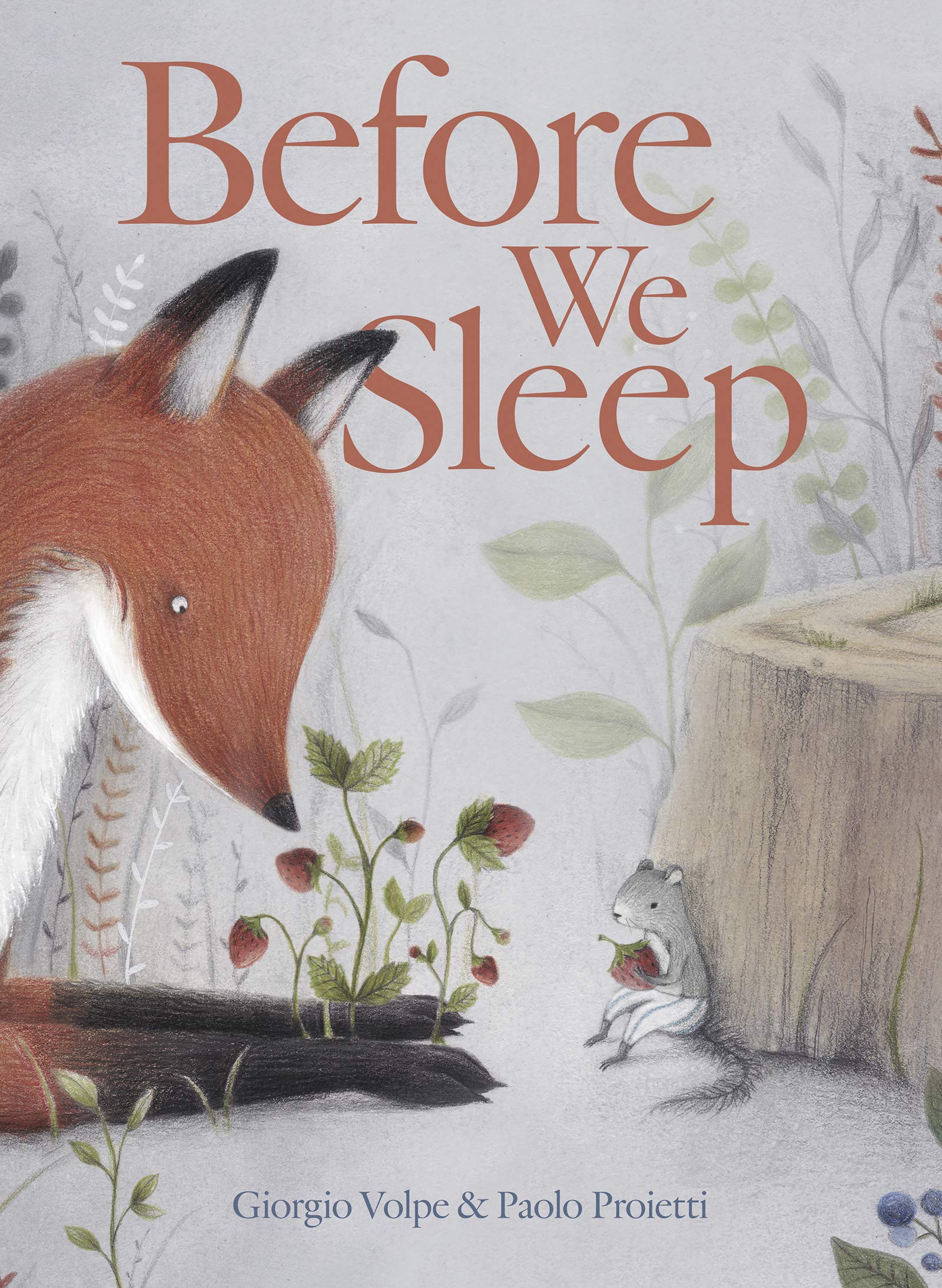
H is for Honey Bee: A Beekeeping Alphabet
Written by Robbyn Smith van Frankenhuyzen | Illustrated by Eileen Ryan Ewen
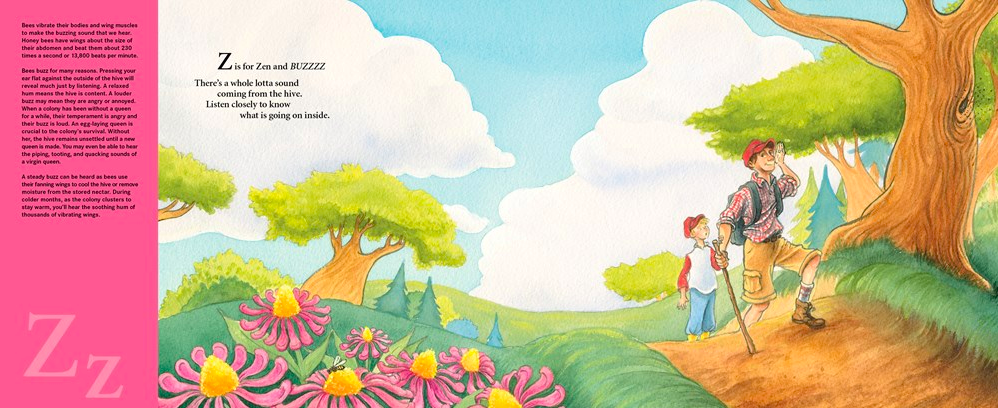
If your garden or yard is anything like mine, the bees are humming around late-summer blooms and tracing their circuitous route to nearby or far-flung hives. The mystery and marvel of how honey bees convert powdery pollen into sweet honey never fails to awe and delight. In H is for Honey Bee, readers of all ages discover fascinating facts and stories about Bees from Apis mellifera (“Apis is the clue that we’re talking about a bee. / And mellifera means it’s all about honey”) to Z “for Zen and BUZZZZ.”
Image copyright Eileen Ryan Ewen, 2020, text copyright Robbyn Smith van Frankenhuyzen, 2020. Courtesy of Sleeping Bear Press.
In between children learn all about a bee hive, its resident bees (from Drones to Guards to the Queen), how bees communicate, and at E how organized beekeeping dates back to 2400 BC and how important it was to Egyptian culture. “Found on hieroglyphs in the sun temple of Pharaoh Ne-user-re near Cairo, Egypt, an Egyptian peasant is depicted smoking stacked hives while other workers are storing and sealing honey in jars.”
Image copyright Eileen Ryan Ewen, 2020, text copyright Robbyn Smith van Frankenhuyzen, 2020. Courtesy of Sleeping Bear Press.
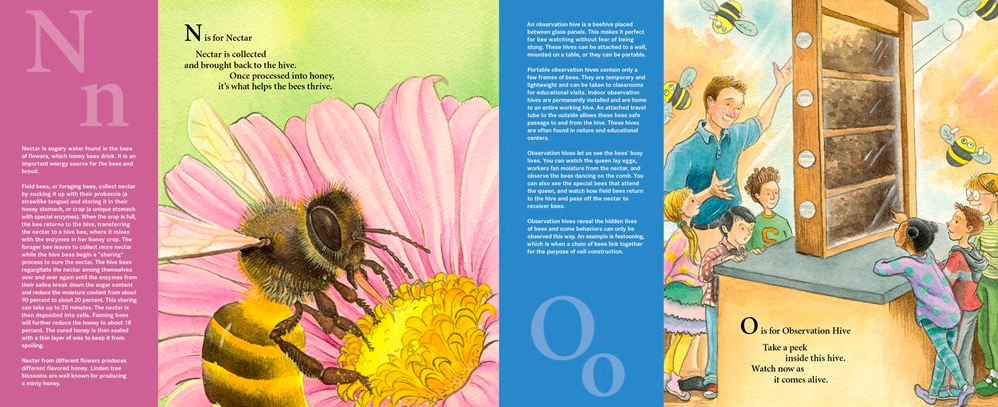
At L kids learn about Lorenzo Langstroth, “the father of humane, practical beekeeping.” After discovering that natural hives had small passages that allowed bees to move freely though them, he invented a hive with removable frames that didn’t upset the other bees or damage the combs. Langstroth’s hive paved the way for other innovations, such as the Observation Hive at O, that gives people a clear view of bees at work. “You can watch the queen lay eggs, workers fan moisture from the nectar, and observe the bees dancing on the comb” and other marvels of a bee’s day.
Image copyright Eileen Ryan Ewen, 2020, text copyright Robbyn Smith van Frankenhuyzen, 2020. Courtesy of Sleeping Bear Press.
Humans aren’t the only innovative ones, and readers will be fascinated to learn about Propolis at P, which bees make from their own saliva and other natural ingredients to protect their hive. V is for Venom—the bee’s defense that is more fun to learn about than experience. If you’re interested in where Beeswax comes from, just flip to W, and if you want to know how to tell if a hive is happy, Z is where you’ll find it.
Back matter includes resources on how you can create a safe and productive atmosphere for bees in your own yard, tips for becoming a beekeeper, and fun facts about busy bees.
Image copyright Eileen Ryan Ewen, 2020, text copyright Robbyn Smith van Frankenhuyzen, 2020. Courtesy of Sleeping Bear Press.
Through charming and informative four-line rhymes and a column of detailed facts for each letter of the alphabet, Robbyn Smith van Frankenhuyzen presents a full and exhilarating look at bees, honey, and the job of beekeeping. She describes the behavior of bees—from how they communicate to how they survive winter temperatures to how the queen rules the hive and more—as well as the dangers bees face, from inside the hive and out, in vivid language that will captivate kids. Discussions on the healthy properties of honey as well as the joys of amateur beekeeping are here as well.
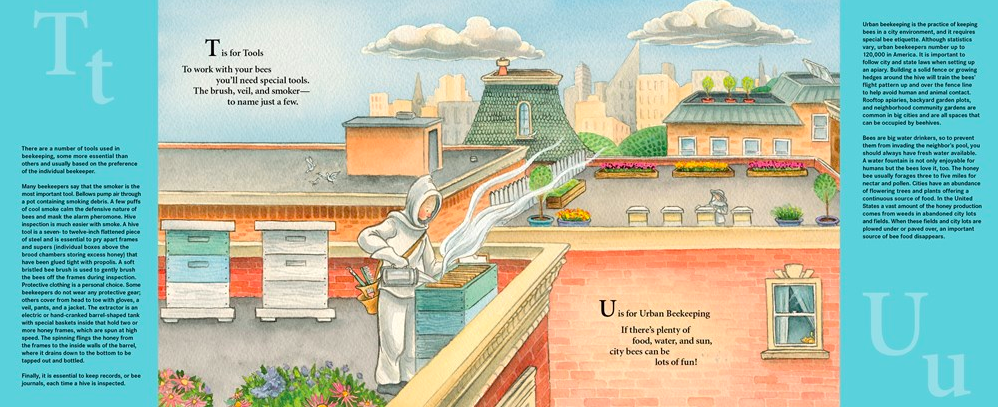
Accompanying the text are Eileen Ryan Ewen’s vibrant illustrations that give readers an up-close view of honey bees developing from egg to adult, gathering nectar, and working in their hive. Kids also meet Lorenzo Langstroth, see beekeepers working at their hives in yards and on rooftops, and travel down the Nile River with ancient beekeepers who moved their hives to continually provide them with the nectar and pollen they needed. Each page invites lingering to see and discuss all the details.
A well-rounded and comprehensive resource for those interested in bees and insects, gardeners of any age, and kids who love nature as well as for elementary and middle-grade science classes, H is for Honey Bee: A Beekeeping Alphabet is highly recommended for home, school, and public libraries.
This year World Elephant Day celebrates its 10th anniversary. The holiday was launched to raise awareness of the dangers the Asian and African elephant populations face. Poaching, habitat destruction, human-elephant conflict, and mistreatment in captivity all threaten these gentle, intelligent creatures. World Elephant Day encourages people to enjoy seeing elephants in safe, non-exploitive environments and to get involved in their protection and survival. To learn more about elephants, discover how you can be elephant ethical, and commemorate today’s holiday with virtual events led by elephant specialists, artists, zoos, and other organizations, visit theWorld Elephant Day website.
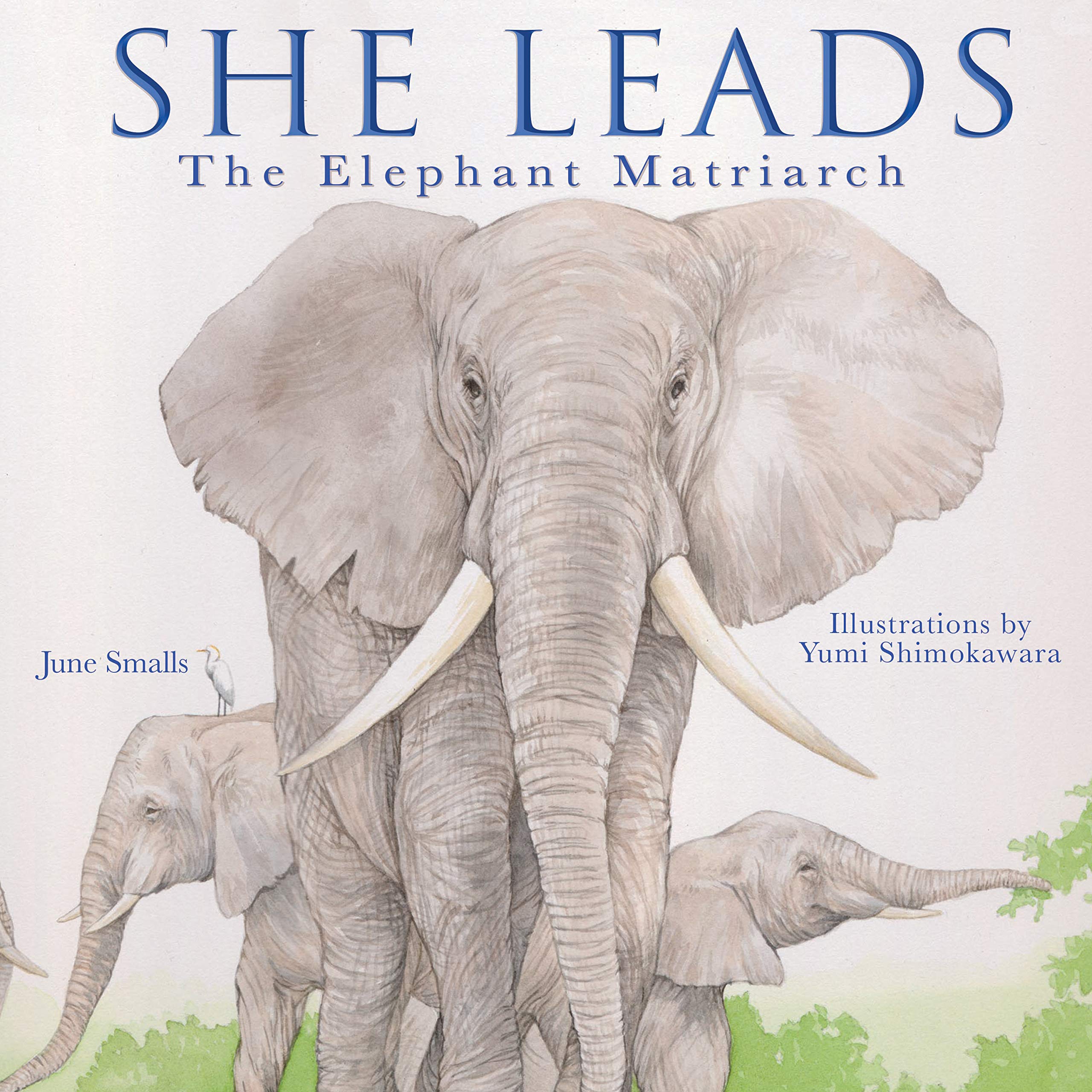
Thanks to Familius for sending me a copy of She Leads: The Elephant Matriarch for review consideration. All opinions on the book are my own.
She Leads: The Elephant Matriarch
Written by June Smalls | Illustrated by Yumi Shimokawara
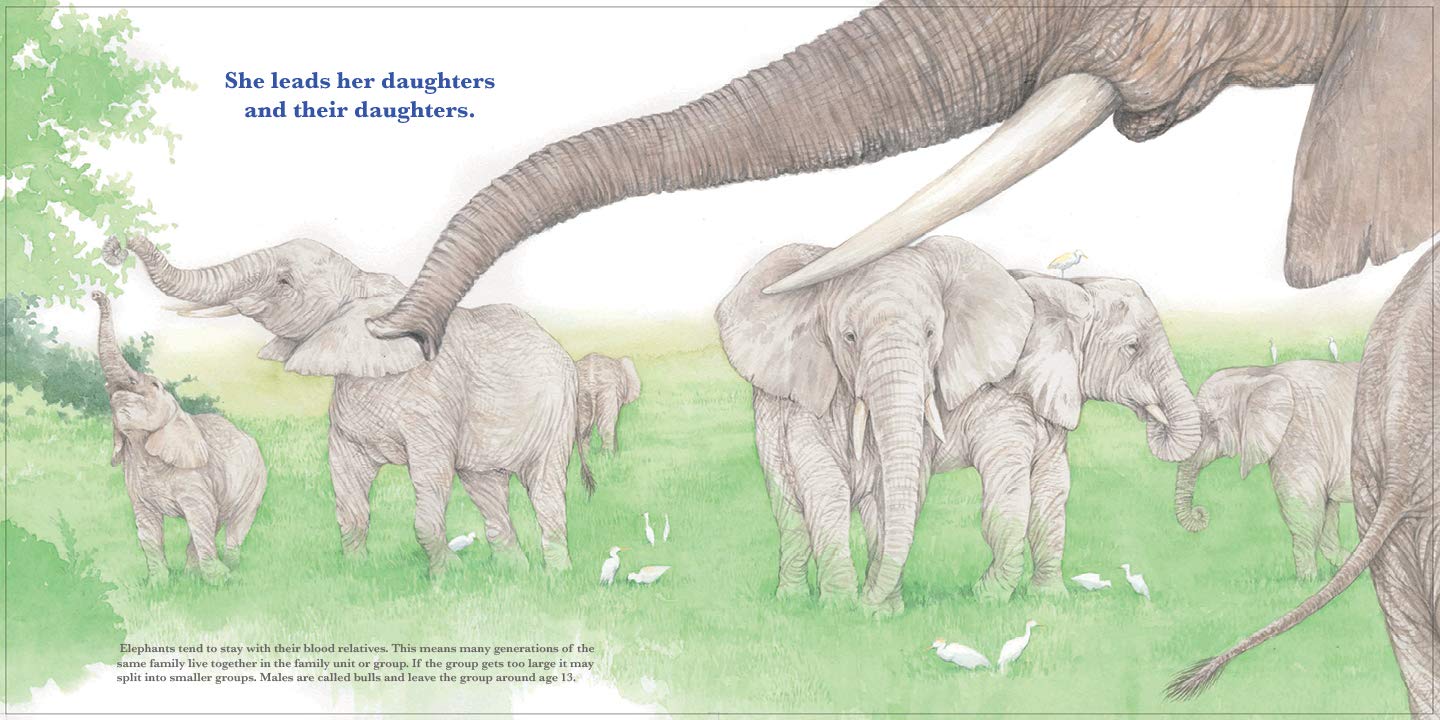
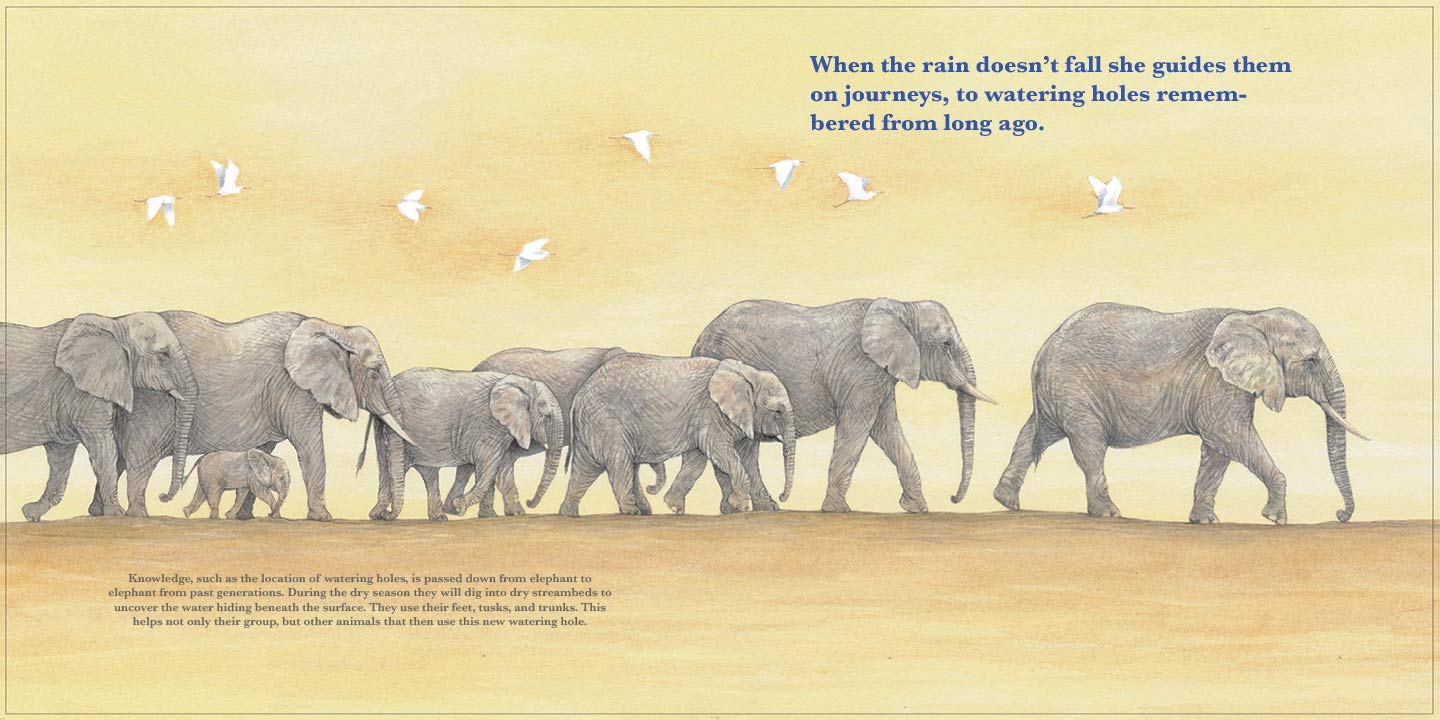
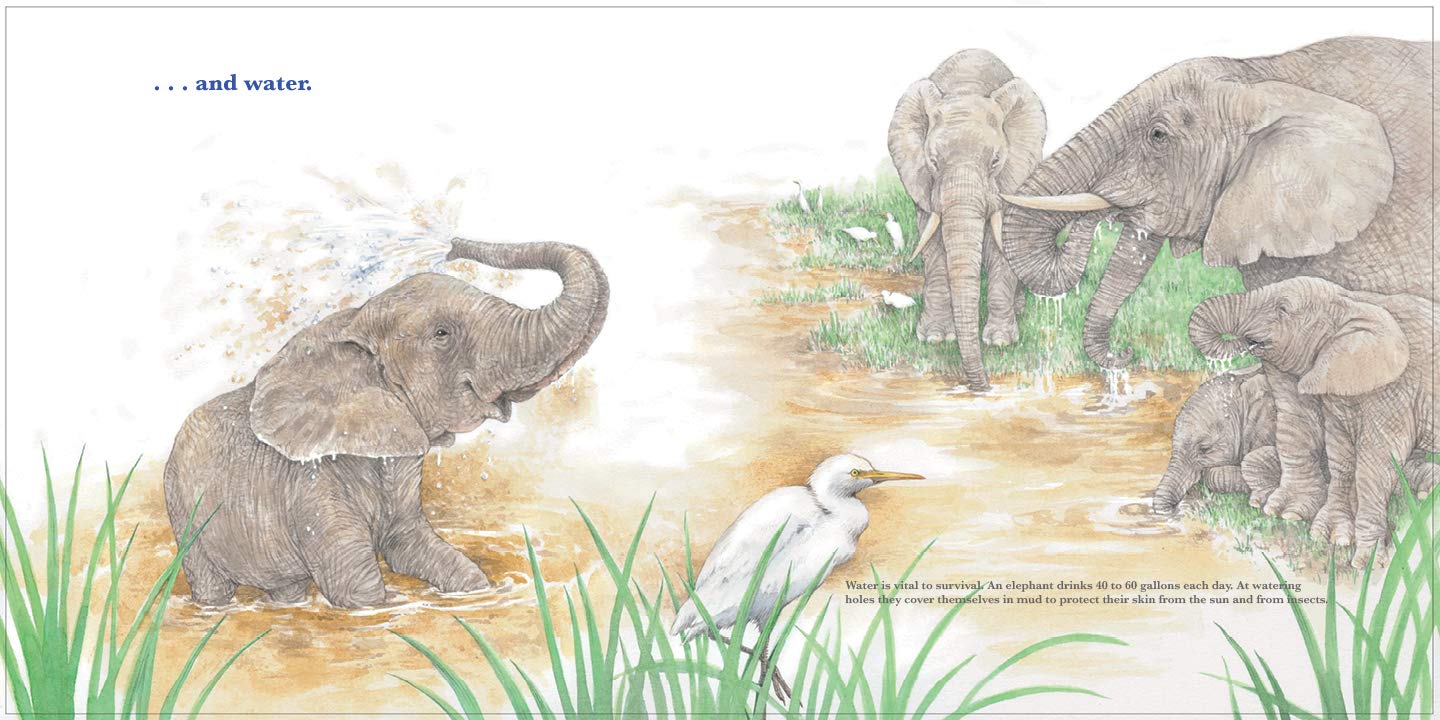
The elephant matriarch is the queen of the family group. “She is usually the oldest, but not always. It is her job to guide and teach her subjects to give them the best opportunities for survival.” Her family group consists of blood relatives—daughters and granddaughters—living together. When groups get too big, some elephants break off and form their own group. The matriarch leads the other elephants to food and water, and when water is scarce “she guides them on journeys to watering holes remembered from long ago.”
Image copyright Yumi Shimokawara, 2020, text copyright June Smalls, 2020. Courtesy of Familius.
Like a loving grandmother, the matriarch teaches younger elephants how to take care of their little ones. Everyone in the family group helps rear the young. “The clumsy babies are sometimes caught in mud or water and the older elephants will work together to push, pull, or dig to rescue them.”
Sometimes, groups of elephants that once lived together will meet. They remember each other and spend time “foraging for food together. These meetings are like a family reunion.” When danger from another animal lurks, the elephants watch and learn how the matriarch defends them. They also huddle together and surround the smaller elephants for protection. “If nature, or predators, or poachers take her friends, she will comfort and care for the orphans.”
Image copyright Yumi Shimokawara, 2020, text copyright June Smalls, 2020. Courtesy of Familius.
Little ones grow and play under the watchful eye of the matriarch and, just like human children, “elephants are not born with all the skills they need.” The matriarch helps teach her children, grandchildren, and great-grandchildren how to use their trunks for heavy work like moving logs and for delicate finessing, such as having the “ability to gently pluck a leaf from a tree.”
Image copyright Yumi Shimokawara, 2020, text copyright June Smalls, 2020. Courtesy of Familius.
The matriarch also thinks about the future when she won’t be able to lead the group anymore. She passes on her knowledge and skills to the elephants in her lineage, “so that when she is gone another matriarch will lead her family.” When the matriarch does die, the elephants mourn their loss in ways similar to humans. “Elephants have been observed burying their dead with grasses and branches,” and they will return to the spot months later to “touch the bones of their lost family member.” A new matriarch emerges to lead the family group. This is “usually the oldest daughter of the matriarch,” and her call “to her daughters and their daughters” can be heard for miles and miles – sometimes up to 110 square miles – as this new queen begins her reign.
Image copyright Yumi Shimokawara, 2020, text copyright June Smalls, 2020. Courtesy of Familius.
June Smalls’ tribute to the matriarchal society of elephants and, through her lyrical storytelling, to strong women in every family and community is both poignant and powerful. The main story reveals the role of the matriarch in leading and teaching her daughters, granddaughters, and great-granddaughters over a lifetime, which can span seventy years. Smalls’ stirring text illuminates the similarities between elephants and humans in everyday needs, behavior, memory, familial care, and even in death. In addition to the story, each page spread includes fascinating, and often touching, facts about how a family group forages for enormous amounts of food, finds crucial water supplies, protects each other, rears their young, and sustains each other in the passing of the matriarch. Smalls’ book ends with an inspirational entreaty to young girls to awaken to their future role as leaders.
Yumi Shimokawara’s stunning realistic illustrations of an elephant matriarch leading and teaching her family group in the wild will thrill readers. On each page spread, young readers follow their elephant peer as she (or he, as male elephants stay with the family group until about age thirteen) plucks leaves from a sun-drenched tree, splashes in a watering hole, walks in the shade of two adults on a long, hot journey, is protected from predators, and plays games with sticks and other babies in the group. Shimokawara’s delicate color palette and beautifully composed images depict the intelligence and gentle manner of these animals in lively and tender moments that children will want to view again and again.
An exquisite combination of inspiration and education, She Leads: The Elephant Matriarch will captivate children as a spark for further learning about these majestic animals, the environment, and nature conservation as well as encouragement to bravely take their place in the world with grace, love, and strength. The book is a must for all home, classroom, and public library collections.
Ages 3 – 8
Familius, 2020 | ISBN 978-1641702324
Discover more about June Smalls and her books on her website.
You can find more books from Familius that joyfully reflect the habits of happy families, including reading, talking, laughing, eating, working, loving, healing, learning, and playing together as well as the Familius blog The Habit Hubhere.
World Elephant Day Activity
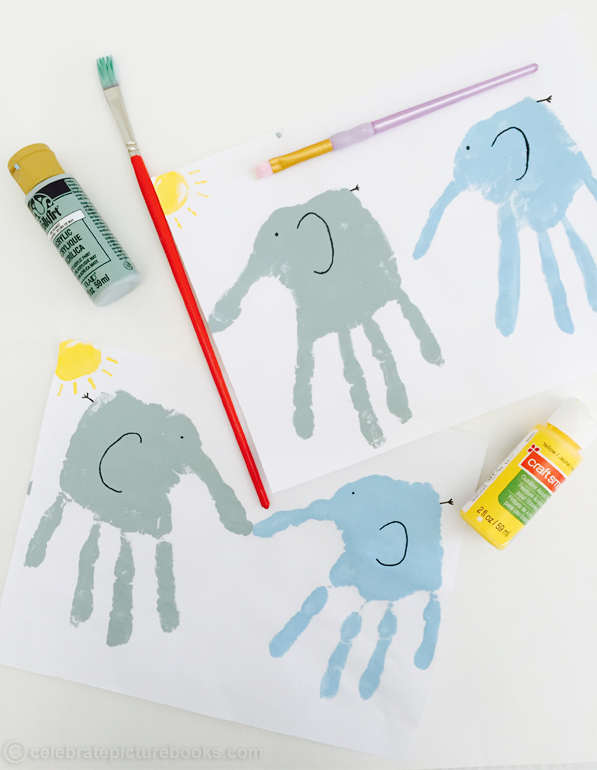
Elephant Handprint Craft
This easy craft is fun for families to do together. Using siblings’ hands or the hands of a child and an adult to make the elephants can make a meaningful and comforting picture to hang in a child’s room or gift for mom, dad, or other family members.
Supplies
Craft paint in two colors of the children’s choice
Yellow craft paint
Black fin-tip marker
Crayons, markers, or colored pencils to make a background
Paper
Paint brush
Directions
Paint one child’s hand and press it on the paper. The thumb is the truck and the fingers make the legs.
Paint the second child’s or adult’s hand and press it on the paper near the other “elephant.”
After the paint has dried, draw on ears and an eye.
Add a sun with the yellow paint or crayon.
Add grass, trees, or other background features if desired.
You can buyShe Leads: The Elephant Matriarch on the Familius website.
This post contains affiliate links. You can read my full disclosure statement here.
International Owl Awareness Day raises awareness of these feathered beauties that can be found all over the world in nearly every ecosystem. The day also encourages people to learn more about the owls in their area as well as to consider ways they can make their yards or the surrounding landscape more welcoming and beneficial to owls. To learn more about owls and how you can help these beautiful birds, visit American Eagle Foundation website.
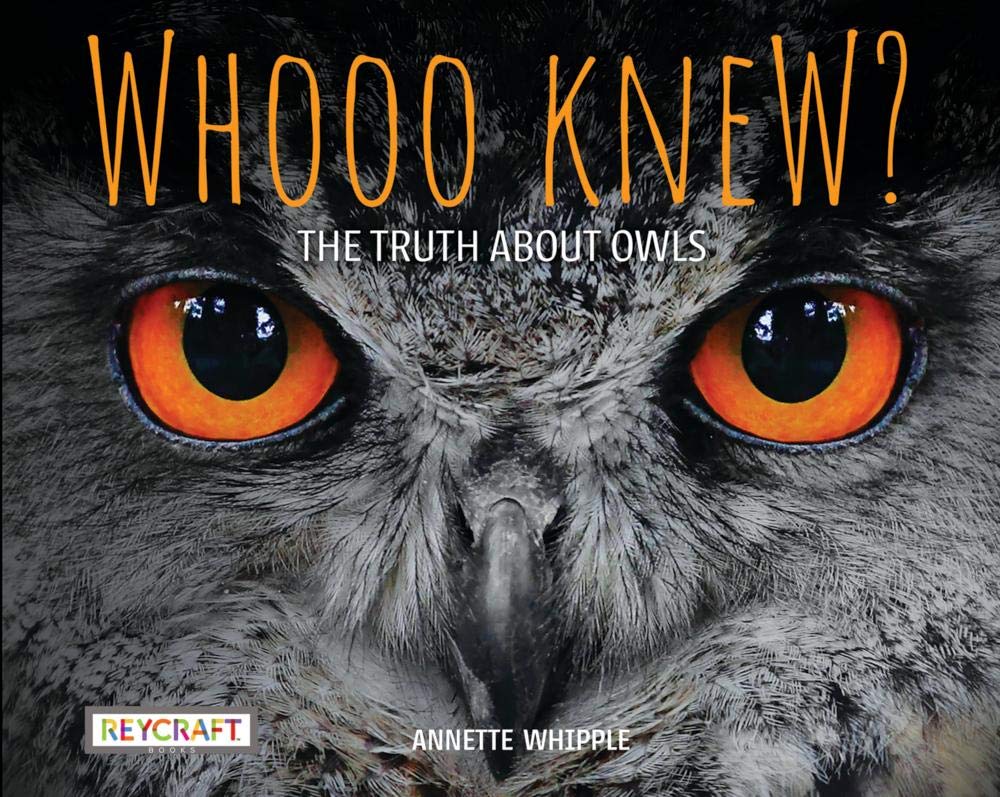
Whooo Knew? The Truth about Owls
By Annette Whipple
You know owls, right? They hoot, they have glowing eyes, and a beak you wouldn’t want to be on the sharp end of. But is that all? Not by a long feather. For instance, do you know what owls eat (besides mice) or how they catch and eat their prey? What happens to all the bones and fur and teeth they swallow? And have you ever seen an owl’s tongue? You’ll discover all these facts through Annette Whipple’s detailed and engaging text (there are even some puns that might make you owl with laughter) and incredible up-close photographs of a variety of owls doing what owls do best.
Let’s see, what else do we know about owls? Ah! They sleep all day, right? Well, not exactly, and not all owls are nocturnal. Of course, those shining eyes that allow owls to see so well in the dark are one of their most well-known traits. Here, you’ll learn how they work, their range of vision, and how they “see” things that are close.
Copyright Annette Whipple, 2021, courtesy of Reycraft Books.
Do you wonder why you never see an owl even though you hear them and know they live nearby? Maybe you already have and just didn’t realize it. Each type of owls’ feathers are colored and patterned to ensure they blend in with their surroundings. Look closely at Annette Whipple’s photos. Do you see the owls? You’ll also learn all about how owls use and communicate with their feathered ear tufts.
You’ll also discover where different kinds of owls live—some even call cacti home!—as well as how baby owlets grow up, learn to hunt, and strike out on their own. With their sharp talons, sharp beaks, and sharp eyes, owls can take care of themselves, right? Well, the truth is that owls have plenty of predators and fall victim to cars on busy highways as well as habitat destruction. Your barn owl host even has a suggestion about how homeowners and landowners can help and includes an added benefit: “Please do us a favor and leave some old trees behind. We’re some of the best all-natural ‘pest control’ around.”
Following the text, readers will find a photographic “anatomy of an owl,” a glossary of words found in the book, and an owl pellet dissection activity.
Annette Whipple’s gorgeous introduction to owls provides young readers with a comprehensive look at the anatomy and behavior of owls, beginning with what they know (or think they know) about these majestic birds and expanding their knowledge with fascinating facts and details, illustrated with astounding photographs caught in the act of eating, sleeping, observing, hiding, and even regurgitating a pellet. Sidebars “hosted” by an illustrated and affable barn owl that talks directly to readers reveal more facts about his species and others.
Sure to captivate readers, Whooo Knew? The Truth About Owls is a fantastic resource for classroom, homeschool, and casual learning. The book is sure to be a favorite go-to for children and educators and is highly recommended for public libraries as well.
Ages 6 – 10
Reycraft Books, 2021 | ISBN 978-1478869634
Discover more about Annette Whipple and her books on her website. You’ll also find STEM activities (indoor and outdoor), crafts, and resources for further reading and research on Annette’s site here.
International Owl Appreciation Day Activity
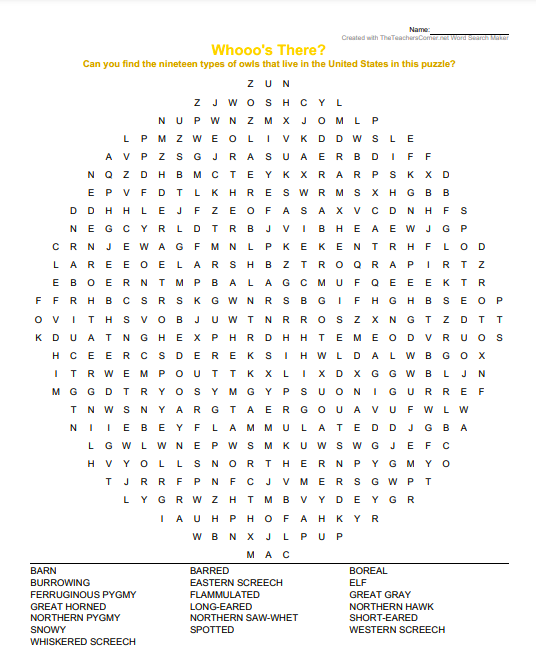
Whooo’s There? Word Search Puzzle
Can you find the nineteen types of owls that call the United States home in this printable puzzle?
Shelley Johannes is the author-illustrator of the Beatrice Zinker, Upside Down Thinker chapter-book series. A former architectural designer, she has a fondness for tracing paper, process, and accidental discoveries. She and her family live in Michigan with two feathered friends, Max and Alex, who make every day sunny and birdy. More Than Sunny is her debut picture book.
Hi Shelley! I love how you describe all sorts of weather days in your new picture book More than Sunny, so I just couldn’t pass up a chance to share Rain Day with you! Rainy days have their own special fun, and you certainly celebrate that in your book! Of course, when the sun comes out, rainy days also bring rainbows – those beautiful symbols of optimism, something we can all use every day and which shines on every page ofMore than Sunny. Can you talk about what inspired the story?
Thank you, Kathy! And thank you so much for having me here today. Optimism is always in season, but metaphorical sunshine definitely feels even more precious these days.
Matthew Johannes
More Than Sunny was inspired by my son Matthew and a first-grade weather project. I’d viewed his daily weather chart—the kind with columns for sunny, cloudy, rainy, windy, snowy—as a mundane task to check off our list, but on the first day, he looked outside and enthusiastically declared, “It’s sunny and birdy today!” When he called the next day “windy and squirrelly”, I knew it had to become a book someday. He turned a routine assignment into something fresh and exciting, and made me pay attention to the beauty I’d forgotten to see. That’s always book-worthy.
In More than Sunny, you describe days with nuances that delight in everything a day can possess. Using your story structure, what would your favorite day have been as a child? How about now as an adult?
I love this question! As a kid, I loved rainy days, and any excuse to curl up with my dog and our special Rainy Day Art Book. So maybe I’d say . . . Dreary and Doggy were my favorite kind of days back then. Rain is so relaxing.
As an adult, it’s a tough call between Springy and Birdy (because May is the most cheerful month, and we are huge bird nerds around here) and Autumn and Squirrelly (because the crisp, colorfulness of fall makes me happy, and we’re huge squirrel nerds too!).
Before writing children’s books, you worked as an architect. Can you talk about that a little? Do you think being an architect influences your writing and art in any way? If so, how?
There was a time I felt bad about my winding path to making books. I felt bad that I didn’t have the guts to go after my dreams sooner. But these days, I’m so grateful for each part of my life and how it shaped me into the person I am today. My years in architecture helped me find my voice and gain the courage to use it. I also learned so much about my love for creative process and collaboration, and the type of people who inspire me. The desire to create, and to make something meaningful, is the motivational underpinning of both fields, so the transition to books felt very natural. The process of designing a building and building a story are surprisingly similar.
A rainy and wormy day from More than Sunny by Shelley Johannes, 2021, courtesy of Harry N. Abrams.
There’s also a direct connection in the way I work. I fell in love with tracing paper and felt-tip pens in my early days in architecture, and I’ve only fallen more in love as time passes. I’ve always loved how a loose sketch or a stray line can capture an idea on paper, and that wonder continues to bring me joy in new ways.
Your son Nolan narrates your wonderful book trailer and his pride and love for you and the More than Sunny really shine through. How great is it to share your writing journey with your kids?
Aw, thank you! We loved making that trailer together! And it was so special to capture his sweet voice just before it shifts into a grown-up one. It’s been so wonderful to share each step of the journey with my kids. I first realized I wanted to make picture books while reading to them as toddlers. They’ve been there for all the ups and downs and in-betweens of the creative process ever since, and enjoyed LOTS of celebratory pizza along the way! So much of each them—and they joy they bring into my life— is woven into everything I make. They inspire so many book moments, and are my most treasured critics and art buddies. I hope being part of this process empowers them to go after all the things they dream of doing, too!
What was your favorite place to read (or write or draw) as a child? What is your favorite place now and why?
As a kid, I loved to read and draw in the quiet privacy of my room, because it was personal and I was shy. These days, I like to mix things up. I write best in a crowded place, with headphones on and music blaring, because it’s easier for me to concentrate when I’m surrounded by stimuli and happy hustle-and-bustle. I also enjoy writing on the go as ideas randomly come to me, and use my Notes app like it’s another piece of my brain. I read anywhere and everywhere, and love listening to audiobooks while riding my bike around my neighborhood!
Though I doodle in sketchbooks all over my house, my studio is still my favorite place to make art. Having a place that’s dedicated to being creative, and filled with my favorite things, makes getting into the zone a bit easier.
What is your favorite season and seasonal activity?
I’m torn between Fall and Spring. It’s hard to beat a cider mill on a crisp Autumn day, especially here in Michigan. Fresh donuts. Crisp apples. Bubbling steam running through the colorful trees. It’s pretty perfect. But then this Spring, we found a nature trail at a local park where wild birds fly down and eat out of your hands, and now we’re addicted to the wonder of that experience too.
Will you be doing any book events this summer that you’d like to tell readers about?
It’ll be a fairly quiet summer (see the answer to the next question!), but I’m doing a virtual event with wonderful Belmont Books on August 26th at 6:30pm ET, and I’d love for everyone to join us! We also had an amazing virtual launch event for More Than Sunny as part of Literati Bookstore’s At Home with Literati series. Jarrett Lerner and I talked about creative process, seeing the world with fresh eyes, and the making of the book. You can watch our conversation here anytime:
What’s up next for you?
This week I am starting the final artwork for my second picture book! I can’t wait to start experimenting with materials and see where it leads me!
Thanks for this wonderful chat and for sharing so many insights. I wish you all the best with More than Sunny and am really looking forward to your next book!
National Rain Day Review
About the Holiday
Today, we celebrate rainy days—but not just any rainy days. Rain Day commemorates an odds-busting record that began in 1874 in Waynesburg, Pennsylvania when one resident remarked to William Allison, the pharmacist at JT Rogers & Co drug store, that it always rained on his birthday—July 29. After that, Allison began keeping an annual record, and all eyes have been on Waynesburg to see if the remarkable run—115 years out of 147—continues. Now weather reporters around the country keep track of this remarkable statistic and broadcast “yes” or “no” to their audiences. As for the people of Waynesburg, they celebrate their notoriety with a huge festival that includes live musical entertainment, arts and crafts and food booths, kids’ games, and, of course, an umbrella-decorating contest. To learn more visit the Rain Day Website. And don’t forget to watch the skies!
More than Sunny
By Shelley Johannes
A girl knocks on her brother’s door and, before he’s even fully awake, she bursts in and announces with exuberance that this spring day is “sunny.” Yawning and rubbing his eyes, her brother adds “and early.” But his big sis pulls him outside to show him all the birds at the feeder and birdhouse. It’s not only sunny, she tells him “it’s sunny and birdy!” They head down to the pond, where the siblings have different ideas of what the day’s like. Little brother finds the day “sunny…and mucky!” But his sister, with feathers in her “wings,” states, “I say it’s sunny and ducky!”
Copyright by Shelley Johannes, 2021, courtesy of Harry N. Abrams.
On another day, these two compatible siblings head outside to discover what summer brings besides heat. The sunny day takes them to a field, a tree, and a dock, where they explore, relax, and use their imaginations. But not all summer days are sunny, and that’s okay because being inside when it’s “stormy” these kids make it cozy. And when the storm tapers off a bit, they grab their raincoats and big umbrella and go outdoors, where the girl exclaims, “it’s rainy and wormy!” and her brother inspects the mud and greets a small worm, “Hello squirmy.” The rainy day brings lots of fun with Mom and their dog too.
Copyright by Shelley Johannes, 2021, courtesy of Harry N. Abrams.
But summer days turn into autumn days with wind and squirrels and piles of leaves to jump in. The kids read and make paper snowflakes, waiting for winter to come. And, finally, the flakes fall. They taste so good. “Can we? Can we?” the siblings ask, eager to be out in the snow. “But I’m warm and socksy,” says Mom. But her kids, tiptoeing and playing, lure her out with “Let’s be snowy and foxy!”
Copyright by Shelley Johannes, 2021, courtesy of Harry N. Abrams.
They take a walk in the woods and, while sledding, see Daddy coming home. “Are you ready and sleddy?!” they ask, but there’s shoveling to be done. That’s all right; there are other ways to have fun in the snow. Tired out and chilly, the family goes inside for bedtime. Now there’s a knock at the sister’s door. Yawning and rubbing her eyes, she goes to see who it is. It’s her brother, and he has something magical to show her.
Copyright by Shelley Johannes, 2021, courtesy of Harry N. Abrams.
Shelley Johannes’s exuberant call to play and explore is a perfect jumping off place for kids to look at and interact with their surroundings with new eyes, imagination, and creativity. Hopping from season to season, Johannes touches on moments of freedom and wonder and those happy discoveries so formative in childhood. Her playful rhymes and bouncy rhythm echo kids’ delighted banter, and her sprightly adjectives invite readers to come up with their own descriptions of their day.
Johannes’s bright, energetic, and cheery illustrations dazzle with lively depictions of the siblings playing outside in all weather. Her smile-inducing portrayals of the siblings mirror real kids and each page is loaded with details readers will love lingering over. Mom and Dad make warm cameos to create a book the whole family will enjoy.
More than Sunny is a generously sized picture book that kids and adults will find themselves joyfully sharing throughout the year. For teachers and homeschoolers, Johannes’s storytelling provides a spark for writing prompts, grammar lessons, and observational skills. Sure to become a quick favorite, More than Sunny is highly recommended for home, classroom, and public library collections.
Ages 4 – 8
Harry N. Abrams, 2021 | ISBN 978-1419741814
Discover more about Shelley Johannes and her books on her website.
One of the best simple pleasures is looking up at the clouds and imagining what shapes you see. Bring those fluffy, white clouds into your room with this craft!
Supplies
White girls’ dress bobby socks in various sizes
Fiber fill, 20-ounce bag
Fishing line, different lengths
Needle
Clear adhesive mountable hooks or clips
Directions
Stuff the socks with fiber fill, pushing it far into the sock and adding more here and there to make various lumps and give it a rounded, cloud-like shape
When the sock is full, tuck the end of the sock in to close it
Cut lengths of fishing line. The lengths will depend on how and where you will hang the clouds
With the needle or by hand, feed one end of the fishing line into the top of the sock and out to attach the line for hanging.
Knot the fishing line
Attach the mountable hooks or clips to the ceiling
On this date in 1866, one of the world’s most beloved children’s authors was born – Beatrix Potter. Her twenty-three books about Peter Rabbit and his friends have enchanted children for generations, and the tale of how The Tale of Peter Rabbit came to be is as full of twists and turns as any good story – as you’ll see in today’s book. To celebrate today, why not go to your bookstore, library, or maybe even your own bookshelf at home and enjoy spending some time in the garden with Peter.
Saving the Countryside: The Story of Beatrix Potter and Peter Rabbit
Written by Linda Elovitz Marshall | Illustrated by Ilaria Urbinati
At home in London, young Beatrix Potter loved drawing and painting pictures of her pet rabbit, Benjamin Bouncer and other woodland creatures. Beatrix and her brother didn’t go to school but were taught at home under a strict daily timeline. “Then came summer and … freedom! During the summer, Beatrix’s whole household—pets included—moved to a country house where there were ducks, chickens, cows, and a garden.
Image copyright Ilaria Urbinati, 2020, text copyright Linda Elovitz Marshall, 2020. Courtesy of little bee books.
When Beatrix’s brother grew a little older, however, he went away to a boarding school while Beatrix had to stay home. “But Beatrix wanted to do something important, something that mattered. She often helped her father with his hobby, photography.” She visited artists’ studios and museums. She learned about art and how to make her drawings better.
She made more pictures of Benjamin Bouncer and sent them to publishers. One publisher put her drawings on the front of greeting cards, and Beatrix began making money from her work. But Beatrix was also interested in the science of nature. She even wrote a paper about mushrooms and hoped to have it printed in a scientific journal, but it was rejected. Beatrix was disappointed but went back to drawing.
Image copyright Ilaria Urbinati, 2020, text copyright Linda Elovitz Marshall, 2020. Courtesy of little bee books.
Then one day, to cheer up a sick child, Beatrix wrote and illustrated a story about Peter Rabbit. Later, she submitted it to publishers. When they told her they weren’t interested, she had books printed herself. She sold every copy—the second batch too. Finally, a publisher agreed to print her books. Beatrix went on to write more and more stories. At last she had fulfilled her dreams of creating something important. She was also an excellent marketer and self-promoter, and “soon people all over the world knew about Peter Rabbit, and they knew about Beatrix Potter too.”
Image copyright Ilaria Urbinati, 2020, text copyright Linda Elovitz Marshall, 2020. Courtesy of little bee books.
As Beatrix grew older, she couldn’t draw in the way she had, but that didn’t mean she left the countryside behind. She wanted to protect the farmland she loved. She helped farms and families, paying for needed veterinary care for animals when the farmers couldn’t afford it and for a nurse when the flu hit. Beatrix Potter’s life was made up of so many things that mattered. Not only did she give the world the beloved Peter Rabbit and his friends, but through donations of farms and acreage she “made sure the land would be cared for, protected, and cherished. Forever.”
An Author’s Note about how she came to write this book and more information on Beatrix Potter’s legacy follows the story.
Image copyright Ilaria Urbinati, 2020, text copyright Linda Elovitz Marshall, 2020. Courtesy of little bee books.
Linda Elovitz Marshall’s delightful and surprising biography of Beatrix Potter delves into the depths of her desire to make a difference with her life. A woman far ahead of her time, Beatrix Potter remains an inspiration for each new generation of readers not only for her well-loved stories but for her community work and foresight. Marshall’s thorough and well-paced story will captivate today’s children, who have the same hopes as Beatrix to influence the world with their talents and opinions. Marshall’s descriptions of Beatrix’s later largesse swell the heart and readers’ admiration for this exceptional woman.
Image copyright Ilaria Urbinati, 2020, text copyright Linda Elovitz Marshall, 2020. Courtesy of little bee books.
Linda Marshall’s words are set among Ilaria Urbinati’s exquisite illustrations that take children inside Beatrix Potter’s world at home in London and out to the countryside she adored. Her delicate and detailed renderings of young Beatrix drawing with her pet Benjamin Bunny by her side, the farm where she spent summers, her scientific explorations, and her later successes immerse readers in the late 1800s to mid-1900s, allowing them to experience the environments that created one of the world’s most beloved authors. Urbinati’s glorious panoramas of the lake district farms that Beatrix saved are breathtaking and inspiring in their beauty.
For fans of Peter Rabbit and any lover of children’s literature, Saving the Countryside: The Story of Beatrix Potter and Peter Rabbit is a must. Stirring on so many levels, the book will inspire multiple readings as well as the discovery or rediscovery of Beatrix Potter’s tales. Perfect for home, school, and public library collections for story times and to enhance language arts lessons and even nature science studies.
To learn more about Ilaria Urbinati, her books, and her art, visit her website.
Great Outdoors Month Activity
Grow a Vegetable Garden Board Game
As all readers know, Peter Rabbit loved vegetable gardens. With this fun game you and your family can grow your own gardens inside! Roll the dice to see whose garden will fully ripen first!
Object: The object of the game is for each player to fill their garden rows with vegetables. Depending on the ages of the players, the required winning number of rows to fill and the number of vegetables to “plant” in each row can be adjusted.
Print one Game Board for each player
Print one set of Playing Cards for each player (for sturdier playing items, print on card stock)
Print one Vegetable Playing Die and assemble it (for a sturdier die, print on card stock)
Cut the vegetables into their individual playing cards
Color the “dirt” on the Garden Plot with the crayon (optional)
Choose a player to go first
The player rolls the die and then “plants” the facing vegetable in a row on the game board
Play moves to the person on the right
Players continue rolling the die and “planting” vegetables until each of the number of determined rows have been filled with the determined number of vegetables.
The first person to “grow” all of their veggies wins!
You can find Saving the Countryside: The Story of Beatrix Potter and Peter Rabbit at these booksellers
Ah, summer! Just the word makes you think of leisurely pursuits – wild rides at an amusement park, toasting marshmallows over a campfire, taking in the exhibits at a science, history, or art museum, hiking a mountain trail, or splashing in the surf during a long beach day. No matter what makes a summer day relaxing and fun for you and your kids, why not take today off and enjoy it!
Down Under the Pier
Written by Nell Cross Beckerman | Illustrated by Rachell Sumpter
A group of kids are having fun on the pier. They ride the Ferris wheel and the roller coaster and “gobble clouds of cotton candy” as they walk in the sunshine. On the carousel they vie for the one goat to sit on. “Up on the pier,” they tell readers, “we feed the machines, roll Skee-Balls, whack moles, and trade our tickets for toys.” When their money runs out, “is the fun all done?” Not at all. For these kids, it’s just begun.
Image copyright Rachell Sumpter, 2020, text copyright Nell Cross Beckerman, 2020. Courtesy of Cameron Books.
They pad downstairs and kick off their flip-flops. “Down under the pier, it’s dark and cool. We inhale sea spray and squish slimy sand through toes.” They listen to the waves crash and when the water recedes, they “find creatures clinging. Mussels, barnacles, sea stars, and anemones festoon a forest of pilings.” Gently they touch these creatures, let crabs tickle their palms.
Image copyright Rachell Sumpter, 2020, text copyright Nell Cross Beckerman, 2020. Courtesy of Cameron Books.
“Sanderlings scamper, their stick legs a blur” as they lead the children in a race down the beach. Here they find long strands of kelp, strong enough for a game of tug-of-war, wild enough to make a seaweed monster costume. Down under the pier they “collect seashell souvenirs” and watch the changing rainbow colors of the setting sun in the quiet twilight away from the blinking lights, clanging bells, and ringing voices on the pier. “Fun is free,” they know, “and the world is ours.”
Through an Author’s Note at the beginning of the book, readers learn that a portion of the proceeds from Under the Pier are donated to Heal the Bay Aquarium, an educational nonprofit located under the Santa Monica Pier, where visitors can see and touch one hundred local sea creatures. An illustrated guide to seven sea creatures found in an intertidal community follows the story.
Image copyright Rachell Sumpter, 2020, text copyright Nell Cross Beckerman, 2020. Courtesy of Cameron Books.
Lyrical, entrancing, and full of the wonder of childhood, Nell Cross Beckerman’s story will transport readers to a languid summer day where a group of friends spend the afternoon reveling in the rides, games, and treats of the pier and then continue their fun under the pier, where nature provides as many delights as the carnival above. Through her detailed and evocative language, readers can hear the thrill of the crowds, taste the cotton candy, and run with the kids to be the first to claim the goat on the carousel.
But it is when the kids “slip down the stairs” to the sand below that Beckerman’s descriptions truly shine with the deep and lasting impressions of new discovery. The children’s mindful awe of the sea creatures they find when the tide goes out and their creative games played out with relished spontaneity reflect this one trip to the beach but also all moments of free play that this group of friends—and readers—will experience and remember as they grow up.
Rachell Sumpter’s glorious artwork blends realism and that feeling of magic that expands a child’s world. Her gorgeous soft pinks, yellows, greens, and blues, embroidered with lacy white accents, swirl with the kids on the carousel and beckon them downstairs. Here, with the page turn, the colors burst into vibrancy as the sea tickles their toes and sea creatures climb the pilings and blanket the rocks and sand. Frothy waves and pearled outlines create a dazzling backdrop to the children’s fun. As they wrap themselves in nature-made costumes and art, the fiery sun sets on a perfect day.
A mesmerizing escapade children will want to join in on, Down Under the Pier is highly recommended for home bookshelves and is a must for school and public library collections. The book would pair well with lessons on marine science and United States geography, giving it cross-curricular appeal.
To learn more about Rachell Sumpter, her books, and her art, visit her website.
National Summer Leisure Day Activity
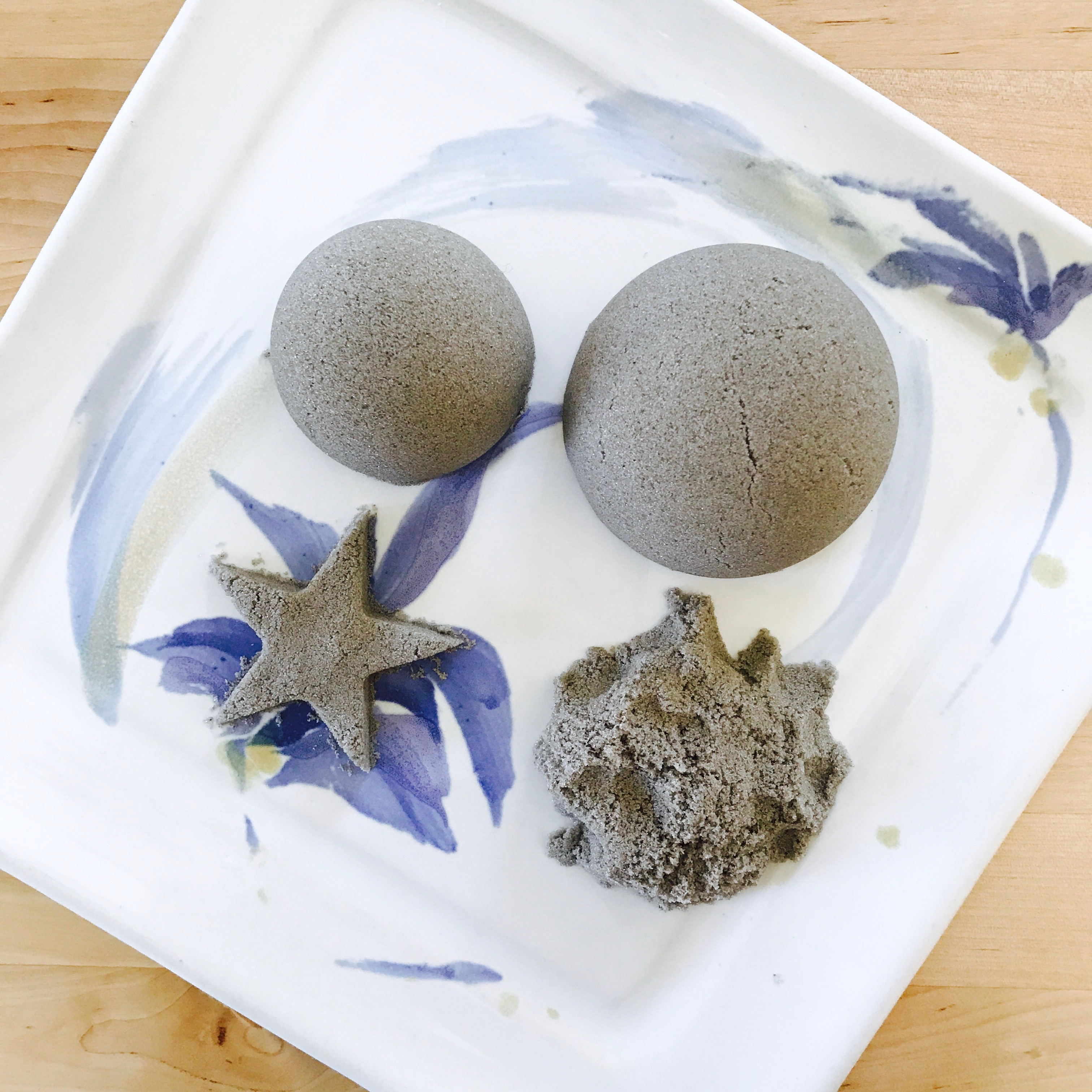
Kinetic Sand
Sand is so much fun to play with at the beach that you just wish you could bring it home. Now you can! With this easy recipe you can create your own kinetic sand to form or let run through your fingers. It makes a great anti-stress reliever too!
Supplies
1 cup sand
½ tablespoon cornstarch
1 teaspoon dish soap
Water as needed – about ¾ cup
Bin or bowl for mixing dry ingredients
Bowl for mixing dish soap and water
Directions
In the bin combine the sand and cornstarch and mix well
In the bowl combine the dish soap and water until the water is bubbly
Slowly add the water mixture to the dry ingredients, mixing and adding water little-by-little until the desired consistency is reached. The grain of the sand will determine how much water is needed.
The sand can be formed with cookie cutters, molds, hands, etc. and is strong enough to stack. Or just let it drip and ooze through your fingers.
It’s Shark Week – one of the most anticipated holiday’s of the year! Kids and adults are fascinated by these denizens of the deep, and especially the Great White, which sports fearsome teeth and intimidates with their imposing size. But there are many more sharks in the sea – about 500 species! – and they are an important part of the world’s ecosystem. If Shark Week is your favorite week of the summer, you’re no doubt enjoying a full schedule of shark-related shows on the Discovery Channel. To learn more information about sharks, including statistics from this year’s coastal shark survey, a chance to cast your vote for “freakiest shark,” a line-up of top videos, and more, visit the National Oceanic and Atmospheric Administration’s Shark Week page. To celebrate sharks and the wonders of the ocean every day, you’ll want to put today’s book at the top of your reading list.
Thanks to Joan Holub for sharing a copy of I Am the Shark with me for review consideration. All opinions on the book are my own. I’m excited to be teaming with Joan in a giveaway package that kids will love. See details below.
I Am the Shark
Written by Joan Holub | Illustrated by Laurie Keller
Great White Shark is excited to introduce himself, especially since he is “the GREATEST SHARK in this book.” But a voice contradicts Great White. Who begs to differ? It’s Whale Shark, and she loses no time in demonstrating why she is “the greatest shark in this book” due to her enormous size, which can’t be matched anywhere in the undersea world. And if that weren’t enough, she adds this bite: “Compared to me, you are small.”
Image copyright Laurie Keller, 2021, text copyright Joan Holub, 2021. Courtesy of Crown Books for Young Readers.
But Great White takes it in stride. If he isn’t the greatest shark, that’s okay because being the smallest has some pretty great perks too. So he’s in the middle of a “smallest shark” victory dance when a voice calls out, “No, you’re not.” It seems there’s a much smaller shark in the sea—Dwarf Lantern Shark, who, besides being the tiniest shark has a rather enlightening ability too. After the long take down from Whale Shark, this time Great White pivots quickly, thinking about how “smart and curious” he is. Could he be “the smartest shark in this book?”
Well, that would be a no. Hammerhead Shark has that one nailed down as well as a unique view of their colorful world. This time, Great White is a little intimidated. “Whoa!” he exclaims. “How can I top that?” But being smart (just not as smart as Hammerhead), Great White has another idea. This one, though, is quashed just like the others in a sneak attack. Turns out Great White isn’t the best hunter, the oldest, or even the “fishiest” shark in this book.
Image copyright Laurie Keller, 2021, text copyright Joan Holub, 2021. Courtesy of Crown Books for Young Readers.
Undeterred, Great White decides to do a little research in other books to “figure out the greatest thing about [him]. He learns all about his different body parts and even shares a labeled diagram (on graph paper and everything) with you. And he doesn’t stop there. He’s discovered all sorts of awesome facts about their skeletons, senses, teeth, skin, and other cool tidbits that he lets you know about. Great White could probably go on and on, but suddenly there’s a “snack alert” and all the sharks take off at top speed after their prey. Great White’s fast! He’s in the lead! Great White’s the fast..est… “Crumbs.” Great White’s passed up by a faster shark. Who is that anyway?
By this time Great White is feeling pretty down in the dumps. “Maybe I should change my name to Just-Okay White Shark or Not-So-Great White Shark,” he bemoans. But then Dwarf Lantern Shark swims up to him and enlightens him with some perspective and sage advice: “Just be happy being you.” Great White takes it to heart. In fact, it helps him think of a new, can’t-miss quality that finally gives him a “GREATEST in this book” status.
Backmatter includes more details on the eight sharks introduced in the story as well as books and links about sharks for kids wanting to learn more.
Image copyright Laurie Keller, 2021, text copyright Joan Holub, 2021. Courtesy of Crown Books for Young Readers.
Kids are always fascinated by the superlative—the fastest, the biggest, the smallest, the silliest, the best—and Joan Holub makes superlative use of this fact in her highly entertaining and educational romp. As Great White goes on a rollercoaster of emotions, one moment thinking he’s the best at something while the next moment having his hopes dashed, readers learn eye-opening details about eight sharks, described in engaging ways that will wow kids. Great White’s boundless optimism is infectious while setting up his disappointment for maximum comic effect. Kids will eagerly await the chance to chime in on the “No, you’re not.” asides that are sure to bring plenty of giggles. But this story isn’t all about sharks. Holub masterfully weaves in an important message for kids about self-acceptance, true happiness, and finding their unique qualities and talents.
Laurie Keller uses her prodigious talent for humor in her up-close images (and is there any other way kids would want to see them?) of these competitive sharks. Loaded with attitude, each shark swims onto the pages to demonstrate their “greatest” trait in ways that will stick with kids and have them excited to learn more. Expressive faces and silly antics add personality and laughs to each page spread. Keller’s vivid, textured, and collage-style illustrations are eye-catching, and funny details, such as Tiger Shark’s tattoos, chain bangle, band-aid, and gold tooth, will have kids lingering over the pages. While they’re there, they’ll want to keep a look out for the Dwarf Lantern Shark who finally lets Great White in on a great secret.
Full of facts, action-packed, and loaded with laughs, I Am the Shark is creative non-fiction at its GREATEST. Kids who love learning about sharks, nature, and the ocean or who just love a fantastic read will want to sink their teeth in this charmer. I Am the Shark is a can’t-miss must for homes, classrooms, and public libraries.
Ages 4 – 8
Crown Books for Young Readers, 2021 | ISBN 978-0525645283
Joan Holub has authored and/or illustrated over 150 children’s books, including the Goddess Girls series and the Heroes in Training series (with Suzanne Williams); the New York Times bestselling picture book Mighty Dads, illustrated by James Dean; Little Red Writing, illustrated by Melissa Sweet; and Zero the Hero, illustrated by Tom Lichtenheld. Her board & novelty books include This Little Trailblazer and Fa la la Llama. Joan adores line dancing to the Jaws theme, reading Sharkspeare, and vacationing in Finland.
Laurie Keller is the author and illustrator of many books, including The Scrambled States of America, Potato Pants!, Arnie the Doughnut, Do Unto Otters: A Book About Manners, the Adventures of Arnie the Doughnut chapter book series, and We Are Growing!, part of the Elephant & Piggie Like Reading! series and winner of the Theodor Seuss Geisel Award. When Laurie isn’t busy making books, she enjoys playing the banjo, traveling, cross-country skiing, and splashing in Lake Michigan, where as far as she knows, there is not a single shark.