June 10 – Don’t Step on a Bee Day

Bees may be small but they are crucial to our food supply. For decades, the bee population has been declining in parts of the world due to habitat destruction, pollution, parasites, and pesticides. Bee colony collapse is also a major threat to their survival. Today’s holiday reminds people to protect these important insects, especially those at ground level that may nest underground or be visiting clover or other flowering ground covers.

Thanks to Holiday House for sending me a copy of this book for review!

Buzz! Being Brave Around Buzzy, Stinging Insects

When the weather turns nice and flowers, clover, and dandelions begin to bloom, you know that bees cannot be far behind. Zipping from blossom to blossom, they announce themselves with a familiar “Bzzzz” can that be both thrilling . . . and chilling. But do we really need to be so afraid of bees and other stinging insects as they go about their business? In her educational book, Toni Buzzeo says we don’t and explains why with fascinating and reassuring facts from the field.

Illustration copyright © 2026 by Joe Cepeda. Text copyright © 2026 by Toni Buzzeo. Courtesy of Holiday House.

Buzzeo introduces readers to the usual stinging insects they can encounter when playing or working outdoors. She then reveals the primary reasons they will sting and provides helpful and simple rules for anyone to follow to stay safe. Buzzeo’s guidelines run counter to our instincts generated by fear, but that’s a good thing because our typical reactions only make things worse—for us and for the insects that are so important to our food supply and ecosystems.

Once children—and adults—get used to being in calm proximity to stinging insects, Buzzeo invites them to “turn up their courage [to] stay and watch.” She promises that you won’t be disappointed if you use your “science eyes” because “stinging insects are interesting. Really!” If you remain still and quiet, bees, especially, put on an intriguing show that can teach you so much about how they survive, how they feed their babies, and how pollination works.

Illustration copyright © 2026 by Joe Cepeda. Text copyright © 2026 by Toni Buzzeo. Courtesy of Holiday House.

So what about wasps and hornets? They’re pretty scary, right? Well, yes—to those “garden pests that eat flowers, fruits, and vegetables” from our gardens. Wasps and hornets are “Superhero Predators of pesky insects” like these. How? They pick them off leaves, flowers, and stems and take them “home to their nests to feed their babies.”

Still—even while armed with all of these tips—people might worry about being stung. Buzzeo empathizes. She also reassures by clarifying what to expect if you are stung as well as what to do to lessen a sting’s effects while confirming that people who “are allergic to stinging insects need to be extra careful not to get stung.” With this advice, she sends readers outside to their backyards, gardens, or local parks to seek out and observe bees and other insects at work.

Back matter includes illustrated pages of facts on bees, wasps, and hornets.

Illustration copyright © 2026 by Joe Cepeda. Text copyright © 2026 by Toni Buzzeo. Courtesy of Holiday House.

In her practical and welcome Buzz! Being Brave Around Buzzy, Stinging Insects, Toni Buzzeo encourages readers to let curiosity, tempered with care, guide them in discovering the captivating lives and work of stinging insects. Her science-based text acknowledges and answers the questions and trepidations many people have about getting close to stinging insects. Her easy-to-follow advice will embolden readers to view for themselves the wonders of these unique pollinators and protectors.

Joe Cepeda’s outdoorsy illustrations of bees, wasps, and hornets homing in on colorful wildflowers while a group of children document their busy buzzy missions, provide realistic close-up views of these stinging insects and context to Toni Buzzeo’s text. He clearly depicts three common stinging insects—European honey bees, Eastern yellow jackets, and bald-faced hornets—helping children identify the insects in their area or inspiring them to do more research. Cepeda also gives visual clues as to how closely readers can approach bees and where honey bee hives, wasps nests, and solitary bees’ underground nests can be found.

A helpful and fascinating guide for learning how to peacefully and beneficially coexist with bees, wasps, and hornets, Buzz! Being Brave Around Buzzy, Stinging Insects is a go-to book that families and educators will find themselves reaching for season after season. It is highly recommended for all library collections.

Ages 4 – 8

Holiday House, 2026 | ISBN 978-0823459711

Toni Buzzeo is a New York Times bestselling children’s author. She has published twenty-nine picture books for kids as well as eleven books for teachers and librarians. A former librarian and college and high school writing teacher, Toni and her books have won many awards, including a Caldecott Honor for One Cool Friend, illustrated by David Small. Her fictional human and animal characters echo children’s experiences in a variety of ways. Her nonfiction topics range from inspiring biographies of women scientists to board books about vehicles and transportation. Endlessly enthusiastic, Toni draws on her career experiences as an elementary school librarian in crafting her books and speaking with audiences of children in schools and libraries. Toni lives in Arlington, Massachusetts. Visit her at tonibuzzeo.com.

Joe Cepeda received his Bachelor of Fine Arts degree from California State University, Long Beach, and also studied Engineering at Cornell University. He is a fine artist, as well as an illustrator of more than thirty-five book jackets and picture books, which have received many honors including Notable Children’s Trade Book in the Field of Social Studies, Parenting Magazine’s Reading Magic Award, Oppenheim Toy Portfolio Platinum Award, Texas Library Association 2×2 Reading List, ALA Notable Books, and Child Magazine’s Best Book of the Year. Joe illustrated Hey, Hey Hay! by Christy Mihaly, ¡Vamonos! Let’s Go! by Rene Colato Lainez, and Swing Sisters by Karen Deans. He both wrote and illustrated the I Like to Read books—Up, I Dig, I See, and I Hop. I Hop received a Theodor Seuss Geisel Honor, given to the most distinguished books for beginning readers. Joe received an American Library Association Pura Belpré Honor (for outstanding books that celebrate the Latino cultural experience) and the Recognition of Merit Award from the George G. Stone Center for Children’s Books. He lives in Claremont, California. You can visit him at joecepeda.com.

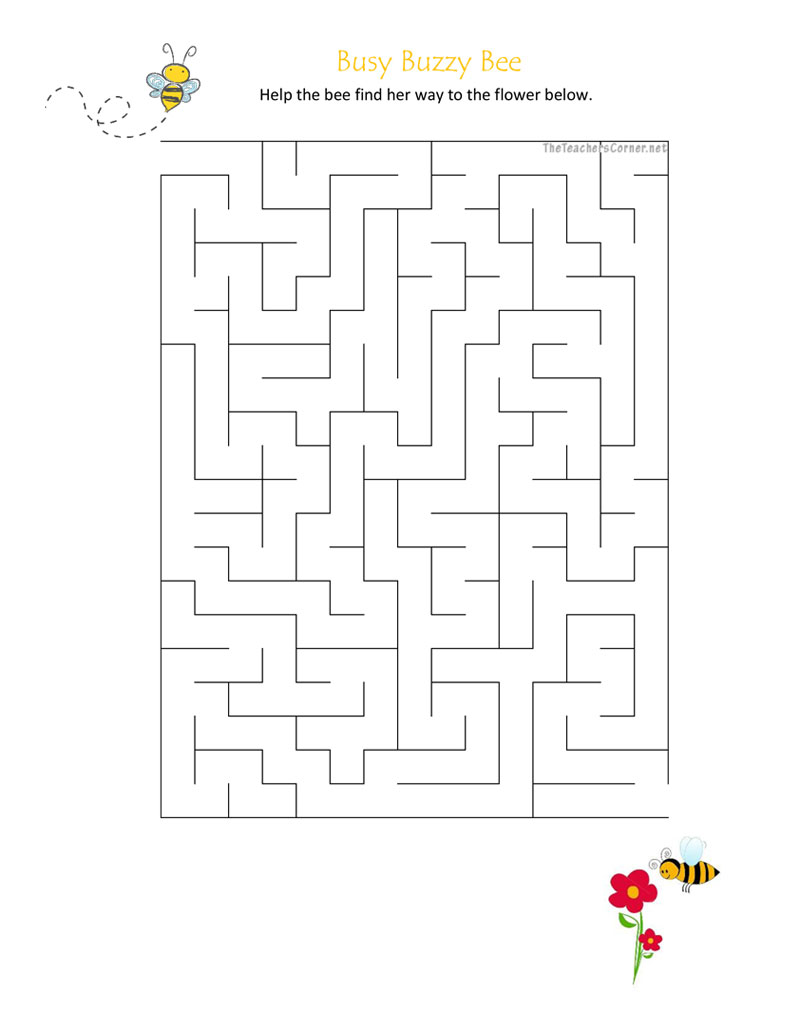
CPB---Busy-Buzzy-Bee-Maze

Can you help the little bee find her way to the flower and her friend in this printable maze?

Busy Buzzy Bee Maze Puzzle | Busy Buzzy Bee Maze Solution

You can find a detailed Classroom Discussion and Activity Guide for Buzz! written by Toni Buzzeo on her website. The Guide is full of science-based activities as well as prompts for art, illustration, and writing that will get kids excited to learn about stinging insects, pollination, and more. You can download it from Toni Buzzeo’s website.

You can purchase Buzz! Being Brave Around Buzzy, Stinging Insects from these booksellers

Amazon | Barnes & Noble | Bookshop

September 20 – It’s World Beach Month

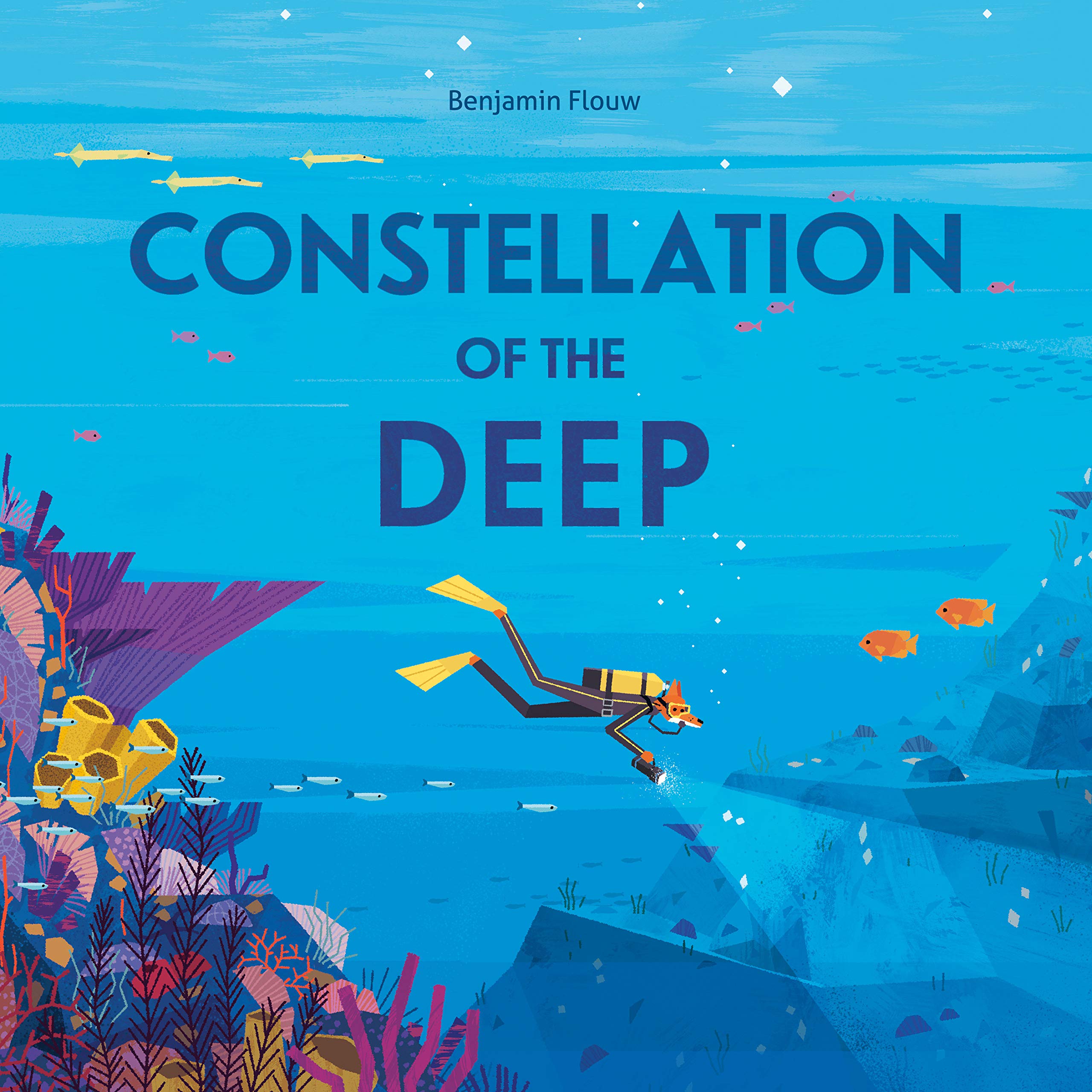
celebrate-picture-books-picture-book-review-constellation-of-the-deep-cover

About the Holiday

This month we celebrate beaches and all of the beauty and recreation they offer. Whether you’re a beachcomber or a swimmer, a sandcastle builder or a sunbather, the beach provides endless ways to enjoy the environment. This month also raises awareness of the types of pollution that mar and endanger the beach as well as the ocean and all of its varied sea life. The world’s coastal areas are irreplaceable habitats and offer crucial resources. Learn what you can do to help our beaches and oceans remain healthy by visiting the Ocean Conservancy website. You can discover more ways to enjoy World Beach Month here.

Constellation of the Deep

By Benjamin Flouw


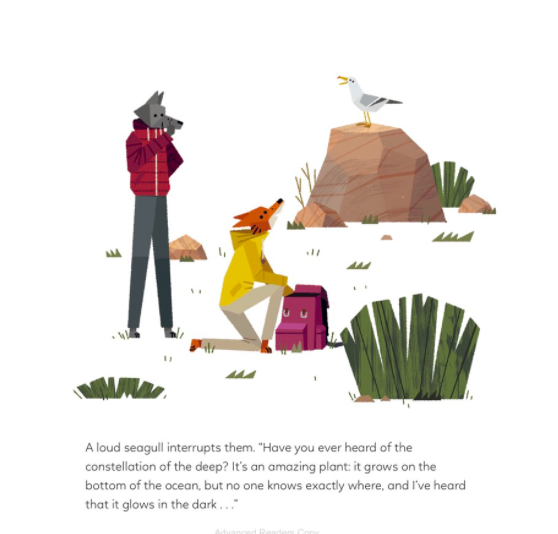
Fox and his cousin, Wolf, spend summer mornings walking along the coast. One day as Fox explores the unusual plants along the path, a seagull lands on a nearby boulder and asks if they have ever heard of the constellation of the deep. The Seagull goes on to tell them that “‘it’s an amazing plant: it grows on the bottom of the ocean, but no one knows exactly where.’” Then he adds that he’s “‘heard that it glows in the dark.’”

celebrate-picture-books-picture-book-review-constellation-of-the-deep-seagull

Copyright Benjamin Flouw, 2021, courtesy of Tundra Books.

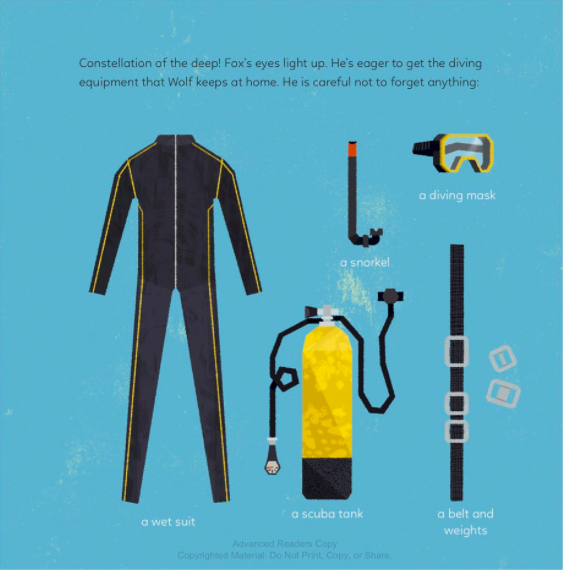
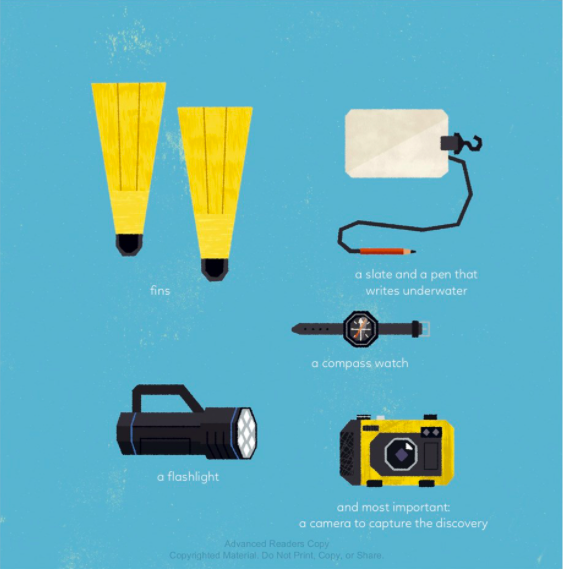
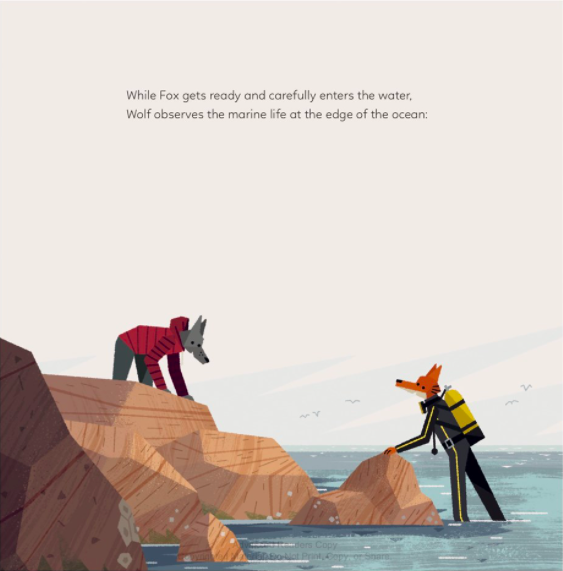
Hearing this, Fox immediately determines to find the constellation of the deep. Wolf has all the diving equipment he’ll need. Outfitted with a wet suit, snorkel, mask, scuba tank, camera, and all the other equipment, Fox and Wolf return to the ocean. While Fox gets ready and dives into the sea, Wolf discovers a crabs, barnacles, periwinkles, scallops, sea anemones, and even a sea star living among the rocks along the shore.

Fox swims above an underwater meadow of posidonia, which he knows “are flowering plants, but they don’t glow in the dark. He leaves the scorpion fish, conger eels, and damselfish behind and dives more deeply. Here, Fox discovers a forest of algae. He recognizes the tall, slender leaves of macrocystis, the fan-shaped leaves of eisenia, the feather-shaped alaria, and many more. While exploring, Fox meets Otter, who’s hunting for sea urchins. Fox tells Otter about his quest, and Otter tells him about “‘a place full of strange plants’” that he encountered just the other day.

celebrate-picture-books-picture-book-review-constellation-of-the-deep-scuba-gear

Copyright Benjamin Flouw, 2021, courtesy of Tundra Books.

Exiting the forest, Fox finds “rocks covered with strange, multicolored sculptures. These aren’t plants, but corals.” Fox is so stunned by their beauty that he gets out his camera and takes some pictures. “He marvels at the different shapes of corals.” He sees “corals that look like brains, trees, tables . . . and curled paper.” Some of the corals are enormous and some are as small as mushrooms.

Still, Fox hasn’t found what he’s looking for. He begins to ask for help. No one has seen the constellation of the deep, but Grouper agrees to help in the search. They glide into the open ocean, where they come upon a mountain jutting up from the ocean floor. Grouper knows of a hole in the mountain. As they approach, Fox sees something glowing inside. He swims closer only to find “a tiny glowworm!”

celebrate-picture-books-picture-book-review-constellation-of-the-deep-scuba-gear

Copyright Benjamin Flouw, 2021, courtesy of Tundra Books.

Fox wants to take a photograph and reaches for his camera, “but oh no! His camera is gone!” Staring down into the depths of the ocean, Fox spots an unusual shape. He swims down to see what it is. It’s Whale, who has become tangled in a fishing net along with bottles, cans, trash, and even a boot. What else is snagged in the net but Fox’s camera! Whale gives Fox a ride back to the surface. Wolf waves at his friend riding on top of Whale’s back.

Even though Fox hasn’t found the glowing plant, “he has made some wonderful memories.” Back home, he hands his cousin his camera to show him his pictures. Wolf is particularly taken with one that is very beautiful. “‘Look at this one,’” he says to Fox. Fox can’t believe it. His camera had captured a picture of the constellation of the deep when it fell to the ocean floor. Happy, Fox relaxes with a glass of mushroom juice, knowing that the photo of the constellation of the deep will always remind him of “the fabulous beauty of the underwater world.”

celebrate-picture-books-picture-book-review-constellation-of-the-deep-rocks

Copyright Benjamin Flouw, 2021, courtesy of Tundra Books.

In his follow up to The Golden Glow, in which plant-loving Fox and readers travel to the top of a mountain to discover a fascinating rare plant and a surprising decision, Benjamin Flouw plumbs the depths of the ocean to introduce kids to the wonders found there. Just as the sea itself, Flouw’s charming and straightforward storytelling is full of mystery and discovery. As Fox swims deeper and deeper through schools of fish, meadows and forests of sea plants, past coral reefs, and finally to an underwater mountain, readers learn about specific sea life found at each level. Interspersed with the story are several glossary-type pages with illustrations and names of scuba diving gear, tidal pool sea creatures, algae, and corals. Fox’s miraculous recovery of his camera and equally astonishing discovery among his photographs is the type of magical happenstance kids love best. Flouw’s understated environmental message is eloquent and effective.

Just as in The Golden Glow, Flouw’s stylized and textured illustrations, rendered in fresh and soothing tones, will get readers excited about discovering more about the environment. Here, the sea beckons with its colorful and varied creatures and plants. Two-page spreads of the algae forest and coral-encrusted rocks are stunning and the image of Whale wrapped in netting offer educators and kids a jumping off place to further research.

Mesmerizing, educational, and conveying a compelling message, Constellation of the Deep is sure to be a favorite. The book is highly recommended for all home, classroom, school, and public library bookshelves.

Ages 4 – 8

Tundra Books, 2021 | ISBN 978-0735268968

You can find a Constellation of the Deep Activity Kit from Tundra Books here.

Discover more about Benjamin Flouw, his books, and his art on his website.

World Beach Month Activity

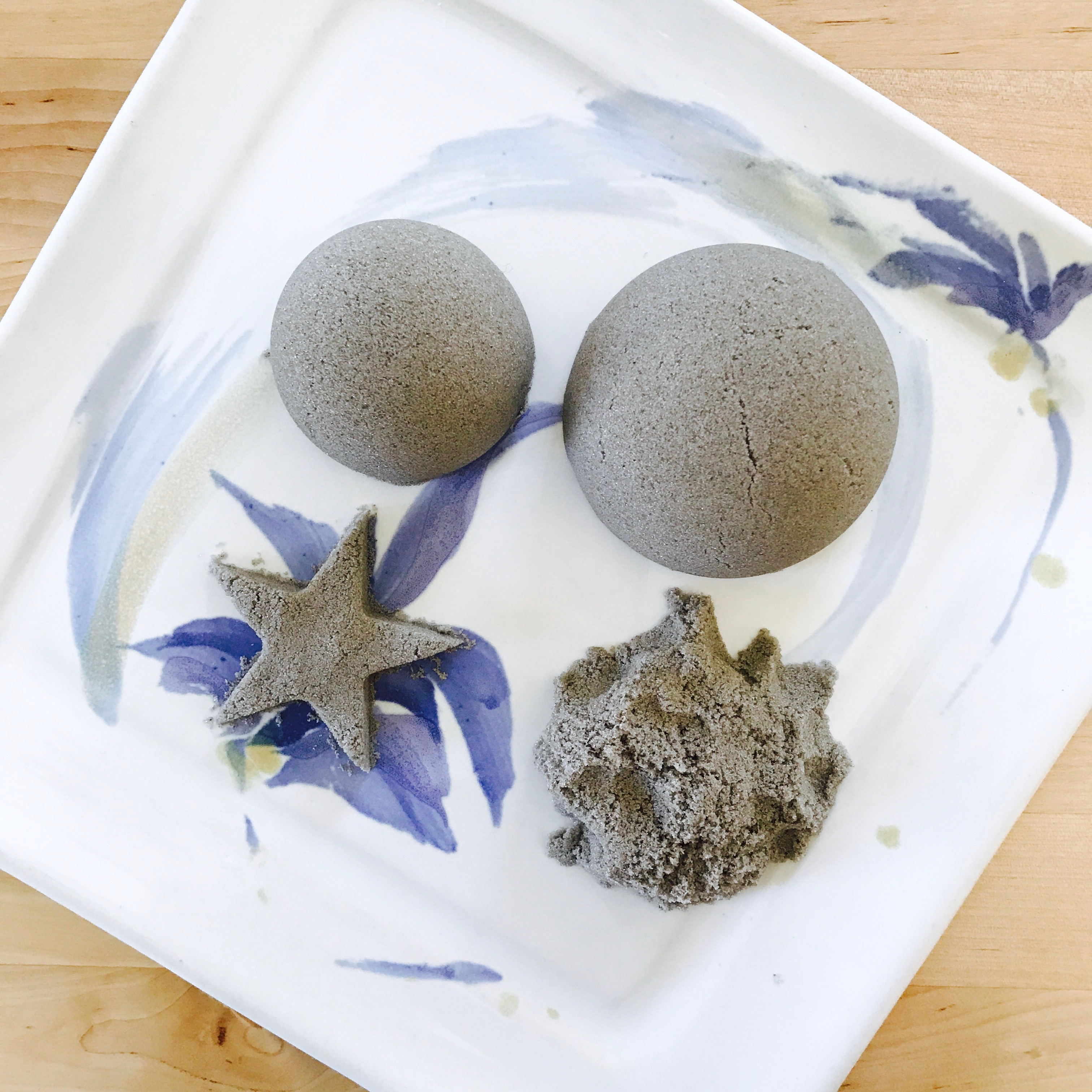
celebrate-picture-books-picture-book-review-kinetic-sand-craft

Kinetic Sand


You don’t have to live near the beach to enjoy playing in the sand! With this easy recipe you can create your own kinetic sand to form or let run through your fingers. It makes a great anti-stress reliever too!

Supplies

  • 1 cup sand
  • ½ tablespoon cornstarch
  • 1 teaspoon dish soap
  • Water as needed – about ¾ cup
  • Bin or bowl for mixing dry ingredients
  • Bowl for mixing dish soap and water

Directions

  1. In the bin combine the sand and cornstarch and mix well
  2. In the bowl combine the dish soap and water until the water is bubbly
  3. Slowly add the water mixture to the dry ingredients, mixing and adding water little-by-little until the desired consistency is reached. The grain of the sand will determine how much water is needed.
  4. The sand can be formed with cookie cutters, molds, hands, etc. and is strong enough to stack. Or just let it drip and ooze through your fingers.

celebrate-picture-books-picture-book-review-constellation-of-the-deep-cover

You can find Constellation of the Deep at these booksellers

Amazon | Barnes & Noble | Books-a-Million

To support your local independent bookstore, order from

Bookshop | IndieBound

Picture Book Review