November 24 – Picture Book Month

About the Holiday

We’re still celebrating one of the best months of the year—Picture Book Month! If you’re starting your holiday shopping, don’t forget to add picture books to your list for the kids in your life. With so many picture books to choose from on all kinds of topics, there’s sure to be a perfect book for each child. You know what they say—and it’s really true: A book is a gift you can open again and again, and today’s book is loaded with interactive elements that will keep kids coming back again and again! 

Thank you to Twirl and Barbara Fisch at Blue Slip Media for sending me a copy of this book for review!

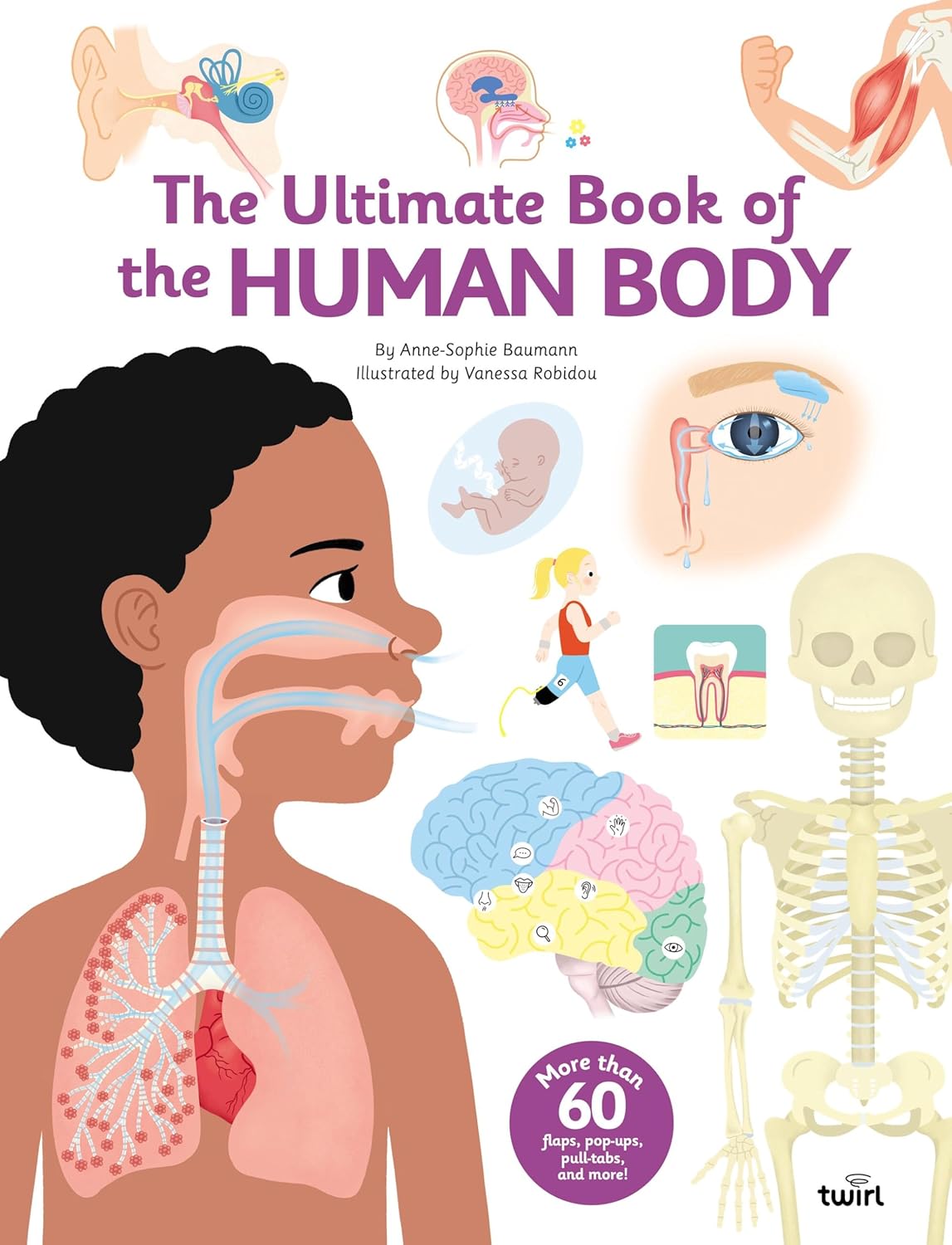
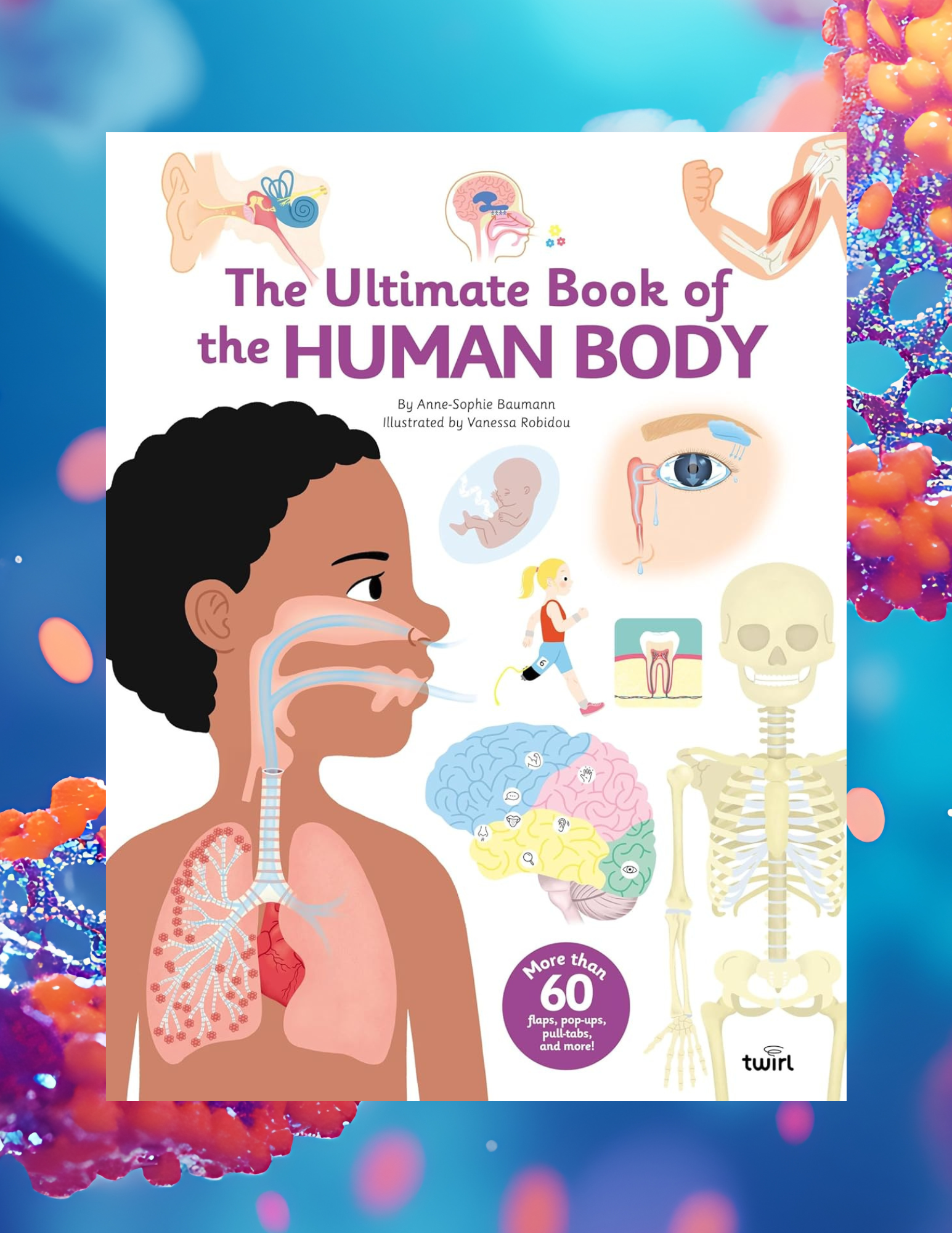
The Ultimate Book of the Human Body

Written by Anne-Sophie Baumann | Illustrated by Vanessa Robidou


If you’re raising or know a child who’s a future medical professional or one who’s simply interested in learning all about health and anatomy, they’ll be enthralled with The Ultimate Book of the Human Body. Teachers and other educators will also find this book an impactful introduction to how the body works that students will love exploring.

Offering an astonishing amount of information on every page, this oversized book is an interactive marvel that engages children through short and detailed, yet easily understood paragraphs that analyze all parts of the body from the tiniest mole to the largest organ: the skin. More than 60 flaps, pull tabs, and tiny booklets take kids under the skin and inside the body with illustrations worthy of a medical textbook. There’s even an articulated skeleton that demonstrates how our joints work. 
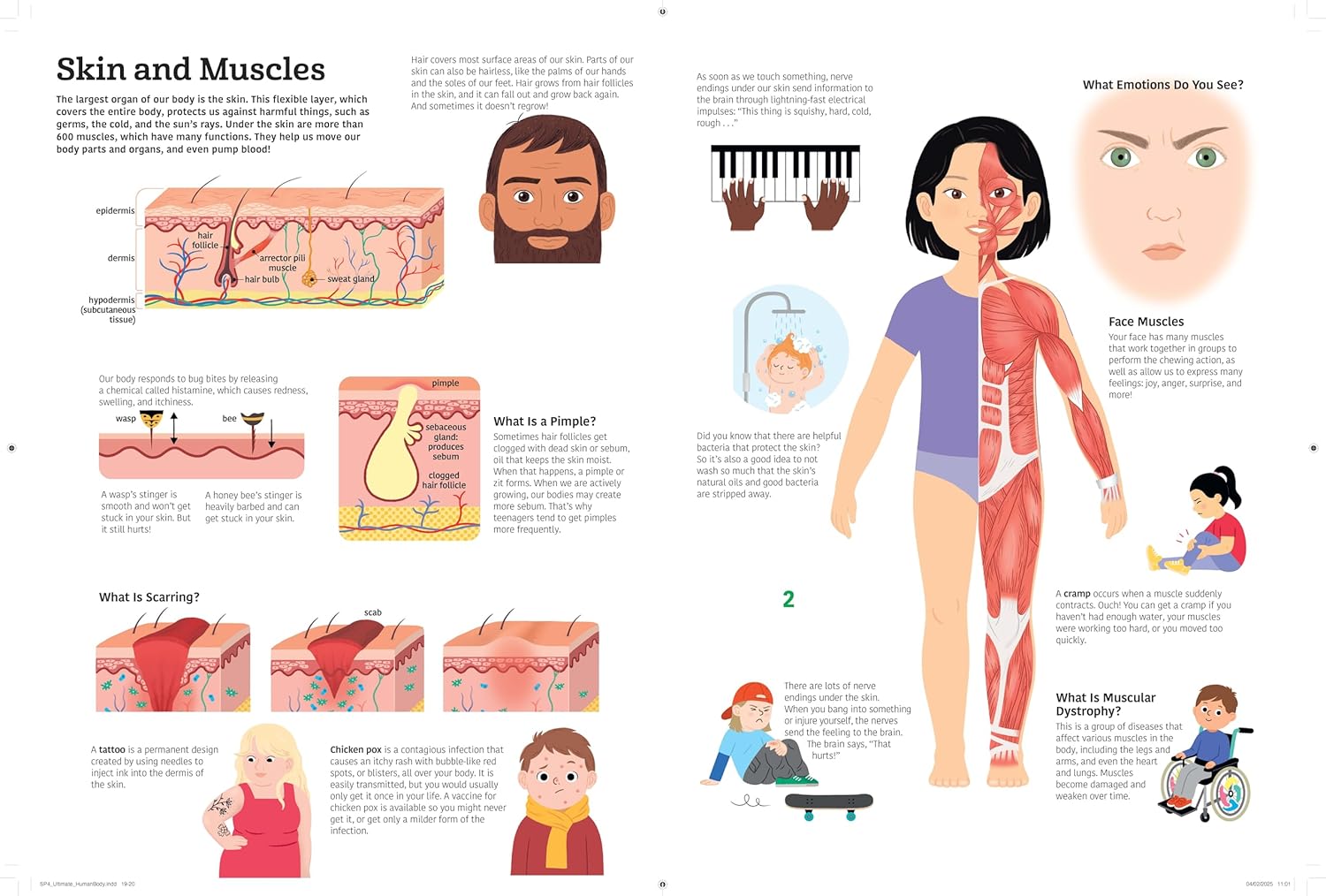
Illustration @ 2025 by Vanessa Robidou. Text © 2025 by Anne-Sophie Baumann. Courtesy of Twirl.

The book is broken into these eleven sections:

The Skeleton: Bones and More in which children learn about bone shapes; the makeup of bones; how bones heal; and information on the skull, spine, and joints. They can interact with a full-size hand that reveals all 27 bones that allow the fingers and wrists to move the way they do.

Skin and Muscles introduces kids to the layers of skin; how the skin heals and reacts to various types of bug bites; how impulses flow from our fingers to the brain; what a pimple and a mole are; what tanning is, and more. Children also get a full view of the muscles and how they work to show different emotions. 

Lungs reveals why we need oxygen, why we cough, what asthma is, how our diaphragm works when we inhale and exhale, and how the voice is produced.

Heart and Blood covers the circulatory system, our pulse and blood pressure, how the heart works, all about blood, and even the fact that “an adult’s heart is about the size of a large apple.”
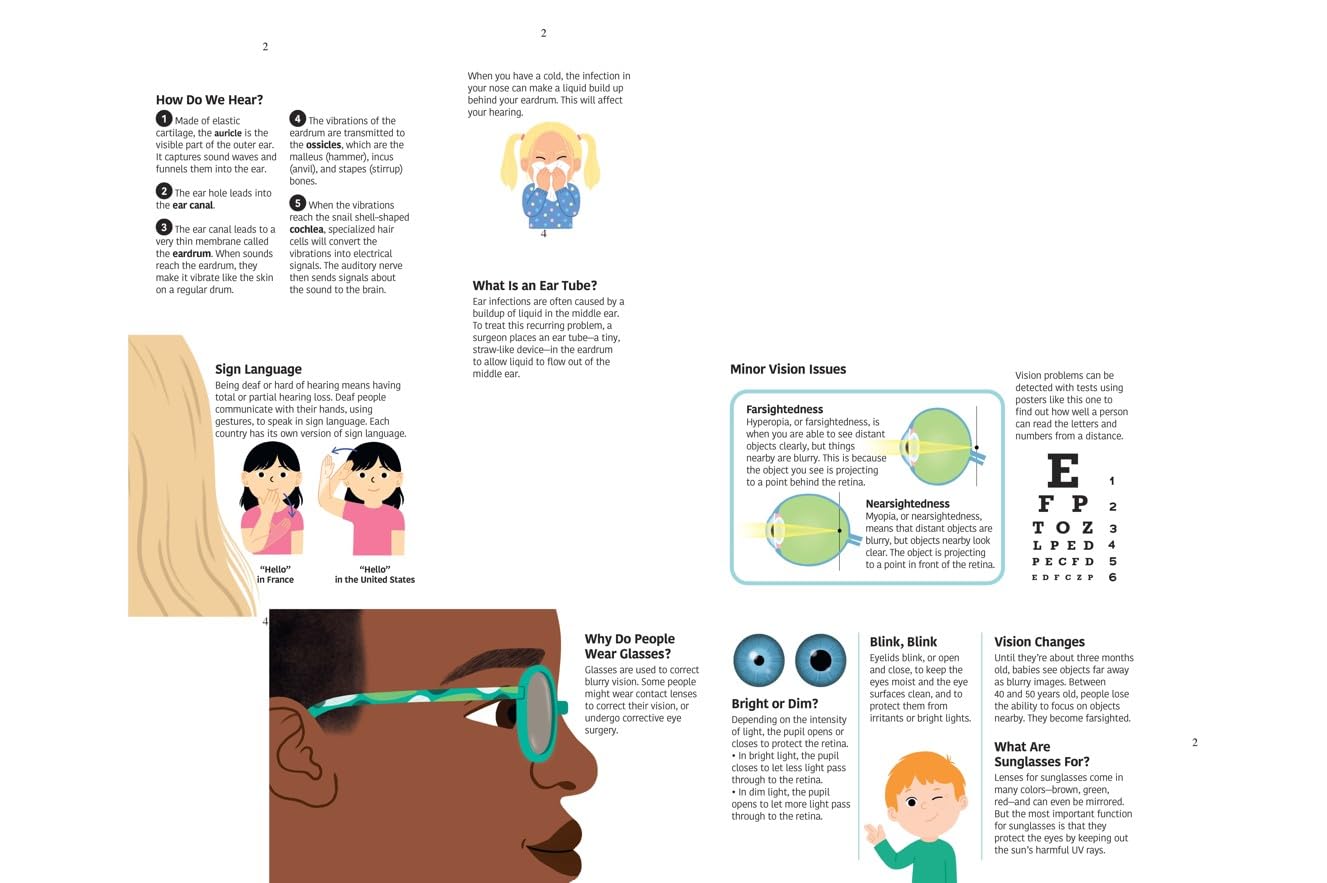
Illustration @ 2025 by Vanessa Robidou. Text © 2025 by Anne-Sophie Baumann. Courtesy of Twirl.

Seeing and Hearing contains information on the parts and working of the eyeball, vision issues, eye color, and more. The hearing section gives kids a look into the inner ear while also learning about sound frequency, earaches, balance, and hearing issues.

Smelling and Tasting talks about the mechanisms of smell, the inner nose, sneezing, the connection between the ear and the nose, the tongue, tasting, ear pain, and sore throats.

Biting and Chewing shows the development of teeth through various ages, and talks about parts of a tooth, cavities, braces, and caring for our teeth.

Eating and Drinking contains a wide range of topics and includes interactive elements that expose the workings of the urinary and digestive systems. Other topics include vitamins, foods, constipation, and appendicitis.
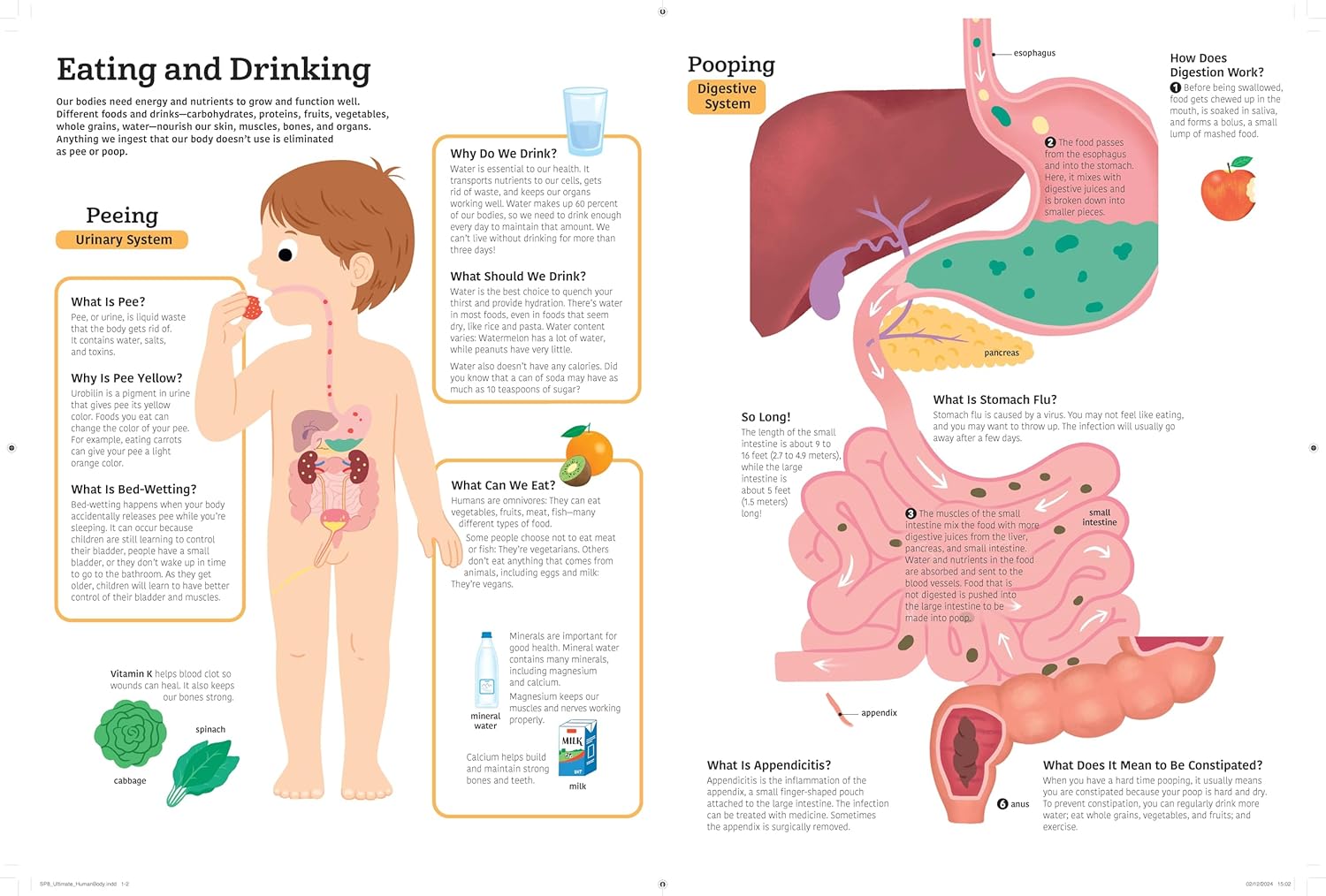
Illustration @ 2025 by Vanessa Robidou. Text © 2025 by Anne-Sophie Baumann. Courtesy of Twirl.

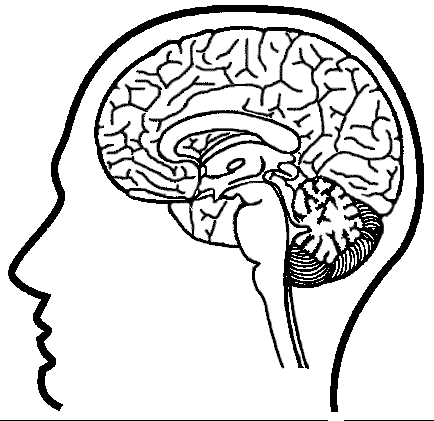
The Brain and the Nervous System is a comprehensive section that goes in-depth on how these intricate systems work and provides detailed illustrations on how the nerves run through the body as well as a pop-up, multilayered depiction of the brain that shows where in the brain our senses, memory, speech, and muscle control originate. You’ll find information on mysteries of the brain, brain disorders, and more.

Birth and Growing Up provides adults and children with a wealth of knowledge about the reproductive organs, how babies are made, how a sperm fertilizes an egg, the major stages of development from embryo to fetus by month, how twins develop, what a cell is, DNA, and highlights of growth and development from birth to adulthood.

Living Well discusses ways people can take care of themselves throughout their lives as well as disabilities, diabetes, Down syndrome, and the role of medical professionals, medications, inventions, and procedures that can help people live a better life.
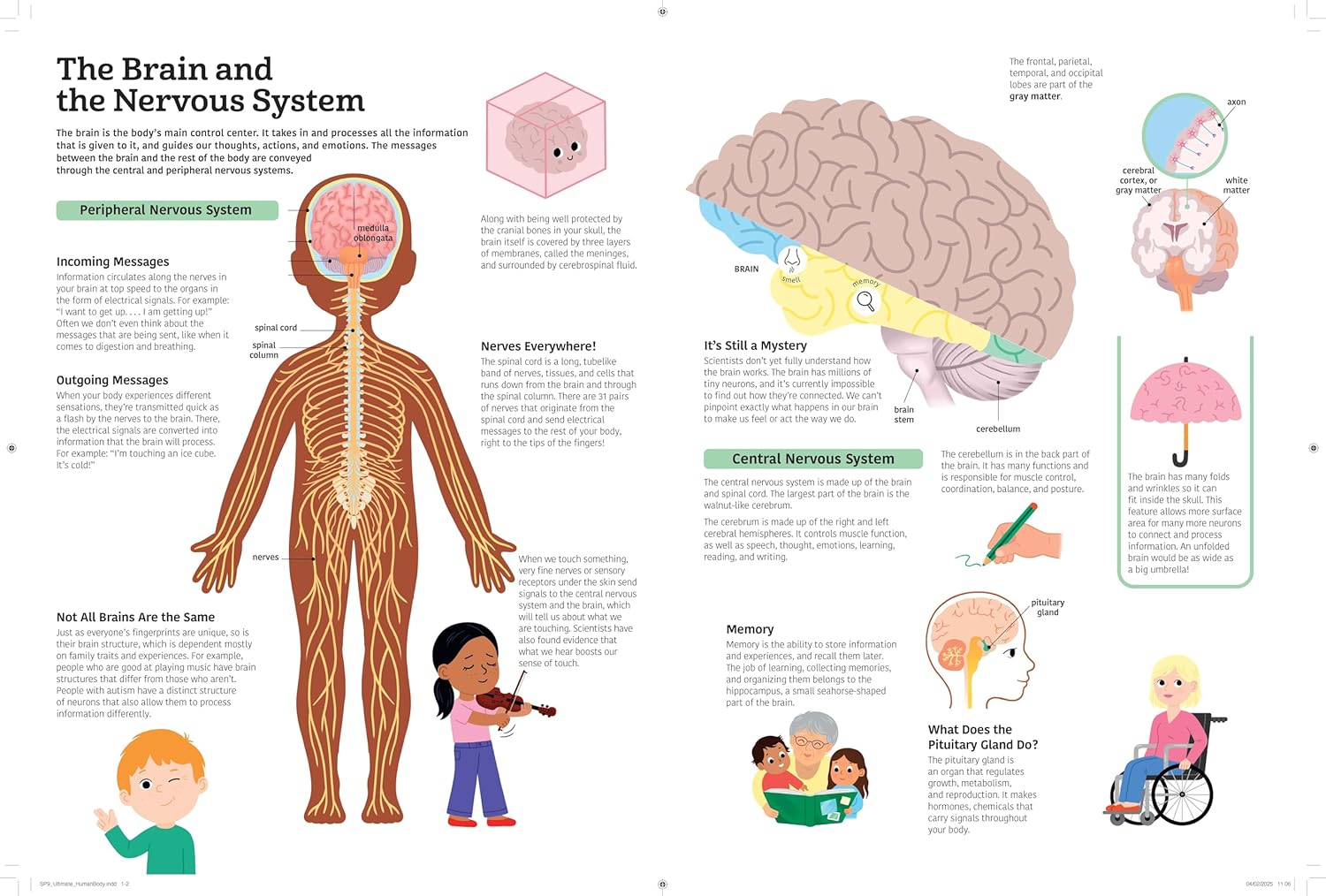
Illustration @ 2025 by Vanessa Robidou. Text © 2025 by Anne-Sophie Baumann. Courtesy of Twirl.

Anne-Sophie Baumann engages her target audience of children ages 8 through 12 with intelligent writing that uses scientific terminology always followed up with an easily understood definition. She addresses her readers directly, drawing them into this extensive education on anatomy and physiology through discussions about the body’s makeup as well as by spotlighting particular issues of interest for her young readers, such as pimples and skin issues, changing voices, braces, and stages of growth and development.

Accompanying Baumann’s text are Vanessa Robidou‘s incredibly detailed, and in some cases life-sized illustrations. Through the wealth of interactive elements, Robidou invites children to peer inside bones; the ear, eye, and mouth; the skin; and the organs as well as to follow breath, food, blood, and even tears through their dedicated systems. Colorful and expressive, these illustration will wow kids as they support Baumann’s text in exciting ways that reinforce learning.

If you’re looking for a hands-on book about the workings of the human body to share with your child or student, The Ultimate Book of the Human Body is highly recommended and would make a fantastic gift for children interested in topics about anatomy and health.

Ages 8 – 12

Twirl, 2025 | ISBN 979-1027613649

About the Author

Anne-Sophie Baumann studied science and literature before becoming an editor and author. She lives hear Paris, France. You can find her on Instagram.

About the Illustrator

Vanessa Robidou‘s illustrations can be found in various media and in many children’s books. She lives in Rennes, France. You can see more of her work on Instagram.

Picture Book Month Activity
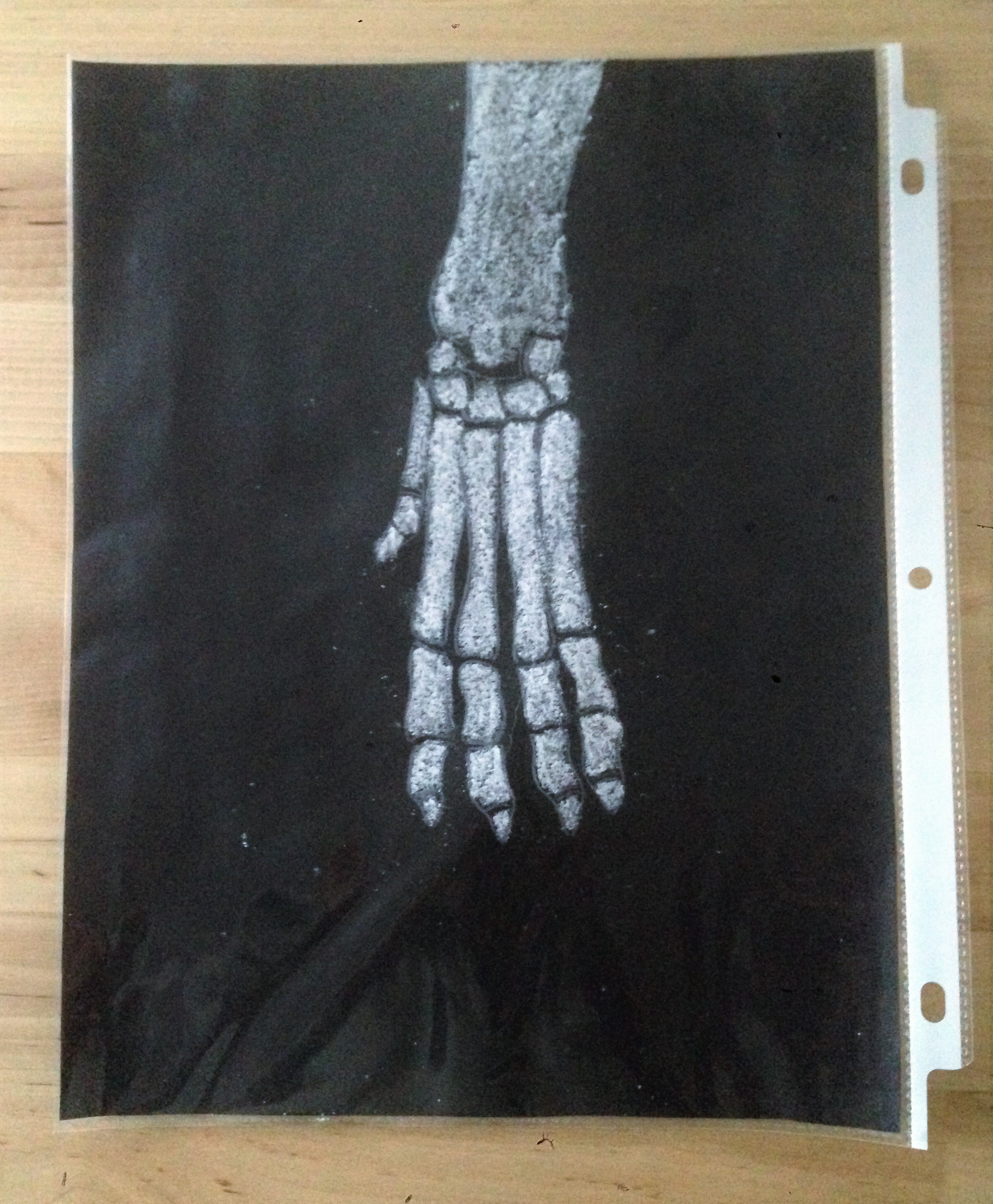
celebrate-picture-books-picture-book-review-x-ray-craft-dog-paw

Dog Paw and Human Hand X-Ray Craft


X-rays are cool to look at, but they always stay at the doctor’s office! With this craft you can simulate X-rays of a dog’s paw and a human hand!

Supplies

  • Printable skeleton templates: Human Hand Template | Dog Paw Template
  • Black chalkboard drawing paper, 8 ½ inches by 11 inches
  • White colored pencil
  • White chalk
  • Clear Plastic Report Sheet Protectors

Directions

  1. Print the Human Hand and Dog Paw Templates (you may want to print two—one to cut and one to follow when transferring the bones to the black paper)
  2. Cut the bones apart
  3. Lay the bones on the black chalkboard paper
  4. Trace the bones with the white colored pencil
  5. Color in the bones with the white chalk
  6. Slip the black paper into the plastic report sheet protector
You can purchase The Ultimate Book of the Human Body from these booksellers

Amazon | Barnes & Noble | Bookshop

Picture Book Review

November 8 – National STEM/STEAM Day

celebrate-picture-books-picture-book-review-santiago-saw-things-differently-cover

About the Holiday

November 8th is National STEM/STEAM Day. This holiday was founded in 2015, and the date was partially chosen for its secret play on words: “NOV 8” can be read as (in)novate! On this day, we highlight the importance of science, technology, engineering, art, and math in education and society at large. This holiday is also meant to uplift voices and perspectives that are often given less representation in STEAM careers and fields of study.

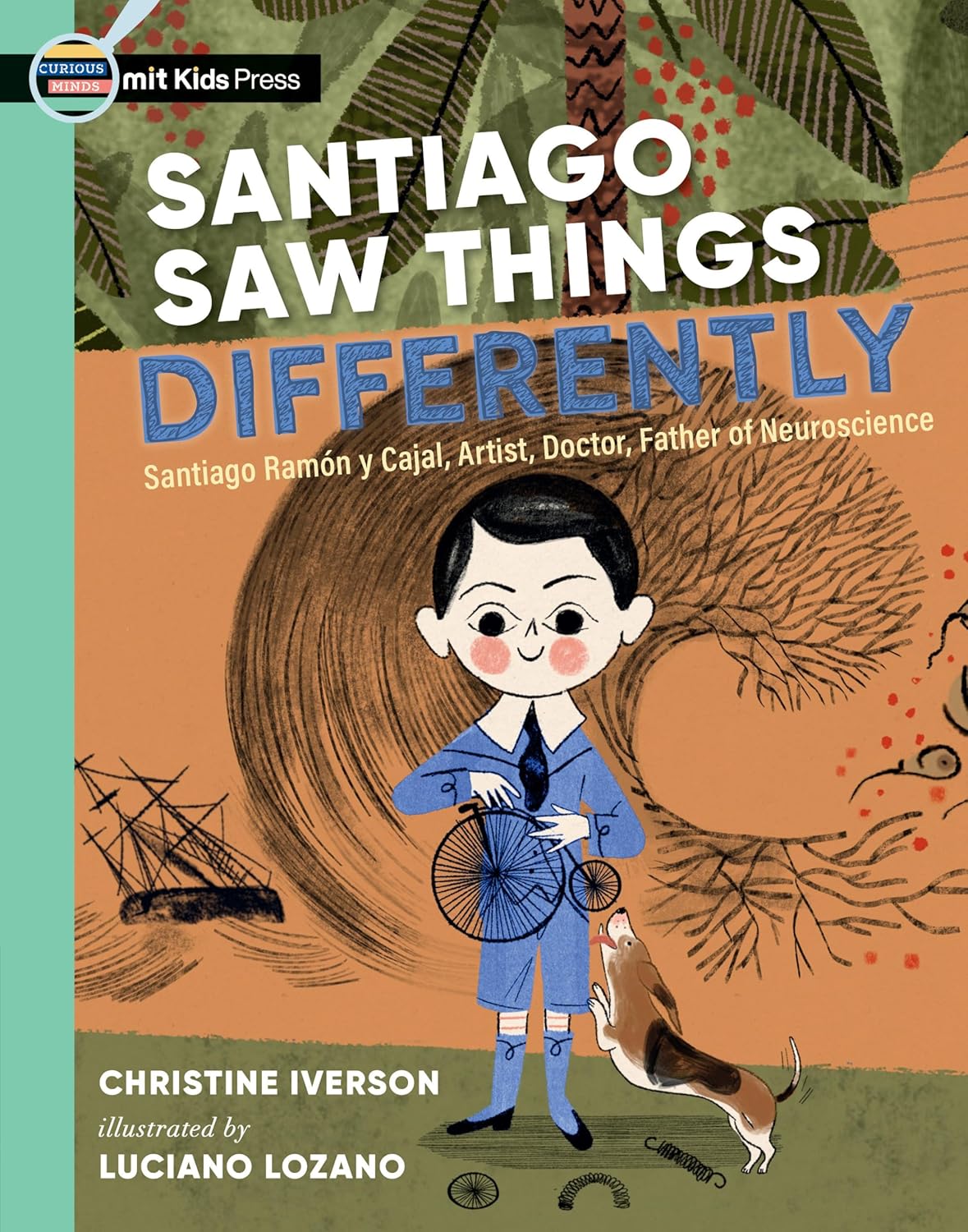
On this National STEM/STEAM Day we review a biography of Santiago Ramón y Cajal, Father of Neuroscience. Despite many people discouraging him along his journey Ramón y Cajal found ways to merge his love for art and observation with his scientific background to create new and important discoveries. 

Reviewed by Dorothy Levine

Santiago Saw Things Differently: Santiago Ramón y Cajal, Artist, Doctor, Father of Neuroscience

Written by Christine Iverson | Illustrated by Luciano Lozano


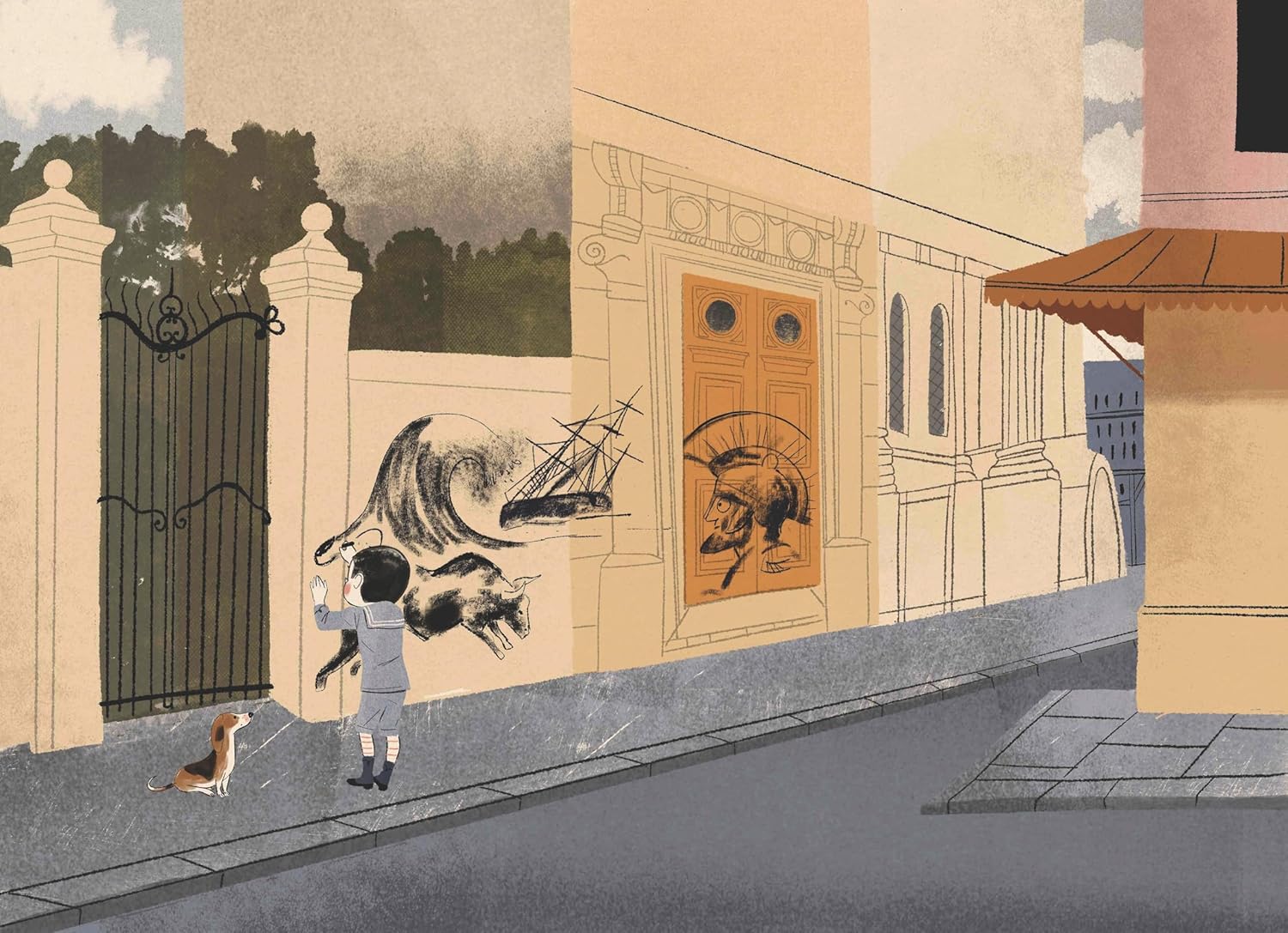
Santiago always had a passion for creating and exploring. As a child in Spain, he spent time creating music and inventing toys with any scraps he could find, drawing elaborate charcoal scenes across neighbors’ walls and racing around his grandfather’s loom shop. There, as “he twirled and tangled woolen thread…. Dust sparked and soared in a kaleidoscope of motion.” Unfortunately, not everybody understood the magic of his creations. Neighbors, and particularly Santiago’s father, believed Santiago’s public displays of art were more bothersome than intriguing. 

celebrate-picture-books-picture-book-review-santiago-saw-things-differently-drawing-on-wall

Image copyright Luciano Lozano, 2024, text copyright Christine Iverson, 2024. Courtesy of MIT Kids Press.

As Santiago’s father ushered him through many different schools, aiming to leave room for no “distractions” from study, Santiago held on to his artistic practice and passion for exploring the natural world in secret. When once admonished for drawing on the margins of his paper, Santiago was forced to spend time in his school’s dark basement. But, in a stroke of luck, “The room was lit by a wisp of light leaking through an old shutter—just enough for drawing.” Another time, stuck in a classroom with no paper, Santiago used his pencil to unlock the door. 

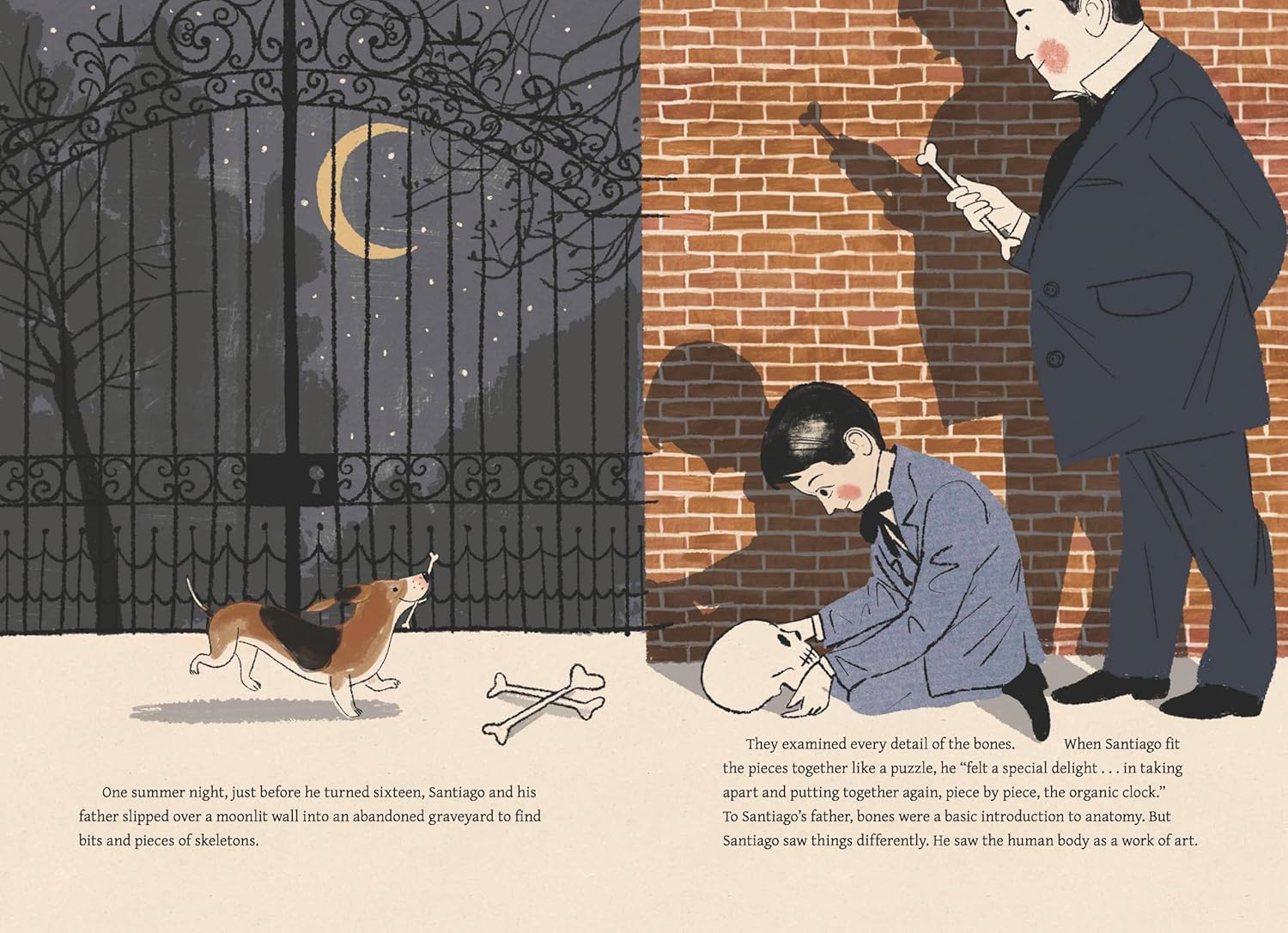
As he grew up, Santiago developed a specific fascination for the human body. At medical school, Santiago observed the way blood vessels in our bodies mirror the canals of the Ebro River near his university. “He saw the human body as a work of art,” a work that replicates in nature and is connected more broadly to the world at large.

celebrate-picture-books-picture-book-review-santiago-saw-things-differently-graveyard

Image copyright Luciano Lozano, 2024, text copyright Christine Iverson, 2024. Courtesy of MIT Kids Press.

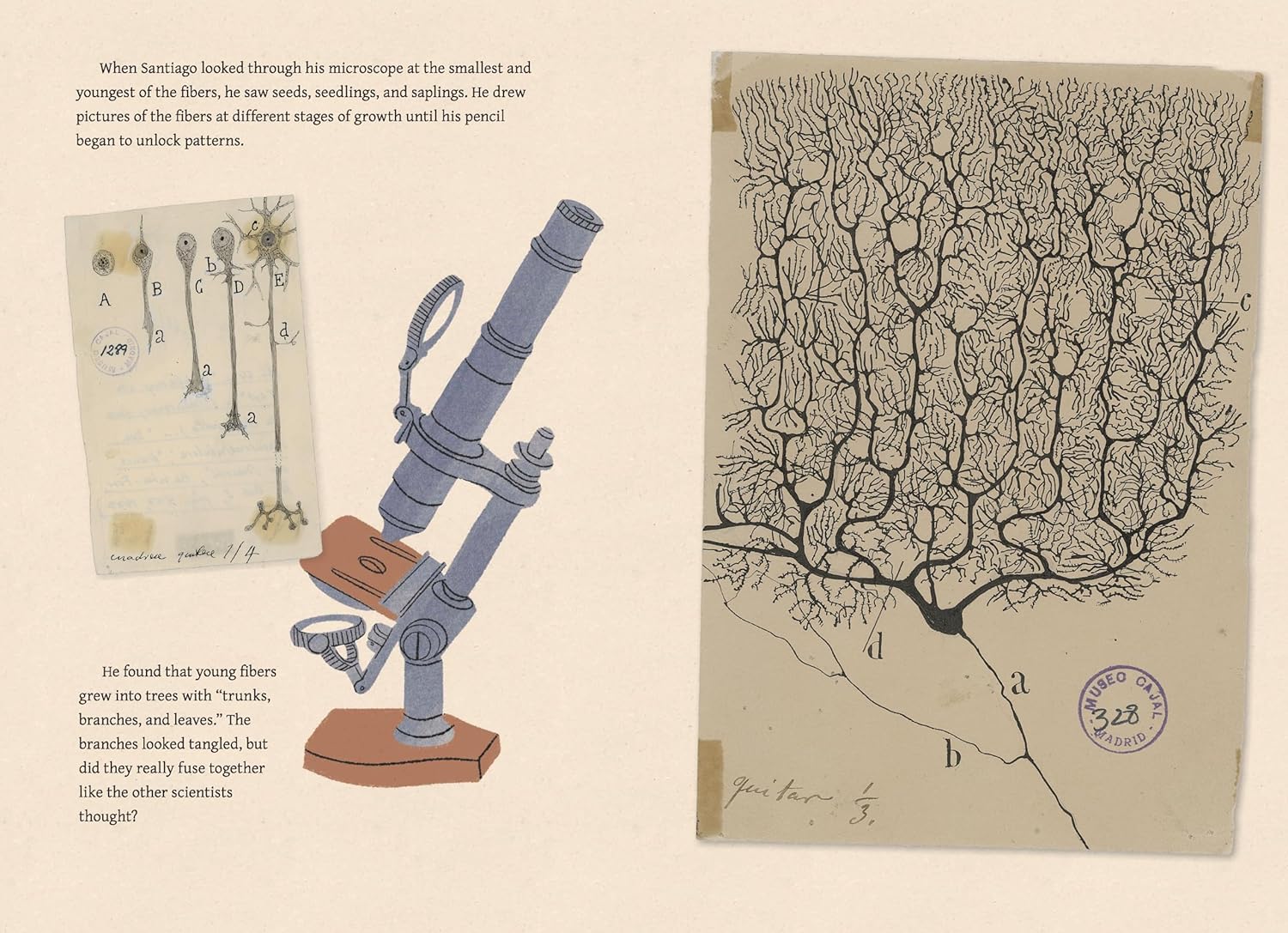
Years later, when scientists were focused on working out how the tiny connectors (or nerve fibers) in our brains worked, Santiago was able to use his microscope and drawing skills to sort out that the fibers spread in a similar fashion to the young trees he had spent so much of his time drawing and observing. With the help of ink stains, study, and lots of drawings of his observations, Santiago drew new conclusions about neurons and cells that helped scientists across the globe to understand the human brain better. 

All because “Santiago saw things differently” he was able to unlock new ways of understanding the brain, gaining him a Nobel prize and the eventual title of the Father of Neuroscience. 

celebrate-picture-books-picture-book-review-santiago-saw-things-differently-microscope-view

Image copyright Luciano Lozano, 2024, text copyright Christine Iverson, 2024. Courtesy of MIT Kids Press.

Iverson writes a detailed lyrical account of the life of Santiago Ramón y Cajal that is accessible for a wide range of readers. For interested older audiences, the book includes extensive back matter on the Anatomy of a Neuron, more biographical information on Santiago Ramón y Cajal and an explanation of the science behind one scene in the story. 

Interwoven with quotes and images from Ramón y Cajal’s original works are Lozano’s masterful swirling illustrations of Santiago and his environment as they both grow and change. Throughout the story, Lozano inserts details for readers to observe and make their own discoveries, such as the dog who follows Santiago throughout his childhood. Lozano illustrates the story mainly in blushing pinks, sky blues and light-yellow browns with accented vibrant greens and darker colors signifying location changes and key turning points in the story. There is a subtle humor helping to lighten the darker parts of Santiago’s life. The tale closes with the image of Santiago face-to-face with a cartoon-like human skeleton (filled with neurons) smiling back at him.

Santiago Sees Things Differently is a celebratory account of innovation, perseverance and appreciation for the often-interdisciplinary nature of outside-of-the-box thinkers. The title page opens with a poignant quote from Santiago Ramón y Cajal himself, encouraging “young investigators” to keep exploring the vast unknown of the natural world and to remember that what is left undiscovered is always larger than what has been already found. Santiago Sees Things Differently provides readers with the empowering knowledge that new perspectives are necessary for new discovery. And that while difference is often looked down upon, it is, often, in fact a superpower. 

(This book is available in both Spanish and English versions)

Ages 5 – 9

MIT Kids Press, 2024 | ISBN 978-1536238334

About the Author

Christine Iverson is a physical therapist with a strong interest in neural pathways. She holds a BS in history from the United States Military Academy at West Point, a doctoral degree in physical therapy from Baylor University, and an M.Ed. with a focus in children’s literature from Pennsylvania State University. She lives in Alexandria, Virginia. Visit her at christineiversonwrites. com.

About the Illustrator

Luciano Lozano is a Spanish author, illustrator, and graphic artist. He is the creator of several picture books, including Mayhem at the Museum: A Book in Pictures, and the illustrator of many others, including I (Don’t) Like Snakes by Nicola Davies. He lives in Spain. Visit him at lucianolozano.com.

STEM/STEAM Day Activities

celebrate-picture-books-brain-coloring-page


Neuroscience Coloring Pages

Follow Santiago’s footsteps by coloring pictures of different parts of the brain and scientific tools used in the story with these coloring pages from the University of Washington. You’ll also find brain games, plus loads of printable puzzles, worksheets, bookmarks, and even treasure hunts here too! (Coloring pages available in English and Spanish!)


Build a Hands-on Model of a Neuron

Have fun and learn about neurons by making a model! You can use almost any kind of material you like—clay, perler beads, bread dough, or even candy—to make it. So put on your thinking cap and get creative! You’ll find lots of ideas on this page from The University of Washington’s Neuroscience for Kids Page.

celebrate-picture-books-picture-book-review-santiago-saw-things-differently-cover

You can purchase Santiago Saw Things Differently at these booksellers

Amazon | Barnes & Noble | Bookshop (to support your local independent bookstore)

May 11 – National Eat What You Want Day

celebrate-picture-books-picture-book-review-poop-for-breakfast-cover

About the Holiday

Do you feel like you’ve been on a diet forever? Have you been denying yourself a favorite treat because maybe it’s not the best thing you can eat? Or do you find yourself always making meals to suit everyone else’s taste when what you really want is just a grilled cheese sandwich? If so, today’s holiday gives you carte blanche to enjoy the foods you want without feeling guilty. It also seems like a fitting day to learn about the rather unusual (at least to us) diet of many creatures in the animal kingdom—and that’s where today’s book come in!

Poop for Breakfast: Why Some Animals Eat It 

Written by Sara Levine | Illustrated by Florence Weiser


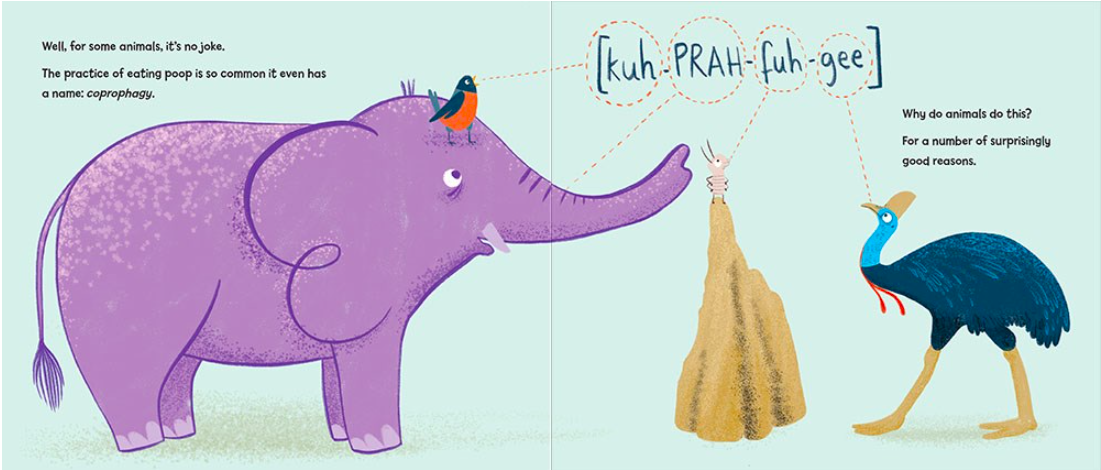
So, you wake up starving for a delicious meal. You’ve been dreaming of pancakes, maybe, or a plate of eggs and bacon. But when you get to the table, there’s a bowl of poop waiting for you?! Come on! While you might sulk (and probably hold your nose), there are plenty of creatures who’d be thinking “Bring it on!” Who are these critters? They’re animals that practice coprophagy, and they do it “for a number of surprisingly good reasons,” Sara Levine reveals.

celebrate-picture-books-picture-book-review-poop-for-breakfast-coprophagy

Image copyright Florence Weiser, 2023, text copyright Sara Levine, 2023. Courtesy of Millbrook Press.

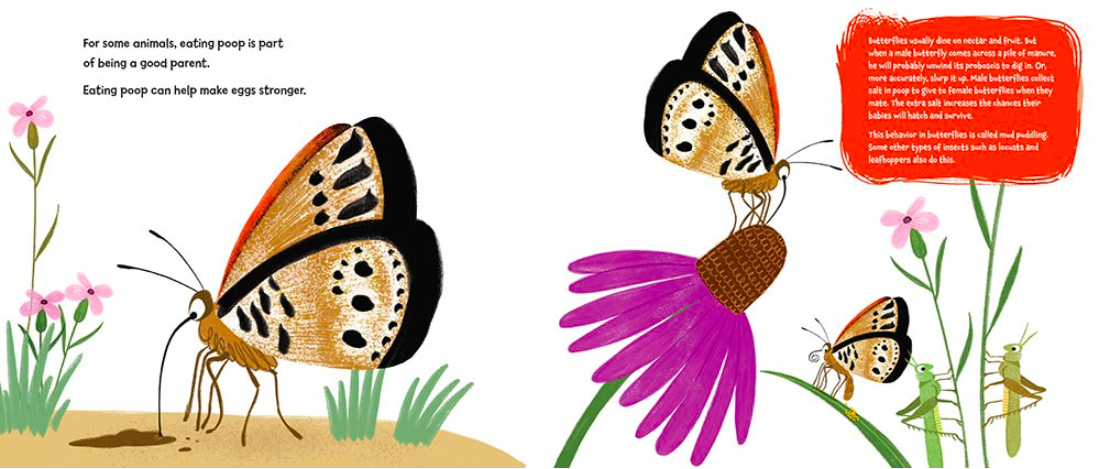
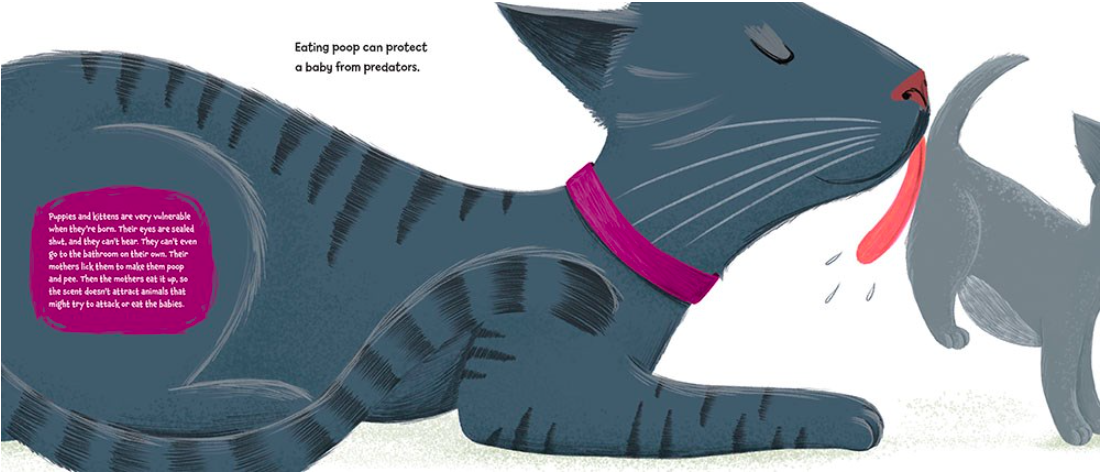
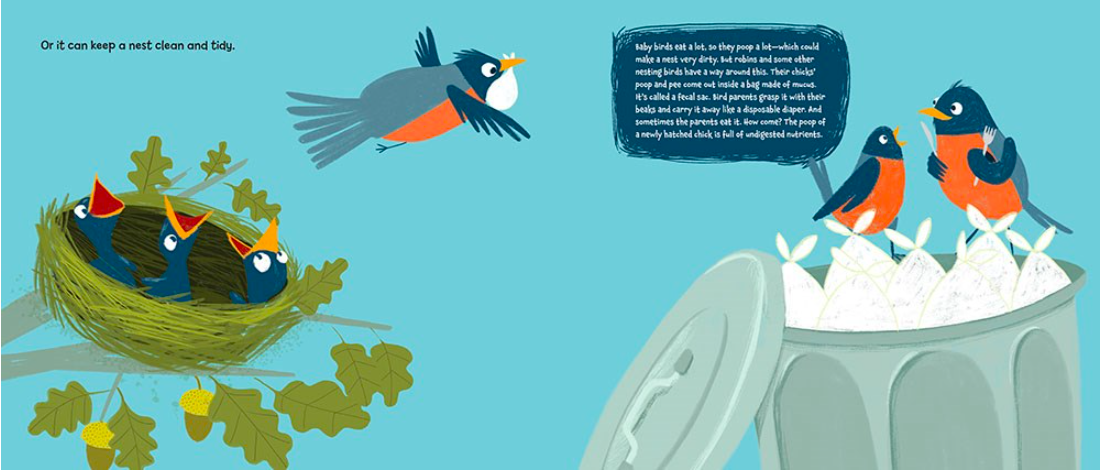
For some animals eating poop is just part of being a Number 1 (or maybe Number 2 is better in this case) parent. Butterflies, cats, and dogs as well as robins and other birds all have specific reasons for dining on doo-doo, from making eggs strong to protecting their babies from predators to keeping “a nest clean and tidy.” Birds have a particularly fascinating way to do this. Since baby birds eat a lot, they poop a lot. Keeping up with that level of cleaning could be daunting. Amazingly, though, these “chicks’ poop and pee come out inside a bag made of mucus. It’s called a fecal sac. Bird parents grasp it with their beaks and carry it away like a disposable diaper. And sometimes the parents eat it. How come? The poop of a newly hatched chick is full of undigested nutrients.”

celebrate-picture-books-picture-book-review-poop-for-breakfast-butterflies

Image copyright Florence Weiser, 2023, text copyright Sara Levine, 2023. Courtesy of Millbrook Press.

While these animals eat poop for external or aesthetic reasons, others engage in coprophagy to keep their digestive system working well. Still others, because of the length or shape of their digestive tract, require that food travels through their body twice to extract all of the nutrients. If you have a rabbit, hamster, guinea pig, or other small rodent as a pet, you know that their poop looks like little round balls or small pellets. As Levine tells readers, “this is the poop that has been through their digestive tract a second time. The first poop comes out soft, sticky, and full of nutrients. It’s called a cecotrope (SEE-ca-trope),” and these animals “gobble it up at night when it comes out. That’s why you don’t see it” in the cage.

celebrate-picture-books-picture-book-review-poop-for-breakfast-robins

Image copyright Florence Weiser, 2023, text copyright Sara Levine, 2023. Courtesy of Millbrook Press.

Since there are so many creatures who do eat poop, why don’t humans? Levine has included a whole list of reasons (and, yes, the frowny- crinkled-nose-face you’re making right now is one of them) for why we don’t—and don’t need to. She’s also provided back matter that includes “The Scoop on Poop”—an explanation of what poop and pee are, how they’re created in the body, and how they’re eliminated through the anus and the urethra as well as a paragraph about creatures that have a single cloaca instead of two openings. Kids will also have fun becoming “poop detectives” with the help of Levine’s and illustrator Florence Weiser’s guide to the sizes and shapes of poop from common pets and wildlife and playing a silly synonym game.

celebrate-picture-books-picture-book-review-poop-for-breakfast-cats

Image copyright Florence Weiser, 2023, text copyright Sara Levine, 2023. Courtesy of Millbrook Press.

Sara Levine is exceptional at presenting fascinating nature science topics in humorous and accessible ways for young audiences, and her latest book is no exception, Leaning into the “Ewww!” factor, Levine dishes up short, take-away reasons certain animals, birds, and insects practice coprophagy followed up with longer passages that explain the science and/or behavior behind them in easy-to-understand language sprinkled with humor that will keep readers riveted to this already high-interest subject.

Florence Weiser’s colorful illustrations perfectly bridge the humorous and the scientific nature of Levine’s text. Readers’ skeptical view of this “gross” habit is amusingly juxtaposed with creatures’ excited anticipation of a delicious meal through the characters’ facial expressions while the anatomical reasons for or against coprophagy are clearly depicted in images of human and various animals’ digestive systems.

Anatomy and nature science education at its best, Poop for Breakfast: Why Some Animals Eat It will keep kids enthralled as each page turn brings on a new round of giggles and avid learning. The book would enhance any home STEM collection and is a must for classroom, school, and public library bookshelves.

Ages 5 – 10

Millbrook Press, 2023 | ISBN 978-1728457963

About the Author

Sara Levine is an author, educator, and veterinarian. Her science books for children include the Animal by Animal series, Germs Up Close, and A Peek at Beaks: Tools Birds Use. Her books have received a number of awards including AAAS/Subaru SB&F Prize, Utah Beehive Book Award, Cook Prize finalist, Monarch Award master list, and Bank Street College Best Children’s Book of the Year.

About the Illustrator

Florence Weiser is a French illustrator currently based in beautiful, rainy Belgium. While growing up in Luxembourg, she always knew she wanted to draw and draw. She lives and works surrounded by nature, from which she gathers most of her inspiration.

celebrate-picture-books-picture-book-review-poop-for-breakfast-cover

You can find Poop for Breakfast: Why Some Animals Eat It at these booksellers

Amazon | Barnes & Noble | Books-a-Million

To support your local independent bookstore, order from

Bookshop

Picture Book Review


May 20 – World Bee Day

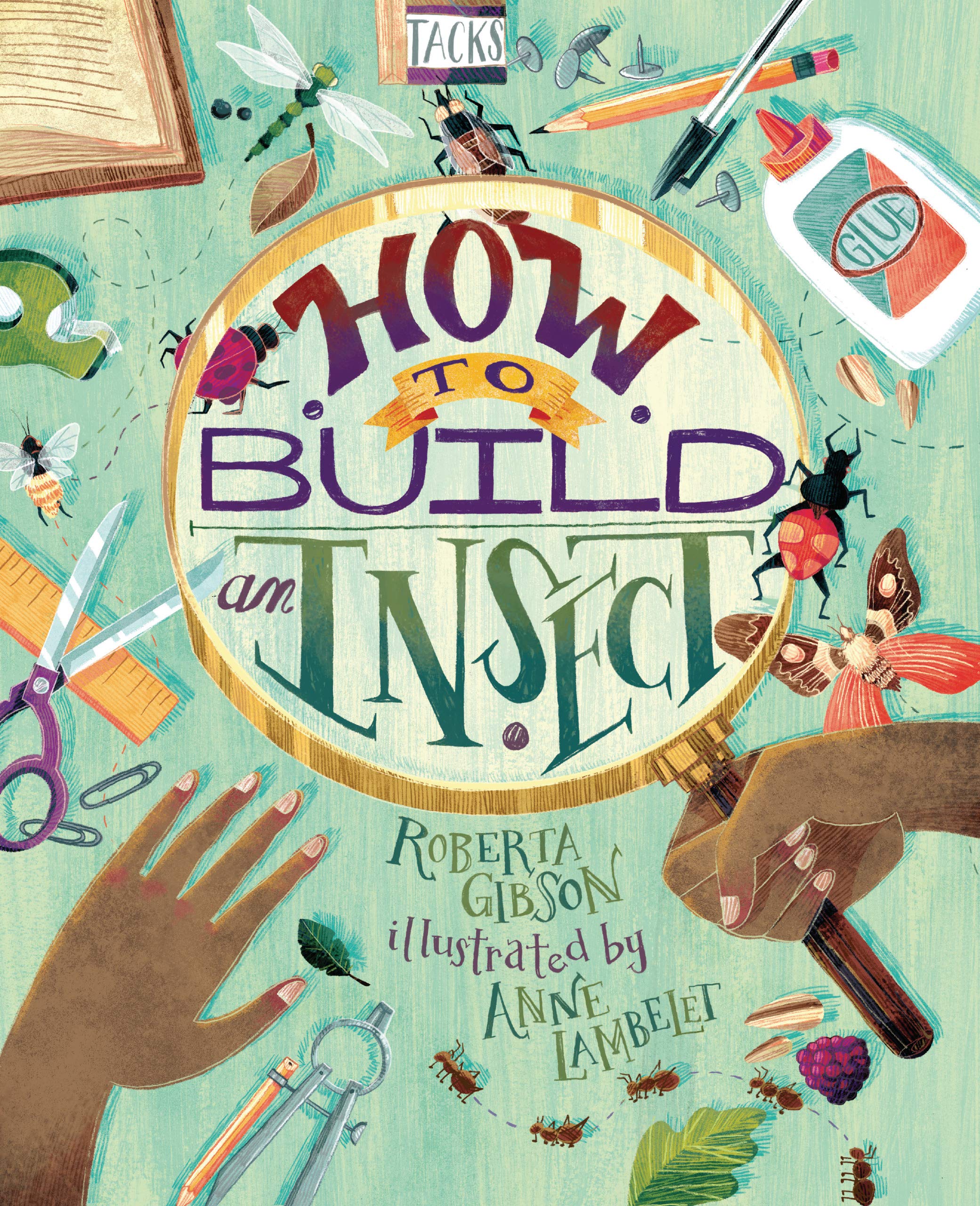
celebrate-picture-books-picture-book-review-how-to-build-an-insect-cover

About the Holiday

Today is World Bee Day! These top-notch pollinators work hard to transport pollen from one flower to the next, so that plants can make their seeds, grow fruit, and launch the next generation of plants! In a larger sense, they keep the world spinning smoothly, by helping plants grow. World Bee Day was created by Slovenian beekeeper Bostjan Noc, president of the Slovenian Beekeepers Association, who first proposed the idea to the United Nations in 2014. The international holiday is meant to show appreciation for bees and other pollinators, and to acknowledge that some bee species are endangered. Make sure to respect and celebrate our bee friends today by reading books about bees, planting a pollinator garden, or installing a sustainable beekeeper. Visit https://www.worldbeeday.org/en/ and http://pollinator.org to learn about the importance of bees and the holiday. To summarize: bee friendly and keep reading.

Thanks to Millbrook Press for sharing a copy of How to Build an Insect for review consideration. All opinions about the book are my own.

Review by Dorothy Levine

How to Build an Insect

Written by Roberta Gibson | Illustrated by Anne Lambelet 


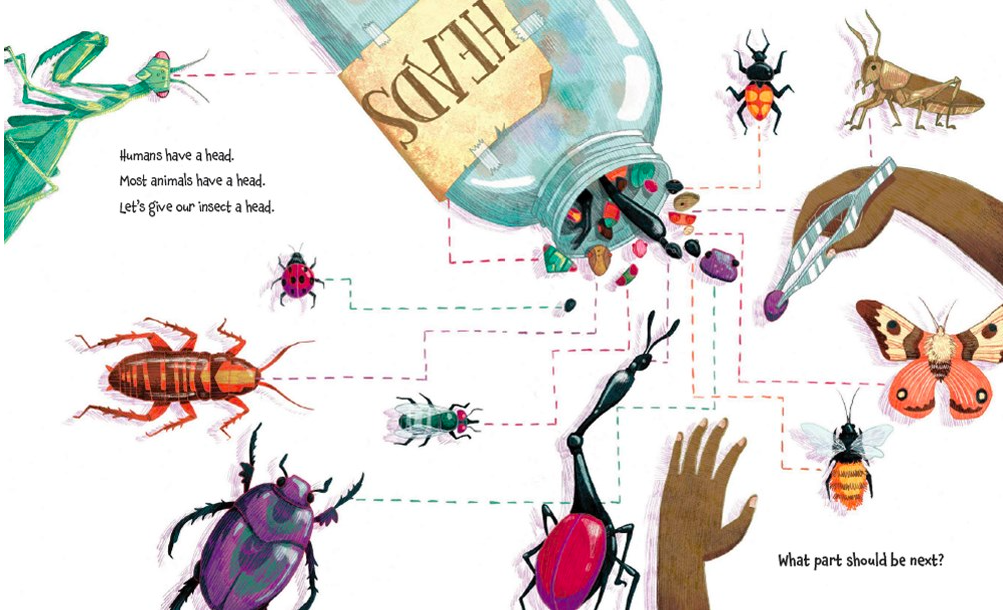
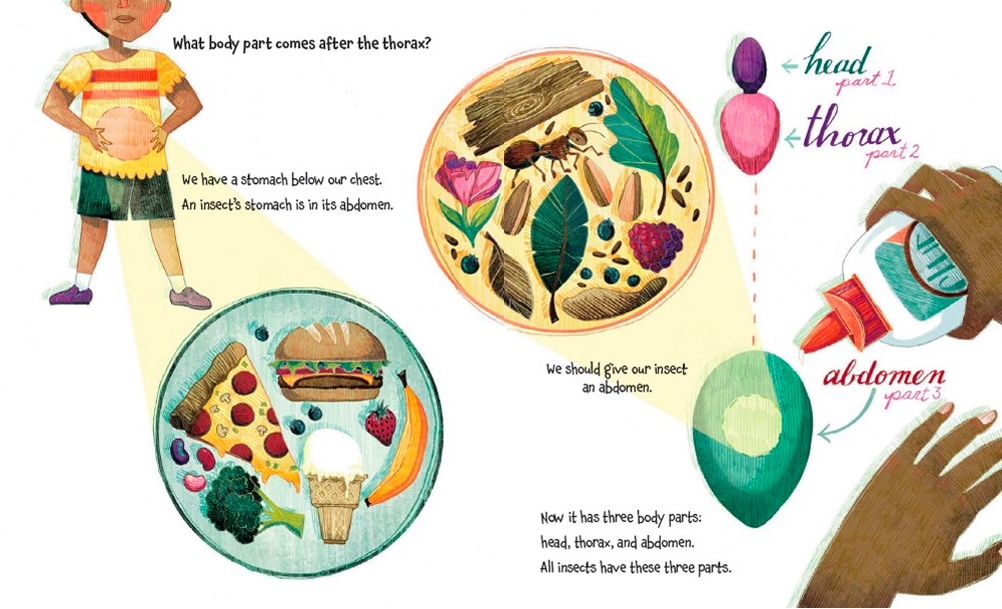
Have you ever wondered how to build an insect? Well, wonder no longer! Get ready to discover the world of creepy-crawlies with this hands-on, information-packed, quirky instruction-book! Ready to begin? First, gather your supplies. Got your “HEADS” jar? Great! Nearly every living creature has a head, and each one has a head that’s just right for them. So, pick a head from the jar and let’s get building. Next add a thorax and an abdomen to your creation. “What else should we add?” you may wonder. “What about bones like ours? Should we give it a skeleton? No. There isn’t any room for big bones inside a small insect. An insect has its skeleton on the outside. It is called an exoskeleton. The exoskeleton keeps the inside stuff in and the outside stuff out.” 

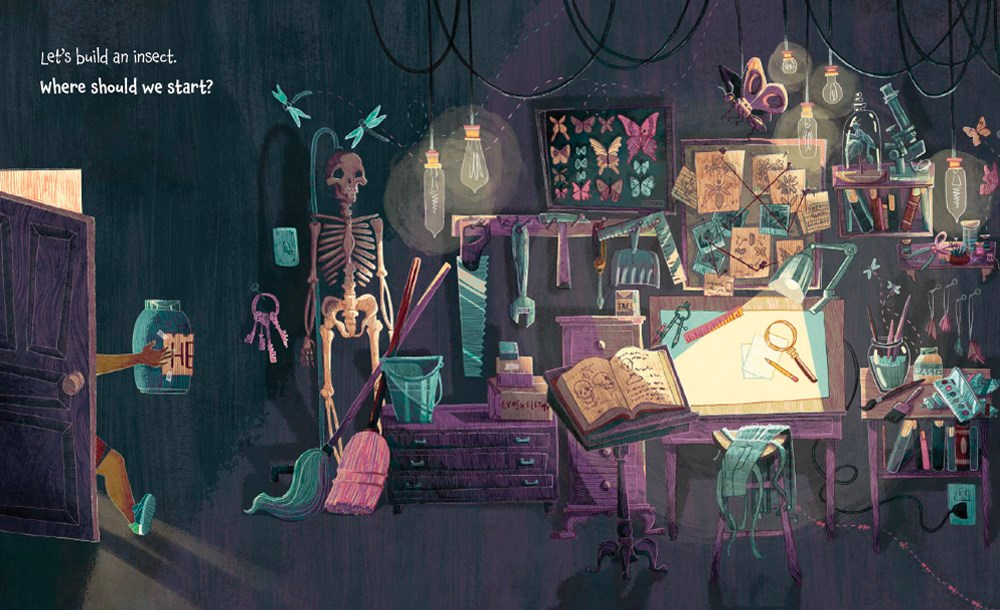
celebrate-picture-books-picture-book-review-how-to-build-an-insect-studio

Image copyright Anne Lambelet, 2021, text copyright Roberta Gibson, 2021. Courtesy of Millbrook Press.

After the correct number of legs and wings go on, the critical (and funky) five senses are added. “How will our insect see? Let’s give it some eyes! How many? Two? Guess again. Five!” The fun facts continue as sensory elements are added. Did you know, “An insect can have its ears anywhere”? This is “music to my knee ears!” a grasshopper chirps in, adding a comedic flare.

Finally, after adorning insects with “hair, or horns, or spikes, or spots” the builder is instructed to finally give their creation “a place to live and a snack.” The completion of the insect and its release into its habitat is followed by an detailed spread of a fly up close that contains further information about different insect body parts. The book also includes a glossary and information on how to create critters out of art materials and recycled parts.  

celebrate-picture-books-picture-book-review-how-to-build-an-insect-heads

Image copyright Anne Lambelet, 2021, text copyright Roberta Gibson, 2021. Courtesy of Millbrook Press.

The young narrator of How to Build an Insect leads readers on a journey of how to build an anatomically correct insect, with a new body part detailed on each spread. Readers will learn about comparative anatomy, what exactly classifies an insect as an insect, and how insect bodies compare to those of humans and other animals. With intricate illustrations detailing bug bits and parts, leaves, berries, skeletons, exoskeletons and a map of “how to” instructions, the book reads like a super-cool science scavenger hunt. The how-to pages are filled with scientific vocabulary that allows readers of all ages to learn the names of insect body parts, from thorax to mandibles, proboscis, cerci, spiracles, and more. 

celebrate-picture-books-picture-book-review-how-to-build-an-insect-abdomen

Image copyright Anne Lambelet, 2021, text copyright Roberta Gibson, 2021. Courtesy of Millbrook Press.

Roberta Gibson cleverly constructs a creative non-fiction storyline jam packed with enchanting scientific facts. Gibson pulled from her knowledge working as an entomologist and research specialist in crafting this fantastic premiere nonfiction picture book. Her well-crafted writing puts complex terms into digestible and interesting explanations that are accessible for kids and adults alike. The writing is snappy, humorous, educational and engaging, featuring silly insect dialogue, and questions bolded for readers to ponder. What more could one possibly ask for?

Anne Lambelet’s masterful illustrations not only provide visually entertaining content to accompany the story, but also provide further information and humor for curious, detail-oriented readers. Insects watch as a brown-skinned, unseen narrator assembles their own insect in their very own science learning space. Sometimes the insects pop in with silly dialogue or engage in human activities, all while maintaining their scientifically accurate appearances. The artwork matches the narrator’s curiosity and close attention to detail perfectly, while maintaining a funky, beautiful art style that is consistent throughout. Spreads are backed by beautiful bursts of purples and greens and feature labeled insect and human anatomy charts; intricate bug- and art-making tools are scattered throughout.

How to Build an Insect is a perfect book for science lovers, outdoorsy individuals, bug enthusiasts, and worm savers of all ages! Also, a good read for those who are less insect-lover-inclined to learn more about how these creatures are not all that different from us humans. A worthwhile addition to libraries, classrooms, and home collections. 

Ages 5 – 9

Millbrook Press, 2021 | ISBN 978-1541578111

Discover more about Roberta Gibson and her books on her website.

To learn more about Anne Lambelet, her books, and her art, visit her website.

World Bee Day Activities

celebrate-picture-books-picture-book-review-how-to-build-an-insect-activities

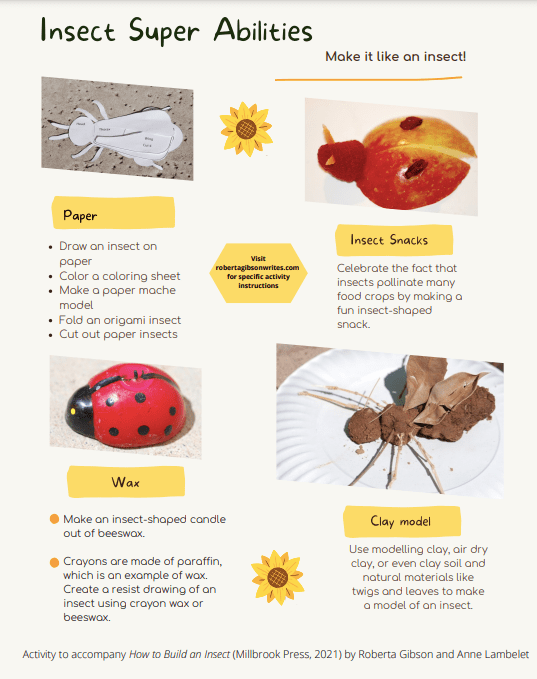
Bee an Insect Lover Activities


Enjoy these fun and creative How to Build an Insect Activities and Experiments from Millbrook Press!

How to Build an Insect Activities

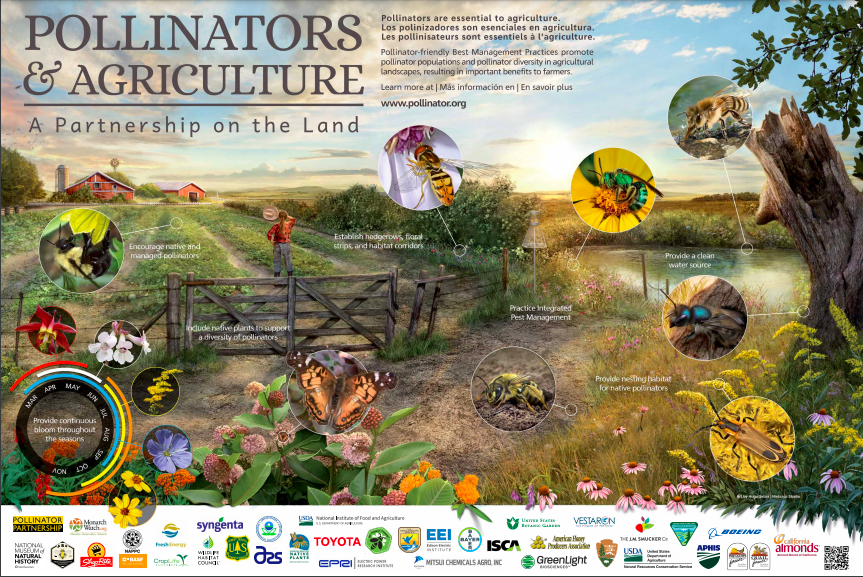
celebrate-picture-books-picture-book-review-how-to-build-an-insect-pollinators-poster

Download this Pollinators and Agriculture Poster that artfully teaches about how pollinators work in harmony with agricultural landscapes.

Pollinators Poster

celebrate-picture-books-picture-book-review-how-to-build-an-insect-cover

You can find How to Build an Insect at these booksellers

Amazon | Barnes & Noble | Books-a-Million

to support your local independent bookstore, order from

Bookshop | IndieBound

Picture Book Review

December 14 – It’s Read a New Book Month

celebrate-picture-books-picture-book-review-eye-by-eye-comparing-how-animals-see-cover

About the Holiday

For kids who love nonfiction, this year has brought a bumper crop of creative, fascinating, and informative books on all topics from biographies to history to science and beyond. Innovative, interactive, and humorous, these books for all ages – even babies – open up the world for children in ways that resonate and make learning exciting and fun. Today’s book will have kids looking at the animals around them in a whole new way.

Eye by Eye: Comparing How Animals See

Written by Sara Levine | Illustrated by T.S Spookytooth


“Have you ever wondered what it would be like to see the world through someone else’s eyes?” Let’s make that musing even more intriguing—How would the world look if you gazed out at it through the eyes of an animal, insect, or bird (you know… a bird’s eye view)? Say, for instance, you had eight eyes dotting your face. “What kind of animal would you be, then?” Hmmm… With “four big eyes on the front of its face…” and “four smaller eyes on the top of its head,” the jumping spider can see what’s above and in front of it.

What if your eyes weren’t on your face at all, but on your arms instead? who would that be? Or how would you like it if your eyes were on “long stalks sticking out of the top of your head?” That might come in handy in a crowded movie theater or museum, but the animal with these eyes doesn’t really frequent those kinds of places. It’s more of an outdoorsman. Can you guess? While you’re contemplating that, you’re also going to want to learn about the animals whose eyes move to other parts of their face and the animals whose eyes are fixed in place.

Now, look deeeep into your eyes. What do you see? A pupil! What shape is it? Would it surprise you to learn that there are animals whose pupils are oval or even rectangular? Cat lovers know that their fav animals have oval pupils, but so do other “predators that hide and then ambush their prey.” Their unique eyes help them “judge distance and plan its attack without making any movements that might scare away its meal.” Animals with rectangular eyes use their peepers to stay safe. Which animals do you think those would be?

celebrate-picture-books-picture-book-review-eye-by-eye-comparing-how-animals-see-eight-eyes

Image copyright T.S Spookytooth, 2020, text copyright Sara Levine, 2020. Courtesy of Millbrook Press.

Some animals, including some humans, can’t see the colors red and green. You know this as color-blindness, but have you ever wondered exactly how color-blind people or animals view the world? Side-by-side pages show you! And that bird’s-eye-view? Because of the way birds’ eyes are constructed, their world is even more colorful than ours! How much more? “We have no idea… since our eyes can’t give us this information. But it’s pretty cool to know that there are things that exist out there that humans can’t see at all.”

One last question: What kind of animal could read the words in this book? If you know the answer, “you are a human who is using your eyes to read.” While other animals can’t read words, they can read the signs other animals and even plants provide. What are some of these? The answers plus even more fascinating information can be yours in the blink of an eye.

Back matter includes hands-on activities kids can do to “see” the way two animals do, a close-up examination of a human’s pupil, and a glossary as well as a list of books and websites for further research.

Sara Levine’s eye-opening guide to how a wide variety of creatures in the animal kingdom see will enthrall kids. In the fourth book of her Animal by Animal series, Levine continues her kid-enticing combination of humor and science to teach children about the specialized eyes that help animals navigate their particular environments. Her conversational storytelling, sprinkled with questions, will have kids engaged in the kind of predicting that reinforces learning. Levine’s detailed answers to the questions, including benefits of particular eye shapes or placement, physiological characteristics and adaptations, and the names of additional animals that share the same types of eyes, are enlightening will inspire young scientists to discover more about their world. 

A highlight of the Animal by Animal series is the artwork by T.S Spookytooth, who excels at translating Levine’s vision into illustrations that get kids giggling and learning. The first page starts off in familiar territory: a glasses-wearing girl stares eye-to-eye with the little wiener dog she’s holding in her hands. But turn the page and this same girl now sports eight eyes and two cleverly constructed pairs of glasses while other kids—and clues for discussions to come—stand by. On the next pages, eyeballs jut from the ends of six arms, peer out from long, wiggly stalks, and migrate across a girl’s face. These images will have kids laughing and riveted to the pages, while Spookytooth’s realistic depictions of the animals these eyes belong to will long remain in their memory. Insets of enlarged eyes allow kids to see the particular formation of eyes and pupils up close. The side-by-side page spread showing full-color human vision and the vision of someone who is color-blind is enlightening. Kids will enjoy following the pet crocodile from page to page and discussing all the reasons for its distinctive eyes. The diverse group of kids are charming companions on this educational journey.

An exciting and fascinating way to spur children to explore and learn about animals, nature, and themselves, Eye by Eye: Comparing How Animals See is a top pick for home, school and public library collections.

Ages 5 – 10

Millbrook Press, 2020 | ISBN 978-1541538382

Discover more about Sara Levine and her books on her website.

To learn more about T.S Spookytooth, his books, and his art, visit his website.

celebrate-picture-books-picture-book-review-eye-by-eye-comparing-how-animals-see-cover

You can find Eye by Eye: Comparing How Animals See at these booksellers

Amazon | Barnes & Noble | Books-a-Million

To support your local independent bookstore, order from

Bookshop | IndieBound

Picture Book Review

July 22 – World Brain Day

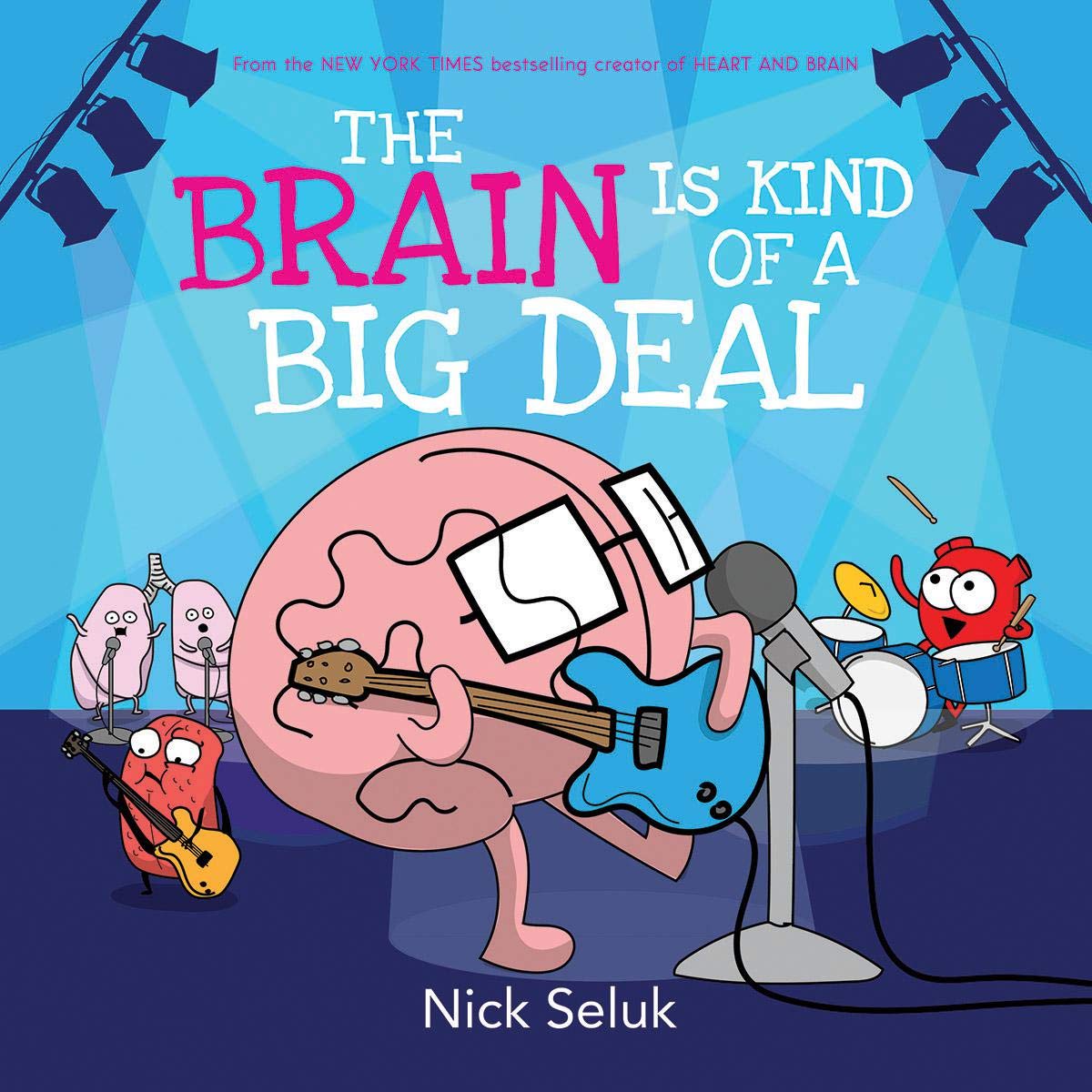
celebrate-picture-books-picture-book-review-the-brain-is-kind-of-a-big-deal-cover

About the Holiday

Established in 2014 by the World Federation of Neurology, the objective of the day is to raise public awareness and promote advocacy related to brain health. Each year the a new theme is chosen to inform the year’s research, policy, and action. This year’s theme is “Move Together to End Parkinson’s Disease.” Through this initiative, the World Federation of Neurology will coordinate with more than 122 global organizations to advocate for improved patient care, education, and additional research for those living with Parkinson’s Disease, a neurodegenerative brain disease that affects the mind, movement, and almost all aspects of brain function, as well as their caregivers. Learning about the brain and its functions early in life can inspire an interest in adopting a healthy diet and lifestyle as they grow up. Today’s book with its high-interest presentation is a perfect place to start.

The Brain Is Kind of a Big Deal

By Nick Seluk


Are you a fan of The Brainiacs? You know, that group led by the Brain that keeps you humming along all day, every day? Yeah, they’re at the top of the (medical) charts, and it’s the Brain that keeps them there. Want to know more about how their body of work all comes together? Then settle in with Nick Seluk’s hip, informative, and clever introduction to the brain and all that it does from its command center “inside of your head, behind your eyes, and under your hair.” From there the brain works continuously, collecting and remembering “information about everything you experience.”

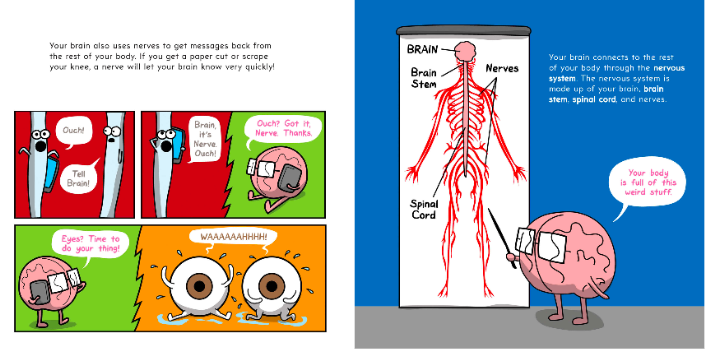
celebrate-picture-books-picture-book-review-the-brain-is-kind-of-a-big-deal-nervous-system

Copyright Nick Seluk, 2019, courtesy of Orchard Books, Scholastic, Inc.

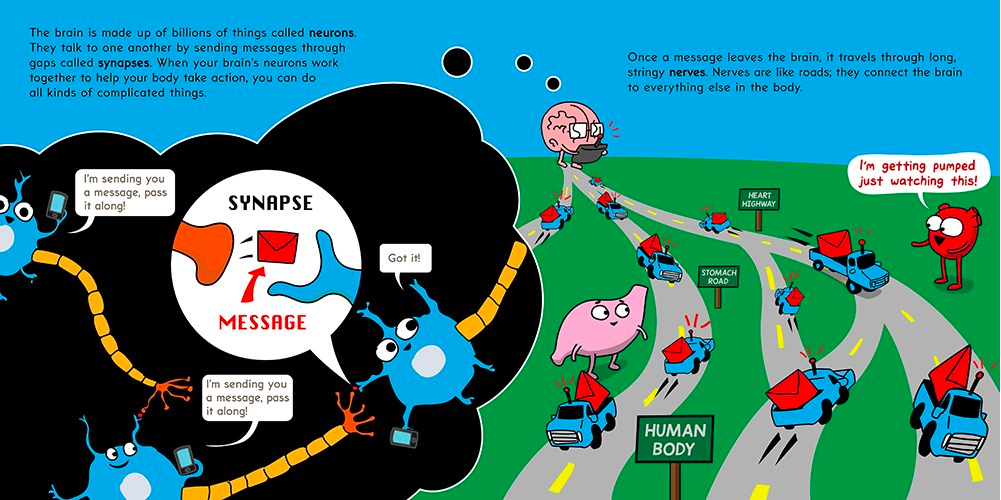
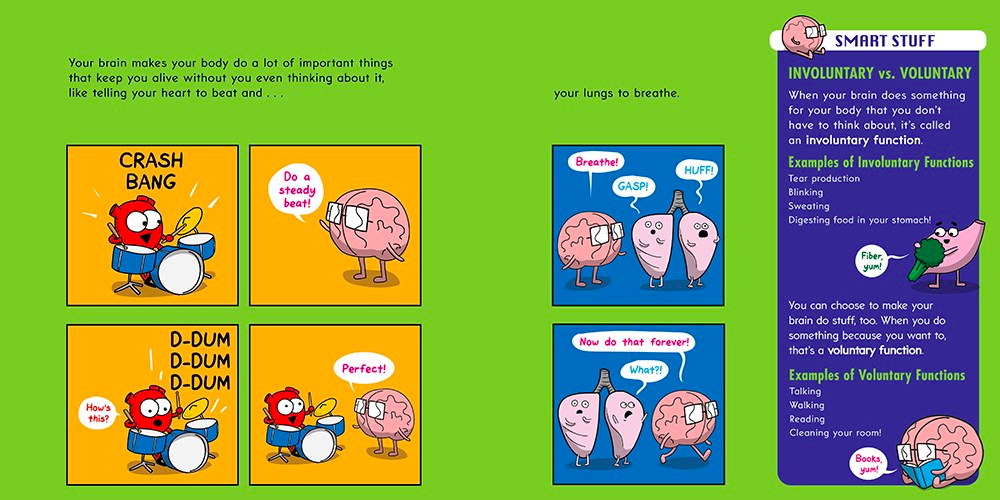
Ready to turn the page? You can’t do it without your brain telling your arm, your hand, and your fingers what to do—and in what seems like no time at all. As you turn the pages you’ll learn how the brain sends these messages to the muscles and organs through synapses, which is a little bit like passing notes in class, and along a “highway” of nerves. Turn a few more pages and you’ll learn about involuntary and voluntary functions, how you know when to eat and when you’re full, and how when you sleep and dream, your brain gets ready for the next day.” Even when “…it dreams about weird stuff.”

celebrate-picture-books-picture-book-review-the-brain-is-kind-of-a-big-deal-ouch

Copyright Nick Seluk, 2019, courtesy of Orchard Books, Scholastic, Inc.

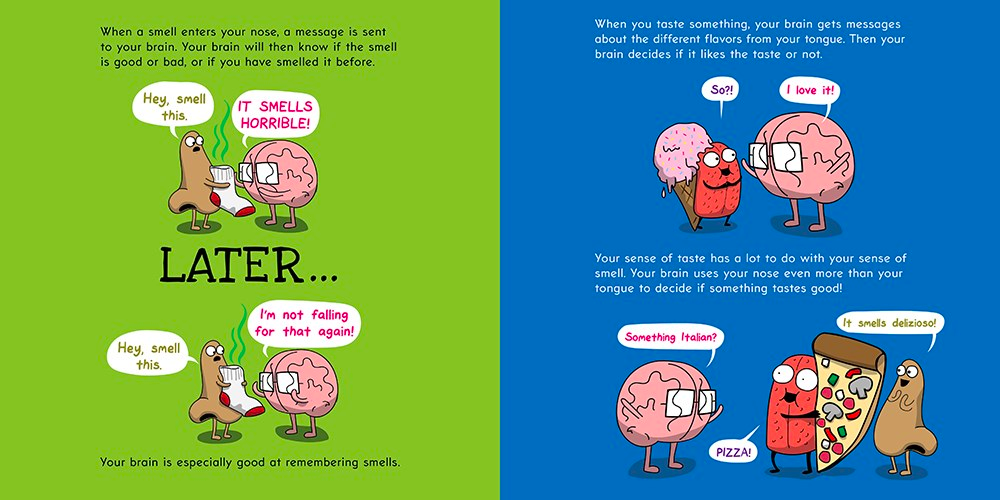
But the Brain isn’t a solo act. He collaborates with the senses, which work through the eyes, ears, nose, tongue, and nervous system, to collect data that helps you remember what things look, sound, smell, and feel like. The brain is great at doing stuff, but it’s also an awesome thinker. With your own incredible brain “you can imagine things and solve problems just by thinking about them.” Ideas aren’t the only things that come from the brain; feelings to too. And the interesting thing about this is that while “you feel happy, sad, angry, or scared without ever having to learn how, you can control how you react when you feel something….” So, what does all of this brain power add up to? Everything that makes you YOU!”

celebrate-picture-books-picture-book-review-the-brain-is-kind-of-a-big-deal-heart

Copyright Nick Seluk, 2019, courtesy of Orchard Books, Scholastic, Inc.

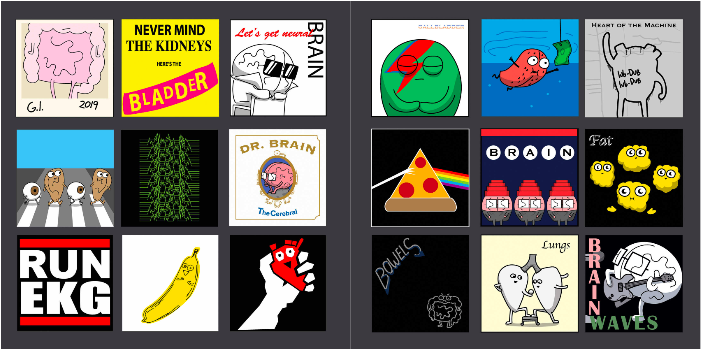
Back matter includes a glossary of terms found in the book, wild facts about animal brains (did you know “a cockroach can live for weeks without its head and brain?”), and a round up The Brainiacs bandmates’ social media posts. The reverse side of the book jacket contains a The Brainiacs concert poster. The front end papers’ riffs on album covers can make for fun adult/child nostalgia bonding,

celebrate-picture-books-picture-book-review-the-brain-is-kind-of-a-big-deal-sock

Copyright Nick Seluk, 2019, courtesy of Orchard Books, Scholastic, Inc.

Fascinating facts about the brain and how it works are accompanied by Nick Seluk’s charming cartoon-style illustrations of anthropomorphized organs, muscles, neurons, and of course the star of the book, the brain—a spectacle-wearing pink orb. These characters are full of personality and puns while taking orders from upstairs. The heart is “pumped” watching messages speed along the nervous system; eyes cry when they receiving the command after an “ouch!” is sent from a nerve to the brain; and the lungs are astonished to learn they must gasp and huff “forever.” Seluk’s writing is clear and engaging, translating the communications from the brain to the rest of the body into steps and purposes that children can understand. Seluk’s sly humor, sprinkled throughout the book, is always in service of the text and allows kids to relate to the concept at hand.

Screen Shot 2019-11-07 at 8.38.00 PM

As the brain recalls information it’s learned, it huddles in a command center where the computer identifies a tree by these attributes. “Sight: Green and Brown; Sound: Rustling; Touch: Rough; Taste: Gross.” When the brain sees a hand hovering over a stove burner, it goes to work. The ring is “bright red, stove says ‘On,’ Mom said ‘No,’ smells hot.” The brain sends out its urgent warning: “Abort! Don’t touch that! Remember last time?! The brain sure does, as the picture of it with bandaged hands on the computer screen shows. Full-bleed, vibrant backgrounds set off the comic-strip panels, funny interactions between Brain and Nose, Ears, Tongue, and other body parts, and Smart Stuff sidebars full of interesting tidbits. Kids will gain valuable knowledge about the body as they giggle through the text in Seluk’s sharp presentation that deftly navigates the dual hemispheres of fun and learning to spotlight the brain for the rock star it is.

You can’t go wrong by adding The Brain is Kind of a Big Deal to your home, classroom, or public library. It is—as they say—a no brainer!

Ages 6 – 8

Orchard Books, 2019 | ISBN 978-1338167009

Discover more about Nick Seluk, his books, his art, and so much more on his website.

World Brain Day Activity

celebrate-picture-books-picture-book-review-scientists-word-search-puzzle

Be a Scientist!


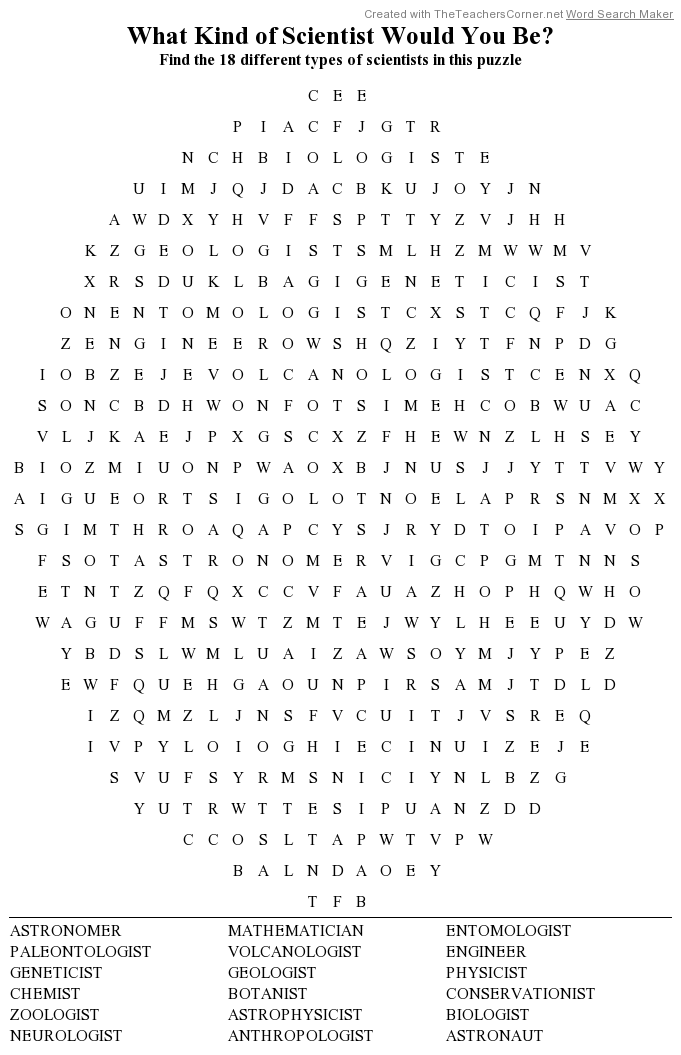
Do people call you a brain? Do you love STEM subjects at school? If so, you might want to consider science as a career. There are eighteen scientists in this printable word search puzzle. Which job would you choose?

What Kind of Scientist Would You Be? Puzzle and Solution

celebrate-picture-books-picture-book-review-the-brain-is-kind-of-a-big-deal-cover

You can find The Brain is Kind of a Big Deal at these booksellers

Amazon | Barnes & Noble | Books-a-Million

To support your local independent bookstore, order from

Bookshop |  IndieBound

Picture Book Review


November 8 – National STEM/STEAM Day

celebrate-picture-books-picture-book-review-the-brain-is-kind-of-a-big-deal-cover

About the Holiday

Instituted in 2015, National STEM/STEAM Day aims to encourage kids to explore the fields of science technology, engineering, art, and math. These subjects are the backbone of innovation and discovery. Children who are introduced early on to the workings of math and science do better as they advance through school and are more likely to choose science-based careers. Solving many of the problems that the world now faces relies on having a workforce who can think creatively and inventively to design a better future for us all. To learn more about STEM and STEAM and to find activities to get kids excited about these subjects, visit the TERC website.

The Brain Is Kind of a Big Deal

By Nick Seluk


Are you a fan of The Brainiacs? You know, that group led by the Brain that keeps you humming along all day, every day? Yeah, they’re at the top of the (medical) charts, and it’s the Brain that keeps them there. Want to know more about how their body of work all comes together? Then settle in with Nick Seluk’s hip, informative, and clever introduction to the brain and all that it does from its command center “inside of your head, behind your eyes, and under your hair.” From there the brain works continuously, collecting and remembering “information about everything you experience.”

celebrate-picture-books-picture-book-review-the-brain-is-kind-of-a-big-deal-nervous-system

Copyright Nick Seluk, 2019, courtesy of Orchard Books, Scholastic, Inc.

Ready to turn the page? You can’t do it without your brain telling your arm, your hand, and your fingers what to do—and in what seems like no time at all. As you turn the pages you’ll learn how the brain sends these messages to the muscles and organs through synapses, which is a little bit like passing notes in class, and along a “highway” of nerves. Turn a few more pages and you’ll learn about involuntary and voluntary functions, how you know when to eat and when you’re full, and how when you sleep and dream, your brain gets ready for the next day.” Even when “…it dreams about weird stuff.”

celebrate-picture-books-picture-book-review-the-brain-is-kind-of-a-big-deal-ouch

Copyright Nick Seluk, 2019, courtesy of Orchard Books, Scholastic, Inc.

But the Brain isn’t a solo act. He collaborates with the senses, which work through the eyes, ears, nose, tongue, and nervous system, to collect data that helps you remember what things look, sound, smell, and feel like. The brain is great at doing stuff, but it’s also an awesome thinker. With your own incredible brain “you can imagine things and solve problems just by thinking about them.” Ideas aren’t the only things that come from the brain; feelings to too. And the interesting thing about this is that while “you feel happy, sad, angry, or scared without ever having to learn how, you can control how you react when you feel something….” So, what does all of this brain power add up to? Everything that makes you YOU!”

celebrate-picture-books-picture-book-review-the-brain-is-kind-of-a-big-deal-heart

Copyright Nick Seluk, 2019, courtesy of Orchard Books, Scholastic, Inc.

Back matter includes a glossary of terms found in the book, wild facts about animal brains (did you know “a cockroach can live for weeks without its head and brain?”), and a round up The Brainiacs bandmates’ social media posts. The reverse side of the book jacket contains a The Brainiacs concert poster. The front end papers’ riffs on album covers can make for fun adult/child nostalgia bonding,

celebrate-picture-books-picture-book-review-the-brain-is-kind-of-a-big-deal-sock

Copyright Nick Seluk, 2019, courtesy of Orchard Books, Scholastic, Inc.

Fascinating facts about the brain and how it works are accompanied by Nick Seluk’s charming cartoon-style illustrations of anthropomorphized organs, muscles, neurons, and of course the star of the book, the brain—a spectacle-wearing pink orb. These characters are full of personality and puns while taking orders from upstairs. The heart is “pumped” watching messages speed along the nervous system; eyes cry when they receiving the command after an “ouch!” is sent from a nerve to the brain; and the lungs are astonished to learn they must gasp and huff “forever.” Seluk’s writing is clear and engaging, translating the communications from the brain to the rest of the body into steps and purposes that children can understand. Seluk’s sly humor, sprinkled throughout the book, is always in service of the text and allows kids to relate to the concept at hand.

Screen Shot 2019-11-07 at 8.38.00 PM

As the brain recalls information it’s learned, it huddles in a command center where the computer identifies a tree by these attributes. “Sight: Green and Brown; Sound: Rustling; Touch: Rough; Taste: Gross.” When the brain sees a hand hovering over a stove burner, it goes to work. The ring is “bright red, stove says ‘On,’ Mom said ‘No,’ smells hot.” The brain sends out its urgent warning: “Abort! Don’t touch that! Remember last time?! The brain sure does, as the picture of it with bandaged hands on the computer screen shows. Full-bleed, vibrant backgrounds set off the comic-strip panels, funny interactions between Brain and Nose, Ears, Tongue, and other body parts, and Smart Stuff sidebars full of interesting tidbits. Kids will gain valuable knowledge about the body as they giggle through the text in Seluk’s sharp presentation that deftly navigates the dual hemispheres of fun and learning to spotlight the brain for the rock star it is.

You can’t go wrong by adding The Brain is Kind of a Big Deal to your home, classroom, or public library. It is—as they say—a no brainer!

Ages 6 – 8

Orchard Books, 2019 | ISBN 978-1338167009

Discover more about Nick Seluk, his books, his art, and so much more on his website.

National STEM/STEAM Day Activity

celebrate-picture-books-picture-book-review-scientists-word-search-puzzle

Be a Scientist!


If you love STEAM subjects at school, you could grow up to be one of the scientists in this printable word search puzzle. Which would you choose?

What Kind of Scientist Would You Be? Puzzle and Solution

celebrate-picture-books-picture-book-review-the-brain-is-kind-of-a-big-deal-cover

You can find The Brain is Kind of a Big Deal at these booksellers

Amazon | Barnes & Noble | Books-a-Million | IndieBound

Picture Book Review