June 12 – National Rivers Month

celebrate-picture-books-picture-book-review-otters-love-to-play

About the Holiday

Rivers are beautiful, provide recreation, and are crucial to our water supply. Did you know that in the United States 65% of our drinking water comes from rivers and streams? This month environmentalists and others promote awareness of the importance of keeping the nation’s rivers pollution free to protect the fish and animals that call them home and increase enjoyment for all. To help the cause, join a volunteer river clean-up crew, help monitor water quality, or learn more about your local river system. Whether you like to fish, swim, boat, or just laze on the bank, June is the perfect month to get out on a river! You might even see some otters—the subject of today’s book!

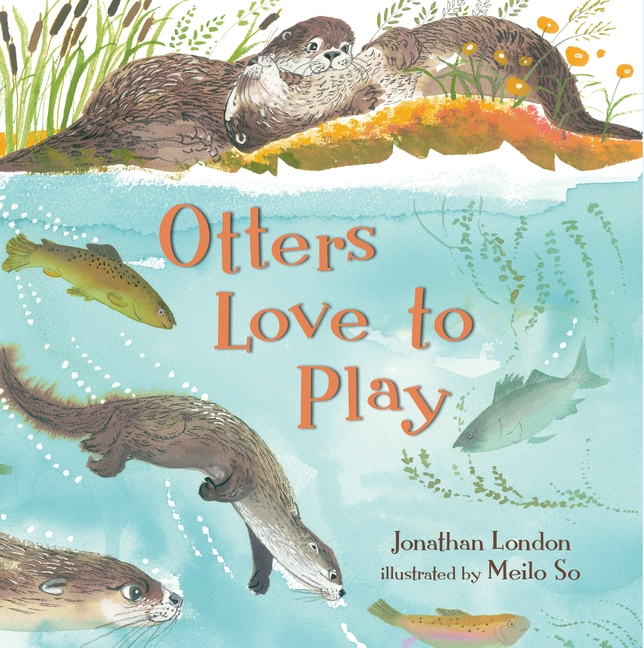
Otters Love to Play

Written by Jonathan London | Illustrated by Meilo So


It’s spring and two otters have moved into an abandoned beaver lodge to start a family. In a soft nest of moss, leaves, and grass the mother otter gives birth to three pups. The pups first open their eyes to the world when they are five weeks old. At two months old they’re ready to come out of the den to play. Playtime is fun, but for the baby otters it’s also work. Running, twisting, wrestling, and matches of tug-of-war teach valuable hunting skills and solidify family bonds.

As spring turns to summer, the pups’ thick waterproof coats grow in, and it’s time for swimming lessons to begin. There are no floaties here! The mother otter simply grabs her charges by the scruff of the neck and drops them into the river. Their mother shows them how to dive and glide and come to the surface as they follow her single file. “Within days, the otter pups gracefully spin and flip and swish like underwater acrobats.” Again and again “they scramble up a mud slide and SLIIIIIIIIIIIDE back down to the water—Ka-Spash!”
celebrate-picture-books-picture-book-review-otters-love-to-play-in-autumn

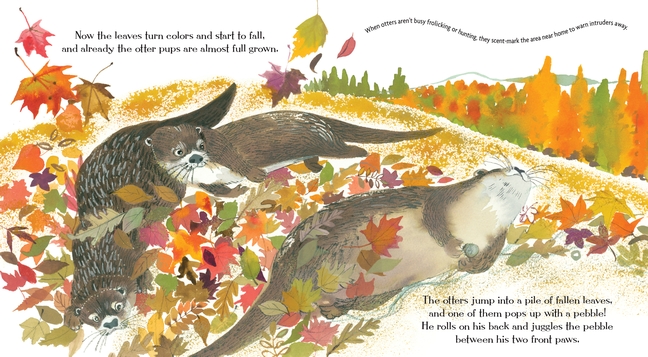
By the end of the summer the pups know how to catch small fish and how to nudge out frogs, crayfish, turtles, and snakes from their hiding places among the rocks. Autumn brings more opportunities for fun as the nearly full-grown pups tumble in the fallen leaves. Even winter’s blasts don’t deter the otters. With their thick fur they roll in the snow and catch fish in the icy river water.

But an ominous shadow appears on the fresh snow as the pups belly-slide down a snowbank. Something is waiting and watching…. So too is mother otter. Screaming and hunching she “slides across the snow and with a terrible GRRRROWL…scares the fox away!” Throughout the winter the otters snuggle in their den, and when the rainy spring makes muddy river banks, the otters come out and speed down the slippery slide “because otters love to play!”

You can’t help but love otters. Watching them dive, swim, and frolic just puts a smile on your face. And what’s more these sleek river creatures are fascinating animals! Jonathon London has written a story that captures the spirit and exuberance of one otter family while incorporating intriguing facts about their dens, birth statistics, purposeful play, hunting techniques, protective fur, predators, and defenses—did you know that otters can slide on snow at speeds up to 18 miles (29 kilometers) per hour?! London’s lyrical journey through the first year of an otter’s life makes captivating reading for young children just navigating the world themselves.

Meilo So’s enchanting otter family will delight readers. Images of the pups somersaulting, sliding, splashing, and swimming charmingly depict the sleek, supple movements of these frisky animals. Their smooth coats, rendered in soft browns with white and black accented texture, and their mischievous, ever-present smiles are realistically portrayed, inviting kids to reach out and pet them. So’s river scenes are beautiful—the pale blue water reflects deep gold and green trees, pink and yellow wildflowers and delicate green grasses flutter along the river bank, and the depths of the underwater world swirl with muted sage greens and blues as the otter pups frolic among gray- and olive-hued fish. Autumn comes with fiery orange and purple leaves, and winter falls shivery white as the russet fox is chased away.

Otters Love to Play would be a lovely gift for any child and a welcome addition to any classroom or school library.

Ages 4 – 8

Candlewick Press, 2016 | ISBN 978-0763669133

Visit Jonathan London’s website for more books by this prolific author.

View more books and art by Meilo So.

National Rivers Month Activity
celebrate-picture-books-picture-book-review-otter-coloring-page

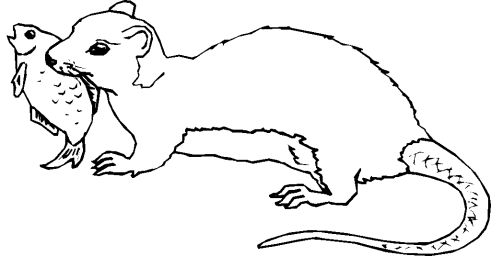
Otter Coloring Page


You “otter” love this coloring page, with its cute river creature who has just caught dinner! You can color it with pencils, crayons, or markers or consider making a collage with bits of paper, cloth, or leaves and sticks. Give the otter a den to snuggle in and a river for frolicking! Here’s your Otter Coloring Page!

June 9 – It’s National Fresh Fruit and Vegetables Month

celebrate-picture-books-picture-book-review-bananas-in-my-ears

About the Holiday

With all the scrumptious fresh fruit and vegetables available at your local farmers market or grocery store, how can you help but enjoy good nutrition? Those red, red strawberries and midnight blue blueberries make perfect smoothies, and the brilliant orange carrots and peppers look good enough to eat! Oh, wait! You can eat them! So grab your bag or basket and head to the store—or plant or pick your own!

Bananas in My Ears: A Collection of Nonsense Stories, Poems, Riddles, and Rhymes

Written by Michael Rosen | Illustrated by Quentin Blake


Things may go from the ridiculous to the sublime or from the sublime to the ridiculous, but the rhymes, stories, poems, and jokes in this collection are both ridiculous and sublime. Divided into four sections—The Breakfast Book, The Seaside Book, The Doctor Book, and The Bedtime Book—these bite-sized tales will nibble at your funny bone.

Each book includes six to seven short pieces that humorously reveal the inner workings of familial and community relationships. Recurring titles “What if…,” “Things We Say,” and “Nat and Anna” siblings stories tie the books together. The tone for Bananas in My Ears is set with aplomb in the very first offering, “Breakfast Time,” which reveals the chaos of early morning with its spilled milk, banging trash cans, pets on the table, school clothes ruined, and “I think I’m going crazy!” shenanigans. 

“What If…” (Breakfast Book) combines kids’ natural penchant for thyming with their unbounded imagination and a bit of stream-of-consciousness to boot. Just as a little boy is to bite into a piece of toast, he has this thought: “What if / a piece of toast turned into a piece of ghost / just as you were eating it / and you thought you were going to sink your / teeth into a lovely crunchy piece of hot toast / and butter and instead this cold wet feeling / jumps into your mouth / going, / ‘Whoooooooooooooooooooo!’ / right down into your stomach…”

celebrate-picture-books-picture-book-review-bananas-in-my-ears-internal-art-cave

Adding speech bubbles and expressive art to commonly used phrases in “Things We Say” transforms throw-off lines like “My hair’s a mess,” “Look what I found,” “You can’t lie there all morning,” and “Now what seems to be the trouble?” into self-deprecating humor all can relate to.

Four stories of Nat and his older sister Anna zero in on particular moments that illuminate the sibling relationship, At once opposed and in sync, Nat and Anna negotiate moments in which Anna is put in charge of watching Nat at breakfast with topsy-turvy results; a fearful story Anna tells Nat about jellyfish that somehow backfires; a trip to the doctor that turns into a competition about future professions; and a “who’s-on-first” type banter that allows Anna to enjoy some alone time.

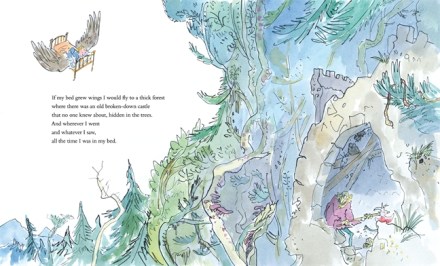
“Three Girls” is a clever take on outwitting-an-ogre tales. Three girls walking on the beach come across a cave. One girl goes in and “sees a pile of gold sitting on the rocks, so she thinks, ‘Yippee, gold, all for me!’ And she steps forward to pick it up and a great big voice booms out ‘I’m the ghost of Captain Cox. All that gold stays on the rocks.’” Afraid, she runs out of the cave. The second girl is braver. She enters the cave, sees the gold, hears the same booming voice and is also chased away. Undeterred, the third girl walks into the cave, sees the gold, and hears the booming voice of Captain Cox. Instead of running away, however, she says, “‘I don’t care. I’m the ghost of Davy Crocket, and all that gold goes in my pocket.’” With her treasure secured she hightails it out to join her friends.

Among other fun stories in this volume are: “These Two Children,” with a lively recitation of familiar bedtime routines; “Fooling Around,” that offers light rhymes on children’s names; and another “What If” (the Breakfast Book) that will have kids not only laughing, but cracking up at a sassy leg—“What if / hard-boiled eggs turned into hard-boiled legs / just when your dad was eating his egg / and he says, / ‘Hey, what’s this?’…”

celebrate-picture-books-picture-book-review-bananas-in-my-ears-internal-art-what-happens-next

Michael Rosen understands, as kids do, that sometimes nonsense makes perfect sense and that even the commonplace is quite absurd when you think about it. This collection of witticisms is sure to resonate with children. Just hand a child this book and get ready for giggles—and, oh yes, adults will chuckle too.

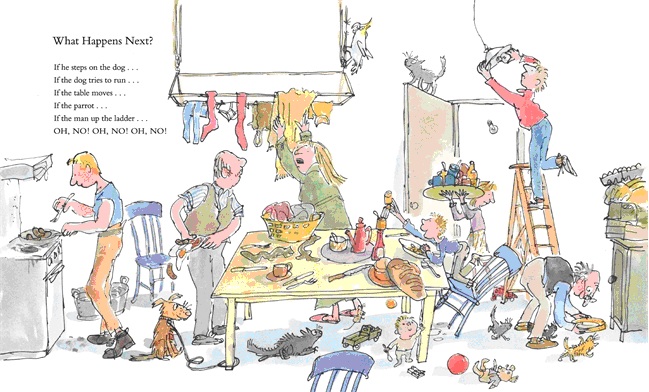
In his colorful pen and ink drawings the inimitable Quentin Blake enlivens each piece with rakish kids, wide-eyed parents, sloppy messes, bouncing, jumping joy, and all the silliness that contributes to having a great day. “An accident waiting to happen” doesn’t begin to describe the bedlam ensuing in “What Happens Next?” as each character and object is set up to play their part in an oh-so-human game of dominoes. Kids will love seeing themselves and the world around them so candidly drawn, and adults will appreciate the whimsical sophistication of the same.

Ages 5 and up

Candlewick Press, 2012 | ISBN 978-0763662486

National Fresh Fruit and Vegetables Month Activity

celebrate-picture-books-picture-book-review-fruit-bowl-coloring-page

Fruit Snack Coloring Page


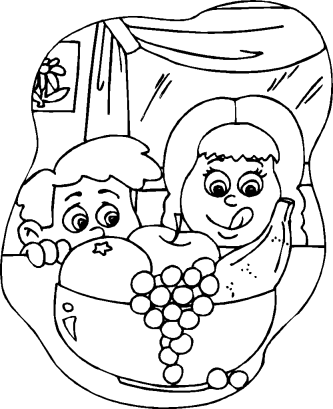
Grab a nutritious snack to munch on while you color this printable Fruit Snack Coloring Page that offers up all your favorites!

Picture Book Review

May 21 – It’s Get Caught Reading Month

celebrate-picture-books-picture-book-review-whoops

About the Holiday

Created by former Congresswoman Pat Schroeder, now president of the Association of American Publishers, Get Caught Reading Month promotes good reading habits and encourages people of all ages to take part in the fun of reading. Reading to young children is especially important as research indicates that early language experience stimulates a child’s brain to grow and gives kids a huge advantage when they start school. Whether you like fiction, non-fiction, poetry, graphic novels, or comics, there is an amazing book just waiting on a shelf for you!

Whoops!

Written by Suzi Moore | Illustrated by Russell Ayto


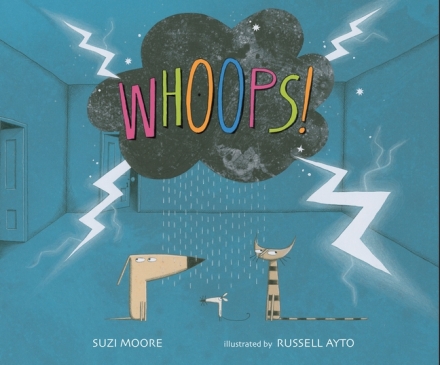
This is the cat that can’t meow. And here’s the dog that can’t bowwow. And the little mouse when she tries to squeak? She opens her mouth but she just can’t squeak.

But the owl says to the three “‘Find the old lady in the tumbledown house. She’ll have a spell to make you all well.” So they go in search of the tumbledown house and find it in the middle of the woods. When they go inside, the little old lady doesn’t seem surprised to see them. In fact she’s heard of their problem and consults her spell book. She casts a spell “and the whole house shook, the wind blew in and the rain came down. Then the tumbledown house turned around and around.”

Now the cat says, “Cluck!” And the dog says, “Quack!” And the mouse says, “Cock-a-doodle-doo!” And the little old lady? She says, “Whoops!” Maybe the right spell is on page three. She casts a new spell and there’s a flash and a crash and the tumbledown house turns around and around. This time the cat says, “Baa!” and the dog says, “Neigh!” and the mouse says, “Moo!” And the little old lady? She says, “Whoops!”

The spell on page seven brings the three closer: the cat says, “Woof!” and the dog says, “Squeak!” and the mouse says, “Meow!” And the little old lady? She says, “Whoops!” That special spell to make them all well must be on page ten. The old lady waves her wand and the storm rages and the tumbledown house turns around and around. Finally, the cat says, “Meow!” and the dog says, “Woof!” and the mouse says, “Squeak!”” And the little old lady? She says, “CROAK!”

Whoops!

Suzi Moore’s laugh-out-loud, shout-out-loud tale of mistaken identity will have kids reading along during the first go-round. The catchy, repeated rhymes, cadence of the words and sentences, errant spells, and building storm create infectious silliness at its best. Kids will eagerly await what comes next for the dog and the cat and the mouse who have trouble speaking.

Russell Ayto accompanies this fun story with a crazy assortment of creatures drawn with maximum comic effect. The thin, angled shapes of the cat, dog, and mouse make for heroes kids will root for, and the little old lady with a cloud of blue hair sitting in the taaall-backed chair will make kids giggle. Who is she knitting three-legged stockings for? And what magic does her knitting-needle wand and maniacal grin possess in that narrow tumbledown house in the middle of the woods?

Ages 3 – 7

Templar Books, Candlewick Press, 2016 | ISBN 978-0763681807

Get Caught Reading Month Activity

celebrate-picture-books-picture-book-review-wand

Reading is Magic! Wand


When you read you are transported into another world—it’s like being under a magic spell! Make your own magic wand and conjure up spells to take you wherever you want to go!

Supplies

  • Wooden dowel
  • Wooden ball with a hole to match the size of the dowel
  • Paint in your favorite colors
  • Ribbon, jewels, or other material to decorate your wand
  • Glue gun or strong glue
  • Paintbrush

celebrate-picture-books-picture-book-review-wand

Directions

  1. Paint the dowel however you would like—one color, with dots or stripes, or multicolored
  2. Paint the wooden ball—you can even give it a mystical look with glow-in-the-dark paint or glitter
  3. Glue the wooden ball to the dowel with the hot glue gun or strong glue
  4. Decorate your wand with jewels, ribbon, or other material

May 5 – Cinco de Mayo

celebrate-picture-books-picture-book-review-mango-abuela-and-me

About the Holiday

Cinco de Mayo has its origins in a victorious battle for Mexico during the Franco-Mexican War in 1862. In the United States this day is a celebration of the rich culture and heritage of Mexico that includes parades, mariachi music performances, Mexican food, and street festivals. If you can, attend a cultural event, listen to Mexican music, or prepare a special Mexican dinner.

Mango, Abuela, and Me

Written by Meg Medina | Illustrated by Angel Dominguez


During the winter Mia’s Abuela moves from her house far away to live with her  family. Mia feels shy around her unfamiliar grandmother, but quickly adapts, sharing her room and her drawer space. The one thing they cannot share is language. Abuela “can’t unlock the English words” in Mia’s book, and Mia knows only a little Spanish.

On the first night Abuela shows Mia two things she has carefully brought with her—a feather from a wild parrot that roosted in her mango trees and a photograph of her late husband. “Tu Abuelo,” she explains to Mia.

For the rest of the winter, Mia spends time with her grandmother, but regrets that she can never tell her important things about her life. Abuela does’t know that Mia’s good at art or can beat the boys in a race. Likewise, Abuela can’t tell Mia about her life or answer Mia’s many questions. 

When Mia confides in her mother, her mom reminds her of how she helped her best friend, Kim, learn English when she was new at school. One day while Mia and her grandma bake meat pies, Mia pretends to be her teacher, naming each ingredient in English. Abuela reciprocates with the Spanish word. Mia suddenly has an idea. Shetags everything in the house with its English name and the pair practices.

The next day on a trip to the pet shop to buy hamster food, Mia sees something in the window that gives her another exciting idea. Right in the middle of the display sits a colorful parrot. “Let’s buy him,” Mia exclaims. “For Abuela.” The parrot can keep Abuela company while she is in school, Mia thinks.

Abuela is thrilled with the gift, and they name the parrot Mango because he is the color of the tropical fruit. Abuela teaches him to say Buenos tardes. Good afternoon, Mia teaches him. “Buenos tardes, good afternoon,” Mango repeats. Abuela, Mia, and Mango spend the days practicing new English and Spanish words, learning the days of the week, the months, and the names of coins. Encouraged by her success, Abuela asks to learn more and harder words so she can meet people in the neighborhood.

Best of all, Mia and Abuela can now talk about everything. Their “mouths are full of things to say,” and they tell each other about their day and their lives. From his perch Mango watches and listens. Night falls and as the light is turned off, Mia says “Hasta mañana, Abuela.” “Good night, Mia,” Abuela whispers.

Meg Medina beautifully represents the relationship between a little girl and her grandmother who are unfamiliar with each other but bound by familial love. The little girl’s acceptance of her grandmother and desire to communicate is strongly depicted in the activities they do together. Mia’s clever ideas to promote the mutual learning of each other’s language shows the kind of inclusiveness that builds friendships. 

Angela Dominguez depicts the developing friendship between Mia and her Abuela in bright paintings that mirror the reds, blues, greens, and yellows of the tropics. The pair’s closeness grows organically from page to page as Mia first shies away from the grandmother who is a stranger to her to attempts at communication to deep feelings of love as they bridge the language barrier through dedication, hard work, and the help of a unique friend.

Ages 5 – 8

Candlewick Press, 2015 | ISBN 978-0763669003                    

Cinco de Mayo Activity

celebrate-picture-books-picture-book-review-parrot

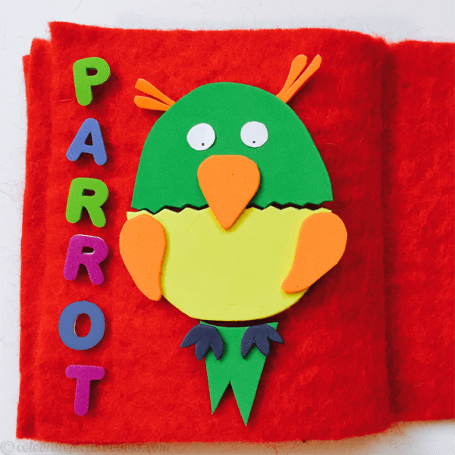
Create a Soft Book, Page 5—Parrot


Parrots are beautiful and exotic birds with a talent for language! Add this colorful tropical parrot to your soft book with the printable template provided.

Supplies

  • Printable Parrot Template
  • Yellow, green, orange, white, and black or brown felt, fleece, or foam
  • Adhesive felt or foam letters
  • Fabric glue
  • Scissors

Directions

  1. Cut out the head and tail from the green felt, fleece, or foam
  2. Cut out the body from the yellow felt, fleece, or foam
  3. Cut out the beak, wings, and feather tufts from the orange felt, fleece, or foam
  4. Cut out the feet from the brown or black felt, fleece, or foam
  5. Assemble the parrot and glue in place
  6. Attach the adhesive letters, making sure they stick firmly. If they don’t use fabric glue

See you tomorrow!

April 17 – International Haiku Poetry Day

The Maine Coon's Haiku and Other Poems for Cat Lovers by Michael J. Rosen and Lee White picture book review

About the Holiday

Part of National Poetry Month, International Haiku Writing Day celebrates the wonders of this most minimalistic yet impactful type of poetry. The familiar 5-7-5 syllable rule doesn’t begin to describe the intricacies of form and thought that goes into these beautiful creations. If you have the opportunity today, read or write some haiku, or attend a recitation of this lovely form of expression.

The Maine Coon’s Haiku and Other Poems for Cat Lovers

Written by Michael J. Rosen | Illustrated by Lee White


Fortunately for poetry—and cat—lovers there are as many types of felines as there are ways to describe them. With wit and keen insight, this collection of haiku depicts the mystery, stealth, crouching, and curiosity of twenty breeds of cats.

The remains of a shredded plant elicits an unanswerable question in Ragdoll: “why today the cat / who sleeps beneath the ivy / halved the blameless hearts”.

celebrate-picture-books-picture-book-review-the-maine-coon's-haiku-american-shorthair

Image copyright Lee White, text copyright Michael J. Rosen. Courtesy of Candlewick Press

Any cat owner who finds vases or lamps overturned will appreciate Siamese: “a toppled lamp shade / moon moth must be here somewhere / batted from the dark” It is commonly known that cats own their domain, a fact acknowledged in British Shorthair: “paws plant mud-daisies / along the polished hillside / parked on the cat’s street.”

In these lines felines become baseball players, gymnasts, ghosts, and mist, as in Bombay: “paired shadows prowling / in nightfall, but just two lights / pierce that darkness” and Norwegian Forest Cat: “caught among branches / fog descends the trunk headfirst / one foot at a time.”

celebrate-picture-books-picture-book-review-the-maine-coon's-haiku-norwegian-forest-coon

Image copyright Lee White, text copyright Michael J. Rosen. Courtesy of Candlewick Press

While the haiku form is necessarily rigid, the supple rhythms of Michael Rosen’s phrases perfectly capture the vast array of quirks, moves, attitudes, and friskiness that make cats such favorite pets. These poems are in turn sweet, spirited, and humorous—just like their subjects.

Lee White similarly highlights the bounding, creeping, prowling, and snoozing postures of all manner and colors of the breeds represented here. The Turkish Angora is painted as transparent as it leaps through the door, becoming more opaque as it reaches mid-page and disappearing from the edge of the book, leaving only its back end behind. The Abyssinian plunks its head and whole body across the open book on its owner’s lap, its eyes closed in dreamy sleep, and the Scottish Fold indomitably maintains its perch in the magnolia tree, determined not to fall like the raining petals.

Ages 5 and up (any cat lover will enjoy these poems)

Candlewick Press, 2015 | ISBN  978-0763664923

Get to know Michael J. Rosen and discover books for kids and adults, poems, videos, work for radio and TV, and more on his website!

View a beautiful gallery of artwork for books and personal illustration by Lee White on his website!

International Haiku Poetry Day Activity

CPB - Cat Bookmark (2)

Hang in there, Kitty! Bookmark


Love cats? Love reading? Then here is the purrfect bookmark for you!

Supplies

Directions

  1. Print the Hang in there, Kitty! bookmark
  2. Color the bookmark
  3. Cut around the toes of the paws, leaving the top of the paws attached to make flaps that will hang over the book’s page you want to mark

Picture Book Review

March 31 – Eiffel Tower Day

A Walk in Paris by Salvatore Rubbino Picture Book Review

About the Holiday

The Eiffel Tower is one of the most recognized monuments in the world. Its iconic shape was designed by Gustav Eiffel, for whom the tower is named. It was built for the International Exhibition of Paris and opened on March 31, 1889 to commemorate the 100th anniversary of the French Revolution.

The Eiffel Tower stands 984 feet high and was at the time of its opening the world’s tallest building, an honor it held until the Chrysler Building was erected in New York in 1930. When the International Exhibition’s 20-year lease on the land expired, the Eiffel Tower was almost taken down, until people realized it could be used as a radio antennae.

Of course, all these facts don’t convey the magic of the tower itself. To celebrate this auspicious date, visit the Eiffel tower if you live close or take a vicarious walk in the fabled city of Paris with today’s book. You can also make and enjoy the French Butter cookie recipe found below.

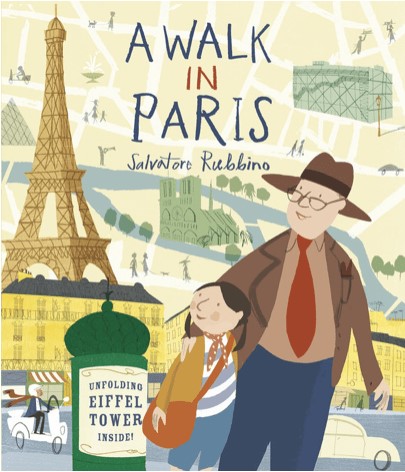
A Walk in Paris

By Salvatore Rubbino


A girl and her grandpa visiting the city of Paris emerge from the metro at Place Maubert just in time to join the throng of shoppers perusing the colorful food stalls on Market Day and to buy some famous French cheese. They continue on their tour through old streets and new boulevards, avoiding the gushing water for the street cleaners, until they reach the fountain at Place Saint-Michel. Their meanderings take them to the River Seine and Notre-Dame. After a long wait in line, they climb to the Chimera Gallery, 151 feet above the ground. From there they look out on the city, all the way to the Eiffel Tower.

On the ground once more they pass salons and boutiques and settle into a cozy bistro for lunch. They visit the Marais, a fashionable area of shops and cafes built on what was once marshland. Up next is a structure that seems to have been built inside-out since all its pipes and escalators are on the outside! This is Pompidou Center, a famous gallery of modern art. The little girl proclaims it formidable!, which means “wonderful!”

Time for a snack! The grandpa-granddaughter duo find themselves in front of a pâtisserie window full of delectable cakes. It’s so hard to choose! Back on the boulevard, they make their way to the majestic building and glass pyramids of the Louvre Art Museum, where perhaps the world’s most famous painting—the Mona Lisa—hangs. A well-deserved rest comes in Tuileries Gardens, where the grandfather enjoys his favorite view and the girl makes a friend by the fountain pool.

It’s getting late and time to leave, but there is one more site to see. As the sun goes down and the night sky darkens, the grandfather treats his granddaughter to a magnificent event – the bright, twinkling lights of the Eiffel Tower!

Through A Walk in Paris Salvatore Rubbino has created a beautiful armchair tour of one of the world’s great cities. The large format of this picture book allows for broad views of the landmarks and vistas, giving children a good idea of the vastness of the city. Each page is dotted with trivia and factual information, printed in small type that does not disturb the flow of the illustrations.

The illustrations in muted yet rich tones and with fine details aptly capture the culture and grandeur of the City of Lights. A fold-out page of the luminescent Eiffel Tower is sure to elicit some oohs and ahhs from children.

Ages 4 – 9 (the embedded facts and illustrations make this a good book for older children and research projects also)

Candlewick Press, 2014 | ISBN 978-0763669843

Eiffel Tower Day Activity

CPB - Eiffel Tower Cookies

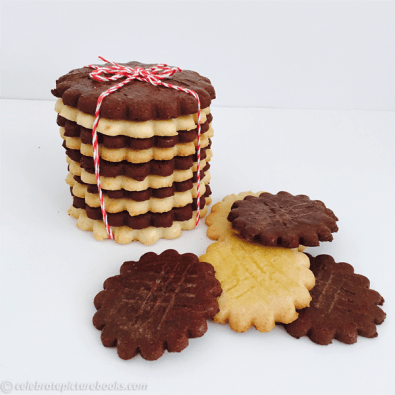
French Butter Cookies – Lemon and Chocolate


Whip up a batch of these delicious cookies to eat while enjoying A Walk in Paris. There’s no better way to spend a day than to take a trip for a new place—even if you do it in the coziness of your own room!

Ingredients for Lemon Cookies

  • 10 tablespoons unsalted butter (room temperature)
  • 1/2 cup sugar
  • 1 large egg
  • 1 1/4 teaspoons vanilla extract
  • 2 cups flour
  • 1/2 teaspoon baking powder
  • 1/4 teaspoon salt
  • 2 teaspoons lemon zest (or to taste)

For Egg Wash

  • 1 egg
  • 1 tablespoon water

For Chocolate Cookies

  • 1 ½ cups flour
  • ½ cup cocoa powder
  • ½ teaspoon cinnamon
  • ¼ teaspoon ground ginger

Directions

  1. In a bowl beat butter and sugar until light and fluffy
  2. Add the egg and vanilla extract and beat until blended
  3. Add the flour, baking powder and salt and beat just until incorporated. Do not over mix the dough. **For Chocolate Cookies use 1 ½ cups flour and add cocoa powder, cinnamon, and ground ginger before mixing**
  4. Transfer the dough to a lightly floured work surface, knead the dough a few times to bring it together, and then divide the dough in half.
  5. Wrap each half in plastic wrap and refrigerate for at least one hour or until firm
  6. Preheat oven to 350 degrees F (177 degrees C) and place rack in the center of the oven.
  7. Line two baking sheets with parchment paper and set aside.
  8. Remove one portion of the dough from the refrigerator and place on a lightly floured work surface. Roll out the dough until it is 1/4 inch (1 cm) thick.
  9. Using a lightly floured 2 inch (5 cm) round, fluted cookie cutter (or other cookie cutter of your choice), cut out the cookies and place them on the prepared baking sheet.
  10. Put the baking sheet of cut out cookies in the refrigerator for about 15 -20 minutes to chill the dough.
  11. Meanwhile, in a small bowl, whisk the egg with the water for the egg wash. Remove the cookies from the refrigerator and brush the tops with the egg wash.
  12. Then, with the tines of a fork or a toothpick, make a crisscross pattern on the top of each cookie.
  13. Bake cookies for about 12-14 minutes or until golden brown around the edges.
  14. Cool cookies on wire rack.

March 30 – National Pencil Day

The Pencil by Allan Ahlberg and Bruce Ingman Picture Book Review

About the Holiday

Writers and artists, this day is for you! On this date in 1858 Hymen Lipman received a patent for the very first graphite pencil with an eraser attached. Lipman must have been an optimist because the pencil he created was ¾ graphite and ¼ India rubber eraser. The user would sharpen both ends to expose the material. There are conflicting reports on why most pencils sport that familiar yellow hue, but both agree that the color was associated with grandeur. One fascinating fact about this most noble instrument is that a single one can pen pencil 45,000 words or draw a line 35 miles long!

So sharpen those pencils—whatever color they are—and spend this day creating something wonderful!

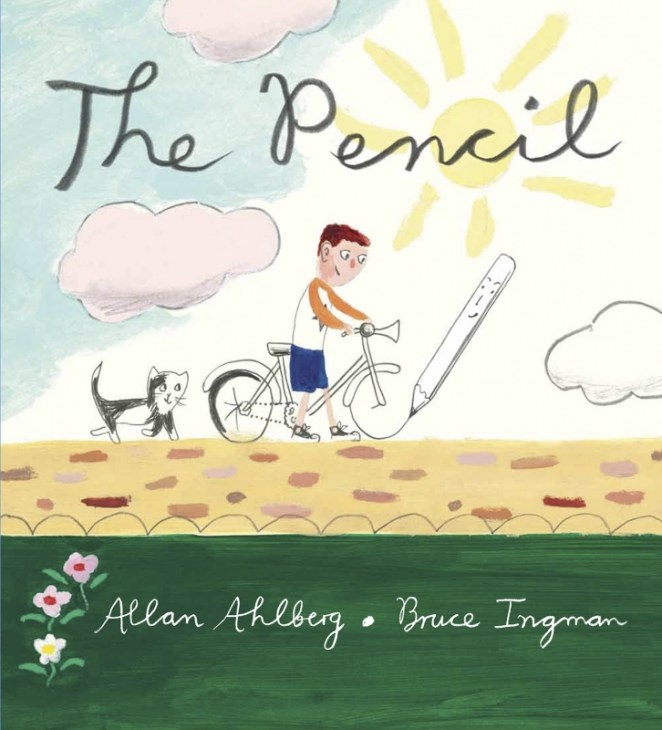
The Pencil

Written by Allan Ahlberg | Illustrated by Bruce Ingman


Even before the title page readers learn of a little pencil, alone in the world. One day the pencil quivers and begins to draw. The pencil draws a boy, who asks for a name, and receives “Banjo” in reply. The boy wants a dog, and the pencil obliges. Bruce is the dog’s name, and he wants a cat. Mildred is immediately created, and of course Bruce chases Mildred. Banjo chases Bruce. They need a place to run, so the pencil draws a house, a town, and a park.

All this excitement makes the trio hungry and tired. Banjo demands the pencil draw him an apple, Bruce wants a bone, and Mildred really wants a mouse but settles for cat food. There’s just one problem—the food is so unappetizing in black and white. The pencil thinks for a bit and comes up with a solution. He draws a paintbrush named Kitty. Kitty colors the food, the boy, the dog, the house, the town, and the park. Mildred is left as created – she’s a black-and-white cat anyway.

The team of Pencil and Paintbrush create a family, a friend for Bruce, a ball (Sebastian) for Banjo, and a kitten for Mildred. But all these extra characters cause trouble. Sebastian breaks a window, and the mom, dad, sister, and grandpa aren’t completely satisfied with their traits. What’s a pencil to do? Draw an Eraser, of course!

The eraser takes care of the problems, but grows fond of his power to rub things out. He erases the table, chair, front door—the whole house. And that’s not all! Nothing the Pencil and Paintbrush have created is safe. Eraser rubs everything out until all that’s left is the pencil and the eraser locked in opposition.

The pencil draws a wall, a cage, a river and mountains with fierce animals but none of it is a match for the eraser. Then the pencil has a brainstorm and draws…another eraser! The two erasers engage in an epic battle, and in the end they rub each other out.

The Pencil recreates everything he had before, and Kitty colors it all in, including a new picnic with a runaway boiled egg named Billy and 10 A-named ants to clean up the crumbs. As the day fades into night, a moon appears in the sky along with a cozy box for Pencil and Paintbrush to sleep in.

Allen Ahlberg’s endearing story of a little pencil who creates himself a world full of friends and excitement as well as the inevitable conflict will appeal to kids for whom the imagination looms large and even competes with and enhances reality. On a subtle metaphorical level, as the eraser rubs out everything in its path, kids may see that simply getting rid of problems can sometimes cause more, and that resolution is a better tact.

Bruce Ingman’s illustrations deftly depict the friendship and collaboration between Pencil and Paintbrush. Graphite lines outline the characters and objects that Pencil draws, and the colorful accents from Paintbrush are vivid and joyful.

Ages 4 – 8

Candlewick Press, 2012 | ISBN 978-0763660888

National Pencil Day Activity

CPB - Pencil Maze

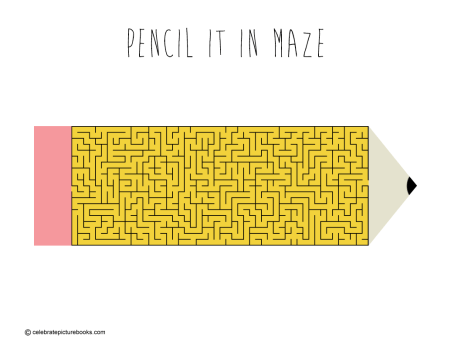
Pencil It In! Maze


Line up here to test your skills against this printable Pencil It In! pencil-shaped maze. Solution included. Sharpen your pencil and start having fun!

Picture Book Review