February 10 – It’s Children’s Authors & Illustrators Week

celebrate-picture-books-picture-book-review-anything-but-pink-cover

About the Holiday

Today I’m celebrating Children’s Authors and Illustrators Week with a humorous book by a debut author whose story embodies the universal themes of Multicultural Children’s Book Day. Her story is a bright reminder that life is better when we embrace the wonderful diversity all around us.

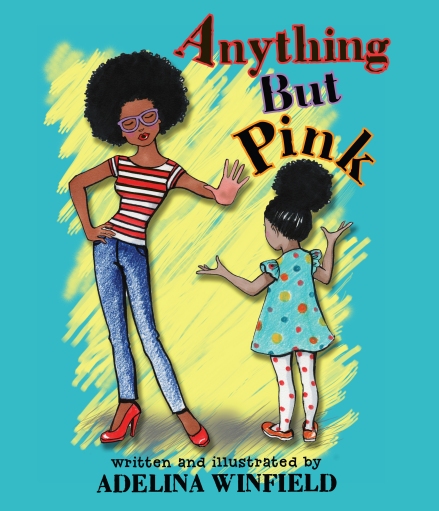
Anything But Pink

By Adelina Winfield


Not long ago in a nearby city—it might even have been yours—a couple was waiting for their little girl to be born. One night under a starlit sky, her mommy and daddy were inspired to call their precious one Starri. Starri’s “parents had big dreams about what she would be like,” but none of those things involved the color pink. In fact, when guests were invited to Starri’s baby shower they were told, “‘Please don’t bring anything Pink. Nope, Not one thing!’”  
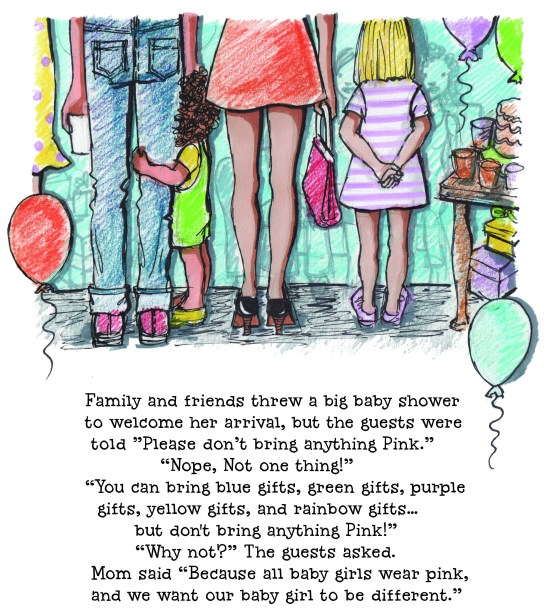
celebrate-picture-books-picture-book-review-anything-but-pink-baby-shower

Image and text copyright Adelina Winfield, courtesy of Adelina Winfield

They were encouraged to bring “‘blue gifts, green gifts, purple gifts, yellow gifts, and rainbow gifts,’” but nothing pink. Why? Starri’s mom said, “‘all baby girls wear pink, and we want our baby girl to be different.’” So the decorations and cupcakes were “red, green, purple, and aqua, and friends and family brought a rainbow of blankets, bouncers, bassinets, toys, clothes, and diapers. But there was not one dot of pink. “Nope. No pink at all.”

Mommy and Daddy took all those presents home and decorated their baby girl’s nursery in “yellow, grey, aqua, and orange.” Pretty soon Starri was born, and she was “as bright as her name.” As an infant Starri was wrapped in green and yellow; she crawled in lavender onesies; she took her first steps in peach and blue; and she greeted the world in a bold red dress. But she never, ever wore anything pink. “Nope. Not one thing.”
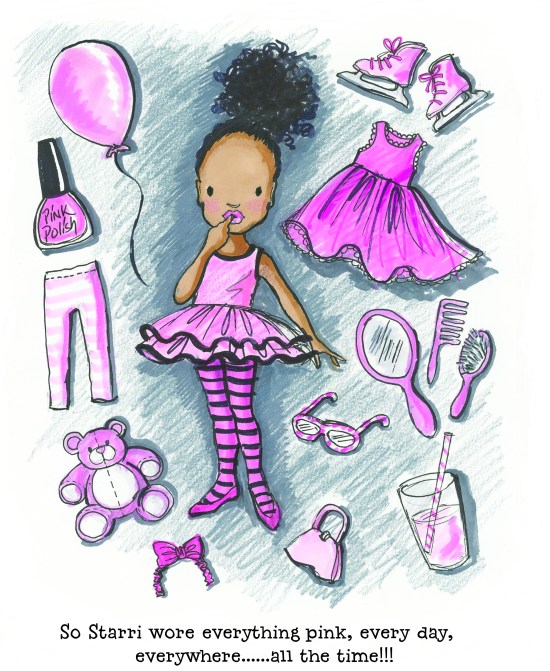
celebrate-picture-books-picture-book-review-anything-but-pink-starri

Image and text copyright Adelina Winfield, courtesy of Adelina Winfield

But one day Starri told her mom and dad that she wanted to wear a pink dress. Their astonished faces said it all. And Starri didn’t want just one pink dress, she wanted a pink tutu, “pink nail polish, pink shoes, pink ice cream, pink cake, pink leggings, and pink sunglasses. A pink room with pink walls, and a pink dresser with a pink lamp on a pink night table.” Yep, she wanted everything pink. And so it happened.
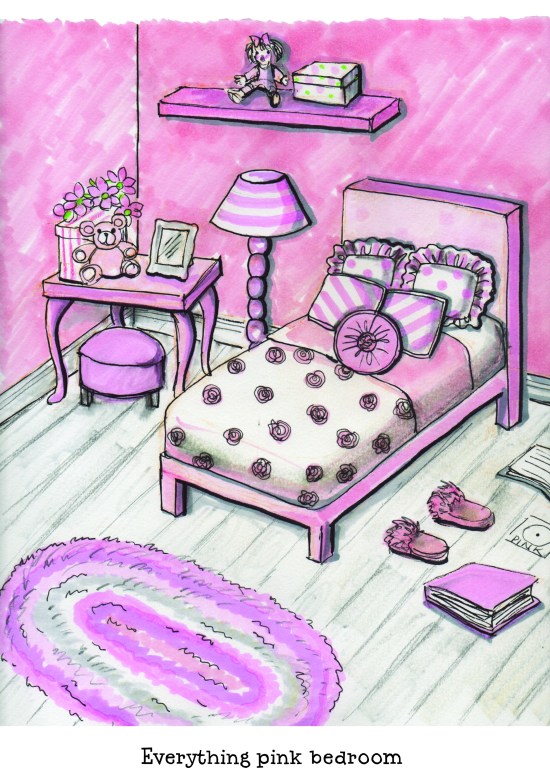
celebrate-picture-books-picture-book-review-anything-but-pink-starri's-pink-bedroom

Image and text copyright Adelina Winfield, courtesy of Adelina Winfield

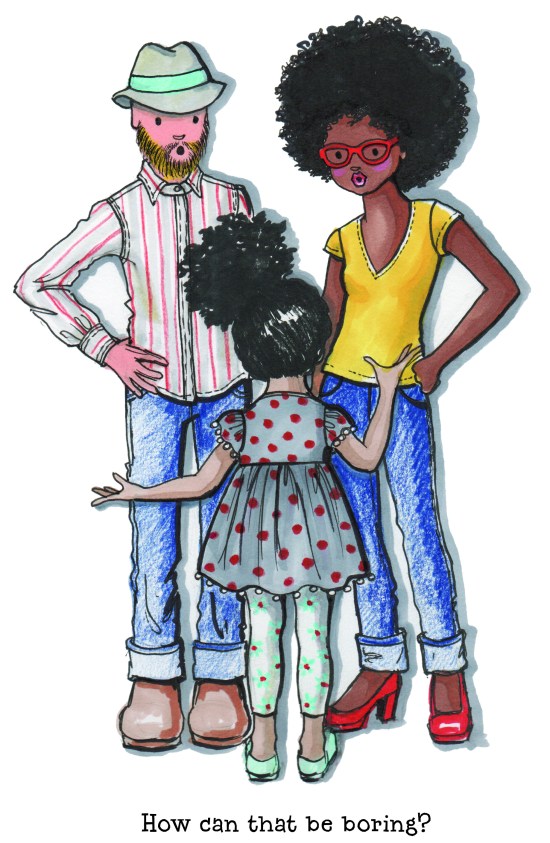
There was not one inch of Starri’s life that was not pink. She wore pink at playtime, somersaulted in pink, sat on the pink spot on the classroom reading rug, and “of course had a pink birthday party.” One day as Starri once again clothed herself head to toe in pink, her mom stopped her. “‘Wearing all pink is boring,’” she said. But Starri didn’t believe it. How could pink be boring when there was “bubble gum pink, candy pink, magenta, rose, fuchsia, flamingo pink, watermelon pink, and hot pink?” Pink was not boring. “Nope, not one bit!”

“‘But honey,’” her mom and dad said, “‘variety is the spice of life,’” and they showed her how all the beautiful colors of the rainbow could “live together with pink.” Starri loved this idea, and so now when you see her, she’s still wearing pink, but she’s welcomed other colors into her life as well!
celebrate-picture-books-picture-book-review-anything-but-pink-starri's parents

Image and text copyright Adelina Winfield, courtesy of Adelina Winfield

If you have ever been a little girl, had a little girl, or even just known a little girl, Adelina Winfield’s Anything But Pink will resonate and make you smile. Despite parent’s preferences, protestations, and prohibitions, pink creeps then gallops into girls’ lives in a million different ways. Winfield’s repetition of a rainbow of colors and the fervently hopeful “Nope, no pink at all. Not one thing” makes her story all the funnier as adults surely know what’s coming and young readers will cheer when Pink finally makes its appearance. I laughed out loud when I turned to the pages after Starri embraces pink as it took me back to when my own daughter, who having earlier rejected pink for green, suddenly wanted a pink room, pink lamp, pink clothes, and even wall stickers exactly like the colorful circles that dot Winfield’s endpapers.

There is a joyous quality to Winfield’s stylish illustrations as Starri’s parents prepare for their baby amid vibrant images that express the dreams they share for their child. When adorable, curly-haired Starri comes along, she happily wears what her parents give her until the moment when she asserts her independence and with personality and flair enters the monochromatic world of pink. The story is infused with a sweet tone shown in the loving relationship between Starri’s parents as they stand close together, walk with their arms around each other, and even have priceless matching expressions the first time the dreaded P word is uttered. Their relationship with Starri is likewise affectionate. When their daughter does discover pink, they support her, only later guiding her to consider a more global perspective.

Anything But Pink is a cute story for all lovers of the color pink and would make an appreciated baby shower or birthday gift and a much-asked-for story time or bedtime read.

Ages 3 – 8

CreateSpace Independent Publishing, 2016 | ISBN 978-1541103672

Anything But Pink is available on Amazon

You can follow Anything But Pink on Instagram

About Adelina Winfield

celebrate-picture-books-picture-book-review-Adelina-Winfield-picture

Adelina is an all around artist and an eternally creative spirit. She spent several years as a Fashion Designer in New York’s garment district, designing children’s clothing for labels such as Guess Jeans, JayZ’s Rocawear brand, and Tina Knowles’ Dereon line. This design experience allowed her to globe trot, where she spotted the latest trends throughout Europe and Asia. Her eclectic upbringing in Brooklyn, NY, worldwide travel, and many years in the fashion business has served as a canvas for her current creative expression: writing. Now living in another creative city, Austin, Texas, Adelina has married her artistic and writing talents in her first children’s book, Anything But Pink

Children’s Authors & Illustrators Week Activity
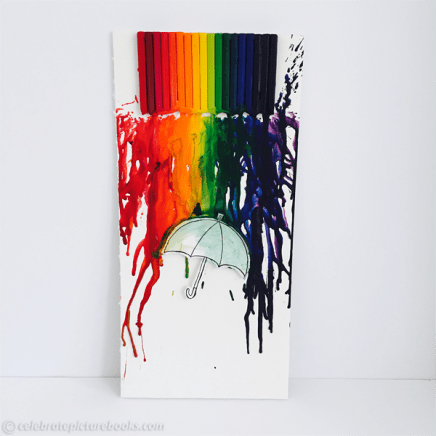
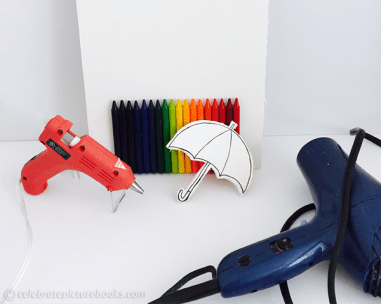
CPB - Rainbow Crayon Art 3

Crayon Rainbow Art


With this cool project you can create an art piece that’s as colorful as a rainbow and as unique as you are! Adult help is needed for children.

Supplies

  • Box of 24 crayons
  • White foam board or thick poster board, 8 inches by 17 inches
  • A small piece of corrugated cardboard, about 5 inches by 5 inches (a piece of the foam board can also be used for this step)
  • A small piece of poster board, about 5 inches by 5 inches
  • Scissors
  • X-acto knife (optional)
  • Hot glue gun
  • Hair dryer
  • Old sheets or towels, newspapers, a large box, or a trifold display board

CPB - Rainbow Crayon Art 2

CPB - Rainbow Crayon Art 1 (2)

Directions

  1. Remove the various red, orange, yellow, blue, indigo, and violet hued crayons from the box of crayons
  2. Strip the paper from the crayons by slicing the paper with the x-acto knife, or removing it by hand
  3. Line them up in order at the top of the white foam board
  4. Glue the crayons with their tips facing down to the board with the hot glue gun
  5. Cut an umbrella or other shape of your choice from the poster board
  6. Trace the umbrella or other shape onto the corrugated cardboard or a piece of the foam board and cut out
  7. Glue the poster board shape onto the corrugated cardboard, let dry
  8. Glue the umbrella or other shape to the foam board, about 4 ½ inches below the crayons
  9. Set up a space to melt the crayons. The wax will fly, so protect the floor and walls by placing the art piece in a large box or hanging newspapers, old sheets or towels on the walls and placing newspapers on the floor. A trifold display board and newspapers works well.
  10. Stand the art piece upright with the crayons at the top
  11. With the hot setting of the hair dryer, blow air at the crayons until they start to melt
  12. Move the hair dryer gently back and forth across the line of crayons from a distance of about 6 to 12 inches away. The closer you are to the crayons, the more they will splatter
  13. The crayons will begin to melt and drip downward
  14. You can experiment with aiming the hair dryer straight on or at an angle to mix colors
  15. Wax that drips onto the umbrella or other shape can be chipped off after it dries or wiped off to create a “watercolor” effect on the shape
  16. Once the hair dryer is turned off, the wax cools and dries quickly
  17. Hang or display your art!

About Multicultural Children’s Book Day

Multicultural Children’s Book Day 2017 (1/27/17) is its fourth year and was founded by Valarie Budayr from Jump Into A Book and Mia Wenjen from PragmaticMom. Our mission is to raise awareness on the ongoing need to include kid’s books that celebrate diversity in home and school bookshelves while also working diligently to get more of these types of books into the hands of young readers, parents and educators. 

Despite census data that shows 37% of the US population consists of people of color, only 10% of children’s books published have diversity content. Using the Multicultural Children’s Book Day holiday, the MCBD Team are on a mission to change all of that.

Current Sponsors:  MCBD 2017 is honored to have some amazing Sponsors on board. Platinum Sponsors include ScholasticBarefoot Books and Broccoli. Other Medallion Level Sponsors include heavy-hitters like Author Carole P. RomanAudrey Press, Candlewick Press,  Fathers Incorporated, KidLitTVCapstone Young Readers, ChildsPlayUsa, Author Gayle SwiftWisdom Tales PressLee& Low BooksThe Pack-n-Go GirlsLive Oak MediaAuthor Charlotte Riggle, Chronicle Books and Pomelo Books

Author Sponsors include: Karen Leggett AbourayaVeronica AppletonSusan Bernardo, Kathleen BurkinshawDelores Connors, Maria DismondyD.G. DriverGeoff Griffin Savannah HendricksStephen HodgesCarmen Bernier-Grand,Vahid ImaniGwen Jackson,  Hena, Kahn, David Kelly, Mariana LlanosNatasha Moulton-LevyTeddy O’MalleyStacy McAnulty,  Cerece MurphyMiranda PaulAnnette PimentelGreg RansomSandra Richards, Elsa TakaokaGraciela Tiscareño-Sato,  Sarah Stevenson, Monica Mathis-Stowe SmartChoiceNation, Andrea Y. Wang

We’d like to also give a shout-out to MCBD’s impressive CoHost Team who not only hosts the book review link-up on celebration day, but who also work tirelessly to spread the word of this event. View our CoHosts HERE.

MCBD Links to remember:

MCBD site: http://multiculturalchildrensbookday.com/

Free Multicultural Books for Teachers: http://bit.ly/1kGZrta

Free Kindness Classroom Kit for Homeschoolers, Organizations, Librarians and Educators: http://multiculturalchildrensbookday.com/teachers-classroom-kindness-kit/

Free Diversity Book Lists and Activities for Teachers and Parents: http://bit.ly/1sZ5s8i

Picture Book Review

February 9 – It’s Library Lovers Month

The Midnight Library by Kazuno Kohara Picture Book Review

About the Holiday

For bibliophiles, this may be the best month of the year! Not only does your local library have shelves stacked with books, magazines, movies, and tapes of every kind, it offers comfy chairs, fascinating lectures, kids programs, and more! This month be sure to take part in some of the activities librarians have planned for you!

The Midnight Library

By Kazuno Kohara


A little librarian opens the doors to her library only as the sun goes down. Working with her three assistant owls, she helps the forest animals find the perfect book. The animals read quietly and the library is peaceful until one night when a band of squirrels begins playing their instruments in the reading room. The little librarian shushes the squirrels and they apologize, saying they’re just working on a new song. The librarian has the perfect solution! She shows the band to the upstairs activity room, and peace reigns once more in the library.

celebrate-picture-books-picture-book-review-the-midnight-library-squirrels-play-music

Image copyright Kozuno Kohara, courtesy of us.macmillan.com

Later that night it begins to rain—inside! The little librarian climbs the ladder to look at the roof, but instead of a leak she finds a wolf sobbing away. Her book is so sad, the wolf says, that she can’t read on. Gently, the librarian takes her to the storytelling corner where she, the owls, and Miss Wolf read the story together. The wolf discovers the book has a happy ending, something the library workers knew all along.

celebrate-picture-books-picture-book-review-the-midnight-library-wolf-cries

Image copyright Kozuno Kohara, courtesy of us.macmillan.com

All too soon the sun peeks over the horizon, and it’s time for the library to close. The patrons file out one by one, but who is left leisurely reading his book in the corner? It’s a tortoise who says he is not leaving until he finishes his book—only 500 pages to go! Once again the little librarian has the answer! She gives the tortoise a library card and reveals that he can take the book home with him and finish it there. The tortoise heads home feeling happy and lucky with the book strapped to his shell.

celebrate-picture-books-picture-book-review-the-midnight-library-saying-goodbye

Image copyright Kozuno Kohara, courtesy of us.macmillan.com

With the library to themselves, the owls and librarian tidy up the shelves and snuggle in with one last book—bedtime stories for the sleepy owls.

The Midnight Library is a perfect bedtime—or daytime—book for budding bibliophiles and library lovers. With its dreamy quality, Kazuno Kohara’s story is as inviting and comforting as a favorite reading nook, and the little librarian of this nighttime treasure trove is sweetly reassuring as she quickly and calmly resolves the issues that arise in her domain. 

celebrate-picture-books-picture-book-review-the-midnight-library-at-night

Image copyright Kozuno Kohara, courtesy of us.macmillan.com

Kohara’s characters are adorable, smiling with pleasure at gathering in their favorite place. An image of the owls holding Miss Wolf’s hands as they read her book together is particularly touching. Kids will love the tricolor pages that masterfully capture both the mystery and radiance of this welcoming after dark meeting place. As readers reach the end of the story, they will look forward to the next night when they can visit The Midnight Library again.

Ages 3 – 6

Roaring Brook Press, 2014 | ISBN 978-1596439856

Library Lover’s Month Activity

CPB - Librarian Thank You card

Design a Thank You Card


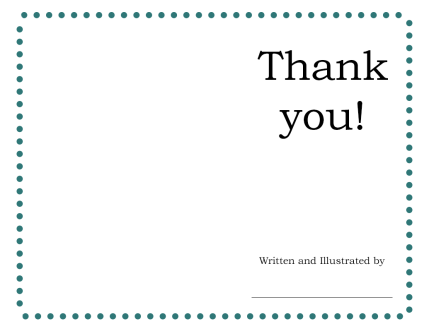
During this month make a card to tell your librarians why you love them and what you like best about the programs they create for you! Print the Thank You! card and then draw a picture and/or write a message and sign your name. Then fold it and give it to your favorite librarian. Get the Thank You! card here.

Picture Book Review

February 8 – Kite Flying Day

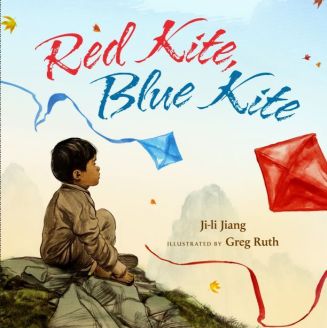
celebrate-picture-books-picture-book-review-red-kite-blue-kite-cover

About the Holiday

If you live in a cold climate and cabin fever has set in or if you live in a warm climate and want to get out and enjoy the day, why not take the opportunity of today’s holiday and go fly a kite? Whether you’re steering a simple diamond or a fancy dragon, watching a kite dip and soar through the sky is an exhilarating experience!

Red Kite, Blue Kite

Written by Ji-li Jiang | Illustrated by Greg Ruth


“I love to fly kites,” young Tai Shan relates, but not he’s while standing on the ground. Instead, because his city is so crowded, his Baba and he climb to the peak of their triangular roof where they are “above but still under, neither here nor there. We are free, like the kites.” While they fly their kites—red for Tai Shan and blue for Baba—Baba tells stories, and Tai Shan feels as if he is soaring through the clouds, “looking down at the dotted houses” and wanting to stay up there forever.

celebrate-picture-books-picture-book-review-red-kite-blue-kite-Tai-Shan-and-Baba-fly-kites

copyright Greg Ruth, courtesy of Disney-Hyperion

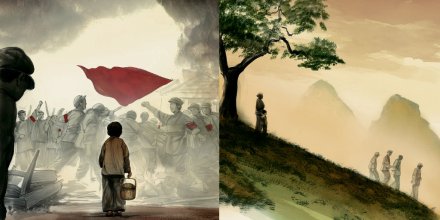
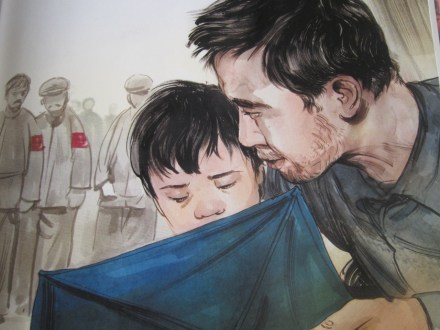
But one day dark times descend. Tai Shan’s school and many others are shuttered. Baba is taken away by men in red arm bands and sent to work in a labor camp. Tai Shan is sent to live with Granny Wang, a farmer who lives in a village next to the labor camp. A thick forest separates Tai Shan and Baba. During the day Granny Wang teaches Tai Shan how to make straw grasshoppers and spin cotton and lets him ride her buffalo. At night Tai Shan dreams of flying kites from the rooftop with his father.

On Sundays Baba walks for hours to visit Tai Shan. He spends time telling stories and playing with his son and his friends. Then they climb the hill and fly kites, Tai Shan’s red one following Baba’s blue. “The kites hop and giggle as they rise and dive, soaring and lunging together.” At the end of the day, Baba returns to the labor camp for another week. In the autumn Baba tells Tai Shan that he won’t be able to visit for a long time. But he has a clever plan—a way that he and Tai Shan can see each other.

Baba gives his son a new red kite and tells him to fly it from the hill each morning. He will see it from his camp. In the evening Baba will fly his blue kite so that Tai Shan can see it. Tai Shan likes the idea of this “secret signal.” The next morning Tai Shan runs to the hill and launches his kite, knowing that “Baba is smiling as he watches the red kite dancing.” In the evening he returns to the hill, and after a long wait “Baba’s blue kite sways into the white clouds.”

celebrate-picture-books-picture-book-review-red-kite-blue-kite-Baba-taken

copyright Greg Ruth, courtesy of Disney-Hyperion

Every day Tai Shan sends his father a silent message—“‘How are you, Baba? I miss you.’” and “Baba’s blue kite swirls and circles, replying, ‘I miss you, too, little Tai Shan.’” Autumn is coming to a close, but still Baba does not visit. One day no blue kite appears in the sky. The next day and the next no kite appears either. Tai Shan asks Granny Wang to take him to the camp to see Baba. If there is no kite on the fourth day they will go, Granny Wang promises.

That night Tai Shan dreams about the thick forest and hears Baba whisper, “‘Tai Shan, I saw your red kite fly so high.’” But these words are not in a dream, Baba is there. But Baba is not home to stay. Hurriedly, he gives Tai Shan his blue kite, telling him that he will not be able to fly it for a while. He asks Tai Shan to fly both kites and know that he is looking up and thinking about his son. Suddenly, men with red armbands rush in and take Baba away. Tai Shan tries to run after him, but Granny Wang holds him back.

Tai Shan cries and does not understand. Granny Wang explains that Baba is being sent to another labor camp far away because the authorities don’t agree with his ideas. During the three days when he didn’t fly his blue kite, Granny Wang says, Baba had been imprisoned. He had escaped and run all the way to see Tai Shan before he was taken away. Now Tai Shan flies the two kites every day and thinks of being together with Baba.

celebrate-picture-books-picture-book-review-red-kite-blue-kite-Baba-gives-kite

copyright Greg Ruth, courtesy of Disney-Hyperion

One summer afternoon, Tai Shan dozes while he allows his red kite to dip and soar in the clouds. When he opens his eyes, he sees dozens of red and blue kites in the sky. Tai Shan jumps up. He sees Baba smiling at him and “holding the string of a huge blue kite dancing in the sky.” Tai Shan’s friends are also smiling and flying their new kites. Tai Shan runs to Baba, and Baba runs toward Tai Shan. The sky “is filled with kites—red and blue. They hop and giggle and cheer as they rise and dive, soaring and lunging together. They are free, flying everywhere.”

An Author’s Note about the Chinese Cultural Revolution follows the text.

Inspired by the story of a family friend whose father was sent to a labor camp during the Chinese Cultural Revolution between 1966 and 1976, Ji-li Jiang wrote Red Kite, Blue Kite “for the many fathers and sons who suffered during that turmoil.” Jiang’s story is a universal and relevant reminder of the precious freedoms of thought and speech that need constant and vigilant protection. Through her sensitive storytelling and lyrical language, Jiang offers a story of understanding, hope, and infinite love that will fill readers’ hearts.

Greg Ruth’s stunning paintings show all the emotion of Jiang’s story through exquisite, realistic portraits of Tai Shan, Baba, and Granny Wang. The distinctive landscapes of China are rendered in colorful foregrounds set on gauzy backgrounds of rising hills. Smoky images of the followers of the Cultural Revolution mirrors the darkness and destruction of the time in a way that is understandable for the young audience. The final two-page spread of Tai Shan and Baba’s reunion amid dozens of red and blue kites is inspiring and full of the strength of the human spirit.

Red Kite, Blue Kite is a must for school and public libraries and makes an excellent addition to home libraries as well.

Ages 5 – 9

Disney-Hyperion, 2013 | ISBN 978-1423127536

For a downloadable Educator’s Guide click here.

Learn more about Ji-li Jiang and her books on her website!

Find galleries of books and illustration for children and adults plus lots more on Greg Ruth’s website!

Kite Flying Day Activity

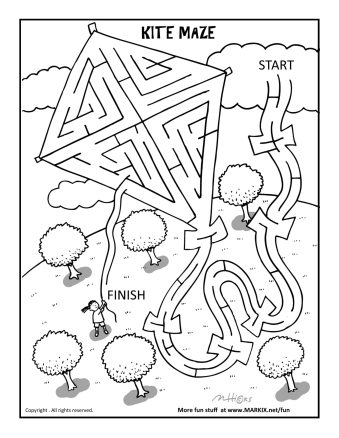
celebrate-picture-books-picture-book-review-kite-maze

Soaring Kite Maze


The dips and rises your pencil takes through this maze is a little like the way a kite flies through the sky! Print your Soaring Kite Maze and enjoy!

Picture Book Review
February 7 – It’s Haiku Writing Month

The Maine Coon's Haiku and Other Poems for Cat Lovers by Michael J. Rosen and Lee White picture book review

About the Holiday

National Haiku Writing Month—also known as NaHaiWriMo—encourages poets and poetry lovers to write one haiku a day for the entire month of February. Why was February chosen for this literary challenge? Perhaps the fact that the haiku is the shortest form of poetry and February is the shortest form of month makes them natural allies. While a haiku may be short, it is full of emotion and impact, not unlike its host month. If you have haiku inside of you, write them down and share them with others!

The Maine Coon’s Haiku and Other Poems for Cat Lovers

Written by Michael J. Rosen | Illustrated by Lee White


Fortunately for poetry—and cat—lovers there are as many types of felines as there are ways to describe them. With wit and keen insight, this collection of haiku depicts the mystery, stealth, crouching, and curiosity of twenty breeds of cats.

The remains of a shredded plant elicits an unanswerable question in Ragdoll: “why today the cat / who sleeps beneath the ivy / halved the blameless hearts.”

celebrate-picture-books-picture-book-review-the-maine-coon's-haiku-american-shorthair

Image copyright Lee White, text copyright Michael J. Rosen. Courtesy of Candlewick Press

Any cat owner who finds vases or lamps overturned will appreciate Siamese: “a toppled lamp shade / moon moth must be here somewhere / batted from the dark.” It is commonly known that cats own their domain, a fact acknowledged in British Shorthair: “paws plant mud-daisies / along the polished hillside / parked on the cat’s street.”

In these lines felines become baseball players, gymnasts, ghosts, and mist, as in Bombay: “paired shadows prowling / in nightfall, but just two lights / pierce that darkness” and Norwegian Forest Cat: “caught among branches / fog descends the trunk headfirst / one foot at a time.”

celebrate-picture-books-picture-book-review-the-maine-coon's-haiku-norwegian-forest-coon

Image copyright Lee White, text copyright Michael J. Rosen. Courtesy of Candlewick Press

While the haiku form is necessarily rigid, the supple rhythms of Michael Rosen’s phrases perfectly capture the vast array of quirks, moves, attitudes, and friskiness that make cats such favorite pets. These poems are in turn sweet, spirited, and humorous—just like their subjects.

Lee White similarly highlights the bounding, creeping, prowling, and snoozing postures of all manner and colors of the breeds represented here. The Turkish Angora, stealthily creeping across a room, is painted as transparent as it leaps through the door, becoming more opaque as it reaches mid-page and disappearing from the edge of the book, leaving only its back end behind. The Abyssinian plunks its head and whole body across the open book on its owner’s lap, its eyes closed in dreamy sleep, and the Scottish Fold indomitably maintains its perch in the magnolia tree, determined not to fall like the raining petals.

Ages 5 and up (any cat lover will enjoy these poems)

Candlewick Press, 2015 | ISBN  978-0763664923

Get to know Michael J. Rosen and discover books for kids and adults, poems, videos, work for radio and TV, and more on his website!

View a beautiful gallery of artwork for books and personal illustration by Lee White on his website!

Haiku Writing Month Activity

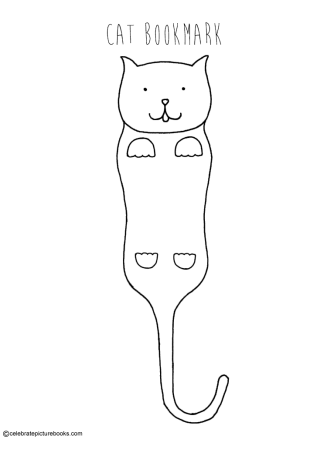
CPB - Cat Bookmark (2)

Hang in there, Kitty! Bookmark


Do you love to read? Do you love to write? If you said yes to either or both of these questions, then here is a kitty that wants to hang out with you! 

Supplies

  • Printable Hang in there, Kitty! bookmark template
  • Card stock paper
  • Colored pencils, crayons, or markers
  • Scissors

Directions

  1. Print the Hang in there, Kitty! bookmark (printing on card stock will make a sturdier bookmark)
  2. Color the bookmark
  3. Cut around the toes of the front paws, leaving the top of the paws attached to make flaps that will hang over the page you want to mark

Picture Book Review
February 6 – It’s Hot Breakfast Month

celebrate-picture-books-picture-book-review-paul-bunyan-and-babe-the-blue-ox-the-great-pancake-adventure

About the Holiday

Hot Breakfast Month was established to encourage people to have a hot, healthy breakfast before they go off to work or school. A good breakfast can keep your brain and your body working longer and better, which will result in a good day and more happiness in your life! Isn’t that worth cracking a few eggs in a pan, toasting some bread, or—as Paul Bunyan preferred—mixing up a batch of pancakes?!

Paul Bunyan and Babe the Blue Ox: The Great Pancake Adventure

By Matt Luckhurst


Everyone knows that Paul Bunyan and his best friend Babe the Blue Ox were “the greatest lumberjacks to every work the forests.” But not many people know just how that came to be. It all started because Paul was a very big boy in a very small town. He found it hard to concentrate on school because he was always thinking about his mom’s pancakes. “‘Math,” Paul said, “is just not very tasty.’”

celebrate-picture-book-picture-book-review-paul-bunyan-and-babe-the-blue-ox-and-the-great-pancake-adventure-babe-and-paul

Copyright Matt Luckhurst, courtesy of mattluckhurst.com

Now, Paul and Babe were lucky enough to live in an area where lots of fresh fruit and vegetables were grown, but they only wanted pancakes. In fact when their mom tried to feed them broccoli, they spit it right out! So Paul’s mom made stacks and stacks of pancakes until she was out of breath—but she still had fields to tend to. Paul and Babe tried to free up time for Mom to keep cooking by working in the fields, “but their big feet just squished and squashed everything in sight.”

Finally, there were just not enough pancakes at home, so Paul hugged his mom and set off into the deep dark forest to find his “pancake fortune” with Babe at his heels. With their heads in the clouds and their bellies empty, they happened upon a lumberman with a huge problem. The Syrup River was dammed up with pancakes and the logs couldn’t get through. It was just the job for Paul and Babe!

celebrate-picture-book-picture-book-review-paul-bunyan-and-babe-the-blue-ox-and-the-great-pancake-adventure-babe-smiling

Copyright Matt Luckhurst, courtesy of mattluckhurst.com

Paul and Babe ate every last pancake until the river was clear. The lumberman was so impressed he offered them a job on the spot! And the best part was that they would be paid in pancakes! The trio tromped from Wisconsin to California, logging the land and making their mark. In Minnesota it was “so cold that all of Paul’s words froze before they could make a sound. They say you can still hear his voice in the forests there today as they thaw out.” Further west Paul and Babe had a little something to do with creating the Rocky Mountains, and the Grand Canyon would still be a flat plateau if it weren’t for Babe’s voracious appetite.

celebrate-picture-book-picture-book-review-paul-bunyan-and-babe-the-blue-ox-and-the-great-pancake-adventure-paul's-words-freeze

Copyright Matt Luckhurst, courtesy of mattluckhurst.com

But one day Babe fell ill, and Paul was feeling a little under the weather himself. The doctor gave them a grave diagnosis. “‘You seem to have been eating too many pancakes!’” he announced. Paul was flabbergasted—how could there be such a thing as too many pancakes?! But the doctor explained that a balanced diet was best. Paul pondered where he could find good food. Then it hit him! Paul and Babe said goodbye and headed back home.

celebrate-picture-books-picture-book-review-paul-bunyan-and-babe-the-blue-ox-the-great-pancake-adventure

Copyright Matt Luckhurst, courtesy of mattluckhurst.com

Mom was thrilled to see them and cooked plenty of nutritious meals to make them healthy. They stayed in town and grew “Bunyan sized veggies,” helped the townspeople, and always listened to Mom. And they never ate another pancake ever again! Well….

As Matt Luckhurst so adroitly knows, there is no more fascinating figure of North American folklore than Paul Bunyan and no greater meal than a pancake breakfast! Combining the two is sweet genius and rollicking fun to boot! Tall tales capture the imagination, and Luckhurst has included plenty of fantastic events to keep kids enthralled from page to page. Luckhurst’s larger-than-life illustrations burst with color and dynamic 3-D typography that enhance the humor and heart of Paul and Babe’s predicament. The juxtaposition of sizes and folk-art influences create unique, eye-catching pages, and Paul and Babe’s endearing innocence make them loveable characters.

Perfect for folktale lovers, pancake aficionados, kids who follow a singular vision, and anyone who loves a good yarn, Paul Bunyan and Babe the Blue Ox: The Great Pancake Adventure is great fun and would be an often-read addition to a child’s bookshelf.

Ages 4 – 8

Abrams Books for Young Readers, 2012 | ISBN 978-1419704208

You’ll enjoy getting to know more about Matt Luckhurst and viewing a portfolio of his work on his website!

Take a peek at this awesome trailer for Paul Bunyan and Babe the Blue Ox: The Great Pancake Adventure!

Copyright Matt Luckhurst

Hot Breakfast Month Activity

celebrate-picture-books-picture-book-review-pancake-game

Pancake Flip-Out Game


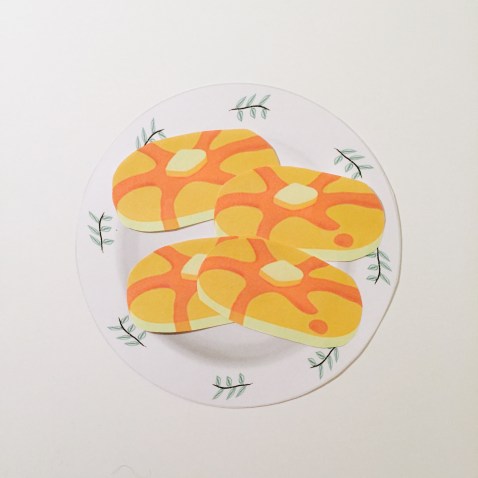
Pancakes are served in a stack because they’re so delicious that each one doesn’t last long! This game gives you the chance to see how many pancakes you can flip onto a plate! You can play this game several ways:

  1. Give each player the same number of pancakes and see how many they can toss onto the plate during their turn
  2. Make a target with the plate in the middle and draw 3 concentric circles around it. Hitting the target can earn you 20 points. Getting your pancake in the first circle around the plate earns you 15 point, the second circle is worth 10 points, and the third is worth 5 points. Rotate through the players as many times as you like and add up the points at the end. The player with the most points wins!
  3. Instead of tossing the pancakes with your hands, try throwing them with a spatula!
  4. Make up your own rules—and have fun!

Supplies

Directions

  1. Print the Pancakes and Breakfast Plates and cut them out
  2. Glue the pancakes and plate to poster board, cardboard, or foam to give the pancakes more weight for throwing and the plate more support
  3. Once dry, the game pieces are ready for fun!

Picture Book Review

February 5 – National Weatherperson’s Day

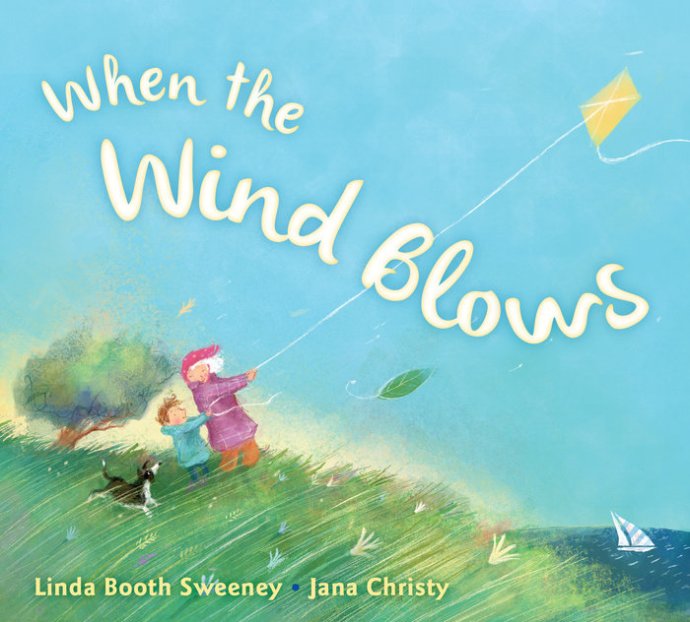
celebrate-picture-books-picture-book-review-when-the-wind-blows-cover

About the Holiday

When you flip on the weather report in the morning, do you ever wonder who the first weather reporter was? Well, In America that honor may well go to native Bostonian John Jeffries, who was born on this date in 1745 and who in 1774 began measuring the weather and making others aware of its importance. In 1784 he became the first to gather weather information during a hot-air balloon flight over London. If meteorological science is your thing, enjoy this day—and this poem by an anonymous British poet:

Whether the weather be fine
Or whether the weather be not,
Whether the weather be cold
Or whether the weather be hot,
We’ll weather the weather
Whatever the weather,
Whether we like it or not.

When the Wind Blows

Written by Linda Booth Sweeney | Illustrated by Jana Christy


A little boy peeks out of his rattling window as the wind sends chimes ringing and doors creeaaaking. Jumbled into their jackets the boy’s mom, baby sister, and grandmother go out to enjoy the day. They fly a kite while nearby bells clang and walkers stroll hand in hand. In the sweeping wind “Trees dance. / Spiders curl. / Mice shiver. / Leaves swirl.”

celebrate-picture-books-picture-book-review-when-the-wind-blows-chase

Image copyright Jana Christy, text copyright Linda Booth Sweeney. Courtesy of G. P. Putnam Sons

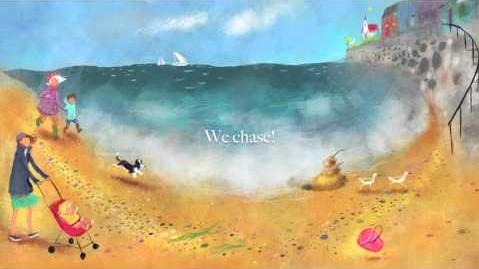
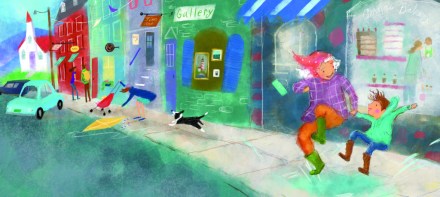
When the wind snatches the kite, the boy and his grandma chase after it amid clouds racing across the sky and seeds scattering to and fro. Running after the kite through waving beach grass, the family sees “Sails puff. / Boats wobble. / Gulls float. / buoys bobble.” Their pursuit takes them into town where they track down their kite lying on a sidewalk. When the wind blows on these narrow seaside village lanes, “Signs shake. / Lights jiggle. / Puddles splosh. / We giggle.”

With the kite safely in hand the foursome ventures to the park for some rolling, swaying, whirling play. But the day is graying—“Skies darken. / Thunder BOOMS. / Rain falls. / We zoom!” Back at home all is cozy as the family dries off and the little boy takes a bath. Tucked into bed the little boy and his mom cuddle while their pets curl up on the blankets. As they sleep, “Skies clear. / Stars gleam. / Earth sleeps. / We dream.”

celebrate-picture-books-picture-book-review-when-the-wind-blows-city

Image copyright Jana Christy, courtesy of G. P. Putnam Sons

Linda Booth Sweeney’s charming tale of a day spent in the midst of a windy day perfectly captures the sights and sounds of such a gusty natural event. Sweeney’s eye for detail and talent for evocative verbs elevate the two-word lines in these short verses, letting readers fully experience the effects of a wild squall. Kids will appreciate the original imagery and love repeating the lyrical lines.

The blustery wind is evident in Jana Christy’s vibrant pastel illustrations, where clouds swirl in scribbles, flowers bow, and buffeted grasses protect small creatures. Everywhere, the wind flutters head scarves and clothing, bends signs, and tears hats and kites from unsuspecting hands. As rain approaches Christy’s skies acquire a gray, gauzy texture, and when the family again reaches home, the colors turn warm and bright, as comforting as a cup of tea or hot chocolate. Readers will be rewarded for lingering over the beautiful pages by seeing details and people carried over from page to page, uniting the story.

Ages 3 – 6

G. P. Putnam’s Sons, Penguin Group, 2015 | ISBN 978-0399160158

Meet Linda Booth Sweeney and find fun activities to extend the fun of When the Wind Blows on her Children’s Books website. You can find detailed information as well as videos, podcasts, and activities about her Systems work on lindaboothsweeney.net.

Learn more about Jana Christy and view galleries of her children’s books and illustration and sculpture work on her website.

Watch this windblown book trailer by animator Xin Xin and Linda Booth Sweeney.

National Weatherperson’s Day Activity

CPB - Windsock

Catch the Wind! Windsock Craft


You can feel the wind in your hair and see it blowing through the trees, but can you actually catch it? You can with this easy-to-make windsock!

Supplies

  • 1 large yogurt container (32 oz) or 1-pound deli salad container
  • 1 long-sleeve T-shirt
  • Strong glue
  • Dowel, 5/8 diameter x 48-inches long or longer
  • String
  • Rubber band
  • sewing seam ripper or cuticle scissors
  • X-acto knife
  • Scissors

Directions

  1. Remove the sleeve from a long-sleeve t-shirt with the seam ripper or cuticle scissors
  2. Cut the shoulder off the sleeve by cutting straight across from the underarm seam
  3. Cut 2 inches from the bottom of the yogurt container OR cut the bottom out of the deli container with the x-acto knife or scissors
  4. With the x-acto knife or scissors, make a hole a little smaller than the diameter of the dowel about 1 inch from the rim of the container
  5. Slide the container into the large opening of the sleeve
  6. Fold about a ¾ -inch edge over the rim of the container and attach all along the rim with strong glue
  7. Put the rubber band around the outside edge of the opening
  8. Tie the bottom of the sleeve’s cuff together with the string
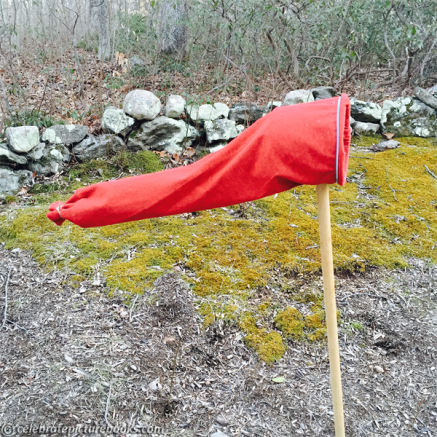
  9. To attach the dowel: Option 1: leaving the t-shirt in place, push the dowel and material through the hole in the container. The t-shirt material will hold the dowel in place (I used this option).  Option 2: cut a small hole in the t-shirt at the location of the hole in the container. Push the dowel through this hole and the hole in the container. Secure with strong glue
  10. Stick your windsock in the ground in an open area where it can catch the wind. As the wind changes direction, you can turn your windsock so the opening faces the wind.

Picture Book Review
February 4 – Take Your Child to the Library Day

celebrate=picture-books-picture-book-review-the-librarian-of-basra-cover

About the Holiday

What better way to spend a Saturday than by stopping by your local library and picking up a few books to while away the hours on a cold winter day? While you’re there thank the librarians for all they do to keep libraries open and books accessible to all. Consider donating to your local library today!

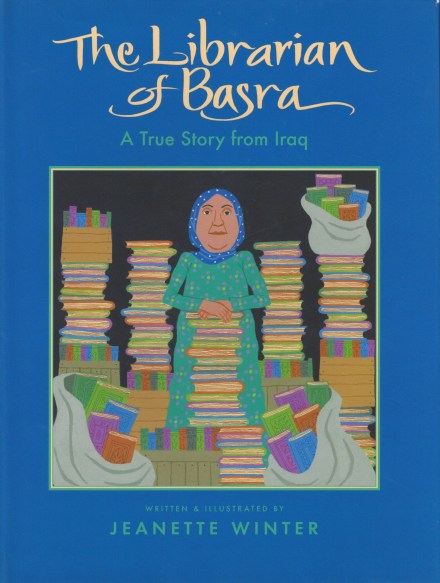
The Librarian of Basra: A True Story from Iraq

By Jeanette Winter


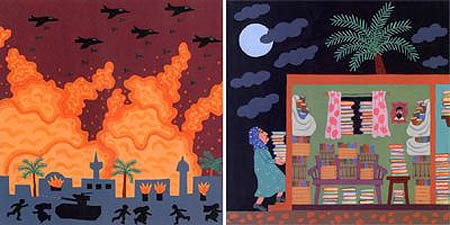
Alia Muhammad Baker, oversees the library of Basra in Iraq, where all those who love books and learning come to “discuss matters of the world and matters of the spirit.” Now, though, their talk is full of the war around them. Alia is afraid for her books, worried that the fires of war will destroy them, so she petitions the government for permission to move them to a safe place. Her request is denied, so Alia secretly fills her car each night with as many books as it can carry and takes them home.

celebrate=picture-books-picture-book-review-the-librarian-of-basra-war

Image copyright Jeanette Winter, courtesy of post-gazette.com

As rumors of war continue to swirl, the library becomes a shelter for government offices. When the battles reach Basra, “the city is lit with a firestorm of bombs and gunfire.” The government officials, soldiers, and library workers abandon the library, leaving Alia alone to protect the books. She summons help from Anis Muhammad, the restaurant owner on the other side of the library wall, and together they remove the rest of the books in crates and sacks and wrapped in curtains. Other shopkeepers and neighbors join in, removing the books and hiding them in Anis’s restaurant.

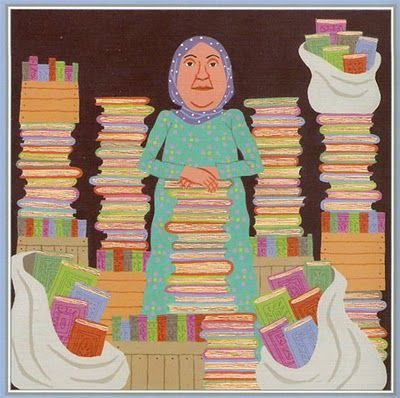
The war rages, but the books’ whereabouts remain a secret. “Then, nine days later, a fire burns the library to the ground.” “At last, the beast of war moves on,” but the books are still in danger. While the city is quiet, Alia “hires a truck to bring all thirty thousand books to her house and to the houses of friends.” Alia’s house is stacked floor to ceiling with the books she loves. They fill every cabinet, teeter on every shelf, and sit in piles under tables, chairs, and Alia’s bed. There’s hardly room for Alia herself.

But Alia is patient. She waits and “dreams of peace” and a time when a new library will be built to replace what has been lost.

celebrate=picture-books-picture-book-review-the-librarian-of-basra-alia

Image copyright Jeanette Winter, courtesy of Houghton Mifflin Harcourt Books for Young Readers

Jeanette Winter’s story of one woman who risked her own safety to protect the books she loved, including an ancient biography of Muhammad, reminds all readers of the importance of these storehouses of our collective history, culture, imagination, and knowledge. The gripping true-life story abounds with suspense as war grows closer but also with hope as friends and neighbors make Alia’s mission theirs too. In these days when so many libraries are threatened with closure, The Librarian of Basra, asks the question: what would we do to protect our books?

In square framed acrylic paintings on solid colored backgrounds, Winter reveals the day-to-day wartime events and the actions Alia takes to save the library’s collection. She is seen visiting a government official, sneaking books into her car by night, and watching as soldiers are stationed on the library roof. When the battle comes to Basra, silhouetted jets fly in a rust-colored sky as orange flames dwarf the buildings and people below. Under the threat of bombs, Alia and her neighbors are portrayed packing up the books and carrying them over the wall to safety. Readers will marvel at the image of Alia’s house stacked with books and may wonder how many their own homes could hold.

Ages 4 – 8

Houghton Mifflin Harcourt Books for Young Readers, 2005 | ISBN 978-0152054458

Take Your Child to the Library Day Activity

celebrate-picture-books-picture-book-review-library-coloring-page

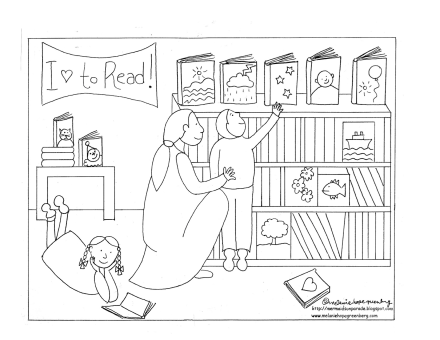
I Love the Library! Coloring Page


If the library is one of your favorite places, print out this I Love the Library! Coloring Page and enjoy!

Picture Book Review