About the Holiday
There may be no better month to celebrate Author’s Day than in November. Not only is it Picture Book Month, but thousands of people set aside their usual routine to take part in NaNoWriMo or National Novel Writing Month, when writers try to complete at least a first draft of a novel in one month. To kick off all of this literary love today, we remember and honor American authors past and present. The holiday was instituted in 1928 by Nellie Verne Burt McPherson, president of the Bement, Illinois Women’s Club. An avid reader, she established Author’s Day to thank writer Irving Bacheller who sent her an autographed story in response to her fan letter. The day was officially recognized in 1949 by the United States Department of Commerce. McPherson’s granddaughter, Sue Cole, has promoted the holiday since her Nellie’s death in 1968 and encourages people to spend a bit of the day writing a note of appreciation to their favorite author.
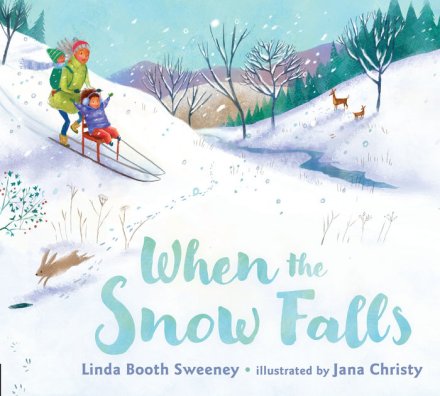
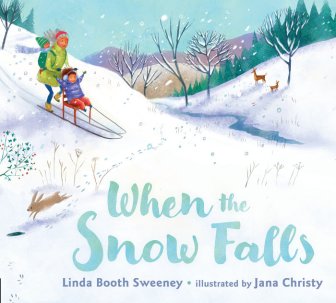
When the Snow Falls
Written by Linda Booth Sweeney | Illustrated by Jana Christy
A little curly-haired girl and her younger brother wake up from a sleepover with Grandma to a magical sight. As they gaze out the big picture window in the little girl’s room, they’re dazzled to see “When the snow falls…Frost paints. / Skies gray. / Windows sparkle/ Snow? Yay!” There’s no school today, so Mommy and Daddy and Grandma bundle up and get the kids ready to head outdoors to take care of the farm animals.
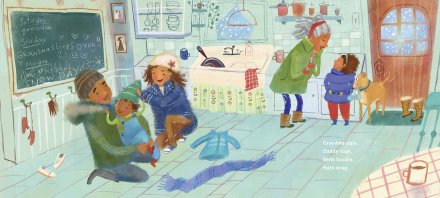
Image copyright Jana Christy, 2017, text copyright Linda Booth Sweeney, 2017. Courtesy of G. P. Putnam’s Sons for Young Readers.
Soft flakes flutter down, piling into deep drifts and providing a little extra after-breakfast treat as “Boot sink. / Lashes flick. / Tongues tickle. / We lick.” In the barn the horses, puppies, and chickens are just as excited about the snowy day. Riding an old chair sled, Grandma and her grandchildren glide down the hill, following tracks left by lively rabbits and now-dozing foxes.
Deep in the forest the three take in the beauty: “Woods hush. / Fields glisten. / Wren sings. / We listen.” On the other side of the woods, people continue their daily routine but at a slower pace as “plows push” and “mountains grow.” Grandma and the kids slide into town, where people are hard at work keeping up with the storm: “Wheels crunch. / Shovels scoop. / Ice cracks! / Awnings droop.”
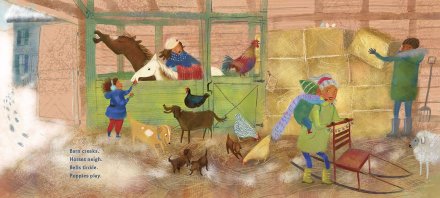
Image copyright Jana Christy, 2017, text copyright Linda Booth Sweeney, 2017. Courtesy of G. P. Putnam’s Sons for Young Readers.
The trio has reached Grandma and Grandpa’s house. They all grab shovels and help clear the walk. Now it’s Grandpa’s turn to have some fun. He takes his granddaughter by the hand, seats her little brother on a sled, and walk to the park. There, kids are making snowmen, building snow forts, and zipping down hills on their snow saucers. At the bottom of the hill everyone plops into the fluff and make snow angels.
It’s been an exhilarating, adventurous day, but twilight is on the horizon and now “toes tingle. / Lips quiver. / Cheeks glow. / We shiver.” As grandma calls from her front porch, the little girl and Grandpa, carrying his grandson, race toward home amid the swirling snowflakes. Inside, the light, warmth, and cozy comforts of warm soup, popcorn, and a crackling fire await. Later, the two kids enjoy quiet time with Grandma and Grandpa when “Cocoa warms. / Mittens puddle. / Day dawdles. / We cuddle.”
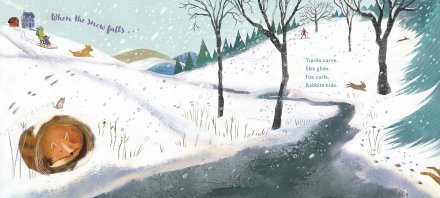
Image copyright Jana Christy, 2017, text copyright Linda Booth Sweeney, 2017. Courtesy of G. P. Putnam’s Sons for Young Readers.
With her brilliantly expressive staccato sentences—each only two words long—Linda Booth Sweeney evokes the sights, sounds, and joy of a care-free, snowy day. Each four-line, rhyming verse abounds with melodic verbs that spark readers’ imaginations and concrete nouns that in many places form delightful alliterative pairs that softly trip off the tongue. Readers will love the story line that takes them from a rustic farmhouse to Grandma and Grandpa’s cozy home through woods, over hills, past the highway, and into downtown all with the help of an old-style sled. Several verses full of snow day fun play out like a long afternoon spent with friends, leading naturally into the slower pace and loving comfort of the night spent with Grandma and Grandpa.
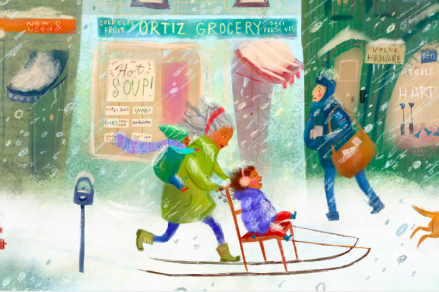
Image copyright Jana Christy, 2017, text copyright Linda Booth Sweeney, 2017. Courtesy of G. P. Putnam’s Sons for Young Readers.
In glorious two-page spreads, the wind-swept snow swirls, spatters, and blankets the world in downy white fluff. Jana Christy takes children into the family’s large farmhouse kitchen where a blackboard announces Grandma’s Sunday sleepover as well as Monday’s snow day in place of the crossed-out piano lesson. The family steps out into the sparkling countryside where purple mountains form a backdrop for the barn and sheep pen. As Grandma and the kids start their journey, the forest, a quiet enclave of teal and greens, welcomes them. By the time they reach town, cars are stuck in snowdrifts, snow shovels scrape against the sidewalk, and kids are heading to the park.
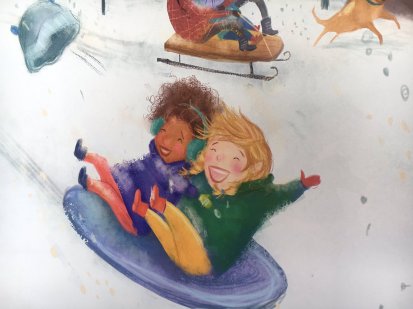
Image copyright Jana Christy, 2017. Courtesy of G. P. Putnam’s Sons for Young Readers.
The thrill of playing in the snow is palpable as saucers zoom down hills, hats fly off, and hair blows in the wind. The final spreads of Grandma and Grandpa’s tidy home glow with love and laughter as the kids pull off their snow gear, their dog shakes off the snow, and they settle on the couch for cocoa and cuddles. The busy townspeople, happy playmates, and close-knit mixed-race family make When the Snow Falls a cheerful celebration of diversity.
When the Snow Falls is a joyous book to add to winter collections and would be often asked for during home, classroom, and library story times.
Ages 3 – 7
G. P. Putnam’s Sons Books for Young Readers, 2017 | ISBN 978-0399547201
Discover more about Linda Booth Sweeney, her books and her systems work, visit her website.
To learn more about Jana Christy, her art, and her books, visit her website.
National Author’s Day Activity
Snow Buddies
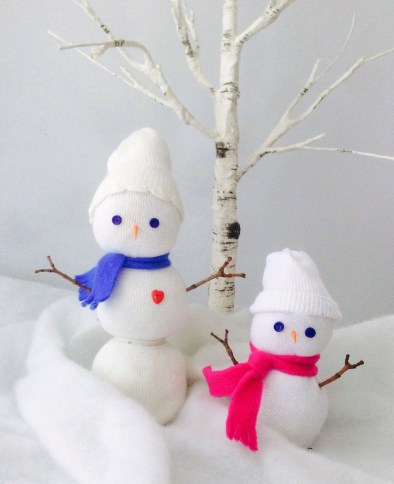
Even when there’s no snow, you can make yourself a snow buddy with this fun and easy craft!
Supplies
- White dress ankle socks
- Polyester Fiber Fill
- Tiny buttons
- Fleece or ribbon, enough for a little scarf
- Toothpicks
- Twigs
- Orange craft paint
- Cardboard
- White rubber bands, one or two depending on the size of the snowman
- Fabric or craft glue
- Small hair band (optional)
Directions
To Make the Snowman
- Cut a circle from the cardboard about 2 inches in diameter for the base
- Place the cardboard circle in the bottom of the sock
- Fill the sock with fiber fill about ¾ full or to where the ribbed ankle cuff begins. Pack tightly while making a sausage shape. You can make your snowman different shapes with the amount of fill you use.
- Stretch out the cuff of the sock and tie it off near the top of the fill either with a loop knot or with the hairband.
- Fold the cuff down around the top of the filled sock to make the hat.
- Wrap a rubber band around the middle of the sock to make a two-snowball snowman. For a three-snowball snowman, use two rubber bands. Adjust the rubber bands to make the “snowballs” different sizes.
To Make the Scarf
- Cut a strip of fleece or ribbon 8 to 10 inches long by ½ inch wide
- Tie the fleece or ribbon around the neck of the snowman
- To Make the Nose
- Dip one end of the toothpick into orange paint, let dry
- Cut the toothpick in half
- Stick the toothpick into the head or top portion of the snowman
To Make the Arms
- Insert small twigs into each side of the body of the snowman
- You can also use wire or cardboard to make the arms
- Attach two mini-buttons to the face for eyes with the fabric or craft glue
- Display your Snow Buddy
Interview with Linda Booth Sweeney
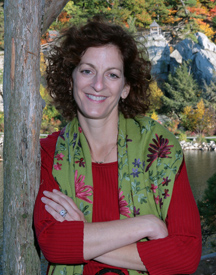
As the weather turns cooler, I’m happy to talk with Linda Booth Sweeney about the event that inspired her first book for children, a favorite wintertime activity, and how we can learn to see and benefit from systems.
How did you get started writing for children?
It seems like I’ve always been writing though it has taken me a long time to call myself a writer. During our last move, I discovered an old cardboard box from my parents’ attic. After moving it literally for years, I finally opened it this summer. Inside there must have been 15 diaries and journals. When I looked at the dates, I realized that I started writing in those when I was about twelve and I really haven’t stopped.
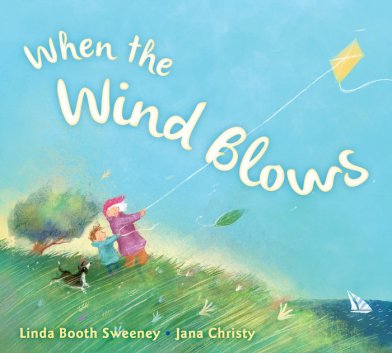
I actually remember the exact day I began writing for children! Jack, my oldest son (now 19), was three. I was pushing him around Cambridge in one of those $20 pop-up strollers. We were a good fifteen minutes from home when a gale force wind blew in. The little canopy on this stroller snapped off and I remember feeling like the stroller lifted up off the ground. This was before cell phones so there was no calling for a ride. I put my head down and ran for home. Well, Jack loved that, and the wind blowing! He was bouncing up and down, pointing to everything he saw: signs rattling, balls rolling, hats flying.
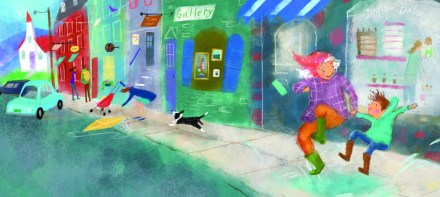
Image copyright Jana Christy, 2017, text copyright Linda Booth Sweeney, 2017. Courtesy of G. P. Putnam’s Sons for Young Readers.
During his nap that afternoon, I flopped down at my desk, grateful we made it home in one piece. Jack’s excitement was contagious and his words were swimming around my head so I wrote them down. That was the beginning of my first children’s book, When the Wind Blows.
Using short, two-word phrases, your picture books are so evocative of actions outdoors and indoors as well as internal emotions. Can you describe your writing process?
I was mimicking the voice of a three-year old so the two words. Balls roll. Object and action. Noun and verb. It just made sense. In my other books like the one I’m working on now about the sculptor of the Lincoln Memorial, I am writing for older readers (ages 7-12). My sentences are longer. The book is inspired by big themes like being true to oneself, equality, social justice, and love for country so I find myself writing punchy sentences in the scenes and more lyrically the bridges, or the transitions, between scenes.
Do you remember your favorite picture book when you were a child?
As a little kid, I always loved Dr. Seuss books. My imagination was going full tilt as a kid. Dr. Seuss made me feel like the other worlds I created were not just okay but to be celebrated! As a nine-year-old, I devoured Encyclopedia Brown and anything by James Herriot.
Your first book for children, When the Wind Blows, takes readers on a jaunt through town on a blustery day. When the Snow Falls is a joyful romp through a winter day. What is it about weather that inspires you and your writing?
It’s the immediacy that weather brings. When the rain is pouring down or the snow is falling, that grabs my attention. Of course my attention is also on how to keep my fingers warm or my feet dry. But I can’t think of much else. I love that. I have to be in the moment. My favorite poet, Mary Oliver, captures this idea well in her “Instructions for living a life:
Pay attention.
Be astonished.
Tell about it.”
If you’re outside stomping in puddles or making snow angels, who needs to be on a phone? There’s a lot of research coming out that equates nature to a “vitamin” we all need. Richard Louv, the author of Last Child in the Woods: Saving Our Children from Nature-Deficit Disorder, says it well: “Just as children need good nutrition and adequate sleep, they may very well need contact with nature.”
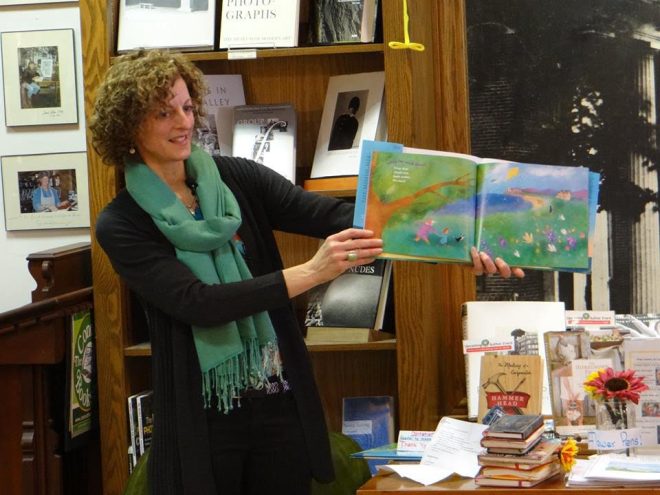
You mentioned in one of your blog posts that When the Snow Falls first took shape during “found time” during the winter of 2015 with its four nearly back-to-back snow storms. Do you have any advice for recognizing and taking advantage of found time not only for writers, but for anyone?
I think the biggest opportunity to enjoy found time comes when we’re willing to put down technology. Sure the photos we can take on our iPhone may be lovely but what if sometimes we are just there, fully present, open and even willing to be a little bored. Maybe then we can be dazzled by the red Cardinal that lands on the white snowman or the hush that creeps in when no can one drive.
What is your favorite wintertime activity?
I love looking for snow art and especially love seeing it through the eyes of little ones. I’m always amazed by the “art” that forms during snow storms – polka-dotted fields, top hats on fence caps, intricate patterns on round porch tables, delicate animal tracks that look like instructions for some kind of dance move.
And then of course there is cross country skiing with my family and my crazy friends.
Your other work involves Systems Thinking. Can you describe systems thinking and talk about your systems thinking work with children and schools?
Sure. Like a spider’s web, what happens on one part of the web affects every other part. The same is true of living systems. A pond, our family, our school, a city, the climate—these are all systems. They have two or more parts that interact over time. What’s really interesting is that these different kinds of systems share some similarities, and they can act in surprisingly similar ways. (You can learn more about my systems work here).
How does considering systems thinking and living systems benefit children and their education?
Systems thinking, or “Thinking about systems,” means paying attention to the interrelationships and patterns that surround us. My experience, and that of systems educators around the globe, shows that children are naturally attuned to this. They can read If You Give a Mouse a Cookie by Laura Numeroff and then recognize that same closed loop of cause and effect in their everyday lives.
A few years back I wrote When a Butterfly Sneezes: A Guide for Helping Kids Explore Connections in our World as a resource for anyone who wants to help children think about interconnections in our world. Each chapter focuses on a favorite children’s picture book—like If You Give a Mouse a Cookie and The Sneetches by Dr. Seuss—and shows how to use the story to engage children in systems thinking. I just finished updating that book and the new version should be up and ready by next week!
To answer your question about how systems thinking benefits children, learning about systems, and about living systems in particular, can help children to make better decisions and avoid unintended consequences. It can also help them to develop a more compassionate and sustainable sensibility about what is beautiful and what is essential.
I always come back to the Joseph Campbell quote—“People who don’t have a concept of the whole, can do very unfortunate things.…”—and flip it: People—and especially children—who have a concept of the whole can do very fortunate things. If we encourage young people to look for the “whole” and not just focus on the parts, they will be geared toward seeing connections and will not see things in isolation. So much in our culture forces us into compartments. But just as we teach kids not to be victims of advertising, we can teach them to see beyond the obvious, to see the systems all around us.
What’s up next for you?
My next children’s book is a richly illustrated biography about Daniel Chester French, the sculptor of the Lincoln Memorial. I am thrilled to be working with Shawn Fields a representational artist on this book. The working title of the book is Monument Man, and that subject is very much a part of our public conversation at this point in our history.
Thanks, Linda! Your books inspire us to look closure and pay attention to the moment, and I wish you all the best with them!
You can connect with Linda Booth Sweeney on:
Her Website | Twitter | Facebook | Linked in
You can find When the Snow Falls with these booksellers:
Amazon | Barnes & Noble | Books-a-Million | IndieBound | Penguin Random House
Picture Book Review