August 2 – It’s Water Quality Month

celebrate-picture-books-picture-book-review-water-can-be-cover

About the Holiday

Water Quality is a crucial world-wide issue. In fact, 2015 closed out a decade-long United Nations initiative “Water for Life” to promote awareness of the importance of water quality as it relates to sanitation, geography, human rights, urbanization, and sustainability. The Audobon Society emphasizes the interconnectedness of all water systems and urges people to be mindful of the dangers that can lurk in runoff from construction, forestry, factories, agriculture, and personal yards as it combines in rivers, lakes, or the ocean. To observe this month be conscious of what is in your water. Limit the use of anti-bacterial soaps that contain a certain pesticide harmful to marine life, don’t flush unused medications, choose nontoxic household cleaners, avoid using fertilizers and pesticides, and clean up leaks from cars and other machinery. Protecting our water sources protects us.

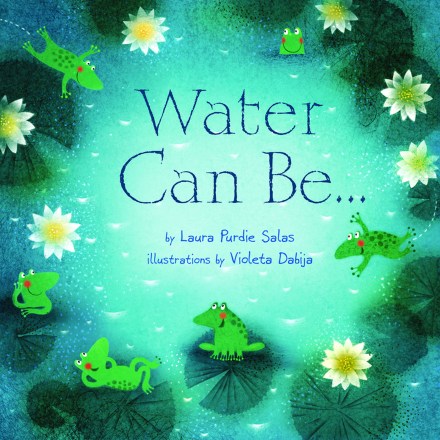
Water Can Be…

Written by Laura Purdie Salas | Illustrated by Violeta Dabija


“Water is water— / it’s puddle, pond, sea. / When springtime comes splashing, / the water flows free.” So begins an inventive journey through the ways that water enriches our lives. With four-word rhyming couplets Laura Purdie Salas illuminates specific moments or circumstances to reveal water’s important role from season to season. From filling ponds, lakes, oceans, and even puddles to roaring down hillsides to floating in misty fogs and forming snowflakes, water sustains us and makes the world a more beautiful place.

During spring and summer when ponds nurture new life and rain puddles reflect, “Water can be…a tadpole hatcher / Picture catcher.” In hot weather water refreshes as a “Thirst quencher / Kid drencher.” And the seas, at times calm and at others roiling, can be both “Home maker / Ship breaker.”

As the air cools in autumn, water can be found in alternate forms. It squirts from fountains for the “school drink-er” and hardens to ice for a “Bruise shrinker.” A river’s winding trail becomes a “Salmon highway / Eagle flyway.” Winter brings water in a more solid form. Whipped by wind snow swirls as a “Storm creator” or gently sticks to surfaces as a “Decorator.” Outside, both animals and people enjoy the frozen precipitation. Snow serves as a “Woodchuck warmer / Snowman former.”

On the final pages as ice sculptors carve castles and dragons, moon beams and rabbits, Laura Purdie Salas encourages readers: “Water is water— / it’s ice, snow, and sea. / Now go and discover / what else it can be.”

Fascinating facts concerning the subject of each rhyme, a glossary, and a bibliography for further reading follow the text. Laura Purdie Salas donates a portion of the royalties from Water Can Be… to WaterAid, an international non-profit organization that transforms lives by improving and providing access to safe water, hygiene, and sanitation.

Laura Purdie Salas always surprises with her selection of examples and clever rhymes leading readers to more fully appreciate the world around them. Water doesn’t just flow, it feeds, speeds, cloaks and soaks, it decorates and bejewels, fluffs and snuffs. After reading Sala’s poetic tribute, readers will never experience water the same way and will be on the lookout for how they can interpret water’s gifts.

Violeta Dabija has created gorgeous, ethereal interpretations of each two-word rhyme. The nourishing blues and aquas of the sea, gauzy whites of fog and clouds, and brilliant whites of snow and ice are subtly crosshatched giving each illustration depth and movement. While the words on each page are short, kids will want to spend a long time taking in the beauty of Dabija’s paintings.

Ages 3 – 8

Millbrook Press, Lerner Books, 2014 | ISBN 978-1467705912

Check out the book trailer for Water Can Be…. It really makes a splash!

There’s so much to see and do on Laura Purdie Salas’s website!

View more beautiful art by Violeta Dabija on her website!

Water Quality Month Activity

celebrate-picture-books-picture-book-review-angel-fish-coloring-page

Angel Fish Coloring Page


Clean water is important for all fish to survive! You can make the ocean sparkling clear by adding a bit of glitter to your printable Angel Fish Coloring Page!

July 20 – National Moon Day

celebrate-picture-books-picture-book-review-to-the-stars-cover

About the Holiday

Today’s holiday celebrates the astounding technological achievement that saw men land—and walk—on the moon. On July 20, 1969 Apollo 11 with astronauts Neil Armstrong, Buzz Aldrin, and Michael Collins touched down on the moon. Six hours after landing, Armstrong made the first “small step for man, one giant leap for mankind” when he descended the ladder of the space craft to the moon’s surface. He spent two and a half hours exploring our nearest neighbor. Aldrin also made a lunar walk. Between them, the two astronauts brought 47.5 pounds of material back to Earth. Millions of people watched live coverage of the moon landing on television, cheering along with NASA at this amazing feat.

To the Stars! The First American Woman to Walk in Space

Written by Carmella Van Vleet and Dr. Kathy Sullivan | Illustrated by Nicole Wong


As a child Kathy Sullivan loved to explore. Her father designed airplanes, and when he brought home blueprints, she carefully studied every line and curve. When she saw airplanes in the sky she wished she were on them, flying to exciting locations all over the world. Maps and foreign languages fascinated her. “Their strange symbols, exotic tales, and musical sounds made her feel like the world was waiting for her.” Kathy wanted to see that whole world and thought maybe she’d like to be a spy or a diplomat, but her friends and other adults told her those weren’t jobs for women.

celebrate-picture-books-picture-book-review-to-the-stars-blueprints

Image copyright Nicole Wong, courtesy of nicole-wong.com

But Kathy always followed her heart. She loved going fishing with her dad and brother, finishing the day with a swim. She “delighted in how her arms and legs moved in slow motion underwater.” Kathy was still a teenager when she learned how to pilot a plane. At first the busy instrument panel made her nervous, but she quickly learned how to manage all the “dials, buttons, and numbers.”

Kathy got a taste for the thrill of space when she bravely jumped at the opportunity to ride in a Breezy—an open air framework plane. Sitting at the very tip of the airplane, in front of the pilot, Kathy had a bird’s eye view. “The wind rushed past her face so fast it pushed her cheeks back. Higher! Faster! Young Kathy looked at the ground below her feet. She felt like she could see the whole world.”

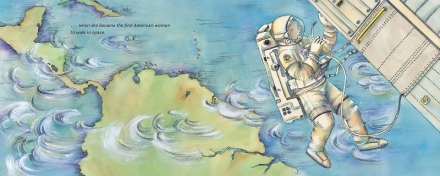
Later, as the first American woman to walk in space, she did!

celebrate-picture-books-picture-book-review-to-the-stars-spacewalk

Image copyright Nicole Wong, courtesy of charlesbridge.com

Carmella Van Vleet and Dr. Kathy Sullivan, have written a compelling biography of Dr. Sullivan that not only tells the story of her adult achievements, but also reveals the childhood and teenage motivations and influences that fostered her journey to the stars. As each event in Kathy’s young life is introduced, it is followed by an adult accomplishment: Kathy’s poring over her father’s aircraft blueprints leads to a spread of college-age Kathy studying charts in textbooks. Her enjoyment of swimming underwater is followed by an illustration showing her NASA training underwater. Her initial introduction to a plane’s instrument panel informs her later responsibilities inside the spacecraft. And the question she once asked herself as a child—what kind of job would allow her to see the whole world—is answered as the astronaut Kathy gazes down at Earth from space.

celebrate-picture-books-picture-book-review-to-the-stars-breezy

Image copyright Nicole Wong, courtesy of charlesbridge.com

Nicole Wong’s lovely, realistic watercolor and ink paintings clearly show readers Kathy Sullivan’s trajectory from curious girl to accomplished astronaut. The blueprints that Kathy studies are filled with schematics. The aqua water she swims in swirls and bubbles in the wake of her cannonball dive, the crisscrossing fields lay like a mottled green quilt under the Breezy. Especially stunning and effective are the illustrations of Dr. Sullivan’s work with NASA. Kids will love the up-close view of the spacecraft’s instrument panel with its myriad buttons and dials, and find the gorgeous two-page spreads of the space shuttle’s launch, the view from the cockpit, and Kathy’s spacewalk particularly thrilling.

Following the text are a personal note from Kathy Sullivan to her young readers, as well as more extensive biographical notes on how Dr. Sullivan discovered her love of science and the NASA missions she supported. Two more pages highlight the women of the first space-shuttle class, which included Kathy Sullivan, and other firsts by eight other women in space.

To the Stars is a wonderful book to teach children that following their own heart is the best path to future happiness and personal accomplishment. It’s a nice addition to any budding scientist’s or adventurer’s library!

Ages 5 – 9

Charlesbridge, 2016 | ISBN 978-1580896443

To find fun activities for To the Stars—including how to make space play dough—as well as other books by Carmella Van Vleet, visit her website!

To learn more about Nicole Wong and view a portfolio of her artwork, visit her website!

National Moon Day Activity

celebrate-picture-books-picture-book-review-moon-and-earth-coloring-page

Out of this World Coloring Page


The view of the Moon from Earth or of Earth from the Moon is spectacular! Have fun coloring this printable Out of this World Coloring Page!

Picture Book Review

July 16 – World Snake Day

celebrate-picture-books-picture-book-review-i-don't-like-snakes-cover

About the Holiday

Snakes are beautiful and fascinating creatures, but they often get a bad rap due to their mysterious nature and their portrayals in literature and throughout history. Today’s holiday promotes awareness of dangers to the snake population through habitat destruction, climate change, disease, and other threats. The wide variety of snakes provide many benefits to their natural environments and deserve protection.

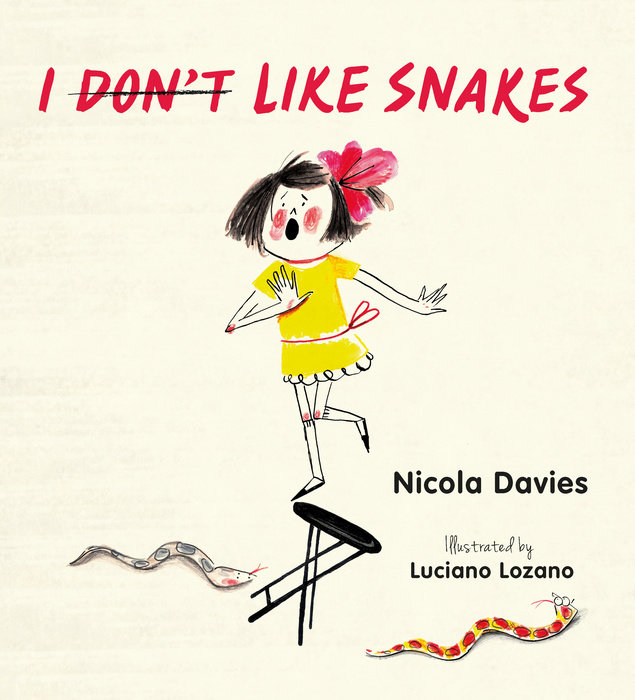
I Don’t Like Snakes

Written by Nicola Davies | Illustrated by Luciano Lozano


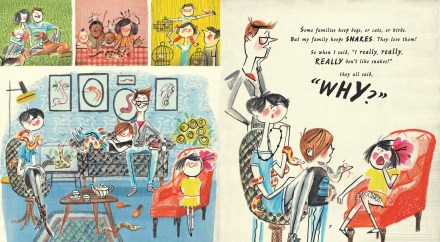
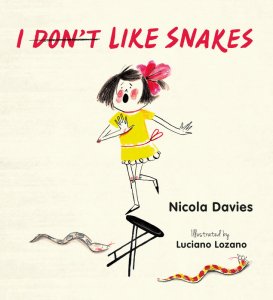
Can you imagine a family who has nothing but snakes for pets? Well, that’s the way it is for the little girl in I Don’t Like Snakes. Sitting in her red chair surrounded by her mother, father, brother and four snakes, she finally pipes up and tells her family that she “‘really, really, REALLY doesn’t like snakes!’” And they ask, “‘Why?’”

“‘Because they slither,’” she answers. Her mom has a ready answer that leads into a scientific discussion of why and how different kinds of snakes move. The mechanics of concertina and serpentine slithering as well as caterpillar crawling are clearly described in both easy-to-understand text and accompanying illustrations. Her father adds more transportation methods, including side-winding, twining, climbing, swimming, and even flying.

celebrate-picture-books-picture-book-review-i-don't-like-snakes-interior-art-why

Image copyright Luciano Lozano, courtesy of walker.co.uk

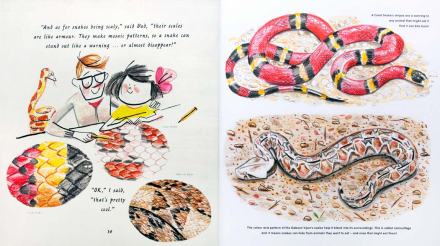
The little girl has to admit these sound pretty smart. “‘But what about their slimy, scaly skin?’” She asks. After all it’s so icky! Well, her mom reveals, snakes aren’t actually slimy, but dry. Following this readers learn why snakes look wet and how they shed their skin. Her dad goes on to explain that a snake’s scales are used for protection and as camouflage or as a warning to other creatures. Ok, the little girl agrees, “‘That’s pretty cool.’”

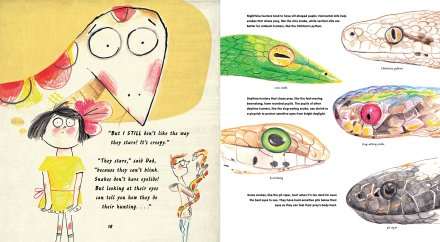
Still, the girl doesn’t like their flicking tongues. Her mom reassures her that snakes only use their tongues to smell with. Readers then see how a snake picks up the scent of a mouse or other prey and how it is transferred to the Jacobsen’s organ that helps it detect even faint odor trails. “‘That IS interesting,’” the girl tells her mom. “‘But I STILL don’t like the way they stare! It’s creepy.’”

celebrate-picture-books-picture-book-review-i-don't-like-snakes-interior-art-eyes

Image copyright Luciano Lozano, courtesy of walker.co.uk

Dad has the answer to that one. They stare because they have no other choice. Without eyelids, it’s impossible for them to blink. But if you look closely at a snake’s eyes, you can tell if they are a night or day hunter or whether they are chasers or ambushers.

All this information is starting to change the little girl’s mind about snakes. “‘Maybe now that I know something about them, I do like snakes—just a little bit!’” she tells her brother. And just like brothers everywhere, he ups the ante by revealing how snakes kill. He revels in explaining about how some snakes have hollow fangs that inject poison into their victims and how others strangle their prey until there’s no life left. And without proper teeth, snakes have to swallow their dinner whole!

The boy’s sister is braver than he thinks, and now she wants to get in the game. She says that she has discovered something about snakes herself. She knows how snakes have babies. Some give birth to live babies but most lay leathery eggs. Either way, the babies are on their own soon after hatching. The little girl has had a complete change of heart. She now thinks snakes are beautiful. “‘And do you know what?’” she says. “‘I really, really, REEEEEALLLLY LIKE THEM!’”

celebrate-picture-books-picture-book-review-i-don't-like-snakes-interior-art-skin

Image copyright Luciano Lozano, courtesy of walker.co.uk

Whether you like snakes, don’t like snakes, or are somewhere in between, Nicola Davies’ engaging tribute to this interesting and often misunderstood species will delight. Cleverly written to include commonly held opinions and provide compelling facts, I Don’t Like Snakes is part story, part nature encyclopedia seamlessly woven together to create a fascinating and funny read. Kids and adults will respond to the conversational tone, and, like the little girl in the story, be open to a change in attitude toward this intriguing reptile.

Luciano Luzano bridges the world of the fictional story and the nonfiction facts in I Don’t Like Snakes with charming sketches of the family and realistic depictions of the snakes they discuss. The little girl with her oversized hair bow and astonished expressions is a disarming guide to discovery. The family’s reptilian obsession is everywhere, from the snakes that twine around the mother, father, and brother’s arms and shoulders to the snakeskin upholstery. The factual information about snakes is accompanied by accurate drawings and representations of the traits portrayed.

I Don’t Like Snakes is a wonderful book for those who already love snakes as well as for those who want to learn more! It’s a great addition to anyone’s nonfiction collection.

Ages 5 – 10

Candlewick Press, 2015| ISBN 978-0763678319

Learn more about Nicola Davies and her books on her website!

To view more art and books by Luciano Luzano visit his website!

World Snake Day Activity

celebrate-picture-books-picture-book-review-snake-word-search

Slithering Snake Word Search


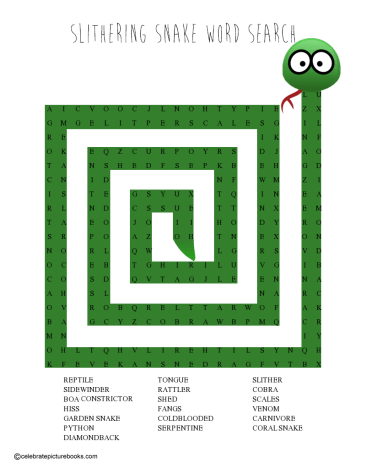
Snakes wind their way along wherever they want to go. Follow the twists and turns in this printable Slithering Snake Word Search to find the reptile-inspired words! 

celebrate-picture-books-picture-book-review-i-don't-like-snakes-cover

You can find I Don’t Like Snakes at these booksellers

Amazon | Barnes & Noble | Books-a-Million | IndieBound

Picture Book Review

June 30 – Meteor Watch Day

celebrate-picture-books-picture-book-review-oh-no-astro-cover

About the Holiday

When space debris, such as pieces of rock as small as a pebble or as large as an apple, fall through Earth’s atmosphere they glow with the heat of friction and streak through the night sky creating a beautiful spectacle. These shooting stars can occur individually or in meteor showers. The early Greeks believed that meteors were stars that escaped the heavens when the gods peeked through to see what the humans were up to. People felt that the gods may be more disposed to grant them wishes during these times, and so the tradition of wishing on a star began. According to the American Meteor Society the average hourly rates for meteors during this week should be nine meteors per hour in the mid-northern latitudes (45N) and about 12 per hour in the tropical southern locations (25S). Dark, cloudless skies are optimal for viewing. Tonight gather friends and/or family and have a stargazing party!

Oh No, Astro!

Written by Matt Roeser | Illustrated by Brad Woodard


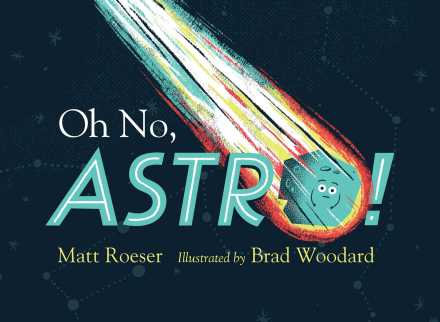
Astro was not a typical asteroid. Instead of zooming around crashing into obstacles, he believed in “personal outer space” and had for millions of years. When Astro spies an approaching satellite he greets him cordially and lays down the rules: “please keep your distance” and “stay in your orbit.” But the satellite ignores him and comes closer and closer until…

celebrate-picture-books-picture-book-review-oh-no-astro-interior-art-satellite

Image copyright Brad Woodard, courtesy of Simon & Schuster


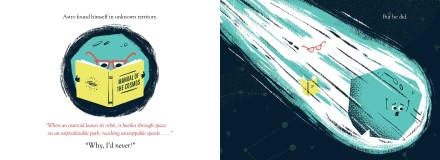
“‘Good gravity! You’ve struck me!” Astro exclaims. He’s just about to “point out to the satellite that it had done considerable damage to one of his favorite craters” when he discovers that he is spinning out of his orbit and out of control. How humiliating! The usually unflappable space rock suddenly finds himself hurtling past Mars at the same time that young astronomer, Nova, is “enjoying a quiet night of stargazing” through her telescope. She catches sight of Astro as he zips past an astronaut, rushes past the Moon, and finds himself on an inevitable crash course with Earth.

As he enters Earth’s atmosphere he begins to break apart, shedding bits of the past, as the universe watches. He lands on Earth with a SMASH! Reeling from the impact Astro slowly opens one eye and then the other; he’s smaller but in one piece. Nova is waiting to welcome him to his new home. “‘My stars,’” he mutters. “‘Dare I say that was…FUN?!’”

And as Astro gazes at the night sky from a fresh perspective with Nova by his side, he asks, “‘What on Earth shall we do next?!’”

celebrate-picture-books-picture-book-review-oh-no-astro-hurtling

Image copyright Brad Woodard, courtesy of Simon & Schuster


For anyone stuck in the rut of their own orbit, Matt Roeser’s story of the unwitting space traveler is a humorous invitation to explore the universe around them. Roeser’s language—from calling asteroids “rambunctious” and the satellite a “celestial wanderer” to exclamations of “good gravity!” and “Pluto’s revenge!”—is an inspired treat. Kids and adults will laugh at Astro’s attempts to handle his undesirable predicament with dignity. Complacent Astro with his dry-as-space-dust wit and sparkling puns makes a stellar guide on this journey to more self-discovery and life enjoyment.

In the hands of Brad Woodard deep space is a very cute and cool place! Rendered in flat tones of black, aqua, yellow, red, and white, Woodard’s illustrations give Oh No, Astro! a retro feel for a space-savvy audience. The oblivious satellite floats through Astro’s orbit with wide eyes and a sweet grin, while angular Astro with his stick arms, expressive face, and boldly displayed “No loitering” banner would be a welcome alien intruder in any back yard. And Nova in her ponytails and Saturn-patterned dress is the perfect companion to greet him! The night sky abounds with constellations, but Astro is the real star!

In the final pages, Astro leads readers in a “A Selection of Space Facts” from the  very Manual of the Cosmos, 2nd edition that he used to sort things out. A short list of suggested reading is also included.

Kids would love to find Oh No, Astro! on their bookshelf for story times of cosmic fun!

Ages 4 – 8

Simon & Schuster Books for Young Readers, 2016 | ISBN 978-1481439763

Visit Matt Roeser’s Website to discover his gallery of book jacket designs!

You can learn more about design and illustration work by Brad Woodard at Brave the Woods!

Meteor Watch Day Activity

celebrate-picture-books-picture-book-review-spaceship-coloring-page


Shooting Star and Spaceship Coloring Pages


With these coloring pages you can make a universe that’s all your own!

June 16 – Dump the Pump Day

celebrate-picture-books-picture-book-review-good-trick-walking-stick-cover

About the Holiday

There’s no better time than early summer to consider “dumping the pump” and traveling by foot, bicycle, scooter, skates, skateboard…there are so many options! Leaving the car at home saves on gas costs, is better for the environment, and leads to a great exercise workout. Today, grab your walking or tennis shoes and with a friend or alone, take an example from the subject of today’s book and enjoy the pleasure of traversing the outside world!

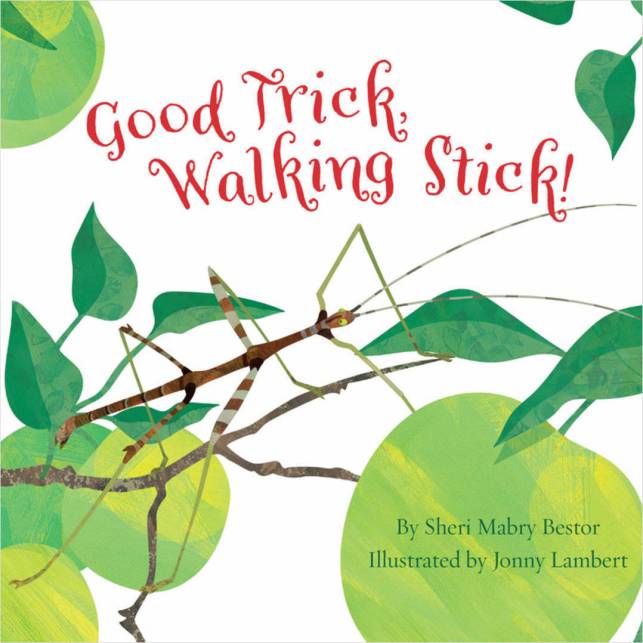
Good Trick, Walking Stick!

Written by Sheri Mabry Bestor | Illustrated by Jonny Lambert


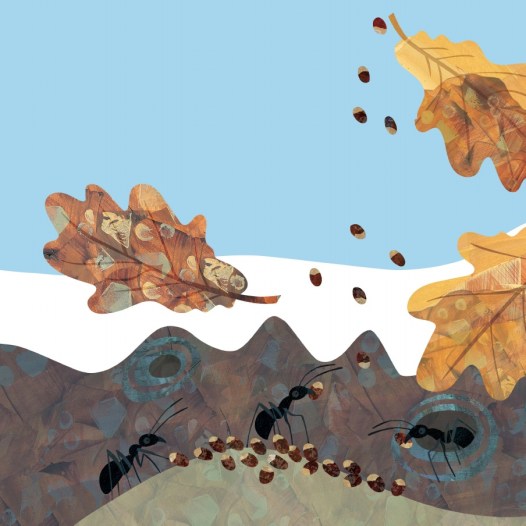
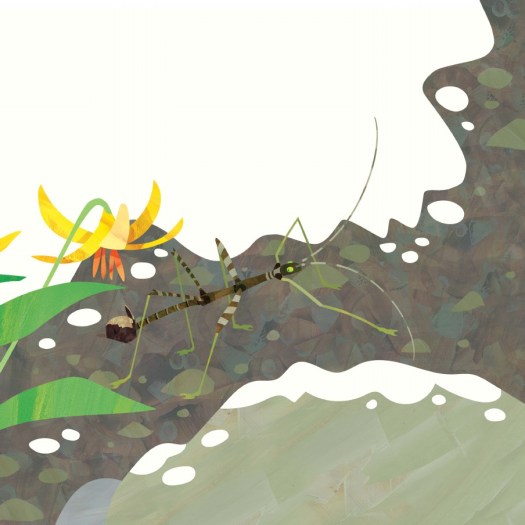
The walking stick is one insect that knows a thing or two about tricks. Even before it’s born wile plays a part in its survival. A mother walking stick drops her eggs where they will be buried by autumn leaves—and found by ants that think they are delicious seeds to eat. Why would a mother purposefully do this?! She knows that the ants will take the eggs to their colony, where they will eat only the tops leaving the baby walking sticks undisturbed. The ants will then drag the remains of the “seeds” to their garbage dump area, where they will spend a warm winter safe from predators until spring.

celebrate-picture-books-picture-book-review-good-trick-walking-stick-interior-art-eggs

In the spring a baby hatches. It look like a tiny twig—a twig that can walk! The baby searches for food and munch, munch, munches the leaves it finds. As it becomes bigger it molts, shedding its old skin and growing a new one. The walking stick looks just like the branches that it lives on. It is perfectly camouflaged! “Good trick, walking stick!”

But a bird with keen eyesight swoops down and in an instant grabs the walking stick in its beak. Quickly, the walking stick squirts out a bad-smelling juice. The bird spits it out, but has gained a snack while the walking stick has lost a leg! It’s okay, though; the walking stick will just grow a new one! “Good trick, walking stick!”

The walking stick finds a tree with others of her kind hidden in its branches. The leaves make delicious meals. During the day the walking stick can change color to blend in with the sunlit bark of the tree and stay cooler. At night the walking stick becomes darker to hide in the shadows and stay warm. “Good trick, walking stick!”

When a squirrel brushes past, looking for a meal, the walking stick “pulls in her legs and drops to the forest floor, just like a stick falling off a larger branch. The stick insect is safe.” All day the insect lies on the ground, not moving, pretending to be just another cutting. At nightfall the walking stick climbs back into the tree. The squirrels and birds are resting now, so the stick insects “Munch munch. Crunch. Munch.”

celebrate-picture-books-picture-book-review-good-trick-walking-stick-interior-art-camouflage

With the onset of fall stick insects begin looking for mates. The females “spritz their perfume into the cooling air.” Males find them. Even if a walking stick does not have a mate, she can still produce eggs which will all develop into females. The eggs settle into the fallen leaves, ready to begin their unique life. “Good trick, walking stick!”

Stick insects are some of the most unusual creatures in the world. Measuring from an inch or two to 21 inches (53 centimeters), they can be found in forests, parks, even your own backyard! Sheri Mabry Bestor’s story of a year in a walking stick’s life is filled with action, suspense, and the clever ploys stick insects use to survive. Bestor’s enthusiastic, conversational tone and evocative language will engage kids over a wide range of ages. Each page also contains fascinating scientific sidebars that expand on the events in the story.

Jonny Lambert’s collage-style illustrations are a perfect match for the text. The mottled hues and textures of nature are beautifully represented in the vibrantly colored two-page spreads. The scientific details of the stick insect’s life are clearly and organically depicted, making it easy for kids to understand and enjoy the concepts: on one page ants carry away eggs with missing tops while on the next baby walking sticks emerge from the same images. Illustrations of the stick insect’s camouflage are particularly effective, and the cyclical quality of the story and the insect’s life are well portrayed.

For teachers and for kids who love the natural world and are curious about its unique creatures, Good Trick, Walking Stick is a wonderful addition to their school or personal library.

Ages 5 – 9

Sleeping Bear Press, 2016 | ISBN 978-1585369430

Dump the Pump Day Activity

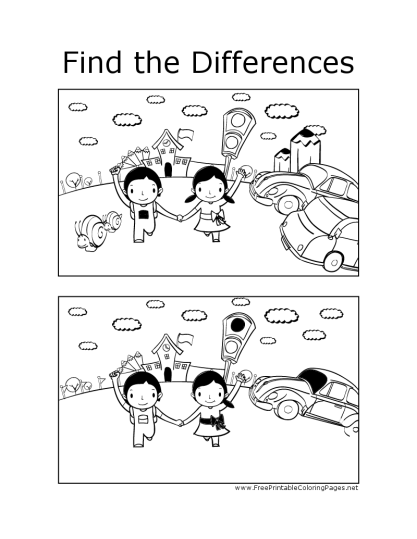
celebrate-picture-books-picture-book-review-walking-find-the-differences-puzzle

Take a Stroll Puzzle


You can see so many amazing things when you take a walk! But can you spot the 15 differences between the two pictures in this printable Take a Stroll puzzle?

June 12 – National Rivers Month

celebrate-picture-books-picture-book-review-otters-love-to-play

About the Holiday

Rivers are beautiful, provide recreation, and are crucial to our water supply. Did you know that in the United States 65% of our drinking water comes from rivers and streams? This month environmentalists and others promote awareness of the importance of keeping the nation’s rivers pollution free to protect the fish and animals that call them home and increase enjoyment for all. To help the cause, join a volunteer river clean-up crew, help monitor water quality, or learn more about your local river system. Whether you like to fish, swim, boat, or just laze on the bank, June is the perfect month to get out on a river! You might even see some otters—the subject of today’s book!

Otters Love to Play

Written by Jonathan London | Illustrated by Meilo So


It’s spring and two otters have moved into an abandoned beaver lodge to start a family. In a soft nest of moss, leaves, and grass the mother otter gives birth to three pups. The pups first open their eyes to the world when they are five weeks old. At two months old they’re ready to come out of the den to play. Playtime is fun, but for the baby otters it’s also work. Running, twisting, wrestling, and matches of tug-of-war teach valuable hunting skills and solidify family bonds.

As spring turns to summer, the pups’ thick waterproof coats grow in, and it’s time for swimming lessons to begin. There are no floaties here! The mother otter simply grabs her charges by the scruff of the neck and drops them into the river. Their mother shows them how to dive and glide and come to the surface as they follow her single file. “Within days, the otter pups gracefully spin and flip and swish like underwater acrobats.” Again and again “they scramble up a mud slide and SLIIIIIIIIIIIDE back down to the water—Ka-Spash!”

celebrate-picture-books-picture-book-review-otters-love-to-play-in-autumn

By the end of the summer the pups know how to catch small fish and how to nudge out frogs, crayfish, turtles, and snakes from their hiding places among the rocks. Autumn brings more opportunities for fun as the nearly full-grown pups tumble in the fallen leaves. Even winter’s blasts don’t deter the otters. With their thick fur they roll in the snow and catch fish in the icy river water.

But an ominous shadow appears on the fresh snow as the pups belly-slide down a snowbank. Something is waiting and watching…. So too is mother otter. Screaming and hunching she “slides across the snow and with a terrible GRRRROWL…scares the fox away!” Throughout the winter the otters snuggle in their den, and when the rainy spring makes muddy river banks, the otters come out and speed down the slippery slide “because otters love to play!”

You can’t help but love otters. Watching them dive, swim, and frolic just puts a smile on your face. And what’s more these sleek river creatures are fascinating animals! Jonathon London has written a story that captures the spirit and exuberance of one otter family while incorporating intriguing facts about their dens, birth statistics, purposeful play, hunting techniques, protective fur, predators, and defenses—did you know that otters can slide on snow at speeds up to 18 miles (29 kilometers) per hour?! London’s lyrical journey through the first year of an otter’s life makes captivating reading for young children just navigating the world themselves.

Meilo So’s enchanting otter family will delight readers. Images of the pups somersaulting, sliding, splashing, and swimming charmingly depict the sleek, supple movements of these frisky animals. Their smooth coats, rendered in soft browns with white and black accented texture, and their mischievous, ever-present smiles are realistically portrayed, inviting kids to reach out and pet them. So’s river scenes are beautiful—the pale blue water reflects deep gold and green trees, pink and yellow wildflowers and delicate green grasses flutter along the river bank, and the depths of the underwater world swirl with muted sage greens and blues as the otter pups frolic among gray- and olive-hued fish. Autumn comes with fiery orange and purple leaves, and winter falls shivery white as the russet fox is chased away.

Otters Love to Play would be a lovely gift for any child and a welcome addition to any classroom or school library.

Ages 4 – 8

Candlewick Press, 2016 | ISBN 978-0763669133

Visit Jonathan London’s website for more books by this prolific author.

View more books and art by Meilo So.

National Rivers Month Activity

celebrate-picture-books-picture-book-review-otter-coloring-page

Otter Coloring Page


You “otter” love this coloring page, with its cute river creature who has just caught dinner! You can color it with pencils, crayons, or markers or consider making a collage with bits of paper, cloth, or leaves and sticks. Give the otter a den to snuggle in and a river for frolicking! Here’s your Otter Coloring Page!

April 22 – Earth Day

picture-book-review-green-city-allan-drummond

About the Holiday

In 1970 the first Earth Day was celebrated to bring awareness to environmental issues and begin a dialogue about how governments, corporations, communities, and individuals could create change that would benefit the Earth and all her inhabitants. Forty-six years later, we are working toward solutions to problems like pollution, climate change, renewable energy, and more. Today look around your home, office, school, or community and see how you can better support our Mother Earth.

Green City: How One Community Survived a Tornado and Rebuilt for a Sustainable Future

By Allan Drummond


On May 4, 2007 a devastating tornado hits Greensburg, Kansas, destroying the town in 9 minutes. When the residents of the town climb from their shelters, they emerge into a world completely changed. There are no more homes, no school, no hospital, no grocery store or other shops. No banks, theater, churches, or water tower. Even the trees have been shredded. Only three buildings remain.

The citizens are urged to move away. Rebuilding will be impossible, some say, and what’s the point anyway when the wind could destroy it all again? But others see opportunity to construct a different kind of town. With the help of volunteers and donations from around the world, Greensburg begins the Herculean task of designing and building a new town.

After clearing away 388,000 tons of debris and moving into a community of trailer homes, the people begin to envision a unique, green town. Individuals design sustainable houses of different shapes and materials to work with the environment. Businesses, too, incorporate sustainability into their offices, retail centers, and hotels as do the hospital and the water tower. A wind farm large enough to provide energy for the entire town is built on the edge of this innovative city.

A new school is central to the town’s survival, and for three years the teachers hold class in small trailers. Along with their regular studies, the kids become experts in environmental science. After several years Greenburg is now thriving—a testament to conservation and sustainability that is an example for global communities now and in the future.

Allan Drummond tells this fascinating story of a community that would not give up in an honest and sensitive way that highlights the courage and pride of a town amid devastating loss. Told from a child’s point of view, the story has extra impact for readers who are growing up amid an era of environmental awareness and activism. The sustainable construction of homes and other buildings is effectively explained and clearly depicted in Drummond’s colorful illustrations.

The images also demonstrate the process of negotiation and cooperation among townspeople that went into designing and building a new Greensburg. The final two-page spread of the town’s layout will interest kids as well as adults who have followed this story in the news.

Ages 5 – 9

Farrar, Straus and Giroux, 2016 | ISBN 978-0374379995

Earth Day Activity

celebrate-picture-book-review-caterpillar-planter-craft

Hatch a Caterpillar Planter


As spring days grow warmer, it’s fun to start growing your own garden. Propagating plants from seed on a windowsill or sun room gives you an up-close view as the seeds develop roots, sprout, and flourish!

Supplies

  • Egg carton made from recycled paper
  • Seeds for your favorite veggies or flowers
  • Potting soil
  • Spoon or small shovel
  • Craft paint or markers in the colors you’d like for your caterpillar
  • Pipe cleaners or wire
  • Googly eyes
  • Marker

Directions

  1. Carefully cut the egg carton into two rows lengthwise, you may need to trim the cardboard between cups
  2. If the cups have low openings on one side, place the second row of cups inside the first facing the opposite way.
  3. Paint or color the carton, let dry
  4. Push pipe cleaners or wire through the edge of the egg carton on one end to form antennae (I used wrapped wire and painted it)
  5. Attach googly eyes and draw a smile on the front of the carton
  6. Fill cups with soil
  7. Plant seeds according to package directions
  8. Place caterpillar planter in a sunny spot

Picture Book Review