May 23 – World Turtle Day

celebrate-picture-books-picture-book-review-turtle-and-me

About the Holiday

American Tortoise Rescue founded World Turtle Day in 2000 to raise awareness and respect for turtles and tortoises and to promote conservation to help them survive. Celebrations take many forms, from fun activities where participants dress as turtles to educational programs that teach about this fascinating creature and how people can help turtles in danger.

Turtle and Me

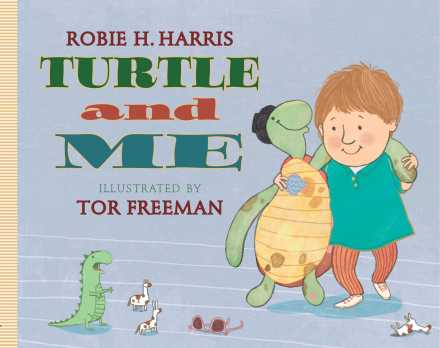
Written by Robie H. Harris | Illustrated by Tor Freeman


The little boy narrator of this story tells readers he met Turtle on the day he was born. Turtle was “way bigger” than he was. Now, the little boy is bigger than Turtle, but they are still best friends. When the boy was a baby he smiled and laughed every time he played with Turtle. As he grew he needed Turtle around to comfort him.

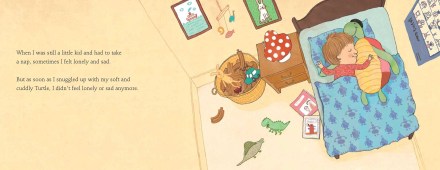
At naptime Turtle made him feel less sad and lonely and allowed him to sleep. Even now, when the boy is older, he still likes to play with Turtle even though his colors have faded, he’s ripped and raggedy, and some bad things have happened to him.
celebrate-picture-books-picture-book-review-turtle-and-me-sleeping

Image copyright Tor Freeman, 2015, text copyright Robie H. Harris, 2015. Courtesy of simonandschuster.com.

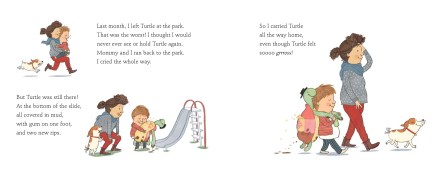
When bad things happened to Turtle the little boy felt terrible; sometimes he even cried and knew Turtle was sad too. But the boy always made sure that Turtle “gets sewn up, washed up, fixed up—and is okay again.” Once Turtle was left at the park. The little boy and his mom raced back and found Turtle covered in mud, sticky with gum, and with two new rips.  Even though Turtle felt gross the boy held him tight all the way home. At home Turtle received a very thorough wash and dry and an extra big hug. The little boy promised Turtle he would never let anything happen to him again.

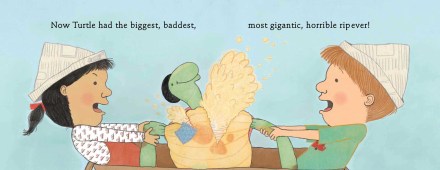
But then last Friday “the worst thing of all happened.” The boy and his friend were sailing around the world in a cardboard box. Turtle was the Captain. But the boy’s friend wanted to be Captain and steer the ship. She grabbed Turtle away, and the boy grabbed Turtle back. In the ensuing tug-of-war, Turtle suffered “the biggest, baddest, most gigantic, horrible rip ever!”
celebrate-picture-books-picture-book-review-turtle-and-me-playground

Image copyright Tor Freeman, 2015, text copyright Robie H. Harris, 2015. Courtesy of simonandschuster.com.

The boy shouted at his friend: “You ripped my Turtle!” Before leaving, the boy’s friend yelled back: “Having Turtle’s a BABY thing!” The little boy hugged Turtle tight and then looked at him. Turtle had lost almost all his stuffing. The boy quickly pushed the fluff back in and taped Turtle’s tummy back up.

But the boy had a change of heart. Suddenly Turtle looked ugly, and the little boy left him on the floor alone. At bedtime, when Daddy brought Turtle to his son, he said he didn’t want Turtle anymore, but sleep without Turtle was elusive. Finally, the boy shouted, “I can’t sleep!” and his dad asked, “Do you want Turtle?” “‘NO’”, the boy said. “‘Having Turtle’s a baby thing! And I’m BIG! And I’m getting bigger! So I don’t need Turtle ever again!’”

His dad thought about this and agreed. His son was getting bigger, but he’s not all big. Daddy picked up Turtle and played with him, making the little boy laugh. Then the boy copied his dad, making his dad laugh. The little boy realized that holding Turtle still felt good. He hugged him close and in no time was fast asleep.
celebrate-picture-books-picture-book-review-turtle-and-me-torn

Image copyright Tor Freeman, 2015, text copyright Robie H. Harris, 2015. Courtesy of simonandschuster.com.

Robie Harris’s sweet story of a little boy and his best friend Turtle reminds kids that no matter how big they get, it’s okay to find comfort in a favorite toy. The story has a deeper meaning for kids as well: things happen; sometimes bad things. But with love mistakes can be cleaned up, scrapes will heal, and scary situations will turn out all right. And when you need them, those who love you are there to help and help make you feel better.

The mishaps Turtle experiences are instantly recognizable and related in a gentile, honest way that will draw kids in. Near the end of the book, kids will root for the little boy and Turtle to patch things up and be best friends again.

Everyone wants a best friend as cool as Turtle! Tor Freeman’s vivid illustrations of the little boy and his plucky stuffed companion are adorable and full of emotion. The close family bonds are well depicted, and the images of the boy hugging Turtle will melt your heart. The looks of anguish on the little boy’s face as Turtle suffers stains and rips elicit sympathy and understanding and are followed up by comforting smiles when Turtle is fixed up.

Turtle and Me would be a terrific addition to home and classroom bookshelves for sweet story times and  when reassurance and a little extra love and comfort are needed.

Ages 3 – 8

little bee books, 2015 | ISBN 978-1499800463

World Turtle Day Activity
celebrate-picture-books-picture-book-turtle-shell-game

Follow the Turtles! Game


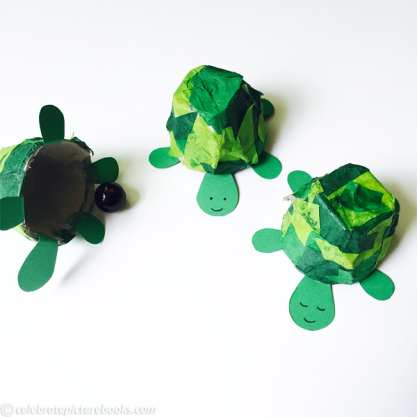
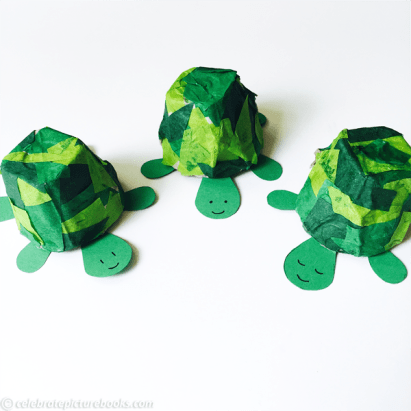
You can make this fun game from recycled materials and a little creativity! When you’re finished making the turtle shells, have fun guessing where the marble, bead or bean is hiding!

Supplies

  • Cardboard egg carton
  • Green tissue paper in different hues
  • Green construction or craft paper
  • A marble, bead, or bean
  • Glue
  • Scissors

celebrate-picture-books-picture-book-turtle-game

Directions

  1. Cut the egg carton apart into individual cups. You will need 3 cups for each game made.
  2. Cut the rims of the cups so they sit flat on a table.
  3. If the cups have open sides, fit two cups inside one another to fill the gaps
  4. Cut the tissue paper into small shapes
  5. Brush glue on a cup (I used a paper towel to apply glue)
  6. Cover the egg cup with pieces of tissue paper. Repeat with other cups.
  7. Let dry
  8. Cut a head and feet from the green craft paper
  9. Tape or glue the edges of head and feet to the inside of the cups
  10. Add a face to the head

To play the game:

  1. Line up the cups on a table
  2. Put a bead, bean, or marble under one of the cups
  3. Show the other player which cup the object is under
  4. Quickly move the cups around each other several times
  5. Ask the other player which cup they think the object is under
  6. Take turns playing

Extra Game: Make three more and play turtle tic-tac-toe! 

May 22 – National Maritime Day

celebrate-picture-books-picture-book-review-toy-boat

About the Holiday

National Maritime Day commemorates the day in 1819 that the steamship Savannah sailed from the United States to England. This event marked the first successful crossing of the Atlantic Ocean by steam propulsion. The US Congress proclaimed May 22 National Maritime Day in 1933. The day gives us an opportunity to honor the ships and seafarers who have served our country in peacetime and during war and to remember the benefits the maritime industry.

Toy Boat

Written by Randall de Sève | Illustrated by Loren Long


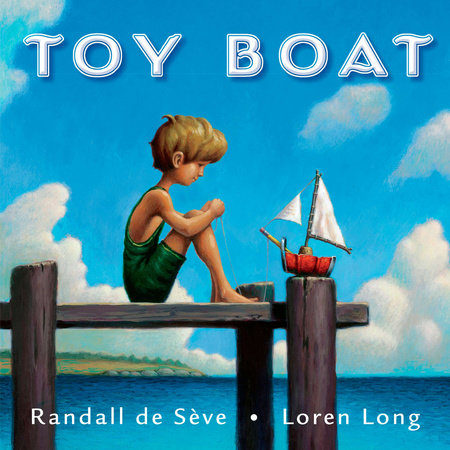
A little boy makes a toy boat from a can, a cork, a pencil and some white cloth. He loves his boat and carries it with him everywhere. Every day the boy takes his boat to the lake and sails it all afternoon. The boy always keeps his toy boat on a string so he won’t lose it. The boat feels secure, but sometimes it gazes out at the big sailboats gliding across the lake and wonders “what it would feel like to sail free.”

One afternoon a squall blows up on the lake, and the boy’s mother pulls him quickly from the edge of the thrashing water. Startled, the boy drops the string and his toy boat floats away. The boat is buffeted by the wind and rain and is carried into deep water where it rides the crests of the wind-whipped waves. As the storm subsides a tug chugs along, pushing the little boat further aside.

The tiny craft rights itself just in time to avoid being sunk by a ferry that blows its horn, warning, “Move Along!” But the tug and the ferry aren’t the only dangers on the water. A fierce speedboat roars past, its engine screaming, “Move Along!”, and its draft sending the little boat reeling. The toy boat feels small and scared as it drifts into the middle of a fleet of sailboats racing to port. For a moment the toy boat and a large sloop “cut through the choppy waves side by side. And the little toy boat felt big. Then the white boat tilted high on its side, spraying the little toy boat with water, warning, “Move along!”

Half drowned and its sail soaked, the little toy boat misses the boy. It bobs all night on the open water, “alone and scared.” As the sun rises an old fishing boat, dented and with peeling paint, put-puts by. It spies the little boat and, knowing how it feels to be pushed around, begins to circle the tiny craft. In the fishing boat’s wake, the toy boat turns and catches the wind in its sail. Soon it is sailing alongside the fishing boat.

“The little toy boat felt strong! ‘I am moving along,’ it shouted to the wind.” The little boat feels so good that it doesn’t realize it is now sailing alone or that it is nearing the shore, where the little boy is watching out for it. When the boy shouts, “Boat! Boat!” the now brave craft waves its sail excitedly and sees the boy wave back.

That night the little boat sails bathtub seas and sleeps on a soft mattress. The next day the boy takes the boat back to the lake, and while he still holds the boat by a string, every so often he lets go, and the little toy boat always comes back. “It knew just where it wanted to be.”

Randall de Sève’s tale of independence sought and found by both the little boat and the boy will resonate with both children and adults. The safety of the “string” set against the perceived freedom of older or bigger others is a universal and on-going rite of passage for every child and their parents and is treated by de Sève with gentleness and understanding. The various dangers and even personalities children meet with are introduced here allowing kids to see that while they may be buffeted by change or adversity, they will not sink.

Loren Long lends his well-known artwork to this story in beautiful two-page spreads that depict the security of first the small bathtub and then the calm lake as well as the storm-tossed waves that take the toy boat into unknown territory. The smallness of the toy boat compared with the size of the tug, ferry, speedboat, and racing sloops well reflects the experiences of children in the wider world. When the friendly face of the fishing trawler comes on the scene, kids will identify with the toy boat and realize help and support are out there and that they are always welcomed home with love.

Ages 3 and up

Philomel Books, Penguin Young Readers, 2014 (board book edition) | ISBN 978-0399167973

National Maritime Day Activity

celebrate-picture-books-picture-book-review-maritime-flag-puzzle


Show Your Colors! Word Puzzle


While ships can’t talk to each other, they can communicate using a system of flags. These colorful flags carrying different designs are recognized internationally as representing letters and symbols. Individual flags have specific meanings related to safety, emergency, or warning issues or they can be combined to form a code that only certain ships can understand.

Use the provided maritime flags code to decipher a special message! Print the Show Your Colors! word puzzle and get decoding! Here’s the Solution!

May 21 – It’s Get Caught Reading Month

celebrate-picture-books-picture-book-review-whoops

About the Holiday

Created by former Congresswoman Pat Schroeder, now president of the Association of American Publishers, Get Caught Reading Month promotes good reading habits and encourages people of all ages to take part in the fun of reading. Reading to young children is especially important as research indicates that early language experience stimulates a child’s brain to grow and gives kids a huge advantage when they start school. Whether you like fiction, non-fiction, poetry, graphic novels, or comics, there is an amazing book just waiting on a shelf for you!

Whoops!

Written by Suzi Moore | Illustrated by Russell Ayto


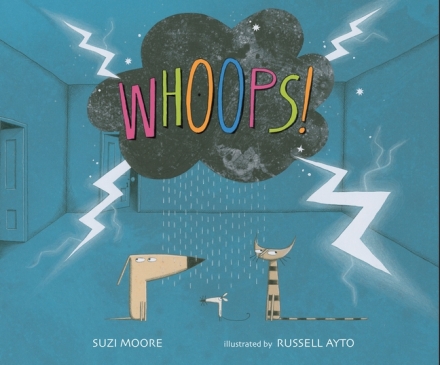
This is the cat that can’t meow. And here’s the dog that can’t bowwow. And the little mouse when she tries to squeak? She opens her mouth but she just can’t squeak.

But the owl says to the three “‘Find the old lady in the tumbledown house. She’ll have a spell to make you all well.” So they go in search of the tumbledown house and find it in the middle of the woods. When they go inside, the little old lady doesn’t seem surprised to see them. In fact she’s heard of their problem and consults her spell book. She casts a spell “and the whole house shook, the wind blew in and the rain came down. Then the tumbledown house turned around and around.”

Now the cat says, “Cluck!” And the dog says, “Quack!” And the mouse says, “Cock-a-doodle-doo!” And the little old lady? She says, “Whoops!” Maybe the right spell is on page three. She casts a new spell and there’s a flash and a crash and the tumbledown house turns around and around. This time the cat says, “Baa!” and the dog says, “Neigh!” and the mouse says, “Moo!” And the little old lady? She says, “Whoops!”

The spell on page seven brings the three closer: the cat says, “Woof!” and the dog says, “Squeak!” and the mouse says, “Meow!” And the little old lady? She says, “Whoops!” That special spell to make them all well must be on page ten. The old lady waves her wand and the storm rages and the tumbledown house turns around and around. Finally, the cat says, “Meow!” and the dog says, “Woof!” and the mouse says, “Squeak!”” And the little old lady? She says, “CROAK!”

Whoops!

Suzi Moore’s laugh-out-loud, shout-out-loud tale of mistaken identity will have kids reading along during the first go-round. The catchy, repeated rhymes, cadence of the words and sentences, errant spells, and building storm create infectious silliness at its best. Kids will eagerly await what comes next for the dog and the cat and the mouse who have trouble speaking.

Russell Ayto accompanies this fun story with a crazy assortment of creatures drawn with maximum comic effect. The thin, angled shapes of the cat, dog, and mouse make for heroes kids will root for, and the little old lady with a cloud of blue hair sitting in the taaall-backed chair will make kids giggle. Who is she knitting three-legged stockings for? And what magic does her knitting-needle wand and maniacal grin possess in that narrow tumbledown house in the middle of the woods?

Ages 3 – 7

Templar Books, Candlewick Press, 2016 | ISBN 978-0763681807

Get Caught Reading Month Activity

celebrate-picture-books-picture-book-review-wand

Reading is Magic! Wand


When you read you are transported into another world—it’s like being under a magic spell! Make your own magic wand and conjure up spells to take you wherever you want to go!

Supplies

  • Wooden dowel
  • Wooden ball with a hole to match the size of the dowel
  • Paint in your favorite colors
  • Ribbon, jewels, or other material to decorate your wand
  • Glue gun or strong glue
  • Paintbrush

celebrate-picture-books-picture-book-review-wand

Directions

  1. Paint the dowel however you would like—one color, with dots or stripes, or multicolored
  2. Paint the wooden ball—you can even give it a mystical look with glow-in-the-dark paint or glitter
  3. Glue the wooden ball to the dowel with the hot glue gun or strong glue
  4. Decorate your wand with jewels, ribbon, or other material

May 18 – International Museum Day

celebrate-picture-books-picture-book-review-homer-henry-hudson

About the Holiday

International Museum day was created in 1977 by the International Council of Museums to raise awareness that “museums are an important means of cultural exchange, enrichment of cultures and development of mutual understanding, cooperation and peace among peoples.” The theme for this year is Museums and Cultural Landscapes. Both nature and history comprise the cultural landscape that links museums to their surrounding neighborhood, towns, and beyond. As museums become more involved in their communities, they acquire the responsibility to protect, conserve, and interpret the cultural heritage inside and outside their walls. International Museum Day is growing—in 2015 more than 35,000 museums in 145 countries participated. Today visit one of your favorite museums and learn more about your cultural landscape.

Homer Henry Hudson’s Curio Museum

By Zack Rock


Everything has a story, the narrator tells readers, especially the Homer Henry Hudson Curio Museum, which he says has been described as “a colossal collection of curios, discovered, described, and displayed by that eccentric explorer extraordinaire: Homer Henry Hudson.”

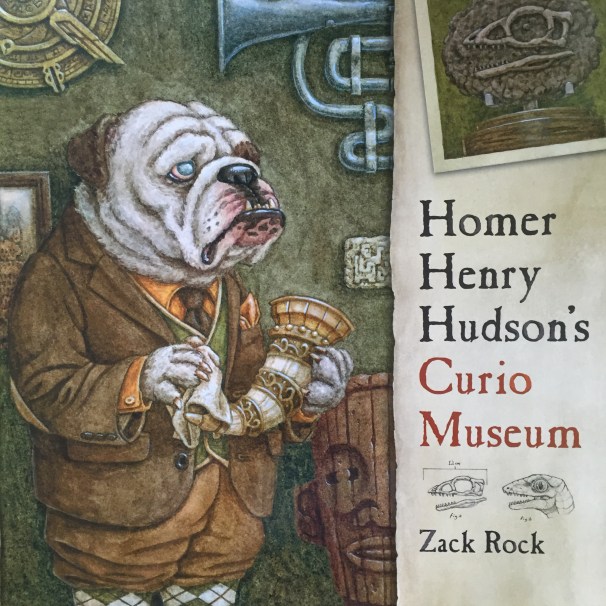
Come in and experience the wonders inside. A dignified bulldog dressed in a dapper tweed suit and leaning on a crooked cane will greet you. His job is to keep the place clean and dusted. Although the museum is stuffed floor to ceiling, he knows the placement of every object, knick-knack, and curiosity. As you explore the museum’s holdings—its portraits, musical instruments, ancient artifacts, taxidermy animals, and other treasures, the caretaker sits silently, hoping you will read the display cards that Homer Henry Hudson has lovingly written out with a description and personal note. He even has his favorite “bits and bobs” that he would like you to see.

One of these is Item #0001, the Conausaurus Skull of a small dinosaur from the late Jurassic Period that HHH found in the soil of his family’s farm. This bony discovery made Homer Henry wonder what else the world held and sparked his love of exploration. Another is Item #0023, a Radial Tide Diviner once used by Calypsonian seers to predict the future based on tidal patterns. It was the discovery of the lost Calypsonian civilization with its valuable artifacts that funded Homer’s further explorations.

Item #3412, a Temple Montepaz Choir Finch with a C sharp trill that chanted to accompany the parrot priest, was a most unusual gift, bestowed on HHH for convincing the Parrot Priest to release a piece of wood stripped from the temple wall. This shard turned out to lead Homer Henry Hudson into his future—for better or worse. With renewed fire, HHH charged toward the promise of riches only to fly his plane into a mammoth stone figurehead, which resulted in injury and his life-long limp.

Item #3415, The Manneken Mort of King Ingmar, is perhaps Homer Henry’s most treasured possession. Composed of fabric bands that represent the stories friends and family tell when someone dies, this Manneken Mort contains hundreds of bands relating the life of King Ingmar. This object HHH acquired for bravery and self-sacrifice when he was younger and still full of enthusiasm for life.

The old bulldog thinks of this curio most. He wonders what his Manneken will look like and whether all the bands of his life been woven. He likes to think his Menneken Mort “would be  hundreds—thousands—of feet tall. It’d tower over the Taj Mahal, shame the Sphinx!” But he knows “few memorable tales are told of rusty old codgers who spent their days…leaning upon fear like a crutch.”

Though blind in one eye and nagged by trepidation, the old bulldog packs his suitcase, dons his hat and throws away his cane. As he walks out the door, past pictures of himself on his early expeditions of discover, he knows he might “meet with catastrophe,” be “swallowed by quicksand,” or “gnawed on by piranhas.” But he also knows “there’s no success without failures,” and he has had many successes.

Homer Henry Hudson boards the cruise liner Phoenix and sets out for adventure once more. After all, he well knows that everything has a story. So if you come by the Homer Henry Hudson Museum today, you will see a sign hanging on the door: The Curio Museum is CLOSED Until Further Notice.

Zack Rock has written a compelling and unique picture book for adventurers of all types and ages. Part motivation and part cautionary tale, this story of the once intrepid explorer turned tremulous caretaker has a mysterious, treasure-around-every-corner quality that will appeal to kids. The life of Homer Henry Hudson is told through the display cards that accompany some of the museum’s curios. As the story develops through the cards’ personal notes, readers learn of the museum’s true owner and the life-altering decision he makes.

Rock’s illustrations in greens and parchment-paper golds and browns have a high “Oh, Cool!” factor, as the odd, ancient, and unusual objects of the museum invite kids to explore every nook and cranny of the pages. The exhibits serve not only to fill the museum, however, they remind us how easily the future can get overshadowed and crowded out by the past.

Ages 6 – 10

Creative Editions, 2014 | ISBN 978-1568462608

International Museum Day Activity

celebrate-picture-books-picture-book-review-cookies

Peanut Butter-M&M Cookies


A good cookie is like a museum—full of interesting flavors, colors, and taste. Here’s a cookie recipe adapted from Cookies & Cups that exhibits all these traits! 

Ingredients

  • 2 cups all purpose flour
  • 1/2 tsp baking soda
  • 1/2 cup butter
  • 1/4 cup peanut butter
  • 1 cup light brown sugar, packed
  • 1/4 cup granulated sugar
  • 1 whole egg
  • 1 egg yolk
  • 1 Tbsp vanilla
  • 1/2 tsp cinnamon
  • 1/4 tsp ground ginger
  • 3/4 cups m&ms
  • 1/4 cup chocolate chips (for extra chocolate)

Instructions

  1. Preheat oven to 325 degrees
  2. Combine butter and peanut butter in microwave safe bowl and melt together for 30 seconds. Remove and stir. Continue in 15-second increments until mixture is melted and smooth.
  3. In a separate large bowl whisk together flour and baking soda. Set aside.
  4. Combine eggs, egg yolks, vanilla, and sugar. Mix on medium until combined and smooth. Turn mixer to low and slowly pour in your butter/peanut butter mixture. Continue stirring until combined.
  5. With mixer still on low, gradually add your flour mixture until just combined. Batter will be thick.
  6. Now add in your candies and stir until they are evenly distributed.
  7. Now form your batter into “golf ball” sized dough balls. You can also use a 3-Tablespoon scooper.
  8. Place on baking sheet about 2 inches apart
  9. Bake for 10 to 12 minutes
  10. Cookies will be puffy, but should be golden around the edges
  11. Let cool on baking sheet for 2 -3 minutes and then transfer to a wire rack to continue cooling.

Cookies & Cups has lots of creative and delicious goodies for special occasions or for just those times when you want to be good to yourself!

Picture Book Review

May 16 -National Biographer’s Day

celebrate-picture-books-picture-book-review-the-noisy-paint-box

About the Holiday

On this day in 1763 James Boswell walked into a London bookshop and met Samuel Johnson—poet, critic, journalist, and writer of the first dictionary. They became friends, and 30 years later Boswell wrote a spirited biography of his companion that fully described Johnson’s feelings, quirks, opinions, and details of his life in a warm, conversational, unstinting way. The Life of Samuel Johnson changed forever the way biographies were written and is still popularly read today. Why not spend some time today with that fascinating biography or one on a favorite personality—or start writing the story of your own life!

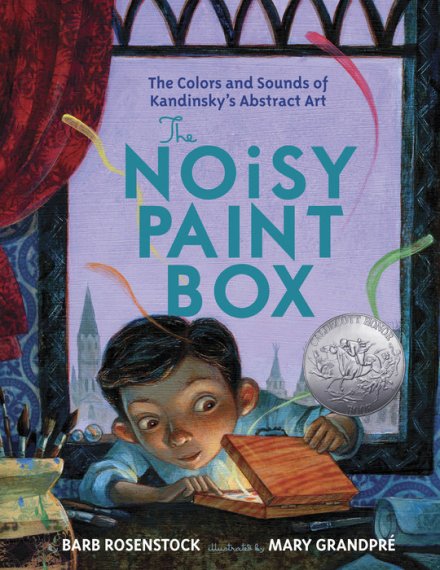
The Noisy Paint Box: The Colors and Sounds of Kandinsky’s Abstract Art

Written by Barb Rosenstock | Illustrated by Mary Grandpré


As a Russian child Vasya Kandinsky spends his days absorbed in learning math, science, and history. He takes piano lessons and attends formal dinners where the adults drone on and on. His life is polite, stiff, and colorless until the day his aunt gives him a small wooden paint box. “Every proper Russian boy should appreciate art,” Vasya’s aunt tells him while explaining how to mix colors.

Vasya takes up the brush and combines red with yellow then red with blue. As the colors change to orange and purple, Vasya hears a whisper that grows into a noisy hiss. “‘What is that sound?’” he asks, but no one else hears anything. “The swirling colors trilled like an orchestra tuning up for a magical symphony,” and “Vasya painted the sound of the colors.” A lemon yellow “clinked like the highest notes on the keyboard; a navy blue “vibrated deeply like the lowest cello strings.” Crimsons “blared” and greens “burbled.”

Vasya runs downstairs to show his family what he has created. His mother, father, and Auntie look at the canvas with its swoops, shapes, and angles. “What is it supposed to be?” they ask, and send him off to art school to learn how “to draw houses and flowers—just like everyone else.” Vasya finishes school and becomes a lawyer. He leaves his paint box untouched and lives the way he is expected, but the sounds of the colors are always with him.

One evening as he listens to an opera, the music surrounds him with color—“stomping lines of vermilion and coral; caroling triangles in pistachio and garnet; thundering arches of aqua and ebony…” Vasya can hear the colors and see the music. He knows then what he must do. He quits his job teaching law and moves to Germany to be a painter. He surrounds himself with artists and takes classes with famous teachers, and yet people still look at his canvases and asked, “What is it supposed to be?”

Once again he paints what is expected. His teachers love his houses and flowers, but Vasya does not. His friends understand. They too want to expand the meaning of art. They agree with Vasya when he says, “‘Art should make you feel.’” In his studio Vasya continues to paint the sounds he hears, to give music color and color sound. Bravely, he invites the public to view his paintings, which are named after musical terms—Composition, Accompaniment, Fugue, and more.

This is a new kind of art—abstract art—and it takes a long time before people understand. They look and still ask, “What is it supposed to be?” “It is my art,” Kandinsky replies “How does it make you feel?” 

An author’s note telling more about Kandinsky’s life and synesthesia, a genetic condition in which one sense triggers another, follows the story.

In the spirit of full disclosure, Kandinsky is one of my favorite artists, so I was excited to read this biography—I was not disappointed! With so many great artists, their work speaks for itself, but viewers wonder, “How did it come about?” “What influenced the artist?” Barb Rosenstock, with lyrical language and beautifully chosen descriptions, reveals the emotions and passion that fueled Kandinsky’s art from his earliest ages: as he walks through Moscow he can’t ignore “the canary-colored mailbox whistling as he rode to work. The scarlet sunset haze ringing above the ancient Kremlin walls.” Rosenstock’s inclusion of the conflicts and opposition Kandinsky faced and overcame will inspire children to listen to their inner voice and makes readers and lovers of his abstract art glad he never gave up.

Mary Grandpré’s unique style brilliantly depicts Kandinsky’s singular vision, allowing readers to experience the way he wielded his paint brush like a conductor’s baton. Vasya’s early life is painted in muted blues and grays, and the boredom on his face as he studies his schoolwork is obvious. Kids will appreciate his one-finger plinking at the piano and the rolled-eyed drowsiness of the formal dinner. Once Vasya is introduced to the paint box, however, Grandpré’s illustrations become vibrant, with swirling colors overlaid with the musical notes that Kandinsky associated with them. His uninhibited painting is gloriously shown as the young boy’s shirt comes untucked and the colors burst from the canvas upon his first painting.

As the adults look at his work, the room is again swathed in somber colors. The text revealing that Vasya attended regular art classes to learn to draw houses and flowers is set above a single wilting flower in a vase. The personal tug-of-war Kandinsky experienced even into adulthood is wonderfully rendered: Colors flow into his ears at the opera; he studies his own landscape and still life paintings with misgiving in a hazy studio, and the joy and freedom of his abstract art is demonstrated with wild abandon while a dove escapes its cage. The final image of a child sitting in front of a Kandinsky painting reinforces the idea that his art lives for all and for all time.

Ages 4 – 9

Alfred Knopf, Random House Children’s Books, 2014 | ISBN 978-0307978486

National Biographer’s Day Activity

celebrate-picture-books-picture-book-review-recipe-box-label

Recipe Box Label and Recipe Cards


People’s stories are written in all different ways: in the objects they surround themselves with, their activities, and the talents they exhibit. Today’s activity will help you tell your stories in the foods you bake! Or try this Recipe Card Writing Idea: Create a very short story and write it on one of the recipe cards! Read it to your family or teacher.

Supplies

celebrate-picture-books-picture-book-review-recipe-cards

Directions

  1. Glue the My Family’s Recipes label to the box you made
  2. Print out the recipe cards. Use them for your favorite dish and prepare for tomorrow’s treat to bake!

Picture Book Review

May 15 – International Day of Families

celebrate-picture-books-picture-book-review-families-families-families

About the Holiday

This United Nations sponsored observance was initiated in 1993 to reflect the importance of families worldwide. The day provides an opportunity to promote issues affecting families, including social, economic, educational and demographic topics. This year’s theme is Families, Healthy Lives and Sustainable Futures and focuses on ending poverty, promoting shared economic prosperity, social development, and health while protecting the environment. The holiday is marked with workshops, educational opportunities, publications, and special community events.

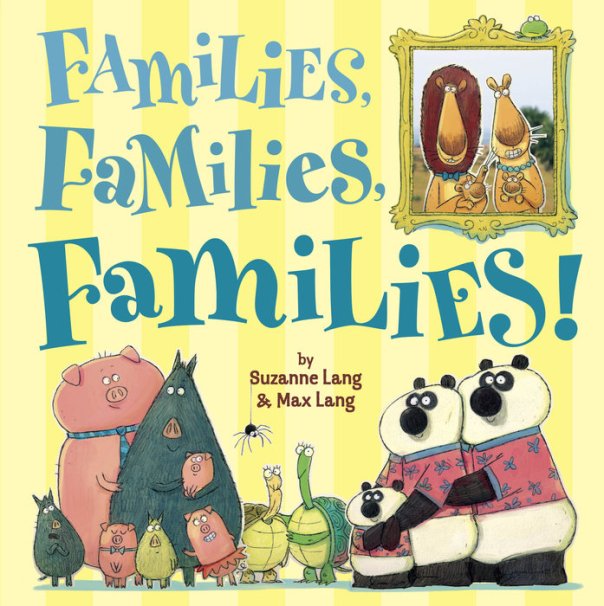
Families, Families, Families

Written by Suzanne Lang | Illustrated by Max Lang


Families—haven’t they always come in all shapes and sizes? With all different customs and traditions? Families, Families, Families delves into this most enduring—and endearing—structure of life in a way that makes sense to kids in a funny and honest way. “Some children have lots of siblings. Some children have none” the book starts. “Some children have two dads. Some have one mom. Some children live with their grandparents…and some live with an aunt.”

Lang does an excellent job of presenting all types of familial arrangements within the pages of the book. Nearly every child will happily find themselves here. Interspersed among the varieties of households, humorous comparisons and rhymes (“some children have many pets…and some just have a plant!”) elevate this book to a tribute to understanding, acceptance, and inclusion. After all…“if you love each other, then you are a family.”

Max Lang hit on an inspired way—during this era of selfies, snapchat, and the like—to illustrate the concepts of family. More than 17 animal families pose for portraits in which comic drawings of smiling moms, dads, kids, and relatives are superimposed onto photographed backgrounds. The portraits are framed with another touch of humor: A chicken family photo sits in a frame made of hay, an octopus and her four children smile from a frame made of seashells, and the Tigers are displayed in a frame of bones. The photos hang on wallpapered, barn, and underwater cave walls; sit on fireplace mantels; are pinned to bulletin boards; and fill scrapbook pages.

Families, Families, Families brilliantly demonstrates how every child takes pride in his or her family—just as the readers take pride in theirs.

Ages 3 – 7

Random House Books for Young Readers, 2015 | ISBN 978-0553499384

International Day of Families Activity

celebrate-picture-books-picture-book-review-recipe-box

Make Your Own Recipe Box


One of the best ways to spend time together is to bake up a favorite recipe and enjoy the results! World Baking Day is celebrated this week, so for the next few days, I’ll be offering baking-related activities for you to have fun with! With a small box you can make your own recipe organizer to keep tasty recipes close at hand!

Supplies

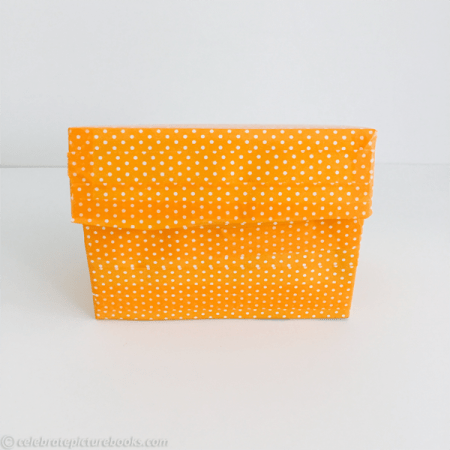
  • A small box with a hinged lid or separate lid, at least 5 inches by 3 1/3 inches (fits a small index card). A Twinings Tea Box works well as does a small wooden box available from craft stores
  • Washi tape or paint
  • Paint brush

Directions

  1. Cover your box with washi tape or paint your box
  2. Decorate your box with your unique style

Picture Book Reviews

May 14 – International Astronomy Day

celebrate-picture-books-picture-book-review-star-stuff

About the Holiday

Instituted by Doug Berger in 1973, International Astronomy Day is held twice a year—in spring and fall—to raise awareness of the benefits and wonder of studying the stars. Museums, observatories, universities and astronomy clubs around the world provide public access to astronomical instruments and hold special programs about this interesting and ancient science. To celebrate, attend an International Astronomy Day event, take time tonight to gaze at the sky and pick out the constellations you recognize, or read about the stars and their importance to history and the future.

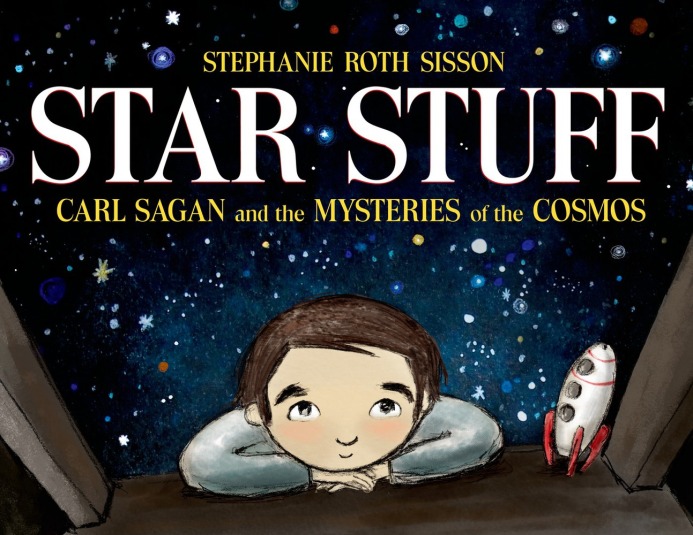
Star Stuff: Carl Sagan and the Mysteries of the Cosmos

By Stephanie Roth Sisson


A boy named Carl Sagan may have lived in a small apartment in Brooklyn, New York, but he was part of so much more—a large city on the third planet from the sun in a “neighborhood of stars” which are part of the Milky Way galaxy. Growing up, Carl marveled at the connections. He had an innate curiosity and was astonished by everything he saw; his imagination was out of this world!

When he attended the 1939 World’s Fair as a young child, he experienced things he had never seen before; he saw a robot, new inventions, and a time capsule filled with messages for the future. At night he looked up at the stars and wondered; he thought they looked like lightbulbs on long black wires. He went to the library to read about the stars.At first the librarian thought he meant movie stars, but soon he got the book he wanted. Reading it made his heart beat fast.

Carl imagined what kinds of creatures and sights he might discover if he were able to travel through space. He tried standing with his arms outstretched and wishing he was on Mars like his favorite science fiction character, John Carter, but nothing happened. He decided he would have to make his “life in space” a reality himself so he went to college and became an astronomer, cosmologist, astrophysicist, astrobiologist, and so much more.

Dr. Carl Sagan then worked with other scientists to develop the exploratory crafts Mariner 2, Mariner 9, and Pioneer 10 that have gone into space to investigate Mars, Venus, and Jupiter. When they sent back pictures, Carl analyzed them and learned more about our solar system

Carl wanted everyone to know and understand Space. He created a television program that explained in easy terms what the stars, planets, and other celestial bodies are made of, how they came to be, and how we are connected to them. The Earth and every living thing are made of star stuff, Carl told his audience. The show – Cosmos: A Personal Voyage – was a hit, watched by millions of people.

Scientists have long wanted to know if life exists on other planets, and as time went on they had the technology to explore the possibilities. Carl worked with other engineers to create Voyager 1 and Voyager 2 to tour the outer solar system and beyond. Remembering that time capsule he saw so long ago at the World’s Fair, Carl had a marvelous idea! He recorded messages and sounds from Earth and made a Golden Record that was carried on each Voyager mission.

Carl Sagan, that boy made of star stuff who grew up to be so many things—astrophysicist, explorer, educator, philosopher, writer, and more—changed the world through the power of his imagination.

Stephanie Roth Sisson’s biography of Carl Sagan wonderfully honors the dreamer and scientist whose imagination went into Space and brought it down to Earth for others to understand and enjoy. The story begins in Sagan’s neighborhood and home, where illustrations depict the curiosity that fueled his passion. Just as the mysteries of Space quickly captured his attention, the pages fill with the night sky and its twinkling lights and celestial bodies. A most ingenious page takes advantage of a two-page vertical spread that transforms Carl’s bedroom window into a space capsule that blasts him into the cosmos as he ponders the stuff of stars.

His work as an adult collaborating with scientists and engineers to develop deep space exploration craft is clearly drawn with pages containing multiple panels of his job and accomplishments up close and from the distance of outer space. A particularly arresting three-page fold-out spread reveals the moment Carl discovered his love of the stars and Earth’s sun (holding a flashlight behind the depiction of the fiery sun would be a show-stopper, especially during a night-time read).

Kids familiar with today’s space travel and the awe-inspiring images sent back to Earth will love this book. To quote Carl Sagan, Star Stuff will definitely elicit a “Wowie!” from readers.

Ages 4 – 8

Roaring Brook Press, 2014 | ISBN 978-1596439603

International Astronomy Day Activity

celebrate-picture-books-picture-book-glow-stars

Make a Room Observatory


If you like gazing at the stars before going to sleep, why not bring them inside? With adhesive glow-in-the-dark stars, available at craft and toy stores, you can create a night sky full of celestial bodies that stay lit long after you’ve said goodnight. You can add planets, rocket ships—even your favorite constellation! This can be a nice alternative to a night light or transition children from a full night light to a gentle, comforting glow in their room.

Picture Book Review