This month we celebrate the wondrously diverse life in the sea. A majority of the earth’s surface is covered in water and yet we know only a fraction of what the oceans have to show us. With new technology scientists are diving deeper and deeper, where some of the most unique creatures in the world are waiting to be discovered. To join in on this month’s holiday, visit a beach or aquarium, learn more about the animals and resources of the sea, and consider donating to the preservation of the world’s oceans.
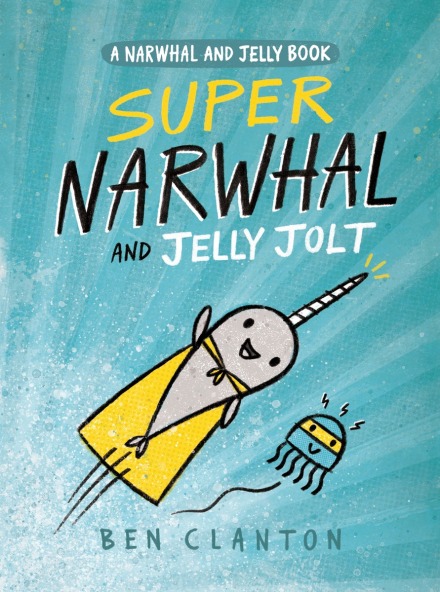
Super Narwhal and Jelly Jolt
By Ben Clanton
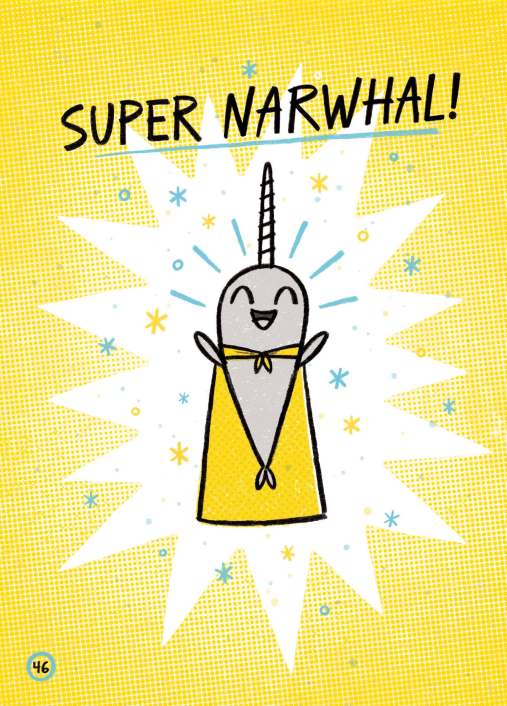
In A Super Start, Narwhal and Jelly are hanging out. Narwhal’s excited because after a swim and a waffle he’s “going to become a superhero!” Jelly is surprised that Narwhal thinks it would be so easy, after all there are the “super outfits” (Narwhal’s got that covered with a snazzy yellow cape); the “super names” (“Super Narwhal” sounds pretty super to Narwhal): and the secret identities (let me introduce you to the dapper mustachioed and bespectacled Clark Parker Wayne, wealthy and eccentric trillionaire).
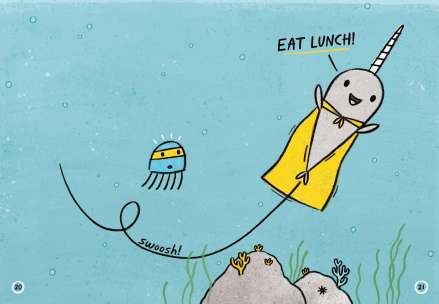
Super Narwhal is also going to need a sidekick. Jelly kicks around a few names—Shark, Octopus, and Turtle—but Narwhal has someone else in mind. Jelly, of course! Jelly’s eyes widen with the possibilities. Sting or Blue Lightening might be cool monikers, but no!— “Jelly Jolt the Super Sidekick” has an electrifying ring to it. Suddenly, Jelly remembers they’ll need superpowers. Narwhal has trouble being invisible or strong, flying or breathing fire, but there’s something even more important than powers—lunch! Yum, yum! Jelly says, “I think waffles are my super weakness.”
In Narwhal, You’re a Superstar, Super Narwhal has come to the rescue of Star. While Star likes the ocean she thinks that maybe she belongs in the sky. “Maybe I am a real star, but I fell to earth and hit my head or something and now I don’t remember!” she says. Narwhal’s up for helping out, but without super strength he can only toss Star back into the sea. Even with Octopus’s cannon, Narwhal is no more successful. They think about building a rocket ship, but neither is exactly a rocket scientist. Then Narwhal has a super idea. Star wishes on…herself…and “Poof!” Star is back where she belongs.
Super Narwhal vs Blue Jelly a.k.a. the Super Superpower finds Clark Parker Wayne, wealthy and eccentric trillionaire discovering a very blue (as in sad) Jelly. In a jiff Super Narwhal appears to save the day! He asks Jelly “What’s wrong? Did someone steal your mustache?” But Jelly’s too blue to join in the repartee. Then Super Narwhal wonders if Jelly’s upset because he set his hair on fire. Jelly seems a bit perturbed at that suggestion—they are underwater, after all. But maybe Super Narwhal is onto something.
Maybe, just maybe, Jelly’s down because a bubble called him “a blue-footed booby,” or because a pirate pig poked him, or because he “got stuck in a tuba!” With a “hee” and a “heehee!” and a “heeheehee!” Jelly is beginning to smile. And when Super Narwhal puts them all together, Jelly can’t help but jiggle with a laugh at how ridiculous the whole thing is. But Super Narwhal is there to help—right? So he somberly asks “what is wrong?” By now, though, Jelly can’t remember.
Jelly gives his Super Friend a super hug. But then he does recall the problem. It seems crab was dissing his superhero outfit and calling him “Jelly Dolt.” “This is a job for Jelly Jolt and Super Narwhal!”, exclaims Narwhal. Jelly’s intrigued, but thinks they ought to leave crab alone. Guided by advice from his “great, great, great, great grandpa Nautilus,” which went something like “Do unto otters,” however, Narwhal reveals that they are off to make crab a superhero.
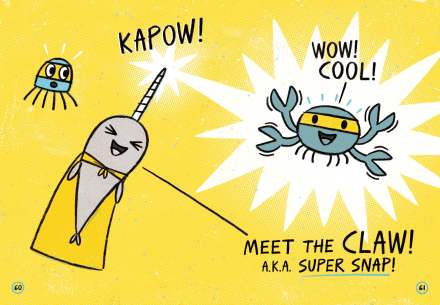
When they get their, though, Crab isn’t feeling it and lets off some steam, but Super Narwhal is undeterred. “Ahoy Crab! Prepare to be super-fied!” he announces. And with a KAPOW! Crab has become “The Claw! a.k.a. Super Snap!” At last, Super Narwhal has discovered his superpower—the ability to “bring out the super in others.” And with that, Super Narwhal, Jelly Jolt, and Super Snap swim off to Superfy the ocean.
Two more short and funny stories make an appearance between the continuing saga of Super Narwhal and Jelly Jolt. Super Sea Creatures is loaded with facts on several types of ocean creatures, and Super Waffle and Strawberry Sidekick is a delectable comic written by Narwhal and Jelly that’s full danger, heroics, and puns.
Ben Clanton’s adorable Super Narwhal and Jelly Jolt, the second in the Narwhal and Jelly series, is a sweet, laugh-inducing romp that is a marvelous take-off on the superhero genre and a perfect way to spend free time with two worthy ocean friends. Clanton fills his comics-style story with plenty of suspense, witty repartee, good advice, and even a bit of science to satisfy any young reader. Narwhal and Jelly, with their eager, inviting smiles, enthusiasm to tackle whatever obstacles get in their way and their ready inclusiveness, are truly superheroes to applauded
Super Narwhal and Jelly Jolt would make a sunny addition to summer reading and a splash on any child’s home bookshelf.
Ages 6 – 9
Tundra Books, 2017 | ISBN 978-1101918296
Discover more about Ben Clanton, his books, and his artwork on his website!
Established in 2013 by the South Florida Kayak Fishing Club, Mother Ocean Day honors the beauty and wonder of the oceans and the fascinating creatures that live in them. It’s estimated that nearly one quarter of the earth’s species live in the world’s five oceans. To join in the celebration take a break and visit a beach near you to swim, snorkel, surf, or go boating.
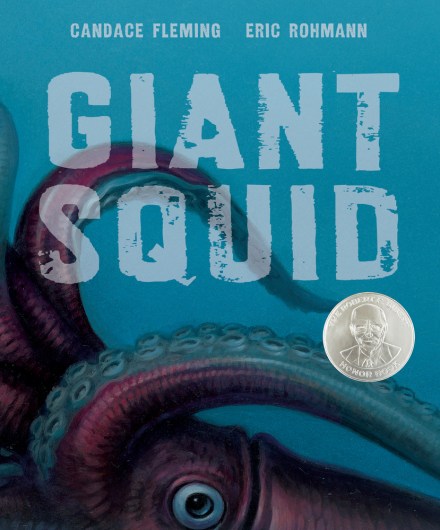
Giant Squid
Written by Candace Fleming | Illustrated by Eric Rohmann
“Down, down in the depths of the sunless sea, deep, deep in the cold, cold dark, creatures, strange and fearsome, lurk.” These mysteries of the ocean silently glide undetected, even though some are as “large as buses” and weigh a ton. They are known only from the quickest of glances or by parts washed up on shore. Many questions remain unanswered, but little by little scientists are learning more about the Giant Squid.
Image copyright Eric Rohmann, text copyright Candance Fleming. Courtesy of Roaring Brook Press
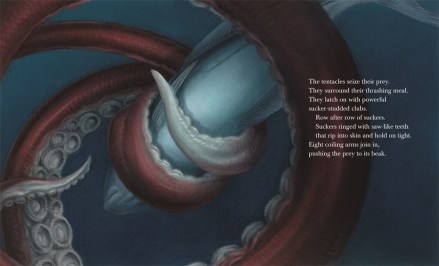
When a Giant Squid is hungry it reaches its two tentacles into the ocean waters “curling and twisting and thirty feet long, waiting for—a passing fish…another squid…anything swimming by.” When the Giant Squid grabs its prey, the tentacle’s “suckers ringed with saw-like teeth” immobilize it, and with the help of eight arms the meal is fed into the squid’s sharp beak.
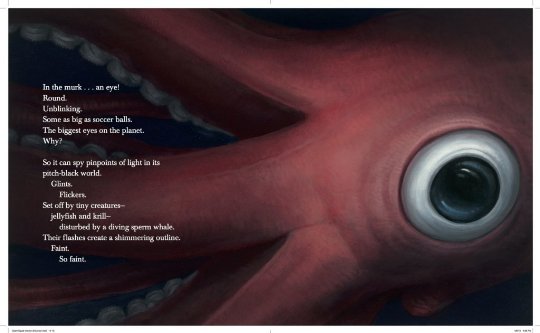
The parrot-like beak is just the beginning, for within the giant squid’s mouth lies a muscle “covered with sharp, tiny blades that slice…grind…file the food into a pasty sludge easy for giant squid to digest.” How does the giant squid see prey swimming by? It has the largest eyes on the planet—“some as big as soccer balls.” With these eyes the squid can see the tiniest flashes of light as sea creatures navigate the black depths. The squid’s gigantic eyes protect it, too, from whales or other predators on the hunt.
Image copyright Eric Rohmann, text copyright Candance Fleming. Courtesy of Roaring Brook Press
The giant squid is capable of changing colors, even patterns. Why? No one knows. Perhaps it enjoys changing its appearance “to impress a mate.” The birth cycle is also a mystery. Scientists have yet to discover where females lay their eggs or how long they take to hatch. But once they do, the baby squid are little—“just two inches long.” They have to scurry away from the barracuda wanting a snack, but in a flume of ink they vanish!
Before readers even turn to the first page, Candace Fleming sets a chilling, atmospheric tone that sinks them into the depths of the ocean on flat, black pages, where writhing arms and tentacles creep into view threatening the white, lyrical text. As the story opens and begins to describe the tentacles, beak, and other physical attributes of the giant squid, Eric Rohmann’s brilliant illustrations grow in size, giving readers close-up views of the brutal beauty of this eerie sea creature.
Image copyright Eric Rohmann, text copyright Candance Fleming. Courtesy of Roaring Brook Press
Working in perfect concert, Fleming and Rohmann take kids on a deep, deep ocean dive to witness firsthand what very few humans have ever seen. Fleming’s gripping rhythm will have children riveted to her thrilling vocabulary that describes the drama of the giant squid’s existence in unforgettable terms. Rohmann’s color palette consists of murky blues and blacks and raw pinks and reds. The squid’s tentacles loop and slither across the page divulging their serrated suckers; the enormous eye stares out questioningly at the reader; and the fearsome beak will make more than a few readers shrink back in awe. A double foldout spread reveals the immensity of the giant squid for a brief glimpse before it disappears back into its mysterious realm.
Following the text, readers can study an illustration of a giant squid that is clearly labeled with detailed descriptions of the various parts of its body, read more about the sea creature, and find resources for further investigations.
For kids fascinated by the ocean and its denizens, budding marine or environmental scientists, or those who love an exhilarating story, Giant Squid is nonfiction at its best. The book deserves prominent placement in public and school libraries and would be a terrific gift or addition to home bookshelves.
Ages 6 – 10
Roaring Brook Press, 2016 | ISBN 978-1596435995
Discover more about Candace Fleming and her books on her website!
Learn more about Eric Rohmann, his books, and his art on his website!
Mother Ocean Day Activity
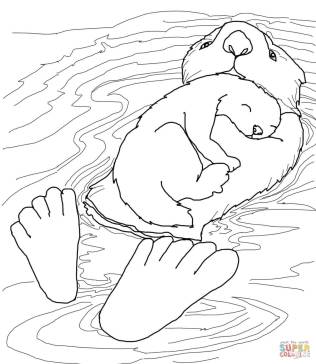
Beautiful Ocean Coloring Page
There are so many varied creatures in the earth’s oceans! Grab your pencils or crayons and make this printable Beautiful Ocean Coloring Page as vibrant as the sea!
Sponsored by UNESCO, World Book and Copyright Day encourages families and individuals to rediscover the joys of reading and promotes the availability of a wide range of books in all languages and for the disabled. It is also an opportunity to highlight the power of books to promote our vision of knowledge societies that are inclusive, pluralistic, equitable, open and participatory for all citizens. Each year publishers, booksellers, and libraries choose a World Book Capitol for a one-year period. This year Conakry, Guinea was selected in part “on account of the quality and diversity of its program, in particular its focus on community involvement.”
You can get involved too! Why not start today? With so many amazing books to discover, reading daily is a luxury worth indulging. For kids, there may be no cozier or more comforting routine than snuggling up next to mom or dad or cuddling under the covers and getting lost in a wonderful story before falling asleep.
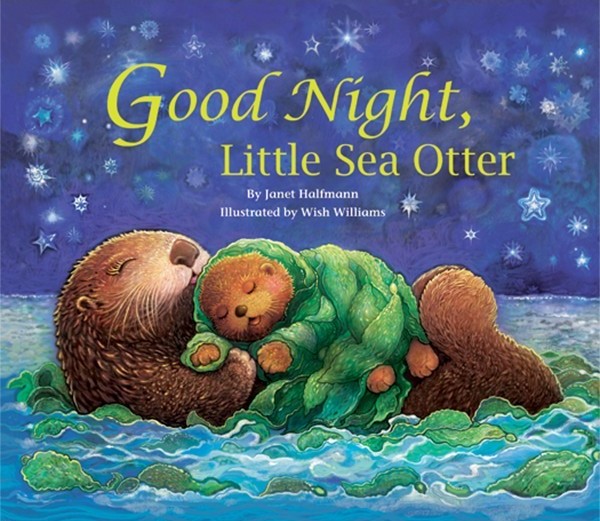
Good Night, Little Sea Otter
Written by Janet Halfmann | Illustrated by Wish Williams
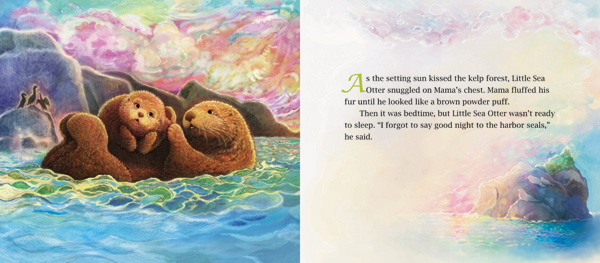
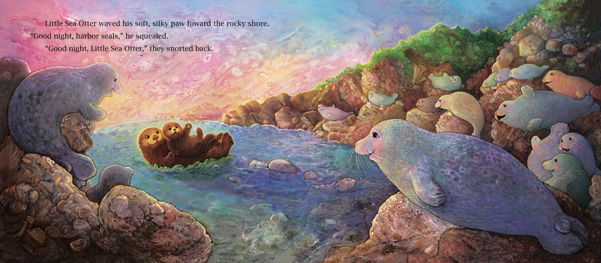
As twilight paints the sky pink, purple, and gold, Little Sea Otter gets ready to sleep in her kelp forest bed. Mama Otter fluffs her baby’s fur and snuggles with her, but Little Otter is still wide awake. “‘I forgot to say goodnight to the harbor seals,’” she tells Mama. The baby waves her “soft, silky paw toward the rocky shore” and says goodnight. The harbor seals all along the craggy cliffs wish the little otter goodnight in return.
Image copyright Wish Williams, text copyright Janet Halfmann. Courtesy of starbrightbooks.org
Hearing the seals’ goodnight song, the sea lions join in, their loud barks echoing in the air. “‘Good night, father sea lions. Good night, mother sea lions and baby sea lions,’” Little Otter calls. Curious about all the commotion, a seagull swoops down and learns that it’s bedtime for Little Otter. The two say “Good night” to each other, and as the seagull flies away to find his own place to sleep, Mama Otter tries to tuck in her little pup.
“But before she could say another word, Little Sea Otter dipped her furry face into the chilly water.” There she sees a whole ocean full of fish to greet. She says “Good night” to the yellow fish, the orange fish, and the purple fish. Of course she can’t forget the long fish or the short fish, the striped fish or the spotted fish either. All these fish are happy to wish the tiny pup sweet dreams too. Mama Otter points out other sea creatures getting ready for bed—different types of crabs, snails, sea stars, anemones, clams, and more. Little Otter says “Good night” to each in turn.
Image copyright Wish Williams, text copyright Janet Halfmann. Courtesy of starbrightbooks.org
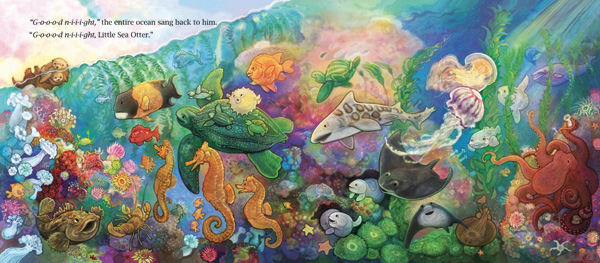
From every part of the ocean sea turtles, lobsters, octopuses, rays, jelly fish, sea horses, eels, and others bubble a chorus of “Good night” to Little Otter. She listens and responds to each one and then asks Mama if she has forgotten anyone. “‘Yes, you did,’” Mama says, “scooping her up in her paws. ‘You missed ME!’” Little Otter giggles and says “Good night.” Mama Otter hugs her tight and rolls over and over in the kelp, wrapping them both “in ribbons of seaweed” that will keep them secure on the ocean currents as they sleep.
Little Otter gazes up into the night sky and says “Good night” to the moon and the stars. As Little Otter’s eyes finally close and she drifts into sleep, Mama kisses her gently on the head and the sea whispers, “‘rock-a-bye.’”
Little Otter’s repeated phrase of “Good night” gives children plenty of opportunities to read along. Kids and adults who enjoy the beach and marine environments will also be delighted in the scientific facts about sea otters organically sprinkled into the text.
Image copyright Wish Williams, text copyright Janet Halfmann. Courtesy of starbrightbooks.org
Janet Halfmann’s gentle bedtime story is a sweet reminder for children of all the people in their life who love them and are thinking of them every day. As Little Sea Otter puts off sleep with just one more “Good night” and then another and another, Halfmann reveals with lyrical language the wide world of the sea and the creatures in it. Mama’s patient support of her pup’s curiosity and connections to her world provide tender moments between mother and child, as do their final bedtime rituals before drifting off to sleep. The readiness of the ocean creatures to respond with their own heartfelt wishes for the little pup suggest that this is a nightly and eagerly anticipated ending to each day by all.
Wish Williams’ beautiful, vivid illustrations are stunning and detailed, offering a magical realism that is perfect for this book’s wide-eyed audience. Little Otter and her sea creature friends are adorable, their smiling faces glowing with their happiness to see each other and finish the day together. While the fish and other sea creatures are colorful, the hues are true to their natural counterparts. The blue-green ocean swirls and foams along the rocky shore at twilight while whitecaps glitter in starlight when the sun goes down.
The lovely nature of the mother/child relationship, opportunities for child participation, and gorgeous art make Good Night, Little Sea Otter a welcome addition to home bookshelves for quiet story times and bedtime.
Ages 2 – 6
Star Bright Books, 2010 | ISBN 978-1595722546 (English Edition).
Star Bright Books offers Good Night, Little Sea Otter in bilingual editions in 8 other languages. To view them click here.
Learn more aboutJanet Halfmannand her other books on her website!
We love animals, but do we take care of them the way we should? Today’s holiday was established in 1931 to promote global awareness of animals and the issues surrounding their welfare. From pets to domesticated animals to wild creatures, humans must protect and advocate for their companions and fellow travelers on this earth. Issues such as pollution, habitat destruction, and poaching threaten the world’s wide variety of species, while closer to home spaying and neutering controls the population of feral animals that often suffer from a lack of resources.
The wildlife kingdom is majestic and awe-inspiring. Today celebrate the world’s animals by taking a trip to a zoo, aquarium, or animal preserve, consider adopting a shelter animal, or donating your time or talents to your favorite animal cause.
Pink is for Blob Fish: Discovering the World’s Perfectly Pink Animals
Written by Jess Keating | Illustrated by David DeGrand
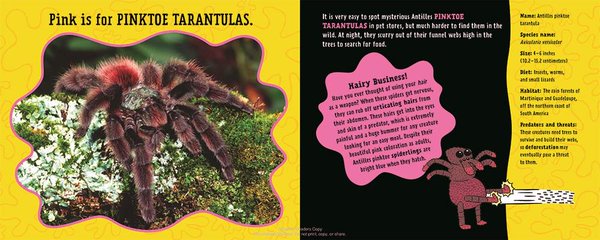
Pink is sweet like cotton candy, right? Pink is pretty like a rose, isn’t it? Pink is quiet like twightlight, don’t cha think? Well…yes, and…maybe not so much. You’d be pardoned for squirming in the presence of a pinktoe tarantula which is found in the rain forests of Matinique and Guadeloupe and can defeat predators with their spiky hairs, and if you can’t make heads or tails of the Pink Fairy Armadillo, which looks like a cross between a lobster tail and a shag rug, no one will blame you.
Text copyright Jess Keating, illustration copyright David DeGrand, courtesy of Penguin Random House
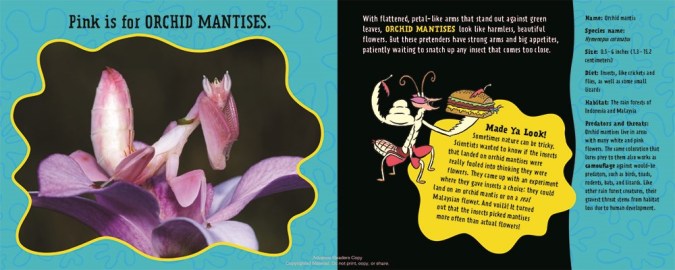
But the world is full of pink, and for each of these grimace-inducing bubble-gum-hued creatures there are plenty who simply take your breath away with their beauty. Imagine watching a duo-toned light-and-dark-pink Roseate Spoonbill take off and soar over marshland along America’s Gulf Coast or a river in South America or the West Indies like a valentine on the wind. You will likewise marvel when you see the delicate form of the Orchid Mantis. This variety of praying mantis found in the rain forests of Indonesia and Malaysia is so identical to real orchids that other insects can’t tell the difference and often land in the grasp of their tricky predator.
Text copyright Jess Keating, illustration copyright David DeGrand, courtesy of Penguin Random House
Seas and rivers also teem with pink wildlife. Pygmy Seahorses swimming in the waters of the South Pacific blend in to their coral surroundings like a spiky ball among hedgehogs. With white-and-pinkish bodies dotted with strawberry-colored knobs, these seahorses are perfectly camouflaged against predators. The rose-colored Amazon River Dolphin hunts for piranhas, crustaceans and bottom dwelling fish with its long snout in the freshwater rivers of South America. The rivers, lakes, and swamps of sub-Sahara Africa are home to Hippopotamuses, which “ooze thick pink oil all over their skin. This pink ‘sweat’ acts like an antibiotic sunscreen, so hippos can stay out in the sun all day without getting burned.” Imagine if you could do that!
Of course, there is also the Blobfish, recently voted as the world’s ugliest animal. But isn’t this little glob of gelatinous goo really so ugly it’s cute? Found in deep waters off the coasts of Australia and New Zealand, this fish survives where others cannot by simply opening its mouth and gobbling down whatever floats by.
With many more examples of pink wildlife in this captivating book, it’s guaranteed that after flipping through the pages of Pink is for Blobfish you will never look at pink the same way again!
Text copyright Jess Keating, illustration copyright David DeGrand, courtesy of Penguin Random House
Jess Keating highlights a host of fascinating pink animals in this volume that is sure to delight kids and get them excited about the world less seen. The first in the World of Weird Animals series, Pink is for Blobfish is loaded with scientific facts, remarkable trivia, and humorous asides to pique the interest of readers’ inner zoologist. Each two-page spread provides a spectacular up-close photograph of the animal, insect, or fish described as well as its common name, species name, size, diet, habitat, and predators or threats. Keating also taps into her audience’s love of the unique and even the bizarre with conversational paragraphs that reveal unusual habits, traits, survival mechanisms, and more for each creature featured.
David DeGrand lends his unique illustration style to the pages with funny cartoon portrayals of the creatures and one of their signature traits. These humorous depictions will not only make kids and adults laugh but will promote better understanding of each unique animal.
Pink is for Blobfish is a perfect addition to personal libraries for budding environmental scientists or anyone interested in the wider, wilder animal world and is an exciting title for school libraries and classrooms, where it could inspire scientific study.
Ages 5 – 10
Knopf Books for Young Readers, Penguin/Random House, 2016 | ISBN 978-0553512274
You’ll discover books, videos, creature features, resources, and lots more on Jess Keating’s website!
You will find the world of David DeGrand‘s art and comics on his website!
Pink is for book trailers—at least this one!
World Animal Day Activity
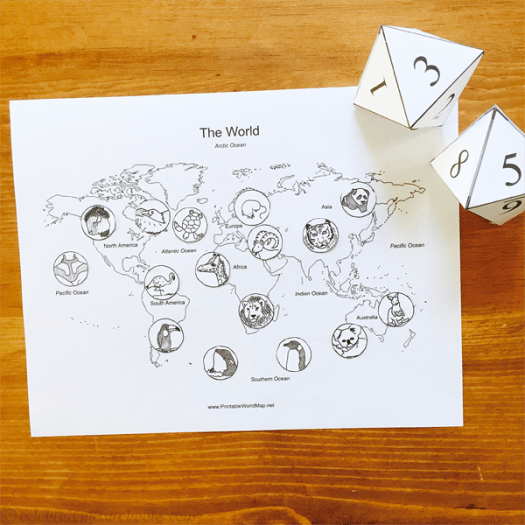
Play the Wonderful Wildlife Board Game! Animal tokens images copyright Conor Carroll
Wonderful Wildlife Board Game
Fascinating animals are found in every part of the world. Play this fun printable Wonderful Wildlife Board Game to match each animal to the area where it lives.
Print one set of 16 Wildlife Tokens for each player
Print two copies of the 8-sided die, fold, and tape together
If you would like, color the map and tokens
Choose a player to go first
Each player rolls both dice and places an animal on their map according to these corresponding sums of the dice below
The first player to fill their map is the winner!
1 = Flamingo – South America
2 = Emperor Penguin – Antarctica (Southern Ocean)
3 = Giraffe – Africa
4 = Bald Eagle – North America
5 = Ibex – Europe
6 = Kangaroo – Australia
7 = Panda – Asia
8 = Orca – Antarctica (Southern Ocean)
9 = Toucan – South America
10 = Buffalo – North America
11 = Koala – Australia
12 = Lion – Africa
13 = Etruscan Shrew – Europe
14 = Manta Ray – Pacific Ocean
15 = Sea Turtle – Atlantic Ocean
16 = Tiger – Asia
Q&A with Author Jess Keating
Today I’m tickled pink to talk to Jess Keating about her work as a zoologist and an author, her favorite animals, and a very cool holiday tradition.
In your work, your books, and your online presence, you bring kids and adults closer to the animal kingdom. What in your early years inspired you to become a zoologist?
I wish there was one poignant answer to this question! The truth is, all my life I’ve been enamored with animals. A physicist I admire once said this: The world is beautiful to look at, but it’s even more beautiful to understand. To me, that sums it all up perfectly.
As a kid, animals sparked my curiosity, my imagination, and even my creativity. The diversity they represent is so amazing to me—they all live their lives so differently, with different senses, abilities, and environments, yet it works perfectly for them. I instantly felt a kinship with them, and as a kid, I wanted to know everything about them.
As I got older and was able to really get into zoology, my goal shifted. The world of animals is so endlessly fascinating, and I now I want to take every opportunity to share it with others, especially young readers.
All animals are amazing, but do you have a soft spot for one particular animal or species? If so, why?
Now this is such a hard question! My favorite animal has always been the wolf. I was lucky enough to see one in the wild once, and it’s pretty hard to come away from that experience without believing in magic!
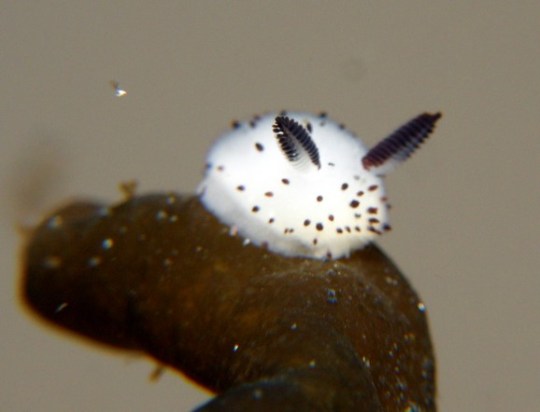
Lately, I also have a soft spot for nudibranchs! I included one (the Hopkins’ rose nudibranch) in my last book, but there are so many other species that we know so little about! As I mentioned above, it’s the diversity that takes my breath away. Some of them look like bunnies:
Image courtesy of crawl_ray on flickr.com
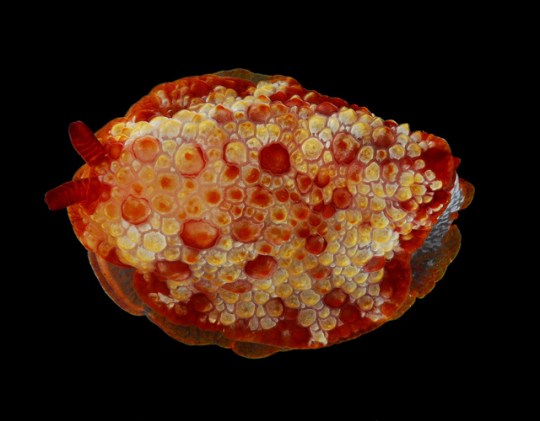
Some even look like pizzas!
Image courtesy of Arthur Anker on flickr.com
You do such a great job of reaching out to kids through videos, KeatingCreature on Twitter, your YouTube Channel: Animals for Smart People, personal appearances, and Skype visits. Can you describe a funny or favorite anecdote from one of your events?
Thank you for the Youtube shout out! I really hope teachers find my videos useful! As for a favorite event, when you mix animals and kids, the results are often hilarious. Usually, my visits involve a lot of dead things. I bring a collection of skulls, animal bones, and animal track castings with me. Every so often, we get lucky with some live specimens.
One of my favorite events was a library visit that involved a 10+ foot python. I had her resting on my shoulders (as you do), and I remember laughing because almost all of the adults in the room were skittish, backing off toward the door.
When I asked who else wanted to hold this lovely python, every adult shook their head. There was no way they were going near it! But then, a tiny six year old girl rushed up to the front, with a massive smile on her face. She wasn’t afraid at all as she held that snake—and I’m pretty sure that her big moment meant as much to me as it did to her!
What inspired you to write Pink is for Blobfish?
Pink is for Blobfish is a book so close to my heart! I know that sounds strange, because it’s essentially a book filled with weirdos!
As you can probably guess, I’ve been reading animal books my whole life. I loved them all, but what I really wanted was to write something that says as much about us as it does about the wild animals on each page. A book that not only shares amazing animals with kids, but also gets them thinking critically about how they view the world, especially regarding their assumptions and judgments. Pink is for Blobfish is my way of getting readers to look at gender expectations, while (hopefully) instilling them with a little wonder about the natural world.
There’s so much humor in your writing and videos. How does your love of comedy help you connect to readers?
The short answer is, I’m just a big ham and love making people laugh. There’s also the added bonus with nonfiction: we’re much more likely to remember something if we connect with it emotionally. My way of accomplishing that is to be funny and get kids laughing. Fiction or nonfiction, one of the easiest ways for me to reach readers is through a well-timed joke.
But, you can also get a little deeper with it. I once heard that Jim Carrey doesn’t think of his job as “making people laugh.” Instead, he views it as “freeing people from concern.” The minute I heard that, it resonated with me. For those few moments, when you’ve got a reader laughing, they’re free from any concern in their lives. It’s a reprieve, a bright moment. It’s true for us as adults too—it’s pretty much impossible to be stressed out when you’re reading about a pigeon that wants to drive a bus!
Now, when I approach my writing, I look for those moments. If I can make myself laugh, that’s half the battle.
What’s the best part about writing books for kids?
For both fiction and nonfiction, my favorite part is seeing the look on a kid’s face when you open a door for them into a whole new world. Sometimes, it’s the ridiculously colorful world of nudibranchs. And sometimes, it’s helping them to the realization that they aren’t alone, no matter how weird they feel.
What’s up next for you?
I’m so glad you asked! I just received F&Gs of the second book in the World of Weird Animals series! I can’t give away the title just yet, but I can say we are going to look at MONSTERS. This isn’t just going to be a book of creepy creatures. We’re going to dig into why we see certain animals as monsters, and how those judgments and assumptions affect how we think of them. I was blown away with the discussions that Pink is for Blobfish prompted with kids, and I can’t wait to see how they respond to this book!
I also have my first picture book biography, SHARK LADY, coming out next year! I’ve always been a fan of sharks, and I was thrilled to tell the story of Eugenie Clark, one of the world’s first female shark scientists. Eugenie is one of those incredible women that changed the world just by being her fearless self, and I am so eager to share this book with everyone. Look for it around June!
I can’t let you get away without asking you a few holiday-themed questions, so…
You told me that World Animal Day is one of your favorite holidays. Can you talk a little about that?
What could be better than a day devoted to animals!? World Animal Day is a day to chat about animals all over the world, and how we can best protect them and their futures. A funny thing happens when you start talking about animals in the global sense—you can’t help them without also helping us. Education and awareness can accomplish so much!
Do you have an anecdote from any holiday that you’d like to share?
I have one that ties in really well here! When I was a teen, I had a really cool Christmas tradition that I highly recommend to parents of animal lovers. On Christmas morning (or any special holiday morning for you!) I would go to my local humane society, bring treats, and walk the dogs. Usually, these centers have lots of volunteers, but busy holidays are often pretty slow for them and there’s not a lot of help. I guarantee the dogs will love the company, and you’ll get to spend an hour surrounded by wagging tails! You can’t lose.
Has a holiday ever influenced your work?
Yes! A very savvy bookstore (DDG Books!) organized a “Valentine for Blobfish” event when Pink is for Blobfish came out. So many young readers felt bad that the blobfish was voted the world’s “Ugliest Animal” (true story!) and they wanted to send him valentine cards to make him feel better!
Thank you, Jess! It’s been so much fun! I wish you all the best with all of your books and your other ventures!
Learn more about Jess Keating!
As a zoologist turned middle grade and picture book author, Jess Keating has been sprayed by skunks, bitten by crocodiles, and been a victim to the dreaded paper cut. Her MY LIFE IS A ZOO series earned two Kirkus stars, a Red Maple nomination, a Rocky Mountain Book Award nomination, and a spot on the LA Times Summer Book Pick List.
Her quirky nonfiction picture book series kicked off with PINK IS FOR BLOBFISH, with a sequel to follow in 2017. Her first picture book biography, SHARK LADY, will also be published in 2017.
Jess is also the creator, writer and host of Animals for Smart People, a Youtube series about animals, science, and nature. Subscribe today and bring Jess into your classroom!
Connect with Jess Keating:
You can find Jess on Twitter @Jess_Keating and on Facebook @JessKeatingBooks!
Pink is for Blobfish can be found at these booksellers












 celebratepicturebooks.com