August 7 – National Lighthouse Day

celebrate-picture-books-picture-book-review-miss-colfax's-light-cover

About the Holiday

Lighthouses have been in use since the earliest days of sea-going vessels. Built to warn sailors of dangerous and damaging rocks and reefs, these sentinels are a picturesque and fascinating part of history. From man—and woman—tended lights to today’s automated systems, lighthouses are a beacon of inspiration and imagination.

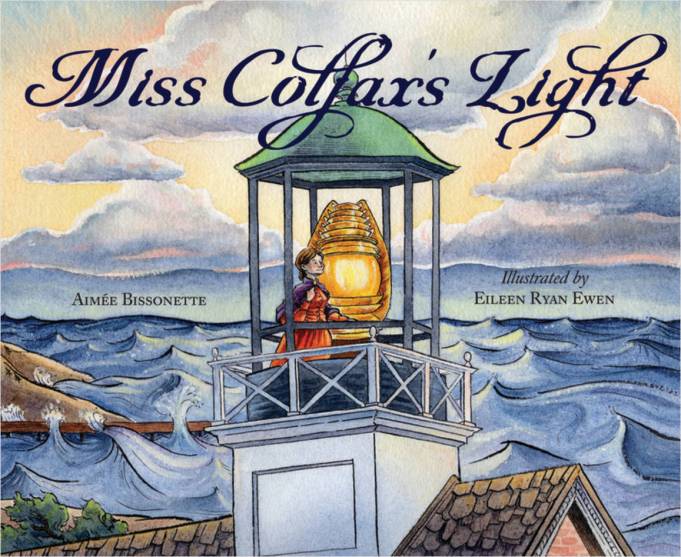
Miss Colfax’s Light

Written by Aimée Bissonette | Illustrated by Eileen Ryan Ewen


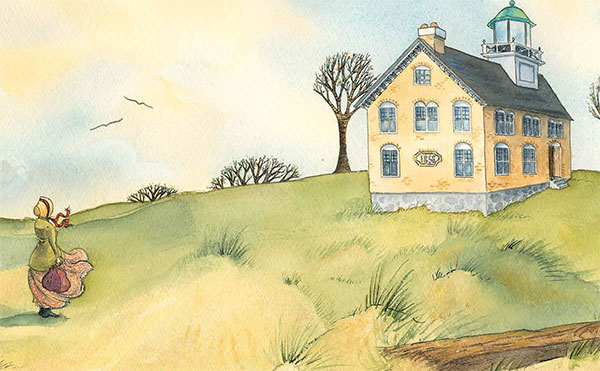
In 1861 when Harriet Colfax’s brother fell ill and decided to leave Indiana, Harriet had two options: she could leave with him—after all she had come to Indiana with him and worked with him at their newspaper—or she could stay on as the lighthouse keeper of the Michigan City Lighthouse, making $350 a year. Most women might have chosen to leave, but Harriet did not want to give up her independence or leave her best friend, Ann. She took the job as lighthouse keeper even though many in town thought she was too weak or too inexperienced to do the work.
celebrate-picture-books-picture-book-review-miss-colfax's-light-Michigan-city-lighthouse

Image copyright Eileen Ryan Ewen, courtesy of sleepingbearpress.com

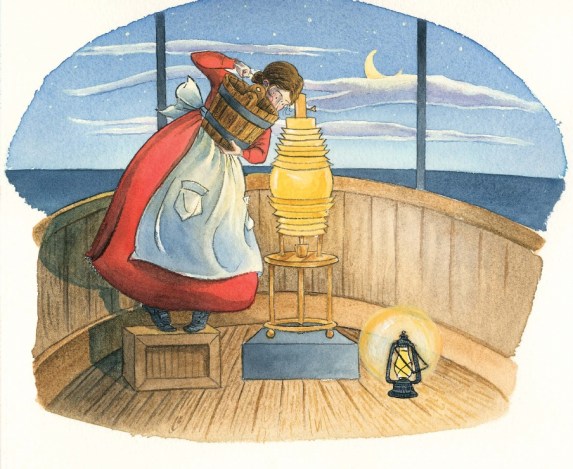
Harriet knew the ships on the sometimes wild waters of Lake Michigan—one of the northern United States’ Great Lakes—relied on the lighthouse to keep them from danger. Twice every night she had to carry “whale oil in a bucket up narrow stairs to the top of the lantern tower” to refill the light and then polish the Fresnel lens. During the day, she “cleaned and painted…varnished the woodwork and shined the brass…and wrote notes in her log.”

It didn’t matter if Harriet was tired or sick or if winter storms rocked the shore, Harriet’s work went on. In 1871 a beacon light was installed at the end of the Michigan City east pier. Now in addition to the main lighthouse, Harriet had to keep this signal lit too. To do so required a long walk down a wooden catwalk that jutted far out into the lake. At times the freezing water roiled and splashed over the catwalk, making the walk tricky and dangerous. By this time lard had replaced whale oil as fuel. While it was cheaper and easier to get, it also had to be heated to pour. Sometimes on frigid winter nights “the lard oil hardened in the cold and Harriet had to fight back through the wind to reheat the oil” on her stove.
celebrate-picture-books-picture-book-review-miss-colfax's-light-harriet-adding-oil

Image copyright Eileen Ryan Ewen, courtesy of sleepingbearpress.com

In 1874 the beacon light was moved to the west pier—farther away. Instead of being within walking distance, Harriet now had to “row a small boat across a creek, hike the far shore, and cross a longer catwalk to light the beacon light.” One night in 1886 storms raged as Harriet made her way down the west pier. “Driving sleet covered her coat with ice. Sand from the dunes along the lake pelted Harriet’s face, stinging her cheeks. Her boots slipped and slid on the catwalk.” Only moments after she finished filling the beacon light and stepped off the catwalk, “a deafening screech filled the air” as the beacon tower “ripped from its moorings and crashed into the lake.”

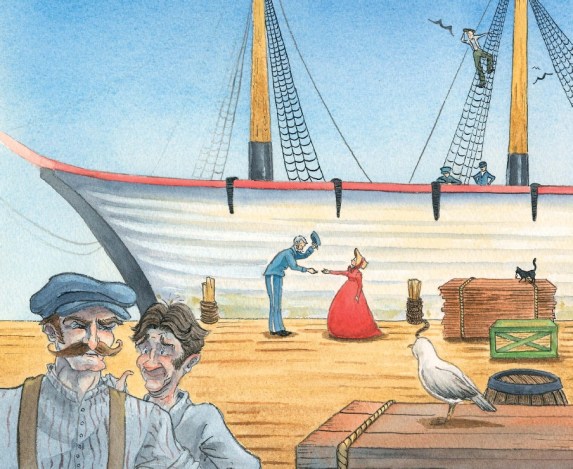
Harriet’s dedication to the Michigan City Lighthouse continued every day and every night for 43 years. People in town came to call the landmark “Miss Colfax’s Light,” and ship captains named it “Old Faithful.” Over the years her vantage point on the tip of the shore allowed Harriet to experience more than stormy seas. She also saw “brilliant sunsets, lunar eclipses, and silent, dancing northern lights. She saw tall-masted schooners with white sails give way to steamships of iron and steel.”
celebrate-picture-books-picture-book-review-miss-colfax's-light-meeting-a-ship-captain

Image copyright Eileen Ryan Ewen, courtesy of sleepingbearpress.com

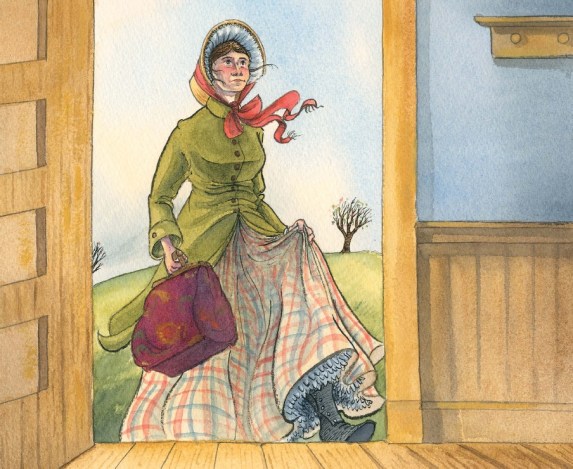
In 1904, when Harriet was 80 years old, the Michigan City Lighthouse underwent a renovation. It acquired a fog signal, and the oil-burning mechanism was replaced with a steam engine and boilers with huge coal-fired furnaces that required several keepers. Although Harriet was sad to leave her life as a lighthouse keeper behind, she understood. With the same bravery that had brought her to the lighthouse, she opened the door and stepped out to what came next.

The life of Harriet Colfax needs no embellishment to reveal the kind of determination and dedication it took to keep the Michigan City Lighthouse shining. Aimée Bissonette tells this brave woman’s story straightforwardly, focusing on particular moments when her duties were increased or her resolve challenged. Harriet’s personal motto that kept her going: “I can do this” is repeated throughout the book, echoing the revolving beacon that shines continuously on the shore of Lake Michigan. Actual entries from Harriet’s log punctuate the text, lending authenticity and Harriet’s voice to the story.Children will be fascinated by this snapshot of American (and world) history.
celebrate-picture-books-picture-book-review-miss-colfax's-light-harriet

Image copyright Eileen Ryan Ewen, courtesy of sleepingbearpress.com

Eileen Ryan Ewen’s action-filled paintings of Harriet and her work beautifully demonstrate to readers Harriet’s incredible will and perseverance under the most difficult circumstances. The narrow stairs of the lighthouse pose daunting in the middle of the night; the seas of Lake Michigan surge and lap at Harriet and the winds buffet her as she navigates the catwalk; and an exhausted Harriet stands at the stove melting lard to light the lens. Children interested in ships and the sea will find much here to excite their imaginations.

An author’s note about Harriet Colfax follows the text along with a glossary of terms used in the book.

Ages 6 – 9

Sleeping Bear Press, 2016 | ISBN 978-1585369553

Meet Aimée Bissonette and learn more about her books and work on her website!

To view Eileen Ryan Ewen‘s portfolio, sketchbook, and other books, visit her website!

National Lighthouse Day Activity

celebrate-picture-books-picture-book-review-lighthouse-coloring-sheet

Lighthouse Coloring Page


Lighthouses are a striking part of any seashore landscape. Here is a printable Lighthouse Coloring Page for you to decorate!

July 15 – It’s National Ice Cream Month

celebrate-picture-books-picture-book-review-ice-cream-summer

About the Holiday

Ice cream has a long and elite history, dating back to Ancient Greece when the confection was made of snow, honey, and fruit. Catherine de’ Medici introduced the treat again in the 16th century. Charles I of England, using his royal clout, proclaimed ice cream to be the prerogative of the crown. He kept the recipe secret and forbid the common people to eat it. The first recorded recipes for ice cream are reported in the 18th century.

This favorite dessert received its true recognition in 1984 when President Ronald Reagan established July as National Ice Cream Month. Today indulge in your favorite flavor or sundae!

Ice Cream Summer

By Peter Sís


A little boy writes a letter to his grandpa telling him about his summer. “So far it’s been a delicious summer,” he says of his ice cream extravaganza. The boy reports that he’s very busy, but is also paying attention to school work every day. He knows how to read big words like tornado and explosion, and he is even creating his own book. He can solve math problems—even word problems—lickity split on his own and sometimes with his family’s help.

At day camp he and his friends are involved in all sorts of activities, such as sports, cartography, and field trips. The boy tells his grandpa that he’s poring over the encyclopedias he sent, learning about world history from Ancient China to Europe and America. He is discovering fabulous inventions and designing some of his own.

celebrate-picture-books-picture-book-review-ice-cream-summer

Image copyright Peter Sís, courtesy of scholastic.com

He assures his grandpa that he has “been working hard all summer (though I always take a break on sundaes)” and has earned the special trip his grandpa mentioned. As the two meet it’s obvious that Grandpa understands his grandson very well. They both sport ice cream shaped backpacks, and the trip they are embarking on is a hike to the tip of Ice Cream Peak.

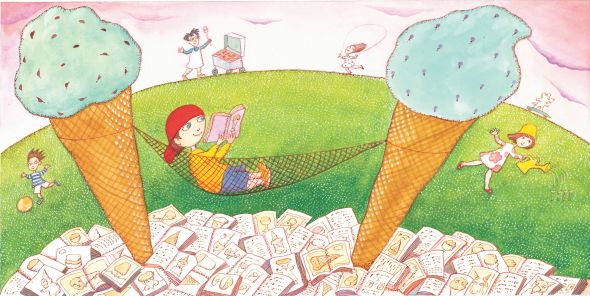
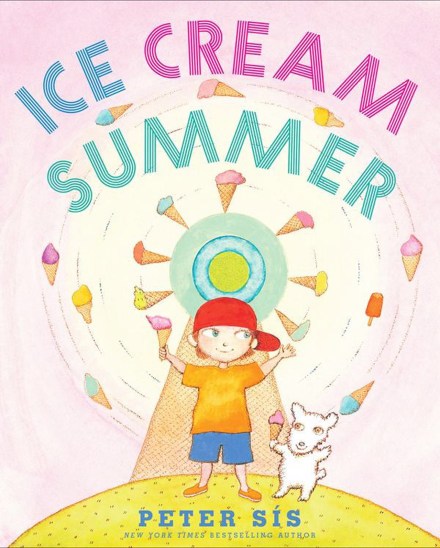
Peter Sís’s celebration of ice cream is a perfect mixture of text and art. While the boy’s letter is kid-like bare bones, the ice-cream hued illustrations humorously and cleverly portray the boy’s delicious obsession. His room, with its scoop-shaped window overlooking an ice cream factory, is filled with a bed, bookshelves, desk, and toys that are all familiarly conical. The boy builds his sandcastle, complete with cone turrets, at the edge of multi-colored scoop waves, and the family’s beach umbrella is a wavy sundae top.

celebrate-picture-books-picture-book-review-ice-cream-summer

Image copyright Peter Sís, courtesy of scholastic.com

At day camp all roads lead to flavorful sites where skyscrapers, attractions, and transportation are all seen through a sweet ice-cream cone lens. Even the Statue of Liberty holds aloft a vanilla soft serve cone. The boy’s travels through history encompass fascinating facts about the invention of ice cream, how it spread across Europe and to America as well as innovations of and improvements to this favorite treat.

The final reveal of Ice Cream Peak, with its sprinkles-covered tip will delight ice cream aficionados of all ages. Kids and adults will want to linger over each page to scoop up all the visual pleasures.

Ages 4 – 8

Scholastic Books, 2015 | ISBN 978-0545731614

To view more books by Peter Sís and discover fun title-related activities, visit his website!

National Ice Cream Month Activity

celebrate-picture-books-picture-book-review-ice-cream-maze

Ice Cream is A-maze-ing! Puzzle


Sometimes you’d walk forever and through any kind of obstacle to get your favorite flavor ice cream cone. Have fun following the path through this printable Ice Cream is Amaze-ing Puzzle

Picture Book Review

July 13 – National Culinary Arts Month

celebrate-picture-books-picture-book-review-the-hole-story-of-the-doughnut-cover

About the Holiday

July is a great month for celebrating culinary arts. With kids home from school it’s fun to spend time together in the kitchen learning new skills and making experimental or favorite recipes. On-the-go meals or vacations can also take you to new and enticing restaurants, where you may try regional cuisine and discover exciting flavors.

The Hole Story of the Doughnut

Written by Pat Miller | Illustrated by Vincent X. Kirsch


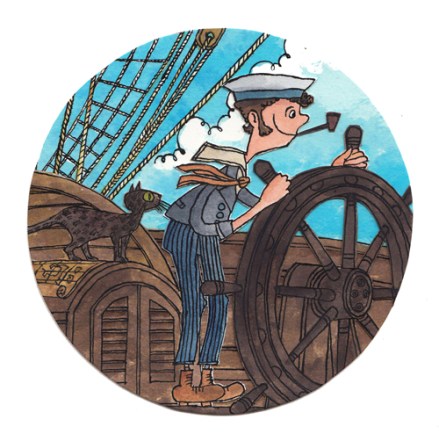
In 1844 at the tender age of 13, Hanson Gregory left the family farm and went to sea as a cabin boy on the schooner Isaac Achorn. He quickly became the cook’s assistant and also learned how to rig the sails and “steer a ship over trackless waves by sun and stars.” By the age of 19 Gregory had become the captain of the schooner Hardscrabble, and within a few more years was racing “his cargo from Maine to California as commander of a clipper, the fastest ship on any ocean.”

celebrate-picture-books-picture-book-review-hole-story-of-the-doughnut

Image copyright Vincent X. Kirsch, courtesy of vincentxkirsch.com

Hanson Gregory may have been one of the best captains to sail the seas—once awarded a medal for heroism for rescuing seven shipwrecked Spanish sailors even though his own ship and crew were endangered. But his greatest achievement was not attained because of his seafaring skills—it was his ingenuity in the galley that people remember.

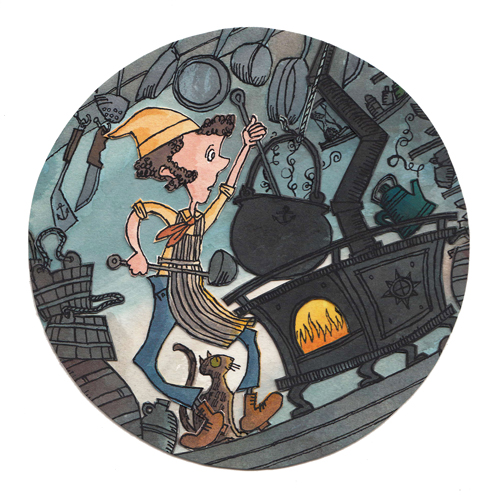
On June 22, 1847 as a 16-year-old cook’s assistant, Hanson was rustling up the crew’s breakfast—coffee and fried cakes, the same as every morning. While the pot of lard bubbled on the stove, Gregory formed balls of sweetened dough and dropped them in. They sizzled and crisped—at least around the edges. The centers were raw, heavy with grease, and they dropped like cannonballs in the stomach. “Sailors called them Sinkers.” But this morning Gregory had an idea. He removed the lid from the pepper can and cut out the center of the balls. “Then he tossed the rings into the bubbling lard.”

celebrate-picture-books-picture-book-review-hole-story-of-the-doughnut

Image copyright Vincent X. Kirsch, courtesy of vincentxkirsch.com

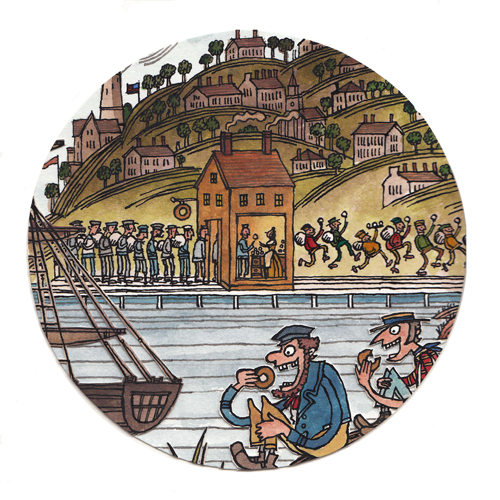
The cook and the sailors took one look at this odd concoction and…ate them up! “The cakes were brown, and sweet, and fully cooked. Sighs of delight rose above the noisy sea. A new breakfast tradition was born.” Gregory told his mom about his invention, and she fried up large batches of these ‘holey cakes’ that were a sensation at a friend’s store and on the docks.

You might think this is a pretty interesting tale in itself, “but sailors like their stories bold” and so they “spun legends worthy of such a delicious treat.” One tale had Captain Gregory inventing the doughnut while he saved his ship from disaster. Another told how Gregory, distraught over the drowning of five sailors pulled to the ocean floor by of their “sinker” breakfast, punched holes in every cake to make them look like life rings and vowed, “‘Never again!’”

Captain Gregory had a sense of humor about his accomplishment. During an interview he once stated that “he had invented ‘the first hole ever seen by mortal eyes.’” Gregory lived to be 89 and is buried “overlooking the sea where stormy weather can be spotted as readily as it once was from the quarterdeck of the Hardscrabble.”

An author’s note expanding on the story of Captain Gregory, the doughnut, doughnut shops, a timeline, and a selected bibliography follow the text.

celebrate-picture-books-picture-book-review-hole-story-of-the-doughnut

Image copyright Vincent X. Kirsch, courtesy of vincentxkirsch.com

Doughnuts have never been so evocative! In Pat Miller’s humorous, informative history of this favorite pastry treat, readers can smell the salt air, feel the ocean swell and roll under their feet, and even ache a little for those poor sailors forced to eat “sinkers.” Seamlessly interwoven into this foodography is a fascinating look at the early days of sail. Miller’s language is immediately stirring: the Ivanhoe bucks and plunges, the sea becomes a monster, and Captain Gregory spears a sinker on the wheel spoke. Kids will marvel at a 13-year-old going off to sea and becoming an inventor at 16.

Vincent X. Kirsch provides just the right touch to this captivating true story with his cartoon-inspired watercolor and cut paper artwork. Ingeniously incorporating Hanson Gregory’s innovation of removing the center of the fried cakes, Kirsch’s illustrations are “cored” to allow for text, while the extracted section appears on the facing page as a glimpse through a porthole. The maritime atmosphere—from ship to shore—of the mid-1800s is beautifully represented in the folk-style sketches, and the humor that is so intrinsic to this story is wonderfully embraced.

The Hole Story of the Doughnut will delight foodies and history buffs alike and would make a fun gift and a delectable addition to personal libraries for all ages.

Ages 5 – 12

Houghton Mifflin Harcourt, 2016 | ISBN 978-0544319615

Vincent X. Kirsch’s website is full of illustrations from his books for children—take a look at his portfolio!

Spend some time with Pat Miller on her website that offers activities, tips, resources and many more books!

Culinary Arts Month Activity

celebrate-picture-books-picture-book-review-cd-doughnut-craft

CD (Compact Doughnuts) Decoration


Are some of  your CDs a little passé? Not if you can turn them into cute décor like this doughnut hanging.

Supplies

  • Unused CDs
  • Craft paint in tan, black, pink, yellow, white (or any colors you want for the doughnut and the icing)
  • Ribbon, any color and length you want
  • Fine-tip markers in bright colors
  • Glue
  • Glue dots (optional)
  • Paint brush

Directions

  1. Paint a wavy edge around the CD, let dry
  2. Paint the center of the CD, leaving the clear circle unpainted
  3. When the icing paint is dry, draw sprinkles on the icing with the markers
  4. With the ribbon make a loop hanger and attach it to the back of the CD with glue or glue dots
  5. Hang your decoration

celebrate-picture-books-picture-book-review-the-hole-story-of-the-doughnut-cover

You can find The Hole Story of the Doughnut at these booksellers

Amazon | Barnes & Noble | Books-a-Million | IndieBound


July 4 – Independence Day

celebrate-picture-books-picture-book-review-lady-liberty's-holiday

About the Holiday

On July 4, 1776, the thirteen colonies that then made up America claimed their independence from England. After much debate and with a majority—but not unanimous—vote, delegates to the Continental Congress adopted the Declaration of Independence. While the vote may not have been unanimous, delegates from all 13 colonies signed the document penned by Thomas Jefferson. John Hancock, who was President of the Continental Congress, signed his name “‘with a great flourish’ so England’s ‘King George can read that without spectacles!’” The action led to the Revolutionary War and ultimately to a break with England.

On this United States national holiday most cities host parades, fireworks displays, and other special events.

Lady Liberty’s Holiday

Written by Jen Arena | Illustrated by Matt Hunt


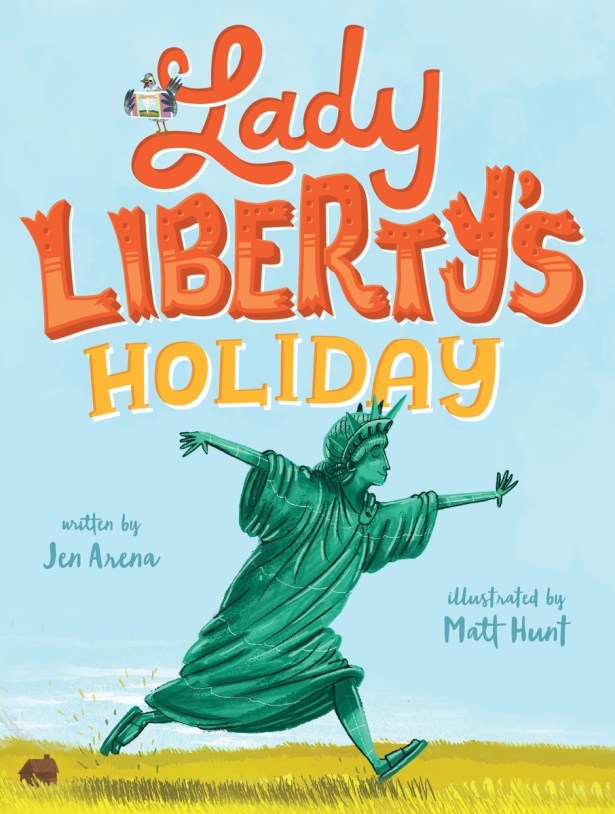
Shortly before the Fourth of July Lady Liberty is feeling down. Year after year she has stood in the same place holding aloft a torch in one hand and cradling a tablet in the other. She turns to her friend Moe, the pigeon on her shoulder, and expresses her dissatisfaction. Moe has a suggestion: “‘Lady, you need a getaway!’” Lady Liberty thinks about it and about the vastness of America. She has only seen a small corner of it. That night Lady Liberty pries herself from her pedestal and sneaks away.

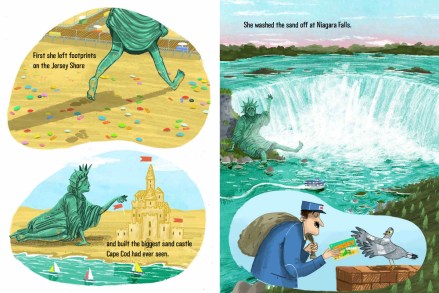
She walks the wide beaches of New Jersey, builds a huge sandcastle on Massachusetts’ Cape Cod, and dips her feet in Niagara Falls. With her long strides it doesn’t take her long to reach the Mississippi River. She finds a seat atop the Gateway Arch in St. Louis, Missouri and watches the Ol’ Man river slip past. In Kansas she plays in wheat fields that “tickle her feet” and are as good for making angels as snow. In South Dakota she photo bombs at Mount Rushmore, and she takes a quick hike over the Rocky Mountains. After all this fun Lady Liberty needs a rest, so she takes a nap on San Francisco’s Golden Gate Bridge.

But the people in New York have noticed the Lady’s absence. The Fourth of July is only three days away and no one is in the mood to celebrate without her. “Tourists were gloomy. Cops were cross. Even the stock market was down.” The mayor is even considering cancelling the holiday! Moe is worried Liberty might not come back.

celebrate-picture-books-picture-book-review-lady-liberty's-holiday

Image copyright Matt Hunt, courtesy of Jen Arena (jenarenabooks.com)

And Moe is right! Lady Liberty is enjoying herself too much to think about returning. The grandeur of the Grand Canyon makes her feel small—it’s a nice change, she thinks. She drinks water from a geyser in Yellowstone Park and sleeps under the stars in Texas. With a hop and a skip she’s dancing in New Orleans, and the Florida Keys make excellent “stepping stones” to her next adventure. She doesn’t even mind schlepping through swamps in the deep south, and an alligator that latches onto her toe is dispatched with a shake.

Lady Liberty suddenly hears the familiar flap of Moe’s wings. Moe tells Liberty how things are in New York. When she hears that they are thinking of cancelling the Fourth of July, she “bolts up as if she’d been struck by lightning.” Yes, says, Moe. “‘Nobody feels like celebrating without you.’” But after her cross-country tour, Lady Liberty knows that “‘the Fourth of July isn’t about me. It’s about America!’” Without another thought Liberty is racing north.

As New Yorkers wake at dawn, they see Lady Liberty happy to be back overlooking the Harbor, “where she had stood for over a hundred years.” Her copper dress shines in the early morning sun. Later that night she glows again in the colors of fireworks and enjoys a very Happy Fourth of July!

The final two pages tell the story of Lady Liberty’s creation, installation, and meaning. Tantalizing tidbits about the statue of Liberty are also revealed.

Jen Arena’s Lady Liberty’s Holiday is an engaging introduction to the story of the Statue of Liberty and American geography. A road trip across America was once a staple of childhood, and Arena replicates the excitement and wonder of viewing the country’s monuments and splendor through Lady Liberty’s walking tour. As each page brings readers to another awe-inspiring landmark, kids will want to learn more about the parks, states, and history of America.

Matt Hunt’s vibrant, full-bleed spreads are as expansive as the American landscape. The blue waters of Niagara Falls roar over the edge, creating white mist; the rock-hewn faces of George Washington, Thomas Jefferson, Teddy Roosevelt, and Abraham Lincoln gaze out from the peak of Mount Rushmore; and the spume of water from a Yellowstone geyser dwarfs the tourists below. As Liberty towers over cruise boats and trees, lounges across the Golden Gate Bridge, and flicks away a pesky alligator, kids gain an excellent perspective on the size of the Statue of Liberty as well as the monuments and natural landmarks she visits.

Like the postcards that Liberty sends to her friend Moe from stops on her journey, Lady Liberty’s Holiday is a welcome snapshot of America any time of year.

Ages 4 – 8

Knopf Books for Young People, Random House Kids, 2016 | ISBN 978-0553520675

To learn more about Jen Arena and view the books she’s written , visit her website!

A gallery of Matt Hunt‘s work can be seen on his website!

Independence Day Activity

celebrate-picture-books-picture-book-review-fourth-of-july-coloring-page

Fourth of July Coloring Page


The 4th of July celebrations mean flags, fireworks, and fun! Here’s a printable Fourth of July Coloring Page for you to make your own holiday festivities. You can even make it sparkle with a dash of glitter!

July 3 – Compliment Your Mirror Day

celebrate-picture-books-picture-book-review-why'd-they-wear-that

About the Holiday

Take a peek in the mirror and who do you see? That’s right—a fantastic person with inner and outer beauty! Today is dedicated to recognizing and appreciating that person in the mirror!

Why’d They Wear That? Fashion as the Mirror of History

By Sarah Albee


Whether you’re a fashionista or an “any ol’ thing will do” kind of person, there’s no denying that clothes make a statement. Sarah Albee’s fascinating look at human wraps spans history from 10,000 BC to the modern era. Along the way she exposes both historical facts as well as the often repugnant, laughable, and can’t-look-away fashion fads and disasters that have brought us to “wear” we are today. 

In Chapter 1: That’s a Wrap, Albee reveals facts about the first needles and thread, silk production, the Mayan tradition of forced elongation of skulls (this was considered attractive, denoted social status, and was intimidating), the first pants, warrior wear, and much more.

Chapter 2: Keeping the Faith exposes the influence religion had on clothing in the Middle Ages. White or russet colored robes were worn by men traveling on pilgrimages while penitents could wear a hair shirt made of itchy, bristly horsehair as punishment. Medieval armor, Samurai dress, why modern men’s loafers are decorated with little holes, and more are also discussed here as is the job of Wool Fuller – in which the Fuller soaked wool in urine to degrease it and improve its texture.

celebrate-picture-books-picture-book-review-why'd-they-wear-that

Image courtesy of National Geographic

Chapter 3: Going Global covers the Age of Exploration, which changed fashion as explorers from Europe came in contact with Native peoples in the New World. Red dye, rubber shoes, and the leather Moccasins were all adopted by Europeans. And if you think the search for remedies for wrinkles and other vestiges of older age is a modern pursuit, you’ll learn about Ponce de Leon and his quest for the fountain of youth.

Chapter 4: Ruff & Ready takes a look at the Renaissance. You may have seen fur stoles with the head of the animal still attached and wondered, Why? This fashion statement goes back to “Flea Furs” which were dead, stuffed animals that people draped over their shoulders in the belief that the fleas that were munching on their skin would transfer to the animal instead. Unfortunately, people discovered that fleas prefer warm bodies. Another curious fad was the ruff collar. While people may have thought they looked swell, these collars hindered physical movement and even led to the invention of the long-handled spoon because people could not get food to their mouths any other way. One “benefit” perhaps: when the first American settlers ran out of all other food options, they ate their collars, which were stiffened with wheat paste. And there’s so much more!

In Chapter 5: Lighten Up! readers will discover facts about the dour dress of the Puritans and the ostentatious dress of the French court. The tradition of men’s wigs is explained, and today’s face-painting has nothing on the unusual solution for facial blemishes—black velvet, leather, or silk patches in various shapes.

celebrate-picture-books-picture-book-review-why'd-they-wear-that

Image courtesy of National Geographic

Revolutionary Times take center stage in Chapter 6: Hats (and Heads) Off. During this time clothes began to fit the task. There were clothing items to protect (walking canes became popular as a way to ward off marauding wild dogs), uniforms to highlight the good looks of running footmen, elaborate costumes for Venetian parties, and homespun clothes that became a sign of protest from the American colonists. And if you think “bumpits” and hair extensions are new, women trying to keep up with Marie-Antoinette wore their hair (real and artificial) “cemented upward over wire armatures into two-foot (0.6-m)-high coiffures that made the wearer stand 7 ½ feet tall!”

Chapters 7 through 9 bring readers into the modern age, taking them from a time when children were dressed as young adults and boys wore elaborate gowns until the age of 7 to the textile innovations of the Industrial Revolution and the popularity of bustles that put fanny packs to shame to the fads of the 1960s and today.

celebrate-picture-books-picture-book-review-why'd-they-wear-that

Image courtesy of National Geographic

Albee’s Why’d They Wear That? is much more than a book about fashion. It’s a humorous, fabulously entertaining way to learn about so many aspects of history, from social revolution to inventions to cultural differences. Enlightening side bars, especially the fascinating “Tough Job” entries, and full-color illustrations, paintings, and photographs depicting every concept make Why’d They Wear That? an essential book for school libraries as well as for home bookshelves. Readers of all ages will want to dip into it again and again…and will “Oh!” “Ah!” and “Ewww!” over every page.

Ages 7 and up (children on the younger end of the range will enjoy the facts and pictures during a read-along session) 

National Geographic Children’s Books, 2015 | ISBN 978-1426319198

Learn more about Sarah Albee and her books on her website!

Watch the trailer for Why’d They Wear That? Fashion never looked so…good? unsettling? hilarious? You decide!

Compliment Your Mirror Day Activity

celebrate-picture-books-picture-book-review-mirror-word-search

Mirror, Mirror, What Shall I Wear?


In this magic mirror word search are 20 fashion-related terms from history. Find them all! Here’s the printable Mirror, Mirror, What Shall I Wear puzzle and the Solution.

May 7 – National Train Day

celebrate-picture-books-picture-book-review-locomotive

About the Holiday

Falling at the end of National Tourism Week, National Train Day honors the history of train travel and its importance to the opening of new frontiers as well as its continued  use for pleasure and business transportation. Train museums and train enthusiasts across the country celebrate with special events, rides, and educational opportunities for all ages. Some celebrations occur today, while others are held on May 14.

Locomotive

By Brian Floca


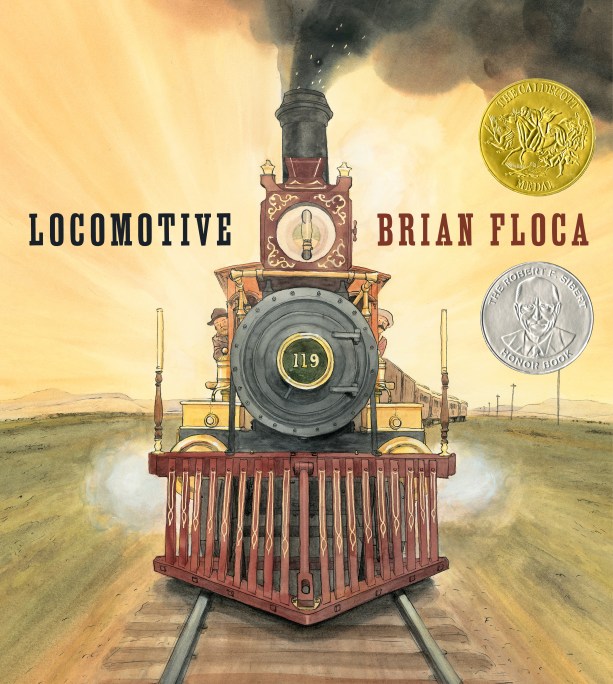
“Here is a road made for crossing the country, a new road of rails made for people to ride.” So begins Brian Floca’s sprawling paeon to the locomotive and its influence on America and the Old West. Amid the Clank Clank Clank of hammers on iron spikes, men from all over toiled from coast to coast to build the rail lines that carried the trains across the country: “Three strokes to the spike, ten spikes to the rail!”

Families who have sold all their possessions to pay for tickets for the week-long trip west stand on the platform in Omaha, Nebraska watching for the approaching train. Suddenly, they hear the clang of the bell and “see a puff from her stack—a puff of smoke, a smudge in the sky.” The awesome train pulls up at the station huffing “like a beast.”

Her crew—the brakeman, fireman, engineer, and conductor—make the train ready. They gather the passengers, stoke the firebox, push forward the Johnson bar, and get the train underway. The passengers sit back, ready for the long journey. The engineer “is the master of his machine, he knows her moods and tempers, where to set her bars and levers….Westward, westward runs the train, through the prairies, to the Great Plains, on to the frontier.”

In the cars the travelers read, play games, meet their neighbors. In winter they are warmed by a coal stove in one corner, while in the other corner a “modern” convenience is provided. Eventually, the train must stop to refuel. The passengers scramble to the railroad restaurant at the station. They have 20 minutes to eat what the menu offers: buffalo steak, antelope chops, or chicken stew (which tastes suspiciously like prairie dog).

As night falls a new engine is carefully attached to the cars by the switchman, who has learned to be quick to avoid the rolling, jumping cars that can take a finger. “Through the night the engine runs. Those up late hear her whistle, her wild and lonesome cry. It echoes on far hills and homes, it sounds in distant dreams.”

By morning the train has reached the mountains. The going is steep and slow. A second engine must be attached to give the train power enough to climb. On the other side of the mountains the terrain is rugged, and the train must traverse long, rickety wooden bridges. Days pass as the train travels through beautiful, mysterious country, skirting land formations such as Castle Rock, The Witches, Devil’s Slide, and the 1000 Mile Tree.

In Utah at Promontory Summit, the train comes to the meeting place of the tracks built from the East and the tracks built from the West. The passengers disembark and change trains, changing train companies also, from the Union Pacific that brought them here to the Central Pacific who will take them the rest of the way. Now the train passes through desolate, dry country, home to the Paiute and the Shoshone.

The mighty Sierra Nevada rises up ahead. A second engine is again required. If the tracks are slick, the “engineers can pull a handle to drop some sand down a tube, onto the tracks. The wheels hit the grit, the traction does the trick!” Closer and closer the train comes to its final destination, puffing through long wooden sheds that keep the tracks clear in winter and into dark tunnels blasted through the mountain rock.

Down, down the train progresses to the end of the line. The weary but excited travelers jump from the train to meet their friends or family or to start a new life in San Francisco!

If you love trains, American history, or the Old West, or if you are simply enamored of travel, you will want to read Brian Floca’s Caldecott Medal Winning and Silbert Honor book, Locomotive. Floca’s lyrical language makes poetry of the steam train’s inception, from the laying of the rails to the inner workings of the engine to the long journey westward. Fascinating facts of the train crews’ work, conditions for the passengers, and the territory crossed make this a page turner that any age will enjoy.

Readers can almost hear the sounds of the clanging bell and huffing engine, as these sounds are represented in a variety of typefaces and sizes, growing larger and larger as the train approaches the station. Every page is a joy. As the train chugs across the country, the paintings are swept in rushing brush strokes and the train whooshes into view from the edges, filling the page. The vast empty plains nearly dwarf the locomotive, and the mountainous regions pose chilling challenges for the iron horse. The nighttime scenes are beautifully lit by starlight and the single headlight of the train, reflecting the dreams of a new nation.

Although Locomotive is a longer picture book, its rhythms, depth of description, and gorgeous language will appeal to even very young children. Make some tea and hot chocolate and settle in for a cozy read of wonderful book!

Ages 4 – 12 and up (adults will also enjoy this book)

Atheneum Books for Young Readers, 2013 | ISBN 978-1416994152

National Train Day Activity

celebrate-picture-books-picture-book-review-all-aboard-maze

All Aboard Maze!


Trains travel over intricate terrain, over mountains, across vast plains, and through exciting cities. It’s a little like finding your way through a maze! Have fun completing this printable All Aboard Maze! Here’s the Solution. Choo choo!

April 28 – Workers’ Memorial Day

celebrate-picture-books-picture-book-review-brave-girl

About the Holiday

Some jobs are so dangerous that workers get hurt or even die doing them. Around the world organizations have been established to help industries provide safer working environments for their employees by establishing standard rules and regulations for buildings, machinery, working hours, and more. Unions and other groups have also been founded that represent workers to ensure their rights are upheld and their needs are met. Today we honor the sacrifices of workers in dangerous professions and raise awareness for safe working conditions.

Brave Girl: Clara and the Shirtwaist Maker’s Strike of 1909

Written by Michelle Markel | Illustrated by Melissa Sweet


Among the immigrants sailing to New York, stands five-foot-tall Clara Lemlich. She may not know it now, but she’s going to change her new city. While her father can’t find work, Clara gets a job in the garment industry, which hires school-age girls to make women’s clothing. Instead of going to school, Clara spends her days hunched over her sewing machine in a dark, smelly factory with many other girls, making clothes as fast as she can.

The rules of the factory are severe. For minor mistakes workers can be fined or worse—fired, leaving their families without an income. The doors are locked so the girls can’t leave without being inspected to ensure they haven’t stolen anything. And the workers must toil long into the night. Despite it all Clara is determined to get an education even though it means walking to the library after work and missing sleep to read her lessons. 

At the factory the girls become friends and reveal stories and secrets. The working conditions make Clara angry. She hears that the men at the factory want to form a union. If all the workers team up, they can hold a strike and force the management to treat them better, the men say. But they don’t think the girls are tough enough.

Clara knows what the girls are capable of. Every day she talks to her friends and the other women, urging them to fight for their rights—and they do! But it’s not as easy as the men predicted. The bosses don’t want to give in. In fact Clara’s life is in danger! She is beaten and arrested. Despite the intimidation she continues to picket. These small strikes make little difference, however—the bosses just hire new girls and the work continues.

Clara and other union leaders think only a huge strike by all workers in every garment factory in New York will cause the bosses to listen and make changes. At a union meeting workers pack the seats to listen to leaders from across the country. Not one of them recommends such a large strike. Clara can keep silent no more. She moves to the front of the hall and calls out. People lift her to the stage. Shouting “Unity is strength” she rallies the crowd and begins the largest strike of women workers ever in United States history.

The next morning thousands of women take to the sidewalks, leaving their sewing machines empty and silent. New York is stunned! Newspapers call the strike a “revolt,” and the girls an “army.” But this is really an army of children—the girls range in age from only 12 to 25 years old. Clara knows how to lead and motivate the girls. She gives rousing pep talks, sings, and stands up to thugs sent to harass them.

All winter the girls join the men strikers. They are starving and cold and become the inspiration for newspaper articles and fundraising. Many wealthy women donate to their cause and join them on the picket lines. Finally the bosses relent. They agree to the formation of unions in their factories, raise salaries, and shorten the work week. Factory workers in Philadelphia and Chicago take heart from Clara’s work and improve conditions in their cities.

Even though Clara is young and small, she proves that anyone can right wrongs and make a difference.

The final pages include more information about the garment industry in the early 1900s as well as a bibliography.

Michelle Markel’s Brave Girl is a spirited biography of Clara Lemlich, clearly outlining the life and working conditions of immigrants in the early 1900s—especially industries’ use of children to fill low-paying, oppressive jobs. This true-life story of a girl who wouldn’t give up or give in is told with pride and balance, touching on the dangers Clara faced in a sensitive manner appropriate for children. Overall, the idea that one person can make a difference no matter how big or how old shines through, making this not only a tale of the past, but an inspiration for today’s children and the future.

Melissa Sweet cleverly combines watercolor and gouache paintings with colorful fabric, ribbon, sewing pattern paper, and ledger pages to create illustrations fitting to the story. The pictures appear sewn onto the pages with straight, zigzag, and embroidery stitches, and the vibrant colors depict the fiery nature of Clara and all the workers who strove for better lives.

Ages 4 – 9 (and up as Brave Girl makes a wonderful teaching text)

Balzar + Bray, Harper Collins, 2013 | ISBN 978-0061804427

Workers’ Memorial Day Activity

celebrate-picture-books-picture-book-review-dream-job-application

Dream Job Application


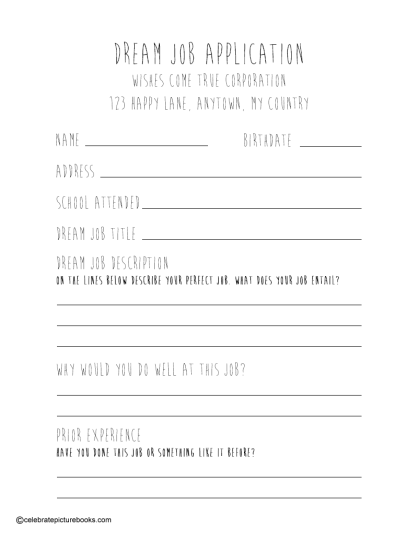
Work isn’t working when you love your job—it’s fun! What is your perfect job? Is it working with animals? Playing a sport? Being an artist, scientist, entrepreneur? Fill out this application and get started on following your dreams! Print the Dream Job Application below!

Dream Job Application