September 11 – Grandparents Day and Q&A with Author Ellen Mayer

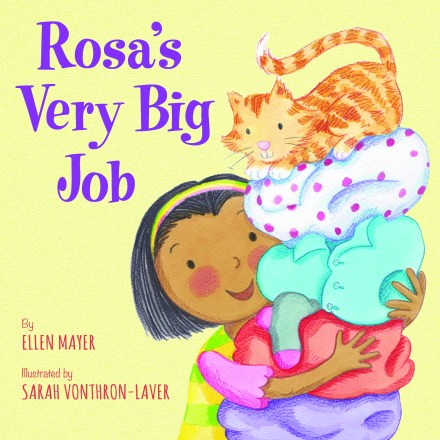
celebrate-picture-books-picture-book-review-rosa's-very-big-job-cover

About the Holiday

In the early 1970s Marion McQuade had the idea for a special day of the year when grandparents and grandchildren could show their love for one another. She further wanted it to be a day when grandparents could pass down the wisdom they had gained over their lifetime as well as share a bit of family history. Of course the same goes for grandparents learning the latest and greatest from the kids in their lives—from new technology to current fads. When all generations share their experiences, we’re all a lot smarter—and have closer relationships!

Rosa’s Very Big Job

Written by Ellen Mayer | Illustrated by Sarah Vonthron-Laver


Rosa may be little, but she has big ideas about how to help. While Mama is out shopping for groceries for that night’s dinner, Rosa decides to surprise her by folding and putting away the laundry. The basket is piled high with fluffy dry clothes, sheets, and towels. Rosa watches her grandpa reading the newspaper. “‘Please help me, Grandpa!’” she says. She tugs on her grandpa’s hands, trying to pull him out of his chair. “‘Come on, Grandpa! Get up.”
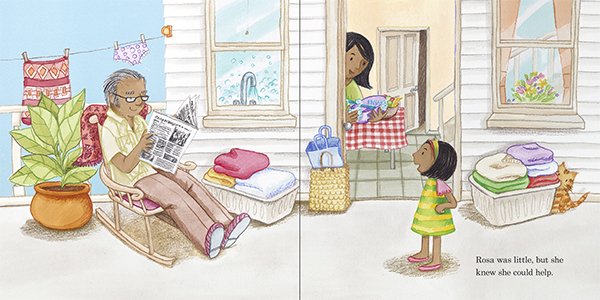
celebrate-picture-books-picture-book-review-rosa's-very-big-job-rosa-likes-to-help

Image copyright Sarah Vonthron-Laver, text copyright Ellen Mayer, courtesy of Star Bright Books, starbrightbooks.com

Grandpa seems to have a little trouble managing: “‘It’s difficult to carry these enormous piles,’” he sighs. But Rosa knows that smaller armloads work better. Grandpa’s clothes come unfolded as he puts them in the drawer. “‘Be neat. Like me,” Rosa says, showing him her tidy stack. Poor Grandpa! He has to keep hanging up the same jacket over and over. “‘It’s difficult to keep this jacket from sliding off the hanger,” he says. Rosa has the answer: “‘Zip it up,’” she explains. “‘Then it stays on.’”

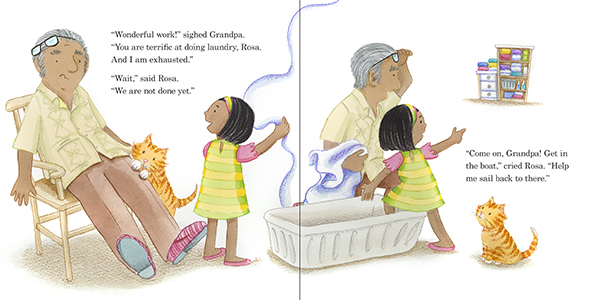
Grandpa sinks back into his chair. “‘You are terrific at doing laundry, Rosa. And I am exhausted,’” he says. But this is no time to quit—Rosa has big plans. As she steps into the now empty laundry basket, she exclaims, “‘Come on, Grandpa! Get in the boat. Help me sail back to there.’” Rosa points to the linen closet.
celebrate-picture-books-picture-book-review-rosa's-very-big-job-rosa-uses-basket-as-boat

Image copyright Sarah Vonthron-Laver, text copyright Ellen Mayer, courtesy of Star Bright Books, starbrightbooks.com

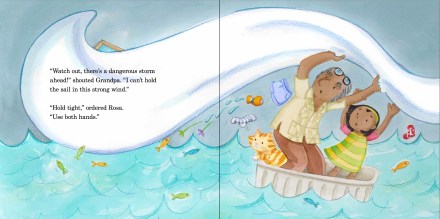
Suddenly, the floor swells with ocean waves teeming with fish. Grandpa channels his inner sailor as he holds aloft a sheet as a sail. As the wind billows and they come perilously close to the kitchen table, he says, “‘It’s difficult to sail around this enormous rock!’” Contemplating the rising sea, he exclaims, “‘It’s difficult to sail over this enormous wave!’”

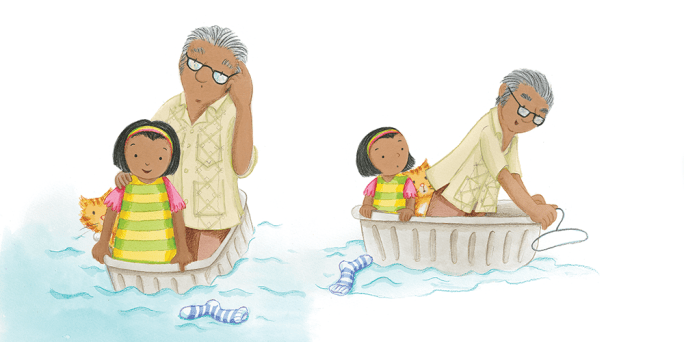
There’s a dangerous storm ahead, warns Grandpa, “‘I can’t hold the sail in this strong wind.’” Rosa is there to help and grabs one side of the sheet. “‘Hold tight,’” she orders. “‘Use both hands.’” At last the seas die down and Grandpa is ready to steer the laundry basket back to port, but Rosa has a more entertaining thought. Spying a sock on the floor, Rosa wants to catch the “enormous fish.” Grandpa obliges and picks up a hangar for a fishing pole. He holds Rosa as she stretches out over the edge of the laundry basket to land her fish.
celebrate-picture-books-picture-book-review-rosa's-very-big-job-sailing-with-sheet

Image copyright Sarah Vonthron-Laver, text copyright Ellen Mayer, courtesy of Star Bright Books, starbrightbooks.com

Just as Rosa nabs the fish, Mama comes home with her bags of groceries. She’s surprised to see that the laundry is not in the basket. Rosa runs to her and proudly explains, “‘We put all the laundry away. It was a very big job. We carried enormous piles. Grandpa dropped things. And I picked them up. It was very difficult for Grandpa. He got exhausted. But not me. I am terrific at laundry!’” Mama agrees that Rosa is a terrific helper. Then Rosa leads her mother to see the most surprising thing of all—the fish she has caught for dinner!
celebrate-picture-books-picture-book-review-rosas-very-big-job-rosa-and-grandpa-fishing

In her series of Small Talk Books® Ellen Mayer presents exciting stories for preschoolers full of imagination and rich language learning. Rosa’s Very Big Job introduces Rosa, a sweet girl bubbling with enthusiasm and the desire to help. The close relationships between Rosa, her mother, and her grandpa promote cooperation as well as effective modeling of speech patterns and a way to introduce larger words in an organic manner through play and common chores. Rosa’s inventive idea to turn the laundry basket into a boat is delightfully enhanced by her grandpa’s willingness to share in the story and expand on it. Humor, cheerful banter, and the easy camaraderie between Rosa and Grandpa invite young readers to join in the fun as they build confidence in their language learning.

Sarah Vonthron-Laver depicts Rosa’s afternoon with her Grandpa with joy and the spirited energy young children bring to everything they do. Grandpa is happy to spend time with his granddaughter, yet shows honest feelings of tiredness and frustration that spur on the plot. The transition from doing laundry to using the basket as a boat is as seamless as a child’s imagination, and the way Rosa and her grandpa use household items to create “sails,” “rocks,” “fish,” and “fishing poles” will give readers great ideas for post-reading play. Bright colors, an adorable kitten, and familiar surroundings welcome young children into the world of reading and expanded vocabulary.

Rosa’s Very Big Job would be a welcome addition to a young child’s bookshelf, not only for its fun story that kids will want to hear again and again, but for its leap into imagination that kids will want to replicate.

Dr. Betty Bardige, an expert on young children’s language and literacy development, provides tips for parents, grandparents, and caregivers following the text.

Ages 2 – 6

Star Bright Books, 2016 | ISBN 978-1595727497

Discover more about Ellen Mayer and her books as well as book-related activities and literacy initiatives she’s involved with on her website!

Find Sarah Vonthron-Laver on Facebook!

Grandparents Day Activity
celebrate-picture-books-picture-book-review-rosa's-big-job-paper-dolls-made

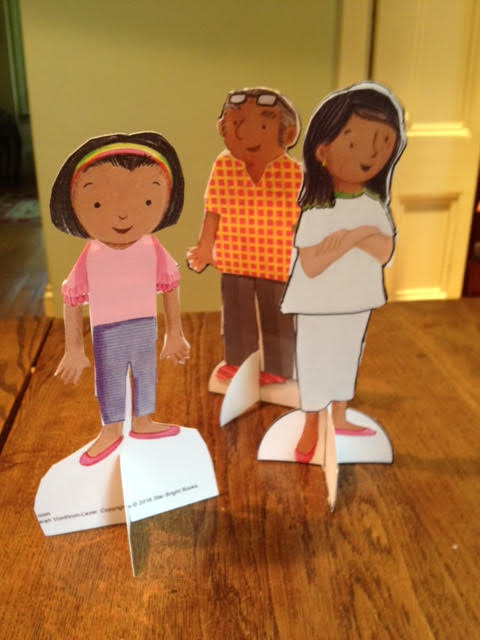
Original illustrations by Saran Vonthron-Laver, Copyrights © 2016 Star Bright Books. Paper dolls created by AislingArt and Celebrate Picture Books, copyrights © 2016

Rosa’s Very Big Job Paper Dolls

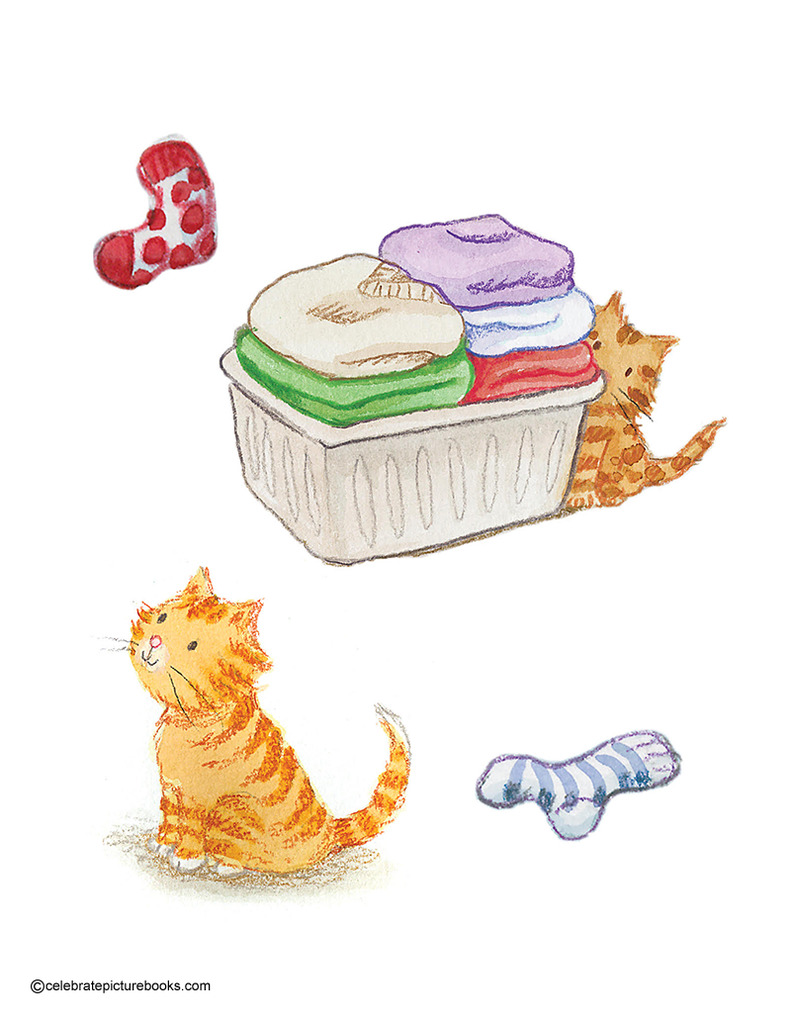
Rosa loves helping out at home. She’s terrific at doing laundry – folding and putting away the family’s clothes, socks, and linens. You are terrific at helping too! Can you help Rosa, Mama, and Grandpa get dressed and ready for the day with these printable paper dolls? You’ll even find a laundry basket, socks, and Rosa’s sweet kitty to play with! 

Supplies

Printable Paper Dolls, Clothes, and Extras

  • Heavy stock paper and/or poster board
  • Scissors
  • Glue

Directions

  1. Print dolls on regular paper or heavy stock paper. Dolls printed on heavy stock paper may stand on their own with the supplied stand cross piece. For dolls printed on regular paper, you can cut the supplied stand templates from poster board or card stock and glue the dolls to the backing.
  2. Rosa’s kitty and the laundry basket can also be attached to the supplied template if needed
  3. Print clothes for each figure
  4. Color the blank clothes templates any way you’d like
  5. Cut out clothes and extra items
  6. Fit outfits onto dolls
  7. Make up your own stories about Rosa, Mama, and Grandpa!

Interview with Author Ellen Mayer

celebrate-picture-books-picture-book-review-interview-with-Ellen-Mayer

Today, I’m happy to present a fascinating interview with Ellen Mayer, a writer and expert in early literacy, in which she discusses her involvement with various organizations and programs, her baby granddaughter, why Hug Your Cat Day is at the top of her list of holidays, and gives us a peek at a very special sugar egg.

I’m really interested in your work in the education and literacy fields. Could you talk a little bit about your job as an education researcher and an early literacy home visitor, and how you got into those fields?

I got into these fields after leaving a Sociology PhD program right near the end.  I didn’t want to be an academic and teach, I wanted to do applied research – to solve practical problems out in the world and to make a difference in the lives of those who were struggling. At the Harvard Family Research Project at Harvard’s Graduate School of Education, I studied the ways that families from underserved communities were engaged in supporting their children’s learning and education, and created research-based materials for families and schools to promote effective engagement. One of these was the Family Involvement Storybook Corner—curated picture book selections with family engagement themes. That got me interested in early literacy and picture books.

After researching family engagement in children’s learning for many years, I decided I wanted to go out into the field and be a practitioner and work directly with families on this topic. I worked as an early literacy home visitor with diverse families with the Parent-Child Home Program, modeling ways to share stories with little ones to build early language. I actually got paid to read picture books and play with families in their homes!
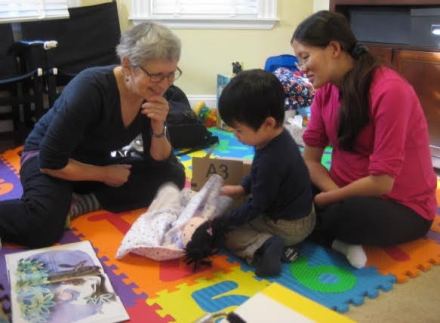
celebrate-picture-books-picture-book-review-interview-with-Ellen-Mayer-home-visit

At the same time, I was pitching my Small Talk Books®, a collection of playful stories about everyday activities that provide fun for kids and ideas for adults – Rosa’s Very Big Job is one. The adults in the stories are engaged with children’s learning, modeling conversational ways to build young children’s language.

I read that your book Red Socks, another of the Small Talk Books®, is being used in a program to turn wash time at Laundromats into talk time for literacy development. Could you discuss this early literacy initiative?

Yes! Wash Time/Talk Time is a terrific campaign led by Too Small To Fail, a joint initiative of the Clinton Foundation and the Opportunity Institute teaming up with a host of partners to turn Laundromats in underserved areas into venues for early literacy. This campaign distributes free books and information to families in Laundromats about building early language to help close what’s called the “word gap” by promoting parent conversation with babies and young children. Almost 60% of children in our country start kindergarten behind in their language development and this then sets them on a downward path and they get even further behind in school.

Red Socks was a natural fit for this program. In it a Mama narrates what she is doing for her little pre-verbal child as she folds the laundry and dresses the child—and as they search for a missing sock!
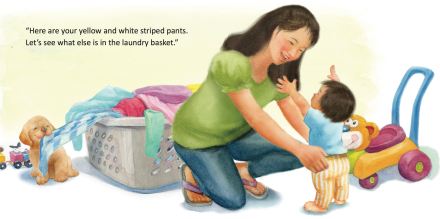
celebrate-picture-books-picture-book-review-interview-with-Ellen-Mayer-Red-Socks-book-interior-art

Illustration © 2015 by Ying-Hwa Hu, text © 2015 Ellen Mayer, courtesy of Star Bright Books

I have to say that it’s a dream come true that Too Small To Fail is using my book.

Wash Time/Talk Time is really reaching the families on the other side of the word gap who most need the ideas and inspiration in Red Socks. When I began writing the Small Talk Books® I wanted to include stories about doing laundry, as it’s something we all do as parents and provides lots of things to talk about with children. (Like the color of socks!) In fact, I used to sit in Laundromats and observe families when I was thinking up ideas for stories. I guess that’s the sociologist in me.
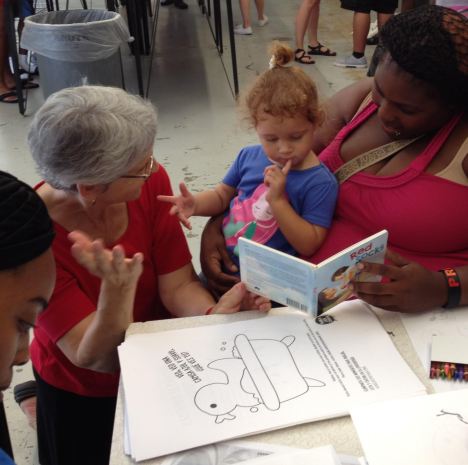
celebrate-picture-books-picture-book-review-interview-with-Ellen-Mayer-free-laundry-day

We just had the opportunity to visit one of the Laundromats in the campaign—at the Free Laundry Day in Tampa, FL hosted by The Laundry Project—and share Red Socks with families. You can see some of the fun illustrator Ying-Hwa Hu and I had here: 

What inspired you to begin writing picture books?

I came to picture book writing through a backdoor. When I was at Harvard Family Research Project, I was thinking about new ways to convey our ideas from research into practice for parents, and it occurred to me that a read-aloud picture book could address an audience of parents, as well as the primary one of children. My boss was enthusiastic about the idea, and so I enrolled in an adult ed class on writing for children. Then I turned one of our research case studies about challenges an immigrant Latino family had in communicating with their son’s teacher into a picture book, Tomasito’s Mother Comes to School/La mamá de Tomasito visita la escuela. Joe Cepeda did the art for it, and we made it downloadable for free.
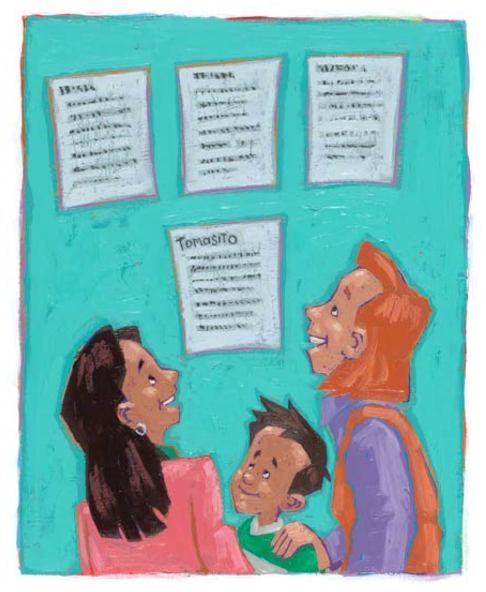
celebrate-picture-books-picture-book-review-interview-with-ellen-mayer-tomasito

Illustration ©2007 Joe Cepeda

What’s up for you next?

Some new things! I have a fellowship with the Storytelling Math Project that’s funded by the Heising-Simons Foundation and coordinated by TERC, a not-for profit STEM research and development organization here in Cambridge, MA. I’ll be a member of a group that’s identifying, creating, and promoting math-infused storybooks for diverse young children and I hope to create a couple of Small Talk Books® along these lines—probably about supermarket shopping! I also was asked to help out the Highlights magazine editorial team that creates HELLO magazine for 0-2 years and be an outside reviewer for issues before they go to publication. And then I’ll be volunteering as a visiting children’s book author to the Somerville Family Learning Collaborative, the family engagement and early childhood hub of the Somerville, MA Public Schools, sharing my books with playgroups and new parent groups.  

But mostly, I plan to write! I have a bunch of picture book manuscripts in various states, and ideas for new ones. These manuscripts are different from the Small Talk Books®; they don’t have a deliberate educational underpinning to them. They are fun, and just fun. One, for example, is called What To Do With Ruby-Lou and it’s about a baby who doesn’t laugh, no matter what her family does. Who is going to be able to get a laugh out of Lou? Well, it’s a surprise and it just might require some audience participation. I’ve had an agent in the past and hope to find a new one to rep me with these picture books.

You recently became a grandmother. Can you tell me a little about your granddaughter?

I thought our granddaughter was the most wonderful and expressive baby in the world when was she born – of course! She and my advance copy of the new Rosa book arrived into the world at just about the same time.
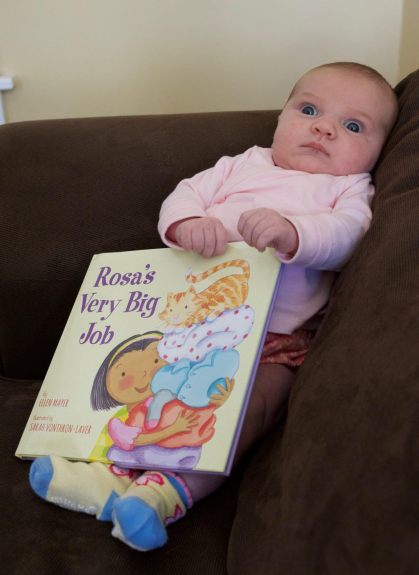
celebrate-picture-books-picture-book-review-interview-with-Ellen-Mayer-granddaughter-holding-book

At three months now my granddaughter is a big reader and is riveted on the B&W hi-contrast board book genre, especially one board book about cars and trucks. She moves her head back and forth, from one end of the spread to the other, scanning the images on the page like a studious scholar of some ancient text.

What is the best part about being a grandmother?

For me the best part about being a grandmother is being able to simply enjoy my granddaughter and play with her and watch her develop, and not have to worry about taking care of her daily needs. I didn’t have to stress when she refused to take the bottle before starting full-day childcare. That wasn’t my job. (She did take it – of course!) They live nearby, and seeing her once or twice a week, I love noticing small changes on each visit. I also love seeing our daughter and son-in-law parent.

Have you given thought to what you’d like your granddaughter to call you?

Our daughter asked us ahead of time what we’d like to be called when we became grandparents. I thought it was a wise idea to be proactive and select a name immediately, to avoid being named by the grandchild something like “Grandma GA-GOO-GA.” My great aunt Jane is called “Nini” as a grandmother, and I’ve always loved that, but I didn’t want to steal it. So I chose “Mimi.”
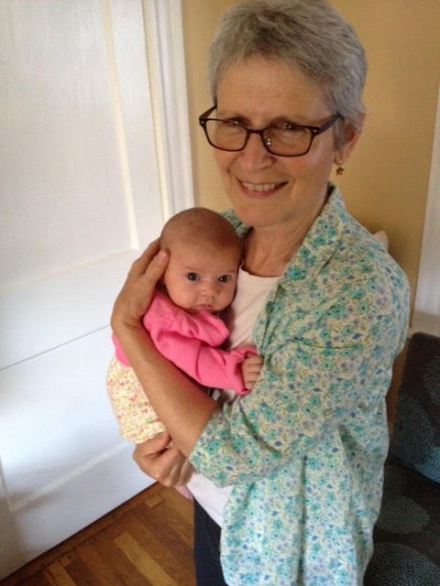
celebrate-picture-books-picture-book-review-interview-with-Ellen-Mayer-ellen-with-granddaughter

It sounds as if Grandparents Day may be one of your top holidays! Do you have another favorite?

When I was little, I liked Easter a lot because it combined a lot of my favorite things: crafts, springtime, running around outside, candy. Also, we didn’t dress up much as kids, but I do remember Easter bonnets!
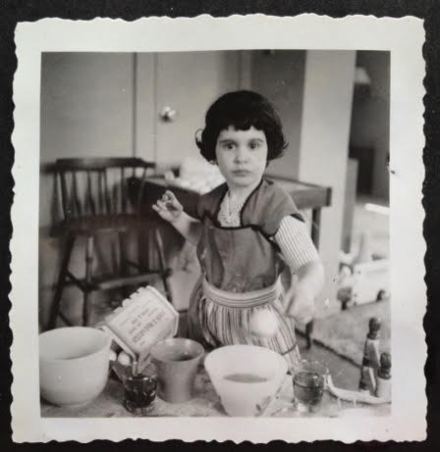
celebrate-picture-books-picture-book-review-interview-with-Ellen-Mayer-dying-easter-eggs

When our children were little, their birthdays became my favorite holiday celebrations. Now that they are grown, maybe I need to pick a new favorite holiday? I see that June 4th is Hug Your Cat Day. That might be just right: we have a rather large and ferocious cat and when she actually lets you hug her, well, it’s a cause for celebration.
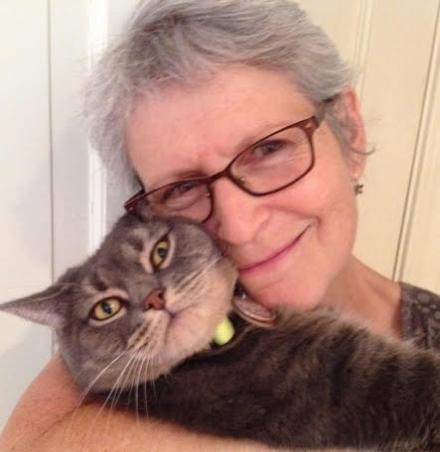
celebrate-picture-books-picture-book-review-interview-with-Ellen-Mayer-hugging-cat

Do you have an anecdote from any holiday that you’d like to share?

When I was six years old, I saw the Easter Bunny. I was staying at my Grandparents’ house, and I looked down the stairwell, and there he was, crossing the landing at the foot of the stairs. He was quite tall, wore a yellow slicker that was too small for him, and he was carrying a large Easter basket. I’m afraid I didn’t have my Brownie camera with me at the time to snap a photo.

But I do have an unwrapped sugar Easter egg that I’ve saved from that era.
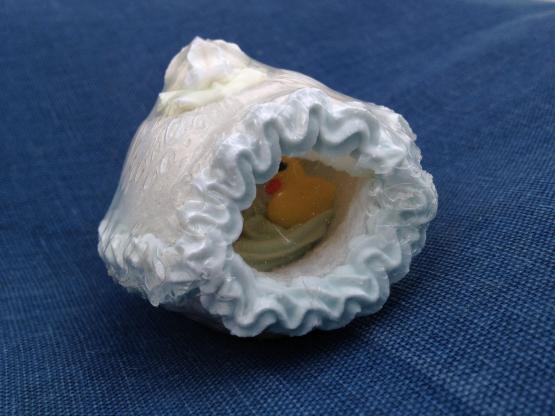
celebrate-picture-books-picture-book-review-interview-with-ellen-mayer-easter-egg

Thanks for sharing so much about your work and life, Ellen! I wish you all the best with Rosa’s Very Big Job, your other Small Talk Books®, and of all your other ventures!

You can also find Ellen Mayer on Facebook and Twitter

Rosa’s Very Big Job can be found at

Star Bright Books | Amazon | Barnes & Noble | Books-a-Million | IndieBound

Other Small Talk Books® available from Ellen Mayer and Star Bright Books include Cake Day, Red Socks, and A Fish to Feed and can also be found at the above booksellers.

Visit Ellen Mayer on her:

Website | Facebook | Twitter

Picture Book Review

August 31 – It’s Happiness Happens Month

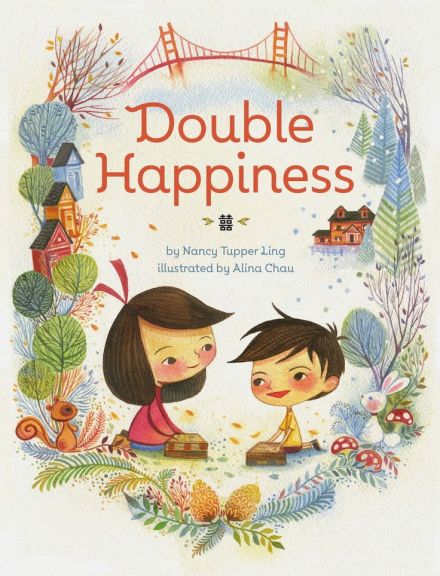
celebrate-picture-books-picture-book-review-Double Happiness by Nancy Tupper Ling Picture Book Review

About the Holiday

Summer is coming to a close and school is starting again. It’s a great time to reflect on the fun you’ve had in the warmer weather and all the memories that are about to be made as another year of activities, education, new friendships, and excitement unfolds. Happiness really does happen if you let it!

Double Happiness

Written by Nancy Tupper Ling | Illustrated by Alina Chau


This quiet, thoughtful picture book tells the story of a family’s move from China to America in a series of unrhymed verses that reveal the experience honestly from alternating viewpoints of a brother, Jake, and his sister, Gracie. Each page is dedicated to one sibling or the other with the Jake’s poems written in blue and Gracie’s in purple. In several poems the children interact with each other, the blue and purple lines acting as dialog tags.

In the first poem, The Move, Gracie stands on her doorstep surrounded by boxes and suitcases and thinks, “I won’t go! / I won’t move / away / from our city house / by the trolley tracks….” But Jake is more adventurous and in the second poem, Train, is already imagining his new room. After considering different décor, he decides what he really wants is something familiar, something outside—“just one long train / that rocks and wobbles / my bed each night. / I can’t fall asleep until the train passes by.”

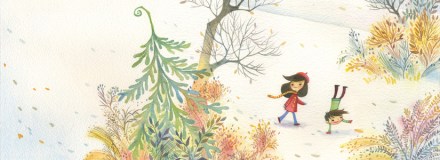
celebrate-picture-books-picture-book-review-double-happiness-train

Image copyright Alina Chau, 2015, courtesy of Chronicle Books

In Grandmother, the siblings are each given a happiness box by their Nai Nai, who wisely challenges her grandchildren to “Find four treasures each, / leading from this home / to your new.” Gracie takes this to heart, and readers see in Panda that even before leaving Nai Nai’s Gracie has added a favorite keepsake to her box: “Nai Nai’s panda sits / by the window / like always. / “I’ll miss you,” I say. / Nai Nai leans over me. / She places Panda / inside my box. / “He has a new home / now.”

Too soon moving day comes, and in Goodbye Gracie and Jake give hugs and kisses to beloved relatives. The search for items to fill Nai Nai’s boxes is taken up in the next three poems. In Treasure, Jake becomes a dragon keeping his “dragon eyes / wide open for stuff / along the way.” He is rewarded in Lucky, in which he discovers an old penny on the bus ride to the airport. In Leaf Gracie receives a surprising gift for her happiness box: “One stray leaf / flutters down / onto my box— / Eucalyptus! / If I had a koala I’d feed / her this minty meal all / day long— / the perfect treasure / to remind me of home.” 

In keeping with the long hours of travel from China to the United States, the next six poems chronicle the brother and sister’s experiences in the airport, waiting for their plane, and during the flight. Airport sees the children running, hopping, waiting, and navigating their way through the crowds of people to their gate. Dad is already tuckered out in Quiet, but Jake is wrangling to look for treasure: “’Huff puff. Puff huff.’” / Dragon blows fire. / Dragon stomps his feet. / “’Ssshhh, you’ll wake Daddy. / I giggle. / Gracie giggles. / “’Daddy can sleep / anywhere.’” Jake finally discovers gum in his backpack and creates a treasure. “I stretch it / and roll it / and ooze it / into one slinky snake / Sssssee, his penny pillow. / Sssssee, he’s kai xin— / so happy—in his brown box. / I’m tied with Gracie now— / two treasures each.”

celebrate-picture-books-picture-book-review-double-happiness-discovering-the-woods

Image copyright Alina Chau, 2015, courtesy of Chronicle Books

Adventures at the airport continue in Cat and Wings, and as the plane takes off Gracie draws pictures of the day’s events in Picture. In Here the children wake up to see their new city far below them and wonder, “can I find our house / from the sky?” Marble and Sadness juxtapose Jake’s happiness at finding another treasure for his box with the apprehension of Gracie as the plane lands and the family makes its way into their new country.

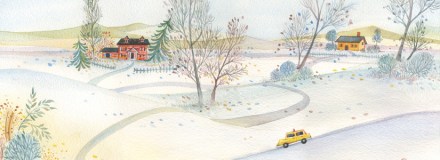
At last in Home the family reaches their new house by taxi. Gracie seems only to see the “piles of snow,” but Jake likes the “windy roads, lots of trees, and the curvy driveway.” In Explore Gracie and Jake walk around the countryside, and while Gracie still determines that she won’t like it, Jake hears a train and is happy. My Room and Dinner see the kids settling in, with a photograph of the family they’ve left behind accompanying them on the table while they eat. In A Surprise, Gracie finds that her grandmother is still with her through a special scarf, and in Paints Jake and Gracie accept the move as they paint their happiness boxes: Jake decorates his with a dragon and a train, while Gracie depicts herself and her brother walking in the snow and “they look very, / very / happy.”

celebrate-picture-books-picture-book-review-double-happiness-coming-to-new-house

Image copyright Alina Chau, 2015, courtesy of Chronicle Books

While Double Happiness tells the story of a family’s distant move, Nancy Tupper Ling’s gentle verses are appropriate for any situation involving change or uncertainty. She reminds children that happiness can be found wherever they are and all around them if they look for it. The poems flow as freely as thoughts, fears, and unguarded moments. As Gracie and Jake resolve their feeling, readers or listeners will also see that feelings of apprehension are common, and that happiness is waiting for them.

Alina Chau’s soft, lovely watercolor illustrations are beautiful representations of Gracie and Jake’s move from the familiar surroundings of their home in China to a new home in a snowy countryside.  The children’s emotions resonate as they alternate between sadness and happiness and between the concrete places of Nai Nai’s house, the airport, and their new city and their own imaginations of dragons, drawings, and dreams.

Ages 5 – 8

Chronicle Books, 2015 | ISBN 978-1452129181

Discover more books for children and adults by Nancy Tupper Ling on her website!

View a gallery of artwork by Alina Chau and more on her website!

Happiness Happens Activity

CPB - Happiness typography

Happiness Is…Game


Happiness is all around you! Grab one or more friends to play a game that reveals what things make you happy. Here are two ways to play:

  1. Like the “Geography” game: the first player names something that makes them happy, the next player must think of something that starts with the last letter of the word the previous player said. The game continues with each player continuing the pattern. Players drop out as they cannot think of a word. The last player left is the winner.
  2. Using a time limit (depending on age): players must think of something that makes them happy. Players drop out if they cannot think of a word within the time limit. The last player left is the winner.

Picture Book Review
August 23 – Ride the Wind Day

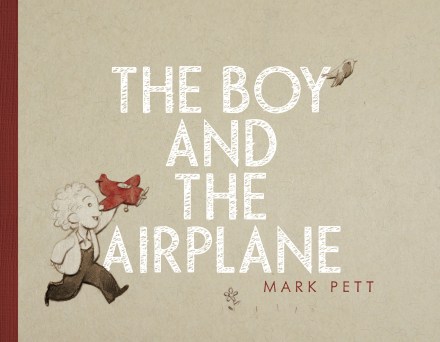
celebrate-picture-books-picture-book-review-the-boy-and-the-airplane-cover

About the Holiday

Today is set aside to honor the first manned air flight to win a Kremer Prize, a series of monetary awards established by Henry Kremer to commemorate pioneers in human-powered flight and administrated by the Royal Aeronautical Society. The first Kremer Prize was won on this date in 1977 by Dr. Paul MacCready when his Gossamer Condor, piloted by Brian Allen flew a figure eight around two markers one half mile apart. Three Kremer Prize milestones still remain to be accomplished. Today people are encouraged to spend time outdoors catching the wind with a kite, pinwheel, sailboat, or maybe with a toy airplane like the little boy in today’s book!

The Boy and the Airplane

By Mark Pett


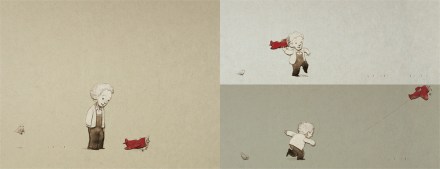
A little boy receives a present and watches the giver as he leaves. When the boy opens the box, he is thrilled to find a red airplane inside. He runs outside to play with it, zooming it up and down. Laying it on the ground, he then becomes an airplane, zooming around with his arms out as wings.

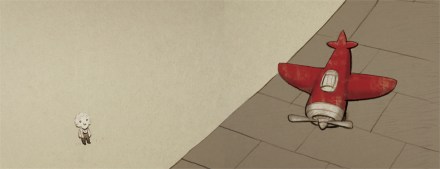
The boy looks at his plane and wonders. He picks it up and gives it a good, hard throw. It soars upward…upward, its propeller spinning as it speeds away. The boy chases after it then stops. His plane has come to a landing…on the roof. He ponders what to do for a moment, then gets a ladder. He leans the ladder against the house and climbs to the top rung, but he’s not nearly close enough. With child-like persistence, he tries different tactics—lassoing it, hitting it off with a baseball, jumping on a pogo stick, spraying it off with a hose—nothing dislodges his new toy.

celebrate-picture-books-picture-book-review-the-boy-and-the-airplane-throwing-plane

Image copyright Mark Pett, courtesy of simonandschuster.com

He sits down under a tree to think. As he reflects a whirlybird seed spirals down in front of him. He gazes at it, then goes to the garage for a shovel. He digs a hole, tosses the whirlybird in, pats down the dirt and waits. Snow falls on a tiny sapling as the boy in his coat, cap, and scarf keep it company. A future springtime sees both the boy and the tree older, with a little more height and hair and a little more height and leaves, respectively.

The tree grows tall and sturdy, complete with a bird’s nest and little peepers as the boy becomes an adult, complete with suit and tie and wiser peepers. By the time the boy reaches middle age, the tree’s trunk is thick and powerful, and as the boy matures to old age, the tree is strong enough to hold him. The elderly man climbs his tree’s branches and reaches over the eaves. His red plane is waiting for him, a little dusty now and tied down with cobwebs, but just as it was on that afternoon so long ago.

celebrate-picture-books-picture-book-review-the-boy-and-the-airplane-plane-on-roof

Image copyright Mark Pett, courtesy simonandschuster.com

With the exuberance of his youth, the man pulls back to give the plane a good, hard throw, but he stops. He considers his recovered toy and keeps it close instead, devising another plan for the airplane. He knows someone else who will like that plane as much as he did. he puts it in a box, wraps it and gives it to his granddaughter.

Mark Pett’s lovely, wordless picture book is a tribute to childhood, imagination, patience, and generational longevity. The subtle, vintage-style drawings in hues of brown on sage green backgrounds, punctuated only with the deep maroon red of the airplane, convey the feeling of permanence and the enduring presence of nature and familial love. The figure disappearing off the left-hand side of the first page after presenting the gift of the airplane to the little boy mirrors the clothes of the elderly man the boy has become as he gives the airplane to his granddaughter, passing down tradition and heritage.

Kids will also enjoy spotting the little bird that follows the boy on every page and hatches its own family in the branches of the mature tree. A close reading reveals deeper meanings and metaphors, comparisons and humor, making The Boy and the Airplane a perfect book for quiet story times or bedtime.

Ages 4 – 8

Simon & Schuster Books for Young Readers, 2013 | ISBN 978-1442451230

Discover more books by Mark Pett and what’s coming next on his website!

Ride the Wind Day Activity

celebrate-picture-books-picture-book-review-tiny-airplane-coloring-page

Tiny Toy Airplane Coloring Page


Is this airplane in the sky or at the airport? Or maybe it’s sitting in a field or at an airshow. It could be an attraction at a fair, or maybe it’s waiting to take you for a ride! Draw in whatever background you imagine and then color it! Get your Tiny Toy Airplane Coloring Page here!

Picture Book Review
August 16 – National Airborne Day

celebrate-picture-books-picture-book-review-brave-like-me-cover

About the Holiday

National Airborne Day was established in 1997 as a time to remember and thank the airborne members of the Armed Forces for their service and sacrifices. August 16 was chosen for this observance because it marks the first official United States Army parachute jump that took place in Georgia in 1940 by 48 volunteer members of the Parachute Test Platoon. The successful jump led the way for hundreds of thousands of paratroopers to follow in their footsteps. The day is commemorated by a ceremony at Fort Bragg in North Carolina, home to the 82nd Airborne Division. Other services are held around the country.

Brave Like Me

By Barbara Kerley


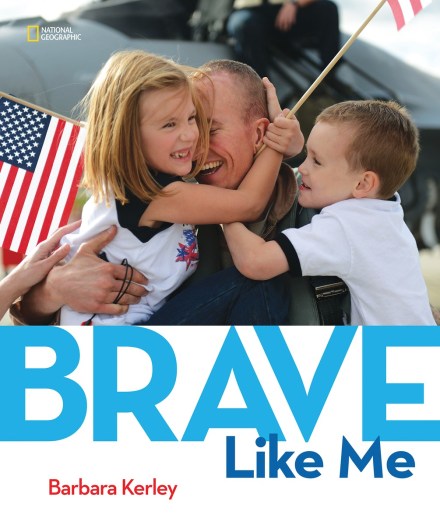
“When someone is serving their country, far from home, they have to be brave. Their families have to be brave. Even their kids have to be brave. Like me.” These lines from a child who has a parent serving their country opens this tribute to military families and the relatives, friends, and neighbors who support them. The child narrator reveals that parents about to be deployed spend a lot of time with their kids “until the day we have to say goodbye.” On that day the family shares kisses and hugs “big enough to last the whole time” parents are away.

Once parents are gone, the house seems empty and children wonder who will take care of them. They look at maps to discover where their parents are and what their day is like. The narrator describes children’s honest emotions, such as sadness and anger at the events parents miss or fear for their safety. But the kids understand that their parents are trained to stay safe.

The children are able to communicate with their parents on the phone and on the computer, where they share the details of their days. They also write letters and draw pictures that they send through the mail. Just as parents have responsibilities, the children know they have jobs to do too. They go to school, do their homework, and help around the house. The family bands together to cook meals, clean, read bedtime stories and tuck younger children into bed.

Friends and neighbors show they care by taking the kids on outings to the park, the movies, the pool, and to special events. Even though parents are far away from home, the child says, they think about their family all the time and want them to be happy playing with friends and pets and even when they are alone. The kids stay busy and enjoy their time with friends and family waiting for the day when they come home. On that day, the narrator says, “I’ll have lots of things to talk about and a million hugs and kisses to share.”

Through full-color photographic spreads and pages alternating between mothers and fathers serving in the military, Barbara Kerley presents an honest and uplifting account of what life is like for children of military families. The photographs of children playing with their parents and kissing and hugging them goodbye as well as pictures of both adults and kids doing their jobs while apart demonstrate the shared love and commitment military families have to their country and their relationships. Brave Like Me is a stirring nonfiction title for school and local libraries to help children understand the sacrifices some families make for their country. It would also be a comforting book for children facing a separation from a service member parent, other relative, or friend or for anyone who wants to better understand the life of service members.

A world map showing the location of each photograph in the book, a variety of children’s definitions of the meaning of “brave” and a discussion on the various branches of foreign service follow the text. There are also pages on how to deal with separation as well as advice and resources for caregivers.

Ages 4 – 8

National Geographic Children’s Books, 2016 | ISBN 978-1426323607

To learn more about Barbara Kerley and her wide range of books, visit her website!

National Airborne Day Activity

celebrate-picture-books-picture-book-review-military-plane-coloring-page

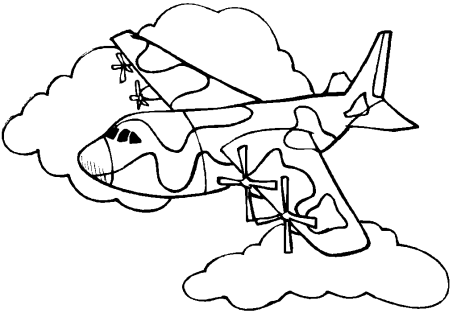
Military Plane Coloring Page


The Airforce uses many different types of planes in their missions. Here’s a printable Military Plane Coloring Page for you to enjoy!

August 14 – It’s Family Fun Month

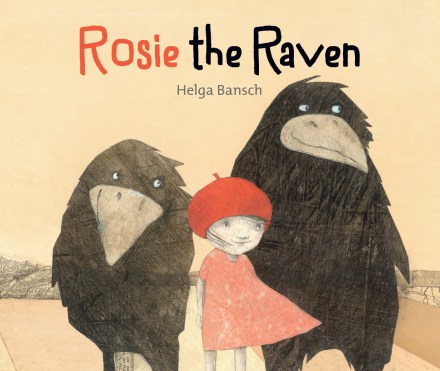
celebrate-picture-books-picture-book-review-rosie-the-raven-cover

About the Holiday

August is a perfect time to have fun with the family! The days are long and warm, and there are so many activities to discover. Get away from the heat at a pool, the beach, or on the cool shade of a forest path. Explore your adventurous side while camping or traveling to an unfamiliar town, or increase your knowledge by visiting a science, art, history, or other museum. Before school starts up for another year, get out there and have fun!

Rosie the Raven

By Helga Bansch | Translated by Shelley Tanaka


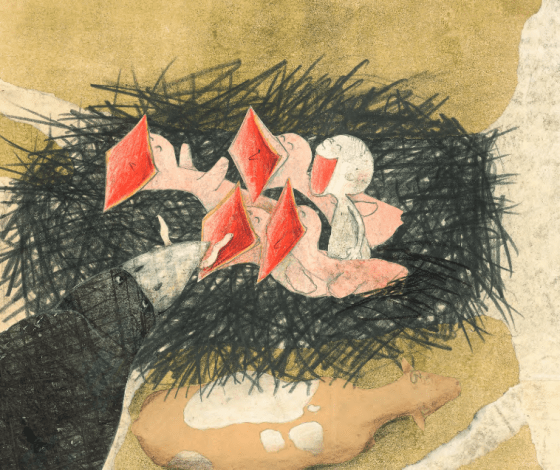
In a nest high in a tree, a little pink egg among the blue speckled ones hatches a little girl. As soon as all five babies are out of their shells, the hatchling says “Mama and Papa took us under their wings. It was nice and warm there.” The babies are hungry and the little girl, following the example of her brothers and sisters, opens her mouth wide to enjoy the “worms, flies, maggots, and snails.”

celebrate-picture-books-picture-book-review-rosie-the-raven-babies-eating

Image copyright Helga Bansch, courtesy of annickpress.com

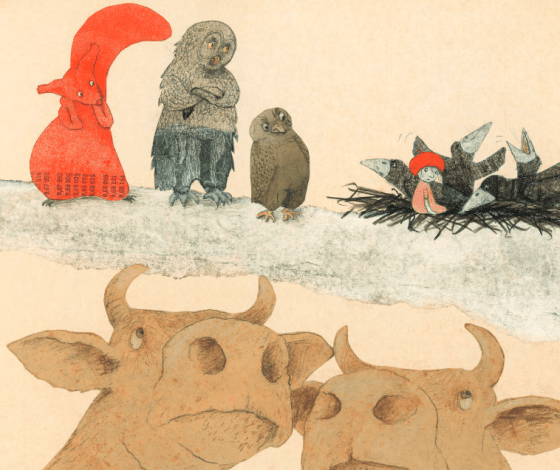
As they grow, the little ones “slept, had cawing contests and goofed around.” Because the little girl is always cold, her papa got her a red dress and hat. “‘Our little Rosie,’” Mama called me,” the girl says. Although Rosie and her nest mates are a happy family, Rosie says that “every day others would come and stare at us” as well as offer unsolicited advice: “‘It needs to exercise its wings” or, because they considered Rosie ugly without feathers, “Rub it with birch leaves. That will make its feathers grow.”

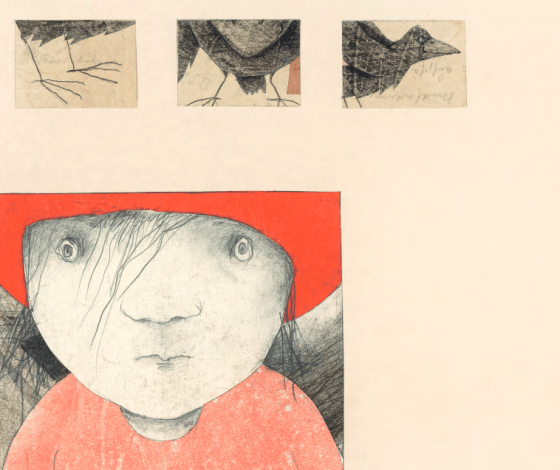
Under the critical gaze of these outsiders, Rosie looks at herself and notices for the first time that she is different than her Mama and Papa, her brothers and sisters. Her siblings are already learning how to fly, their caws are wild and resonant, and their feathers are fluffy and soft. In comparison, when Rosie flaps nothing happens, her voice sounds “pitiful,” and she has no fluff.

celebrate-picture-books-picture-book-review-rosie-the-raven-other-animals-judge

Image copyright Helga Bansch, courtesy of annickpress.com

Rosie “so wanted to be like them” that she beats her “wings over and over.” She caws until she is hoarse and rubs herself with birch leaves until her skin glows green. Soon she decides that “all this was just silly.” “‘I’m just different. And if the others talk about me, what do I care,’” she thinks. Besides, she learns that her “kind of wings are quite useful for other things.”

When Rosie’s siblings fly away from the nest after several weeks, the nest seems quiet. As the weeks progress and “the air began to smell like autumn, it was time to set out for the south.” Rosie’s parents practice flying with Rosie on their back until she can ride safely. Finally the day comes when they make the trip, and they find a new home in a tree that is perfect for Rosie to climb. Now it is her job to gather food for the family—which will soon include four new babies.

In her new home Rosie meets a frog who is going to teach her to swim. After their first meeting, the frog asks, “‘So, what are you really?’” “‘I am Rosie the Raven!’” Rosie squawks loudly. Then she goes home and climbs up to her nest in the tree, looking forward to tomorrow.

celebrate-picture-books-picture-book-review-rosie-the-raven-rosie-realizes

Image copyright Helga Bansch, courtesy of annickpress.com

Helga Bansch’s Rosie the Raven, bathed in tones of beige and black and punctuated with the red of Rosie’s cap and dress, is a quiet, but powerful book of what it means to be different and who defines that difference. The story of the Raven family is all the more eloquent and compelling for its being told through straight narration and not as a fairy tale or fable. The moment when Rosie looks at herself through others’ eyes, but quickly rejects the notion that her identity as a Raven is based on her having wings or feathers as well as her decision to stay with Mama and Papa affirms the idea that the true self is found within.

Bansch’s little Ravens are endearing as they frolic in the nest under the watchful and loving eyes of Mama and Papa. Rosie exudes a strong sense of confidence and happiness that readers will respond to. Bansch’s pages are a mix of panels, collages, and beautiful two-page spreads that give the book a distinctive look and feel. Fields and mountains are created from maps and bits of printed material in a variety of languages that emphasizes the book’s theme. Rosie the Raven could easily become a child’s favorite for bedtime or quiet story time and would be a wonderful addition to home as well as school libraries.

Ages 4 – 8

annick press, 2016 | ISBN 978-1554518340 (Austrian edition Die Rabenrosa: 978-3702658748)

To view more books and artwork by Helga Bansch, visit her website!

Check out more books for children and young adults at annick press!

Family Fun Day Activity

celebrate-picture-books-picture-book-review-bungalow-house-coloring-page

Home is Where Your Heart Is Coloring Pages

Apartments Coloring Page

Bungalow Coloring Page

August 13 – Garage Sale Day

celebrate-picture-books-picture-book-review-yard-sale-book-cover

About the Holiday

Isn’t every nice-weather Saturday garage sale day for someone? Nevertheless, the second Saturday in August has officially been designated with this special shopping moniker. Garage sales aka yard sales are fun to explore—you never know what treasures you might find. Hosting your own can free up space in your house to start fresh or, as in today’s book, reaffirm the most important things in life.

Yard Sale

Written by Eve Bunting | Illustrated by Lauren Castillo


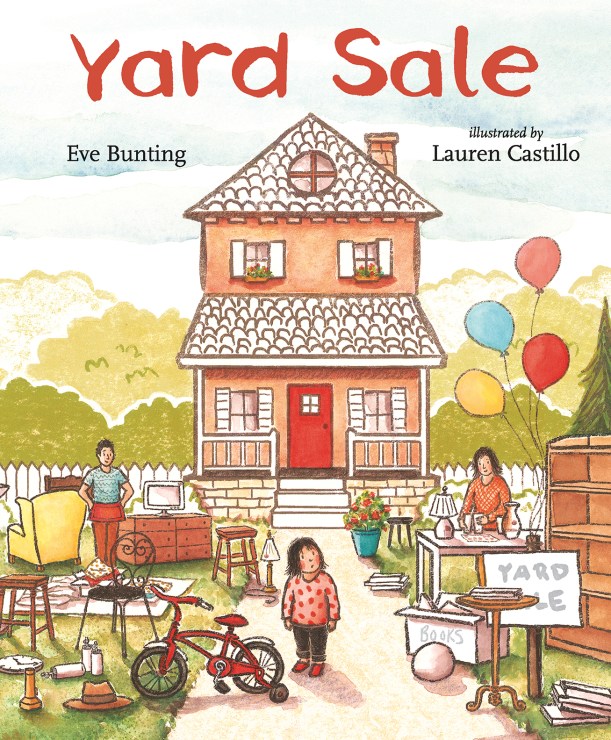
From the first words—“Almost everything we own is spread out in our front yard”—readers realize that this is no ordinary yard sale. A little girl sits on the front porch of her tidy house gazing out sadly at the family’s furniture, toys, books, and knick-knacks that are all for sale. The family is moving to a small apartment: “‘Small but nice,’ my mom told me.” The apartment has a secret bed that opens down from the wall “right in the living room.”

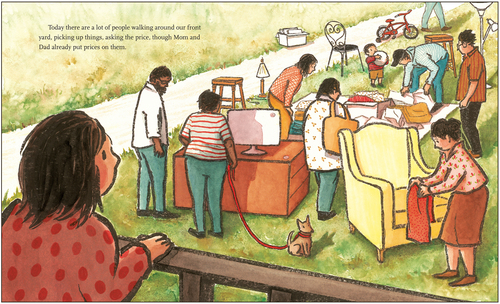
When the yard sale opens people stop by to look, “picking up things, asking the price, though Mom and Dad already put prices on them.” Even though the items are priced low, people haggle over how much they want to pay. A woman complains that ten dollars is too much for the little girl’s bed because the headboard has crayon marks on it. Watching, Callie now wishes she hadn’t made the marks to show how often she had read Goodnight Moon. Her mother settles for five dollars for the bed.

celebrate-picture-books-picture-book-review-yard-sale-bike-sold

Image copyright Lauren Castillo, courtesy of laurencastillo.com

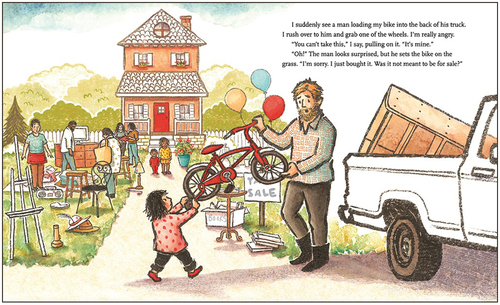
Suddenly, Callie sees a man loading her bike into a truck and runs to grab it. The man is confused, sorry for taking it, but tells her he has just bought it. Callie’s dad runs over and explains again that the apartment has no place for the bike or sidewalks nearby to ride it on. Callie looks at her dad who seems to have tears in his eyes, “but probably not,” she says. “My dad doesn’t cry.” She relinquishes the bike, but asks the man, “‘Will you give it back to me when we get our house back?’”

Callie’s best friend, Sara, is waiting for her. The two friends hug and talk about why Callie has to move. “‘I wish you didn’t have to go,’” Sara mutters. “‘Why do you, anyway?’” Callie shrugs. “‘I don’t know. It’s something to do with money.’” They don’t understand what has happened, and Sara offers, “‘I could ask my parents if you could stay with us.’” But Callie’s heart tells her where she belongs. “‘My parents would be lonely,’” she says. “‘…I’d miss my mom and dad.’”

The sale continues and people drive away with tables, chairs, and clothing. For a moment, Callie feels important when a man asks her if their large potted geranium is for sale and she directs him to her dad. By the end of the day almost everything is gone. Callie’s mom “looks droopy” and her dad is comforting her. Callie sits dejectedly watching the final things being carried away and thinking that she will give Sara her red heart necklace and invite her to visit their new apartment.

celebrate-picture-books-picture-book-review-yard-sale-callie-watching

Image copyright Lauren Castillo, courtesy of laurencastillo.com

At that moment a woman comes up to Callie and says, “‘Aren’t you just the cutest thing? Are you for sale?’” Callie has a visceral reaction: “A shiver runs through me, from my toes to my head.” She runs to her parents, crying. “‘I’m not for sale, am I? You wouldn’t sell me, would you?’” Her parents drop what they are doing to hug and reassure Callie that they would “‘not ever ever, ever’” sell her. “‘Not for a million, trillion dollars.’”

With everything gone, Callie and her parents go back inside their “almost empty house.” It’s okay, Callie thinks. None of the stuff is important, and it wouldn’t fit in their new place anyway. “But we will fit in our new place. And we are taking us.”

For so many children frequent relocations or sudden moves from a home they know is a reality. Eve Bunting’s Yard Sale treats this subject with sensitivity and honest emotion through the eyes of a little girl for whom the change is confusing but ultimately reassuring. Bunting does not stint on either the setting of the yard sale itself, where people quibble over a couple of dollars, or the toll the day takes on the family. Her dialogue always rings true, and her straightforward delivery allows for understanding and for the moments of humor to shine through.

Lauren Castillo’s ink-and-watercolor paintings anchor this emotional story in a homey, loving environment even as they realistically portray the atmosphere of the yard sale. The full range of feelings are apparent in the characters’ faces from sadness and doubt to kindness and acceptance. Children will respond to Callie with her earnest attempts to understand and feel the comfort and encouragement Callie receives as her parents bend down to talk to her, hold her hand, and give her hugs.

Yard Sale is a poignant story that offers assurance and insight both for children who are facing a move and the friends and classmates who will miss them. The book’s theme is applicable to other daunting circumstances and would be a welcome addition to classroom and local libraries as well as for individuals encountering change.

Ages 4 – 9

Candlewick Press, 2015 | ISBN 978-0763665425

To view more books and artwork by Lauren Castillo, visit her website!

Garage Sale Day Activity

celebrate-picture-books-picture-book-review-garage-sale-maze

Garage Sale Maze


A garage sale is a bit like a treasure hunt. Can you find your way through this printable Garage Sale Maze from the roadside sign to the items for sale? Here’s the Solution!

July 30 – International Day of Friendship

celebrate-picture-books-picture-book-review-hector-and-hummingbird-cover

About the Holiday

First established in 2011 by the United Nations General Assembly, the International Day of Friendship asserts the idea that friendship between peoples, countries, cultures, and individuals can inspire peace efforts and build bridges between communities. The UN resolution places particular emphasis on involving young people in community activities that include different cultures and promote respect for individual diversity. On this day UN Secretary General Ban Ki-moon urges everyone, especially young people who will be our future leaders, “to resolve to cherish and cultivate as many warm relationships as possible, enriching our own lives and enhancing the future.”

The day is celebrated with special initiatives, events, and activities that promote dialogue, education, understanding, and cooperation.

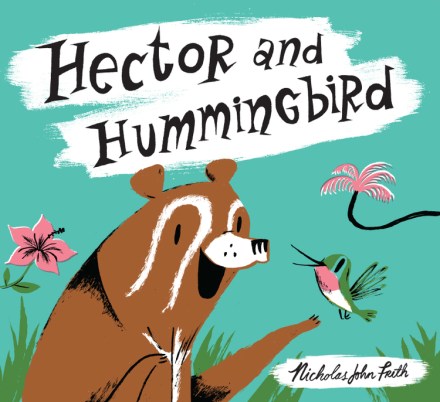
Hector and Hummingbird

By Nicholas John Frith


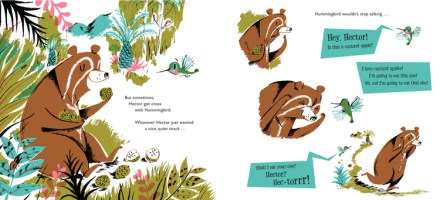
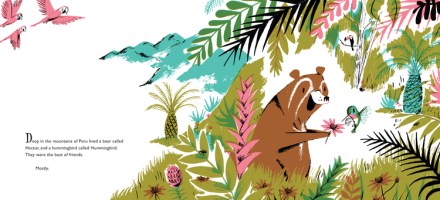
Deep in the mountains of Peru Hector and Hummingbird have forged an unbreakable friendship. “Mostly.” Hummingbird has lots of energy and loves to hover around his best bear pal. Which is ok, except sometimes Hector would just like a little quiet time, and Hummingbird won’t stop talking: “Hey, Hector! Is that a custard apple? I love custard apples! I’m going to eat this one! Oh, no! I’m going to eat that one! Shall I eat your one! Hector? Hec-torrr!” Sometimes a simple alone-time scratch would be just perfect, but Hummingbird copies him on a tree nearby: “Hey, Hector! Are you scratching? I’m going to scratch too!…” And nap time? Forget it! Hummingbird always keeps Hector awake with some story. It’s enough to make Hector cross with Hummingbird!

One day Hector can’t take it anymore—“‘Arrgh!!’” he roars. “‘Leave me alone!’”—and he takes off into the forest to find some peace. Hector’s outburst comes as a surprise to Hummingbird. He needs to find out what’s wrong, so he follows Hector into the woods, his constant hum filling the air. “‘Stop following me!’” Hector says. And Hummingbird complies—mostly. From behind leaves and tree trunks Hummingbird spies on his friend.

celebrate-picture-books-picture-book-review-hector-and-hummingbird-interior-art-bear-cross

Image copyright Nicholas John Frith, courtesy of zoetucker.co.uk

As Hector delves deeper and deeper into the woods, he feels an unfamiliar excitement and also a bit of trepidation. Perhaps he’s just hungry, Hector thinks. He picks a custard apple to quell the gnawing in his stomach. The fruit tastes delicious, but Hector also feels funny eating alone. He imagines how much Hummingbird would enjoy the apple too.

The scratchiest tree Hector has ever seen beckons to him, and he settles in for a nice, quiet scratch. But again he experiences that twinge of loneliness. As the forest becomes dark, Hector finds a branch to snooze on. The night air is full of strange noises, and Hector is a little scared. “‘I wish Hummingbird were here,’” sniffs Hector. “‘He could tell me a story.’”

That’s all Hummingbird needs to hear. “A story? Yay! You should have said! I love telling stories! Once upon a time…” This time Hector doesn’t roar or run away. He exclaims, “‘Hummingbird! You’re here! I missed you!’” Hummingbird admits that he missed Hector too, and that he was there all the time. “Here all along?” says a surprised Hector. “I thought I told you not to follow me!”

celebrate-picture-books-picture-book-review-hector-and-hummingbird-interior-art-best-friends

Image copyright Nicholas John Frith, courtesy of zoetucker.co.uk

“But why?” Hummingbird asks. This time Hector doesn’t keep his thoughts inside. “‘Because you never stop talking!’” he answers. “‘And you’re always copying me!” Hummingbird has ready reasons. He’s only being friendly, he explains. And he loves Hector’s ideas. “‘Oh,’” says Hector. “‘Really?’” Then Hector has a brain storm. He asks Hummingbird if he can copy his being really, really quiet. “Absolutely!” Hummingbird says. And he does—in his Hummingbird sort of way, which sounds like this: “Hey, Hector? This is fun, isn’t it? We’re being really, really quiet, aren’t we? I love being quiet, don’t you? Hector? Hec-torrr?”

Nicholas John Frith humorously exposes the niggling burrs of true friendship with his endearing and inspired pairing of a quiet bear and an energetic hummingbird. While best friends love to spend time together, have lots in common, and share a history, they also share moments of frustration, misunderstanding, and vexation. Through Hector and Hummingbird, Frith reveals what happens when communication breaks down and resentments build up. Readers will see that true friendship consists of both honest dialogue and accepting people for who they are.

Frith’s jungle environment, rendered in a palate of vintage aqua, pink, green, brown, and black on a white background gives the story a fresh, bold appeal while highlighting the emotional responses of the characters to maximum effect. As day turns to night, Hector—having gone off in a huff—realizes that he misses his friend and moreover misses the very things that annoyed him about Hummingbird. His expressions of sadness and loneliness, delight at seeing Hummingbird again, and then confusion as to why Hummingbird is there in the first place can lead kids into an understanding that even the best of friends have differences.

Hector and Hummingbird offers kids both amusing and teachable moments with two funny, charming characters to escort them on the journey. An animated storyteller will have kids asking for this book again and again. It’s a great addition to the family library.

Ages 4 – 8

Arthur A. Levine Books, Scholastic, 2015 | ISBN 978-0545857017

Have fun perusing Nicholas John Frith’s online portfolio of illustrations, projects, and products!

International Day of Friendship Activity

celebrate-picture-books-picture-book-review-friendship-coloring-page

Best Friends Coloring Pages


Friends like to play together and color together! Here are two printable pages for you to have fun with. Why not text a friend and color them together?

Coloring Page 1

Coloring Page 2