April 21 – It’s Global Astronomy Month

celebrate-picture-books-picture-book-review-the-little-spacecraft-that-could-cover

About the Holiday

Instituted by Astronomers Without Borders, a group who sees in our shared sky an opportunity to create “a global community that appreciates, studies, and shares the wonders of the universe, to broaden perspectives, transcend borders, and improve lives,” The group’s goals are twofold: to inspire and empower a worldwide community of astronomy enthusiasts and educators through astronomy-related programs and to cultivate a diverse, international community dedicated to sharing the Earth’s resources equitably. To try to accomplish these goals, Global Astronomy Month brings people together with arts activities, parties, and special events. To find resources, such as April sky maps in English and Spanish, and more information on how you can participate, visit the Astronomers Without Borders website.

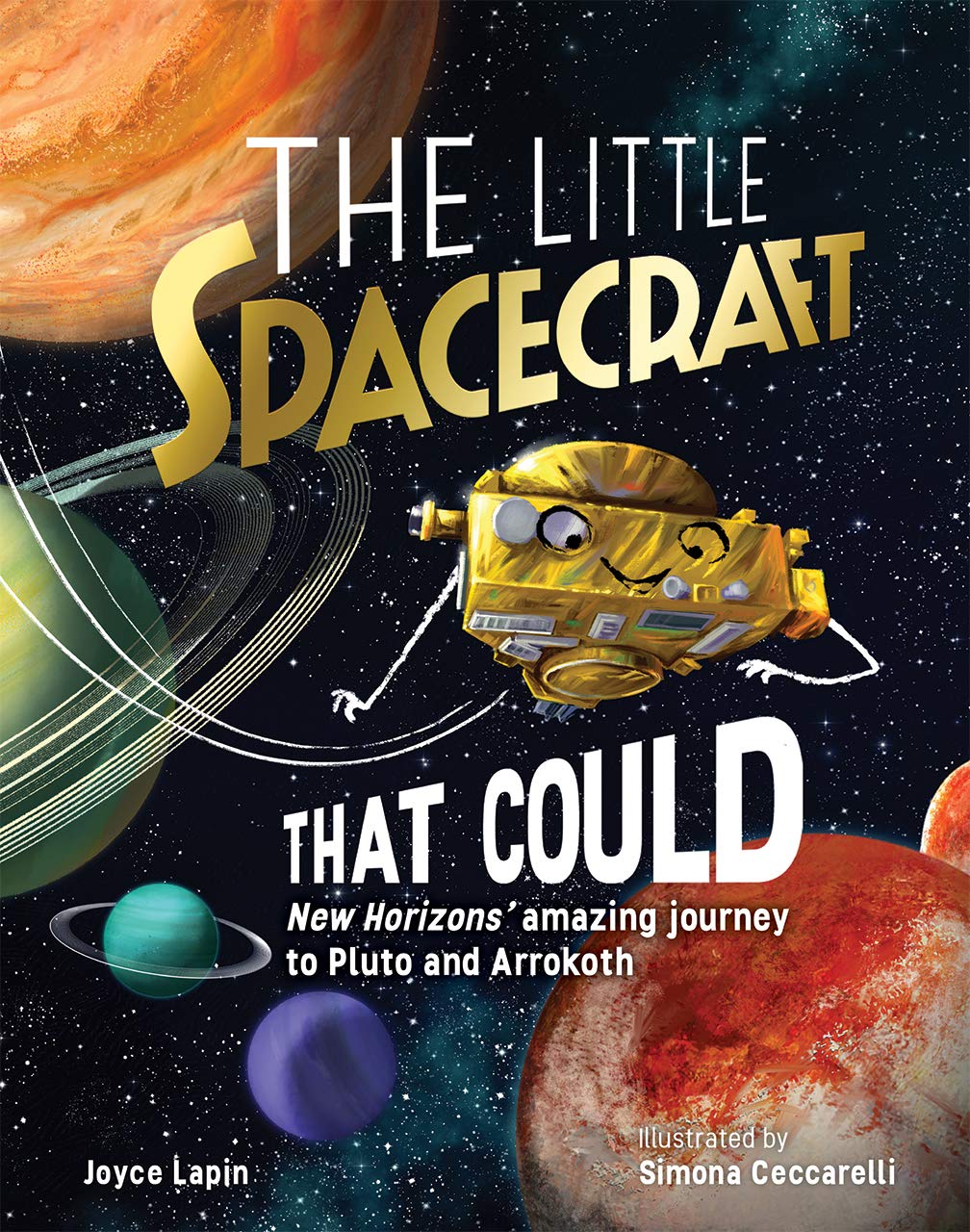
The Little Spacecraft That Could: New Horizons’ Amazing Journey to Pluto and Arrokoth

Written by Joyce Lapin | Illustrated by Simona Ceccarelli


As the little spacecraft blasted away from the launch pad on January 19, 2006, she thought that her name—New Horizons—“was a brave-sounding name. And you had to be brave to fly to the edge of the solar system.” New Horizons was on her way to Pluto—the first spacecraft to do so. Zooming through space, her engines dropped away in stages. Free of these engines the little spacecraft, “no bigger than a small piano… streaked through space at more than 10 miles per second.”

While she soared, New Horizons wondered what she would find when she finally reached Pluto. She knew that everyone was counting on her to provide answers about this mysterious planet. People had a lot of questions, and New Horizons had a lot of time to ponder them. In fact, it would take her “nearly 10 years to reach Pluto.” Things were going well for New Horizons. She was on track and jogging along at 36,000 miles an hour… but then on August 24, 2006, astronomers decided Pluto wasn’t big enough to be considered a planet and demoted it to dwarf planet status.
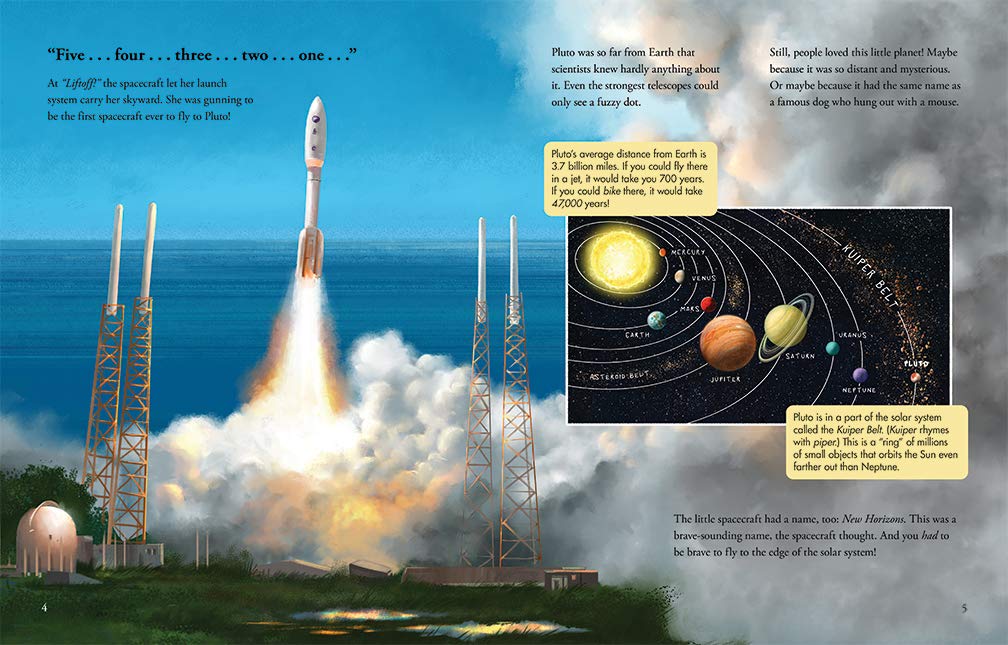
celebrate-picture-books-picture-book-review-the-little-spacecraft-that-could-launch

Image copyright Simona Ceccarelli, 2021, text copyright Joyce Lapin, 2021. Courtesy of Sterling Publishing.

Planetary scientists didn’t and don’t agree with this change, and New Horizons? She just wanted to complete her mission, and she had to concentrate on what came next—meeting up with Jupiter at just the right time to take advantage of this giant planet’s gravitational pull to speed up her trajectory toward Pluto. Carefully, New Horizons got into position. She sped faster and faster and was flung into space, heading toward her destination at “nearly a million miles per day.”

Now and for the next eight years, New Horizons would fly on autopilot while she took a well-deserved nap that would conserve fuel as well as her computers and instruments. Periodic wake-ups by the scientists on Earth made sure everything was going well. Finally, on December 6, 2014 it was time for New Horizons to wake up and go to work. She wouldn’t be landing on Pluto but doing a “flyby” 7,800 miles away from the surface of Pluto. At this distance the photographs she took would be clear and her other instruments for listening, smelling, feeling, and measuring other aspects of Pluto and its atmosphere would work too.
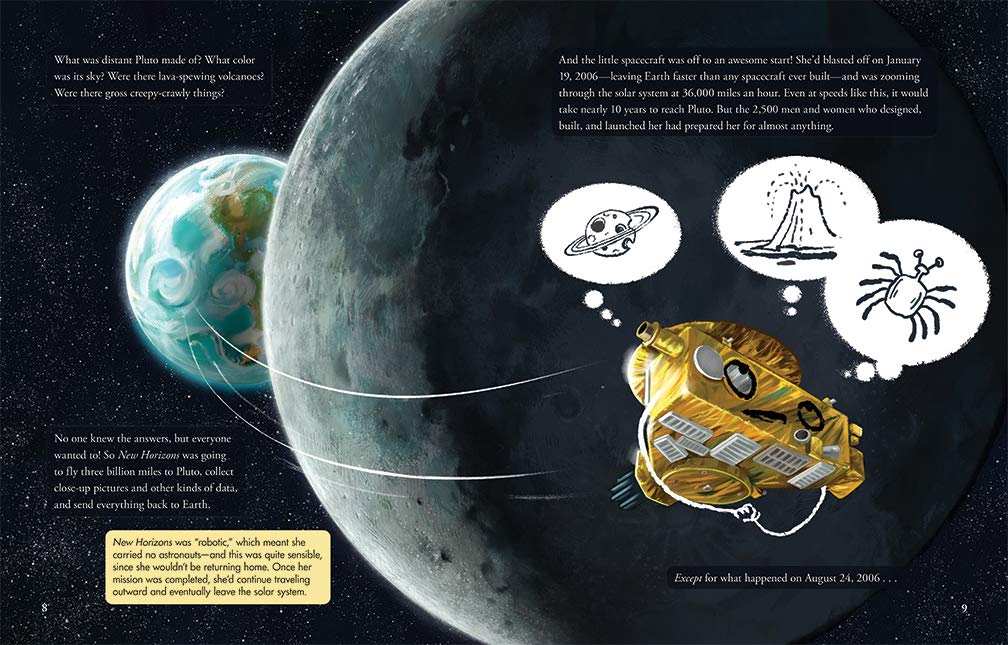
celebrate-picture-books-picture-book-review-the-little-spacecraft-that-could-robotic

Image copyright Simona Ceccarelli, 2021, text copyright Joyce Lapin, 2021. Courtesy of Sterling Publishing.

New Horizons couldn’t wait to get started and began snapping pictures “from half a million miles out.” What people saw when she sent back her photos “sent the internet on fire.” It appeared that Pluto was holding a white heart—a valentine for Earth. “Everybody loved the dwarf planet with a heart!” This heart is actually a glacier made of nitrogen, which on Pluto’s cold surface forms ice instead of gas like on Earth

On July 14, 2015, New Horizons at last reached her optimal distance, and what wonders she uncovered! Towering ice mountains, valleys deeper than the Grand Canyon, “‘ice blades’ the height of New York City skyscrapers,” and “‘ice volcanoes’…that spew out icy slush instead of lava.” This was only the beginning of what scientists discovered. Measurements also showed that Pluto was larger than was thought—bumping it up “from second-largest dwarf planet to the largest.”
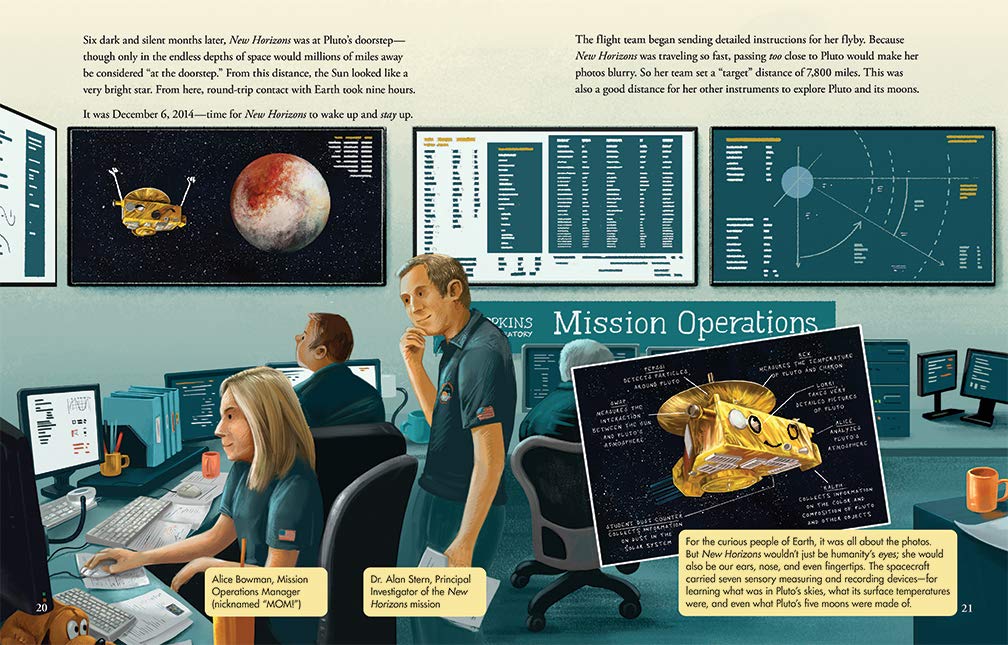
celebrate-picture-books-picture-book-review-the-little-spacecraft-that-could-control-room

Image copyright Simona Ceccarelli, 2021, text copyright Joyce Lapin, 2021. Courtesy of Sterling Publishing.

New Horizons also took pictures and measurements of Pluto’s moons and, after snapping one last picture: Pluto “‘crowned’ with the hazy blue glow of its atmosphere” while lit from behind by the Sun, New Horizons was off for Arrokoth, an object in the Kuiper Belt that hadn’t even been discovered when she blasted off from Earth all those years ago. A billion miles later, New Horizons reached Arrokoth on January 1, 2019. New Horizons continues to send information about this fascinating body, and because she’s still so “robust…her team wants [her] to visit an even more distant Kuiper Belt world in the 2020s. No one doubts she can do it.

In addition to the story about New Horizons’ journey, each page contains illustrated insets with detailed facts and information about the New Horizons spacecraft, Pluto, our solar system, how the planets were named, and more.

Back matter includes a timeline of New Horizons’ journey, an extensive glossary, a list of books for further reading and research, and a list of internet resources where readers can see videos and learn more about New Horizons and her mission.

celebrate-picture-books-picture-book-review-the-little-spacecraft-that-could-pluto-heart

Image copyright Simona Ceccarelli, 2021, text copyright Joyce Lapin, 2021. Courtesy of Sterling Publishing.

Joyce Lapin’s thrilling true tale of New Horizons’ mission to Pluto and beyond lends pep and personality to this little spacecraft that the world watched blast off with the heart and anticipation of a parent sending their child off on their first day of school. Her engaging storytelling helps kids understand and appreciate the magnitude of New Horizons’ flight and all it has accomplished. Lapin’s clear descriptions of the various stages of the mission, scientists’ expectations, and the tricky maneuvering necessary to put New Horizons at the right place at the right time are delivered smoothly and concisely.

Scientific vocabulary and definitions are woven seamlessly throughout, enhancing the reader’s understanding without their losing any of the suspense. Kids will identify with the childlike nature of New Horizons’ confidence in herself and commiserate with her dismay when Pluto is demoted. Readers will cheer on this little spacecraft as her mission is expanded and will be excited to learn more about what New Horizons has already discovered and what she will find in the future.

Simona Ceccarelli’s illustrations are nothing short of phenomenal. Photographic in detail, Ceccarelli’s vibrant images take kids from the launchpad with the fiery rocket boosters produce clouds of smoke as the spacecraft climbs into the sky, into outer space, where they see how the engines disengaged to set New Horizons free to navigate past Mars, pick up speed from Jupiter (shown in its colorful, striped glory) and rocket past Saturn (the rocky debris of its icy rings clearly visible) to become just a dot in the black sky.

Ceccarelli also takes readers into the control room where graphs, screens, coordinates, and more line the walls and computers stand side-by-side on the desks and carefully observed by the mission’s directors. Images of the heart on Pluto include internet snapshots that will remind some readers of how the world reacted to the first images sent back by New Horizons.

The final images of Pluto, showing a landscape of ice blades, deep canyons, mountains, and swirling patterns of color and then backlit by the Sun, are breathtaking. The spacecraft itself is lightly anthropomorphized with expressive eyes and mouth and cable-thin arms. Drawn from all sides, the images of New Horizons give kids a good a look at this amazing spacecraft.

A sensational achievement in presenting the scientific and human accomplishments involved in the New Horizons mission as well as an exhilarating overview of our solar system, The Little Spacecraft That Could would be a stimulating addition to science units for elementary and high school students to spark a love for astronomy, engineering, research, and other related subjects. The book will be a favorite and is a must for home, classroom, and public library collections.

Ages 7 and up

Sterling Children’s Books, 2021 | ISBN 978-1454937555

Discover more about Joyce Lapin and her books, visit her website.

To learn more about Simona Ceccarelli, her books, and her art, visit her website

Global Astronomy Month Activity
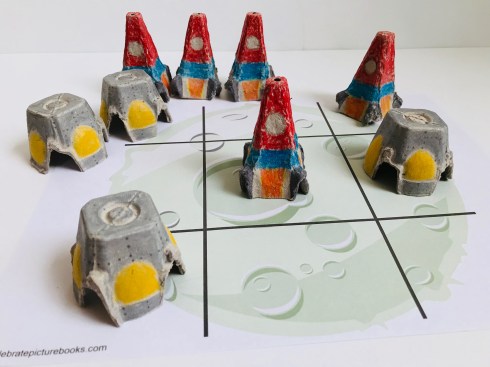
celebrate-picture-books-picture-book-review-rocket-to-the-moon-tic-tac-toe-game

Out-of-This-World Tic-Tac-Toe Game


You can launch your own Tic-Tac-Toe Game with this set you make yourself! With just a couple of egg cartons, some crayons, and a printable game board, you’ll be off to the moon for some fun! Opposing players can be designated by rockets and capsules. Each player will need 5 playing pieces. 

SUPPLIES

  • Printable Moon Tic-Tac-Toe Game Board
  • 2 cardboard egg cartons
  • Heavy stock paper or regular printer paper
  • Crayons
  • Black or gray fine-tip marker

DIRECTIONS

To Make the Rockets

  1. Cut the tall center cones from the egg carton
  2. Trim the bottoms of each form so they stand steadily, leaving the arched corners intact
  3. Pencil in a circular window on one side near the top of the cone
  4. Color the rocket body any colors you like, going around the window and stopping where the arched corners begin
  5. With the marker color the arched corners of the form to make legs
  6. On the cardboard between the legs, color flames for blast off

To Make the Capsule

  1. Cut the egg cups from an egg carton
  2. Color the sides silver, leaving the curved section uncolored. (If your egg cup has no pre-pressed curve on the sides of the cup, draw one on each side.)
  3. Color the curved section yellow to make windows
  4. With the marker, dot “rivets” across the capsule

Print the Moon Game Board and play!

celebrate-picture-books-picture-book-review-the-little-spacecraft-that-could-cover

You can find The Little Spacecraft That Could at these booksellers

Amazon | Barnes & Noble | Books-a-Million

To support your local independent bookstore, order from

Bookshop | IndieBound

Picture Book Review

April 20 – It’s Medical Laboratory Professionals Week

celebrate-picture-books-picture-book-review-germs-up-close-cover

About the Holiday

Instituted in 1975, Medical Laboratory Professionals Week aims to raise awareness of and an appreciation for the importance of laboratory professionals to patient care. Better and more accurate diagnoses as well as targeted treatment are accomplished through the specialized knowledge and dedication of laboratory technicians. This year, especially, we celebrate these individuals who have worked tirelessly to help create a vaccine to combat the COVID-19 virus. Laboratory Science can be an exciting and rewarding career choice for science– and medical-minded students. To learn more about today’s holiday and the work of laboratory professionals, visit the American Society for Clinical Laboratory Science website and LibraryScienceCareers.

Germs Up Close

By Sara Levine


You know they’re there. It’s hard to forget, since people keep reminding you: “wash your hands,” “use sanitizer,” “sneeze into your elbow,” “don’t leave food out too long.” But since you can’t see the germs, it can be hard to remember all the time. If only you could see what everyone is warning you about that might make it easier. Well, now you can with Sara Levine’s book Germs Up Close (and I mean really, really close), which also tells you exactly where germs come from and what they do.

How can you see a germ? “With special magnifying equipment and some dye to make their parts show up,” you can see exactly what different kinds of bacteria, protozoa, fungi, and viruses look like. And you might be surprised to discover that they are very “interesting and beautiful to look at.” Levine lets you in on some fascinating facts about each type of germ, including how its name is pronounced, its common name, its microscopic appearance, where it lives, some diseases it causes, and some more you ought to know. So, let’s get started.

Okay, let’s have a show of (clean) hands! “Have you ever had a cavity? An ear infection? Strep throat?” Yeah? Then you’re already acquainted with bacteria. Sounds bad, huh? Well, yes and no. Levine explains that the majority of bacteria on your body are actually helpful. It’s the bad bacteria that can make us sick that are called germs. In her section on bacteria, Levine introduces kids to salmonella, spirillum, staphylococcus, streptococcus, and Escherichia coli (better known as E. coli) with colorful photographs of each of these “round, hotdog-shaped, or wormlike and squiggly bacteria.

Next up are protozoa. You know not to drink pond water or dirty water, right? These little, one-cell-big guys are the reason why. Here, kids learn about “trypanosoma, the germ that causes sleeping sickness,” plasmodium, which causes malaria, and giardia, which causes giardiasis, an intestinal infection. Turning the page, they’ll discover different kinds of fungi, some of which are edible, like mushrooms and yeast, and others which can produce itchy rashes, yeast infections, or ringworm. 

celebrate-picture-books-picture-book-review-germs-up-close-bacteria

Copyright Sara Levine, 2021, courtesy of Millbrook Press.

And now we come to a germ you’re all very familiar with: the virus. If you’ve had a cold or the flu or “been vaccinated against viral infections that used to be very common such as mumps, measles, and chickenpox,” you’ve heard about viruses. And, of course, we all know about the coronavirus. But what do these germs look like? Kids get to see them in all of their round, peas-in-a-pod, peanut-shaped, or knob-covered wonder. 

But how can we stop germs in their tracks or fight them when they do invade? “The good news is that our bodies take care of most of this for us” through our immune system. Levine gives kids a detailed overview of the ways our skin, mucus, saliva, and stomach acid combat the germs that assail us. She also talks about the different kinds of white blood cells we have and how each kills germs. Illustrations show what the five types of white blood cells look like and their comparative sizes.

Levine reminds kids of all the ways people can protect themselves from surface and air-borne germs as well as germs that are transmitted through food and water. Her discussion on vaccines explains how they work and prepare white blood cells to recognize and fight germs. Still, sometimes we do get sick, and Levine reassures kids that there are medicines for each kind of germ that can make the better.

A glossary, a list of eleven careers that revolve around germs or helping sick people, and resources for further reading or research follow the text.

Sara Levine strikes just the right balance of humor and hard science facts in her engaging and educational book about the germs that make us sick as well as good bacteria and fungi, how our body protects us from most germs, and the vaccines and medicines that help us get well. Through her compelling writing style, Levine presents complex concepts in ways that make it easy for readers to embrace biological and medical science and get excited about research and learning more.

The stunning color photographs of various types of bacteria, fungi, protozoa, and viruses with their unusual shapes – some sporting protrusions like a hairbrush and others that look like they could be the stars of their own sci-fi picture book or TV show – will wow kids and spark a fascination for this important field of knowledge and research.

A fantastic book to add to home libraries for kids who are interested in medicine, biology, veterinary science, and other research sciences, Germs Up Close is a must for school libraries to enhance science, STEM, and research lessons as well as for public library collections.

Ages 5 – 10

Millbrook Press, 2021 | ISBN 978-1728424088

Discover more about Sara Levine and her books on her website.

Medical Laboratory Professionals Week Activity

celebrate-picture-books-picture-book-review-germs-word-search

Look Out for Germs! Word Search


Find the twenty-three words associated with germs in this printable word search puzzle.

Look Out for Germs! Word Search Puzzle | Look Out for Germs! Word Search Solution

celebrate-picture-books-picture-book-review-germs-up-close-cover

You can find Germs Up Close at these booksellers

Amazon | Barnes & Noble | Books-a-Million

To support your local independent bookstore, order from

Bookshop | IndieBound

Picture Book Review
April 19 – It’s National Frog Month

celebrate-picture-books-picture-book-review-elliot-the-heart-shaped-frog-cover

About the Holiday

With the rainy weather of April, swampy areas and wetlands swell with water, and peeps and throaty croaks begin to fill the nighttime air. April is the perfect time to learn more about the more than 4700 species of frogs as well as their importance to the ecosystem. Frogs are vital to the food system, and they eat insects that are harmful to crops and carry disease. Because they don’t drink water but absorb it through their skin, frogs are particularly susceptible to pollution. In addition, habitat destruction, climate change, and an increase in invasive species threaten the frog population, making the conservation of their environment of utmost importance. To raise awareness of the importance and threats to frogs, Save the Frogs conservation organization has established April 24 as Save the Frogs Day. You can learn more about their work and how you can participate on the Save the Frogs website. To celebrate National Frog Month, hop over to I Love Veterinary for some toad-ally awesome activities and facts about these fascinating amphibians!

Elliot the Heart-Shaped Frog

Written by Matt Forrest Esenwine | Illustrated by Anna Kubaszewska


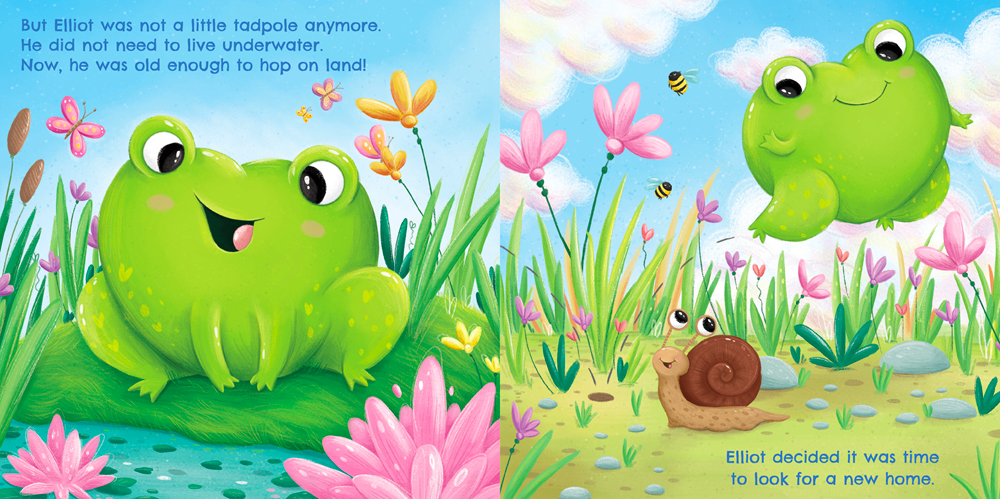
When Elliot was a little tadpole, he lived in the pond, making friends with the fish and sea creatures who lived there too. But Elliot had lost his tail, grown strong legs, and acquired the ability to breathe air. “Now, he was old enough to hop on land!” Elliot began looking for a new home. He wanted his home to be just right.

He spied a “blue, square-shaped stone, but it was too cold.” The next spot he tried was round and “too hard.” He found a “diamond-shaped patch of grass” and a bumpy log, but those weren’t quite right either. He tried hopping onto lots of things he found in the woods—and even into an old discarded box, but none of these places felt like home.

celebrate-picture-books-picture-book-review-elliot-the-heart-shaped-frog-snail

Image copyright Anna Kubaszewska, 2021, text copyright Matt Forrest Esenwine, 2021. Courtesy of Rainstorm Publishing.

Under the full moon, Elliot went to sleep and had a sweet dream about finding a home and making a new friend. When he woke up, there on the pond, floated a green “heart-shaped lily pad.” Elliot leaped on. It felt just right. And not far away, a little girl frog was waving at him. Elliot gathered a little bouquet of flowers and went to her pad to visit “his new heart-shaped friend.”

celebrate-picture-books-picture-book-review-elliot-the-heart-shaped-frog-square

Image copyright Anna Kubaszewska, 2021, text copyright Matt Forrest Esenwine, 2021. Courtesy of Rainstorm Publishing.

Matt Forrest Esenwine’s enchanting story of a little frog looking for the perfect home and a new friend on land is a sweet introduction to basic shapes and colors for the youngest readers. Its familiar “Goldilocks” structure makes it easy for little ones to join in on the refrains of “too cold”, “too hard”, and the rest. Little ones will be charmed by Elliot and understand his desire to find the place where he belongs and to make new friends after his big move to dry land. Esenwine’s gentle storytelling makes this a perfect book for bedtime, naptime, or any story time.

Bright, cheery, and full of smiles, Anna  Kubaszewska’s illustrations are sure to make little ones’ smile back as they follow Elliot on his search for the perfect home. Elliot, with his heart-shaped body, heart-shaped spots, and infectious enthusiasm, is adorable, as are all of the pond-side creatures Elliot encounters. Inspired by Esenwine’s specific references to various shapes and colors, Kubaszewska invites kids to look for them and others throughout her lush illustrations.

An endearing and vibrant board book, Elliot the Heart-Shaped Frog will quickly become a favorite on any baby’s, toddler’s, or preschooler’s bookshelf at home, school, and for public libraries. In addition to its introduction of the concepts of shapes and colors, the book would make a wonderful story to share with little ones beginning daycare or preschool or learning early nature science.

Ages 2 – 5

Rainstorm Publishing, 2021 | ISBN 978-1628858020 (Board Book)

Discover more about Matt Forrest Esenwine, his books, poetry, and other work on his website.

To learn more about Anna Kubaszewska and see a portfolio of her work, visit her website.

National Frog Month Activity

celebrate-picture-books-picture-book-review-frog-matching-game

Hop Along Matching Game


Hop along now and help these frogs! Each of these frogs has a twin, but they’ve gotten separated. Can you spot the identical pairs in this printable game? 

Hop Along Matching Game

celebrate-picture-books-picture-book-review-elliot-the-heart-shaped-frog-cover

You can find Elliot the Heart-Shaped Frog at these booksellers

Main Street Bookends | Amazon | Barnes & Noble | Books-a-Million

To support your local independent bookstore, order from

Bookshop | IndieBound

Picture Book Review
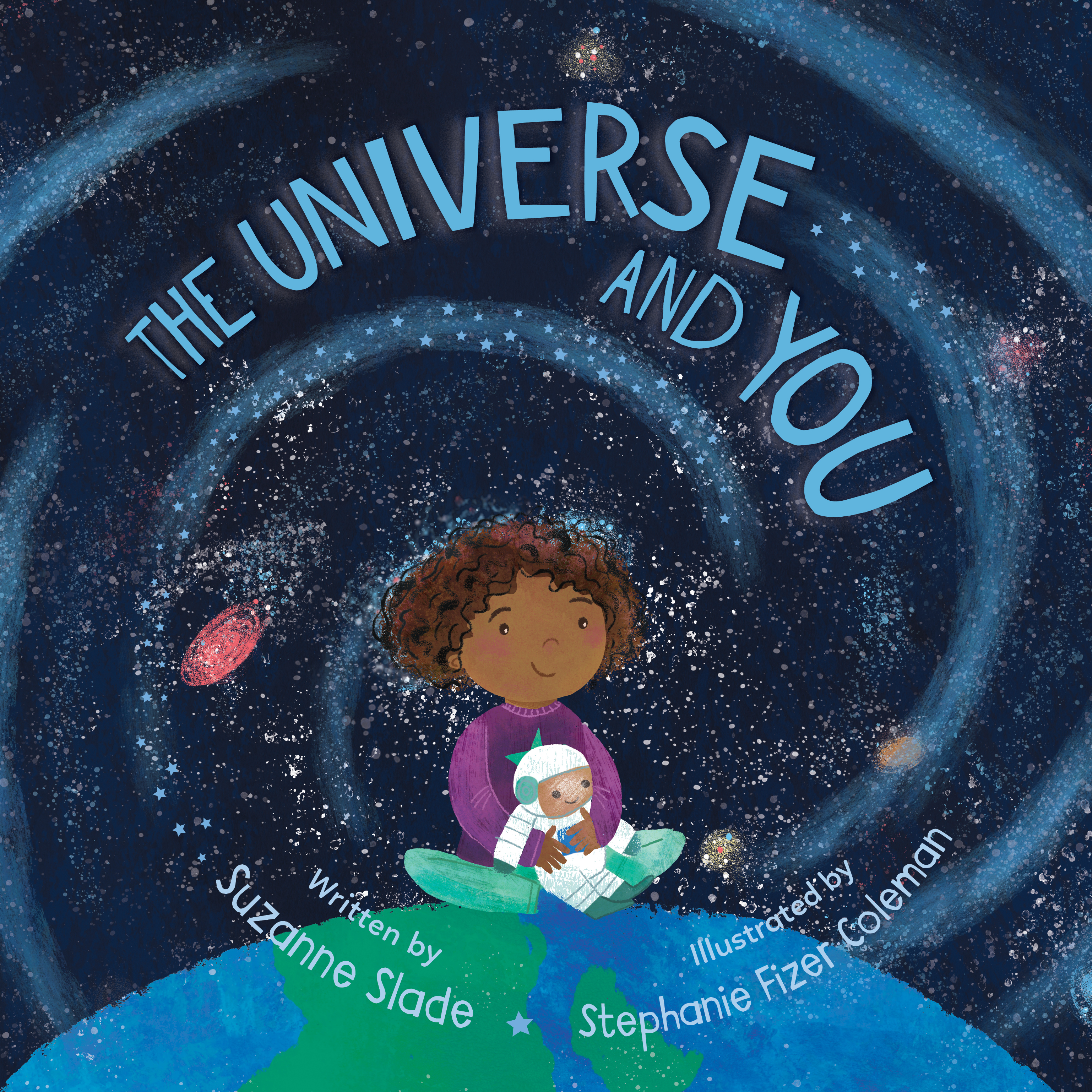
April 16 – Global Astronomy Month COVER REVEAL of The Universe and You

celebrate-picture-books-picture-book-review-the-universe-and-you-cover

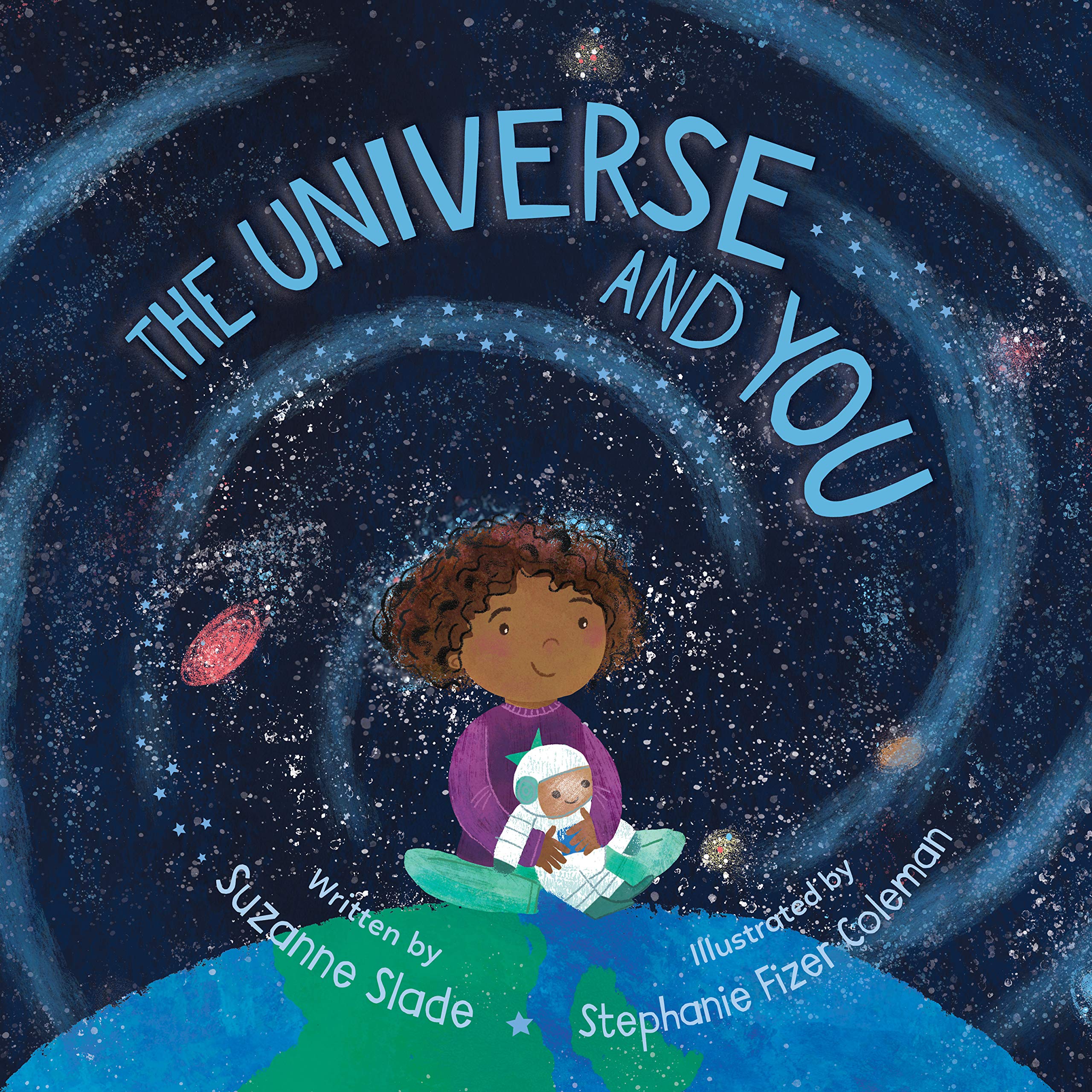
The Universe and You

Written by Suzanne Slade | Illustrated by Stephanie Fizer Coleman


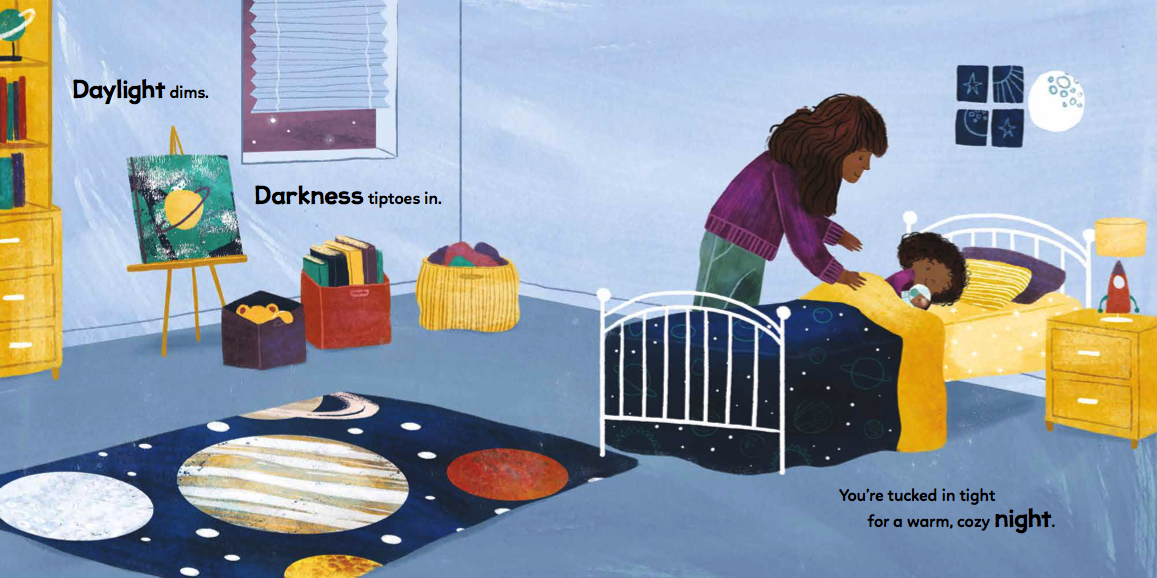
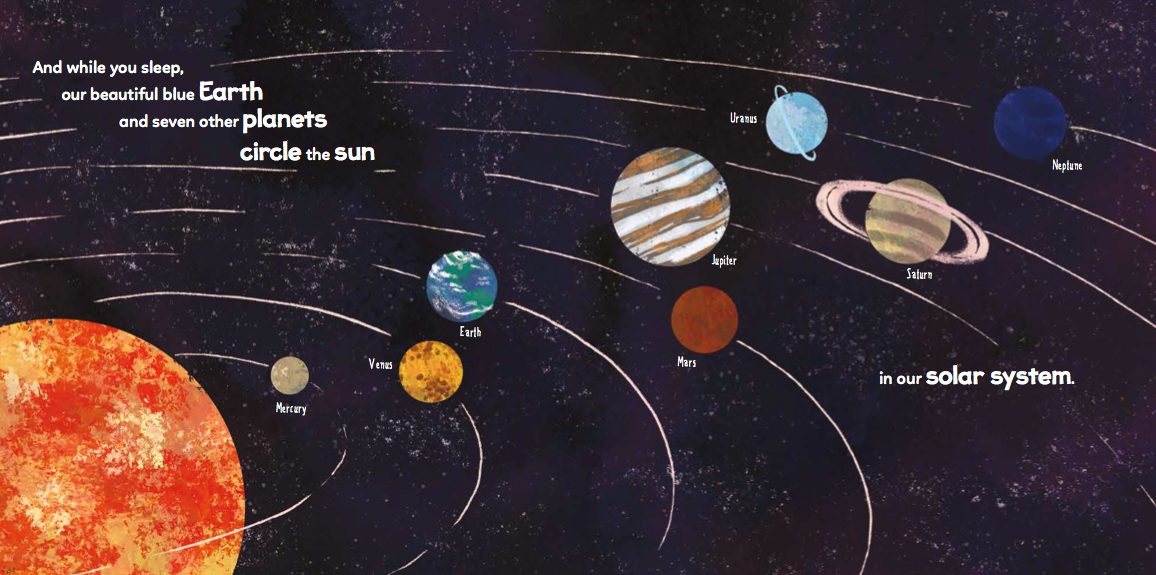
As the sun goes down and the stars come out, a little girl is tucked into bed in the midst of a beautiful celestial dance. Although Earth seems solid and still while she sleeps, it’s actually spinning on its axis and circling the sun. Joining Earth in this orbit around the sun are the other seven planets in our solar system, along with dozens of moons and millions of comets and asteroids. Containing our solar system is the wondrous Milky Way galaxy, with its billions of stars, just like our own sun, swirling and whirling around. And on from there are billions of galaxies with their own stars swirling, whirling into the ever-expanding space called our universe. When the sun rises, the little girl awakens on a brand-new day as the “moving, circling, and swirling” dance continues.

Through lyrical text, award-winning science writer Suzanne Slade takes young readers on an exploration of Earth, our solar system, the galaxies beyond, and finally the universe as a whole. Illustrated back matter includes scientific facts about our solar system.

Meet Suzanne Slade

celebrate-picture-books-picture-book-review-Suzanne-Slade-space-headshot

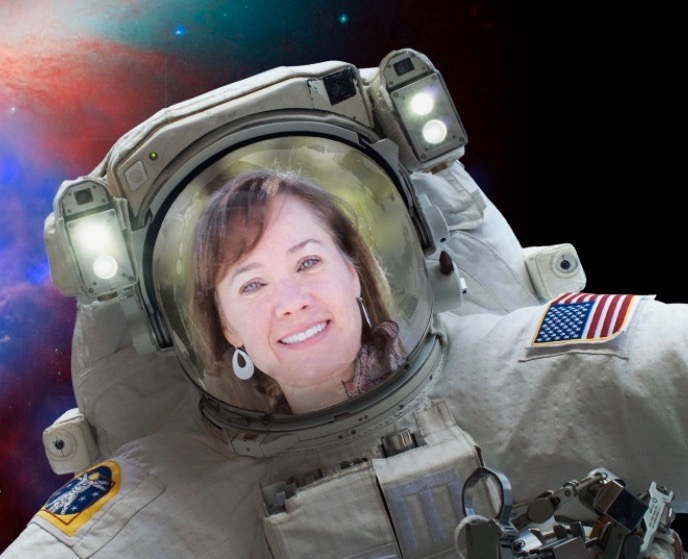
Suzanne Slade is the award-winning author of more than 100 books, including June Almeida, Virus Detective! The Woman Who Discovered the First Human Coronavirus. She lives in Libertyville, Illinois. Learn more about Suzanne at suzanneslade.com. You can connect with Suzanne on Twitter.

Welcome, Suzanne! I’m really excited to be talking with you about this inspirational book for little dreamers! What inspired you to write The Universe and You?

I’ve done a lot of research about space exploration in the last decade for various book projects, so space seems to be on my mind. (Plus, I’m a mechanical engineer who has worked on rockets.) In more recent years I’ve been working on a book about a woman astronomer, so was reading about stars/galaxies and visited an observatory. Then one morning I woke with the idea of a simple, lyrical bedtime book which starts with Earth, moves out to our solar system, our galaxy, and the universe.

The cover to The Universe and You is stunning! What was your first reaction when you saw it?

The illustrator, Stephanie Fizer Coleman, initially created 3 rough cover sketches to gather opinions. The sketch I liked best ended up as the cover design, so when I later saw it in full, glorious color I was blown away. Stephanie knocked this cover out of the park (and universe!).

In what ways did Stephanie Fizer Coleman’s illustrations surprise you or go beyond what you had imagined?

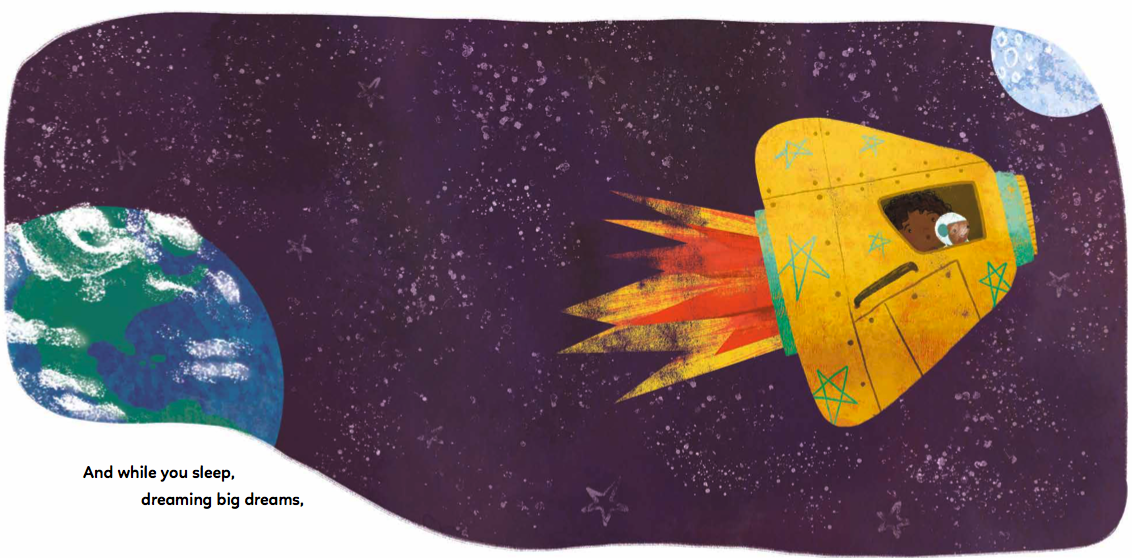
I hadn’t given a great deal of thought to what the child’s dreams might entail (though I knew they’d have to do with space). I love Stephanie’s creative and colorful depictions of the girl dreaming about soaring through space in a rocket and walking on the moon. I also adore the wonderful space items in the girl’s bedroom and the fantastic planets in the solar system! 

celebrate-picture-books-picture-book-review-the-universe-and-you-interior-1

Image copyright Stephanie Fizer Coleman, 2021. Text copyright Suzanne Slade, 2021. Courtesy of Sleeping Bear Books.

celebrate-picture-books-picture-book-review-the-universe-and-you-interior-3

Image copyright Stephanie Fizer Coleman, 2021. Text copyright Suzanne Slade, 2021. Courtesy of Sleeping Bear Books.

In college you studied engineering and actually worked on Delta and Titan Rockets. What is one of the coolest things you learned while working as an engineer on these rockets?

How a rocket works. It was fascinating to learn about the rocket “stages” needed to launch it from Earth, how a rocket soars through space, and much more.

celebrate-picture-books-picture-book-review-the-universe-and-you-interior-2

Image copyright Stephanie Fizer Coleman, 2021. Text copyright Suzanne Slade, 2021. Courtesy of Sleeping Bear Books.

You’ve written so many wonderful books about so many diverse people and subjects, including June Almeida, Virus Detective!, which was just released in March. What is your favorite part about writing STEAM books for kids?

My favorite part is introducing young readers to a fascinating STEM topic or person who has made a big impact in a STEM field. The challenging aspect of creating a picture book is to find an engaging way to present the story so it draws readers in and makes them want to find out more.

What would you like for kids to take away from this story?

I hope it inspires children to dream BIG dreams and boldly pursue those dreams!

celebrate-picture-books-picture-book-review-the-universe-and-you-interior-4

Image copyright Stephanie Fizer Coleman, 2021. Text copyright Suzanne Slade, 2021. Courtesy of Sleeping Bear Books.

Meet Stephanie Fizer Coleman

celebrate-picture-books-picture-book-review-stephanie-fizer-coleman-headshot

Stephanie Fizer Coleman has illustrated numerous children’s books, including You Are Mine, Porcupine. She lives in Scott Depot, West Virginia. Learn more about Stephanie atstephfc.com. You can connect with Stephanie on Instagram.

Hi, Stephanie! I’m thrilled for readers to get their first look at the breathtaking cover you designed for The Universe and You! What inspired this image? Can you describe your process of designing and finalizing this cover illustration?

Well, I can’t take all the credit, because Felicia, the art director on this book, had a clear idea of what would go on the cover. I knew the cover would feature some beautiful universe bits and of course, our smart and sweet main character too.

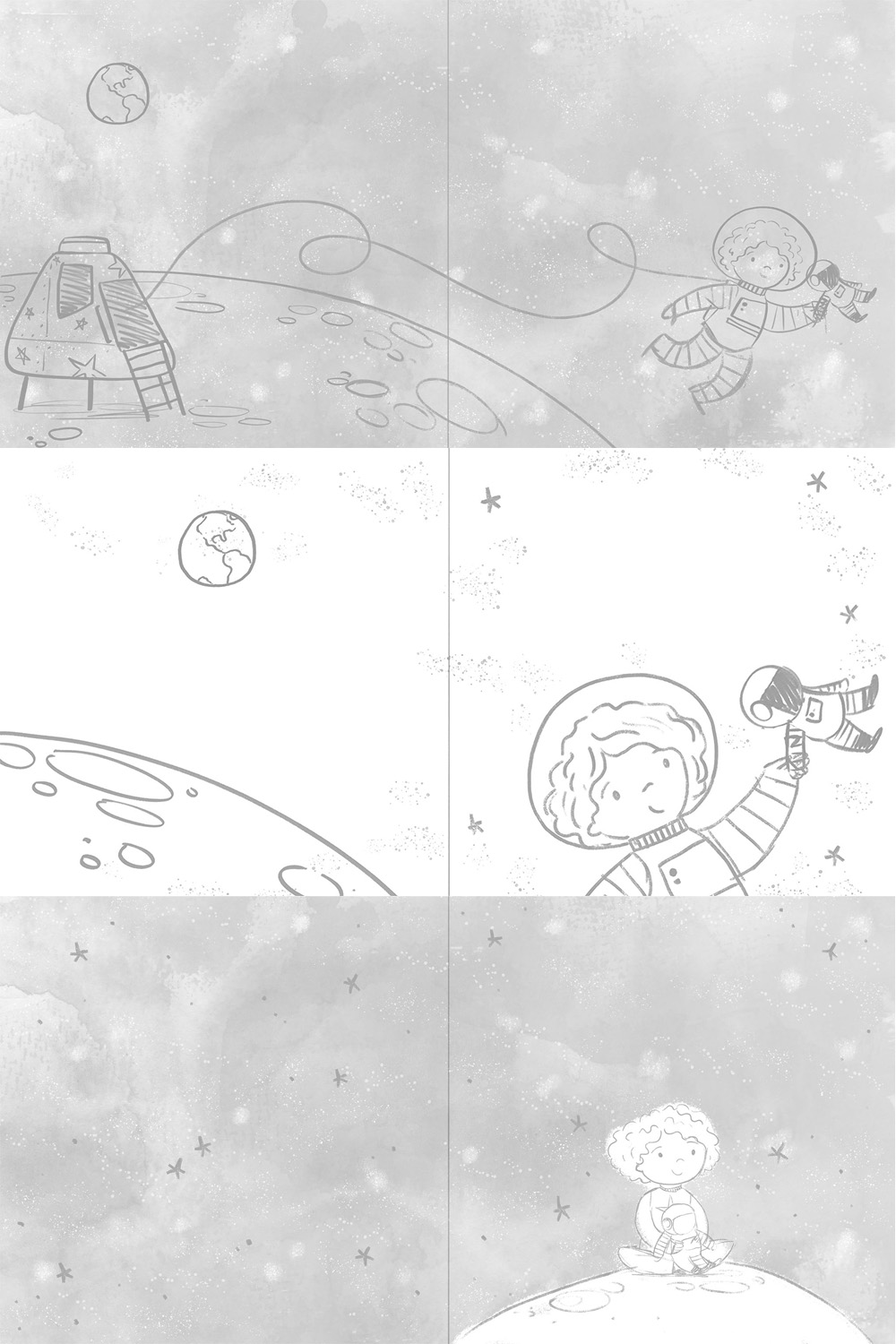
I worked up three cover options to start with, including one with the rocket ship, which is my favorite bit from the book. In the end, the image of the girl sitting on the moon with the Milky Way swirling behind her was chosen. We did a few more versions of the sketch, changing some little things like having her sitting on the Earth instead of the moon, and then it was off to final cover art!

celebrate-picture-books-picture-book-review-the-universe-and-you-initial-cover-sketches

Image copyright Stephanie Fizer Coleman, 2021. Courtesy of Sleeping Bear Press.

Did you have a passion for outer space prior to reading this story?

You know, I’ve always been more of a history buff, but my husband is a space nerd, so over the years a fascination with space has grown in me as well.  I could look at Hubble photos for hours!

Do you have a favorite spread in the book? If so, which one and why?

Both dream spreads, with the rocket ship, are my favorites! It was fun to think up what this girl would be dreaming about and to tie that in with the outer space theme.

One of my initial sketches for this was the girl as a little artist who loved painting planetary bodies and I was a little sad when it got cut, so instead I hinted at her creative energy by imagining the kind of rocket ships her dream self would create.

In the end, I’m so happy that both dream spreads involve the adorable rocket ship and our adventuring astronaut pair.

If you were going to visit outer space, where would you like to go?

This is tough because I’m obsessed with the Crab Nebula! How magical is the Crab Nebula? I mean, seriously. But also Jupiter is my favorite planet and I think I could orbit Jupiter for many years, totally engrossed in watching the rolling storms on its surface.

You have an affinity for flight of another kind too—birds! Several years ago you embarked on a project to paint a bird a day for one hundred days. Readers can see the original charming and beautiful 100 + 1 birds on your website as well as follow along with your current bird drawings on Instagram. What inspired you to do this project? Do you have a favorite bird?

I started the 100 Day project as a way to explore my style using a subject matter I already loved: birds! The simple shapes and vibrant colors lend themselves to creative exploration while feeling easy and approachable as a subject matter. My favorite bird is the chickadee and I try to sneak them into as many children’s books as I possibly can.

What do you like best about illustrating children’s books?

I love getting to illustrate the books that I would have loved as a child! There’s something special about making something that will show children how beautiful the world is and how magical nature is.

Thanks so much, Suzanne and Stephanie, for sharing the story behind The Universe and You! I’m sure readers can’t wait to see your book when it blasts into bookstores on August 15th!

celebrate-picture-books-picture-book-review-the-universe-and-you-cover

You can preorder The Universe and You from these booksellers

Anderson’s Bookshops | Amazon | Barnes & Noble | Books-a-Million

To support your local independent bookstore, preorder from

Bookshop | IndieBound

Picture Book Review
April 14 – It’s Global Astronomy Month

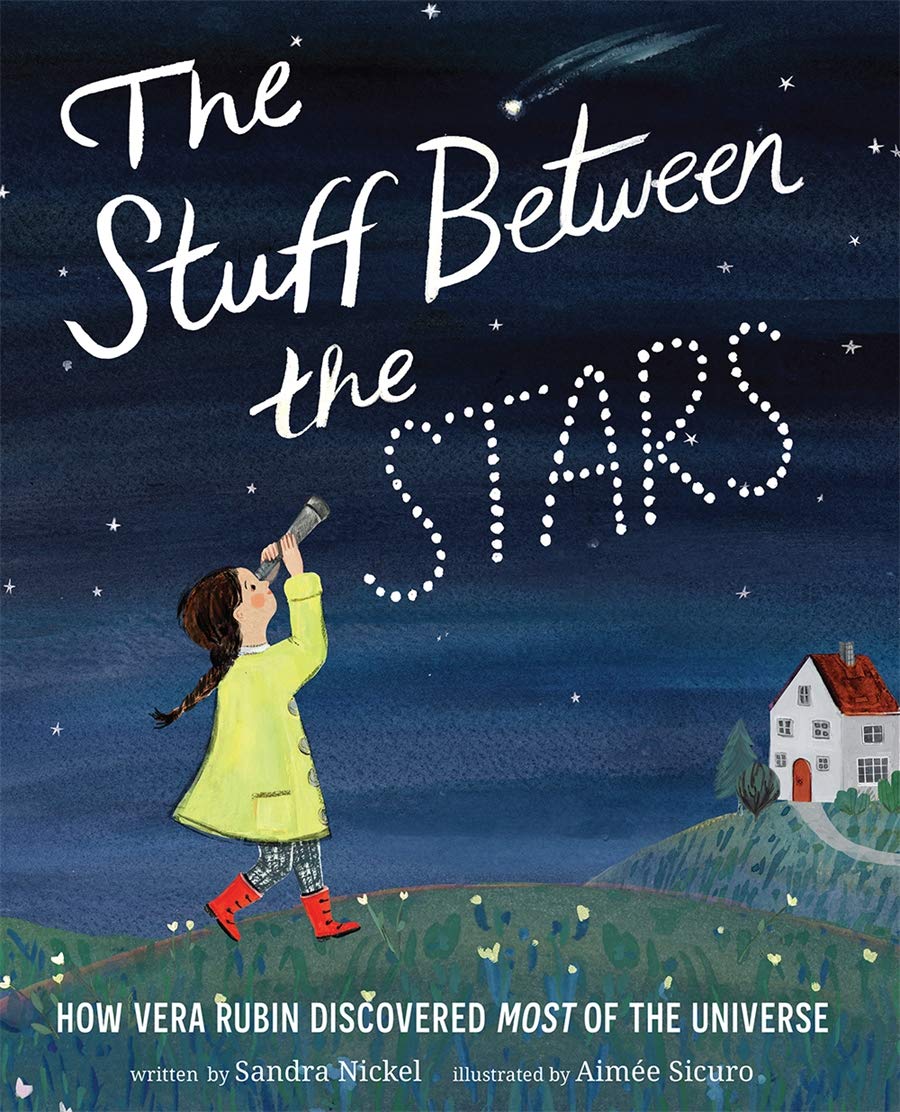
celebrate-picture-books-picture-book-review-the-stuff-between-the-stars-cover

About the Holiday

Instituted by Astronomers Without Borders, a group who sees in our shared sky an opportunity to create “a global community that appreciates, studies, and shares the wonders of the universe, to broaden perspective, transcend borders, and improve lives,” Global Astronomy Month brings people together with arts events, parties, and special events. To find resources, such as April sky maps in English and Spanish, and more information on how you can participate, visit the Astronomers Without Borders website.

Thanks to Abrams Books and Blue Slip Media for sending me a copy of The Stuff Between the Stars for review consideration. All opinions on the book are my own. I’m excited to be hosting a giveaway of the book. See details below.

The Stuff Between the Stars: How Vera Rubin Discovered Most of the Universe

Written by Sandra Nickel | Illustrated by Aimée Sicuro


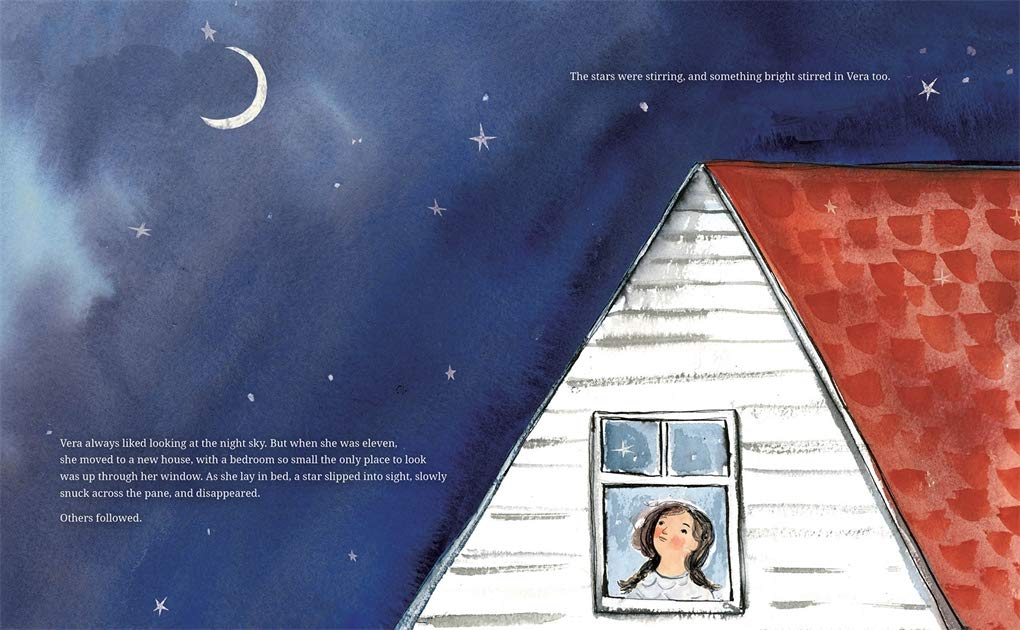
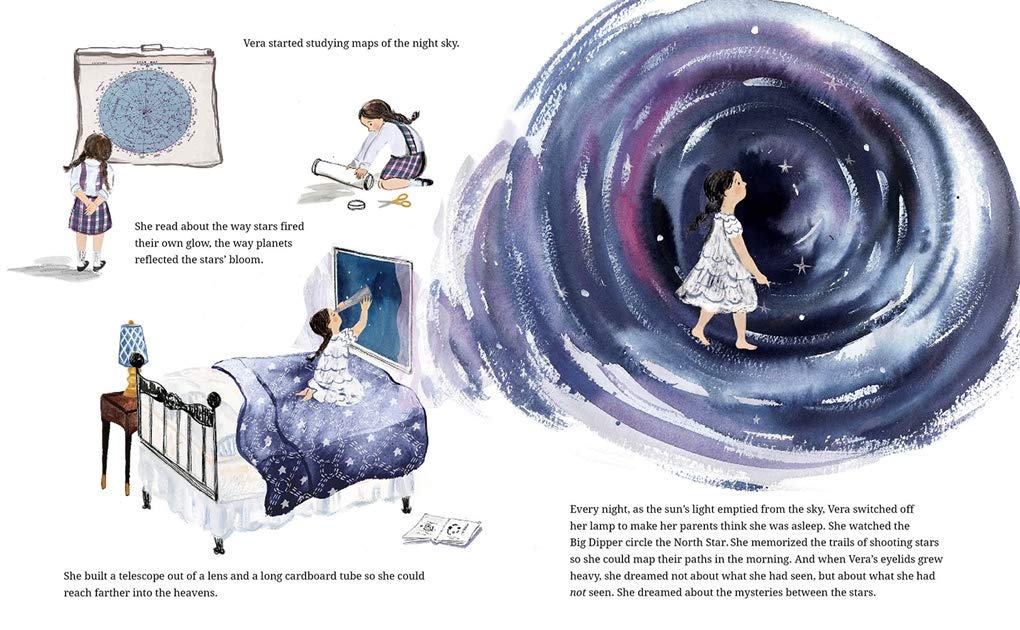
Vera had always been fascinated with the night sky. As she gazed up through her bedroom window, she saw when “the stars were stirring, and something bright stirred in Vera too.” She began studying everything she could about the stars, planets, and how they interacted in the night sky. She even made her own telescope from a cardboard tube and a lens. At seventeen Vera began attending Vassar College as the only astronomy major in her class. Here, she could use the school’s telescope whenever she wanted.

celebrate-picture-books-picture-book-review-the-stuff-between-the-stars-window

Image copyright Aimée Sicuro, text copyright Sandra Nickel. Courtesy of Abrams Books for Young Readers.

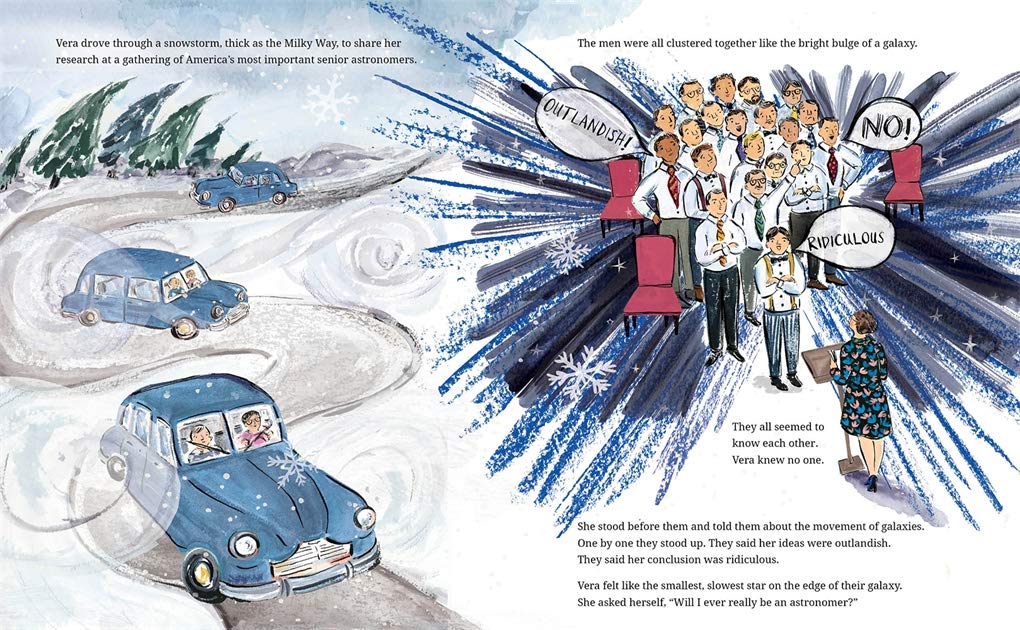
While at Vassar, she fell in love with Robert Rubin, a mathematician. They married and soon Vera was going to have a baby. During her pregnancy, she explored an idea she had: “was it possible that galaxies rotated around a center in the universe like the Big Dipper circled the North Star?” By the time her son was born, Vera decided she was right. Vera presented her conclusions at a meeting of America’s top astronomers. They thought her ideas were “outlandish” and “ridiculous” and told her so. “Vera felt like the smallest, slowest star on the edge of their galaxy” and wondered if she’d “ever really be an astronomer.”

celebrate-picture-books-picture-book-review-the-stuff-between-the-stars-young

Image copyright Aimée Sicuro, text copyright Sandra Nickel. Courtesy of Abrams Books for Young Readers.

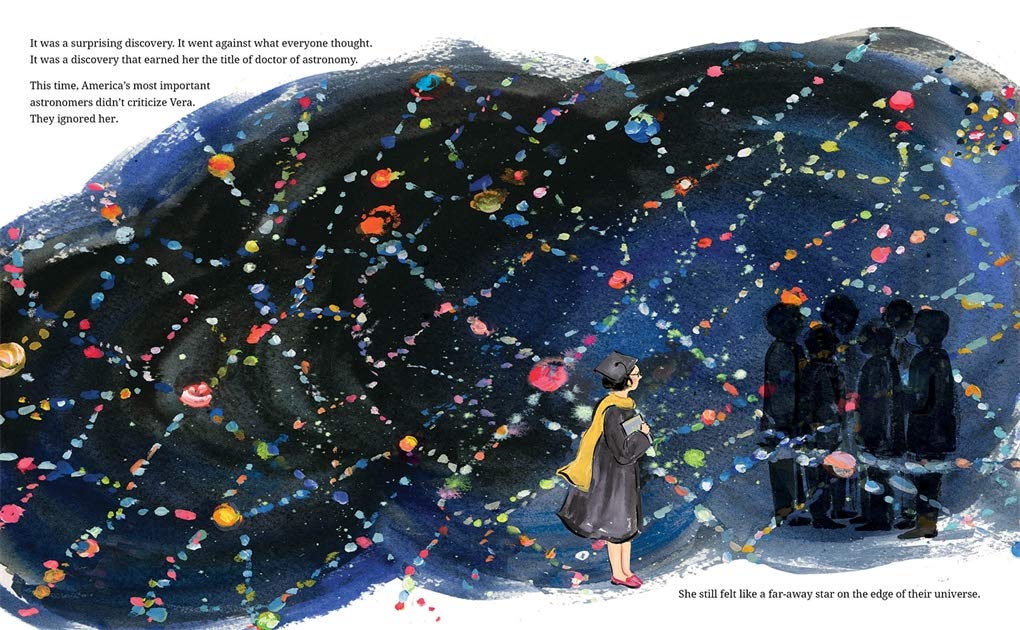
After Vera had a baby girl, she decided to concentrate on a new question that she thought would be fun. She wondered if galaxies were scattered haphazardly or whether there was “a pattern to where they spun.” After many months of staying up late into the night doing calculations, Vera determined that galaxies were “clumped together like dew drops on a spider’s web.” This was a major discovery; one that earned her a doctorate in astronomy. Instead of criticizing her, America’s top astronomers ignored her.

celebrate-picture-books-picture-book-review-the-stuff-between-the-stars-outlandish

Image copyright Aimée Sicuro, text copyright Sandra Nickel. Courtesy of Abrams Books for Young Readers.

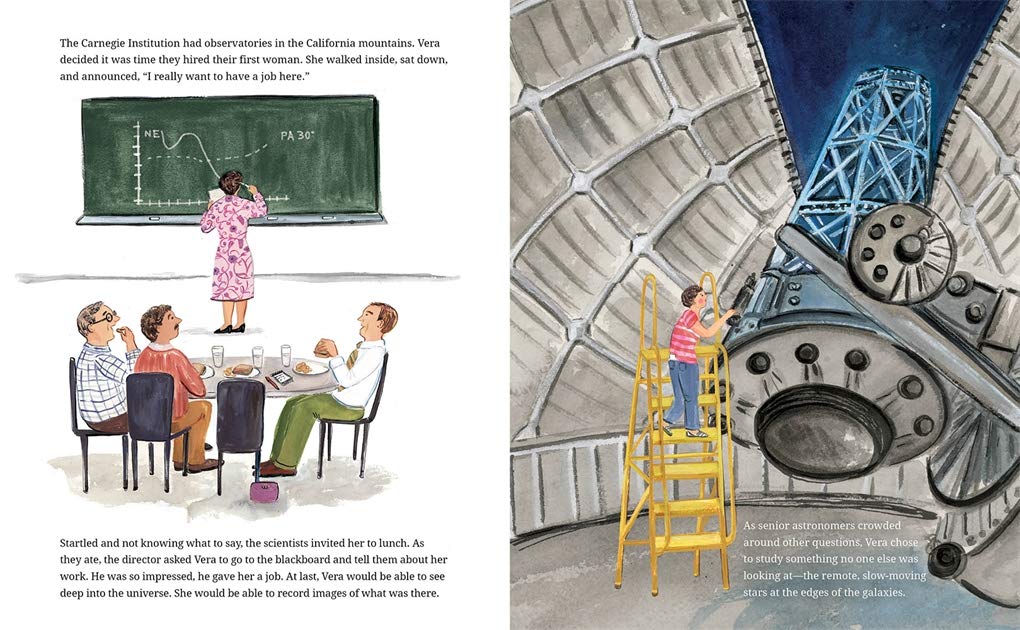
Vera had two more children, and as her family grew she dreamed of observing galaxies from a mountaintop like the senior astronomers and watch gravity work within galaxies. She began teaching astronomy at colleges in Washington D.C., and other astronomers began hearing about her and wanting to know more about her ideas that had been dismissed in the past. More than ever Vera wanted to view the sky from an observatory in the mountains—one like the Carnegie Institution had in the California mountains.

One day she went to the Carnegie Institution and announced that she would like a job there. When the director and other scientists learned about her work and theories, they were so impressed that she landed a job. While the other senior astronomers worked on other questions, Vera studied the “slow-moving stars at the edges of the galaxies.”

celebrate-picture-books-picture-book-review-the-stuff-between-the-stars-galaxies

Image copyright Aimée Sicuro, text copyright Sandra Nickel. Courtesy of Abrams Books for Young Readers.

In Arizona Vera studied the Andromeda Galaxy and the stars on its outside spiral. What Vera found was astounding. Instead of moving slower at the edges of the galaxy because of waning gravity from the center, these stars moved at the same speed. She remembered that earlier astronomers had theorized about a mysterious, unseen “dark matter” with its own gravity that “might be at work in the universe.”

Vera believed dark matter “could fill the space between the stars.” In fact, she was sure it was there by the way the stars moved. Once again, when Vera revealed her findings, most astronomers didn’t want to believe it. They didn’t want to believe that all this time they’d only been studying a small fraction of the universe. After Vera studied two hundred more galaxies, the astronomers had to agree that she was correct. At last “Vera was no longer at the edge of astronomy, she was at it’s very center.”

Backmatter includes an Author’s Note detailing more about Vera Rubin’s work, a timeline of Rubin’s life, resources on quotes found in the text, and a selected bibliography.

celebrate-picture-books-picture-book-review-the-stuff-between-the-stars-observatory

Image copyright Aimée Sicuro, text copyright Sandra Nickel. Courtesy of Abrams Books for Young Readers.

Sandra Nickel’s straightforward and comprehensive storytelling gives kids a well-rounded view of Vera Rubin’s life as she doggedly pursued a career in astronomy despite all the naysayers and snubs along the way and made an astounding discovery that still baffles scientists today. Rubin’s inspirational example will resonate with young readers and give them a pathway to accomplishing their own goals. Nickel does an excellent job of explaining the complex ideas Rubin studied, theorized on, and wrote about, allowing readers to fully understand her impact on the field of astronomy and our understanding of the universe. Nickel’s lyrical prose is also sprinkled with metaphors that link Rubin’s feeling and life changes to the night sky she loved to observe.

Through Aimée Sicuro’s mixed-media illustrations, readers follow Vera Rubin as she matures from a curious child who loves watching the night sky to a college student to a mother to an astronomer making discoveries that changed the way scientists understood the universe. Her detailed images give kids visual representations of Rubin’s work and ideas, including a complex mathematical calculation she works on while her family sleeps and her idea that galaxies were clumped together. Depictions of the Palomar Observatory will thrill space buffs and show readers why Rubin so wanted to study the sky from a mountain top. The final image of a group of children gazing up at the night sky as a shooting star flashes by offers an inspirational quote from Vera Rubin.

A superb biography that will inspire and nurture young minds, The Stuff Between the Stars is highly recommended for home, school, and public library collections.

Ages 6 – 9

Abrams Books for Young Readers, 2021 | ISBN 978-1419736261

Discover more about Sandra Nickel and her books on her website. You can also find curriculum guides and activity sheets to download on her site.

You can connect with Aimée Sicuro on Instagram.

Watch the book trailer for The Stuff Between the Stars!

Global Astronomy Month Activity

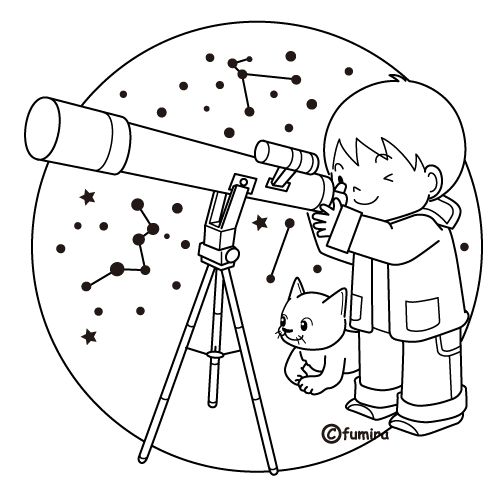
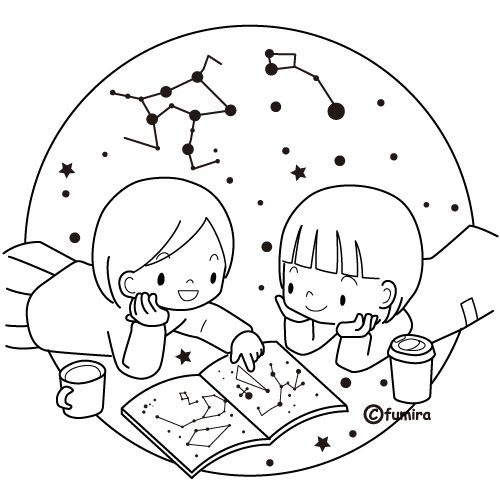
celebrate-picture-books-picture-book-review-astronomy-coloring-page-telescope    celebrate-picture-books-picture-book-review-astronomy-coloring-page-kids

Explore the Galaxies Coloring Pages


Indulge your love of star stuff with these printable coloring pages!

Looking through the Telescope | Studying the Stars | Milky Way Dot-to-Dot

celebrate-picture-books-picture-book-review-the-stuff-between-the-stars-cover

You can find The Stuff Between the Stars at these booksellers

Amazon | Barnes & Noble | Books-a-Million

To support your local independent bookstore, order from

Bookshop | IndieBound

Picture Book Review
 

April 13 – It’s the Week of the Young Child

celebrate-picture-books-picture-book-review-let's-go-on-a-digger-cover

About the Holiday

2021 marks the 50th anniversary of Week of the Young Child, an annual initiative hosted by the National Association for the Education of Young Children to celebrate learning, young children, their families, and their teachers. Daily themes focus on ways that children learn. These included Music Monday, Tasty Tuesday, Work Together Wednesday, Artsy Thursday, and Family Friday, in which people are encouraged to share their family stories. To get more information on this week-long celebration of kids and discover activities to make each day of the week fun, visit the NAEYC website.

Thanks to Lerner Books for sending me a copy of Let’s Go on a Digger, Let’s Go on a Plane, and Let’s Go on a Train for review consideration. All opinions on the books are my own.

Let’s Go! Series

Each of the books in this upbeat series for youngest readers, which also includes Let’s Go on a Rocket, Let’s Go on a Ferry, and Let’s Go on a Tractor introduces kids to some of the methods of transportation they love to see in the outside world and that spark their imaginations. Combining vocabulary that teaches terms associated with each vehicle, realistic visuals, and a story that shows the vehicle in motion, these books are well-rounded and sweet ways to satisfy any child’s love of transportation. Also inherent in each book are depictions of friendship, teamwork, and adventure. Readers will also like recognizing familiar faces, as the same six kids take part in each book. So let’s get going!

Let’s Go on a Digger

Written by Rosalyn Albert | Illustrated by Natalia Moore

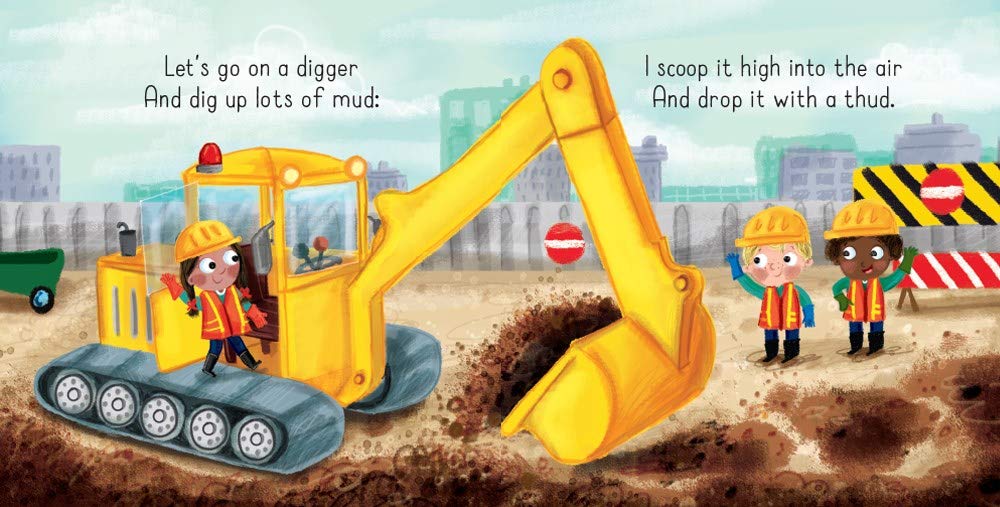
What little one wouldn’t love to climb into a huge machine and dig in the mud? With this bright and cheery board book, kids take over a construction site. From the cab of the digger, a little girl says, “I’ll make a mountain with the mud / All piled in a heap. / I’ll dig a swimming pool-sized hole: / It will be extra deep.” She tells readers that she uses the joysticks to move the boom and shovel.

Then, when the bucket is all full of dirt, she pushes the “drive rods forward / To make the treads move straight.” While two other young workers dig with a shovel and remove dirt with a wheelbarrow, the girl drives the digger to a dump truck, where she lifts the bucket and pours the dirt into the back of the truck. “‘Hooray!’” she exclaims. She’s had such fun on her digger.

celebrate-picture-books-picture-book-review-let's-go-on-a-digger-construction-site

Image copyright Natalia Moore, 2021, text copyright Rosalyn Albert, 2021. Courtesy of Catch a Star.

Rosalyn Albert’s engaging rhymes are just right for young readers excited about construction vehicles and how they work. Whether on a big scale or small, digging in the mud is a favorite kid activity, and readers will love learning the words for various parts of a digger while seeing it in action.

Natalia Moore’s vibrant yellow digger and enthusiastic kids in their hardhats and safety vests welcome readers to the construction site where a big project is underway. Kids will love Moore’s depictions of the digger scooping and dumping, the joysticks in the cab, and the caterpillar treads that help the big machine move over muddy ground.

Ages Preschool and up

Lerner Books, 2021 | ISBN 978-1913639112

You can find Let’s Go on a Digger at these booksellers

Amazon | Barnes & Noble | Books-a-Million

To support your local independent bookstore, order from

Bookshop | IndieBound

celebrate-picture-books-picture-book-review-let's-go-on-a-plane-cover

Let’s Go on a Plane

Written by Rosalyn Albert | Illustrated by Natalia Moore

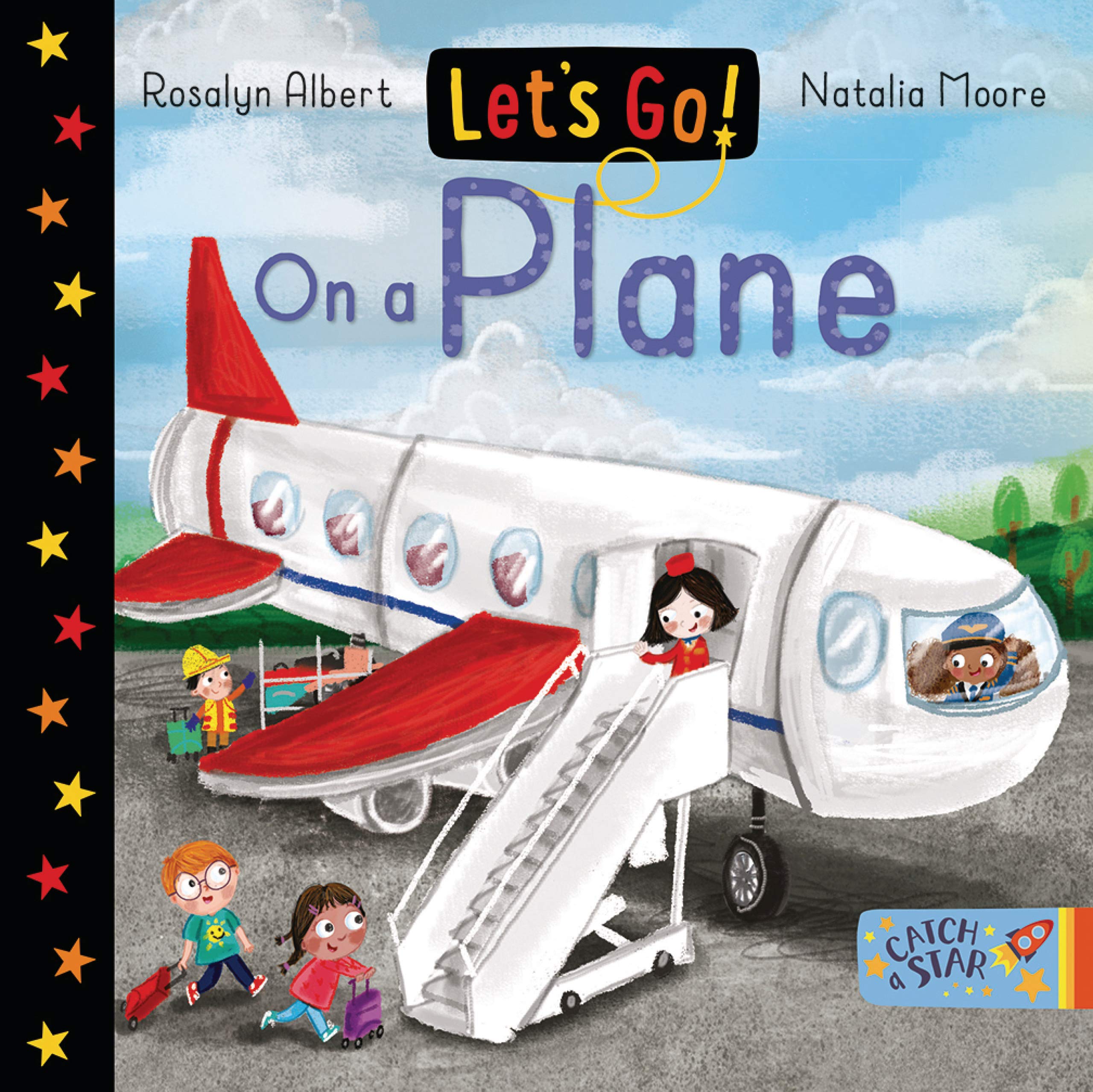
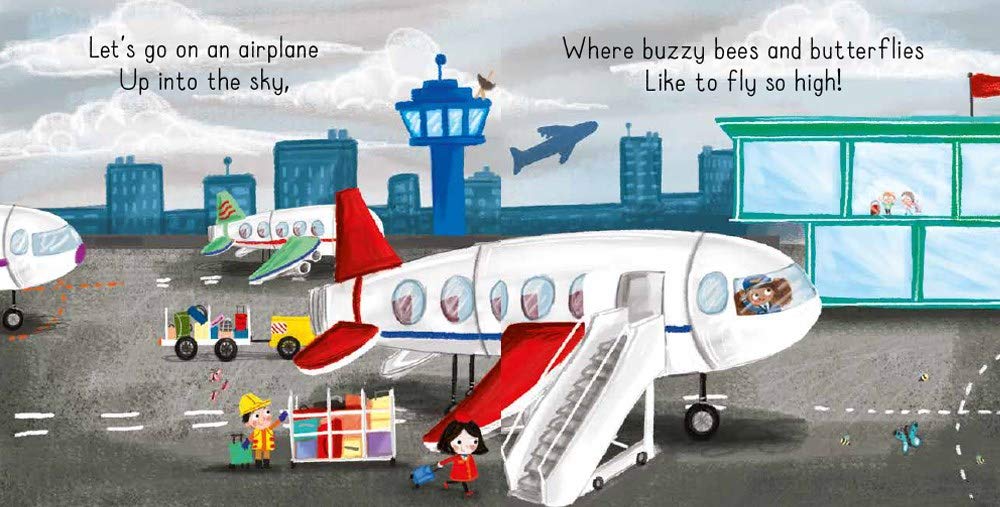
At a busy airport, a pilot is almost ready to take off. A flight attendant is about to board, and a luggage handler is ready to load the passenger’s suitcases. From the huge windows of the terminal, two kids, eager for their flight, wave at the pilot and she waves back. As the plane takes off into the sky, the passengers think about how small everything on Earth will look from way up high.

“The engines roar, the wheels go up, / My seatbelt’s fastened tight. / I see the huge wings flying / Up, up, up into the night.” In the clear night sky, the kids see the moon closer than they ever have, and stars seem to be twinkling just for them.” When the pilot invites them into the cockpit, the kids are thrilled to watch her fly the plane. Soon, the plane is “gliding to the ground,” and the kids’ vacation is about to begin.

celebrate-picture-books-picture-book-review-let's-go-on-a-plane-airport

Image copyright Natalia Moore, 2021, text copyright Rosalyn Albert, 2021. Courtesy of Catch a Star.

If your little one loves planes or is going to be taking a trip, Rosalyn Albert’s story of a night flight will fill them with the wonder and excitement of air travel. From a smooth ascent and landing to the phenomenon of seeing earth from afar to a visit to the cockpit to meet the pilot, Albert includes all the fun of an airplane trip.

Natalia Moore invites kids to the tarmac of a busy airport where planes wait their turn for takeoff while one plane begins to soar over the city. In the cockpit, kids can see the myriad buttons and dials, the radar screen, and the control stick the pilot uses to fly the plane. As the plane approaches its destination, kids may want to take a guess as to where it’s landing.

Ages Preschool and up

Lerner Books, 2021 | ISBN 978-1913639129

You can find Let’s Go on a Plane at these booksellers

Amazon | Barnes & Noble | Books-a-Million

To support your local independent bookstore, order from

Bookshop | IndieBound

celebrate-picture-books-picture-book-review-let's-go-on-a-train-cover

Let’s Go on a Train

Written by Rosalyn Albert | Illustrated by Natalia Moore

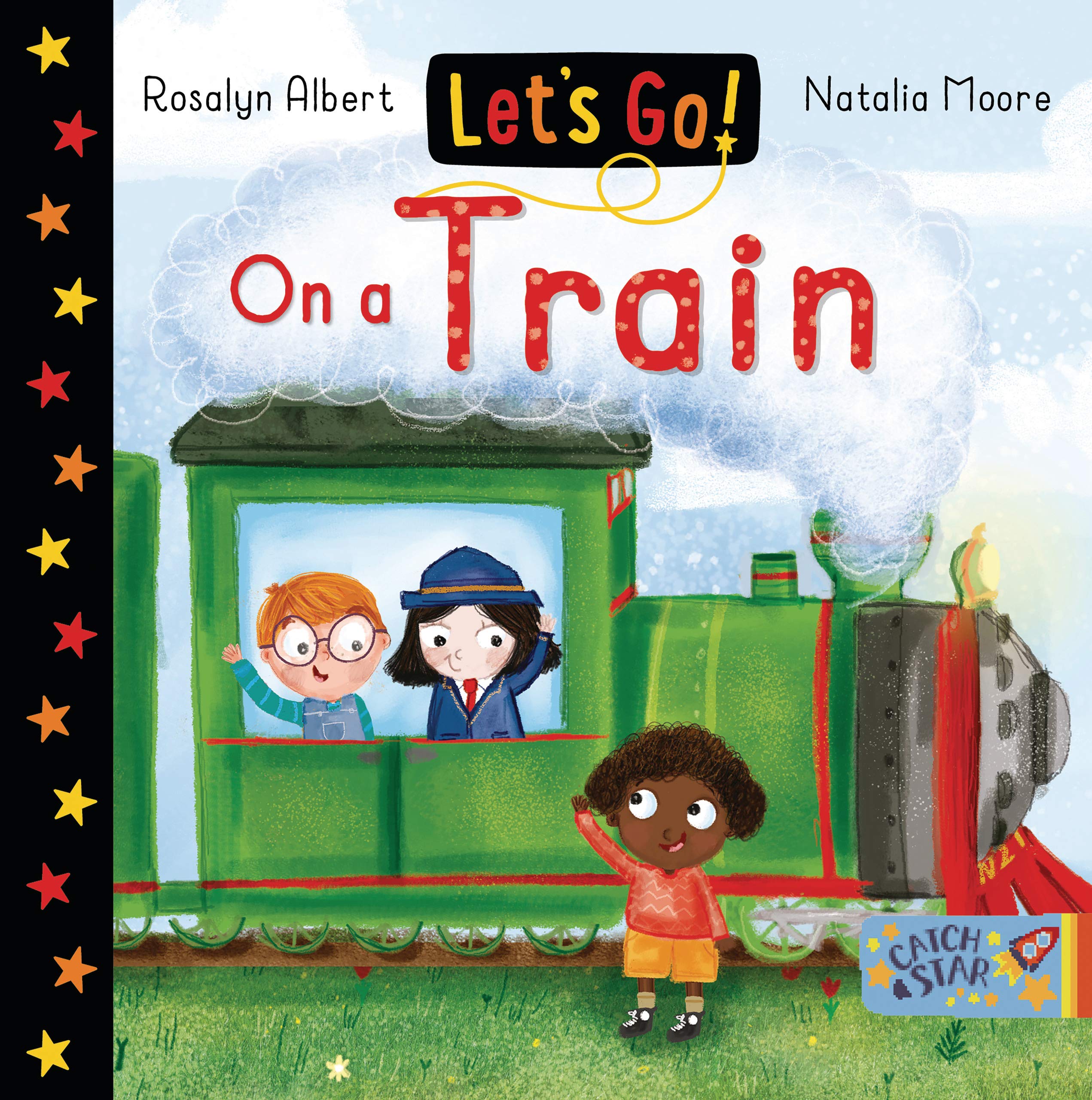
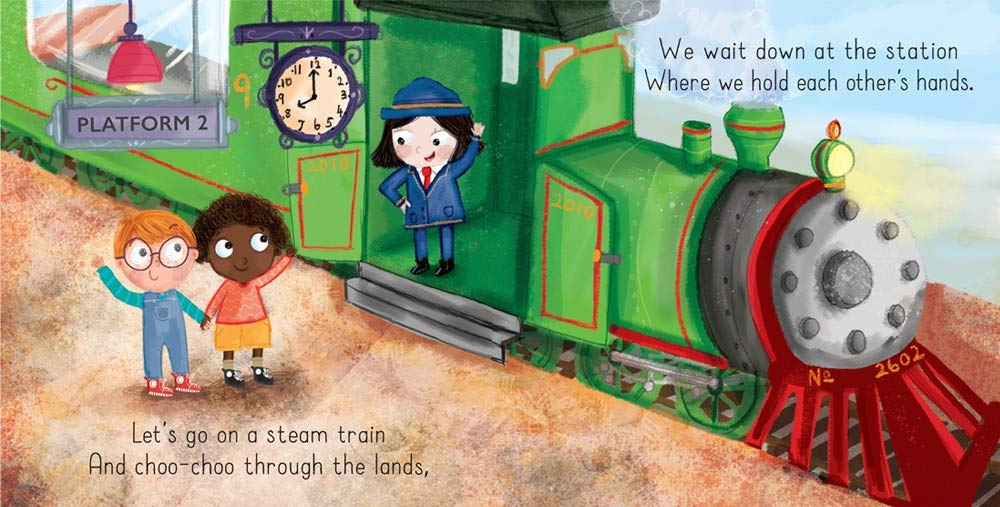
On Platform 2 of the train station, two kids wait to board their train. The driver even lets them “help to stoke the fire” by shoveling coal into the furnace. As the train takes off down the tracks, the kids pass fields of sheep, travel “in and out of tunnels, / Over mountains high and green, / Through towns with people waving— / It’s such a pleasant scene.” The inspector checks their tickets, and they get tea from the trolley when it comes by. As they watch out the window, the kids tap their feet to the “click-clack” rhythm of the train. At last, “The station is in sight. / It’s been such an adventure— / I’ll have sweet dreams tonight.”

celebrate-picture-books-picture-book-review-let's-go-on-a-train-platform

Image copyright Natalia Moore, 2021, text copyright Rosalyn Albert, 2021. Courtesy of Catch a Star.

From standing on the platform as the powerful train pulls into the station to watching the sights speed by through the windows, Rosalyn Albert’s story of train travel is a thrill. She even includes that favorite response to seeing a train pass by—waving at the passengers. In addition to the sights, Albert also includes the distinctive sounds of train travel, from the whistle to the rhythmic “click-clack” of the wheels. Ending with a nighttime arrival scene, Let’s Go on a Train would make a sweet bedtime read for little train lovers.

Little ones will love Natalia Moore’s big green train and especially getting to see inside where knobs, dials, wheels, and piping control the furnace and the steam that powers the engine. On their long trip the kids see countryside, mountains, and rivers, and they get to partake of a favorite train-trip treat: getting a snack from the trolley or food car. Led by the glow of the lantern out front, the train pulls into the station under a full moon as the little passengers snooze.

Ages Preschool and up

Lerner Books, 2021 | ISBN 978-1913639105

You can find Let’s Go on a Train at these booksellers

Amazon | Barnes & Noble | Books-a-Million

To support your local independent bookstore, order from

Bookshop | IndieBound

Week of the Young Child Activity

celebrate-picture-books-picture-book-review-plane-coloring-page  Digger, Plane, and Train Coloring Pages

Grab your crayons or pencils and enjoy these coloring pages of your favorite vehicles

Digger Coloring Page | Plane Coloring Page | Train Coloring Page

celebrate-picture-books-picture-book-review-let's-go-on-a-digger-cover

Picture Book Review
April 12 – D.E.A.R (Drop Everything And Read) Day

celebrate-picture-books-picture-book-review-pirates-vs-monsters-cover

About the Holiday

National D.E.A.R. Day is celebrated every year on April 12th in commemoration of Beverly Cleary’s birthday. D.E.A.R. stands for Drop Everything And Read and encourages families to set aside at least thirty minutes to enjoy reading together. Beverly Cleary, who recently passed away at the age of 104, gave the world such unforgettable characters as Ramona and Beezus Quimby, Henry Huggins and his dog Ribsy, and the motorcycle-riding mouse, Ralph S. Mouse. You can learn more about D.E.A.R. Day and find resources and tips for reading with children on the Reading Rockets website.

Thanks to Lerner Books for sending me a copy of Pirates vs. Monsters for review consideration. All opinions on the book are my own.
Pirates vs. Monsters

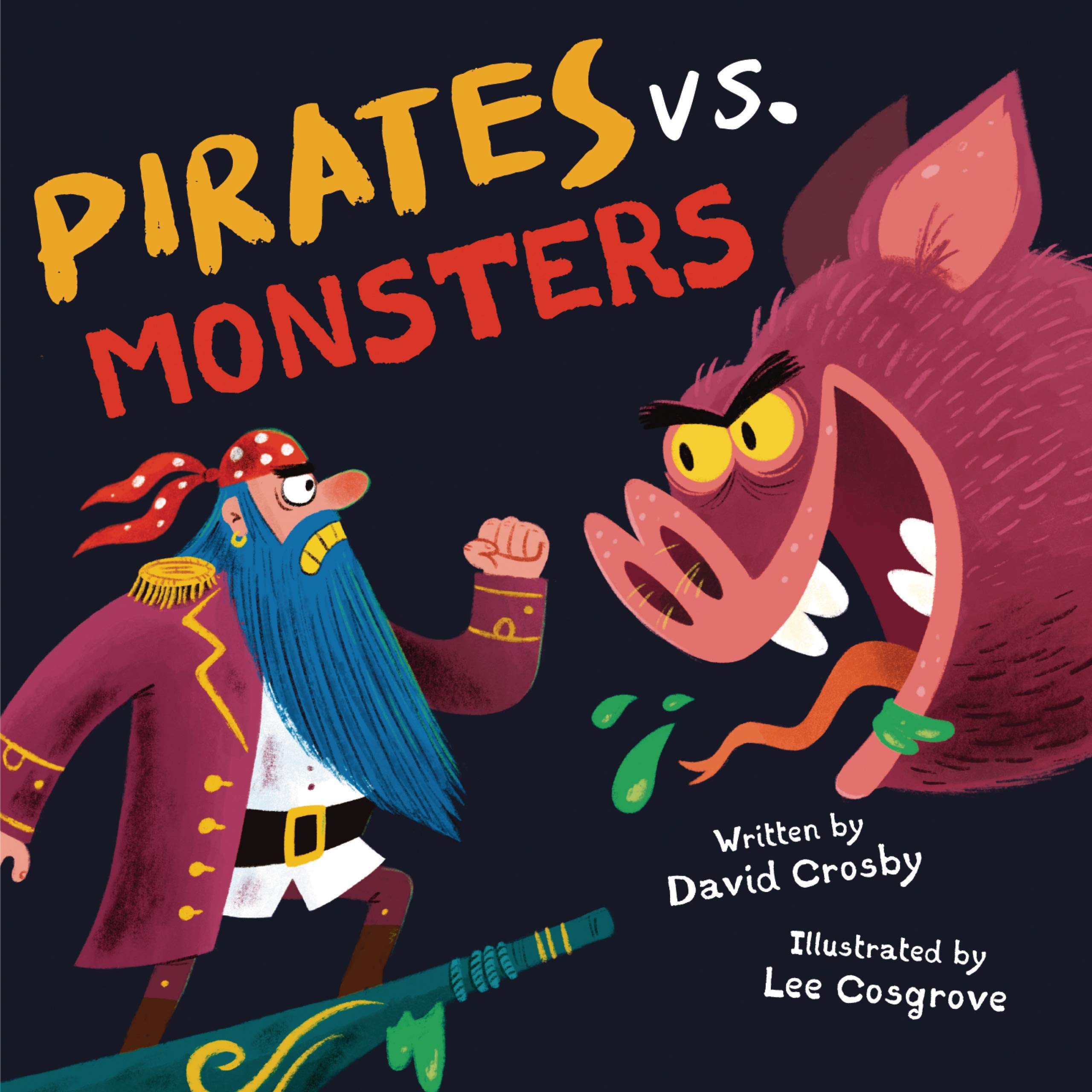
Written by David Crosby | Illustrated by Lee Cosgrove


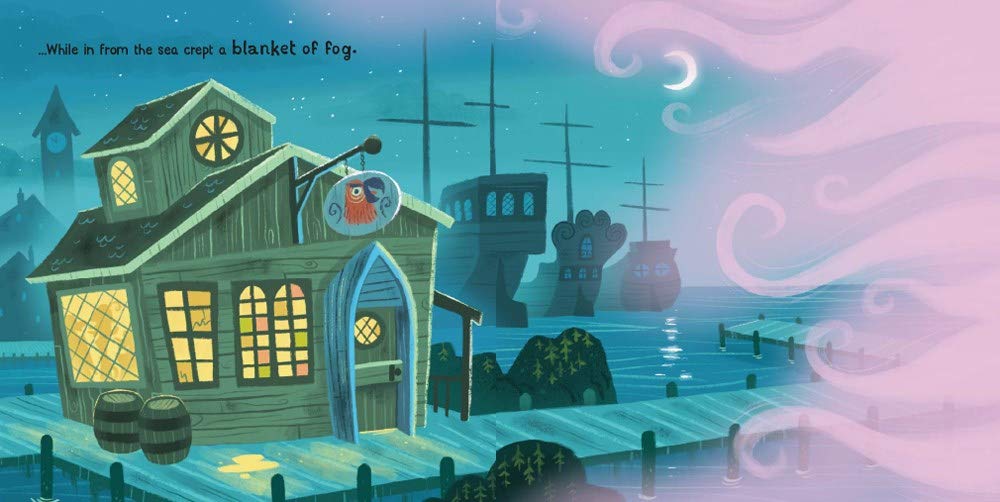
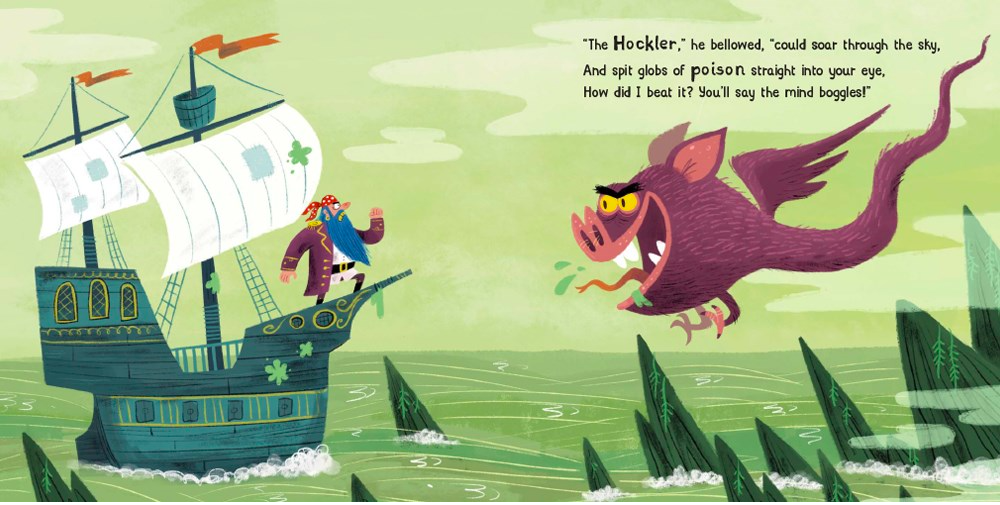
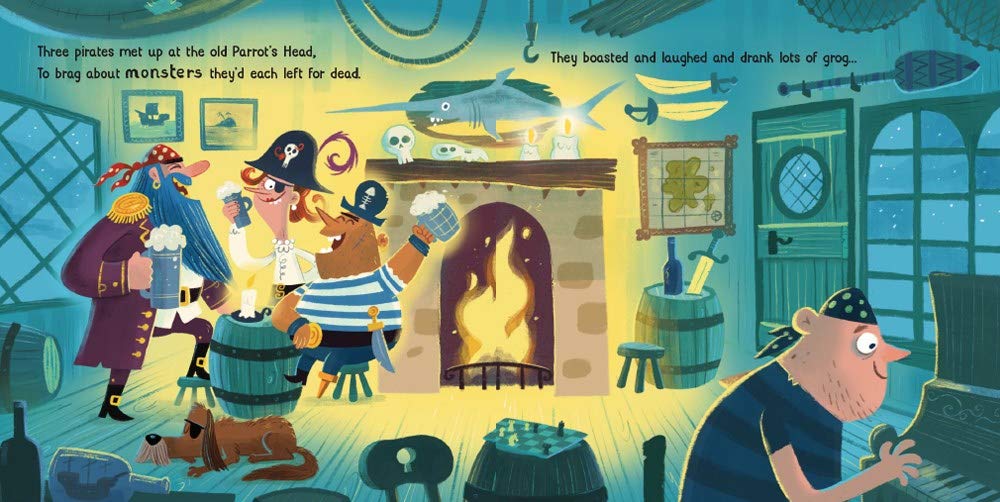
“Three pirates met up at the old Parrot’s Head, / to brag about monsters they’d each left for dead.” Over a few mugs of frothy grog, while the fog rolled in over the pier, Hector took the stage first. His gold teeth glinted in the light as regaled the others with his tale of besting the Hockler, who could “spit globs of poison straight into your eye.” While the pirates were enjoying deep belly laughs over Hector’s adventure, an eerie ship pulled into port.
celebrate-picture-books-picture-book-review-pirates-vs-monsters-restaurant

Image copyright Lee Cosgrove, 2021, text copyright David Crosby, 2021. Courtesy of Maverick Arts/Lerner.

Next up was Pirate Sue. She climbed atop a barrel and told a hair-curling story of defeating the Crunk, “‘…a two-headed beast” who’s heads took turns feasting and sleeping. The three pirates were laughing so hard that they didn’t see three shrouded shapes leave the spooky ship. Finally, it was George’s turn to tell his story. Holding his peg leg aloft, he began. “‘The Muncher,’ he snarled, / ‘bites pirates on sight. / He ate my left leg but did / not get my right.” To beat him, George tricked the Muncher into swallowing an anchor festooned with sharp points all around by dressing it up like a pirate scarecrow.

celebrate-picture-books-picture-book-review-pirates-vs-monsters-fog

Image copyright Lee Cosgrove, 2021, text copyright David Crosby, 2021. Courtesy of Maverick Arts/Lerner.

The pirates were rolling on the floor in hysterics when a “BANG!” shook the door. The piano player screamed as in burst the Hockler, the Crunk, and the Muncher. The three pirates ran for their lives from the Parrot’s Head. Hector dove off the pier, Sue took off down the pier, and George leaped through the window.

With grog in their claws, “three monsters met up at the old Parrot’s Head, / to brag about pirates they’d faced and had fled.” But who told the truth and who was a liar while telling brave tales in the glow of the fire?
celebrate-picture-books-picture-book-review-pirates-vs-monsters-hockler

Image copyright Lee Cosgrove, 2021, text copyright David Crosby, 2021. Courtesy of Maverick Arts/Lerner.

David Crosby’s story of three pirates and three monsters who love bragging about their exploits will have kids guffawing along with Hector, Sue, and George as they crack each other up with their tales of daring do. Crosby’s madcap rhymes are a joy to read aloud, especially using dramatic inflection to wring out all the arg-mosphere and suspense of this surprising story.

Lee Cosgrove’s cozy Parrot’s Head, with its crackling fire; wooden barrel tables; swords, swordfish, and skeleton décor; and scruffy piano player is the perfect pier-side hangout for a jovial tankard of grog. Even the dog wears an eyepatch. Images of the pirates and monsters will have kids giggling, and close examinations of the pages reveal plenty of humorous details like the island map on the wall of the Parrot’s Head that looks suspiciously like the “globs of poison” the Hockler spits, the curly hair sprouting from the skull on Sue’s hat that mirrors her own, and George’s heart-print underwear.

A treasure for kids who love pirates, monsters, and a funny story with an unexpected ending, Pirates vs. Monsters makes a fun go-to book for boisterous story times at home, in the classroom, and for public library collections.

Ages 4 – 9

Maverick Arts Publishing/Lerner, 2021 | ISBN 978-1848867086

You can connect with David Crosby on Twitter.

To learn more about Lee Cosgrove, his books, and his art, visit his website.

D.E.A.R Day Activity

CPB - Bookworm Book (2)

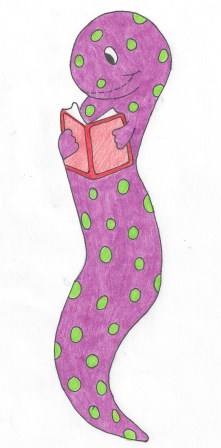
Bookworm Bookmark


For all you bookworms out there who love to read, here’s your very own Bookworm Bookmark to color and put between the pages of your favorite story!

Supplies

  • Bookworm Bookmark template
  • Heavy stock paper (optional)
  • Colored pencils or markers
  • Scissors

Directions

  1. Print out the Bookworm Bookmark template
  2. Color the bookworm
  3. Cut out the Bookworm
  4. Cut the Bookworm’s mouth at the dotted line. The top part of the bookworm’s mouth hangs over the page and marks your place!

celebrate-picture-books-picture-book-review-pirates-vs-monsters-cover

You can find Pirates vs. Monsters at these booksellers

Amazon | Barnes & Noble | Books-a-Million

To support your local independent bookstore, order from

Bookshop | IndieBound

Picture Book Review