
About the Holidays
Today I’m highlighting two upcoming holidays that celebrate science and introduce kids to the wide-ranging applications that science, engineering, technology, and math have on our lives now and as we move into the future.
STEM Day — November 8
Instituted in 2015, National STEM Day aims to encourage kids to explore the fields of science technology, engineering, and math. This year’s theme is “Hands on Learning” to promote creative and impactful experimentation, innovation, and discovery. Children who are introduced early on to the workings of math and science do better as they advance through school and are more likely to choose science-based careers. Solving many of the problems that the world now faces relies on having a workforce who can think inventively to design a better future for us all. To learn more about STEM and to find lots of free ideas and activities to get kids excited about these subjects all year around—from awesome virtual field trips to labs, space centers, museums, and more to detailed lesson plans and printables to hands-on activities from the National Inventors Hall of Fame—visit Create & Learn.
World Science Day for Peace and Development — November 10
This annual, internationally observed day highlights the importance of science in and for society and is sponsored by the United Nations. Its aim is to promote education and awareness of scientific issues that affect the world and its sustainability as well as to underscore the role that scientists play in improving our lives and developing solutions for the future.
Thanks go to Phaidon for sharing a copy of Our Galaxy: A First Book of Space with me for review consideration. All opinions on the book are my own.
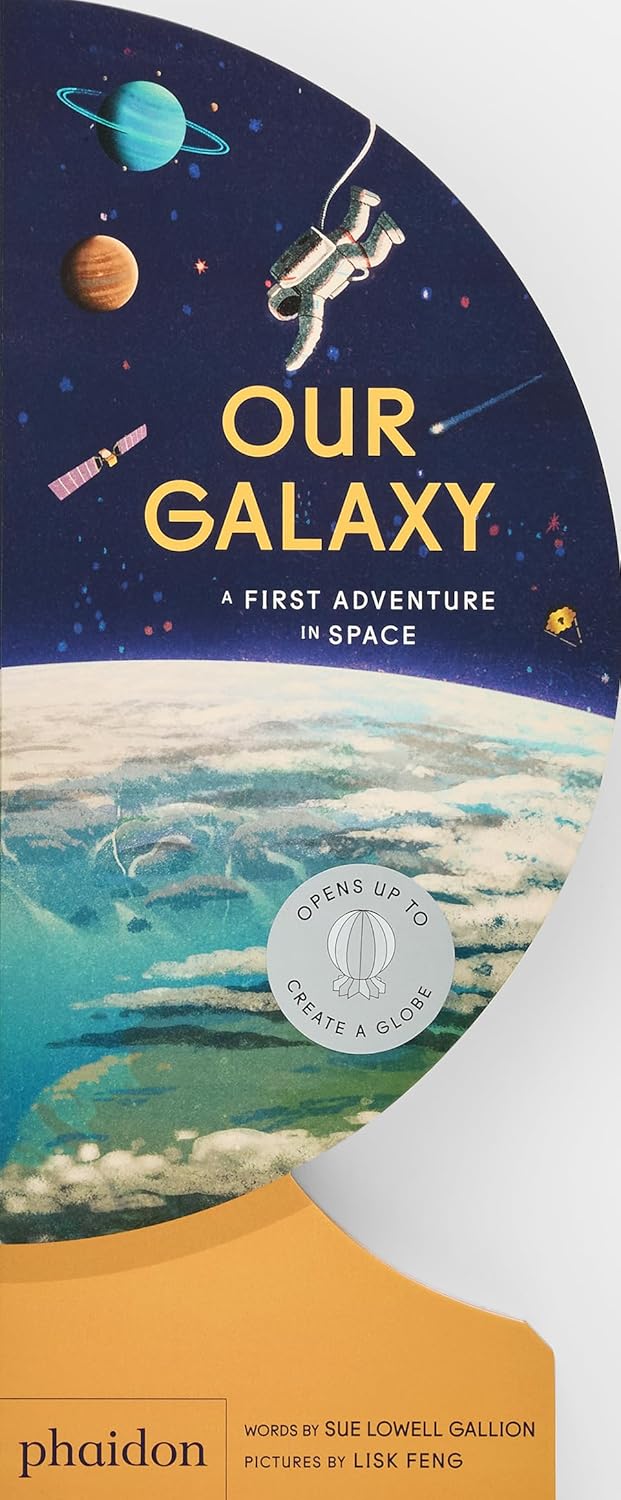
Our Galaxy: A First Adventure in Space
Written by Sue Lowell Gallion | Illustrated by Lisk Feng
If you want to WOW your young children, students, or library patrons and make them eager to learn about space, science, technology, engineering, and math, open the cover of Our Galaxy: A First Adventure in Space. Then open it a little more . . . and a little more . . . and all the way around until this awe-inspiring book becomes a sturdy, freestanding globe full of adventure and exploration.
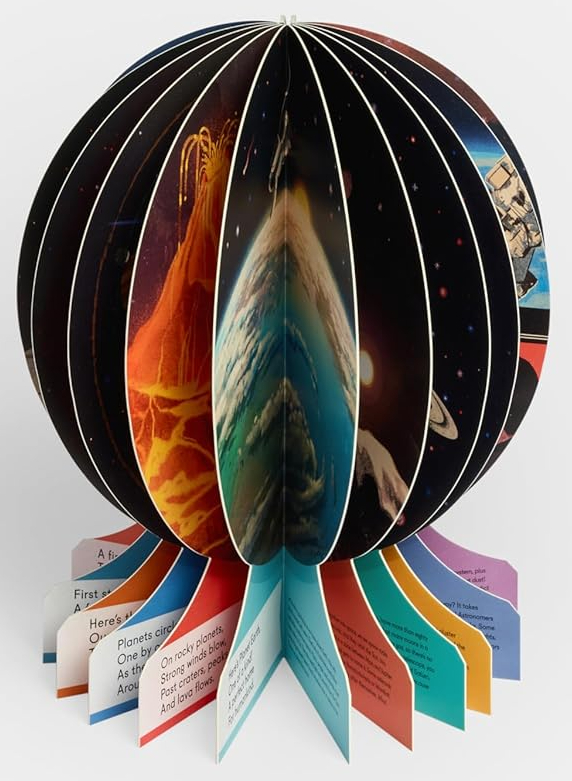
Image copyright Lisk Feng, 2024, text copyright Sue Lowell Gallion. Courtesy of Phaidon.
As this journey into space begins, readers find themselves in a planetarium, where Lisk Feng’s mesmerizing illustration of an enormous telescope aimed at the starry sky hints at the marvels above. Sue Lowell Gallion’s accompanying rhyming couplet invites kids to “Start at sunset, / Scan the sky. / Let’s take a voyage, / Way up high!”
On the next page readers join viewers on shore to count down “5, 4, 3, 2, 1 . . . Liftoff!” As a rocket is propelled upwards by a fiery blast, a short paragraph explains that “some rockets are like high-tech delivery vehicles” supplying the International Space Station while “other rockets are an astronaut’s ride into space.” She then asks kids whether they’d rather “watch a rocket launch” or “be on board,” a great way to get kids thinking and joining in.
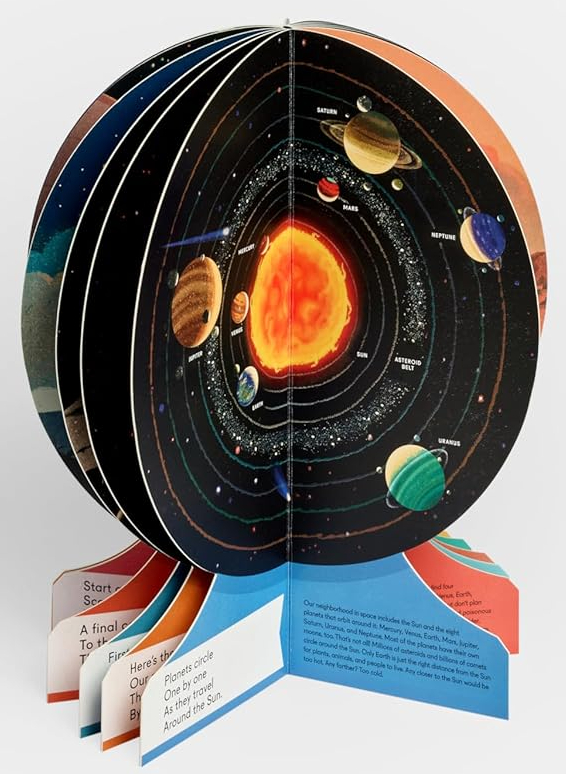
Image copyright Lisk Feng, 2024, text copyright Sue Lowell Gallion. Courtesy of Phaidon.
Appropriately, the rocket’s first stop is the Moon. In Feng’s gorgeous painting, kids are beckoned to join two astronauts using a vehicle on the rocky surface as Gallion imparts information about this “familiar face”—facts about the Moon’s orbit, its astronaut visitors, and the long-lasting imprint they’ve made on the Moon. Of course, we wouldn’t be able to take a voyage like this—or even live on Earth—without the Sun, “Our nearest star, / The brightest in our sky, / By far.” Children can almost feel the heat radiating from the sun as they learn about the Sun’s power and size.
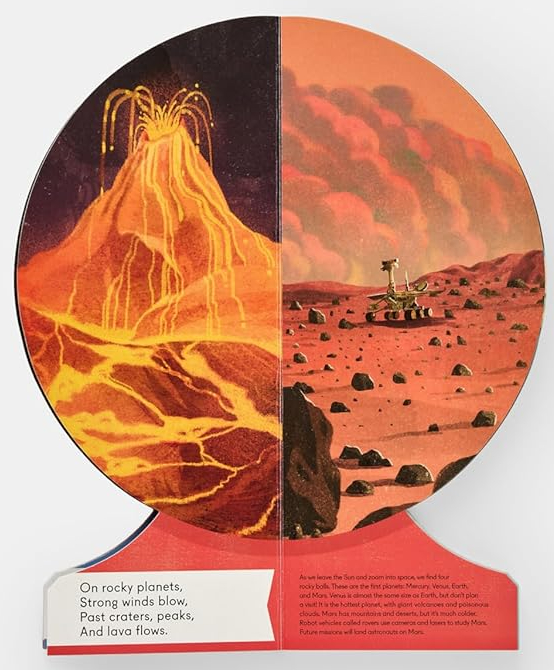
Image copyright Lisk Feng, 2024, text copyright Sue Lowell Gallion. Courtesy of Phaidon.
On following pages, kids also learn about our solar system; meet the four rocky planets of Mercury, Venus (complete with a scorching look at one of its volcanoes), Earth, and Mars (which astronauts plan to visit in the future); and discover why Earth is “One of a kind! / A perfect home / For humankind.”
Planets aren’t the only objects in space. On their journey, readers also learn about asteroids—what they are, where they’re found, and even some of their funny names—before zipping on to uncover fascinating tidbits about Jupiter, Saturn, Uranus, and Neptune.
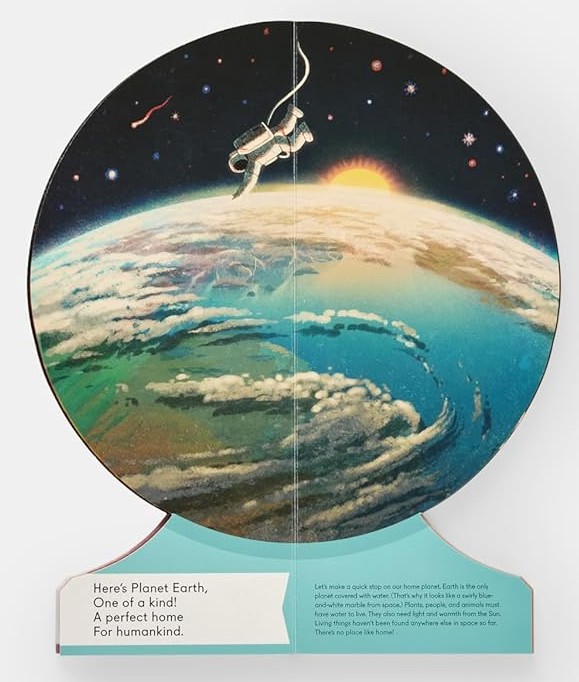
Image copyright Lisk Feng, 2024, text copyright Sue Lowell Gallion. Courtesy of Phaidon.
Future scientists and astronauts will want to accept Lisk Feng’s invitation to join astronauts working on the International Space Station and floating in the cosmos. They’ll view a giant telescope that informs scientists about our galaxy and beyond and the technology that monitors space and records data. Kids will also be intrigued by the illustrations of space probes and satellites that, in addition to teaching us about objects light years away, help “scientists predict weather and transmit signals that make out phones and TVs work better.” Returning to Earth, readers have a chance to contemplate “Our universe, / A starry show, / With mysteries / We want to know!”
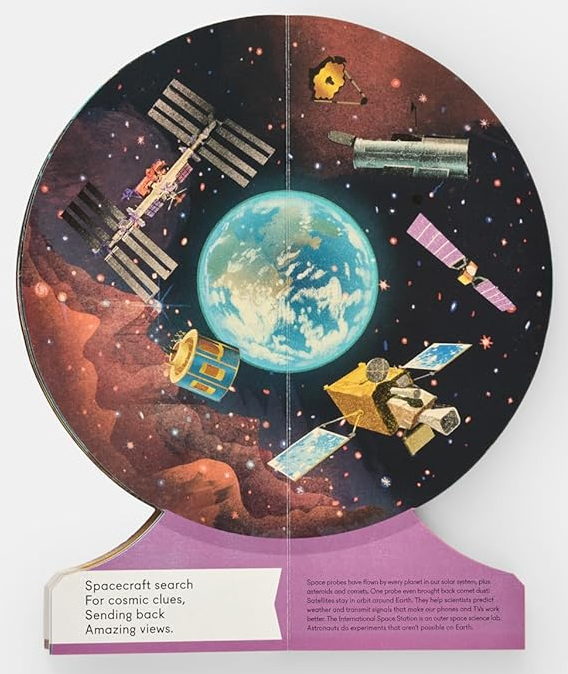
Image copyright Lisk Feng, 2024, text copyright Sue Lowell Gallion. Courtesy of Phaidon.
In her poetic and accessible multi-layered text, Sue Lowell Gallion engages both the youngest readers and those ready for more in-depth facts in an inspiring and educational exploration of the wonders of space and a celebration of human curiosity that has propelled us to tremendous scientific achievements. The rigorously researched text is also sprinkled with engaging questions that will get kids excited about joining in discussions at school or at home, while opening their imaginations to what they could accomplish in their future.
In her stunning, realistic illustrations, Lisk Feng captures the breathtaking beauty and vastness of space. Her dazzling images of our solar system are textured and detailed, urging children to look closer (is that a satellite among the asteroids?) and appreciate not only what lies beyond but humans’ early accomplishments as well as the technology that marks our contemporary era of space exploration.
Sure to ignite wonder, curiosity, and a desire to learn more about space, science, and technology, Our Galaxy: A First Adventure in Space offers endless inspiration for teachers and educators, homeschoolers, and any child enthralled with space. The unique format allows for easy and eye-catching display and will entice kids to dip into this book again and again, making it a must addition to school, public library, and home collections.
Ages 2 – 5+
Phaidon Press, 2024 | Oversized Boardbook: ISBN 978-1838668839
Pair Our Galaxy: A First Adventure in Space with Our World: A First Book of Geography when kids are ready to explore all the wonders on our home planet.
Get Ready for STEM Day & World Science Day Day Activity

“I Am the Future of STEM” Activity Book
The coloring pages, puzzles, and other activities in this comprehensive activity book makes an impactful addition to any lesson or simply makes free time fun!
I Am the Future of STEM Activity Book
You can purchase Our Galaxy: A First Adventure in Space at these booksellers
Amazon | Barnes & Noble | Bookshop (to support your local independent bookstore)
Picture Book Review


![Tool-Box-Coloring-Page-[www.getcoloringpages.com]](https://celebratepicturebooks.com/wp-content/uploads/2018/03/tool-box-coloring-page-www-getcoloringpages-com.gif)








 celebratepicturebooks.com