October 28 – National Immigration Day

Today’s holiday celebrates the uniqueness of our “melting pot” culture and our tradition of welcoming those seeking a new and better life of opportunity. Most of America’s citizens can look back on a history of immigration, especially during the 19th century, when famine, oppression, and political upheaval threatened people’s lives and livelihoods. To honor today’s holiday, talk with your kids about your family’s history.

Thank you to Apples & Honey Press for sending me this book for review!

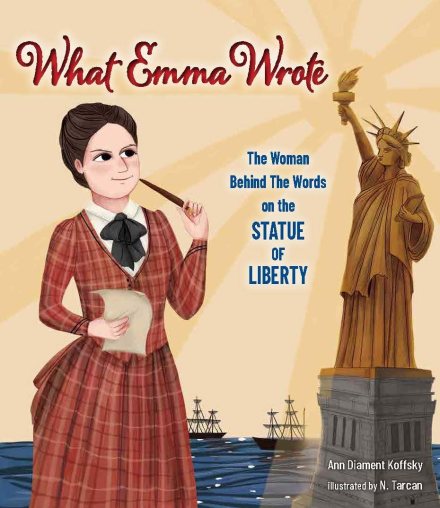
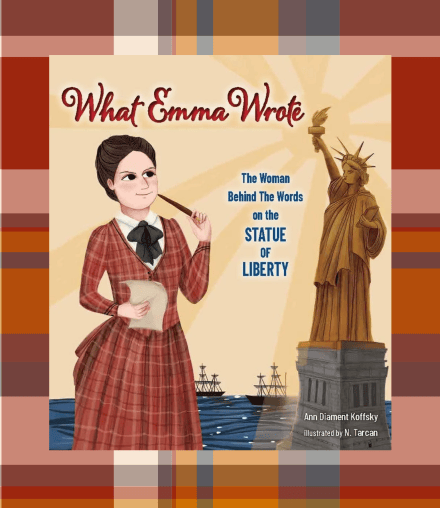
What Emma Wrote: The Woman Behind the Words on the Statue of Liberty

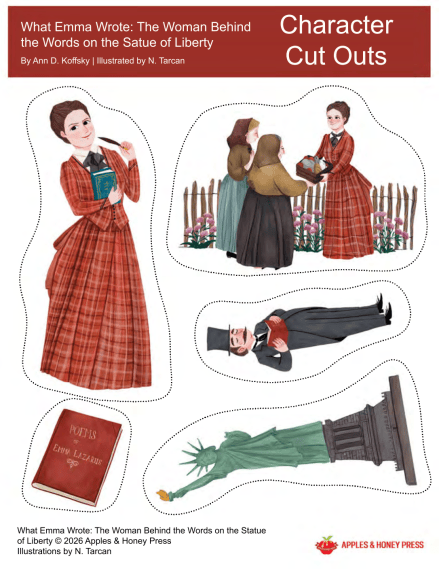
Emma Lazarus was a born writer, penning stories, poems, and essays wherever she went. Her parents were so proud of her that they bound her work into a book for family and friends, but so many people wanted one that they had to print more copies. While Emma was happy with this accomplishment, she was also looking for new ideas. Then one day Emma heard a group complaining about the “many people who had recently moved to New York from other countries.” Emma thought about her own family, who had come from Brazil many years ago after the king made it illegal to be Jewish.
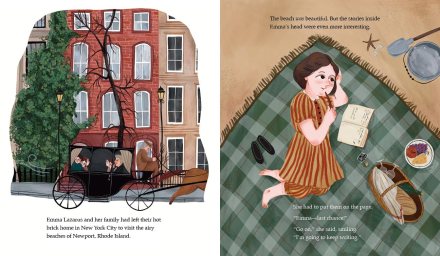
Illustration copyright © 2026 by N. Tarcan. Text copyright © 2026 by Ann Diament Koffsky. Published by Apples & Honey Press copyright © 2026.

Emma wondered about the new immigrants’ stories and decided to talk to them herself. “She went to Wards Island, where many new immigrants lived.” She met a mother from Russia with young children and others who had come to America after their homes were burned because they were Jewish. Emma began helping this community, bringing them food and clothing and helping to set up a trade school to help them find work.
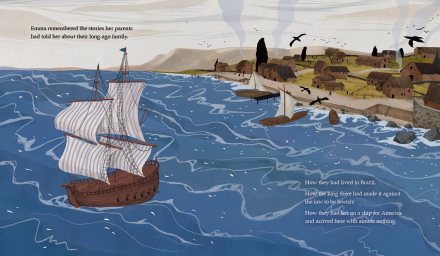
Illustration copyright © 2026 by N. Tarcan. Text copyright © 2026 by Ann Diament Koffsky. Published by Apples & Honey Press copyright © 2026.

When Emma read an article in a popular magazine blaming the immigrants for their plight, she went to the magazine’s editor, who told her to write a rebuttal. Her first article led to many more, and soon these were changing people’s minds and conversations about the immigrants. Now, people wanted to help them and accept them as their own. Her work became so well-known that Emma was asked to write a poem about the Statue of Liberty. Emma imagined what the statue would say to those “who traveled so far to come to America,” and pictured her as a “mother, welcoming her children home.” She began to write: “Give me your tired, your poor, / Your huddled masses yearning to breathe free . . .”
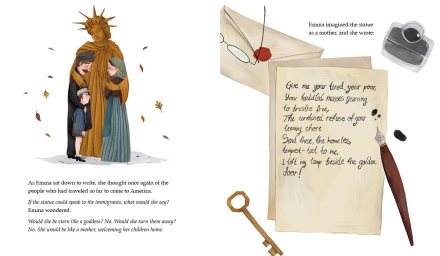
Illustration copyright © 2026 by N. Tarcan. Text copyright © 2026 by Ann Diament Koffsky. Published by Apples & Honey Press copyright © 2026.

People loved Emma’s poem, and “it inspired them to love the statue, too.” When her pedestal and the Statue of Liberty were finally settled in New York Harbor, the celebration attracted more than a million people. In the ensuing years, millions of people have traveled through New York Harbor to make America their home. Emma’s poem, “carved into a metal plate inside the statue’s base” welcomes each of them “with kindness.”

Back matter includes an Author’s Note about immigration in the 1800’s to early 1900’s and today, as well as the story of her own family’s immigration to America; facts about the Statue of Liberty; and a discussion of the deep connection between Emma and the Statue along with the text of Emma’s sonnet, “The New Colossus.”
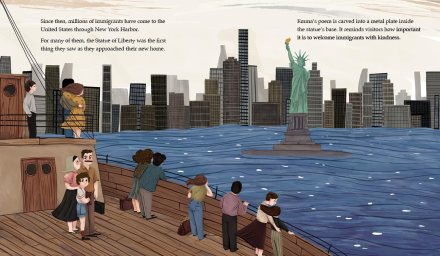
Illustration copyright © 2026 by N. Tarcan. Text copyright © 2026 by Ann Diament Koffsky. Published by Apples & Honey Press copyright © 2026.

Ann Diament Koffsky reveals Emma Lazarus as a profound thinker and writer with a big heart even from a very young age, who, instead of relying on hearsay and the voices of prejudice, sought the truth by talking to the immigrants herself and then acting on their behalf. Through her poignant use of Emma’s thoughts, various characters’ dialogue, and Emma’s family’s and other immigrants’ stories, Koffsky provides readers with an understanding of the underpinnings of immigration. Her compelling, well-paced prose will keep children riveted to the story and prompt them to want to learn more about their own family’s history of coming to America. Koffsky’s excellent portrayal of the impact of journalism on people’s opinions opens doors to discuss today’s communication methods.

N. Tarcan’s stunning illustrations of New York during the mid to late 1800s allow readers to experience the customs and lifestyle of Emma’s world during this period. Tarcan contrasts this with an image of the village in Brazil from which Emma’s ancestors escaped. Children see the trade school Emma established as well as her determination to help the immigrants on Wards Island and elsewhere. An image of the Statue of Liberty embracing an immigrant family is particularly moving and exemplifies Emma Lazarus’s warmhearted welcome to all.

What Emma Wrote: The Woman Behind the Words on the Statue of Liberty is a must for all public and school libraries and would be an inspiring and impactful addition to any home collection.

Ages 4 – 8

Apples & Honey Press, 2026 | ISBN 978-1681157191

About the Author

Ann D. Koffsky is an award-winning author and illustrator of more than thirty books for children, including The Peddler and the President, the Kayla and Kugel series, What’s In Tuli’s Box?, Under-the-Sea Seder, and Noah’s Swimathon, all published with Apples & Honey Press. She lives in West Hempstead, New York. Visit her at annkoffsky.com.

About the Illustrator

N. Tarcan is a Turkish illustrator. She studied photography at Yildiz Technical University, but life had other plans! One day, she was taking photos of a local circus and the next thing she knew, she was performing with them and traveling around the world—from Qatar to Georgia and beyond. When COVID hit, she decided to return to her first love: drawing. Today, she draws inspiration from the small details of everyday life. She lives in Namur, Belgium. Follow her on Instagram.

You can find a detailed Reading Guide to What Emma Wrote with discussion questions, extension activities, coloring pages, character cut outs, and more on the Apples & Honey Press and Behrman House website and here.
You can purchase What Emma Wrote: The Woman Behind the Words on the Statue of Liberty from these booksellers

Amazon | Barnes & Noble | Bookshop

June 18 – National Go Fishing Day

Is fishing your thing? Do you like nothing better than heading down to the lake or stream and spending a relaxing day with a fishing pole, some bait, and the possibility of reeling in a “whopper?” Perhaps you like fly fishing better, challenging yourself to flick that hook in just the right place. Then again, maybe taking a boat out to deep water and pitting yourself against the truly big fish is more your style. However you like to fish, make some time to enjoy your hobby today! If you haven’t yet discovered the joys of fishing, today’s book is sure to get you hooked!

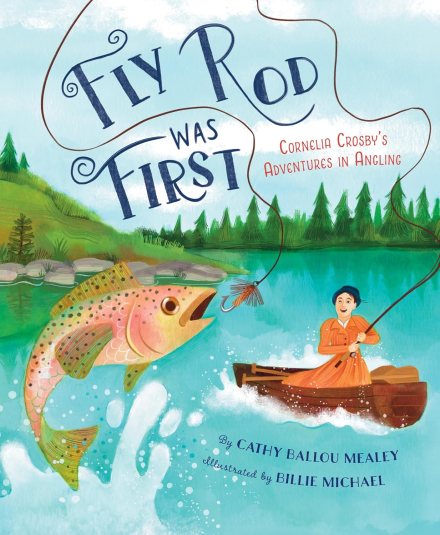
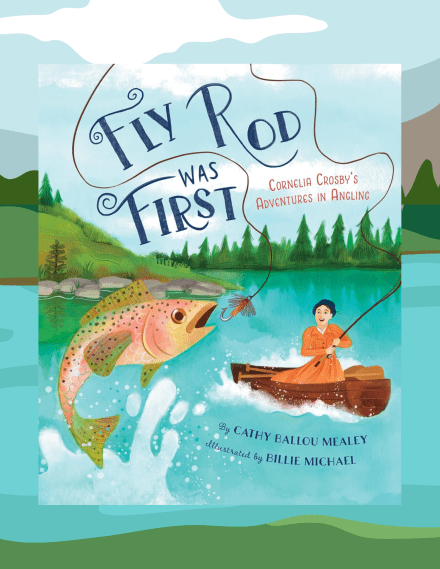
Fly Rod Was First: Cornelia Crosby’s Adventures in Angling

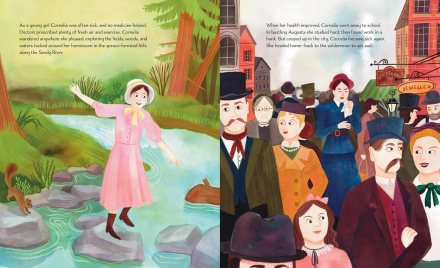
When Cornelia Crosby was born in 1854, Maine was a fishing paradise. “From lunkers to whoppers, the biggest trout and salmon pulled from the rivers and lakes were longer and heavier than baby Cornelia.” As a young girl, Cornelia spent much of her days outdoors, exploring the fields, woods, and waterways around her home—an antidote for her poor health. As a young woman, with her health improved, Cornelia was sent to the city to attend school, but she relapsed and returned home.

Illustration copyright © 2026 by Billie Michael. Text copyright © by Cathy Ballou Mealey. Courtesy of Sleeping Bear Press.

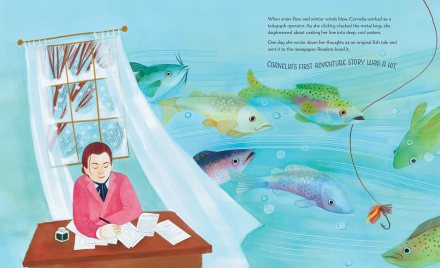
Here, the long days stretched out before her. She decided to try fishing, and with her first catch she was hooked. Cornelia spent spring and summer traveling among the fishing camps that dotted the state of Maine, wearing a full-length skirt and high-neck collar that amused her male counterparts. With her bamboo fishing rod, she reeled in fish after fish. During the winter, Cornelia worked as a telegraph operator and “daydreamed about casting her line into deep, cool waters.”

Illustration copyright © 2026 by Billie Michael. Text copyright © by Cathy Ballou Mealey. Courtesy of Sleeping Bear Press.

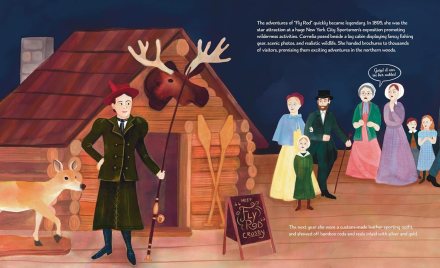
One day she crafted an original fish tale from her experiences and sent it to the newspaper, which published it. Readers were enthralled, and the editor wanted more of Cornelia’s stories. He even gave her a nickname, “Fly Rod.” “Fly Rod” Crosby’s columns about Maine’s natural beauty and extraordinary fishing opportunities took off. How good was fishing in Maine? It was so exceptional that Cornelia and her guide “once landed fifty-two trout in forty-four minutes.” On another “especially good day, she caught more than 200 fish!” But as one of the first public advocates for “catch-and-release,” Cornelia returned most of these to the water.

Illustration copyright © 2026 by Billie Michael. Text copyright © by Cathy Ballou Mealey. Courtesy of Sleeping Bear Press.

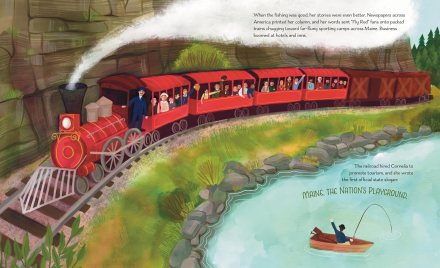
Cornelia’s stories began appearing in newspapers across the country, bringing visitors to all parts of Maine. Hotels and restaurants thrived. The railroad even “hired Cornelia to promote tourism and she wrote the first official state slogan. By 1895 “Fly Rod” Crosby was a legend, and Maine had become a top vacation destination. But at the height of her career, an accident curtailed her ability to hike or get out on the water. She fished from docks, however, and wrote her column into her eighties. Cornelia is remembered with a statue in the Maine Women’s Hall of Fame, a wilderness trail named for her, and even a bluegrass tune, “The Ballad of Fly Rod Crosby.”

Following the story, readers can enjoy Cathy Ballou Mealey’s step-by-step tips on how to write a fish story and see a photograph of Cornelia Crosby holding an impressive catch of fish.

Illustration copyright © 2026 by Billie Michael. Text copyright © by Cathy Ballou Mealey. Courtesy of Sleeping Bear Press.

Cathy Ballou Mealey’s biography of the trail-blazing Cornelia Crosby will fascinate children as well as adults as she transports them back more than 180 years to the pristine waters of Maine. With lovely, evocative language, Mealey puts readers at Fly Rod’s side to witness her fishing prowess, follow her innate talent for storytelling, and experience her impact on Maine’s nascent tourism boom. Mealey’s distinctive subject easily lends itself to a wide range of topics for educators and students to further explore, including fishing, the growth of US tourism and tourist attractions, women in journalism, changing fish and animal populations, and so many more.

Billie Michael’s magnificent illustrations transport readers to the mid-1800s with shimmering lakes and roaring rivers teeming with dazzling salmon and rainbow trout, sport undertaken in formal clothing, steam train travel, and the country-wide influence of newspaper columnists. Her images of Cornelia “Fly Rod” Crosby are packed with personality, exhibiting her brilliance and indefatigable spirit. Readers can almost hear the “swish” and “snap” of Crosby’s fishing line, while each page contains clear depictions of life and common objects from the period, inviting children into an exciting transitional era.

An exceptional biography of a remarkable woman, Fly Rod Was First: Cornelia Crosby’s Adventures in Angling will charm and inspire readers to embrace their passion and generate excitement for learning about the past. The book is a must for any school and public library collection as well as for children who love fishing, young adventurers, and history and biography buffs.

Ages 6 – 9

Sleeping Bear Press, 2026 | ISBN 978-1534113602

Cathy Ballou Mealey lives in Massachusetts where she still tells fish stories about the giant hornpout she caught (and released) at midnight on a dock at Beaver Lake. She is the author of Make More S’mores and the Sloth and Squirrel books. To learn more, visit her website. You can also find her on Instagram or BlueSky @catballoumealey.

Billie Michael is an illustrator with a passion for creating artwork that is full of detail, texture, and rich colors. She works with watercolor, colored pencil, and other media to bring stories and characters to life. When she’s not drawing, Billie loves watching movies, going on very long walks, and playing guitar. She lives with her cat, Louise, in Philadelphia. Visit her at billiemichael.com and on Instagram.

celebrate-picture-books-picture-book-review-go-fishing-game-4

Kids can go fishing right at home with this easy-to-make game! With a paper plate pond, a few printable fish, and a few other supplies, kids will be catching a whole lot of fun!

Supplies

celebrate-picture-books-picture-book-review-go-fishing-game-1

Directions

  1. Color the paper plate blue
  2. Print the Go Fishing! Game Playing Die (optional)

To Make the Fish

  1. Print the fish templates or have kids draw and color their own fish and cut out
  2. Tape a paper clip to the back of the fish or slip a paperclip onto the nose of the fish
  3. If using back-to-back templates, cut fish out, put a paper clip between the sides and glue or tape the two sides together

To Make the Fishing Pole

  1. Tie a length of string to the straw, pencil, or dowel
  2. Sandwich the other end of the string between the two circular magnets
  3. Lay the fish on the plate
  4. Go fishing!

Optional Game: Kids can roll the die to determine which fish to catch.

You can purchase Fly Rod Was First: Cornelia Crosby’s Adventures in Angling from these booksellers

Amazon | Barnes & Noble | Bookshop