About the Holiday
Don’t you wish there was somewhere that you could find all the books you’d love to read and then be able to take them home for free? Oh! You’re right! There is such a place—and what’s even more amazing is that there’s one in almost every town. Libraries are one of the most valuable community services, and this month people are encouraged to visit their local library and sign up for a library card. It’s easy and free and pays way more benefits than any of the store cards hanging from your keychain. Kids, especially, are excited to get their own library card that can start them off on a lifetime love of reading. So, if you or your child don’t have a library card, visit your library and make it a special event!
Thank you to Gnome Road Publishing for sending me this book for review!
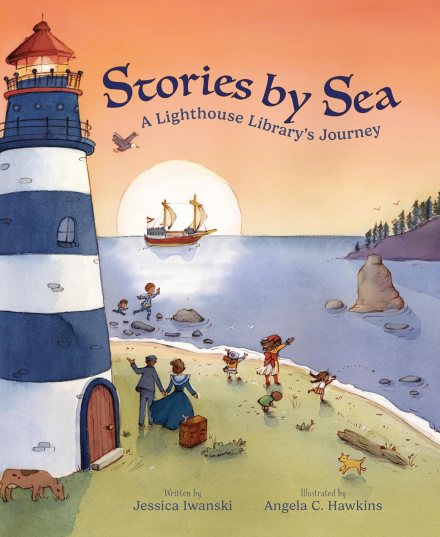
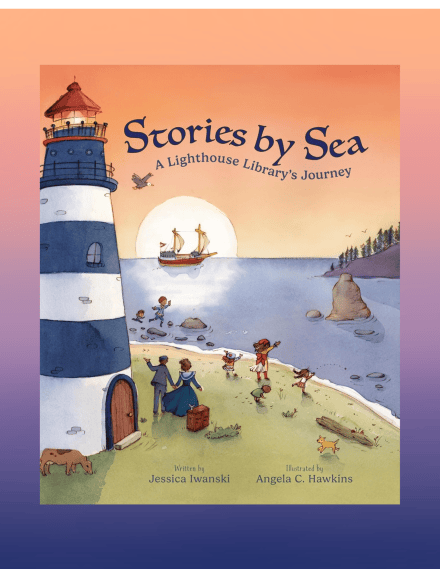
Stories by the Sea: A Lighthouse Library’s Journey
Written by Jessica Iwanski | Illustrated by Angela C. Hawkins
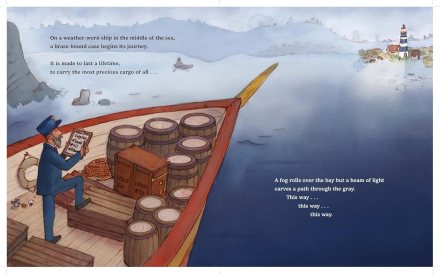
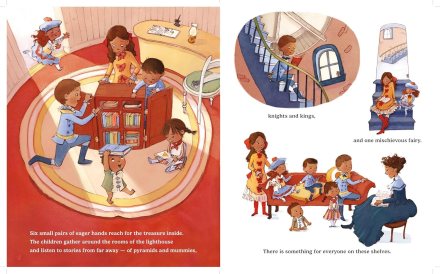
A ship’s captain of the 1800s sets sail on his mission to deliver “the most precious cargo of all”—a “brass-bound case” filled with books. As he nears a misty coastline, the captain heeds the beam of the lighthouse guiding him “this way . . . this way . . . this way.” Along the railing at the top of the lighthouse, the keeper and her six children watch the ship’s progress with excitement. They shout and wave, “‘The books are here! The books are here!” The polished library box opens like a bookcase to reveal a world of stories, and the children settle in on the rug, the stairs, and the sofa to read by themselves or listen to their mother’s voice. Later, they write in the log book about their favorite stories and to ask for “more historical books in the next case.”
In a few months, the ship returns to take the books on their next journey to another lighthouse. This time the seas are stormy, but the beam of light guides them in. This lighthouse keeper had asked for Shakespeare’s plays. At the end of his time with the library, he jots his notes in the log before sending them on their way. The library arrives at the next lighthouse with a technical manual just in time for a needed repair. Throughout the year, the quarterly visits continue, fulfilling the soulful, imaginative, spiritual, educational, connective, and practical needs of the lighthouse keepers and their families—”Each stop along the way, a story all its own.”
Back matter includes an Author’s Note that offers fascinating information about lighthouses, life as a lighthouse keeper, and the history of lighthouse libraries. In a Did You Know? section, Angela C. Hawkins presents intriguing facts about the construction and internal workings of lighthouses, the work of lighthouse keepers, the cost of building a lighthouse and keepers’ salaries in the 1800s, and even the animals that often called these small, dedicated islands home.
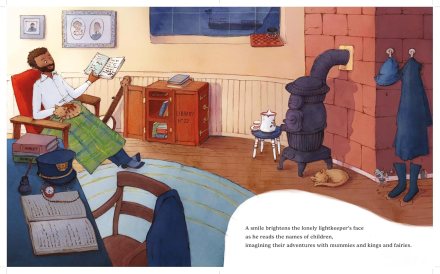
Jessica Iwanski’s enchanting story based on historical fact illuminates both the importance of books and the fascinating life and diverse lighthouse keepers and their families, who kept ships safe from perilous coastlines. Her beautifully lyrical storytelling evokes the mystery and constancy of the sea and the excitement, connection, and discovery the library books provided. Including snippets from the logbook that made the rounds with each delivery may entice kids to keep such a diary of their own reading.
Angela C. Hawkins’ stunning illustrations place young readers onboard a wooden sailing ship as it nears a variety of scenic coastlines, among diverse families and single keepers eagerly awaiting new books, and in the froth of storms as the lighthouses’ beam guides the ships to safety. Young readers will be intrigued by the homey touches inside each lighthouse and want to linger over Hawkins’ captivating details—as well as to spy the little book-loving mouse on each spread! Every page offers gleaming perspectives, and each stop by the ship brings a new, charming lighthouse to explore.
Created with obvious love and care, Stories by the Sea is a gleaming tribute to book lovers, libraries, and the early lighthouse keepers dedicated to safe passage for all ships. This moving book will appeal to all fiction and nonfiction fans as well as history buffs and anyone interested in early maritime life. It is a must for all public and school libraries and will be a read-again favorite on home bookshelves.
Ages 4 – 8
Gnome Road Publishing, 2026 | ISBN 978-1957655703
About the Author
Jessica Iwanski is a lyrical children’s writer with a passion for all things books and reading. She loves drawing inspiration from true stories and enjoys the challenge of bringing new life to overlooked historical and cultural gems. As a second-generation homeschooler, Jessica can often be found planning literature-based learning for her children and their homeschool co-op. In her free time, Jessica enjoys spending time with her family, baking mediocre sourdough loaves, and trying to find her next favorite read – or else, trying to write it! Jessica lives in Arizona with her husband, three children, and one curly dog (who the family agrees is probably a cat in disguise). Visit her at jessicaiwanski.com.
About the Illustrator
Angela C. Hawkins has been creating since she was as small as her characters. In 2003 she sold her first story to Spider Magazine. Soon after, she plunged into illustration. Practice, two babies, and ten moves later she got paid for that too! In addition to writing and illustrating MousterWorks (Gnome Road Publishing 2025) and illustrating Nancy Bess Had a Dress (Claire Annette Noland, Gnome Road Publishing, Spring 2024), you’ll find Angela’s art in books for Heinemann and Deeds Publishing, a poster for the Brooklyn Public Library, and Babybug/Ladybug/Spider Magazines. She’s won several awards, including the 2017 Don Freeman Grant, the 2017 RMC-SCBWI Portfolio Showcase, and the 2021 SCBWI SW Texas Portfolio Contest. Angela was also a 2023/2024 PBParty Finalist and is currently represented by Mara Cobb (Martin Literary Agency). Find out more about Angela at angelachawkins.com.
Library Card Sign-Up Month Activity
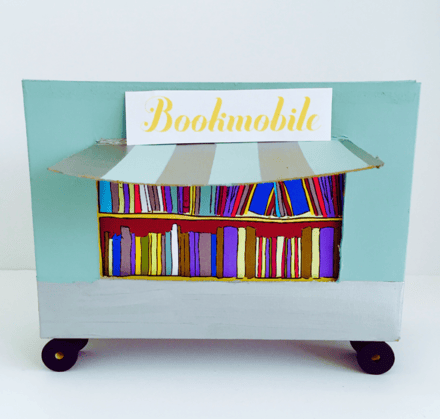
Bookmobile Craft
Bookmobiles are love on wheels! If libraries are some of your favorite places, you’ll like making this bookmobile from a recycled box! You can even use it as a desk organizer!
Supplies
- Printable Book Shelves and Sign Template
- Cardboard box, 16-oz pasta or other recyclable boxes work well (I used a 5” x 7 ¼ -inch pasta box)
- Small wooden spools or wheels
- Paint
- Scissors
- X-acto knife
- Strong glue
- Paint brush
Directions
1.Gently pull the box apart at the seam and lay it flat with the unprinted side facing up
2. To Make the Awning:
- On one of the wide sides of the box, measure a rectangle 1 inch from the top of the box, leaving at least 1 ¼ inches at the bottom of the box and 1 ¼ inches on both sides
- With the x-acto knife or scissors cut the sides and bottom of the rectangle, leaving the top uncut
- Paint the top and underside of the awning (if you want to make stripes on the awning lay strips of tape side by side across the awning. Remove every other strip of tape. Paint the open stripes one color of paint. When the paint dries replace the tape over the paint and remove the tape from the unpainted stripes. Paint those stripes a different color.)
3. Paint the rest of the box on the unprinted side any way you like, let dry
4. To add the bookshelf, print and cut the Book Shelf template to fit the size of your window opening, leaving at least a ½ inch margin all around (or draw and color your own bookshelves).
5. Tape the book shelf to the inside of the window
6. Reconstruct the box, making the original seam an inside flap
7. Glue the flap and sides together
8. If using small spools for wheels, paint them black. Let dry
9. Glue the wheels to the bottom of the box
10. Print and attach the Bookmobile sign, from the printable template, above the awning
** To Make a Desk Organizer from the Bookmobile, cut an opening in the top of the bookmobile with the x-acto knife or a scissor
You can purchase Stories by the Sea: A Lighthouse Library’s Journey from these booksellers
Amazon | Barnes & Noble | Bookshop
Picture Book Review