April 24 – It’s National Frog Month

celebrate-picture-books-picture-book-review-i-dont-want-to-be-a-frog

About the Holiday

As the weather gets warmer, rain falls, and swampy areas and wetlands swell with water, the peeps and throaty croaks of frogs begins to fill the nighttime air. April is the perfect time to learn more about frogs and their importance to the ecosystem. Frogs are vital to the food system, and they eat insects that are harmful to crops and carry disease. Because they don’t drink water but absorb it through their skin, frogs are particularly susceptible to pollution. This, in addition to habitat destruction, climate change, and an increase in invasive species, threaten the frog population, making the conservation of their environment of utmost importance. This month, visit an aquarium, nature preserve, or zoo where you can learn more about these fascinating creatures.

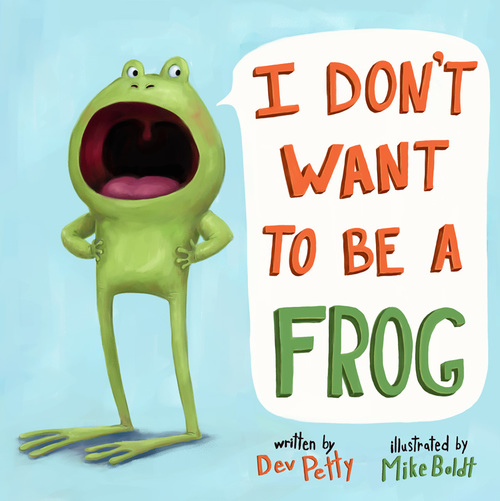
I Don’t Want to be a Frog

Written by Dev Petty | Illustrated by Mike Boldt


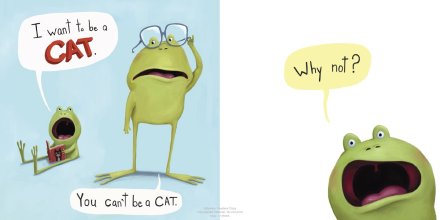
“I want to be a cat,” a little frog announces to his father. “You can’t be a cat,” his dad answers, which elicits the inevitable “Why not?” from his son. His dad isn’t quite ready for this conversation and gives him the standard “because you’re a frog” response. Well, it turns out the little frog would rather be almost anything other than what he is. As he rattles off a list of alternatives that he considers much better, his dad warms to the game and counters each of his son’s suggestions with the realities of life (at least their life).
celebrate-picture-books-picture-book-review-i-don't-want-to-be-a-frog-cat

Image copyright Mike Boldt, 2015, text copyright Dev Petty, 2015. Courtesy of Doubleday Books for Young Readers.

When little frog opines that he’d like to be a rabbit, his dad points out that he doesn’t have long ears. Being a pig seems like an attractive option, but Dad reminds him that he doesn’t have a curly tail or eat garbage. While both son and father believe being an owl would be “the greatest thing ever,” three things are standing in the way: Frogs don’t have wings, they don’t look wise, and they can’t spin their heads around.

So what’s so bad about being a frog? It’s “too wet,” “too slimy,” and there’s “too much bug eating,” little frog complains. Just then a wolf sneaks up and wants to know why the little guy is so glum. Without turning around to see who’s asking, the frog reveals his plight.
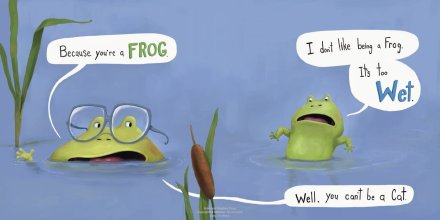
celebrate-picture-books-picture-book-review-i-don't-want-to-be-a-frog-too-wet

Image copyright Mike Boldt, 2015, text copyright Dev Petty, 2015. Courtesy of Doubleday Books for Young Readers.

With glee the wolf lets the frog in on a little secret, explaining that he revels in eating cats, rabbits, pigs, and owls. In fact, just talking about it makes him hungry.  “Guess the one thing I never eat,” the wolf urges. “Badgers?” guesses the little frog. But no, the answer is “frogs.” And why? Because they are “too wet and slimy and full of bugs.”

Wiser for this fresh perspective, the young frog sends the wolf off with a hearty, “I guess you can’t fight nature. We are what we are. You are a fierce hunter.” As the wolf walks away all’s well that ends well—except not so much for the creature who next happens upon the scene!
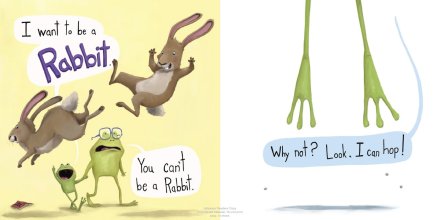
celebrate-picture-books-picture-book-review-i-don't-want-to-be-a-frog-rabbit

Image copyright Mike Boldt, 2015, text copyright Dev Petty, 2015. Courtesy of Doubleday Books for Young Readers.

Dev Petty’s sassy-in-a-good-way young frog’s identity crisis is pure fun! The notion of self-acceptance and that each person is built, has talents, and embodies skills just right for who they are is playfully presented by Petty’s sweet father-and-son team. The humorous, escalating dialogue will keep kids laughing, and the surprise ending is a perfect twist. Petty’s endearing amphibian has spawned two sequals—I Don’t Want to Be Big and There’s Nothing to Do. A third, I Don’t Want to Go to Sleep, is due this fall.
celebrate-picture-books-picture-book-review-i-don't-want-to-be-a-frog-little-frog

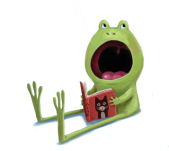
Mike Boldt’s olive green frogs are a delight as they trade off assurance and skepticism in their life-lesson conversation. Dad, initially mystified by his son’s pronouncements, discusses the issue with patience and genuine curiosity, his eyes registering cunning and understanding behind oversized glasses. His son, wide-eyed and vocal, displays the honesty of children with his questions. Boldt’s illustrations of the rabbit, pig, and owl that so captivate the young frog, juxtaposed with the father’s objections, are comical joy, as are the frogs’ looong legs and expressive faces. The final scenes with the enlightening wolf, whose head spans two pages, offer more laughs as the father and son resolve their differences.

Kids will love hearing I Don’t Want to be a Frog again and again, making it sure bet for home and classroom bookshelves. And now, even the littlest tadpoles can enjoy the story with the new board book edition.

Ages 3 – 7

Doubleday Books for Young Readers, 2018 (Board Book) | ISBN 978-0525579502 | 2017 (Paperback) 978-1338225259 | 2015 (Hardcover) 978-0385378666  

Discover more about Dev Petty and her books on her website

To learn more about Mike Boldt, his books, and his art, visit his website.

You do want to watch the I Don’t Want to be a Frog book trailer!

National Frog Month Activity

celebrate-picture-books-picture-book-review-frog-matching

Hop Along Matching Game


Hop along now and help these frogs! Each of these fantastic frogs has a twin, but they’ve gotten separated. Can you spot the identical pairs? Print out the Hop Along Matching Game and draw a line between the pairs.

picture book review

April 20 – National Look Alike Day

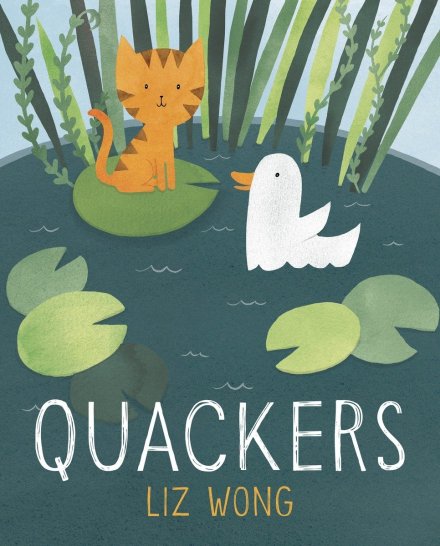
celebrate-picture-books-picture-book-review-quackers-liz-wong-cover

About the Holiday

Do people say you look like someone else—a family member or friend or maybe a celebrity or historical figure? If so, today is the day to embrace that dopplegänger and perhaps have a little fun with the resemblance. The holiday got started in 1980 when television news reporter Jack Etzel was looking for a feature story on a slow news day. Out on the sidewalk with his camera crew, Etzel spotted a man who looked like Humphrey Bogart. He stopped him and asked him who people said he looked like. Etzel and his crew went on to ask more people about their look-alikes. The next day, Etzel contacted the people who organize the Chase Calendar of Events and proclaimed April 20 as Look Alike Day. Why not join in the fun and go all out? Dress up as your look alike, talk and act like them, and enjoy a day of fame!

Quackers

By Liz Wong


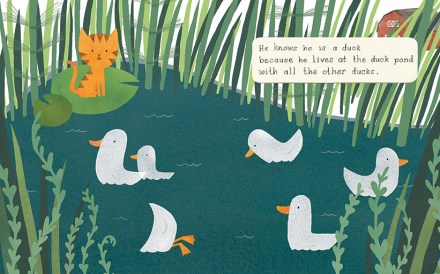
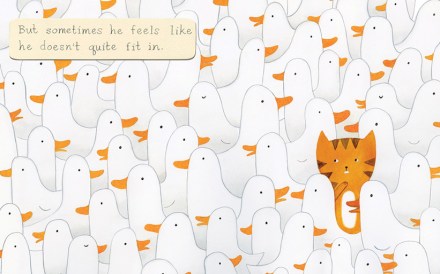
Quackers, a little orange tabby, wants to say hello! “Meow.” Quackers is a duck. “He knows he’s a duck because he lives at the duck pond with all the other ducks.” Not only that, but all of his friends are ducks. Sometimes, though, when he looks around at all the white feathers and orange beaks, he feels a bit out of place, and communicating is sometimes difficult. There’s also the issue of food—some of the things he’s given to eat are pretty slimy or tiny or hard to chew, and duckweed seems to be on the menu all the time. The worst, though? Getting wet.

celebrate-picture-books-picture-book-review-quackers-liz-wong-at-the-pond

Copyright Liz Wong, 2016, courtesy of Knopf Books for Young Readers.

One day, Quackers meets another duck who looks like him and sounds like him. In his joy, Quackers blurts out, “‘I’ve never met a duck who understands me!’” The gray kitten, Mittens, is confused at first and then understands and then laughs. At last, she invites Quackers to follow her. They end up at a farm where Mittens lives with “a whole flock of strange ducks. Ducks just like Quackers.”

Mittens shows Quackers how they “chase mice,” which Quackers prefers to swimming; “drink milk,” which is more delicious than duckweed; and clean themselves, which Quackers is a bit iffy on. Soon, Quackers is napping with his new friends. As much as he enjoys being a cat, Quackers starts to miss the duck pond. He even finds that he has a craving for duckweed. He scampers back and discovers that “most of all, he missed his friends.”

Now Quackers splits his time at the pond and the farm. Sometimes he’s a duck, and sometimes he’s a cat. But all the time “he’s just Quackers, and that makes him completely happy.”

celebrate-picture-books-picture-book-review-quackers-liz-wong-ducks

Copyright Liz Wong, 2016, courtesy of Knopf Books for Young Readers.

As mom to a cat who thinks he’s part person and possibly part dog, I fell in love with Liz Wong’s little Quackers and little readers will too. Kids will giggle as Quackers sits contentedly on a lily pad, accepts slugs and snails as snacks with a meow-nimum of fuss, and explains to Mittens that he’s a duck.  Readers, who are beginning to develop their own identity, will be cheered when Quackers embraces both his duck and cat sides. They’ll understand that it’s what’s inside a person that matters and that being yourself is the best thing you can be. Wong’s adorable kittens and ducks will charm kids, and her simple hand-lettered text and speech bubbles create a cozy reading experience that’s like a sweet hug in a book.

Full of humor, self-acceptance, and inclusion, Quackers should find a home on any child’s and classroom’s bookshelf.

Ages 3 – 7

Knopf Books for Young Readers, 2016 | ISBN 978-0553511543

Discover more about Liz Wong, her books, and her art on her website.

National Look Alike Day Activity

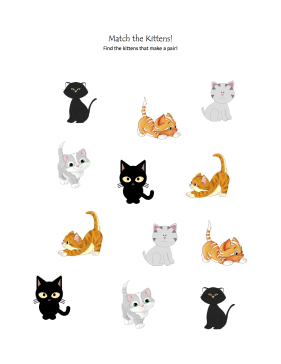
celebrate-picture-books-picture-book-review-match-the-kittens-puzzle

Match the Kittens Puzzle


These adorable kittens all have a twin, but they’ve gotten mixed up while playing. Can you find the matching pairs in this printable Match the Kittens Puzzle?

Picture Book Review

April 9 – International Unicorn Day

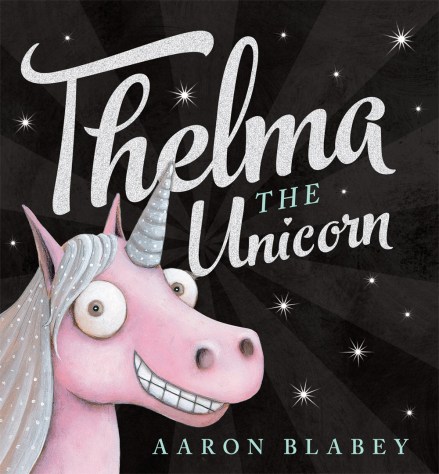
celebrate-picture-books-picture-book-review-thelma-the-unicorn-cover

About the Holiday

If you ask a child—maybe even an adult—to name a magical creature, chances are they’ll say, “a unicorn!” Unicorns have been part of legend since ancient times, undergoing changes from an image of fierceness and power to a representation of strength and true love to today’s more glittery superstar. To celebrate, learn more about the history of these mystical animals and check out your favorite unicorns of book, TV, and toy fame!

Thelma the Unicorn

By Aaron Blabey


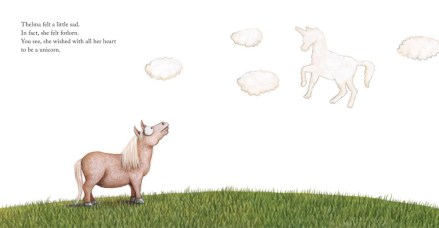
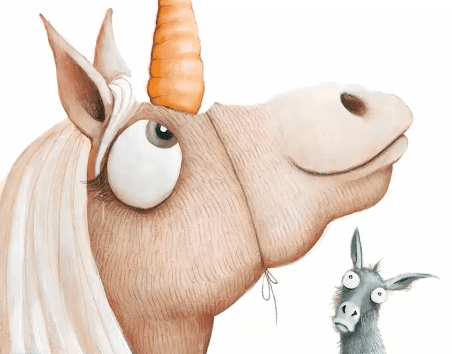
“Thelma felt a little sad. / In fact, she felt forlorn. / You see, she wished with all her heart / to be a unicorn.” Thelma was a little pony—brown and short and overlooked. Her best friend Otis told her, “‘You’re perfect as you are,’” but when Thelma compared herself to the sleek white mare on the farm, she said, “‘I’m not.’” Then she saw a carrot left over from dinner and had an idea.

celebrate-picture-books-picture-book-review-thelma-the-unicorn-wishing

Copyright Aaron Babey, 2017, courtesy of Scholastic Press.

She tied the carrot to her forehead and told Otis, “‘I’ll say that I’m a unicorn! / It might just work… / who knows?’” At this very moment a truck driver passing by caught sight of Thelma and careened off the side of the road. “As Thelma watched the swerving truck, / it very nearly hit her. / Would you believe that truck was filled / with nice pink paint and glitter?”

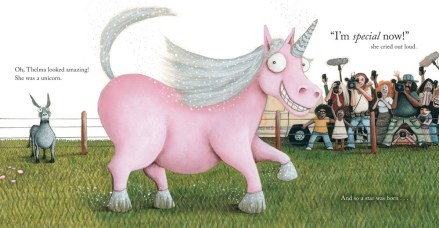
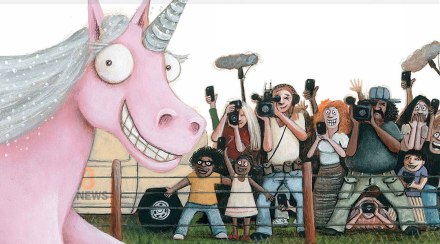
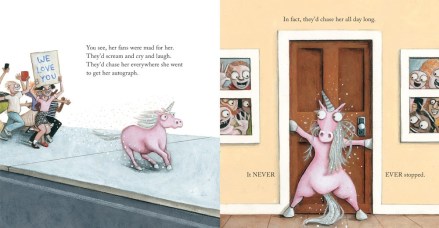
In the blink of an eye Thelma was doused in sparkles and had become what she always dreamed of. She was a unicorn and “special now!” Crowds lined up at the farm gate to see the pink unicorn. The media descended with their cameras and video recorders, and Thelma quickly became a world-wide phenomenon. Everywhere she went fans screamed her name, took pictures, waved signs, and wanted to be near her. She even got her hoofprint on the Walk of Fame.

celebrate-picture-books-picture-book-review-thelma-the-unicorn-becomes-unicorn

Copyright Aaron Blabey, 2017, courtesy of Scholastic Press.

Thelma sailed to foreign ports on a ship named The Fairy Princess, attended by stewards who fulfilled her every wish. “But soon she found that so much fame / was kind of tricky, too….” Her fans mobbed her with crushing zeal; chased after her wherever she went, screamed, cried, laughed, and pointed whenever they saw her; and hounded her day and night for her autograph. “It NEVER EVER stopped.”

When Thelma asked “the screaming crowd” not to chase her anymore, they said “‘We’ll chase you all we want….We’re fans, so it’s allowed.’” Then there were  the people who “were not her fans at all. / No, some were really mean. / And some just did the meanest things / she’d really ever seen.” Some threw eggs while she roller skated for charity and others held up signs reading “I don’t like unicorns” where she was sure to see them.

celebrate-picture-books-picture-book-review-thelma-the-unicorn-adoring-crowds

Copyright Aaron Blabey, 2017, courtesy of Scholastic Press.

Back in her fancy hotel room, all alone and bedraggled, soaked in egg, and with her “horn” losing its luster, Thelma looked at a photo of Otis. “…she felt quite sad, / this famous little pony. / She said, ‘I thought that I’d feel great… / but all I feel is lonely.’” Right then, she decided to make a change. She washed off all the pink paint and sparkles and removed her horn.

She left and “walked right past the crowd. / They didn’t even notice / She thought how nice that it would be…to see her lovely Otis.” Back at the farm, Thelma happily stood underneath a tree with Otis, When he asked her about her trip, she simply said, “‘Oh, it was fun, but I’d rather be just me.’”

celebrate-picture-books-picture-book-review-thelma-the-unicorn-being-chased

Copyright Aaron Blabey, 2017, courtesy of Scholastic Press.

Aaron Blabey’s cautionary tale of a pony who is granted her wish to be “more” than she is, deftly reveals the pitfalls of abandoning your true nature for what appears to be the perks of celebrity with a splash of humor and some no-nonsense honesty. Through Blabey’s smoothly flowing rhymes, readers see that being special is not based on a sparkly appearance that pleases false friends. Instead, each person is remarkable for their unique personalities and talents that true friends will appreciate.

Today’s social media-savvy children will recognize Blabey’s screaming crowds and overzealous fans and will come to understand, with Thelma, that being “in the pink” can be short-lived and that glitter soon fades.

celebrate-picture-books-picture-book-review-thelma-the-unicorn-carrot-horn

Copyright Aaron Blabey, 2017, courtesy of Scholastic Press.

Blabey’s distinctive illustrations portray Thelma’s transformation from “regular pony” to celebrity unicorn and back again with flair and all the bling that goes along with superstardom. The crowds are giddy, awed, obsessive, and adoring until the backlash starts, which Blabey portrays with candid examples. His final spreads in which Thelma goes unrecognized by her fans and is then lovingly welcomed back by Otis beautifully sum up the theme of the story.

Aaron Blabey’s light touch coupled with his encouragement to be true to yourself makes Thelma the Unicorn a great choice for  home and classroom libraries.

Ages  3 – 7

Scholastic Press, 2017 | ISBN 978-1338158427

Scholastic Press sent me a free copy of Thelma the Unicorn to check out. All opinions are my own.

Discover more about Aaron Blabey, his books, and his art on his website

International Unicorn Day Activity

celebrate-picture-books-picture-book-review-unicorn-coloring-page

Magical Unicorn Coloring Page


Grab your crayons—and your glitter—and make this printable Magical Unicorn Coloring Page sparkle!

Picture Book Review