October 13 – It’s Positive Attitude Month

celebrate-picture-books-picture-book-review-raising-don-cover

About the Holiday

No matter how old (or young) you are there’s no getting around the fact that sometimes things are tough or don’t work out the way you planned. For kids, learning how to accept and even make the best of setbacks or disappointments is part of living a happier life. And that’s what Positive Attitude Month is all about. The holiday was established to encourage people to see the bright side of things since being upbeat can improve your health, lower chances of depression, make you more motivated, and lead to better relationships with family and friends. One way for kids to learn this skill is through reading, and today’s book—the true story about a little guy overcoming a few rocky patches of his own—is an adorable and joyful place to start. 

I’d like to thank the San Diego Zoo Wildlife Alliance Press and Blue Slip Media for sharing a copy of Raising Don with me for review consideration. All opinions on the book are my own.

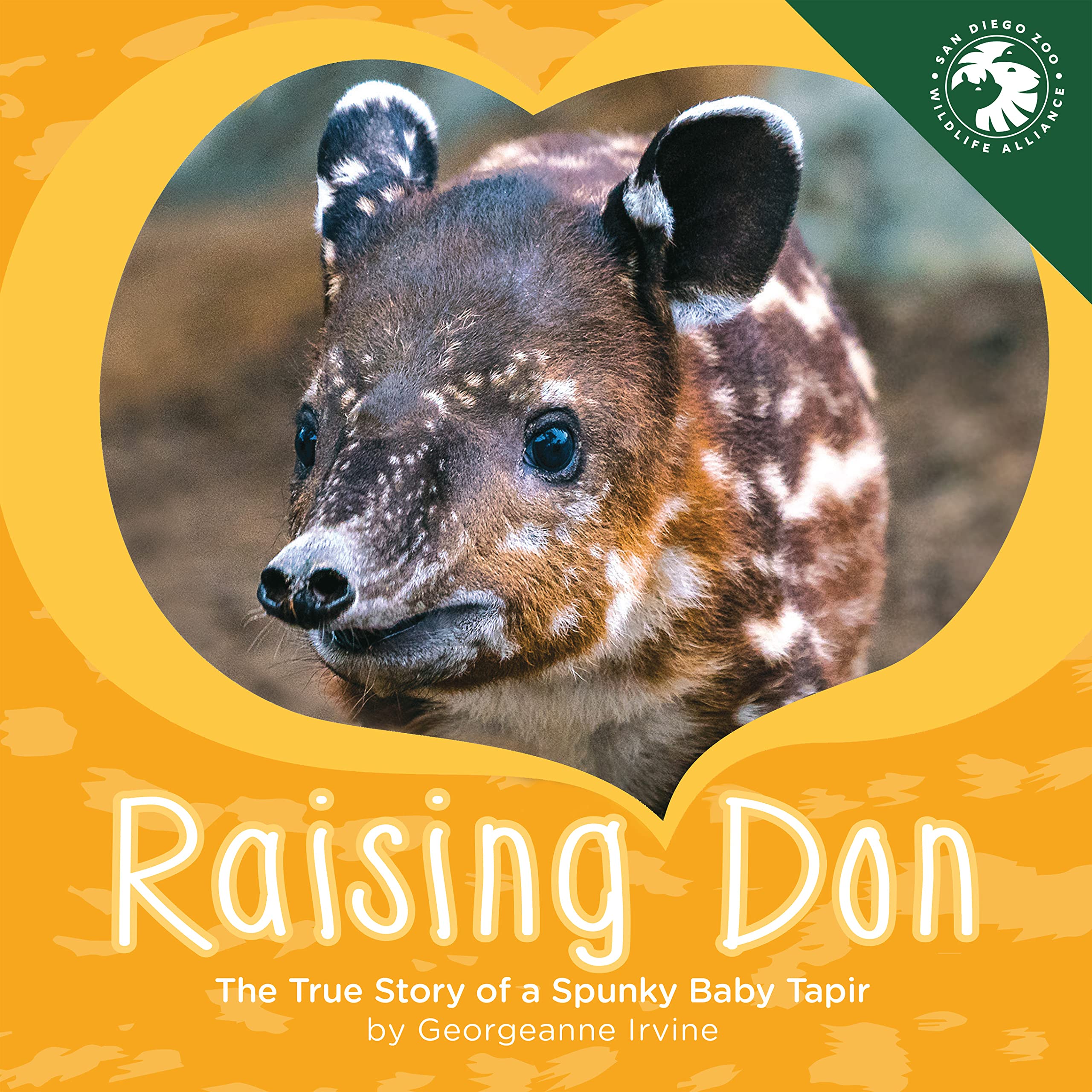
Raising Don: The True Story of a Spunky Baby Tapir

By Georgeanne Irvine


Get ready to open Raising Don and fall in love with this little Baird’s tapir, an absolute cutie with the sweetest of personalities to match. From the first pages—which show the wildlife care team at the San Diego Zoo eagerly anticipating Don’s birth, describe the moment of lucky serendipity when one member of the team witnessed this exciting event, and then reveal that Don’s mother, Luna, as a hesitant “first-time mom” rejected her calf—readers will find themselves invested in the future of “this endangered Baird’s tapir born at the zoo in more than 30 years.”

As the wildlife care team takes over bottle-feeding Don, children learn about the extraordinary steps they took to provide Don with some of Luna’s milk while ensuring that each animal was treated with affection. Discovering that Luna enjoying being scratched with a soft scrub brush while being milked and Don being fed after first having “his back scratched and his face rubbed before he would take his bottle” and getting a belly rub afterwards will make readers with pets of their own smile at this universal favorite. 

celebrate-picture-books-picture-book-review-raising-don-baby-born

Copyright Georgeanne Irvine, 2022, courtesy of San Diego Zoo Wildlife Alliance Press.

Tapirs, kids learn, have noses that are “similar to an elephant’s trunk, only shorter.” Don used his little trunk “for smelling as well as picking up things like branches and bits of lettuce.” But Don was also as playful as any toddler and after eating “often grabbed the bottle with his tiny trunk and tried to run off with it!” Next, when Don was only a week old, the specialists introduced him to a shallow pool. Tapirs are good swimmers, but they need to be taught—just like kids.

In no time, Don was “running, jumping, and belly flopping into the pool.” He even liked to blow bubbles in the water with his trunk. Children then see photographs and read about how Don was gradually introduced to a deeper pond in the habitat where he would eventually live with guanacos, capybaras, and a llama—and, of course, rewarded with “extra back scratches and belly rubs for being such a good swimmer.”

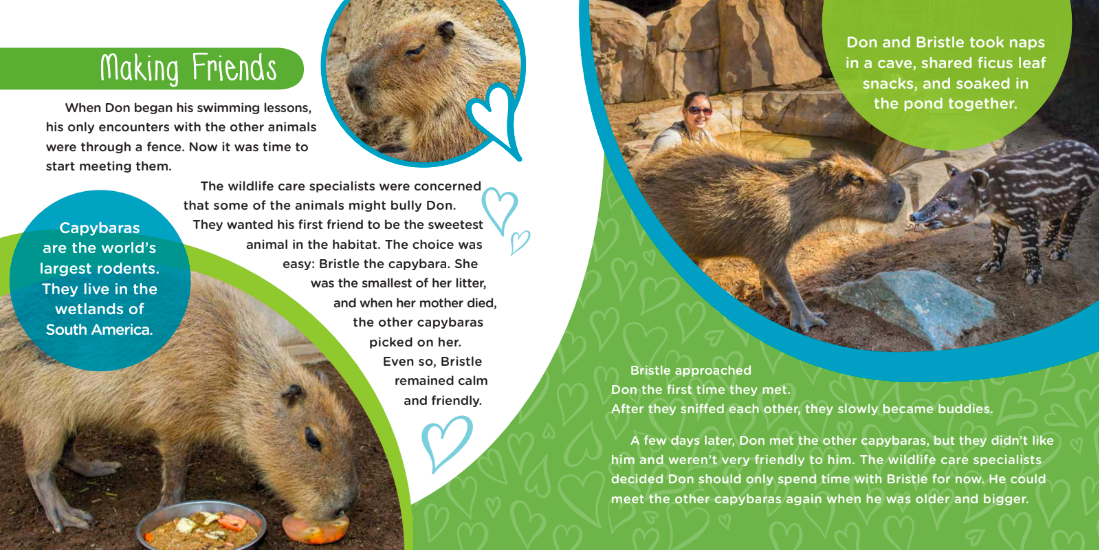
Soon Don would be old enough to be moved to his habitat, so now it was time for him to make a friend. The wildlife care specialists picked out a sweet-tempered capybara, Bristle, with whom he “took naps in a cave, shared ficus leaf snacks, and soaked in the pond together.” Don also met an elderly tapir who, over time, taught him good manners and other particulars about being a tapir. 

celebrate-picture-books-picture-book-review-raising-don-pool-party

Copyright Georgeanne Irvine, 2022, courtesy of San Diego Zoo Wildlife Alliance Press.

But Don learned some other lessons about life too. Even when Don was a baby and the guanacos and the llama saw him through a fence, they didn’t like him. And when, later, Don approached them in the habitat, they bullied him in the way llamas do—by spitting and kicking at him. Don simply took to avoiding them and sticking with his good friend Bristle. 

In these first months of life, Don discovered his favorite foods and learned to accept regular examinations from the care specialists that would keep him healthy. “Tapirs have sensitive feet and need them looked at every day to make sure there aren’t any cuts, scrapes, or bruises.” As he grew older, Don became more independent and confident. He celebrated his first birthday with his favorite foods and a swim. Soon he’d be moving to the Nashville Zoo in Tennessee. “There, he would meet a female tapir and hopefully become a father someday.”

And what about Luna? She has given birth to and is taking care of Don’s sister, named Taiyari (which “means ‘our heart’ in the language of Mexico’s Huichol people”). Now, Don and his new best friend Juju, a female tapir, live in a spacious habitat with shade trees and a pond. Don, as you might imagine, has “won the hearts of his new caregivers,” and someday soon he and Juju will “become parents of their own precious calf, helping to bring more of these endangered animals into the world.”  

Back matter includes fun facts about tapirs, a map showing where they live, the dangers to wild tapirs, and a list of ten ways readers can do to help wildlife.
celebrate-picture-books-picture-book-review-raising-don-making-friends

Copyright Georgeanne Irvine, 2022, courtesy of San Diego Zoo Wildlife Alliance Press.

Full of joy, humor, and personality, Georgeanne Irvine’s story about one plucky tapir born at the San Diego Zoo will capture readers’ hearts. The fervent love felt by Irving and the wildlife care specialists for Don and all the animals at the zoo radiates from the pages. With lively language and detailed, yet easy-to-understand descriptions, Irving reveals the day-to-day attention Don enjoys as well as the ways the specialists became his surrogate mothers.

Children also learn about the thoughtful methods zoo caregivers use to introduce animals to their particular habitats, behaviors, diet, and other animals. Children will respond to the parallels between Don’s experiences while learning skills and making friends and their own, examples that provide wonderful teachable moments and opportunities to fully appreciate the natural world as well as their place and responsibilities in it.

Endearing photographs of Don from babyhood and throughout his first year allow readers to follow his progress and see first hand his adorable, spunky personality as well as how he learns to swim, discover favorite foods, make friends, gets health examinations, and finally moves to Nashville and meets a new best friend.

Nature nonfiction at its finest, Raising Don: The True Story of a Spunky Baby Tapir is sure to be a favorite choice for all animal lovers as a read aloud or for independent reading. The book offers a wide range of learning and discussion opportunities for teachers, educators, and homeschoolers and is a must-addition to home, classroom, school, and public library collections.

Ages 7 – 10 (Younger children will also enjoy this book as a read aloud taken in parts)

San Diego Zoo Wildlife Alliance Press, 2022 | ISBN 978-1943198146

To learn more about the San Diego Zoo and the San Diego Zoo Wildlife Alliance, visit their website.

About the Author

Georgeanne “George” Irvine has devoted her career to raising awareness about animals and wildlife conservation. She is director of publishing for the San Diego Zoo Wildlife Alliance, where she has worked for more than four decades, as well as the author of over two dozen children’s books about animals, including the award-winning Hope and Inspiration collection. Photographing and learning about animals in their native habitats are passions for George. Her worldwide adventures have taken her to many of the wildest places on Earth—from the jungles of Borneo and South America to the mountains of China and the forests of India to the Outback of Australia and the savannas of Africa. 

About the San Diego Zoo Wildlife Alliance Press

San Diego Zoo Wildlife Alliance Press is the book publishing division of San Diego Zoo Wildlife Alliance, a nonprofit international conservation leader, committed to inspiring a passion for nature and working toward a world where all life thrives. Through its publishing efforts, San Diego Zoo Wildlife Alliance Press seeks to motivate and inspire multiple generations to care about wildlife, the natural world and conservation.  

Positive Attitude Month Activity

celebrate-picture-books-picture-book-review-tapir-coloring-page

Tapir Mom and Baby Coloring Page


If you love Don, you’ll love this adorable coloring page created by Honduran graphic designer Jen Chibi! Just download and print—and don’t forget to give the baby stripes and spots like Don!

Tapir Mom and Baby Coloring Page

celebrate-picture-books-picture-book-review-raising-don-cover

You can find Raising Don: The True Story of a Spunky Baby Tapir at these booksellers

Amazon | Barnes & Noble | Books-a-Million

To support your local independent bookstore, order from

Bookshop | IndieBound

Picture Book Review
September 30 – It’s National Mushroom Month

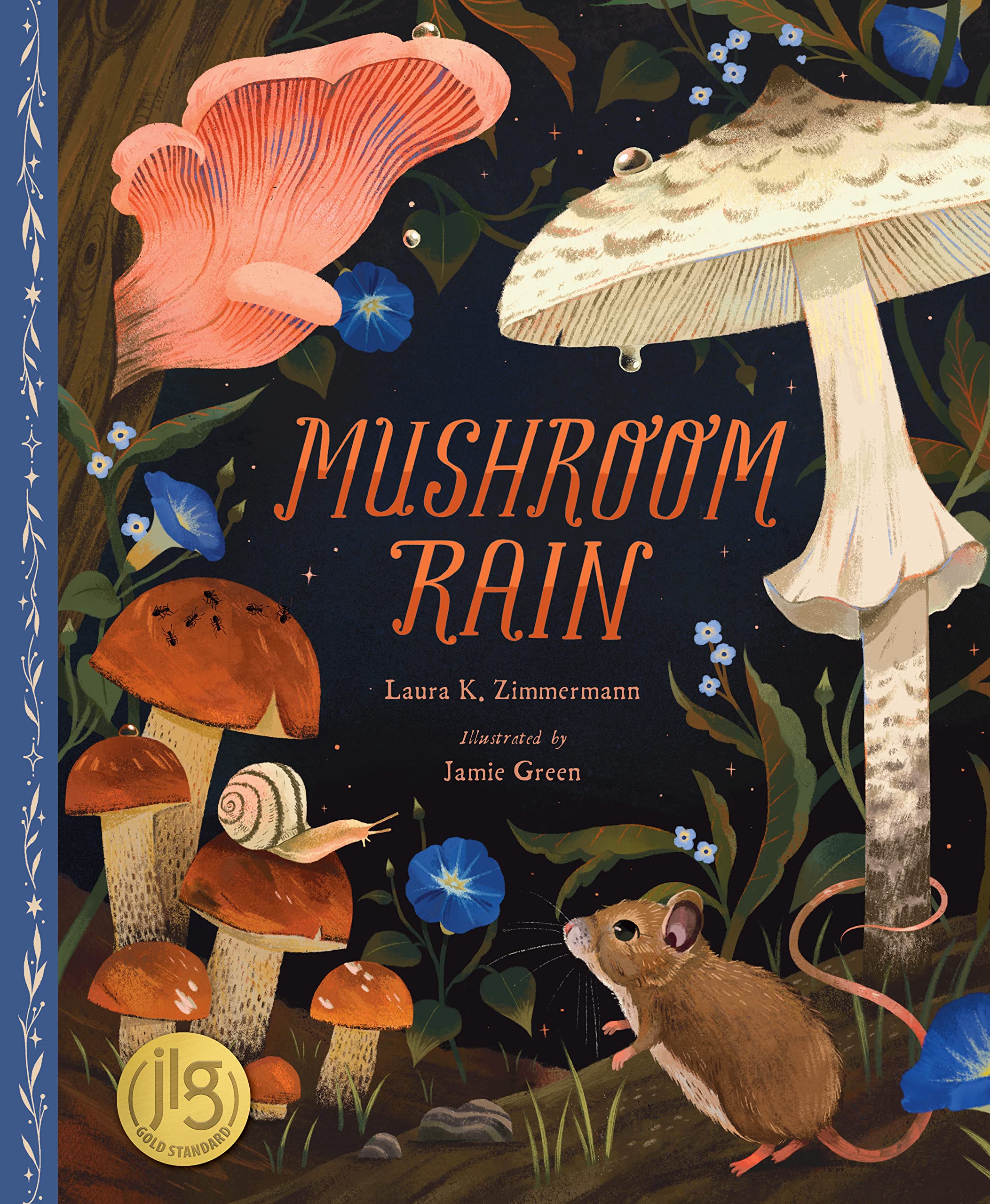
celebrate-pciture-books-picture-book-review-mushroom-rain-cover

About the Holiday

Whether you say “Yes, please!” to mushrooms on pizza, in salads, and in soups, stews, and other dishes or just like to stop and admire them in your yard or on a walk, National Mushroom Month is for you! The holiday was first created by the U.S. Mushroom Council as part of the Mushroom Promotion, Research & Consumer Information Act of 1990 that was instituted to raise awareness and an appreciation for mushrooms, both non-edible and nutritious edible varieties. President George H.W. Bush signed the Act into law on November 28, 1990, and the holiday was first celebrated in 1993. Celebrate your love of mushrooms today and all through the year with your favorite mushroom dish—and today’s book!

Mushroom Rain

Written by Laura K. Zimmermann | Illustrated by Jamie Green


You know how it is with mushrooms—they appear suddenly on the path you take every day, on trees, in the middle of lawns, and each with their own shape and color. Mushrooms are surprising, beautiful, and mysterious. In her evocative, lyrical text, Laura K. Zimmermann takes readers into the forests, meadows, and even up into sky to learn about these plants that can oftentimes seem otherworldly. 

celebrate-pciture-books-picture-book-review-mushroom-rain-bizarre-blooms

Image copyright Jamie Green, 2022, text copyright Laura K. Zimmermann, 2022. Courtesy of Sleeping Bear Press.

Under a starlit sky, Zimmermann gives children a peek into a darkened woods where “delicate umbrellas open, red octopus arms rise from the ground, cupped nests with eggs appear,” and another cluster of mushrooms glow “a spooky green.” These fungi don’t just look unusual, they are “bizarre blooms with strange scents,” and Zimmermann describes them—”some like bubble gum, coconut, maple syrup…”— so readers can imagine the aromas that mix in the night air. Can you smell them?

celebrate-pciture-books-picture-book-review-mushroom-rain-animals-eating

Image copyright Jamie Green, 2022, text copyright Laura K. Zimmermann, 2022. Courtesy of Sleeping Bear Press.

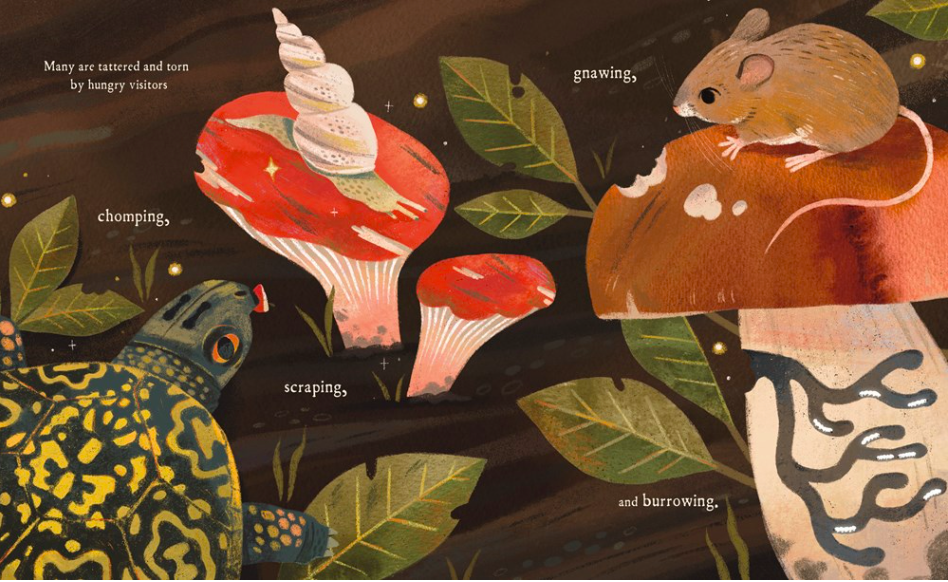
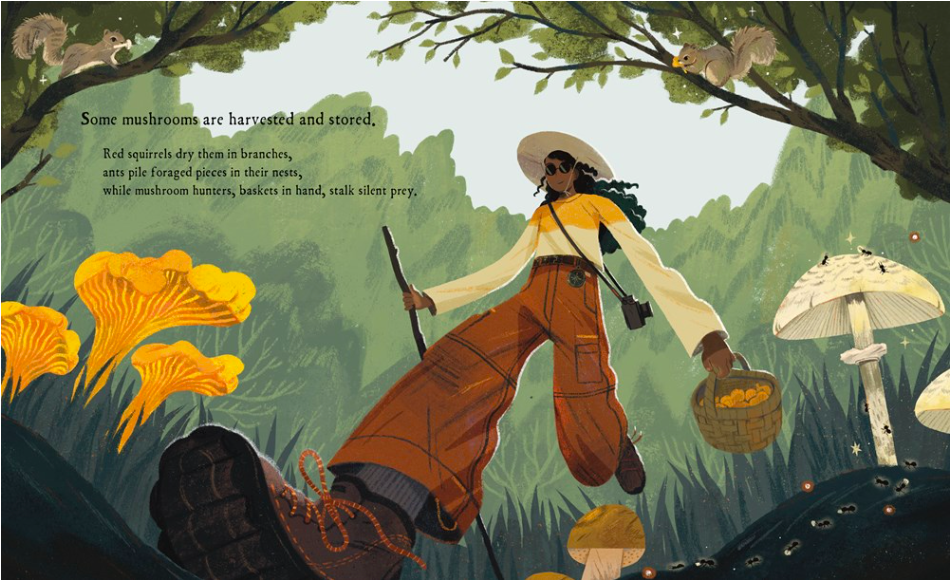
You’ve seen mushrooms with notches and nibbles, scratches and scars, and even meandering trails on their stems and tops. “Many are tattered and torn by hungry visitors chomping, scraping, gnawing, and burrowing” into the soft flesh. And while some are consumed where they grow, others are taken away by a variety of mushroom hunters—”harvested and stored” for another day.

celebrate-pciture-books-picture-book-review-mushroom-rain-mushroom-hunter

Image copyright Jamie Green, 2022, text copyright Laura K. Zimmermann, 2022. Courtesy of Sleeping Bear Press.

Then, just as suddenly as they appeared, mushrooms disappear. But are they gone completely? Zimmermann leads children underground to explore the vast network of roots beneath a forest floor. She floats them on breezes that send spores far and wide. And she sweeps them into the sky to soar with other spores into the clouds, where they’ll discover that an astonishing phenomenon occurs to begin mushrooms growing once again.

Following the text, extensive illustrated back matter reveals more about mushrooms: where they live, who eats them, how spores grow into mushrooms, how they help seed rainclouds, and how they are different from plants. Zimmermann also defines each part of a mushroom, describes the biggest mushroom-producing fungus and the largest living organism in the world, and shows kids how to use a mushroom to make a spore print.

celebrate-pciture-books-picture-book-review-mushroom-rain-disappeared

Image copyright Jamie Green, 2022, text copyright Laura K. Zimmermann, 2022. Courtesy of Sleeping Bear Press.

While Laura K. Zimmermann is taking children on a verbal sensory tour through the darkened world where mushrooms thrive, Jamie Green provides a feast for the eyes with her glorious illustrations of these odd colorful fungi jutting from the ground, posing, and  jockeying for position. Some stand close together, as endearing as a parent and child, or like a large family at a photo shoot while others reach upwards like roaring campfires. Turn the page and readers find themselves in the midst of a glowing alien landscape staring up into the dark night sky along mushrooms frilled and gilled while also aware of the small creatures on the forest floor having dinner or a snack. Green then takes kids underground and into the air, to show how spores find ingenious ways to grow and break the soil once again.

Arresting in both its beauty and enlightening facts that will excite readers’ curiosity, Mushroom Rain is a glowing invitation into the mysterious world of mushrooms and will spur readers to learn more about these delights of nature. The book, along with its extensive back matter and the materials found on Laura K. Zimmermann’s website (link below), would make a superb addition to any lessons on nature, the environment, and ecosystems for schools and homeschoolers, and is a must for school and public library collections.

Ages 5 – 8

Sleeping Bear Press, 2022 | ISBN 978-1534111509

Discover more about Laura K. Zimmermann, her book, and her other writing for children on her website. You’ll also find lots of mushroom-related activities, crafts, posters, puzzles, and more to enjoy with Mushroom Rain. There’s also a Teacher’s Guide for educators.

To learn more about Jamie Green, her books, and her art, visit her website.

celebrate-pciture-books-picture-book-review-mushroom-rain-cover

You can find Mushroom Rain at these booksellers

Amazon | Barnes & Noble | Books-a-Million

To support your local independent bookstore, order from

Bookshop | IndieBound

Picture Book Review

September 1 – It’s Read a New Book Month

celebrate-picture-books-picture-book-review-the-boy-and-the-mountain-cover

About the Holiday

The beginning of a new school year is a terrific time to celebrate Read a New Book Month—especially for kids. Whether their reading tastes have broadened, their reading level has changed, or they’ve discovered new and fascinating topics to explore over the summer months, there are new books just waiting for them! The books may be recently published—like today’s book—or just new to your child, there are countless fictional stories and nonfiction books ready to inspire learning, to laugh or cry with, and to share with friends. This month visit your local bookstore and library and stock up on books for your kids and everyone in the family! 

The Boy and the Mountain

Written by Mario Bellini | Illustrated by Marianna Coppo


“There once was a boy who always looked at a mountain.” It was the first thing he looked at in the morning and the last thing he said good night to before going to bed. The boy loved to draw, and one day he “decided to draw the mountain.” His first attempt didn’t look anything like the mountain he saw out his window. When he looked closer, he realized “the mountain was covered with trees,” so he added trees. 

celebrate-picture-books-picture-book-review-the-boy-and-the-mountain-drawing

Image copyright Marianna Coppo, 2022, text copyright Mario Bellini, 2022. Courtesy of Tundra Books.

Still, his picture wasn’t quite right. Next, he noticed the sky and clouds around the mountain and drew those, but his picture “still didn’t look the same as the real thing.” He tried drawing the mountain at different times of day and in different weather, but “he was never happy with what he had drawn.” 

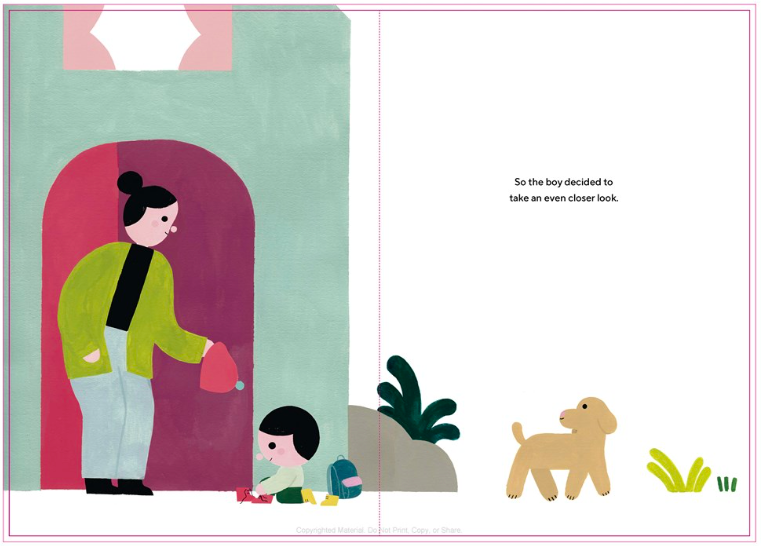
One day, the boy decided to get a closer look. He took his dog and headed out. One the way, he met a goat and drew a picture of it in his sketchbook. The goat decided to come along. When a flock of birds flew by, the boy drew those too. One bird left the flock to follow the boy and his dog and the goat. When they stopped at a stream for a drink of water, the boy drew that too.

celebrate-picture-books-picture-book-review-the-boy-and-the-mountain-trees

Image copyright Marianna Coppo, 2022, text copyright Mario Bellini, 2022. Courtesy of Tundra Books.

It was fall, and the ground was covered in leaves. The boy “wanted to draw them all,” but even though he drew many of them, there was no way they would all fit on the page. He continued on up and up into the forest and beyond. Along the way, he picked up other followers, including a frog, a bear, and a beaver. When he had left the trees behind, there was very little to draw “until he looked more closely” and saw a tiny white flower poking up between some rocks. He drew it.

celebrate-picture-books-picture-book-review-the-boy-and-the-mountain-hike

Image copyright Marianna Coppo, 2022, text copyright Mario Bellini, 2022. Courtesy of Tundra Books.

At last he came to the mountain’s peak. He sat down and flipped through his sketchbook, but he still wasn’t satisfied with his drawings. It was then that he became aware of the goat, the bear, the frog, the bird, the beaver, and a snail who had joined him. “‘Ohhh … hello!'” he said. They played until it was time to go home. The bear gave the boy a ride home on his shoulders. Once home, the boy promised that he would see them all again soon. That night before going to sleep, the boy drew the mountain again with his new perspective. This time his drawing was complete—and the boy was completely satisfied with it.

celebrate-picture-books-picture-book-review-the-boy-and-the-mountain-goat

Image copyright Marianna Coppo, 2022, text copyright Mario Bellini, 2022. Courtesy of Tundra Books.

Mario Bellini’s thoughtful and well-paced adventure gently guides readers to consider not only their perspective on big and small topics of life but where and how they fit into the wider world. Just as children observe the world from their vantage points of home, school, and activities, the boy in the story looks at the mountain and tries to make sense of it by drawing it. Then, like kids slowly adding bits of what the world has to offer to their lives, the boy includes trees, clouds, and different times of day to his drawing. But he thinks there must be something more, and, now braver and more knowledgeable, he ventures out to get a better look. 

Along the way he sees more of the world and interacts with what he encounters in the way that means the most to him. Some of these experiences turn out well, and others don’t, but he persists. When it appears that he’s finally come to the end of his journey, he sits down (alone, or so he thinks) and ponders his single-subject, disjointed pictures. When he finally notices all of the animals who have joined him on his trek and embraces them as friends, the boy discovers an interconnectedness that has been missing for him all along. At last, with his final drawing, the boy is able to be satisfied with his knowledge, understanding, and place in his world.

Marianna Coppo’s delightful rounded illustrations lend a quiet elegance to the story while allowing readers to view the boy’s drawings for themselves and then join him on his journey to see the mountain up close. Kids will enjoy noticing the animals that begin to populate the boy’s sphere, even while he is unaware that they are following him. The boy’s drawings of the river, the leaf-strewn forest floor, and the hidden mountain peak give kids and adults an opportunity to talk about times when things go wrong, when life seems overcrowded or overwhelming, and when goals seem elusive. Coppo also helps kids see that surprises can be found in the most unlikely of places as well as when you least expect them. 

A multi-layered story that invites thought, observation, conversation, and discovery (of both the self and the world), The Boy and the Mountain would be a favorite read for quiet story times or as a prelude to any new experience at home or in school. The book is highly recommended for home bookshelves as well as classroom, school, and public libraries.

Ages 3 – 7

Tundra Books, 2022 | ISBN 978-0735270251

You can connect with Marianna Coppo on Instagram and Twitter.

Read a New Book Month Activity

celebrate-picture-books-picture-book-review-take-a-bookworm-trek-maze

Take a Bookworm Trek! Maze


These two friends love reading! Can you help them through the maze to meet the bookworm? 

Take a Bookworm Trek! Maze Puzzle | Take a Bookworm Trek! Maze Solution

celebrate-picture-books-picture-book-review-the-boy-and-the-mountain-cover

You can find The Boy and the Mountain at these booksellers

Amazon | Barnes & Noble | Books-a-Million

To support your local independent bookstore, order from 

Bookshop | IndieBound

Picture Book Review

August 11 – Play in the Sand Day

celebrate-picture-books-picture-book-review-a-beach-chase-cover

About the Holiday

Is there any better way to spend a summer day than playing on a sandy beach? That wet, compact surface is perfect for running on, digging in, and, of course, building sandcastles with. And the soft, dry areas are great for beachcombing, wiggling toes in, playing volleyball, and simply strolling along. So head out to your favorite beach and have some family fun! 

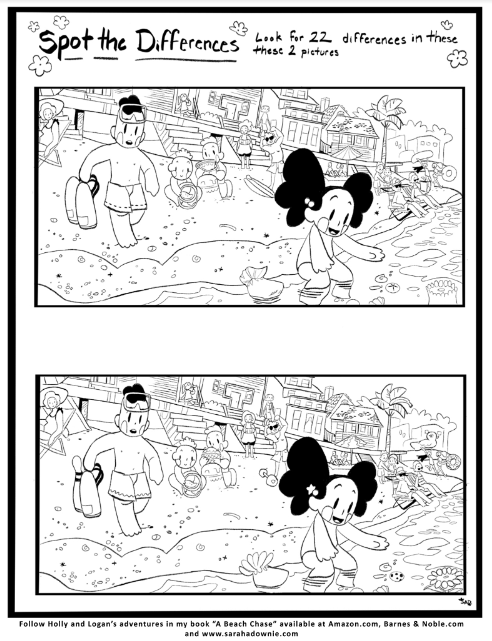
A Beach Chase: An A – Z Alphabet book

By Sarah Downie


Holly and Logan love playing at the beach. Today, Holly is looking “for shells to add to her collection.” She spies something “among the anemones” and rushes into the water, where she discovers an anchor. Holly also finds a conch shell and, as she’s admiring it, a girl floats by on a buoy and asks her what she’s going to do with it. But this is no ordinary girl—Holly realizes that she’s a mermaid. A mermaid who quickly grabs Holly’s new shell and takes off, diving deep into the ocean.

celebrate-picture-books-picture-book-review-a-beach-chase-letter-wading

Image copyright Sarah Downie, 2020, courtesy of Leaning Rock Press.

And so begins a wet and wild chase to recover Holly’s shell. Logan and Holly swim past various sea creatures, come to an island, and mistake “just a jumble of jellyfish” for the mermaid they’re looking for. Undeterred, they swim on until they see a kayak in the distance. “They kick, kick, kick towards” it and then paddle out to sea through a mass of kelp. On their way, they spot other creatures and seaside landmarks—even freeing an octopus from a net—before spying a tell-tail flick in a tide pool. 

celebrate-picture-books-picture-book-review-a-beach-chase-letter-e

Image copyright Sarah Downie, 2020, courtesy of Leaning Rock Press.

Jumping in, they discover another world, one where mermaids and mermen are having a party. But where is the mermaid who took Holly’s shell? Holly and Logan swim through the party and a zig-zag-y tunnel before finally spotting her near an outcropping of rocks at the ocean floor. The mermaid shows Holly and Logan the very special reason she needed the conch shell. She didn’t want it for herself, but for a hermit crab that “was in need of a home.” 

Immediately, Holly offers to bring more shells from her collection for other hermit crabs if the mermaid will let her and Logan come again. The mermaid enthusiastically agrees and invites her new friends to stay and join the party.

celebrate-picture-books-picture-book-review-a-beach-chase-letter-h

Image copyright Sarah Downie, 2020, courtesy of Leaning Rock Press.

Back matter includes a visual dictionary that depicts each illustration in the book and lists words for the objects or creatures corresponding to each letter found there. Kids may also spy other, unlisted letter-appropriate creatures (such as sand dollars on the “S” page) or actions (like Logan’s being nice to the octopus on the “N” and “O” spreads or the octopus peeking above the waves on the “P” page).

celebrate-picture-books-picture-book-review-a-beach-chase-letter-t

Image copyright Sarah Downie, 2020, courtesy of Leaning Rock Press.

In her eye-catching art, Sarah Downie cleverly incorporates the letters of the alphabet while inviting readers to join Holly and Logan on their search for the mermaid. From the shallows of the seashore to the far depths of the ocean, kids will eagerly follow this quick-paced story while feeling pride and excitement in spotting all the hidden objects. Well-conceived for its target audience, the illustrations contain a range of difficulty so that little ones as well as older children will enjoy the search-and-find aspects of this book.

Downie’s engaging storytelling includes plenty of alliteration that reinforces the sound of each letter while promoting letter recognition throughout the book. She also infuses her story with themes of kindness, sharing, and care for the environment that will resonate with young readers.

A charming and clever story that transcends its alphabet roots to engage readers on many levels, A Beach Chase: An A – Z Alphabet book is playful fun that kids will want to dip into again and again. The book would make a terrific take-along on seaside or lakeside beach trips, where kids could extend the story’s search-and-find to their own experience. It could also spark creative cross-curricular lessons for teachers and homeschoolers and would be a welcome addition to any home library to enjoy throughout the year.

Ages 3 – 8

Leaning Rock Press, 2020 | ISBN 978-1950323241

You can learn more about Sarah Downie, her books, and her art on her website.

Play in the Sand Day Activity

celebrate-picture-books-picture-book-review-a-beach-chase-activity

A trip to the beach can inspire all kinds of games and puzzles! Sarah Downie has created an activity pack with 15 challenges to get you searching and having fun just like Holly and Logan. You can download it here:

A Beach Chase Activity Pack

celebrate-picture-books-picture-book-review-a-beach-chase-cover

You can find A Beach Chase: An A – Z Alphabet book at these booksellers

Amazon | Barnes & Noble | Books-a-Million

To support your local independent bookstore, order from

Bookshop | IndieBound

Picture Book Review

July 2 – World Firefly Day

celebrate-picture-books-picture-book-review-light-the-sky-firefly-cover

About the Holiday

World Firefly Day was instituted by Fireflyers International Network to raise awareness of these summer-night beauties and the dangers to their survival, including habitat destruction, pesticides, light pollution, and over-collection. More and more, as fields and marshlands are paved over for building and waterways open up to recreation, the fireflies that call these places home are disappearing. This year’s theme is “Let’s stay together in the challenging world” and encourages everyone to learn how to “live in harmony” with fireflies. To learn more about fireflies, how you can make your garden or lawn firefly friendly, and more, visit Firefly Conservation & Research.

Light the Sky, Firefly!

Written by Sheri Mabry Bestor | Illustrated by Jonny Lambert


When fireflies begin dotting the summer night sky with light, it may seem like they’ve magically appeared out of nowhere. But as Sheri Mabry Bestor eloquently reveals, these beautiful insects have been lurking and luminescing for a long time. How long? Well, would you believe a full year? As summer rains dampen the earth, a firefly lays her eggs (up to 500!) under brush or fallen leaves. “Under the leaves, the eggs lay still. For the baby fireflies inside the shells, it is time to grow. And begin to glow.”

celebrate-picture-books-picture-book-review-light-the-sky-firefly-laying-eggs

Image copyright Jonny Lambert, 2022, text copyright Sheri Mabry Bestor, 2022. Courtesy of Sleeping Bear Press.

The larvae hatch after a month, and then they begin to eat, eat, eat. Slugs and snails are on the menu and, as a paragraph of scientific information about the firefly’s nighttime dining discloses, “instead of fighting their prey, the larvae bite and then inject the prey with a liquid that keeps it from moving to get away.” All through the rest of summer and fall, the baby fireflies grow. During the winter, the larvae undergo many transformations, growing and outgrowing a series of casings.

celebrate-picture-books-picture-book-review-light-the-sky-firefly-launch

Image copyright Jonny Lambert, 2022, text copyright Sheri Mabry Bestor, 2022. Courtesy of Sleeping Bear Press.

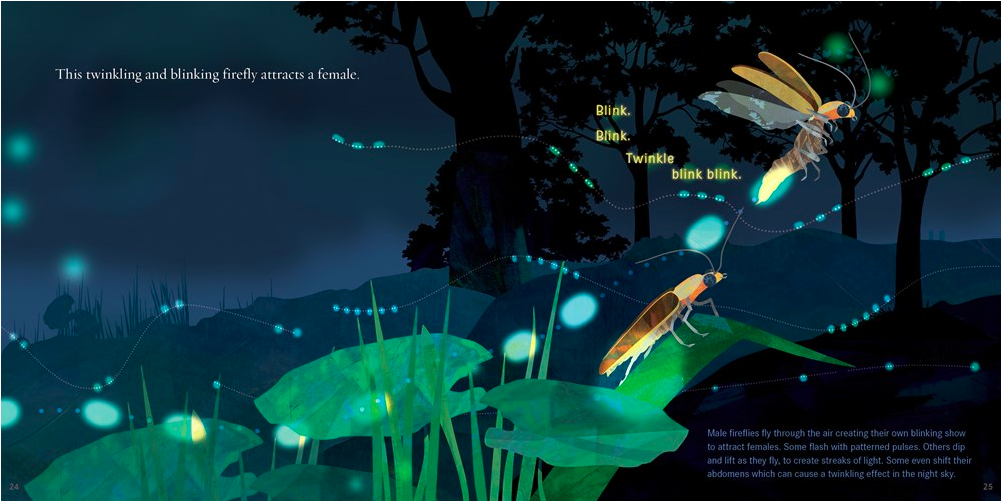
It isn’t until late spring when the larvae are ready to become an adult. When they are ready, they emerge from their mud nest. Then, while the sun is high, they stay low to the ground. But “when the sun begins to set, they begin to climb higher. And when the sky turns black, fireflies launch!” Then “the sky is filled with flashing fireflies. They twinkle like faraway stars.”

celebrate-picture-books-picture-book-review-light-the-sky-firefly-blink-blink

Image copyright Jonny Lambert, 2022, text copyright Sheri Mabry Bestor, 2022. Courtesy of Sleeping Bear Press.

Still, the darkness of night doesn’t protect them from predators, so fireflies always have to be on the alert. If they are caught, fireflies have a bitter surprise for the hungry critter. And what about those “blink, blinks” that we all marvel at? Those signals aren’t random. As Sheri Mabry Bestor explains, “Fireflies blink with specific rhythms called ‘flash patterns,’ and each species has its own. This helps them communicate with each other.” Not only does that luminescent chemical help fireflies, Bestor describes ways in which scientists and doctors are studying it in hopes of helping people.

“In time, the females are ready to lay their eggs. Pitter-patter, drizzle-drip. Summer rain cools the earth. Bees buzz. Birds glide. A firefly finds a place under the leaves that blanket the ground.” The eggs hide, waiting until next summer when it’s their turn to shine.

celebrate-picture-books-picture-book-review-light-the-sky-firefly-summer-again

Image copyright Jonny Lambert, 2022, text copyright Sheri Mabry Bestor, 2022. Courtesy of Sleeping Bear Press.

Sheri Mabry Bestor’s lovely, poetic story of the lifecycle of fireflies is a beautiful read aloud for summer nights or for whenever you and your kids are missing the simple pleasures of summer. While the story plays out from page to page in flowing and sometimes vibrant text, scientific facts about these insects, their transformations, homes, anatomy, protection, and, of course, their bright and glowing communication skills are tucked in the corner waiting to be discovered and explored. Bestor’s rhythmical cadence also highlights the seasonal changes that accompany a fireflies’ growth and the cyclical wonder of nature.

Jonny Lambert’s stunning textured collage-style illustrations portray all the beauty of these unique insects and the landscape they inhabit. Mottled greens and yellows give depth to lush leaves, opaline snail shells catch the light above as the curious snail discovers the glowing eggs below, and delicate spring flowers camouflage the mud nests where the larvae are transforming into adults. The nighttime scenes are breathtaking with deep blue skies, a canvas for the pin pricks of light that create summer’s most spectacular show. Both realistic and dreamlike, these nighttime pages will have kids and adults scurrying outside to watch and be a part of it.

A gorgeous book to celebrate the exquisite charm of fireflies as well as to impart natural science facts, Light the Sky, Firefly is highly recommended for home, school, and public library bookshelves.

Ages 4 – 8

Sleeping Bear Press, 2022 | ISBN 978-1534111158

Discover more about Sheri Mabry Bestor and her books on her website.

You can connect with Jonny Lambert on Twitter.

World Firefly Day Activity

celebrate-picture-books-picture-book-review-firefly-maze

Firefly Flight Maze


This little firefly wants to join her friends in the forest. Can you help her through the maze to find them in this printable maze?

Firefly Flight Maze Puzzle | Firefly Flight Mage Solution

celebrate-picture-books-picture-book-review-light-the-sky-firefly-cover

You can find Light the Sky, Firefly! at these booksellers

Amazon | Barnes & Noble | Books-a-Million

To support your local independent bookstore, order from

Bookshop | IndieBound

Picture Book Review

June 28 – It’s National Camping Month

celebrate-picture-books-picture-book-review-wild-about-camping-cover

About the Holiday

June is the perfect month to explore the great outdoors up close through camping. Whether you enjoy pitching a tent, renting a cabin, or parking an RV, all the enjoyment of hiking, fishing, swimming, and of course toasting marshmallows and singing around the campfire await! If you’re more of a stay-at-home camper, the wilds of the backyard (or even the family room) offer plenty of adventure!

Wild About Camping

Written by Jane Whittingham | Illustrated by Bryanna Chapeskie


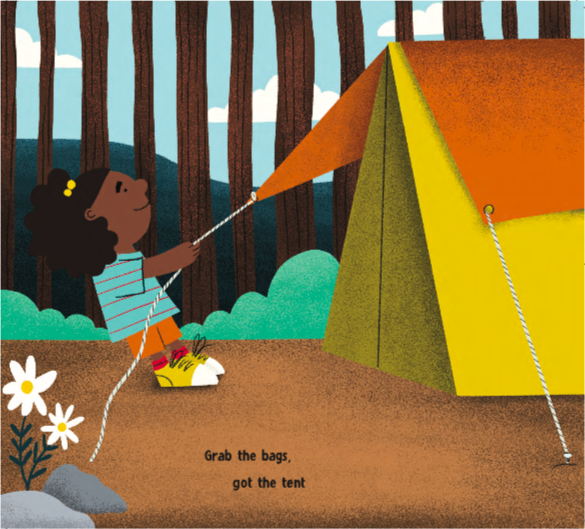
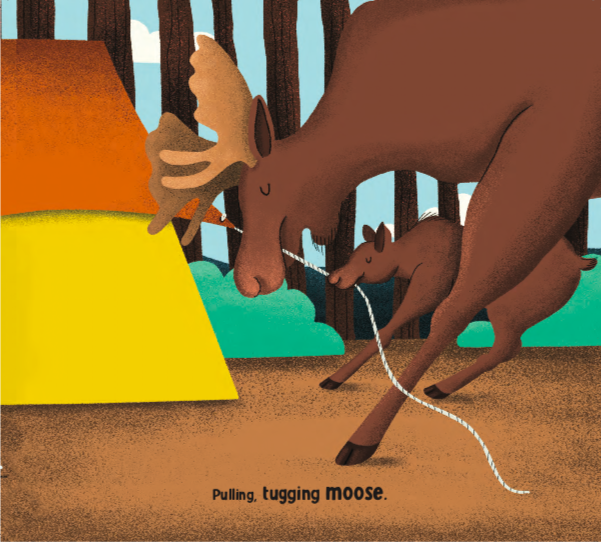
Two kids are excited to be “out the door, down the stairs,” and on their way to the woods for a camping trip. Winding roads take this sister and brother into the heart of the forest, but they’re not the only ones who are ready for an adventure. As the little girl secures the guy rope at the front of the tent, two “pulling, tugging moose” assist in the back.

celebrate-picture-books-picture-book-review-wild-about-camping-putting-up-tent-1celebrate-picture-books-picture-book-review-wild-about-camping-putting-up-tent-2

With the tent set up, brother and sister run to the beach and begin building a sandcastle while not far away a pair of industrious “digging, scurrying squirrels” try to hide their piles of acorns before the seagull descends. And, of course, swimming is enjoyed by kids and loons alike!

celebrate-picture-books-picture-book-review-wild-about-camping-toasting-marshmallows

Image copyright Bryanna Chapeskie, 2022, text copyright Jane Whittingham, 2022. Courtesy of Nimbus Publishing Limited.

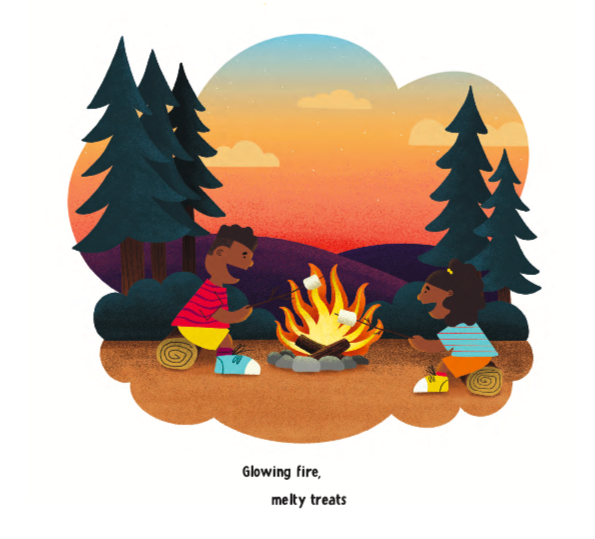
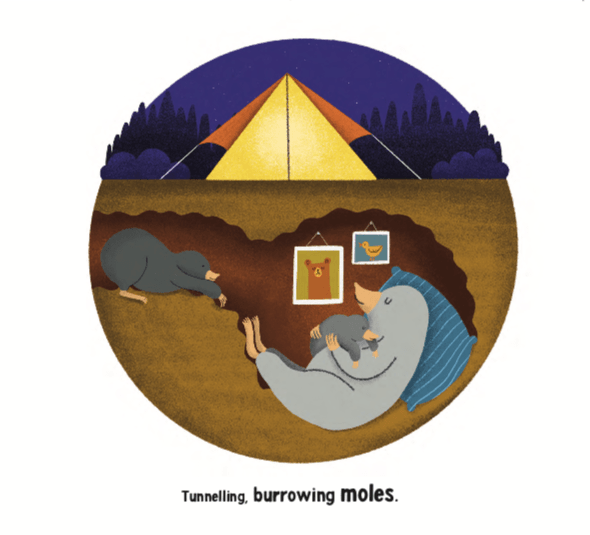
Dinner time is just the beginning of a full night of treats and songs and spooky stories – all echoed by woodland creatures who add their own take on after-dinner snacks, nighttime music, and “eerie sounds.” Too soon, it’s time for sleeping bags for a tired sister and brother as well as a family of “tunnelling, burrowing moles” below.

Of course, summer camping trips aren’t made for turning in early, but for late-night laughs under a star-filled sky for all “wishing, dreaming kids.”

celebrate-picture-books-picture-book-review-wild-about-camping-sleeping-2

Image copyright Bryanna Chapeskie, 2022, text copyright Jane Whittingham, 2022. Courtesy of Nimbus Publishing Limited.

Jane Whittingham’s bouncy, rhythmic story delights with surprising and funny juxtapositions that bring kids and forest animals together to enjoy a favorite summer activity. Her short, exuberant sentences will spur kids to read along – and maybe even add their own woodland creatures to the party. 

The vivacious kids and lively animals in Bryanna Chapeskie’s vibrant illustrations will entice readers to keep turning the pages to discover who is joining the camping trip next. The brother and sister’s ear-to-ear smiles are infectious, and there are plenty of humorous details to keep the giggles going right up to the starry end, when they can join in with the brother and sister as they “Hee Hee! Ha Ha!” into the night.

A fun and lively read aloud, Wild About Camping is a spirited romp that will get kids excited about camping trips long or short, outdoors or in. A charming addition for home and library bookshelves for summer story times or winter warmups.  

Ages 4 – 8

Nimbus Publishing Limited, 2022 | ISBN 978-1774710432

Discover more about Jane Whittingham and her books on her website.

You can connect with Bryanna Chapeskie on Instagram.

National Camping Month Activity

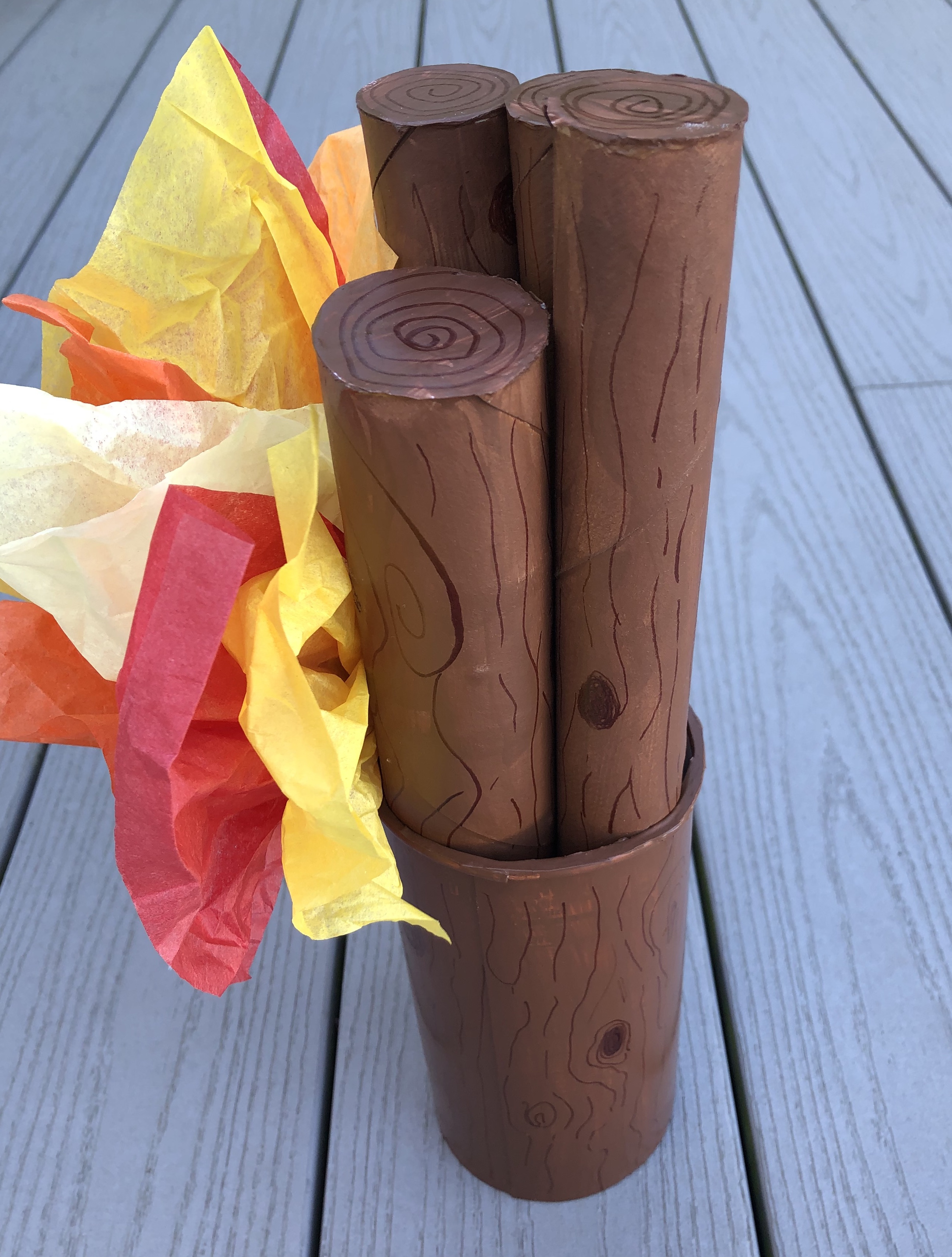
CPB - campfire craft 2

Pretend Campfire


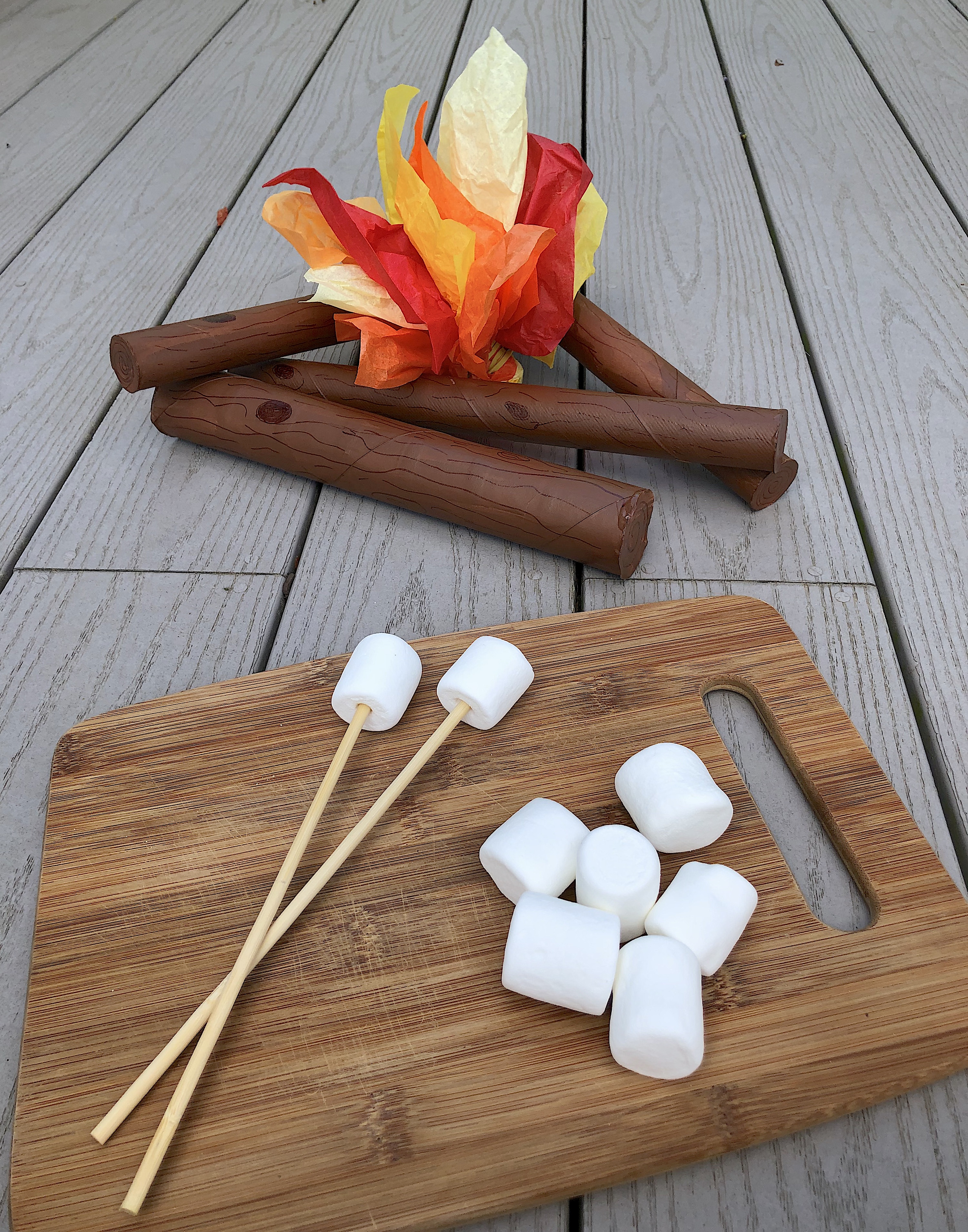
Kids and their friends and family can enjoy the cozy fun of a campfire in their own family room with this craft that’s easy to make from recycled materials. While the supplies might make the campfire artificial, kids will love it if the marshmallows are the real thing!

Supplies

  • Three or four paper or cardboard tubes
  • Cylindrical bread crumbs or oatmeal container
  • Tissue paper in red, orange, and yellow
  • Brown craft paint
  • Brown marker
  • Brown construction paper or white paper
  • Strong glue or hot glue gun
  • Chopsticks (one for each person)
  • Marshmallows

CPB - campfire craft container

Directions

To Make the Logs

  1. Cover the ends of the tubes with circles of brown construction paper or white paper and glue into place
  2. Paint the tubes and the ends if needed, let dry
  3. Paint the sides of the cylindrical container with the brown paint, let dry
  4. With the marker draw tree rings on the ends of the tubes. Decorate the sides with wavy lines, adding a few knot holes and swirls.

To Make the Fire

  1. Cut 9 squares from the tissue paper (3 in each color, about 8 to 6-inch square)
  2. Layer the colors and gather them together at one tip. Fold over and hold them together with a rubber band.
  3. To Assemble the Campfire
  4. Stack the tube logs
  5. Put the tissue paper fire in the middle of the logs

To “Roast” Marshmallows

  1. Stick marshmallows on chopsticks for “roasting” and eating!

You can keep your logs and fire in the cylindrical log until the next time!

celebrate-picture-books-picture-book-review-wild-about-camping-cover

You can find Wild About Camping at these booksellers

Amazon | Barnes & Noble | Books-a-Million

To support you’re local, independent bookstore, order from

Bookshop | IndieBound

Picture Book Review
May 19 – World Plant a Vegetable Garden Day

celebrate-picture-books-picture-book-review-in-the-garden-cover

About the Holiday

There’s nothing quite as rewarding as planting seeds, watching the plants grow, and finally being able to enjoy the bounty of your work. If you live in cooler climates, now is the perfect time to get started, and if you’re already experiencing warm or even hot weather, your garden may well be on its way. Wherever you stand on the growing calendar and whether you plant a large garden plot or enjoy deck gardening, today’s holiday highlights all of the benefits of vegetable gardening and provides education for gardeners of all experience levels. Celebrate the holiday with today’s book and consider planting your own veggie garden. Or, if digging in the dirt really isn’t your thing, you can play the printable Plant a Vegetable Garden Game at the end of this post!   

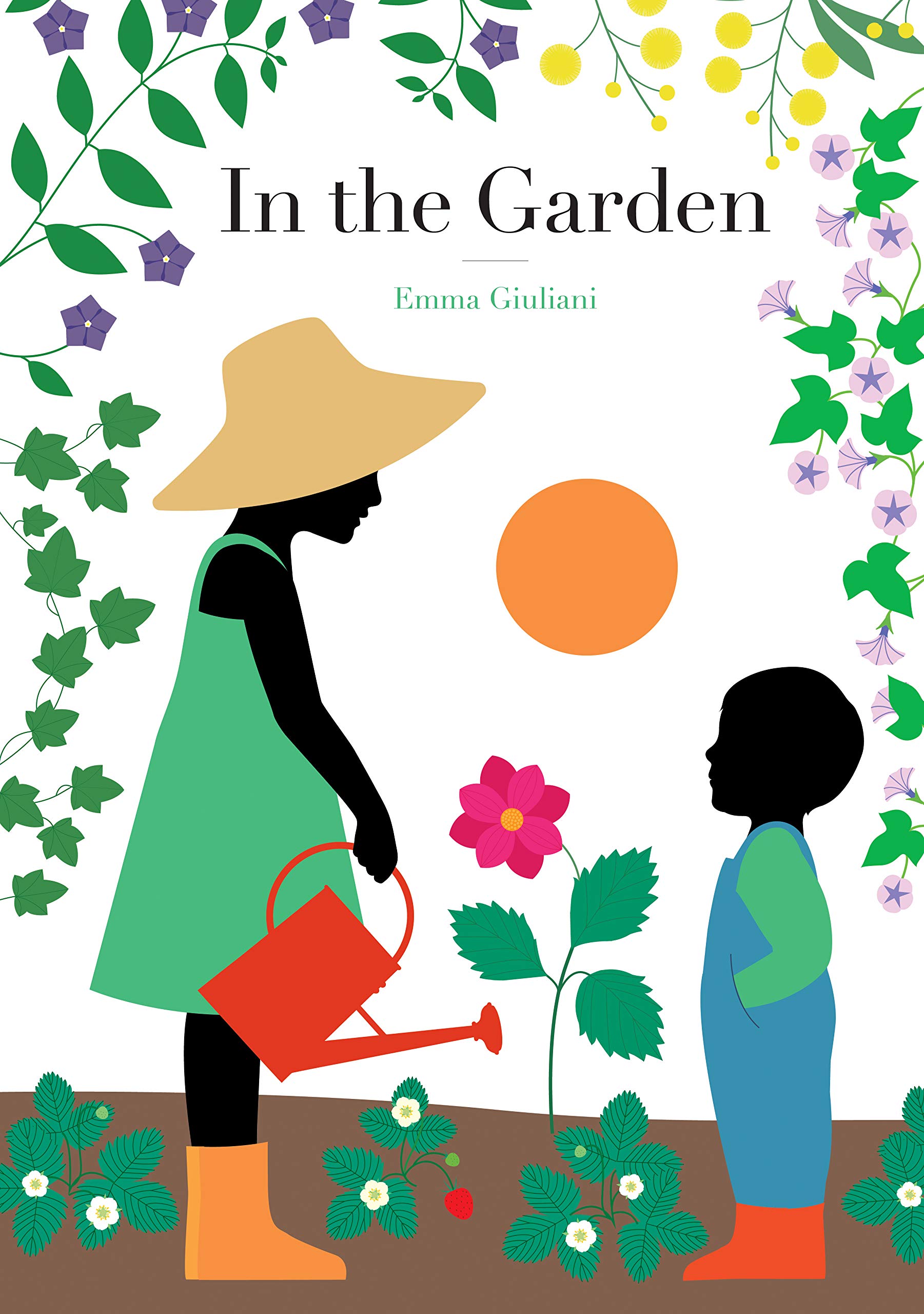
In the Garden

By Emma Giuliani


In her stunningly illustrated interactive guide through the seasons, Emma Giuliani introduces Plum and her little brother, Robin, and invites readers to join them as they tend to their garden and all the plants, animals, and birds that call it home. Plum and Robin begin at winter’s end. “This morning it’s cold. It’s not yet spring, but, in the garden, Plum and her brother Robin see the first catkins appearing on the branches of the willows and hazels. The blossoming mimosa makes the gardeners impatient for spring to come.” As Robin counts the long, drooping catkins, Plum rakes a layer of compost over the ground. On the facing page, readers get a close-up view of the fuzzy catkins, can peek inside a bud, burrow underground with earthworms just waking from hibernation, and view a few early bloomers. They also learn about what makes up the earth’s soil and get a recipe for compost.
celebrate-picture-books-picture-book-review-in-the-garden-shed

Copyright Emma Giuliani, 2020, courtesy of Princeton Architectural Press.

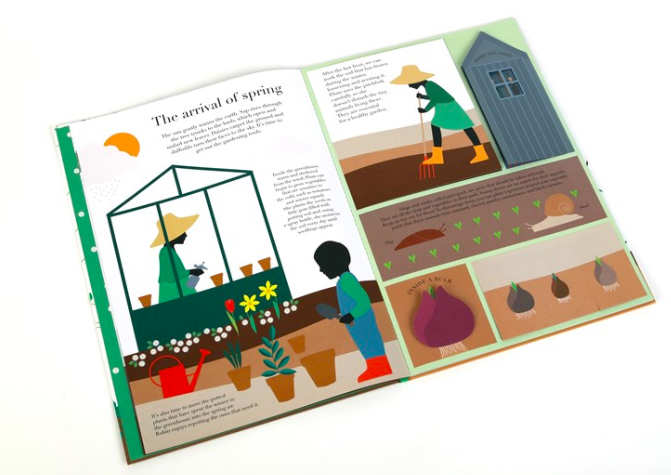
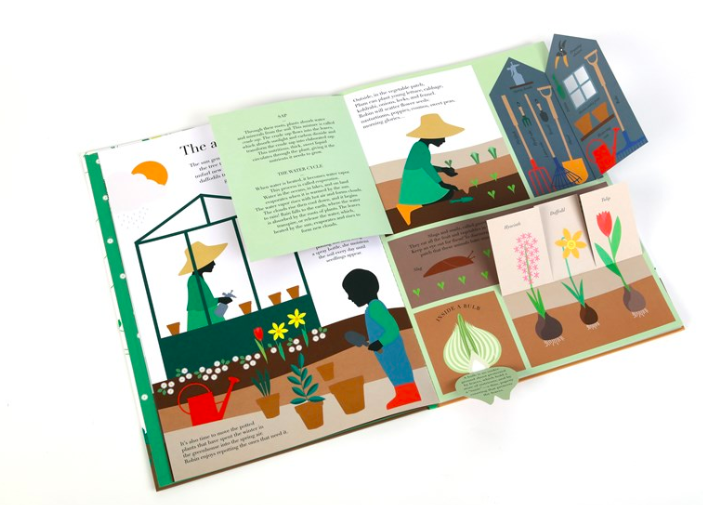
With the arrival of spring, Plum is in her little greenhouse, planting vegetable seeds and spritzing the soil with water to keep it moist while Robin repots some plants who have spent the winter in the greenhouse. Outside, Plum aerates the garden bed with a pitchfork, careful of any tiny creatures below. Children can open the door to Plum’s well-stocked shed to see all the tools tidily stored there and lift the flaps to look inside a bulb and help a hyacinth, a daffodil, and a tulip grow.

celebrate-picture-books-picture-book-review-in-the-garden-open-shed

Copyright Emma Giuliani, 2020, courtesy of Princeton Architectural Press.

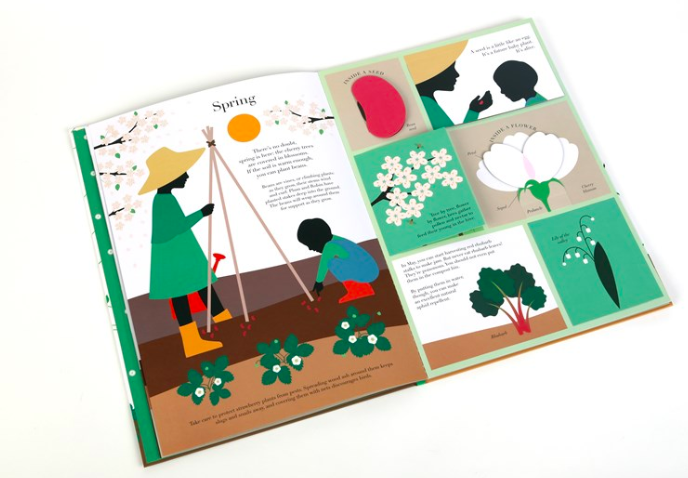
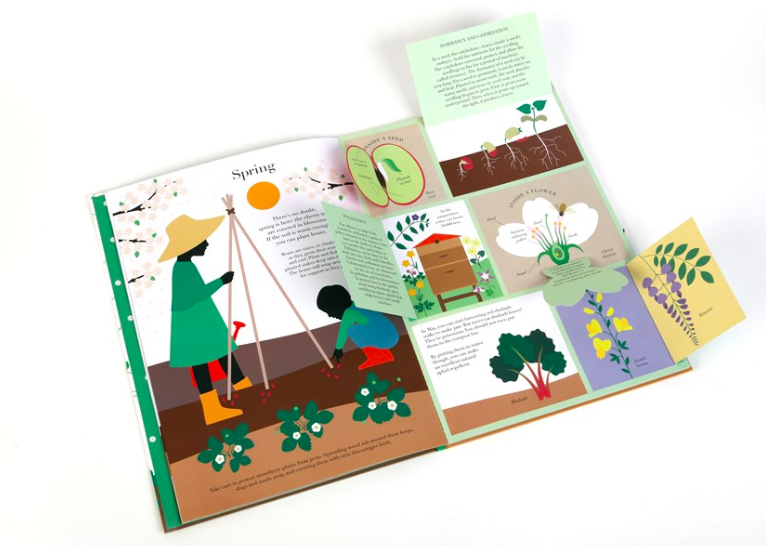
At last the warm weather of spring has arrived. The cherry trees are blossoming, and Plum and Robin are setting stakes and planting bean seeds. Next, they provide protection for the tender strawberry plants that are beginning to bloom. Young gardeners will enjoy opening a bean seed to learn what’s inside and then following its growing process. The bees are visiting the cherry blossoms, pollinating the flowers and making honey. What does a bee see as it hovers around the flower? Pull down the flap to see for yourself and learn all the parts of a flower. What other plants are flowering now? Open the flap to see!

celebrate-picture-books-picture-book-review-in-the-garden-spring

Copyright Emma Giuliani, 2020, courtesy of Princeton Architectural Press.

Summer begins and “what a joy to be in the garden in June! The gentle breeze, the smell of cut grass, and the tangy taste of strawberries and cherries make the gardeners smile.” While Plum waters the tomato plants, “Robin looks for ripe strawberries under the leaves.” Join him! Robin is also picking cherries before the birds eat them. How do those bright red, round fruits grow? Lift the flap to learn and see how they develop from flower to fruit. Plum is getting help with the aphids on the bean plants from industrious—and hungry—ladybugs. “Dragonfly larvae are transforming into graceful flying insects….Their presence is a sign of a healthy garden.”
celebrate-picture-books-picture-book-review-in-the-garden-open-spring

Copyright Emma Giuliani, 2020, courtesy of Princeton Architectural Press.

It’s high summer and the garden is glorious. Bean pods hang from the vines, and Plum contemplates whether they are ready to pick. She may leave some “husks dry out on the plant before picking them.” Dried completely indoors, they can be stored and eaten during the fall and winter. Take a look inside a pod to see the seven red beans there. Flowers greet you too: an orange marigold with petals like a pinwheel, a brilliant pink and purple fuchsia, and a perky mignon dahlia. Robin took cuttings of these plants and potted them to grow some more. Learn how you can do that with your plants too!

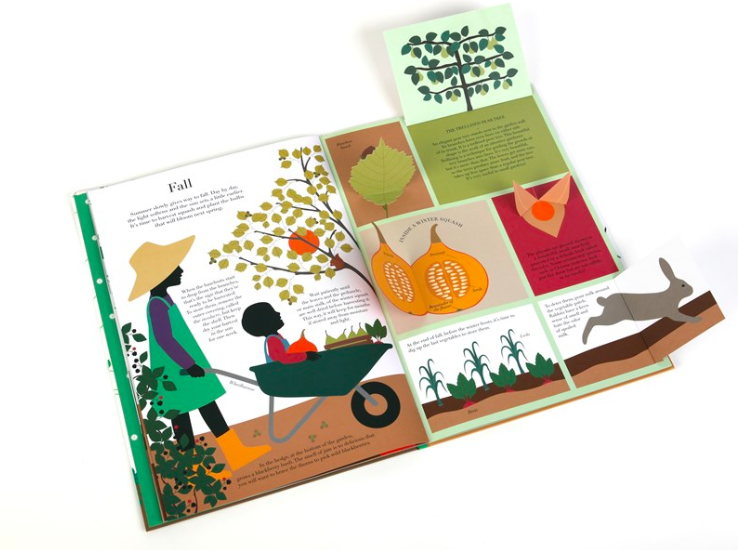
The summer heat is waning and the days are growing shorter. Fall is here. The catkins of early spring have become hazelnuts that are ready to be harvested. Even the squirrel approves! Plum and Robin teach you how to store them—and when to pick the winter squash and keep them for months as well. Can you count the number of seeds inside the winter squash? Plum’s beautiful trellised pear tree is bearing sweet fruit. Yum! But look out—a crafty rabbit is after the last leafy vegetables in the garden. 

celebrate-picture-books-picture-book-review-in-the-garden-open-fall

Copyright Emma Giuliani, 2020, courtesy of Princeton Architectural Press.

The air is chilly again and winter is on the horizon. “Plum and Robin have donned their warmest clothes and gone out to collect the dead leaves. Some leaves will feed the compost, others will become mulch to protect plants over the winter. The hedgehogs can use the rest of the leaves in making their homes.” Do you see the pile of crunchy leaves? Lift them gently…shhh! A hedgehog is snoozing underneath. Robin and Plum have built an insect hotel to keep the bugs cozy during the winter and have filled the greenhouse again. For the colorful birds who stay awhile or all winter, Robin and Plum put out a bird feeder and fill it with locally produced seeds.

After putting all of their tools back in the shed, Plum and Robin head indoors to plan next year’s garden and “watch eagerly for the very first signs of spring.”

celebrate-picture-books-picture-book-review-in-the-garden-open-winter

Copyright Emma Giuliani, 2020, courtesy of Princeton Architectural Press.

If your family tends a garden or is thinking of starting one, Emma Guiliani’s superb book is a must. At 16 inches tall, In the Garden provides fascinating facts about plants, insects, and animals; helpful tips on when and how to plant a variety of fruit, vegetables, and flowers, information on natural ways to ward off pests; and how to recognize when fruit and vegetables are ready for picking and how to store them. Through copious flaps, children get inside views of flowers, seeds, buds, and vegetables to learn the names of each part and how they contribute to the growth of the plant. Along the way, young and adult gardeners discover how early gardening can begin, directions on how to create and use compost, when bushes can be planted, information on pollination; and how to winter over the garden for the coming spring.

Giuliani’s crisp, lush illustrations are marvels, combining intricate paper cuts that replicate the shapes of delicate bulbs and buds, flowers and seeds, smooth and serrated leaves, the long bean pod, and even Plum’s garden shed with a window in the door. Her extraordinarily beautiful color palette immerses readers in the garden experience; you can almost smell the rich earth, hear the bees buzzing at the blossoms, and feel the air changing season to season.

A brilliant resource and a joy to peruse, In the Garden is a book that adults and children—both gardeners or nature lovers—will share throughout the seasons and from year to year. The book is most highly recommended for home, school, and public library collections.

Ages 7 – 12

Princeton Architectural Press, 2020 | ISBN 978-1616898939

You can connect with Emma Giuliani on Instagram.

World Plant a Vegetable Garden Day Activity

celebrate-picture-books-picture-book-review-garden-board-game-1

Plant a Vegetable Garden Game


With this fun game you and your family and friends can grow gardens inside! Roll the dice to see whose garden will fully ripen first!

Supplies

Directions

Object: The object of the game is for each player to fill their garden rows with vegetables. Depending on the ages of the players, the required winning number of rows to fill and the number of vegetables to “plant” in each row can be adjusted.

  1. Print one Game Board for each player
  2. Print one set of Playing Cards for each player (for sturdier playing items, print on card stock)
  3. Print one Vegetable Playing Die and assemble it (for a sturdier die, print on card stock)
  4. Cut the vegetables into their individual playing cards
  5. Color the “dirt” on the Garden Plot with the crayon (optional)
  6. Choose a player to go first
  7. The player rolls the die and then “plants” the facing vegetable in a row on the game board
  8. Play moves to the person on the right
  9. Players continue rolling the die and “planting” vegetables until each of the number of determined rows have been filled with the determined number of vegetables.
  10. The first person to “grow” all of their veggies wins!

celebrate-picture-books-picture-book-review-flower-garden-game

You can play the Plant a Flower Garden Board Game with the printable game pieces here:

celebrate-picture-books-picture-book-review-in-the-garden-cover

You can find In the Garden at these booksellers

Amazon | Barnes & Noble | Books-a-Million | Princeton Architectural Press

To support your local independent bookstore, order from

Bookshop | IndieBound 

Picture Book Review