March 20 – Spring Equinox and Q&A with Author Marsha Diane Arnold

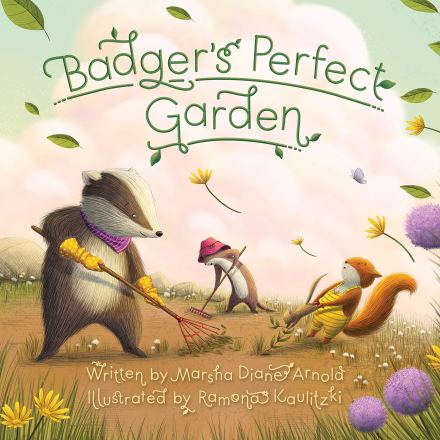
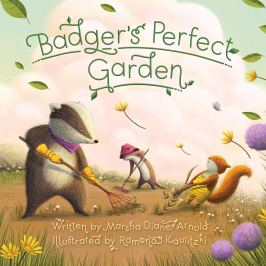
celebrate-picture-books-picture-book-review-badger's-perfect-garden-cover

About the Holiday

Today, we celebrate the first day of spring! This year the vernal equinox is accompanied by a full moon—and not only a full moon, but a supermoon!. The last time the spring equinox and a full moon occurred on the same day was on March 20, 1981, and the next time this happens it will be 2030! What makes the equinox so special? On this date, day and night are equally long around the globe. With longer days and warmer weather, thoughts turn to gardening, and whether you enjoy fruit and vegetable gardening or planting flowers—like Badger in today’s book—the first day of spring is a time for blossoming in so many ways.

I received a copy of Badger’s Perfect Garden from Sleeping Bear Press to check out. All opinions are my own. I’m thrilled to be teaming with Sleeping Bear Press in a giveaway of two terrific prizes. See details below.

Badger’s Perfect Garden

Written by Marsha Diane Arnold | Illustrated by Ramona Kaulitzki


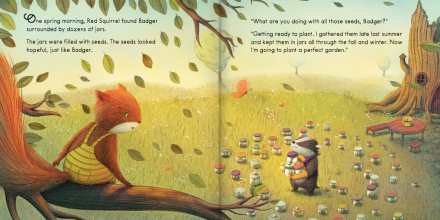
On a spring morning, Red Squirrel watched as Badger brought out all of his jars of the seeds he had collected and kept safe all winter. He was planning on planting a perfect garden. Red Squirrel noticed that all the seeds looked different. Badger explained that they were “‘all kinds. Green and brown. Flat and round, Bumpy and smooth. Whirly-curly and straight as my whiskers.’”
celebrate-picture-books-picture-book-review-badgers-perfect-garden-seeds

Image copyright Ramona Kaulitzki, 2019, text copyright Marsha Diane Arnold, 2019. Courtesy of Sleeping Bear Press.

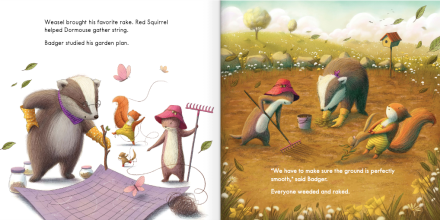
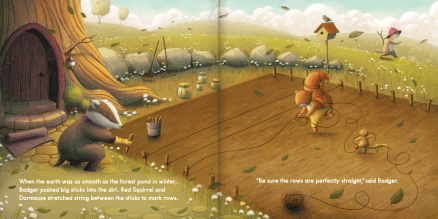
Red Squirrel wanted to help plant them. As Badger carefully studied his garden plan, Weasel showed up with his rake and Dormouse gathered string. Everyone helped Badger weed and rake his garden plot until it was smooth. Then they set up stakes on each side and ran string between them to make perfect rows. After that Weasel poked holes in the dirt for the seeds. Badger directed where each seed should go so that each type stayed together. That evening the friends had a party with muffins and mulberry juice, and Badger “imagined the plants that would grow in perfect rows in his perfect garden.”

The next morning, just in time, it began to rain. But the next day the rain turned heavy, and the day after that it became a deluge. Badger ran out into the storm to try to save his garden, but the strings collapsed and the soil washed away. Badger sniffled as he thought of his ruined garden. His friends tried to cheer him up by telling him they’d help gather new seeds in the summer, but Badger despaired of not having his perfect garden this year.
celebrate-picture-books-picture-book-review-badgers-perfect-garden-plan

Image copyright Ramona Kaulitzki, 2019, text copyright Marsha Diane Arnold, 2019. Courtesy of Sleeping Bear Press.

To ward off the sadness, Badger kept busy reading, cleaning, exercising, and sleeping. One summer day, he heard a knock on his door. It was Red Squirrel, Weasel, and Dormouse. They grabbed Badger’s hand and pulled him outside to a glorious field of wildflowers. Badger gazed at it in wonder. “‘Those can’t be my seeds,’ said Badger, rubbing his eyes. They’re all mixed up.’” But they were! The wild garden  was a “jumble-tumble of shapes and sizes. They made him feel jumbly and tumbly, too.” Badger thought it was “the most perfect garden of all,” and the friends raced into it for a perfect summer celebration.
celebrate-picture-books-picture-book-review-badgers-perfect-garden-planting

Image copyright Ramona Kaulitzki, 2019, text copyright Marsha Diane Arnold, 2019. Courtesy of Sleeping Bear Press.

Marsha Diane Arnold fills Badger’s Perfect Garden with sprightly, lyrical language that makes the story a delight to read. Little gardeners will relish the descriptions of Badger’s seeds and enjoy the precision of planting day. As the rains come, kids will empathize with Badger’s disappointment, knowing how it feels when plans don’t work out quite right. But the riotous results will spark their own happy, “jumbly-tumbly” excitement for Badger, his friends, and even their own endeavors. in the beauty of the wild, carefree, mixed-up garden can see the joy that can be found in new experiences outside one’s comfort zone.

Ramona Kaulitzki’s charming illustrations are a perfect mix of the whimsical and the realistic and will captivate readers. With soft colors and flowing textures, Kaulitzki depicts early spring with its light green grasses and mellow, cloud-filled skies. When stormy days come, the sky turns purple and rain whips through Badger’s garden, leaving things topsy-turvy and Badger’s plans uprooted. Late summer brings a series of show-stopping two-page spreads, where flowers of all kinds and colors mix with vegetable plants to attract bees and butterflies and, of course, provide the perfect spot for a summer party.

Beautiful through and through, Badger’s Perfect Garden plants the seeds of gentle encouragement, heartening friendship, and cheerful celebration. The book would be a favorite addition to home, classroom, and public library collections.

Ages 5 – 8

Sleeping Bear Press, 2019 | ISBN 978-1534110007

Discover more about Marsha Diane Arnold and her books on her website.

To learn more about Ramona Kaulitzki, her books, and her art, visit her website.

Q & A with Marsha Diane Arnold
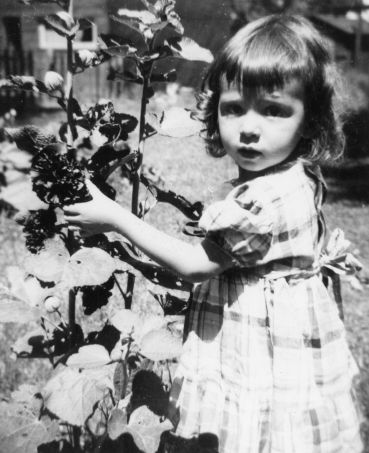
celebrate-picture-books-picture-book-review-marsha-diane-arnold-childhood-photo

Called a “born storyteller” by the media, Marsha Diane Arnold’s award-winning picture books have sold over one million copies and been called, “whimsical,” “inspiring,” and “uplifting.” Marsha was raised on a Kansas farm, lived most of her life in Sonoma County, California, a place Luther Burbank called “the chosen spot of all this earth as far as Nature is concerned,” and now lives with her husband, near her family, in Alva, Florida. Nothing makes her happier than standing in her backyard in the midst of dragonflies, listening to cardinals sing.

I’m so glad to be chatting with you, Marsha, about her newest book, Badger’s Perfect Garden! This story seems to have a close personal connection for you. Can you talk a little bit about what inspired you to write this book?

Having a father who was a farmer and gardener and a mother who was a perfectionist, must have had something to do with it! I grew up surrounded by nature, animals, and gardens. Growing up with so many animals around me, I talked with them all the time and I felt they talked back, so anthropomorphism comes easily to me. Illustrations of animal characters are so often enchanting, drawing young children into a book. They can create a strong emotional connection for children to learn from and remember.

Can you tell me more about what it was like growing up on a farm? What kind of farming did your family do?

My father was most proud of being a dairy farmer, but he, his father before him, and his five brothers also grew wheat and corn. I often stayed with my grandmother during the day; I loved being on the farm. Grandmother had to feed 8 children, Grandpa Henry, and herself, so she had a huge vegetable garden and did home canning. But her heart was with her flower gardens. There was spirea, yards and yards of bearded iris, a line of lilacs from the house to the outhouse, petunias, Bachelor buttons, hollyhocks, and more. Badger and Grandmother would have been fast friends.

As a child, what was your favorite part of farming or the farm? What do you appreciate more now as an adult?

I most loved being around the farm animals, although I was a bit frightened of those protective hens when I had to collect the eggs, and I enjoyed helping my father with the calves. One of our neighbors had a pet raccoon that I have fond memories of “hanging out” with, often in my friend’s tree house. (Remember, it was a long time ago and there were no wild animal rehabilitation centers near us.)
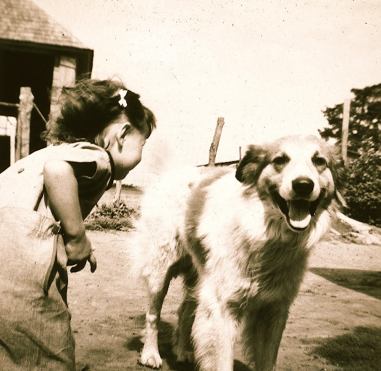
celebrate-picture-books-picture-book-review-Marsha-Diane-Arnold-and-dog

Marsha having fun with her dog.

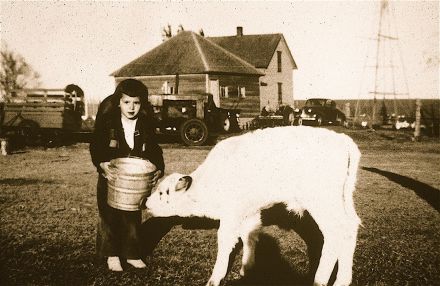
celebrate-picture-books-picture-book-review-Marsha-Diane-Arnold-and-calf

Marsha hanging out with a calf on her family’s farm.

I think I always appreciated the freedom of big spaces and gardens to play in and trees and barns (don’t tell) to climb on, but now I realize even more how very lucky I was.

Have you continued the family farming tradition?

I had a spectacular garden in Sonoma County, California. Mostly I grew flowers and a small plot of fruit trees. My favorite part of creating the gardens was designing them, using the land as my canvas. I collected over 50 heirloom roses, selecting plants for their fragrance and color. I loved the stories that came with them, like, “This one was collected from an old farm house in Windsor.” I had over 30 sweet pea varieties. There’s nothing better than a home filled with the fragrance of sweet peas. Most of my fruits were “antique” varieties. There was a Spitzenburg, reputed to have been Thomas Jefferson’s favorite apple, and a Calville Blanc, traced back to 1598 France. The fruit from my trees was unique and absolutely delicious. The stories behind them were delicious too.
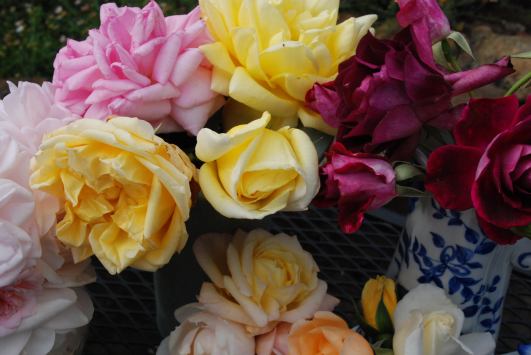
celebrate-picture-books-picture-book-review-flowers

Roses from Marsha’s flower garden.

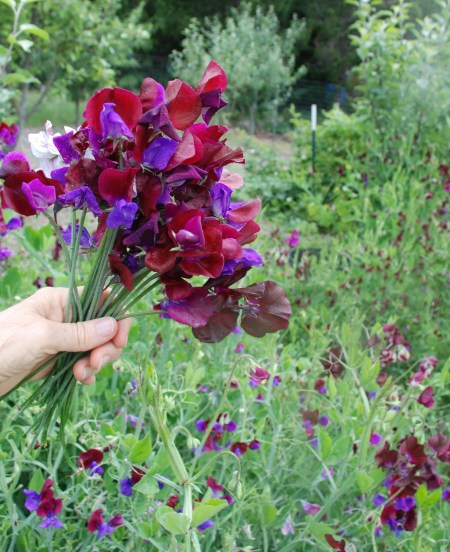
celebrate-picture-books-picture-book-review-sweetpeas

A beautiful bouquet of sweet peas.

How have your experiences with nature influenced your writing for children?

When a child grows up surrounded by nature, he or she grows to understand it and respect it. I learned to see the small things in nature, like my father before me. His neighbors said he knew the name of every wildflower or “weed” in the county. When you pay attention to something in that way, you come to love it and it becomes part of you. So, nature is what I write about, from my first book Heart of a Tiger, about a small kitten who had a dream to give himself a name like that of the Magnificent Bengal Tiger, to Galápagos Girl, about the unique animals of the Galápagos Islands, to the jumble tumble beauty of Badger’s Perfect Garden.
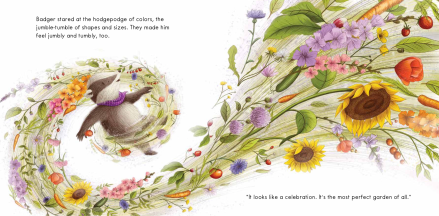
celebrate-picture-books-picture-book-review-badgers-perfect-garden-swirl

Image copyright Ramona Kaulitzki, 2019, text copyright Marsha Diane Arnold, 2019. Courtesy of Sleeping Bear Press.

What is your favorite wildflower and why?

Wild rose! At our California home, there was a wild rose growing in our gully. Every spring I would walk down the hill to see if it was still blooming. When I was diagnosed with breast cancer, I looked carefully for it each year, telling myself that if it was still in bloom, in the shade of our oak forest, alone and straggly, I would still be well. I’m sure it’s blooming still.

Thank you for sharing so much about your passion for nature and what joy living fully within it can bring. I wish you all the best with Badger’s Perfect Garden and all of your wonderful books!

You can connect with Marsha Diane Arnold on

Her website | Facebook | Twitter | Instagram

Spring Equinox Activity

celebrate-picture-books-picture-book-review-flower-garden-game

Plant a Flower Garden Game


With this fun game you and your family and friends can grow gardens inside! Roll the dice to see whose garden will fully blossom first!

Supplies

Directions

Object: The object of the game is for each player to fill their garden or garden rows with flowers. Depending on the ages of the players, the game can be adjusted to fill all of the rows, some or all rows, or just one.           

  1. Print one Game Board for each player
  2. Print one or more sets of Flower Playing Cards for each player, depending on how  (for sturdier playing items, print on card stock)
  3. Cut the flowers into their individual playing cards
  4. Print one Flower Playing Die and assemble it (for a sturdier die, print on card stock)
  5. Color the “dirt” on the Garden Plot with the crayon (optional)
  6. Choose a player to go first
  7. The player rolls the die and then “plants” the flower rolled in a row on the game board
  8. Play moves to the person on the right
  9. Players continue rolling the die and “planting” flowers until each of the number of determined rows have been filled with flowers or one row has been filled with all six flowers.
  10. The first person to “grow” all of their flowers wins!
celebrate-picture-books-picture-book-review-badger's-perfect-garden-cover

You can find Badger’s Perfect Garden at these booksellers

Amazon | Barnes & Noble | Books-a-Million | IndieBound | Sleeping Bear Press

Picture Book Review


March 12 – National Plant a Flower Day

celebrate-picture-books-picture-book-review-flower-talk-cover

About the Holiday

Spring is right around the corner and with it the beautiful blooms that color our yards, neighborhoods, and communities. In some places the flowers are already blossoming, while in others, people are eagerly waiting for the snow to melt so seeds and plants can grow again. If you’re looking forward to flower gardening—indoors or out—today’s the perfect day to start planning. Why not take a trip to your local nursery or garden supply store and stock up?

I received a copy of Flower Talk: How Plants Use Color to Communicate from Millbrook Press to check out. All opinions are my own. I’m happy to be partnering with Millbrook Press in a giveaway of the book. See details below.

Flower Talk: How Plants Use Color to Communicate

Written by Sara Levine | Illustrated by Masha D’yans


Do you hear something? Yeah, me too. Oh! It’s the little purple prickly pear down there with all the other cacti. It seems it has something to say about plants. Okay, we’re listening.

“I want to clear up some of your crazy ideas about what the colors of our flowers mean.” You’ve got it all wrong if you think “red roses stand for love and white ones are good for weddings.” While that may be how you interpret the colors, that’s not what they’re really for.

celebrate-picture-books-picture-book-review-flower-talk-cactu

Image copyright Masha D’yans, 2019, text copyright Sara Levine, 2019. Courtesy of Millbrook Press.

“We use our flowers to talk to the animals” so that we can make seeds and more plants. To do that each plant needs pollen from another plant that’s the same kind. Our flowers are like big ads that attract just the right birds, bees, or butterflies to help us out. Lots of times if they’re hungry they fly from flower to flower and bring pollen along with them.

How does each bird or butterfly or bee know which flowers to visit? That’s where our colors come in! And it’s pretty fascinating. Birds can see a color that insects can’t, and they don’t have a good sense of smell. Can you guess which flowers they’re attracted to? How about bees? Which colors do you think they like the best? I’ll give you a hint: “scientists just figured out that bees have three favorite colors.” Of course, we flowers “have known this for ages. That’s why so many of us make flowers in these colors. We like the reliable help.” This is fun, right?

celebrate-picture-books-picture-book-review-flower-talk-insects

Image copyright Masha D’yans, 2019, text copyright Sara Levine, 2019. Courtesy of Millbrook Press.

How about moths and bats—which flowers do you think they visit? The flowers even assist them in finding their way by putting “out perfume as an extra guide.” You may not like flies buzzing around you, but these color flowers love it. They put out a smell too, but I wouldn’t call it perfume—I don’t think you would either. There’s even a certain color flower that doesn’t talk to animals or insects at all. Go on, try to guess….

Colors aren’t the only trick flowers have either. Some are just the right shape—like mine. In fact, I’ve got to get going. “I’m making a new flower” and “I’m just about done with it.” Oh—what are the answers to the game we were playing? You’ll have to read my book and see!

Back matter includes an illustrated discussion about pollination, information on how to protect pollinators, and a list of other books for further reading.

celebrate-picture-books-picture-book-review-flower-talk-field

Image copyright Masha D’yans, 2019, text copyright Sara Levine, 2019. Courtesy of Millbrook Press.

With appropriate attitude, Sara Levine’s hilarious and knowledgeable prickly pear narrator engages kids in witty banter while taking them on a colorful garden tour. As the cactus explains a plant’s growing cycle and the need for pollinators, the information it imparts is eye-opening for children and adults. Why and how each flower’s color and scent attract just the right pollinator is clearly described in conversational language that kids will laugh along with and learn from. Every page contains an “ah-ha” moment that will spark discussion and an excitement to plant a garden and watch nature at work.

Like a riotous field of wildflowers, Masha D’yan’s dazzling illustrations put colors on glorious display as the flowers lure insects and animals to them. D’yan’s detailed images provide a great place for young naturalists to start researching the various plants introduced. Depictions of the prickly pear, birds, and bees match the humor of Levine’s text . Kids will love lingering over the two-page spreads to point out the various animals and insects and how they interact with the plants. They’ll also like following the growth of the prickly pear’s bud as it grows bigger and blossoms.

A superb book for teaching children about this fascinating feature of flowers and plants as well as providing a guide for gardeners interested in attracting a variety of pollinators, Flower Talk: How Plants Use Color to Communicate would be an outstanding addition to home, classroom, and public libraries.

Ages 7 – 11

Millbrook Press, 2019 | ISBN 978-1541519282

Discover more about Sara Levine and her books on her website.

To learn more about Masha D’yans, her books, and her art, visit her website.

National Plant a Flower Day Activity

celebrate-picture-books-picture-book-review-flower-pot-stake-craft

Flower Garden Stakes


It’s fun to start a garden from seeds, but how do you remember what you’ve planted where? With these easy to make garden stakes, you can mark your pots with style! 

Supplies

  • Wide craft sticks
  • Chalkboard paint in various colors
  • Colorful chalk
  • Paint brush

Directions

  1. Paint the stakes with the chalkboard paint, let dry
  2. With the chalk, write the name of the different flowers or plants
  3. After planting your seeds, stick the stake in the pot 
  4. Wait for your seeds to grow!

celebrate-picture-books-picture-book-review-flower-talk-cover

You can find Flower Talk: How Plants Use Color to Communicate at these booksellers

Amazon | Barnes & Noble | Books-a-Million | IndieBound

Picture Book Review
April 3 – National Find a Rainbow Day

celebrate-picture-books-picture-book-review-rainbow-stew-cover

About the Holiday

It’s not often someone wishes you a rainy day. Today, though, I’m doing just that because you can’t see a rainbow without a little of the wet stuff. This early spring month was chosen for this special day because, as we all know, April showers bring May flowers. Those same April showers lead to beautiful rainbows—even double rainbows sometimes! So, I hope you have a bad (weather) day and good luck finding a rainbow today! By the way—what do May flowers bring? Right! Pilgrims!

Rainbow Stew

By Cathryn Falwell


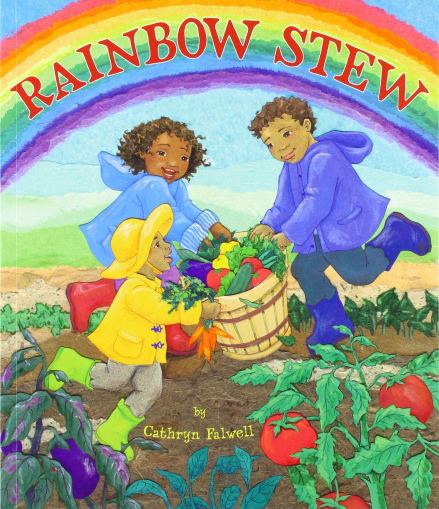
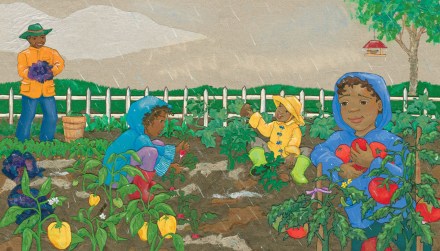
Grandpa’s making pancakes for his three favorite kids, and his granddaughter and two grandsons are excited to be visiting where they can play outside all day. Through the window the kids see that it’s a rainy day. Does this mean they’ll have to stay inside? Their grandpa knows just what to do! “Let’s go and find some colors for my famous Rainbow Stew!” he says.

celebrate-picture-books-picture-book-review-rainbow-stew-interior-art-picking-vegetables

Image copyright Catherine Falwell, 2013, courtesy of rainbowstewbook.com

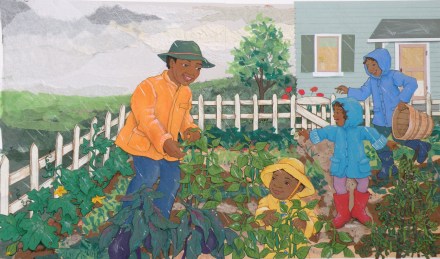
Out to the garden they run in their raincoats and hats. “Splish, splash, / puddle dash, / We bounce right out the door. / We’re off to find some red and green, / some yellow, orange, and more. / Grandpa shows us how to move / Between each garden row. / Lifting up the drippy leaves, /  we see what colors grow.” They collect green spinach, kale, and zucchini; yellow peppers, purple cabbage and eggplant, red radishes and tomatoes; brown potatoes; and orange carrots. After some muddy fun among the plants, the kids go inside, get dried off, and begin to prepare their colorful stew.

celebrate-picture-books-picture-book-review-rainbow-stew-interior-art-in-the-garden

Image copyright Catherine Falwell, 2013, courtesy of rainbowstewbook.com

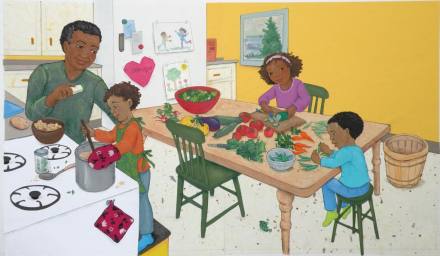
Peel, slice / chop and dice, / colors fill the pot. / Stir in herbs and water / and then wait till it gets hot.” While the pot simmers on the stove, Grandpa and the kids snuggle on the couch with favorite books, reading together until the stew has simmered to perfection. The family then sits down to a homemade, colorful, delicious lunch of Rainbow Stew. 

celebrate-picture-books-picture-book-review-rainbow-stew-interior-art-cooking-together

Image copyright Catherine Falwell, 2013, courtesy of rainbowstewbook.com

Cathryn Falwell’s Rainbow Stew is a wonderful book to share with young children on many levels. The bright colors of Grandpa’s house mirror the vividness of the garden vegetables in his stew, which could be made into a matching game for extra fun. The rhyming verses—each begun with an energetic couplet that would be fun for kids to repeat or act out—draw listeners into the story. Introducing colors through familiar and delicious vegetables can get kids excited about gardening, cooking, even going to the grocery store.

Children will identify with the disappointment of the three siblings when they learn it’s too wet to spend the day outside as well as their glee at squishing in the mud. The close bond between the kids and their grandfather as they cook and read together is a strong anchor for this story.

celebrate-picture-books-picture-book-review-rainbow-stew-interior-reading-together

Image copyright Catherine Falwell, 2013, courtesy of rainbowstewbook.com

A recipe for Rainbow Stew follows the story. Combined with the craft below, the book and recipe could make for a fun rainy-day get-together!

Ages 4 – 7

Lee & Low Books, 2013 | ISBN 978-1600608476 (Hardcover) | ISBN 978-1643790572 (Paperback, 2019)

National Find a Rainbow Day Activity

CPB - Rainbow Crayon Art 3

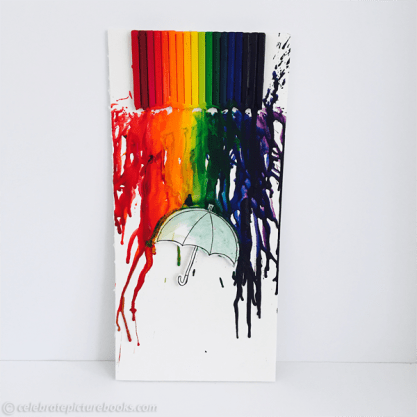
Crayon Rainbow Art


With this cool project you can create an art piece that’s as colorful as a rainbow and as unique as you are! Adult help is needed for children.

Supplies

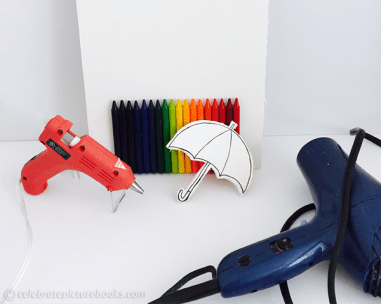
  • Box of 24 crayons
  • White foam board or thick poster board, 8 inches by 17 inches
  • A small piece of corrugated cardboard, about 5 inches by 5 inches (a piece of the foam board can also be used for this step)
  • A small piece of poster board, about 5 inches by 5 inches
  • Scissors
  • X-acto knife (optional)
  • Hot glue gun
  • Hair dryer
  • Old sheets or towels, newspapers, a large box, or a trifold display board

CPB - Rainbow Crayon Art 2

CPB - Rainbow Crayon Art 1 (2)

Directions

  1. Remove the various red, orange, yellow, blue, indigo, and violet hued crayons from the box of crayons
  2. Strip the paper from the crayons by slicing the paper with the x-acto knife, or removing it by hand
  3. Line them up in order at the top of the white foam board
  4. Glue the crayons with their tips facing down to the board with the hot glue gun
  5. Cut an umbrella or other shape of your choice from the poster board
  6. Trace the umbrella or other shape onto the corrugated cardboard or a piece of the foam board and cut out
  7. Glue the poster board shape onto the corrugated cardboard, let dry
  8. Glue the umbrella or other shape to the foam board, about 4 ½ inches below the crayons
  9. Set up a space to melt the crayons. The wax will fly, so protect the floor and walls by placing the art piece in a large box or hanging newspapers, old sheets or towels on the walls and placing newspapers on the floor. A trifold display board and newspapers works well.
  10. Stand the art piece upright with the crayons at the top
  11. With the hot setting of the hair dryer, blow air at the crayons until they start to melt
  12. Move the hair dryer gently back and forth across the line of crayons from a distance of about 6 to 12 inches away. The closer you are to the crayons, the more they will splatter
  13. The crayons will begin to melt and drip downward
  14. You can experiment with aiming the hair dryer straight on or at an angle to mix colors
  15. Wax that drips onto the umbrella or other shape can be chipped off after it dries or wiped off to create a “watercolor” effect on the shape
  16. Once the hair dryer is turned off, the wax cools and dries quickly
  17. Hang or display your art!