September 30 – International Translation Day

celebrate-picture-books-picture-book-review-good-night-little-sea-otter-cover

About the Holiday

Established in 1953 by the International Federation of Translators, today’s holiday celebrates the translators in every language who work to break down barriers and bring great literature to all people across the globe. Everyone’s story matters, and it is through access to a wide range of books that readers acquire deeper understanding of the commonalities and unique experiences that make us all citizens of the world. For children in bilingual and multicultural homes the ability to read and hear books in their native tongue as well as their adopted language is especially comforting and promotes greater literacy and language learning. With eight bilingual editions available, today’s book is a great example of the importance of translators’ work!

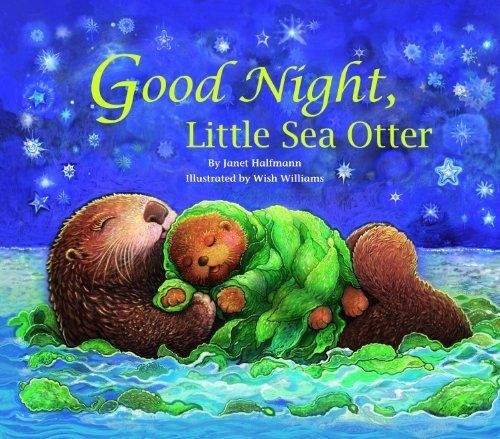
Good Night, Little Sea Otter

Written by Janet Halfmann | Illustrated by Wish Williams


As twilight paints the sky pink, purple, and gold, Little Sea Otter gets ready to sleep in her kelp forest bed. Mama Otter fluffs her baby’s fur and snuggles with her, but Little Otter is still wide awake. “‘I forgot to say goodnight to the harbor seals,’” she tells Mama. The baby waves her “soft, silky paw toward the rocky shore” and says goodnight. The harbor seals all along the craggy cliffs wish the little otter goodnight in return.
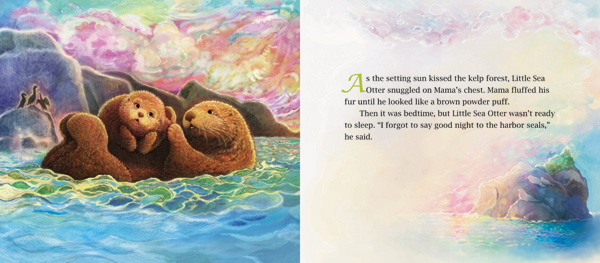
celebrate-picture-books-picture-book-review-good-night-little-sea-otter-mama-fluffing-pup's-fur

Image copyright Wish Williams, text copyright Janet Halfmann, courtesy of starbrightbooks.org

Hearing the seals’ goodnight song, the sea lions join in, their loud barks echoing in the air. “‘Good night, father sea lions. Good night, mother sea lions and baby sea lions,’” Little Otter calls. Curious about all the commotion, a seagull swoops down and learns that it’s bedtime for Little Otter. The two say “Good night” to each other, and as the seagull flies away to find his own place to sleep, Mama Otter tries to tuck in her little pup.

“But before she could say another word, Little Sea Otter dipped her furry face into the chilly water.” There she sees a whole ocean full of fish to greet. She says “Good night” to the yellow fish, the orange fish, and the purple fish. Of course she can’t forget the long fish or the short fish, the striped fish or the spotted fish either. All these fish are happy to wish the tiny pup sweet dreams too. Mama Otter points out other sea creatures getting ready for bed—different types of crabs, snails, sea stars, anemones, clams, and more. Little Otter says “Good night” to each in turn.
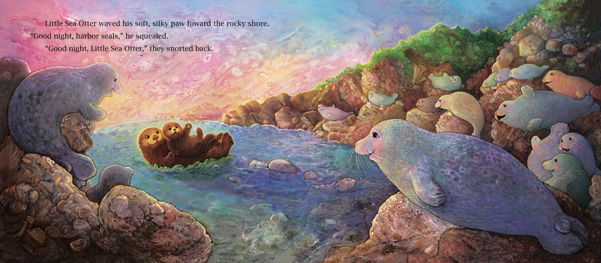
celebrate-picture-books-picture-book-review-good-night-little-sea-otter-harbor-seals

Image copyright Wish Williams, text copyright Janet Halfmann, courtesy of starbrightbooks.org

From every part of the ocean sea turtles, lobsters, octopi, rays, jelly fish, sea horses, eels and others bubble a chorus of “Good night” to Little Otter. She listens and responds to each one and then asks Mama if she has forgotten anyone. “‘Yes, you did,’” Mama says, “scooping her up in her paws. ‘You missed ME!’” Little Otter giggles and says “Good night.” Mama Otter hugs her tight and rolls over and over in the kelp, wrapping them both “in ribbons of seaweed” that will keep them secure on the ocean currents as they sleep.

Little Otter gazes up into the night sky and says “Good night” to the moon and the stars. As Little Otter’s eyes finally close and she drifts into sleep, Mama kisses her gently on the head and the sea whispers “‘rock-a-bye.’”
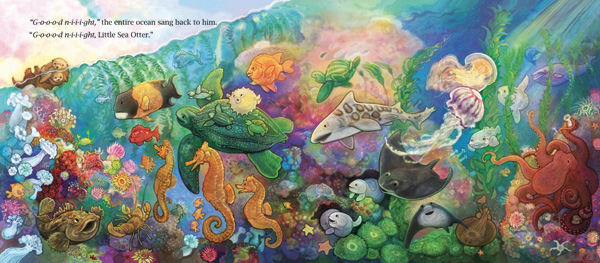
celebrate-picture-books-picture-book-review-good-night-little-sea-otter-all-ocean-creatures

Image copyright Wish Williams, text copyright Janet Halfmann, courtesy of starbrightbooks.org

Janet Halfmann’s gentle bedtime story is a sweet reminder for children of all the people in their life who love them and are thinking of them every day. As Little Sea Otter puts off sleep with just one more “Good night” and then another and another, Halfmann reveals with lyrical language the wide world of the sea and the creatures in it. The readiness of the ocean creatures to respond with their own heartfelt wishes for the little pup suggest that this is a nightly and eagerly anticipated ending to each day by all.

One might imagine that in addition to “Good night” Little Otter’s nightly repertoire includes the request to be told all the names of the fish and sea animals, just as children love to look through pictures of family and friends and learn their names. Mama’s patient support of her pup’s curiosity and connections to her world provide tender moments between mother and child, as do their final bedtime rituals before drifting off to sleep.
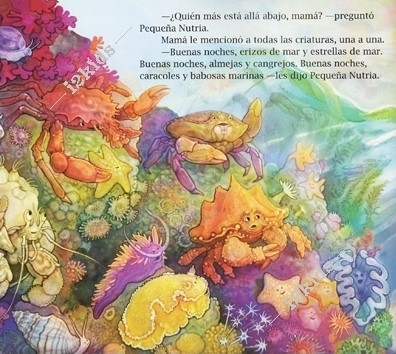
celebrate-picture-books-picture-book-review-good-night-little-sea-otter-spanish-translation

Image copyright Wish Williams, text copyright Janet Halfmann, courtesy of starbrightbooks.org

Wish Williams’ beautiful, vivid illustrations are stunning and detailed, offering a magical realism that is perfect for this book’s wide-eyed audience. Little Otter and her sea creature friends are adorable, their smiling faces glowing with their happiness to see each other and finish the day together. While the fish and other sea creatures are colorful, the hues are true to their natural counterparts. The blue-green ocean swirls and foams along the rocky shore at twilight while whitecaps glitter in starlight when the sun goes down.

Little Otter’s repeated phrase of “Good night” gives children plenty of opportunities to read along. Kids and adults who enjoy the beach and marine environments will also be delighted in the scientific facts about sea otters organically sprinkled into the text. The lovely nature of the mother/child relationship, opportunities for child participation, and gorgeous art make Good Night, Little Sea Otter a welcome addition to home bookshelves for quiet story times and bedtime.

Translations

Star Bright Books also publishes Good Night, Little Sea Otter in eight bilingual editions. For information on each click on the links below:

Arabic/English | Burmese/English | Burmese Karen/English | French/English | Hmong/EnglishNavajo/English | Portuguese/English | Spanish/English

Ages 2 – 6

Star Bright Books, 2010 | ISBN 978-1595722546 (English Edition)

Learn more about Janet Halfmann and her other books on her website!

International Translation Day Activity

We Are All Family English/Spanish Word Search
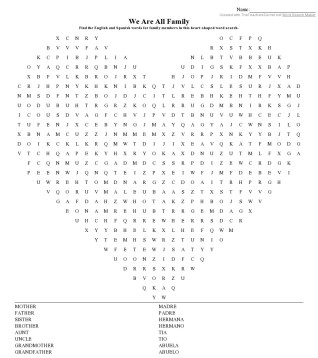
celebrate-picture-books-picture-book-review-we-are-all-family-word-search

Find the names of family members in both English and Spanish in this printable heart- shaped We Are All Family Word Search! Here’s the Solution!


Sleepy Sea Otters Coloring Page
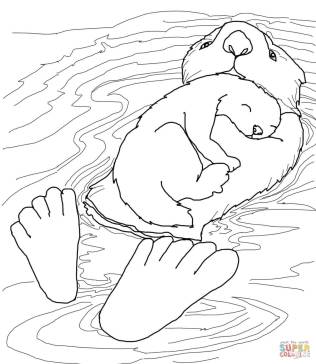
celebrate-picture-books-picture-book-review-sleep-sea-otters-coloring-page

Say “Good night” to these sweet sea otters before going to bed by coloring this printable Sleepy Sea Otters Coloring Page.

Picture Book Review

September 29 – It’s National Piano Month

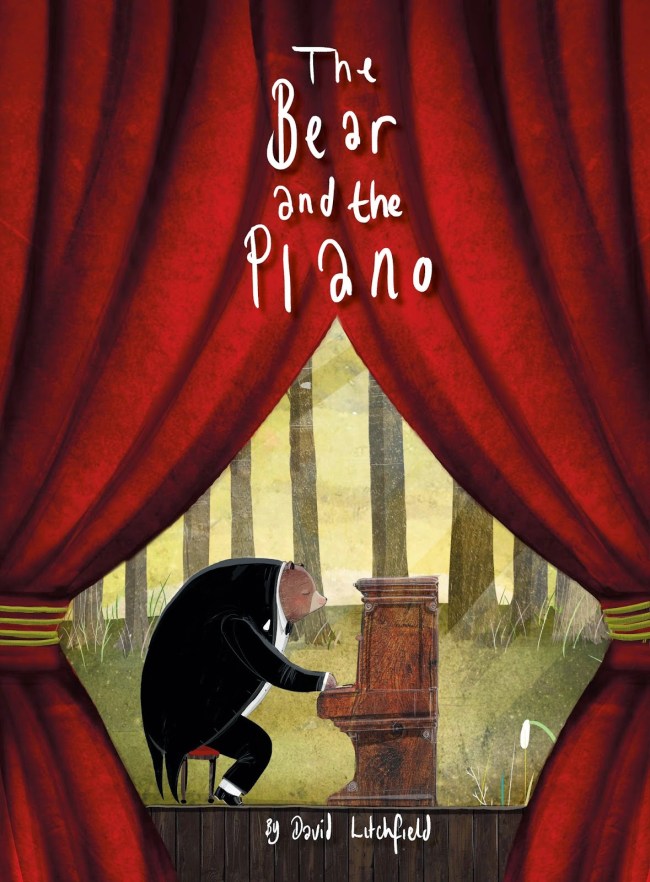
The Bear and the Piano by David Litchfield picture book review

About the Holiday

Invented around 1700, the piano was not an immediate hit with composers and performers. It took several decades before musicians embraced its versatility, and over the next 150 years the piano underwent many changes in tonality, size, and shape. In the 19th century the instrument became larger and more powerful to accompany soloists in concert and on tour with large orchestras. At the same time, individuals and families took the piano to heart – and hearth – as it became the primary source of home entertainment and piano lessons a must for all children. The United States became a major producer of pianos, with factories in Boston, New York, and Philadelphia. New technology in the twentieth century provided other types of entertainment that came to toke precedence over the piano, and domestic sales declined.

Today we celebrate the beauty of the piano—both in shape and sound—and all the musical artists who play and compose for this storied instrument.

The Bear and the Piano

By David Litchfield


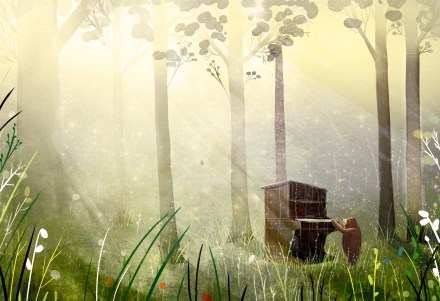
One day a bear cub happens upon a piano in a clearing in the middle of the forest. Wondering what it could be, he approaches and lays his paw on the keys. The strange thing goes PLONK!—such an awful sound. The bear cub leaves, but is drawn back again and again for days, months, and years. Over time the bear grows up and learns to play the piano. The music is beautiful and transports him to strange and wonderful places.

celebrate-picture-books-picture-book-review-bear-finds-piano

Image copyright David Litchfield, courtesy of davidlitchfieldillustration.com

Other bears soon gather in the clearing to hear the “magical melodies” the bear plays. The bear is happy entertaining his friends. One night a girl and her father hiking in the forest come to the clearing. They listen and then tell the bear what his strange instrument is. They invite him to move to the city with them, where he will be able to play grand pianos for hundreds of people. The music he will play and hear “will make your fur stand on end,” they tell him.

The bear is conflicted. One on paw he knows that leaving the forest will make the other bears sad; on the other he longs to explore the world, to play the piano better, and master more intricate music. He decides to go with the girl and her father.

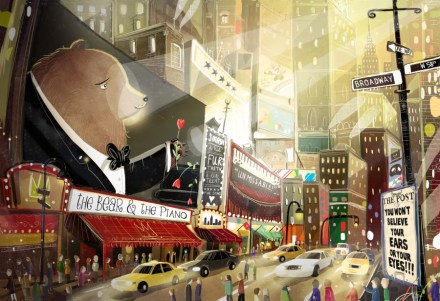
celebrate-picture-books-picture-book-review-bear-in-big-city

Image copyright David Litchfield, courtesy of davidlitchfieldillustration.com

In the city the bear is a sensation! He quickly becomes a celebrity with his name on marquees and playing to sold-out crowds. The bear records albums that go platinum, he appears on the covers of magazines, and wins awards. His experience is everything he could ever wish for. But deep in his heart there is another longing. He misses the forest and his friends there.

He decides to leave the city and rows a boat across the expanse of water to his old home. Excitedly he runs to the clearing, but when he arrives everything has changed. His piano is gone and there are no friends to greet him. The bear worries that everyone is angry at him for leaving, or worse—that they have forgotten him.

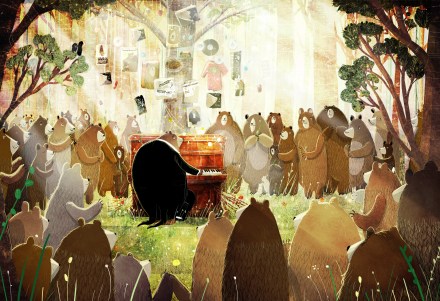
celebrate-picture-books-picture-book-review-bear-playing-for-friends

Image copyright David Litchfield, courtesy of davidlitchfieldillustration.com

Suddenly an old friend peeks around the trunk of a tree. The bear hails him with a hearty “Hello!” The other bear remains silent, however, and then turns and runs into the trees. The bear follows, plunging deeper and deeper into the forest. Suddenly he stops. In front of him is a sight that makes his fur stand on end.

There, protected in the shade of a tree and surrounded by the albums, magazines, t-shirts, and other mementos of the bear’s success sits the old piano. The bear’s friends have not forgotten him and they are not angry. They are proud and welcoming. The bear tells them all about his adventures then sits down to play again—for the most important audience of all.

David Litchfield’s very original and moving story is such a wonderfully conceived microcosm of the changes life brings. Stumbling upon a talent, cause, or inspiration; opening up to other influences; and acting on hard decisions are all part of growing up. These concepts are honestly and sensitively presented in The Bear and the Piano, and the reassuring ending brings comfort as well as a tear to the eye.

celebrate-picture-books-picture-book-review-bear-giving-concert

Image copyright David Litchfield, courtesy of davidlitchfieldillustration.com

Litchfield’s touching illustrations—rendered in gorgeous hues of browns, greens, yellows, and blues—brim with yearning and mystery. The piano sits in a misty glow, silent and draped with vines, when the cub discovers it. While the bear grows and learns to play, the air clears and the colors become brighter. When the bear moves to the city, the pages glint and swirl with the glow of marquees and concert halls announcing his enormous achievements. But as he sits on a rooftop one night contemplating his life and looking out toward his old home, the lights around him are the elements of normal life—lamps in apartment windows, stars, and the moon glimmering on the water. His nostalgia to be home will resonate with both kids and adults.

The Bear and the Piano makes a wonderful gift for any age—especially as a graduation or new-job gift—and is a must-have for anyone’s personal library.

Clarion Books, Houghton Mifflin Harcourt, 2016 | ISBN 978-0544674547

To learn more about David Litchfield, his books, and his artwork, visit his website!

While I take a few personal days during this month, I am reposting earlier reviews updated with new links, interior art, and book trailers.

Watch the beautiful The Bear and the Piano book trailer!

https://www.youtube.com/watch?v=jEqLAKx8l_M

National Piano Month Activity

CPB - Record Bulletin Board

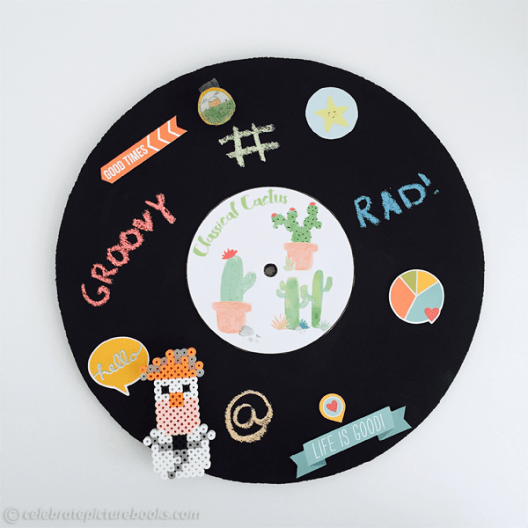
Make a Record Chalkboard Bulletin Board


Do you play the piano or another instrument? Would you like to make a record some day? Why wait? In this fun craft you can create your own record bulletin board—and even create your own label art! While this record may not spin on turntables around the world, it will drop in a more important place—your very own room!

Supplies

  • Printable Record Label for you to design
  • Foam board, or a corkboard at least 12-inches x 12-inches square
  • Adhesive cork
  • A 12-inch round plate, record, or other round object to trace OR a compass
  • Chalkboard paint, black
  • X-acto knife
  • Paint brush or foam paint brush
  • Mounting squares

Directions

  1. Cut a section from the adhesive cork a little larger than 12 inches by 12 inches
  2. Affix the cork to the foam board
  3. Trace the 12-inch round object onto the cork/foam board OR use the compass to make a 12-inch circle
  4. With the x-acto knife, carefully cut out the circle (adult help needed for children)
  5. Cut out a ¼ -inch circle in the center of the record bulletin board
  6. Paint the cork, sides and inside the spindle hole with the black chalkboard paint. Let dry
  7. Print the label template and design your own record label
  8. When the paint is dry, glue your label to the center of the bulletin board
  9. Hang your bulletin board with the mounting squares
  10. Decorate!

Picture Book Review

September 27 – It’s Fall Hat Month

celebrate-picture-books-picture-book-review-mr-brown's-fantastic-hat-cover

About the Holiday

As the weather turns cooler in certain parts of the world, it’s time to pull out those old favorite cozy hats or buy a stylish new one to keep your head and ears warm! Whether you like wearing felt hats, knit hats, furry hats, or even top hats—like the character in today’s book—this is the season for you!

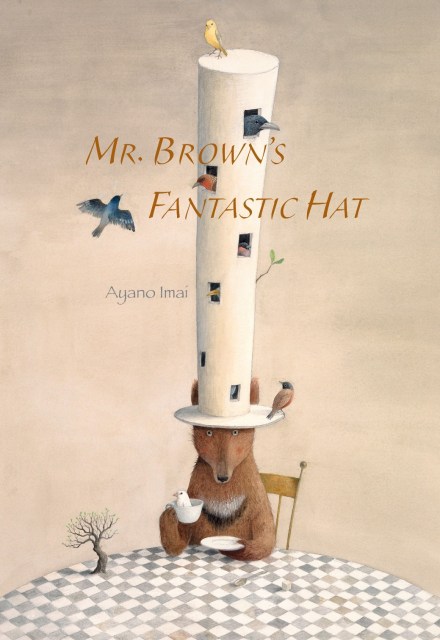
Mr. Brown’s Fantastic Hat

By Ayano Imaí


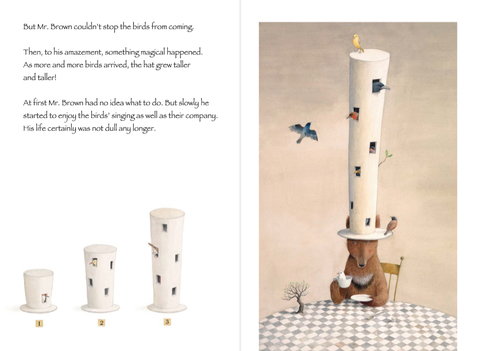
Mr. Brown lived alone and, if you asked him, he’d tell you he liked it that way. He “had no friends and he didn’t want any.” If you were privy to his secret thoughts, however, you’d learn that Mr. Brown was actually very lonely. Mr. Brown liked to take long walks, and when he went out, he always wore his “smart,” distinctive hat. “One day while Mr. Brown was sleeping, a woodpecker flew down and started tapping a hole in his hat, thinking, ‘What a wonderful nest this hat would make!’”

When Mr. Brown woke up he was shocked to discover that a bird had moved into his hat. Someone living this close to him was not what Mr. Brown had in mind at all. Then to Mr. Brown’s dismay the “woodpecker soon told all his friends about the wonderful new home and invited them all to join him.” Soon Mr. Brown’s hat was full of holes—and birds! You might think a regular hat would not have enough room for so many residents—but Mr. Brown’s hat was no ordinary one. As more and more birds moved in, his hat grew taller and taller!

celebrate-picture-books-picture-book-review-mr-brown's-fantastic-hat-birds-live-in-hat

Image copyright Ayano Imaí, 2014, courtesy of minedition

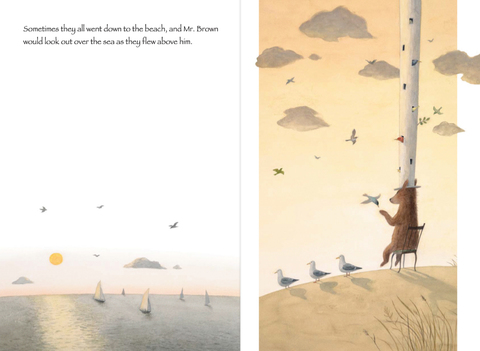
As the days went on Mr. Brown discovered that he was beginning to enjoy the birds’ singing and their company. Now Mr. Brown had renewed purpose in his daily walks: “He loved to show off his hat. Everywhere he went it was full of the music of singing birds.” People on the street took notice and wanted to emulate Mr. Brown. All over town people began wearing tall hats, “but the birds preferred to stay with Mr. Brown no matter how hard people tried to persuade them.”

One day as autumn settled in, Mr. Brown noticed that all the birds had flown away. He was sad and didn’t understand where they had gone or why they had left him. He wondered if he would see them again. The idea of a quiet life no longer held the appeal it once did, and Mr. Brown missed his friends. He tried to convince himself that he didn’t care that the birds had left, but he continued to fill the feeders and watch out for them every day.

celebrate-picture-books-picture-book-review-mr-brown's-fantastic-hat-looking-out-to-sea

Image copyright Ayano Imaí, 2014, courtesy of minedition

Even though it was time for Mr. Brown to take a long winter’s nap, he tried to stay awake, worried that there would be no one to care for the birds if they returned. But nature took its course, and Mr. Brown fell into a deep sleep. One morning after a particularly vivid dream in which Mr. Brown could hear the birds singing, he woke to a tapping sound. He went to the door and peered out.

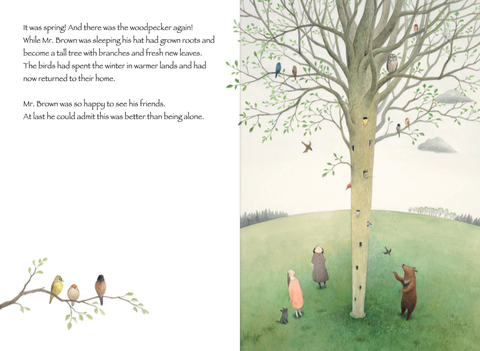
Spring had come and with it Mr. Brown’s hat had grown roots and sprouted branches and leaves. The old holes were filled with their previous tenants. The sight filled Mr. Brown with joy, and he finally could admit to himself that sharing his life with friends “was better than being alone.”

celebrate-picture-books-picture-book-review-mr-brown's-fantastic-hat-hat-grows-into-tree

Image copyright Ayano Imaí, 2014, courtesy of minedition

Ayano Imaí’s gloriously beautiful book plumbs the nature of solitude and loneliness as well as the value of friendship with an honesty that is at once heartrending and uplifting. For so many quiet, introspective people—children and adults alike—navigating the world of small talk, casual relationships, and making friends is similar to traveling uncharted territory, where the language and mores are foreign. It can become easier to tell oneself that it doesn’t matter, when in reality it matters a great deal. Many times happiness comes when one finds their niche or, in some surprising way, a niche finds them.

Imaí tells the story of Mr. Brown and his fantastical hat in straightforward narration, but more profound meaning is revealed in her illustrations. Mr. Brown, it is discovered, is a brown bear who has taken on the aspects of humans. He walks upright, carries an umbrella and bag, owns a home, and wears a hat. His fur is even the same color as the townspeople’s clothing. But while he may be among people, he is not of them. His home has a grass floor which sprouts mushrooms and weeds; another weed pokes out from the bristles of his brush; a tree branch juts from a wall; and mushrooms share space with the laundry on the drying line.

Mr. Brown comes from nature and belongs with nature, so it is no surprise that the birds flock to him and prefer him to humans, who in an ironic twist long to be like Mr. Brown. I especially like the ending of Mr. Brown’s Fantastic Hat, in which Mr. Brown stays true to himself. He does not suddenly discover his “wild” side and become someone that he is not. He is able to remain a quiet, introspective bear while also embracing his friends, his love for them, and his place in the world. He finds inner happiness and loved ones to share it with.

Ages 3 – 8 (and up)

minedition, 2014 | ISBN 978-9888240845

Fall Hat Month Activity

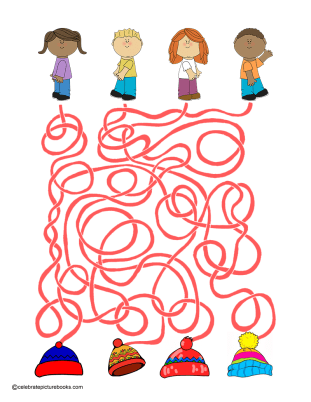
celebrate-picture-books-picture-book-review-favorite-hat-matching-puzzle

Favorite Fall Hat Matching Puzzle


Each child has a favorite hat for cooler weather. Follow the paths in this printable Favorite Fall Hat Matching Puzzle to find out which hat each child chooses!

Picture Book Review

September 25 – World Dream Day

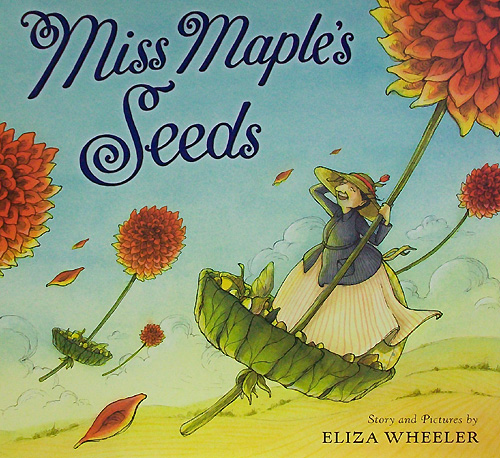
MIss Maple's Seeds by Eliza Wheeler Picture Book Review

About the Holiday

Dreamed up by a professor at Columbia University in 2012, today’s holiday is not for the sleepy  but for those wide awake to all the possibilities in life. It’s a time for adults and kids to really think about their hopes and dreams and plan how to achieve them. So sit down with a group of friends or by yourself and let your imagination soar – don’t let the day or opportunities pass you by! 

Miss Maple’s Seeds 

By Eliza Wheeler


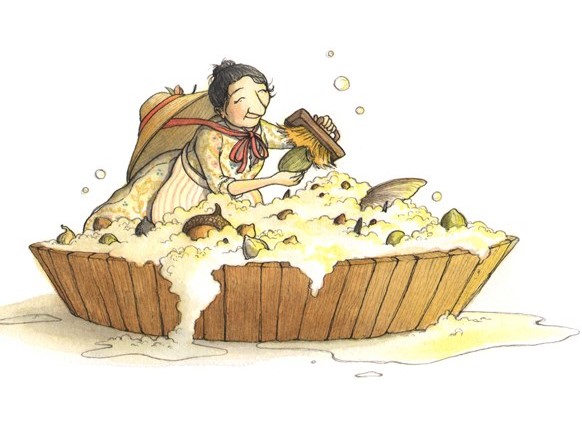
Late in the summer, Miss Maple hurries to prepare for some very special guests. She has searched all summer for “orphan seeds that got lost during the spring planting,” and now bluebirds are carrying baskets full of these little pods so full of potential to her home. Once they arrive she “learns each seed by heart.” There are poppy, wild rice, maple, water lily, pine, impatiens, apple raspberry, sunflower, acorn, pea, fern seeds, and as many more as make up our world.

celebrate-picture-books-picture-book-review-miss-maple's-washing-the-seeds

Image copyright Eliza Wheeler, courtesy of Nancy Paulson Books, Penguin Books

As she lovingly tends to each one, she whispers to them, “Take care, my little ones, for the world is big and you are small.” Miss Maple takes her little charges on field trips and shows them the world they will inhabit—muddy soil along riverbanks, grassy fields, and thickly populated forests. She cautions them about “weedy characters” who can show up even in a “bustling garden.”

At night Miss Maple snuggles each seed into a comfortable bed and reads to them by the light of fireflies. During the winter Miss Maple entertains other guests—woodland creatures who gather in her maple tree home to share food, stories, and songs. With the spring come rains and new lessons that teach the seeds how to burrow into the ground.

celebrate-picture-books-picture-book-review-miss-maple's-seeds-bedtime-story

Image copyright Eliza Wheeler, courtesy of Nancy Paulson Books, Penguin Books

In May Miss Maple knows it’s time for her little ones to “find roots of their own.” She sends them out into the world, knowing that she has prepared them well for what they will become. Her seeds say goodbye and sail off to begin their futures, leaving Miss Maple alone. But soon another summer day comes, and Miss Maple sets off to gather more orphan seeds, because “the world is big and they are small.”

Eliza Wheeler’s Miss Maple’s Seeds is a lovely metaphor for the nurturing relationship between children and their parents or caregivers. At once comforting and liberating, Wheeler’s sweet tribute reveals the hopes and dreams adults have for each child they raise and finally let go to bloom into what they are meant to be.  

celebrate-picture-books-picture-book-review-miss-maple's-lantern-boats

Image copyright Eliza Wheeler, courtesy of Nancy Paulson Books, Penguin Books

Wheeler’s beautiful language floats as quietly and unhurried as a leaf on a gentle breeze, and her luminous artwork is breathtaking in its fully realized details of the greater world Miss Maple’s seeds and all of us inhabit. Each season is gorgeously rendered in soft blues, roses, browns, and yellows, and Wheeler imbues each little seed with personality without anthropomorphism. The reader may well wish they could be friends with these future beauties and with Miss Maple as well.

Miss Maple’s Seeds would be a wonderful gift for high school graduates, teachers, and anyone who loves taking care of children. It’s timeless message also makes it a perfect choice for quiet reading times or bedtime and a welcome addition to anyone’s bookshelf.

Ages 3 – 7, all ages

Nancy Paulsen Books, an imprint of Penguin Group, 2013 | ISBN 978-0399257926

Discover the world of Eliza Wheeler‘s books and art on her website! Download an activity sheet for Miss Maple’s Seeds here!

While I take a few personal days this month, I am reposting earlier reviews updated with new links and interior art.

World Dream Day Activity

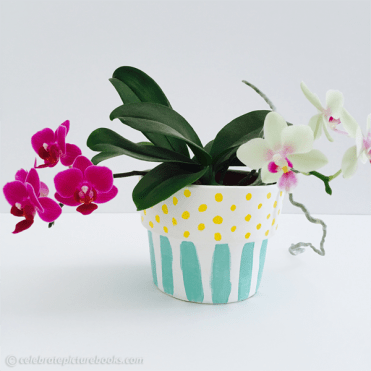
CPB - Flower Pot

Hopes and Dreams Flower Pot


Ideas, hopes, and dreams are like seeds, sprouting and growing into fruition with a bit of attention and care. With today’s craft you can create a flower pot of your own design. Then fill it with “dream seeds” of your favorite flower or plant. As you tend to the plant and it grows, tend to your own dreams and watch them grow as you achieve your desires.

Supplies

  • Terra cotta pot in any size
  • Acrylic multi-surface paint in various colors
  • Flower seeds
  • Soil

Directions

  1. Paint your terra cotta pot—be creative!
  2. Let paint dry
  3. Fill pot with soil
  4. Plant flower seeds

Picture Book Review

August 31 – It’s Happiness Happens Month

celebrate-picture-books-picture-book-review-Double Happiness by Nancy Tupper Ling Picture Book Review

About the Holiday

Summer is coming to a close and school is starting again. It’s a great time to reflect on the fun you’ve had in the warmer weather and all the memories that are about to be made as another year of activities, education, new friendships, and excitement unfolds. Happiness really does happen if you let it!

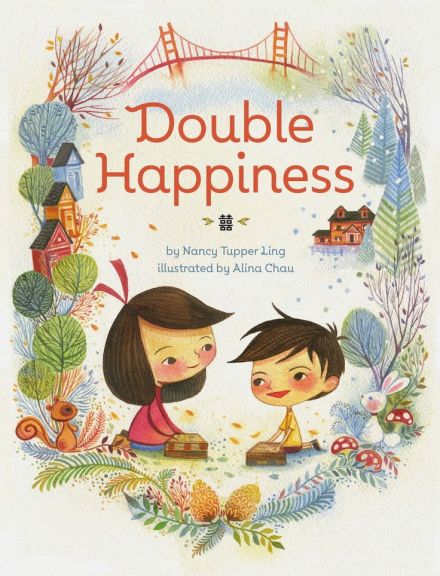
Double Happiness

Written by Nancy Tupper Ling | Illustrated by Alina Chau


This quiet, thoughtful picture book tells the story of a family’s move from China to America in a series of unrhymed verses that reveal the experience honestly from alternating viewpoints of a brother, Jake, and his sister, Gracie. Each page is dedicated to one sibling or the other with the Jake’s poems written in blue and Gracie’s in purple. In several poems the children interact with each other, the blue and purple lines acting as dialog tags.

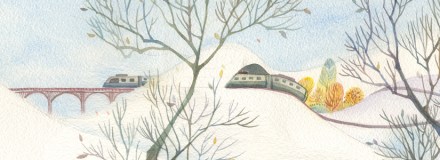
In the first poem, The Move, Gracie stands on her doorstep surrounded by boxes and suitcases and thinks, “I won’t go! / I won’t move / away / from our city house / by the trolley tracks….” But Jake is more adventurous and in the second poem, Train, is already imagining his new room. After considering different décor, he decides what he really wants is something familiar, something outside—“just one long train / that rocks and wobbles / my bed each night. / I can’t fall asleep until the train passes by.”

celebrate-picture-books-picture-book-review-double-happiness-train

Image copyright Alina Chau, 2015, courtesy of Chronicle Books

In Grandmother, the siblings are each given a happiness box by their Nai Nai, who wisely challenges her grandchildren to “Find four treasures each, / leading from this home / to your new.” Gracie takes this to heart, and readers see in Panda that even before leaving Nai Nai’s Gracie has added a favorite keepsake to her box: “Nai Nai’s panda sits / by the window / like always. / “I’ll miss you,” I say. / Nai Nai leans over me. / She places Panda / inside my box. / “He has a new home / now.”

Too soon moving day comes, and in Goodbye Gracie and Jake give hugs and kisses to beloved relatives. The search for items to fill Nai Nai’s boxes is taken up in the next three poems. In Treasure, Jake becomes a dragon keeping his “dragon eyes / wide open for stuff / along the way.” He is rewarded in Lucky, in which he discovers an old penny on the bus ride to the airport. In Leaf Gracie receives a surprising gift for her happiness box: “One stray leaf / flutters down / onto my box— / Eucalyptus! / If I had a koala I’d feed / her this minty meal all / day long— / the perfect treasure / to remind me of home.” 

In keeping with the long hours of travel from China to the United States, the next six poems chronicle the brother and sister’s experiences in the airport, waiting for their plane, and during the flight. Airport sees the children running, hopping, waiting, and navigating their way through the crowds of people to their gate. Dad is already tuckered out in Quiet, but Jake is wrangling to look for treasure: “’Huff puff. Puff huff.’” / Dragon blows fire. / Dragon stomps his feet. / “’Ssshhh, you’ll wake Daddy. / I giggle. / Gracie giggles. / “’Daddy can sleep / anywhere.’” Jake finally discovers gum in his backpack and creates a treasure. “I stretch it / and roll it / and ooze it / into one slinky snake / Sssssee, his penny pillow. / Sssssee, he’s kai xin— / so happy—in his brown box. / I’m tied with Gracie now— / two treasures each.”

celebrate-picture-books-picture-book-review-double-happiness-discovering-the-woods

Image copyright Alina Chau, 2015, courtesy of Chronicle Books

Adventures at the airport continue in Cat and Wings, and as the plane takes off Gracie draws pictures of the day’s events in Picture. In Here the children wake up to see their new city far below them and wonder, “can I find our house / from the sky?” Marble and Sadness juxtapose Jake’s happiness at finding another treasure for his box with the apprehension of Gracie as the plane lands and the family makes its way into their new country.

At last in Home the family reaches their new house by taxi. Gracie seems only to see the “piles of snow,” but Jake likes the “windy roads, lots of trees, and the curvy driveway.” In Explore Gracie and Jake walk around the countryside, and while Gracie still determines that she won’t like it, Jake hears a train and is happy. My Room and Dinner see the kids settling in, with a photograph of the family they’ve left behind accompanying them on the table while they eat. In A Surprise, Gracie finds that her grandmother is still with her through a special scarf, and in Paints Jake and Gracie accept the move as they paint their happiness boxes: Jake decorates his with a dragon and a train, while Gracie depicts herself and her brother walking in the snow and “they look very, / very / happy.”

celebrate-picture-books-picture-book-review-double-happiness-coming-to-new-house

Image copyright Alina Chau, 2015, courtesy of Chronicle Books

While Double Happiness tells the story of a family’s distant move, Nancy Tupper Ling’s gentle verses are appropriate for any situation involving change or uncertainty. She reminds children that happiness can be found wherever they are and all around them if they look for it. The poems flow as freely as thoughts, fears, and unguarded moments. As Gracie and Jake resolve their feeling, readers or listeners will also see that feelings of apprehension are common, and that happiness is waiting for them.

Alina Chau’s soft, lovely watercolor illustrations are beautiful representations of Gracie and Jake’s move from the familiar surroundings of their home in China to a new home in a snowy countryside.  The children’s emotions resonate as they alternate between sadness and happiness and between the concrete places of Nai Nai’s house, the airport, and their new city and their own imaginations of dragons, drawings, and dreams.

Ages 5 – 8

Chronicle Books, 2015 | ISBN 978-1452129181

Discover more books for children and adults by Nancy Tupper Ling on her website!

View a gallery of artwork by Alina Chau and more on her website!

Happiness Happens Activity

CPB - Happiness typography

Happiness Is…Game


Happiness is all around you! Grab one or more friends to play a game that reveals what things make you happy. Here are two ways to play:

  1. Like the “Geography” game: the first player names something that makes them happy, the next player must think of something that starts with the last letter of the word the previous player said. The game continues with each player continuing the pattern. Players drop out as they cannot think of a word. The last player left is the winner.
  2. Using a time limit (depending on age): players must think of something that makes them happy. Players drop out if they cannot think of a word within the time limit. The last player left is the winner.

Picture Book Review
August 18 – It’s Get Ready for Kindergarten Month

celebrate-picture-books-picture-book-review-sophie's-squash-go-to-school-cover

About the Holiday

Starting kindergarten is a huge step toward future learning and fun! This milestone can take a lot of preparation—from buying backpacks and school clothes to establishing different routines to becoming a new member of the school community. Most school years start during August and this month gives families an opportunity to talk about the changes, go shopping together, and look forward to the new experiences to come!

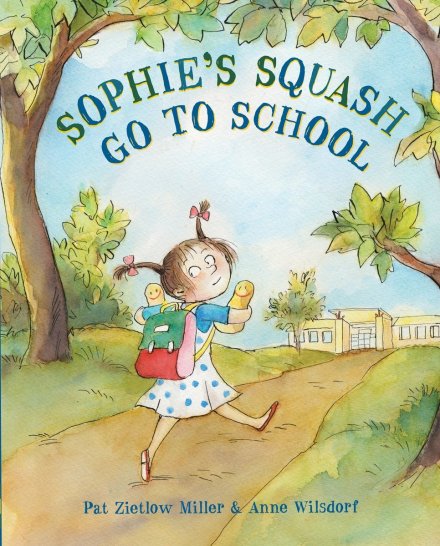
Sophie’s Squash Go to School

Written by Pat Zietlow Miller | Illustrated by Anne Wilsdorf


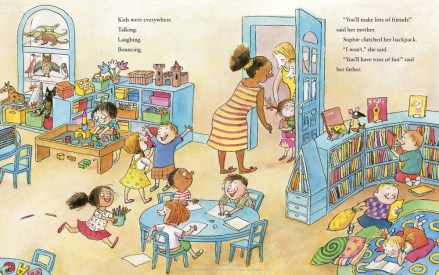
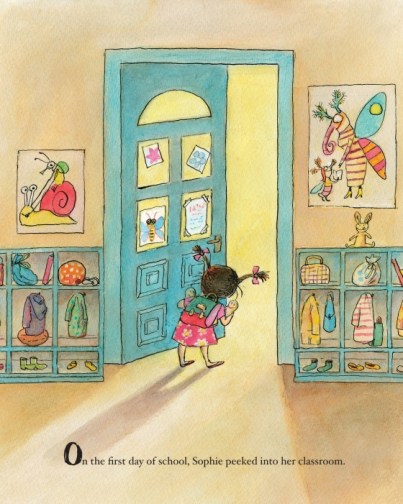
Backed up by her parents and clutching her best friends, two squash named Bonnie and Baxter, Sophie peeks into her classroom on the first day of school. She sees kids running everywhere, talking and laughing. Her parents assure Sophie that she’ll make a lot of friends and have tons of fun, but Sophie is adamant: “‘I won’t,’” she says. And Sophie’s right. “The chairs were uncomfortable. The milk tasted funny. And no one appreciated her two best friends, Bonnie and Baxter.”

celebrate-picture-books-picture-book-review-sophie's-squash-go-to-school-classroom

Image copyright Anne Wilsdorf, courtesy of Schwartz & Wade

The other kids surround her with questions about Bonnie and Baxter. “‘Are they toys? Do they bounce? Can we EAT them?’” Sophie has had enough. “‘No, no, no! I grew them in my garden. They’re my FRIENDS.’” And then there’s Steven Green. He sits near Sophie at circle time, plays near her on the playground, and stands over her breathing down her neck during art time. Ms. Park, the teacher, tells Sophie Steven is just being nice, but Sophie isn’t interested.

Steven does not give up so easily. He returns to show Sophie his best friend—Marvin, a stuffed frog that he got when the toy was just a tadpole. “‘Then you don’t need me,’” Sophie says and decides “that’s that.” But that isn’t that. The next day Steven is back, building a block tower near Sophie, reading her book over her shoulder, and even offering facts about fruit and vegetables during Sophie’s show and tell.

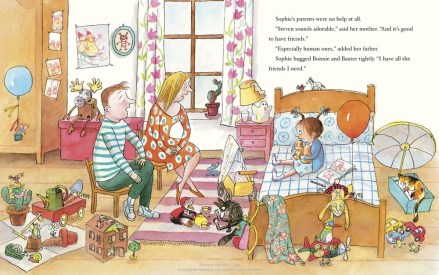
When her parents hear about Steven, they encourage Sophie to make a friend, but Sophie just clings tighter to Bonnie and Baxter. “Still, Sophie knew that Bonnie and Baxter wouldn’t last forever,” so when the other kids dance, spill their milk, or tell jokes, Sophie considers joining in. On the playground Sophie plays hopscotch while the other kids play tag, jump rope, and play other games together. When Steven asks if he can join Sophie, Bonnie, and Baxter, she refuses, leaving Steve and Marvin to sit alone.

celebrate-picture-books-picture-book-review-sophie's-squash-go-to-school-talk-with-mom-and-dad

Image copyright Anne Wilsdorf, courtesy of Schwartz & Wade

When the weekend comes Bonnie and Baxter look “too tired to hop. Or build towers. ‘It’s time,’” says Sophie’s mother. Sophie digs a hole to make “a garden bed and tucked her squash in for their winter nap. ‘Sleep tight,’” she says. “‘See you soon.’ But spring seemed very far away.” On Monday Ms. Park asks the class to tell her what makes a good friend. The kids answer that friends play with you, help you, and think you’re funny. Steven answers “‘They like what you like.’” Ms. Park sends the kids off to draw pictures of their friends.

When Steven wants to see Sophie’s drawing of Bonnie and Baxter, the two get into a scuffle over the paper and it tears in half. “‘You are NOT my friend,’” Sophie says as she walks away. On the way home from school, Sophie tells her mom what happened. “‘Sweet potato,’” her mom says. “‘That adorable boy didn’t mean to tear your picture.’” But Sophie’s not so sure.

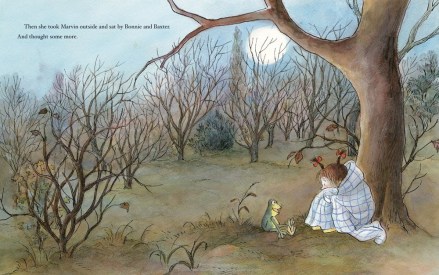
The next morning Sophie finds Marvin and a note in her cubby. She ignores it, and by lunchtime, Marvin is gone. Later that night, though, Sophie and her dad discover Marvin and the note inside her backpack. The note contains a drawing of Bonnie and Baxter as well as a packet of seeds.  “‘Do friends really like the same things you like?’” Sophie asks her dad. When he answers “Sometimes,” Sophie begins to think. She takes Marvin outside and sits near Bonnie and Baxter to think some more.

celebrate-picture-books-picture-book-review-sophie's-squash-go-to-school-nighttime-thinking

Image copyright Anne Wilsdorf, courtesy of Schwartz & Wade

The next day Sophie runs up to Steven to tell him the great idea that Marvin had. They then tell Ms. Park. The next day, Ms. Park hands each child “a cup, some dirt and one small seed.” “‘Can we EAT them?’” a classmate asks. “‘No!’” says Sophie, and Steven adds, “‘You never eat a friend.’” The kids plant the seeds and put the pots on the windowsill. Soon tiny shoots appear in the cups and Sophie and Steven invite the kids to do a new-plant dance.

“‘See?’” Sophie tells Steven. “‘Sometimes growing a friend just takes time.’”

Pat Zietlow Miller’s sequel to her award-winning Sophie’s Squash is a heartfelt story for kids for whom the definition of friendship runs deep. Sophie’s hesitancy to join in the freewheeling play of other kids echoes the feelings of many children entering new classrooms, joining unfamiliar groups, or meeting any new challenge. The excellent pacing of the story as well as Sophie’s honest emotions allow for development of the theme that sometimes friendship takes time. Steven’s persistence sets a positive example for not passing judgement too quickly. Sophie’s transition from squash friends to human is treated sensitively and with cleverness. In the end Sophie learns how to make a friend while still staying true to herself.

celebrate-picture-books-picture-book-review-sophie's-squash-go-to-school-peeking-in-classroom-door

Image copyright Anne Wilsdorf, courtesy of Schwartz & Wade

Anne Wilsdorf’s cartoon-inspired illustrations perfectly depict the world that Sophie reluctantly inhabits. Her classroom is boldly colorful, full of books, toys, separate spaces, and of course all sorts of kids. Sophie’s reactions to the comments and actions of her classmates are clearly registered on her face and will make kids giggle even while they recognize her feelings. Steadfast Steven is, as Sophie’s mom says, adorable, and readers will empathize with his plight in just wanting to make a friend. The nighttime scene beautifully sums up Sophie’s dilemma and provides her and readers a moment to reflect on the story’s ideas.

On so many levels, Sophie’s Squash Go to School makes a wonderful addition to children’s and school bookshelves.

Ages 4 – 9

Schwartz & Wade, Penguin/Random House, 2016 | ISBN 978-0553509441

Discover much more about Pat Zietlow Miller and her books on her website!

Get Ready for Kindergarten Month Activity

celebrate-picture-books-picture-book-review-smile-for-school-word-search

Smile for School! Word Search


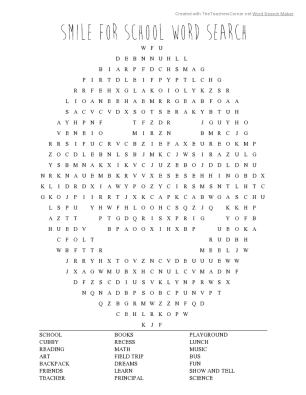
Find 20 words about school in this printable Smile for School! Word Search. Here’s the Solution!

Picture Book Review

August 16 – National Airborne Day

celebrate-picture-books-picture-book-review-brave-like-me-cover

About the Holiday

National Airborne Day was established in 1997 as a time to remember and thank the airborne members of the Armed Forces for their service and sacrifices. August 16 was chosen for this observance because it marks the first official United States Army parachute jump that took place in Georgia in 1940 by 48 volunteer members of the Parachute Test Platoon. The successful jump led the way for hundreds of thousands of paratroopers to follow in their footsteps. The day is commemorated by a ceremony at Fort Bragg in North Carolina, home to the 82nd Airborne Division. Other services are held around the country.

Brave Like Me

By Barbara Kerley


“When someone is serving their country, far from home, they have to be brave. Their families have to be brave. Even their kids have to be brave. Like me.” These lines from a child who has a parent serving their country opens this tribute to military families and the relatives, friends, and neighbors who support them. The child narrator reveals that parents about to be deployed spend a lot of time with their kids “until the day we have to say goodbye.” On that day the family shares kisses and hugs “big enough to last the whole time” parents are away.

Once parents are gone, the house seems empty and children wonder who will take care of them. They look at maps to discover where their parents are and what their day is like. The narrator describes children’s honest emotions, such as sadness and anger at the events parents miss or fear for their safety. But the kids understand that their parents are trained to stay safe.

The children are able to communicate with their parents on the phone and on the computer, where they share the details of their days. They also write letters and draw pictures that they send through the mail. Just as parents have responsibilities, the children know they have jobs to do too. They go to school, do their homework, and help around the house. The family bands together to cook meals, clean, read bedtime stories and tuck younger children into bed.

Friends and neighbors show they care by taking the kids on outings to the park, the movies, the pool, and to special events. Even though parents are far away from home, the child says, they think about their family all the time and want them to be happy playing with friends and pets and even when they are alone. The kids stay busy and enjoy their time with friends and family waiting for the day when they come home. On that day, the narrator says, “I’ll have lots of things to talk about and a million hugs and kisses to share.”

Through full-color photographic spreads and pages alternating between mothers and fathers serving in the military, Barbara Kerley presents an honest and uplifting account of what life is like for children of military families. The photographs of children playing with their parents and kissing and hugging them goodbye as well as pictures of both adults and kids doing their jobs while apart demonstrate the shared love and commitment military families have to their country and their relationships. Brave Like Me is a stirring nonfiction title for school and local libraries to help children understand the sacrifices some families make for their country. It would also be a comforting book for children facing a separation from a service member parent, other relative, or friend or for anyone who wants to better understand the life of service members.

A world map showing the location of each photograph in the book, a variety of children’s definitions of the meaning of “brave” and a discussion on the various branches of foreign service follow the text. There are also pages on how to deal with separation as well as advice and resources for caregivers.

Ages 4 – 8

National Geographic Children’s Books, 2016 | ISBN 978-1426323607

To learn more about Barbara Kerley and her wide range of books, visit her website!

National Airborne Day Activity

celebrate-picture-books-picture-book-review-military-plane-coloring-page

Military Plane Coloring Page


The Airforce uses many different types of planes in their missions. Here’s a printable Military Plane Coloring Page for you to enjoy!