May 27 – It’s National Family Month

celebrate-picture-books-picture-book-review-brothers-at-bat

About the Holiday

National Family Month was established by KidsPeace and is observed in the weeks between Mother’s Day and Father’s Day to encourage families to spend time together. Now that the school year is coming to a close, it’s the perfect time to plan some fun activities!

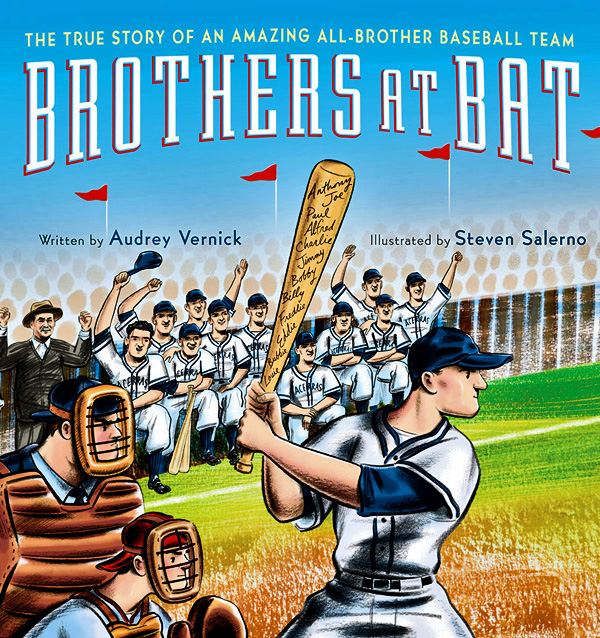
Brothers at Bat: The True Story of an Amazing All-Brother Baseball Team

Written by Audrey Vernick | Illustrated by Steven Salerno


When the weather warms and kids’ thoughts turn to sports, the afternoon air rings with the sounds of slamming doors as players race from home to the baseball diamond. Back in the 1920s and ‘30s, the same door slammed not once or twice, not three or four times, not even eight or nine! The door shut behind 12 brothers! Anthony, Joe, Paul, Alfred, Charlie, Jimmy, Bobby, Billy, Freddie, Eddie, Bubbie, and Louie Acerra. These 12 boys also had 4 sisters—but this is a story about baseball, and back then girls didn’t play ball.

It could be said that “baseball set the rhythm of their lives.” Neighbors couldn’t remember a time when Acerra boys weren’t throwing or hitting a ball or running the bases at the local park. And there was an Acerra on the high school baseball team for 22 years in a row!

In 1938 the nine oldest brothers formed a semi-pro team and competed against other New Jersey teams and teams from New York and Connecticut. Their dad was their coach. The brothers all had different skills—Anthony could hit homeruns, and even hit a couple into the Atlantic Ocean from a seaside park; Charlie was a slow runner; and Jimmy had a knuckleball that was unhittable and uncatchable.

But playing had its dangers too. In one game Alfred was going to bunt, but the ball bounced badly off the bat and hit him in the face. He was rushed to the hospital, but the accident caused him to lose an eye. Everyone thought he would never play again. But after he healed, his brothers helped him recover his skills and his courage.

During World War II six of the brothers joined the war effort and spent years apart. Far from home they dreamed of the days when they played together on warm afternoons. When the war ended all the Acerra boys came home to their very happy mother. The brothers got back to what they loved doing best. Now Anthony was their coach, and from 1946 to 1952 they won the Long Branch City Twilight Baseball League championship four times—much to the pleasure of the crowds that came out to watch the Acerras play.

As time went on the Acerras got jobs, married, and had families of their own. In 1952 the brothers played their last game as a team, having made history as the longest-playing, all-brother baseball team ever. Even though the Acerras played many, years ago, people have not forgotten them. In 1997 they were honored by the Baseball Hall of Fame. The surviving seven brothers made the trip along with one sister and more than a hundred relatives. Now Jimmy Acerra’s uniform and glove are on display alongside exhibits about Babe Ruth, Ty Cobb, and Willie Mays. If you visit the Baseball Hall of Fame, you can see them too!

Interesting and personal author’s and artist’s notes follow the text.

Baseball fans will love Audrey Vernick’s exciting, true story of this most unusual team. Her focus on the close relationship of the Acerra brothers elevates the tale from merely a sports story to one that reveals deep affection and support during difficult times. The different personalities of the brothers shine through in Vernick’s easy, conversational tone, and the inclusion of the Acerra brothers’ induction into the Baseball Hall of Fame shows that this story lives on for all generations.

Steven Salerno’s evocative illustrations will transport readers into a past where neighborhood leagues enjoyed the same level of loyalty as the majors. Capturing the brushed style, colors, and portraiture of pictures of the period, Salerno shows kids not only what it meant to be a baseball player in the 1930s and 40s, but what it meant to be a family.

Ages 4 – 9

Clarion Books, 2012 | ISBN 978-0547385570

National Family Month Activity
celebrate-picture-books-picture-book-review-we-are-all-family-word-search

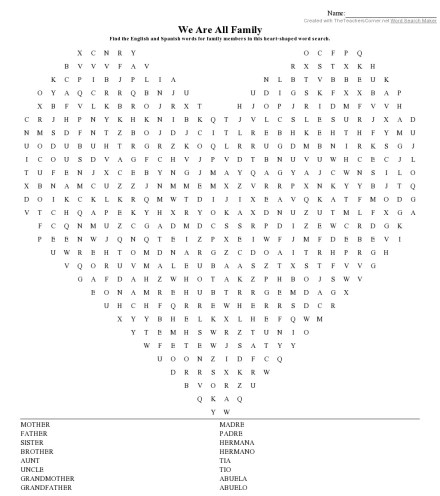
We Are All Family English – Spanish Word Search


This month is all about family! Find the words for special relatives in this English – Spanish dual language word search! Print the We Are All Family word search puzzle here! And here’s the Solution!

May 24 – Brother’s Day

celebrate-picture-books-picture-book-review-the-day-glo-brothers

About the Holiday

Brothers share a special bond built on mischief, inside jokes, shared experience, and love. If you have a brother—either by blood or friendship—spend some time with him, give him a call, or just text and say, “hi.”

The Day-Glo Brothers: The True Story of Bob and Joe Switzer’s Bright Ideas and Brand-New Colors

Written by Chris Barton | Illustrated by Tony Persiani


Before the Switzer brothers had their bright idea, the world was a much less colorful place. Bob Switzer, born in 1914, loved to work and saved his money for exciting plans. His younger brother Joe loved magic and had an inventive mind. When the family moved to Berkley, California, Joe developed a magic act that included “black art” in which an object that was painted half black and half white seemed to float and disappear in midair.

Joe loved this trick but thought it could be better. Meanwhile Bob planned to become a doctor. But during the summer before he began college, Bob had an accident that ended his plans. Because his injury effected his head, he had to recover in a darkened room. While Bob healed, Joe spent time in the basement with him studying the glow of fluorescence, hoping to use it in his magic show. Together the brothers built an ultraviolet lamp which they tested in their father’s pharmacy. When they shone it on a shelf full of bottles, a container of eyewash glowed yellow.

celebrate-picture-books-picture-book-review-the-day-glo-brothers-inventing

Image copyright Tony Persiani, text copyright Chris Barton. Courtesy of Charlesbridge

The brothers had an idea. They experimented with chemicals that could make paints glow in the dark. In regular light the paint looked normal, but under ultraviolet light it radiated attention-getting colors. That was great for Joe’s magic act, but Bob thought these paints could be used for other things too, such as store-window displays. Selling the paint could help pay for Bob’s medical bills too.

Bob and Joe searched through the university and other labs for other fluorescent materials. They then combined them with other ingredients in their mother’s mixing bowl to create glowing paints and even once—when the mixing bowl was not cleaned well enough—a very colorful cake!

celebrate-picture-books-picture-book-review-the-day-glo-brothers-inventing

Image copyright Tony Persiani, text copyright Chris Barton. Courtesy of Charlesbridge

Joe used these paints to major effect in one of his acts in which a dancing woman “lost her head” as Joe, unseen by the audience in the darkened theater, took off her headdress as she danced away. This trick brought Bob and Joe lots of customers for their original paints. But there was one problem: these colors only shone under ultraviolet light.

One day in 1935, however, one of Bob’s experiments resulted in a surprising innovation—a dye that glowed even in daylight. Bob didn’t know how exactly it had worked, so the brothers continued experimenting. Finally, they discovered the secret when an orange billboard they had created glowed as if it were on fire even in the daytime! The brothers then created reds, yellows, greens, and other colors that could do the same thing.

During World War II these glowing colors were used on fabric panels used to send signals from the ground to airplanes overhead, in lifeboats, on buoys, and on other safety products. After the war the colors continued to influence culture and are still part of our lives today.

celebrate-picture-books-picture-book-review-the-day-glo-brothers-final

Image copyright Tony Persiani, text copyright Chris Barton. Courtesy of Charlesbridge

Older kids with a penchant for science and history will love this biography. Chris Barton goes in-depth to reveal the Switzer brothers’ dreams and motivations that resulted in a most astounding discovery. Barton infuses the story with humor and interesting details that will fascinate curious minds.

Using a retro style, Tony Persiani sets this biography in its time while also giving the story a modern feel. Gray scale tones become dotted with florescent color as the brothers’ experiments bear fruit and give way to eye-popping spreads with the ultimate success of Day-Glo paints and dyes.

Ages 7 – 12

Charlesbridge, 2009 | ISBN 978-1570916731

Brother’s Day Activity

celebrate-picture-books-picture-book-review-day-glo-maze

Day-Glow Maze


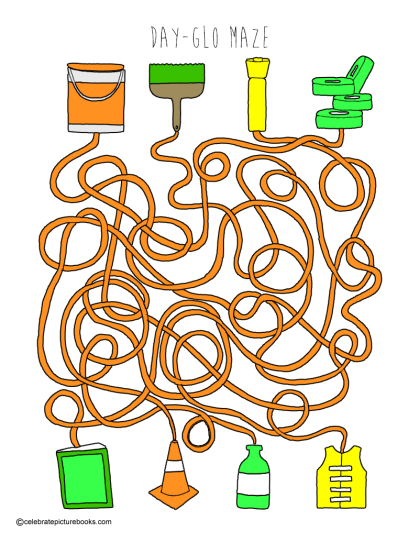
Follow the twisty glowing paths to match the Day-Glo product to the object they color! Print the Day-Glo Maze puzzle here!

Picture Book Review

May 16 -National Biographer’s Day

celebrate-picture-books-picture-book-review-the-noisy-paint-box

About the Holiday

On this day in 1763 James Boswell walked into a London bookshop and met Samuel Johnson—poet, critic, journalist, and writer of the first dictionary. They became friends, and 30 years later Boswell wrote a spirited biography of his companion that fully described Johnson’s feelings, quirks, opinions, and details of his life in a warm, conversational, unstinting way. The Life of Samuel Johnson changed forever the way biographies were written and is still popularly read today. Why not spend some time today with that fascinating biography or one on a favorite personality—or start writing the story of your own life!

The Noisy Paint Box: The Colors and Sounds of Kandinsky’s Abstract Art

Written by Barb Rosenstock | Illustrated by Mary Grandpré


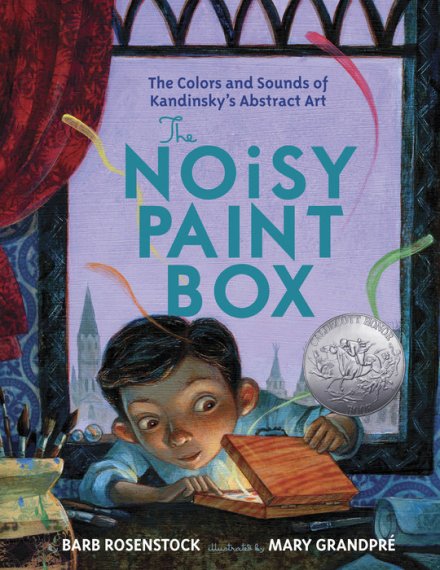
As a Russian child Vasya Kandinsky spends his days absorbed in learning math, science, and history. He takes piano lessons and attends formal dinners where the adults drone on and on. His life is polite, stiff, and colorless until the day his aunt gives him a small wooden paint box. “Every proper Russian boy should appreciate art,” Vasya’s aunt tells him while explaining how to mix colors.

Vasya takes up the brush and combines red with yellow then red with blue. As the colors change to orange and purple, Vasya hears a whisper that grows into a noisy hiss. “‘What is that sound?’” he asks, but no one else hears anything. “The swirling colors trilled like an orchestra tuning up for a magical symphony,” and “Vasya painted the sound of the colors.” A lemon yellow “clinked like the highest notes on the keyboard; a navy blue “vibrated deeply like the lowest cello strings.” Crimsons “blared” and greens “burbled.”

Vasya runs downstairs to show his family what he has created. His mother, father, and Auntie look at the canvas with its swoops, shapes, and angles. “What is it supposed to be?” they ask, and send him off to art school to learn how “to draw houses and flowers—just like everyone else.” Vasya finishes school and becomes a lawyer. He leaves his paint box untouched and lives the way he is expected, but the sounds of the colors are always with him.

One evening as he listens to an opera, the music surrounds him with color—“stomping lines of vermilion and coral; caroling triangles in pistachio and garnet; thundering arches of aqua and ebony…” Vasya can hear the colors and see the music. He knows then what he must do. He quits his job teaching law and moves to Germany to be a painter. He surrounds himself with artists and takes classes with famous teachers, and yet people still look at his canvases and asked, “What is it supposed to be?”

Once again he paints what is expected. His teachers love his houses and flowers, but Vasya does not. His friends understand. They too want to expand the meaning of art. They agree with Vasya when he says, “‘Art should make you feel.’” In his studio Vasya continues to paint the sounds he hears, to give music color and color sound. Bravely, he invites the public to view his paintings, which are named after musical terms—Composition, Accompaniment, Fugue, and more.

This is a new kind of art—abstract art—and it takes a long time before people understand. They look and still ask, “What is it supposed to be?” “It is my art,” Kandinsky replies “How does it make you feel?” 

An author’s note telling more about Kandinsky’s life and synesthesia, a genetic condition in which one sense triggers another, follows the story.

In the spirit of full disclosure, Kandinsky is one of my favorite artists, so I was excited to read this biography—I was not disappointed! With so many great artists, their work speaks for itself, but viewers wonder, “How did it come about?” “What influenced the artist?” Barb Rosenstock, with lyrical language and beautifully chosen descriptions, reveals the emotions and passion that fueled Kandinsky’s art from his earliest ages: as he walks through Moscow he can’t ignore “the canary-colored mailbox whistling as he rode to work. The scarlet sunset haze ringing above the ancient Kremlin walls.” Rosenstock’s inclusion of the conflicts and opposition Kandinsky faced and overcame will inspire children to listen to their inner voice and makes readers and lovers of his abstract art glad he never gave up.

Mary Grandpré’s unique style brilliantly depicts Kandinsky’s singular vision, allowing readers to experience the way he wielded his paint brush like a conductor’s baton. Vasya’s early life is painted in muted blues and grays, and the boredom on his face as he studies his schoolwork is obvious. Kids will appreciate his one-finger plinking at the piano and the rolled-eyed drowsiness of the formal dinner. Once Vasya is introduced to the paint box, however, Grandpré’s illustrations become vibrant, with swirling colors overlaid with the musical notes that Kandinsky associated with them. His uninhibited painting is gloriously shown as the young boy’s shirt comes untucked and the colors burst from the canvas upon his first painting.

As the adults look at his work, the room is again swathed in somber colors. The text revealing that Vasya attended regular art classes to learn to draw houses and flowers is set above a single wilting flower in a vase. The personal tug-of-war Kandinsky experienced even into adulthood is wonderfully rendered: Colors flow into his ears at the opera; he studies his own landscape and still life paintings with misgiving in a hazy studio, and the joy and freedom of his abstract art is demonstrated with wild abandon while a dove escapes its cage. The final image of a child sitting in front of a Kandinsky painting reinforces the idea that his art lives for all and for all time.

Ages 4 – 9

Alfred Knopf, Random House Children’s Books, 2014 | ISBN 978-0307978486

National Biographer’s Day Activity

celebrate-picture-books-picture-book-review-recipe-box-label

Recipe Box Label and Recipe Cards


People’s stories are written in all different ways: in the objects they surround themselves with, their activities, and the talents they exhibit. Today’s activity will help you tell your stories in the foods you bake! Or try this Recipe Card Writing Idea: Create a very short story and write it on one of the recipe cards! Read it to your family or teacher.

Supplies

celebrate-picture-books-picture-book-review-recipe-cards

Directions

  1. Glue the My Family’s Recipes label to the box you made
  2. Print out the recipe cards. Use them for your favorite dish and prepare for tomorrow’s treat to bake!

Picture Book Review

May 14 – International Astronomy Day

celebrate-picture-books-picture-book-review-star-stuff

About the Holiday

Instituted by Doug Berger in 1973, International Astronomy Day is held twice a year—in spring and fall—to raise awareness of the benefits and wonder of studying the stars. Museums, observatories, universities and astronomy clubs around the world provide public access to astronomical instruments and hold special programs about this interesting and ancient science. To celebrate, attend an International Astronomy Day event, take time tonight to gaze at the sky and pick out the constellations you recognize, or read about the stars and their importance to history and the future.

Star Stuff: Carl Sagan and the Mysteries of the Cosmos

By Stephanie Roth Sisson


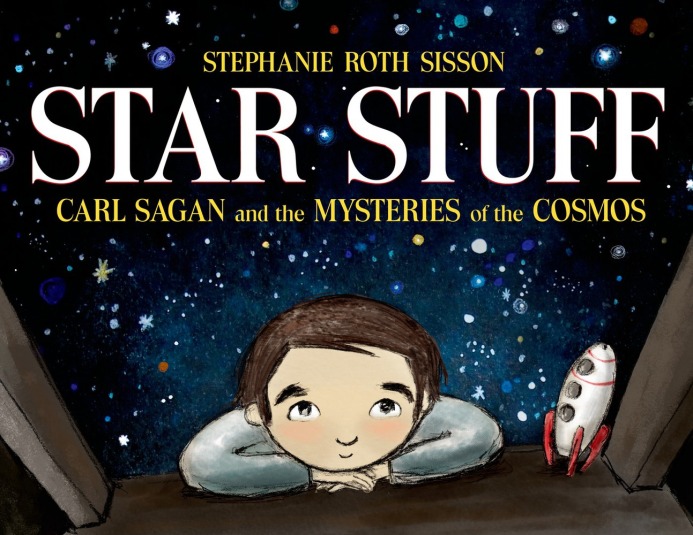
A boy named Carl Sagan may have lived in a small apartment in Brooklyn, New York, but he was part of so much more—a large city on the third planet from the sun in a “neighborhood of stars” which are part of the Milky Way galaxy. Growing up, Carl marveled at the connections. He had an innate curiosity and was astonished by everything he saw; his imagination was out of this world!

When he attended the 1939 World’s Fair as a young child, he experienced things he had never seen before; he saw a robot, new inventions, and a time capsule filled with messages for the future. At night he looked up at the stars and wondered; he thought they looked like lightbulbs on long black wires. He went to the library to read about the stars.At first the librarian thought he meant movie stars, but soon he got the book he wanted. Reading it made his heart beat fast.

Carl imagined what kinds of creatures and sights he might discover if he were able to travel through space. He tried standing with his arms outstretched and wishing he was on Mars like his favorite science fiction character, John Carter, but nothing happened. He decided he would have to make his “life in space” a reality himself so he went to college and became an astronomer, cosmologist, astrophysicist, astrobiologist, and so much more.

Dr. Carl Sagan then worked with other scientists to develop the exploratory crafts Mariner 2, Mariner 9, and Pioneer 10 that have gone into space to investigate Mars, Venus, and Jupiter. When they sent back pictures, Carl analyzed them and learned more about our solar system

Carl wanted everyone to know and understand Space. He created a television program that explained in easy terms what the stars, planets, and other celestial bodies are made of, how they came to be, and how we are connected to them. The Earth and every living thing are made of star stuff, Carl told his audience. The show – Cosmos: A Personal Voyage – was a hit, watched by millions of people.

Scientists have long wanted to know if life exists on other planets, and as time went on they had the technology to explore the possibilities. Carl worked with other engineers to create Voyager 1 and Voyager 2 to tour the outer solar system and beyond. Remembering that time capsule he saw so long ago at the World’s Fair, Carl had a marvelous idea! He recorded messages and sounds from Earth and made a Golden Record that was carried on each Voyager mission.

Carl Sagan, that boy made of star stuff who grew up to be so many things—astrophysicist, explorer, educator, philosopher, writer, and more—changed the world through the power of his imagination.

Stephanie Roth Sisson’s biography of Carl Sagan wonderfully honors the dreamer and scientist whose imagination went into Space and brought it down to Earth for others to understand and enjoy. The story begins in Sagan’s neighborhood and home, where illustrations depict the curiosity that fueled his passion. Just as the mysteries of Space quickly captured his attention, the pages fill with the night sky and its twinkling lights and celestial bodies. A most ingenious page takes advantage of a two-page vertical spread that transforms Carl’s bedroom window into a space capsule that blasts him into the cosmos as he ponders the stuff of stars.

His work as an adult collaborating with scientists and engineers to develop deep space exploration craft is clearly drawn with pages containing multiple panels of his job and accomplishments up close and from the distance of outer space. A particularly arresting three-page fold-out spread reveals the moment Carl discovered his love of the stars and Earth’s sun (holding a flashlight behind the depiction of the fiery sun would be a show-stopper, especially during a night-time read).

Kids familiar with today’s space travel and the awe-inspiring images sent back to Earth will love this book. To quote Carl Sagan, Star Stuff will definitely elicit a “Wowie!” from readers.

Ages 4 – 8

Roaring Brook Press, 2014 | ISBN 978-1596439603

International Astronomy Day Activity

celebrate-picture-books-picture-book-glow-stars

Make a Room Observatory


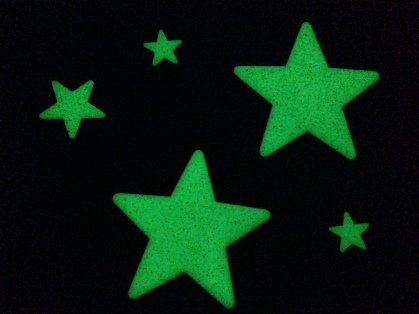
If you like gazing at the stars before going to sleep, why not bring them inside? With adhesive glow-in-the-dark stars, available at craft and toy stores, you can create a night sky full of celestial bodies that stay lit long after you’ve said goodnight. You can add planets, rocket ships—even your favorite constellation! This can be a nice alternative to a night light or transition children from a full night light to a gentle, comforting glow in their room.

Picture Book Review

February 15 – Susan B. Anthony Day

celebrate=picture-books-picture-book-review-heart-on-fire-cover

About the Holiday

On February 15, 1820 in Adams, Massachusetts a girl was born who would grow up to set the world afire with her belief in women’s rights. Her name was Susan Brownell Anthony. An early feminist, her father believed it was as important for his five daughters to receive an education as for his two sons. After graduating from school, Susan Anthony became a teacher—at the age of 14—making $2.50 a week compared to the $10.00-per-week salary of the male teachers. Anthony later became active in the abolition and temperance movements. She recognized that the inability to vote limited women’s influence in these causes and began promoting women’s rights. She worked tirelessly to change the voting laws until her death on March 13, 1906 without seeing her greatest wish fulfilled. It was not until 1920, with the ratification of the 19th Amendment, that women were allowed to vote.

Susan B. Anthony has been honored for her dedication with commemorative stamps, and her portrait appears on the dollar coin. We also remember her work on behalf of all women on her birthday with memorial services at her gravesite in Rochester, NY and in Washington DC. Susan B. Anthony Day is a legal holiday in Florida, West Virginia, Wisconsin, New York and California.

Heart on Fire: Susan B. Anthony Votes for President

Written by Ann Malaspina | Illustrated by Steve James


It’s November 1, 1872 and only four days until the presidential election. Everywhere people are being urged to register to vote. Knowing how important voting is, Susan B. Anthony races to the registration office with her sister and a friend in tow. The men in the office stare at her in confusion.

They know that women can’t vote—only men! What is Susan B. Anthony trying to do? But Anthony argues that the new 14thAmendment, which says “all persons born in the United States have the same rights as citizens,” gives women the right to vote. Some inspectors think she is right, some disagree. Finally they allow Anthony to sign the registration card.

celebrate=picture-books-picture-book-review-heart-on-fire-susan-goes-to-vote

Image copyright Steve James, courtesy of Albert Whitman & Company

On November 5, Voting Day, Anthony and 15 other women cast their ballots. Thirteen days later, however, a deputy federal marshal shows up at Anthony’s door with a warrant for her arrest. The charges? Voting illegally! The other women and the men who had allowed them to register and vote are also arrested.

In January word comes that unless Anthony pays a $1,000 fine, she will have to spend the time until her trial in prison. Anthony is adamant about not paying, but her lawyer sends the money. People in the country are split over whether she is right or not, but Anthony knows she’s right. Without being able to vote, women will have no voice in government.

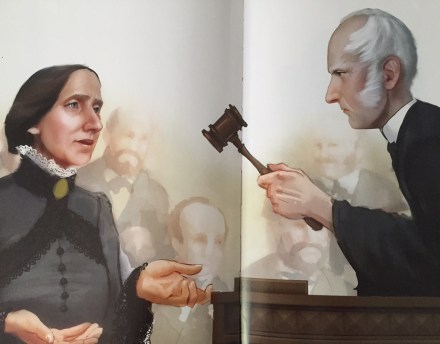
She gives speeches, trying to rally people to her cause, and when her trial begins on June 17, 1873 the courtroom is packed. After Anthony’s lawyer and the prosecutor speak, the judge decides that Anthony has broken the law. He proclaims her guilty. When the judge asks if she has anything to say, Anthony answers, “You have trampled under foot every vital principle of our government. My natural rights, civil rights, political rights….” The judge stops her and does not allow her to continue speaking. He fines her $100, plus court costs. Susan B. Anthony refuses to pay, and she never did.

celebrate=picture-books-picture-book-review-heart-on-fire-susan-pleads-case

Image copyright Steve James, courtesy of Albert Whitman & Company

Through action, dialogue, and the metaphorical theme of fire, Ann Malaspina has written an exciting biography of Susan B. Anthony. Readers will understand and, more importantly, feel the opinions and determination that fueled Anthony’s crusade for women’s rights. The final pages follow the history of the women’s suffrage movement until the ratification of the 19th Amendment in 1920 and provide photographs from the time. The text of the 14th and 19th Amendments is also included.

Opening the pages of Heart on Fire is like walking into a city of the 1800s. The lush colors and intricate details of Steve James’ illustrations immediately immerse readers in the time and place of Susan B. Anthony’s world, depicting the reality of her struggles. This is a perfect book to share with children, especially in this election year when they can see how far women have come—from being denied the vote to running for president.

Ages 5 – 9

Albert Whitman & Company, Chicago, 2012 | ISBN 978-0807531884

Learn more about Ann Malaspina and her books on her website!

View a gallery of illustration by Steve James on his website!

Susan B. Anthony Day Activity

CPB - Vote For Me round (2)

Vote For Me! Campaign Poster and Frame


If you were running for President, what would be important to you? Here’s a Vote For Me! Poster and Picture Frame to get your campaign started!

Supplies

Directions

  1. Print Vote For Me! Poster and Picture Frame templates
  2. Take a selfie or use your school picture
  3. Cut out the Picture Frame and the circle or rectangle in the middle
  4. Tape or glue your picture in the circle or rectangle
  5. If you are using a clear magnetic frame, slip the template inside and hang on your refrigerator or any metal object.
  6. If you are using a magnetic sheet, peel the paper off the adhesive side. Stick the Vote For Me! Picture Frame template with your picture attached to the adhesive. Cut around the edges. Hang!
  7. On the Vote For Me! Poster, list the things you would do if you were President. Talk to your family and see if you might be able to do some of them now! Hang your poster in your room or in the house where others can see it.