June 25 – National Catfish Day

celebrate-picture-books-picture-book-review-a-catfish-tale

About the Holiday

National Catfish Day dates back to 1987 when President Ronald Reagan proclaimed this holiday to promote the importance of the catfish farming industry and the nutritional benefits of catfish. This delicious fish is found mostly in Mississippi, Arkansas, Alabama, and Louisiana and is one of the most sustainable species of fish. Fried or blackened with spicy Cajun or other spices, catfish makes for a scrumptious meal! Try some today!

A Catfish Tale: A Bayou Story of the Fisherman and His Wife

Written by Whitney Stewart | Illustrated by Gerald Guerlais


Down in the bayou, so the story goes, there lived two young sweethearts named Jacques and Jolie. Jacques liked to “pole his skiff through cypress knees to his favorite fishing hole,” and Jolie cooked up peppery hot gumbo and sang “so true even the cicadas hushed up to listen.” One day Jacques hooked a big one, and when he pulled up his line a catfish sprang from the water. But this was no ordinary catfish. The wily fellow explained that he was a magic catfish and not at all a catch for supper. Jacques was so frightened that he freed the “jabbering critter” and took off for home.
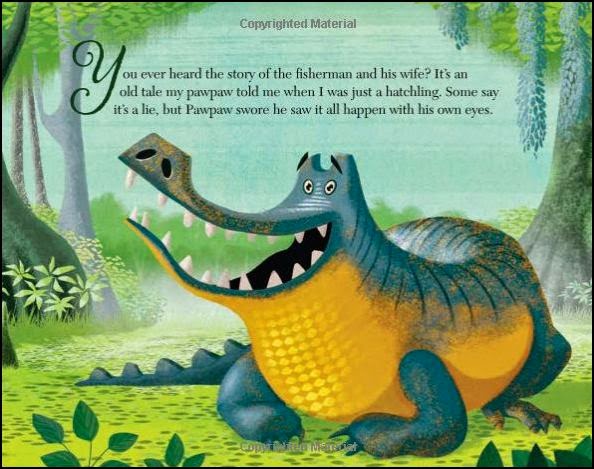
celebrate-picture-books-picture-book-review-a-catfish-tale-crocodile

Image copyright Gerald Guerlais, courtesy of Albert Whitman & Company

When Jolie learned Jacques had given up their chance for a wish that could replace their shack with “a proper house where she could sing for a crowd,” she was steamed. Jacques thought everything was all right the way things were, but he hightailed it back to the swamp and asked that catfish for a house. The catfish was obliging and with a grin said, “‘Ah, tooloulou—if that ain’t the easiest thing to do.’”

In her big, beautiful house, Jolie entertained loads of friends and decided to take her show to all the cities down the river. All she needed, she said, was a paddle wheel boat. The catfish smiled when he heard Jacques’ request and said, “‘Ah, tooloulou—if that ain’t the easiest thing to do.’” Singing from the bow of her grand paddle wheeler, Jolie’s fans called her the Queen of the Mississippi, and she ate it up.

celebrate-picture-books-picture-book-review-a-catfish-tale-catfish

Image copyright Gerald Guerlais, courtesy of Albert Whitman & Company

Jacques was miserable stuck in his stateroom with a pounding headache and no fishing pole, so he returned to the bayou to find his catfish friend. Meanwhile, Jolie took the New Orleans nightclubs by storm. With Mardi Gras approaching, Jolie had one more little favor to ask of the catfish, and with a “tooloulou” Jolie became Queen of Mardi Gras. She wore a diamond crown and a white satin gown. Even though things were a little rocky—the cheering crowds couldn’t hear her sing, and the Mardi Gras beads she tossed to her fans got tangled in her crown—she loved being queen.

Jolie wrote to Jacques and asked to become Queen of the Bayou. The catfish said his magic words and in no time Jolie was crowned Queen amid blaring musicians and applauding fans. Jolie smiled and began to sing. Suddenly, a fierce hurricane blew up, “snakes, alligators, and swamp creatures slithered up the riverbank. Ghosts, and goblins flew from the cemeteries and pirate skeletons escaped watery graves to dance in the streets.” And Jolie? She was swept up and unceremoniously dropped in a tree. From among the branches she called to a passing pelican, “‘Tell my husband to ask that catfish for one more little thing!’”
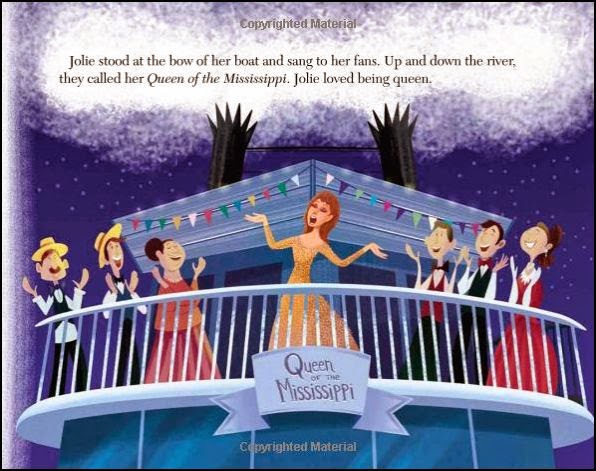
celebrate-picture-books-picture-book-review-a-catfish-tale-riverboat

Image copyright Gerald Guerlais, courtesy of Albert Whitman & Company

Jacques “paddled faster than an alligator could swish its tale” and asked that catfish for one last wish…, and what do you think he said? Well, he just slipped back beneath the water ‘cause he knew “Jolie didn’t need nothin’ more.”

A Catfish Tale includes a Bayou Glossary as well as a recipe for Seafood Gumbo by New Orleans native Hans Andersson.

Whitney Stewart’s tall tale of a magic catfish, the woman who learns enough is often enough, and the man who loves her will capture kids’ fancy. Jolie’s overreaching ambition and the catfish’s ready spell give children plenty of opportunity to join in with repeated phrases, and the well-paced suspense will keep kids engrossed in the action. The unique bayou setting and colloquial lilt sets A Catfish Tale apart as a rollicking story time romp with a bit of Cajun caution and a whole lot of magic.

Gerald Guerlais brings the mystery and flavor of the deep south to A Catfish Tale with moss greens and shadowy blues that well depict the bayou’s natural environment. Twisty Cypress trees dip their roots in still, lily pad-filled waters, shimmering lights glow in the nighttime swamp, and spooky critters teem in the stormy sky. The magic catfish wears an ever-present, easy-going grin, and a crusty, good-ol’-boy alligator spins the tall tale just the way he’s heard it. Children will love the scenes of the paddle wheeler and the festive atmosphere of Mardi Gras.

Whitney Stewart’s  A Catfish Tale, a deft retelling of  Grimm’s A Fisherman and His Wife, is a fantastic introduction to the distinctive qualities of the southern Mississippi region, one which kids may want to explore further!

Ages 4 – 8

Albert Whitman & Company, 2014 | ISBN 978-0807510988

To learn more about Whitney Stewart and her work as well as discover activities for children and teachers, visit her website!

View a gallery of illustrations by Gerald Guerlais on his website!

National Catfish Day Activity

celebrate-picture-books-picture-book-review-bayou-coloring-page

Catfish Coloring Page


The catfish is a most unusual creature! Add your own swamp or river setting to this Printable Catfish Coloring Page!


March 16 – Freedom of Information Day

Gordon Parks: How the Photographer Captured Black and White America Picture Book Review

About the Holiday

Freedom of Information Day is observed today to honor James Madison, who was born March 16, 1751 in Port Conway, Virginia. Madison is widely regarded as the Father of the Constitution and was the 4th President of the United States. He was a leading proponent of openness in government. The Freedom of Information Act, which took effect on July 4 1967, was enacted to promote transparency in government, but the idea of openness and inclusion can pertain to all aspects of society and relationships.

Today we remember all those who work to provide free and honest information and portrayals of government as well as other conditions and situations around the world.

Gordon Parks: How the Photographer Captured Black and White America

Written by Carole Boston Weatherford | Illustrated by Jamey Christoph


When the 15th child of the Parks family is born, he has neither a heartbeat nor a name. But the doctor is able to revive the nearly dead infant in an ice bath, and the appreciative mother gives her child his name—Gordon. Gordon Parks’ dramatic entry into the world may have given him the unique perspective he used in becoming a renowned photographer and the first black movie director in Hollywood.

celebrate-picture-books-picture-book-review-gordon-parks-how-the-photographer-captured-black-and-white-america-gordon-works

Image copyright Jamey Christoph, 2015, text copyright Carole Boston Weatherford, 2015. Courtesy of Albert Whitman & Company.

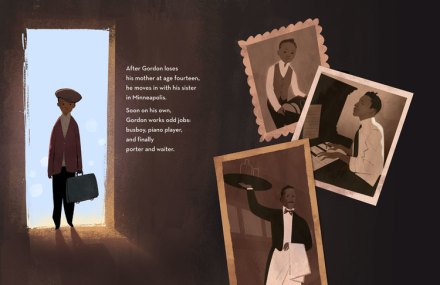
Gordon rides a horse across the wide open fields of Kansas to school, but once there his prospects narrow with a white teacher who tells her all-black class that their education will go to waste as they are destined to work as waiters and porters. When he is 14 Gordon’s mother dies, and Gordon moves to Minneapolis. He soon must make his own way, and he finds jobs as a busboy, a piano player, and the predicted waiter and porter.

At the age of 25 Gordon reads about the plight of migrant workers and, inspired, buys a camera. Gordon has discovered his natural talent—a unique eye on the world. After only a month he exhibits his photographs in a camera store and is soon engaged in fashion and portrait photography. His work takes him to Chicago, where he documents the struggling families living on the South Side and wins a job with the government in Washington DC. Encouraged by his boss to find a subject for his work, Gordon focuses his lens on the black families living in the back alleys and in the shadows of the Capitol’s great monuments.

celebrate-picture-books-picture-book-review-gordon-parks-how-the-photographer-captured-black-and-white-america-gordon-sees-a-camera

Image copyright Jamey Christoph, 2015, text copyright Carole Boston Weatherford 2015. Courtesy of Albert Whitman & Company.

Through his photographs Gordon vows to expose the racism blacks face in housing, shops, restaurants, and other institutions. Looking for a personal subject, Gordon talks to Ella Watson, a cleaning lady in his office building. Ella supports five children on only $1,000 a year and knows hardship. Gordon accompanies her and her grandchildren, taking pictures wherever they go and of whatever they are doing. They become the inspiration for his greatest work.

Over his lifetime Gordon Parks will break barriers in the publishing and entertainment industries, becoming the first black photographer for Vogue and Life magazines and the first black director in Hollywood. He writes novels and poetry and composes music. But the work that becomes his most famous is a photograph of Ella Watson standing in front of the American flag, with her broom in hand. Called “American Gothic,” this picture fulfills Park’s determination to expose segregation and the hopes of all people struggling under its inequality.

celebrate-picture-books-picture-book-review-gordon-parks-how-the-photographer-captured-black-and-white-america-gordon-in-washington

Image copyright Jamey Christoph, 2015, text copyright Carole Boston Weatherford, 2015. Courtesy of Albert Whitman & Company.

Carole Boston Weatherford’s portrayal of Gordon Parks’ life is as starkly revealing as her subject’s photographs. With her writer’s skills, however, she deftly contrasts the facts of his life and turns his story into a universal metaphor for freedom and the struggle to attain it: “When young Gordon crosses the prairie on horseback, nothing seems beyond reach. But his white teacher tells her all-black class, you’ll all wind up porters and waiters. What did she know?” Weatherford’s pacing also adds to the story’s power. Although Parks attained wide acclaim, this biography ends with one of his earlier photographs—a picture of Ella Watson, a cleaning lady, who inspired Parks and came to symbolize the hopes of her generation and beyond. This is not only Parks’ story, but the story of millions of others.

Jamey Christoph continues and strengthens the metaphorical force of this biography in his illustrations. Readers first see Gordon Parks as a much-loved, smiling infant. He goes to school and grows up, his expression changing, slightly but importantly. He acquires his camera, and the pages are filled with drawn representations of his black-and-white photographs. Alternating dark and light pages further emphasize Parks’ world. The darkroom contrasts with Parks’ new bright office and prospects; the shadowed back alleys of Washington DC contrast with the city’s gleaming white marble monuments. Later photographs are also depicted, and “American Gothic” is represented on two pages. Christoph provides readers with much to see and ponder.

Ages 5 – 8

Albert Whitman & Company, 2015 | ISBN 978-0807530177

Ages 5 – 8

Albert Whitman & Company, 2015 | ISBN 978-0807530177

Freedom of Information Day Activity

CPB - New Professionals Picture

News Professionals Clothespin Figures

Make one of these clothespin figures that honors the men and women who work to keep the world informed.

Supplies

Directions

  1. Draw a face and hair on the clothespin
  2. Cut out the clothes you want your journalist or photographer to wear
  3. Wrap the clothes around the clothespin. The slit in the clothespin should be on the side.
  4. Tape the clothes together
  5. Cut out the camera
  6. Tape one end of a short length of thread to the right top corner of the camera and the other end of the thread to the left corner. Now you can hang the camera around the figure’s neck.

Idea for displaying the figures

  • Attach a wire or string to the wall and pin the figure to it
  • Pin it to your bulletin board or on the rim of a desk organizer


February 25 – National Chili Day

Armadilly Chili picture book review

About the Holiday

What could be more satisfying on a mid-winter day than a spicy bowl of chili?  Whether made with meat or veggies, combined with macaroni, or served in potato skins, the simmered flavors make for a scrumptious meal. Although the origins of chili are lost to history, it’s believed that the dish is a southwestern, specifically Texan, concoction. It began to attract attention in the early 1800s, and by the 1880s”Chili Queens” were selling “bowls o’red” at chili stands throughout San Antonio. In 1893 the San Antonio Chili Stand made an appearance at the Chicago World’s Fair. It’s popularity took off across Texas and throughout the west by the 1920s. When the Great Depression hit, chili became one of the only affordable meals for the hungry population.

Armadilly Chili

Written by Helen Ketteman | Illustrated by Will Terry


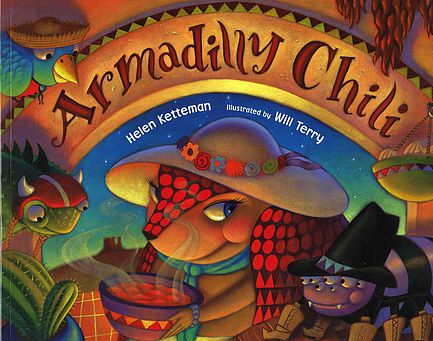
What a hoot! The knee-slappin’, root-a-tootin’ phrasing in Hellen Ketteman’s Armadilly Chili is shor ‘nuf gonna make this a favorite on any child’s bookshelf. While the plot may be familiar, the southwest setting and Miss Billie Armadilly put a fresh, funny twist on it.

celebrate-picture-books-picture-book-review-armadilly-chili-gathering-ingredients

Image copyright Will Terry, courtesy of willterry.com

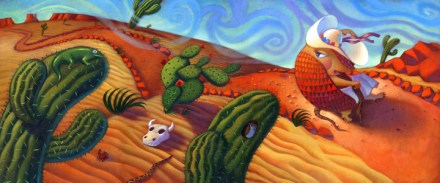
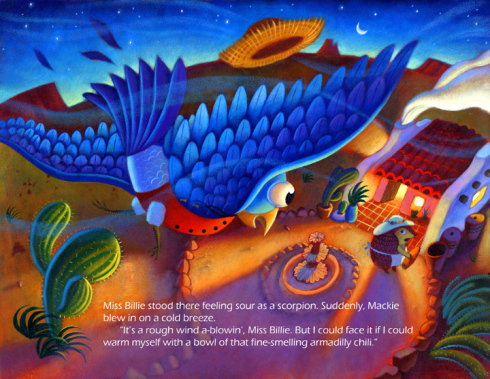
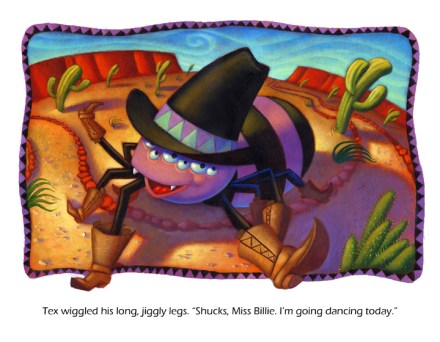
Miss Billie Armadilly is gathering ingredients for her hot armadilly chili as a blue norther blows in. She’s gathering beetles when her friend Tex, a many eyed tarantula tip taps by. When Billie asks him to help her collect beetles, he tells her he can’t because he’s going dancing. Miss Billie harrumphs and does it herself. Next Miss Billie is picking peppers, and when Mackie the bluebird flies in she thinks she has some help. Once again, though, she’s left on her own since Mackie is going to the movies. Her friend Taffy, the horned toad, begs off from chopping prickly pear, saying he’s got plans to go skating.

celebrate-picture-books-picture-book-review-armadilly-chili-Mackie-flies

Image copyright Will Terry, text copyright Helen Ketteman, courtesy of willterry.com

At home, Miss Billie stirs her chili to a scrumptious bubble. The aroma entices first Tex, then Mackie, and finally Taffy to come a’knockin’ at her door looking for a bowlful. Billie has something to say about that—specifically, “no workin’ with Billie, no sharin’ the chili!”

Billie’s friends hurry away, and Billie sits down to her feast. But after all that work, the chili tastes as “flat as a Texas prairie.” What’s wrong? She realizes what the missing ingredient is just as the doorbell rings. She opens the door to find her friends standing there with bags in their hands. What’s in those sacks? Apologies! And hot apple cider, jalapeno biscuits, and homemade chocolate fudge. Now that the friends are all together, the chili tastes just right, and they laugh and talk and eat throughout the blustery night.

celebrate-picture-books-picture-book-review-armadilly-chili-tex

Image copyright Will Terry, text copyright Helen Ketteman, courtesy of willterry.com

Helen Ketteman’s fast-paced Armadilly Chili is a welcome take on what it means to be a good friend. Her Western setting, lively language, and fast pacing will keep kids laughing and rooting for Billie and her pals. Will Terry’s bright illustrations washed with a palette of deep reds, oranges, greens, and yellows firmly sets the story in the Southwest. Billie’s facial expressions as each of her friends abandon her to her chores are priceless, and their final camaraderie is highly satisfying.

Ages 4 – 8

Albert Whitman & Company, 2008 | ISBN 978-0807504581

Discover more about Helen Ketteman and her books on her website!

View a gallery of illustration work, drawings, and picture books by Will Terry on his website!

National Chili Day Activity

CPB - Chili Pepper Game

Hot, Hot, Hot! Chili Pepper Chili Game


Chili just isn’t chili without a little heat! But can you take 15 chili peppers in your bowl? If you want to win the Hot, Hot, Hot! Chili Pepper Chili Game you’ll have to!

Object of the Game

The object of the game is to collect 15 chili peppers in your bowl before any other player.

Supplies

Rules

  1. Any number of players can play at one time. Print 1 Chili Bowl game board and 1 set of 15 Chili Pepper cards for each player
  2. Give 1 Chili Bowl Game Board to each player
  3. Place the Chili Pepper Cards in a pile or in a bowl
  4. Roll the die to see who goes first. The person with the highest roll goes first
  5. To begin play, the first player must roll a 1, 2, or 3. They should roll until they get one of these numbers.
  6. Players roll the die and collect or lose chili pepper cards by the number of dots on the die. If you roll a:
  • 1 – Pick up 1 chili pepper card and place it on your chili bowl game board
  • 2 – Pick up 2 chili pepper cards and place them on your chili bowl game board
  • 3 – Pick up 3 chili pepper cards and place them on your chili bowl game board
  • 4 – Get a chili pepper card from the player on your left
  • 5 – Give a chili pepper card to the player on your left
  • 6 – Lose a turn

     7. If a player does not have chili pepper cards to give to another player or if the player on           their left has no cards to give, the player rolls again.

    8. Continue play until one player has filled their Chili Bowl with chili peppers!