April 27 – Tell a Story Day

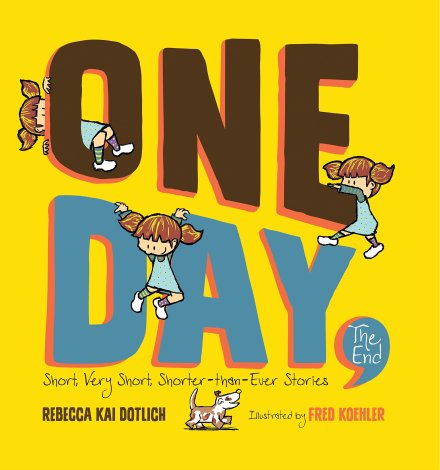
celebrate-picture-books-picture-book-review-one-day-the-end-cover

About the Holiday

Are you a raconteur? Do you love to weave a tale so intricate and intriguing that your listeners are on the edge of their seats? Or are you the one leaning forward, all ears, feeling the tingling thrill of that story? Either way—this day is for you! So take some time to tell or listen to a story—or even write your own!

One Day, The End: Short, Very Short, Shorter-than-Ever Stories

Written by Rebecca Kai Dotlich | Illustrated by Fred Koehler


Hey! I have a fantastic story to tell you! Ya gotta minute? Ok! See… “One day I went to school. I came home. The End” What do you mean, “Is that it?” Don’t you get it?  So many things happened—funny, messy, worrisome, happy. It was an amazing day! I didn’t say that? But it’s all right there! Where? In the middle. In the pictures!

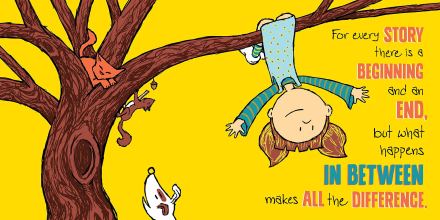
celebrate-picture-books-picture-book-review-one-day-the-end-tree

Image copyright Fred Koehler, 2015, text copyright Rebecca Kai Dotlich, 2015. Courtesy of Boyds Mills Press.

On other days the little girl who went to school in the story above becomes a detective to find her lost dog, invents ingenious ways to hide from her brother, and creates something awesome for her mom. She also runs away from home, but of course comes back, and shadows her cat to a surprising discovery. On yet another day she just feels like stomping. And on still another she  relents to a much-needed bath…and shares it with her dog!

And what does she want to do after all these adventures? She wants to write a book…and does!

celebrate-picture-books-picture-book-review-one-day-the-end-school

Image copyright Fred Koehler, 2015, text copyright Rebecca Kai Dotlich, 2015. Courtesy of Boyds Mills Press.

Rebecca Kai Dotlich’s One Day…The End is such an ingenious concept that readers will keep turning the pages just to see what clever idea comes next. Each story consists of a first sentence that introduces a plot and the last line that wraps it up. Sure Dotlich could have fleshed out the characters, detailed the setting, added dialogue, and symbolized a theme, but sometimes pictures are worth a thousand words, and this is where Fred Koehler comes in.

Koehler takes these kid-centric tales and fills in the exploding science experiments, ice-cream trucks, accidental oopsies, distractions, clues, and more that make up each day’s adventure. With humor and an eye for real-kid emotions and actions (the little girl pours glue from the bottle held above her head), Koehler creates a unique plot for each story.

celebrate-picture-books-picture-book-review-one-day-the-end-write

Image copyright Fred Koehler, 2015, text copyright Rebecca Kai Dotlich, 2015. Courtesy of Boyds Mills Press.

In “One day I felt like stomping” the little girl doesn’t stomp for no reason: her cat eats her pizza lunch, she splatters herself with purple paint, and her fishing pole breaks. She just feels like…! The word STOMP grows bigger across the page and even gets stomped on itself as the girl vents her frustration in a puddle, on a pile of leaves, and—almost—on a flower. But seeing the daisy saves her day and she saves the daisy. Haven’t we all been there?

One Day…The End is a joy to share with kids. They’ll love to spend time pointing out the humorous details and depth of story each page holds, and may even like to “tell” the story as they read. This book would be a fantastic jumping off point for kids wanting to write their own stories or for teachers wanting to demonstrate the elements of active, detailed story writing. As Dotlich says on the first page: “For every story there is a beginning and an end, but what happens in between makes all the difference.”

Ages 4 – 8

Boyds Mills Press, 2015 | ISBN 978-1620914519

Discover more about Rebecca Kai Dotlich and her books on her website.

To learn more about Fred Koehler, his books, and his art, visit his website.

Tell a Story Day Activity

celebrate-picture-books-picture-book-review-tell-a-story-maze

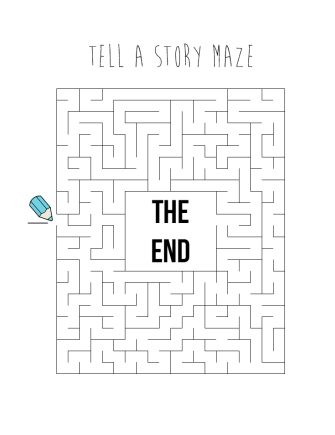
Tell a Story Maze


This puzzle may look like a regular maze, but there’s a secret to it! Within this maze is any story you’d like to make up. Why do you go left instead of right? Are you avoiding a zombie or a rain shower? Why do you go up instead of down? Is it because you can you float? What lurks in that dead end you’ve entered? There are as many cool stories as you can imagine right in those little pathways. And when you find your way to The End, you’ll have written a story with this printable puzzle!

Tell a Story Maze | Tell a Story Maze Solution 

picture book review

April 24 – It’s National Garden Month

picture-book-review-up-in-the-garden-and-down-in-the-dirt

About the Holiday

April is the month when the earth comes alive again after a long winter! Flowers bloom in brilliant colors, trees bud and blossom with pale, green leaves, and the birds and animals prepare for new life to come. Today enjoy the warmer weather, plan a garden or flower bed, or visit a nursery or park and take in the sights and smells of spring!

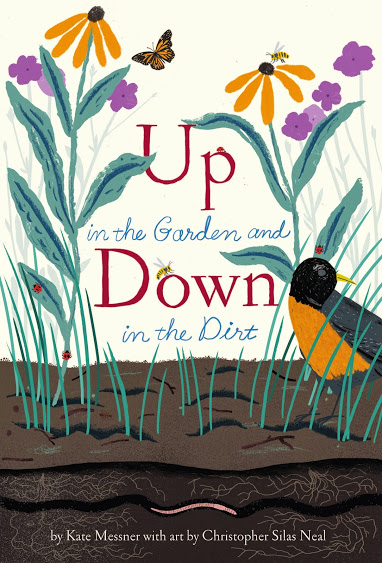
Up in the Garden and Down in the Dirt

Written by Kate Messner | Illustrated by Christopher Silas Neal


Snow still blankets the ground as a little girl and her Nana survey their garden plot. The girl’s head is full of dreams of the bounty to come. As the days warm and the wind whistles, the girl and her Nana dig in the mud. “’It’s not quite time,’” says Nana. “’Down in the dirt, things need to dry out and warm up.’” Her granddaughter is curious about what’s below.

Down in the dirt, Nana tells her, a whole world of insects are already working. Up above, the two gardeners are working too—gathering scattered twigs, removing weeds, and spreading compost.

Down in the dirt, pill bugs chew dead leaves, rolling into tight balls when poked. Up in the garden planting is taking place, the seeds carefully snuggled into beds and watered. As peas and other early plants sprout, bees pollinate and wasps hover.

Down in the dirt earthworms tunnel, enjoying the cool soil. Up in the garden the girl and her Nana rest in the shade then play in a sprinkled shower. Down in the dirt the water soaks deep, feeding the squash plants’ roots.

The summer is progressing and up in the garden tomatoes and beans are ripe for eating. Down in the dirt a robin finds a meal too. Up in the garden there’s so much to harvest. Nana and her granddaughter work until dark, sharing the garden with bats and June bugs. With nightfall a skunk finds grubs and cutworms down in the dirt.

The air is turning cooler up in the garden. Pumpkins turn orange under towering sunflowers while down in the dirt a spider weaves her sticky web. As Autumn wanes it’s time for the final garden harvest. Down in the dirt the insects know it too; they scurry to gather food.

Up in the garden and down in the dirt everything is prepared for winter. As snow once again blankets the garden plot, the girl and her Nana, the earthworms and pill bugs, the bees, and the skunk are all waiting for spring to come again.

Kate Messner’s lyrical paean to gardening is a wonderful way to introduce children to the changing seasons and how nature works together. Comparing and contrasting what gardeners do up above as they plant, tend, and harvest their crops to the work insects and animals perform down below emphasizes the interconnectedness contained in even a small plot of land. Messner’s language is beautifully evocative—the snow is sleepy, brittle stalks snap and are rustly when gathered, chickens squabble and scratch, newly planted seeds snuggle in the dark, pumpkins blush orange, and sunflowers bow to September.

Christopher Silas Neal illustrates the changing garden with striking up-close, ground view images of the plants and creatures that call the garden home. Vibrant green grasshoppers, brilliant yellow sunflowers, deliciously red tomatoes, soft pink worms, scruffy backyard animals, and more join a sprightly Nana and her curious granddaughter in soil so dark and fertile that any gardener would be envious.

The final pages include more information on the creatures found in the book, a list for further reading, and an author’s note. Up in the Garden and Down in the Dirt would be a welcome and special addition to any budding gardener’s or outdoor lover’s library.

Ages 5 – 9

Chronicle Books, 2015 | ISBN 978-1452119366

National Garden Month Activity

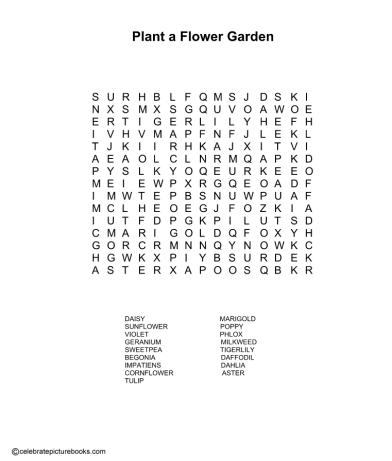
celebrate-picture-books-picture-book-reviews-garden-word-search


Plant a Flower Garden! Word Search


Whether you like to plant your flower bed in horizontal or vertical rows or just scatter the seeds for a wild burst of color, you’ll love this word search planted with favorite spring and summer blooms. Print your Plant a Flower Garden! word search and the Solution here!

April 23 – Talk Like Shakespeare Day

picture-book-review-will's-words

About the Holiday

To read or not to read—is that even a question?! Of course “to read!” And who produced literature containing some of the most excitement ever? William Shakespeare! Not only did Shakespeare write astounding plays and poems, he coined words and phrases that are still part of our everyday speech 400 years after his death in 1616. In recognition, the Chicago Shakespeare Theater initiated Talk Like Shakespeare Day in 2009. To honor Shakespeare’s legacy today, read or reread one of his famous plays, attend a performance, or watch a film adaptation of his work, and for goodness sake – use some of the terms he so cleverly invented.

*Italicized words were invented by William Shakespeare

Will’s Words: How William Shakespeare Changed the Way You Talk

Written by Jane Sutcliffe | Illustrated by John Shelley


“In 1606 London was a bustling, jostling, clanging, singing, stinking, head-chopping, pickpocketing wonder of a city.” With that phenomenal sentence Jane Sutcliffe begins this fascinating and ingenious look at the Globe Theatre and the experience of attending a play in William Shakespeare’s time.

In addition to all the qualities of London mentioned above, the town was also a “play-going city.” Every day of the week except Sunday, a play—or maybe even two or three—was performed, and as many as 18,000 (!) people attended plays every week! They just couldn’t get too much of a good thing!” And everyone loved the plays written by William Shakespeare!

How did a day at the theater begin? Well, at 1:00 a banner was raised from the roof of the playhouse, and men, women, and children streamed through the streets toward the Globe. It cost a penny to get in, but if you paid more you got a chair, and if you paid a little more than that you were seated in the Lord’s Rooms. The Lord’s Rooms were actually for fashionable people who wanted to be seen but didn’t really care what they were seeing.

All the actors were…well…actors. There were no actresses in those days. Men played women’s parts as well as men’s. And if you think phones and talking are problematic in today’s theaters, you would have been aghast at the audiences back then! They were not well behaved at all!

There were plays to please all tastes—comedies, tragedies, histories, and romances—all full of complicated plots and plenty of twists and turns. While the stories may have been intricate, the sets were not. But the bare-bones sets were made up for in gorgeous costumes and even some special effects accomplished with trap doors and ceiling holes. Sounds full of amazement, right? Good thing too because these plays could go on for hours, and most people stood through the whole thing, rain or shine!

William Shakespeare’s plays didn’t end when the last line was spoken. In fact theatre-goers repeated the lines they’d heard long after they left the Globe. They used Will’s words so much that his new phrases became part of the common language, and we still use them today!

Jane Sutcliffe inserts a tongue-in-cheek apology before the main text, explaining how she wanted to tell the world about the Globe Theatre in her own words, but that William Shakespeare’s words kept getting in the way. Yes, using another writer’s words is a no-no—but if they’re Shakespeare’s words? Words we use every day? Hmmm…Sutcliff’s lively history of the Globe Theatre and Old London’s theater culture is conversational, humorous, and highly informative.

The left-hand page tells the story of the Globe with phrases and words coined by William Shakespeare sprinkled throughout and set in bold type. On the right-hand page readers learn the meaning of those words and phrases (some have changed a bit since Will’s time) and which play they come from. A final note from Sutcliffe at the end of the book reveals a bit more about the playwright. A timeline of Shakespeare’s life and a bibliography are also included.

John Shelley’s incredible illustrations of London and the Globe Theatre will take your breath away. The streets teem with vendors, knights, shoppers, kids, Ladies, and Lords. If you look closely at the intricate paintings you’ll also spy the seamier side of Old London—a pickpocket, a criminal in the stocks, a tavern brawl, a cat snatching a free meal, a woman about to empty a chamber pot on her unsuspecting downstairs neighbor’s head, and…could that be a dead rat?— and that’s only on the first page!!

Subsequent pages show the waterfront with its sailing vessels, a peek into Shakespeare’s study and a look at the printing press, an aerial view of London, the Globe Theatre with its thatched awning, the actors donning wigs and costumes, and the audiences enjoying the plays and the fun of a day out. Each illustration is alive with color and movement, texture and design, expressive faces, and all the sights, sounds, and aspects of Old London. Kids will love lingering over each page picking out the funny events going on in the lanes, in the theatre seats, and on stage.

So hurry to get your own copy of Will’s Words and enjoy it to your heart’s content! You will definitely get your money’s worth!

Ages 6 – 10 and up (Anglophiles and Shakespeare lovers will enjoy this book)

Charlesbridge, 2016 | ISBN 978-1580896382

Talk Like Shakespeare Day Activity

picture-book-reviews-quill-pen-craft

Fashion a Quill Pen


William Shakespeare didn’t have a laptop to compose his great plays; he didn’t even have a desktop or a typewriter or a ballpoint pen! Shakespeare wrote all of those intrigues, characters, settings, sonnets and words with a feather!! (Plus a little ink!) Try your hand at making a quill pen—you may not be able to write with it, but it sure will look cool on your desk!

Supplies

  • Medium to large size feather with quill, available at craft stores
  • Clay, oven-bake or air-dry, in various colors if desired
  • Wire, beads, paint, and/or markers for decorating     
  • Scissors
  • Baking pan for oven-bake clay

Directions

  1. Roll clay 2 ½ inches to 4 inches long 
  2. Push the quill end of the feather into the clay
  3. Add bits of clay or roll sections of the clay between your fingers to give the clay shape
  4. To make the twisted shape pen, twist the length of clay around itself before adding the feather
  5. Shape the end or cut it with scissors to make the pointed writing nib
  6. If using air-dry clay: Add beads and/or wire and let clay dry around feather
  7. If using oven-bake clay: Add beads and other layers of clay before baking then carefully remove feather. Bake clay according to package directions
  8. Add wire and other decorations after clay has baked and cooled
  9. Reinsert feather into clay

April 19 – It’s Mathematics Awareness Month

The Boy Who Loved Math: The Improbable Life of Paul Erdős by Deborah Heiligman and LeUyen Pham picture book review

About the Holiday

If you think numbers are numero uno then Math Awareness Month is for you! During April mathematicians, engineers, and all techie types are honored for their contributions to the advancements in science, medicine, computer technology, environmental concerns, and other areas. It’s also a great time to explore and experiment and discover all the benefits of being a numbers-oriented person. This year’s theme is “The Future of Prediction.” Activities will explore how math and statistics are the future of prediction, providing insight and driving innovation. 

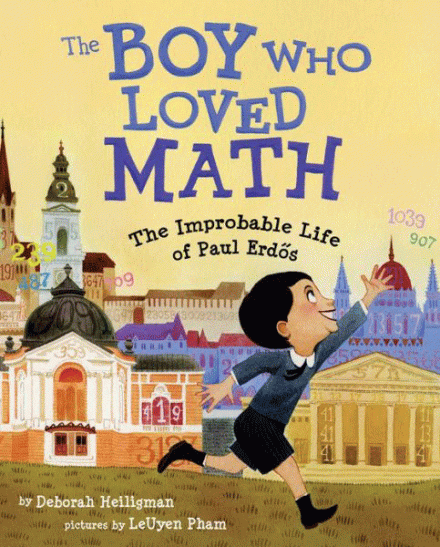
The Boy Who Loved Math: The Improbable Life of Paul Erdős

Written by Deborah Heiligman | Illustrated by LeUyen Pham


In Budapest, Hungary a boy is born who loves math. His name is Paul Erdős and he lives with his mother, who loves him “to infinity” just as Paul loves her. When she goes back to work as a math teacher, she leaves Paul with Fräulein, his nanny. Fräulein loves rules and tries to get Paul to sit still, eat all his lunch, take a nap—to obey. But Paul hates rules.

At three years of age he teaches himself to count the days until his mother will be home with him 100 percent of the time. Knowing the number makes Paul feel better as his head is constantly full of numbers and what they can do. One day when he is four years old, he meets a woman and asks her two questions—what year she was born and at what time. When the woman tells him, it only takes him a moment to reveal how many seconds she has been alive.

He continues to play with numbers, learning more and more about the various types. He decides he will be a mathematician when he grows up. When Paul is old enough to go to school, he once again encounters rules he can’t abide. His mother decides he will be schooled at home, and even though this means more time with Fräulein, Paul considers it the better option.

There’s just one thing – while Paul thinks about numbers, Fräulein and his mother do everything for him. At meals they cut his meat and butter his bread; they dress him, and tie his shoes. When he becomes a teenager, he goes to high school and meets other kids who love math. He and his friends spend all their time doing math and by the time Paul is 20 he is famous around the world for his math equations.

There’s just one problem – even as an adult, Paul is so focused on numbers and math that he still doesn’t know how to do basic things for himself. When he is 21 he’s invited to go to England to work. At his first dinner there he stares at his bread and he stares at his meat. What is he supposed to do? With a little experimentation, he figures it out, but he also figures out that he sees the world in a different way.

He doesn’t want a normal life with a family and a house and a regular job. He designs for himself a very unusual lifestyle. Everything he owns fits into two suitcases, and with a little money in his pocket he flies from city to city to do math. He knows so many mathematicians that wherever he goes they invite Paul to stay with them. These families take care of Paul just as his mother and Fräulein had! They do his laundry, cook his meals, and pay his bills.

But even so, everyone loves “Uncle Paul!” He brings people together and shares his knowledge. His work in mathematics has given the world better computers, better search engines, and better codes for our spies to use. He was so admired that even now people represent their relationship with Paul by giving it a number – the “Erdős number.” Paul was a unique person who counted numbers and people as his best friends and experienced the world in a way that added up to a very special life.

Reading Deborah Heiligman’s The Boy Who Loved Math is a liberating experience. Her biography reveals not just what Paul Erdős did, but the quirky genius he was. It also honors all the people around the world who embraced his personality, allowing Erdős to focus on the work he was born to do. Heiligman’s engaging patter, full of interesting anecdotes, humor, and personality, is storytelling at its best and provides an absorbing look at a very unique life.

LeUyen Pham’s illustrations perfectly complement the text, exposing Erdős’s chafing under rules, his delight in math, and his development from youth to old age. Each fascinating page cleverly represents the way Erdős saw the world as numbers, equations, and geometric shapes appear on buildings, domes, and even in the very air! The text too is infused with numerals and mathematical symbols (“Paul loved Mama to ∞, too!), making this a prime book for any math lover!

Ages 5 – 9

Roaring Brook Press, 2013 | ISBN 978-1596433076

Mathematics Awareness Month Activity

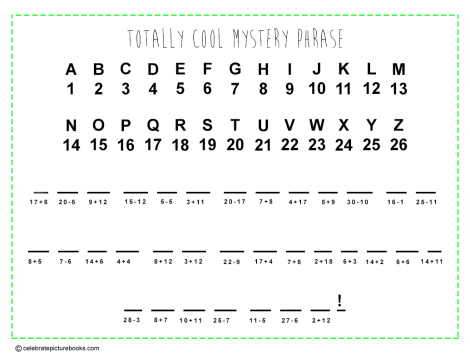
CPB - Math Mystery Phrase


Totally Cool Mystery Phrase! Puzzle


What plus what equals an equation that can’t be beat? You and numbers, of course! Complete this Printable Totally Cool Mystery Phrase! puzzle to discover a coded sentence! Here’s the Solution!

April 18 – It’s National Inventor’s Month

The Most Magnificent Thing by Ashley Spires picture book review

About the Holiday

Perhaps April was chosen as Inventor’s Month because the blossoms of early spring echo the flourish of ideas that come from fertile minds. This month honors all the men and women throughout history who dared to think differently and changed the world. Today, that proud tradition continues in the excitement of school labs and classrooms, through online courses and computer technology, and in private homes where people of all ages are pondering and creating the next big thing. If you have a knack for innovation or invention, take time to sit down and work on your ideas today.

The Most Magnificent Thing

By Ashley Spires


A little pony-tailed girl and her puppy do everything together. They race, eat, explore, and relax. When she makes things, her best friend unmakes them. One day the girl has a brilliant idea—she is going to make “the most MAGNIFICENT thing!” In her mind it’s going to be “easy-peasy.” She knows exactly how it will look and how it will work.

With her faithful assistant following at her heels, the girl gathers materials and goes to work on the sidewalk outside her home. The girl “tinkers and hammers and measures” while her assistant “pounces and growls and chews.” When the little invention is finished, they stand back to examine it. Hmmm…it doesn’t look quite right. It doesn’t feel quite right either. In fact it is all wrong! The girl tries again.

She “smooths and wrenches and fiddles” while her assistant “circles and tugs and wags.” It still turns out wrong. Determined to make her vision reality, she gives it another go…and another…and another. She makes her invention different shapes, gives it various textures, measures out assorted sizes. One attempt even smells like stinky cheese! But none of these creations are MAGNIFICENT.

People stop by and offer encouraging—even admiring—remarks, but the little girl just gets mad. Can’t they see how wrong her invention is? In her anger the little girl works at a fevered pitch, shoving parts together, her brain fogged by “all the not-right things.” In her haste she hurts her finger. This is the last straw. She explodes and declares that she QUITS!

The ever-watchful assistant suggests a bit of fresh air. The girl takes her puppy for a walk and at first her feelings of defeat stay with her. Little by little, though, she pays attention to the world around her and her mind clears. Coming home, she encounters all the wrong things she has made lined up on the sidewalk. Her disappointment threatens to return, but then she notices something surprising—there are parts of each iteration that she likes!

After studying each earlier attempt, she knows just what to do! Slowly and carefully she once more begins to tinker. At the end of the day she and her assistant stand back to look. The machine may lean a bit, and be a little heavy, and it may need a coat of paint…but as the girl and her puppy climb aboard, they both agree that “it really is THE MOST MAGNIFICENT THING!”

You are never too young or too old for Ashley Spires’ inspiring and inspired story. The journey from idea to realization—so often fraught with disaster (or apparent disaster)—is depicted here honestly and with humor as the on-going process it is. Step-by-step the little girl thinks, gathers materials, tinkers, discovers, tinkers some more, and triumphs. It is this last step that is so “magnificently” presented—it’s only by not giving up that success can be achieved.

Spires’ tale is a delight of language—the girl “smooths, wrenches, fiddles, twists, tweaks, and fastens, pummels, jams, and smashes.” Likewise, her illustrations wonderfully depict the changing emotions of this thoughtful, steely-eyed, shocked, and ultimately thrilled young inventor. Her faithful puppy is a charming companion and foil, and kids will love examining the early inventions that lead up to the final product.

The Most Magnificent Thing is a fabulous book to keep on any child’s or adult’s bookshelf for those times when inspiration hits but achievement seems elusive.

Ages 3 – 7 and up (creative types of all ages will enjoy this book)

Kids Can Press, 2014 | ISBN 978-155453704

National Inventor’s Month Activity

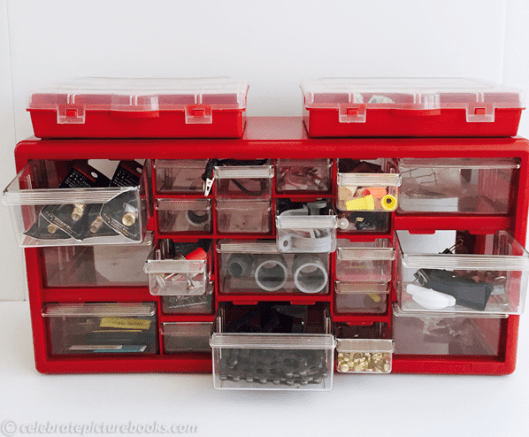
CPB - Inventor's Tool Kit II (2)

Inventor’s Tool Kit


Every idea begins as a jumble of seemingly unrelated parts. Gathering whatever types of material inspires you and keeping it in a box ready to go when inspiration hits is a great way to support innovation and spark experimentation.

Supplies

  • Small parts organizer with drawers or compartments, available at hardware stores and craft stores
  • A variety of parts or craft materials that can be combined, built with, or built on
  • Some hardware ideas—pulleys, wheels, small to medium pieces of wood, wire, nuts, bolts, screws, hooks, knobs, hinges, recyclable materials
  • Some craft ideas—clay, beads, wooden pieces, sticks, paints, pipe cleaners, string, spools, buttons, glitter, scraps of material, recyclable materials

Directions

  1. Fill the organizer with the materials of your choice
  2. Let your imagination go to work! Build something cool, crazy, silly, useful—Amazing!

April 13 – National Bookmobile Day

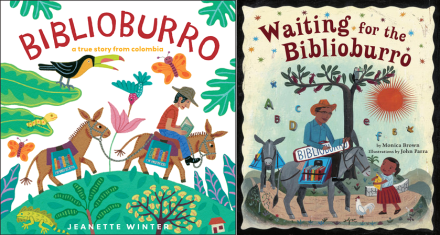
CPB - Biblioburro 3It’s not often that kids are able to read the same story from two different sides. In today’s post I review two picture books about the inspiring Luis Soriano Bohórquez. The first book is from Soriano’s viewpoint, and the second focuses on the children whose lives are changed by his courage and dedication.

About the Holiday

Today we honor the more than 930 dedicated library professionals who bring books to remote places, shut-ins, and others in the community who have no access to libraries and the services they offer. For over 100 years, bookmobiles have delivered information, technology, and resources for life-long learning to Americans of all walks of life.  To celebrate today’s holiday show your support for bookmobiles by thanking your library workers in person or by sending them a letter or email. You can also consider donating to a book drive or book fund to keep this vital service going!
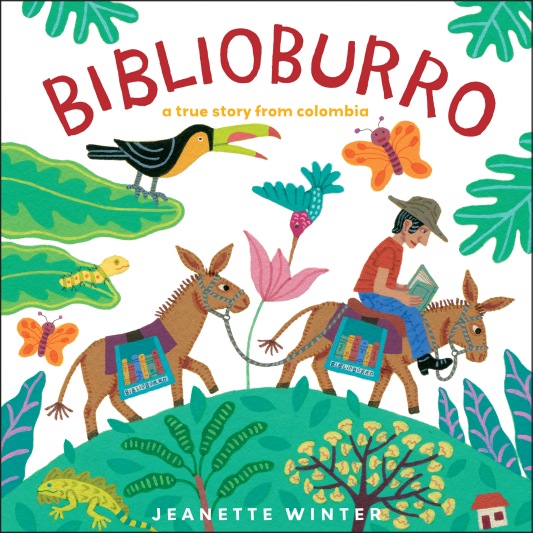
Biblioburro: a True Story from Columbia by Jeanette Winter Picture Book Review

Biblioburro: A True Story from Columbia

By Jeanette Winter


Luis lives deep in the jungles of Columbia surrounded by his beloved books. In fact, Luis loves books so much that his entire house is filled with them, floor to ceiling. “What will we do with them all?” asks his wife, Diana. Luis thinks about it and suddenly has an idea. He can share his books with people who live in the faraway hills! How will he get them there? By burro!

Luis buys two burros and names them Alfa and Beto. He builds special crates that will fit on their backs to carry the books. He paints a sign to carry with him: “Biblioburro”—The Burro Library—it says. Every week Luis takes the burros to far off villages, but it is not an easy trip. On his way to El Tormento, the hot sun makes the burros thirsty. When they stop at a stream to drink the water, Luis has a hard time pulling Beto away from the cool oasis.
celebrate-picture-books-picture-book-review-biblioburro-el-tormento

Copyright Jeanette Winter, 2010, courtesy of Beach Lane Books.

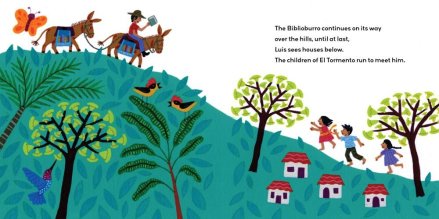
Among the jungle trees, bandits wait. As Luis passes through a lonely section of his path, a robber jumps out and demands silver. Luis has no money, so the bandit takes one of his precious books, demanding silver “next time.” At last Luis reaches El Tormento. The children run to greet him! Before they choose their books, however, Luis reads them a story. Today he has brought along a special treat—pig masks for everyone! As the children wear their masks, Luis reads the story of the Three Little Pigs and the Big Bad Wolf. After the story the kids choose their books and head for home.

Luis leads Alfa and Beto on the journey back as the sun sets. At home he and his burros have a well-deserved dinner. Luis is tired from his long journey, but as Diana sleeps he sits in his rocking chair reading into the deep, dark night—just the same as the children of El Tormento.

celebrate-picture-books-picture-book-review-biblioburro-Luis

Copyright Jeanette Winter, 2010, courtesy of Beach Lane Books.

The final page presents factual information about Soriano and his life. He has inspired many to donate to his cause, bringing education and literacy to hundreds of people since the year 2000. This book is also available in a Spanish language version.
celebrate-picture-books-picture-book-review-biblioburro-spanish-edition-cover

Any book lover will be fascinated by this true story of a man dedicated to bringing books to children living in remote areas of Columbia. Jeanette Winter’s straightforward tale reveals not only the imagination and care it took to make Luis’s dream a reality, but also the perils he faces in carrying out his mission. Winter’s lyrical tone emphasizes the isolation of the far-off villages Luis visits and his solitary travels. The story is full of suspense and humor that will draw children into this unique biography of Luis Soriano Bohórquez.

Winter’s vivid illustrations bring the Columbian jungles to life—vivid green leaves and flowers are home to orange snakes, yellow caterpillars, multi-colored toucans and parrots, and other native species. Kids will wish they could reach out and pet the sweet burros that work so hard to carry the books. As nighttime falls, the hues cool to muted teals and blues—the color of dreams.

Ages 5 – 9

Beach Lane Books, Simon & Schuster, 2010 | ISBN 978-1416997788

You can find Biblioburro: A True Story from Columbia at these booksellers

Amazon| Barnes & Noble | Books-a-Million | IndieBound
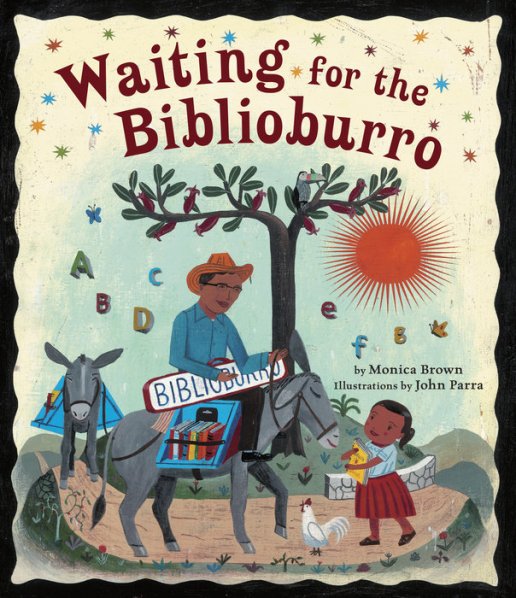
Waiting for the Biblioburro by Monica Brown and John Parra picture book review

Waiting for the Biblioburro

Written by Monica Brown | Illustrated by John Parra


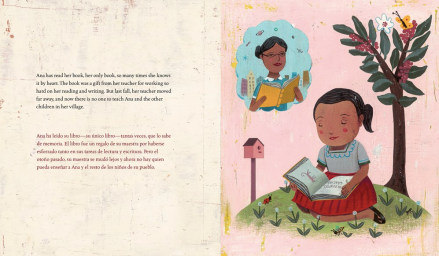
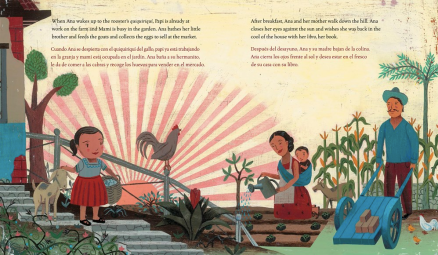
On a faraway hill in a small Columbian village, a little girl named Ana wakes to a day of feeding the farm animals, taking care of her younger brother, and collecting eggs to sell in the market. When the long, hot day is over, Ana retreats to her room to read her most precious treasure—the one book that her teacher gave her before she moved and the school closed.
celebrate-picture-books-picture-book-review-waiting-for-the-biblioburro-bilingual-edition-reading

Image copyright John Parra, 2016, text copyright Monica Brown, 2016. Courtesy of Tricycle Press.

Ana has memorized the book and wishes she had more, but there is no one to provide books or education in her tiny village. To make up for it, Ana imagines her own stories and tells them to her brother before they go to sleep. But one day everything changes. Ana hears an unfamiliar clip-clop and a loud iii-aah! Iii-aah!

Ana runs outside to see a most unusual but wonderful sight! Riding past her house is a man with two burros loaded down with books! All the children leave the fields and run to this stranger. “Who are you?” the children ask. The man says he is a librarian and a teacher. His burros are Alfa and Beto, and his name is Luis Soriano. Together they are a moving library. Luis reads to the children and teaches them the alphabet. He then tells them they can choose books from the crates strapped to the burros’ backs and keep them until he returns.
celebrate-picture-books-picture-book-review-waiting-for-the-biblioburro-bilingual-edition-sunrise

Image copyright John Parra, 2016, text copyright Monica Brown, 2016. Courtesy of Tricycle Press.

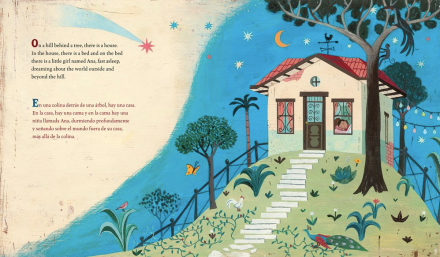
Ana gazes at the selection—there are so many cuentos, so many stories! She hugs the books she has chosen and, before Luis goes on his way, tells him someone should write a story about Alfa and Beto. Why don’t you? Luis encourages her. With a promise to return, Luis is gone. Ana shares her books with her brother, reading until she can’t keep her eyes open.
celebrate-picture-books-picture-book-review-waiting-for-the-biblioburro-bilingual-edition-nighttime

Image copyright John Parra, 2016, text copyright Monica Brown, 2016. Courtesy of Tricycle Press.

It seems like forever and no biblioburro! “When will he come back?” Ana pesters her mother. Finally, unable to wait for a new story, Ana takes the librarian’s advice and creates a book about the biblioburros. Just when Ana has almost given up hope of seeing Luis again, she hears the now familiar iii-aah! Iii-aah. She runs to show Luis her special surprise. Not only does he read her book to the other children, he carefully packs it away on the burro’s back “ready to be carried away over the hills and through the fields to another child “who is dreaming of the stories the biblioburro will bring.”

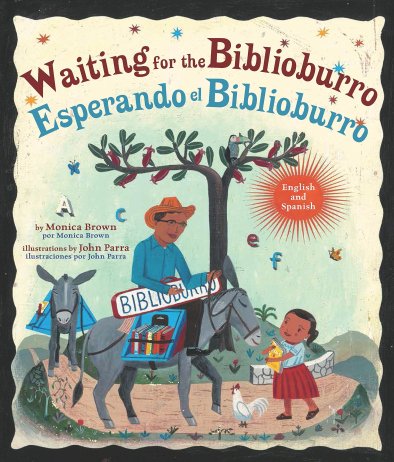
This book is also available in a bilingual edition: Waiting for the Biblioburro/Esperando el Biblioburro.

celebrate-picture-books-picture-book-review-waiting-for-the-biblioburro-bilingual-edition-cover

Monica Brown’s telling of this inspirational story reveals how much one person’s actions can touch another. Through her expressive language and rhythms, Brown effectively reveals the thoughts and feelings of a little girl thirsty for knowledge but without any means of acquiring it. The girl’s enthusiasm for books and learning is infectious and will resonate with children. Listeners will empathize with her longing and celebrate when they hear of the biblioburro’s arrival.

John Parra’s well-known paintings are a highlight of this book, filling each page with the radiant sun, colorful architecture, exotic animals, tropical vegetation, and other sights of the jungles and hills of Columbia. Ana’s hopes and dreams are also illustrated in Parra’s unique style, creating a world of imagination fitting for a budding young writer.

Ages 5 – 8

Tricycle Press, Penguin Random House, 2011 | ISBN 978-1582463537 | ISBN 978-0553538793 (Spanish–English Bilingual Edition)

Discover more about Monica Brown and her books on her website.

To learn more about John Parra, his books, and his art, visit his website.

You can find Waiting for the Biblioburro at these booksellers

Amazon | Barnes & Noble | Books-a-Million | IndieBound

National Bookmobile Day Activity
CPB - Bookmobile

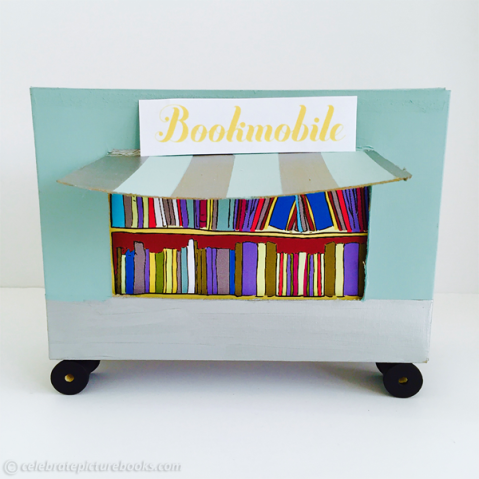
Make a Box Bookmobile


Bookmobiles are love on wheels! If libraries are some of your favorite places, you’ll like making this box bookmobile! You can even use it as a desk organizer!

Supplies

  • Printable Book Shelves and Sign Template
  • Cardboard box, 16-oz pasta or other recyclable boxes work well (I used a 5” x 7 ¼ -inch pasta box)
  • Small wooden spools or bottle caps, large beads, or toy wheels
  • Paint
  • Scissors
  • X-acto knife
  • Strong glue
  • Paint brush

Directions

1.Gently pull the box apart at the seam and lie flat with the unprinted side facing up

2. To Make the Awning:

  • On one of the wide sides of the box, measure a rectangle 1 inch from the top of the box, leaving at least 1 ¼ inches at the bottom of the box and 1 ¼ inches on both sides
  • With the x-acto knife or scissors cut the sides and bottom of the rectable, leaving the top  uncut
  • Paint the top and underside of the awning (if you want to make stripes on the awning lay strips of tape side by side across the awning. Remove every other strip of tape. Paint the open stripes one color of paint. When the paint dries replace the tape over the paint and remove the tape from the unpainted stripes. Paint those stripes a different color.)

3. Paint the rest of the box on the unprinted side any way you like, let dry

4. Cut the Printable Book Shelf template to fit the size of your window opening, leaving at least a ½ inch margin all around

5. Tape the book shelf to the inside of the window

6. Reconstruct the box, making the original seam an inside flap

7. Glue the flap and sides together

8. If using small spools for wheels, paint them black. Let dry

9. Glue the wheels to the bottom of the box

10, Attach the Bookmobile sign, found on the printable template, above the awning

** To Make a Desk Organizer from the Bookmobile

  • Cut an opening in the top of the bookmobile with the x-acto knife or a scissor

April 5 – National Read a Road Map Day

Maps by Aleksandra and Daniel Mizielinski Picture Book Review

About the Holiday

Sure, GPS can get you where you want to go—even with voiced directions—but how do you know where you want to go? How do you discover what’s out there in your neighborhood, town, state, country? You can read a road map! It’s fascinating to see how roads snake along the terrain, around lakes, and over hills as well as crisscross in dozens of places but still get you where you want to go. And if you want to see how a place has changed over time, compare an old road map to a current one. So get out your road maps and start investigating!

Maps

By Aleksandra Mizielińska and Daniel Mizielińska


The world is a big and intriguing place in this oversized picture book. Forty-two countries are represented within its pages and populated from border to border and even from page edge to edge with cultural, historical, zoological, economic, agricultural, culinary, and linguistic information, all illustrated in stunning thumb-sized detail.

Whether you’re casually flipping through the book or examining each page, a colorful or unusual detail will capture your attention and demand a lingering look, which leads to discovering more and more intriguing facts. Opening the book to Switzerland, I noticed the Appenzeller sheepdog then the Appenzeller cheese round, both from the town of Appenzell. But what’s this? Schwingen? And why are the two guys wearing their shorts on the outside of their pants? It’s Swiss Wrestling! A quick Google search tells me that the wrestlers wear special “breeches” with belts for getting a good grip for tossing opponents!

Another flip of the pages brings me to Nepal, which is so mountainous! It’s home to the Himalayas which include Mount Everest (the tallest peak on earth), as well as Kangchenjunga, Lhotse, and Makalu (the third, fourth, and fifth highest peaks). As you might imagine you can engage in mountain biking, but beware of the Mugger Crocodile!

G’day, Mate! Welcome to Australia! Here you’ll find a Superb Lyrebird with a phenomenal tail, sneak a peek at a short-beaked echidna with a spiky coat and a mole-like snout, and learn to duck for a gliding possum. If you’re a sports fan, you’ll be interested in the didgeridoo, and remember vegemite? This is where it’s from!

I could go on and on! There are so many amazing animals, monuments, people, and structures around the world just waiting for you to discover them! The thick, matte, softly muted pages of Aleksandra and Daniel Mizielińska’s Maps are reminiscent of fine cartographers’ volumes. This book is a fantastic resource for teachers, homeschoolers, and students with curiosity or a report to write. Just a glance will give readers ideas, and a more thorough examination will open up a world of possibilities! Maps is a must-have for any young person’s or armchair traveler’s bookshelf.

Ages 5 and up

Big Picture Press, 2013 | ISBN 978-0763668969

National Read a Road Map Day Activity

CPB - Map Day II

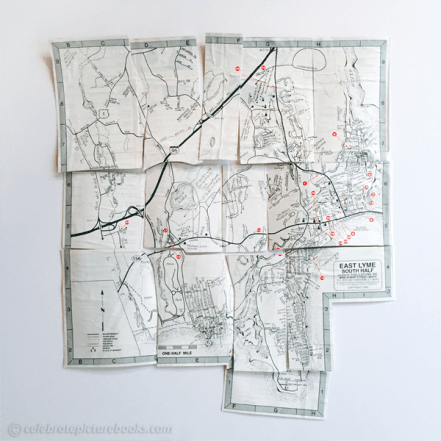
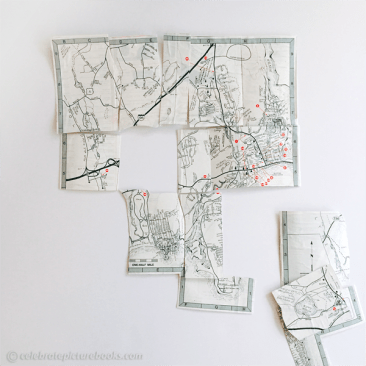
Map Jigsaw Puzzle


Sometimes reading a map is like putting together a puzzle—so why not make a puzzle out of a map? It can be fun to use a map of your town or state or to use a map of a state or country you’d like to visit!

Supplies

  • Small to medium size map (maps are often offered free at tourist stops, town halls, or other tourist information offices or racks)
  • Poster board
  • Glue
  • Scissors

CPB - Map Day

Directions

  1. Use the entire map or cut a desired-sized section from a map
  2. Glue the map to the poster board, let dry
  3. Cut the map from the poster board
  4. Cut the map into puzzle sections, these can be straight-sided sections or ones with interconnecting parts