August 28 – Pony Express Day

celebrate-picture-books-picture-book-review-you-wouldn't-want'to-be-a-pony-express-rider-cover

About the Holiday

Today’s holiday commemorates the intrepid souls who risked life and limb to bring our ancestors important letters in a timely manner. Towns across America hold special, fun events to remember the riders who took to heart the postal carrier’s motto: “Neither snow, nor rain, nor heat nor gloom of night, stays these couriers from the swift completion of their appointed rounds.” Find a local festival or maybe reenactment and have a little Old West fun!

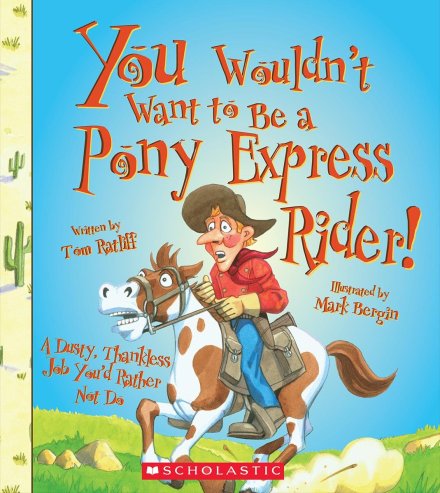
You Wouldn’t Want to be a Pony Express Rider! A Dusty, Thankless Job You’d Rather Not Do

Written by Tom Ratliff | Illustrated by Mark Bergin


So, you’re 16 years old and lookin’ for a job. There’s not much out there, and the pay stinks. Then you see a broadside advertising jobs with a newfangled technology. The description seems pretty good, exciting even—just up your alley. “WANTED: Young, skinny, wiry fellows not over eighteen. Must be expert riders, willing to risk death daily. Orphans preferred.” And here’s the kicker—you make $25 per week! Heck most people only make $25 a month!

You decide to apply for this Pony Express position, and your life takes off in a whole new direction—to California, to be exact! William Russell, Alexander Majors, and William Waddell own the company. It’s real name is the Central Overland California and Pike’s Peak Express Company, but that’s quite a mouthful, so the enterprise is fondly known as The Pony Express. It’s a rapid mail-delivery system that promises letters and packages will go from St. Joseph, Missouri to Sacramento, California (2,000 miles/3,200 km) in only 10 days. Can you imagine?!

Planning begins in January of 1860 and is completed in less than four months. Hundreds of horses are bought and about just as many riders are trained (they have to learn how to change horses in two minutes or less). Along the route 157 relay stations are also constructed. All this is to supply communication for the many pioneers who are steering their Conestoga Wagons out West, battling floods, snow, disease, and those pesky obstacles called the Rocky Mountains to find a better life for themselves and their families. 

You’re young, enthusiastic, and want to be part of this new landscape. You strap on your company-given “two revolvers, rifle, and Bowie knife,” have your horse shod, and take the Rider’s Oath: “While in the employ of A. Majors, I agree not to use profane language, get drunk, gamble, treat animals cruelly, or do anything else that is incompatible with the conduct of a gentleman.” Well, Dang! (Oops!)

The route West is fraught with danger, so forts and trading posts pop up along the way to protect and supply Pony Express riders. The pioneers also keep an eye out for you, so it’s handy to get to know them. While you ride you can be assured that you have the latest in mail-carrying gear. A special saddle modeled on those used by Spanish vaqueros (cowboys) is more comfortable for the long miles, and a mochila (a leather pouch that fits over the saddle) is stuffed full of the mail.
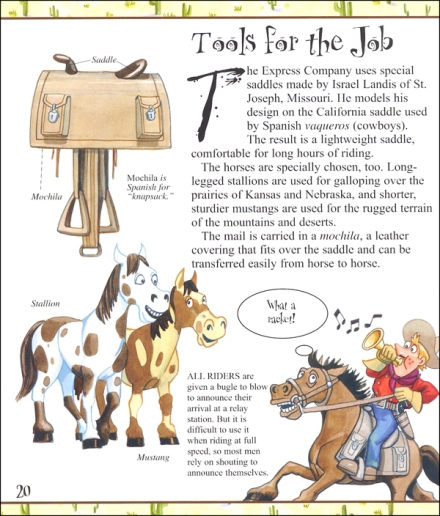
celebrate-picture-books-picture-book-review-you-wouldn't-want'to-be-a-pony-express-rider-interior-art

Image copyright Mark Bergin, courtesy Scholastic

You were right about the job being exciting! Every day brings a new experience: dehydration, heat exhaustion, blizzards, frostbite, floods, 6-to-10-hour hard rides, plus you’re a target for outlaws and bandits. It’s worth it all, though, to bring a smile to someone’s face when they open a letter from their far-away sweetheart—and all for only $5.00 a letter (that’ll be about $120 in 2016). Just be thankful it’s not a business letter—that’ll set ya back $30, which is…uh…umm…well, a heck of a lot (oops!).

In 1844 some upstart named Samuel F. B. Morse invented the telegraph that uses a code of electrical signals to deliver messages. It only takes 5 years for all the major cities to be connected, and as more people move west, so do the poles and electrical wires.”In June 1860, congress authorizes construction of a telegraph line to California. If the telegraph ever reaches the West Coast, you will most likely be out of a job.” One thing about this Morse Code, though. Because “messages sent long distances have to be copied and recopied several times, mistakes are common.” Betcha in the future, though, there will be some kinda automatic correction system, and errors will be left back here in the past.

It’s 1860—a presidential election year—and the campaign has been ugly and hard fought. The country is divided, and fast delivery of the election results is crucial to keeping the United States together. You are part of saving the country, as the news of Abraham Lincoln’s victory reaches California from Washington in only 7 days and 17 hours—a cross-country delivery record! Within a year, the U.S. is at war and danger looms for the Pony Express riders. To protect the riders and the mail, the Overland Stage Company (soon to be known as Wells Fargo) and their enclosed stagecoaches take over.

And the Pony Express? Well, as you probably know, it’s losing money and limping along, what with the competition and the war and all. In October 1861 the transcontinental telegraph is completed and the Pony Express stables its horses. And you? You’ll be fine. With all the experience you’ve gained, you can easily find a job as a scout to guide folks over the trails to their new Western homes.

These “You Wouldn’t Want to Be…” series of books brings history to life by revealing the seamy side of events—and aren’t those really the most fascinating? Tom Ratliff corrals a heap o’ info on the Pony Express and the pivotal changes the United States experienced during the 1860s. While the text trots out fun sidebars, the short chapters are loaded with concrete facts about the development of the American West as it grappled with the need for faster and better communication.

Mark Bergin depicts the concepts presented with bold, vivid cartoon-inspired illustrations of the pioneers, riders, inventors, and townspeople who made up the Pony Express system. The people’s faces register well-earned skepticism, fright, and weariness, but also pride and excitement to be on the cutting edge of technology. Maps portray the 2,000-mile route from America’s middle to its western sea.

The Pony Express may be long gone, but as this book affirms, the more things change the more they stay the same. Teachers, researchers, and anyone interested in history will want to hoof it to add You Wouldn’t Want to Be a Pony Express Rider! to their collection.

Ages 7 – 10

Scholastic, Inc., 2012 | ISBN 978-0531209479

Pony Express Day Activity

celebrate-picture-books-picture-book-review-pony-express-coloring-page

Pony Express Mail Carrier Coloring Page


Can you color this printable Pony Express Mail Carrier Coloring Page as quickly as a rider could deliver the post? You’ve got 10 days—so don’t rush!

Picture Book Review

August 26 – Women’s Equality Day

celebrate-picture-books-picture-book-review-for-the-right-to-learn-malala-yousafzai's-story-cover

About the Holiday

Today’s holiday commemorates the day in 1920 when the 19th Amendment to the United States Constitution was ratified, giving  women the right to vote. Over the years women all over the world have fought and are still striving to gain equal footing with men in areas such as employment, salary, and education and to be free from fears of violence and discrimination. Empowering women across the globe and ensuring their voices are heard is an issue for all people to be involved in.

For the Right to Learn: Malala Yousafzai’s Story

Written by Rebecca Langston-George | Illustrated by Janna Bock


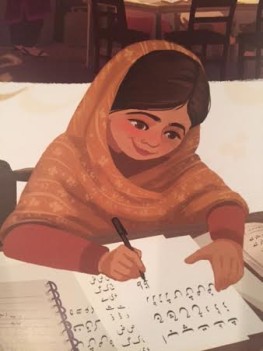
Malala Yousafzai lived in the Swat Valley of Pakistan, where her father, Ziauddin, ran a school in the town of Mingora. Malala loved school and even when she was tiny visited classes with her father often. Not all Pakistani children could go to school—some families couldn’t afford it and some believed girls should stay home to clean, cook, and keep house. But Malala’s father believed his daughter had the same right to an education as his sons. Malala thrived at school. She learned multiple languages and won many academic awards.

“But Taliban leaders who controlled the area were against letting girls go to school. They declared that females should be separated from males. They wanted to outlaw education for girls.” The Taliban leaders even tried to intimidate Malala’s father. “One ordered Ziauddin to close his school because girls and boys used the same entrance.” Ziauddin refused.

celebrate-picture-books-picture-book-review-for-the-right-to-learn-malala-yousafzai's-story-writing

Image copyright Janna Bock, courtesy of Capstone Press

While her father was worried, Malala’s determination grew stronger. She studied harder at school, and during the school holidays while most Pakistani women covered their hands with henna flowers and vines, Malala painted science formulas on hers. The Taliban continued to exert a tight grip on the Swat Valley, and instituted new rules: men could not shave, women had to cover their faces, movies were banned. And the radio “crackled with the sound of the Taliban preaching: No education for girls! Girls who attend school bring shame to their families!”

The Taliban frightened many, and empty seats in school classrooms began to be more frequent. Ziauddan and Malala appeared on TV to express the importance of education. In response the Taliban threatened Ziauddan and his school. Despite the threats Malala and her father continued to speak and write, “demanding equal education for girls.” The Taliban began patrolling the streets, perpetrating violence and destruction on anyone who didn’t obey their rules.

In December 2008, the Taliban announced that all girls’ schools would close by January 15. “Even before the deadline, bombs started to rain down on nearby schools as warnings.” The British Broadcasting Corporation wanted to reveal to the world what was happening. They wanted a girl to write a blog about her experience and “how it felt to be denied an education. Malala volunteered.

celebrate-picture-books-picture-book-review-for-the-right-to-learn-malala-yousafzai's-story-sneaking-to-school

Image copyright Janna Bock, courtesy of Capstone Press

She took the pen name Gul Makai and related her blog by phone to a reporter who typed and published her words for two months. The first post appeared on January 3, 2009. On January 14 Malala wrote: “‘They can stop us from going to school, but they can’t stop us learning!’” Because activists were growing angry, the Taliban let girls ages 10 and younger go to school. Malala and her friends were 11. They began dressing to look younger and hid school books in their clothes. If they had been caught lying about their ages, they and their teachers could have been beaten or executed.

In May 2009 the Pakistani army began battling the Taliban and ordered everyone to evacuate. Malala and her family had to pack their belongings and leave. Malala wanted to take her books along, but there wasn’t room. She could only hope that they—and her home—would survive the fighting. Three months later, the people of Mingora were allowed to come home, but the town was not the same as they had left it. Shops and buildings were destroyed, burned frames of cars were strewn across the roads. The school’s walls were riddle with bullet holes. But the Taliban was gone. Ziauddin reopened his school for boys and girls.

While Malala returned to school, her life was not the same. Because of her blog, speeches, and interviews, she was internationally famous. Everyone wanted to hear what she had to say—everyone but the Taliban. “Talban leaders began to threaten her on the Internet. Saying she was working for the West, they announced Malala was on their hit list. The police warned the Yousafzai family to leave, but Malala refused to hide. She refused to be silenced.”

Because of the danger, Malala’s mother wanted her to ride the bus to school instead of walk. On October 9, 2012 as Malala and her classmates rode the bus home after school, the bus was stopped and a man boarded, demanding to know which girl was Malala. While no one spoke, the girls couldn’t stop their eyes from flashing quickly toward Malala. That was all the man needed. He “pointed a gun at Malala. Three shots shattered the silence.”

The bus driver rushed Malala and two of her friends to the hospital. Word spread quickly about the shooting through the town and around the world. Malala lay unconscious for days as the Taliban threatened her again should she live. As determinedly as Malala fought for equal education, she fought for survival. Finally, she was flown to a hospital in England for more surgery and to keep her safe. Gifts and wished poured in from all over the world. Malala stayed in the hospital for three months and underwent many procedures to correct the damage done by the Taliban’s bullets.

When she had recovered, Malala returned to her family and to her place on the world stage where she continues to speak out for the rights of all. On July 12, 2013 in a speech at the United Nations, Malala “declared, ‘One child, one teacher, one book, and one pen can change the world.’” On December 10, 2014 Malala became the youngest recipient of the Nobel Peace Prize for her “strength, power, and courage” to “lift her voice for children everywhere.”

celebrate-picture-books-picture-book-review-for-the-right-to-learn-malala-yousafzai's-story-speaking-to-the-UN

Image copyright Janna Bock, courtesy of Capstone Press

Malala. Those three syllables have become synonymous with bravery, freedom, and education. Rebecca Langston-George tells Malala’s remarkable story with the same unstinting vision that fuels Malala’s mission. Told sensitively, but candidly, this compelling biography reveals the harrowing evolution of the Taliban’s reach that, far from intimidating young Malala, only served to make her more determined. Langston-George’s excellent command over her well-chosen details and gripping pacing enhances the power of this important true story. Readers should come away inspired—not only by Malala’s life, but the fact that they too can make a difference.

Janna Bock depicts the changing landscape of Malala’s hometown both physically and philosophically with illustrations that help readers clearly envision and understand Malala’s life and environment. The faces of the townspeople and the Yousefzai family register distress and fear, but also determination, courage, and optimism as schools close, Mingora comes under fire, and the citizens become refugees. Malala’s shooting, and recovery are portrayed with thoughtful consideration of the readers, and the ending takes children inside the United Nations to witness Malala’s ultimate triumph.

An Author’s Note detailing more about Malala’s story then and now as well as a glossary and index follow the text.

For the Right to Learn: Malala Yousafzai’s Story is an important biography of current events and people shaping the world and our children’s future and is a must read for all.

Ages 8 – 12

Capstone Press, 2016 | ISBN 978-1623704261

Discover more fascinating books by Rebecca Langston-George on her website!

View a gallery of art by Janna Bock on Tumblr!

Women’s Equality Day Activity

celebrate-picture-books-picture-book-review-star-border-writing-template

Be a Star! Letter to Your Teacher


The school year is about to begin! Do you feel excited? Nervous? Ready to learn? Your teachers are looking forward to meeting you! With the printable Be a Star! Letter to Your Teacher Template, tell your teacher something funny about yourself, something serious, and something you’d like to learn about this year. Add a thank you for all their work and dedication and give it to your teacher on the first day of school! If you’ve already started school, give it to your teacher this week!

Picture Book Review
August 22 – National Tooth Fairy Day

celebrate-picture-books-picture-book-review-tooth-by-tooth-cover

About the Holiday

Today’s holiday celebrates the mythical (shhhh!) fun of the Tooth Fairy. When a child loses a tooth, they put it under their pillow and that night the Tooth Fairy comes, takes the tooth, and leaves money. What the sprite does with the teeth is a mystery and many theories abound. The mystery of how the whole thing got started is explained here! I had never heard this story, so was excited to find it in my research!

In 1927 Esther Watkins Arnold wrote an eight-page play called The Tooth Fairy. In the same year none other than Sir Arthur Conan Doyle claimed that fairies and gnomes were real and by proof published pictures of two girls surrounded by “verified” fairies. In 1928 schools began performing Esther Arnold’s play, and kids took it to heart, leaving their teeth under their pillows. The rest of the story is, as Sherlock Holmes would say, “Elementary!”

Tooth By Tooth: Comparing Fangs, Tusks, and Chompers

Written by Sara Levine | Illustrated by T. S. Spookytooth


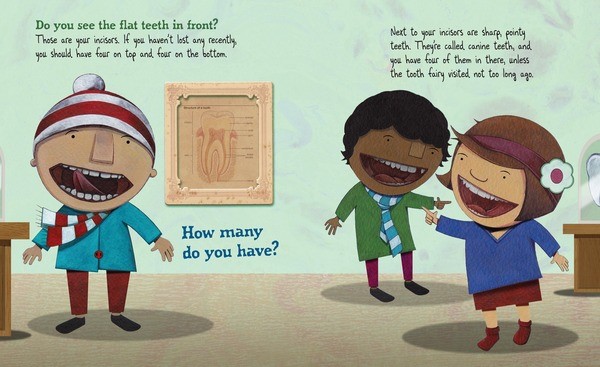
“Open wide!” a little girl with a good set of teeth herself encourages on the first page of this fun nonfiction book. “Look at all the chompers in there.” Mirror in hand she proceeds to reveal that human teeth are unusual because we are mammals, and mammal teeth come in different shapes and sizes. In fact there are three distinct types. A little boy takes over to describe them. Incisors are the four flat teeth in a person’s mouth—two on the top and two on the bottom right in front.

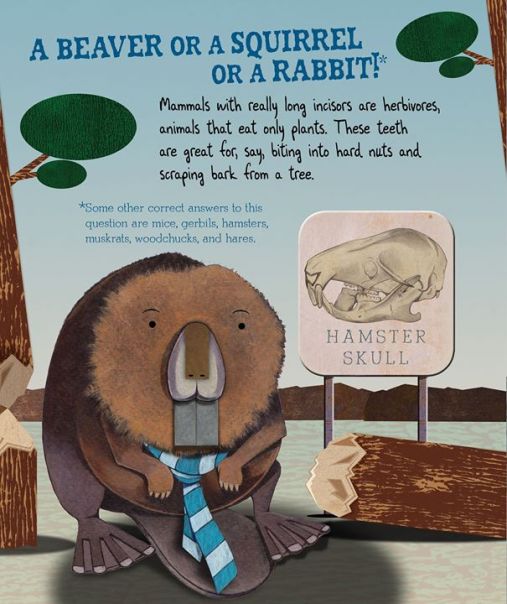
The four pointy teeth next to the incisors are canines, and the rest of the teeth are molars. Other mammals also have these teeth, and you can tell what an animal eats by which type is largest. For example, say your incisors were bigger than all your other teeth and they were so big they stuck out of your mouth even when it was closed, then you would be a beaver…or a squirrel…or a rabbit. These animals are herbivores and their oversized incisors help them break into nuts and scrape bark from trees.

celebrate-picture-books-picture-book-review-tooth-by-tooth-human-teeth

Image copyright T. S. Spookytooth, courtesy of Lerner Books

From here on Tooth by Tooth offers up amusing illustrations and “what kind of animal would you be if…” questions to spark kids’ powers of recognition. How about if your canines were so long they poked out of your mouth? Well, then you could be a “seal or a cat or a dog or a bear!” All these animals eat meat and need the sharp teeth to do it.

What if you had really tall molars? Then you’d be a “horse or a cow or a giraffe!” These guys use their molars to grind up grass. And if all your teeth were the same height? Come on…you know! You’d be you! Because humans eat plants and meat, we “need teeth that do many different jobs.”

But there are a lot more wacky teeth out there waiting for us to brush up on. So let’s get started. What if “two of your top incisors were so long that they grew out of your mouth and pointed to the sky? What if they were so long you could use them to carry your school bag?” You’ve probably guessed this one—you’d be an elephant. While an elephant’s tusks aren’t used for eating, they are used to procure the bark, roots, and other plant material that make up the elephant’s diet.

celebrate-picture-books-picture-book-review-tooth-by-tooth-beaver

Image copyright T. S. Spookytooth, courtesy of Lerner Books

What if you could almost trip over your canine teeth? Yep, you’d be a walrus, and you would use those sharp bad boys to poke holes in the ice to grab your favorite oysters and clams. But after eating they’re not done using their teeth. “After diving down for a meal, walruses can use their tusks to pull themselves back up onto the ice for a nap. Imagine if “your top and bottom canine teeth curled up out of your mouth so you had two pairs of tusks?” Or if your one upper canine grew through your upper lip and kept on growing?  Or if you had no teeth at all? Yikes! The remarkable answers are just a read away!

Fish, amphibians, and reptiles also have teeth of a sort, but because they are all the same shape and size, they don’t get special names—that doesn’t mean you can ignore them, though, because sharks are among this group, and you know what they can do!

More information about mammals, mammal teeth, a glossary, and a list of online and print references follow the text.

There’s nothing like the Wow! factor to capture kids’ attention, and Sara Levine uses it to humorous and fascinating effect in Tooth by Tooth: Comparing Fangs, Tusks, and Chompers. After giving a solid description of each kind of tooth and what it is used for in language that kids use and will relate to, Levine begins her guessing game that leads to even more discovery. We’ve all seen elephants and walruses with their mighty tusks, but how many know what they are really used for? And what about warthogs and narwhals? It’s all here in this creative nonfiction title.

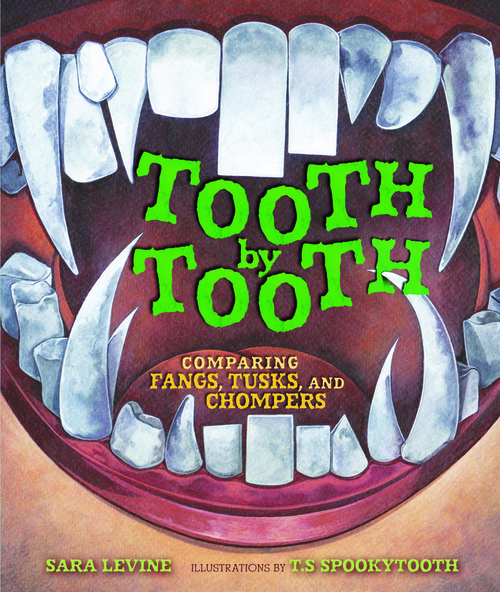
T. S. Spookytooth took a big bite out of the “how to make kids laugh” manual in illustrating each question and type of tooth. Pictures of girls and boys with enormous teeth jutting this way and that will make readers glad to be human. And while the animals that belong to each molar, incisor, or canine sport the scarf, bow, or head band of its human counterpart, they are clearly and scientifically drawn to provide full understanding. Animal skulls also demonstrate the placement of teeth. The cover, with its close enough to eat you view of a very scary mouth is a show stopper and will attract kids as soon as they see it.

Ages 5 – 9

Millbrook Press, Lerner Books, 2016 | ISBN 978-1467752152

Check out Sara Levine’s website for more books, stuff for kids, teachers’ resources, and more!

View a gallery of T. S. Spookytooth’s art and read his biography (?!) on his website!

National Tooth Fairy Day Activity

celebrate-picture-books-picture-book-review-kid-shaped-maze

Smile! Kids are A-maze-ing! Maze


Smile with those pearly whites as you find your way through this printable Kids are A-maze-ing maze! Here’s the Solution!

August 20 -World Honey Bee Day

celebrate-picture-books-picture-book-review-the-honeybee-man-cover

About the Holiday

In 2009 beekeepers in the United States petitioned the United States Department of Agriculture to establish an official day to commemorate honey bees and beekeeping. Since then the holiday has expanded world wide, and the plight of the bee population has become a global concern. Bees are a crucial component in sustainable farming, and even home gardeners know their harvest will be successful when they see bees hovering nearby. Bee enthusiasts commemorate the day by planting flowers that will attract these tiny dynamos, such as lavender, marjoram, and borage. To celebrate, why not try some local honey—you might fall in love with the taste, like Fred in today’s book!

The Honeybee Man

Written by Lela Nargi | Illustrated by Kyrsten Brooker


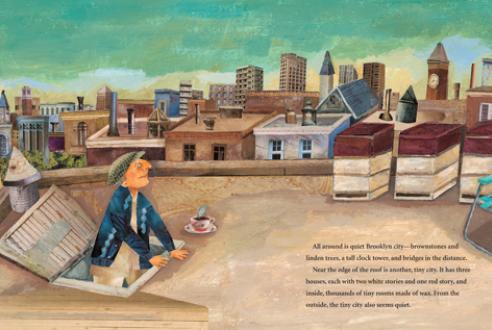
At dawn on a July morning, Fred awakes to begin his day with his “enormous” family. His morning routine consists of a cup of tea and a climb back upstairs and through a hatch in the ceiling that takes him to the roof. “All around is quiet Brooklyn city—brownstones and linden trees, a tall clock tower, and bridges in the distance.” But nearby is another, tiny city. It consists of only three houses, but inside are “thousands of tiny rooms made of wax.”

The summer morning smells of “maple leave and gasoline and the river and dust. He turns to the tiny city and inhales its smaller, sweeter smell—a little like caramel, a little like ripe peaches.” He bends down to the three houses to wake their residents. “‘Good morning, Queen Mab. Good morning, Queen Nefertiti. Good morning, Queen Boadicea,’” he calls before greeting the rest of his family: “‘Good morning, my bees, my darlings!’”

Inside the houses the bees are busy. The queens are laying eggs while the workers build wax rooms, nurse bees feed the babies, and others are getting ready to find fields of flowers for nectar. Fred dreams of the marvelous flowers the bees may find to flavor their honey. He imagines the bees flying low over the flowers moving among them and wishes he could soar with them too.

celebrate-picture-books-picture-book-review-the-honeybee-man-on-the-roof

Image copyright Kyrsten Brooker, courtesy of Schwartz & Wade

Fred watches the young bees uncertainly leave the hive and swirl off into the air. The older bees “zip out of the hives and throw themselves at the air, embracing it with their wings.” When a few land on Fred’s arm, he gently flicks them on their way. He spies on them from his rooftop as they disperse into his backyard garden, other neighborhood gardens, and perhaps, if Fred is lucky, to “blueberry bushes somewhere across town.” He sees the bees “dive into sweet pea and squash flowers. If he were closer, he could see them using their tubelike tongues to drink in flower nectar, which they store in honey sacs inside their bellies.”

The bees fly slowly home weighted down with their treasure. Fred knows that inside the hive the bees will go to work, some will do the waggle dance that tells other bees where the flowers are, some will take the nectar and store it in the wax rooms, and others will fan “their wings to evaporate the water from the nectar so it will turn to honey.”

At the end of August Fred knows it’s time to collect the honey. He carefully enters the tiny houses, removing the honeycomb from the top. In his own home he cuts the wax caps of the comb and the honey begins to flow. A special spinning machine squeezes every drop from the honeycomb. He pours the honey into jars and labels them “Fred’s Brooklyn Honey, Made by Tireless Brooklyn Bees.” In the evening Fred sits on his stoop chatting with the neighbors. He gives each a jar of golden honey.

As night falls Fred opens a jar of honey as the bees huddle “back in their own city, waiting for the rays of tomorrow’s sun to call them up and away over Brooklyn.” Fred dips a finger into the honey and tastes. “It is sweet, like linden flowers. It is sharp, like rosemary. It is ever-so-slightly sour. “‘Ah,’ says Fred, absorbing these happy flavors. ‘Blueberries!’”

celebrate-picture-books-picture-book-review-the-honeybee-man-in-the-garden

Image copyright Kyrsten Brooker, courtesy of Schwartz & Wade

Lela Nargi’s lovely city-based nature book brilliantly likens the tightly packed, exhilarating environs of Brooklyn to the stirring realm of the beehive. Through Fred’s love of his bee family, Nargi lyrically and with marvelous metaphors and verbs reveals the fascinating world of bees as well as the rich and satisfying life of one particular beekeeper. Readers organically learn fascinating facts about the ways bees collect nectar and transform it into delicious honey as well as why honey can have so many flavors.

In her gorgeous illustrations, Kyrsten Brooker uses the golden hues of honey to paint not only the beehive but Brooklyn as well, giving the two “cities” a sense of cohesiveness and equality. Fred, older, with his cup of tea and blue slippers is shown gently and lovingly taking care of his bees, even as he still has their spirit of adventure. Brooker’s combination of oils and collage fuse the dreamy quality of the text with the concreteness of its facts to create a unique book that would be perfect for quiet story times, rainy afternoons, or bedtime.

If there is such a thing as a child’s nature cozy, The Honeybee Man is it, and it would make a wonderful gift and a delightful addition to anyone’s library.

The endpapers provide detailed diagrams of the various types of bees, beehives, flowers, the waggle dance, and even a bee’s stinger. Nature lovers will relish the two pages of “amazing facts about honey, honeybees, and beekeepers” that follow the story.

Ages 5 – 10

Schwartz & Wade, Penguin Random House | ISBN 978-0375849800

You can find books for children, articles for adults, and so much more on Lela Nargi’s website!

World Honey Bee Day Activity

celebrate-picture-books-picture-book-review-bees-and-hive-coloring-page

Bees and Hive Coloring Page


The world of the honeybee is mysterious and marvelous! Here’s a printable Bees and Hive Coloring Page for you to enjoy!

Picture Book Review

August 15 – National Relaxation Day

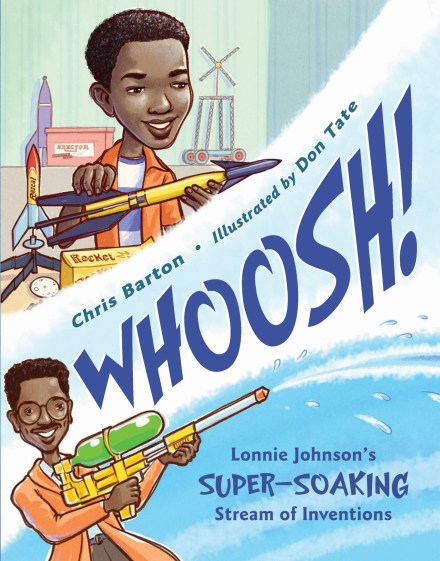
celebrate-picture-books-picture-book-review-whoosh!-lonnie-johnson's-super-soaking-stream-of-inventions-cover

About the Holiday

Relaxation Day was founded in 1985 by then fourth-grader Sean Moeller, who already knew a thing or two about balance in life when he suggested that “cleaning and real work are not part of relaxation.” Today’s holiday gives you permission to kick back and enjoy yourself. The subject of today’s book invented a great way to take advantage of a day off—and also demonstrates that sometimes work and relaxation go hand-in-hand!

WHOOSH! Lonnie Johnson’s Super-Soaking Stream of Inventions

Written by Chris Barton | Illustrated by Don Tate


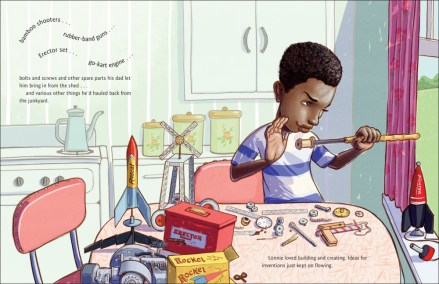
Lonnie Johnson had a way with stuff. In his hands bolts and screws, gears and springs, spools, clothespins, “spare parts his dad let him bring in from the shed, and various other things he’d hauled back from the junkyard” fueled Lonnie’s ideas for inventions and rocket ships. The kids at school loved to watch him launch the rockets he’d devised on the playground. Lonnie wanted to have a career as an engineer. Getting there took a lot of determination and courage. Once, the results of a standardized test said that he would not make a good engineer. Lonnie felt discouraged, but he knew that the person who had graded his test didn’t know him—or Linex.

celebrate-picture-books-picture-book-review-whoosh!-lonnie-johnson's-super-soaking-stream-of-inventions-young-lonnie-inventing

Image copyright Don Tate, courtesy of charlesbridge.com

Linex was the robot Lonnie had built from scrap metal. “Compressed –air cylinders and valves allowed Linex’s body to turn and its arms to move. The switches came from an old, broken jukebox. Lonnie used a tape recorder to program Linex, and as a bonus the reels looked like eyes.” Lonnie’s goal was to enter Linex in a science fair, but first he wanted to be able to program it. It took several years before he discovered how. Using his little sister’s walkie-talkie, Lonnie took Linex to the “1968 science fair at the University of Alabama—where only five years earlier, African American students hadn’t even been allowed.” Lonnie’s team won first place.

Lonnie went to college at Tuskegee Institute, where he realized his dream of becoming an engineer. His career “took him beyond Alabama—way beyond.”  He went to work for NASA. Before the orbiter Galileo could be sent to Jupiter, Lonnie developed a system that would ensure the craft would have a constant supply of power for its computer memory in case the main power was lost. Some fellow scientists doubted his idea would work, but it did. “As it photographed Jupiter and its moons, Galileo was supported by the power package that Lonnie designed.”

celebrate-picture-books-picture-book-review-whoosh!-lonnie-johnson's-super-soaking-stream-of-inventions-linex

Image copyright Don Tate, courtesy of charlesbridge.com

Even though Lonnie worked for NASA, he continued tinkering with his own ideas—in his own workshop. One problem he was trying to solve involved the need for the world’s refrigerators and air conditioners to have a cooling system that didn’t use the damaging chemical R-12. “He had an idea for using water and air pressure instead.” He built a prototype and experimented with it in his bathroom sink. When he turned his pump and nozzle on, a stream of water blasted across the room.

Suddenly, Lonnie saw another use for his invention—as a water gun. He created a design small enough for children’s hands, and tested it at a picnic, where it was a hit. Lonnie took his idea to a toy company…and another…and another. Finally one company agreed to make his water gun. Spurred on by this success, Lonnie found investors to help him build other original inventions: “a water-propelled toy airplane, two kinds of engines, and his cooling system” that had led to the water gun. He even quit his day job to devote his time to inventing.

But things don’t always work out. Each project fell through—even the water gun. It was a scary time as he and his family had to move out of their house and into an apartment. But Lonnie believed in himself. He took his water gun to another toy company. In 1989 he found a toy company willing to take a look. Lonnie made the trip to Philadelphia and wowed the executives with his invention.

celebrate-picture-books-picture-book-review-whoosh!-lonnie-johnson's-super-soaking-stream-of-inventions-water-powered-nozzle

Image copyright Don Tate, courtesy of charlesbridge.com

Now kids everywhere enjoy the fun of the Super Soaker. Today, Lonnie can be found in his workshop doing what he loves: “facing challenges, solving problems and building things” because “his ideas just keep on flowing.”

Chris Barton’s biography of Lonnie Johnson is a fascinating look at a man who succeeds in turning “No” into “Yes” by the power of his intelligence, ideas, and determination. Kids will love hearing about how one of their favorite toys came to be and will be inspired to chase their own dreams despite challenges and setbacks. Barton’s detailed narration provides a full picture of Lonnie Johnson and his times, specifics that attract and inform like-minded kids. Including the results of Lonnie’s exam should encourage kids who think differently. The story is enhanced by the conversational tone that makes it accessible to kids of all ages.

Don Tate illuminates Lonnie Johnson’s life story with his bold, full-bleed paintings that follow Lonnie from his being a child with big ideas to becoming a man who has seen these ideas through to success. With an eyebrow raised in concentration, young Lonnie demonstrates confidence and skill as he works on an invention, and kids will love seeing the tools of his trade laid out on the kitchen table. With his eyes narrowed in frustration and disappointment, Lonnie reads the results of his childhood exam. As Lonnie grows older and designs systems for NASA, the illustrations depict the schematics of the Galileo power package and Lonnie’s surprise at the strength of the water stream in his prototype cooling design. As all kids know, the spurt of a Super Soaker is awesome, and this fact is demonstrated in a “Wowing” fold-out page.

WHOOSH! Lonnie Johnson’s Super-Soaking Stream of Inventions is a welcome biography of the man who designs systems for the greater world but has never lost his youthful enthusiasm to invent.

Ages 5 – 10

Charlesbridge, 2016 | ISBN 978-1580892971

Check out more fiction and nonfiction books by Chris Barton on his website!

Discover more books written and illustrated by Don Tate as well as a portfolio of his work and book-related activity guides on his website!

National Relaxation Day Activity

celebrate-picture-books-picture-book-review-kids-in-pool-coloring-page

Dive In! Coloring Page


The Super Soaker is a great way to cool off! Another relaxing water activity is swimming in a pool! So dive in to this printable cool pool Dive In! Coloring Page!

August 12 – International Youth Day

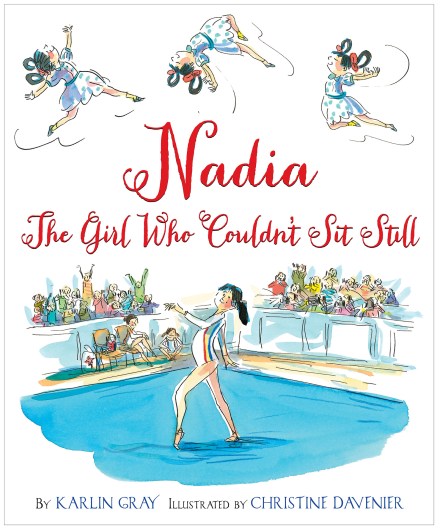
celebrate-picture-books-picture-book-review-nadia-the-girl-who-couldn't-sit-still-cover

Image copyright Christine Davenier, courtesy of Houghton Mifflin Harcourt Publishing Co.

About the Holiday

In so many ways children and young adults are not only our future but they lead the world forward now. In recognition of this, the United Nations established International Youth Day to work toward ensuring that all children have access to resources to make positive and progressive choices. The theme for this year’s International Youth Day revolves around sustainable consumption, an important topic for the world our young people are inheriting.

It’s fitting that today’s holiday comes during the Olympic Games, a showcase of the best determination, hope, and spirit of today’s youth and tomorrow’s promise. A “perfect” reminder of that is the subject of today’s book!

Nadia: The Girl Who Couldn’t Sit Still

Written by Karlin Gray | Illustrated by Christine Davenier


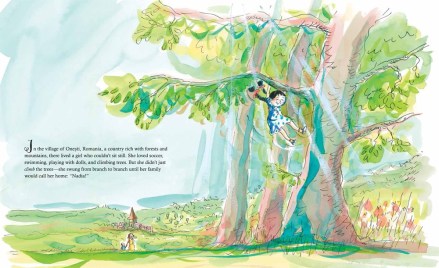
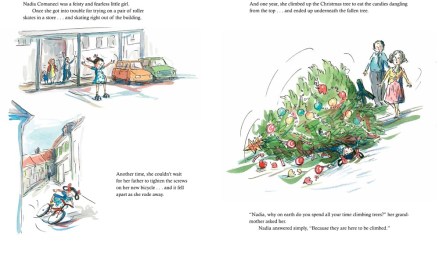
“In the village of Oneşti, Romania, a country rich with forests and mountains” Nadia Comaneci could often be seen swinging from tree branch to tree branch. She was a little girl who loved to play. She was “feisty and fearless,” attempting new things on a whim and always with a sense of adventure. Once she tried on a pair of roller skates and skated right out of the store! Another time she was so impatient to ride her new bike that she pedaled off before her father could even tighten the screws. The bike “fell apart as she rode away.” And one year her love of climbing trees extended to the family Christmas tree, which toppled over on her, pinning her to the ground.

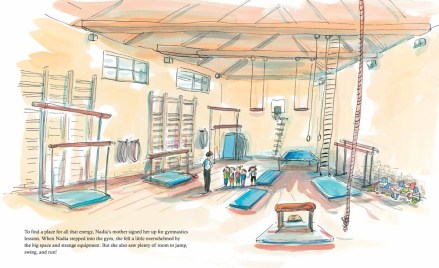
To channel all that energy, Nadia’s mother enrolled her in gymnastics lessons. Nadia’s eyes lit up when she saw the room full of ropes, ladders, bars, mats, and trampolines to discover, but she didn’t leave her new skills at the gym. Nadia and a friend cartwheeled around the school playground, capturing the attention of Bela and Marta Karolyi, who owned a gymnastics school. They invited the girls to join.

celebrate-picture-books-picture-book-review-nadia-the-girl-who-couldn't-sit-still-swinging-in-trees

Image copyright Christine Davenier, courtesy of karlingray.com

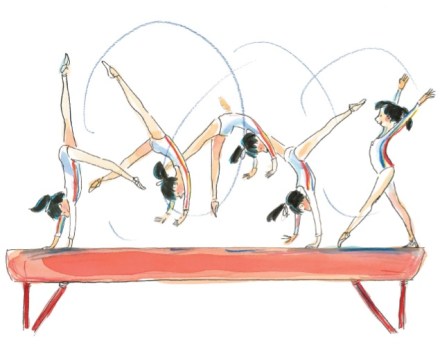
Nadia was only 6 when she began studying with Bela and Marta. Immediately, she discovered that she liked gymnastics better than her school subjects. She progressed quickly from performing “a straight cartwheel on a line painted on the floor” to doing it on a low balance beam and finally on the high balance beam. She began learning harder and harder moves, “flying from bar to bar, from floor to vault, and high above the beam.”

At 9 years old, Nadia competed in her first National Junior Championship. Despite her skill and hard work, she fell from the high beam during a leap not once but three times. Nadia finished the competition in 13th place. Her disappointment only strengthened her resolve. She went back to the gym and continued to practice many hours every day. Her determination paid off, “and at the next National Junior Championship games, she won first place.”

The ultimate recognition of her skill came when she was chosen to be part of the 1976 Romanian Olympic team. The games were held in Montreal, Canada, and all eyes were on the returning gold medalists from Russia, Olga Korbut and Lyudmila Turischeva. But excitement soon filled the venue as Nadia performed on the beam, the floor, and the vault where she scored 9.9, 9.75, and 9.7 on a scale of 1 (the lowest score) to 10 (a perfect score). The next event was the uneven parallel bars on which Olga Korbut had just scored a 9.9. “Nadia mounted the bars. Now fourteen years old, she was a long way from the forests in Romania. But she swung around as easily as she had jumped from branch to branch as a little girl. The audience gasped as she twirled and whipped and flipped.”

celebrate-picture-books-picture-book-review-nadia-the-girl-who-couldn't-sit-still-gym

Image copyright Christine Davenier, courtesy of karlingray.com

Nadia dismounted and landed perfectly on the mat below as the audience “exploded with applause.” Nadia returned to her team to wait for her score. And wait…and wait. Finally, the score appeared on the board—1.00. The worst score. How could that be? “‘What is Nadia’s score?’” Bela asked the judges. “One of the officials held up ten fingers as a voice announced over the loudspeaker: ‘Ladies and gentlemen, for the very first time in Olympic history, Nadia Comaneci has received the score of a perfect ten!’”

Because no one had ever achieved a 10 before, the scoreboards were programmed only for a high of 9.9. Nadia couldn’t bask in her accomplishment for long, however. She moved on to her next event—and her next perfect 10! “When the competition ended, she had earned seven perfect 10s.” At the medal ceremony both Olga and Lyudmila congratulated their competitor as the new Olympic champion. In all Nadia won five medals and became the youngest ever Olympic gold medalist in gymnastics.

celebrate-picture-books-picture-book-review-nadia-the-girl-who-couldn't-sit-still-balance-beam

Image copyright Christine Davenier, courtesy of karlingray.com

Nadia became a darling of the press. They surrounded her, asking “how it felt to have the world’s attention, if she had been confident she would win, and when she would retire.” She answered each reporter with enthusiasm and confidence, and promising that she was a long way from retiring. When she returned home, it seemed that all of Romania had come out to welcome her and her teammates—even the country’s president.

Now Nadia was famous all over the world. She returned to practicing and inventing new routines, preparing for other competitions and the 1980 Olympic Games. She had come far from swinging branch to branch in the trees of Oneşti, but she would always be that little girl who couldn’t sit still.

Karlin Gray’s compelling biography captures all the spunk and spirit of Nadia Comaneci that made the world fall in love with her at the 1976 Olympic Games. Adults of a certain age well remember watching her in astonishment as she seemed to effortlessly swirl, twirl, and flip through her routines, flashing her sweet smile as she waved to fans. In the first pages Gray reveals anecdotes of Nadia’s adventurous nature that will captivate readers even as they giggle at her predicaments.

celebrate-picture-books-picture-book-review-nadia-the-girl-who-couldn't-sit-still-mishaps

Image copyright Christine Davenier, courtesy of karlingray.com

The straightforward narration of Nadia’s trajectory from playground cartwheeler to Olympic champion enhances both the gritty determination of her studies with her coaches as well as the suspense of her competitions. All children—no matter what their talent—will draw inspiration from Nadia’s story, which includes disappointments as well as unbounded accomplishments. Gray’s lyrical language flows as smoothly as Nadia flew through the air and will land in readers’ hearts as a perfect 10.

From the cover, which sports Nadia in her iconic floor exercise pose, to the last page, Christine Davenier depicts the world of gymnastics with beauty and the kind of realistic details that create a classic. The two-page spread of the gym where 6-year-old Nadia learns to love gymnastics portrays the enormity of the space and the equipment for a small girl—as well as the enormity of her achievement.

Kids will love the almost “play-by-play” illustrations of how Nadia learned to perform her feats, from starting with a line on the floor to perfecting the high beam and more. Nadia is shown leaping, somersaulting, doing handstands, and even wavering and falling as she practices and competes. The thrill of the Olympic Games, from the opening ceremonies, to the rapt and cheering audiences to the awards ceremony are drawn with stirring action, color, and attention to the specifics of that very special 1976 summer in Montreal.

An Afterword expands on Nadia Comaneci’s courageous life choices and career post-gymnastics and includes a timeline, notes, a selected bibliography, and websites for further study.

Nadia: The Girl Who Couldn’t Sit Still will fascinate kids and would be a very welcome addition to school classroom—as well as home—libraries.

Ages 5 – 10

Houghton Mifflin Harcourt, 2016 | ISBN 978-0544319608

Visit Karlin Gray‘s website to learn more about her and to download fun activities!

View a gallery of artwork by Christine Davenier on her website!

Discover more about Nadia: The Girl Who Couldn’t Sit Still on the Houghton Mifflin Harcourt website!

International Youth Day Activity

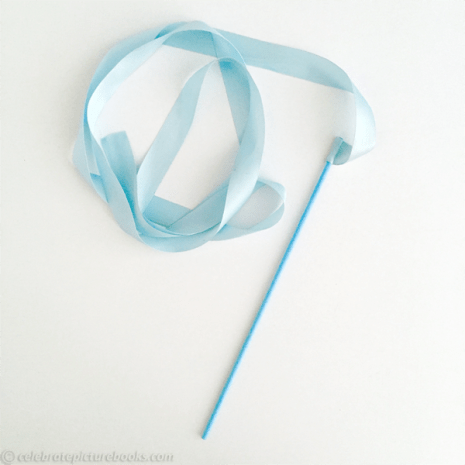
celebrate-picture-books-picture-book-review-rhythmic-gymnastics-ribbon-craft

Rhythmic Gymnastics Ribbon


You can recreate the grace of rhythmic gymnastics with this easy craft! The swirling beauty of the ribbon makes any movement fun!

Supplies

  • 12-inch dowel
  • 6-foot length of ribbon
  • Paint the same color as the ribbon
  • Hot glue gun or strong glue
  • Paint brush

Directions

  1. Paint the dowel and let dry
  2. Glue the edge of the ribbon to one end of the dowel. Wrap the ribbon about ½ inch around the dowel and secure with glue. Let glue dry.

Picture Book Review

July 31 – Uncommon Instrument Awareness Day

celebrate-picture-books-picture-book-review-ada's-violin-cover

About the Holiday

Today is the day to be musically experimental. Intriguing, inventive instruments that make a wide variety of sounds exist in every corner of the world. From Russia comes the contrabass balalaika, a triangular stringed instrument. The cimbalom, a concert hammered dulcimer, originated in Hungary. And only the Welsh could give us an instrument with no vowels: the crwth. Glass, water, and lightning are also used to make beautiful sounds, and the Holophonor—a musical instrument and hologram projector all in one—is perfect for Elvis sightings wherever he is! So, play a different instrument or research one, and read the inspiring story in today’s book!

Ada’s Violin: The Story of the Recycled Orchestra of Paraguay

Written by Susan Hood | Illustrated by Sally Wern Comport


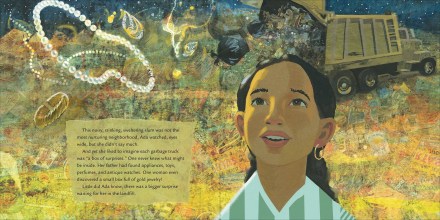
Ada Ríos is growing up in Cateura, a town built of trash as the main garbage dump for the capital city of Paraguay. Every morning the refuse trucks rumble into town to deposit their loads—1,500 tons of trash every day. The citizens of Cateura—gancheros or recyclers—go to work sifting through the mounds and tearing into bags looking for anything valuable enough to recycle or sell. Cardboard is worth 5 cents a pound, plastic 10 cents a pound.

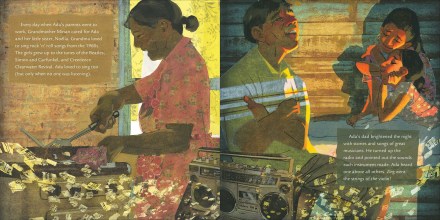
Ada knows the landfill can hold surprises—“Her father, a ganchero, had found appliances, toys, perfumes, and antique watches.”—but she can never imagine what it holds for her. When Ada and her sister were little, their grandmother watched them while their parents worked. They loved to listen to music, to sing, and to learn stories of musicians and the sounds of different instruments. Ada fell in love with the violin.

celebrate-picture-books-picture-book-review-ada's-violin-making-singing

Image copyright Sally Wern Comport, courtesy of simonandschuster.com

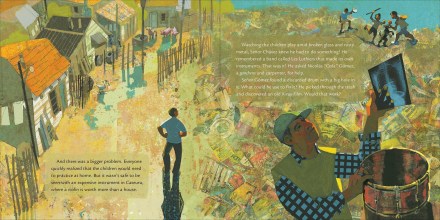
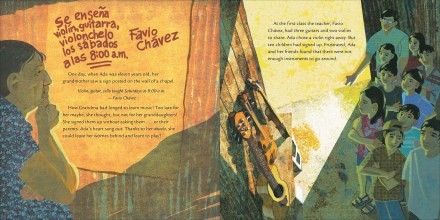
As the girls grow older and go to school, they venture farther into town, but there is little to fill their time. Many kids join gangs or get into fights. When Ada is 11 her grandmother signs her and her sister up for music lessons being offered by a new man in town named Favio Chávez. “Ada’s heart sang out” when she hears the news. On the first day ten children show up to play the five instruments available. But a bigger problem looms: the three guitars and two violins cannot be taken home for practicing as they are magnets for thieves. In Cateura a violin is worth more than a house.

But Favio Chávez has an idea. With help from Nicolás Gómez, a ganchero and carpenter, they pull bits and pieces from the landfill. An old broken drum and an X-ray film become a workable drum, water pipes become flutes, packing crates become guitars and violins, and oil drums become cellos. “Ada chose a violin made from an old paint can, an aluminum baking tray, a fork, and pieces of wooden crates. Worthless to thieves, it was invaluable to her. It was a violin of her very own.”

celebrate-picture-books-picture-book-review-ada's-violin-making-instruments

Image copyright Sally Wern Comport, courtesy of simonandschuster.com

The children practice tirelessly outside in 100-degree heat until the initial “screeches, twangs, and tweets hit all the right notes. Their class became ‘a small island’ where Chávez taught them to respect themselves and one another.” They become known as The Recycled Orchestra. Music now fills the air, adding a soundtrack of beauty to the grueling work. The orchestra is soon invited to play concerts in Cateura and the capital city of Asunción. When word spreads of their talent, they receive offers to play from other cities and even other countries.

When Ada is 16 The Recycled Orchestra is invited to tour with a world-famous rock band. As Ada takes the stage in front of 35,000 people in Bogotá, Colombia, she is afraid, but the audience cheers for them and sings along as they play. On that night the children discover a new life. “Buried in the trash was music. And buried in themselves was something to be proud of.”

celebrate-picture-books-picture-book-review-ada's-violin-lessons

Image copyright Sally Wern Comport, courtesy of simonandschuster.com

An extensive author’s note plus a photograph of The Recycled Orchestra, websites, and videos follow the text, as well as a list of sources.

Ada’s Violin is also available in a Spanish edition—El violín de Ada: La Historia de la Orquesta de Instrumentos Reciclados del Paraguay.

Susan Hood has brought to light an incredible story of perseverance, hope, and the ability of music and other arts to provide opportunities and self-confidence that change lives. Told with unstinting honesty and sensitivity, Hood’s biography of Ada Ríos, Favio Chávez, and The Recycled Orchestra will inspire all who read it. The well-paced text offers revealing details on every page and flows with a lyrical quality that enhances the effect of the story and its impact. From the first sentence to the last, both children and adults will be riveted to The Recycled Orchestra.

celebrate-picture-books-picture-book-review-ada's-violin-hope

Image copyright Sally Wern Comport, courtesy of simonandschuster.com

Sally Wern Comport’s paintings beautifully capture the human spirit that shines through and drives people to astonishing achievements even in the most adverse conditions. With intricately created collages of rich hues, Comport depicts the town of Cateura and the mountains of trash the citizens work and play on. Warm lighting illuminates faces full of dreams and love, and readers will linger over depictions of the instruments workshop and cheer along with the concert audience as the children receive recognition. The full-bleed, two-page spreads echo the expanded world music gave to the children in the orchestra and the adults who heard them as music score confetti flutters throughout.

Both school classrooms and home libraries will benefit from the stirring message of Ada’s Violin.

Ages 4 and up

Simon & Schuster Books for Young Readers, 2016 | ISBN 978-1481430951 (English edition); 978-1481466578 (Spanish edition)

Discover more about Susan Hood and her books, plus fun activities for kids and information for teachers and parents on her website!

View a gallery of Sally Wern Comport’s artwork on her website!

Uncommon Instrument Awareness Day Activity

celebrate-picture-books-picture-book-review-homemade-musical-instrument


Make Your Own Musical Instrument


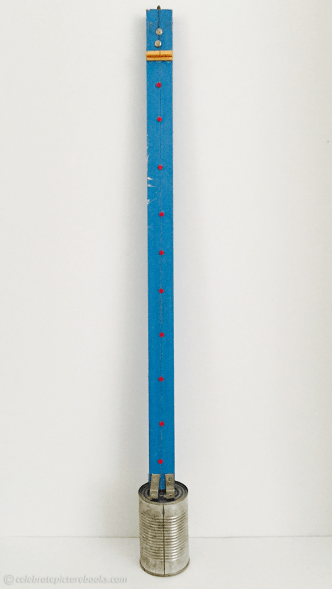
Inspiration for sound can come from almost any object! Look around your house or classroom and discover the music in boxes, cans, blocks of wood, plastic egg cartons or deli containers, and more. Add string or wire for plucking, sticks for drumming, or beans for shaking. With a little glue, tape, or hardware and some creativity, you’ll be making your own rhythms in no time!

Supplies for the instrument shown in the picture above

  • Tin can
  • Two small L brackets
  • Piece of wooden molding, 2 1/2 feet by 1 1/2 inches by 3/4 inches
  • Five small strips of wood to raise the wire off the neck of the instrument. I used long wooden fireplace matches cut into 1 1/2″ sections 
  • Thin wire
  • Small circular hook screw or regular screw
  • Two tacks
  • A nail, screw, or piece of wood that will fit horizontally in the mouth of the can
  • a small nail to make a hole in the can
  • Hammer
  • Strong Glue
  • Paint
  • Foam decorative dots

Directions

  1. Paint the wood and let dry
  2. Paint the small strips of wood and let dry
  3. Decorate the can with paint, sticker, duct tape, or paper
  4. With the hammer and small nail, make a hole in the center of the bottom of the can
  5. Wrap one end of the wire around the nail and glue so it is firmly in place
  6. Feed the other end of the wire through the hole in the bottom of the can
  7. Screw or glue two L brackets to one end of the wood molding so that the bottom of the L is flush with the bottom of the wood molding and there is space between the brackets. This makes the neck of the instrument
  8. Screw the circular or regular screw into the top, center of the wooden molding
  9. When the wooden strips are dry, glue three side by side 3 inches from the top of the molding. Glue two more matches, one on top of the other on the center strip.
  10. When the L brackets are dry, glue them (and the neck of the instrument) to the can, making sure the brackets are on either side of the hole in the can. Make sure the wire is out of the hole. 
  11. When the brackets are firmly attached to the can, pull the wire to the top of the neck. Settle it in the center of the small pieces of wood, so that the wire is not touching the neck.
  12. Wrap the wire around the screw at the top of the molding until it is firmly in place and the wire is taut. 
  13. Secure the wire to the neck with the tacks
  14. Mark the “frets” with the foam dots

Picture Book Review