July 4 – Independence Day

celebrate-picture-books-picture-book-review-lady-liberty's-holiday

About the Holiday

On July 4, 1776, the thirteen colonies that then made up America claimed their independence from England. After much debate and with a majority—but not unanimous—vote, delegates to the Continental Congress adopted the Declaration of Independence. While the vote may not have been unanimous, delegates from all 13 colonies signed the document penned by Thomas Jefferson. John Hancock, who was President of the Continental Congress, signed his name “‘with a great flourish’ so England’s ‘King George can read that without spectacles!’” The action led to the Revolutionary War and ultimately to a break with England.

On this United States national holiday most cities host parades, fireworks displays, and other special events.

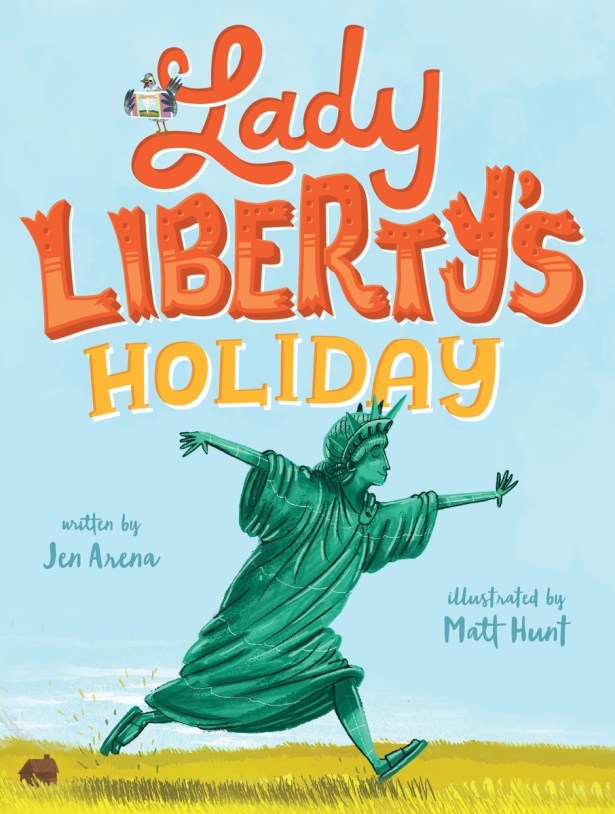
Lady Liberty’s Holiday

Written by Jen Arena | Illustrated by Matt Hunt


Shortly before the Fourth of July Lady Liberty is feeling down. Year after year she has stood in the same place holding aloft a torch in one hand and cradling a tablet in the other. She turns to her friend Moe, the pigeon on her shoulder, and expresses her dissatisfaction. Moe has a suggestion: “‘Lady, you need a getaway!’” Lady Liberty thinks about it and about the vastness of America. She has only seen a small corner of it. That night Lady Liberty pries herself from her pedestal and sneaks away.

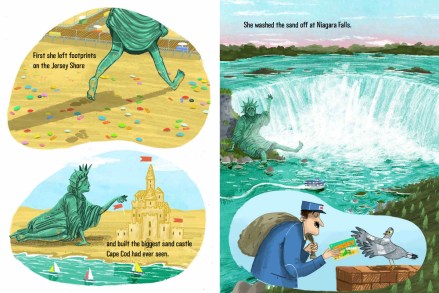
She walks the wide beaches of New Jersey, builds a huge sandcastle on Massachusetts’ Cape Cod, and dips her feet in Niagara Falls. With her long strides it doesn’t take her long to reach the Mississippi River. She finds a seat atop the Gateway Arch in St. Louis, Missouri and watches the Ol’ Man river slip past. In Kansas she plays in wheat fields that “tickle her feet” and are as good for making angels as snow. In South Dakota she photo bombs at Mount Rushmore, and she takes a quick hike over the Rocky Mountains. After all this fun Lady Liberty needs a rest, so she takes a nap on San Francisco’s Golden Gate Bridge.

But the people in New York have noticed the Lady’s absence. The Fourth of July is only three days away and no one is in the mood to celebrate without her. “Tourists were gloomy. Cops were cross. Even the stock market was down.” The mayor is even considering cancelling the holiday! Moe is worried Liberty might not come back.
celebrate-picture-books-picture-book-review-lady-liberty's-holiday

Image copyright Matt Hunt, courtesy of Jen Arena (jenarenabooks.com)

And Moe is right! Lady Liberty is enjoying herself too much to think about returning. The grandeur of the Grand Canyon makes her feel small—it’s a nice change, she thinks. She drinks water from a geyser in Yellowstone Park and sleeps under the stars in Texas. With a hop and a skip she’s dancing in New Orleans, and the Florida Keys make excellent “stepping stones” to her next adventure. She doesn’t even mind schlepping through swamps in the deep south, and an alligator that latches onto her toe is dispatched with a shake.

Lady Liberty suddenly hears the familiar flap of Moe’s wings. Moe tells Liberty how things are in New York. When she hears that they are thinking of cancelling the Fourth of July, she “bolts up as if she’d been struck by lightning.” Yes, says, Moe. “‘Nobody feels like celebrating without you.’” But after her cross-country tour, Lady Liberty knows that “‘the Fourth of July isn’t about me. It’s about America!’” Without another thought Liberty is racing north.

As New Yorkers wake at dawn, they see Lady Liberty happy to be back overlooking the Harbor, “where she had stood for over a hundred years.” Her copper dress shines in the early morning sun. Later that night she glows again in the colors of fireworks and enjoys a very Happy Fourth of July!

The final two pages tell the story of Lady Liberty’s creation, installation, and meaning. Tantalizing tidbits about the statue of Liberty are also revealed.

Jen Arena’s Lady Liberty’s Holiday is an engaging introduction to the story of the Statue of Liberty and American geography. A road trip across America was once a staple of childhood, and Arena replicates the excitement and wonder of viewing the country’s monuments and splendor through Lady Liberty’s walking tour. As each page brings readers to another awe-inspiring landmark, kids will want to learn more about the parks, states, and history of America.

Matt Hunt’s vibrant, full-bleed spreads are as expansive as the American landscape. The blue waters of Niagara Falls roar over the edge, creating white mist; the rock-hewn faces of George Washington, Thomas Jefferson, Teddy Roosevelt, and Abraham Lincoln gaze out from the peak of Mount Rushmore; and the spume of water from a Yellowstone geyser dwarfs the tourists below. As Liberty towers over cruise boats and trees, lounges across the Golden Gate Bridge, and flicks away a pesky alligator, kids gain an excellent perspective on the size of the Statue of Liberty as well as the monuments and natural landmarks she visits.

Like the postcards that Liberty sends to her friend Moe from stops on her journey, Lady Liberty’s Holiday is a welcome snapshot of America any time of year.

Ages 4 – 8

Knopf Books for Young People, Random House Kids, 2016 | ISBN 978-0553520675

To learn more about Jen Arena and view the books she’s written , visit her website!

A gallery of Matt Hunt‘s work can be seen on his website!

Independence Day Activity

celebrate-picture-books-picture-book-review-fourth-of-july-coloring-page

Fourth of July Coloring Page


The 4th of July celebrations mean flags, fireworks, and fun! Here’s a printable Fourth of July Coloring Page for you to make your own holiday festivities. You can even make it sparkle with a dash of glitter!

July 3 – Compliment Your Mirror Day

celebrate-picture-books-picture-book-review-why'd-they-wear-that

About the Holiday

Take a peek in the mirror and who do you see? That’s right—a fantastic person with inner and outer beauty! Today is dedicated to recognizing and appreciating that person in the mirror!

Why’d They Wear That? Fashion as the Mirror of History

By Sarah Albee


Whether you’re a fashionista or an “any ol’ thing will do” kind of person, there’s no denying that clothes make a statement. Sarah Albee’s fascinating look at human wraps spans history from 10,000 BC to the modern era. Along the way she exposes both historical facts as well as the often repugnant, laughable, and can’t-look-away fashion fads and disasters that have brought us to “wear” we are today. 

In Chapter 1: That’s a Wrap, Albee reveals facts about the first needles and thread, silk production, the Mayan tradition of forced elongation of skulls (this was considered attractive, denoted social status, and was intimidating), the first pants, warrior wear, and much more.

Chapter 2: Keeping the Faith exposes the influence religion had on clothing in the Middle Ages. White or russet colored robes were worn by men traveling on pilgrimages while penitents could wear a hair shirt made of itchy, bristly horsehair as punishment. Medieval armor, Samurai dress, why modern men’s loafers are decorated with little holes, and more are also discussed here as is the job of Wool Fuller – in which the Fuller soaked wool in urine to degrease it and improve its texture.

celebrate-picture-books-picture-book-review-why'd-they-wear-that

Image courtesy of National Geographic

Chapter 3: Going Global covers the Age of Exploration, which changed fashion as explorers from Europe came in contact with Native peoples in the New World. Red dye, rubber shoes, and the leather Moccasins were all adopted by Europeans. And if you think the search for remedies for wrinkles and other vestiges of older age is a modern pursuit, you’ll learn about Ponce de Leon and his quest for the fountain of youth.

Chapter 4: Ruff & Ready takes a look at the Renaissance. You may have seen fur stoles with the head of the animal still attached and wondered, Why? This fashion statement goes back to “Flea Furs” which were dead, stuffed animals that people draped over their shoulders in the belief that the fleas that were munching on their skin would transfer to the animal instead. Unfortunately, people discovered that fleas prefer warm bodies. Another curious fad was the ruff collar. While people may have thought they looked swell, these collars hindered physical movement and even led to the invention of the long-handled spoon because people could not get food to their mouths any other way. One “benefit” perhaps: when the first American settlers ran out of all other food options, they ate their collars, which were stiffened with wheat paste. And there’s so much more!

In Chapter 5: Lighten Up! readers will discover facts about the dour dress of the Puritans and the ostentatious dress of the French court. The tradition of men’s wigs is explained, and today’s face-painting has nothing on the unusual solution for facial blemishes—black velvet, leather, or silk patches in various shapes.

celebrate-picture-books-picture-book-review-why'd-they-wear-that

Image courtesy of National Geographic

Revolutionary Times take center stage in Chapter 6: Hats (and Heads) Off. During this time clothes began to fit the task. There were clothing items to protect (walking canes became popular as a way to ward off marauding wild dogs), uniforms to highlight the good looks of running footmen, elaborate costumes for Venetian parties, and homespun clothes that became a sign of protest from the American colonists. And if you think “bumpits” and hair extensions are new, women trying to keep up with Marie-Antoinette wore their hair (real and artificial) “cemented upward over wire armatures into two-foot (0.6-m)-high coiffures that made the wearer stand 7 ½ feet tall!”

Chapters 7 through 9 bring readers into the modern age, taking them from a time when children were dressed as young adults and boys wore elaborate gowns until the age of 7 to the textile innovations of the Industrial Revolution and the popularity of bustles that put fanny packs to shame to the fads of the 1960s and today.

celebrate-picture-books-picture-book-review-why'd-they-wear-that

Image courtesy of National Geographic

Albee’s Why’d They Wear That? is much more than a book about fashion. It’s a humorous, fabulously entertaining way to learn about so many aspects of history, from social revolution to inventions to cultural differences. Enlightening side bars, especially the fascinating “Tough Job” entries, and full-color illustrations, paintings, and photographs depicting every concept make Why’d They Wear That? an essential book for school libraries as well as for home bookshelves. Readers of all ages will want to dip into it again and again…and will “Oh!” “Ah!” and “Ewww!” over every page.

Ages 7 and up (children on the younger end of the range will enjoy the facts and pictures during a read-along session) 

National Geographic Children’s Books, 2015 | ISBN 978-1426319198

Learn more about Sarah Albee and her books on her website!

Watch the trailer for Why’d They Wear That? Fashion never looked so…good? unsettling? hilarious? You decide!

Compliment Your Mirror Day Activity

celebrate-picture-books-picture-book-review-mirror-word-search

Mirror, Mirror, What Shall I Wear?


In this magic mirror word search are 20 fashion-related terms from history. Find them all! Here’s the printable Mirror, Mirror, What Shall I Wear puzzle and the Solution.

June 21 – World Music Day

celebrate-picture-books-picture-book-review-hey-charleston

About the Holiday

Celebrated every year on the summer solstice, World Music Day, also known as the Fête de la Musique, brings together professional and amateur musicians to ply their trade and entertain audiences for a day full of sound. The day was first conceived in 1982 by French Minister of Culture Jack Lang, who elicited the help of Maurice Fleuret, the Director of Music and Dance. When Fleuret discovered that half of the nation’s children played a musical instrument, he devised a way to bring people out into the streets for a music festival. Since then, the event has become an international phenomenon, celebrated in more than 700 cities in 120 countries worldwide. To participate consider organizing or attending a  free concert or enjoying music in your favorite way.

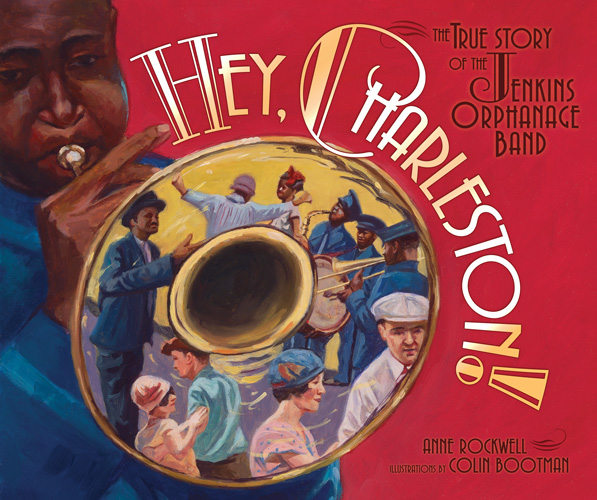
Hey, Charleston! The True Story of the Jenkins Orphanage Band

Written by Anne Rockwell | Illustrated by Colin Bootman


“Have you ever known someone who was always trying to turn bad into good, always seeing hope where others saw despair?” This question, which begins the biography of Reverend Daniel Joseph Jenkins and the orphans he loved is as relevant today as it was in the early 1900s, when this story takes place. Reverend Jenkins was the pastor of a small church in Charleston, South Carolina. One night while collecting scrap wood at a railroad yard, he discovered a group of boys huddled and sobbing inside a freight car. Reverend Jenkins took them to his church, fed them, and gave them a warm place to sleep. He knew what it was like to be an orphan because he had been one too.

Soon more orphans showed up at the church door, and Reverend Jenkins accepted them all. Room grew tight so he convinced the city officials to give him an abandoned warehouse for his orphanage. There was just one drawback: the warehouse was next to a prison, where less-than-desirable sounds emanated from the walls. Reverend Jenkins figured out a way to drown out the noise, however. He gathered the orphans and led them in song outside the orphanage door. The kids were good singers, and that gave the reverend an idea.

He had grown up during the Civil War and remembered the marching bands that led the soldiers into battle. He remembered the instruments these musicians carried and asked for any that were now unused to be donated to the children. Instruments poured in! They were polished and tuned and the children learned to play under the direction of the best teachers in Charleston. With the money Reverend Jenkins thought they could make entertaining people, he planned to buy a farm for the orphans.

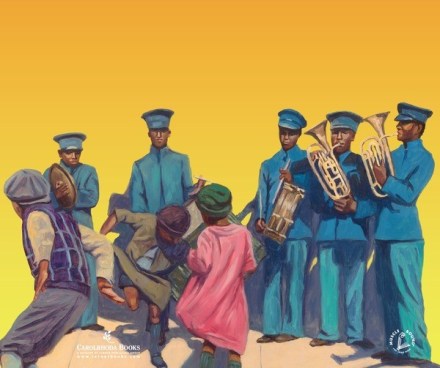
Soon the Jenkins Orphanage Band was playing on street corners and in other venues. Many of the kids were descended from the Geechee or Gullah people who lived on islands off the coast of South Carolina, and they played the old band music with their own special rhythm, called “rag.” “A couple of Geechee boys would lead the band by doing a dance—twisting and twirling and tapping their toes, knocking their knees, and flapping their arms.” People loved the music, but most South Carolinians were poor and couldn’t donate much to the orphans. Reverend Jenkins decided to take his band to New York City. The band took the city by storm! People loved when the kids played their raggedy music and soon were imitating the Geechee boys’ dance. “Hey, Charleston,” they’d shout, “Give us some rag!” They called the dance “the Charleston,” and soon everyone was doing it.

celebrate-picture-books-picture-book-review-hey-charleston-interior-art

The orphans made so much money they were able to buy a new house, and the music instruction became so renowned that families began paying to have their children taught along with the orphans. The band continued to travel around the United States, and they were even invited to perform in the inaugural parade for President Theodore Roosevelt. Finally, they were able to buy the farm Reverend Jenkins had dreamed of.

In 1914 the Jenkins Orphanage Band was even invited to play for Britain’s King George V at the Anglo-American Exposition in London. While they were there, however, Britain entered World War I. The British government ensured that the band had safe passage back home, but many other Americans were stranded in England. Reverend Jenkins offered to lend these citizens the money needed for them to return home as well.

The ship sailed silently through the dangerous Atlantic Ocean until it reached an American port. Once safe the passengers shouted, “‘Hey, Charleston! Give us some rag!’” Happy to be home, the band tuned up their instruments and played loudly and enthusiastically for the shipboard audience. As the passengers disembarked in New York Harbor, crowds greeted them with a hearty welcome. Back home “as they lay down to sleep that night, those band players knew they had done what Reverend Jenkins always taught them. They had turned bad into good.”

Anne Rockwell succinctly and clearly relays the story of the Jenkins Orphanage Band while also retaining all the heart and soul of this fascinating group of children and their dedicated caregiver. The true-life tale is mesmerizing, not only for the historical details of the growth of ragtime music and the Charleston dance but for the accomplishments of the orphans once given love, acceptance, and education. Rockwell’s conversational tone contributes to the story’s smooth, flowing pace, which will keep listeners or readers rapt from beginning to end.

Colin Bootman’s bold two-page spreads illuminate the sights and sounds of the early 1900s for readers. Emphasizing the personal connections between Reverend Jenkins and the orphans as well as the band and their audiences, Bootman’s vibrant paintings are full of people watching, dancing, marching, and celebrating these boys’ awesome gifts.

Ages 6 – 10

Carolrhoda Books, 2013 | ISBN 978-0761355656

World Music Day Activity

celebrate-picture-books-picture-book-review-musical-instruments-word-search


It’s Instrumental Word Search


Triangles may not get a lot of play in an orchestra, but there’s plenty of play in this printable It’s Instrumental Word Search that contains the names of 20 instruments! 

June 20 – American Eagle Day

celebrate-picture-books-picture-book-review-is-a-bald-eagle-really-bald

About the Holiday

The first American Eagle Day was proclaimed by President Bill Clinton and Tennessee Governor Don Sundquist in 1995 to commemorate and bring awareness to this most enduring American symbol. Chosen as the United States’ National Emblem by our Founding Fathers on June 20, 1782, the Bald Eagle represents the best of America: freedom, courage, strength, spirit, and excellence. Once threatened with extinction—only 400 nesting pairs existed in the early 1960s—the American Eagle has made a comeback, with 15,000 nesting pairs living in the lower 48 states. Besides celebrating what the American Eagle symbolizes, today’s holiday is used to raise awareness of conservation efforts for this most majestic bird.

Is a Bald Eagle Really Bald?

Written by Martha E. H. Rustad  | Illustrated by Holli Conger


“Our class is having a visitor today,” Ms. Patel tells her class. “Guess who it is,” she urges after giving the kids a hint that the visitor eats fish. Anabelle thinks it might be her dad, but Ms. Patel adds that the visitor has a sharp beak and feathers. Joshua guesses that it’s a duck. The kids are getting closer, and with one more hint—Ms. Patel holds up a one-dollar bill—Rose correctly shouts, “‘a bald eagle!’”

Natalie wants to know why there’s a bald eagle on the dollar, and Ms. Patel tells her that the eagle is a symbol of our country. When John asks what a symbol is, she compares the eagle to the school’s bear mascot and goes on to say that the eagle can also be found on the Great Seal. Luke is momentarily excited about the prospect of a seal also visiting the class, but Ms. Patel shows the class that the Great Seal is actually an image. This image demonstrates that something is officially American and appears on stamps, government buildings, important papers, and even the buttons on military uniforms.

The class takes a closer look at the Great Seal, with its eagle in the center. In one foot the eagle is holding a plant, says Karen. Right, Ms. Patel says. “‘It’s an olive branch. It stands for peace.’” Noah notices that in the other foot the eagle carries arrows. The arrows represent strength, Ms. Patel explains. The banner in the eagle’s beak reads E. Pluribus Unum, which is Latin for “one from many” and describes how the single country of America is made of many states. The thirteen stars above the eagle’s head reminds us of the 13 original colonies and states.

Dr. Kelly from the raptor center soon arrives with a bald eagle named Sam. Dr. Kelly puts on a protective glove and carefully takes Sam out of his carrier. Sam is huge! Kyra exclaims, and Jackson wants to know why he’s called “bald.” Dr. Kelly explains that the word bald actually comes from piebald, which means “‘having white marks.’” The class learns many facts about bald eagles, including that they have keen eyesight, can see their prey from high overhead, and can swallow a meal in mid-air.

Then the class talks about how the bald eagle became America’s mascot. Lily raises her hand and suggests it’s because eagles fly free and Americans are free. “‘Good answer,’” Ms. Patel says. She adds that bald eagles are native to North America, and shows the class a map of their summer and winter habitats.

All too soon class is over and it’s time for lunch. “Fish is on today’s menu,” Ms. Patel tells the kids, and they feel just like bald eagles. The children say “thank you” and “goodbye” to Dr. Kelly and Sam, and after lunch they draw their own mascots. You can do that too with the activity at the back of the book!

Scattered throughout the pages, sidebars expand on the facts delivered in the story. Readers learn that the Great Seal has been used since 1782, what raptors and raptor centers are, the weight and wingspan of an adult bald eagle, incredible statistics on eagle’s nests, and about conservation efforts to protect bald eagles.

A Draw-Your-Own Mascot activity follows the text along with a glossary and resources for further study, including free downloadable educational resources.

In her Our American Symbols books Martha E. H. Rustad does a wonderful job of explaining the importance of America’s emblems to children. Through classroom discussions between a teacher and her students, Is a Bald Eagle Really Bald? answers readers’ questions about how and why the bald eagle became a United States symbol. The natural give-and-take will resonated with kids, and Rustad’s clear and kid-friendly definitions of concepts will make an impact. The inclusion of a representative from a raptor center will also feel familiar to children experienced with these types of classroom visitors as well as similar field trips. Sidebars provide more scientific and historical facts.

Holli Conger’s bright, bold illustrations distinctly depict the concepts in the text through large, colorful, and easily understood images. A bulletin board holds pictures of a bald eagle and the American flag, while the teacher holds up a school mascot t-shirt to help relay the idea of a symbol; the Great Seal is shown with well-defined details as the teacher uses a pointer to indicate its various parts; and pages portraying the visit by the raptor center representative give kids a good idea of the size and grandeur of the bald eagle. The children portrayed in the classroom are enthusiastic and welcoming, and readers will feel right at home in their midst.

Ages 5 – 9

Millbrook Press, 2014 | ISBN 978-1467744669

American Eagle Day Activity

celebrate-picture-books-picture-book-review-american-eagle-coloring-page

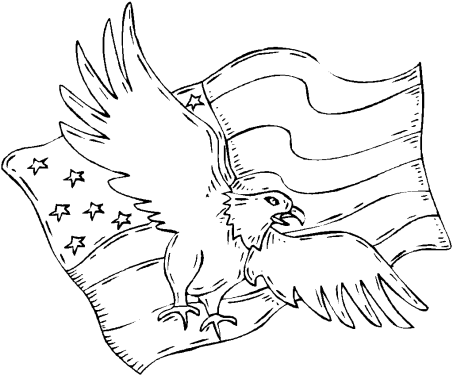
American Eagle and Flag Coloring Page


The majestic American Bald Eagle is a perfect symbol to represent the courage, freedom, and spirit of the USA. Here’s a printable American Eagle and Flag Coloring Page for you to enjoy!

June 14 – Flag Day

celebrate-picture-books-picture-book-review-why-are-there-stripes-on-the-american-flag

About the Holiday

Flag Day commemorates the day in 1777 when the “Stars and Stripes” designed by Besty Ross was adopted as the official flag of the United States by the Second Continental Congress. Through early efforts by BJ Cigrand, a school teacher in Fredonia, Wisconsin, in 1885 and George Balch, a kindergarten teacher in New York City in 1889, observances celebrating the flag’s birthday were initiated. Three decades of remembrances followed, and in 1916 President Woodrow Wilson officially established the holiday. It wasn’t until President Harry S Truman signed an Act of Congress on August 3, 1949 that June 14 was designated National Flag Day. Today, people are encouraged to display the American flag. Special events and ceremonies also take place on this day.

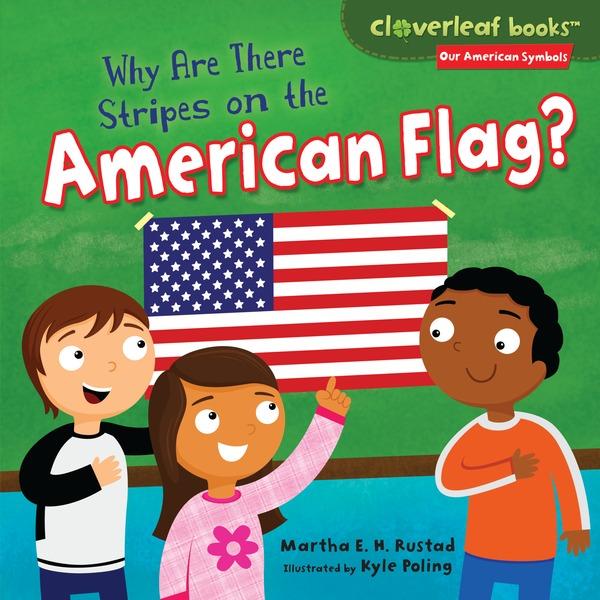
Why Are There Stripes on the American Flag?

Written by Martha E. H. Rustad | Illustrated by Kyle Poling


The school bell rings and the kids in Mr. Gomez’s class get ready to say the Pledge of Allegiance. Charles raises his hand with a question. Suddenly all the kids have questions about the flag and the words of the Pledge they say each morning. Mr. Gomez is enthusiastic about answering the kids, and the class starts a discussion that includes a bit about the Revolutionary War and how the original 13 colonies became the first states. The new government, Mr. Gomez says, wanted a symbol for the country.

In 1777, Mr. Gomez continues, the American leaders decided to use the colors red, white, and blue. The red stands for courage, the white for goodness, and the blue for fairness. The Flag Act of 1777 decreed that the flag have 13 stripes, alternating red and white, and 13 white stars on a blue field. Stars were chosen to represent the states because the founders believed America was “like a new group of stars shining in the night sky.” Mr. Gomez shows his class pictures of how the flag changed over the years as states were added to the union.

Next, the kids want to understand the wording of the Pledge of Allegiance better. Line by line, Mr. Gomez defines the more difficult words. Allegiance he explains means loyalty or friendship and that in the first line of the pledge we are promising to be loyal to and respect the flag. Respect is shown when we stand and place a hand over our heart while reciting the pledge, obey the rules of raising and lowering the flag, and other requirements. Mr. Gomez then explains what a Republic is and the idea that America is indivisible in that her people live and work as a team, staying together even when we disagree. The concepts of liberty and justice are also defined.

The class is excited with their new knowledge and before heading out for recess, they say the Pledge of Allegiance together.

A Make Your Own Flag activity follows the text along with a glossary of words used in the book and resources for further study.

Martha E. H. Rustad has written a primer about the American flag and the Pledge of Allegiance that will engage kids and teach them about these important patriotic concepts. Words such as symbol, justice, liberty, and more are described through the give and take between Mr. Gomez and his students, using familiar examples from the playground and classroom. Each page also includes facts about the US flag, the Flag Act, the design of early flags, flag etiquette, and more.

Kyle Poling’s friendly and colorful illustrations depict a diverse class where the concepts being discussed are clearly visible. Young readers will feel right at home in Poling’s classroom environment and be excited to learn about the origins of our most familiar symbol.

Ages 5 – 8

Millbrook Press, 2014 | ISBN 978-1467744652

Flag Day Activity

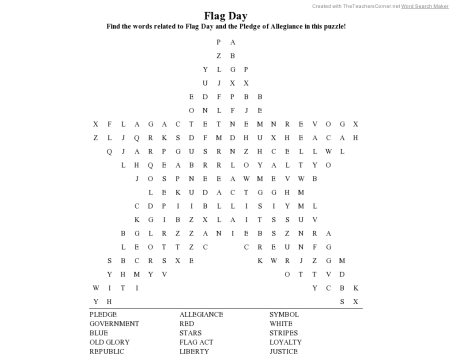
celebrate-picture-books-picture-book-review-flag-day-word-search

Star-Shaped Word Search


The stars on the American flag represent the country’s 50 states. In this printable Star-Shaped Word Search you’ll find words about the origins of the US flag and the Pledge of Allegiance. 

June 12 – National Rivers Month

celebrate-picture-books-picture-book-review-otters-love-to-play

About the Holiday

Rivers are beautiful, provide recreation, and are crucial to our water supply. Did you know that in the United States 65% of our drinking water comes from rivers and streams? This month environmentalists and others promote awareness of the importance of keeping the nation’s rivers pollution free to protect the fish and animals that call them home and increase enjoyment for all. To help the cause, join a volunteer river clean-up crew, help monitor water quality, or learn more about your local river system. Whether you like to fish, swim, boat, or just laze on the bank, June is the perfect month to get out on a river! You might even see some otters—the subject of today’s book!

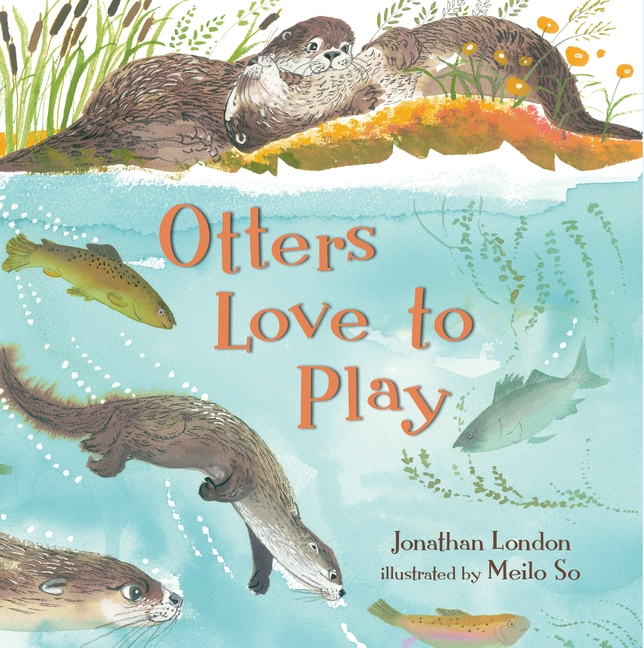
Otters Love to Play

Written by Jonathan London | Illustrated by Meilo So


It’s spring and two otters have moved into an abandoned beaver lodge to start a family. In a soft nest of moss, leaves, and grass the mother otter gives birth to three pups. The pups first open their eyes to the world when they are five weeks old. At two months old they’re ready to come out of the den to play. Playtime is fun, but for the baby otters it’s also work. Running, twisting, wrestling, and matches of tug-of-war teach valuable hunting skills and solidify family bonds.

As spring turns to summer, the pups’ thick waterproof coats grow in, and it’s time for swimming lessons to begin. There are no floaties here! The mother otter simply grabs her charges by the scruff of the neck and drops them into the river. Their mother shows them how to dive and glide and come to the surface as they follow her single file. “Within days, the otter pups gracefully spin and flip and swish like underwater acrobats.” Again and again “they scramble up a mud slide and SLIIIIIIIIIIIDE back down to the water—Ka-Spash!”

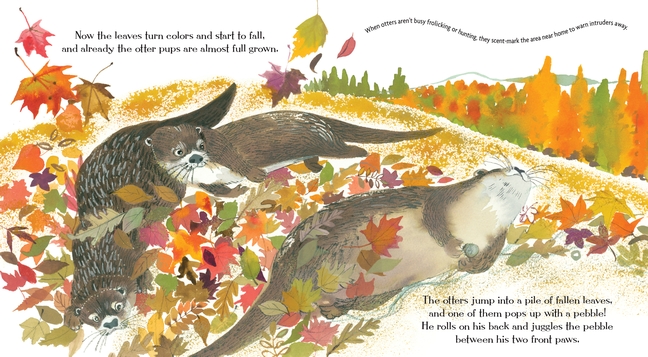
celebrate-picture-books-picture-book-review-otters-love-to-play-in-autumn

By the end of the summer the pups know how to catch small fish and how to nudge out frogs, crayfish, turtles, and snakes from their hiding places among the rocks. Autumn brings more opportunities for fun as the nearly full-grown pups tumble in the fallen leaves. Even winter’s blasts don’t deter the otters. With their thick fur they roll in the snow and catch fish in the icy river water.

But an ominous shadow appears on the fresh snow as the pups belly-slide down a snowbank. Something is waiting and watching…. So too is mother otter. Screaming and hunching she “slides across the snow and with a terrible GRRRROWL…scares the fox away!” Throughout the winter the otters snuggle in their den, and when the rainy spring makes muddy river banks, the otters come out and speed down the slippery slide “because otters love to play!”

You can’t help but love otters. Watching them dive, swim, and frolic just puts a smile on your face. And what’s more these sleek river creatures are fascinating animals! Jonathon London has written a story that captures the spirit and exuberance of one otter family while incorporating intriguing facts about their dens, birth statistics, purposeful play, hunting techniques, protective fur, predators, and defenses—did you know that otters can slide on snow at speeds up to 18 miles (29 kilometers) per hour?! London’s lyrical journey through the first year of an otter’s life makes captivating reading for young children just navigating the world themselves.

Meilo So’s enchanting otter family will delight readers. Images of the pups somersaulting, sliding, splashing, and swimming charmingly depict the sleek, supple movements of these frisky animals. Their smooth coats, rendered in soft browns with white and black accented texture, and their mischievous, ever-present smiles are realistically portrayed, inviting kids to reach out and pet them. So’s river scenes are beautiful—the pale blue water reflects deep gold and green trees, pink and yellow wildflowers and delicate green grasses flutter along the river bank, and the depths of the underwater world swirl with muted sage greens and blues as the otter pups frolic among gray- and olive-hued fish. Autumn comes with fiery orange and purple leaves, and winter falls shivery white as the russet fox is chased away.

Otters Love to Play would be a lovely gift for any child and a welcome addition to any classroom or school library.

Ages 4 – 8

Candlewick Press, 2016 | ISBN 978-0763669133

Visit Jonathan London’s website for more books by this prolific author.

View more books and art by Meilo So.

National Rivers Month Activity

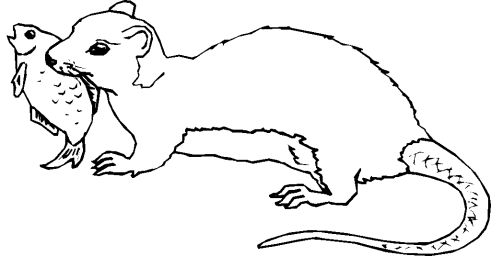
celebrate-picture-books-picture-book-review-otter-coloring-page

Otter Coloring Page


You “otter” love this coloring page, with its cute river creature who has just caught dinner! You can color it with pencils, crayons, or markers or consider making a collage with bits of paper, cloth, or leaves and sticks. Give the otter a den to snuggle in and a river for frolicking! Here’s your Otter Coloring Page!

June 6 – Russian Language Day

celebrate-picture-books-picture-book-review-mussorgsky's-pictures-at-an-exhibition

About the Holiday

Established in 2010 by the United Nations Educational, Scientific, and Cultural Organization, Russian Language Day honors the music, art, and other unique aspects of this intriguing country. The observance coincides with the 1799 birthday of Alexander Pushkin, a Russian poet who is considered the father of Russian literature. Celebrations include concerts, readings, and other cultural events. Today, listen to the music of a Russian composer, read a novel or short story, or learn a few Russian words!

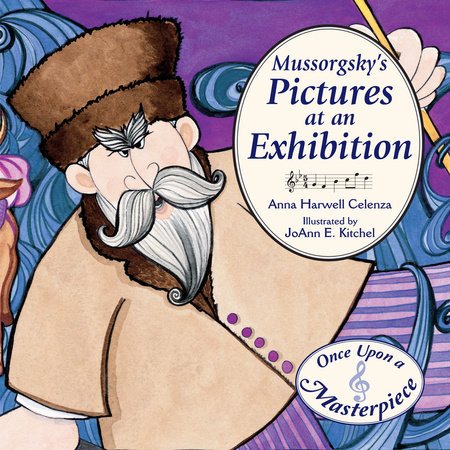
Mussorgsky’s Pictures at an Exhibition (Once Upon a Masterpiece Series)

Written by Anna Harwell Celenza | Illustrated by JoAnn E. Kitchel


It’s the 1870s and Russian culture is enjoying a resurgence. Young musicians and artists are excited to be recognized by the world. Three friends—Modest Mussorgsky, a musician; Victor Hartmann, an artist and architect; and Vladimir Stasov, an art critic—have big plans for their work. Victor, especially, has dreams of designing the new City Gate in Kiev. But on July 23, 1873 Victor suffers an aneurysm and dies. Modest is devastated. He feels that Victor’s death is his fault because he had dismissed Victor’s complaints about a headache only days before. Although Vladimir tries to comfort his friend, Modest pushes him away.

Modest stops going out, he stops being happy, and he stops writing music. Meanwhile Vladimir organizes an exhibition of Victor’s art so everyone will remember him. Vladimir and other friends think that seeing Victor’s work displayed will help Modest come to terms with his friend’s death. When the exhibit is ready, Vladimir visits Modest to invite him to come. When Modest refuses, Vladimir locks the door, puts the key in his pocket, and tells Modest he had two choices: either go to the exhibition or have a new roommate in Vladimir. Modest reluctantly agrees to go.

When they reach the gallery, Modest reluctantly enters. He is awestruck. “Every inch was filled with Victor’s hopes and dreams, his fears, and his greatest triumphs.” Slowly Modest wanders through each room, gazing at the paintings that bring back such vivid memories. He sees familiar faces, costume designs, children, couples, peasants, even Baba-Yaga, a witch from Victor’s favorite fairy tale.

Modest stops in front of Victor’s picture “The Great Gate of Kiev.” Tears fill his eyes and he thinks, “This was to be your greatest achievement…now it will never be more than a dream. If only I could build it for you.” He studies the picture for a long time, and suddenly an idea comes to him—“Maybe I can build it for you!” He dashes from the gallery straight to his piano.

As Modest thinks about Victor’s art, “one by one the spirit of each picture filled the room.” The images rise from the piano and Modest follows them from one theme to another, note by note. Some passages he plays are slow and sad, others clear and quick, while still others flutter or whisper. Even Baba-Yaga makes an appearance. With each chord special parts of Victor came to life until the last majestic strains built the Great Gate of Kiev in music. Modest calls his composition Pictures at an Exhibition.

With the spirit of his friend Victor in his heart. Modest Mussorgsky goes on to compose operas and visit with friends. Vladimir Stasov also follows his dreams to travel far and wide, and wherever he goes he tells people about Victor and Modest’s Pictures at an Exhibition

Anna Harmann Celenza relates the heartfelt story of the origins of Modest Mussorgsky’s great work with sensitivity and honors the emotional origins and effect of his Pictures at an Exhibition. The hopes of the three friends as well as the details of Victor’s artwork are evocatively described, allowing children to easily picture the feelings and objects that influenced Mussorgsky’s music.

Both the colorful architecture of Russia and the soaring notes of Mussorgsky’s music are beautifully depicted in JoAnn E Kitchel’s illustrations. Each one-and-a-half-page spread depicting scenes of St. Petersburg, Modest’s apartment, the art gallery, musical imagery, and the theater is framed in lovely floral borders, tying together the themes of art and music. Rich purples, regal blues, fiery reds, and glowing yellows makes this book a feast for the eye as well as the mind.

The book is accompanied by a CD of Mussorgsky’s work, making Pictures at an Exhibition a must have for music lovers of all ages.

Ages 6 – 10 and up

Charlesbridge, 2016 | ISBN 978-1580895286

Russian Language Day Activity

celebrate-picture-books-picture-book-review-russia-word-search

Celebrate Russia Word Search


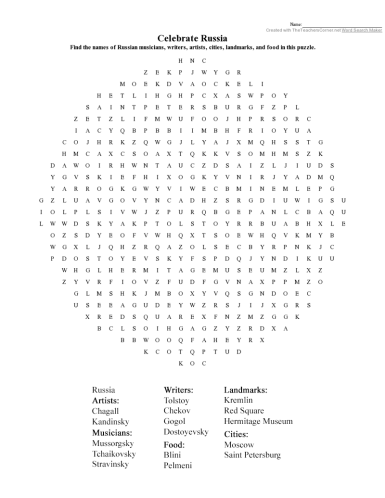
Find the names of Russian musicians, artists, writers, cities, and more in this circular word search. Print your Celebrate Russia Word Search here! And here’s the Solution!

Picture Book Review