January 30 – Chinese New Year

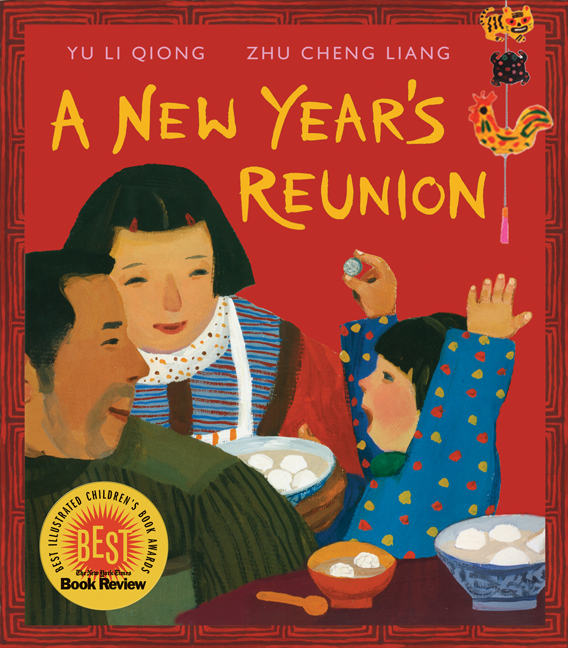
celebrate-picture-books-picture-book-review-a-new-year's-reunion-cover

About the Holiday

Chinese New Year celebrations began on the eve of January 28, ushering in the Year of the Rooster. Also known as the Spring Festival, the New Year is a time for festivities including lion and dragon dances, fireworks, visiting friends and relatives, family meals, and special decorations.The New Year is the busiest travel season of the year as family members return home to spend the holiday with loved ones. The Chinese New Year celebrations  end on the 15th day of the new year with the Lantern Festival.  People born in the Year of the Rooster are said to be honest, energetic, intelligent, flexible, and confident.

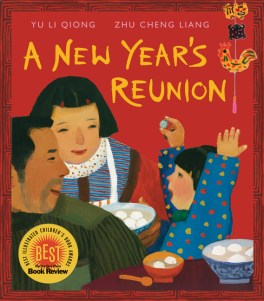
A New Year’s Reunion

Written by Yu Li-Qiong | Illustrated by Zhu Cheng-Liang


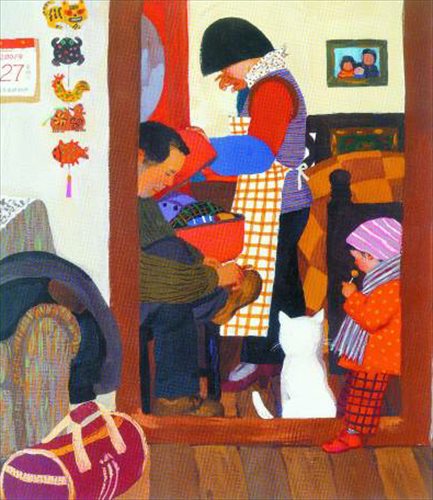
Maomao’s papa works far away as a house builder and can only return home once a year—during Chinese New Year. Today, Maomao and her mother wake up early and get ready because “Papa is coming home.” When Papa arrives, Maomao peers at her father from a distance. He seems unfamiliar, and when he picks her up in his arms she calls for her mama in alarm. But Papa has come with gifts—a hat for Maomao and a coat for Mama.

celebrate-picture-books-picture-book-review-a-new-year's-reunion-papa-decorating-house

Image copyright Yu Li-Qiong, 2011, courtesy of Candlewick Press

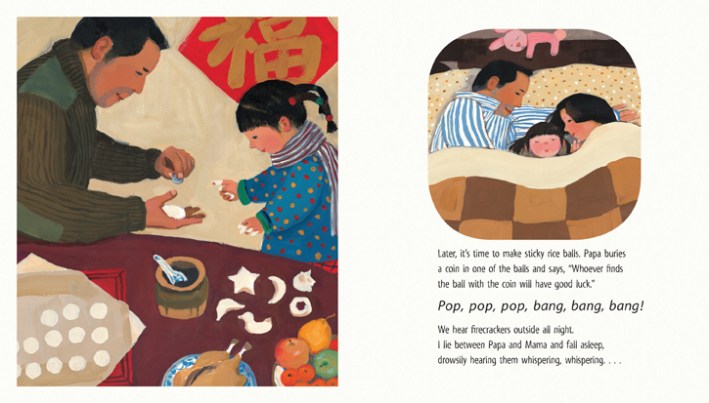
After catching up and eating lunch, Papa takes Maomao with him to the barber shop, where he gets a haircut and a shave. As Maomao watches, the Papa in the mirror is getting more like Papa the way he used to be.” Back home, Papa helps the family decorate their house and later they make sticky rice balls for the next day. “Papa buries a coin in one of the balls and says, ‘Whoever finds the ball with the coin will have good luck.’” As she falls asleep to the whispers of her parents, Maomao hears firecrackers snapping in the night air.

celebrate-picture-books-picture-book-review-a-new-year's-reunion-making-sticky-rice-balls

Image copyright Yu Li-Qiong, 2011, text copyright Zhu Cheng-Liang, 2013. Courtesy of Candlewick Press.

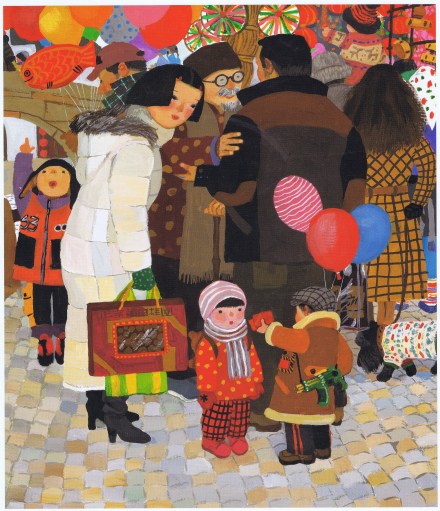
In the morning while eating the sticky rice balls, Maomao bites down on something hard. “‘The fortune coin! It’s the fortune coin!’” she exclaims. Her papa tells her to put it in her pocket so that the good luck will not escape. She places it in her coat pocket and then they all join the crowd in the square going on holiday visits. On the way she meets her friend Dachun, who shows her the red envelope he has gotten. Maomao proudly shows Dachun her lucky coin.

On the second day of New Year’s while Papa is doing chores around the house, he takes his little daughter to the roof. From here she can see Dachun’s house and hear the dragon dance over on Main Street. Maomao stands on tiptoe as tall as she can, but she can’t see the parade. Papa swings her onto his shoulders. “‘Now can you see it?’ he asks. ‘Yes, I can. They’re coming!’” she answers with excitement.

celebrate-picture-books-picture-book-review-a-new-year's-reunion-visiting-in-square

Image copyright Yu Li-Qiong, 2011, courtesy of Candlewick Press

The third day of New Year’s brings snow, and Maomao, Dachun, and the other neighborhood children build a tall snowman and have a snowball fight in the courtyard. When Maomao comes in at the end of the day, she reaches into her coat pocket, but her fortune coin is gone! She runs outside, but the courtyard is covered in snow, and she can’t find it anywhere. Papa tries to give her another coin, but it isn’t the same.

Later, feeling miserable, Maomao climbs into bed and takes off her jacket. Suddenly, she hears a clink as something falls to the floor. “‘It’s the coin! My fortune coin!’” she cries. ‘‘Papa come quick—come and see! I haven’t lost the fortune coin. It’s been with me all the time.’” Maomao falls asleep happy. The next morning, she wakes to see Mama packing Papa’s things. Soon, he will return to work. He crouches down and with a promise to bring Maomao a doll hugs her tight. But Maomao shakes her head. “‘I want to give you something…,’” she says. She puts the coin in Papa’s hand and tells him, “‘Here, take this. Next time you’re back, we can bury it in the sticky rice ball again!’” Papa is silent and gives Maomao another hug before they say goodbye for another year.

celebrate-picture-books-picture-book-review-a-new-year's-reunion-papa-packing

Image copyright Yu Li-Qiong, 2011, courtesy of Candlewick Press

Yu Li-Qiong’s touching story of a little girl’s reunion with the father she rarely sees is a heartfelt reminder that love continues over miles and days or months. Just as the fortune coin was with Maomao all the time, Maomao’s papa is always in her heart and she in his. Little ones, especially, will be captivated by the day-to-day activities of Maomao’s New Year festivities and appreciate the importance of her coin. Li-Qiong’s sweet story, filled with homey details of child and parent interactions, resonates beyond the holiday theme of the story and is a beautiful book for the many children who have parents who travel frequently with their jobs.

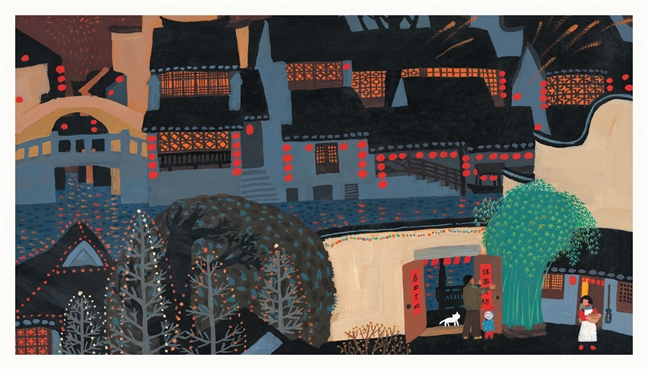
The quiet grace and wonder of Zhu Cheng-Liang’s gouache illustrations perfectly convey the loving relationship between father and daughter and the excitement of a family being together after a long absence. Although the Chinese New Year provides a frame for the story, Cheng-Liang’s paintings predominately focus on the day-to-day activities Maomao and her papa share—getting a haircut, fixing the house, cooking, meeting and playing with friends, and special hugs—emphasizing the universal scope of the story. The enchantment of the New Year’s festivities shines in a two-page spread where a fiery red-and-orange dragon puppet cavorts over the village bridge followed by a throng of people as others watch from homes and windows. Adorable Maomao may raise a lump in readers throats as she hugs her papa and gives him her treasured fortune coin.

A brief Author’s Note following the text pays tribute to the millions of migrant workers in China who often do not see their families except once each year.

A New Year’s Reunion would be a welcome book on any child’s bookshelf as a reminder that love overcomes any absence, long or short.

Ages 3 – 7

Candlewick Press, 2011 | ISBN 978-076366748

Chinese New Year Activity

celebrate-picture-books-picture-book-review-chinese-new-year-lantern-festival-coloring-page

Lantern Festival Coloring Page


Chinese New Year festivities end with a brilliant festival of lights. Enjoy this printable Lantern Festival Coloring Page to celebrate the Chinese New Year.

celebrate-picture-books-picture-book-review-a-new-year's-reunion-cover

You can find A New Year’s Reunion at these booksellers

Amazon | Barnes & Noble | Books-a-Million | IndieBound

Picture Book Review


January 10 – It’s International Quality of Life Month and Q & A with Deborah Sosin

celebrate-picture-books-picture-book-review-charlotte-and-the-quiet-place-noisy-neighborhood

About the Holiday

How one achieves their definition of a good quality of life may differ for every person, but in general it encompasses being happy and satisfied with one’s relationships, work, living conditions, and self. Whether you find happiness and quality of life in outdoor or indoor pursuits, with others or alone, at work or at home, this month’s holiday gives you time to get in touch with your inner quiet place and reflect on changes or improvements to bring you more peace and happiness in life.

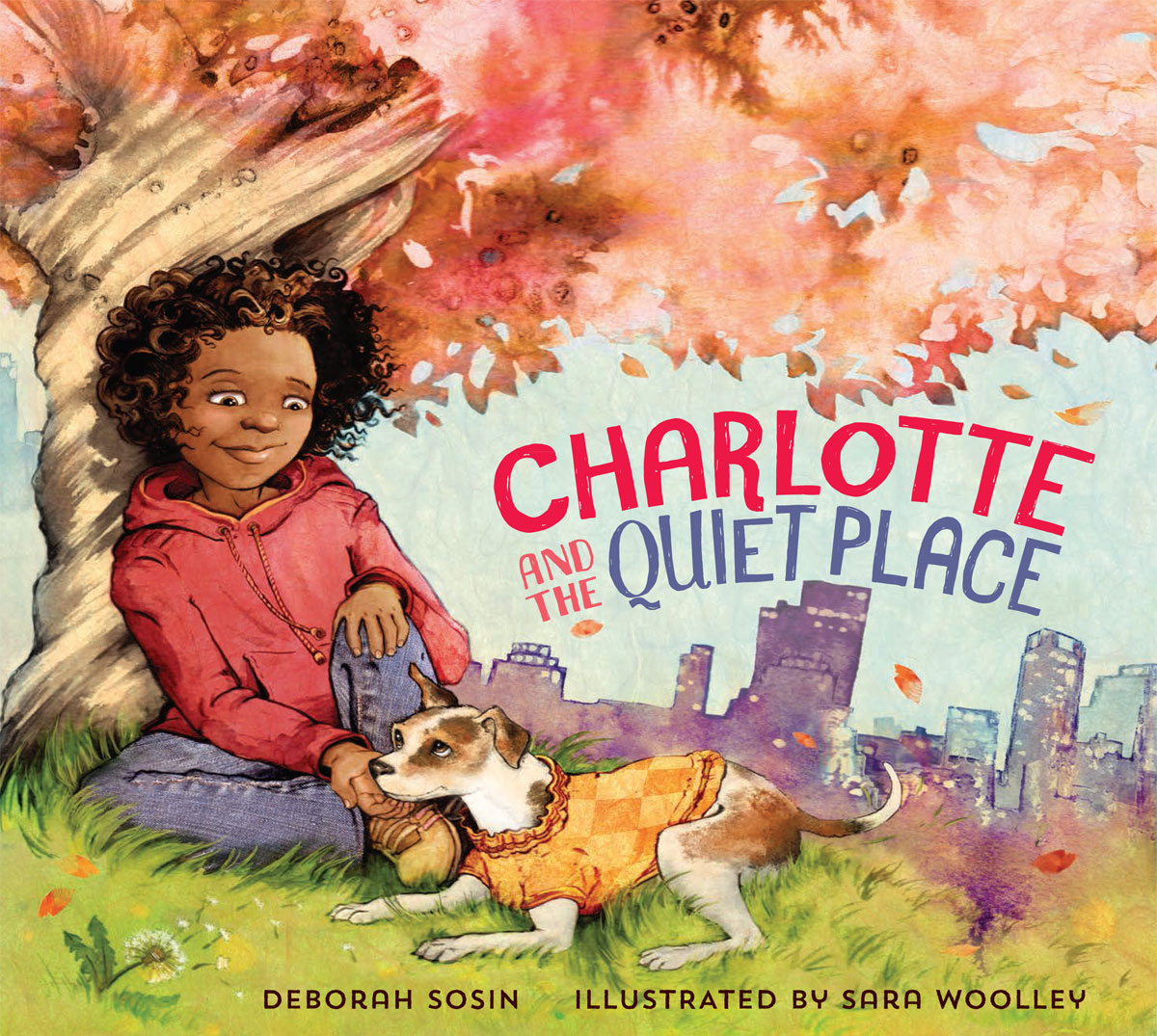
Charlotte and the Quiet Place

Written by Deborah Sosin | Illustrated by Sara Woolley


Charlotte is a girl who likes quiet who lives in a noisy world. Everywhere she goes, it seems, it’s impossible to escape from sounds that disturb her peace. At home the hallway creaks where “the floorboards groan,” the living room is like an arcade where the “TV bellows and blares,” and the kitchen is filled with Otto’s barks for his dinner. Even in Charlotte’s bedroom, “which is supposed to be a quiet place, the old steam radiator hisses, whistles, and whines. Where can Charlotte find a quiet place?”

celebrate-picture-books-picture-book-review-charlotte-and-the-quiet-place-noisy-home

Image copyright Sara Woolley, text copyright Deborah Sosin, Courtesy of sarawoolley.com

When Charlotte goes to school, things are no better. In the classroom kids are boisterous and bells ring; the lunchroom echoes with clattering trays and scuffing chairs; and the playground blares with big voices and stomping feet but also with the little squeaks and rattle of the swings. “Even in the library, which is supposed to be a quiet place, the children giggle, yammer, and yell. Where can Charlotte find a quiet place?”
celebrate-picture-books-picture-book-review-charlotte-and-the-quiet-place-noisy-subway

Image copyright Sara Woolley, text copyright Deborah Sosin, Courtesy of sarawoolley.com

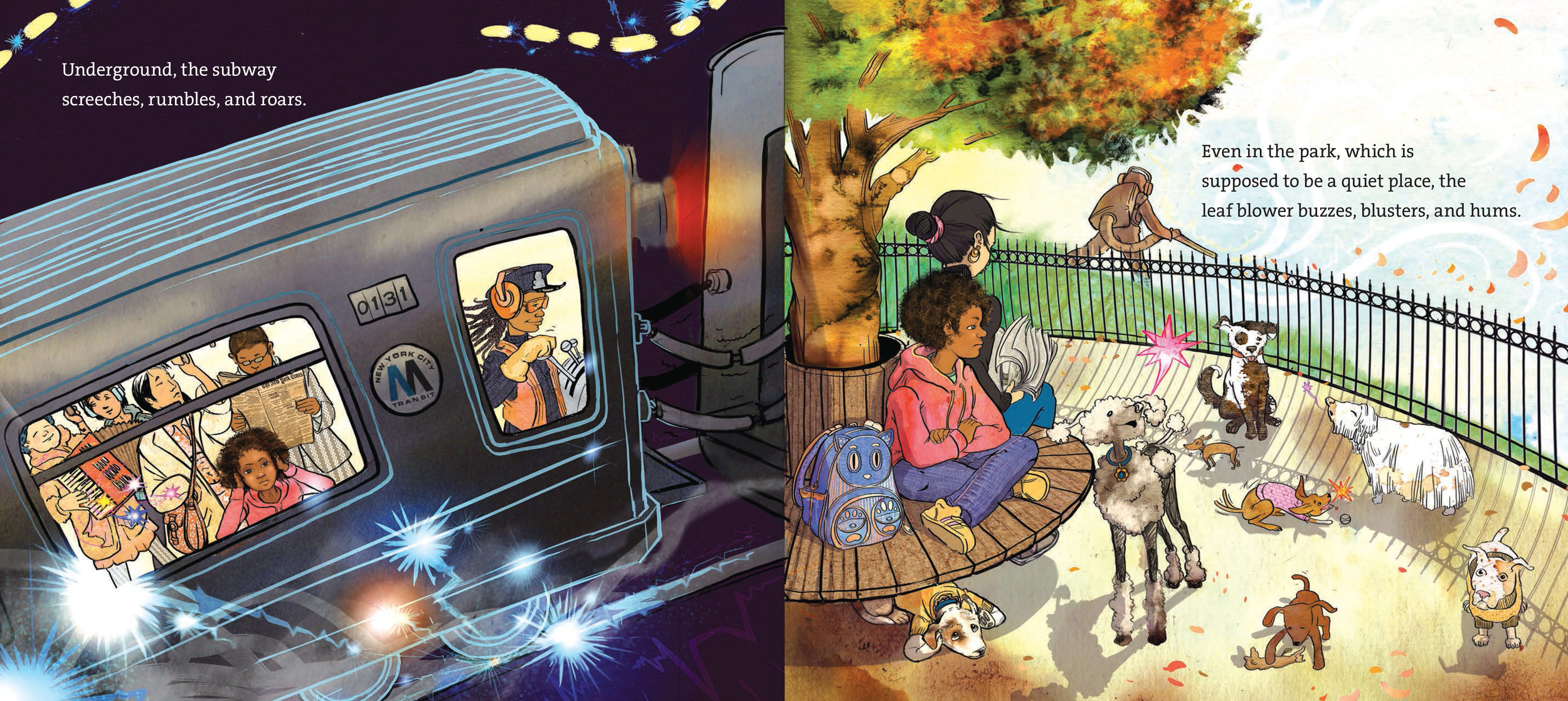
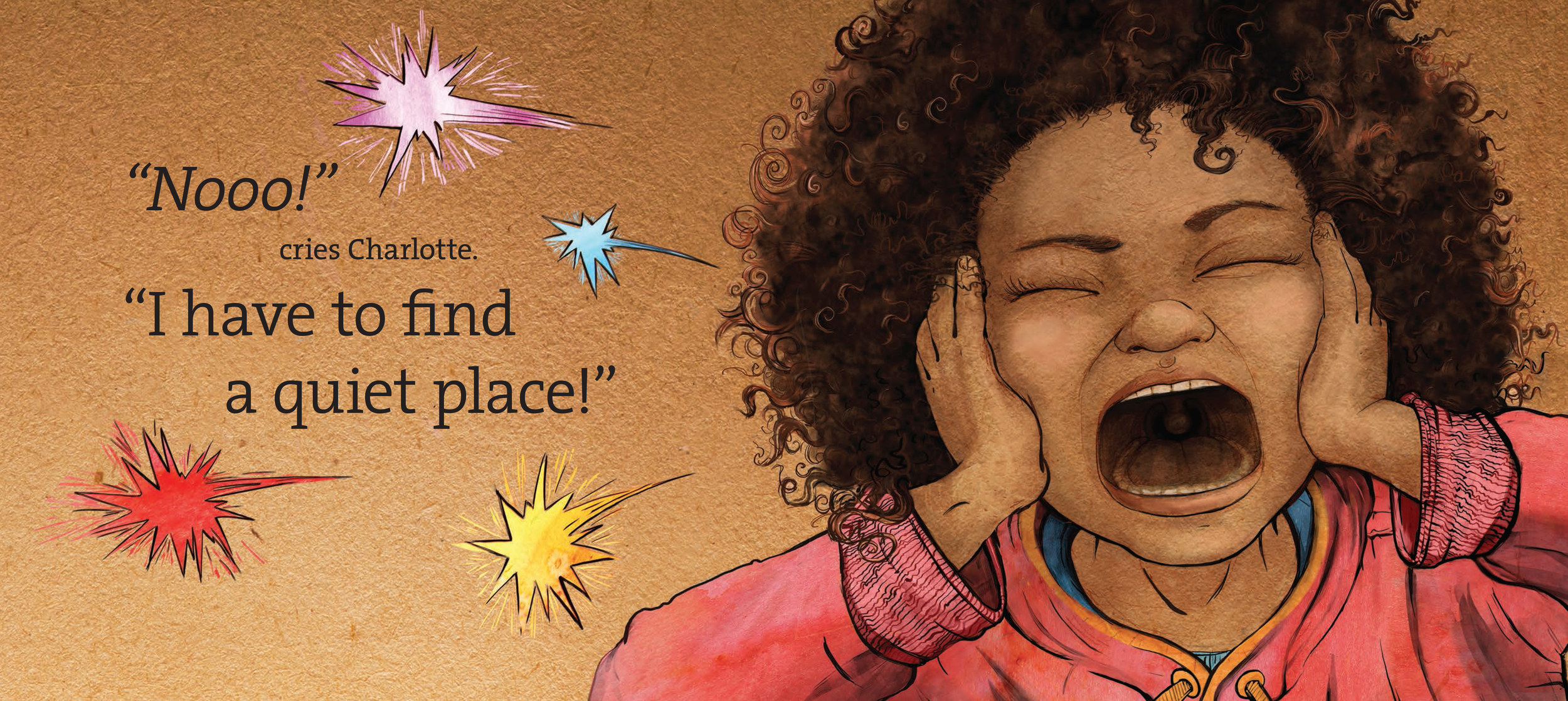
The outside world resounds with the din of jackhammers, horns, sirens, shouts, cars, music, and the “screeches, rumbles, and roars” of the subway. “Even in the park, which is supposed to be a quiet place, the leaf blower buzzes, blusters, and hums.” Charlotte puts her hands to her ears. “‘Nooo!’” she cries, “‘I have to find a quiet place!’”
celebrate-picture-books-picture-book-review-charlotte-and-the-quiet-place-nooo!-charlotte-cries

Image copyright Sara Woolley, text copyright Deborah Sosin, Courtesy of sarawoolley.com

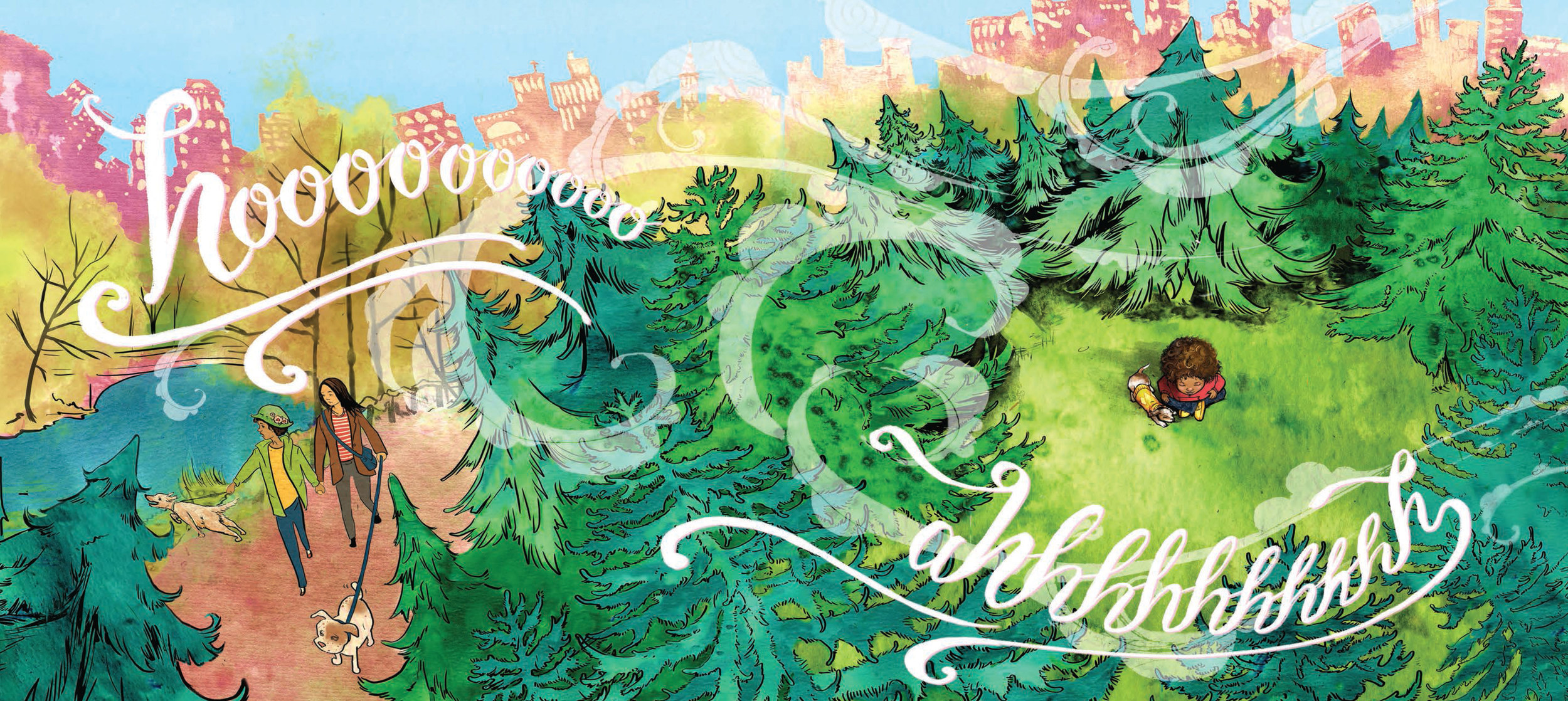
On Saturday Charlotte takes her dog for a walk in the park. Suddenly, Otto spies a squirrel and takes off running, wrenching his leash out of Charlotte’s hand. She chases after him down a hill, over a bridge, into the middle of a grove of trees. Out of breath, Charlotte and Otto sit beneath a tree. Gasping, Charlotte’s “belly rises up and down, up and down. Her breath goes in and out, in and out. Hooooo ahhhhh. Hooo ahhh.”

Slowly, Charlotte’s breath comes easier and “her mind slows down.” In this state, she discovers another, even quieter place. It is a place deep inside where her breath is soft and her “thoughts are hushed and low.” It is “a place as quiet as the small silence on the very last page of her favorite book, the silence right after ‘The End.’”
celebrate-picture-books-picture-book-review-charlotte-and-the-quiet-place-quiet-woods

Image copyright Sara Woolley, text copyright Deborah Sosin, Courtesy of sarawoolley.com

In a little while, Charlotte and Otto leave the grove, but now whenever home or school or the neighborhood is too loud, Charlotte remembers where she can find a quiet place. She simply closes her eyes and pays attention to that place deep in her belly and deep in her mind—“that quiet place inside.”

For so many children the world is a blaring, clattering place where their thoughts are drowned out by the noises around them. Deborah Sosin’s award-winning Charlotte and the Quiet Place validates these feelings and offers children a way to discover inner peace wherever they are. As a tonic to today’s hyper-stimulated environment, kids and adults alike will benefit from the method of mindful reflection Sosin presents. Sosin’s combination of evocative verbs and repetition makes the story fresh and an excellent read-aloud while also mirroring the sounds that are a part of our everyday life.

celebrate-picture-books-picture-book-review-charlotte-and-the-quiet-place-noisy-neighborhood

Image copyright Sara Woolley, text copyright Deborah Sosin, Courtesy of sarawoolley.com

Sara Woolley’s beautiful watercolor illustrations vividly depict not only Charlotte’s world but the sounds that disturb her peace. Amid the fully realized home, school, and neighborhood environments, complete with realistic details kids will recognize, sharp cracks of equipment, blaring bells and whistles, high-pitched voices, and other noises spark the page. Portrayals of Charlotte, her hands over her ears and her eyes sad, express her distress in a way kids will understand. When Charlotte finds the grove of trees in which she first experiences inner peace, Woolley’s color palette turns softer, with peaceful tones of green, blue, and yellow where, previously, “louder” purples, reds, and golds predominated.

Charlotte and the Quiet Place is a very welcomed book for those times when peace seems elusive and will give comfort to children who prefer quiet places and have more introverted natures. The book would make a wonderful addition to all children’s book shelves as well as to school and public library collections.

Ages 4 – 8

Parallax Press, 2015 | ISBN 978-1941529027

Visit Charlotte and the Quiet Place on her own website! You’ll find resources, images and videos, news about events, and more!

Discover more about Deborah Sosin, her writing for children and adults, writing workshops, mindfulness services, and more on her website!

View a gallery of artwork for books, comics,  and other illustration work by Sara Woolley on her website!

International Quality of Life Activity
celebrate-picture-books-picture-book-review-smile-cards-craft

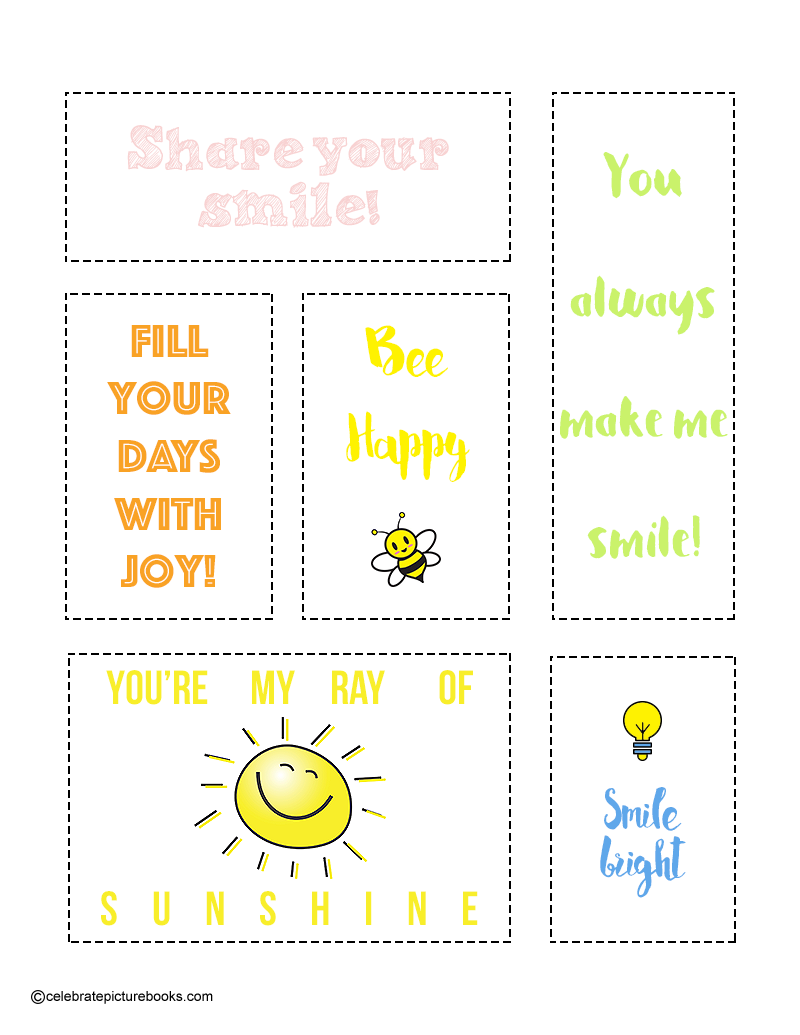
Share a Smile Cards


Life is better when you share smiles with those you know—and those you don’t! Try it! When you’re out today at school or other places, look someone in the eye and smile. You’ll probably get a smile back—and you can be sure that you will have made the other person’s and your day better!

Here are some Smile Cards that you can share. Why not slip one into your dad’s pocket or your mom’s purse, put one in your friend’s backpack, or sneak one onto your teacher’s desk? You can even leave one somewhere for a stranger to find! Have fun sharing your smiles, and see how much better you and the others around you feel!

Click here to print your Share a Smile Cards.

celebrate-picture-books-picture-book-review-interview-with-author-deborah-sosin

Photo by Kevin Day Photography

Q&A with Author Deborah Sosin


Today, I’m thrilled to talk with Debbie Sosin, a writer, editor, and clinical social worker who specializes in mindfulness-based psychotherapy, about her first picture book, her choral singing, and how kids respond to her presentations.

In your career you write for adults and children, work within the publishing industry, provide publicity services, and teach. How did you get started? Did you always want to write?

I kept a diary starting at around age ten and always loved writing for school or for fun. I started getting more serious about writing for publication in the past ten years, studied at GrubStreet, attended the Kenyon Review Writers Workshop, and eventually went back to school to get an MFA in Creative Writing. I wish I had started earlier, but it’s been rewarding to finally follow my true passion.

What influenced you to write Charlotte and the Quiet Place?

I wrote the book as an independent project as part of my MFA studies at Lesley University. They say “write what you know,” so I thought about my childhood growing up in kind of a noisy house, where my brother played the piano, my father had a radio and TV on simultaneously, and my mother was on the phone a lot. And then I thought about my longtime meditation practice and how tuning in to my breathing has helped me find a quiet place inside. So I wanted to write a story about children finding their own quiet place inside themselves.

You give school presentations on mindfulness and your picture book Charlotte and the Quiet Place for various ages. Is there an experience from any of these that you would like to share?

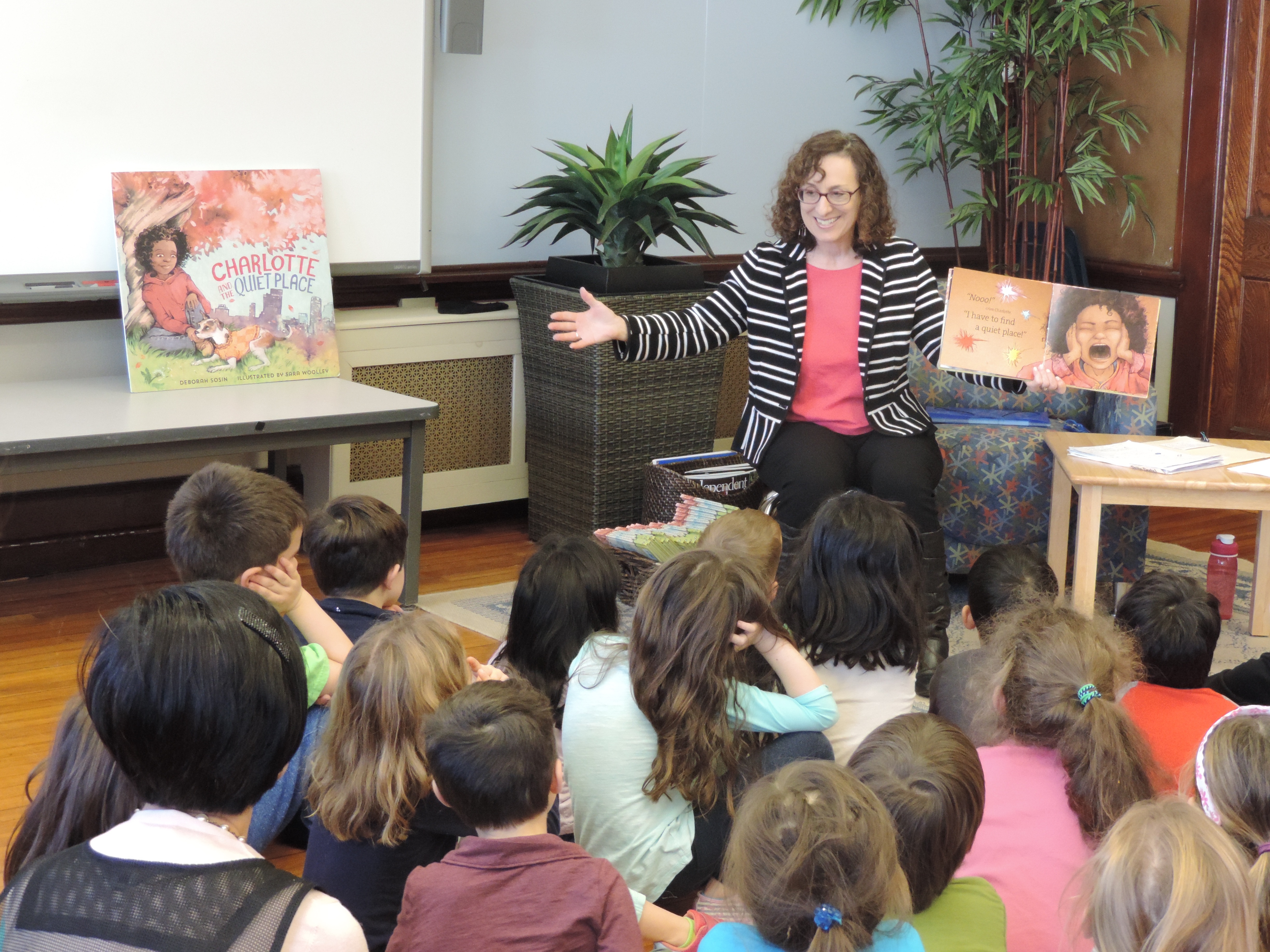
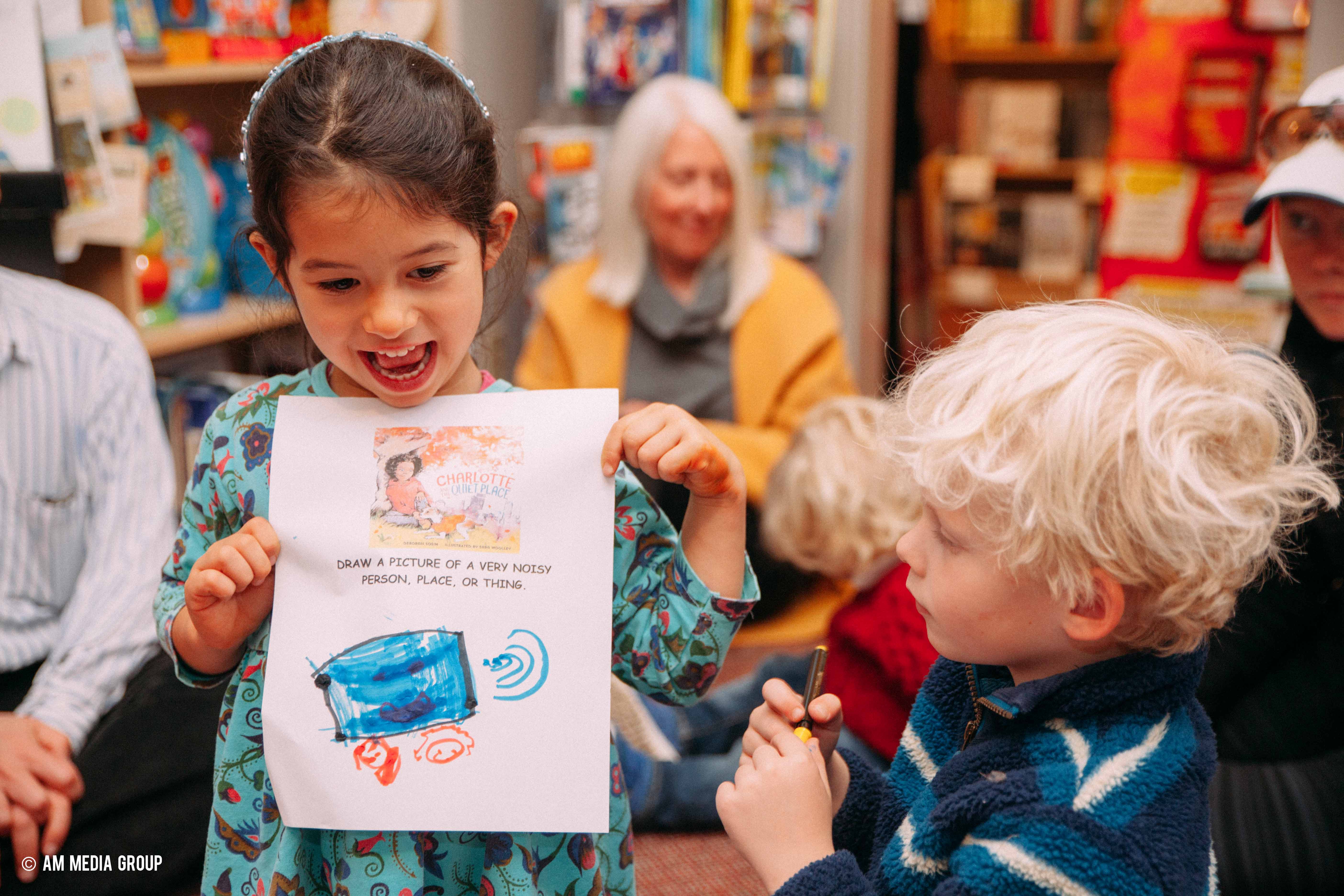
School visits are my favorite part of being an author! No matter what age the students are, they love to help me tell the story by repeating the “noisy” sounds and the “hoo ahh” breathing sounds. We usually do a few calming/breathing exercises together and, without fail, even the squirmiest group will settle into a beautiful, shared, often profound silence. Once, when asked where Charlotte finds her quiet place, one kindergarten girl said, “In her belly and in her brain, where it’s calm.” Many kids get that idea. What could be better? I also love showing them my early scribbles and illustrator Sara Woolley’s wonderful sketches and storyboards, and sharing the step-by-step process of publishing the book, from concept to completion
celebrate-picture-books-picture-book-review-author-deborah-sosin-visits-Newton-Monetssori-School

Deborah Sosin reads Charlotte and the Quiet Place to students at Newton Montessori School. Photo courtesy of Newton Montessori School.

Can you talk a little about mindfulness and how it can benefit children?

Mindfulness has become a catchword these days, but my favorite definition is from Dr. Amy Saltzman: “Noticing what’s happening right here and now, with a friendly, curious attitude, then choosing what to do next.” Many top-notch scientific studies show that mindfulness can help kids with concentration, attention, self-soothing, anxiety, depression, sleep, mood, compassion, confidence…I could go on. Compared with adults, most kids are naturally mindful, that is “in the moment,” but kids do get stressed out and worried about the past or the future, so mindfulness helps. I sometimes worry that parents and teachers might use it for disciplinary reasons (“Enough! Go be mindful in the corner!”), which is not the point. It’s a whole-life practice, not a technique or intervention. And, as the book shows, mindfulness can lead us to a quiet place inside that we can access whenever we want.
celebrate-picture-books-picture-book-review-interview-with-deborah-sosin-debbie-at-cottage-montessori-school

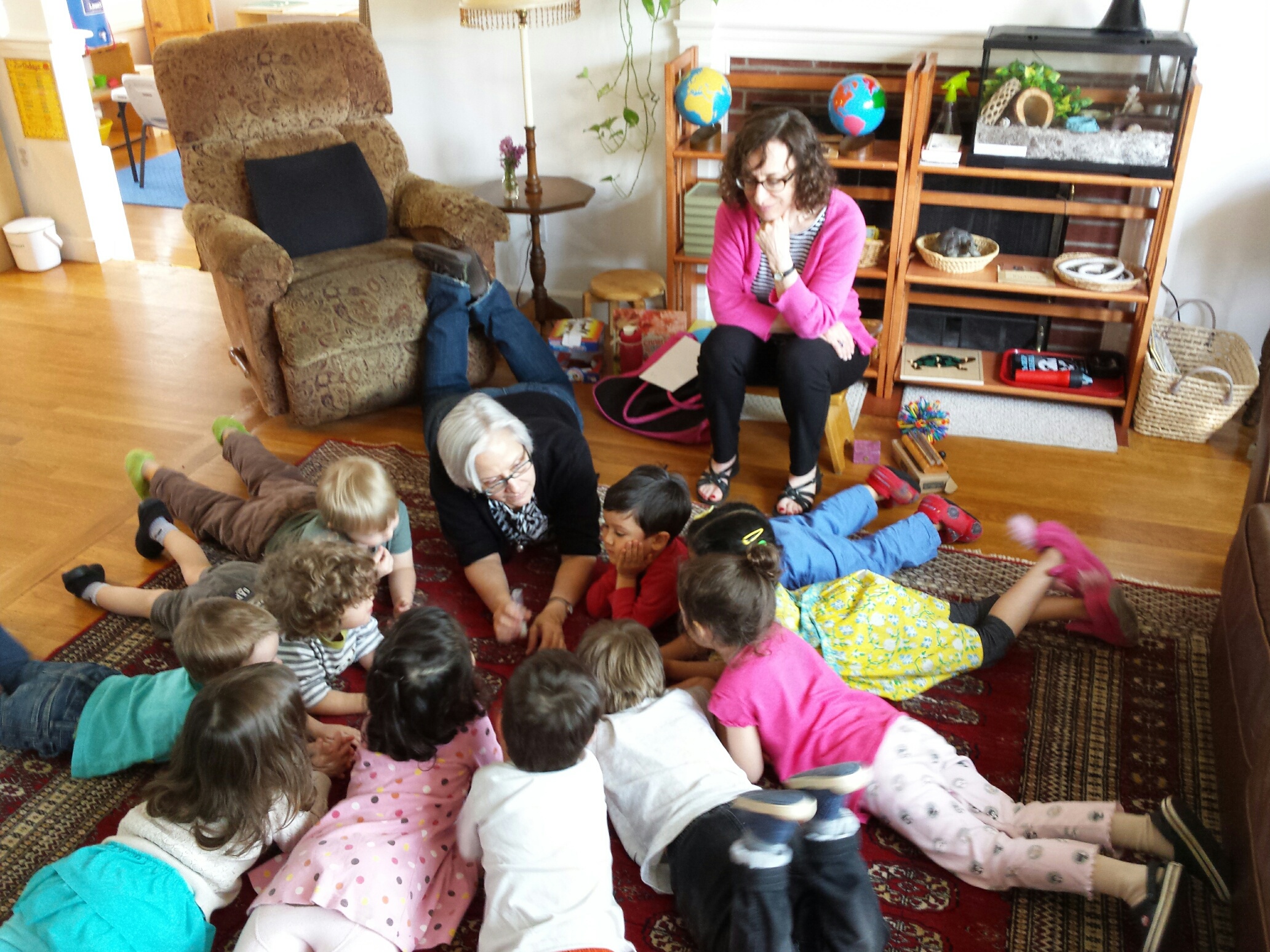
Students at the Cottage Montessori School in Arlington, Massachusetts play the Silence Game with director Karen Wagner, watching the sand in the hourglass. Photo courtesy of Stacey Moriarty.

Can you tell me a little about your work with Grub Street, a creative writing center in Boston?

I started taking classes at GrubStreet in 2008; my first class was “Six Weeks, Six Essays,” and from that class, I helped form a longtime regular writing group. I started blogging soon after and then submitted personal essays for publication, with some good luck. GrubStreet is a fantastic, inclusive community, with excellent faculty and a huge range of motivated, smart, and enthusiastic students, from beginners to veterans. After a few years, I applied to teach classes there and am proud to be on their instructor and consultant rosters now.

You are an accomplished choral singer, having performed at Lincoln Center, the United Nations, Boston’s Symphony Hall, and on an international tour. When did you begin choral singing? Do you have an anecdote you’d like to share from any of your experiences?

I’ve been singing my whole life and have been in choruses since elementary school. Singing with other people is extremely gratifying and, after all the “verbal”-type things I do, including my work as a psychotherapist, it’s a lovely change of pace. I spent about 15 years in the Zamir Chorale of Boston, which specializes in Jewish choral music. Our tours to Eastern Europe, Italy, and Israel were extraordinary. In 1999, when we sang at Auschwitz and Terezin, the sites of former concentration camps, it was hard to keep our emotions in check, but it felt important to revive the voices of the Jewish people that the Nazis had attempted to quell. A PBS documentary film, “Zamir: Jewish Voices Return to Poland,” chronicled our tour that summer. I think it’s still available through the Zamir Chorale website.

What’s the best part about writing for children?

After having focused almost exclusively on nonfiction for most of my writing career, it’s been wonderful to work in the very precise and rich world of picture-book writing with so many lovely, funny, imaginative, and supportive fellow writers I’ve met through SCBWI and the amazing Writers’ Loft in Sherborn, Mass.
celebrate-picture-books-picture-book-review-interview-with-deborah-sosin-debbie-at-The-Oblong-Bookstore-event

Children enjoy drawing their noisy and quiet places at an Oblong Bookstore event in NY. Photo courtesy of AM Media Group

What’s up next for you?

I have a couple of Picture Book manuscripts in progress and I’m participating in Storystorm (formerly PiBoIdMo) this month, so I hope to generate more ideas and get some new work out there soon.

Since this is a holiday-themed blog, I’d be remiss if I didn’t ask you at least one question about holidays, so…

What is your favorite holiday and why?

Thanksgiving is probably my favorite, as it means getting together with my family, which is now spread far and wide, and having an opportunity to express our gratitude.

Thanks, Debbie, for stopping by and chatting! I wish you all the best with Charlotte and the Quiet Place and all of your future endeavors!

You can connect with Deborah Sosin on

Her Website | charlotteandthequietplace.com | Facebook | Twitter

celebrate-picture-books-picture-book-review-charlotte-and-the-quiet-place-noisy-neighborhood


You can find Charlotte and the Quiet Place at these booksellers

Amazon | Barnes & Noble | Books-a-Million | IndieBound | Parallax Press |Porter Square Books (signed copies available)

Picture Book Review

January 7 – It’s Hot Tea Month

celebrate-picture-books-picture-book-review-the-tea-party-in-the-woods-cover

About the Holiday

I must confess that this may be my favorite holiday. There’s nothing better than waking up with a well-steeped cup of tea, writing with a favorite mug brimming with hot tea with honey sitting nearby, enjoying scones with clotted cream and jam and a hot cuppa…well…you get the picture. People have drunk tea since earliest times for its soothing and medicinal properties. Mellower than coffee and available in endless varieties and tastes, hot tea is just the thing for relaxing moments. Today, enjoy your favorite tea or try a new kind!

The Tea Party in the Woods

By Akiko Miyakoshi


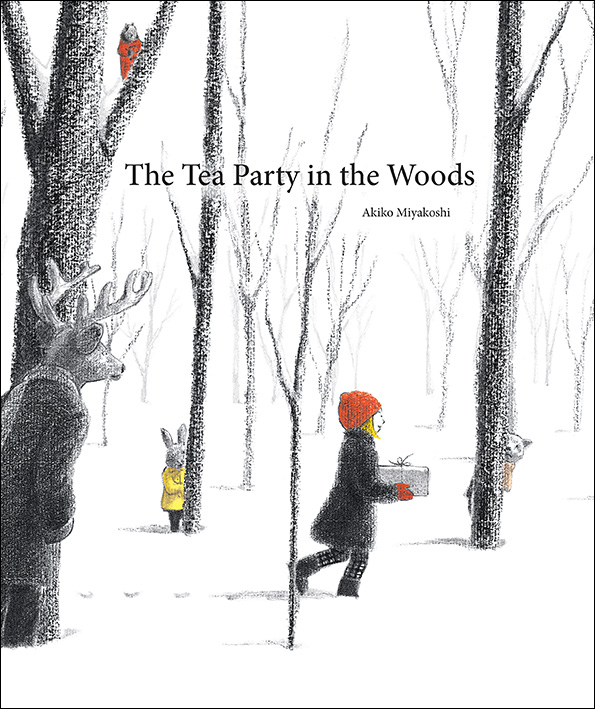
Because snow had fallen overnight Kikko’s father was off to her grandmother’s house to shovel the walk. After he left, Kikko noticed that he had forgotten to take the pie her mother had made for Grandma. “‘I can still catch up to him,’” said Kikko. Carefully, carrying the boxed pie, Kikko followed “her father’s tracks in the fresh snow. The woods were very still. And so quiet. Kikko’s footsteps were the only sound.”

celebrate-picture-books-picture-book-review-the-tea-party-in-the-woods-kikko-peers-in-window

Spying a coated figure in the distance, Kikko began to run, but she fell in the deep snow, crushing the pie. Still, she picked up the box and hurried on. She watched as her father entered a strange house. “Has it always been here? Kikko wondered. She couldn’t remember having seen it before.” Kikko crept to the window and peered inside, just as her father took off his hat and coat. But—he wasn’t her father at all!” He was a bear!

celebrate-picture-books-picture-book-review-the-tea-party-in-the-woods-lamb-meets-kikko

A little lamb approaching the house found Kikko looking through the window and asked if she were there for the tea party. Taking Kikko’s hand, the lamb led her into the house. When Kikko saw all of the animals gathered there, she couldn’t believe it. The animals cheered and welcomed Kikko enthusiastically. “‘We’re about to serve the tea,’ said the rabbit. ‘You’re just in time.’” After the animals seated themselves around a long table, a doe stood, thanked everyone for coming, and asked Kikko to introduce herself.

She told then her name and why she was in the forest. The animals thought she was very brave, and Kikko began to feel braver herself. When the animals learned that Kikko’s pie had been ruined, they all contributed a piece of their own pie from the party. “Slice by slice they assembled a new pie on a pretty plate. Each piece had a different filling of seeds and nuts and fruit and other delicious things gathered from the woods.” They found a new box, placed the plate inside, and tied it with a red ribbon.

celebrate-picture-books-picture-book-review-the-tea-party-in-the-woods-animals-meet-kikko

Kikko was so excited to bring her Grandma this gift that she wanted to leave right away. The animals said they would come too. The woods rang with music, talking, laughing, and singing as the group “paraded to Grandma’s house.” When they reached Grandma’s house, the animals encouraged Kikko to go to the door. Grandma and Kikko’s father were surprised to see her. “‘My dear, did you come all this way on your own?’ asked Grandma, stepping inside.” Kikko could not see the animals anywhere. “‘You’re never alone in the woods,’” Kikko answered, smiling. She was sure her new friends were listening.”

celebrate-picture-books-picture-book-review-the-tea-party-in-the-woods-parade

Akiko Miyakoshi’s reassuring story about a little girl venturing out into strange territory on her own for the first time is a delight. The straightforward narrative offers just the right amount of familiarity for young readers to allow them to be fully charmed by the magical elements that provide surprise and suspense. Little ones will be entranced by the warm welcome Kikko receives at the splendid and well-attended tea party. They will also find comfort in realizing that even when travels become hard, they can still discover wondrous things and that friends and help are always available – sometimes where they least expect it.  

Miyakoshi’s stunning black-and-white drawings, done in charcoal and pencil, are gorgeous in their portrayal of the woodland animals and their tea party. The long table they crowd around is laden with pies, bowls of fruit, vases of flowers, and of course teapots and teacups. At first Kikko offers the only color on the pages with her red cap and skirt and yellow hair. Later, however, when the animals suggest sharing their pie, the plate dazzles with mouthwatering brilliance, and hints of red and yellow brighten the next page. As the parade marches through the woods, the animals’ red and yellow clothes and musical instruments make a festive party. But as Kikko goes on to her Grandma’s house alone, the color fades from the animals, highlighting her achievement.

Ages 3 – 7

Kids Can Press, 2015 | ISBN 978-177138107

Discover more about Akiko Miyakoshi and a portfolio of her work on her website!

Tea Month Activity

celebrate-picture-books-picture-book-review-ceramic-mug-craft

Decorate Your Own Mug


It’s fun to drink tea (or hot chocolate—shhh!) from a mug you’ve designed yourself. Personalized mugs also make fantastic presents for friends and family.

Supplies

  • Plain ceramic mug
  • Bakeable markers or paint

Directions

  1. Design and color your mug
  2. Follow directions on the markers or paint to properly bake on your decoration and make it permanent.

Picture Book Review
January 6 – Cuddle Up Day

celebrate-picture-books-picture-book-review-you-belong-to-me-cover

About the Holiday

As the cooler days of December turn into the colder days of January, Cuddle Up Day reminds us that snuggling up with someone you love warms us and warms our hearts. Children especially love the comfort and security that close hugs bring. Today, get your comfy clothes on, pour a mug of hot chocolate or tea, and cuddle up together with a good book!

You Belong to Me

By Mamoru Suzuki


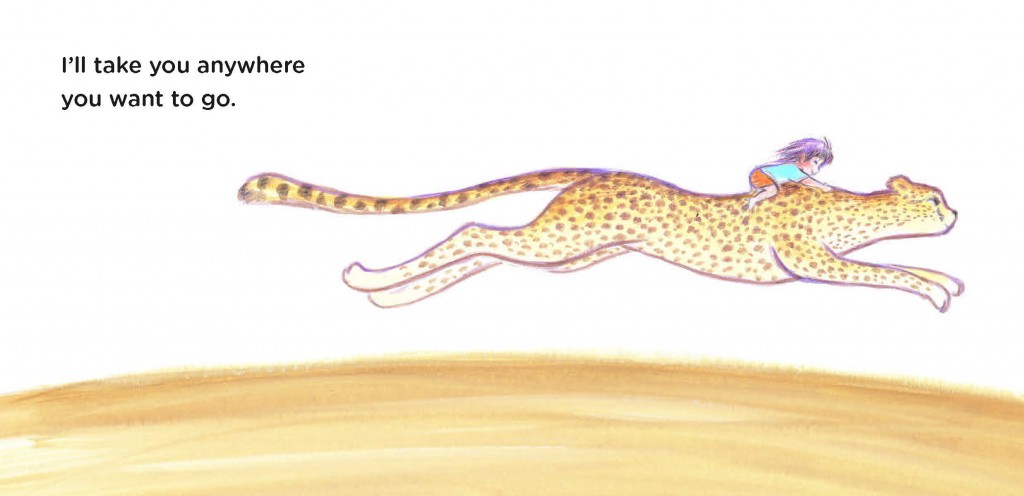
The emotions of parents and other caregivers of children escape from the heart on the very first page of this gentle, spoken lullaby: “I love you so much.” On the second page, listeners discover why: “You are my favorite person in the whole world.” As the pages flow, the reader continues to reassure the child of the constancy of their love. Devotion is shown when the adult spends time with their child, watches out for them, and takes them to activities, play dates, and even, perhaps on flights of fancy.

celebrate-picture-books-picture-book-review-you-belong-to-me-I-love-you-so-much

Image and text copyright Mamoru Suzuki, courtesy of Museyon Press

Through the words on the pages, the reader encourages the child to “come to me whenever you are lonely” or “whenever you can’t sleep” and promises that “I’ll hug you when you are sad.” Comfort comes in many forms—from drying tears to stroking hair—and from the many people who love the child.

celebrate-picture-books-picture-book-review-you-belong-to-me-where-you-want-to-go

celebrate-picture-books-picture-book-review-you-belong-to-me-I-love-you-so-much

In fact, all of the people in the child’s life agree that “we all love you” and that they will be there “whenever,” “wherever,” and “however” the child needs them. But the deepest love of all is found in the heart of the reader who confirms “I love you most of all, because…you belong to me.”

celebrate-picture-books-picture-book-review-you-belong-to-me-we-love-you

celebrate-picture-books-picture-book-review-you-belong-to-me-I-love-you-so-much

Mamoru Suzuki’s sweet hug of a book gives parents and caregivers the tender words that overflow in their hearts coupled with endearing illustrations of various animals nuzzling, snuggling, protecting, and comforting a small child. The mellow colors and chiffon texture of the images are at once soothing and stirring, wonderfully mirroring the mixture of emotions that make love for a child so profound.

You Belong to Me is a cuddle to keep on your child’s bookshelf for those times when you want to tell them how much you love them.

Ages birth – 5

Museyon, 2016 | ISBN 978-1940842127

Cuddle Up Day Activity

celebrate-picture-books-picture-book-review-snuggle-buddy-craft

Snuggle Buddy Craft


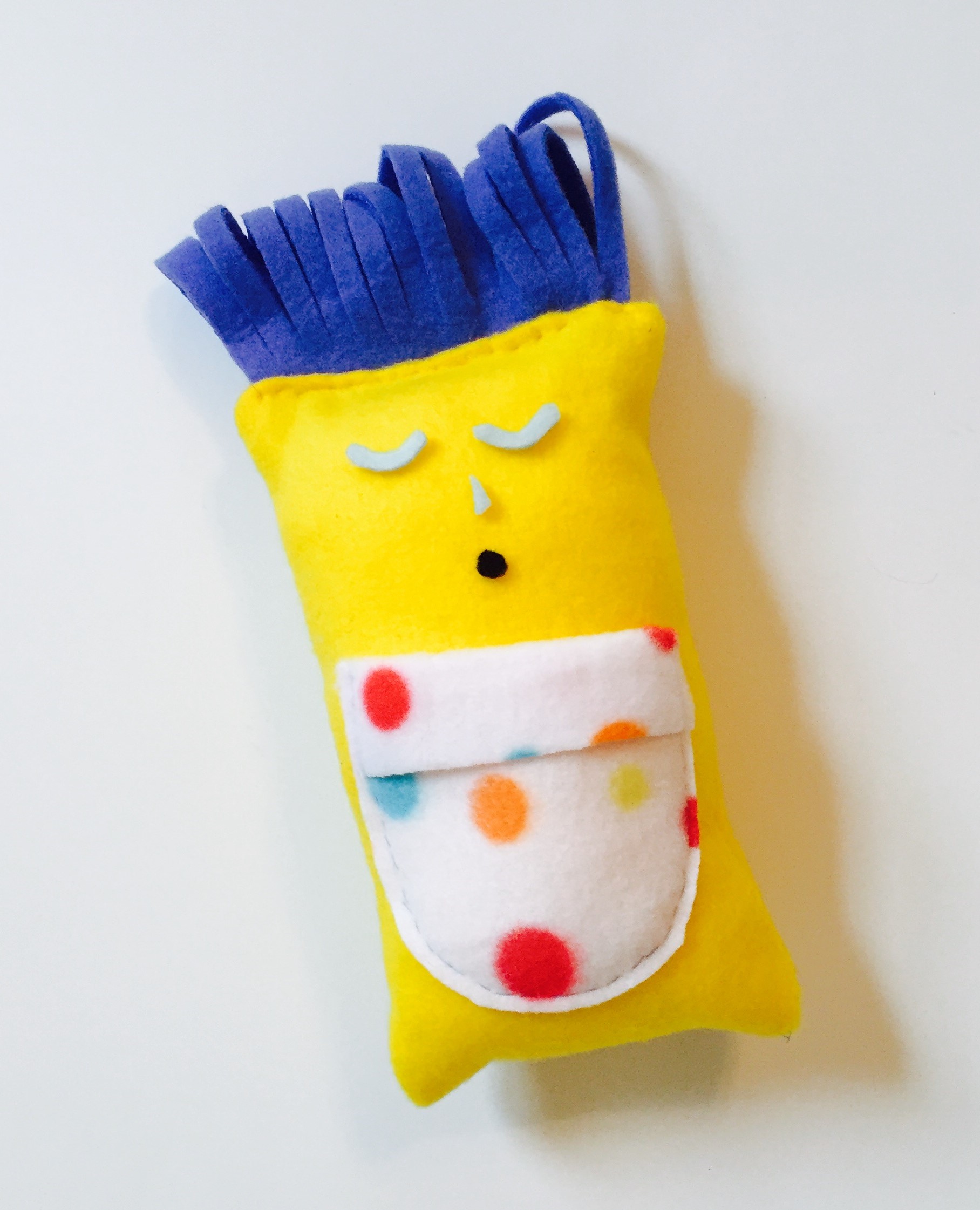
It’s easy to make your own snuggle buddy with a few pieces of fleece, some fiber fill, and a needle and thread or fabric glue. The great thing about creating your own friend is you can personalize your pal anyway you want!

Supplies

  • 1 8-inch by 11-inch piece of fleece in the color or your choice for the body (or scraps if you have some from an earlier project). A larger piece of fleece can be used to make a larger buddy
  • 1 5-inch by 8-inch piece of fleece in the color or your choice for the hair (or scraps if you have some from an earlier project)
  • 1 small piece of fleece or other material for a pocket, clothes, or blanket
  • Small scraps of fleece or other material for the face
  • Fiber Fill
  • Thread and sewing needle OR fabric glue
  • Scissors

Directions

To Make the Body

  1. Fold the large piece of fleece in half lengthwise and sew along the open side and along the bottom. Alternatively, if using a larger size piece of fleece, fold upward and sew or glue the two sides closed.
  2. Turn the form inside out

To Make the Hair

  1. Cut a piece of fleece as wide as your buddy and about 7 – 8 inches long
  2. Fold the fleece lengthwise
  3. Insert both ends of the fleece into the opening at the top of the body
  4. Sew or glue the opening shut, securing the hair
  5. Cut strips about ¼-inch wide from the top of the hair to close to where the hair is sown into the body

To Make a Pocket or Clothes

  1. Cut a piece of fleece in the shape of a pocket, shirt, pants, diaper, or blanket
  2. Sew or glue the pocket or clothes to the buddy

To Make the Face

  1. Cut eyes, a nose, and a mouth in whatever way you would like your buddy to look. (My buddy is sleeping.)
  2. Sew or glue the face to the buddy
  3. Snuggle up!

Picture Book Review

December 31 – No Interruptions Day

celebrate-picture-books-picture-book-review-the-quiet-book-cover

About the Holiday

Perhaps on this last day of the year you’re suffering from a little stimulation overload. Everywhere you go, it seems, there is something else begging for your attention, whether it’s flashing signs, sale advertisements, that chore you haven’t gotten to, or just coworkers, family members, or others wanting to say hi or needing help. On No Interruptions Day you’re allowed to take a little time for yourself to decompress and enjoy a bit of silence and relaxation. Sure, you can party later, but for now—Ahhhhh….

The Quiet Book

Written by Deborah Underwood | Illustrated by Renata Liwska


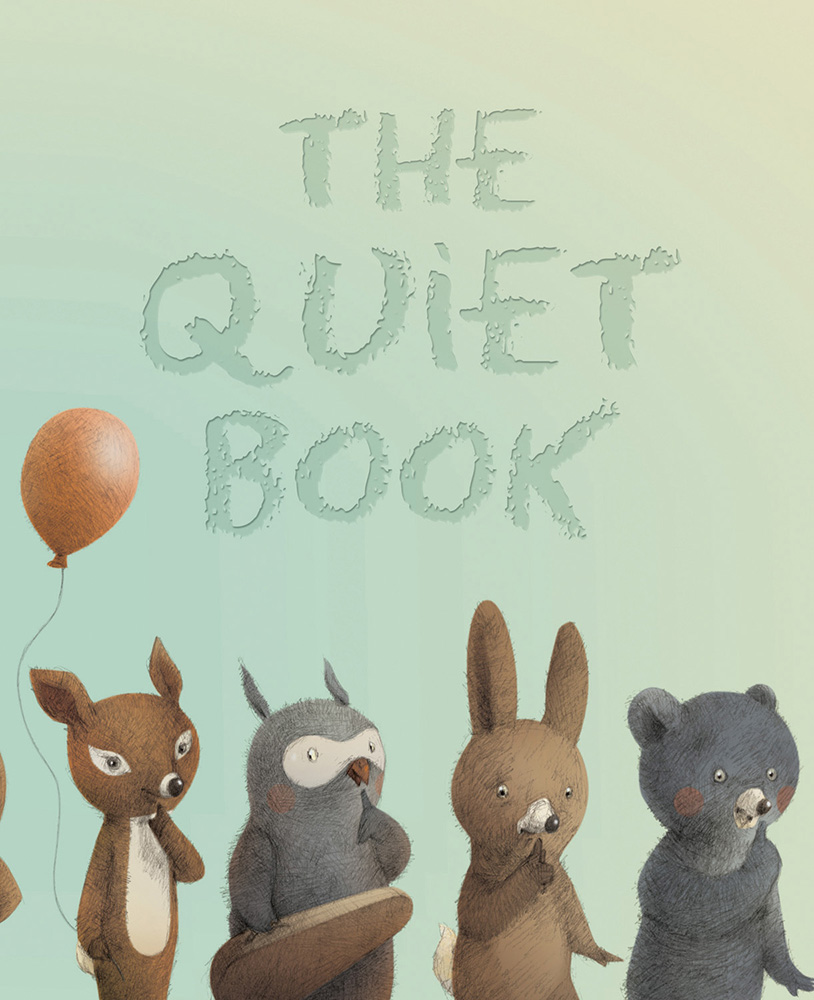
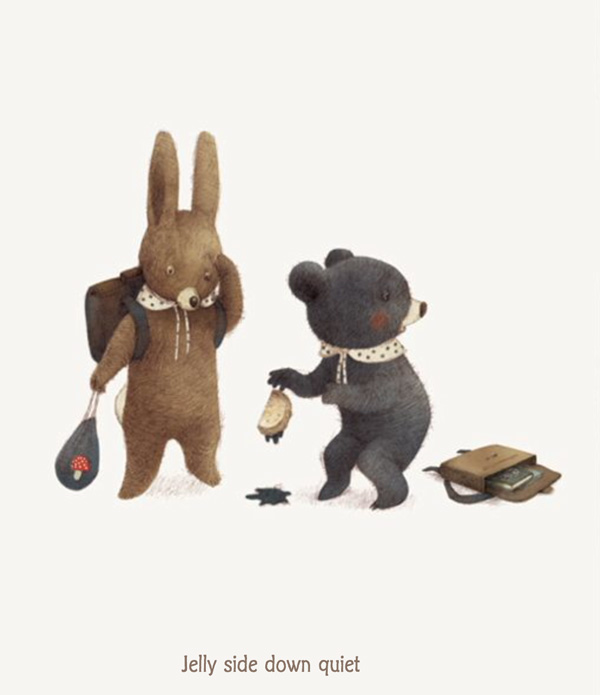
Quiet comes in many guises, for many reasons, and with many internal emotions attached to it. Each type of quiet is unique, compelling, and special. If you are lucky enough to enjoy a “first one awake quiet,” you have a bit of time to compose yourself for the day because you never know if you might experience “jelly side down quiet,” “thinking of a good reason you were drawing on the wall quiet,” or even “last one to get picked up from school quiet.”

celebrate-picture-books-picture-book-review-the-quiet-book-jelly-side-down

Image copyright Renata Liwska, text copyright Deborah Underwood. Courtesy of Houghton Mifflin Harcourt

Suspense is full of quiet—like “hide-and-seek quiet,” “pretending you’re invisible quiet,” and bubbling “top of the roller coaster quiet.” There are times when quiet is required, for instance “sleeping sister quiet” and “right before you yell ‘SURPRISE!’ quiet.” Experiences in nature inspire quiet awe, like “swimming underwater quiet,” “first snowfall quiet,” and “don’t scare the robin quiet.”

Concentration, commiseration, and companionship all contain their own depth of quiet, and the end of the day brings comfortable moments of quiet in story time, tucking in time, bedtime kisses, and finally “sound asleep quiet.”

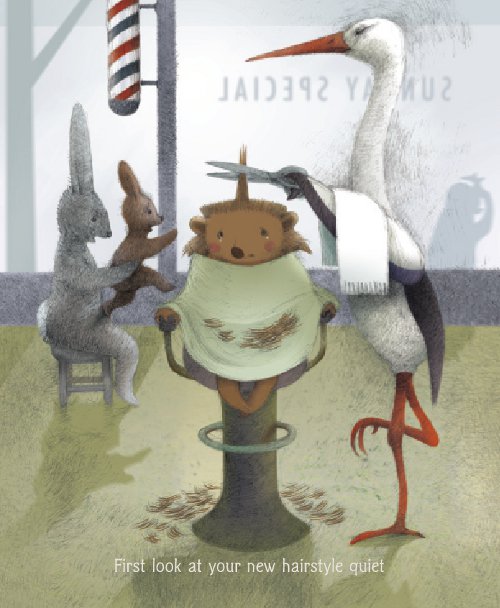
celebrate-picture-books-picture-book-review-the-quiet-book-haircut

Image copyright Renata Liwska, text copyright Deborah Underwood. Courtesy of Houghton Mifflin Harcourt

In her sweet tribute to the wondrous moments of quiet, Deborah Underwood is always surprising. Her original examples of quiet times are both ingenious and familiar, lending depth, humor, and insight to those times of the day that may defy definition but are felt in the heart.  The Quiet Book is perfect for bedtime, but also for any time when quiet reigns. It’s a beautiful book for children who are more reflective and for whom quiet times are treasured.

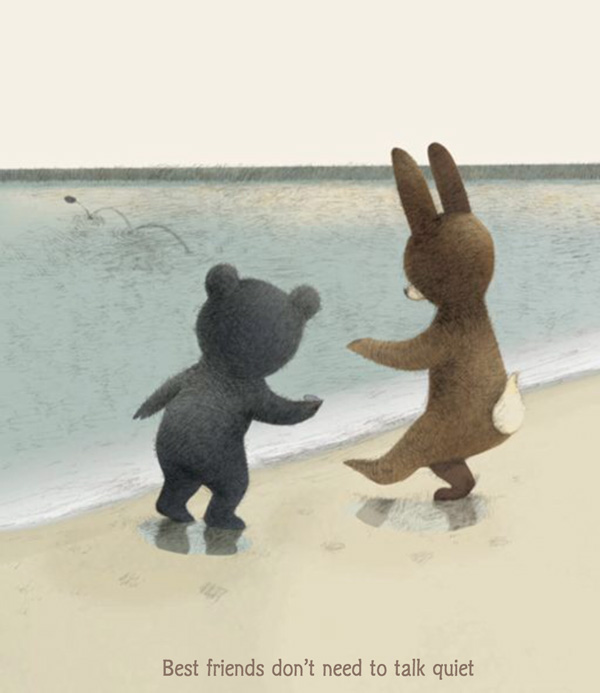
celebrate-picture-books-picture-book-review-the-quiet-book-skipping-stones

Image copyright Renata Liwska, text copyright Deborah Underwood. Courtesy of Houghton Mifflin Harcourt

Renata Liwska’s soft, enchanting illustrations are as cuddly and comforting as a favorite blanket. Her little furry, spiky, and feathery animals navigate their day, experiencing those occasions of calm or turmoil with faces registering thoughtfulness, sadness, resignation, or cheer. Each page contains details, such as a bunny with an ear bandaged in solidarity with her friend who has a hurt tail and head, a bear holding a hiccupping rabbit upside down, and a cactus whose shadow is transformed into a monster, that will give even the youngest readers much to discover.

While the text on each page is sparse, the feelings they elicit are intimate and profound. Offering readers—both children and adults—much to discuss, The Quiet Book is a must for children’s home bookshelves.

Houghton, Mifflin, Harcourt, 2016 (paperback) | ISBN 978-0544809048

Discover the world of books by Deborah Underwood, including picture books, books for older readers, and nonfiction on her website!

View a gallery of picture book artwork by Renata Liwska on her website!

No Interruptions Day Activity

Quiet Time 


Finding opportunities to spend time in quiet contemplation or creativity is rejuvenating. Teaching children to appreciate down time and listen to their own thoughts is a gift that can bring them happiness and success that follows them into adulthood.

Today, set aside 15 minutes (or an appropriate amount of time for your child) and do one—or both—of these activities:

  1. You can do this with or without a piece of paper and pencil. Sit still and quietly in a place with no distractions and listen to what you hear. If you’d like write down the answers to these questions or just consider them:
  • What do you hear inside?
  • What do you hear coming from outside?
  • Can you tell how close or how far away the sound is?
  • In what way might you be a part of the sounds you hear?
  • Pick one sound and expand on its meaning
  1. Listen carefully to your own thoughts. What do you “hear” or “see”? On the paper draw or write whatever comes to mind, without changing it or erasing anything.

Picture Book Review
December 20 – It’s Write to a Friend Month

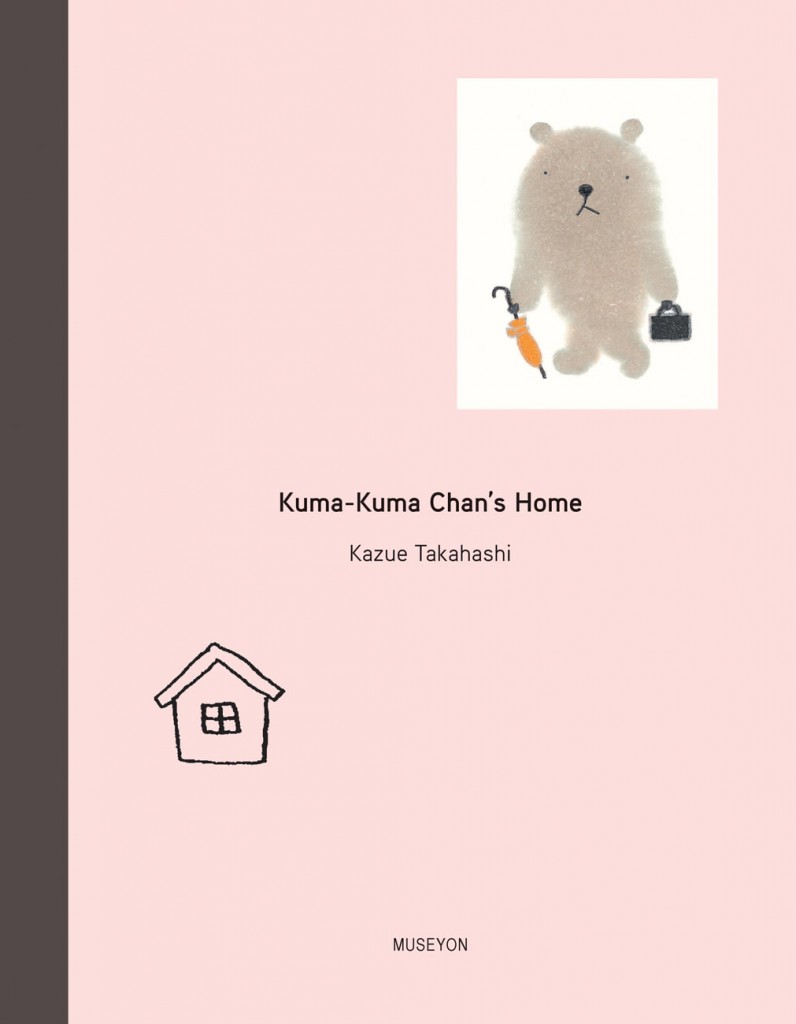
celebrate-picture-books-picture-book-review-kuma-kuma-chan's-home-cover

About the Holiday

As long as you have a pen or pencil and some paper out to write a list, why not jot a quick note to a friend? Even just a few words like “I’m thinking of you” or a few lines about what you’ve been doing make a special surprise when they appear in someone’s mailbox.

Kuma-Kuma Chan’s Home

By Kazue Takahashi


Framed by his window Kuma-Kuma Chan, the little bear, sits at his writing desk penning a letter. It says simply, “How are you? Come visit me soon.” When it is received, Kuma-Kuma Chan’s friend begins the long journey to see him. “I have to ride a train for an hour, take a bus for thirty minutes, then walk for fifteen minutes,” the boy states. From the bus stop, the boy can see the red roof of Kuma-Kuma Chan’s house in the distance, and as he approaches he sees hisfriend waiting outside to welcome him.

celebrate-picture-books-picture-book-review-kuma-kuma-chan's-home-welcome

Copyright Kazue Takahashi, courtesy of museyon.com

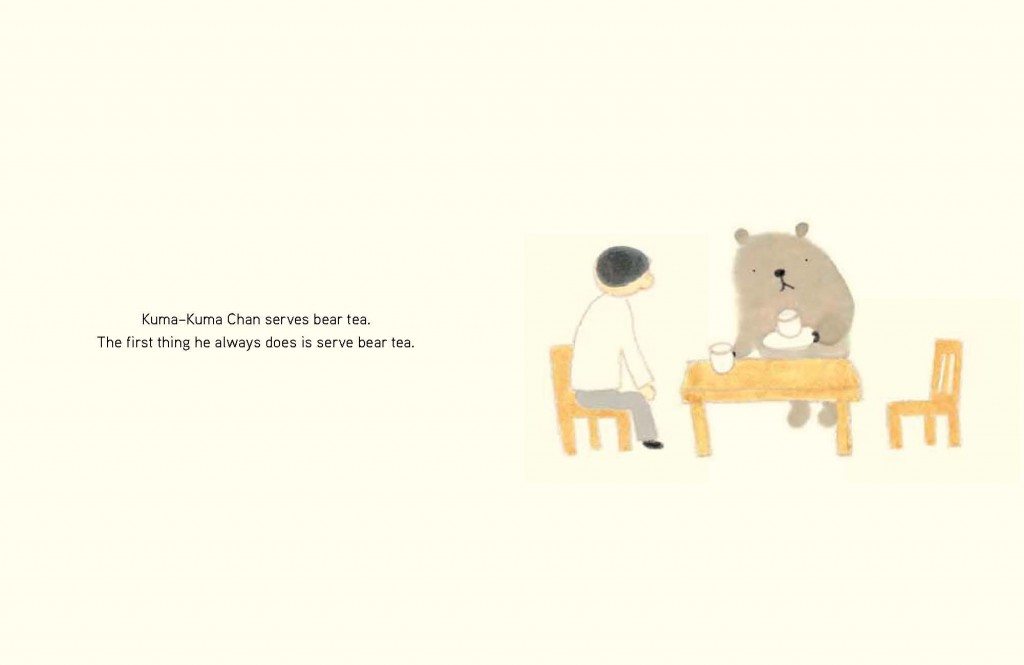
The boy has been here before and once more enjoys the routine as “Kuma-Kuma Chan serves bear tea. The first thing he always does is serve bear tea,” the boy explains. It seems that the time between visits has been long, and at first the silences are longer than the conversation. In the quiet the boy watches “the dust floating around in the afternoon sunbeams” and looks “at the books on the shelf,” reading “the titles one by one….” Meanwhile Kuma-Kuma Chan may be having second thoughts about his hospitality. He “gets up and opens the window to let in some fresh air” and checks the expiration date on the bear tea.

celebrate-picture-books-picture-book-review-kuma-kuma-chan's-home-dinner

Copyright Kazue Takahashi, courtesy of museyon.com

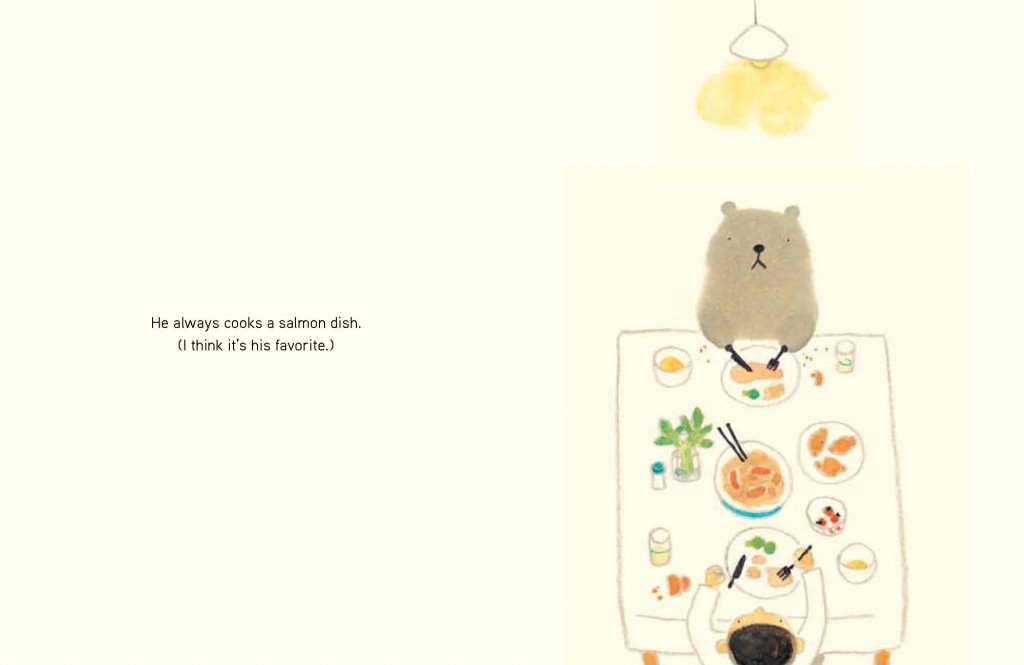
By the time Kuma-Kuma Chan serves the rice crackers conversation comes easier. For dinner Kuma-Kuma Chan prepares a salmon dish as always. It is, the boy thinks, his favorite and “perfect for a bear.” After dinner the two watch television and enjoy a mutually favorite snack of chocolate and hot milk. Soon all of the chocolates the boy brought are gone and it is time for him to catch the last bus home.

He slings his backpack over his shoulders and says goodbye to Kuma-Kuma Chan, who invites him to come back soon. Framed in the golden light of his doorway, the little bear waves farewell to his friend as he ventures out into the sapphire blue night.

celebrate-picture-books-picture-book-review-kuma-kuma-chan's-home-watching-tv

Copyright Kazue Takahashi, courtesy of museyon.com

Kazue Takahashi, a Japanese illustrator and children’s book author, employs kawaii—the quality of being cute and adorable—in creating her quiet, moment-in-time story that focuses on the essence of true friendship. The boy and the little bear are happy simply being together. The details of the day that Takahashi chooses to highlight are ones that we as adults choose to overlook, but which for children are still new and fascinating: the way Kuma-Kuma Chan’s house “smells slightly of bear,” a self-consciousness on the part of a host, the desire of each party to please the other.

celebrate-picture-books-picture-book-review-kuma-kuma-chan's-home-bear-tea

Copyright Kazue Takahashi, courtesy of museyon.com

Each right-hand page contains a central image that highlights the spare text presented on the left-hand page. The white space surrounding the illustrations, which are free of all extraneous details, echoes the openness of the storyline. The only two-page illustration spreads come at the beginning of the story, when Kuma-Kuma Chan stands at his door welcoming the boy, and at the end, when the two are saying goodbye, emphasizing the connection of their friendship and perhaps also the distance between them when they are apart. The muted colors and downy texture of the images enhances the sweet charm of Kuma-Kuma Chan, who is no bigger than a thumbprint.

Kuma-Kuma-Chan’s Home would appeal to a varying age-range of children—and even adults. Young children would enjoy discussing the story page-to-page, while older readers would like the quiet respite the book offers. It’s depiction of a one-on-one friendship would be welcomed by introverted children as well. Kuma-Kuma Chan’s Home is a perfect little book to keep on personal library shelves for those times when companionship—and cuteness—is needed.

Ages 3 and up

Museyon, 2016 | ISBN 978-1940842097

Write to a Friend Day Activity

celebrate-picture-books-picture-book-review-snowman-stationery

There’s Snow Time Like Now to Write! Stationery


Shorter days and colder weather usually means more indoor time. Why not write a short letter to a friend who’s far away or just down the street. Maybe make a game of it—see how many letters you can write to each other or send secret coded messages—and have fun writing! Print out this special Snowman Stationery and get started!

Picture Book Review

November 30 – It’s Picture Book Month

celebrate-picture-books-picture-book-review-owl-sees-owl-cover

About the Holiday

During the month of November we’ve celebrated picture books—those wonderful stories and works of art that open the world to children and adults in surprising and amazing ways. Creating home libraries for children as well as reading together every day is an important part of improving language development and literacy. The close bond formed between parents and other caregivers and children during quiet or boisterous reading times last a lifetime. If you have young children or even older kids who love the beauty of picture books, make every month Picture Book Month!

Owl Sees Owl

Written by Laura Godwin | Illustrated by Rob Dunlavey


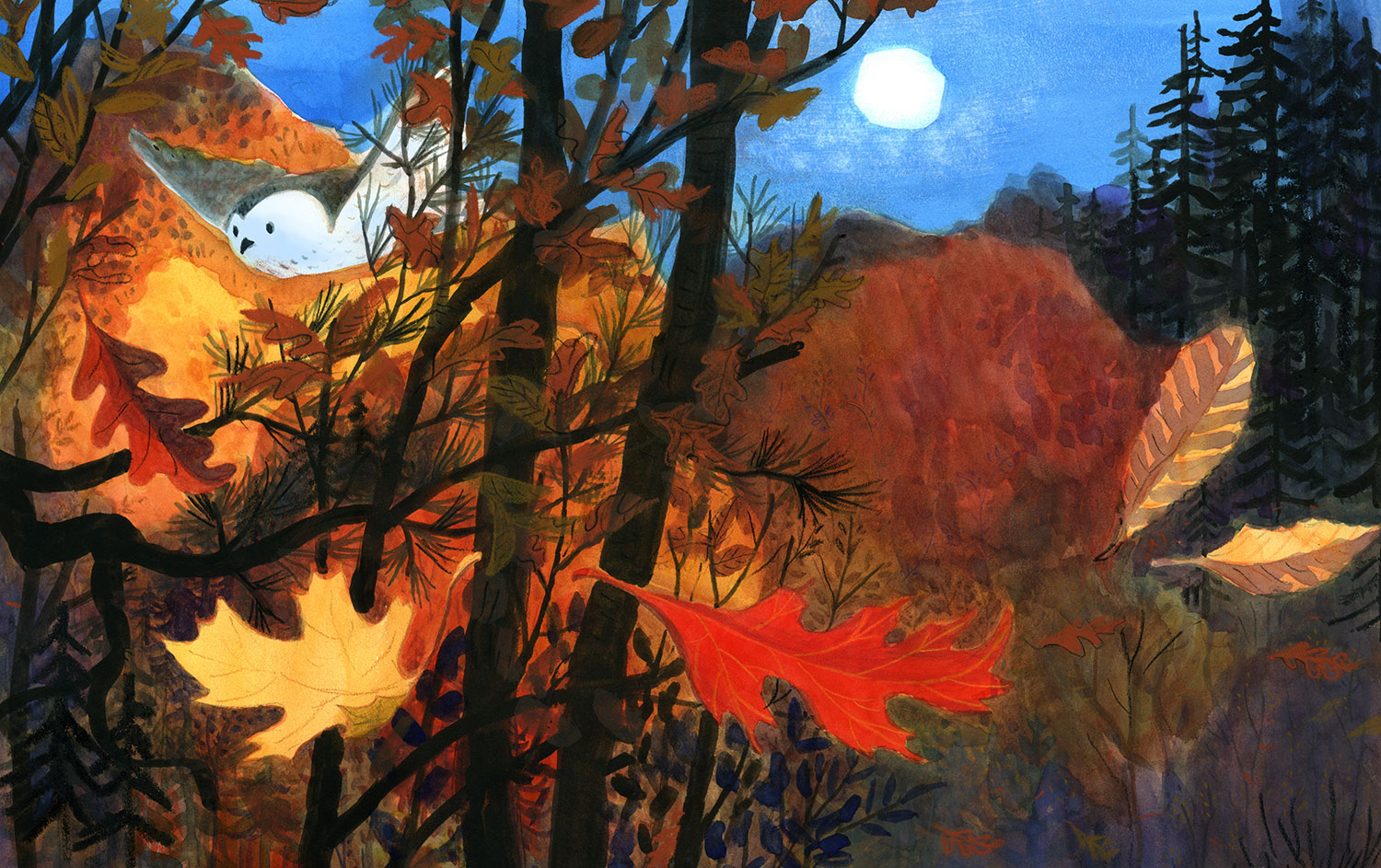
An adorable baby owl, wide awake in the full moonlight while its family sleeps, gazes out from its nest in a tree at the surrounding forest. The night is filled with “Home / Mama / Brother / Sister.” The little owl ventures out onto a sturdy limb. It knows “Tree / Nest / Hop / Look.” From its perch with a “Jump / Flutter / Flap / Fly” the owlet soars through the deep blue sky, its white face shining like the stars. It floats over autumn leaves while in the “Moon / Beam / Eyes / Gleam.”

celebrate-picture-books-picture-book-review-owl-sees-owl-flying-home-mama

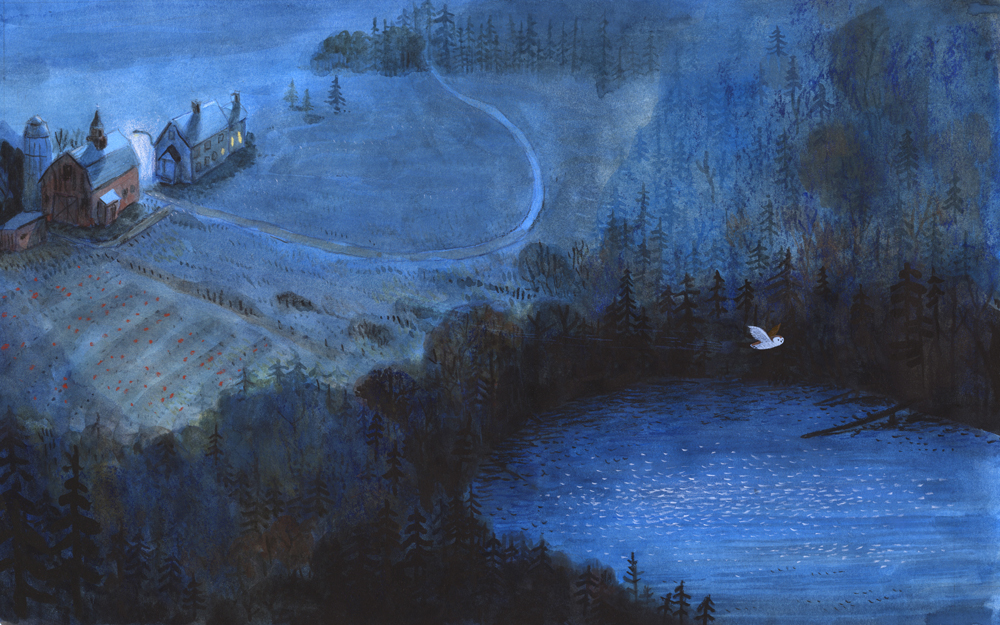
Down below other nocturnal animals have come out to play. On the farm the barn is quiet and dark while someone is stirring in the house. The baby owl passes them by with a “Soar / Glide / Swoop / Swoosh.” Something glistens in the midst of the forest, and the owl descends to investigate. “Owl… / Sees / Owl” in the rippled rings of the small pond.

celebrate-picture-books-picture-book-review-owl-sees-owl-flying-over-farm

Image copyright Laura Godwin, courtesy of Rob Dunlavey, robd.com

After a moment the owlet takes off with a quick “Swoosh / Swoop / Glide / Soar,” reversing its nighttime flight. Once more the curious baby passes over the star- and moonlit field, feeling bolder: “Scamper / Mice / Twinkle / Stars.” Deer perk up their ears and stare alert to the nearly silent woosh of the owl’s wings above. “Yellow / Red / Leaves / Fall as the owl zooms with a “Fly / Flap / Flutter / Jump toward “Sister / Brother / Mama / Home,” where Mama waits wide awake.

celebrate-picture-books-picture-book-review-owl-sees-owl-eyes-gleam

Image copyright Laura Godwin, courtesy of Rob Dunlavey, robd.com

Inspired by reverso poetry, Laura Godwin’s lovely Owl Sees Owl is a language- and emotionally rich story to share with young children. With only four words per two-page spread, Godwin tells the detailed adventure of an inquisitive baby owl who leaves home for a nighttime caper through woods and over farmland to a pond where it sees itself reflected in the mirror-like surface. In a minute the owl is back in the air for the trip home, reversing its path and also the order of the words. Godwin’s dynamic, lyrical words are joyful to read and allow for readers to linger over each page and talk about what they see, what the little owl is doing, and even whether a sentence such as “Fall / Leaves / Red / Yellow” is active or descriptive. The reverse nature of the story brings the baby owl’s adventure to a sweet, satisfying conclusion that children will love.

celebrate-picture-books-picture-book-review-owl-sees-owl-fall-leaves

Image copyright Laura Godwin, courtesy of Rob Dunlavey, robd.com

Rob Dunlavey’s illustrations transfer the most beautiful clear, moonlit night to the page, creating a perfect quiet time or bedtime book for young children. The lush, dark woods rendered in deep olives, rusts, browns, grays, and blacks as well as the indigo sky highlight the gleaming moon, twinkling stars, and white feathers of the owl. In one spread deer appear in silhouette in the background as mice scamper over pumpkins in the foreground; in another fiery red, yellow, and orange autumn leaves make a spectacular backdrop to the owl’s outstretched wings. The central spread in which the owl sees its own reflection offers readers much to talk about. Is the owl startled? Wondering? Happy? Is the owlet going home for comfort or to tell of its amazing discovery? Kids will love lingering over each page to think and talk about all that is there.

Owl Sees Owl makes a wonderful gift for young children or children who love poetry and art. The book would be a welcome and often read addition to home libraries.

Ages 2 – 7

Schwartz & Wade Books, 2016 | ISBN 978-0553497823

To see a gallery of illustration work for picture books, nature sketches, and other artwork by Rob Dunlavey, visit his website!

Picture Book Month Activity

celebrate-picture-books-picture-book-review-owl-coloring-page

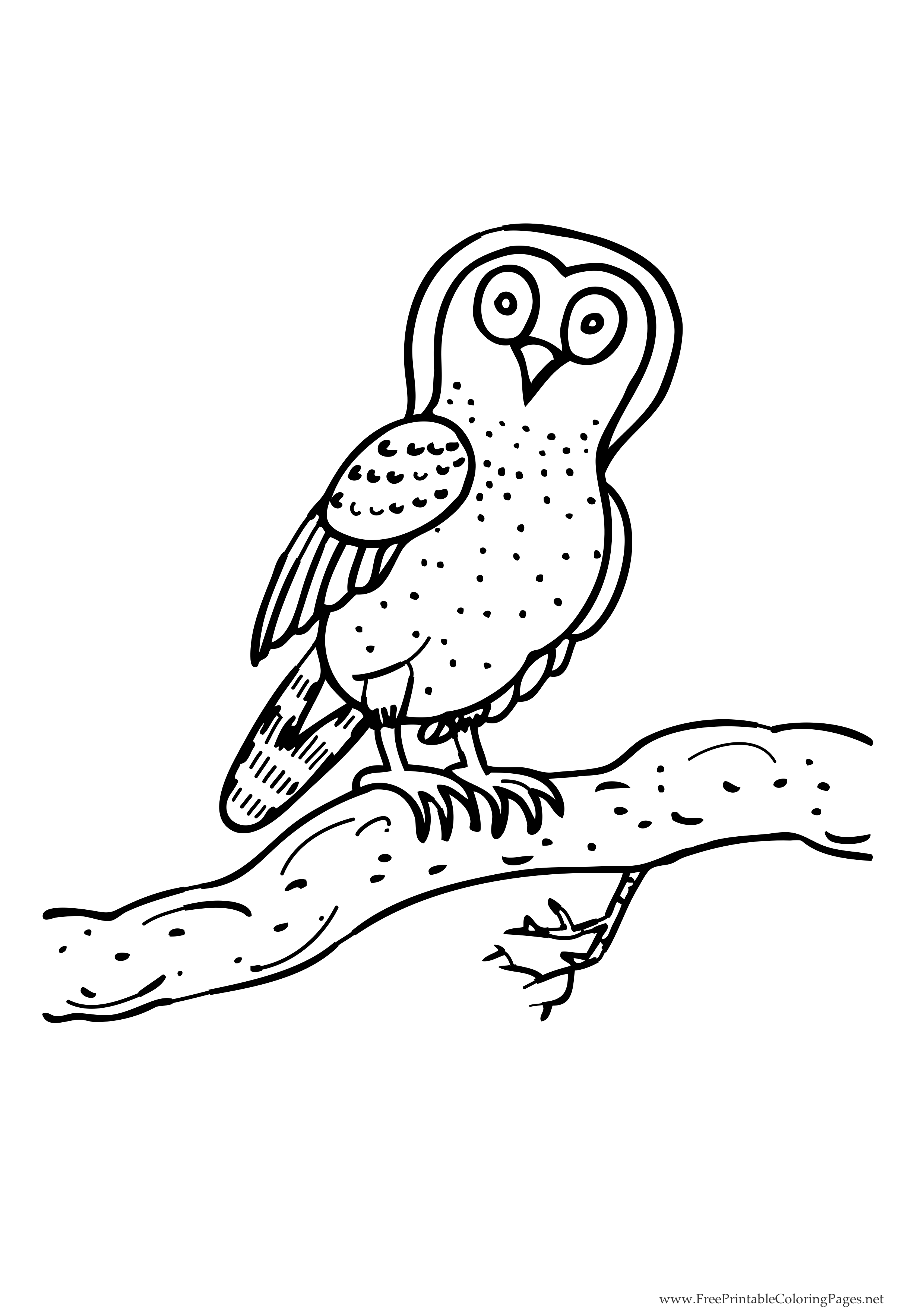
Barn Owl Coloring Page


This little guy looks ready for an adventure! Grab your pencils or crayons, color this printable cute Barn Owl Coloring Page, and give him a background to start his journey!

Picture Book Review