May 15 – Straw Hat Day

celebrate-picture-books-picture-book-review-miss-fannie's-hat-cover

About the Holiday

Straw hats are found in nearly every culture in the world and have been used since ancient times. Made from local materials, some are unique to and even iconic of the country in which they’re made. Woven loosely, straw hats can protect a person from the hot sun while also keeping their head cool. In rainy climates, tightly woven hats are good for staying dry. Of course, straw hats are a staple of women’s fashion and can be found in nearly every color and decorated with ribbon, flowers, feathers, beads, and more.

Miss Fannie’s Hat

Written by Jan Karon | Illustrated by Toni Goffe


“Miss Fannie has lots of hats. And each one is her favorite.” Miss Fannie is ninety-nine years old and has a closet full of hats that she has worn on special occasions throughout her life. When she tries on her “red felt with the big feather, she looks in the mirror and says ‘I just love this hat!’” It’s the same with her green velour hat that’s decorated with a fancy pin. She’s not the only one who loves her hats. When she wears them to church, people always tell her, “‘Miss Fannie, I sure do love that hat!’” But Miss Fannie has a favorite among her many hats: the pink straw with silk roses. Everyone else loves this hat too.

celebrate-picture-books-picture-book-review-miss-fannie's-hat-closet (2)

Image copyright Toni Goffe, text copyright Jan Karon. Courtesy of Puffin Books.

Miss Fannie is a tiny woman who now lives with her daughter, Wanda. Wanda takes good care of her mother. She makes her big breakfasts, and even though Miss Fannie always says its “way too much,” she always clears her plate. Every Saturday, Wanda helps her mother wash her hair in the bathroom sink. Miss Fannie is so small that she has to stand on a stool to reach. Afterward, Wanda rolls her mother’s hair in curlers, and on Sunday morning she “combs out her mama’s hair, which is all nice and soft and gray, like the feathers of a dove.”

Then Miss Fannie puts on make-up, dresses in her best clothes, and chooses a hat. Choosing can be difficult because “Miss Fannie has three black hats, two red hats, one green hat, two white hats, two navy hats, three beige hats, one brown hat, and the famous pink straw with roses. Because she never wears the same one twice in a row, some people think she has a whole closet full of hats. Which, of course, she does.”

One Sunday, Miss Fannie’s preacher comes to her with an earnest request. He asks her to donate one of her hats to the auction that will raise money to fix up the church for Easter. Miss Fannie wants to help, but how can she choose among her beautiful hats? When they get home, Miss Wanda helps her mother lay out all of her hats on the bed and dresser. Alone in her room, Miss Fannie looks over all her hats. As she holds each in her hand she remembers her past. “The green velour with the fancy pin was very, very old, and still very beautiful.” She had worn it during the great flood of 1916 when she “crossed the swollen river on a ferry to visit her mother and father. As she stood at the rail…a house had floated by, almost close enough to touch.”

celebrate-picture-books-picture-book-review-miss-fannie's-hat-breakfast

Image copyright Toni Goffe, text copyright Jan Karon. Courtesy of Puffin Books.

Next, she considers the red, wide-brimmed felt. The feather on this hat came from a hawk Miss Fannie had caught trying to nab one of her chickens. Then she picks up the brown velvet hat that “always reminded her of Flower, her grandmother’s cow.” She had begun milking Flower when she was seven years old and had learned to churn butter that was better than any found in a store. “Finally, Miss Fannie came to her most favorite hat of all: the pick straw with silk roses.” She had worn it every Easter for thirty-five years and it never failed to make her feel brand new. It was a tradition everyone else enjoyed too, “just as they looked for the tulips and daffodils to bloom in the spring.”

She puts the pink straw hat on, looks in the mirror, and sighs. “In her heart she did not want to giver her hat away. Not at all.” But as she places it back in its box and ties the ribbon, she discovers “she was very, very excited” about all the things it might be able to do. The old pipe organ needed fixing, there was a crack in the church bell, and the roof really needed to be replaced.

At the auction, when the preacher holds up Miss Fannie’s pink straw hat with the silk roses, “the bidding took off lickety-split.” With the bang of the gavel, the hat goes to a woman in the front row. The check she gives the preacher is “enough to really get things fixed,” Miss Fannie knows. She also knows “that she would not miss her favorite hat one bit.”

celebrate-picture-books-picture-book-review-miss-fannie's-hat-outside

Image copyright Toni Goffe, text copyright Jan Karon. Courtesy of Puffin Books.

On Easter morning Miss Fannie rises and fixes her hair. She looks at her hats—none of which seemed right. As she meets Wanda at the front door in her best dress, her best jewelry, her best gloves, and a white corsage, “Miss Wanda couldn’t believe her eyes. Her mama was going out the door without wearing any hat at all!” When they arrive at the freshly painted church, Miss Fannie and Miss Wanda are surprised and delighted to see pink roses planted everywhere around the building. “‘Oh, Mama!’ said Miss Wanda. ‘It looks just like your pink hat!’”

With tears in her eyes, Miss Fannie learns that they were able to fix the organ and the bell as well as planting all the roses. As the congregation looks on “they didn’t see an old woman at all. What they saw was a young girl with hair as soft as the feathers of a dove.” And now when people pass the church, they don’t see gardens of roses. Instead, they see Miss Fannie’s hat. “And it will always be her favorite.”

Jan Karon’s story of selfless love was a favorite in our house when my daughter was young. Not only is the well-paced narrative full of evocative sensory details, bits of history, and realistic dialogue, it centers around a unique plot involving the types of soul-searching decisions that are hard to make. No matter how many times we read the book, Miss Fannie’s choice to auction her favorite hat to benefit her church seemed to come as a surprise that both inspired and heartened. While the tale is primarily Miss Fannie’s, it is Wanda’s story of benevolence too as Karon affectionately describes the ways in which Wanda lovingly attends to her mother’s physical and emotional needs. Throughout Miss Fannie’s Hat, Karon demonstrates that a life well-lived is one abounding in joyous giving.

Toni Goffe takes readers into Miss Wanda’s home—and Miss Fannie’s memory—with his bright, delicate illustrations that fully satisfy little one’s love of realistic detail. My daughter enjoyed the textured feel to the images, where steam rises from a cup of tea and from the bathroom sink, Miss Wanda brushes out her mother’s soft hair, and the hats—made of velvet, velour, and straw and sporting feathers, flowers, nets, and ribbon—beg to be touched. In fact, with the first page and its tantalizing peek into Miss Fannie’s closet, readers will find themselves riveted to her hats and life story. Vignettes from Miss Fannie’s younger years as well as scenes of her now demonstrate her enduring courage and strength of character.

For kids who like to count, sort, and compare, a one-page illustration and a glorious two-page spread allow them to match the list of hats in the text with the contents of Miss Fannie’s closet. They are also invited to choose their favorite from among Miss Fannie’s hats.

Miss Fannie’s Hats is a wonderful story to share with young readers for its ideas of giving, multigenerational relationships, and friendship.

Ages 3 – 6

Puffin Books, 2001 | ISBN 978-0140568127

Discover more about Jan Karon and her books for children and adults on her website!

View a gallery of artwork by Toni Goffe on his website!

Straw Hat Day Activity

celebrate-picture-books-picture-book-review-hat-matching-game

Hat Matching Game


These hats come in pairs—or maybe even triplets—but somehow they’ve been mixed up! Can you find all the matching sets? Just put on your thinking caps and play this printable game!

Supplies

Directions

  1. Print two or more sets of cards
  2. Cut the hat cards apart
  3. Mix them up and lay them face down on the floor or table
  4. Choosing one card at a time, turn them over to try and find a match
  5. If the cards do not match, replace them face down and try again
  6. Continue play until all the hats have been matched

Picture Book Review

May 4 – Petite and Proud Day

celebrate-picture-books-picture-book-review-the-smallest-girl-in-the-smallest-grade-coverAbout the Holiday

Life’s not about how tall you are but about how big your heart is! Today we celebrate people who are 5’4” and under—the petite! There are many advantages to being on the smaller side—it’s easier to fit into tight spaces; airline, train, and other transportation seats are more comfortable; and we can blend into the crowd more easily when we’re having a bad hair day. All-in-all being petite is pretty perfect!

The Smallest Girl in the Smallest Grade

Written by Justin Roberts | Illustrated by Christian Robinson


Sally McCabe was so small that she was mostly overlooked. “She was the smallest girl in the smallest grade.” The other kids heard her name called every morning along with theirs, and they passed her in the hall on the way to class, but no one knew that “Sally was paying super extra special attention” to what went on around her. For instance, she noticed the kite someone had lost in the tree and had counted twenty-seven keys on the janitor’s ring.  She watched as the leaves turned “green to gold in the fall” and when “Tommy Torino was tripped in the hall.”

celebrate-picture-books-picture-book-review-the-smallest-girl-in-the-smallest-grade-classroom

Image copyright Christian Robinson, text copyright Justin Roberts. Courtesy of G. P. Putnam’s Sons.

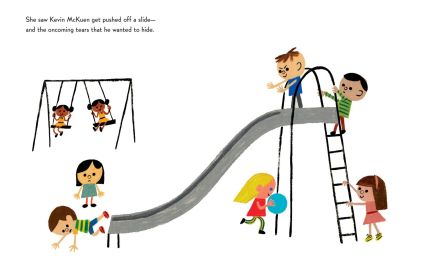
She saw wildflowers turn their face toward the sun and “was there when the stray cats who normally fought / conducted a meeting in the church parking lot.” On the playground she saw Kevin McKuen get shoved down the slide and knew of the “tears that he wanted to hide.” On Parent-Teacher day, too, she watched kids pulled down the hall by parents upset at what they had heard. But during all this, no one happened to see Sally watching or knew what that could mean.

celebrate-picture-books-picture-book-review-the-smallest-girl-in-the-smallest-grade-slide

Image copyright Christian Robinson, text copyright Justin Roberts. Courtesy of G. P. Putnam’s Sons.

Sally understood that these slights, mean words, and cruel actions kept building and building without any stop, and she finally decided that something must change. So one day during lunch she stepped out of line, stuck her hand in the air, and announced very loud, “‘I’m tired of seeing this terrible stuff. / Stop hurting each other! This is enough!’”

Some kids just giggled and ignored what she’d said, but many others joined in with their hands in the air. “Like waves rolling in, one after another— / first Molly rose up, then Michael’s twin brother. / It was Tyrone and Terence, then Amanda and Paul, / who pushed out their chairs and stretched their arms tall.” And they all felt connected “like the janitor’s keys. Fastened together with a heavy steel ring / that held all the secrets to unlock everything.”

celebrate-picture-books-picture-book-review-the-smallest-girl-in-the-smallest-jump-rope

Image copyright Christian Robinson, text copyright Justin Roberts. Courtesy of G. P. Putnam’s Sons.

After that day, things went back to normal—but with much welcomed kindness in small doses and places. Spaces were made for strangers to sit, doors held wide open, and many such “moments that get taken for granted—a wildflower appearing that no one had planted.” And so the world changed for this school and this town all because Sally was courageous and kind and paying attention.

Justin Roberts’ rhyming tribute to the empathy and bravery of one little girl who takes notice and makes a difference shows kids and adults that anyone can create change no matter who they are. Readers of all ages will recognize the hurts that Roberts chooses to include, good examples of the small and large acts that cause physical and emotional pain. The infectious rhythm and the inspirations of kindness—from the alley cats’ truce to wildflowers to keys (objects that at once have familiarity and deeper meanings)—give the book resonance far beyond the immediate reading.

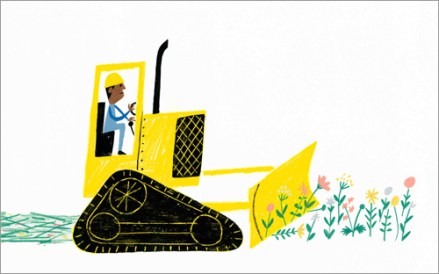
celebrate-picture-books-picture-book-review-the-smallest-girl-in-the-smallest-grade-bulldozer

Image copyright Christian Robinson, text copyright Justin Roberts. Courtesy of G. P. Putnam’s Sons.

Christian Robinson’s bright, wide-lens drawings of Sally’s schoolroom, cafeteria, and playground give young readers the same view Sally has, allowing them to also find the examples of arguing, pushing, whispering, and other slights that she reacts to. An illustration of Sally and her classmates sitting at their desks shows exactly how small she is in comparison to the other children; the rest of the pages demonstrate just how big her heart is. Each page offers opportunities for kids and adults to discuss the problems of bullying and options for how they can make a difference.

The Smallest Girl in the Smallest Grade is a wonderful reminder of how important each person is in making the world a happier place and would make an excellent addition to home libraries.

Ages 3 – 7

G. P. Putnam’s Sons, 2014 | ISBN 978-0399257438

Visit Christian Robinson’s website, where books and art are always fun!

Check out all the music, videos, activities, and other stuff by Justin Roberts on his website!

Petite and Proud Day

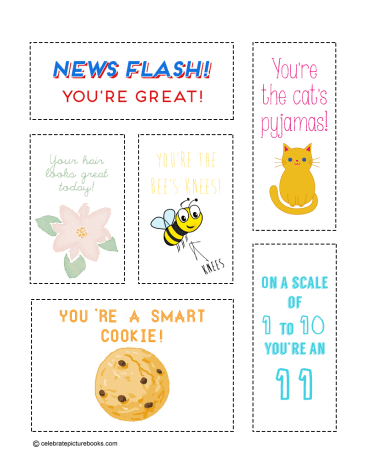
celebrate-picture-books-picture-books-review-kindness-cards

Kindness Cards


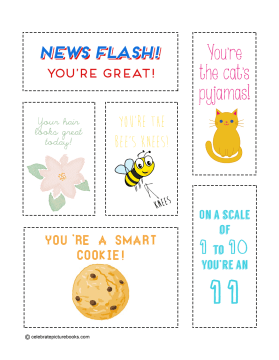
Being kind to someone can be as easy as slipping a friendly note into someone’s locker or backpack or leaving a card for a favorite teacher, bus driver, or librarian. If you notice someone who could use a pick-me-up, you could give them one of these cards too! Print out your Kindness Cards and start spreading some good cheer!

Picture Book Review

April 22 – Earth Day

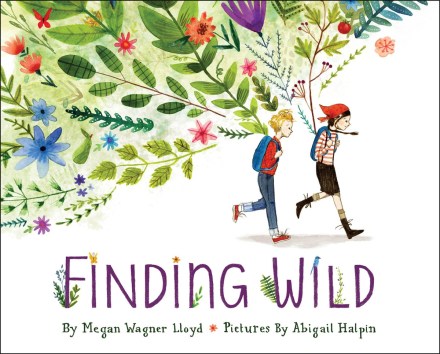
celebrate-picture-books-picture-book-review-finding-wild-cover

About the Holiday
While we should be mindful of our impact on the earth every day, today’s holiday puts a focus on how we can conserve and protect the beauty and resources of our planet. Now more than ever, it’s up to us to do what we can on a personal level to make sure the environment is clean, healthy, and sustainable for the future. If you’d like to learn how you can make a difference or get involved with your global community, here’s a good place to start!

Finding Wild

Written by Megan Wagner Lloyd | Illustrated by Abigail Halpin


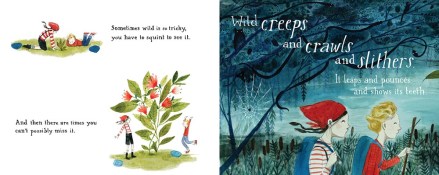
A girl and a boy stand with their backs to the stairs leading down to the subway contemplating the jungle of growth in front of them. A single floating leaf seems to lead the way. They follow along the path, leaving the city behind and enter the wild. Here “Wild is tiny and fragile and sweet-baby new. It pushes through cracks and crannies and steals back forgotten places.” Wild comes in many guises—some obvious, some not.

Wild also moves in various ways. As the boy and girl continue on the path passing a spider’s web and shadowy shapes with glowing eyes, wild “creeps and crawls and slithers. It leaps and pounces and shows its teeth.” Everywhere the pair ventures, wild has a distinct smell—fresh or musty, sharp or sweet, tangy or acrid. They discover wild can be as hot as a forest fire or as cold as an icicle. Running through a field of flowers and climbing a rocky cliff, the two find that wild is “as smooth as the petals of poppies, and as rough as the fierce face of a mountain.” They also find that wild can hurt in so many ways.

celebrate-picture-books-picture-book-review-finding-wild-creepy

Image copyright Abigail Halpin, text copyright Megan Wagner Lloyd. Courtesy of Alfred A. Knopf

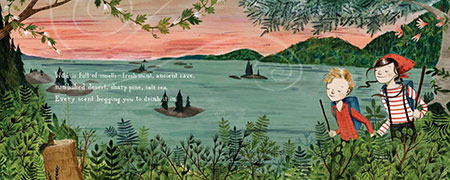
Plunging deeper into the wild the boy and girl uncover more secrets—delicious and quenching. The sounds of wild chill and soothe them. Suddenly, though, the girl and the boy find themselves outside of the wild, back in front of a subway entrance. The wild, now seems far away, invisible and unknown, as if “the whole world is clean and paved, ordered and tidy.” As the pair gaze upward, the tall buildings and skyscrapers block the sky. But the girl points to a leaf swirling through the air. They follow it through an open door that leads to a most surprising discovery.  

celebrate-picture-books-picture-book-review-finding-wild-water

Image copyright Abigail Halpin,  text copyright Megan Wagner Lloyd, Courtesy of Alfred A. Knopf

Megan Wagner Lloyd entreats readers to rediscover the wild no matter where they live. Her lyrical descriptions of the splendor of nature in all its incarnations—from gentle to intense, quiet to loud, mysterious to open—delightfully capture the way children interact with the environment. Lloyd reminds readers that tasting a single juicy blackberry, thrilling to a coyote’s howl on a dark night, even feeling the prick of a cactus needle connect them to the greater world and that searching for and finding the wild—especially in the midst of an “ordered and tidy” world—brings peace and happiness.

Abigail Halpin’s lush illustrations of the wild environment gorgeously depict the vibrant colors, sometimes chilling shadows, and refreshing water the two children discover in the middle of their city. The thick vegetation rendered in a palette of greens is a riot of ferns, pines, flowering trees, and vines that hide small birds and animals. As the children huddle in a tent, the indigo night crackles with lightning and the songs of coyotes. A two-page scrapbook-type spread displays various plants and insects that sting, burn, or cause itching. When the boy and girl reenter the city, buildings—old and new—billboards, and traffic meet their eyes, but they keep their gaze on the leaf leading them on. That leaf invites readers, also, to get outside and explore the wild.

Ages 3 – 8

Alfred A. Knopf, Random House Books for Young Readers, 2016 | ISBN 978-1101932810

Discover more about Megan Wagner Lloyd, the world of Finding Wild, and news on her upcoming book on her website!

View a gallery of artwork by Abigail Halpin on her website!

Earth Day Activity

celebrate-picture-books-picture-book-review-earth-day-coloring-page

Love the Earth Coloring Page


Earth Day is all about loving the Earth and treating her well. Have fun with this printable Love the Earth Coloring Page and think of one thing you can do to make a difference!

Picture Book Review


March 10 – International Day of Awesomeness

celebrate-picture-books-picture-book-review-i-want-that-love-cover

About the Holiday
Okay, so it’s Friday and the end of a long work and school week. Maybe everything didn’t go as planned this week—maybe not even close. But who cares. Why? Because you are still awesome! Begun as a kind of inside joke among coworkers, International Day of Awesomeness continues to grow, attracting more and more awesome individuals around the world. To celebrate get creative and perform feats of awesomeness—whatever that might mean to you. Sometimes that just means having and showing an awesome amount of love—as you’ll soon see!

I Want That Love

By Tatsuya Miyanishi


Long ago Tyrannosaurus ruled the earth. His philosophy was “In this world, strength means everything. The strongest wins. The strongest rules. And I am the strongest!” Tyrannosaurus stomped across the landscape crushing and eating the “worthless weaklings” in his path. The other dinosaurs quaked whenever they heard him roar. They hid and were quiet, and never opposed him. Soon this led to some skewed thinking—they also began to believe that “Tyrannosaurus could do anything he wanted to because he was the strongest.”

celebrate-picture-books-picture-book-review-i-want-that-love-sleeping

Text and image copyright Tatsuya Miyanishi, courtesy of museyon.com

As time passed, however, the Tyrannosaurus grew old and feeble. One day he happened upon a Masiakasaurus who mocked him for moving so slowly. The Tyrannosaurus threatened him, but could do little else. Another Masiakasaurus bit the Tyrannosaurus’s tail. “‘Ouch…stop,’ the Tyrannosaurus cried.” But it did no good; no one was afraid of him anymore.

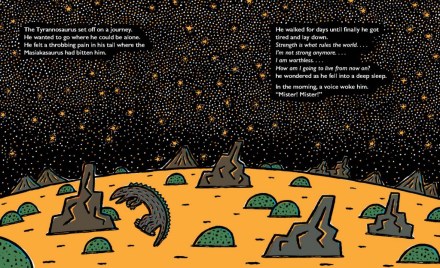
The Tyrannosaurus just wanted to be alone. He traveled for days, and when he was exhausted he lay down and went to sleep. Now that he was no longer strong, he felt he was worthless and wondered how he was “going to live from now on.” He was awakened by a voice. “He opened his eyes and saw a yummy-looking baby Triceratops right in front of him.” He had every intention of eating this little snack, but his tail was so sore he couldn’t move.

celebrate-picture-books-picture-book-review-i-want-that-love-hugging-triceratops

Text and image copyright Tatsuya Miyanishi, courtesy of museyon.com

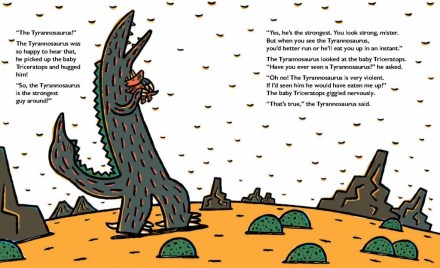
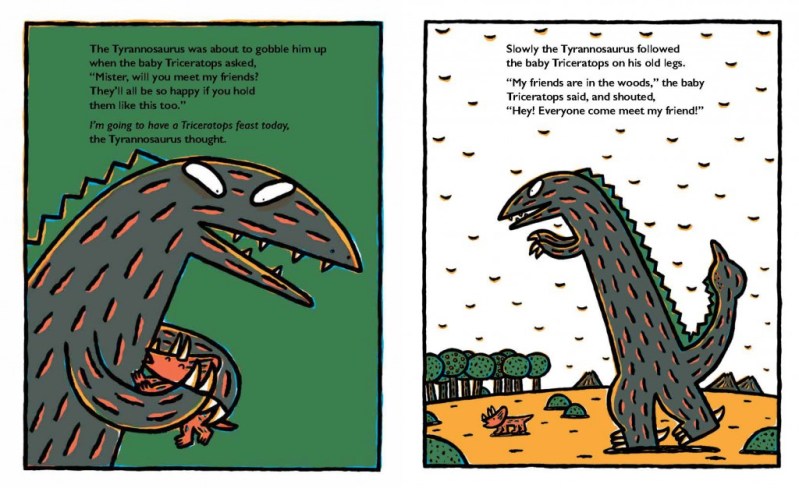
The little Triceratops noticed his swollen tail and stroked the injury to help it feel better. He also warned the Tyrannosaurus that sleeping in the open was dangerous because the “strong, scary Tarbosaurus” would eat him. The Tyrannosaurus scoffed, saying that there was someone much stronger than the Tarbosaurus. The Triceratops suggested the Gorgosaurus, but Tyrannosaurus disagreed. “‘I’m thinking of someone who is much, much stronger,’” he said. Oh, yes! The Triceratops remembered. “‘The Tyrannosaurus!’” Tyrannosaurus was so happy to hear his name that “he picked up the baby Triceratops and hugged him.” The baby warned the dinosaur to run away if he saw Tyrannosaurus because he would surely be eaten.

The giant dinosaur was surprised that the baby had never seen Tyrannosaurus before, and was just about to gobble him up when the little one asked if he would meet his friends and hug them too. The Tyrannosaurus eagerly followed the Triceratops, imagining the feast he was about to have. When they reached the woods all the little Triceratops came out to play and begged to be picked up and hugged.  “‘No, no, guys!’ said one little Triceratops. ‘Even a mighty man like Mr. Rhabdodon can get tired.’”

celebrate-picture-books-picture-book-review-i-want-that-love-following-triceratops

Text and image copyright Tatsuya Miyanishi, courtesy of museyon.com

The Tyrannosaurus was insulted. Rhabdodon was stupid, a weakling, and an herbivore. But before he could protest, the other little Triceratops discovered his wound. They all began tending carefully to his injury and gathered red berries to help him heal even though it hurt their horns to ram the tree and dislodge the berries. Suddenly, Tyrannosaurus understood their sacrifice on his behalf. Tears sprang to his eyes, and he grabbed a trunk in his teeth and shook it. The youngsters were amazed as red berries rained down on them.

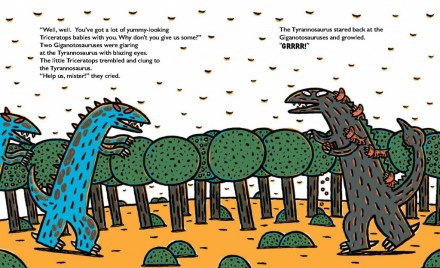
They cheered and said they wanted to be just like Mr. Rhabdodon. They bet that he could even beat mean Tyrannosaurus. The Tyrannosaurus mumbled his old slogan, and began to tell the little ones that strength wasn’t so important when they were interrupted by two Giganotosauruses who wanted a Triceratops snack. The Tyrannosaurus growled at the newcomers. But the Giganotosauruses attacked, biting the Tyrannosaurus to get at the babies in his arms. The Tyrannosaurus curled his body around them and promised to protect them.

celebrate-picture-books-picture-book-review-i-want-that-love-playing-with-triceratops

Text and image copyright Tatsuya Miyanishi, courtesy of museyon.com

As the Giganotosauruses continued to bite him, the Tyrannosaurus “murmured, ‘I finally understand…Remember this, kids. It’s not being strong that is important. What’s most important is…’” At last, unsuccessful in their quest, the Giganotosaurus went away, and the Tyrannosaurus fell over. The little Triceratops crawled safely away and headed home when the Tyrannosaurus told them  he was tired. Before he left, the first Triceratops asked what the most important thing was, but the Tyrannosaurus didn’t reply.

Many years later a father Triceratops and his babies were spotted by two Giganotosauruses looking for food in the woods. They jumped on the family, but the father hid his children under his body and endured the attack. “He remembered how the Tyrannosaurus had protected him and his friends.” Finally, the Giganotosauruses gave up and went away. His little ones were impressed but asked why he hadn’t beaten up the Giganotosauruses.

celebrate-picture-books-picture-book-review-i-want-that-love-giganotosaurus

Text and image copyright Tatsuya Miyanishi, courtesy of museyon.com

With tears in his eyes, the father said, “‘Violence isn’t the answer. There is something more powerful than strength, and more precious too. That is love…A truly strong guy who broke this tree once gave me that love….’ One baby looked at his father and said, “‘Will you give me that love? I want that love.’”

Originally published in Japan, Tatsuya Miyanishi’s story of what constitutes true strength and how love can transform even the most hardened heart will resonate with kids and adults on many levels. Children’s familiarity with and love of dinosaurs allows them to easily understand the complexities of the actions and emotions revealed in the story. Ambiguity in the wording after the Tyrannosaurus defeats the Giganotosauruses allows for various interpretations of his fate depending on the age and sensitivity of the child, and a bit of humor when the Triceratops does not recognize Tyrannosaurus adds levity to the plot. The innocence and generosity of the Triceratops babies as an agent of change within the Tyrannosaurus is poignant and realistic. Likewise, the long-term effects of experiencing awesome love when young is well demonstrated as the father Triceratops later gives back to his own family.

The harsh dinosaur-eat-dinosaur landscape is effectively portrayed in Miyanishi’s bold green, gold, and orange illustrations in which the stylized Tyrannosaurus towers over trees, angular rock formations, and especially the tiny, unsuspecting Triceratops. Images of the Tryannosaurus and Triceratops father guarding the babies are touching and demonstrate a parent’s or caregivers love.

I Want That Love is the third book in the Tyrannosaurus series, along with You Look Yummy and You Are My Best Friend, and will reward readers who love dinosaurs as well as those looking for books on kindness and acceptance.

Ages 5 – 7

Museyon, 2016 | ISBN 978-1940842141

Day of Awesomeness Activity

celebrate-picture-books-picture-book-review-awesomeness-cards

Awesomeness Cards


Do you have some awesome people in your life? Give them one of these printable Awesomeness Cards and watch them smile!

Picture Book Review

February 21 – It’s Love the Bus Month

celebrate-picture-books-picture-book-review-last-stop-on-market-street-cover

About the Holiday

Love the Bus Month, sponsored  by the American School Bus Council, promotes awareness of and offers appreciation to the thousands of school bus drivers across the country who safely transport students every day to and from school, to field trips and to sporting events. To join the celebration, write a note to your bus driver and thank them for all they do for you!

Last Stop on Market Street

Written by Matt de la Peña | Illustrated by Christian Robinson


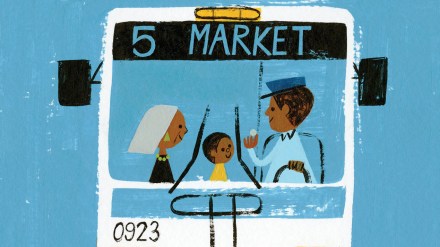
CJ, fresh from church, skips out into the sprinkling rain. He and his nana wait for the bus under her umbrella. From the bus stop CJ watches as his friend climbs into a warm, dry car and asks, “‘Nana, how come we don’t got a car?’” Nana was just telling CJ that they didn’t need a car when “the bus creaked to a stop in front of them. It sighed and sagged and the doors swung open.’”  As they stepped aboard, Mr. Dennis, the bus driver, pulled a quarter from behind CJ’s ear, making him giggle.

celebrate-picture-books-picture-book-review-last-stop-on-market-street-at-bus-stop

Image copyright Christian Robinson, text copyright Matt de da Peña, 2015. Courtesy of G. P. Putnam and Sons Books for Young Readers.

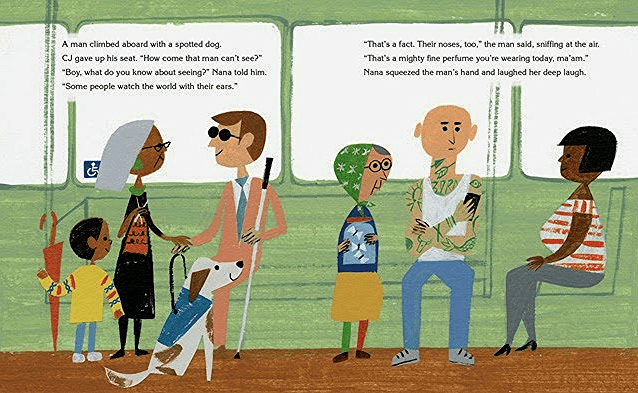
CJ and Nana found seats up front across from a man with a guitar and an old woman with a jar of butterflies on her lap. Nana said hello to everyone and “made sure CJ did the same.” As the bus pulled away from the curb, Nana began to knit and CJ looked out the window feeling sorry that he couldn’t just go home after church like his friends. Nana said she felt “‘sorry for those boys….They’ll never get a chance to meet Bobo or the Sunglass Man.’”

celebrate-picture-books-picture-book-review-last-stop-on-market-street-getting-on-bus

Image copyright Christian Robinson, text copyright Matt de da Peña, 2015. Courtesy of G. P. Putnam and Sons Books for Young Readers.

At the next stop a blind man and his dog got on. CJ gave him his seat, but asked Nana why he couldn’t see. “‘Some people watch the world with their ears.’” Nana told him. When the bus stopped again, two older boys stepped on. CJ wished he could listen to music on a phone like they were, but Nana pointed to the man with the guitar, who began to pluck the strings and sing. CJ closed his eyes and let the music transport him out of the city. In his mind he saw waves and colors, hawks and butterflies. “CJ’s chest grew full and he was lost in the sound and the sound gave him the feeling of magic.”

celebrate-picture-books-picture-book-review-last-stop-on-market-street-blind-man

Image copyright Christian Robinson, text copyright Matt de da Peña, 2015. Courtesy of G. P. Putnam and Sons Books for Young Readers.

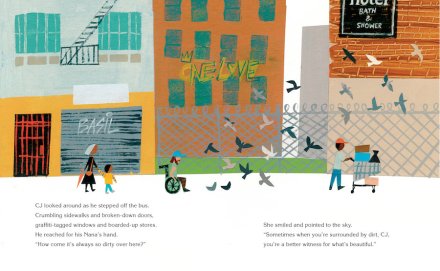
When the man finished his song everyone clapped, and CJ dropped his quarter into the man’s hat. Finally, the bus came to the last stop on Market Street. CJ and his nana stepped off into a neighborhood of “crumbling sidewalks and broken-down doors, graffiti-tagged windows and boarded-up stores.” CJ wondered why it was always so dirty there, but Nana pointed to the beauty of the sky above them. CJ looked up and saw a rainbow arching over the soup kitchen. Then CJ saw familiar faces at the window and felt glad they had come. “‘Me too,’” Nana agreed as she and CJ took up their posts and began ladling soup into bowls.

celebrate-picture-books-picture-book-review-last-stop-on-market-street-soup-kitchen

Image copyright Christian Robinson, text copyright Matt de da Peña, 2015. Courtesy of G. P. Putnam and Sons Books for Young Readers.

Matt de da Peña’s gentle nudging to look on the bright side and appreciate the beauty and wonder around you is made all the more poignant for readers by the story’s young protagonist. Through realistic dialogue and honestly expressed feelings, CJ and Nana engage in one of life’s most important lessons—connecting empathetically with others. CJ’s rich experiences on the bus and at the soup kitchen—microcosms of our larger world—broadens his view and enlivens his imagination. Last Stop on Market Street reminds readers that to truly enjoy a meaningful life they must be aware of and appreciate the diversity of people and events around them.

Christian Robinson’s acrylic and collage illustrations are smart, captivating snapshots of CJ’s day as he watches and interacts with a variety of people on the bus and at the soup kitchen. The visual camaraderie of the passengers—old and young, tattooed, talented, and disabled—as they talk together and smile at one another will cheer readers. The color scheme of bright and pastel colors shared from page to page enhances the book’s themes of interconnectedness and cohesion, and the clean, unadorned images reflect the idea that often the simple things in life really are the best.

Last Stop of Market Street, winner of the 2016 Newberry award and a Caldecott Honor book as well as the winner of many other awards, is a superb book to add to any child’s home library.

Ages 3 – 6

G. P. Putnam Suns Books for Young Readers, 2015 | ISBN 978-0399257742

Learn more about Matt De La Peña, his books, and more on his website!

Discover more about Christian Robinson and view a gallery of his work on his website!

Get on board this Last Stop on Market Street book trailer!

Love the Bus Month Activity

celebrate-picture-books-picture-book-review-school-bus-coloring-page

Where Are You Going? Coloring Page


Do you love riding the bus? It’s a great way to sightsee while getting where you want to go. Grab your colored pencils, markers, or crayons and enjoy this Where Are You Going? Coloring Page!

Picture Book Review

February 19 – Plant the Seeds of Greatness Month

Who Says Women Can't Be Doctors by Tanya Lee Stone and Marjorie Priceman picture book review

About the Holiday

Plant the Seeds of Greatness Month was established to help people remove barriers to their success and make changes to better their lives. Whether you want to learn a new skill, take care of your health, meet new people, or pursue a job or profession you’ve always dreamed of, this month is a perfect time to get started!

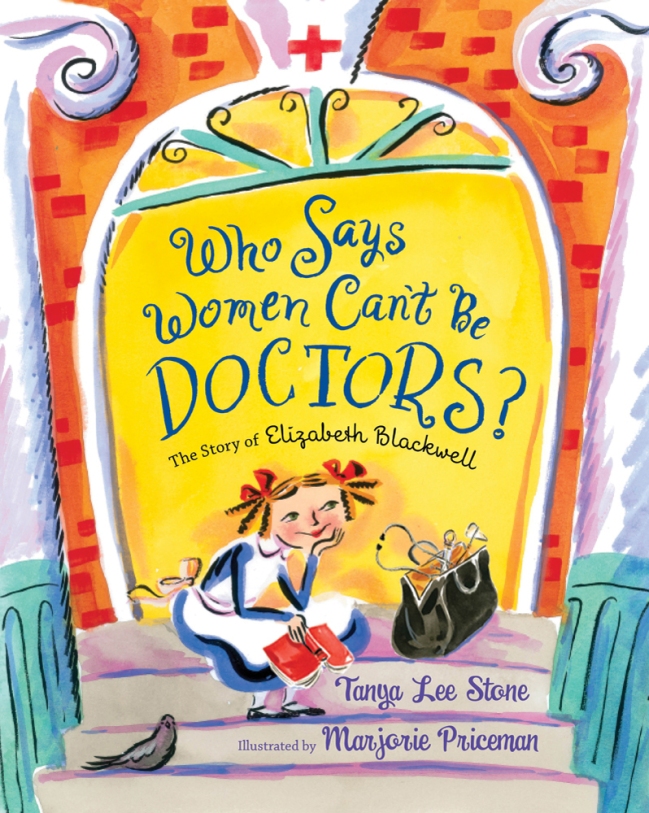
Who Says Women Can’t be Doctors? The Story of Elizabeth Blackwell

Written by Tanya Lee Stone | Illustrated by Marjorie Priceman


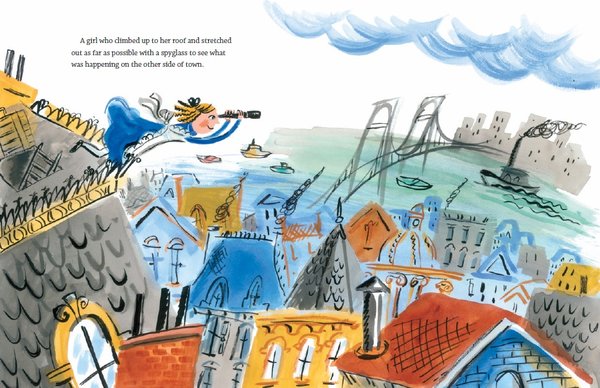
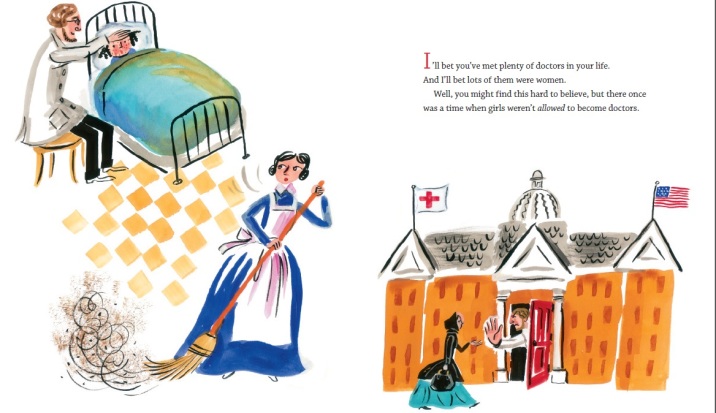
Once upon a time there were no women doctors. Women weren’t even allowed to be doctors. Sounds like a fairy tale, doesn’t it? But it was the truth. Then Elizabeth Blackwell, came along. Elizabeth was not like other girls of the 1830s. She loved to explore and take on challenges. She could lift her brother over her head, and to toughen herself up she slept on the hard wood floor. To get a better look at the world she once climbed to the roof of her house and leaned waaaaay out with a spyglass. What did she see? Maybe she saw her future. But it wasn’t what she imagined at the time. Blood made her queasy, dissection was disgusting, and being sick just made her want to hide from all the fussing.

celebrate-picture-books-picture-book-review-who-says-women-can't-be-doctors-elizabeth-brave

Image copyright Marjorie Priceman, text copyright Tanya Lee Stone. Courtesy of Henry Holt.

A comment by a sick friend, however, puts a bee in Elizabeth’s bonnet. Mary Donaldson tells Elizabeth that she would much rather have been examined by a woman than her male doctor, and then says, “You should be a doctor, Elizabeth.” What a crazy notion, right? Well… Elizabeth can’t stop thinking about it. She asks around. Some people think it’s a good idea, but impossible; others simply think it’s impossible. They believe women aren’t strong enough or smart enough and they laugh at her. By this time, though, Elizabeth is determined.

celebrate-picture-books-picture-book-review-who-says-women-can't-be-doctors-no-women-doctors

Image copyright Marjorie Priceman, text copyright Tanya Lee Stone. Courtesy of Henry Holt.

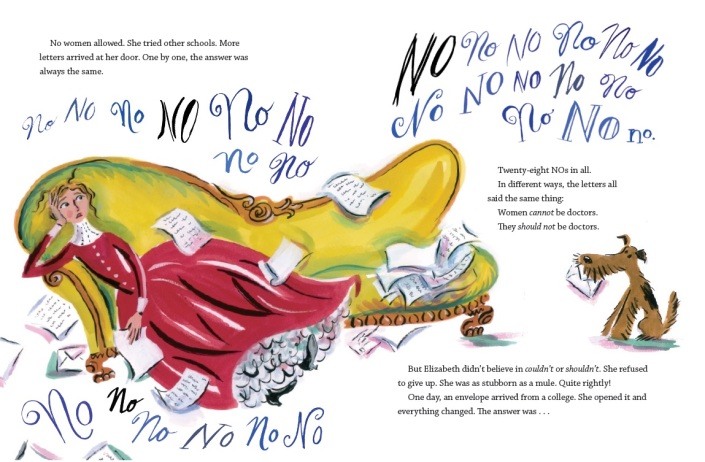
She applies to 28 medical schools, and they all say, “No.” But one day a “Yes” arrives in the mail. Elizabeth packs her bags. As she nears the school, Elizabeth sees that the townspeople have all come out to see her. They aren’t there to welcome their new medical student, though; they just want to whisper and point and stare. Surely, Elizabeth thinks, her classmates will be happy to see her. 

celebrate-picture-books-picture-book-review-who-says-women-can't-be-doctors-everyone-says-no

Image copyright Marjorie Priceman, text copyright Tanya Lee Stone. Courtesy of Henry Holt.

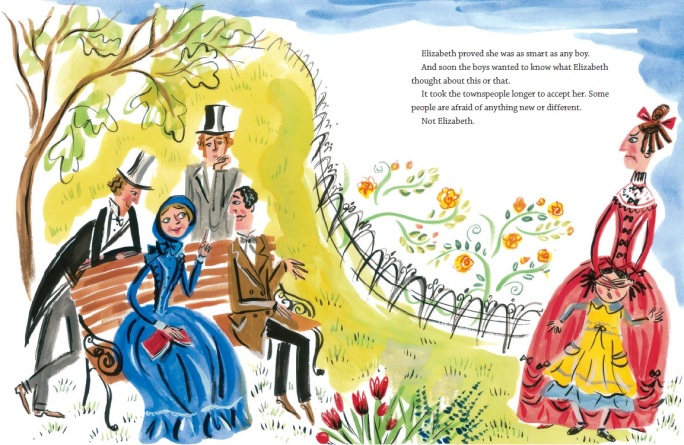
But she receives the same reception on the college campus. In fact, she learns that the only reason she was accepted was because the men voted to let her in as a joke! Elizabeth knows how to handle it. She studies hard and gives her opinions, and soon she wins the respect of her fellow students—even if the townspeople still don’t accept her.

On January 23, 1849 Elizabeth Blackwell graduates from medical school with the highest grades in the class. She has become the first woman doctor in America! Many people hope that she will be the last. But as we know…she was Not!

celebrate-picture-books-picture-book-review-who-says-women-can't-be-doctors-elizabeth-does-well-in-school

Image copyright Marjorie Priceman, text copyright Tanya Lee Stone. Courtesy of Henry Holt.

Tanya Lee Stone magnificently imbues this short biography of Elizabeth Blackwell with enough mystery, conflict, and history for even the youngest readers to understand the type of girl and woman Elizabeth was as well as the challenges she faced. Stone has deftly included details of Blackwell’s life that  make her instantly recognizable and relatable to children. This biography is not only historical nonfiction, but a universal story for all generations. Blackwell may have started out as a reluctant dreamer, but once she dared to believe she accomplished more than she or anyone could have imagined. It is what we want for all our children.

Marjorie Priceman’s illustrations that swirl with words, are angled on the page, and float in white space are as topsy-turvy as the world Elizabeth Blackwell created with her courage and life’s work. Blackwell’s boldness is echoed in the rich colors and strong lines of Priceman’s gouache and India-ink paintings, and the emotions she stirred in others—from derision to horror to admiration—are cleverly and exceptionally drawn in a minimal style on the characters’ faces.

Ages 5 – 9

Henry Holt and Company, 2013 | ISBN 978-0805090482

Learn more about Tanya Lee Stone and her work—both fiction and nonfiction—for children and teens on her website!

You can connect with Marjorie Priceman on Facebook!

Plant the Seeds of Greatness Month Activity

CPB - Doctors Clothespins

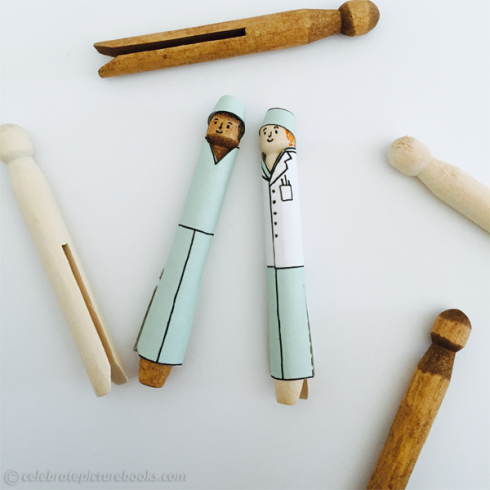
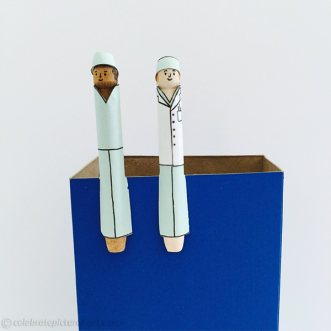
Doctor Clothespin Figures


Elizabeth Blackwell believed in herself and became the doctor she wanted to be. With this craft you can make a doctor figure or color your own clothes to make your figure any profession you are dreaming of!

Supplies

CPB - Doctors Clothespins on box

Directions

  1. Draw a face and hair on the clothespin
  2. Cut out the outfit you want your doctor to wear (color pants on your clothespin if you choose the lab coat)
  3. Wrap the coat or scrubs around the clothespin. The slit in the clothespin should be on the side.
  4. Tape the clothes together
  5. Wrap the cap around the head and tape it.
  6. If you’d like to display your clothespin doctor on a wire, string, or the edge of a box or other container, cut along the dotted lines of the clothes template.

Picture Book Review


February 16 – International Month of Black Women in the Arts

celebrate-picture-books-picture-book-review-fancy-party-gowns-cover

About the Holiday
During this month we recognize the contributions of black women across the fields of literature, fine, performing, culinary, and healing arts. To celebrate, research black women artists and attend exhibits, readings, or other events that showcase these talented women.

Fancy Party Gowns: The Story of Fashion Designer Ann Cole Lowe

Written by Deborah Blumenthal | Illustrated by Laura Freeman


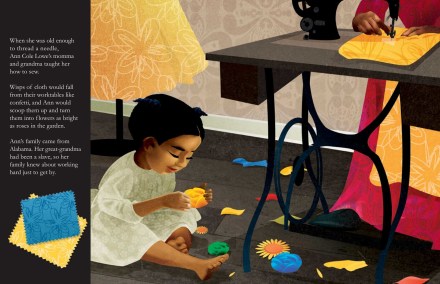
From the time that Ann Cole Lowe was old enough to thread a needle, she loved to sew. While her momma and grandma worked at their sewing machines, making dresses for the socialites of Alabama, Ann sat nearby turning “the wisps of cloth” that fell to the floor into “flowers as bright as roses in the garden.” Even at a young age Ann understood that “doing what you love could set your spirit soaring.”

celebrate-picture-books-picture-book-review-fancy-party-gowns-ann-as-child

Image copyright Laura Freeman, text copyright Deborah Blumenthal, courtesy of simonandschuster.com

When Ann was only sixteen years old, her momma died. Not only did her mother’s death leave Ann bereft, it left her in charge of the business, and many women were waiting for gowns, most importantly the Alabama governor’s wife. “Ann thought about what she could do, not what she couldn’t change.” She sat down and finished the dresses. “Then she stood up and ran the business.”

celebrate-picture-books-picture-book-review-fancy-party-gowns-design-school

Image copyright Laura Freeman, text copyright Deborah Blumenthal, courtesy of simonandschuster.com

In 1916 a woman in Florida hired her to sew dresses. She also sent Ann to design school in New York. Because she was African American, however, Ann was required to study in a separate classroom by herself. Ann was not deterred. She continued to make unique gowns and dresses, and her client list grew. Finally, Ann had saved enough money to open a salon of her own in Manhattan. Sometimes she didn’t have enough money to pay all the bills, but she persisted. Her life was about “what she could do, not what she couldn’t change.”

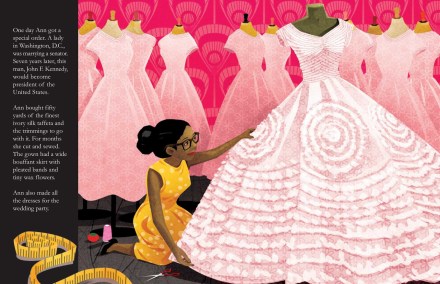
One day Ann received an order for a wedding dress from a woman who was marrying a United States senator. The woman’s name was Jacqueline Bouvier and the man was John F. Kennedy, a future president of the U.S. Ann bought 50 yards of ivory silk taffeta and designed a beautiful dress with a bouffant skirt and pleated bands decorated with tiny wax flowers. She also made the dresses for Jacqueline’s attendants.
celebrate-picture-books-picture-book-review-fancy-party-gowns-wedding-dress

Image copyright Laura Freeman, text copyright Deborah Blumenthal, courtesy of simonandschuster.com

Then ten days before the wedding, Ann walked into her workroom and discovered that a water pipe had burst, flooding the dresses, material, everything. Ten of the sixteen gowns Ann had sewn were destroyed. “Ann though about what she could do, not what she couldn’t change.” She ordered new fabric, hired more seamstresses, and went to work. On this job she lost money instead of making it, but none of that mattered. In eight days all of the dresses were ready.

When Ann delivered the gowns to the mansion in Newport, Rhode Island, the butler who answered the door told her workers needed to use the back entrance. Ann replied that “if she had to enter through the back door, the bride and bridesmaids wouldn’t be wearing her dresses for the wedding.” The front door swung open. On the day of the wedding—September 12, 1953—the whole world oohed and aahed over Jacqueline Bouvier Kennedy’s gorgeous gown and her bridesmaids’ dresses, but not many people thought about or knew the name of the woman who had created them. “Why? Because Ann Cole Lowe was African American. And life wasn’t fair.”

celebrate-picture-books-picture-book-review-fancy-party-gowns-sewing

Image copyright Laura Freeman, text copyright Deborah Blumenthal, courtesy of simonandschuster.com

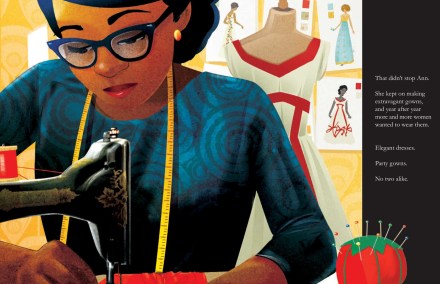
Ann continued to design and sew party dresses and evening gowns for the women of high society. She “didn’t make fine clothes to get rich or famous,” however, but, as she once said, “‘To prove that a Negro can become a major dress designer.’” In 1961 Ann finally gained public recognition for her work when she was named “Official Couturiere” in honor of the 33 ball gowns she created for an elegant ball in Omaha, Nebraska. She proudly accepted her award as the fashion world applauded.

An Author’s Note explaining more about Ann Cole Lowe’s life and work follows the text.

celebrate-picture-books-picture-book-review-fancy-party-gowns-recognized

Image copyright Laura Freeman, text copyright Deborah Blumenthal, courtesy of simonandschuster.com

With straightforward storytelling adorned with lyrical passages, Deborah Blumenthal reveals Ann Cole Lowe’s lifelong love of fashion design, her struggles, and her ultimate acclaim. Lowe’s natural talent, single focus, self-confidence, courage, and persistence come through as she overcomes obstacles and prejudice to become the first African American couture designer. Children interested in fashion and history will find much to spark their curiosity and desire to know more about the woman and her times. Blumenthal’s repetition of Lowe’s philosophy to think about what she could do instead of what she couldn’t change will inspire readers to push past difficulties and find solutions.

Laura Freeman’s full-bleed illustrations are as bold and vivacious as Ann Cole Lowe herself. Beginning with the endpapers, which are scattered with drawings of Lowe’s one-of-a-kind gowns, Freeman takes readers on a tour of the workrooms and salons stocked with the fabrics that gave form to Lowe’s creativity. While the backgrounds are typically brilliantly colored and patterned, twice Freeman places Lowe on a completely white page—after her mother has recently died and she is left alone to finish dresses and when she is segregated from the other students in design school. These pages make a moving and effective statement. Children fascinated by fashion will love seeing the beautifully depicted gowns, and may be stirred to create styles of their own.

Ages 4 – 8

little bee books, 2017 | ISBN 978-1499802399

To learn more about Deborah Blumenthal and her books for children, young adults, and adults, visit her website!

Discover a gallery of illustration work by Laura Freeman on her website!

International Month of Black Women in the Arts Activity

celebrate-picture-books-picture-book-review-tablecloth-dress


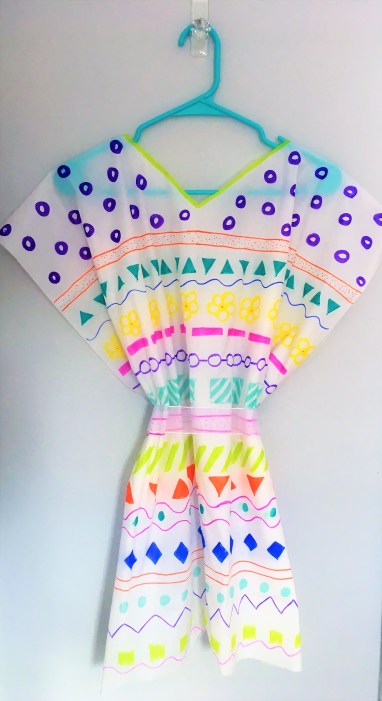
Create Your Own Party Dress 


With this easy craft you can make a  fun sheath dress for playing dress-up. It’s also a great party activity! All you need is a plastic or paper party table cloth, Sharpies, and your imagination!

Supplies

  • 1 plastic party tablecloth (1 cloth will most likely make 4 dresses)
  • Sharpies or other permanent markers
  • Ribbon, scarf, crepe paper garland, or other material for a belt
  • Scissor
  • Newspaper, old sheeting or other material to protect the floor

Directions

  1. With the table cloth folded along one edge, cut a rectangle the appropriate size for the child
  2. In the middle of the folded edge cut a V-shaped or rounded opening for the child’s head. Begin with a small opening and enlarge it as needed
  3. Lay the dress on newspaper or other material to protect the floor
  4. Draw and color shapes, lines, figures, or other designs on the dress
  5. Slip on over a shirt and pants or leggings
  6.  Add a belt with a ribbon, scarf, piece of crepe paper garland, or other material

Picture Book Review