May 10 – National Train Day

About the Holiday

You just have to love the train. With its storied past and iconic whistle, train travel is imprinted in our minds as a fun, efficient way to get from here to there and back again. Today’s holiday was established in 2008 to commemorate all the mystery and romance of train travel while also remembering the history of the railroad, especially the the May, 1869 completion of the transcontinental railroad, and its importance to the development of the United States. Suddenly, distances didn’t seem as far, and those seeking a new life out West or wanting to visit family back East had a safe, quick way of spanning the miles.

Thank you to Marsha Diane Arnold and Sleeping Bear Press for sharing a digital copy of today’s book with me!

Big Boy 4014 and the Steam Team: The World’s Largest Steam Engine Roars Back to Life!

Written by Marsha Diane Arnold | Illustrated by Adam Gustavson


In 2013, Big Boy 4014, the largest steam train in the world, sat stranded in an outdoor museum in Pomona, California, her work carrying heavy freight across the Wasatch Mountains and her indispensable role in transporting American soldiers and military equipment across the western prairies only a memory (Arnold makes note that trains were referred to as “she” by engineers and crew). She had thrilled museum visitors for more than fifty years, but “cold ashes lay in her firebox / Cobwebs wove through her wheels. / Rust crept into her cab.”

Then one day men came to visit her. As they inspected her, most decided that restoring her would be too expensive, too crazy, impossible. But one voice disagreed, saying “All we need is a great steam team. It can be done.” Nine men signed onto the Steam Team, with the aim to restore Big Boy for the Golden Spike Celebration in 2019 that would commemorate the finishing of the transcontinental railroad—the first railroad to stretch all across the America from East to West.
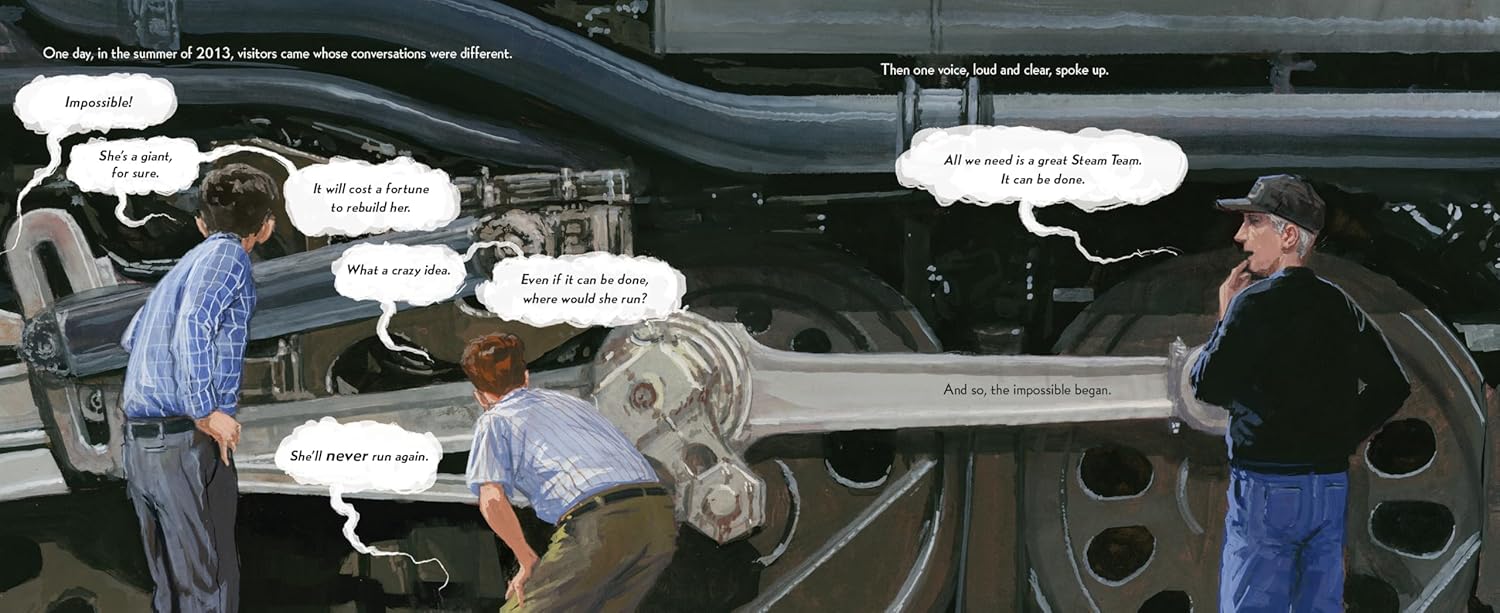
illustration © 2025 by Adam Gustavson, text © 2025 by Marsha Diane Arnold. Courtesy of Sleeping Bear Books.

To move Big Boy from the museum to the tracks a mile away, temporary tracks were laid and a bulldozer slowly pulled her along inch by inch. She was then pulled and pushed 1,300 miles to Wyoming, where the work on her would be done. There, Big Boy underwent intensive scrutiny, getting new parts, being made to look like new. Years went by, the Golden Spike Celebration was months away, then days away. It was “time to test her out.” 

“Double-headed with the ‘Living Legend,’ locomotive 884,” Big Boy, pulling train cars behind her, chugged “to Ogden, Utah, for the celebration.” All along the route, people came out to watch, “to feel the rumble under their feet as Big Boy passed, to see the steam cloud billowing above her, to hear her whistle, loud and clear.” At the ceremony, Big Boy 4014 and Locomotive 884 faced each other, just as two steam engines had 150 years before, when a set of tracks moving east-to-west and another running west-to-east were united with a golden spike.

illustration © 2025 by Adam Gustavson, text © 2025 by Marsha Diane Arnold. Courtesy of Sleeping Bear Books.

Following the Golden Spike Celebration, Big Boy 4014 took another trip, a tour of more than 8,000 miles “past grasslands and sagebrush. / Past farmlands and rivers. / Past fields and cities and towns.” Whether it was raining or snowing or blisteringly hot, people came out to cheer Big Boy on and feel that awesome rumble as she passed by. No longer is her time only a memory from long ago. With more tours planned, “if steam locomotives could talk, Big Boy would say . . . “I’m ringing my bell and sounding my whistle.” DONG-DONG-DONG-DONG-DONG-DONG WHOOOOOO-WHOO-WHOOOOOO / “I’m chugging up the Wasatch Mountains at top speed, feeling the warmth of the oil in my firebox, as powerful as 7,000 horses.”

An in-depth discussion about the origins of the twenty-five Big Boy steam locomotives; the incredible engineering feat of designing and building them; how a steam engine works, How Big Boy 4014 was chosen for restoration; short profiles of the men instrumental in Big Boy’s restoration; a brief history of the building of the transcontinental railroad; and the research involved in making tours of Big Boy 4014 possible.
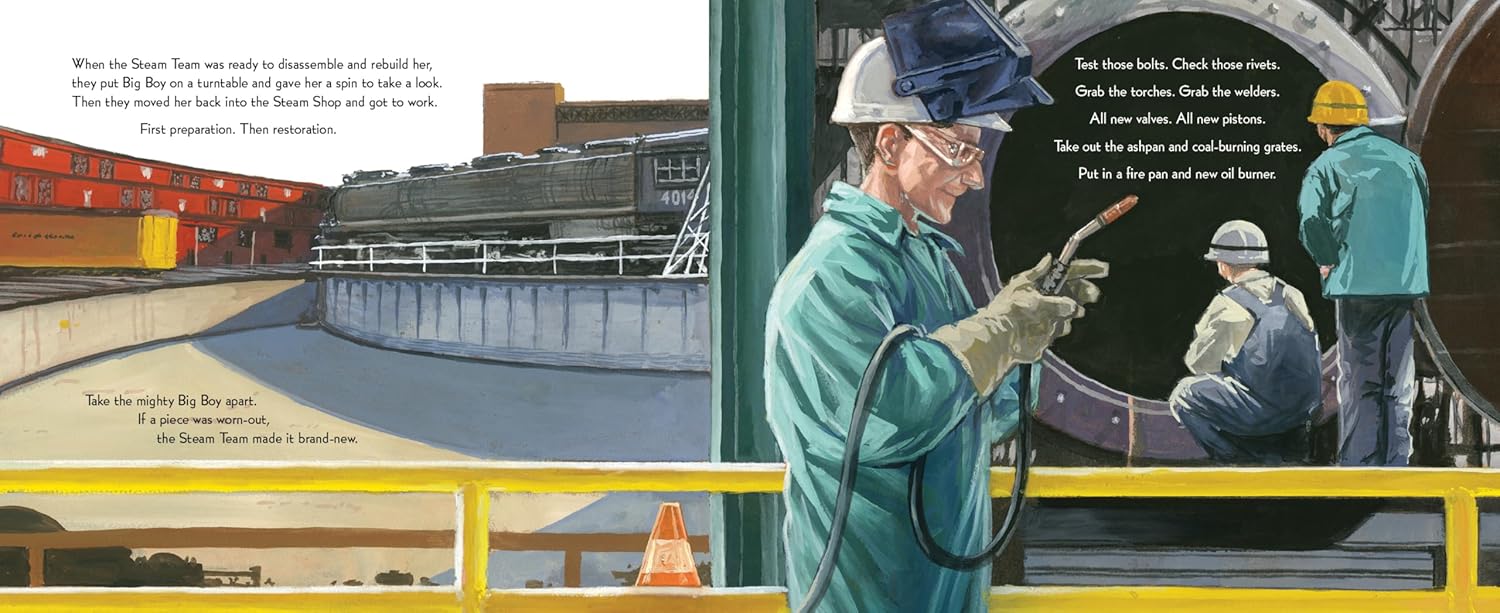
illustration © 2025 by Adam Gustavson, text © 2025 by Marsha Diane Arnold. Courtesy of Sleeping Bear Books.

Combining imaginative lyrical text with compelling nonfiction storytelling, Marsha Diane Arnold weaves an immersive tale of the restoration and triumphant comeback of the steam locomotive Big Boy 4014. Where once 25 of these behemoth machines conquered mountains and rough terrain to move freight and people across the country and contributed to our success in World War II, they have been relegated to history as diesel and electric trains took prominence.

Arnold recalls the importance of these storied locomotives for young readers and train enthusiasts of all ages, bookending her story with wistful “If steam locomotives could dream/talk” re-imaginings of Big Boy 4014’s glory days of leaving a station, sounding her bell and whistle, and “chugging up mountains” with the “power of 7,000 horses.” Readers will be wowed by the dedicated and painstaking work that went into moving and restoring Big Boy 4014, a recounting Arnold accomplishes with a deft hand for details that don’t overwhelm. She leaves readers with a new appreciation for steam locomotives and a hope that they too will be able to witness a tour of this earth-rumbling beauty.

Adam Gustavson’s stunning realistic paintings depict Big Boy 4014 from various perspectives, giving readers a sense of her scale compared to the adults and children, the mountainous landscapes she traversed, and the crowds who came out to celebrate her. Up-close renderings allow train lovers to get a glimpse into the steam-powered mechanics that propelled her while also seeing how run-down she had become over her nearly 60 years of disuse. Each page spread is a showstopper to linger and marvel over as readers gain insight and admiration for these trains and those who created them.

For train enthusiasts, history buffs, and those who simply love a story masterfully told, Big Boy 4014 and the Steam Team: the World’s Largest Steam Engine Roars Back to Life! is a book you won’t want to miss. The book is an exciting must-addition for all school and public library collections.

Ages 6 – 9+

Sleeping Bear Press, 2025 | ISBN 978-1534113145

About the Author

Marsha Diane Arnold is a multiple-award–winning author whose books have sold over one million copies. Called a “born storyteller” by the media, Marsha’s works include Badger’s Perfect Garden (Florida Book Awards Bronze Medal), the bilingual Galápagos Girl/Galapagueña (Bank Street Best Book and Campoy-Ada honor book), and Lights Out (Golden Kite finalist). Among her many pastimes, Marsha especially enjoys reading to her grandchildren and visiting schools to talk about writing and books. Born in rural Kansas, Marsha now lives with her husband and dog Sailor in Alva, Florida. Visit her at marshadianearnold.com.

About the Illustrator

Adam Gustavson’s illustrations have appeared in over thirty books for children. He is a teaching professor of art at Rowan University, and lives in a quirky little house in New Jersey with his lovely wife, their two sons, and two rather small dogs.

National Train Day Activity

Steam Engine Coloring Page


Steam locomotives once carried passengers and freight. Enjoy this coloring page of a steam train from days gone by from Monday Mandala!

You can purchase Big Boy 4014 and the Steam Team: the World’s Largest Steam Engine Roars Back to Life! from these booksellers

Amazon | Barnes & Noble | Bookshop

Picture Book Review

March 27 – It’s International Ideas Month

About the Holiday

This month we celebrate Ideas! Ideas are amazing things, appearing in your mind seemingly out of nowhere, but really, they’re often fueled by curiosity, by something you’ve seen, or by something you think could be better or done differently. Innovations in science, technology, engineering, art, and math are like that. Ideas can even transform home life too. The spark behind this month’s holiday is to encourage adults and kids alike to write down the ideas they have and explore making them work. You never know what a good idea might lead to! 

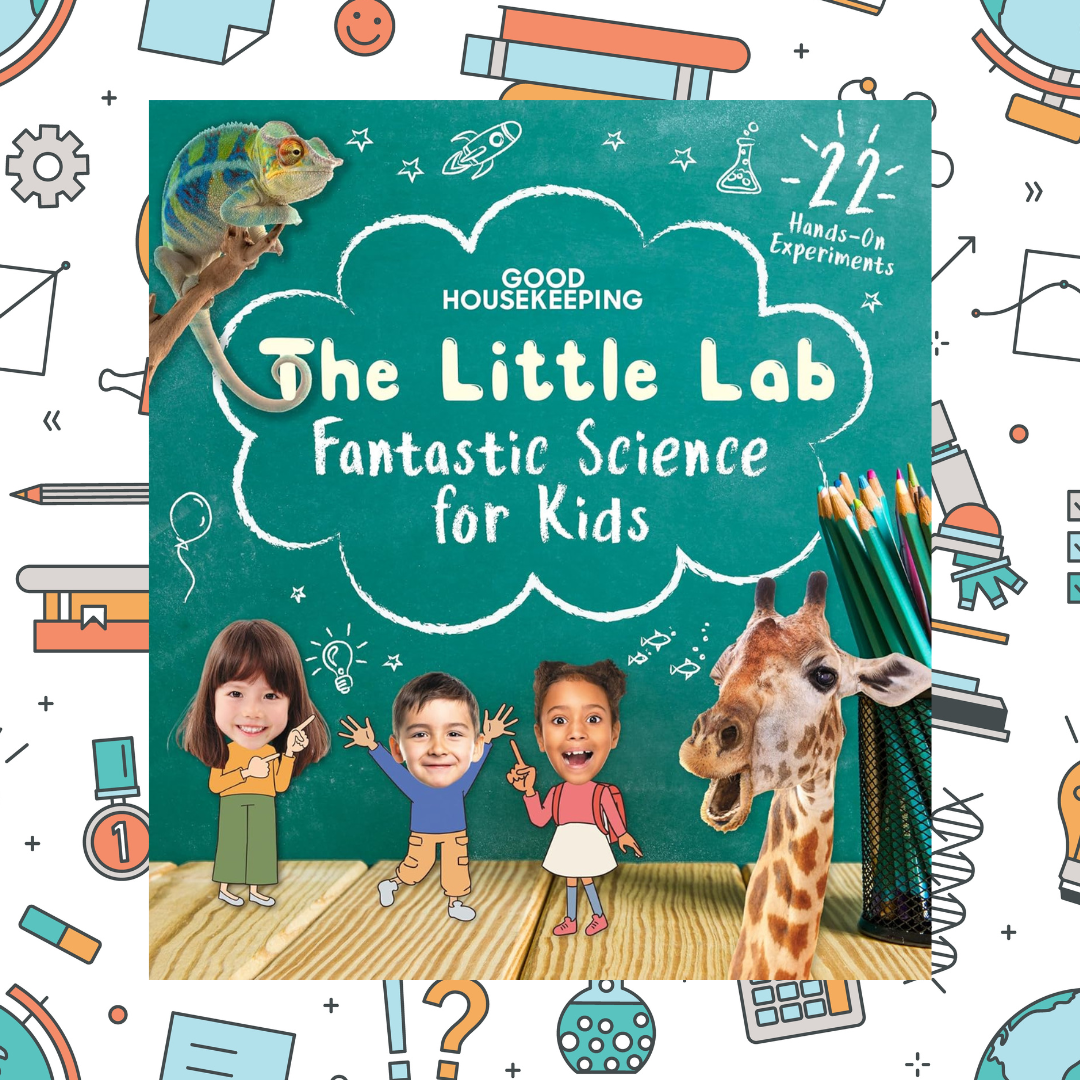
The Little Lab: Fantastic Science for Kids

Margie Markarian (Text and Editing) | Rachel Rothman (Editing) | Ashley Prine (Design)


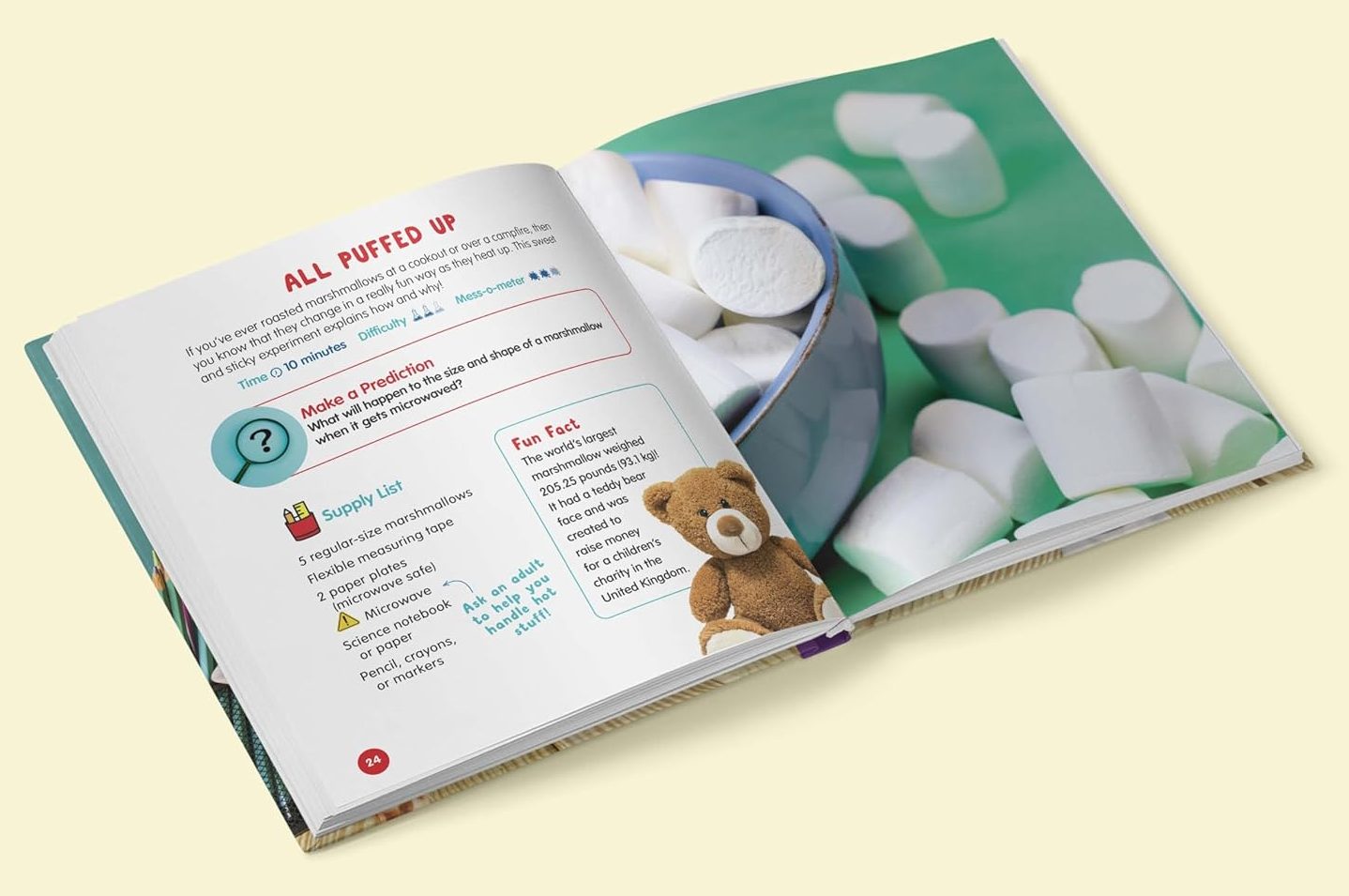
Whether you have kids who can’t get enough of hands-on learning, are exploring science with your children or students, or looking ahead to all those summer days to fill, The Little Lab: Fantastic Science for Kids has you covered! Inside, this go-to resource, you’ll find 22 exciting experiments accompanied by

  • Informative photographs
  • Detailed supply lists of items you probably already have at home
  • A “Make a Prediction” prompt
  • Step-by-step instructions that are simple to follow
  • A “What Happened?” explanation of the science behind the results

Photo courtesy of Hearst Home Kids.

Chosen and tested by nine scientists, engineers, and other experts at the Good Housekeeping Institute, these fantastically fun experiments encourage kids to think like a scientist while following the scientific method of observing, asking questions, and making predictions before doing the experiment and then evaluating what they see happen. The experiments also address core scientific concepts, such as the states of matter, energy, motion and force, and simple machines.

If your kids are anything like mine were while growing up, your kitchen is their favorite room in the house. Why not transform this gathering space into a little laboratory where food chemistry and creativity really cook?! With ingredients from your fridge and cupboards, kids can make an abstract masterpiece while learning about liquids; test the pH scale of various foods; experiment with puffed up marshmallows; challenge their nose to a taste test; and explore more with a “gadgets and gizmos” matching puzzle.

Photo © 2023 Michael Sapryhin. Courtesy of Hearst Home Kids.

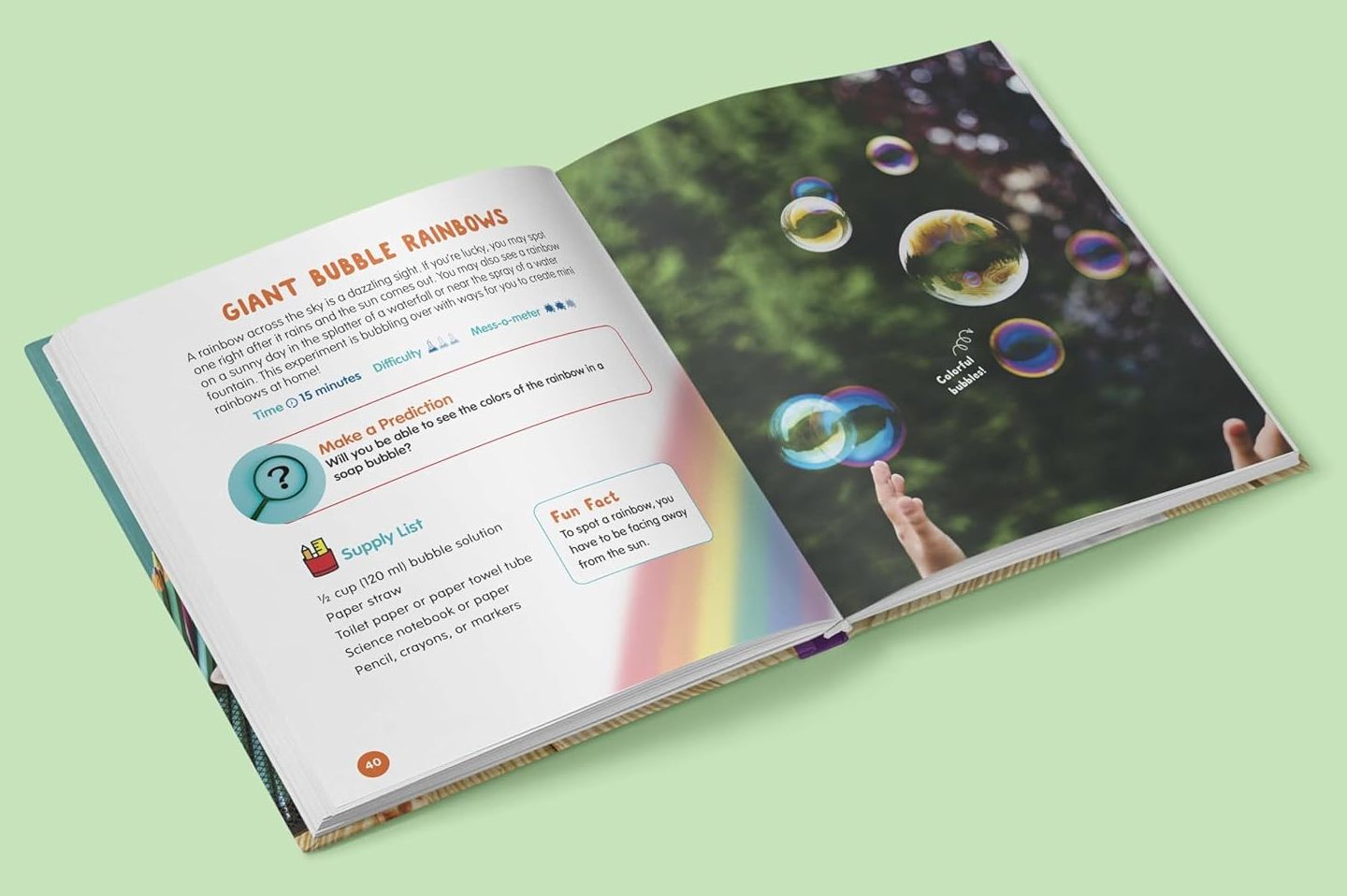
Curious kids will really make a splash with the experiments in Chapter 2: Water Works as they get in the swim of discovering why certain objects float while others sink; blow rainbow-colored bubbles; test the strength and absorbency of various paper products; and—get this!—create a drawing that floats in water, without any paper or other medium.

Powerful learning comes in Chapter 3, where young scientists work with energy to make their own rainbows; bake up solar s’mores—yummy!; light a florescent bulb just by rubbing a balloon on their hair; put Newton’s three Laws of Motion to the test by launching pom poms and/or marshmallows; and play around with sound. The Explore More! exercises in this chapter spark kids’ interest in listening for high and low pitches in their environment and investigating the force of friction.

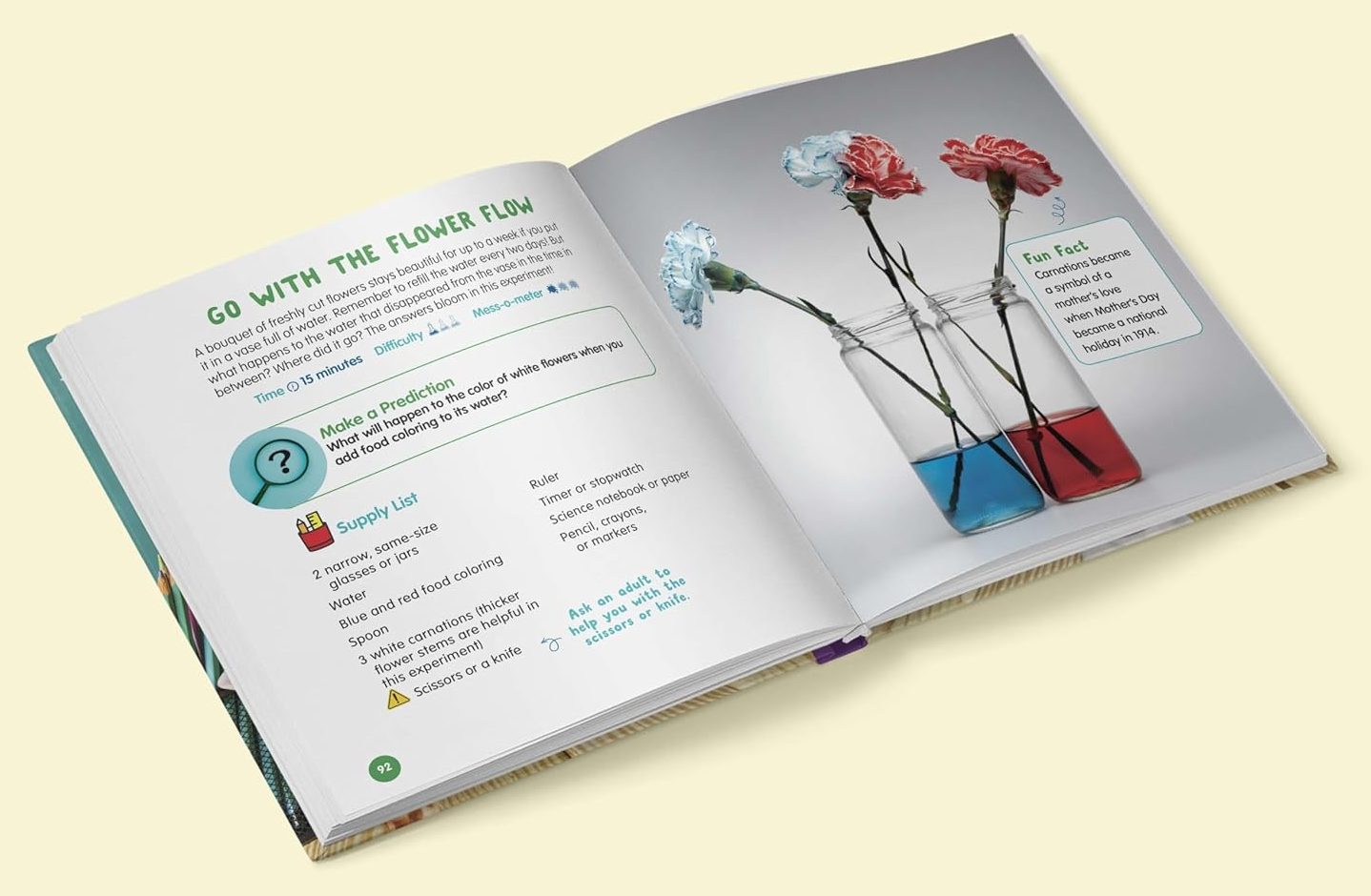
Chapter 4 sends kids outside, where they’ll try balancing like a flamingo; discover what makes balls bounce high, higher, and highest; get the dirt on what’s in dirt; give white carnations a bit of color; and— in a creative way to bring weather science down to earth—get to make “rain clouds” from shaving cream. The Explore More! section teaches kids how to read clouds—from wispy Cirrus to cotton ball-like Stratus—as well as the favorite flower colors of bats, bees, butterflies, and hummingbirds.

Photo © 2023 Carol Yepes. Courtesy of Hearst Home Kids.

In Chapter 5, the scientists at Good Housekeeping present experiments that are not only hands-on, but hands-all-in! Here kids get to clean old pennies to try and reclaim their original shine; discover the most reliable way to un-stink smelly sneakers; make slime; find out how long it takes to really wash away germs on your hands; and learn about the viscosity of various liquids.

Throughout the book, experiments are also accompanied by quick “Fun Fact” and “Did You Know?” information related to each section’s topic, and here and there the Good Housekeeping scientists pop up to impart interesting tidbits that will get kids thinking. There are even funny puns to get them laughing. Each experiment also includes a Time, Difficulty, and Mess-o-meter indicator.

Following the chapters are a glossary, a STEAM index that ticks off which disciplines (science, technology, engineering, art, and math) each experiment embodies, and an in-depth index.

Photo © 2023 Jeffery Coolidge. Courtesy of Hearst Home Kids.

Good Housekeeping’s The Little Lab: Fantastic Science for Kids is a treasure trove of intrigue, excitement, and discovery. Offering so many opportunities for fun learning, the book would be a favorite addition to any home library for rainy days, empty weekends, science-themed parties, playdates, or any time you hear “There’s nothing to do!” Teachers, child-centered organizations, libraries, and anyone involved in elementary age science education will also find this book a valuable resource.

Ages 4 – 8

Hearst Home Kids, 2023 | ISBN 978-1950785926

International Ideas Month Activity

celebrate-picture-books-picture-book-review-kinetic-sand-craft

Kinetic Sand


Sand is so much fun to play with at the beach that you just wish you could bring it home. With this recipe for kinetic sand, you can use science to make dry sand just the right consistency to form and play with. Kinetic sand makes a great stress reliever too!

Supplies

  • 1 cup sand
  • ½ tablespoon cornstarch
  • 1 teaspoon dish soap
  • Water as needed – about ¾ cup
  • Bin or bowl for mixing dry ingredients
  • Bowl for mixing dish soap and water

Directions

  1. In the bin combine the sand and cornstarch and mix well
  2. In the bowl combine the dish soap and water until the water is bubbly
  3. Slowly add the water mixture to the dry ingredients, mixing and adding water little-by-little until the desired consistency is reached. The grain of the sand will determine how much water is needed.
  4. The sand can be formed with cookie cutters, molds, hands, etc. and is strong enough to stack. Or just let it drip and ooze through your fingers.

You can purchase Good Housekeeping’s The Little Lab: Fantastic Science for Kids from these booksellers

Amazon | Barnes & Noble | Bookshop (discounted books and support for your local independent bookstore)

Picture Book Review

August 27 – It’s National Inventors Month

celebrate-picture-books-picture-book-review-how-was-that-built-cover

About the Holiday

While dates for this holiday may vary – some say May while others celebrate in August, National Inventors Month was established in 1998 by the United Inventors Association of the USA, the Academy of Applied Science, and Inventors’ Digest magazine. This month-long holiday recognizes the imagination and talent of individuals who dare to think differently to create new products, services, and ways of doing things that make a positive contribution to the world. Today, I’m sharing a book that highlights those who reach for the sky, dive under the sea, and look for opportunities to better help and connect people through the structures we use and live in. If you harbor dreams of being an inventor—on a large or small scale—look for opportunities to share your ideas!

How Was that Built?

Written by Roma Agrawal | Illustrated by Katie Hickey


They seem to have sprung from the ground, they soar into the clouds, they cross vast waterways—over and under the ripples and waves, and they come in all shapes and sizes. What are they? Buildings! For lovers of architecture, engineering, and just the marvels that people can construct, Roma Agrawal’s compendium of some of the world’s most incredible buildings will leave them enthralled—and much more knowledgeable on how these structures came to be.

In fifteen chapters, Agrawal reveals all the nuts and bolts about how buildings are secured on difficult sites (such as on sinking ground, in the sea, underground, and on ice); constructed to be tall, long, or able to move; and made to serve civic purposes. In addition to detailed explanations of the conditions architects and engineers must take into consideration when designing and constructing a building, bridge, or other structure, Agrawal clearly describes the materials used, how they are made, and why each is chosen for a particular job.

celebrate-picture-books-picture-book-review-how-was-that-built-emily-warren

Image copyright Katie Hickey, 2022, text copyright Roma Agrawal, 2022. Courtesy of Bloomsbury Children’s Books.

Rounding out each chapter, Agrawal goes in depth on one world building that demonstrates her topic. For example, In the first chapter she introduces readers to the Metropolitan Cathedral in Mexico City, which was built on top of an old Aztec pyramid in the middle of a filled-in lake. When it began sinking and tilting, engineers in the 1990s devised an intriguing way to save it. If you’re a fan of skyscrapers and wonder just how they’re built, a chapter on The Shard in London, which “is over 1,000 feet tall…and has 11,000 glass panels” (and for which Roma Agrawal worked as an engineer) reveals the secrets of a strong core and the incredible machinery that allows workers to keep going up and up.

Readers who love bridges will find two chapters on these beautiful and intricate structures. One reveals the fascinating story of how the construction of the Brooklyn Bridge overcame many challenges under the direction of Emily Warren, a woman who broke barrios for women in the engineering field. Another describes six different types of bridges as well as where they are used and why.

Readers also learn about concrete and how arches and domes work. They then explore the Pantheon and discover how it has stood for nearly 2,000 years. Other concrete structures from around the world are also discussed. You may not think too much about sewers, but imagine living without them! You’ll get a good (and stinky) idea about the conditions in London hundreds of years ago before Joseph Bazalgette designed and built the first sewer system. How did he do it? Agrawal breaks it down and then talks about today’s modern sewers.

celebrate-picture-books-picture-book-review-how-was-that-built-the-shard

Image copyright Katie Hickey, 2022, text copyright Roma Agrawal, 2022. Courtesy of Bloomsbury Children’s Books.

You’ll also find chapters on dams, tunnels, and buildings with moveable parts—or buildings like the Halley VI research station in Antarctica that can be moved easily in their entirety to avoid snow or ice that may crack beneath them. Then there are the challenges of building under the sea and in outer space. While astronauts now rely on the International Space Station, “some engineers and scientists are studying how to build structures on the Moon! Then researchers could live there for a long time to carry out their experiments and learn more about outer space.” What considerations must engineers take into account and what materials will they use? Agrawal fills readers in. She then closes her book with a look toward the future and talks about new materials and methods of building that may transform our world.

Sprinkled throughout the book are “Try It At Home” prompts for experiments that readers can easily do at home to visually interact with the concepts Agrawal lays out, such as using malted milk balls and raisins to understand “how carbon atoms make steel stronger” and making a pneumatic caisson with just a few household items.

Back matter includes a glossary of terms found in the book and brief biographies of ten influential engineers from the past and present.

celebrate-picture-books-picture-book-review-how-was-that-built-outer-space

Image copyright Katie Hickey, 2022, text copyright Roma Agrawal, 2022. Courtesy of Bloomsbury Children’s Books.

Readers of all ages will be engrossed by Roma Agrawal’s guide through the architecture and engineering that go into housing, moving, connecting, and supporting the world’s population. Every page contains fascinating details and interesting tidbits culled from Agrawal’s extensive experience as an engineer. These go far beyond an introduction to landmark buildings to show readers exactly how each type of building works. Relayed in a simple-to-understand, conversational style, her text is also broken up into short paragraphs that are easily digestible and invite further research, making this a superb resource for schools, homeschooling, and enthusiasts of all things engineering and architectural. Agrawal’s inclusion of structures from the past reveal the ingenuity of our ancestors and how they still influence today’s engineers and architects. Kids who love geography, archaeology, astronomy, and learning about all the intricate workings of the world will be enthralled with this book.

Katie Hickey gives readers an insider’s view of these phenomenal buildings with her stylish and incredibly detailed illustrations. Cityscapes allow children to understand the scale of skyscrapers from around the world and the beauty and breadth of New York City’s Brooklyn Bridge. Hickey whisks readers off to London to see The Shard; to New Zealand to view Te matau ā pohe, a bascule bridge whose shape was inspired by a fish hook; to Japan, where the Sapporo Dome accommodates soccer and baseball games with a moveable field of natural turf; and to Africa to stand on the edge of the Katse Dam and look 600 feet down into its reservoir. Along with this world tour, Hickey helps readers visualize the intricate working parts of certain buildings and bridges with interior views and small insets that demonstrate the physics of each design. Images of various types of cranes, pulleys, and other machinery also reveal the science behind building each structure.

A rich and comprehensive resource on the intricate engineering that goes into designing and building complex structures while also sharing the stories behind them, How Was that Built? will captivate readers of all ages. The book is a must for any STEM, science, art, or archaeology lover and belongs in all school and public library collections. 

Ages 6 and up

Bloomsbury Children’s Books, 2022 | ISBN 978-1547609291

Roma Agrawal is a structural engineer who builds big. From footbridges and sculptures, to train stations and skyscrapers – including The Shard – she has left an indelible mark on London’s landscape. She is a tireless promoter of engineering and technical careers to young people, particularly under-represented groups such as women. She has advised policymakers and governments on science education, and has given talks to thousands around the world at universities, schools and organizations, including two for TEDx. Roma has been awarded international awards for her technical prowess and success in promoting the profession, including the prestigious Royal Academy of Engineering’s Rooke Award. 

Discover more about Roma Agrawal and her work on her website, and connect with her on Instagram | Twitter. You can read an interview with Roma Agrawal in Publishers Weekly here.

To view a portfolio of work by Katie Hickey, visit Pickled Ink. You can connect with Katie Hickey on Instagram | Twitter 

National Inventors Month Activity

celebrate-picture-books-picture-book-review-spaghetti-box-bridge-craft

Build a Remarkable Recycled Bridge


You don’t need fancy blocks and construction materials to build a bridge! Little ones will be fascinated to put together a bridge made out of items you already have at home or that may even be slated for the recycle bin. Spaghetti boxes make great roadways, and cut-up egg cartons can be used as supports.

Build a Whole Town

Want to give your bridge a town with a river to span – or maybe two towns to connect? Cereal boxes and pasta boxes make great skyscrapers, apartment buildings, fire stations, and more. Need a farm silo? Grab a peanut butter jar, oatmeal container, or aluminum can. Cut a meandering river for your bridge to span from paper or cardboard. You can use them as is or—if your kids are sticklers for a little more detail—add some paint and details! So look around at the raw materials around you, use your imagination, and get creative!

celebrate-picture-books-picture-book-review-how-was-that-built-cover

You can find How Was that Built? at these booksellers

Amazon | Barnes & Noble | Books-a-Million

To support your local independent bookstore, order from

Bookshop | IndieBound

Picture Book Review
February 24 – Introduce a Girl to Engineering Day

celebrate-picture-books-picture-book-review-goldilocks-and-the-three-engineers-cover

About the Holiday

All this week, we celebrate Engineers and Engineering! Founded by the National Society of Professional Engineers (NSPA) in 1951, Engineering Week focuses on increasing an understanding of and interest in engineering and other technical careers to ensure a diverse and well-educated engineering workforce for the future. More than seventy engineering, education, and cultural societies and more than fifty corporations and government agencies cooperate to raise public awareness of engineers’ contributions to our quality of life. Throughout the week they work to foster a recognition in parents, teachers, and students of the importance of a technical education as well as a high level of math, science, and technology literacy. By reaching out to schools, businesses, and community organizations across the country, they hope to motivate young people to pursue engineering careers. For Introduce a Girl to Engineering, or Girl Day, educators, engineers, volunteers, and others demonstrate engineering activities, show girls how engineers change our world, and provide mentors to guide tomorrow’s engineers. To learn more about Engineering Week and today’s holiday in particular, visit the NSPA website.

Goldilocks and the Three Engineers

Written by Sue Fliess | Illustrated by Petros Bouloubasis


“In a tiny bungalow, / there lived a clever thinker. / Young Goldilocks invented things. She’d make and craft and tinker.” Goldilocks made lots of useful things, like machines to help you tie your shoes, to a self-zipping zipper to a hat outfitted with a flashlight, magnifying glass, and itty-bitty satellite dish to help you find the things you’ve lost. But one day, Goldilocks found that she had “inventor’s block,” so she decided to take a walk.

celebrate-picture-books-picture-book-review-goldilocks-and-the-three-engineers-bears

Image copyright Petros Bouloubasis, 2021, text copyright Sue Fleiss, 2021. Courtesy of Albert Whitman & Company.

At the same time, the Bear family was out gathering nuts and berries for their pre-hibernation celebration. Baby Bear had a nifty contraption that knocked fruit and nuts into a basket with a tennis racquet. Papa Bear had an ingenious wheelbarrow with mechanical arms and hands that picked berries one by one and deposited them in the cart—but only after tossing them through a tiny basketball hoop. Swish! And Mama Bear’s handy vacuum sucked fruit right off the bushes and collected them in a tank.

Their next stop was the beehive at the top of a hill. After they’d eaten all their goodies, Baby Bear spied a little bungalow. The Bears thought it was just the place to spend the winter. When they went inside, they found “the room was full of strange devices, / widgets, tools, and more!” Looking more closely, Papa Bear found a chair that was perfect for Baby Bear. He marveled that “it feeds you and it wipes your mouth, / and reads you stories, too!” Meanwhile, Mama Bear had discovered a bowl that stirred porridge and a bed that automatically rocked you to sleep.

celebrate-picture-books-picture-book-review-goldilocks-and-the-three-engineers-workshop

Image copyright Petros Bouloubasis, 2021, text copyright Sue Fleiss, 2021. Courtesy of Albert Whitman & Company.

Baby Bear loved the chair but wished for one more innovation that would make it just right. Papa Bear found parts and tools and fixed the chair to Baby Bear’s specifications. Mama Bear tasted the porridge and found it lacking one ingredient, so Papa Bear created a porridge-stirrer accessory to add it drop by drop. By now it was dark, and even though Papa Bear thought it wasn’t right to stay, Baby Bear convinced him that one night would be okay.

But when they crawled into bed and turned it on, it rocked so much that it tipped the Bears right onto the floor. There was only one thing to do: “Baby fixed the engine block. / Replace the gears that burned. / Soon the bears were fast asleep… / Then Goldilocks returned.” She saw the chair, tasted the porridge, and then… “heard snoring sounds.” Wide awake now, the bears began to explain. But Goldilocks was not upset. Instead she said, “‘You’ve improved my projects here, / and made them much more fun. / Proving that four brains, by far, / are better than just one!’”

Excited to be inventing again with the bears on board to lend their smart innovations, Goldilocks sends the family off amid promises to “‘…meet up in the spring’” when they will “‘…make the next big thing!’”

celebrate-picture-books-picture-book-review-goldilocks-and-the-three-engineers-bed

Image copyright Petros Bouloubasis, 2021, text copyright Sue Fleiss, 2021. Courtesy of Albert Whitman & Company.

With her fun flip on the Goldilocks story, Sue Fleiss invites kids to indulge their inner inventor with wacky contraptions that can make getting dressed, cooking, going to bed, and chores more exciting. Fleiss’s clever takes on the well-known “just right” chair, porridge, and bed get readers thinking creatively—perhaps even about their own household appliances. While the original story ends with the interloper being chased away, Fleiss’s version shines with the benefits of cooperation, collaboration, and being open to new ideas.

With so many cool inventions to discover on every page, readers will love taking extra time to find and talk about them all. Any young maker would swoon over Petros Bouloubasis’s well-stocked workbench, and readers would have a blast drawing their own gadgets using the tools and supplies depicted. Quirky, abstract landscapes add to the kid-centric ambiance, and just like the Bear family, who drives away in a new vehicle with their full wheelbarrow in tow, readers will look forward to returning to Goldilocks’ little bungalow again and again.

Imagination, creativity, teamwork, and friendship all wrapped up in a clever fractured fairytale—what could be better?! Goldilocks and the Three Engineers is one to add to home, classroom, and public library bookshelves.

Ages 4 – 8

Albert Whitman & Company, 2021 | ISBN 978-0807529973

Discover more about Sue Fleiss and her books on her website.

To learn more about Petros Bouloubasis, his books, and his art, visit his website.

Introduce a Girl to Engineering Day Activity

celebrate-picture-books-picture-book-review-spaghetti-box-bridge-craft

Build a Remarkable Recycled Bridge


Engineers are at the core of so many things that make our homes and neighborhoods what they are. Kids will have fun building a bridge from Using items you already have at home or that may even be slated for the recycle bin, kids will have fun making the bridge above and maybe even a whole town! Spaghetti boxes make great roadways, and cut-up egg cartons can be used as supports. Cereal boxes and pasta boxes make skyscrapers, apartment buildings, fire stations, and more. Need a farm silo? Grab a peanut butter jar, aluminum can, or bread crumb container. You can use them as is or—if your kids are sticklers for a little more detail—turn the boxes inside out, tape, and add paint and details! So look around, use your imagination, and get creative!

celebrate-picture-books-picture-book-review-goldilocks-and-the-three-engineers-cover

You can find Goldilocks and the Three Engineers at these booksellers

Amazon | Barnes & Noble | Books-a-Million

To support your local independent bookstore, order from

Bookshop | IndieBound

Picture Book Review
August 31 – It’s National Inventor’s Month

celebrate-picture-books-picture-book-review-who-invented-this-cover

About the Holiday

Established in 1998 by the United Inventors Association of the USA, the Academy of Applied Science, and Inventors’ Digest magazine, this month-long holiday celebrates the imagination and talent of individuals who dare to think differently and create new products, services, and ways of doing things that make a positive contribution to the world. To join in, enjoy your favorite new inventions, and if you harbor dreams of being an inventor—on a large or small scale—look for opportunities to share your ideas.

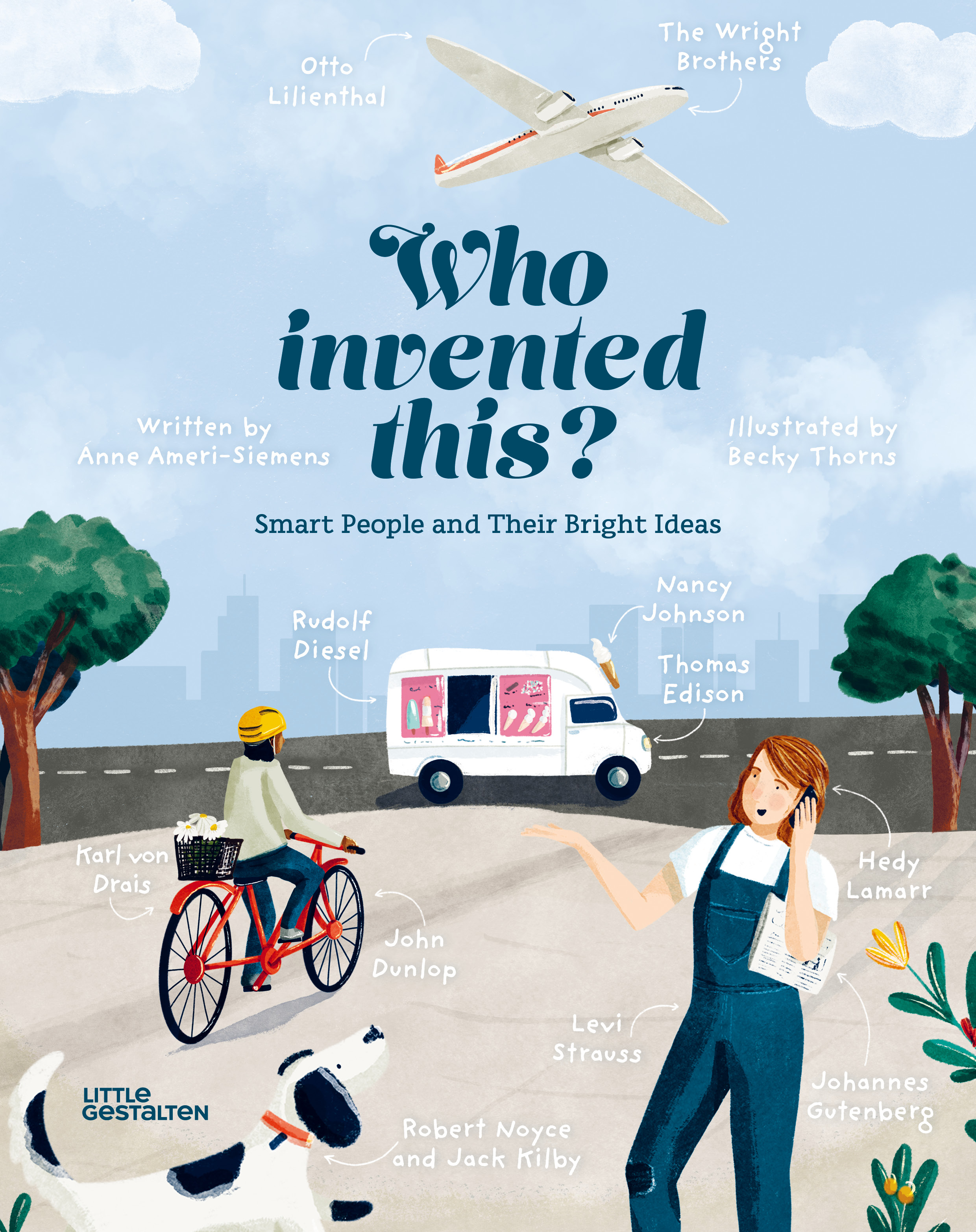
Who Invented This? Smart People and Their Bright Ideas

Written by Anne Ameri-Siemens | Illustrated by Becky Thorns


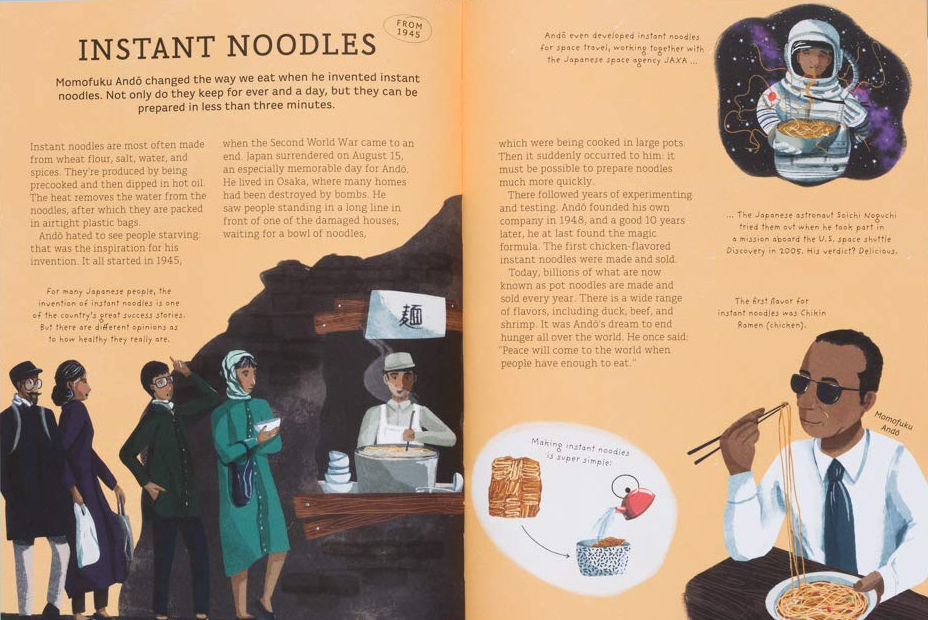
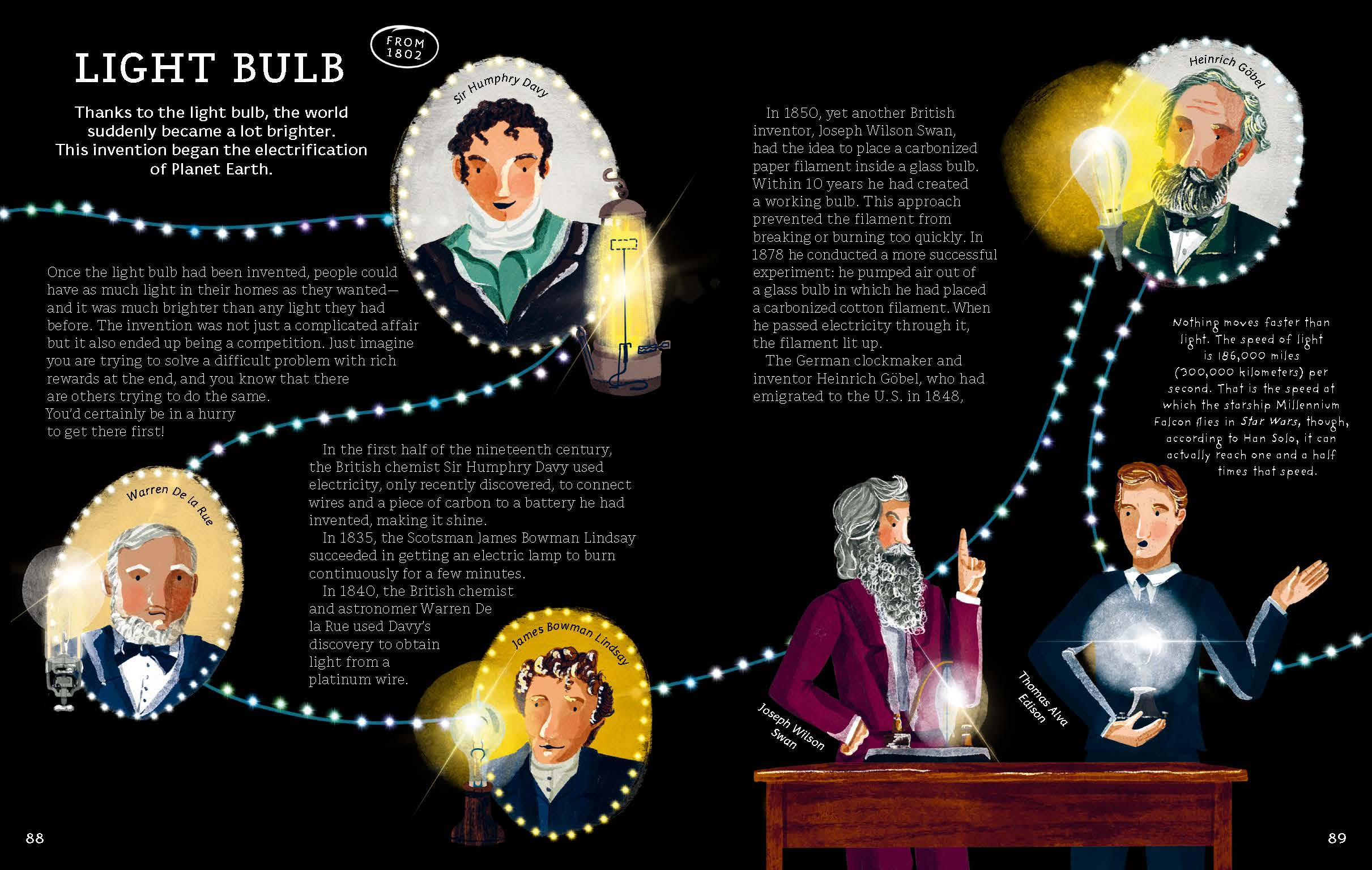
When you jump in the car or turn on a lamp, the idea that these were someone’s inventions (and even the names Henry Ford and Thomas Edison) may flash through your mind. But what about when you slurp up delicious Raman noodles, watch your pet fish through the aquarium glass, or squeeze out the last bit of toothpaste in the tube? In Who Invented This? Anne Ameri-Siemens introduces young readers to the brilliant minds behind some of the things we use every day.

celebrate-picture-books-picture-book-review-who-invented-this-light-bulb

Image copyright Becky Thorns, 2021, text copyright Anne Ameri-Siemans, 2021. Courtesy of Little Gestalten.

Take bicycles, for instance. You’ve probably seen pictures of those old bikes with a huge front wheel and a tiny back wheel. Was this the first bike? Not at all! Ameri-Siemens reveals that the first bicycle—called a “running machine”—had two wheels but didn’t have pedals. Invented by Karl von Drais in 1817, it had a steering bar in the front and was powered by the rider sitting on the seat and “running along the ground.” It may seem comical, but this invention led to more and more improvements until Pierre Michaux designed the first bike with pedals in the 1860s. You can read about all of the advancements in bikes and the other products it inspired too.

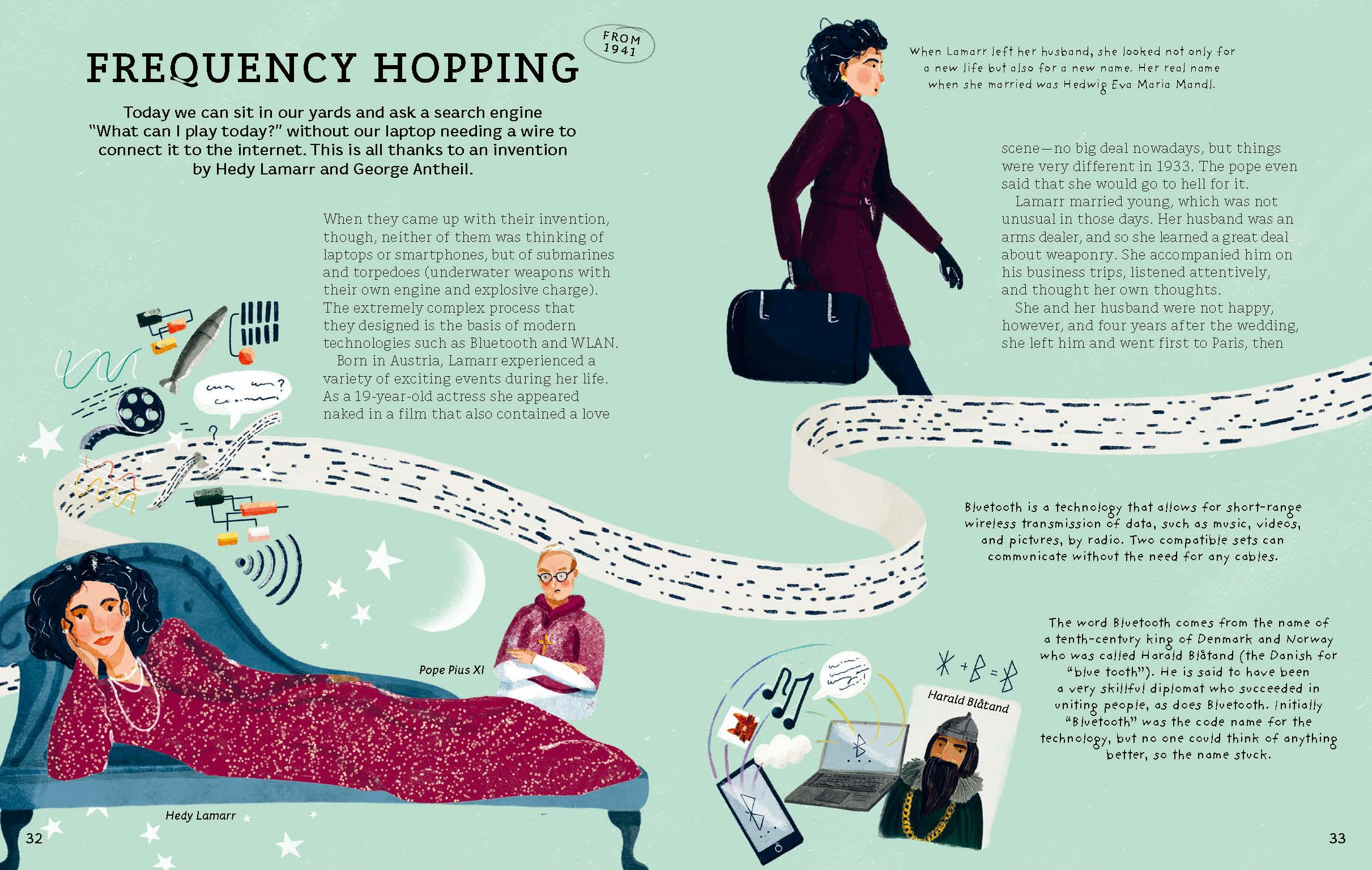
celebrate-picture-books-picture-book-review-who-invented-this-frequency-hopping

Image copyright Becky Thorns, 2021, text copyright Anne Ameri-Siemans, 2021. Courtesy of Little Gestalten.

As long as we’re talking about things that transport people here and there, have you ever thought about what drivers did before there were modern traffic lights? While the idea of indicating “stop” and “go” in red and green is universal across the world, the use of yellow for the transition came later from American policeman William Potts. “The first traffic lights in the world were built in London in 1868.” But they weren’t automatic. A policeman standing in the road had to move arms up and down to regulate the flow of traffic. “At night the arms were lit up in red and green.” Readers will find out more about how traffic lights progressed as well as how the timing of stop and go is controlled.

celebrate-picture-books-picture-book-review-who-invented-this-fizz

Image copyright Becky Thorns, 2021, text copyright Anne Ameri-Siemans, 2021. Courtesy of Little Gestalten.

Sometimes inventors get their ideas from nature—this is called bionics—and kids will learn how George de Mestral was ingeniously inspired by those sticky burrs that cling to socks to create a product most of them use all the time. There are other everyday products that are so important that they were invented long, long, long ago. One of these? Toothpaste! While Washington Sheffield invented the first smooth paste in 1850 by adding glycerin to the powder then used—“a mixture of pumice stone, powdered marble, grated oyster shells, ashes, peppermint oil or sage, and some soap power”—and his son realized the toothpaste could be packed in tubes like artists’ paints instead of sold in foil bags, prehistoric humans also brushed their teeth. Kids will be fascinated to learn more about the history of this morning and nighttime routine and even examples from the animal kingdom.

celebrate-picture-books-picture-book-review-who-invented-this-plastic

Image copyright Becky Thorns, 2021, text copyright Anne Ameri-Siemans, 2021. Courtesy of Little Gestalten.

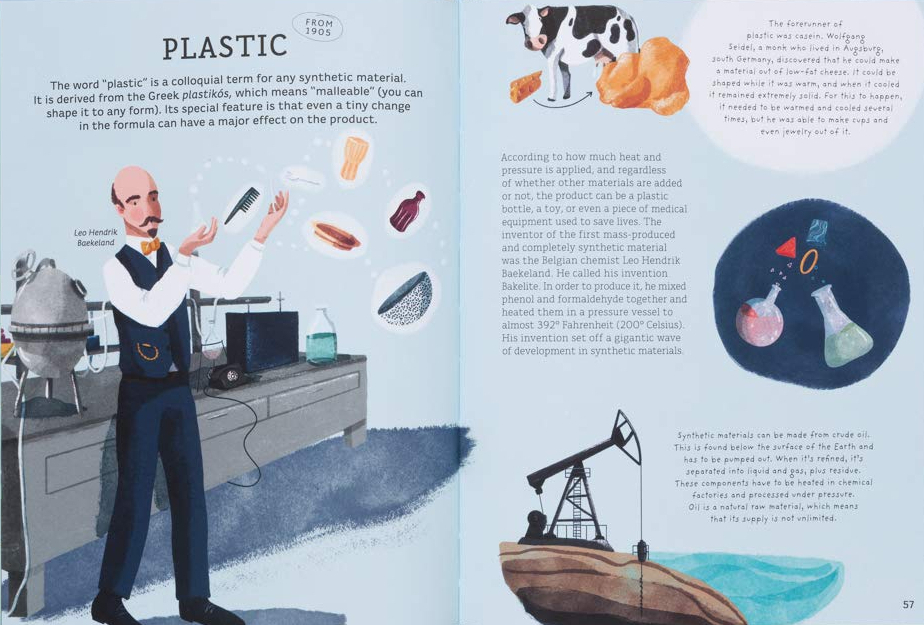
Readers will be excited to learn about these inventions and many more that make up the fabric of our everyday lives and were conceived by talented inventors, scientists, and engineers. Some are the result of teamwork while some are the product of many years spent alone in a laboratory or even simply chance. In all, kids learn about 34 inventions that fall into diverse categories from transportation to communications, clothing to food, music to science and high-tech marvels.

celebrate-picture-books-picture-book-review-who-invented-this-instant-noodles

Image copyright Becky Thorns, 2021, text copyright Anne Ameri-Siemans, 2021. Courtesy of Little Gestalten.

Anne Ameri-Siemens’ conversational and engaging text will captivate readers interested in learning about how the world they know came to be. Ameri-Siemen’s storytelling beautifully balances the scientific and personal details of each invention to deliver compelling profiles. Interesting asides on each page reveal more about the inventions and the people who created them.

Accompanying each subject are Becky Thorns’ eye-catching illustrations that depict not only the invention but its creator or creators as well as how it is used or where it can be found. Thorns also employs clever ways to connect images on a page-spread that reinforcing their purpose and history. Each page spread offers plenty of ideas to spur research projects or extended lessons for classrooms and homeschoolers.

Packed with information on products, ideas, world-changing inventions, and the brilliant minds behind them, Who Invented This? Smart People and Their Bright Ideas will fascinate kids and spark an interest in further research, science, engineering, and technical studies. The book is highly recommended for young inventors, history buffs, and other creative thinkers as well as for classrooms and school and public library collections.

Ages 9 – 12 and up

Little Gestalten, 2021 | ISBN 978-3899551334

To learn more about Becky Thorns, her books, and her art, visit her website.

National Inventor’s Month Activity

celebrate-picture-books-picture-book-review-share-your-bright-idea-activity

Share Your Bright Idea! Page


Do you sometimes have a lightbulb moment when an idea seems just right? Use this printable Share Your Bright Idea! Page to write about or draw your idea!

celebrate-picture-books-picture-book-review-who-invented-this-cover

You can find Who Invented This? Smart People and Their Bright Ideas at these booksellers

Amazon | Barnes & Noble | Books-a-Million

To support your local independent bookstore, order from

Bookshop | IndieBound

Picture Book Review
June 17 – National Week of Making

celebrate-picture-books-picture-book-review-goldilocks-and-the-three-engineers-cover

About the Holiday

In 2016 President Barack Obama instituted June 17 – 23 as the National Week of Making to celebrate the spirit of American ingenuity and invention and ensure that future generations receive the support they need to continue this proud tradition. In his official proclamation, President Obama stated: “Since our earliest days, makers, artists, and inventors have driven our economy and transformed how we live by taking risks, collaborating, and drawing on their talents and imaginations to make our Nation more dynamic and interconnected. During National Week of Making, we recommit to sparking the creative confidence of all Americans and to giving them the skills, mentors, and resources they need to harness their passion and tackle some of our planet’s greatest challenges.” Today, makerspaces can be found across the country in studios, libraries, schools, and community venues to encourage kids and adults to explore their ideas and the feasibility of bringing their creations to market. To learn more about this week-long holiday, visit the Nation of Makers website.

Goldilocks and the Three Engineers

Written by Sue Fliess | Illustrated by Petros Bouloubasis


“In a tiny bungalow, / there lived a clever thinker. / Young Goldilocks invented things. She’d make and craft and tinker.” Goldilocks made lots of useful things, like machines to help you tie your shoes, to a self-zipping zipper to a hat outfitted with a flashlight, magnifying glass, and itty-bitty satellite dish to help you find the things you’ve lost. But one day, Goldilocks found that she had “inventor’s block,” so she decided to take a walk.

celebrate-picture-books-picture-book-review-goldilocks-and-the-three-engineers-bears

Image copyright Petros Bouloubasis, 2021, text copyright Sue Fleiss, 2021. Courtesy of Albert Whitman & Company.

At the same time, the Bear family was out gathering nuts and berries for their pre-hibernation celebration. Baby Bear had a nifty contraption that knocked fruit and nuts into a basket with a tennis racquet. Papa Bear had an ingenious wheelbarrow with mechanical arms and hands that picked berries one by one and deposited them in the cart—but only after tossing them through a tiny basketball hoop. Swish! And Mama Bear’s handy vacuum sucked fruit right off the bushes and collected them in a tank.

Their next stop was the beehive at the top of a hill. After they’d eaten all their goodies, Baby Bear spied a little bungalow. The Bears thought it was just the place to spend the winter. When they went inside, they found “the room was full of strange devices, / widgets, tools, and more!” Looking more closely, Papa Bear found a chair that was perfect for Baby Bear. He marveled that “it feed you and it wipes your mouth, / and reads you stories, too!” Meanwhile, Mama Bear had discovered a bowl that stirred porridge and a bed that automatically rocked you to sleep.

celebrate-picture-books-picture-book-review-goldilocks-and-the-three-engineers-workshop

Image copyright Petros Bouloubasis, 2021, text copyright Sue Fleiss, 2021. Courtesy of Albert Whitman & Company.

Baby Bear loved the chair but wished for one more innovation that would make it just right. Papa Bear found parts and tools and fixed the chair to Baby Bear’s specifications. Mama Bear tasted the porridge and found it lacking one ingredient, so Papa Bear created a porridge-stirrer accessory to add it drop by drop. By now it was dark, and even though Papa Bear thought it wasn’t right to stay, Baby Bear convinced him that one night would be okay.

But when they crawled into bed and turned it on, it rocked so much that it tipped the Bears right onto the floor. There was only one thing to do: “Baby fixed the engine block. / Replace the gears that burned. / Soon the bears were fast asleep… / Then Goldilocks returned.” She saw the chair, tasted the porridge, and then… “heard snoring sounds.” Wide awake now, the bears began to explain. But Goldilocks was not upset. Instead she said, “‘You’ve improved my projects here, / and made them much more fun. / Proving that four brains, by far, / are better than just one!’”

Excited to be inventing again with the bears on board to lend their smart innovations, Goldilocks sends the family off amid promises to “‘…meet up in the spring’” when they will “‘…make the next big thing!’”

celebrate-picture-books-picture-book-review-goldilocks-and-the-three-engineers-bed

Image copyright Petros Bouloubasis, 2021, text copyright Sue Fleiss, 2021. Courtesy of Albert Whitman & Company.

With her fun flip on the Goldilocks story, Sue Fleiss invites kids to indulge their inner inventor with wacky contraptions that can make getting dressed, cooking, going to bed, and chores more exciting. Fleiss’s clever takes on the well-known “just right” chair, porridge, and bed get readers thinking creatively—perhaps even about their own household appliances. While the original story ends with the interloper being chased away, Fleiss’s version shines with the benefits of cooperation, collaboration, and being open to new ideas.

With so many cool inventions to discover on every page, readers will love taking extra time to find and talk about them all. Any young maker would swoon over Petros Bouloubasis’s well-stocked workbench, and readers would have a blast drawing their own gadgets using the tools and supplies depicted. Quirky, abstract landscapes add to the kid-centric ambiance, and just like the Bear family, who drives away in a new vehicle with their full wheelbarrow in tow, readers will look forward to returning to Goldilocks’ little bungalow again and again.

Imagination, creativity, teamwork, and friendship all wrapped up in a clever fractured fairytale—what could be better?! Goldilocks and the Three Engineers is one to add to home, classroom, and public library bookshelves.

Ages 4 – 8

Albert Whitman & Company, 2021 | ISBN 978-0807529973

Discover more about Sue Fleiss and her books on her website.

To learn more about Petros Bouloubasis, his books, and his art, visit his website.

National Week of Making Activity

CPB - Inventor's Tool Kit II (2)

Inventor’s Tool Kit


Every idea begins as a jumble of seemingly unrelated parts. Gathering whatever types of material inspires you and keeping it in a box ready to go when inspiration hits is a great way to support innovation and spark experimentation.

Supplies

  • Small parts organizer with drawers or compartments, available at hardware stores and craft stores
  • A variety of parts or craft materials that can be combined, built with, or built on
  • Some hardware ideas—pulleys, wheels, small to medium pieces of wood, wire, nuts, bolts, screws, hooks, knobs, hinges, recyclable materials
  • Some craft ideas—clay, beads, wooden pieces, sticks, paints, pipe cleaners, string, spools, buttons, glitter, scraps of material, recyclable materials

Directions

  1. Fill the organizer with the materials of your choice
  2. Let your imagination go to work! Build something cool, crazy, silly, useful—Amazing!

celebrate-picture-books-picture-book-review-goldilocks-and-the-three-engineers-cover

You can find Goldilocks and the Three Engineers at these booksellers

Amazon | Barnes & Noble | Books-a-Million

To support your local independent bookstore, order from

Bookshop | IndieBound

Picture Book Review

March 11 – Worship of Tools Day

celebrate-picture-books-picture-book-review-whose-tools-cover

About the Holiday

What would we do without tools? Handheld and big machinery devices help us create buildings, artwork, crafts, and furniture; cook delectable meals; tend the garden; and keep our vehicles and homes in tip-top shape. Even animals use sticks, rocks, and their own paws as tools to get food and build homes. To celebrate today’s holiday make sure your tools are all in order and working, or if you’ve had your eye on a new tool, treat yourself!

Whose Tools?

Written by Toni Buzzeo | Illustrated by Jim Datz


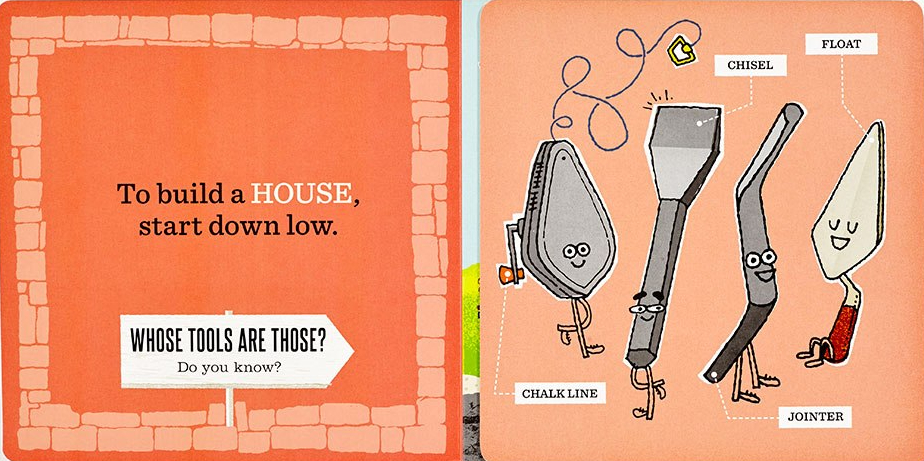
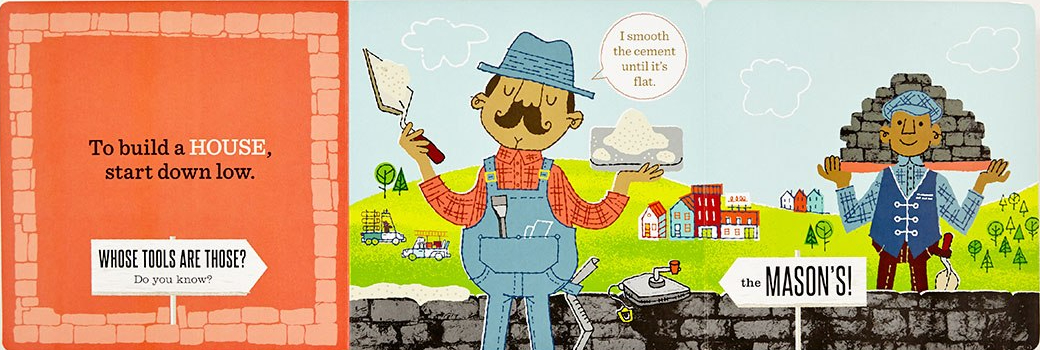
There’s a lot of building going on! Where to start? Well, that depends…. “To build a house, start down low” and use these tools: the chalk line, the chisel, the jointer, and the float. “Whose tools are those? The mason’s!” What does he use them for? He’ll tell you himself: “I smooth the cement until it’s flat.” Where do windows go? Way up high! Here are the hammer, the level, the square, and the saw. Can you guess who uses those tools? They belong to the carpenter! He’s cutting the frame where the windows will go.

celebrate-picture-books-picture-book-review-whose-tools-foundation

Image copyright Jim Datz, 2015, text copyright Toni Buzzeo, 2015. Courtesy of Harry N. Abrams Books for Young Readers.

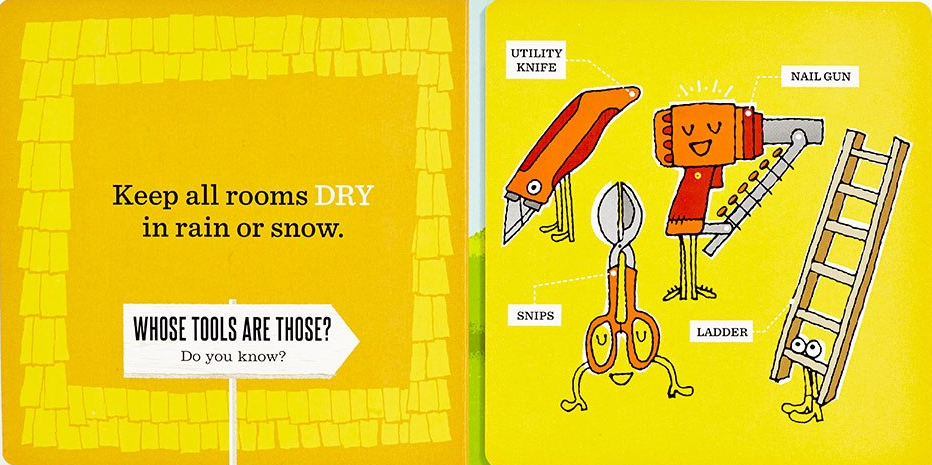
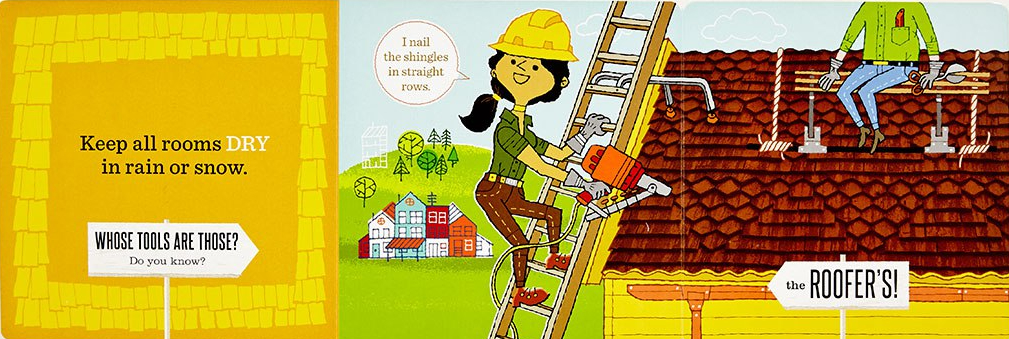
It’s important that a house stays dry in rain and snow. What tools help with that? The utility knife, the snips, the nail gun, and the ladder. “Whose tools are those? Do you know?” They’re the roofer’s! What does she do with them? She climbs to the top of the house and nails “the shingles in straight rows.” A house can’t be dark, so the workers will “add some lights that softly glow.” They’ll use a screwdriver, a drill, a linesman pliers, and a wire stripper. Who are they? They’re the electricians! One electrician is busy stringing “the wire from switches to lights.”

celebrate-picture-books-picture-book-review-whose-tools-mason

Image copyright Jim Datz, 2015, text copyright Toni Buzzeo, 2015. Courtesy of Harry N. Abrams Books for Young Readers.

A house needs water too! What kinds of tools are used for that? An adjustable wrench, a pipe cutter, pipe tape, and a pipe wrench. And who uses these tools? The plumber! He turns “the pipe elbows until they’re tight” so there are no leaks! The house is almost finished, and now “on all four walls bright colors flow.” What tools are used to make such a pretty house? A brush, a roller, a roller tray, and masking tape. And who uses them? The painter! Right now she’s putting another coat of green paint on the wall. “The house is still not finished, though. Who’s come to build?” Surprise! “It’s you!”

celebrate-picture-books-picture-book-review-whose-tools-roof

Image copyright Jim Datz, 2015, text copyright Toni Buzzeo, 2015. Courtesy of Harry N. Abrams Books for Young Readers.

Children are naturally curious about the tools, utensils, and machinery they see adults using. Toni Buzzeo’s delightful board book introduction to twenty-four tools for the youngest readers will capture their interest and imagination with fun prompts and a house-construction project in process. Buzzeo’s enthusiastic language and guess-who format invites multiple readings during which little ones are sure to memorize the names of all the tools and recognize them in the “real world” when they see them.

celebrate-picture-books-picture-book-review-whose-tools-roof-fold-out

Image copyright Jim Datz, 2015, text copyright Toni Buzzeo, 2015. Courtesy of Harry N. Abrams Books for Young Readers.

Through Jim Datz’s cheery illustrations, kids watch as a cozy house comes together from foundation to finished as they learn the shape of each tool and see some being used. Questions are introduced on the left-hand page while the particular tools, drawn with sweet, smiling faces, are named on the right. This page opens to a double spread in which both men and women workers are busily and happily plying their trade. The final image will bring a giggle from kids as they discover that the house being built is actually a house of blocks being carefully constructed by a little girl and boy.

Whose Tools? would make a welcome baby gift and a fun addition to home and preschool libraries for little tool lovers.

Ages 2 – 4

Harry N. Abrams, 2015 | ISBN 978-1419714313

Discover more about Toni Buzzeo and her books on her website.

To view a portfolio of artwork by Jim Datz, visit his website

Worship of Tools Day Activity

Tool-Box-Coloring-Page-[www.getcoloringpages.com]

Terrific Tools! Coloring Pages


Tools are terrific when you need to fix something old or build something new! Have fun coloring these tools and their toolbox!

Saw | Wrench | Toolbox

celebrate-picture-books-picture-book-review-whose-tools-cover

You can find Whose Tools? at these booksellers

Amazon | Barnes & Noble | Books-a-Million

To support your local independent bookstore, order from

Bookshop | IndieBound

Picture Book Review