May 20 – It’s National Egg Month

celebrate-picture-books-picture-book-review-after-the-fall-cover

About the Holiday

During the month of May we celebrate the humble egg. In that small oval package lie protein and other nutrients that provide low-cost, healthy meals for people across the world. Eggs are also used as delicate canvases for beautiful art, colorful objects for hide-and-seek-games, and as characters in children’s books—the most famous of which is the star of today’s book!

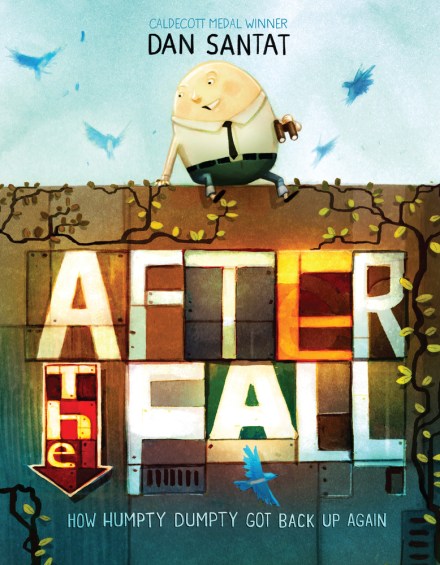
After the Fall (How Humpty Dumpty Got Back Up Again)

By Dan Santat


If readers don’t quite remember what happened to Humpty Dumpty back in the day,  his unfortunate accident is captured on the title page. But this is not a story about falling (we all do that sometimes). Instead, as the subtitle reveals, it’s about the recovery. Here, Humpty Dumpty tells his story his way—what really happened on that fateful day and afterward.

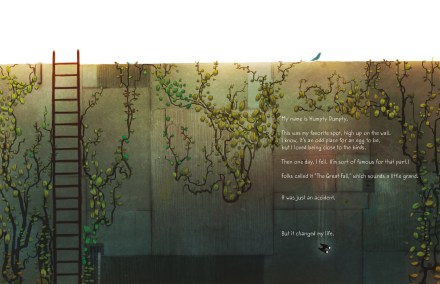
Humpty takes readers back to the scene where it all happened: his “favorite spot high up on the wall.” He acknowledges that it’s a strange place for such a fragile being to be, but up there he felt closer to the birds. He goes on to say that he’s not really comfortable with all the fuss and the fancy “Great Fall” title. It was just a mistake; even if that mistake did change his life.

celebrate-picture-books-picture-book-review-after-the-fall-wall

Copyright Dan Santat, 2017, courtesy us.macmillan.com.

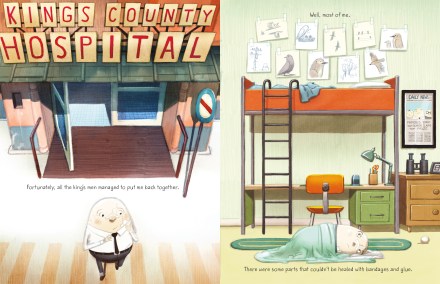
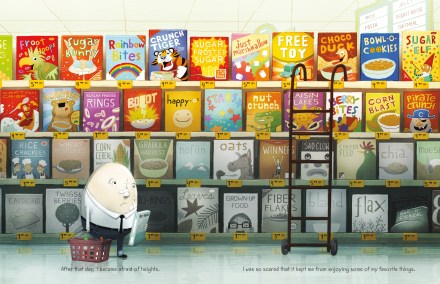
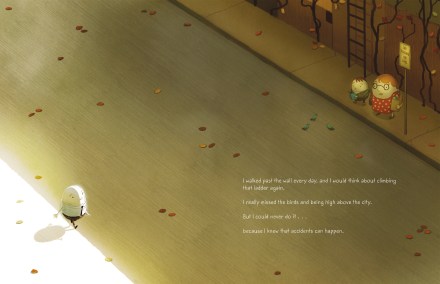
It turns out that despite what we’ve all learned, the king’s men were able to patch Humpty up. Well, at least partly. His shell was repaired, but inside? “There were some parts that couldn’t be healed with bandages and glue.” Where Humpty once loved his bunk bed above his desk, he now slept on a mat on the floor; he only bought items from the lowest grocery store shelves; and even though he passed the wall every day, he knew he could never climb the ladder to the top again.

Humpty resigned himself to watching the birds from the ground through a pair of binoculars. Then, one day, a paper airplane streaked across the sky and gave him an idea. Paper airplanes looked so easy to make, but Humpty found it hard. Day after day he struggled, suffering paper cuts and scratches. One day, though, he “got it just right.” In his hand was a beautiful paper bird.

celebrate-picture-books-picture-book-review-after-the-fall-hospital

Copyright Dan Santat, 2017, courtesy us.macmillan.com.

Humpty took his bird plane outside and launched it into the air. “It flew like nothing could stop it.” Humpty felt happier than he had in ages, and even though watching his plane wasn’t the same as being on top of the wall among the birds, “it was close enough.” But then the unthinkable happened—the bird plane flew over the wall. Humpty was well aware that “unfortunately, accidents happen…they always do.”

For a minute Humpty Dumpty considered walking away. But then he remembered all the work he’d put into his plane, which led him to think about all the things he was missing out on. He looked up that tall, tall ladder and started to climb. The farther up he got, though, the more afraid he became. Without looking up or down, he continued climbing. “One step at a time.”

When he reached the top, he “was no longer afraid.” At that moment, as his shell began to crack and he felt lighter and more powerful. Humpty tells readers that he hopes they won’t remember him as “that egg who was famous for falling,” but as “the egg who got back up and learned how to fly.”

celebrate-picture-books-picture-book-review-after-the-fall-cereals

Copyright Dan Santat, 2017, courtesy us.macmillan.com.

Dan Santat deftly works with preconceived notions and a well-known idiom to turn the nursery rhyme about Humpty Dumpty into an inspirational “happily ever after” story. Just as fears can come to define a person, traditional interpretations of this tale classify Humpty as a chicken egg and specify his lack of repair as physical. But what if, as Santat envisions, Humpty is the egg of a bird that soars and that his hurts are more internal? Then readers can identify with this hero who doesn’t give in and who conquers his fear to come out of his shell and fly. Santat’s honest, straightforward storytelling will resonate with young readers and listeners. The gentle reassurance in After the Fall will encourage children to try again—one step at a time.

celebrate-picture-books-picture-book-review-after-the-fall-walking-past-wall

Copyright Dan Santat, 2017, courtesy us.macmillan.com.

Santat’s luminous illustrations express wonder, humor, and touching moments in ways that not only enhance the story but make readers think about other issues as well.  Children will want to linger over the pages to catch all the references to Humpty’s bird watching hobby, take in the enormity of the wall that Humpty Dumpty confronts, and catch humorous takes on the original rhyme, including Santat’s King’s County Hospital. Adults and kids alike will enjoy poring over and discussing the wall of cereals, and as Humpty’s tiny hand reaches for the next rung on the ladder adults may feel a lump in their throats. When Humpty breaks free of his shell and emerges in the same form as the paper bird he created, readers may consider whether Humpty spent time only working on his toy or on himself as well.

After the Fall is a picture book that offers reassurance and invites deeper discussion. The book would be a welcome addition to home, classroom, and school libraries.

Ages 4 – 8

Roaring Brook Press, 2017 | ISBN 978-1626726826

Learn more about Dan Santat, his books, and his art on his website.

National Egg Month Activity

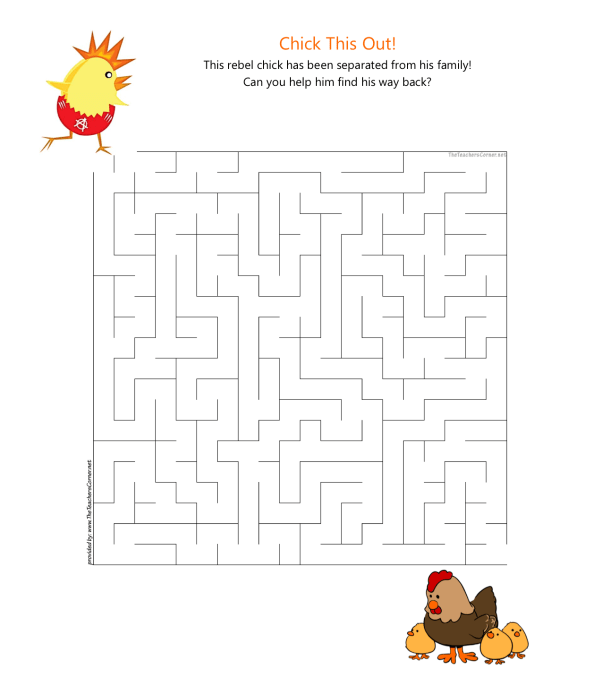
 celebrate-picture-books-picture-book-review-Chick-This-Out-maze

Chick This Out! Maze


This little rebel chicken has been separated from his family! Can you help him find his way back to the nest? 

Chick This Out! Maze | Chick This Out! Solution

Picture Books Review

May 6 – National Nurses Day

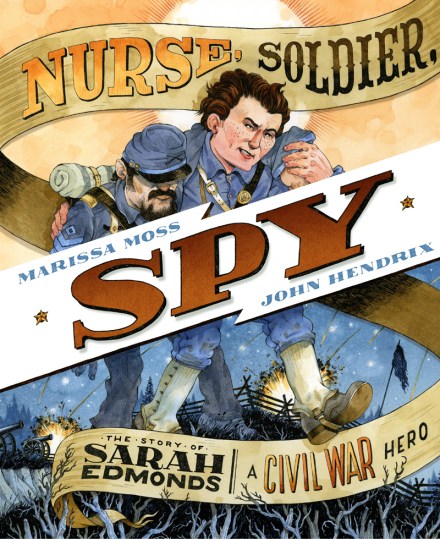
celebrate-picture-books-picture-book-review-nurse-soldier-spy-the-story-of-sarah-edmonds-cover

About the Holiday

Today’s holiday kicks off National Nurses Week, which runs until May 12, the birthday of Florence Nightingale. Nightingale, born in 1820, was an English social reformer and the founder of modern nursing. She was well-known for her work tending wounded soldiers during the Crimean War and was called “the lady with the lamp,” because of the rounds she made of her patients during the night.

During National Nurses Day and Week, we honor and thank all of the nurses working in hospitals, private practices, and with charitable organizations around the world for their dedication to and compassion for the patients under their care.

Nurse, Soldier, Spy: The Story of Sarah Edmonds, A Civil War Hero

Written by Marissa Moss | Illustrated by John Hendrix


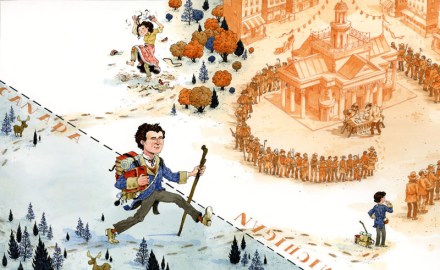
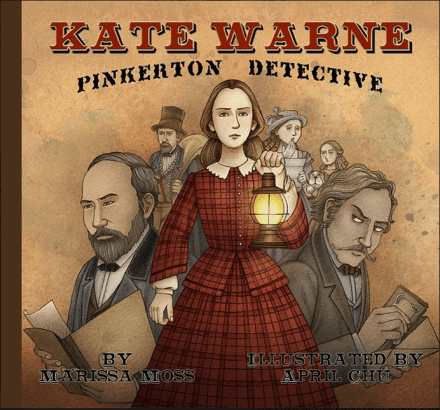
When President Abraham Lincoln called for young men to join the army fighting against the Southern states that wanted to secede from the Union, Frank Thompson signed up. One thing though, Frank wasn’t really a man but, instead, a 19-year-old woman named Sarah Edmonds. Sarah already knew the freedom that posing as a man could bring in her society. Three years earlier to escape a marriage arranged by her parents, Sarah cut her long hair, began wearing pants, and crossed “the border from Canada into the United States, trading a bridal gown for trousers, trading countries, without a single regret.”

celebrate-picture-books-picture-book-review-nurse-soldier-spy-the-story-of-sarah-edmonds-becoming-frank

Image copyright John Hendrix, courtesy of johnhendrix.com

Now, outside the Michigan courthouse, Sarah slowly moved her way along the line to the table where she could sign up to join the troops. When she finally stood in front of the recruiter, however, he stopped her. Sarah was mystified. How did he know she wasn’t a man? She had grown up on a farm, learning the work, copying the gestures, and even wearing the clothes of her brother. But the recruiter took one look at “Frank Thompson” and told her…she was too young to join the army. “He looked at her peachy cheeks free of any sign of a whisker. ‘We aren’t taking any sixteen-year-olds,’” he told her.

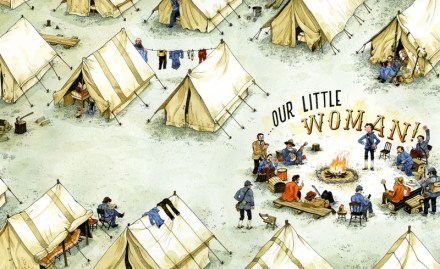
A month later, however, more men were needed, and Sarah was allowed to join up. Now a soldier, Frank was a valuable member of the corps. She was an expert at riding and shooting, and she felt at home among the men, enjoying the jokes, stories, and letters. Keeping her identity a secret was made easier by the fact that soldiers did not change clothes to go to sleep. Her small feet led the other soldiers to give her a nickname: “Our little woman.” A name Frank enjoyed immensely.

celebrate-picture-books-picture-book-review-nurse-soldier-spy-the-story-of-sarah-edmonds-union-camp

Image copyright John Hendrix, courtesy of johnhendrix.com

On the battlefield Frank trained to be a nurse, “which was something only men with the strongest stomachs did because of the long, draining hours and the horrors of surgery without anesthetic.” She fearlessly participated in the battles of Bull Run and Fair Oaks, risking her own life to rescue wounded soldiers. One night the regimental chaplain approached Frank. He wanted to recommend her for a very important—and very dangerous—job. The chaplain wanted to recommend to the generals that Frank become a spy for the North.

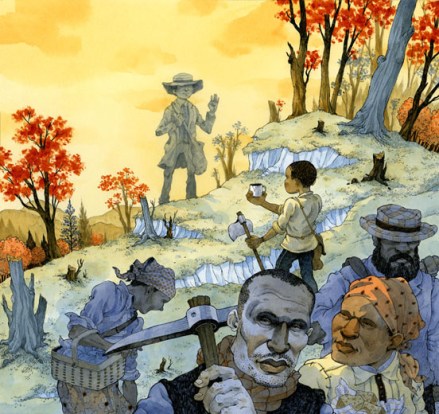
“Frank didn’t hesitate. ‘I’m your man!’” she said. Disguising herself as a freed slave, she infiltrated “a group of slaves bringing breakfast to the rebel pickets, the men who guarded the camp.” With so much work to do, the group quickly accepted her, but when the rest of the men, women, and children went off to their own assignments Frank hesitated, not knowing where to go next. Suddenly, a Confederate soldier caught Frank and ordered her to work on the fortifications. The work was backbreaking and left her hands blistered and bloody. The other workers helped when she had trouble.

celebrate-picture-books-picture-book-review-nurse-soldier-spy-the-story-of-sarah-edmonds-battlefield

Image copyright John Hendrix, courtesy of johnhendrix.com

The work gave Frank an opportunity to count the number of guns the army had, sketch a layout of the fort, and notice that some cannons were fake—just logs painted to look like cannons. By switching jobs with the water boy, Frank was able to get closer to the troops, where she encountered another spy—one working for the Confederate army. When night fell, Frank returned to his Union battalion. Giving the password, Frank was let into camp and made her way to the general’s tent. “Freedom, she knew, wasn’t something to take for granted. It was something to fight for, to cherish. And so long as her heart was beating strong, that’s just what she would do.”

An extensive Author’s Note revealing more about Sarah Edmond’s life and an Artist’s Note on the creation of the illustrations follow the text.

Marissa Moss’s biography of Sarah Edmonds is a suspenseful, gripping, and enlightening story of a woman who broke molds, lived on her own terms, and paved the way for future generations of women. Her well-chosen vignettes from Edmonds’ time as a Union soldier demonstrate not only Edmonds’ bravery and abilities but also create a clear and exciting trajectory of her increasing responsibilities and the danger that went with them. Fascinating details of the Civil War period, the people and attitudes involved, and the duplicitous nature of warfare, add up to a rich account of Sarah Edmonds’ life as well as the Civil War era in general.

celebrate-picture-books-picture-book-review-nurse-soldier-spy-the-story-of-sarah-edmonds-as a spy

Image copyright John Hendrix, courtesy of johnhendrix.com

Meticulously researched and drawn, John Hendrix’s illustrations perfectly accompany and illuminate the text. Accurate depictions of Civil War-era buildings and clothing as well as Union and Confederate uniforms and weapons allow children to become fully immersed in the time period. Wide-view depictions of encampments and battlefields let readers peek into tents and scour trenches, and action abounds. In camp soldiers pick out tunes on banjos, write letters, and hang laundry; on the battlefield fires rage and ammunition explodes as soldiers follow the charge of their leaders; at the Confederate fortifications black workers steer wheelbarrows of rock; and in the medical tent Frank tends to wounded soldiers, the equipment used clearly visible. Scenes portrayed in both daylight and at night highlight the ongoing conflict and the dangerous, secretive work Sara Edmonds undertook.

Nurse, Soldier, Spy: the Story of Sarah Edmonds a Civil War Hero is historical and biographical work at its best. This fast-paced, fascinating look at one particular soldier informs readers about so many aspects of the Civil War era, including societal issues that shaped the United States and are still discussed today. The book is a must for school and public libraries and its in-depth, absorbing content makes it a welcome addition to home libraries for children who love history, art, biographies, and a well-told story.

Ages 5 – 12

Abrams Books for Young People, 2016 (Paperback edition) | ISBN 978-1419720659

Discover many more books, fun stuff, writing tips and more on Marissa Moss‘s website!

View a portfolio of picture book art, editorial illustration, a sketchbook, and more on John Hendrix‘s website!

National Nurses Day Activity

CPB - Doctors Clothespins

Nurse Clothespin Dolls


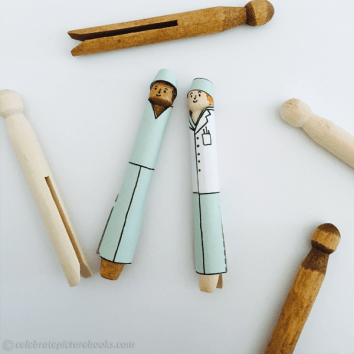
Make one of these clothespin figures that honors hard-working and compassionate emergency nurses!

Supplies

CPB - Doctors Clothespins on box

Directions

  1. Draw a face and hair on the clothespin
  2. Cut out the outfit you want your doctor to wear (color pants on your clothespin if you choose the lab coat)
  3. Wrap the coat or scrubs around the clothespin. The slit in the clothespin should be on the side.
  4. Tape the clothes together
  5. Wrap the cap around the head and tape it.
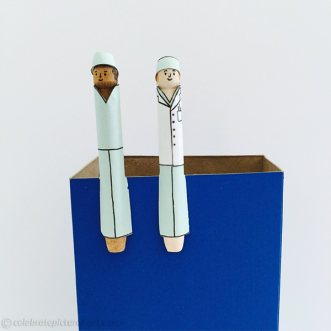
  6. If you’d like to display your clothespin doctor on a wire, string, or the edge of a box or other container, cut along the dotted lines of the clothes template.

Picture Book Review
May 4 – Petite and Proud Day

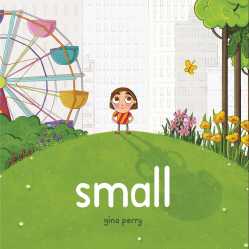
celebrate-picture-books-picture-book-review-small-gina-perry-cover

About the Holiday

Today is a day for anyone who is on the petite side to stand tall and show the world what you are capable of! Kids especially need encouragement and support as they begin to notice ways in which they can make a difference. Community events and personal ideas for helping others, their school, their town, or even projects close to home are terrific ways that children can get involved. Working for a cause they believe in is a great way to boost their self-confidence and self-assurance while making them proud of what they can accomplish. Today, talk to your kids about how you can help them achieve their goals.

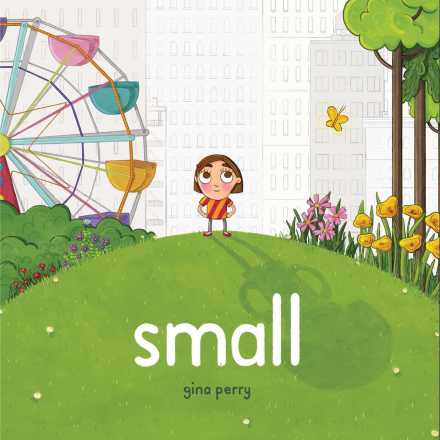
Small

By Gina Perry


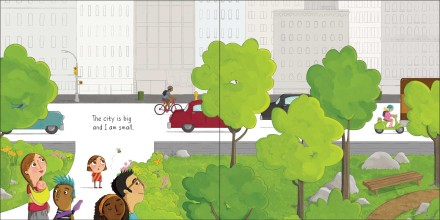
A little—and I mean little—girl is out and about in the big—and I mean big—city. All around her are buildings, people, and trees that seem to emphasize her smallness. Standing next to the “wide street. Tall buildings,” she thinks, “I look small.” Compared to the “noisy cars. Speeding bikes,” she even walks small.

celebrate-picture-books-picture-book-review-small-gina-perry-city

Copyright Gina Perry, 2017, courtesy of simonandschuster.com

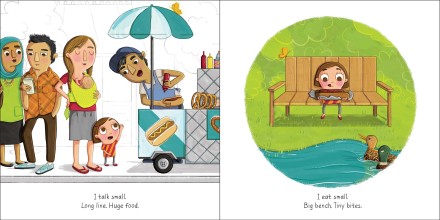
While buying and eating lunch, the little girl is surrounded by more examples of how tiny she really is. Even the ducks at the pond appear bigger than she is with their oversized QUACK! QUACK! Yes, says the girl as she abandons her “huge food” to the gobbling ducks, “I am small.”

celebrate-picture-books-picture-book-review-small-gina-perry-hot-dog

Copyright Gina Perry, 2017, courtesy of simonandschuster.com

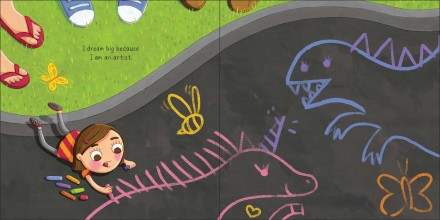
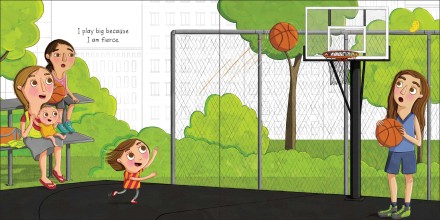
But…in the park she spies a tall slide and with determination climbs the high ladder. At the top and with a Whoosh!, she suddenly says, “I feel big because I can fly.” Down on the blacktop with her colorful chalk, she becomes an artist capable of expressing her big dreams. On the basketball court, she barely comes up to the teenagers’ knees, but, still, the ball she throws rises to the net. “I play big because I am fierce,” she explains.

celebrate-picture-books-picture-book-review-small-gina-perry-drawing

Copyright Gina Perry, 2017, courtesy of simonandschuster.com

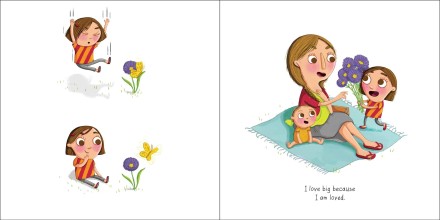
When she’s happy, the little girl’s voice rings through the air, and her bravery allows her to swing through it too. She brings her mom flowers because her heart overflows with love, and when she’s just tall enough to ride the Ferris wheel, she soars over the city because she is “BIG!”

celebrate-picture-books-picture-book-review-small-gina-perry-love

Copyright Gina Perry, 2017, courtesy of simonandschuster.com

Gina Perry zeroes in on what it means to be a child surrounded by bigness in her profound and encouraging book that shows young readers that size is not only measured in outward ways, but in the intensity of one’s heart, dreams, personality, and self-confidence. Through visual juxtapositions that kids will recognize and appreciate, Perry demonstrates the various meanings of “small” and “big” that influence a child’s thinking and feelings. When the little girl approaches the slide, however, her perspective changes, allowing her and readers to soar. 

celebrate-picture-books-picture-book-review-small-gina-perry-basketball

Copyright Gina Perry, 2017, courtesy of simonandschuster.com

Perry’s distinctive illustrations are full of humor and a very welcome cast of diverse characters. Children will love lingering over each page to talk about the ideas of big and small, long and short, wide and tall and the less-concrete ideas of “bigness” of thought and action. Kids will also like following the yellow butterfly that keeps the little girl company from spread to spread.

Small is a wonderful book to give as a gift or to add to home libraries. It also makes a great discussion starter in classrooms, which are full of children in various stages of growth.

Ages 4 – 8

little bee books, 2017 | ISBN 978-1499804010

Discover more about Gina Perry, her books and her art on her website!

Petite and Proud Day Activity

celebrate-picture-books-picture-book-review-self-esteem-worksheet

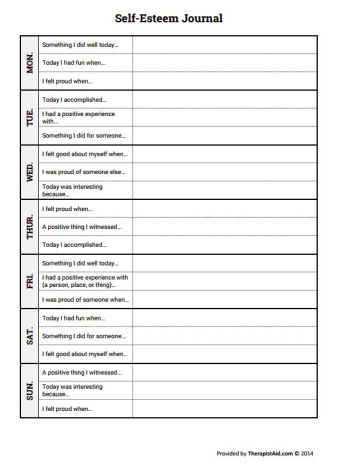
Weekly Self-Esteem Worsheet


Keeping track of all the things you do that make you happy and proud is a good way of seeing how much difference you make to those around you while raising self-esteem. Print, hang, and fill out this Weekly Self-Esteem Worksheet to remind kids of their accomplishments.

celebrate-picture-books-picture-book-review-small-gina-perry-cover

You can find Small at these booksellers

Amazon | Barnes & Noble | Books-a-Million | IndieBound

Picture Book Review
April 23 – National Take a Chance Day

celebrate-picture-books-picture-book-review-what-do-you-do-with-a-chance-cover

About the Holiday

Sometimes it takes a special nudge to get us to leave our comfort zone and try something new—even if it’s something we’ve been wanting to do for a long time. Today’s holiday provides that push by encouraging people to let go of the fears and doubts that hold them back. Whether you prefer to try new things a little at a time or decide to dive right in, you’ll feel happier and more excited by life if you reach for that gold ring when it comes around.

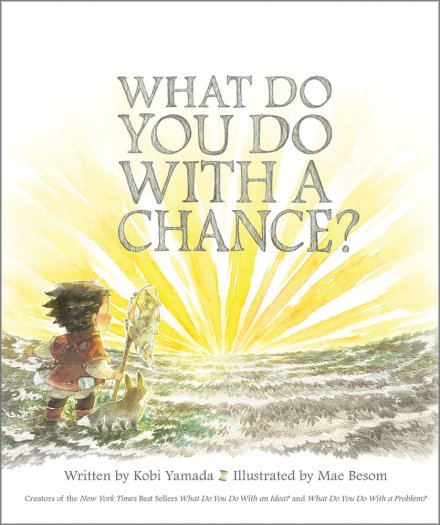
What Do You Do with a Chance?

Written by Kobi Yamada | Illustrated by Mae Besom


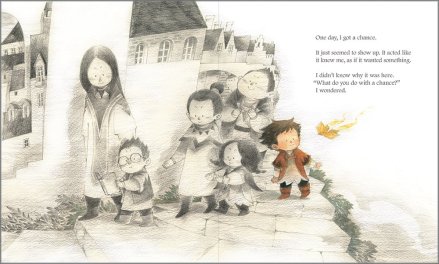
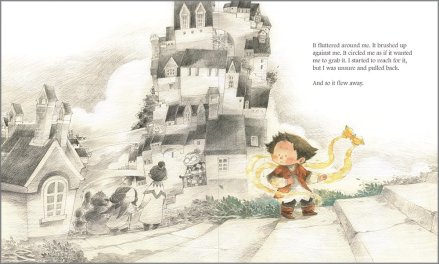
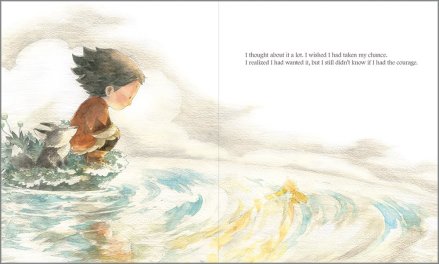
One day, a child says, they got a chance. The chance seemed to know them, but the child wasn’t sure why it was there or what to do with it. The chance was persistent, but unsure, the child “pulled back. And so it flew away.” Later the child thought about that chance and realized they “had wanted it,” but even now they didn’t know if they had the courage to take one.

celebrate-picture-books-picture-book-review-what-do-you-do-with-a-chance-first-chance

Image copyright Mae Besom, 2017, text copyright Kobi Yamada, 2017. Courtesy of Compendium.

The next time a chance came by, the child tried to grab it, but they “missed and fell.” They felt embarrassed, and “it seemed like everyone was looking at [them].” That was a feeling they never wanted again. Now whenever they saw a chance, “[they] ignored it.” They let so many pass them by that chances stopped coming. Then the child worried that they would never get another one.

celebrate-picture-books-picture-book-review-what-do-you-do-with-a-chance-pulls-away

Image copyright Mae Besom, 2017, text copyright Kobi Yamada, 2017. Courtesy of Compendium.

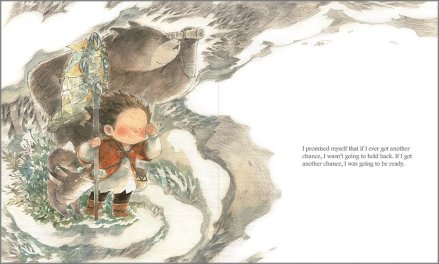
Although the child acted as if they didn’t care, they really did. They just didn’t know if they “would ever be brave enough” to take a chance. But then the child had a new idea and thought that maybe being brave “for a little while at the right time” was what it too. The child decided that the next time a chance came around, they were going to grab it. The child even went out to search for it, and then on a regular day, a glow appeared in the distance. Could this be it?

celebrate-picture-books-picture-book-review-what-do-you-do-with-a-chance-searches-for-new-chance

Image copyright Mae Besom, 2017, text copyright Kobi Yamada, 2017. Courtesy of Compendium.

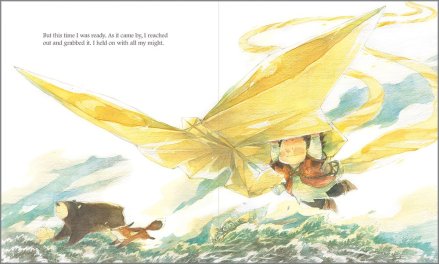
The child was ready. Racing toward the light, they didn’t feel afraid; instead, they were excited. As the child got near, they saw that it was an enormous chance. As soon as they could reach it, they climbed aboard and soared wherever it took them. Now the child understands that when they ignore chances, they miss out on all the wonderful things they wants to learn and do and be.

celebrate-picture-books-picture-book-review-what-do-you-do-with-a-chance-soars

Image copyright Mae Besom, 2017, text copyright Kobi Yamada, 2017. Courtesy of Compendium.

Whether the reader is a natural risk taker or on the more hesitant side, a child or an adult, Kobi Yamada offers encouragement and inspiration for those times when doubt or fear interferes with taking an opportunities when they come along. Kobi’s use of a first person narrator provides a level of comfort as the focus isn’t on the reader, but on feelings shared with a kindred spirit.

Quiet children or those with anxiety will see that there are others for whom leaving their comfort zone is difficult. Kobi’s concrete language echoes the inner monologue of questioning, hope, embarrassment, and regret that can hinder people from trying something new or big. He also presents gentle, solid advice and reveals that small voice of determination and courage that does lie within most hearts. When the child finally grabs onto the greatest chance, readers will also feel emboldened and will be ready to soar too.

celebrate-picture-books-picture-book-review-what-do-you-do-with-a-chance-at-reflecting-pond

Image copyright Mae Besom, 2017, text copyright Kobi Yamada, 2017. Courtesy of Compendium.

Mae Besom brilliantly depicts the child’s contrasting feelings to be free, spontaneous, and courageous on one hand and secure and protected on the other through her use of space and color. The mystical, medieval-type town the child lives in is crowded, with homes wall-to-wall and stacked one on top of the other. The friends or family the boy follows walk together tightly grouped, and these are all rendered in charcoal, white and dusty yellow. In contrast, the chances—origami butterflies with long tails—are golden yellow and fly away from the town, touching down on the child’s reflecting pool, over fields, and into the vast sky.

The child’s clothes are earthy brown, and the grass underfoot always green. As the child embraces bravery, animal companions also gain color, and as they all race toward the huge chance, they appear closer to the reader, filling the page. At last as the child soars on the wings of the chance, the town appears in the distance but is now also a place of color, light, and opportunity.

Without gender pronouns and a child with neutral clothing and hairstyle, What Do You Do with a Chance? is universal for all children.

The final book in the series, which includes What Do You Do with an Idea? and What Do You Do with a Problem?, What Do You Do with a Chance? is a must-own for home and classroom libraries to inspire discussions about overcoming fear, taking chances, and being yourself. The book will be an often-read addition to any bookshelf.

Ages 5 – 10 and up

Compendium, 2017 | ISBN 978-1943200733

National Take a Chance Day Activity

celebrate-picture-books-picture-book-review-butterfly-craft-vivid-filter-2

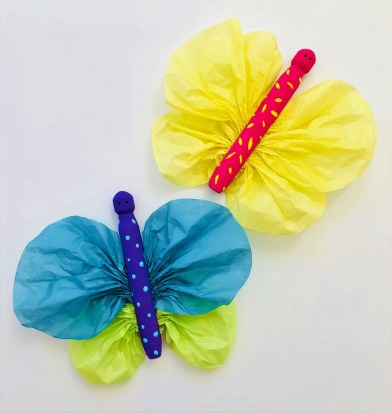
Colorful Clothespin Butterfly Craft


Butterflies are a lot like chances. They don’t start right off fully formed, but go through different stages, waiting times, and some amazing changes on their metamorphosis from caterpillar to butterfly. Chances also take time, practice, and spreading your wings to be fulfilled.

With this easy Colorful Clothespin Butterfly Craft, you can make your own butterfly that will always remind you to take a chance when it flies your way.

Supplies

  • Wooden pin clothespin
  • Tissue paper in a choice of colors
  • Craft paint in a choice of colors
  • Black craft paint
  • Paintbrush
  • Toothpick
  • Scissors
  • Fishing line, thread, or string for hanging (optional)
  • Adhesive magnet for hanging (optional)

Directions

To Make the Body

  1. Paint the clothespin, let dry
  2. When dry add accent dots or lines and eyes. I used a toothpick with the point cut off to make the dots on the purple butterfly. I used the pointy end of a toothpick to make the eyes and the lines on the pink butterfly.

To Make the Wings

  1. For the top wings, cut a 6 ½ -inch circle from tissue paper
  2. For the bottom wings, cut a 5 ¼ – inch circle from tissue paper
  3. With the head of the clothespin facing down, insert the larger circle into the split in the clothespin so that half of the circle shows on either side.
  4. Gently pull the circle down tightly into the split, pulling it as far in as possible—about half way
  5. Next insert the smaller circle into the split and repeat the above step.
  6. Gently fan out the wings if necessary

If hanging the butterfly, attach fishing line, threat, or string

If making a magnet, attach the adhesive magnet to the back of the butterfly.

Picture Book Review
March 9 – It’s National Reading Month

celebrate-picture-books-picture-book-review-somewhere-else-cover

About the Holiday

Hosting Read across America Day, March is the perfect month to celebrate reading! Reading is one of life’s great joys! Reading with children every day is one of the best ways to develop language and literacy skills that promote future success in school and beyond. Even if your child isn’t talking yet, they’re listening and learning about their language as you read to them. You can get kids enthusiastic about reading by setting up a bookcase specially for them and letting them choose the books they want to read. To celebrate this month, why not go on a book hunt and bring home some new books to enjoy together?

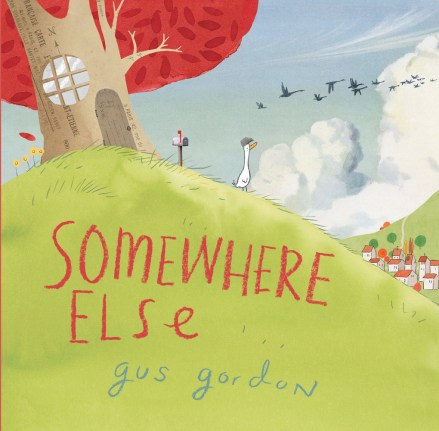
Somewhere Else

By Gus Gordon


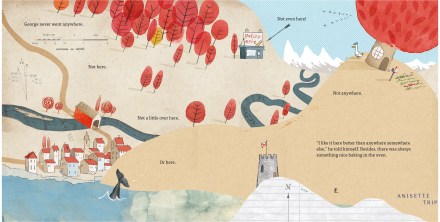
There are birds that fly north and those that fly south. There are birds that take the bus and those that don’t care how they travel just so long as they go somewhere. And then there’s George Laurent. “George never went anywhere.” He told himself that he liked his home and his garden and, especially, the pastries he baked in his oven better than anything or anywhere else.

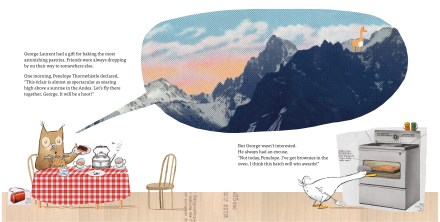
It wasn’t like he never saw anyone. His “friends were always dropping by on their way to somewhere else” to enjoy his delicious treats. And they often invited George to fly away with them. When Penelope Thornwhistle was reminded of the Andes while eating one of his éclairs, she asked George to go with there with her. But George had potentially award-winning brownies in the oven. When Walter Greenburg tasted George’s apple strudel and thought about Paris, he was ready to take George to see the city of lights, but George had ironing to do. And a trip to the Alaskan tundra with a flock of other ducks had to be postponed because of yoga class.

celebrate-picture-books-picture-book-review-somewhere-else-map

Copyright Gus Gordon, 2017, courtesy of us.macmillan.com.

As time went on, everyone stopped asking George to share their adventures. They knew he was too busy anyway. When winter came, “George found himself alone.” At least until Pascal Lombard, came knocking, looking for a place to spend the snowy months. When the bear wondered why George wasn’t sunning himself on some Caribbean beach, George said he was learning Flamenco songs on his guitar, catching up on the TV series Lost in Space, and typing out his memoirs.

But Pascal reminded George that he didn’t have a guitar or a television and that he hadn’t yet done anything worthy of a memoir. It was then that George made his confession: he didn’t know how to fly. When all the other ducks had learned to fly, he said, he had been too busy with something else. “He had been making excuses not to fly, ever since.”

celebrate-picture-books-picture-book-review-somewhere-else-andes

Copyright Gus Gordon, 2017, courtesy of us.macmillan.com.

Well, Pascal was ready to remedy the situation. Fortunately, he had an “uncanny knack for solving tricky problems.” They tried reading books, taking wing on a kite, and using a crane. But nothing worked. “It turned out Pascal Lombard didn’t have much of a knack for solving tricky problems after all.” Both George and Pascal felt disappointed as they read by the fire, until George happened to peek at Pascal’s newspaper and see an announcement for a hot air balloon ride in Paris.

celebrate-picture-books-picture-book-review-somewhere-else-making-balloon

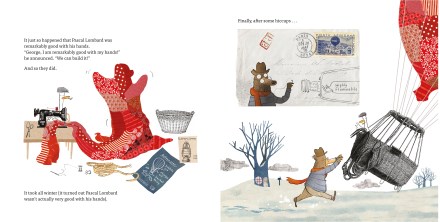
Copyright Gus Gordon, 2017, courtesy of us.macmillan.com.

George was intrigued. And Pascal said, “‘I am remarkably good with my hands! We can build it!’” So they set to work, but it was harder than they thought, and “it took all winter (it turned out Pascal Lombard wasn’t actually very good with his hands).” Finally, though, they were flying! They flew their red patchwork balloon for months, seeing the Eiffel Tower, floating over the Arctic Circle, soaring through Madagascar, and experiencing places that were “more exciting than they had ever imagined.” But still, they missed George’s homemade pie. So they flew home, enjoyed tea and pie, and planned next year’s “anywhere somewhere else” adventure.

celebrate-picture-books-picture-book-review-somewhere-else-flying-in-balloon

Copyright Gus Gordon, 2017, courtesy of us.macmillan.com.

Gus Gordon’s tenderhearted and funny story about missed opportunities that can lead to more missed opportunities, excuses, and sometimes isolation tackles a common predicament not often seen in children’s books. George’s amusing tales of loads of laundry, Flamenco lessons, and yoga classes as well as his real talent for baking will endear George to readers, making his admission a moment for true empathy and encouragement. More silliness ensues as Pascal tries to help out, and kids will cheer when the two finally get off the ground.

Gordon’s reassurance that there’s no shame in making mistakes or not knowing something is also found in Pascal’s bravado and subsequent asides to the contrary. As George and Pascal work together to teach George to fly, kids see that help can be as close as a good friend—and as fun. A welcome undertone to the story is the idea that it’s also okay to be yourself: the first page abounds with very unique birds flying here and there; for Penelope an éclair reminds her of the Andes and for Walter, strudel reminds him of Paris—and who’s to say they’re wrong?; and when George and Pascal miss home and homemade goodies, they return to their favorite place.

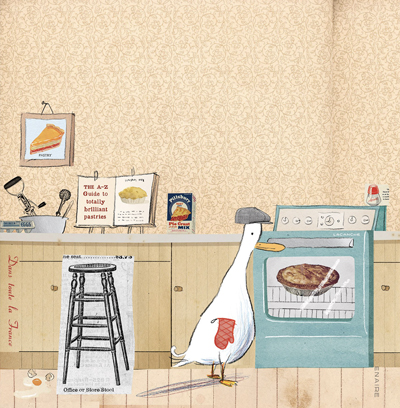
celebrate-picture-books-picture-book-review-somewhere-else-george-in-kitchen

Copyright Gus Gordon, 2017, courtesy of us.macmillan.com.

Gordon’s illustrations are a treat too. Full of visual humor and word play, the mixed-media, collage-style images bring together snippets of old advertising, photography, and traditional mediums and invite readers to linger to catch all the humor included. The page on which George finally makes his confession is worthy of special note. Here, in contrast to the other pages, the background is white, a saddened George is simply sketched with a blue outline, and the stack of firewood he was carrying lies haphazardly at his feet. The image gives children and adults an opportunity to talk about feelings of embarrassment, doubt, or uncertainty.

Somewhere Else is an original story with heart, humor, and an uplifting lesson that would make a sweet and meaningful addition to classroom and home libraries.

Age 4 – 8

Roaring Brook Press, 2017 | ISBN 978-1626723498

Discover more about Gus Gordon and his books on his website.

National Reading Month Activity

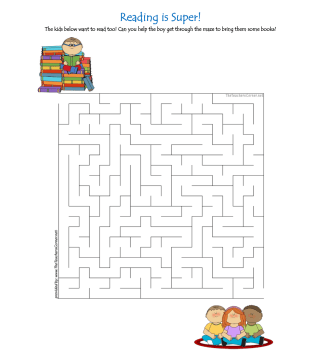
celebrate-picture-books-picture-book-review-reading-is-super-maze

Reading is Super! Maze


A boy wants to bring books to his friends so they can all read together. Can you help him get through this printable Reading is Super Maze to reach his friends?

Picture Book Review
 

February 7 – Girls and Women in Sports Day

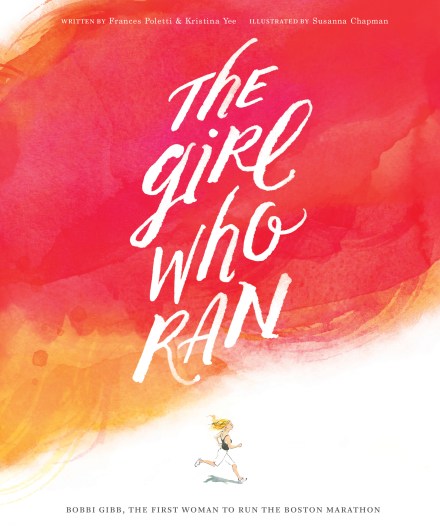
celebrate-picture-books-picture-book-review-the-girl-who-ran-cover

About the Holiday

Celebrating its 32nd anniversary, National Girls and Women in Sports Day honors all of the girls and women involved in sports at all levels and highlights their extraordinary achievements. It also raises awareness of the positive influence sports can have on those who participate. This year’s theme is “Play Fair, Play IX,” providing a reminder of Title IX, which “ensures that all students receive educational opportunities free from discrimination based on sex.” While programs have expanded for female athletes since the inception of Title IX, many schools still do not provide equal opportunities for girls to participate in the sport of their choice. To learn more about National Girls and Women in Sports Day, find resources, and perhaps get involved yourself, visit ngwsd.org.

The Girl Who Ran: Bobbi Gibb, the First Woman to Run the Boston Marathon

Written by Frances Poletti and Kristina Yee | Illustrated by Susanna Chapman


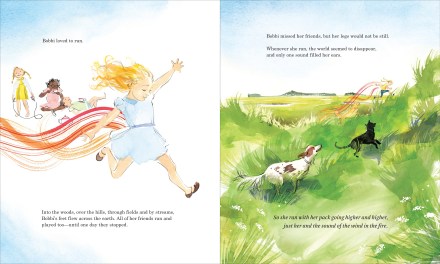
“Bobbi loved to run. Into the woods, over the hills, through fields and by streams, Bobbi’s feet flew across the earth.” When Bobbi was little, she and her friends ran and played together. But as they grew older, her friends found other pursuits while Bobbi still loved to run. She took to the fields with her dogs, “going higher and higher, / just her and the sound of the wind in the fire.”

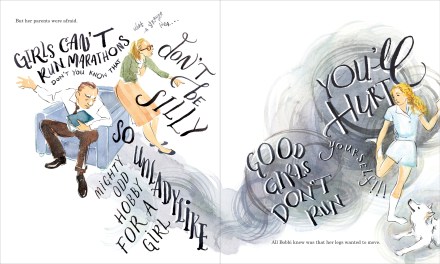
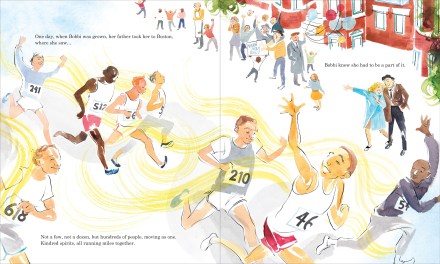
When Bobbi was grown, her father took her to watch the Boston Marathon. She loved the camaraderie of “hundreds of people moving as one. Kindred spirits, all running miles together.” Immediately, she wanted to participate too. When Bobbi told her parents that she wanted to run in the marathon, however, they thought her idea was strange. They told her she would hurt herself and that it was unladylike.

celebrate-picture-books-picture-book-review-the-girl-who-ran-young-bobbi

Image copyright Susanna Chapman, 2017, text copyright, Frances Poletti and Kristina Yee, 2017. Courtesy of Compendium.

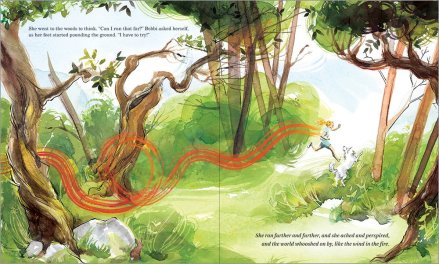
But Bobbie wanted to run. She didn’t know if she could run that far but was determined to try. She trained in the woods, running “further and further, and she ached and perspired, / and the world whooshed on by, like the wind in the fire.” Because she knew her parents disapproved, Bobbi set out on her own across country to train. Every day she ran in a new place—“lush forests in Ohio and Indiana, vast plains in Nebraska and Kansas, majestic mountains in Wyoming and Montana.” She even ran with wild horses out west and up steep Rocky Mountain trails. At night she camped, “tired and happy.”

All of her training seemed for nothing, however, when Bobbi received a letter rejecting her application for the Boston Marathon. The letter said that women were incapable of running marathons, that it was against the rules for a woman to run, and that the rules had been written to protect women from injury. Bobbi was not deterred, however. She went back home and told her parents what she wanted to do. Her father thought she was crazy to attempt it.

celebrate-picture-books-picture-book-review-the-girl-who-ran-woods

Image copyright Susanna Chapman, 2017, text copyright, Frances Poletti and Kristina Yee, 2017. Courtesy of Compendium.

Bobbi knew that the only way she could run would be “to blend in with the men.” Dressed in men’s shorts and a baggy hooded sweatshirt to hide her hair and wearing men’s running shoes (running shoes were not made for women), Bobbi was ready to go. Her father refused to drive her to the race, though. He stormed out of the house, and drove away. Bobbi thought her dream was dashed until her mom came to her room, car keys in hand, and said, “‘Let’s go.”

Hiding in the bushes at the starting line, she sprang out and joined the pack of runners with the bang of the starting pistol. “So she ran with the pack, going higher and higher, / the world whooshing by, like the wind in the fire.” As she ran, she realized that the men around her had seen through her disguise. Bobbi was worried, but the men were supportive. “‘Hey! Are you running the whole way?’ one asked.” She told him she hoped to, but in that sweatshirt, she was getting hotter and hotter. She was afraid that if she took it off, she’d be thrown out of the race.

celebrate-picture-books-picture-book-review-the-girl-who-ran-parents-afraid

Image copyright Susanna Chapman, 2017, text copyright, Frances Poletti and Kristina Yee, 2017. Courtesy of Compendium.

The men around her said they wouldn’t let that happen, so Bobbi took off the sweatshirt. “Word spread quickly throughout the course. A girl was running! They couldn’t believe it!” All along the route, the crowd cheered and encouraged her. Hearing the roar motivated Bobbi to ignore the hard ground and her stiff shoes and face the last steep hill. “Closing her eyes, she imagined she was back in Montana running up the mountains, the soft earth under her feet.”

Her feet were blistered and she was parched with thirst, but she crossed the finish line—ahead of nearly half of the men. Photographers, reporters, and radio presenters swarmed around her to hear her history-making story. From that day on “hearts and minds were forever changed.”

celebrate-picture-books-picture-book-review-the-girl-who-ran-young-Boston-marathon-all-men

Image copyright Susanna Chapman, 2017, text copyright, Frances Poletti and Kristina Yee, 2017. Courtesy of Compendium.

The story of Bobbi Gibbs is one that every girl and boy should know, and Frances Poletti and Kristina Yee’s excellent biography will have readers awe-struck by how she changed the way the world viewed women and their capabilities. A pioneer for women’s rights in every way—from her traveling the country alone to rejecting the prevailing ideas to competing on her own terms—Bobbi Gibbs is an inspiration for achievers everywhere. Poletti and Yee’s conversational storytelling is both lyrical and honest, not stinting on the obstacles Bobbi had to overcome, including race officials, her own parents, and even the fact that running shoes weren’t made for women.

As the marathon approaches, readers will be enthralled by the building suspense. They’ll feel Bobbi’s determination, her disappointment, and her fear that she will be discovered and thrown out of the race, and will cheer along with the crowd at her victory.

celebrate-picture-books-picture-book-review-the-girl-who-ran-crowds

Image copyright Susanna Chapman, 2017, text copyright, Frances Poletti and Kristina Yee, 2017. Courtesy of Compendium.

Susanna Chapman’s gorgeous illustrations are infused with Bobbi’s boundless energy and spirit as she soars over grassy dunes with her dogs at her heels, zips through shady woods, and runs alongside wild horses in the shadow of the Rockies all the while trailing a red swish, representative of the fire within her. The turmoil surrounding Bobbi’s desire to run the Boston Marathon is depicted in words of rebuke, recrimination, and rejection printed in large, emphatic typefaces that swirl around her like a tornado.

The inclusion of the image of Bobbi’s mother with the car keys in hand on the morning of the race is a welcome reminder of the many unknown women of earlier generations who  contributed to the fight for women’s equality. A beautiful double gate-fold illustration of Bobbi crossing the finish line to cheering crowds and the waiting media puts the focus fully on Bobbi and the fire that spurred her on.

An Afterword tells more about Bobbi Gibb, and a timeline of seminal events in the Boston Marathon from 1896 to today, is a fascinating must-read.

The Girl Who Ran is an inspirational biography and revealing history from the not-so-distant past that offers encouragement and triumph. It would be a wonderful addition to home, school, and public libraries.

I received a copy of The Girl Who Ran from Compendium to check out. All opinions are my own.

Ages 8 – 12

Compendium, 2017 | ISBN 978-1943200474

Discover more about Kristina Yee, her books, and her films on her website

Learn more about Susanna Chapman, her books, and her art on her website

Girls and Women in Sports Day Activity

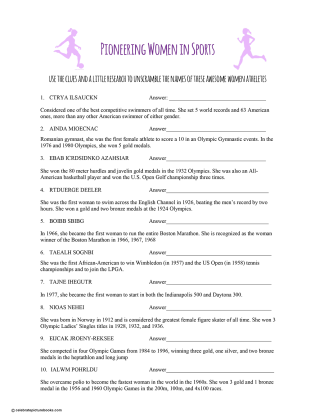
celebrate-picture-books-picture-book-review-pioneering-women-in-sports-puzzle

Pioneering Women in Sports Word Scramble Puzzle


In every sport there have been women who have overcome barriers, incredible odds, set records, and inspired others. Using the clues and a little research, can you unscramble the names of these twelve awesome athletes?

Pioneering Women in Sports Word ScramblePioneering Women in Sports Word Scramble Solution

Picture Book Review
November 27 – Pins and Needles Day

celebrate-picture-books-picture-book-review-jabari-jumps-cover

About the Holiday

Originally established to celebrate the pro-labor Broadway play Pins and Needles that opened in 1937 on this date, today’s holiday has come to commemorate that pins-and-needles nervous or excited feeling that certain events cause. That electric anticipation is especially experienced at this time of year and is often the lead-in to momentous achievements—as today’s book shows!

Jabari Jumps

By Gaia Cornwall


Today was the day! Jabari was going to jump off the diving board at the local swimming pool. Sure, the board “was high and maybe a little scary,” but Jabari had taken swimming lessons and passed his test, and he was ready. “‘I’m a great jumper,’ said Jabari, ‘so I’m not scared at all.’” As he and his dad approached the pool, Jabari watched other kids springing into the air from the diving board and plunging into the water below.

celebrate-picture-books-picture-book-review-jabari-jumps-at-the-pool

Copyright Gaia Cornwall, 2017, courtesy of Candlewick Press.

“‘Looks easy,’ Jabari said. But when his dad squeezed his hand, Jabari squeezed back.” Jabari stopped at the base of the ladder and looked up, up, up. He let the other kids in line go ahead of him while he thought about “what kind of special jump” he was going to do. Pretty soon he was the only one left at the ladder.

Jabari climbed up rung after rung. Part way up, he realized just how tall the ladder really was. When his dad asked him if he was all right, Jabari told him he was a little tired. His dad suggested “a tiny rest.” Jabari backed down, and when he got to the ground, he decided he needed to stretch. After loosening up, he and his dad looked at the diving board again. “‘I think tomorrow might be a better day for jumping,’ Jabari said.”

celebrate-picture-books-picture-book-review-jabari-jumps-stretching

Copyright Gaia Cornwall, 2017, courtesy of Candlewick Press.

Jabari’s dad knelt down and told his son that he felt scared too sometimes. When that happened, he said, he would take a deep breath and tell himself he was ready. Sometimes he realized he actually was, and it felt “‘a little like a surprise.’” That sounded good to Jabari because he liked surprises. He breathed deeply and began his climb. At the top, he walked to the end of the diving board, grabbed the edge with his toes, and looked down. Then he looked out at the horizon. “He felt like he was ready. ‘I love surprises,’ he whispered.”

He bounced into the air and as the others below waited for him, he jumped. “Jabari hit the water with a SPLASH!” He floated down and then sprang back up. “‘You did it!’” his dad celebrated. “‘I did it!’ said Jabari. ‘I’m a great jumper!’” He ran to the ladder and climbed up for his next dive: a “surprise double backflip.”

celebrate-picture-books-picture-book-review-jabari-splash

Copyright Gaia Cornwall, 2017, courtesy of Candlewick Press.

Often in life taking big leaps can be scary—for adults as well as kids. Gaia Cornwall’s jubilant story of a little boy working up the courage to try the unknown of the diving board offers both support and comfort. Knowing that his son has it in him to accomplish his goal, Jabari’s dad provides not only the gentle nudge he needs but also the permission to decide on his own when the time is right. Cornwall’s straightforward telling sprinkled with good advice will resonate with children and is applicable for many new experiences.

Cornwall’s watercolor, pencil, and collage illustrations abound in the excitement of a day out with Dad. The loving relationship of the family is evident in their smiles, the way the father squeezes Jabari’s hand and bends down to offer encouragement, and the joyful celebration of both Dad and Jabari’s younger sister after Jabari’s jump. The diverse group of swimmers at the pool play, laugh, and talk together, giving readers much to enjoy on each detailed page. Cornwall’s beautiful palette of blues and greens accented by structures rendered from printed pages of text, highlights the buoyancy of the story.

Jabari Jumps is a wonderful story to add to any child’s or classroom bookshelf for those times when a little more encouragement is needed.

Ages 4 – 8

Candlewick Press, 2017 | ISBN 978-0763678388

Discover more about Gaia Cornwall and her work as well as activity sheets on her website

Jump into this Jabari Jumps book trailer!

Pins and Needles Day Activity

celebrate-picture-books-picture-book-review-kinetic-sand-craft

Soothing Sand


When you feel nervous or on pins and needles, this easy-to-make kinetic sand can help you relax as the sand slips through your fingers.

Supplies

  • 1 cup of play sand
  • ½ tablespoon cornstarch
  • 1 teaspoon dish soap
  • About ¾ cup of Water or as needed
  • Bin or larger bowl
  • Small bowl

Directions

  1. The amount of water you use will depend on the consistency of the sand
  2. In a bin or bowl, combine the sand and cornstarch and mix well
  3. In the small bowl combine the dish soap and water and stir until the water is bubbly
  4. Slowly pour some of the water/dish soap mixture into the sand/cornstarch mixture and mix well.
  5. Continue mixing, adding a little water at a time until the desired consistency is reached

celebrate-picture-books-picture-book-review-jabari-jumps-cover

You can find Jabari Jumps at these booksellers

Amazon | Barnes & Noble | Books-a-Million | IndieBound

Picture Book Review