November 1 – Dia de los Muertos (Day of the Dead)

celebrate-picture-books-picture-book-review-funny-bones-posada-and-his-day-of-the-dead-calaveras-cover

About the Holiday

Originating in Mexico, but celebrated throughout Latin America, Dia de los Muertos commemorates the lives of deceased loved ones with music, food, parties, and activities the person enjoyed in life. Dia de los Muertos revolves around the belief that death is just a natural part of the life cycle, and the dead are awakened from their eternal rest to once more join their community for this special day.

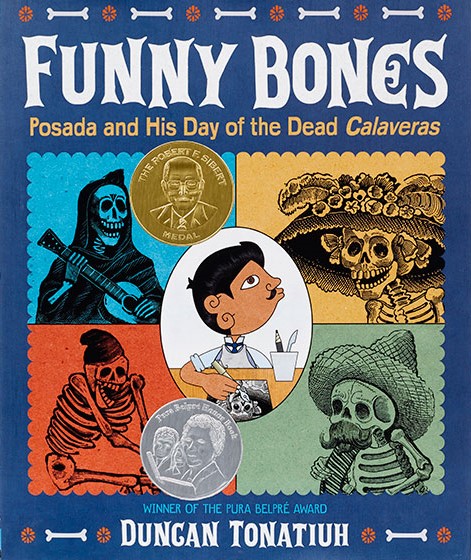
Funny Bones: Posada and His Day of the Dead Calaveras

By Duncan Tonatiuh


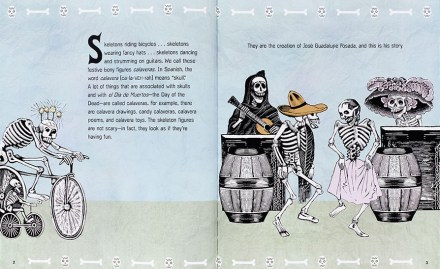
José Guadalupe Posada was born in 1852 in the Mexican city of Aguascalientes. His older brother, a teacher, taught Lupe how to read and write, and seeing how well he drew, helped him enroll in art classes. When Lupe was 18, he went to work in a print shop where he learned lithography and engraving. During working hours Lupe created labels, invitations, flyers, and other documents.
celebrate-picture-books-picture-book-review-funny-bones-posada-and-his-day-of-the-dead-calaveras-introduction

Copyright Duncan Tonatiuh, courtesy of abramsbooks.com

After work, he gathered with other artists and talked about the government. They didn’t like how their government officials ran things. Lupe’s boss, Don Trinidad Pedroza, at the print shop also published a newspaper, and he invited Lupe to create editorial drawings to be included in the paper. Lupe’s drawings were humorous, but also highlighted the officials’ bad traits. After the elections some of these politicians remained in power and were angry with Lupe and his boss. Lupe and Don Trinidad decided to move to the city of León.

In León Lupe opened his own print shop, he got married, and had a son. He became well known not only for his printing work but also for book and pamphlet illustrations. People began to call him Don Lupe as a sign of respect. “But in 1888 a terrible flood destroyed a large part of the city, including Don Lupe’s shop.” He and his family moved to Mexico City, where in time he was able to open another print shop.
celebrate-picture-books-picture-book-review-funny-bones-posada-and-his-day-of-the-dead-calaveras-calavera-love

Copyright Duncan Tonatiuh, courtesy of abramsbooks.com

He worked with Antonio Vanegas, a writer, who published his stories on large sheets of paper called ‘broadsides.’ “The tales were about a wide range of topics, including scary creatures, fires, miracles, violent crimes, heroes, bandits, cockfights, and bullfights.” Don Lupe drew illustrations for many of these stories. Even people who couldn’t read began buying the broadsides because they were fascinated by Don Lupe’s art.

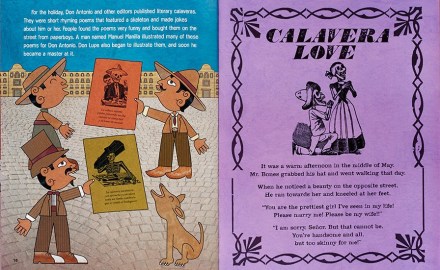
Every November first and second, during the Dia de Muertos celebrations venders sold special “pan de muerto (bread), cempasúchil (marigold flowers), alfeñiques (sugar skulls), and papel picado (paper cutouts). People bought these and other items to decorate the ofrendas (offerings) they made for their loved ones who had died.” Don Antonio and other editors published “literary Calaveras, which were “short rhyming poems that featured a skeleton and made jokes about him or her. People thought they were very funny. Soon Don Lupe began drawing illustrations for these poems.
celebrate-picture-books-picture-book-review-funny-bones-posada-and-his-day-of-the-dead-calaveras-fancy-hat

Copyright Duncan Tonatiuh, courtesy of abramsbooks.com

Over time Don Lupe began using the technique of etching, and his illustrations grew more complex. In his calaveras drawings Don Lupe interpreted and commented on what he saw not only on Dia de Muertos, but every day. For example, he watched families gather at loved ones’ graves with food, stories, and music then “drew skeletons dancing and partying. Was he saying that…El Dia de Muertos is not only a celebration of death but also a celebration of life? A day when the dead become alive?”

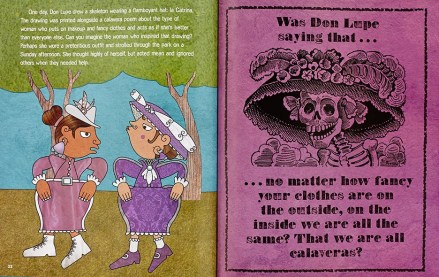
In another drawing a skeleton wears a large hat covered with lace, feathers, and flowers. This illustration accompanied a poem about a woman who wore expensive clothes and thought she was better than others and ignored them when they needed help. “Was Don Lupe saying that…no matter how fancy your clothes are on the outside, on the inside we are all the same? That we are all calaveras?

Don Lupe also commented on the ever increasing hustle and bustle of society, the Mexican Revolution of 1910, revolutionary leaders and government officials, and just common people and events. Perhaps the main idea Don Lupe was trying to communicate was that “calaveras are all around us. That we are all calaveras, whether we are rich or poor, famous or not.”

celebrate-picture-books-picture-book-review-funny-bones-posada-and-his-day-of-the-dead-calaveras-today

Copyright Duncan Tonatiuh, courtesy of abramsbooks.com

While many people loved and looked forward to Don Lupe’s artwork, they did not know the artist who drew them. It wasn’t until many years after his death in 1913 that “historians and artists such as Jean Charlot and Diego Rivera began to wonder who had drawn such wonderful images.” Today, we know Don Lupe by his last name—Posada—which is how he signed his work, and he and his work is still beloved around the world.

An extensive Author’s Note about El Dia de Muertos and Posada’s influence on other artists. A glossary, bibliography, art credits, and places where Posada’s work is displayed follow the text.

celebrate-picture-books-picture-book-review-funny-bones-posada-and-his-day-of-the-dead-calaveras-etching

Copyright Duncan Tonatiuh, courtesy of abramsbooks.com

In Funny Bones Posada and His Day of the Dead Calaveras, Duncan Tonatiuh accomplishes many things. First, his book is a fascinating look at the life of the man who entertained and enlightened the world with his distinctive talent and ideas. Tonatiuh’s straightforward storytelling reveals the personal and historical events that influenced Posada from childhood through adulthood, clearly explaining and highlighting each concept for his young audience. Second, Tonatiuh provides readers with brief primers on the printing processes of lithography, engraving, and etching with step-by-step descriptions of these interesting art forms.

Third, his own vibrant and expressive stylized illustrations both contrast with and complement the depictions of Posada’s life and his calaveras drawings. On nearly every two-page spread readers experience this biography through Tonatiuh’s portrayals of Don Lupe, the townspeople, and others as well as through Posada’s actual broadsides and editorial drawings. The juxtapositions allow children to fully appreciate the meaning and humor behind these famous drawings that are still so popular and resonant today.

Ages 6 – 10

Harry N. Abrams, 2015 | ISBN 978-1419716478

View a gallery of Duncan Tonatiuh‘s artwork for children and adults on his website!

Dia de los Muertas (Day of the Dead) Activity
celebrate-picture-books-picture-book-review-day-of-dead-coloring-page

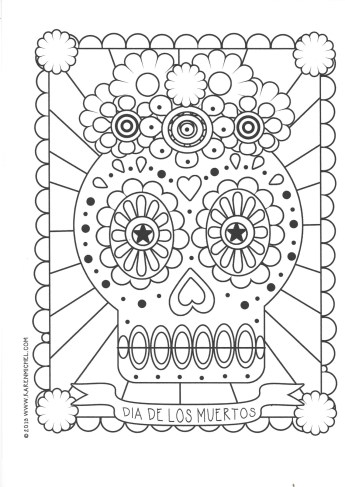
Calaveras Coloring Page


With their intricate designs and vibrant hues, calaveras are a joy to color. Grab your entire set of markers, pencils, or crayons and design a masterpiece with this printable Calaveras Coloring Page.

Picture Book Review

July 23 – National Day of the Cowboy

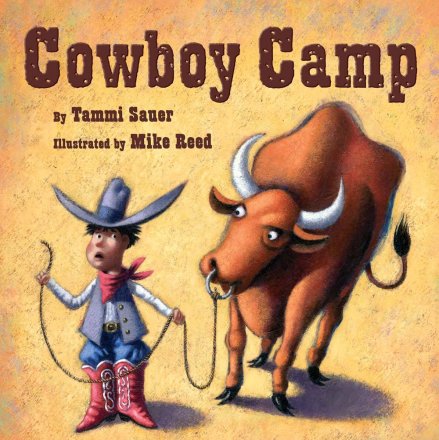
celebrate-picture-books-picture-book-review-cowboy-camp-cover

About the Holiday

Observed annually on the third Saturday of July, the day commemorates the “contributions of the Cowboy and Cowgirl to America’s culture and heritage. The heyday of the cowboy and cowgirl came after the Civil War when Texas experienced a booming wild cattle population. As the United States grew and people moved West, the demand for beef in the Northern states grew. Cowboys and cowgirls drove nearly 5 million head of cattle north, sparking tales, legends, and a rich history of the Great Plains in their boot and hoof steps.

Cowboy Camp

Written by Tammi Sauer | Illustrated by Mike Reed


In the first moments of Cowboy Camp, Avery sizes up the other kids (both boys and girls) and decides he “was all wrong.” Not only is his belt buckle too big and his hat too small, but his name is completely UNcowboy. When the Camp leader, Cowboy Dan, introduces himself, Avery thinks he is “the realest looking cowboy” he’s ever seen. Cowboy Dan promises to turn the “little ragamuffins” into real walkin’, talkin’ cowboys. But first a chow time of grits and beans!

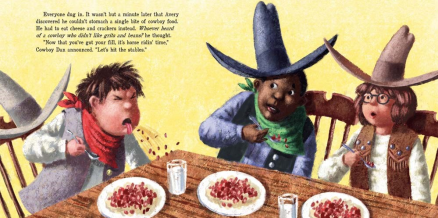
celebrate-picture-books-picture-book-review-cowboy-camp-beans

Image copyright Mike Reed, 2005, text copyright Tammi Sauer, 2005. Courtesy of Sterling Children’s Books.

All the other buckaroos dig into their plate eagerly, but Avery spits out his very first bite and is relegated to eating cheese and crackers. “Whoever heard of a cowboy who doesn’t like grits and beans?” Avery thinks. Next up, announces Dan, is horse riding. All the kids saddle up. “It wasn’t but a minute later” though that Avery starts sneezing and has to ride a cow instead.

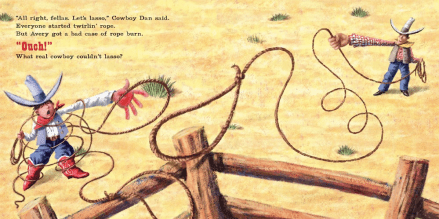
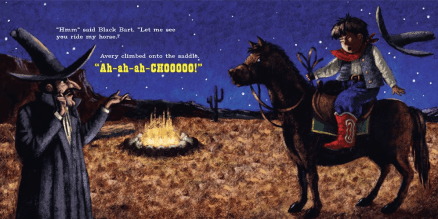
Surely, lassoing will be easier, he reasons. “It wasn’t but a minute later,” however, that his hands are red and chaffed with rope burn and he has to practice with yarn. “Whoever heard of a cowboy who got rope burn?” he thinks. A bit dejected, Avery sits in front of the campfire trying to think cowboy thoughts after all the other kids have “turned in for some shut-eye.” “It wasn’t but a minute later that Avery discovered he wasn’t alone.” Creeping out of the shadows is the meanest looking cowboy Avery has ever seen.

celebrate-picture-books-picture-book-review-cowboy-camp-lasso

Image copyright Mike Reed, 2005, text copyright Tammi Sauer, 2005. Courtesy of Sterling Children’s Books.

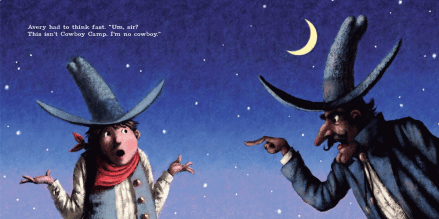
“‘I’m Black Bart,’” the mean looking cowboy says. He tells Avery that he’s there to put a stop to Cowboy Camp because “‘Cowboy Dan and his gang of good cowboys are makin’ it too hard to be a bad guy.’” Avery does some quick thinking. He doesn’t want anything to happen to Cowboy Dan or the camp. He stutters out that this isn’t Cowboy Camp, but Space Camp. Black Bart isn’t so easily fooled. Sensing disaster, Avery gives himself up as proof: “‘Sir,’” asks Avery, “‘Do I look like cowboy material?’”

To root out the truth Black Bart gives Avery three tests. First he opens a can of beans from his saddlebag. “‘All cowboys eat beans,’” Bart exclaims. Avery takes a tiny taste from the can and begins coughing and wheezing. “‘Hmm…’” says Bart. Next he sets Avery on his horse. “‘All cowboys ride horses,’” Bart exclaims, but as soon as Avery sits astride the horse, he begins sneezing. “‘Hmm…’” says Bart. He hands Avery his rope. “‘All cowboys know how to lasso,’” Bart exclaims. Avery grabs the rope and immediately begins crying in pain.

celebrate-picture-books-picture-book-review-cowboy-camp-bart

Image copyright Mike Reed, 2005, text copyright Tammi Sauer, 2005. Courtesy of Sterling Children’s Books.

Black Bart has seen enough. “‘You’re no cowboy,’” he agrees. With time a wastin’ to find and stop the real cowboys, Black Bart saddles up and turns his horse toward the rising sun. “‘It wasn’t but a minute later’” that the other campers and Cowboy Dan arrive. Dan congratulates Avery on his bravery and quick wit and proclaims that “‘No one but a real cowboy could outsmart the likes of Black Bart the way you just did.’” Avery smiles. He finally feels like a “real honest-to-goodness cowboy.”

In Avery, Tammi Sauer has created a welcome hero—a boy who uses his individual talents of intelligence and bravery to defeat the bad guy and comes to realize that he does fit into the group. Sauer’s witty plot line is a joy to read and offers real surprise when Black Bart appears on the scene. Bart’s “cowboy test” in which Avery’s supposed failings become his greatest assets is inspired. The realistic dialogue with a Western twang transports kids to the Great Plains and is fun to read, while the repeated “uh-oh” moment—“It wasn’t but a minute later that Avery discovered…”—elicits suspense and will have kids reading along.

celebrate-picture-books-picture-book-review-cowboy-camp-sneeze

Image copyright Mike Reed, 2005, text copyright Tammi Sauer, 2005. Courtesy of Sterling Children’s Books.

Mike Reed beautifully captures the allure of the Wild West in his humorous, sometimes larger-than-life illustrations. The golden plains of Cowboy Camp stretch to the red-rock plateaus in the distance while scrub grass and cacti pop up here and there. Cowboy Dan has a chin almost as long as his 20-gallon hat is tall, and Black Bart is perfectly scruffy and menacing, with a long black coat and bolo tie, as he creeps out of the midnight blue shadows to confront Avery by campfire light. Kids will both sympathize with Avery’s travails even as they giggle at his evocative expressions.

An ingenious bit of illustration occurs in Reed’s depiction of Avery. Although Avery feels as if his belt buckle is too big and his hat too small, in reality both of these are the same size as the other kids. Moreover, a side-by-side comparison with Cowboy Dan, the “realest cowboy,” shows that Avery looks almost identical to his hero with both wearing grey vests and hats. (You can even measure the hats for yourself!) In addition, the other campers are all different in some way, emphasizing the idea that everyone is unique and has their own place in any group and the world in general.

Both for the wonderful story and the burst of confidence building provided, Cowboy Camp belongs on every young reader’s bookshelf.

Ages 4 – 9

Sterling Publishing Co., 2014 | ISBN 978-1454913603 (Paperback) | ISBN 978-1454913894 (Board Book)

To view more of Tammi Sauer’s books and learn what she’s working on next, visit her website!

National Day of the Cowboy Activity

celebrate-picture-books-picture-book-review-cowgirl-coloring-page

The Best Durn Tootin’ Cowboy and Cowgirl Coloring Pages


Well, buckaroos, here’s your chance to create your own Wild West scene. Just print out these Best Durn Tootin’ Coloring Pages and have a rip roarin’ blast!

July 17 – National Tattoo Day

celebrate-picture-books-picture-book-review-tell-me-a-tattoo-story-cover

About the Holiday

As an emerging holiday, National Tattoo Day gives us an opportunity to learn about and appreciate this very personal form of art. As the Smithsonian reports, tattoos have been found on human remains dating to Ancient Egypt and is believed to have been designed for therapeutic reasons similar to acupuncture. Body art has long been associated with soldiers and sailors, seeing a surge in popularity during the American Civil War, with the establishment of modern tattoo artists, and World War II. Today people of all ages and cultures embrace body art as a way of self-expression, and as today’s book shows, each tattoo tells its own story.

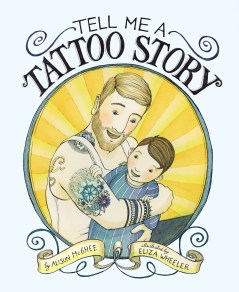
Tell Me a Tattoo Story

Written by Alison McGhee | Illustrated by Eliza Wheeler


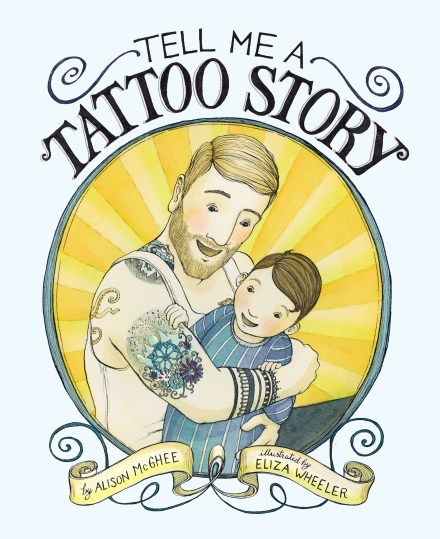
A little boy tugs on his dad’s T-shirt, wanting to see his tattoos—again. His dad sits down with his son and patiently goes through them, like the pages of a favorite book. In fact, the tattoo on his shoulder—a dragon flying above mountain peaks—is from the book his mom read to him in childhood. “Did she read it to him over and over and over? She sure did,” he says.

celebrate-picture-books-picture-book-review-tell-me-a-tattoo-story-interior-art-at-home

Image copyright Eliza Wheeler, courtesy of abramsandchronicle.co.uk

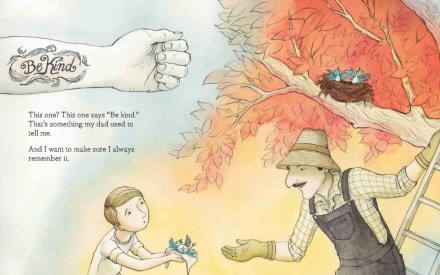
The elaborate design on the dad’s wrist reads “Be Kind,” advice his father used to give him. An intricate depiction of a carnival, complete with a Ferris wheel, fireworks, and flowers reminds him “of the day I met a pretty girl.” His son asks what made the girl so pretty, and his dad responds, “That’s a good question, little man. I’d have to say it was her smile.” In answer to his son’s wondering if he has ever met this girl, Dad looks at his wife and says, “You sure have.”

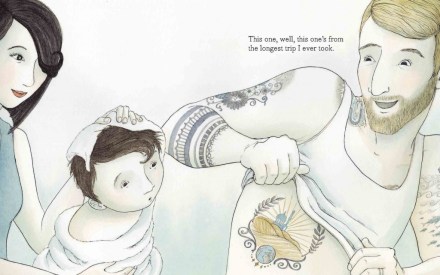
The tattoo picturing a globe and monument that covers the dad’s right side is from “the longest trip I ever took.” He reminisce—Did I miss home while I was there?”—and confesses, “I sure did.”  The last tattoo the little boy asks about is a small heart festooned with a banner that reads “7● 22 Two Thousand Twelve.” Father and son engage in banter that is most likely familiar to them both, with the boy asking the questions he already knows the answers to but loves to hear again and again: “Those numbers inside it? Just somebody’s birthday, I guess. Whose birthday? / Oh some little man I know, is all. / What do you mean, this one’s your favorite? This dinky little heart?” Then leaning in to learn a secret, the boy rediscovers that that tattoo is his dad’s favorite too.

celebrate-picture-books-picture-book-review-tell-me-a-tattoo-story-interior-art-be-kind

Image copyright Eliza Wheeler, courtesy of abramsandchronicle.co.uk

Alison McGhee’s Tell Me a Tattoo Story is such a sweet, original homage to the love between father and son. The use of body art to reveal not only seminal events in the dad’s life but the trajectory of his child’s birth is inspired. The minimal text highlights the deep emotion, giving the boy in the story as well as young readers the information they are really looking for. The soft-spoken dad is such an appealing character—emotionally available, honest, and offering just the right tone of humorous repartee—for today’s family dynamic.

Beautifully rendering McGhee’s text into art, Eliza Wheeler creates a homey atmosphere that emphasizes the theme of the book while creating tattoos that are immediately accessible to children. The dragon tattoo could come from The Hobbit or Harry Potter, kids will recognize the fun and excitement represented by the Ferris wheel, and the little heart is simplicity at its finest. While the pages depicting the dad’s tattoos are minimally hued, the father’s reminiscences burst with color and details—providing an overall feeling of warmth and affection. The image of the dad in his military uniform over the hot, golden sands on “the longest trip he ever took” will bring a tear to your eye.

celebrate-picture-books-picture-book-review-tell-me-a-tattoo-story-interior-art-longest-trip

Image copyright Eliza Wheeler, courtesy of abramsandchronicle.co.uk

The originality of the story and gorgeous illustrations make Tell Me a Tattoo Story a must for children’s bookshelves and will become an often-asked-for read during quiet story times or for bedtime.

Ages Birth – 6

Chronicle Books, 2016 | ISBN 978-1452119373

To discover more books for children and adults by Alison McGhee, visit her website!

View Eliza Wheeler’s portfolio and other books on her website!

National Tattoo Day Activity

celebrate-picture-books-picture-book-review-design-your-own-tattoo-template

Design Your Own Tattoo


Tattoos can be simple or elaborate, but they are always personal. They tell a story, commemorate an event, or reveal an emotion. What would your tattoo look like? Design your own body art on this printable Design Your Own Tattoo Template!

celebrate-picture-books-picture-book-review-tell-me-a-tattoo-story-cover

You can find Tell Me a Tattoo Story at these booksellers

Amazon | Barnes & Noble | Books-a-Million | IndieBound

July 7 – Tell the Truth Day

celebrate-picture-books-picture-book-review-tell-the-truth-b.b.-wolf

About the Holiday

While the truth may sometimes seem elusive, today’s holiday provides an opportunity to clear the air and resolve any misconceptions that might be lingering. If there’s a truth—either positive or a little harder to say—consider taking a chance today. You never know—the truth doesn’t always get you into trouble and it can lead to unexpected opportunities or relationships!

Tell the Truth, B. B. Wolf

Written by Judy Sierra | Illustrated by J. Otto Seibold


The Villain Villa Senior Center is getting a makeover. The Big Bad Wolf and his equally evil friends are doing the repairs. Suddenly, the air hums with the tune “Who’s Afraid of the Big Bad Wolf.” “‘Quiet!’” the wolf shouts, “‘I have to answer my phone.’” It turns out that Miss Wonderly at the library wants B. B. to come in and tell the story of how he met the Three Little Pigs. He’s excited to take part, but one thing worries him: He wasn’t a hero in the story.

Rumpelstiltskin tells B. B. Wolf to spin the story; the crocodile advises a happy ending. B. B. Wolf changes into his best clothing and, vowing to try these suggestions, hurries over to the library. Ensconced in a cozy chair, B. B. begins with a song: “Hard luck always follows me, and Trouble is my middle name.” But this ploy doesn’t fly with one little attendee (a pig with the number 1 on his hat) who reminds B. B. that his middle name is B-A-D.

celebrate-picture-books-picture-book-review-tell-the-truth-b.b.-wolf

Image copyright Jotto Seibold, courtesy penguinrandomhouse.com

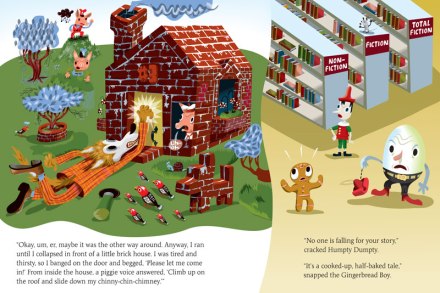
Undeterred, B. B. Wolf launches into his story after amending his song to include that he is always blamed for any crime that occurs. It seems that one day B. B. Wolf was out innocently picking dandelions. While blowing on the puff to make a wish, he inadvertently blew down the straw house of a little piggie. The poor wolf was on the run as the piggie chased him. This version of events brings an oinkburst from the back of the room: “‘Tell the truth, B. B. Wolf!’”

As he ran, B. B. Wolf continues, he suddenly smelled smoke and dashed over to help. He found a little piggie playing with matches next to a pile of sticks that were on fire! He only blew on the sticks to put out the fire. From his place on a shelf Pinocchio thinks he sees the wolf’s snout growing bigger. Charged by this second piggie, B. B. Wolf says, he kept running until he collapsed at the door of a little brick house. Tired and thirsty the wolf begged to be let in. But the mean porker merely said, “‘Climb up on the roof and slide down my chinny-chin-chimney.’”

That ridiculous fib causes an uproar in the children’s section. “‘No one is falling for your story,’ cracked Humpty Dumpty.” And the Gingerbread Boy added, “‘It’s a cooked-up, half-baked tale.’” “Tell the truth, B. B. Wolf,” orders Pig 3. Deflated, B. B. Wolf lets out “a dismal huff and a small, sad puff.” He admits that he hasn’t told the truth because the truth is so embarrassing. But “‘what’s important is that I’ve changed. Really I have,’” he says. The three pigs demand that he apologize, and B. B. stutters over the words. Try as he might, B. B. cannot say it. But he can sing it!

celebrate-picture-books-picture-book-review-tell-the-truth-b.b.-wolf

Image Jotto Seibold, courtesy of penguinrandomhouse.com

Down on his knees, he sings a heartfelt and perfectly rhyming apology. The Three Little Pigs take pity on their former enemy and give him a second chance. “‘But your middle name is still Bad,’” the third pig reminds him. Taking advantage of where he is, B. B. grabs a dictionary from the shelf and flips through the B words. He finds many to his liking, and before he leaves the library with an armful of books, he’s changed his name and even added a B! “‘From this day forward, I am the one and only Big Bodacious Benevolent Bookish Wolf,’” B. B. B. Wolf announces on his way out the door.

The wolf was even better than his word. Once home he straightaway began designing a big, beautiful house for his new friends, and when it came time to build it, all the villains helped. The Three Little Pigs were so thrilled with their “piggyback mansion” that they composed a song to thank B. B. B. Wolf: “The wolf was mean and vicious. / He thought piggies were delicious. / Then he lied and told a story / that was wrong and he was sorry. / Now he’s changed. He’s not pretending. / That’s a very happy ending!”

Judy Sierra writes a hilarious and enchanting story of personal reinvention which reveals that while people may not be able to escape their past, they can make up for it. Through fast-paced, clever dialogue and characters with a compelling stake in the action, Sierra’s howler of a story will have kids wondering what excuse the wolf will devise next. The circular plot line ties up the beginning and ending neatly and is a satisfying resolution to this favorite fairy tale in fractured form.

J. Otto Seibold has drawn the Big Bad Wolf as he has never been seen before. Sporting a kitschy plaid suit and green top hat, B. B. Wolf grows more and more disheveled as his falsehoods fall flat. The wolf’s tall tales are vividly illustrated to comic effect, bridging the wolf’s attempt to refurbish his reputation and the absurdity of his invention. Kids will love to point out the many storybook characters that populate the pages and will giggle throughout at the wolf’s misadventures.

Ages 3 – 8

Knopf Books for Young Readers, 2010 | ISBN 978-0375856204

Tell the Truth Day Activity

celebrate-picture-books-picture-book-review-pig-dot-to-dot

Dot-to-Dot Coloring Pages


After the Big Bad Wolf admitted the truth, he and the Three Little Pigs made up! Here are two printable dot-to-dot coloring pages that bring them together for fun!

Picture Book Review

June 30 – Meteor Watch Day

celebrate-picture-books-picture-book-review-oh-no-astro-cover

About the Holiday

When space debris, such as pieces of rock as small as a pebble or as large as an apple, fall through Earth’s atmosphere they glow with the heat of friction and streak through the night sky creating a beautiful spectacle. These shooting stars can occur individually or in meteor showers. The early Greeks believed that meteors were stars that escaped the heavens when the gods peeked through to see what the humans were up to. People felt that the gods may be more disposed to grant them wishes during these times, and so the tradition of wishing on a star began. According to the American Meteor Society the average hourly rates for meteors during this week should be nine meteors per hour in the mid-northern latitudes (45N) and about 12 per hour in the tropical southern locations (25S). Dark, cloudless skies are optimal for viewing. Tonight gather friends and/or family and have a stargazing party!

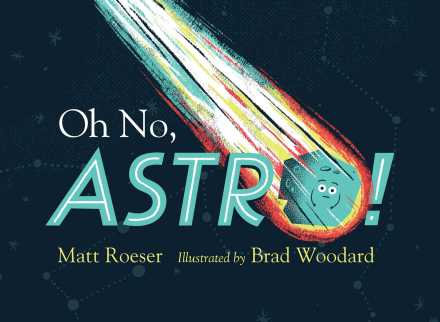
Oh No, Astro!

Written by Matt Roeser | Illustrated by Brad Woodard


Astro was not a typical asteroid. Instead of zooming around crashing into obstacles, he believed in “personal outer space” and had for millions of years. When Astro spies an approaching satellite he greets him cordially and lays down the rules: “please keep your distance” and “stay in your orbit.” But the satellite ignores him and comes closer and closer until…

celebrate-picture-books-picture-book-review-oh-no-astro-interior-art-satellite

Image copyright Brad Woodard, courtesy of Simon & Schuster


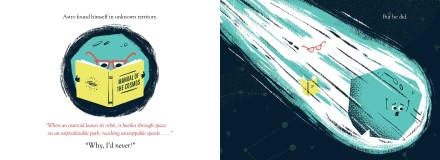
“‘Good gravity! You’ve struck me!” Astro exclaims. He’s just about to “point out to the satellite that it had done considerable damage to one of his favorite craters” when he discovers that he is spinning out of his orbit and out of control. How humiliating! The usually unflappable space rock suddenly finds himself hurtling past Mars at the same time that young astronomer, Nova, is “enjoying a quiet night of stargazing” through her telescope. She catches sight of Astro as he zips past an astronaut, rushes past the Moon, and finds himself on an inevitable crash course with Earth.

As he enters Earth’s atmosphere he begins to break apart, shedding bits of the past, as the universe watches. He lands on Earth with a SMASH! Reeling from the impact Astro slowly opens one eye and then the other; he’s smaller but in one piece. Nova is waiting to welcome him to his new home. “‘My stars,’” he mutters. “‘Dare I say that was…FUN?!’”

And as Astro gazes at the night sky from a fresh perspective with Nova by his side, he asks, “‘What on Earth shall we do next?!’”

celebrate-picture-books-picture-book-review-oh-no-astro-hurtling

Image copyright Brad Woodard, courtesy of Simon & Schuster


For anyone stuck in the rut of their own orbit, Matt Roeser’s story of the unwitting space traveler is a humorous invitation to explore the universe around them. Roeser’s language—from calling asteroids “rambunctious” and the satellite a “celestial wanderer” to exclamations of “good gravity!” and “Pluto’s revenge!”—is an inspired treat. Kids and adults will laugh at Astro’s attempts to handle his undesirable predicament with dignity. Complacent Astro with his dry-as-space-dust wit and sparkling puns makes a stellar guide on this journey to more self-discovery and life enjoyment.

In the hands of Brad Woodard deep space is a very cute and cool place! Rendered in flat tones of black, aqua, yellow, red, and white, Woodard’s illustrations give Oh No, Astro! a retro feel for a space-savvy audience. The oblivious satellite floats through Astro’s orbit with wide eyes and a sweet grin, while angular Astro with his stick arms, expressive face, and boldly displayed “No loitering” banner would be a welcome alien intruder in any back yard. And Nova in her ponytails and Saturn-patterned dress is the perfect companion to greet him! The night sky abounds with constellations, but Astro is the real star!

In the final pages, Astro leads readers in a “A Selection of Space Facts” from the  very Manual of the Cosmos, 2nd edition that he used to sort things out. A short list of suggested reading is also included.

Kids would love to find Oh No, Astro! on their bookshelf for story times of cosmic fun!

Ages 4 – 8

Simon & Schuster Books for Young Readers, 2016 | ISBN 978-1481439763

Visit Matt Roeser’s Website to discover his gallery of book jacket designs!

You can learn more about design and illustration work by Brad Woodard at Brave the Woods!

Meteor Watch Day Activity

celebrate-picture-books-picture-book-review-spaceship-coloring-page


Shooting Star and Spaceship Coloring Pages


With these coloring pages you can make a universe that’s all your own!

June 25 – National Catfish Day

celebrate-picture-books-picture-book-review-a-catfish-tale

About the Holiday

National Catfish Day dates back to 1987 when President Ronald Reagan proclaimed this holiday to promote the importance of the catfish farming industry and the nutritional benefits of catfish. This delicious fish is found mostly in Mississippi, Arkansas, Alabama, and Louisiana and is one of the most sustainable species of fish. Fried or blackened with spicy Cajun or other spices, catfish makes for a scrumptious meal! Try some today!

A Catfish Tale: A Bayou Story of the Fisherman and His Wife

Written by Whitney Stewart | Illustrated by Gerald Guerlais


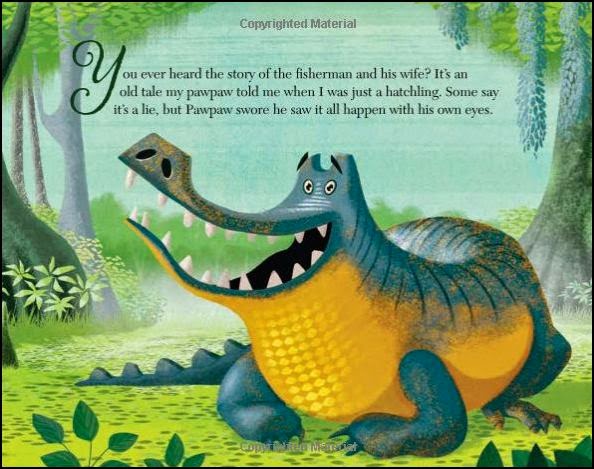
Down in the bayou, so the story goes, there lived two young sweethearts named Jacques and Jolie. Jacques liked to “pole his skiff through cypress knees to his favorite fishing hole,” and Jolie cooked up peppery hot gumbo and sang “so true even the cicadas hushed up to listen.” One day Jacques hooked a big one, and when he pulled up his line a catfish sprang from the water. But this was no ordinary catfish. The wily fellow explained that he was a magic catfish and not at all a catch for supper. Jacques was so frightened that he freed the “jabbering critter” and took off for home.

celebrate-picture-books-picture-book-review-a-catfish-tale-crocodile

Image copyright Gerald Guerlais, courtesy of Albert Whitman & Company

When Jolie learned Jacques had given up their chance for a wish that could replace their shack with “a proper house where she could sing for a crowd,” she was steamed. Jacques thought everything was all right the way things were, but he hightailed it back to the swamp and asked that catfish for a house. The catfish was obliging and with a grin said, “‘Ah, tooloulou—if that ain’t the easiest thing to do.’”

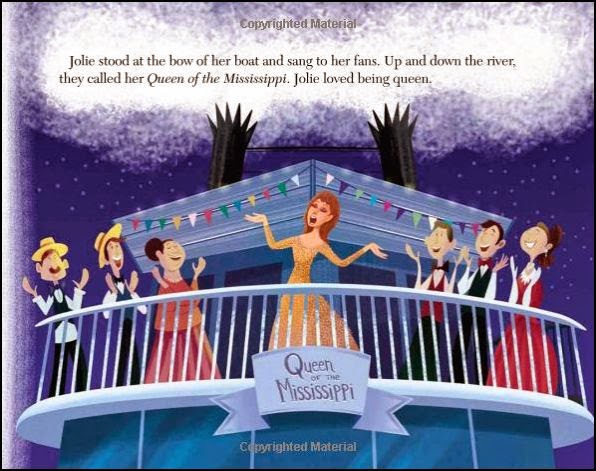
In her big, beautiful house, Jolie entertained loads of friends and decided to take her show to all the cities down the river. All she needed, she said, was a paddle wheel boat. The catfish smiled when he heard Jacques’ request and said, “‘Ah, tooloulou—if that ain’t the easiest thing to do.’” Singing from the bow of her grand paddle wheeler, Jolie’s fans called her the Queen of the Mississippi, and she ate it up.

celebrate-picture-books-picture-book-review-a-catfish-tale-catfish

Image copyright Gerald Guerlais, courtesy of Albert Whitman & Company

Jacques was miserable stuck in his stateroom with a pounding headache and no fishing pole, so he returned to the bayou to find his catfish friend. Meanwhile, Jolie took the New Orleans nightclubs by storm. With Mardi Gras approaching, Jolie had one more little favor to ask of the catfish, and with a “tooloulou” Jolie became Queen of Mardi Gras. She wore a diamond crown and a white satin gown. Even though things were a little rocky—the cheering crowds couldn’t hear her sing, and the Mardi Gras beads she tossed to her fans got tangled in her crown—she loved being queen.

Jolie wrote to Jacques and asked to become Queen of the Bayou. The catfish said his magic words and in no time Jolie was crowned Queen amid blaring musicians and applauding fans. Jolie smiled and began to sing. Suddenly, a fierce hurricane blew up, “snakes, alligators, and swamp creatures slithered up the riverbank. Ghosts, and goblins flew from the cemeteries and pirate skeletons escaped watery graves to dance in the streets.” And Jolie? She was swept up and unceremoniously dropped in a tree. From among the branches she called to a passing pelican, “‘Tell my husband to ask that catfish for one more little thing!’”

celebrate-picture-books-picture-book-review-a-catfish-tale-riverboat

Image copyright Gerald Guerlais, courtesy of Albert Whitman & Company

Jacques “paddled faster than an alligator could swish its tale” and asked that catfish for one last wish…, and what do you think he said? Well, he just slipped back beneath the water ‘cause he knew “Jolie didn’t need nothin’ more.”

A Catfish Tale includes a Bayou Glossary as well as a recipe for Seafood Gumbo by New Orleans native Hans Andersson.

Whitney Stewart’s tall tale of a magic catfish, the woman who learns enough is often enough, and the man who loves her will capture kids’ fancy. Jolie’s overreaching ambition and the catfish’s ready spell give children plenty of opportunity to join in with repeated phrases, and the well-paced suspense will keep kids engrossed in the action. The unique bayou setting and colloquial lilt sets A Catfish Tale apart as a rollicking story time romp with a bit of Cajun caution and a whole lot of magic.

Gerald Guerlais brings the mystery and flavor of the deep south to A Catfish Tale with moss greens and shadowy blues that well depict the bayou’s natural environment. Twisty Cypress trees dip their roots in still, lily pad-filled waters, shimmering lights glow in the nighttime swamp, and spooky critters teem in the stormy sky. The magic catfish wears an ever-present, easy-going grin, and a crusty, good-ol’-boy alligator spins the tall tale just the way he’s heard it. Children will love the scenes of the paddle wheeler and the festive atmosphere of Mardi Gras.

Whitney Stewart’s  A Catfish Tale, a deft retelling of  Grimm’s A Fisherman and His Wife, is a fantastic introduction to the distinctive qualities of the southern Mississippi region, one which kids may want to explore further!

Ages 4 – 8

Albert Whitman & Company, 2014 | ISBN 978-0807510988

To learn more about Whitney Stewart and her work as well as discover activities for children and teachers, visit her website!

View a gallery of illustrations by Gerald Guerlais on his website!

National Catfish Day Activity

celebrate-picture-books-picture-book-review-bayou-coloring-page

Catfish Coloring Page


The catfish is a most unusual creature! Add your own swamp or river setting to this Printable Catfish Coloring Page!

June 20 – American Eagle Day

celebrate-picture-books-picture-book-review-is-a-bald-eagle-really-bald

About the Holiday

The first American Eagle Day was proclaimed by President Bill Clinton and Tennessee Governor Don Sundquist in 1995 to commemorate and bring awareness to this most enduring American symbol. Chosen as the United States’ National Emblem by our Founding Fathers on June 20, 1782, the Bald Eagle represents the best of America: freedom, courage, strength, spirit, and excellence. Once threatened with extinction—only 400 nesting pairs existed in the early 1960s—the American Eagle has made a comeback, with 15,000 nesting pairs living in the lower 48 states. Besides celebrating what the American Eagle symbolizes, today’s holiday is used to raise awareness of conservation efforts for this most majestic bird.

Is a Bald Eagle Really Bald?

Written by Martha E. H. Rustad  | Illustrated by Holli Conger


“Our class is having a visitor today,” Ms. Patel tells her class. “Guess who it is,” she urges after giving the kids a hint that the visitor eats fish. Anabelle thinks it might be her dad, but Ms. Patel adds that the visitor has a sharp beak and feathers. Joshua guesses that it’s a duck. The kids are getting closer, and with one more hint—Ms. Patel holds up a one-dollar bill—Rose correctly shouts, “‘a bald eagle!’”

Natalie wants to know why there’s a bald eagle on the dollar, and Ms. Patel tells her that the eagle is a symbol of our country. When John asks what a symbol is, she compares the eagle to the school’s bear mascot and goes on to say that the eagle can also be found on the Great Seal. Luke is momentarily excited about the prospect of a seal also visiting the class, but Ms. Patel shows the class that the Great Seal is actually an image. This image demonstrates that something is officially American and appears on stamps, government buildings, important papers, and even the buttons on military uniforms.

The class takes a closer look at the Great Seal, with its eagle in the center. In one foot the eagle is holding a plant, says Karen. Right, Ms. Patel says. “‘It’s an olive branch. It stands for peace.’” Noah notices that in the other foot the eagle carries arrows. The arrows represent strength, Ms. Patel explains. The banner in the eagle’s beak reads E. Pluribus Unum, which is Latin for “one from many” and describes how the single country of America is made of many states. The thirteen stars above the eagle’s head reminds us of the 13 original colonies and states.

Dr. Kelly from the raptor center soon arrives with a bald eagle named Sam. Dr. Kelly puts on a protective glove and carefully takes Sam out of his carrier. Sam is huge! Kyra exclaims, and Jackson wants to know why he’s called “bald.” Dr. Kelly explains that the word bald actually comes from piebald, which means “‘having white marks.’” The class learns many facts about bald eagles, including that they have keen eyesight, can see their prey from high overhead, and can swallow a meal in mid-air.

Then the class talks about how the bald eagle became America’s mascot. Lily raises her hand and suggests it’s because eagles fly free and Americans are free. “‘Good answer,’” Ms. Patel says. She adds that bald eagles are native to North America, and shows the class a map of their summer and winter habitats.

All too soon class is over and it’s time for lunch. “Fish is on today’s menu,” Ms. Patel tells the kids, and they feel just like bald eagles. The children say “thank you” and “goodbye” to Dr. Kelly and Sam, and after lunch they draw their own mascots. You can do that too with the activity at the back of the book!

Scattered throughout the pages, sidebars expand on the facts delivered in the story. Readers learn that the Great Seal has been used since 1782, what raptors and raptor centers are, the weight and wingspan of an adult bald eagle, incredible statistics on eagle’s nests, and about conservation efforts to protect bald eagles.

A Draw-Your-Own Mascot activity follows the text along with a glossary and resources for further study, including free downloadable educational resources.

In her Our American Symbols books Martha E. H. Rustad does a wonderful job of explaining the importance of America’s emblems to children. Through classroom discussions between a teacher and her students, Is a Bald Eagle Really Bald? answers readers’ questions about how and why the bald eagle became a United States symbol. The natural give-and-take will resonated with kids, and Rustad’s clear and kid-friendly definitions of concepts will make an impact. The inclusion of a representative from a raptor center will also feel familiar to children experienced with these types of classroom visitors as well as similar field trips. Sidebars provide more scientific and historical facts.

Holli Conger’s bright, bold illustrations distinctly depict the concepts in the text through large, colorful, and easily understood images. A bulletin board holds pictures of a bald eagle and the American flag, while the teacher holds up a school mascot t-shirt to help relay the idea of a symbol; the Great Seal is shown with well-defined details as the teacher uses a pointer to indicate its various parts; and pages portraying the visit by the raptor center representative give kids a good idea of the size and grandeur of the bald eagle. The children portrayed in the classroom are enthusiastic and welcoming, and readers will feel right at home in their midst.

Ages 5 – 9

Millbrook Press, 2014 | ISBN 978-1467744669

American Eagle Day Activity

celebrate-picture-books-picture-book-review-american-eagle-coloring-page

American Eagle and Flag Coloring Page


The majestic American Bald Eagle is a perfect symbol to represent the courage, freedom, and spirit of the USA. Here’s a printable American Eagle and Flag Coloring Page for you to enjoy!