April 28 – Workers’ Memorial Day

celebrate-picture-books-picture-book-review-brave-girl

About the Holiday

Some jobs are so dangerous that workers get hurt or even die doing them. Around the world organizations have been established to help industries provide safer working environments for their employees by establishing standard rules and regulations for buildings, machinery, working hours, and more. Unions and other groups have also been founded that represent workers to ensure their rights are upheld and their needs are met. Today we honor the sacrifices of workers in dangerous professions and raise awareness for safe working conditions.

Brave Girl: Clara and the Shirtwaist Maker’s Strike of 1909

Written by Michelle Markel | Illustrated by Melissa Sweet


Among the immigrants sailing to New York, stands five-foot-tall Clara Lemlich. She may not know it now, but she’s going to change her new city. While her father can’t find work, Clara gets a job in the garment industry, which hires school-age girls to make women’s clothing. Instead of going to school, Clara spends her days hunched over her sewing machine in a dark, smelly factory with many other girls, making clothes as fast as she can.

The rules of the factory are severe. For minor mistakes workers can be fined or worse—fired, leaving their families without an income. The doors are locked so the girls can’t leave without being inspected to ensure they haven’t stolen anything. And the workers must toil long into the night. Despite it all Clara is determined to get an education even though it means walking to the library after work and missing sleep to read her lessons. 

At the factory the girls become friends and reveal stories and secrets. The working conditions make Clara angry. She hears that the men at the factory want to form a union. If all the workers team up, they can hold a strike and force the management to treat them better, the men say. But they don’t think the girls are tough enough.

Clara knows what the girls are capable of. Every day she talks to her friends and the other women, urging them to fight for their rights—and they do! But it’s not as easy as the men predicted. The bosses don’t want to give in. In fact Clara’s life is in danger! She is beaten and arrested. Despite the intimidation she continues to picket. These small strikes make little difference, however—the bosses just hire new girls and the work continues.

Clara and other union leaders think only a huge strike by all workers in every garment factory in New York will cause the bosses to listen and make changes. At a union meeting workers pack the seats to listen to leaders from across the country. Not one of them recommends such a large strike. Clara can keep silent no more. She moves to the front of the hall and calls out. People lift her to the stage. Shouting “Unity is strength” she rallies the crowd and begins the largest strike of women workers ever in United States history.

The next morning thousands of women take to the sidewalks, leaving their sewing machines empty and silent. New York is stunned! Newspapers call the strike a “revolt,” and the girls an “army.” But this is really an army of children—the girls range in age from only 12 to 25 years old. Clara knows how to lead and motivate the girls. She gives rousing pep talks, sings, and stands up to thugs sent to harass them.

All winter the girls join the men strikers. They are starving and cold and become the inspiration for newspaper articles and fundraising. Many wealthy women donate to their cause and join them on the picket lines. Finally the bosses relent. They agree to the formation of unions in their factories, raise salaries, and shorten the work week. Factory workers in Philadelphia and Chicago take heart from Clara’s work and improve conditions in their cities.

Even though Clara is young and small, she proves that anyone can right wrongs and make a difference.

The final pages include more information about the garment industry in the early 1900s as well as a bibliography.

Michelle Markel’s Brave Girl is a spirited biography of Clara Lemlich, clearly outlining the life and working conditions of immigrants in the early 1900s—especially industries’ use of children to fill low-paying, oppressive jobs. This true-life story of a girl who wouldn’t give up or give in is told with pride and balance, touching on the dangers Clara faced in a sensitive manner appropriate for children. Overall, the idea that one person can make a difference no matter how big or how old shines through, making this not only a tale of the past, but an inspiration for today’s children and the future.

Melissa Sweet cleverly combines watercolor and gouache paintings with colorful fabric, ribbon, sewing pattern paper, and ledger pages to create illustrations fitting to the story. The pictures appear sewn onto the pages with straight, zigzag, and embroidery stitches, and the vibrant colors depict the fiery nature of Clara and all the workers who strove for better lives.

Ages 4 – 9 (and up as Brave Girl makes a wonderful teaching text)

Balzar + Bray, Harper Collins, 2013 | ISBN 978-0061804427

Workers’ Memorial Day Activity
celebrate-picture-books-picture-book-review-dream-job-application

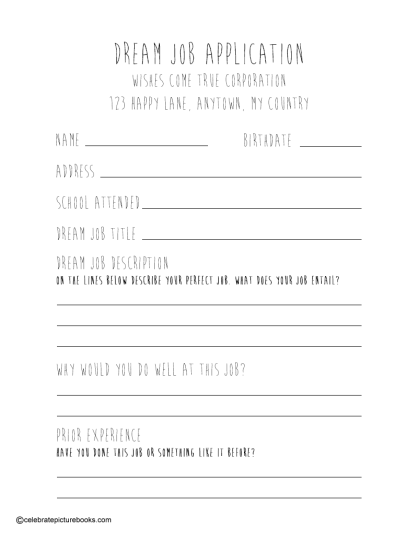
Dream Job Application


Work isn’t working when you love your job—it’s fun! What is your perfect job? Is it working with animals? Playing a sport? Being an artist, scientist, entrepreneur? Fill out this application and get started on following your dreams! Print the Dream Job Application below!

Dream Job Application 

April 23 – Talk Like Shakespeare Day

picture-book-review-will's-words

About the Holiday

To read or not to read—is that even a question?! Of course “to read!” And who produced literature containing some of the most excitement ever? William Shakespeare! Not only did Shakespeare write astounding plays and poems, he coined words and phrases that are still part of our everyday speech 400 years after his death in 1616. In recognition, the Chicago Shakespeare Theater initiated Talk Like Shakespeare Day in 2009. To honor Shakespeare’s legacy today, read or reread one of his famous plays, attend a performance, or watch a film adaptation of his work, and for goodness sake – use some of the terms he so cleverly invented.

*Italicized words were invented by William Shakespeare

Will’s Words: How William Shakespeare Changed the Way You Talk

Written by Jane Sutcliffe | Illustrated by John Shelley


“In 1606 London was a bustling, jostling, clanging, singing, stinking, head-chopping, pickpocketing wonder of a city.” With that phenomenal sentence Jane Sutcliffe begins this fascinating and ingenious look at the Globe Theatre and the experience of attending a play in William Shakespeare’s time.

In addition to all the qualities of London mentioned above, the town was also a “play-going city.” Every day of the week except Sunday, a play—or maybe even two or three—was performed, and as many as 18,000 (!) people attended plays every week! They just couldn’t get too much of a good thing!” And everyone loved the plays written by William Shakespeare!

How did a day at the theater begin? Well, at 1:00 a banner was raised from the roof of the playhouse, and men, women, and children streamed through the streets toward the Globe. It cost a penny to get in, but if you paid more you got a chair, and if you paid a little more than that you were seated in the Lord’s Rooms. The Lord’s Rooms were actually for fashionable people who wanted to be seen but didn’t really care what they were seeing.

All the actors were…well…actors. There were no actresses in those days. Men played women’s parts as well as men’s. And if you think phones and talking are problematic in today’s theaters, you would have been aghast at the audiences back then! They were not well behaved at all!

There were plays to please all tastes—comedies, tragedies, histories, and romances—all full of complicated plots and plenty of twists and turns. While the stories may have been intricate, the sets were not. But the bare-bones sets were made up for in gorgeous costumes and even some special effects accomplished with trap doors and ceiling holes. Sounds full of amazement, right? Good thing too because these plays could go on for hours, and most people stood through the whole thing, rain or shine!

William Shakespeare’s plays didn’t end when the last line was spoken. In fact theatre-goers repeated the lines they’d heard long after they left the Globe. They used Will’s words so much that his new phrases became part of the common language, and we still use them today!

Jane Sutcliffe inserts a tongue-in-cheek apology before the main text, explaining how she wanted to tell the world about the Globe Theatre in her own words, but that William Shakespeare’s words kept getting in the way. Yes, using another writer’s words is a no-no—but if they’re Shakespeare’s words? Words we use every day? Hmmm…Sutcliff’s lively history of the Globe Theatre and Old London’s theater culture is conversational, humorous, and highly informative.

The left-hand page tells the story of the Globe with phrases and words coined by William Shakespeare sprinkled throughout and set in bold type. On the right-hand page readers learn the meaning of those words and phrases (some have changed a bit since Will’s time) and which play they come from. A final note from Sutcliffe at the end of the book reveals a bit more about the playwright. A timeline of Shakespeare’s life and a bibliography are also included.

John Shelley’s incredible illustrations of London and the Globe Theatre will take your breath away. The streets teem with vendors, knights, shoppers, kids, Ladies, and Lords. If you look closely at the intricate paintings you’ll also spy the seamier side of Old London—a pickpocket, a criminal in the stocks, a tavern brawl, a cat snatching a free meal, a woman about to empty a chamber pot on her unsuspecting downstairs neighbor’s head, and…could that be a dead rat?— and that’s only on the first page!!

Subsequent pages show the waterfront with its sailing vessels, a peek into Shakespeare’s study and a look at the printing press, an aerial view of London, the Globe Theatre with its thatched awning, the actors donning wigs and costumes, and the audiences enjoying the plays and the fun of a day out. Each illustration is alive with color and movement, texture and design, expressive faces, and all the sights, sounds, and aspects of Old London. Kids will love lingering over each page picking out the funny events going on in the lanes, in the theatre seats, and on stage.

So hurry to get your own copy of Will’s Words and enjoy it to your heart’s content! You will definitely get your money’s worth!

Ages 6 – 10 and up (Anglophiles and Shakespeare lovers will enjoy this book)

Charlesbridge, 2016 | ISBN 978-1580896382

Talk Like Shakespeare Day Activity

picture-book-reviews-quill-pen-craft

Fashion a Quill Pen


William Shakespeare didn’t have a laptop to compose his great plays; he didn’t even have a desktop or a typewriter or a ballpoint pen! Shakespeare wrote all of those intrigues, characters, settings, sonnets and words with a feather!! (Plus a little ink!) Try your hand at making a quill pen—you may not be able to write with it, but it sure will look cool on your desk!

Supplies

  • Medium to large size feather with quill, available at craft stores
  • Clay, oven-bake or air-dry, in various colors if desired
  • Wire, beads, paint, and/or markers for decorating     
  • Scissors
  • Baking pan for oven-bake clay

Directions

  1. Roll clay 2 ½ inches to 4 inches long 
  2. Push the quill end of the feather into the clay
  3. Add bits of clay or roll sections of the clay between your fingers to give the clay shape
  4. To make the twisted shape pen, twist the length of clay around itself before adding the feather
  5. Shape the end or cut it with scissors to make the pointed writing nib
  6. If using air-dry clay: Add beads and/or wire and let clay dry around feather
  7. If using oven-bake clay: Add beads and other layers of clay before baking then carefully remove feather. Bake clay according to package directions
  8. Add wire and other decorations after clay has baked and cooled
  9. Reinsert feather into clay

April 20 – It’s Jazz Appreciation Month

How Jelly Roll Morton Invented Jazz by Jonah Winter and Keith Mallett picture book review

About the Holiday

Jazz Appreciation Month, nicknamed JAM, was initiated by the Smithsonian National Museum of American History in 2002 to celebrate the heritage and history of jazz and to inspire people to embrace this musical form by attending concerts, listening to recordings, reading about jazz, and playing your own jazz music. The theme for JAM 2016 is an exploration of how jazz is a form of democracy in itself. Jazz works as a method of communication, brings people together, and can be enjoyed individually or in a group. This year’s events also remember the legacy of bandleader Benny Carter.

How Jelly Roll Morton Invented Jazz

Written by Jonah Winter | Illustrated by Keith Mallett


So “here’s what could’ve happened” if you were the baby born to grow up and become one of the best, most innovative talents—maybe even the inventor—of jazz music: Living in New Orleans in the 1890s you might have been put under the spell of music by your godmother, who was a voodoo queen. This same godmother might have taken you with her to a saloon, and later that night you may have accompanied her to jail when trouble broke out at the bar. In jail you may have cried and cried until the other people in your cell “commenced to singing—‘cause music was the only thing that calmed you down.”

When you were still a little child, it might have happened that you sat down at a piano and without training “commenced to play.” With that kind of talent you might have snuck out at night to play for adults who loved to hear your music and paid you well. But one morning your great-grandmother who was raising you may have seen you sneaking back home. She’d ask where you’ve been and how you got such a fancy suit.

When you tell her, she says “she wouldn’t have no LOWLIFE MUSICIAN livin’ under her respectable roof.” But music is who you are, and so still a child, you have nowhere to live and must make your way in the world. This is how and why in 1902 “a thing called JAZZ got invented by a man named Jelly Roll Morton.” At least that’s how the story goes.

Jelly Roll Morton knew the only way to escape his life and show people who’s the best is by playing the music inside him “one piano note at a time.” He had a recipe for jazz as spicy as a pot of Creole gumbo combining the rhythms of New Orleans, the beat of Africa, a dash of Spanish melodies and a pinch of Calypso syncopation. Stir in the Blues and add a bit of “messin’ around” and the tones of laughter. Throw in a teaspoon of symphony, with its flavorful instruments, and you’ve got a ragtime band that produces “high-steppin’, low-down, horn-blowin’ spectacularamicus!”

Jelly Roll Morton took his unique style to Mobile, Alabama and Chicago, Illinois and to every place in between, showing people how music should be played. And while Jelly Roll Morton might not have invented jazz all by himself, he “sure did spread it around the towns,” waving that magic spell everywhere he went.

The final pages give more information about the life of Ferdinand Joseph La Menthe, nicknamed Jelly Roll, as well as further reading and listening resources.

Immersing yourself in Jonah Winter’s biography of Jelly Roll Morton is akin to sitting at the knee of the most captivating storyteller. With mesmerizing rhythms Winter weaves the events of Morton’s life into a tale as enthralling as jazz music itself. Passages of the text are infused with the flavor of New Orleans: “I thought I heard Mister Jelly Roll too / Sayin’ ‘I invented jazz in 1902, / It was me who invented jazz—‘cause it sure wasn’t you.’”

Complimenting Winter’s story, Mallett paints Jelly Roll Morton’s environment in dark washes of night illuminated by the glow of music. The bayou of New Orleans, the dance halls, and city streets glimmer in golden hues from lamp light, the dawning sun, and the radiance of Jelly Roll’s piano keyboard. Notes fly away from Morton’s piano, becoming birds as they soar over the wakening city, and the recipe for “Jazz Gumbo” is stunningly illustrated.

How Jelly Roll Morton Invented Jazz is a unique, fascinating true-life tale that will entice music lovers and all readers.

Ages 5 – 9

Roaring Brook Press, 2015 | ISBN 978-1596439634

Jazz Appreciation Day Activity

CPB - Trumpet maze

Blow Your Horn for Jazz Day! Maze


Jazz music is amazing in so many ways! Enjoy this riff on the usual maze and trumpet your success to your friends! Print the Blow Your Horn for Jazz Day! maze here. And here’s the Solution.

April 19 – It’s Mathematics Awareness Month

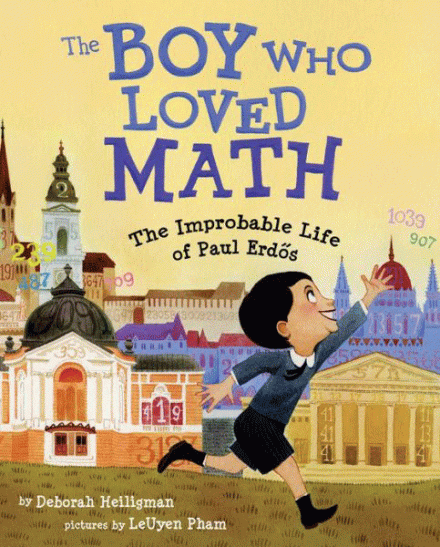
The Boy Who Loved Math: The Improbable Life of Paul Erdős by Deborah Heiligman and LeUyen Pham picture book review

About the Holiday

If you think numbers are numero uno then Math Awareness Month is for you! During April mathematicians, engineers, and all techie types are honored for their contributions to the advancements in science, medicine, computer technology, environmental concerns, and other areas. It’s also a great time to explore and experiment and discover all the benefits of being a numbers-oriented person. This year’s theme is “The Future of Prediction.” Activities will explore how math and statistics are the future of prediction, providing insight and driving innovation. 

The Boy Who Loved Math: The Improbable Life of Paul Erdős

Written by Deborah Heiligman | Illustrated by LeUyen Pham


In Budapest, Hungary a boy is born who loves math. His name is Paul Erdős and he lives with his mother, who loves him “to infinity” just as Paul loves her. When she goes back to work as a math teacher, she leaves Paul with Fräulein, his nanny. Fräulein loves rules and tries to get Paul to sit still, eat all his lunch, take a nap—to obey. But Paul hates rules.

At three years of age he teaches himself to count the days until his mother will be home with him 100 percent of the time. Knowing the number makes Paul feel better as his head is constantly full of numbers and what they can do. One day when he is four years old, he meets a woman and asks her two questions—what year she was born and at what time. When the woman tells him, it only takes him a moment to reveal how many seconds she has been alive.

He continues to play with numbers, learning more and more about the various types. He decides he will be a mathematician when he grows up. When Paul is old enough to go to school, he once again encounters rules he can’t abide. His mother decides he will be schooled at home, and even though this means more time with Fräulein, Paul considers it the better option.

There’s just one thing – while Paul thinks about numbers, Fräulein and his mother do everything for him. At meals they cut his meat and butter his bread; they dress him, and tie his shoes. When he becomes a teenager, he goes to high school and meets other kids who love math. He and his friends spend all their time doing math and by the time Paul is 20 he is famous around the world for his math equations.

There’s just one problem – even as an adult, Paul is so focused on numbers and math that he still doesn’t know how to do basic things for himself. When he is 21 he’s invited to go to England to work. At his first dinner there he stares at his bread and he stares at his meat. What is he supposed to do? With a little experimentation, he figures it out, but he also figures out that he sees the world in a different way.

He doesn’t want a normal life with a family and a house and a regular job. He designs for himself a very unusual lifestyle. Everything he owns fits into two suitcases, and with a little money in his pocket he flies from city to city to do math. He knows so many mathematicians that wherever he goes they invite Paul to stay with them. These families take care of Paul just as his mother and Fräulein had! They do his laundry, cook his meals, and pay his bills.

But even so, everyone loves “Uncle Paul!” He brings people together and shares his knowledge. His work in mathematics has given the world better computers, better search engines, and better codes for our spies to use. He was so admired that even now people represent their relationship with Paul by giving it a number – the “Erdős number.” Paul was a unique person who counted numbers and people as his best friends and experienced the world in a way that added up to a very special life.

Reading Deborah Heiligman’s The Boy Who Loved Math is a liberating experience. Her biography reveals not just what Paul Erdős did, but the quirky genius he was. It also honors all the people around the world who embraced his personality, allowing Erdős to focus on the work he was born to do. Heiligman’s engaging patter, full of interesting anecdotes, humor, and personality, is storytelling at its best and provides an absorbing look at a very unique life.

LeUyen Pham’s illustrations perfectly complement the text, exposing Erdős’s chafing under rules, his delight in math, and his development from youth to old age. Each fascinating page cleverly represents the way Erdős saw the world as numbers, equations, and geometric shapes appear on buildings, domes, and even in the very air! The text too is infused with numerals and mathematical symbols (“Paul loved Mama to ∞, too!), making this a prime book for any math lover!

Ages 5 – 9

Roaring Brook Press, 2013 | ISBN 978-1596433076

Mathematics Awareness Month Activity

CPB - Math Mystery Phrase


Totally Cool Mystery Phrase! Puzzle


What plus what equals an equation that can’t be beat? You and numbers, of course! Complete this Printable Totally Cool Mystery Phrase! puzzle to discover a coded sentence! Here’s the Solution!

April 13 – National Bookmobile Day

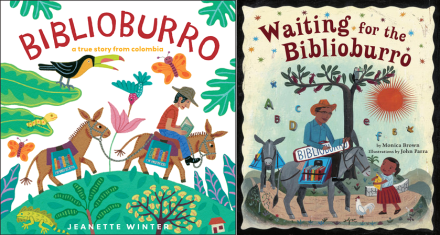
CPB - Biblioburro 3It’s not often that kids are able to read the same story from two different sides. In today’s post I review two picture books about the inspiring Luis Soriano Bohórquez. The first book is from Soriano’s viewpoint, and the second focuses on the children whose lives are changed by his courage and dedication.

About the Holiday

Today we honor the more than 930 dedicated library professionals who bring books to remote places, shut-ins, and others in the community who have no access to libraries and the services they offer. For over 100 years, bookmobiles have delivered information, technology, and resources for life-long learning to Americans of all walks of life.  To celebrate today’s holiday show your support for bookmobiles by thanking your library workers in person or by sending them a letter or email. You can also consider donating to a book drive or book fund to keep this vital service going!

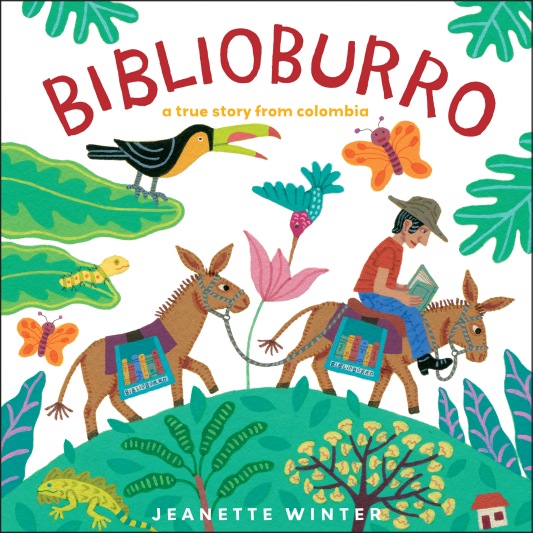
Biblioburro: a True Story from Columbia by Jeanette Winter Picture Book Review

Biblioburro: A True Story from Columbia

By Jeanette Winter


Luis lives deep in the jungles of Columbia surrounded by his beloved books. In fact, Luis loves books so much that his entire house is filled with them, floor to ceiling. “What will we do with them all?” asks his wife, Diana. Luis thinks about it and suddenly has an idea. He can share his books with people who live in the faraway hills! How will he get them there? By burro!

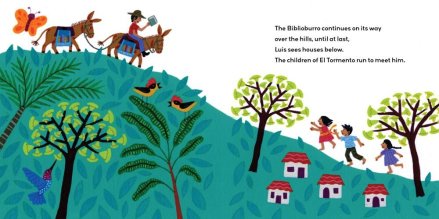
Luis buys two burros and names them Alfa and Beto. He builds special crates that will fit on their backs to carry the books. He paints a sign to carry with him: “Biblioburro”—The Burro Library—it says. Every week Luis takes the burros to far off villages, but it is not an easy trip. On his way to El Tormento, the hot sun makes the burros thirsty. When they stop at a stream to drink the water, Luis has a hard time pulling Beto away from the cool oasis.

celebrate-picture-books-picture-book-review-biblioburro-el-tormento

Copyright Jeanette Winter, 2010, courtesy of Beach Lane Books.

Among the jungle trees, bandits wait. As Luis passes through a lonely section of his path, a robber jumps out and demands silver. Luis has no money, so the bandit takes one of his precious books, demanding silver “next time.” At last Luis reaches El Tormento. The children run to greet him! Before they choose their books, however, Luis reads them a story. Today he has brought along a special treat—pig masks for everyone! As the children wear their masks, Luis reads the story of the Three Little Pigs and the Big Bad Wolf. After the story the kids choose their books and head for home.

Luis leads Alfa and Beto on the journey back as the sun sets. At home he and his burros have a well-deserved dinner. Luis is tired from his long journey, but as Diana sleeps he sits in his rocking chair reading into the deep, dark night—just the same as the children of El Tormento.

celebrate-picture-books-picture-book-review-biblioburro-Luis

Copyright Jeanette Winter, 2010, courtesy of Beach Lane Books.

The final page presents factual information about Soriano and his life. He has inspired many to donate to his cause, bringing education and literacy to hundreds of people since the year 2000. This book is also available in a Spanish language version.

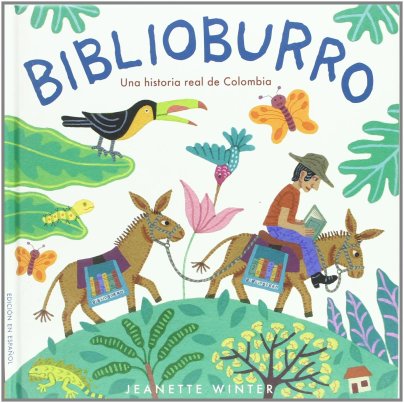
celebrate-picture-books-picture-book-review-biblioburro-spanish-edition-cover

Any book lover will be fascinated by this true story of a man dedicated to bringing books to children living in remote areas of Columbia. Jeanette Winter’s straightforward tale reveals not only the imagination and care it took to make Luis’s dream a reality, but also the perils he faces in carrying out his mission. Winter’s lyrical tone emphasizes the isolation of the far-off villages Luis visits and his solitary travels. The story is full of suspense and humor that will draw children into this unique biography of Luis Soriano Bohórquez.

Winter’s vivid illustrations bring the Columbian jungles to life—vivid green leaves and flowers are home to orange snakes, yellow caterpillars, multi-colored toucans and parrots, and other native species. Kids will wish they could reach out and pet the sweet burros that work so hard to carry the books. As nighttime falls, the hues cool to muted teals and blues—the color of dreams.

Ages 5 – 9

Beach Lane Books, Simon & Schuster, 2010 | ISBN 978-1416997788

You can find Biblioburro: A True Story from Columbia at these booksellers

Amazon| Barnes & Noble | Books-a-Million | IndieBound

Waiting for the Biblioburro by Monica Brown and John Parra picture book review

Waiting for the Biblioburro

Written by Monica Brown | Illustrated by John Parra


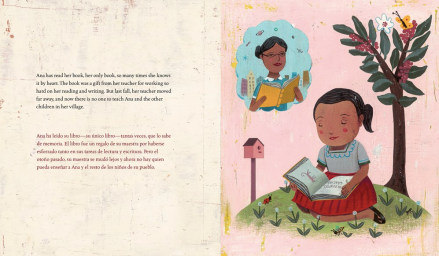
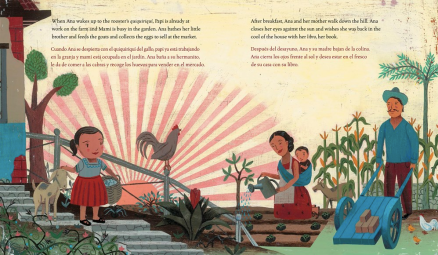
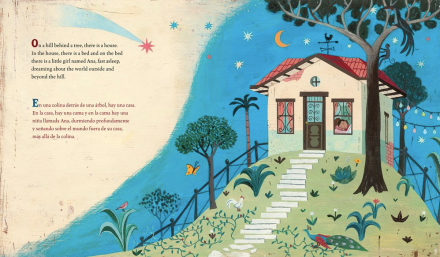
On a faraway hill in a small Columbian village, a little girl named Ana wakes to a day of feeding the farm animals, taking care of her younger brother, and collecting eggs to sell in the market. When the long, hot day is over, Ana retreats to her room to read her most precious treasure—the one book that her teacher gave her before she moved and the school closed.

celebrate-picture-books-picture-book-review-waiting-for-the-biblioburro-bilingual-edition-reading

Image copyright John Parra, 2016, text copyright Monica Brown, 2016. Courtesy of Tricycle Press.

Ana has memorized the book and wishes she had more, but there is no one to provide books or education in her tiny village. To make up for it, Ana imagines her own stories and tells them to her brother before they go to sleep. But one day everything changes. Ana hears an unfamiliar clip-clop and a loud iii-aah! Iii-aah!

Ana runs outside to see a most unusual but wonderful sight! Riding past her house is a man with two burros loaded down with books! All the children leave the fields and run to this stranger. “Who are you?” the children ask. The man says he is a librarian and a teacher. His burros are Alfa and Beto, and his name is Luis Soriano. Together they are a moving library. Luis reads to the children and teaches them the alphabet. He then tells them they can choose books from the crates strapped to the burros’ backs and keep them until he returns.

celebrate-picture-books-picture-book-review-waiting-for-the-biblioburro-bilingual-edition-sunrise

Image copyright John Parra, 2016, text copyright Monica Brown, 2016. Courtesy of Tricycle Press.

Ana gazes at the selection—there are so many cuentos, so many stories! She hugs the books she has chosen and, before Luis goes on his way, tells him someone should write a story about Alfa and Beto. Why don’t you? Luis encourages her. With a promise to return, Luis is gone. Ana shares her books with her brother, reading until she can’t keep her eyes open.

celebrate-picture-books-picture-book-review-waiting-for-the-biblioburro-bilingual-edition-nighttime

Image copyright John Parra, 2016, text copyright Monica Brown, 2016. Courtesy of Tricycle Press.

It seems like forever and no biblioburro! “When will he come back?” Ana pesters her mother. Finally, unable to wait for a new story, Ana takes the librarian’s advice and creates a book about the biblioburros. Just when Ana has almost given up hope of seeing Luis again, she hears the now familiar iii-aah! Iii-aah. She runs to show Luis her special surprise. Not only does he read her book to the other children, he carefully packs it away on the burro’s back “ready to be carried away over the hills and through the fields to another child “who is dreaming of the stories the biblioburro will bring.”

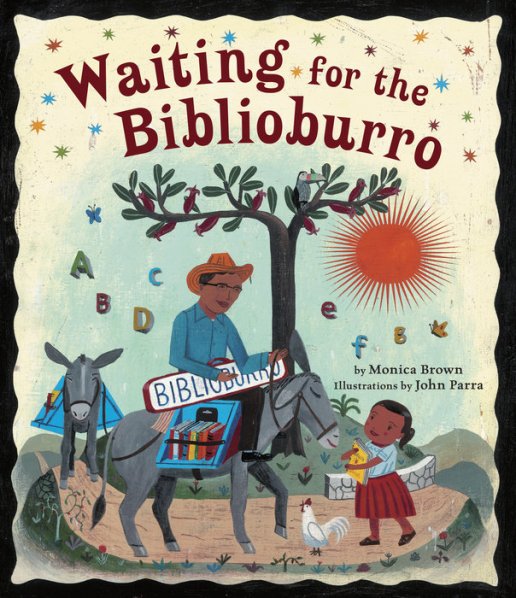
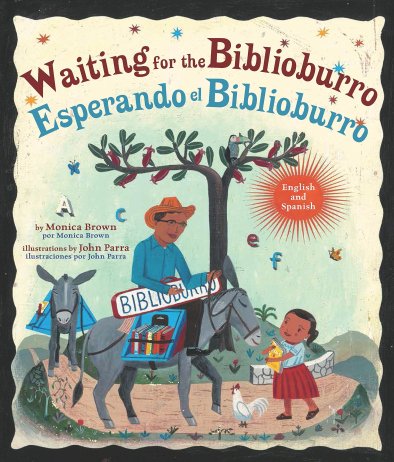
This book is also available in a bilingual edition: Waiting for the Biblioburro/Esperando el Biblioburro.

celebrate-picture-books-picture-book-review-waiting-for-the-biblioburro-bilingual-edition-cover

Monica Brown’s telling of this inspirational story reveals how much one person’s actions can touch another. Through her expressive language and rhythms, Brown effectively reveals the thoughts and feelings of a little girl thirsty for knowledge but without any means of acquiring it. The girl’s enthusiasm for books and learning is infectious and will resonate with children. Listeners will empathize with her longing and celebrate when they hear of the biblioburro’s arrival.

John Parra’s well-known paintings are a highlight of this book, filling each page with the radiant sun, colorful architecture, exotic animals, tropical vegetation, and other sights of the jungles and hills of Columbia. Ana’s hopes and dreams are also illustrated in Parra’s unique style, creating a world of imagination fitting for a budding young writer.

Ages 5 – 8

Tricycle Press, Penguin Random House, 2011 | ISBN 978-1582463537 | ISBN 978-0553538793 (Spanish–English Bilingual Edition)

Discover more about Monica Brown and her books on her website.

To learn more about John Parra, his books, and his art, visit his website.

You can find Waiting for the Biblioburro at these booksellers

Amazon | Barnes & Noble | Books-a-Million | IndieBound

National Bookmobile Day Activity

CPB - Bookmobile

Make a Box Bookmobile


Bookmobiles are love on wheels! If libraries are some of your favorite places, you’ll like making this box bookmobile! You can even use it as a desk organizer!

Supplies

  • Printable Book Shelves and Sign Template
  • Cardboard box, 16-oz pasta or other recyclable boxes work well (I used a 5” x 7 ¼ -inch pasta box)
  • Small wooden spools or bottle caps, large beads, or toy wheels
  • Paint
  • Scissors
  • X-acto knife
  • Strong glue
  • Paint brush

Directions

1.Gently pull the box apart at the seam and lie flat with the unprinted side facing up

2. To Make the Awning:

  • On one of the wide sides of the box, measure a rectangle 1 inch from the top of the box, leaving at least 1 ¼ inches at the bottom of the box and 1 ¼ inches on both sides
  • With the x-acto knife or scissors cut the sides and bottom of the rectable, leaving the top  uncut
  • Paint the top and underside of the awning (if you want to make stripes on the awning lay strips of tape side by side across the awning. Remove every other strip of tape. Paint the open stripes one color of paint. When the paint dries replace the tape over the paint and remove the tape from the unpainted stripes. Paint those stripes a different color.)

3. Paint the rest of the box on the unprinted side any way you like, let dry

4. Cut the Printable Book Shelf template to fit the size of your window opening, leaving at least a ½ inch margin all around

5. Tape the book shelf to the inside of the window

6. Reconstruct the box, making the original seam an inside flap

7. Glue the flap and sides together

8. If using small spools for wheels, paint them black. Let dry

9. Glue the wheels to the bottom of the box

10, Attach the Bookmobile sign, found on the printable template, above the awning

** To Make a Desk Organizer from the Bookmobile

  • Cut an opening in the top of the bookmobile with the x-acto knife or a scissor

March 16 – Freedom of Information Day

Gordon Parks: How the Photographer Captured Black and White America Picture Book Review

About the Holiday

Freedom of Information Day is observed today to honor James Madison, who was born March 16, 1751 in Port Conway, Virginia. Madison is widely regarded as the Father of the Constitution and was the 4th President of the United States. He was a leading proponent of openness in government. The Freedom of Information Act, which took effect on July 4 1967, was enacted to promote transparency in government, but the idea of openness and inclusion can pertain to all aspects of society and relationships.

Today we remember all those who work to provide free and honest information and portrayals of government as well as other conditions and situations around the world.

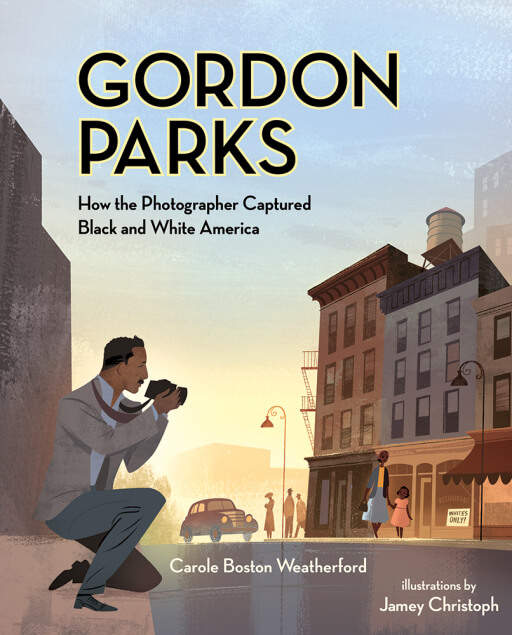
Gordon Parks: How the Photographer Captured Black and White America

Written by Carole Boston Weatherford | Illustrated by Jamey Christoph


When the 15th child of the Parks family is born, he has neither a heartbeat nor a name. But the doctor is able to revive the nearly dead infant in an ice bath, and the appreciative mother gives her child his name—Gordon. Gordon Parks’ dramatic entry into the world may have given him the unique perspective he used in becoming a renowned photographer and the first black movie director in Hollywood.

celebrate-picture-books-picture-book-review-gordon-parks-how-the-photographer-captured-black-and-white-america-gordon-works

Image copyright Jamey Christoph, 2015, text copyright Carole Boston Weatherford, 2015. Courtesy of Albert Whitman & Company.

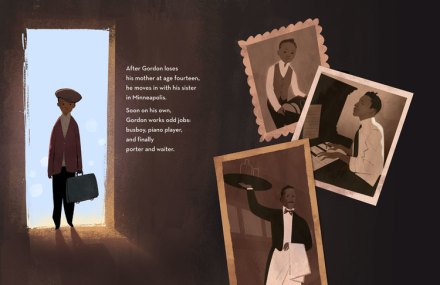
Gordon rides a horse across the wide open fields of Kansas to school, but once there his prospects narrow with a white teacher who tells her all-black class that their education will go to waste as they are destined to work as waiters and porters. When he is 14 Gordon’s mother dies, and Gordon moves to Minneapolis. He soon must make his own way, and he finds jobs as a busboy, a piano player, and the predicted waiter and porter.

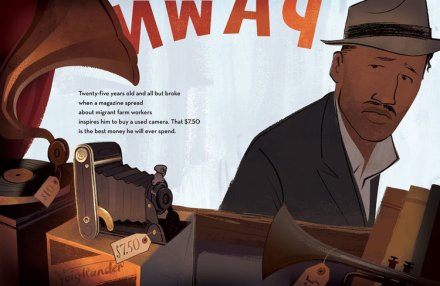
At the age of 25 Gordon reads about the plight of migrant workers and, inspired, buys a camera. Gordon has discovered his natural talent—a unique eye on the world. After only a month he exhibits his photographs in a camera store and is soon engaged in fashion and portrait photography. His work takes him to Chicago, where he documents the struggling families living on the South Side and wins a job with the government in Washington DC. Encouraged by his boss to find a subject for his work, Gordon focuses his lens on the black families living in the back alleys and in the shadows of the Capitol’s great monuments.

celebrate-picture-books-picture-book-review-gordon-parks-how-the-photographer-captured-black-and-white-america-gordon-sees-a-camera

Image copyright Jamey Christoph, 2015, text copyright Carole Boston Weatherford 2015. Courtesy of Albert Whitman & Company.

Through his photographs Gordon vows to expose the racism blacks face in housing, shops, restaurants, and other institutions. Looking for a personal subject, Gordon talks to Ella Watson, a cleaning lady in his office building. Ella supports five children on only $1,000 a year and knows hardship. Gordon accompanies her and her grandchildren, taking pictures wherever they go and of whatever they are doing. They become the inspiration for his greatest work.

Over his lifetime Gordon Parks will break barriers in the publishing and entertainment industries, becoming the first black photographer for Vogue and Life magazines and the first black director in Hollywood. He writes novels and poetry and composes music. But the work that becomes his most famous is a photograph of Ella Watson standing in front of the American flag, with her broom in hand. Called “American Gothic,” this picture fulfills Park’s determination to expose segregation and the hopes of all people struggling under its inequality.

celebrate-picture-books-picture-book-review-gordon-parks-how-the-photographer-captured-black-and-white-america-gordon-in-washington

Image copyright Jamey Christoph, 2015, text copyright Carole Boston Weatherford, 2015. Courtesy of Albert Whitman & Company.

Carole Boston Weatherford’s portrayal of Gordon Parks’ life is as starkly revealing as her subject’s photographs. With her writer’s skills, however, she deftly contrasts the facts of his life and turns his story into a universal metaphor for freedom and the struggle to attain it: “When young Gordon crosses the prairie on horseback, nothing seems beyond reach. But his white teacher tells her all-black class, you’ll all wind up porters and waiters. What did she know?” Weatherford’s pacing also adds to the story’s power. Although Parks attained wide acclaim, this biography ends with one of his earlier photographs—a picture of Ella Watson, a cleaning lady, who inspired Parks and came to symbolize the hopes of her generation and beyond. This is not only Parks’ story, but the story of millions of others.

Jamey Christoph continues and strengthens the metaphorical force of this biography in his illustrations. Readers first see Gordon Parks as a much-loved, smiling infant. He goes to school and grows up, his expression changing, slightly but importantly. He acquires his camera, and the pages are filled with drawn representations of his black-and-white photographs. Alternating dark and light pages further emphasize Parks’ world. The darkroom contrasts with Parks’ new bright office and prospects; the shadowed back alleys of Washington DC contrast with the city’s gleaming white marble monuments. Later photographs are also depicted, and “American Gothic” is represented on two pages. Christoph provides readers with much to see and ponder.

Ages 5 – 8

Albert Whitman & Company, 2015 | ISBN 978-0807530177

Ages 5 – 8

Albert Whitman & Company, 2015 | ISBN 978-0807530177

Freedom of Information Day Activity

CPB - New Professionals Picture

News Professionals Clothespin Figures

Make one of these clothespin figures that honors the men and women who work to keep the world informed.

Supplies

Directions

  1. Draw a face and hair on the clothespin
  2. Cut out the clothes you want your journalist or photographer to wear
  3. Wrap the clothes around the clothespin. The slit in the clothespin should be on the side.
  4. Tape the clothes together
  5. Cut out the camera
  6. Tape one end of a short length of thread to the right top corner of the camera and the other end of the thread to the left corner. Now you can hang the camera around the figure’s neck.

Idea for displaying the figures

  • Attach a wire or string to the wall and pin the figure to it
  • Pin it to your bulletin board or on the rim of a desk organizer


March 11 – Johnny Appleseed Day

celebrate-picture-books-picture-book-review-johnny-appleseed-cover

About the Holiday

If you love apples, apple pie, applesauce, and all things apple, you probably have John Chapman to thank. John Chapman was a remarkable man who lived his values of kindness and generosity as he journeyed across the newly opened American frontier in the early 1800s. He is most commonly known as Johnny Appleseed for the apple seeds he planted and nurseries he founded across the country. Apples were a welcome crop—easily grown and stored for consumption throughout the year. He was well loved by the people he met on his travels, respected by the Native Americans, and gentle with all animals. Today we remember his contributions to the growth of America and his inclusive beliefs.

Johnny Appleseed

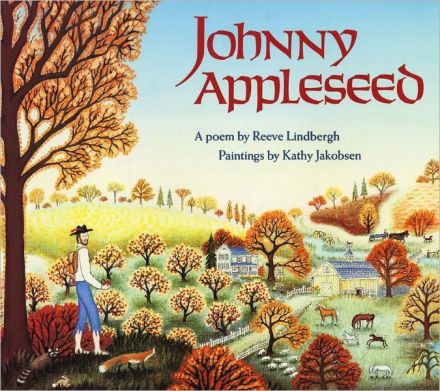
Written by Reeve Lindbergh | Illustrated by Kathy Jakobsen


As the poem opens, John Chapman approaches the simple Goodwin cabin in the woods. “Young Hannah Goodwin saw him first, / A stranger lean and lorn, / His face was thin, his feet were bare, / His clothing old and worn.”

Hannah first meets Johnny Appleseed when she is a little girl and he accepts the family’s invitation to dinner. He is an engaging source of entertainment, news, and stories about the American frontier, but he cannot stay long as he must continue his mission to plant apple trees across the country. Although John Chapman’s work takes him far away, Young Hannah heard the tales of him / All through her growing years / As he brought apples, sharp and sweet, / To other pioneers.

celebrate-picture-books-picture-book-review-johnny-appleseed-kathy-jakobsen-across-the-wild-frontier

Image copyright Kathy Jakobsen, courtesy of kathyjakobsen.com

The stories are exciting and comforting. Johnny Appleseed walks through any weather, is trusted by Native Americans, and lives peacefully with all animals, all the while scattering seeds along his path.

As an old man John Chapman returns to the Goodwin house, now nestled among a mature apple orchard. “Old Hannah Goodwin saw him last / when many years had gone. / He came in by the orchard gate / A quiet hour past dawn.”

Again, he regales Hannah with stories of his adventures and how the trees he had planted helped families thrive and make America strong. “There was spicy apple cider now / Out on the western plain. / There was applesauce in Iowa / and apple pie in Maine.

Although Hannah never sees John Chapman again, she passes down his legacy to her children, just as we still do today.

celebrate-picture-books-picture-book-review-johnny-appleseed-kathy-jakobsen-in-an-apple-orchard

Image copyright Kathy Jakobsen, courtesy of kathyjakobsen.com

The format of Reeve Lindbergh’s rhythmic and rhyming poem is a fitting tribute to the life of Johnny Appleseed. The lyrical lines flow as smoothly as the reader might imagine John Chapman tread across the Midwest plains and rugged West. With evocative language and a straightforward delivery, Lindbergh echoes the philosophy of simplicity and steadfastness that guided John Chapman’s life.

Kathy Jakobsen, one of America’s premiere folk artists, has embraced the story of Johnny Appleseed in stunning paintings of an America at her beginning. Depictions of rolling hills dotted with farms and trees, stone mills, horse-drawn carts loaded with apples, families at home and on the move in Conestoga wagons, as well as lush scenes of John Chapman interacting with nature and Native Americans portray the grandeur of America and the singularity of Johnny Appleseed. A quilt of small paneled scenes surround the text on each left-hand page, while the right page is fully dedicated to Jakobsen’s work.

Ages 5 – 8

Little Brown Books for Young Readers, 1998 | ISBN 978-0316526340

Johnny Appleseed Day Activity

CPB - Cinnamon Apples (2)

Cinnamon Apples Recipe


Cinnamon apples are a delicious side dish to any meal! This tasty recipe is fun for kids and adults to make together.

Ingredients

  • 4 cups of apples, Macintosh or Granny Smith apples are good choices
  • 2 tablespoons brown sugar
  • 1 teaspoon cinnamon
  • 1/4 teaspoon lemon juice

CPB - Cinnamon Apples ingredients (2)

Directions

  1. Mix brown sugar and cinnamon
  2. Peel and core 2 large apples
  3. Thinly slice apples
  4. Combine apples and cinnamon sugar/brown sugar mixture
  5. Stir until well combined
  6. Drizzle with lemon juice and stir again
  7. Cook apples on the stove at medium heat for 8 to 10 minutes or until desired texture